Saturn Devouring His Son
Francisco de Goya y Lucientes · c. 1820-1823 (mural); transferred to canvas from 1874, before the 1878 Paris exhibition
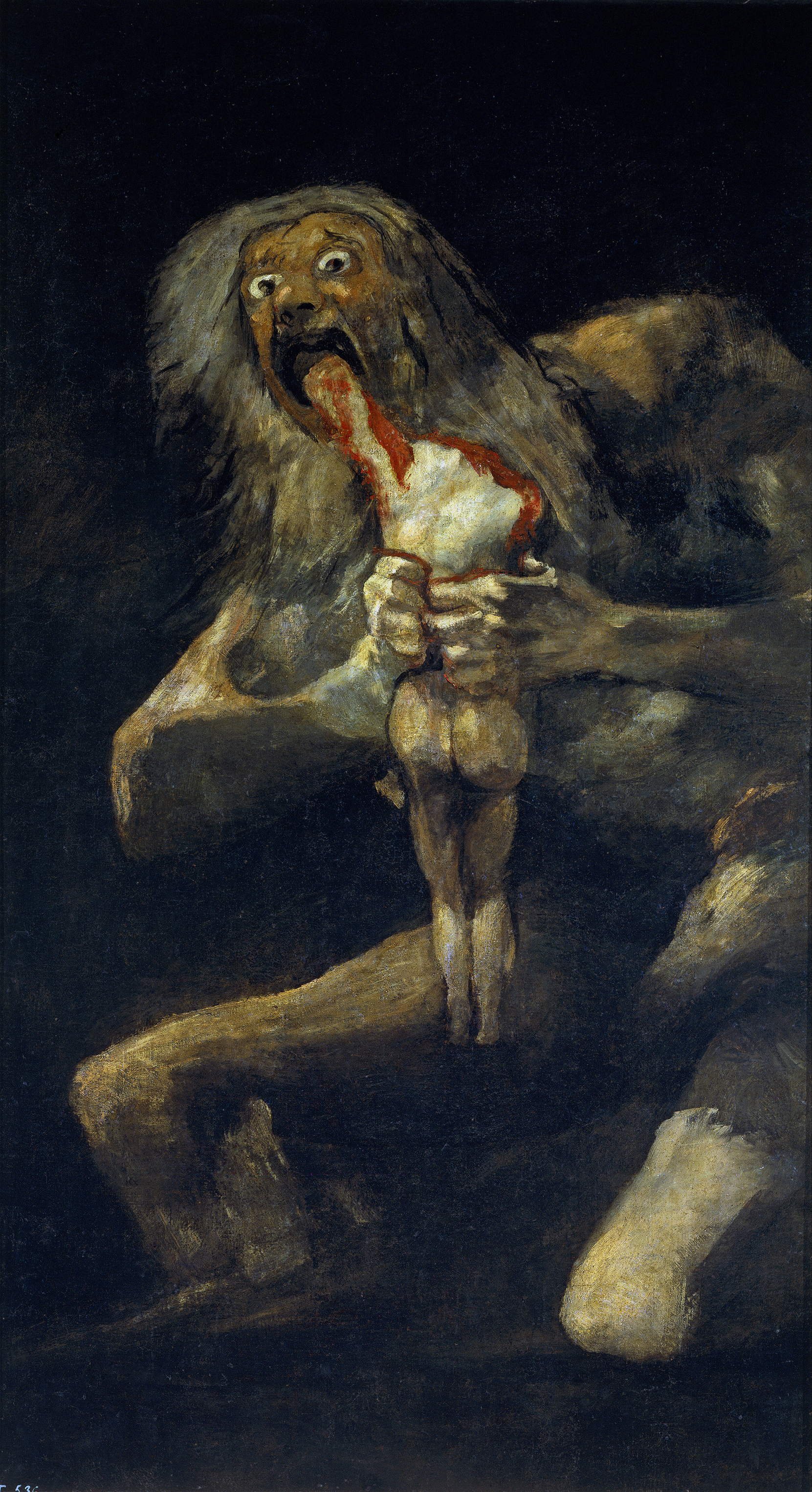
This IS the picture described in this record: the whole transferred canvas, Museo Nacional del Prado P000763, c. 1820-23, 143.5 x 81.4 cm. Colour and contrast vary between reproductions; compare the Yorck Project scan below.
| Artist | Francisco de Goya y Lucientes |
|---|---|
| Date | c. 1820-1823 (mural); transferred to canvas from 1874, before the 1878 Paris exhibition |
| Medium | Oil on plaster, transferred to canvas |
| Dimensions | 143.5 x 81.4 cm (81.5 cm in the Fundacion Goya en Aragon catalogue) |
| Where it is now | Museo Nacional del Prado, Madridlast confirmed |
| Inventory number | P000763 |
| Attribution | AcceptedAttributed to Goya by the Museo del Prado and listed as an undisputed work by the Fundacion Goya en Aragon. Full note |
| Object type | Painting |
| Period | Spanish, early nineteenth century |
| Inscriptions | None recorded in the sources opened. |
| Owners on record | 12 links9 documented, 3 disputed |
| Sources | 24 cited |
About this record Last verified · 24 sources cited · Change log
On this page 9 sections
ContentsClose
Goya painted Saturn Devouring His Son on the plaster wall of the ground-floor dining room of his country house outside Madrid, probably between 1820 and 1823, after buying the house on 27 February 1819. It is one of the best known of the fourteen Black Paintings, a headless adult body gripped and eaten by a wild-eyed old man, and the picture the Prado shows today is not that wall: it is the paint layer lifted from the plaster from 1874 and mounted on canvas, with the white ground lost and the eyes repainted.
The house passed from Goya to his grandson Mariano in 1823 and to Javier in 1830, then through several owners including Colmenares, Coumont and Saulnier to the banker Baron Frederic Emile d'Erlanger, who paid Salvador Martinez Cubells to lift the murals, showed them in Paris in 1878 and gave them to the Spanish state by a decree of 20 December 1881, asking no money. In 2003 Juan Jose Junquera argued that the Black Paintings could not be by Goya and raised the possibility that his son Javier painted them; Nigel Glendinning answered point by point in 2004 and the Prado kept the attribution to Goya.
No sale of the transferred canvas, by auction or otherwise, is recorded in the sources opened; the house with the murals still on its walls was offered at public auction in 1858-59. Its meaning is argued, not documented: Goya left no word on it, and readings by Nordstrom, Glendinning, Licht, Ciofalo and others are recorded here as theirs.
Provenance
Each link is graded. Documented: a cited source supports it. Disputed: the identification is argued but not established. Unknown: no owner for that span, and the gap is not smoothed into a narrative. The grades in the glossary.
- 27 Feb 1819 - c. 1823-24Francisco de Goya, painterdisputed
The paint layer was applied to the plaster wall of the ground-floor room of the Quinta del Sordo after Goya bought the house on 27 February 1819 (the earliest possible date) and before he left for Bordeaux in 1824. Catalogues give about 1820-23; recent research, in Spanish Wikipedia's summary, extends it to the first months of 1824. The authorship was challenged in 2003 by Junquera, who proposed Goya's son Javier; the Prado, Glendinning, Mena and the Fundacion Goya en Aragon keep the attribution to Goya.134711
- 27 Feb 1819 - Sept 1823Francisco de Goyadocumented
Bought the house from Pedro Marcelino Blanco by a deed of 27 February 1819 (Madrid notarial archive, protocol of Miguel Calvo Garcia), cited by Sanchez Canton in 1946 and by Glendinning. The price is not recorded in the sources opened.235
- Sept 1823 - 1830Pio Mariano de Goya, grandson of the painterdocumented
Goya conveyed the house to his grandson by a deed of September 1823 (protocol of Antonio Lopez de Salazar, cited by Foradada), a measure Foradada reads as protection against confiscation. Mariano was left in charge of the house when Goya went to France.25
- 1830 - 1854Francisco Javier de Goya, son of the painterdocumented
Mariano passed the house to his father in 1830. In 1832 Javier, described as a landowner and farmer, mortgaged one of his houses to pay for farming the Huerta de Goya (Glendinning). He died in 1854.2345
- 1854 - 1859Pio Mariano de Goyadocumented
Mariano took the property back on his father's death and tried to sell it, failing for some years. A lease of January 1857 and a sale of the property for which no bidders came are in the notarial record cited by Junquera. The Brugada inventory is not part of this chain.45
- 1 Jun 1859 - 1863Segundo Colmenares, property developerdocumented
Glendinning cites a register entry of 1 June 1859 recording Colmenares's purchase; Foradada gives the same contract date and also an auction on 12 April 1858. Junquera and Spanish Wikipedia describe failed auctions in 1859 before Colmenares bought. Colmenares paid 470,908 reales for the lands in the district, according to Foradada.35
- 1863 - 1866 or laterLuis Rodolphe Coumont, Belgian financierdocumented
Foradada cites a deed of 23 November 1863 for Coumont's purchase of Colmenares's lands, which he puts at more than five million reales. Yriarte named Coumont as owner in 1867 and says Coumont had the paintings photographed. Yriarte says he looked after the frescoes with the care of an amateur.56
- 1866 - 1873Baron Charles Saulnierdisputed
Foradada says the French baron Saulnier bought the lands in 1866 and sold to d'Erlanger in 1873, receiving Pierre Leonce Imbert in 1873. That sits uneasily with Yriarte's 1867 text, which names Coumont as the owner; the exact dates of the two men's tenure are not established in the sources opened.56
- 1873 - 1881Baron Frederic Emile d'Erlanger, bankerdisputed
Bought the house in 1873 according to Foradada and the Fundacion Goya en Aragon; Spanish Wikipedia gives 1873 and English Wikipedia 1874. He commissioned Salvador Martinez Cubells to lift the paintings from 1874; the Saturn's own date of transfer is not recorded. Price paid not recorded.25121314
- 1874 - by 1878Baron d'Erlanger (through Martinez Cubells)documented
The mural was removed from its plaster and mounted on canvas (Spanish Wikipedia's Quinta article gives 1874-76 for the lifting; no source gives an end date for this canvas), with loss of the white ground and repainting where paint was missing, the eyes among the worst-damaged areas. The wing that held the paintings was pulled down about 1876.121213
- 20 May 1878 - 10 Nov 1878Baron d'Erlangerdocumented
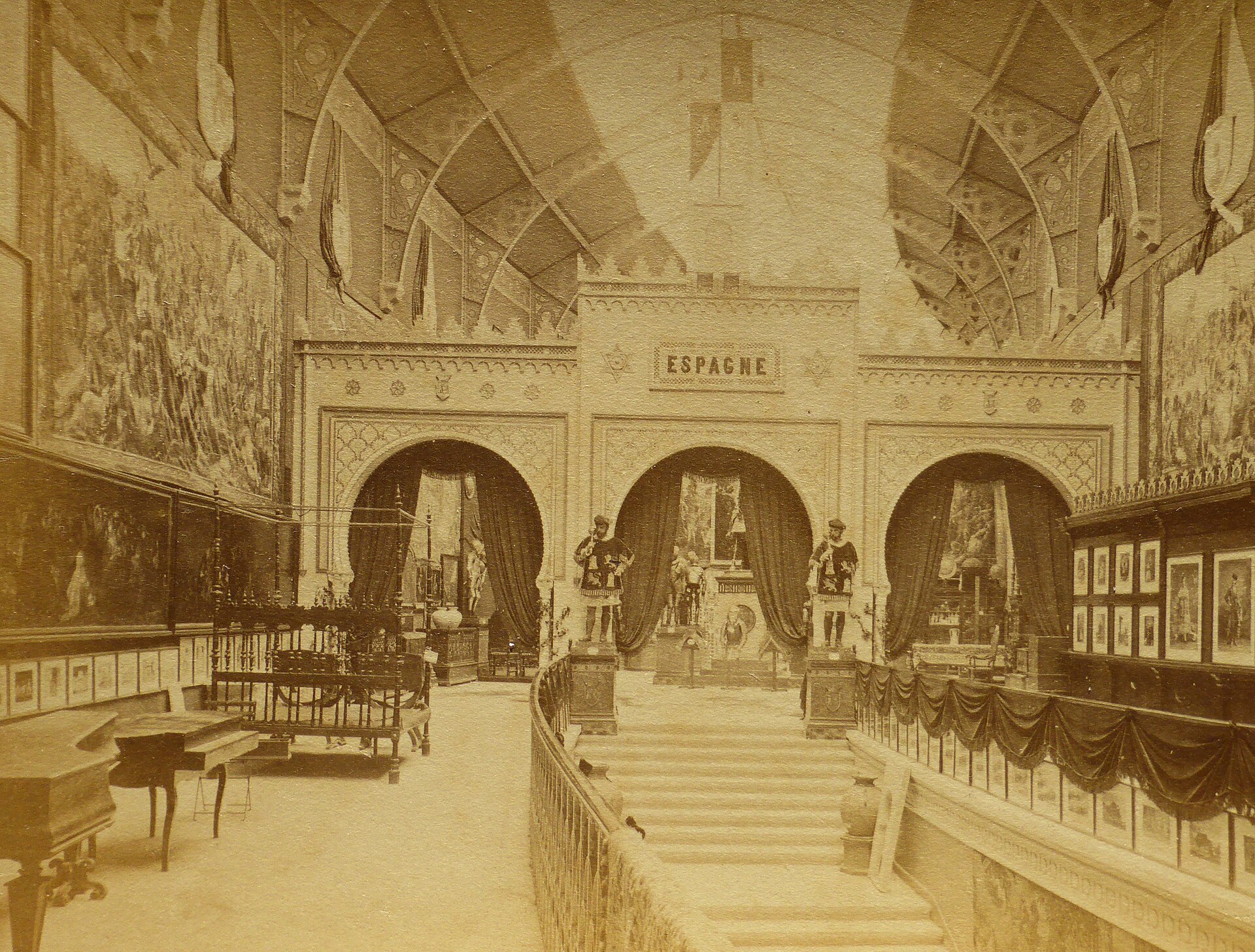
Shown in the Spanish section of the Palais du Trocadero at the Exposition Universelle, Paris. Hamerton, in 1879, described Saturn devouring his children among the pictures shown. Whether the baron meant to sell is disputed, and no sale or offer is recorded.1258
- 20 Dec 1881 - presentSpanish State, Museo Nacional del Pradodocumented
Given by d'Erlanger to the Spanish state by Royal Decree of 20 December 1881, without payment according to Foradada. Ten of the fourteen paintings went to the Prado and four to the Presidency of the Council of Ministers until an authorisation of 3 February 1898; which group included the Saturn is not stated in the sources opened. Inventory P000763. The Prado's own entry could not be opened. No sale of the canvas is recorded after the gift of 1881. Before the transfer, the property carrying the mural was put to public auction (Foradada: bought by Colmenares at auction on 12 April 1858; Junquera: failed auctions in 1859).12515
Technical evidence
| Attribution note | Attributed to Goya by the Museo del Prado and listed as an undisputed work by the Fundacion Goya en Aragon. Juan Jose Junquera argued in 2003 that the Black Paintings could not be by Goya and might be by his son Javier; Nigel Glendinning answered in 2004 and Manuela Mena, formerly of the Prado, maintains the attribution. No technical comparison of the Quinta murals with autograph Goya has been found in the sources opened. |
|---|---|
| Support | Originally a plaster (revoco) surface over sun-dried adobe brick, on the ground-floor dining room wall of the Quinta del Sordo. Since the transfer begun in 1874 a canvas onto which the paint layer was transferred and relined; the canvas lost its white ground in the process.161115 |
| Medium | Oil painted directly on the wall, not fresco (Yriarte, 1867); catalogued as oil on plaster transferred to canvas. Wikidata records a mixed technique on wall and canvas. Spanish Wikipedia names the transfer method as strappo.161523 |
| Dimensions | 143.5 x 81.4 cm (Wikidata and the Prado figures as quoted by Wikipedia); 143.5 x 81.5 cm in the Fundacion Goya en Aragon catalogue.115 |
| Inventory | Museo Nacional del Prado P000763 (printed P00763 in the Fundacion catalogue).115 |
| Original setting | Ground floor of the old part of the house, on the end wall facing the entrance, beside Judith and Holofernes and facing La Leocadia; which side of the window is argued (right: Gowing and Glendinning; left: Foradada); the Fundacion catalogue, reporting Glendinning, puts it opposite the Two Old Men rather than opposite La Leocadia. The wall was about 5 m wide with the picture set inside a moulded border of plaster or card.3561 |
| Wall treatment | Fruit-and-leaf wallpaper on the ground floor and geometric diagonal paper upstairs, visible round the paintings in the Laurent photographs. Junquera held the paper too late for Goya; Glendinning cited experts who did not rule out a date before 1820.34510 |
| Handling | Palette knife and fingers according to Yriarte (1867) and Ossorio y Bernard (1868, as quoted by Junquera); Spanish Wikipedia, without a source, describes thick strokes and a palette mostly of white and black with ochre flesh and a white-red flame for the son's body.34623 |
| Earlier layers | Rural landscapes with small figures beneath the series, with at least one reused in Duel with Cudgels; whether Goya painted them is disputed (Bozal for, Glendinning and Foradada against). Foradada reads Carmen Garrido's 1984 technical study (radiographs and micro-samples) as showing that only the Witches' Sabbath lacks an earlier painting beneath it, which would put the Saturn over earlier work; I did not read Garrido and cannot say what was sampled on the Saturn.1116 |
| Condition and restorations | Lined; white ground lost; repainted where paint was lost, the eyes among the worst-damaged areas; Prado restorations recorded in 1919 and in 1987 (Herlinda Cabrero); the catalogue also prints 1973 for a restoration it attributes to Martinez Cubells, which is chronologically impossible.12 |
| Transfer | Lifted from the wall from 1874 (Spanish Wikipedia's Quinta article says between 1874 and 1876) by Salvador Martinez Cubells at the request of Baron d'Erlanger; four murals were already transferred by 1875 according to Spanish Wikipedia. The date of the Saturn's own transfer is not recorded in the sources opened.21213 |
| Inscriptions | None recorded in the sources opened. Goya left no signature, date or title on any of the Quinta murals.810 |
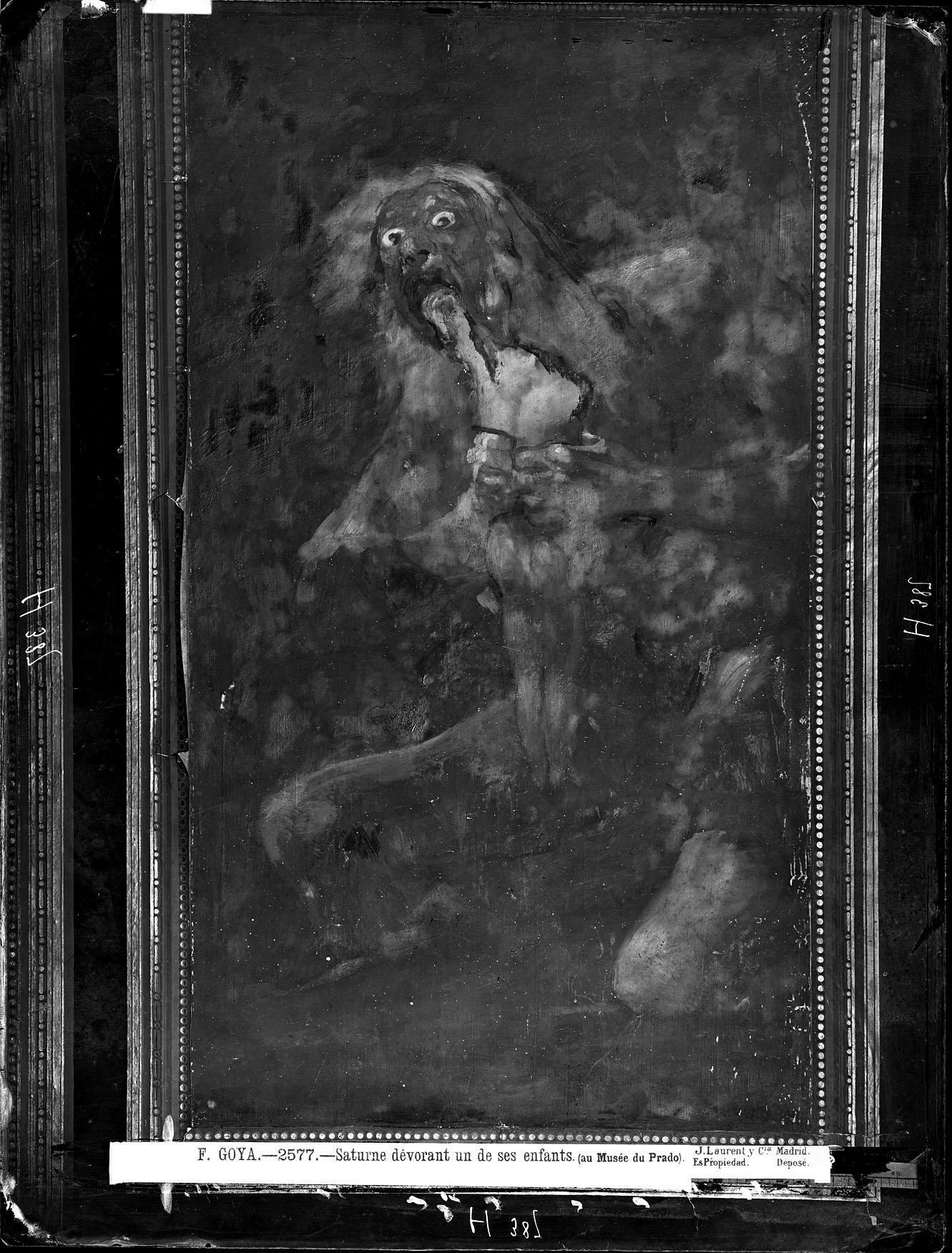
| Photographic record | Laurent photograph of the mural on the wall (glass negative about 27 x 36 cm, Archivo Ruiz Vernacci, IPCE; printed label 'F. GOYA.-2577.-Saturne devorant un de ses enfants (au Musee du Prado)'); dated 1874 by the Commons record, to the mid-1860s by Glendinning and to after 1879 by Junquera.341220 |
| Exhibitions as listed | Paris, Palais du Trocadero, Exposition Universelle, 20 May to 10 November 1878; Madrid, Prado, 'Goya. 250 Aniversario', 29 March to 2 June 1996 (cat. 158); Boston, Museum of Fine Arts, 'Goya: Order and Disorder', 2014 (cat. 3); Lille, 'Experience Goya', 2021 (cat. 78). The Fundacion Goya en Aragon lists these; the Boston museum page does not name the Saturn, so whether the canvas itself travelled in 2014 and 2021 is unconfirmed.122 |
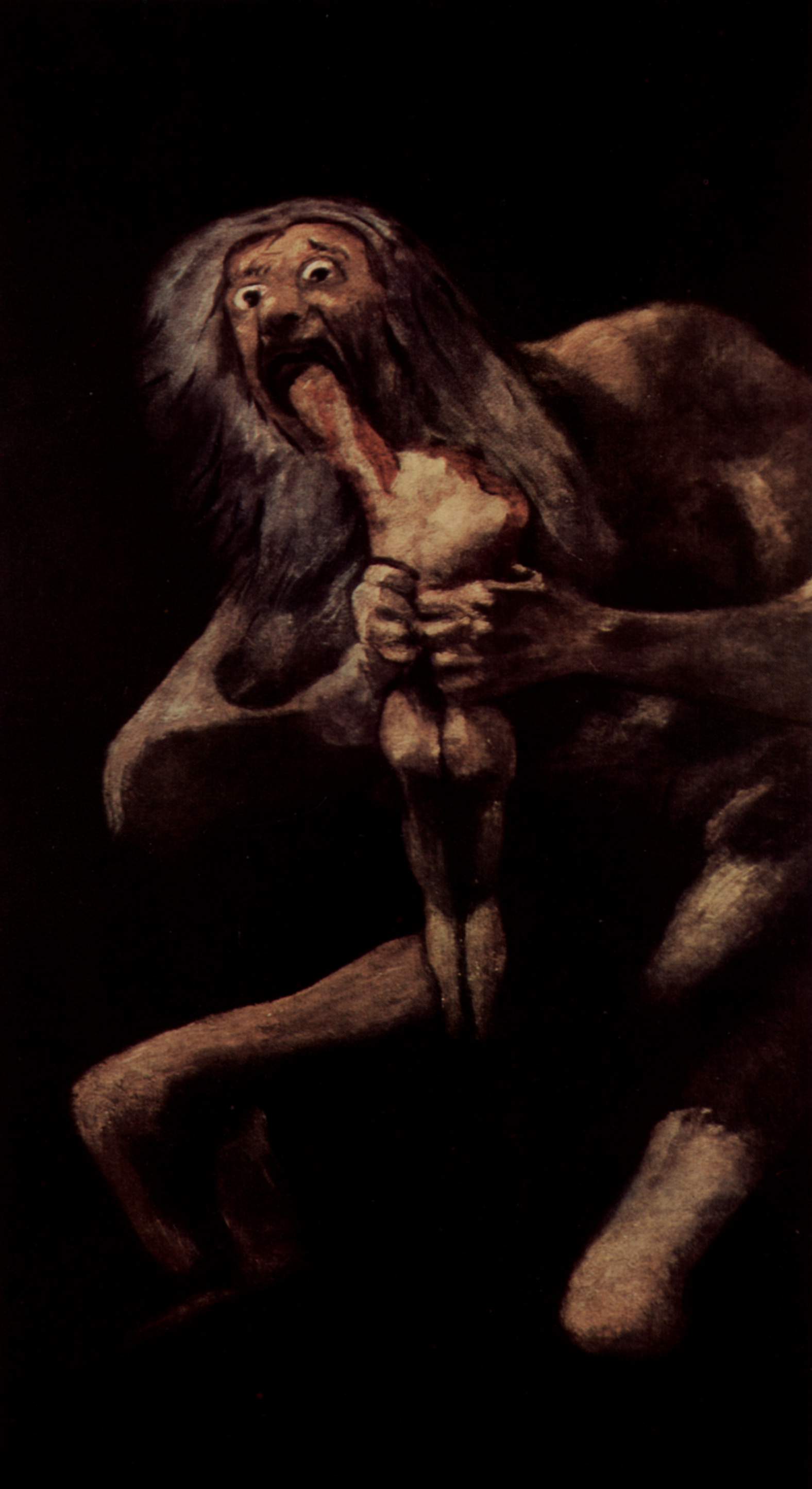
| Digital reproductions | Commons lead file 1661 x 3051 px (aspect about 1.83); Yorck Project scan 1576 x 2889 px; Web Gallery of Art file 700 x 1287 px. The files are File:Francisco de Goya, Saturno devorando a su hijo (1819-1823).jpg, File:Saturno devorando a sus hijos por Goya.jpg and File:Francisco de Goya y Lucientes - Saturn Devouring One of his Children - WGA10109.jpg. All are taller relative to their width than the catalogue dimensions of 143.5 x 81.4 cm (about 1.76); the reason is not stated.24 |
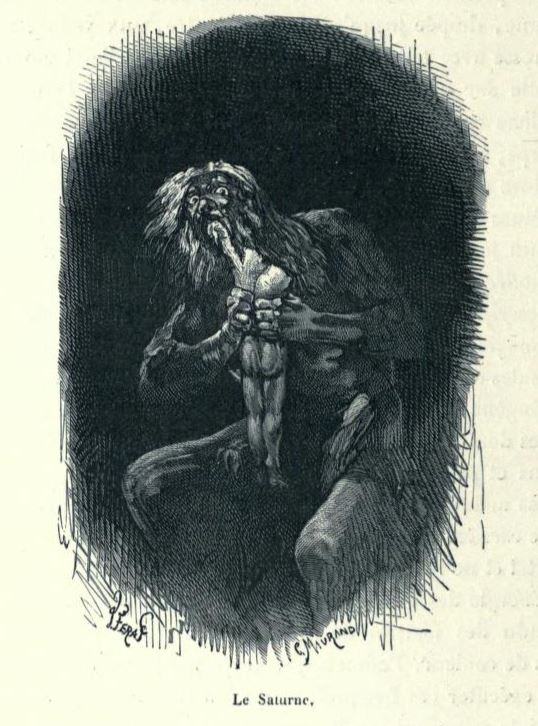
| Engraving | 'Le Saturne', signed Ferat and Maurand, after a photograph, in Yriarte 1867 (page 96 per the Commons credit line); made before the transfer.621 |
Images
The record in full
Chapter 1What hangs in the Prado is a lifted mural, not the wall Goya painted
The picture in the Museo Nacional del Prado, inventory P000763, measures 143.5 by 81.4 centimetres (the Fundacion Goya en Aragon catalogue gives 81.5) and is catalogued as oil on plaster transferred...
The picture in the Museo Nacional del Prado, inventory P000763, measures 143.5 by 81.4 centimetres (the Fundacion Goya en Aragon catalogue gives 81.5) and is catalogued as oil on plaster transferred to canvas. That description carries the whole history. Goya painted it on a plaster wall in the ground-floor dining room of a country house outside Madrid, probably between 1820 and 1823. In the 1870s the paint layer was taken off that wall and fixed to canvas by a restorer, and it has been a canvas ever since. The wall and the room are gone: the wing that held the paintings was pulled down about 1876, and the house was demolished in part in 1909.
So the object described here is neither the mural as Goya left it nor a painting on canvas that Goya ever touched. It is Goya's paint, detached and relined, with the later repainting that a detached and damaged paint layer needed. The Fundacion Goya en Aragon's catalogue text says the canvas was lined and lost its white ground, that the work was repainted where paint had been lost, and that the eyes were among the worst-damaged areas and were repainted. A reader looking at the figure's staring eyes is therefore looking at the part of the picture that the catalogue itself says was redone.
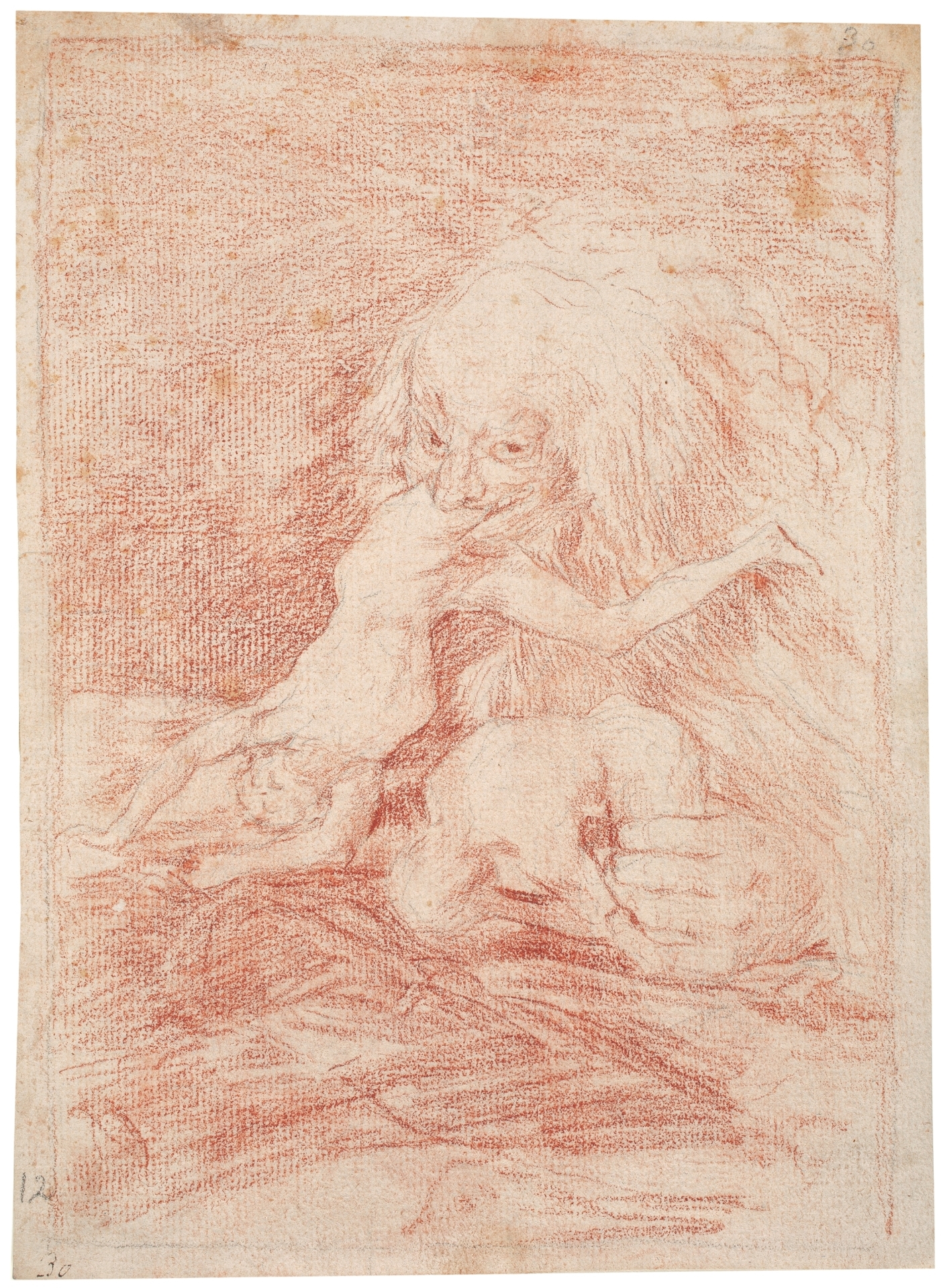
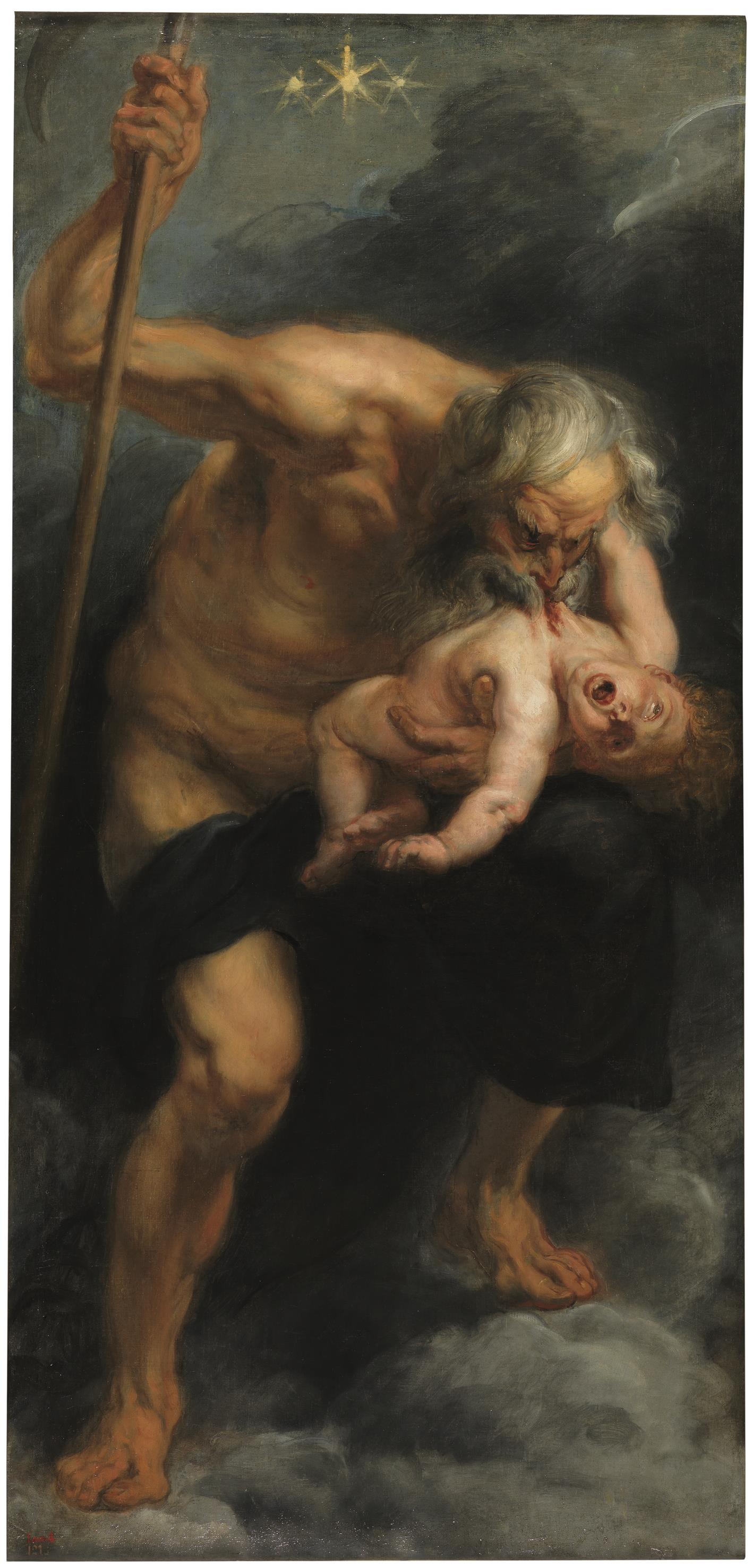
Three other Saturns sit close to this one in the literature and must not be confused with it. Rubens painted a Saturn for the Torre de la Parada in 1636-38, now also in the Prado and a different picture entirely. Goya himself made a red chalk drawing of the subject about 1796-97, which the Prado holds as a drawing and which shows a quite different, comparatively mild composition. And the mural in its original state survives only in photographs and an engraving: a photograph by J. Laurent and an engraving after a photograph in Charles Yriarte's 1867 book. Those are records of this picture on the wall, not other versions of it. The plates on this page are labelled accordingly.
Goya gave the series no titles, or none that has come down. The names in use were assigned by others. The Spanish title on Wikidata and in the Fundacion's catalogue is Saturno devorando a un hijo (the Prado's own title was not checked); English usage is Saturn Devouring His Son, and the Prado web address recorded on Wikidata ends simply 'saturn'.
Chapter 2A house bought on 27 February 1819
The documentary start of the picture is a sale deed.
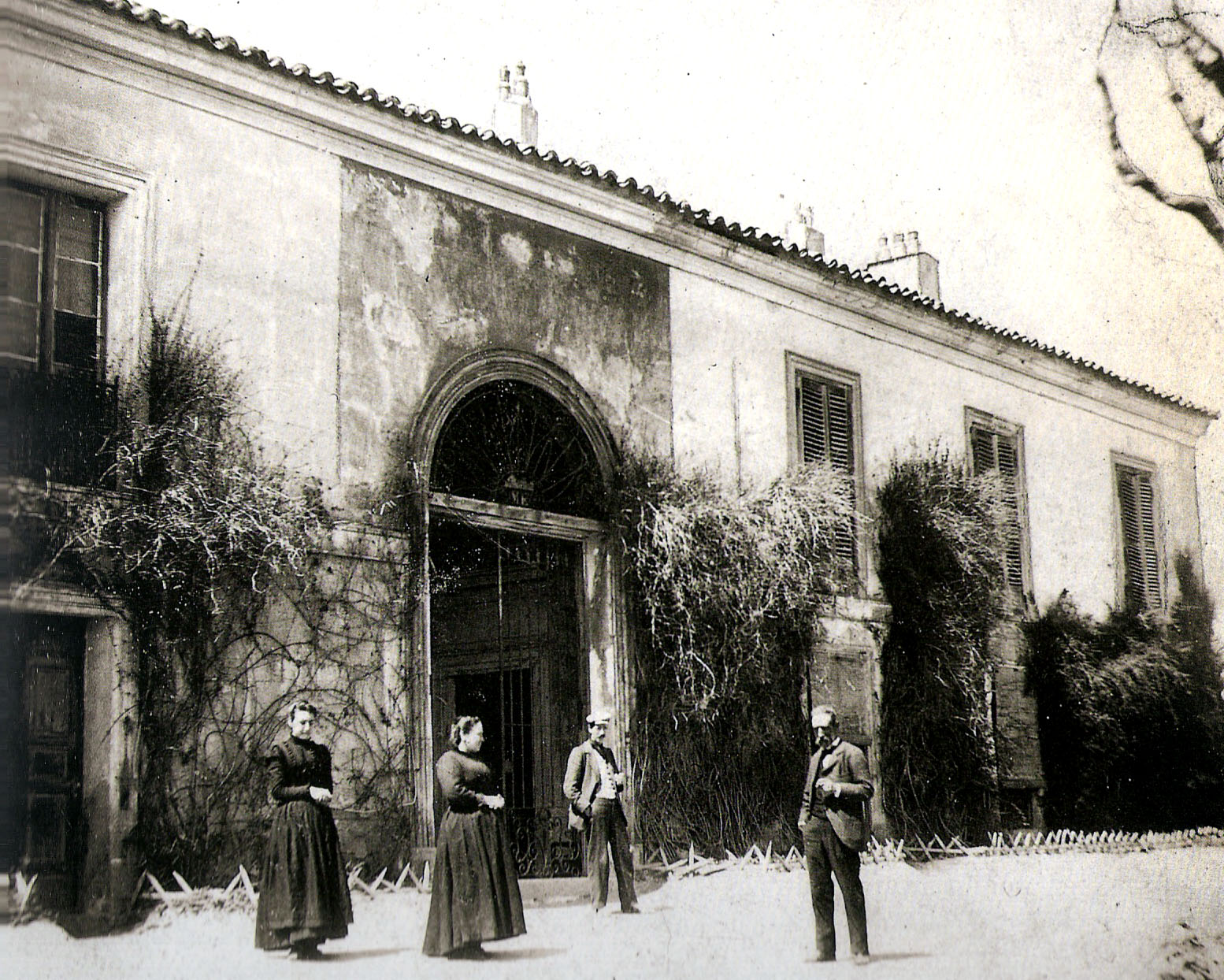
The documentary start of the picture is a sale deed. Nigel Glendinning, working from the archival references first published by Francisco Javier Sanchez Canton in 1946, reports that on 27 February 1819 Pedro Marcelino Blanco sold Goya a country property outside Madrid. Foradada and Spanish Wikipedia place it on the right bank of the Manzanares near the Segovia bridge. The deed records that the house had been built or rebuilt by Anselmo Montanes, a military assistant at the Royal Factories and Palace precinct, on a plot of five fanegas he bought in 1795: a house of adobe with a garden, two low dwellings divided into rooms, two wells, two lofts and five white poplars planted along the stream. Carlos Foradada quotes the same deed as a sale to Goya of fourteen fanegas and ten celemines of arable land with the house on it.
The name 'Quinta del Sordo', Deaf Man's Villa, is often read as a joke on Goya, who had been deaf since his illness of 1792-93. The sources fall short of that neat reading. The house is generally said to be named for an earlier deaf owner, and Pedro Marcelino Blanco, the seller, is the deaf owner named in Spanish Wikipedia's account. Foradada points out that an 1832 mortgage deed describes the property as bordering land of Flores 'or of the Sordo', which may be the origin of the nickname, and Juan Jose Junquera argued that 'Quinta del Sordo' was an older neighbouring estate that the Goyas added to their own market garden. None of this is settled.
Goya was seventy-two when he bought it and seventy-three by the end of that year. He did not simply move in. Foradada, citing the 1823 donation deed, notes that Goya made improvements, an enlargement of the house and a block for the gardeners, and he reconstructs the two main rooms, a ground-floor dining room and a first-floor salon, from the scale model of Madrid made in 1828-30. Leocadia Zorrilla, called Weiss after her husband Isidoro, lived there as his housekeeper. Spanish Wikipedia calls the suggestion that she was more than that speculation without foundation, and the Fundacion's catalogue describes her only as his housekeeper in his last years.
Goya left Spain for Bordeaux in 1824 and died there on 16 April 1828. He never sold the house. In September 1823, as the French army that ended the liberal Trienio was completing its campaign, he conveyed it to his grandson Mariano, a measure Foradada reads as protection against confiscation, since his natural heir was his son Javier. Whatever he painted after September 1823 he painted on a house that was no longer his.
Chapter 3The dining room and the wall opposite the door
The ground floor held the room in which Saturn was painted.
The ground floor held the room in which Saturn was painted. Charles Yriarte, whom Foradada places as a guest of the owner Coumont in the 1860s, gave the first detailed published description of the room in 1867 and says the ground-floor room contained six compositions. The two longest walls, to right and left as one entered, each carried a single large picture, a witches' gathering on the left and the San Isidro pilgrimage on the right. The two short walls carried four smaller ones, two on either side of the door and two facing it. To the left of the door he places a woman whose mantilla falls over her face, which he says reliable information identified as Dona Leocadia, and beside her a long-bearded figure listening in suppressed terror to something hideous murmured at his ear. The two panels at the other end of the room, in his words (my translation), show 'Saturn devouring his children, and Judith cutting off the head of Holofernes'.
Which of the two hung on the left is argued. Yriarte does not say. Lawrence Gowing, in 1966, put Saturn on the right as one entered. Glendinning agreed, adding that in Laurent's photograph the moulding around Saturn catches light from the right, which he took to mean a window or door on that side. Foradada, writing in 2019, thinks the light in the photographs may come from the electric lamps Laurent was by then using, and concludes instead that Saturn stood on the left, Judith on the right, in the order Yriarte names them. The Fundacion Goya en Aragon catalogue prints Glendinning's placing opposite the Two Old Men. The disagreement matters less for Saturn's meaning than for what a visitor entering the room saw first.
The room is also hard to measure. Glendinning estimated the ground-floor room at about 9 by 4.5 metres. Miguel Hervas proposed 6.6 by 4.7 metres, and Foradada, using the scale model of Madrid made by Leon Gil de Palacio in 1828-30, puts the end walls at about 5 metres with the entrance taking about 1 metre of that and the room about twice as long as it was wide. Foradada also reports that a small gabinete lay behind the end wall that carried Saturn and Judith.
The walls were not bare plaster. The Laurent photographs (dated 1874 on Commons, to the mid-1860s by Glendinning) show the paintings framed by classical-looking borders of plaster or card and surrounded by wallpaper: fruit-and-leaf paper downstairs and a geometric diagonal pattern upstairs. Junquera argued that the paper was machine-printed and too late to be Goya's; Glendinning cited wallpaper specialists who did not rule out a date before 1820 and noted that the Royal Painted Paper Factory run by Pedro Giroud was in the news in 1818 and 1819. A Laurent photograph therefore shows Saturn on the wall before the transfer, inside a paper border on a papered wall, whether or not that dressing goes back to Goya's own years.
The earliest list of the room's contents is the so-called Brugada inventory. Foradada and Glendinning agree that it distributes the paintings by floor and wall. It survives only as a copy made about 1875 by Xavier Desparmet Fitz-Gerald from sheets held by the widow of the painter Antonio de Brugada, and was published in 1928; the first page is missing. It names seven works on the ground floor and eight above, one more than the fourteen that reached the Prado. I did not see the inventory's wording for the Saturn entry, so its own title for the picture is not recorded here.
Chapter 4Painted with a palette knife and fingers over earlier landscapes
Yriarte understood in 1867 that the pictures were not frescoes.
Yriarte understood in 1867 that the pictures were not frescoes. Goya had painted straight onto the wall in oil, he wrote, and the walls were built of raw brick dried in the sun, which cracked even with props. He thought it 'materially impossible' to lift the paint layer and keep the sketches, whatever sum was spent. He also wrote that Goya had certainly used the palette knife and his fingers to animate these monsters, and that he thought Goya never took up a brush for them. The 1868 biographical dictionary of Ossorio y Bernard, as quoted by Junquera, likewise said the frescoes of the house were largely painted with the palette knife. Glendinning adds that Cean Bermudez, in a volume of his history of painting begun in August 1824, recorded having seen Goya paint with his fingers without saying where or when.
Under the black there was something else. The Spanish literature says the Black Paintings were painted over rural scenes with small figures, whose landscapes Goya reused in at least one mural, Duel with Cudgels. Whether those earlier scenes were Goya's own is disputed: Valeriano Bozal inclines to think so because only that explains the reuse, while Glendinning and, after him, Foradada hold that they already decorated the walls when Goya bought the house. Jay Scott Morgan, in a personal essay, reports that radiography and stratigraphy have revealed lush landscapes with mountains, rivers, donkeys and small figures beneath the series, but he gives no source for the analysis. Foradada and Spanish Wikipedia cite Carmen Garrido's technical study of the series (Boletin del Museo del Prado 5, 1984: radiographs and micro-samples). On Foradada's reading of it only the Witches' Sabbath was painted directly on the plaster, so the Saturn lies over an earlier painting; I did not read Garrido and cannot say what was sampled on the Saturn.
The colour of this picture is nearly reduced to two tones with an ochre flesh. Spanish Wikipedia describes it, without citing a source, as whites and blacks applied in thick strokes, broken only by the ochre of the flesh and the white-and-red flame of the son's torn body. In the Fundacion's catalogue text Jose Gudiol is cited for the view that the vigorous brushwork of the god's face conceals a sound drawing underneath. The catalogue also calls the picture 'very simple, bordering on the abstract', and notes that the god stands out against a dark, neutral and rather unreal background.
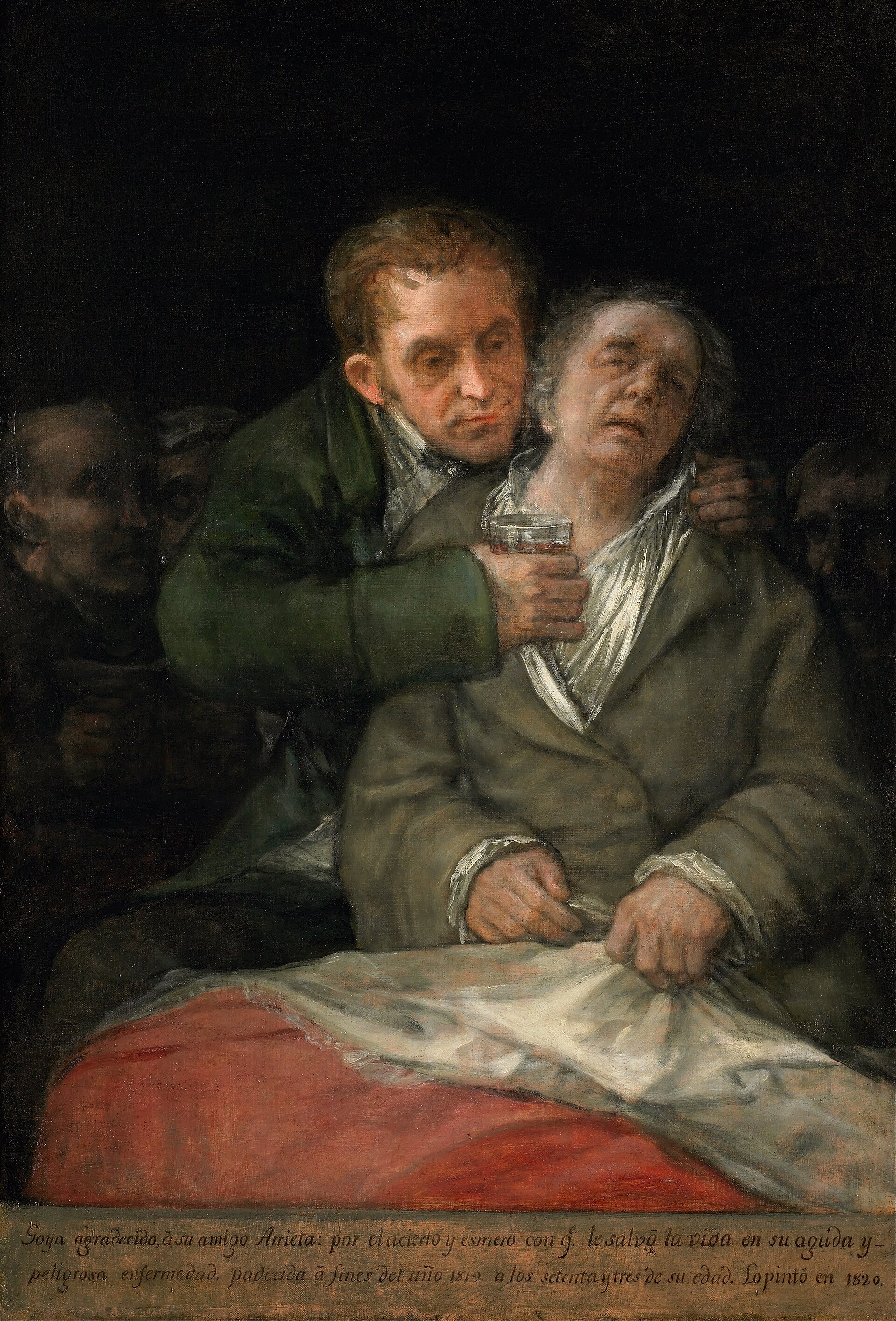
The date is a range, not a fact. The purchase of 27 February 1819 is the earliest the paintings can be, and Goya's departure in 1824 the latest, because he left the house in the care of his grandson. Most catalogues give about 1820-23. A serious illness at the end of 1819 is documented by Goya himself in the inscription on his Self-Portrait with Dr Arrieta (Minneapolis), which says he painted it in 1820 in thanks to the physician who saved his life in the acute and dangerous illness of late 1819, at seventy-three. Several writers link the dark murals to that illness, though no document does. Recent research, in Spanish Wikipedia's summary, argues that Goya finished the series in the first months of 1824, before leaving in the summer. Nothing in the sources says which wall was finished last.
Chapter 5Time, Rubens and a title Goya never wrote
The myth is the one Hesiod tells. Saturn, the Roman form of Cronus, had learned from Earth that one of his children would overthrow him, and so swallowed each as it was born.
The myth is the one Hesiod tells. Saturn, the Roman form of Cronus, had learned from Earth that one of his children would overthrow him, and so swallowed each as it was born. His wife hid the sixth, Jupiter, on Crete and gave Saturn a stone in swaddling clothes to swallow instead; Jupiter grew up, forced his father to disgorge the others and took the throne. The ancient story is about swallowing whole and vomiting up whole. Goya's picture shows something else: a crouched, long-haired old man with huge round eyes and an open mouth, tearing at a headless adult body whose left arm he has already begun to eat. Only the white flesh, the red of the blood and the white knuckles break the dark.
Madrid already had a Saturn. Rubens painted one in 1636 for Philip IV's hunting lodge, the Torre de la Parada, with a detail drawn from astronomy: the three stars at the top stand for the planet as Galileo described it a few years earlier. It is now in the Prado. Francisco Javier Sanchez Canton compared Goya's Saturn with it and found Goya's violence far greater, stripped of any mythological excuse. Goya's own c. 1796-97 chalk drawing of the subject, which Morgan describes as showing a figure biting a leg while holding a second child, is an earlier treatment of the same subject. Whether Goya had the Rubens in mind in 1820 is not known. Yriarte, in 1867, saw no tradition at all: it was, he wrote, a scene of cannibalism that has nothing to do with mythology, with no god in it, a terrible creature with a beggar's face.
The naming drifted. Yriarte called it 'Saturne devorant ses enfants'. Laurent's printed label narrows it to one child: 'Saturne devorant un de ses enfants (au Musee du Prado)'. The English critic Philip Gilbert Hamerton, who wrote about the pictures exhibited in Paris in 1878, listed Saturn devouring his children. Wikidata and the Fundacion's catalogue use 'Saturno devorando a un hijo' and the catalogue offers 'Saturn Devouring One of His Children'. Wikipedia and most English writing say 'Saturn Devouring His Son', although Spanish usage sometimes shortens it to 'Saturno'. Every one of these is a label put on the picture after Goya. Fred Licht, as reported in Wikipedia's summary, warned that the traditional title may be misleading, since the attributes of Saturn, the scythe and the hourglass, are absent and the victim is not an infant.
The Brugada inventory, the only list that may date from Goya's lifetime, would show what the household called it. It was not available in full to me, which is why this record gives no Goya-era title.
Chapter 6What readers have argued it means
Goya left no word on the picture. No letter, bill or note explains any of the murals, and the series has no known commission.
Goya left no word on the picture. No letter, bill or note explains any of the murals, and the series has no known commission. Every account of the meaning is therefore an argument by a later reader, and this record keeps the readings apart from the maker.
Argued: Saturn as the god of melancholy and of age. Folke Nordstrom, in a 1962 book on Goya, Saturn and melancholy, treated the picture as the starting point of the dining-room programme, with Saturn, god of melancholy, standing for Goya's state of mind in the face of old age and the illness of 1819, and with Goya himself marked by Saturn's sign. The Fundacion Goya en Aragon summarises him this way. Glendinning, in his 2004 reply to Junquera, argued that the ground-floor decoration was governed by Saturn, who in the old scheme of the ages of man presides over the seventh and last age, life after seventy, which Goya had reached. Spanish Wikipedia repeats the same point in the form that Saturn ruled the seventh heaven and was the patron of septuagenarians.
Argued: Time. The traditional Spanish account takes the figure as an allegorical emblem of the passing of time, the devourer of what he made. The Freudian note in Spanish Wikipedia links Saturn to melancholy and destruction.
Argued: a politics of the moment. The 2022 article by Juan Jose Barragan, listed in Spanish Wikipedia, reads the picture as a satirical portrait of Ferdinand VII devouring Spain. A broader version, that the figure is the state eating its citizens, is mentioned in the same encyclopaedia. Manuela Mena, formerly the Prado's deputy director for conservation and research, told the Guardian in 2019 that she finds it difficult to agree with scholars who present the series as political despondency or deathbed despair.
Argued: the title is wrong. Licht, summarised in Wikipedia, doubted that the figure is Saturn at all and proposed that the picture inverts old antisemitic prints of Jews eating children, an argument he himself admitted could not be proved. John J. Ciofalo, in 2001, read the victim as an adult woman, headless and already dead, and the picture's weight as falling on the male fury of the figure. Wikipedia cites Edward Olszewski (2008) and Robert Hughes (2004) for the claim that the mural originally showed Saturn with an erect penis, removed at d'Erlanger's request; I have not read either and report it as their claim, not as a fact.
Argued: depth psychology. Andre Malraux's 1950 book Saturne, as summarised in Spanish Wikipedia, tied the series to the unconscious, and the Hungarian writer Laszlo Foldenyi in 2008 read the Saturn mural in terms of Jung. Speculative: father and son. Morgan's essay reads it against Goya's relationship with Javier, the only one of his children to reach adulthood; the essay is candid that it is a personal reading.
Teresa Vega, an art historian who leads guided tours at the Prado, told the Guardian that to her the mad eyes suggest 'not evil, but a kind of shock at his own monstrousness'; the Guardian adds that it is not her job to tell visitors what a painting means. Pierre Gassier and Juliet Wilson, quoted by the Fundacion, took the series as a record of a descent into hell and declined the search for a programme.
No document gives a hidden programme or a patron's instruction. The absence of one is a finding. The series was made for the house of a man living in near seclusion, and no text says it was meant for any eye but his own household and his visitors.
Chapter 7From Goya to Mariano, Javier and a run of owners
After Goya's conveyance of September 1823 the house passed to his grandson Mariano, who in 1830 transferred it to his own father Javier, the painter's only surviving child.
After Goya's conveyance of September 1823 the house passed to his grandson Mariano, who in 1830 transferred it to his own father Javier, the painter's only surviving child. Glendinning's 2004 article quotes an 1832 document in which Javier, described as a landowner and farmer, mortgaged one of his houses to pay for cultivating the Huerta de Goya. Javier died in 1854 and Mariano again took charge. The house was put up for sale. A deed of 1 June 1859 in the property register, quoted by Glendinning, records the purchase by Segundo Colmenares and describes a house of ground and main floors whose 'frente' (front end, on Glendinning's reading the left end) was the old house of the famous painter Goya, where several paintings on the walls were fairly deteriorated. Foradada gives both an auction on 12 April 1858 and a contract of sale on 1 June 1859, the date Glendinning takes from the property register; Junquera and Spanish Wikipedia describe failed auctions in 1859 before Colmenares bought.
Junquera, who argues against Goya's authorship, treats the same period very differently. He notes that none of the notarial papers for the house, including inventories and a lease of 1857 that lists even prints and watercolours, mentions the Black Paintings, and that they appear in notarial documents only from the failed sales of 1859. He also points out that the Marques del Saltillo showed Mariano had no real claim to the title Marques del Espinar that he used. Junquera draws from that a general doubt about Mariano's reliability; Glendinning replies that none of it bears on whether Goya painted the walls. Both statements are theirs, not ours.
Colmenares was a property developer, and Foradada says his goods were later seized. Citing a deed of 23 November 1863, Foradada says the Belgian financier Luis Rodolphe Coumont bought the lands of the district, including the Quinta, for more than five million reales in all. Yriarte named Coumont as owner when he published in 1867, said he looked after the frescoes with the care of an amateur, and said Coumont had had them photographed and had sent him the photographs. Foradada adds that the French baron Charles Saulnier bought the property in 1866, received the writer Pierre Leonce Imbert there in 1873, and sold in that same year to Baron Frederic Emile d'Erlanger. Yriarte's book and Foradada's date are hard to reconcile, which the provenance table records as a dispute over who held the property in 1866-67.
The sources also disagree on d'Erlanger's date. The Fundacion Goya en Aragon and Foradada say 1873, and Spanish Wikipedia gives 1873 and English Wikipedia 1874. What is clear is that by 1874 d'Erlanger owned the house and had commissioned the removal of the paintings.
Chapter 8The 1867 judgment that they could not be saved, and the engraving that recorded one
Yriarte's chapter on Goya's house is, among other things, an obituary written in advance.
Yriarte's chapter on Goya's house is, among other things, an obituary written in advance. The rumour had gone round that the house would be demolished for speculation. He wrote that in his view it would not be possible to save these curious sketches, that the walls were raw brick that split despite the props, that lifting the paint layer would be physically impossible however much was spent, and that he had studied the question with specialists. The Marques de Salamanca had in fact succeeded, 'by dint of money', in removing one of the paintings, which Yriarte reported, with a conditional and on the strength of the Marques del Espinar's correspondence, as perhaps by Goya's son rather than Goya; he had chosen the best preserved and not the most important. Yriarte's own plan was a special publication giving each of the paintings. The book carried an engraving of the Saturn, signed Ferat and Maurand, made from a photograph.
The Salamanca painting is a separate story. Spanish sources treat it as the fifteenth of the series, an upper-floor picture taken to the Palace of Vista Alegre. Some critics identify it with Heads in a Landscape, now in a private collection in New York, which Foradada says has not been conclusively studied; he knows of analyses made in March 2017 at a New York laboratory, which he judges very limited and in no way conclusive. Others think it was lost. It matters here only because it shows that removal of a mural was possible in 1860s Madrid at a price, and had been done once before d'Erlanger.
Pedro de Madrazo wrote in 1872 that the so-called Casa del Sordo still held, not long before, thirteen or fourteen of Goya's pictures of the highest merit; the quotation comes from Glendinning, who uses it to show that Madrazo did not doubt either their quality or their authenticity. Cruzada Villaamil's article of 1868 in El Arte en Espana, with engravings by Eduardo Gimeno, listed the titles by which the series was beginning to be known.
Chapter 9d'Erlanger, Martinez Cubells and the transfer from 1874
Baron Frederic Emile d'Erlanger (1832-1911) was born in Frankfurt, took over the Paris branch of the family bank in 1859 and moved the firm to London in 1870.
Baron Frederic Emile d'Erlanger (1832-1911) was born in Frankfurt, took over the Paris branch of the family bank in 1859 and moved the firm to London in 1870. His business was state loans and railways. Wikipedia's account says he and his wife funded the rescue of the Black Paintings, which were costly to save. Glendinning, in a 1975 inaugural lecture quoted by Foradada, wondered whether the baron bought the house and land around it as a property speculation, on the assumption that the area would be developed, noting that he had profited from West End property elsewhere. Foradada's own view is that d'Erlanger wanted both to save the paintings from deterioration and to show them in Paris.
He hired Salvador Martinez Cubells (Valencia 1845, Madrid 1914), a history painter who in 1869 became the Prado's first restorer and held the post until 1895. The work began in 1874 and was slow. According to Spanish Wikipedia's article on the restorer, four paintings were already transferred by 1875, among them the Witches' Sabbath. Spanish Wikipedia describes the method as the Italian strappo and says that lifting the paintings meant piercing the adobe walls and ruining the rooms; the wing was pulled down about 1876. The mural's state beforehand is on record. The Laurent photographs of the walls show big cracks, colour dragged away, repaints and gaps filled with plaster; they were used as a guide during the transfer, according to the Spanish Wikipedia article on the restorer.
Those photographs are themselves in dispute. The Commons record gives them as taken in 1874 inside the house and says Laurent's successors added the Prado label about 1890. Spanish Wikipedia gives the negatives as 27 by 36 centimetres and Glendinning places them in the Archivo Ruiz Vernacci. Glendinning argued in 2004 that the numbers inscribed in the emulsion, in an H series, place the Black Paintings negatives in the mid-1860s, in the period when Coumont, the owner, is known to have commissioned photographs for Yriarte. Junquera argued that they were taken after the 1881 donation, because the printed labels name the Prado, and that they are absent from Laurent's own 1879 catalogue. Glendinning replied that the labels were stuck on long after the negatives were made. The label on the Saturn print reads 'F. GOYA.-2577.-Saturne devorant un de ses enfants. (au Musee du Prado)', and a hand-inscribed H number is visible on the plate.
No source I could open says on which day the Saturn itself was lifted or what the operation cost; Bozal, quoted in Spanish Wikipedia, says Martinez Cubells was helped by his brothers Enrique and Francisco. The sources do say that the Spanish state paid nothing for the paintings: Foradada states that the baron, disappointed, gave them to the state in 1881 and, unexpectedly, asked for no money.
Chapter 10Paris in 1878 and the gift of 1881
Some of the transferred murals went to Paris for the Exposition Universelle of 1878 and were shown in the Spanish retrospective section of the Palais du Trocadero, from 20 May to 10 November...
Some of the transferred murals went to Paris for the Exposition Universelle of 1878 and were shown in the Spanish retrospective section of the Palais du Trocadero, from 20 May to 10 November, according to the Fundacion Goya en Aragon. A photograph of the Spanish section taken by the Neurdein firm in about May 1878, now on Commons, shows the Witches' Sabbath on the left. Junquera notes that the pictures hung in a very minor space, a passage, and appear neither in the official catalogue nor in the Lamarre and Louis-Lande guide to Spain at the exhibition. Other writers did look: Alfredo Escobar for La Ilustracion Espanola y Americana, and Philip Gilbert Hamerton, an English critic, who wrote in The Portfolio in 1879. Hamerton named Saturn devouring his children first among the horrors and, as quoted by the Guardian, called Goya a 'hyena' and the paintings emanations from a hideous inferno. Foradada reports that every review he found was negative.
Whether d'Erlanger wanted to sell them in Paris is not agreed. Spanish Wikipedia says some say he did and others say he intended to give them to the Prado from the first. No source I could open records a price asked, an offer to a French museum or a buyer. I found nothing to support the suggestion that the Louvre was approached.
The gift followed in 1881. By a Royal Decree of 20 December 1881 the paintings returned to Spain, according to the Fundacion Goya en Aragon. Ten went to the Prado and four to the Presidency of the Council of Ministers, and the four joined the others after an authorisation of 3 February 1898. Spanish Wikipedia says some were not shown until 1898, when the baron's son presented a claim, and that the series was on display at the Prado from 1889. Which group Saturn belonged to is not stated in the sources I could open, so how early it was shown is not recorded. Foradada notes that the pictures have been rehung several times at the Prado and in none of the arrangements has the original room's order been followed.
The baron died in 1911. By then the house had been demolished: Foradada and the Spanish Wikipedia article both put the demolition in the summer of 1909, although the latter notes that only the front range of the heirs' enlargement fell then, the wing of the Black Paintings having been pulled down about 1876.
Chapter 11Condition: lining, a lost ground and repainted eyes
The Fundacion Goya en Aragon catalogue gives the following for the Saturn.
The Fundacion Goya en Aragon catalogue gives the following for the Saturn. The canvas was lined and lost its white ground. In the first restoration the work was repainted in various places where the paint had been lost, and the eyes were among the most damaged areas and were repainted. Restoration is dated to 1919 at the Prado and again to 1987 by Herlinda Cabrero. The catalogue's opening clause says 'apart from the restoration work carried out by Martinez Cubells in 1973'. That date cannot be right for a restorer who died in 1914 and is probably a slip for 1873 or 1874 or a merging of two sentences; I have not been able to check the Prado's own text. The companion entry for La Leocadia dates a Prado restoration to 1973, followed by 1979 and 1987, which suggests that a 1973 treatment of the series is recorded and that the Saturn sentence has been garbled.
The loss of the white ground matters to the way the picture looks. A figure now seen as luminous flesh against black was built on a pale preparation that the transfer stripped. Juliet Wilson-Bareau, the Goya scholar, was quoted in 2003 as saying that rigorous technical analysis would be valuable, noting the deteriorated condition of the paintings and their heavy overpainting. Carmen Garrido's 1984 study of the series' technique exists, but I did not read it and cannot say what it sampled on this canvas; I found no account of what Cubells repainted beyond the eyes.
The Laurent print preserves the earlier state, a cracked wall surface inside a paper frame, and Wikipedia's caption for the 1867 engraving says the print shows details absent from the present canvas. I make no claim about what they are. The plates in this record let a reader compare the three states: the engraving of 1867, the photograph on the wall and the picture the Prado shows now.
Chapter 12The authorship challenge of 2003 and the replies
In 2003 Juan Jose Junquera, a professor at the Complutense University of Madrid, published three things: an article in the magazine Descubrir el Arte (May 2003), a book for Scala in London and a...
In 2003 Juan Jose Junquera, a professor at the Complutense University of Madrid, published three things: an article in the magazine Descubrir el Arte (May 2003), a book for Scala in London and a longer article in Archivo Espanol de Arte. His claim, in his own abstract, was the impossibility of attributing the surviving Black Paintings to Francisco de Goya, with a first attempt to separate fakes of his father's work by Javier Goya. The Art Newspaper summed up the first of his arguments in its report of 31 May 2003: the works could not be by Goya because they are on two storeys, and in his lifetime the house had only a ground floor.
His arguments, in the 2003 article, run as follows. The notarial papers up to 1857 never mention the paintings. The Brugada inventory is too late: Antonio de Brugada, he argued, was out of Spain in 1823 and 1828, and the inventory uses 'vargueno', 'maque' and 'estilo Luis XV', which Junquera dated to the later nineteenth century. The early printed references, up to 1868, speak of amiable frescoes, not of the Black Paintings. The Laurent photographs, he argued, were taken after the donation, with the paintings already in the Prado. He raised the possibility that Javier painted the series, and that Javier or Mariano then let it pass as Goya's. Junquera's two-storey argument concerns the first floor, but he also argued that the ground-floor room had its walls covered with a percal hanging; Glendinning answered that the inventory entry is for a bed hanging, not a wall covering.
Glendinning, after a first public reply in the Madrid newspaper ABC on 30 April 2003 (as Junquera cites it), answered in 2004 in the same journal, point by point. He cited the 1859 registry description of a two-floor house whose left end he reads as the painter's old house, and the Asenjo photograph of about 1900 whose left part he read as the old two-storey house. He argued that the language arguments prove nothing, since 'maqueado' appears in a Spanish inventory of 1835; that Madrazo's 1872 text and the 1834 and 1838 notices in Le Magasin Pittoresque and in Carderera's biography show the pictures were known early; that the Laurent numbers date the plates to the mid-1860s; and that nothing known of Javier's career as a painter is compatible with fourteen works of this force, since he described himself as a landowner and farmer in 1832 and no signed picture by him has been found. The Prado, in 2003, said it respected Junquera's views but kept the attribution. Manuela Mena, formerly the Prado's deputy director for conservation and research, told the Guardian in 2019 that she is quite sure Goya painted the walls and that she sees his hand in the strokes, the strength and the light. The Fundacion Goya en Aragon classes Saturn as an undisputed work of Goya.
What is still lacking is the rigorous technical analysis that Wilson-Bareau said would be valuable, and Foradada judges the analyses made on Heads in a Landscape in 2017 very limited and in no way conclusive. The question has not been closed by laboratory evidence on the Saturn itself. Spanish Wikipedia names Bozal, Glendinning and Foradada as scholars who reject Javier's authorship on the grounds of technique, brushwork and the obsessive themes that recur in Goya's earlier and later work.
Chapter 13What the money was, in the money of the time
No source I could open gives what Goya paid for the house in 1819.
No source I could open gives what Goya paid for the house in 1819. What the sources do give is a scale of values around the property in its later years, in the Spanish currency of the day, the real.
A lease of January 1857 let the Casa Grande, stables, coach houses and an inner garden to Santiago Ortiz at 5,000 reales a year, paid in half-yearly instalments, according to Junquera. In April 1857 furniture was assigned to Francisca Vildosola in payment of a debt of 7,300 reales owed to her by Mariano. In 1859 Colmenares paid 470,908 reales for the lands in the district, and in 1863 Coumont paid more than five million reales for all the lands of the district, Quinta included (both figures from Foradada's footnotes citing the Madrid notarial archive). Those are the figures for land and are not the price of the house alone.
For a measure of what a Goya was worth in the market of the day: in 1803 Goya asked for help for his son Javier's study journey and a pension of twelve thousand reales was granted to Javier (Morgan, quoting Goya's letters to Soler; Glendinning dates the grant to 6 October 1803). On 29 January 1869 Federico de Madrazo wrote to his son in Paris that the dealer Durand-Ruel was buying Goya's portrait of the painter Asensio Julia for 2,000 francs, a letter quoted by Junquera.
The price paid by d'Erlanger for the house and the cost of the transfer are not stated in the sources opened. He asked nothing for the paintings in 1881. I give no modern equivalents. None of the sources opened offers a conversion from reales or francs, and a figure without its method would be worse than none.
Chapter 14How the image travelled
The picture had a reproductive life before it was in a museum.
The picture had a reproductive life before it was in a museum. Yriarte's engraving of 1867, drawn by Ferat and cut by Maurand from a photograph, gave the Saturn to a French readership while the mural was still on the wall of a private house. Laurent's firm also issued a photograph of it, and the print in this record carries the firm's label and its Madrid and Paris addresses.
After the transfer the picture reached critics through the 1878 Paris display, through Hamerton's article in The Portfolio the next year, and through Spanish writers such as Escobar. Quite how its fame grew in the twentieth century is not documented in the sources opened. The Fundacion Goya en Aragon says that the expressionism of the Saturn, the deformed bodies and the gestures of beasts, served as an inspiration for twentieth-century artists such as Solana and Francis Bacon. Malraux's Saturne (1950) tied the series to the Surrealist moment, according to Spanish Wikipedia. In the Prado's bicentennial year of 2019 the Guardian ran a long feature on the series.
I looked for connections to Dali, Picasso or Rothko and found none in the sources opened, so none is claimed.
For a student, the usable open material is this: the Fundacion Goya en Aragon online catalogue with exhibition and bibliographic fields, the Wikidata item with the inventory number and dimensions, the Commons files of the painting, of Laurent's photograph and of Yriarte's engraving, the two articles in Archivo Espanol de Arte under open licences, and Foradada's 2019 article in the University of Zaragoza repository. The Laurent negatives are held at the Archivo Ruiz Vernacci of the Instituto del Patrimonio Cultural de Espana. I did not find a published IIIF manifest for the painting.
Chapter 15What nobody has documented
The record leaves a number of things open on purpose.
The record leaves a number of things open on purpose. No document gives Goya's own word for the picture, so the title, the date and the meaning all come from others. No source opened says what the Brugada inventory calls the picture. The place on the end wall is argued both ways. Nothing opened gives the transfer date of this canvas after 1874, the cost of that work, the price the baron paid for the house, or the price Goya paid in 1819.
The Prado's own catalogue page could not be opened, so every statement about the museum's present display, the museum's published provenance and its current conservation record comes from other writers and should be checked against that page. In particular I could not verify whether the Saturn is on view in October 2026, whether it has been treated since 1987, or what the Prado now says about the 1973 restoration. The Fundacion Goya en Aragon lists the Saturn among the works shown at the 1996 Prado Goya exhibition (catalogue 158), at the Boston exhibition 'Goya: Order and Disorder' in 2014 (catalogue 3) and at the Lille show 'Experience Goya' in 2021 (catalogue 78). The Boston museum's page, which I opened, does not name the Saturn, and I could not confirm that the physical painting left Madrid; the entries may refer to a catalogue illustration or a reproduction.
The oddest unresolved item is also the simplest. Every digital reproduction of the picture found on Commons, the Yorck Project scan, the Web Gallery of Art file and the lead file, has a height-to-width ratio of about 1.83 to 1, while the catalogue dimensions of 143.5 by 81.4 give about 1.76 to 1. Either the photographs include a margin or the figures include none or the dimensions come from a different measurement. The sources opened do not say.
The artist
Francisco Jose de Goya y Lucientes
Goya's late years are unusually well documented for the story of this one picture, and the documents are about property, not painting. Between 1819 and 1824 he was a painter withdrawn from the court in his seventies, deaf, widowed and living outside Madrid with a housekeeper, and he spent that time covering his house with images that no commission asked for. He never exhibited them and never described them. Everything that is known of how they were meant to be read comes from the people who later owned, moved, photographed, sold and argued about them.
The artist whose hand is in dispute is a single man with a long record, and that record is the main evidence for attribution: a century of paintings, drawings and prints with which the Quinta murals share their handling, their types and their themes.
Related works
| Work | Relation | Where it is |
|---|---|---|
| Saturn (Saturn Devouring His Son) Peter Paul Rubens | Prado comparandum, painted for the Torre de la Parada, c. 1636-38 A different picture. Sanchez Canton compared it with Goya's and found Goya's far more violent; whether Goya meant to answer it is not known. | Museo Nacional del Prado, Madrid |
| Saturn devouring his sons (red chalk drawing) Francisco de Goya | Earlier treatment of the subject, c. 1796-97 A drawing, not the mural. Morgan describes it as a figure biting a leg while holding a second child. | Museo Nacional del Prado, Madrid (credited on Commons to the Prado; the Prado page could not be opened) |
| La Leocadia (Una manola) Francisco de Goya | Companion mural in the same ground-floor room, on the traditional and Foradada placing facing the Saturn (the Fundacion, reporting Glendinning, puts the Saturn opposite the Two Old Men) Its catalogue entry carries the shared history of the series. | Museo Nacional del Prado, Madrid (P000754 per the Fundacion catalogue) |
| Judith and Holofernes Francisco de Goya | Pendant on the end wall beside Saturn Yriarte pairs it with Saturn; Spanish Wikipedia links the two through the theme of the mutilated body and a banquet. | Museo Nacional del Prado, Madrid |
| Heads in a Landscape (Cabezas en un paisaje) Attributed to Francisco de Goya | Possible fifteenth Black Painting, now detached from the series Foradada judges the analyses made in March 2017 very limited and in no way conclusive. | Stanley Moss collection, New York |
| Self-Portrait with Dr Arrieta Francisco de Goya | Dated 1820, documents the illness of late 1819 The nearest dated work to the Quinta decoration; the inscription is Goya's own words. | Minneapolis Institute of Art |
| Nothing. It will say so (Disasters of War, plate 69) Francisco de Goya | Another Goya image of a devoured body and a silent message Morgan connects the two in his essay; this is his reading, not a documented link. | Metropolitan Museum of Art (see the Iconotheca record goya-desastres-plate-69-met) |
Open questions
- What title does the Brugada inventory give the Saturn, and when, by whom and for whom was it made? The inventory survives only as a partial copy by Desparmet Fitz-Gerald (published 1928) with its first page missing, and is dated variously to 1823 (Baticle), 1828 (Fauque and Villanueva), before Goya's death (Glendinning) and the 1870s or later (Junquera).
- Which side of the end wall did the Saturn occupy, to the left of the window as Foradada argues or the right as Gowing and Glendinning argue?
- When was the Saturn finished: about 1820, 1823 or the first months of 1824, as recent research is summarised in Spanish Wikipedia? Nothing dates it by document.
- What did Carmen Garrido's 1984 technical study (radiographs and micro-samples, Boletin del Museo del Prado 5) sample on the Saturn, and was the earlier painting beneath it Goya's own? I did not read the study.
- On what day after 1874 was the Saturn lifted from the wall, by whom, at what cost and what exactly did Martinez Cubells repaint beyond the eyes?
- Did the mural show details now absent from the canvas, as Olszewski and Hughes are said to claim, and if so were they removed at the baron's request or lost in the transfer?
- Were the Laurent photographs of the Saturn taken in the mid-1860s, in 1874 or after 1881, as Glendinning, the Commons record and Junquera respectively argue?
- Was the Saturn among the ten pictures that went to the Prado in 1881 or the four held by the Presidency of the Council of Ministers until 1898, and when was it first shown?
- Why do the standard digital reproductions have a height-to-width ratio near 1.83 when the catalogue dimensions give 1.76?
- Did the physical painting travel to Boston in 2014 or Lille in 2021, as the Fundacion Goya en Aragon exhibition fields list, or did only reproductions go?
Questions about this object
What is Saturn Devouring His Son?
Saturn Devouring His Son is a painting, dated c. 1820-1823 (mural); transferred to canvas from 1874, before the 1878 Paris exhibition. Medium: Oil on plaster, transferred to canvas.
Who made Saturn Devouring His Son, and is the attribution settled?
The attribution to Francisco de Goya y Lucientes is recorded here as accepted. Attributed to Goya by the Museo del Prado and listed as an undisputed work by the Fundacion Goya en Aragon. Juan Jose Junquera argued in 2003 that the Black Paintings could not be by Goya and might be by his son Javier; Nigel Glendinning answered in 2004 and Manuela Mena, formerly of the Prado, maintains the attribution. No technical comparison of the Quinta murals with autograph Goya has been found in the sources opened.
Where is Saturn Devouring His Son now?
Museo Nacional del Prado, Madrid. Inventory number P000763. Last confirmed 8 October 2026. Given to the Spanish state by Baron Frederic Emile d'Erlanger, Royal Decree of 20 December 1881 (Fundacion Goya en Aragon); inventory number from Wikidata. The Prado's own page could not be opened and display status in 2026 is not verified.
What is still unknown about Saturn Devouring His Son?
What title does the Brugada inventory give the Saturn, and when, by whom and for whom was it made? The inventory survives only as a partial copy by Desparmet Fitz-Gerald (published 1928) with its first page missing, and is dated variously to 1823 (Baticle), 1828 (Fauque and Villanueva), before Goya's death (Glendinning) and the 1870s or later (Junquera).
Sources
- 1Fundacion Goya en Aragon, online catalogue entry 'Saturn Devouring One of His Children (Saturno devorando a un hijo)', record 660 (Prado inventory P00763; dimensions, technique, artistic analysis, conservation, exhibitions, bibliography). Catalogue record revised 16 May 2024 per the page. fundaciongoyaenaragon.es/eng/...
- 2Fundacion Goya en Aragon, online catalogue entry 'Leocadia (La Leocadia)', record 654 (shared history text for the whole Black Paintings series: purchase, Mariano, d'Erlanger, 1878 Exposition, Royal Decree of 20 December 1881, the Brugada inventory and Yriarte as sources for the arrangement, restoration of the companion mural). fundaciongoyaenaragon.es/eng/...
- 3Nigel Glendinning, 'Las Pinturas Negras de Goya y la Quinta del Sordo. Precisiones sobre las teorias de Juan Jose Junquera', Archivo Espanol de Arte, LXXVII, 2004, no. 307, pp. 233-245 (CSIC open access PDF). xn--archivoespaoldearte-53b.revistas.csic.es/index.php/...
- 4Juan Jose Junquera, 'Los Goya: de la Quinta a Burdeos y vuelta', Archivo Espanol de Arte, LXXVI, 2003, no. 304, pp. 353-370, doi 10.3989/aearte.2003.v76.i304.263 (CSIC open access PDF). xn--archivoespaoldearte-53b.revistas.csic.es/index.php/...
- 5Carlos Foradada Baldellou, 'El interior de la Quinta del Sordo. Las Pinturas negras de Goya y la maqueta de Leon Gil de Palacio', AACA Digital (Asociacion Aragonesa de Criticos de Arte), no. 46, 2019 (University of Zaragoza repository PDF). zaguan.unizar.es/record/...
- 6Charles Yriarte, Goya: sa biographie, les fresques, les toiles, les tapisseries, les eaux-fortes et le catalogue de l'oeuvre, Paris, Henri Plon, 1867, chapter 'La maison de Goya' (pp. 91-96) and the engraving 'Le Saturne' (Internet Archive full text, University of Toronto copy). archive.org/details/...
- 7The Art Newspaper, 'Doubts cast on authorship of Goya's Black Paintings', 31 May 2003 (reports Junquera's claim, the Prado's response and Juliet Wilson-Bareau's comment). theartnewspaper.com/2003/...
- 8Stephen Phelan, 'Goya's Black Paintings: Some people can hardly even look at them', The Guardian, 30 January 2019 (interviews with Teresa Vega and Manuela Mena; Hamerton's 1878-79 reaction; the d'Erlanger transfer). theguardian.com/artanddesign/...
- 9Wikipedia (English), 'Saturn Devouring His Son'. en.wikipedia.org/wiki/...
- 10Wikipedia (English), 'Black Paintings'. en.wikipedia.org/wiki/...
- 11Wikipedia (Spanish), 'Pinturas negras'. es.wikipedia.org/wiki/...
- 12Wikipedia (Spanish), 'Quinta del Sordo'. es.wikipedia.org/wiki/...
- 13Wikipedia (Spanish), 'Salvador Martinez Cubells'. es.wikipedia.org/wiki/...
- 14Wikipedia (English), 'Frederic Emile d'Erlanger'. en.wikipedia.org/wiki/...
- 15Wikidata item Q1150997 'Saturn Devouring His Son' (inventory number P000763 at the Museo del Prado, 143.5 x 81.4 cm, Spanish title 'Saturno devorando a un hijo', location from 1881). wikidata.org/wiki/...
- 16Jay Scott Morgan, 'The Mystery of Goya's Saturn', New England Review (volume 22, no. 3 per the page address). A personal essay, used only for what it reports (the 1796-97 chalk drawing, the landscapes beneath the Black Paintings, the Zapater and Soler letters) and for its own reading. cat.middlebury.edu/~nereview/...
- 17Wikipedia (English), 'Self-Portrait with Dr Arrieta'. en.wikipedia.org/wiki/...
- 18Wikipedia (English), 'Saturn (Rubens)'. en.wikipedia.org/wiki/...
- 19Wikipedia (English), 'Francisco Goya'. en.wikipedia.org/wiki/...
- 20Wikimedia Commons file page, J. Laurent, photograph of the Saturn mural on the wall of the Quinta, with the printed label 'F. GOYA.-2577.-Saturne devorant un de ses enfants (au Musee du Prado)' (Fototeca del Patrimonio Historico, VN-03194 P; licence CC BY-SA 2.5 es). commons.wikimedia.org/wiki/...
- 21Wikimedia Commons file page, 'Le Saturne' (1867 print after a photograph, signed Ferat and Maurand, from Yriarte 1867; public domain). commons.wikimedia.org/wiki/...
- 22Museum of Fine Arts, Boston, exhibition page 'Goya: Order and Disorder', 12 October 2014 to 19 January 2015 (checked for a loan of the Saturn; the page does not name it). mfa.org/exhibitions/...
- 23Wikipedia (Spanish), 'Saturno devorando a su hijo'. es.wikipedia.org/wiki/...
- 24Wikimedia Commons file page for the lead plate, 'Francisco de Goya, Saturno devorando a su hijo (1819-1823).jpg' (public domain, 1661 x 3051 px). commons.wikimedia.org/wiki/...


.jpg)
Last verified · Published
Change log
8 October 2026 - Record created at the house standard: researched narrative, technical evidence, maker dossier, graded provenance chain, prices with hammer and premium separated, related works, open questions and sources.