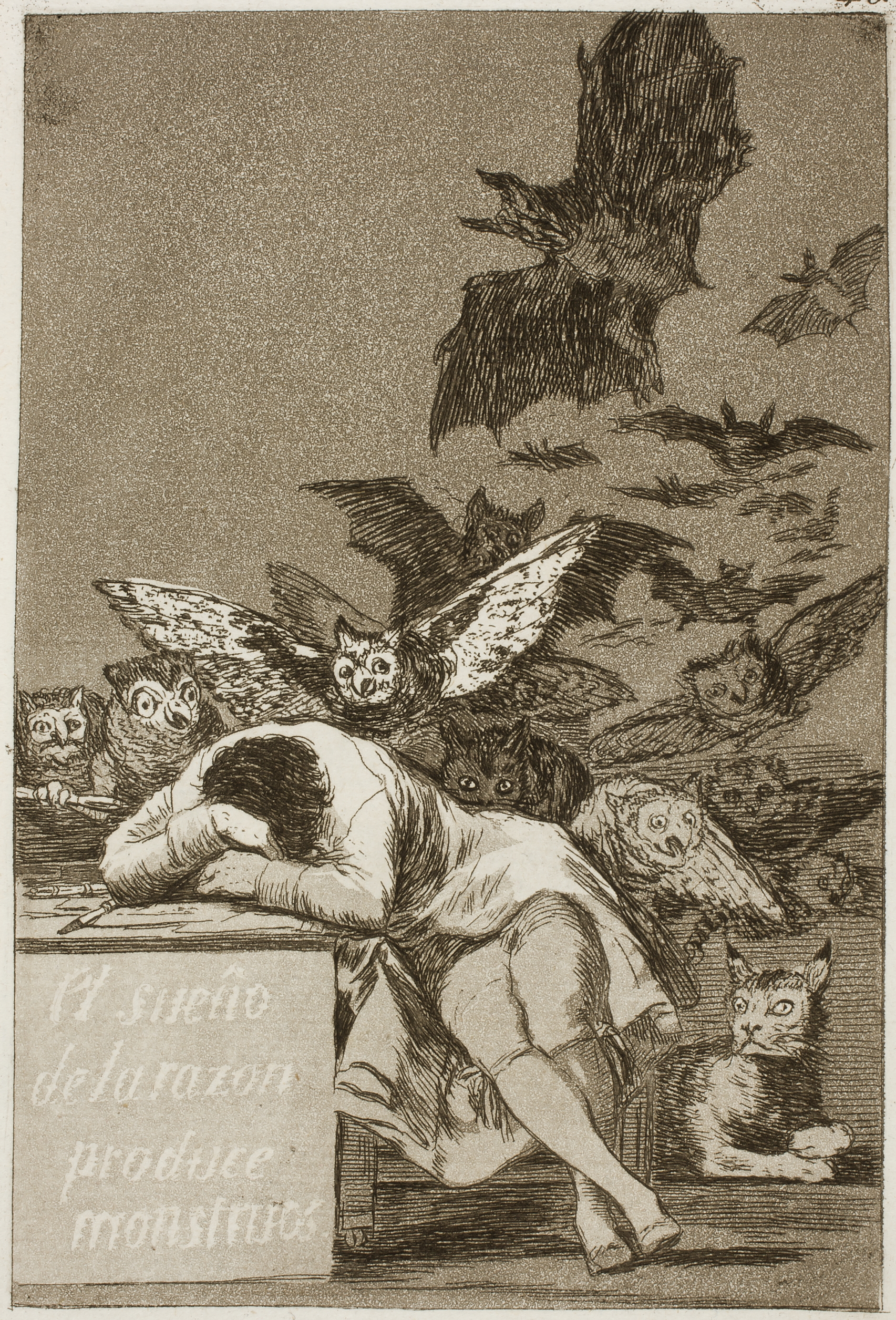
Plate 43 from Los Caprichos: The Sleep of Reason Produces Monsters (El sueno de la razon produce monstruos)
Francisco de Goya y Lucientes · Designed and etched 1797-1799; this impression printed and issued in the first edition, Madrid, 1799
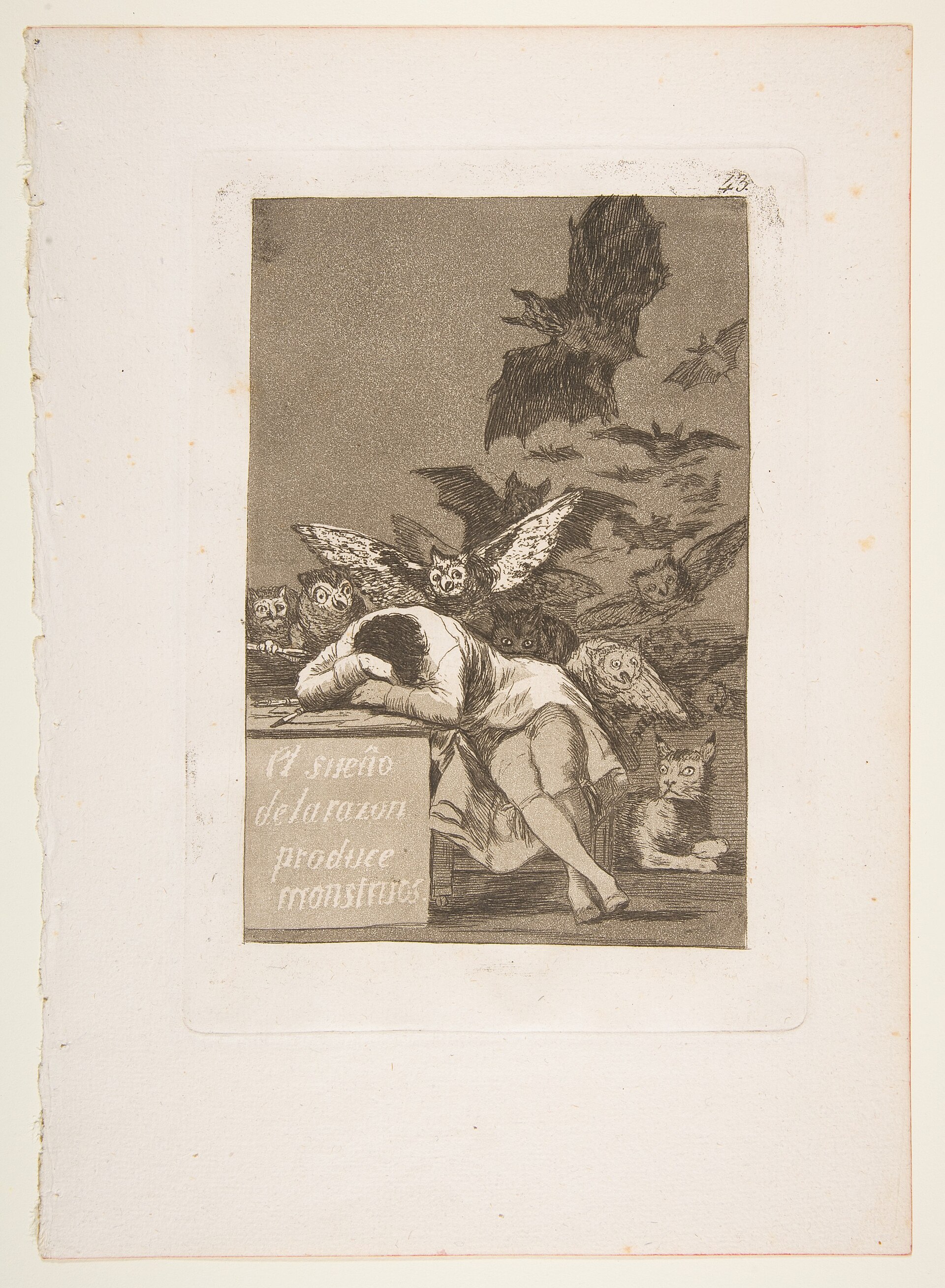
The object described in this record. First-edition impression, Madrid, 1799. Metropolitan Museum of Art, accession 18.64(43), gift of M. Knoedler and Co., 1918.
| Artist | Francisco de Goya y Lucientes |
|---|---|
| Date | Designed and etched 1797-1799; this impression printed and issued in the first edition, Madrid, 1799 |
| Medium | Etching, aquatint, drypoint, and burin on paper |
| Dimensions | Plate 21.2 x 15.1 cm (8 3/8 x 5 15/16 in); sheet 29.5 x 21 cm (11 5/8 x 8 1/4 in) |
| Where it is now | The Metropolitan Museum of Art, New Yorklast confirmed |
| Inventory number | 18.64(43) |
| Attribution | AcceptedUndisputed autograph work. Full note |
| Object type | |
| Period | Spanish, late eighteenth century |
| Cases | Has a provenance gap |
| Inscriptions | 43 etched at upper right of the plate, fixing its position in the published sequence; the caption El sueno de la razon produce monstruos printed beneath the image |
| Owners on record | 7 links6 documented, 1 unknown |
| Sources | 20 cited |
About this record Last verified · 20 sources cited · Change log
On this page 9 sections
ContentsClose
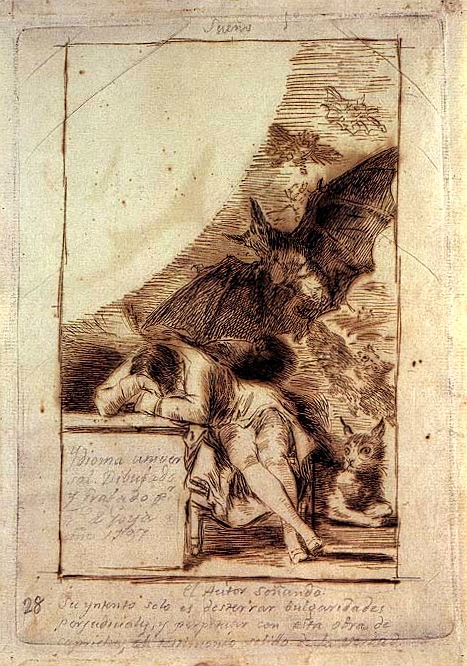
This is one sheet from the Metropolitan Museum of Art's complete set of the first edition of Francisco Goya's Los Caprichos, printed and offered for sale in Madrid in February 1799 and withdrawn from public sale about two weeks later. Plate 43 shows a man, understood to be Goya himself, asleep at a table while owls and bats swarm out of the darkness behind him and a lynx watches from below; Goya's own working drawing shows he had first planned this exact image, captioned Universal Language: The Author Dreaming, as the frontispiece of the whole album before moving his self-portrait to plate 1 and relegating this design to the middle of the sequence.
The same copper plate that made this 1799 impression was printed from for more than a century afterward by the Spanish royal print works, and the Metropolitan itself owns a second, later impression of the identical design pulled around 1908-1912 from a plate worn by a hundred years of use. This record describes only the first-edition sheet, accession 18.64(43), a gift of the dealer M. Knoedler and Co. in 1918.
In 1803 Goya handed the eighty plates and 240 unsold sets to Charles IV in exchange for a pension for his son. What happened to the roughly thirty sets unaccounted for between the 27 sold in 1799 and the 240 later surrendered to the Crown is not established in the sources consulted.
Provenance
Each link is graded. Documented: a cited source supports it. Disputed: the identification is argued but not established. Unknown: no owner for that span, and the gap is not smoothed into a narrative. The grades in the glossary.
- 1797 - 1799Francisco de Goyadocumented
Plate 43 designed and etched by Goya, developed from a 1797 preparatory drawing (Sueno 1 / Ydioma universal, now Museo del Prado) originally intended as the album's opening image under the working title Suenos.6814
- 6 February 1799 - c. 20 February 1799Offered for public sale by Goyadocumented
The complete eighty-plate album, this plate among them, advertised in the Diario de Madrid and sold from a perfume and liquor shop at Calle del Desengano 1, Madrid, at 320 reales per set. Sources differ on the exact length of the sale (Goya's own later account says two days; other evidence supports roughly a fortnight); 27 sets are documented as sold before Goya withdrew the remaining stock.6781011
- c. 1799 - 1803Francisco de Goyadocumented
Unsold sets and the eighty copper plates remained in Goya's possession.68
- 1803 - 1803Transferred to King Charles IV, via the Real Calcografiadocumented
Goya surrendered the eighty copper plates and 240 unsold printed sets to the Crown, in a letter to the treasury minister Miguel Cayetano Soler, in exchange for a lifetime pension of 12,000 reales a year for his son, Francisco Javier Goya. This transaction concerns the plates and the 240 sets as a body; it does not by itself establish which channel put the Metropolitan's specific set into circulation.68
- 1803 (or 1799) - 1918Unknownunknown
No source consulted documents the ownership of the Metropolitan's specific complete first-edition set between the 1799 sale period (if it was one of the 27 sets sold) or the 1803 transfer, and its appearance in the hands of the New York dealer M. Knoedler and Co. by 1918.12
- unknown - 1918M. Knoedler and Co., New Yorkdocumented
The complete first-edition set was in the hands of the New York art dealership M. Knoedler and Co. by 1918, when it was given to the Metropolitan Museum of Art. How or when Knoedler acquired it is not documented in sources consulted.123
- 1918 - presentMetropolitan Museum of Art, New Yorkdocumented
Gift of M. Knoedler and Co., 1918. Accessioned as 18.64(1-80), the complete set; this sheet is 18.64(43). Held in the Department of Drawings and Prints.123
Technical evidence
| Attribution note | Undisputed autograph work. Goya's authorship of Los Caprichos is documented by his own announcement in the Diario de Madrid of 6 February 1799 and by the 1803 transfer of the eighty copper plates, this one among them, into royal hands in his own name. The genuine dispute is not over authorship but over the print's original place in the album's design, addressed in the narrative below. |
|---|---|
| Support | Paper, sheet 29.5 x 21 cm; the specific paper stock of this impression is not further characterised in the sources consulted.1 |
| Medium | Etching, aquatint, drypoint, and burin.1 |
| Plate dimensions | 21.2 x 15.1 cm (8 3/8 x 5 15/16 in).1 |
| Sheet dimensions | 29.5 x 21 cm (11 5/8 x 8 1/4 in).1 |
| Plate numbering | 43 etched at the upper right corner, fixing the sheet's position in the published sequence of eighty plates.67 |
| Edition | First edition, Madrid, 1799. Accession 18.64(43), one of the eighty sheets in the Metropolitan's accession 18.64, catalogued by the museum as a complete set of the first edition.123 |
| Ink and impression character | First-edition impressions are generally described as printed in a warmer reddish-brown to sepia ink with full aquatint tonal range; later Calcografia print runs are generally described as printed in flatter black ink with visibly worn, coarser aquatint grain. This record has not independently verified the ink colour of accession 18.64(43) against a first-hand examination.6 |
| Copper plate today | The original copper plate, steel-faced, is held by the Calcografia Nacional of the Real Academia de Bellas Artes de San Fernando, Madrid. Since a 2022 conservation programme the Academy has stated it will not print from the plate again.12 |
Images
The record in full
Chapter 1The sheet itself
The object described in this record is a single sheet of paper, 29.5 by 21 centimetres, carrying an etched, aquatinted image 21.2 by 15.1 centimetres, printed from a copper plate Goya etched in...
The object described in this record is a single sheet of paper, 29.5 by 21 centimetres, carrying an etched, aquatinted image 21.2 by 15.1 centimetres, printed from a copper plate Goya etched in 1797-99 and numbered 43 at the upper right. Beneath the image runs the printed caption El sueno de la razon produce monstruos. It is one of eighty such sheets that together make up accession 18.64 at the Metropolitan Museum of Art, catalogued by the museum as a complete set of the first edition of Los Caprichos, a gift of the New York art dealer M. Knoedler and Co. in 1918.
Nothing about the sheet is unique in the way a painting is unique. Roughly three hundred copies of this same image were pulled from the same plate in the first printing alone, and the plate went on being printed from for more than a hundred years afterward. What makes any one sheet identifiable as this object is the specific combination of plate state, paper, ink and accession history that ties it to a documented pull. That combination is the subject of much of what follows.
Chapter 2How the image was pulled
Goya worked the plate in etching for the drawn line, aquatint for the broad tonal washes that give the print its smoky, atmospheric dark, and drypoint and burin for local reinforcement.
Goya worked the plate in etching for the drawn line, aquatint for the broad tonal washes that give the print its smoky, atmospheric dark, and drypoint and burin for local reinforcement. Aquatint was still a comparatively new technique in Spain in the 1790s, and Los Caprichos is generally treated as the series in which Goya first used it with full technical command, laying grain over the plate in graduated bites to produce the soft gradation from the lit page under the sleeping man's arms to the near-black in which the owls and bats materialise.
Impression quality depends entirely on how much wear the plate had taken by the time a given sheet was pulled. Early pulls carry a full range of aquatint tone and a crisp bitten line; later pulls, printed after the plate had been reworked and reprinted for a century, show flattened blacks and a coarser, more mechanical grain as the fine tonal steps wear away. This distinction is not incidental to the object described here - it is the reason this record exists in its present form, addressed directly below.
Chapter 3What the image shows
A man slumps forward over a table or portfolio, head buried in his folded arms, asleep.
A man slumps forward over a table or portfolio, head buried in his folded arms, asleep. Behind and above him a mass of owls and bats crowds out of the dark, and at the lower right a lynx-like wildcat crouches, eyes open, alert in exactly the way the sleeping man is not. The printed caption reads, in translation, The sleep of reason produces monsters.
A longer gloss on the image survives in a manuscript commentary associated with the album, sometimes attributed to Goya's own circle: Fantasia abandonada de la razon, produce monstruos imposibles: unida con ella, es madre de las artes y origen de sus marabillas - fantasy abandoned by reason produces impossible monsters; united with reason, she is the mother of the arts and the origin of their wonders. Read against that longer text, the image is not a simple endorsement of reason over superstition. It states a balance: reason without imagination is sterile, imagination without reason breeds monsters, and the print's own darkness is itself an argument for keeping the two together rather than a straightforward Enlightenment slogan. Scholars including Philip Hofer have argued that Goya's decision to move this ambivalent image out of the frontispiece position was itself a form of caution, since a design built partly on ideas associable with Rousseau would have read as more politically pointed as the announced keynote of the whole series than it does at plate 43. That argument is Hofer's; it is not stated by Goya in any surviving document, and it is presented here as an interpretation, not a fact about Goya's intentions.
Chapter 4Planned as the frontispiece, moved to the middle
A preparatory drawing for this design survives at the Museo del Prado, in pen and brown ink, inscribed at the top Sueno 1 (Dream 1).
A preparatory drawing for this design survives at the Museo del Prado, in pen and brown ink, inscribed at the top Sueno 1 (Dream 1). On the table in the drawing Goya wrote Ydioma universal. Dibujado y grabado por Fco. de Goya, ano 1797 (Universal language. Drawn and etched by Francisco Goya, year 1797), and beneath the image, El autor sonando (The author dreaming). The drawing's ownership is documented in an unbroken line from Goya's son Javier, to his grandson Mariano Goya by 1854, to the collector Valentin Carderera around 1861, to Mariano Carderera in 1880, and into the Prado in 1886.
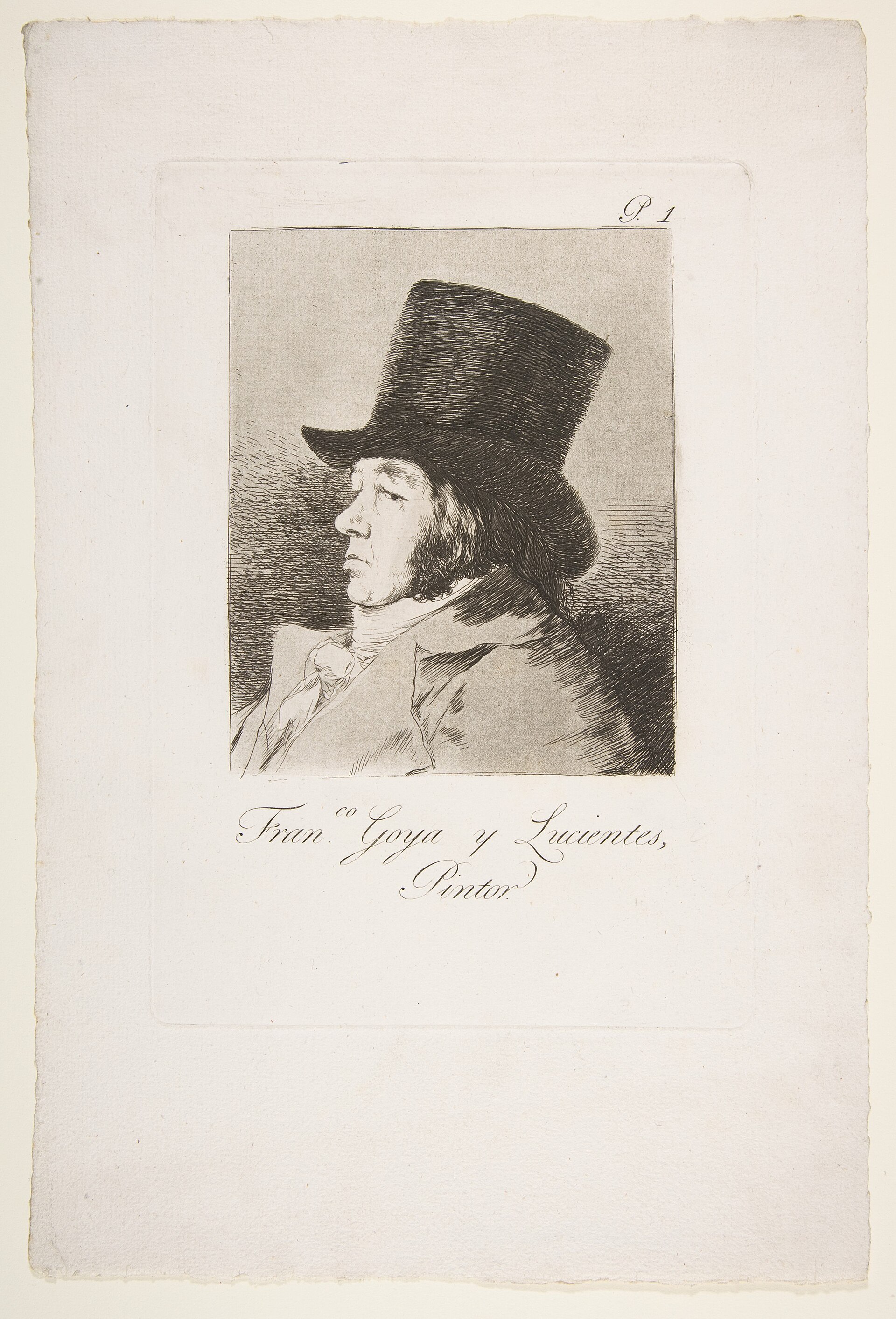
Read together with other surviving material for the album, the drawing is the basis for the standard account that Goya first conceived this design, under the working title Suenos (Dreams), as the opening image and effective manifesto of the whole series. In the published album as it appeared in 1799, the opening image is a different self-portrait entirely - the sober, top-hatted likeness captioned Franco. Goya y Lucientes, Pintor, placed at plate 1 - and the dreaming-author design was moved to plate 43, roughly the midpoint of the eighty-plate sequence, where it marks the hinge between the album's first half of social and behavioural satire and its darker second half of witches, demons and night. The reordering itself is documented by the surviving drawing and its inscription; the reasoning behind it is inference, not a statement by Goya, and is treated that way throughout this record.
Chapter 5Thirteen days in Madrid
Goya announced the series on the front page of the Diario de Madrid on 6 February 1799: a collection of eighty prints of capricious subjects, invented and etched by himself, on sale at a shop selling...
Goya announced the series on the front page of the Diario de Madrid on 6 February 1799: a collection of eighty prints of capricious subjects, invented and etched by himself, on sale at a shop selling perfume and liquor at number 1, Calle del Desengano, near his own house, at 320 reales de vellon the set - a price contemporaries equated to roughly one ounce of gold. The advertisement insisted the subjects were drawn from the universal, not aimed at any named individual.
The withdrawal that followed is one of the most repeated episodes in Spanish art history, and the sources disagree on its length. The best-supported modern account holds that the album stayed on sale for about a fortnight, roughly thirteen to fourteen days, during which 27 sets were sold out of an edition usually put at around three hundred, before Goya pulled the remaining stock from the shop. Goya's own later account does not match this: in a letter of 1803 to the treasury minister Miguel Cayetano Soler, he stated the series had been on sale for only two days. Modern cataloguers treat the two-day figure as Goya's own retrospective minimisation rather than the documented fact, since the fourteen-day figure is the one supported by the contemporary record.
Why Goya withdrew the album is genuinely contested, and the theories are not the same claim dressed differently. Goya's own explanation, so far as one survives, is indirect: a 1825 letter to his friend Joaquin Ferrer, written in exile in Bordeaux, states that he had been denounced to the Inquisition over the prints. No Inquisition trial record for Goya over Los Caprichos has been found, so this is Goya's own claim, uncorroborated by a surviving case file. A second, complementary line of art-historical argument notes the political timing: the reform-minded ministers who might have offered Goya cover, chiefly Manuel Godoy and Gaspar Melchor de Jovellanos, had themselves been removed from government in the course of 1798, so that by February 1799 Goya had no comparable protection at court. A third, more skeptical reading, associated with commentary on the album's poor commercial result, holds that the withdrawal is better explained by weak sales at a very high price through an unconventional retail outlet - a perfumer's, not a bookshop - than by any active threat, and that the Inquisition explanation is Goya's own later dramatisation of what was in fact a commercial disappointment. This record presents all three as distinct, documented positions rather than blending them into a single smooth story.
Chapter 6Twelve thousand reales a year
Goya did not sell the plates. In 1803, in a letter to Miguel Cayetano Soler, he offered King Charles IV the eighty copper plates of Los Caprichos together with 240 unsold printed sets, for deposit at...
Goya did not sell the plates. In 1803, in a letter to Miguel Cayetano Soler, he offered King Charles IV the eighty copper plates of Los Caprichos together with 240 unsold printed sets, for deposit at the Real Calcografia, the royal print works, in exchange for a lifetime pension of 12,000 reales a year for his son, Francisco Javier Goya, who wished to study painting. It was, on its face, not a cash transaction but a favour done in the language of royal patronage, and it is documented as such in the surviving correspondence summarised by modern cataloguers.
The arithmetic does not fully close in the sources consulted for this record. An edition commonly put at around 300 sets, minus the 27 sold in February 1799 and the 240 sets Goya later surrendered to the Crown, leaves roughly 33 sets unaccounted for - copies that may have been sold quietly after the formal withdrawal, given away, spoiled, or held back for reasons not recorded. This gap is noted in open questions below rather than bridged with a guess.
Later commentators have proposed, as an interpretation rather than a documented motive, that the Crown's interest in acquiring a provocative and only lightly circulated series had as much to do with controlling it as with preserving it. No document in the sources consulted states this as the Crown's reason; it is included here, graded as argued rather than documented, because it recurs in serious secondary literature on the transaction.
Chapter 7A plate printed for a hundred and seventy years
After 1803 the plates belonged to the Real Calcografia, the institution today known as the Calcografia Nacional, part of the Real Academia de Bellas Artes de San Fernando in Madrid.
After 1803 the plates belonged to the Real Calcografia, the institution today known as the Calcografia Nacional, part of the Real Academia de Bellas Artes de San Fernando in Madrid. The Academy went on printing from the original eighty plates for well over a century. Secondary sources differ on the precise count of official editions - figures of twelve, thirteen and twenty total editions across the nineteenth and twentieth centuries all appear in material consulted for this record, a discrepancy this record has not been able to resolve and is stating plainly rather than picking one figure to sound authoritative. What is consistent across sources is the broad shape: further print runs through most of the nineteenth century, a further cluster in the first decades of the twentieth, and a final official edition dated 1970.
Since 2022 the Real Academia has been conserving 228 of Goya's plates across four series - the Caprichos, the Desastres de la Guerra, the Tauromaquia and the Disparates - work that has included stabilising a nineteenth- and twentieth-century electrolytic steel coating applied to protect the copper. The Academy has stated it will not print from the restored plates again, converting them permanently from working tools into conserved artefacts. A selection is on public view at the Gabinete Francisco de Goya in Madrid, shown alongside digital reproductions of the prints they made.
Chapter 8The same plate, printed eleven decades apart
The clearest demonstration of why edition matters for this object is not an external comparison but an internal one.
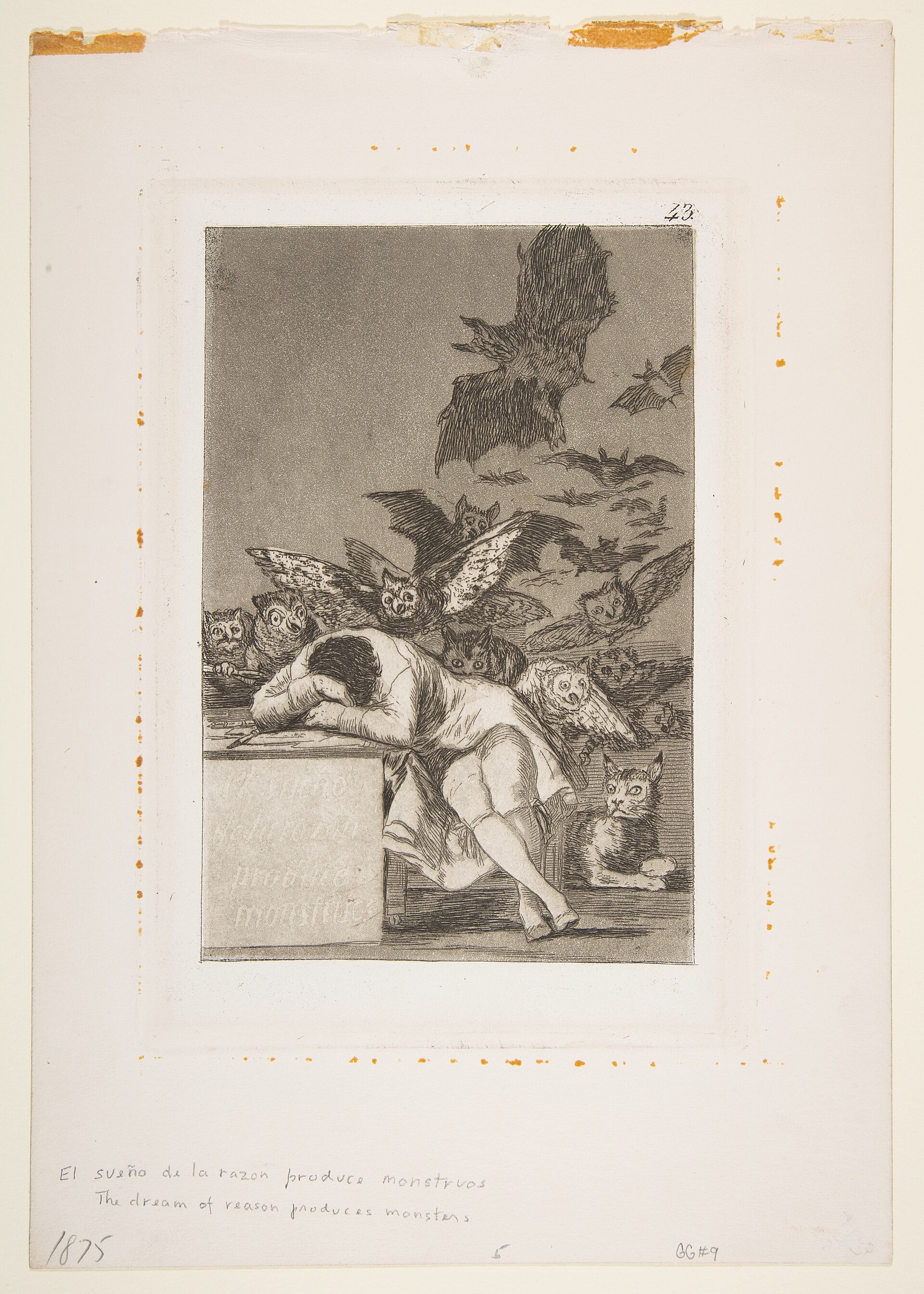
The clearest demonstration of why edition matters for this object is not an external comparison but an internal one. The Metropolitan Museum of Art holds two separate, independently accessioned impressions of plate 43, pulled from the same copper plate more than a century apart. The sheet described in this record, accession 18.64(43), belongs to the museum's complete set of the first edition, 1799, given by M. Knoedler and Co. in 1918. A second Metropolitan sheet, accession 1986.1180.895, bequeathed by Grace M. Pugh in 1985, is catalogued by the museum itself as printed in 1908-1912 - one of the twentieth-century Calcografia print runs, pulled more than a hundred years after Goya's death from a plate that had by then been printed thousands of times and steel-faced for durability.
The two sheets show the same design, carry the same plate number, and sit in the same museum's storerooms under superficially similar-looking accession codes. Only the object record - the year of the gift, the donor's name, the edition field - distinguishes a sheet worth citing as a document of 1799 Madrid from a sheet that documents a print shop's routine reprinting a century later. Every fact, dimension and image in this record refers to accession 18.64(43) alone. Where the later Metropolitan impression appears in the image gallery below, it is labelled as what it is: a different, later pull from the same plate, not the object described here.
Chapter 9This impression's own history
What can be said with confidence about accession 18.64(43) specifically is limited.
What can be said with confidence about accession 18.64(43) specifically is limited. It is one sheet of a complete eighty-plate set that the Metropolitan's own records identify as the first edition, and the set came to the museum as a gift from the New York dealer M. Knoedler and Co. in 1918. Where the set was between 1799 and its appearance in Knoedler's hands is not documented in the sources consulted for this record. It is not established here, and should not be assumed, whether this set was one of the 27 sold from the Calle del Desengano shop before the February 1799 withdrawal, or reached the market by some later channel; the two are not the same claim, and only the first would place this specific set inside the documented two-week sale.
What is documented is the accession itself, and the museum's own classification of the set as complete and first-edition, a classification this record treats as authoritative pending any published Metropolitan curatorial file that says otherwise.
Chapter 10What it cost, and what comparable sets have made since
320 reales for the eighty-print set in 1799 was, by contemporary account, roughly the price of an ounce of gold - a luxury purchase, not an impulse buy, and one aimed by its retail venue and price at...
320 reales for the eighty-print set in 1799 was, by contemporary account, roughly the price of an ounce of gold - a luxury purchase, not an impulse buy, and one aimed by its retail venue and price at a wealthy or professional buyer rather than a popular audience. No source consulted for this record offers a defensible period-wage or retail-price-index conversion of that figure into modern currency, and this record is not supplying one rather than quoting an unsourced round number.
Complete first-edition sets in original condition are now rare and valuable as a class. A complete first-edition set in a contemporary Spanish binding, from the Josefowitz collection, sold at Christie's, New York, on 28 January 2014, for 1,445,000 US dollars; the source consulted for this figure did not distinguish the hammer price from the buyer's premium, and that distinction should be confirmed against Christie's own sale record before this figure is used for valuation purposes. The Fitzwilliam Museum, Cambridge, acquired a complete bound first-edition set through the Gow Fund in 1986. The British Museum's holdings of the series descend through the Tomas Harris collection, catalogued by Juliet Wilson-Bareau. The Museum of Fine Arts, Boston, built its Goya print holdings under the curator Eleanor A. Sayre, who co-directed, with Alfonso E. Perez Sanchez, the 1988-89 exhibition Goya and the Spirit of Enlightenment, shown at the Museo del Prado, at the Museum of Fine Arts, Boston, and at the Metropolitan Museum of Art itself - the institution that holds the sheet described in this record.
The artist
Francisco Jose de Goya y Lucientes
Goya is unusually well documented for an artist of his period, and the documentation makes the existence of Los Caprichos stranger, not more expected. He was, at the moment he etched and sold these prints, the most senior painter at the Spanish court, on the largest salary the position paid. Los Caprichos was not a commission. He financed it, designed it, etched it, and sold it himself from a shop near his own house, under his own name, at his own risk - an act of private authorship unusual for a sitting court painter anywhere in Europe in 1799.
Related works
| Work | Relation | Where it is |
|---|---|---|
| Self-Portrait; Plate 1 from Los Caprichos Francisco de Goya | The self-portrait Goya substituted as the album's actual opening image, in place of the design now at plate 43 A separate Metropolitan Museum impression, accessioned in 1950 as a gift of Mrs. Francis Ormond; not confirmed in sources consulted as belonging to the first-edition set. | Metropolitan Museum of Art, New York (accession 50.558.33) |
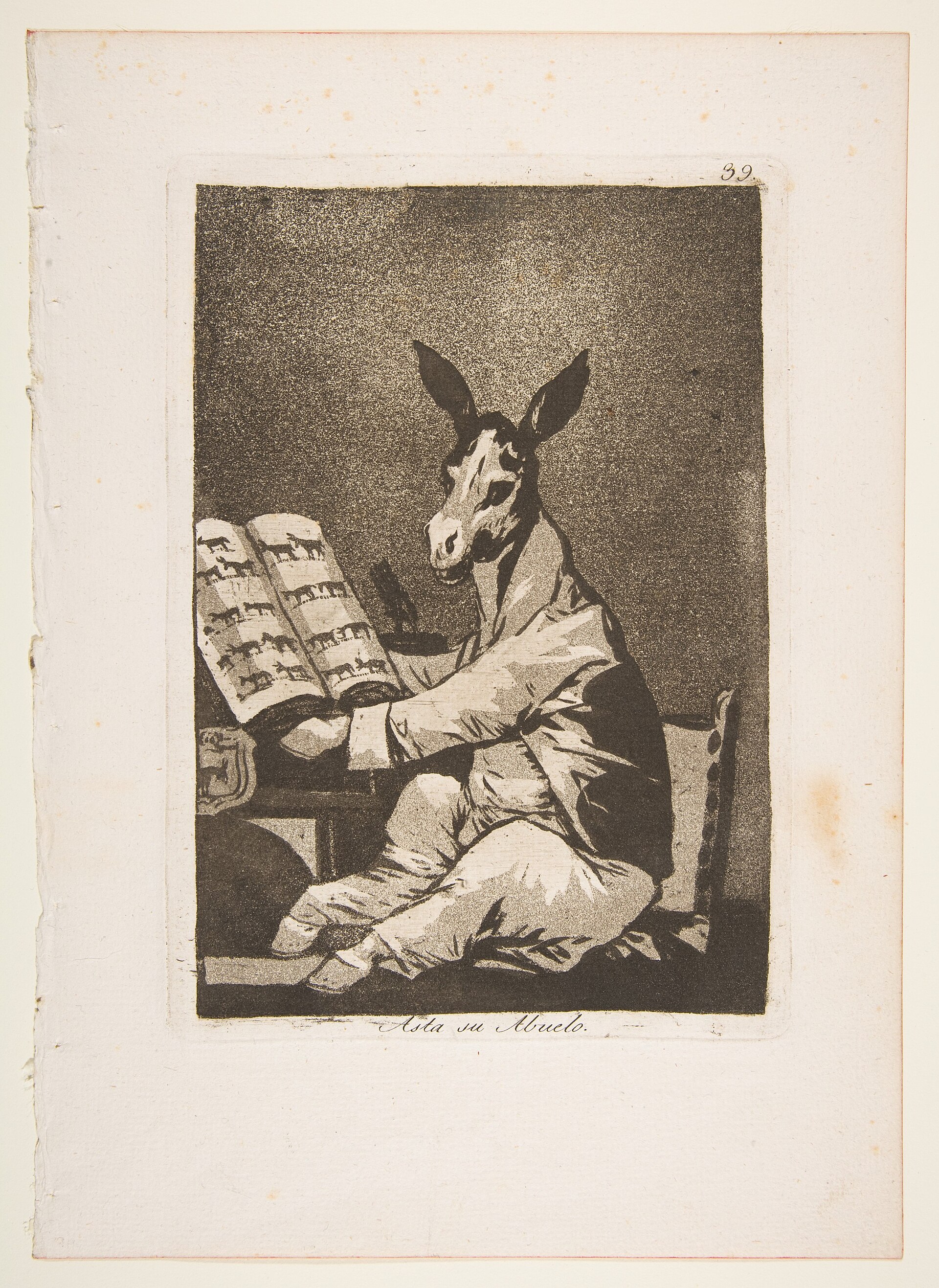
| Plate 39 from Los Caprichos: Asta su abuelo (And so was his grandfather) Francisco de Goya | A sibling sheet from the same physical set as the object in this record Part of the same accession 18.64 complete first-edition set, same 1918 Knoedler gift. | Metropolitan Museum of Art, New York (accession 18.64(39)) |
| Sueno 1 / Ydioma universal (preparatory drawing) Francisco de Goya | The 1797 preparatory drawing establishing Goya's original plan to open the album with this design Pen and ink, inscribed Ydioma universal. Dibujado y grabado por Fco. de Goya, ano 1797 and El autor sonando. Documented ownership from Javier Goya through the Carderera family to the Prado in 1886. | Museo del Prado, Madrid |
| Los Caprichos, complete first-edition set (bound) Francisco de Goya | Comparanda: another complete, bound first-edition set of the same album Acquired 1986 through the Gow Fund; bound with six pages of period manuscript notes in an early nineteenth-century German binding. | Fitzwilliam Museum, Cambridge |
| Los Caprichos, the Tomas Harris collection Francisco de Goya | Comparanda: the British Museum's holdings of the series Catalogued by Juliet Wilson-Bareau in Goya's Prints: The Tomas Harris Collection in the British Museum. | British Museum, London |
| Plate 43 from Los Caprichos, later Calcografia impression Francisco de Goya | The same design, the same copper plate, printed roughly 1908-1912 - a different, later edition object, not the one described in this record Bequest of Grace M. Pugh, 1985. Catalogued by the museum itself as printed 1908-1912, over a century after the plate was first bitten. Included here specifically as a documented example of what a late-edition impression of this same plate looks like, for contrast with the first-edition object this record describes. | Metropolitan Museum of Art, New York (accession 1986.1180.895) |
Open questions
- Was the Metropolitan's set (accession 18.64) one of the 27 sets sold from the Calle del Desengano shop before the February 1799 withdrawal, or did it reach the market by a different, undocumented channel? Not established in the sources consulted.
- What became of the roughly 33 sets unaccounted for between an edition usually cited at about 300, the 27 sold in 1799, and the 240 surrendered to the Crown in 1803? No source consulted resolves this gap.
- Was Goya ever formally denounced to, or investigated by, the Spanish Inquisition over Los Caprichos? His own 1825 letter to Joaquin Ferrer claims a denunciation; no surviving Inquisition case file has been identified in the sources consulted.
- Why does Goya's own 1803 account of the withdrawal (two days) conflict with the roughly fourteen-day timeline supported by other evidence? Whether this is a simple lapse of memory, a deliberate minimisation, or evidence the true withdrawal date is less certain than usually stated is not resolved.
- How many official Calcografia editions of Los Caprichos were actually printed between 1799 and 1970? Sources consulted give twelve, thirteen and twenty as the total count, and this record has not been able to determine which is correct.
- Between the 1803 transfer and the 1918 Knoedler gift, where was the Metropolitan's specific set of eighty sheets, and through whose hands did it pass? Undocumented in sources consulted.
Questions about this object
What is Plate 43 from Los Caprichos: The Sleep of Reason Produces Monsters (El sueno de la razon produce monstruos)?
Plate 43 from Los Caprichos: The Sleep of Reason Produces Monsters (El sueno de la razon produce monstruos) is a print, dated designed and etched 1797-1799; this impression printed and issued in the first edition, Madrid, 1799. Medium: Etching, aquatint, drypoint, and burin on paper.
Who made Plate 43 from Los Caprichos: The Sleep of Reason Produces Monsters (El sueno de la razon produce monstruos), and is the attribution settled?
The attribution to Francisco de Goya y Lucientes is recorded here as accepted. Undisputed autograph work. Goya's authorship of Los Caprichos is documented by his own announcement in the Diario de Madrid of 6 February 1799 and by the 1803 transfer of the eighty copper plates, this one among them, into royal hands in his own name. The genuine dispute is not over authorship but over the print's original place in the album's design, addressed in the narrative below.
Where is Plate 43 from Los Caprichos: The Sleep of Reason Produces Monsters (El sueno de la razon produce monstruos) now?
The Metropolitan Museum of Art, New York. Inventory number 18.64(43). Last confirmed 13 August 2026. Gift of M. Knoedler & Co., 1918, as one sheet of accession 18.64, the Metropolitan's complete set of the first edition of Los Caprichos (plates 1-80).
What is still unknown about Plate 43 from Los Caprichos: The Sleep of Reason Produces Monsters (El sueno de la razon produce monstruos)?
Was the Metropolitan's set (accession 18.64) one of the 27 sets sold from the Calle del Desengano shop before the February 1799 withdrawal, or did it reach the market by a different, undocumented channel? Not established in the sources consulted.
Sources
- 1Metropolitan Museum of Art, Collection API record for object 338473, Plate 43 from Los Caprichos (accession 18.64(43)). collectionapi.metmuseum.org/public/...
- 2Metropolitan Museum of Art, Collection API record for object 333801, The Caprices (Los Caprichos), plates 1-80 (accession 18.64(1-80)), portfolio field: Complete set of the first edition. collectionapi.metmuseum.org/public/...
- 3Wikimedia Commons, file page for the Metropolitan Museum's digital photograph of accession 18.64(43), donated under the Met's Open Access policy, CC0. commons.wikimedia.org/wiki/...
- 4Wikimedia Commons, file page for the Metropolitan Museum's digital photograph of accession 1986.1180.895, dated by the museum '1799, published 1908-1912', CC0. commons.wikimedia.org/wiki/...
- 5Wikimedia Commons, file page for the Museo del Prado's photograph of its own impression of Plate 43, described in the file record as first edition (1st ed., Madrid, 1799), public domain. commons.wikimedia.org/wiki/...
- 6Wikipedia, 'Los caprichos'. en.wikipedia.org/wiki/...
- 7Wikipedia, 'The Sleep of Reason Produces Monsters'. en.wikipedia.org/wiki/...
- 8Fundacion Goya en Aragon, catalogue entry for El sueno de la razon produce monstruos, including the preparatory drawing's documented provenance (Javier Goya to the Prado, 1886). fundaciongoyaenaragon.es/eng/...
- 9National Gallery of Victoria, 'Goya's Caprichos', curatorial essay. ngv.vic.gov.au/essay/...
- 10JSTOR Daily (Artstor), 'Goya's Los Caprichos: A magnificent failure', on the 1799 sale, price, retail location and commercial-failure reading of the withdrawal. about.jstor.org/blog/...
- 11InfoGoya, Universidad de Zaragoza, 'Los Caprichos', on the Diario de Madrid announcement and the 1803 transfer. goya.unizar.es/InfoGoya/...
- 12Fundacion Goya en Aragon, 'La Calcografia Nacional de la Real Academia de Bellas Artes de San Fernando restaurara 228 planchas de Goya' (2022), on the plates' current condition, conservation and the Academy's decision to stop printing from them. fundaciongoyaenaragon.es/eng/...
- 13Fitzwilliam Museum, Cambridge, collection highlight page for its complete first-edition, bound set of Los Caprichos, acquired 1986 through the Gow Fund. fitzmuseum.cam.ac.uk/explore-our-collection/...
- 14Wikimedia Commons, file page for Ydioma universal (the 1797 preparatory drawing), public domain, describing the inscription and the drawing as the basis for the frontispiece-reordering account. commons.wikimedia.org/wiki/...
- 15Wikimedia Commons, file page for the Metropolitan Museum's photograph of Plate 1 (Self-portrait), accession 50.558.33, CC0. commons.wikimedia.org/wiki/...
- 16Wikimedia Commons, file page for the Metropolitan Museum's photograph of Plate 39 (Asta su abuelo), accession 18.64(39), same 1918 gift as the lead object, CC0. commons.wikimedia.org/wiki/...
- 17Wikipedia, 'Eleanor Sayre'. en.wikipedia.org/wiki/...
- 18Internet Archive, catalogue record for 'Goya and the Spirit of Enlightenment' (Alfonso E. Perez Sanchez and Eleanor A. Sayre, codirectors), exhibition catalogue for the Museo del Prado, Museum of Fine Arts Boston, and Metropolitan Museum of Art, 1988-89. archive.org/details/...
- 19Aggregated auction-market reporting on the Josefowitz copy of Los Caprichos (complete first-edition set, contemporary Spanish binding), sold Christie's, New York, 28 January 2014, lot 9. The Christie's lot page itself could not be fetched directly for this record; the hammer price and buyer's premium are not distinguished in the sources consulted and should be confirmed against Christie's own record before use. christies.com/en/...
- 20Wikipedia, 'Francisco Goya'. Robert Hughes, Goya, or a Prado/Sayre catalogue biography). en.wikipedia.org/wiki/...
_MET_DP816992.jpg)
_MET_DP816991.jpg)


_MET_DP816886.jpg)
_MET_DP816977.jpg)
Last verified · Published
Change log
13 August 2026 - Record created at the house standard: researched narrative, technical evidence, maker dossier, graded provenance chain, prices with hammer and premium separated, related works, open questions and sources.