Berthe Morisot
 French · 1841-1895
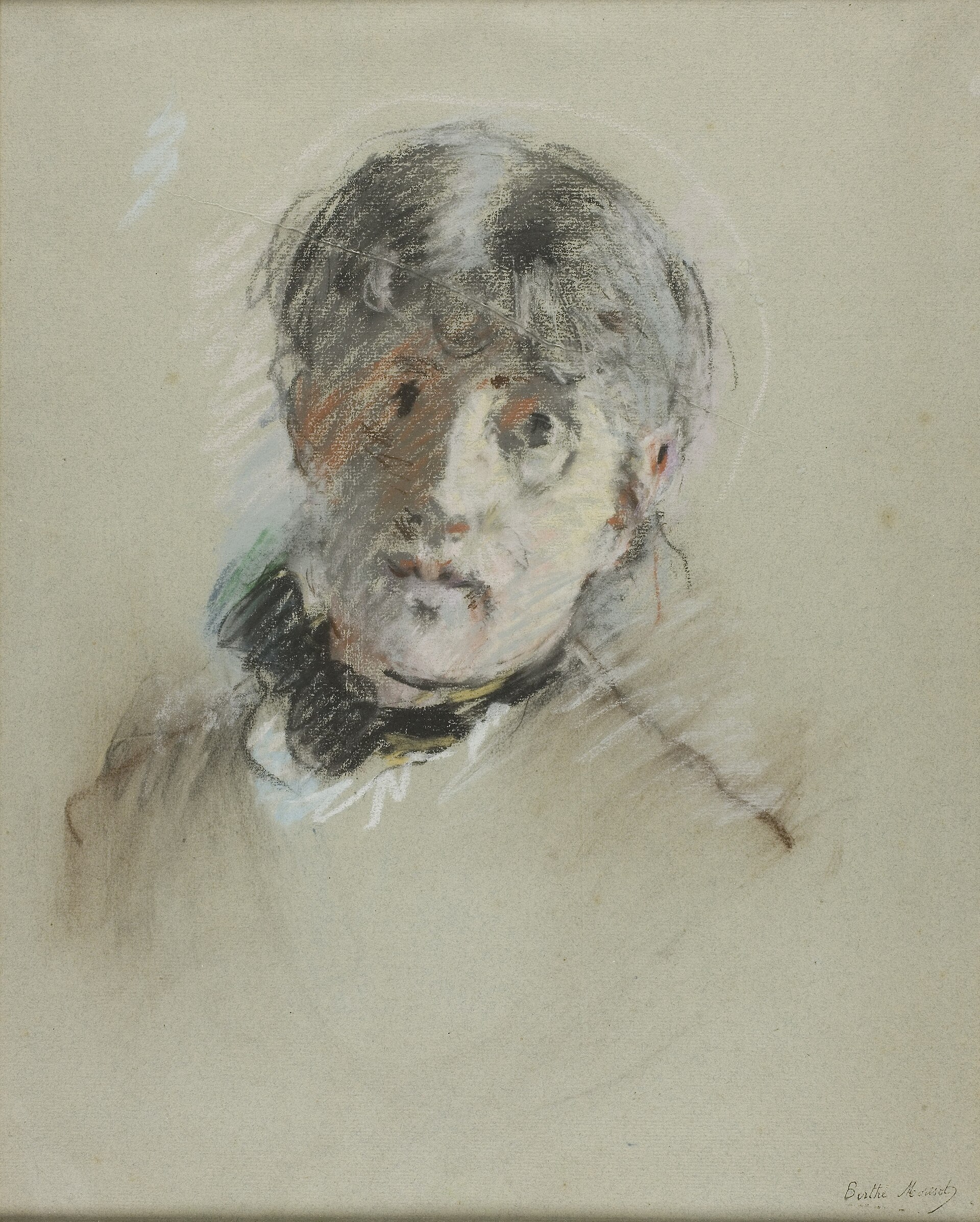
Self-Portrait, c. 1885, pastel with stumping on grey laid paper with blue fibres, 48 x 38 cm, Art Institute of Chicago 1965.685R, signed lower right. The museum catalogues it as a self-portrait and the signature supports that. A separate oil Autoportrait of 1885 is at the Musee Marmottan.
Art Institute of Chicago (public domain, Helen Regenstein Collection)| Full name | Berthe Marie Pauline Morisot |
|---|---|
| Worked as | Painter, Pastellist, Watercolourist, Printmaker |
| Born | 14 January 1841 · Bourges, France |
| Died | 2 March 1895 · Paris, France |
| Nationality | French |
| Movement | Impressionism |
| Sources | 24 cited |
| Last verified |
About this page Last verified · 24 sources cited
On this page 13 sections
ContentsClose
Berthe Morisot showed in seven of the eight Impressionist group exhibitions between 1874 and 1886 and missed only the fourth, in 1879, the year after her daughter Julie was born. She sold little in her lifetime. The largest single group of her work, 25 oil paintings and 75 watercolours with many pastels and drawings, is at the Musee Marmottan Monet in Paris, which says it holds the collection by the will of the artist's descendants.
The number that circulates for her output is not a count of paintings. Encyclopedia.com says she made more than 860 paintings. The catalogues say otherwise: the 1997 catalogue of her oils ends at entry 423, and the 1961 catalogue that mixes oil, pastel and watercolour ends at 847, with a few bis entries on top. Her drawings, which were catalogued once in 1933, have not been catalogued as a body since.
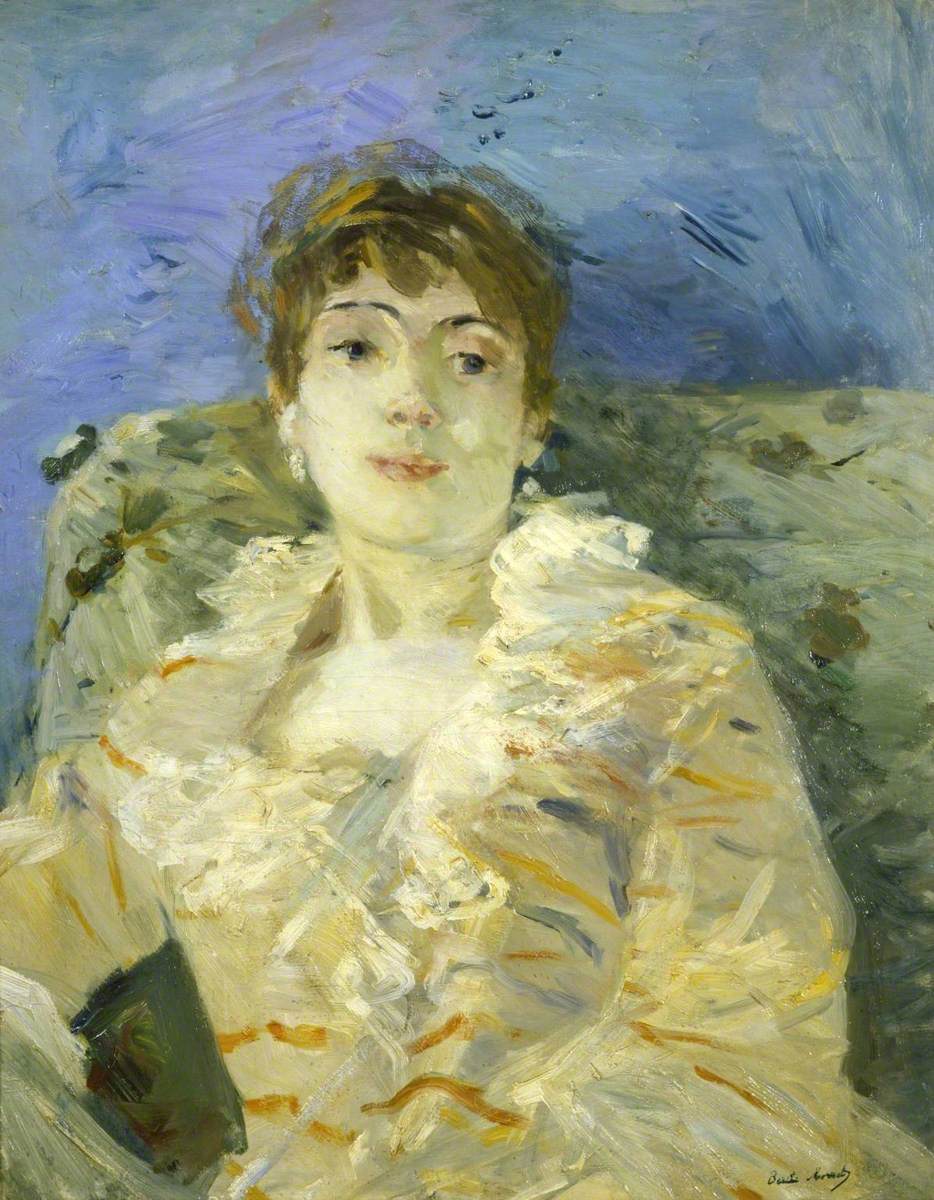
The other thing a buyer or a student should know is that the signature on a Morisot can be her daughter's doing. Julie Manet's son said in 1969 that the studio stamp on one picture was applied by his mother herself, and that she supplied the date. No authentication committee turned up in the sources read. One of the three authors of the 1997 catalogue of her oils, Yves Rouart, whom Wesley Johnston calls her great-grandson, signed a certificate of authenticity that a London dealer cites in a 2026 listing.
Images
Chronology
- 1841
Born 14 January at Bourges, where her father Edme Tiburce Morisot was prefect of the Cher.15
- 1857
First lessons with Geoffroy-Alphonse Chocarne, then with Joseph Guichard, who introduces her to the Louvre; she is copying there by 1858.15
- 1864
Appears at the Salon for the first time, listed as a pupil of Guichard and of Achille Oudinot.15
- 1868
Introduced to Edouard Manet by Henri Fantin-Latour.15
- 1872
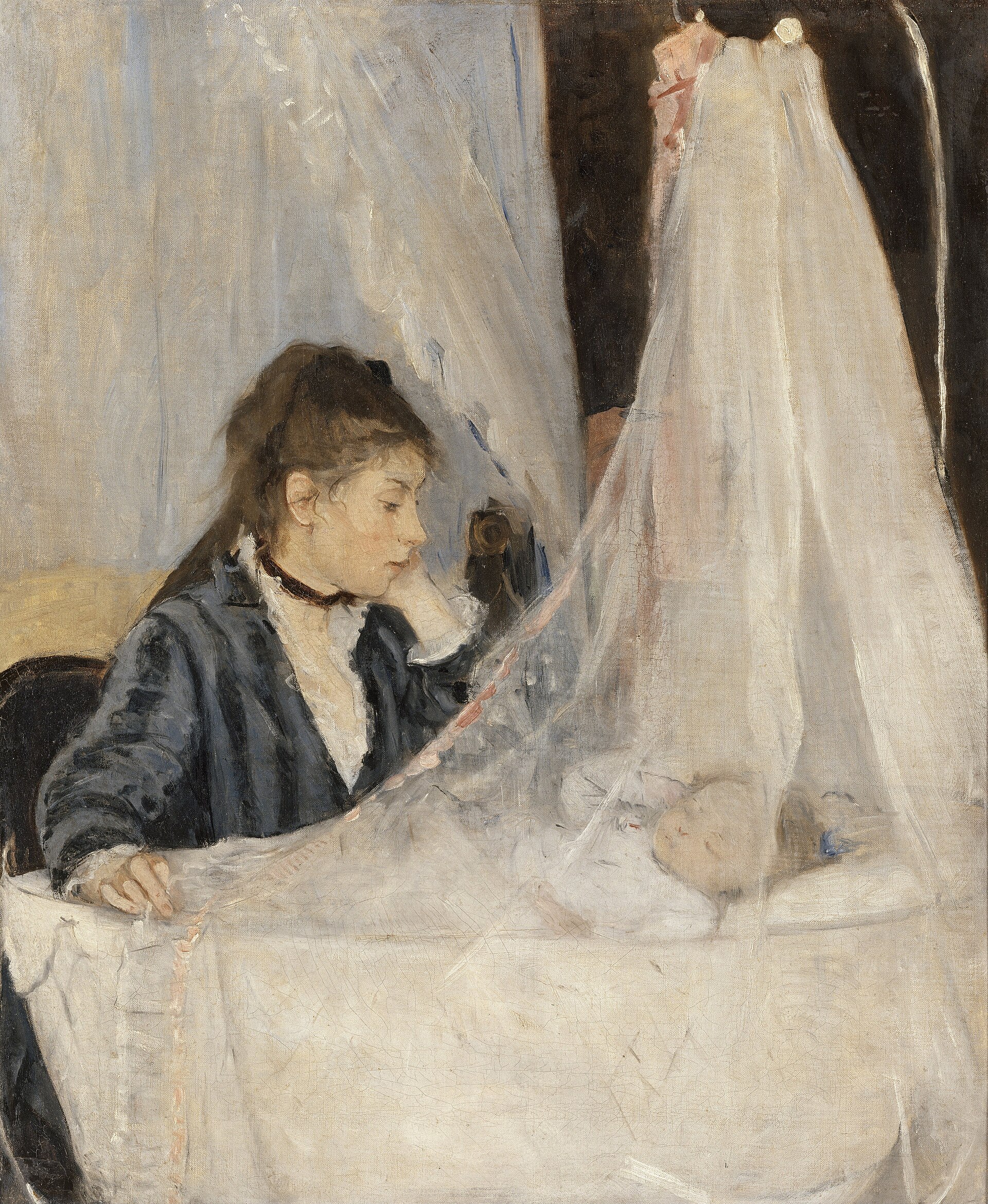
Paints The Cradle, later priced by her at 800 francs.17
- 1874
Shows in the first Impressionist exhibition from 15 April; marries Eugene Manet the same year.15
- 1875
Hotel Drouot sale: an interior fetches 480 francs and a pastel 320.15
- 1878
Julie Manet born 14 November.15
- 1879
Misses the fourth Impressionist exhibition, the only one of the eight she skips.2
- 1882
Apres le dejeuner hangs at the seventh exhibition while she is in Nice and Eugene Manet manages her contribution.1
- 1886
The Bath is shown at the last group exhibition and finds no buyer.2
- 1894
The French state buys Jeune femme en toilette de bal for the Luxembourg museum.16
- 1895
Dies at Paris on 2 March.15
- 1896
Durand-Ruel retrospective in March, helped by Julie, Degas, Renoir and Monet, with a preface by Mallarme.1
- 1930
The Louvre acquires The Cradle.17
- 1933
Monique Angoulvent's catalogue of 663 entries in all media, compiled with Julie Manet's help.9
- 1961
Bataille and Wildenstein catalogue of oils, pastels and watercolours, numbered to 847.9
- 1969
Denis Rouart gives his account of the stamp and the date of Girl on a Divan.4
- 1997
Clairet, Montalant and Rouart publish the catalogue of the oils, ending at entry 423.921
- 2011
French press reports a raid on the Wildenstein Institute turning up works described as stolen or missing, reportedly including a Morisot oil missing for 17 years; Yves Rouart had filed a complaint for handling stolen goods.12
- 2013
Apres le dejeuner makes GBP 6,985,250 at Christie's London on 6 February.1
- 2026
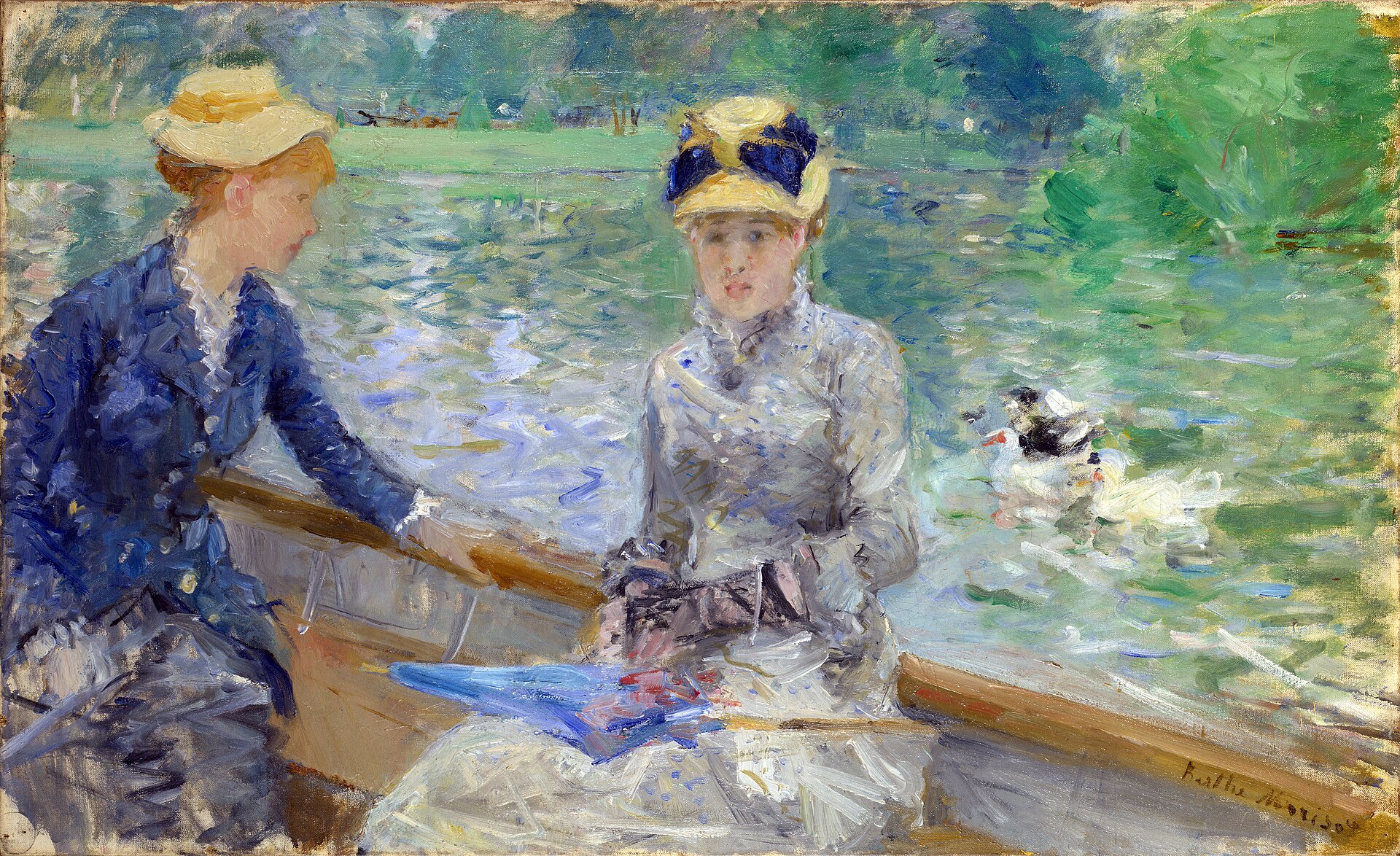
Summer's Day goes on a new long loan to the Hugh Lane gallery, Dublin, running to 2031.5
The market
The record is a single picture sold in 2013, Apres le dejeuner, at GBP 6,985,250 including premium. In October 2025 the headline lot of a Christie's London day sale was an 1888 painting at USD 802,300. The lifetime figures recorded here are hundreds of francs. Christie's lot page gives the 2013 figure as a single price realised and does not state the hammer.
The 2013 picture came with a documented chain through Portier, Vever, Sears and Lasker, the 1896 retrospective and a lot essay arguing for its place in the 1882 show. I found no source that says what a provenance is worth in her prices.
| Date | Sale | Work | Result | Note |
|---|---|---|---|---|
| 1875 | Hotel Drouot | Interior (Young Woman with Mirror) | Hammer 480 With premium not recorded francs | Her top price at the 1875 sale; a pastel, On the Lawn, made 320. Reported by English Wikipedia, which does not say whether this was hammer or total. |
| 6 February 2013 | Christie's, London | Apres le dejeuner (1881), 81 x 100 cm, lot 11, Impressionist/Modern Evening Sale | Hammer not stated on the lot page With premium GBP 6,985,250 price realised; hammer and premium not separated on the page GBP | Estimate GBP 1,500,000 to 2,500,000. Lot noted 5 per cent VAT on hammer. Last sold at Christie's New York on 14 May 1997 as lot 16. |
| 17 October 2025 | Christie's, London | Jeanne Gobillard au piano et Julie Manet (1888) | Hammer not stated With premium USD 802,300 as reported by HENI; sterling figure not on the page USD (reported conversion) | 19 per cent above its low estimate of USD 674,100. Headline lot of a sale totalling USD 18.45 million. |
Hammer is the price at which the bidding stopped; with premium adds the fee the house charges the buyer on top. Hammer price and buyer's premium in the glossary.
Where to see the work
| Institution | City | Holdings | Note |
|---|---|---|---|
| Musee Marmottan Monet | Paris | 25 oils, 75 watercolours and many pastels and drawings, the largest group | Includes Eugene Manet a l'ile de Wight, Au bal and the 1885 Autoportrait, per the museum page. |
| Musee d'Orsay | Paris | The Cradle (Le Berceau), 1872 | Acquired by the Louvre in 1930 and moved to Orsay after 1986. Orsay's own page could not be read. |
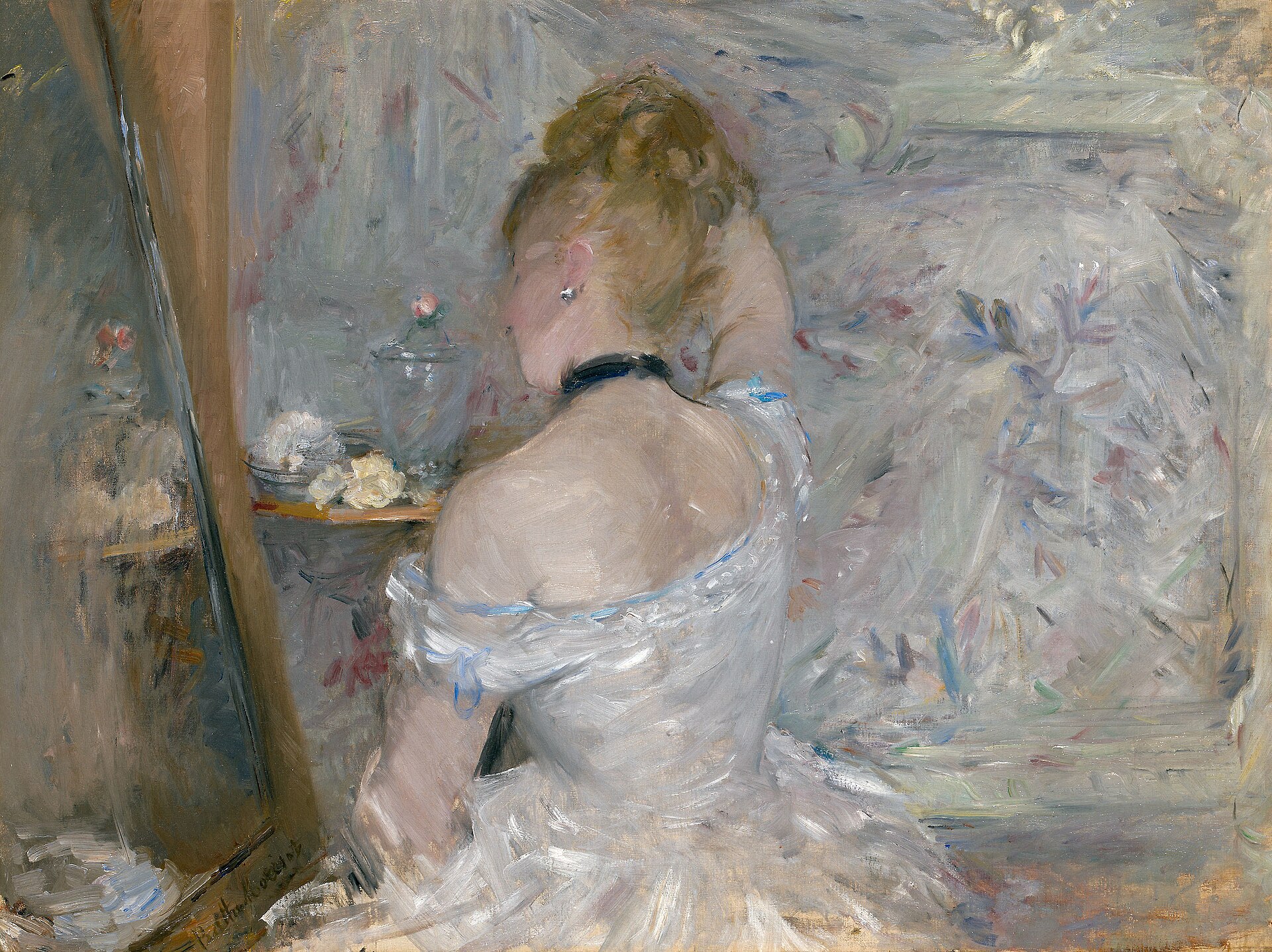
| Art Institute of Chicago | Chicago | Woman in a Garden, Woman at Her Toilette, Self-Portrait (pastel) and further works on paper | Open access data. |
| National Gallery | London | Summer's Day; Girl on a Divan (Tate loan L720) | Summer's Day is on long loan to the Hugh Lane in Dublin from February 2026. |
| Dublin City Gallery The Hugh Lane | Dublin | Summer's Day, long loan to 23 February 2031 | From the Hugh Lane Bequest, 1917. |
| Clark Art Institute | Williamstown, Massachusetts | The Bath (Au bain), 1885-86 | Technical report published in the 2012 catalogue. |
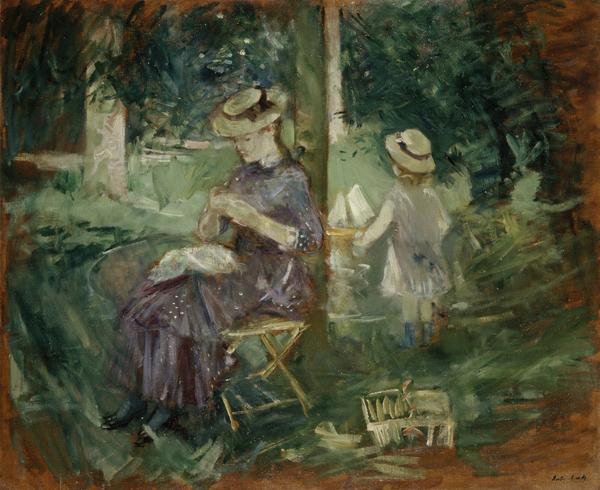
| National Galleries of Scotland | Edinburgh | A Woman and Child in a Garden, NG 2269 | Not checked beyond the Commons file record. |
| National Gallery of Art | Washington | Several oils and drypoints | Taken from the English Wikipedia list of works; not checked against the museum record. |
Forgeries and misattributions
- Head of a Child, Clark Art Institute 1955.819 (misattribution, not a forgery)
- Bought in 1926 from Scott and Fowles as a Morisot. By March 1972 the attribution had been changed to nineteenth-century French. A student suggested a likeness with a Morisot in Brooklyn and also Cassatt or Bracquemond. Wildenstein's Morisot experts judged it not by Morisot and probably not French, with no record in their files. It is on a black walnut panel, a wood native mainly to America. Absence from the catalogue raisonne and a house opinion from Wildenstein. The Clark says the walnut panel may point to an American source but that the picture cannot be placed as French or American. The Clark still lists it as artist unknown.3
The essay
Chapter 1The oil count is 423, and the 860 is not an oil count
Encyclopedia.com states that she produced more than 860 paintings .
Encyclopedia.com states that she produced more than 860 paintings . No catalogue I opened supports that as a count of paintings. Monique Angoulvent's 1933 catalogue, the first of every medium, has numbered entries up to 663 plus two unnumbered sculptures . The 1961 catalogue by Marie-Louise Bataille and Georges Wildenstein covers oils, pastels and watercolours and is numbered to 847, with a few bis entries slipped between numbers . A dealer's page for a work of 1894 cites its entry 842 , which fits that range. The 1997 catalogue by Alain Clairet, Delphine Montalant and Yves Rouart covers oils only and ends at 423, again with a few bis numbers .
So the oil corpus in the standard reference is about 423 pictures. The 860 figure is not an oil count under any of the three books. The nearest total, 847 plus its bis entries, counts pastels and watercolours as well as oils, so a figure of that size can only be a count of works of all those kinds, and I could not trace where Encyclopedia.com took it from. Anyone pricing a Morisot against a catalogue should know which of the three numbers they are holding.
Chapter 2Three catalogues, three jobs, three numbers for one picture
Each catalogue numbers the same painting differently, because each counts a different set of things.
Each catalogue numbers the same painting differently, because each counts a different set of things. Apres le dejeuner is Angoulvent 126, Bataille and Wildenstein 110 and Clairet 111 . The Bath of 1885-86 is 222, 190 and 194 . The Art Institute of Chicago's Woman in a Garden is 155, 142 and 143 . The small Bateau illumine painted in Nice in 1889 is 360, 234 and 238 . A catalogue number quoted without the author and year is close to meaningless for this artist.
The 1933 book is the only one that lists drawings. Wesley Johnston, who transcribed it online, notes that the later catalogues corrected many of its dates and that Janine Bailly-Herzberg corrected the dates of the eight drypoints in a 1979 article, but that Angoulvent remains the only place where all of the drawings are catalogued . A gallery text of 2026 says the drawings have not yet been catalogued, since the 1961 book is limited to drawings connected to paintings . That makes the works on paper the least documented part of the output, and the part where a buyer has the least to check against.
An economist, Edward Oczkowski, has published a study of the 1997 catalogue raisonne and Morisot's auction prices in Empirical Economics . I could read only the record of it, not the findings.
Chapter 3Who rules on a Morisot now
No authentication committee or foundation turned up in anything I read.
No authentication committee or foundation turned up in anything I read. What does turn up is a person. A London dealer's listing for a work of 1894 says it comes with a certificate of authenticity signed by Yves Rouart and dated 25 March 2026 . Rouart is the great-grandson of Berthe Morisot according to Johnston , and he is the third author of the 1997 catalogue of the oils.
One document shows where an opinion once came from. In 1972 the Clark Art Institute asked Wildenstein in New York about a small painting it had bought in 1926 as a Morisot. Wildenstein's president answered that the firm's Morisot experts had observed that the portrait was not by her and in all probability not French, and that there was no record of it in their files . That one exchange is the only trace of a rejection I found: the picture was missing from the catalogue raisonne, and the firm said it had no record of it in its own files.
The result is a small system with few moving parts. The one certificate I found was signed by a family member who co-wrote the catalogue. For works on paper there is no modern catalogue to sign against. A collector buying a pastel or watercolour is relying on a person and on the 1961 book, and should ask what happens to that certificate when the person is no longer there.
Chapter 4The stamp, the date and the daughter
The National Gallery in London shows Girl on a Divan, a Tate loan, with the inscription noted as stamped.
The National Gallery in London shows Girl on a Divan, a Tate loan, with the inscription noted as stamped. It records what Julie Manet's son Denis Rouart wrote in 1969 about the picture: the studio stamp of Morisot's signature was put on it by his mother herself, the sitter was a model whose name his mother did not know, and his mother had dated it to 1885 for reasons he took to be documentary or a matter of her own judgement, so that he saw no sound reason to change the date . Morisot had kept the picture until she died, and Julie sold it afterwards .
This is the plainest statement I found of how a Morisot reaches the market. On this one picture the stamp was a mark applied after her death, and the date was a daughter's recollection. Christie's describes the 1889 Bateau illumine, from Julie Manet and Ernest Rouart, as stamped with the signature Berthe Morisot, citing Lugt 1826, lower right . The Clark's catalogue records of one flower picture that its signature stamp, in brownish black ink, was applied after the ground had cracked and abraded .
I did not find a source that says every stamped Morisot was stamped by Julie, or that the stamp was ever used to authenticate. What the sources do show is that a stamp should be read as an estate mark, and that a Morisot signed by hand, like the double signature on The Bath, is a different kind of evidence .
Chapter 5What was in the studio when she died, and where it went
Morisot's will is not summarised in any source I could open, and the accounts conflict.
Morisot's will is not summarised in any source I could open, and the accounts conflict. Encyclopedia.com says she left her collection of paintings by Degas, Monet and Renoir to Julie . The French Wikipedia says she left most of her works to artist friends, Degas, Monet and Renoir . The Clark's catalogue says that The Bath, unsold from the 1886 exhibition, passed to Monet after her death and that whether he received it by gift or purchase remains unclear .
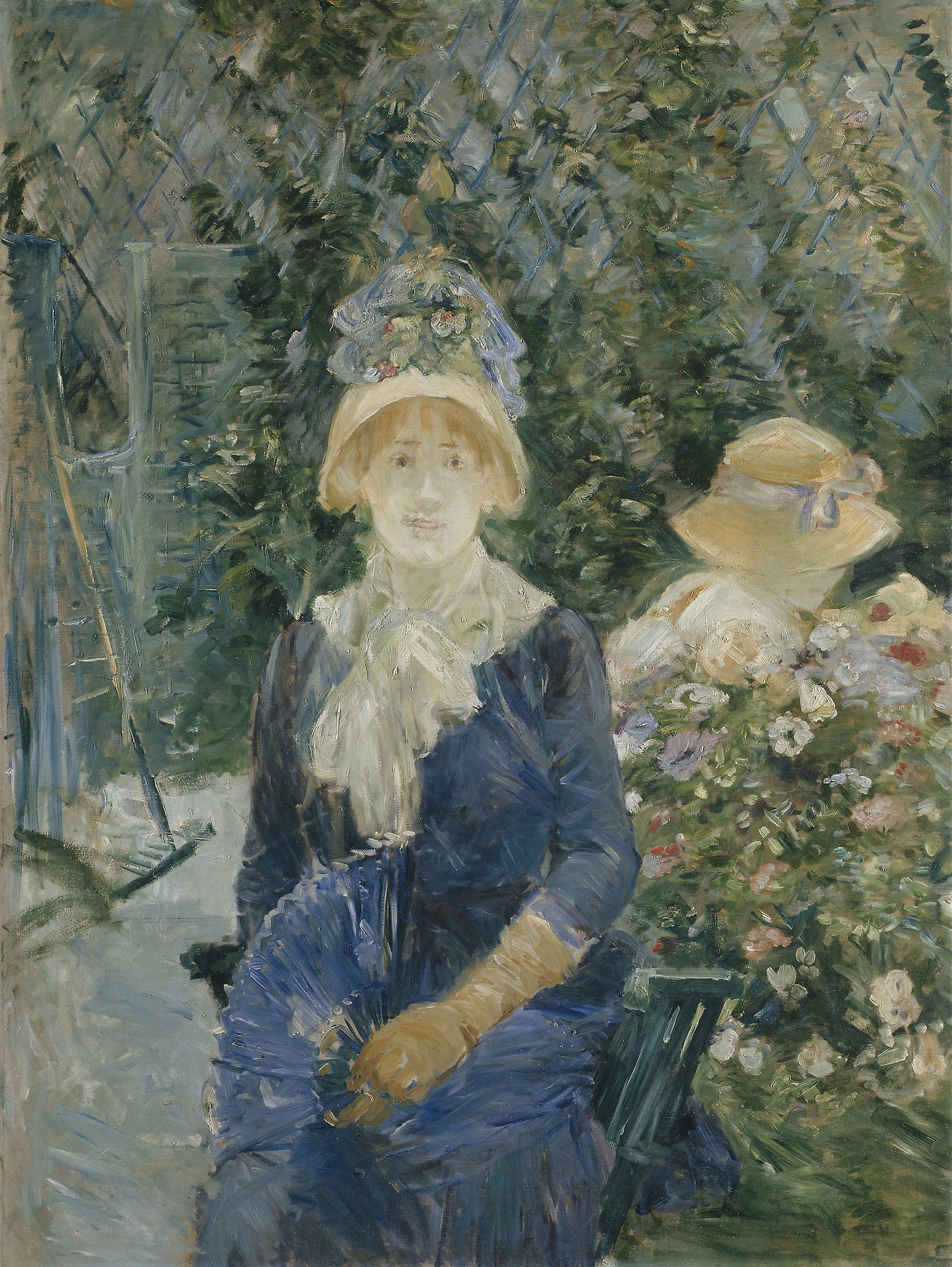
The pictures that stayed in the family are easier to follow. The Art Institute of Chicago's Woman in a Garden stayed with the artist, passed to Julie and her husband Ernest Rouart, then to their son Denis, who sold it to Nathan Cummings in 1955; after two further owners it reached the museum as a gift in 1999 . The Cradle was priced by Morisot at 800 francs, failed to sell and stayed with the family until the Louvre acquired it in 1930 . The Marmottan's holding of 25 oils and 75 watercolours came by the will of the descendants .
One family loss is dated. On 2 February 2011 the French press reported that a raid on the Wildenstein Institute had turned up some thirty paintings and sculptures described as stolen or missing, among them, the report says, a Morisot oil, Chaumiere en Normandie, that had been missing for 17 years. Yves Rouart, an heir of the owner, had filed a complaint against persons unknown for handling stolen goods over the disappearance . I found no source on how that case ended.
Chapter 6A canvas left raw
The Clark's technical report on The Bath of 1885-86 is the most complete published account of how she built a large picture.
The Clark's technical report on The Bath of 1885-86 is the most complete published account of how she built a large picture. The support is a fine-weave canvas of 28 threads per centimetre with no ground, and the aged raw canvas shows through the background. Broad charcoal outlines are visible to the eye in the skirt; the drawing of the face shows only in infrared reflectography. A charcoal and pastel study fixed the head and arms first and was transferred to the canvas as dark lines. The paint is thick and open, and she appears to have scratched around the shoulders and face with a sharp tool after the paint had hardened. There are two signatures, a larger one in red and a smaller one in green that reads as black .
A flower picture in the same Clark volume shows an earlier method: a ground, possibly a thin grey wash between ground and paint, no underdrawing, paint applied wet into wet with very little blending, and pinholes and paint on the tacking margins suggesting the canvas was painted off its stretcher .
Two museum descriptions say what the touch looks like. The National Gallery writes of her zig-zag strokes in Summer's Day, an unlined canvas, which energise the whole surface . The Art Institute of Chicago says she painted the figure in Woman in a Garden with the same strokes as the setting, slashing acid greens and bluish ochres across the canvas . Wikipedia adds that she began working on unprimed canvases around 1880 and moved to squaring and tracing paper to transfer drawings after 1887 . I have not tested those two points against a primary technical study.
Chapter 7What a Morisot cost in her lifetime
Morisot set the price of The Cradle at 800 francs for the first Impressionist exhibition in 1874, and it did not sell .
Morisot set the price of The Cradle at 800 francs for the first Impressionist exhibition in 1874, and it did not sell . At the Hotel Drouot sale of 1875 her Interior (Young Woman with Mirror) made 480 francs and a pastel, On the Lawn, 320; her works averaged 250 francs, the best relative prices at that sale, according to the English Wikipedia . The same article says the dealer Durand-Ruel bought twenty-two of her paintings .
In 1882 Eugene Manet, managing her contribution to the seventh exhibition while she was in Nice, reported in a letter that Duret had listed prices, and Christie's says Apres le dejeuner was the most expensive on that list. The figures are not in the lot essay . The Bath of 1886 found no buyer and stayed with her until she died . In 1894 the French state bought Jeune femme en toilette de bal for the Luxembourg museum, at the urging of Mallarme according to the French Wikipedia . I found no franc figure for that purchase, and no source that gives a period wage or a comparable price in the same year, so I give no modern equivalent for any of these sums.
Chapter 8The picture that made 6,985,250 pounds
Apres le dejeuner, 81 by 100 centimetres, painted at Bougival in 1881, is the picture behind her auction record.
Apres le dejeuner, 81 by 100 centimetres, painted at Bougival in 1881, is the picture behind her auction record. Christie's London sold it on 6 February 2013, lot 11 of the Impressionist and Modern evening sale, against an estimate of GBP 1,500,000 to 2,500,000, for a price realised of GBP 6,985,250 . That is about 2.8 times the top estimate. The lot page does not separate hammer from premium, so the figure on this page is the price paid and not the hammer price.
The chain is unusually well documented, and it is a chain of people who sold or bought things for a living. Alphonse Portier, who started by selling paint and became an important dealer and an early supporter of Van Gogh, had it by 1882. Henri Vever, a wealthy jeweller whose interest in Impressionism grew partly from Japanese art, owned it next. It then went to the Boston financier Joshua Montgomery Sears, and by descent to his family, then through Knoedler to Albert Lasker in November 1950; the family of the consigning owner bought it at Christie's New York on 14 May 1997, lot 16 . Christie's lot notice also records 5 per cent VAT on the hammer price, which suggests the picture was imported for the sale .
The essay notes that the 1997 catalogue raisonne is one of the few publications that does not list this picture at the 1882 exhibition. It lists the portrait of Eugene Manet and Julie as entry 92, A la campagne, and the reviews of the time describe that entry as a girl with foliage behind her . That is a dispute between the auction house and the standard catalogue about what hung on the wall.
For depth beneath the record, the trade site HENI reports that the headline lot of Christie's London day sale of 17 October 2025 was a Morisot, Jeanne Gobillard au piano et Julie Manet of 1888, at USD 802,300, 19 per cent above its low estimate of USD 674,100, in a sale that totalled USD 18.45 million . One sale in 2013 sits far above the rest.
Chapter 9A woman painter in a city that did not count her as one
The Morisot sisters were trained privately in drawing and then by Joseph Guichard, who introduced them to the Louvre in 1857; Berthe was copying there by 1858 .
The Morisot sisters were trained privately in drawing and then by Joseph Guichard, who introduced them to the Louvre in 1857; Berthe was copying there by 1858 . Encyclopedia.com says tradition kept women from the Ecole des Beaux-Arts and that she was hampered by the lack of commissions, medals and academic qualifications . In 1874 the critic Albert Wolff described the Impressionists as five or six lunatics of whom one was a woman .
The Clark's catalogue shows the register the critics used. They felt they should exercise gallantry toward works with the floating charm of sketches, and wrote that she did not trouble to finish. Others admired her feeling for colour and compared her to Fragonard . Her husband's brother Manet, according to the National Gallery, saw the distinctiveness of her technique .
The French Wikipedia says her death certificate gave her occupation as without profession and that the Manet vault at Passy carries only the words Berthe Morisot, widow of Eugene Manet . Encyclopedia.com repeats the death certificate point in English . I could not see the certificate or the stone, and both rest on tertiary sources here. The sentence she is quoted as writing is plainer: I don't think there has ever been a man who treated a woman as an equal and that's all I would have asked, for I know I'm worth as much as they .
Chapter 10What the pictures are about
I found no hidden programme in her work, and the record is better for saying so.
I found no hidden programme in her work, and the record is better for saying so. What the sources document is a deliberate choice of private settings. The Clark's catalogue describes a body of work set in the bedroom and bathroom, in which lightly clad adolescents seem comfortable with themselves, advancing from a bare neck and arms to a nude back and finally a wholly naked figure. For The Bath the Clark names the sitter as Isabelle Lambert, a personal friend described as a little seventeen-year-old, who posed in the bathroom of the artist's home, and cites Rouart's edition of the correspondence for it. A letter of 11 January 1886 records Morisot calling on Renoir and hearing him say that nudes were one of the essential forms of art .
The Art Institute of Chicago reads Woman at Her Toilette as disrupting the old trope of the woman at a mirror as a symbol of vanity: the mirror is rendered as gauzily as the room, the figure's reflection is obscured, and Morisot signed along the bottom of the mirror, which the museum says may suggest the figure stands in for the artist . That is the museum's reading and the museum words it as a possibility.
English Wikipedia says that pictures like The Cradle reflect current trends in nursery furniture and her sensitivity to fashion . I found no inventory of her library, no record of a confessor or a society, and no letter stating a belief. Stephane Mallarme was a close friend and, after she died, Julie's guardian . Paul Valery married her niece Jeannie Gobillard in 1900 and wrote an essay on her in 1926 .
Chapter 11Titles and dates that moved
Summer's Day, now NG3264 at the National Gallery, was almost certainly shown at the 1880 exhibition as The Lake in the Bois de Boulogne, alongside a second picture of the same two women in the same...
Summer's Day, now NG3264 at the National Gallery, was almost certainly shown at the 1880 exhibition as The Lake in the Bois de Boulogne, alongside a second picture of the same two women in the same clothes . The Bath has been Au bain, Le Bain, Girl Arranging Her Hair and The Toilette in different catalogues and exhibitions . The Chicago picture has been Le Jardin rue de Villejust of 1883, Le Jardin, Im Garten, In the Garden, The Garden and Young Woman in a Garden, and the museum now dates it 1882-83 and places it at Bougival . Apres le dejeuner is said by Christie's to have been shown in 1882 as A la campagne, a title the Clairet catalogue attaches to a different picture .
Dates move too. The 1933 list of plates dates Le Berceau 1873 and Wikipedia gives 1872 . Morisot rarely dated her canvases. The Clark notes that its flower picture was not dated by her and was designated 1876 only in the 1896 memorial catalogue .
Chapter 12The Fragonard story
English Wikipedia says her mother was a great-niece of Fragonard .
English Wikipedia says her mother was a great-niece of Fragonard . The National Gallery writes that she was reputedly related . The Clark's catalogue says a later claim that she was distantly related to Fragonard has since been refuted and cites the 1987-88 exhibition catalogue, Washington, Fort Worth and South Hadley, pages 81 and 183, note 192 . The French Wikipedia says she had no family link with him, contrary to what was long supposed . The critics' comparison with Fragonard of 1880 was about her touch and not her blood, and it survived the refutation of the relationship .
Chapter 13Where it stands now
Summer's Day was lent to the Hugh Lane gallery in Dublin from 2012 to 2019 and has been there on a new long loan since 24 February 2026, which runs to 23 February 2031 .
Summer's Day was lent to the Hugh Lane gallery in Dublin from 2012 to 2019 and has been there on a new long loan since 24 February 2026, which runs to 23 February 2031 . The same record lists the exhibitions that have framed her recently: the Marmottan retrospective of 2012, Dallas and the Musee d'Orsay in 2019, Dulwich Picture Gallery in 2023, the Thyssen-Bornemisza in 2023-24, the National Gallery of Ireland in 2024, and Morisot / Manet at the Legion of Honor in San Francisco from October 2025 and then the Cleveland Museum of Art until 5 July 2026 .
What is documented
Technique
The surviving work
- What is accepted
- About 423 oil paintings, the numbered entries of the 1997 Clairet, Montalant and Rouart catalogue, which also uses a few bis numbers. The 1961 Bataille and Wildenstein catalogue numbers 847 works in oil, pastel and watercolour. The 1933 Angoulvent catalogue has 663 entries in every medium. The figure of more than 860 paintings given by Encyclopedia.com is not an oil count under any of these; it is of the size of the 1961 book, which counts pastels and watercolours as well.
- What is contested
- No campaign of de-attribution is documented in the sources I opened. One rejection is documented, a Head of a Child at the Clark Art Institute, rejected in the early 1970s by Wildenstein's Morisot experts. The 860 figure is the other soft point.
- Who rules on attribution
- No committee found in the sources read. Yves Rouart, called her great-grandson by Wesley Johnston and third author of the 1997 catalogue, signed a certificate of authenticity dated 25 March 2026 that a London dealer cites. I found no other certificate. One 1972 letter shows the Clark Art Institute consulting Wildenstein's Morisot experts on a doubtful picture; I found no wider account of how that firm was used. Works on paper have no modern catalogue to be checked against.
Catalogue raisonne
- Monique Angoulvent, Berthe Morisot, Paris, Editions Albert Morance, 1933, catalogue pp. 117-152 The first complete catalogue, in all media, 663 numbered entries plus two sculptures, compiled with the help of Julie Manet. It remains the only catalogue of the drawings as a body. Many dates were later corrected.9
- Marie-Louise Bataille and Georges Wildenstein, Berthe Morisot: Catalogue des peintures, pastels et aquarelles, Paris, Les Beaux-Arts, 1961 Numbered to 847 with a few bis numbers. Includes only drawings connected to paintings.914
- Alain Clairet, Delphine Montalant and Yves Rouart, Berthe Morisot 1841-1895: Catalogue raisonne de l'oeuvre peint, Montolivet, 1997 Oils only, ending at 423, with a few bis numbers. One lot essay says it does not list Apres le dejeuner in the 1882 show.1921
Questions about Berthe Morisot
Who was Berthe Morisot?
Painter; Pastellist; Watercolourist; Printmaker. 1841-1895.
When did Berthe Morisot live?
Born 14 January 1841, Bourges, France; died 2 March 1895, Paris, France.
How are fakes and misattributions of Berthe Morisot detected?
Head of a Child, Clark Art Institute 1955.819 (misattribution, not a forgery). Bought in 1926 from Scott and Fowles as a Morisot. By March 1972 the attribution had been changed to nineteenth-century French.
Where can you see work by Berthe Morisot?
Musee Marmottan Monet (Paris); Musee d'Orsay (Paris); Art Institute of Chicago (Chicago); National Gallery (London); Dublin City Gallery The Hugh Lane (Dublin); Clark Art Institute (Williamstown, Massachusetts).
What does the market for Berthe Morisot look like?
The record is a single picture sold in 2013, Apres le dejeuner, at GBP 6,985,250 including premium. In October 2025 the headline lot of a Christie's London day sale was an 1888 painting at USD 802,300.
What is still unresolved about Berthe Morisot?
What hung as entry 92 at the 1882 exhibition: Apres le dejeuner, as the Christie's essay argues from reviews and Eugene Manet's letters, or the portrait of Eugene and Julie, as the Clairet catalogue has it.
Open questions
- What hung as entry 92 at the 1882 exhibition: Apres le dejeuner, as the Christie's essay argues from reviews and Eugene Manet's letters, or the portrait of Eugene and Julie, as the Clairet catalogue has it.
- What replaces the family's certificates when Yves Rouart can no longer sign them, and who rules on pastels and watercolours, which have no modern catalogue.
- Whether the Fragonard relationship exists. English Wikipedia and the National Gallery repeat it, the Clark catalogue and French Wikipedia refute it, and I have not read the 1987-88 catalogue page the Clark cites.
- How Monet acquired The Bath: the Clark says gift or purchase is unclear.
- How the 2011 Chaumiere en Normandie case ended, and whether the painting was returned to the Rouart family or the Academie des Beaux-Arts.
- Whether Morisot's death certificate really reads without profession, and what the Passy stone says. Only tertiary sources were readable.
- What the 1997 catalogue's coverage has done to prices, the question of the Oczkowski paper in Empirical Economics, whose findings I could not read.
- Her library, confessor and religion: no inventory or letter surfaced in the sources I opened. Julie Manet's diary and the published correspondence were not available to me.
Sources
- 1Christie's, Berthe Morisot, Apres le dejeuner, Impressionist/Modern Evening Sale, London, 6 February 2013, lot 11 (sale 1102): provenance, literature, lot essay and price realised. christies.com/en/...
- 2Sterling and Francine Clark Art Institute, Nineteenth-Century European Paintings, 2012: entry 235, The Bath 1885-86 (1955.926), with technical report; includes end of the preceding flower-picture entry. Primary museum catalogue. media.clarkart.edu/1955.926_EuroCat.pdf
- 3Clark Art Institute catalogue entry 372, Head of a Child (1955.819), artist unknown, formerly attributed to Morisot. media.clarkart.edu/1955.819_EuroCat.pdf
- 4National Gallery, London, Girl on a Divan, about 1885 (L720), overview and key facts including Denis Rouart's 1969 statement. nationalgallery.org.uk/paintings/...
- 5National Gallery, London, Summer's Day, about 1879 (NG3264): overview, provenance, exhibition history. nationalgallery.org.uk/paintings/...
- 6Art Institute of Chicago, Woman in a Garden, 1882-83 (1999.363): description, provenance, publication and exhibition history, via the museum's public API. artic.edu/artworks/...
- 7Art Institute of Chicago, Self-Portrait, c. 1885 (1965.685R), via the museum's public API. artic.edu/artworks/...
- 8Art Institute of Chicago, Woman at Her Toilette (1924.127): description and provenance, via the museum's public API. artic.edu/artworks/...
- 9Wesley Johnston, introduction to his 2006 transcription of Monique Angoulvent's catalogue of Morisot's works (1933). wwjohnston.net/wj/...
- 10Christie's, Berthe Morisot, Bateau illumine, Impressionist/Modern Day Sale 1509, lot 493: stamp Lugt 1826, provenance, literature. christies.com/en/...
- 11Musee Marmottan Monet, page on the Berthe Morisot permanent collection (25 oils, 75 watercolours). marmottan.fr/en/...
- 12evous.fr, report of 2 February 2011 on the police raid at the Wildenstein Institute and the Morisot Chaumiere en Normandie. evous.fr/Bonne-pioche-pour-la-police-a-l,1146238.html
- 13Connaught Brown, Berthe Morisot, Jeune fille au manteau vert, 1894: dealer listing with Bataille and Wildenstein no. 842 and a certificate signed by Yves Rouart dated 25 March 2026. Trade source. connaughtbrown.co.uk/artworks/...
- 14Galerie Heim, Berthe Morisot, Julie Manet picking cherries, 1891: footnote that the drawings have not yet been catalogued. Trade source. galerieheim.com/en/...
- 15Wikipedia, Berthe Morisot (English). en.wikipedia.org/wiki/...
- 16Wikipedia, Berthe Morisot (French). fr.wikipedia.org/wiki/...
- 17Wikipedia, The Cradle (Morisot). en.wikipedia.org/wiki/...
- 18HENI News, Berthe Morisot Leads Christie's $18.45m sale in London, 17 October 2025. Trade news. heni.com/news/...
- 19Encyclopedia.com, Berthe Morisot (history entry): 860 paintings, no profession, the notebook quotation. encyclopedia.com/history/...
- 20Encyclopedia.com, Morisot, Berthe (1841-1895) (women entry): exclusion from the Ecole des Beaux-Arts. encyclopedia.com/women/...
- 21PubHist record for La petite Marcelle, 1895, Musee Marmottan: Clairet, Montalant and Rouart 1997, no. 423. Database. pubhist.com/w40219
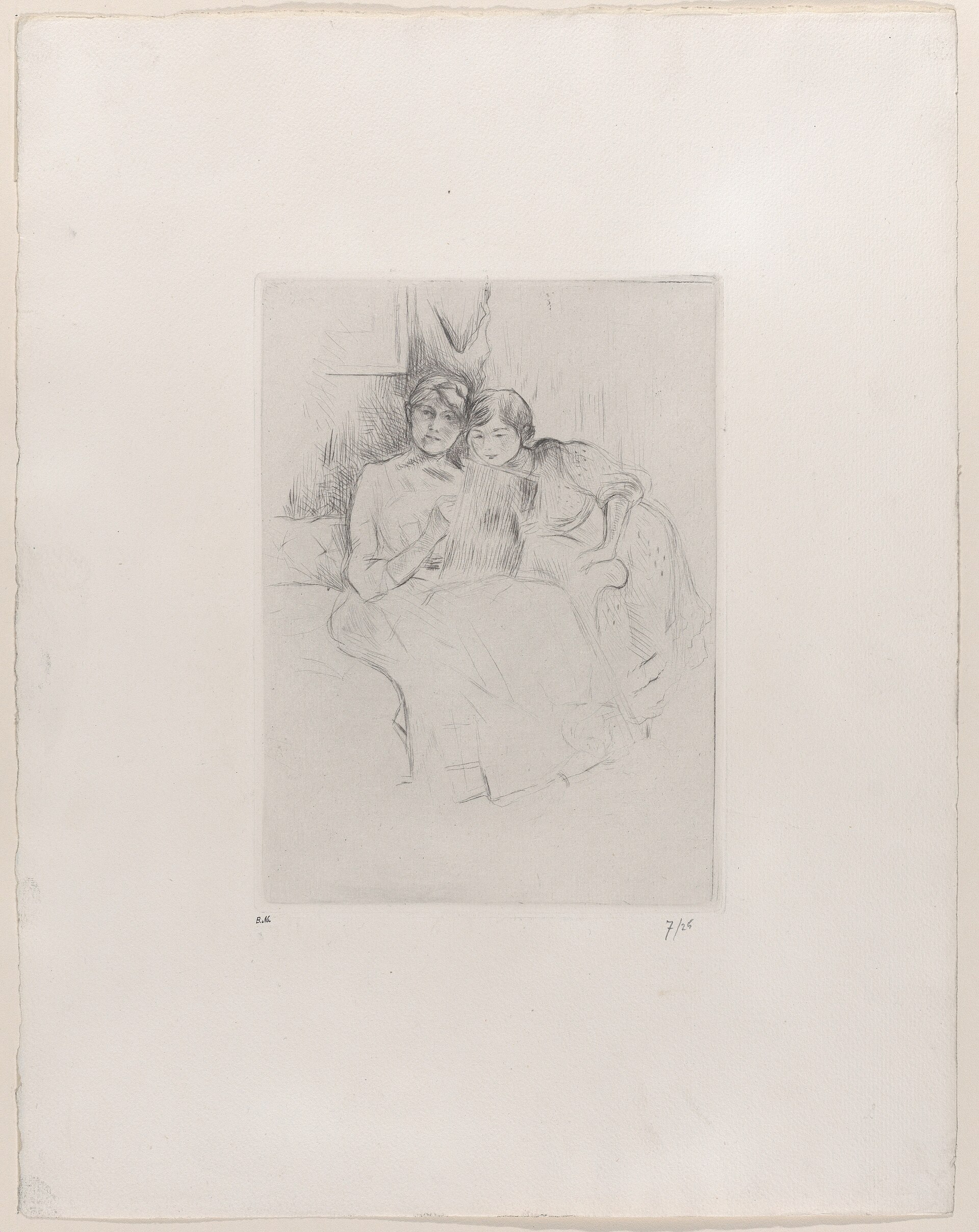
- 22Wikimedia Commons, Self Portrait of Berthe Morisot Sketching with Julie Manet (Metropolitan Museum of Art 22.60.93), CC0 file record. commons.wikimedia.org/wiki/...
- 23The Irish Times, The last Manet: Julie Manet was the living legacy of impressionism (Mallarme as guardian). irishtimes.com/culture/...
- 24Edward Oczkowski, The catalogue raisonne and art auction prices: the case of Berthe Morisot, Empirical Economics, DOI 10.1007/s00181-020-01920-5. Record only; abstract and findings not read. researchoutput.csu.edu.au/en/...

Last verified