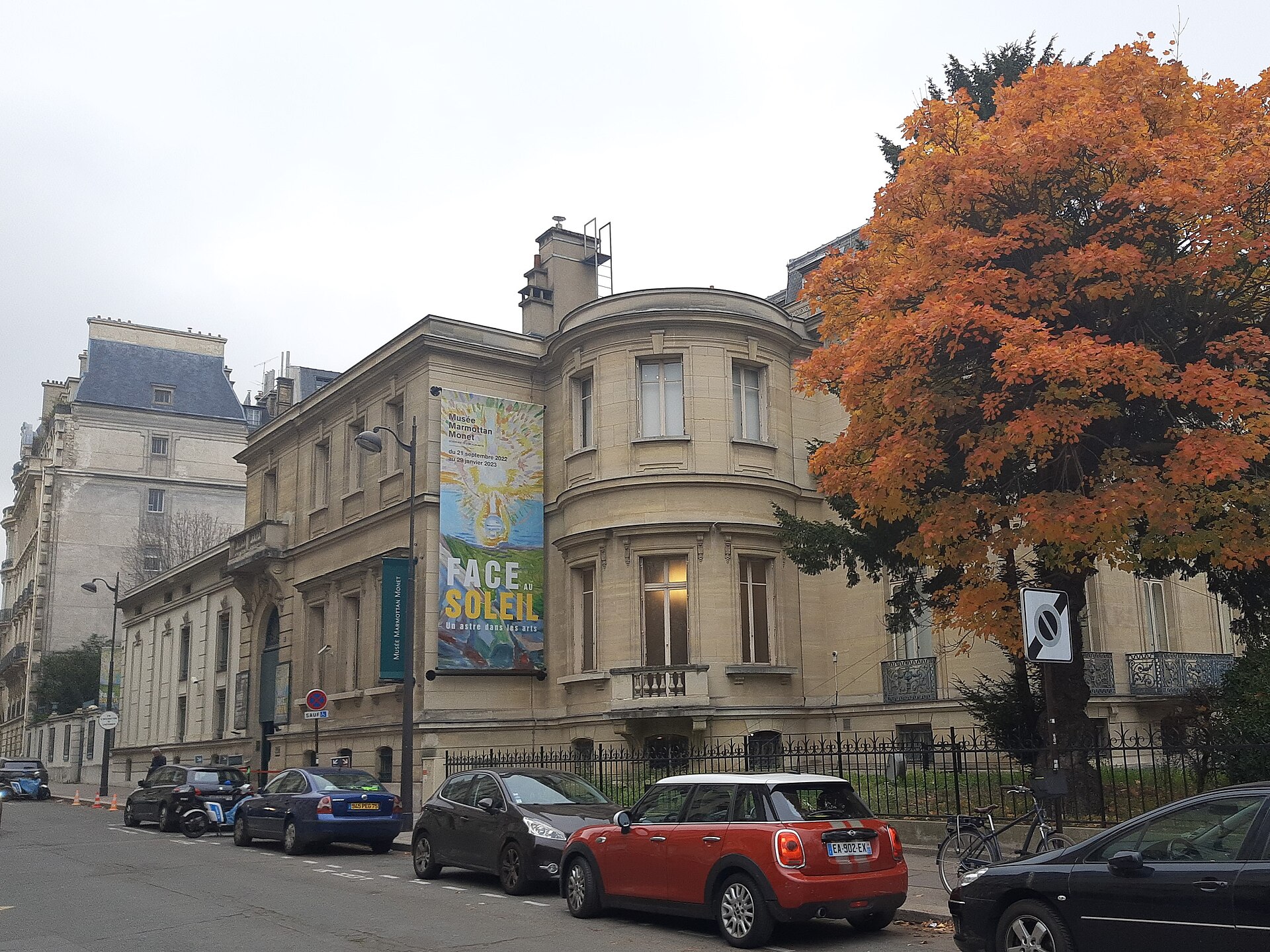
The Musee Marmottan Monet seen from rue Louis-Boilly, during the 2026 exhibition Face au Soleil.
Gerda Arendt · CC BY-SA 4.0Musee Marmottan Monet
Museum · Musée Marmottan Monet · Founded 1934
Open, admission and hours confirmed 19 August 2026 · 11 sources
On this page 16 sections
ContentsClose
The collection's strength is depth built entirely from inheritance rather than acquisition: every major holding, the First Empire founding collection, the Donop de Monchy Impressionists, the Michel Monet bequest, the Rouart Morisots and the Wildenstein illuminations, arrived as a single family or estate gift rather than through purchase, which is why the museum can hold both the largest Monet collection in the world and 322 unrelated medieval manuscripts under one roof with no curatorial logic connecting them beyond who happened to leave what to whom.
| Local name | Musée Marmottan Monet |
|---|---|
| Kind | Museum |
| Founded | 1934 |
| City and country |  Paris, France Paris, France |
| Address | 2 rue Louis-Boilly, 75016 Paris, France |
| Website | marmottan.fr/en |
| Status | Open, confirmed |
| Record last verified |
Visiting
- Hours
- Tuesday-Wednesday, Friday-Sunday10:00 to 18:00Last entry 17:00
- Thursday10:00 to 21:00Late opening; last entry 20:00
- MondayClosed
- Closed
- Monday. 1 May. 25 December. 1 January.
- Admission
- Full priceEUR 14Covers the permanent collection and any temporary exhibition together
- Reduced (under 18, students under 25)EUR 9Proof of age or status required
- Under 7FreeFree
- Combined ticket with Fondation Monet, Giverny, full priceEUR 27
- Combined ticket with Fondation Monet, Giverny, reducedEUR 16
- Tickets
- marmottan.fr/en The museum's own ticket page.
- Do I need to book?
- Not required; timed online tickets give skip-the-line access and must be printed or shown on a phone, and are non-exchangeable and non-refundable
- Address
- 2 rue Louis-Boilly, 75016 Paris, France MapMetro Line 9, La Muette or Ranelagh
RER Line C, Boulainvilliers
Bus Lines 22, 32, 52, 63, 70, PC1 - Website
- marmottan.fr/en
- Telephone
- +33 1 44 96 50 33
- [email protected]
Before you go how long, access, photography, bags, eating, shop
- How long to allow
- One and a half to two hours; reviewers note the collection is larger than the townhouse setting suggests and can outlast a short visit
- Access
- Not detailed on the pages fetched for this record
- Photography
- Not addressed on the pages fetched for this record
- Bags
- Not detailed on the pages fetched for this record
- Eating
- An ephemeral cafe operates on site alongside the temporary exhibition programme
- Shop
- A collections boutique sells books and reproductions tied to the Monet and Morisot holdings
Prices and hours change. We take them from the institution's own pages and print the day we read them, and you can check the current position at the source we used. Confirm before you travel.
What is inside
The Marmottan family rooms
The First Empire furniture, paintings and objets d'art Paul Marmottan collected as a historian of the Consulate and Empire, including a bed that belonged to Napoleon I and furnishings salvaged from the Tuileries Palace, shown in the rooms of the hunting pavilion his father Jules bought in 1882.
Ground floor: the Donop de Monchy Impressionists
The paintings bequeathed by Victorine Donop de Monchy from the collection of her father, the physician and early Impressionist patron Georges de Bellio, including Impression, soleil levant, the picture that gave the movement its name, bought by de Bellio at auction in 1878 for 210 francs after its previous owner went bankrupt.
The underground Monet gallery
A gallery built specifically to hold Michel Monet's 1966 bequest of more than a hundred of his father's canvases, among them large-format Water Lilies panels that were never exhibited in Claude Monet's lifetime and were shown publicly for the first time only after entering this museum.
The Berthe Morisot rooms
Twenty-five oil paintings, seventy-five watercolours and a run of pastels and drawings by Berthe Morisot, given mainly by the Rouart family, forming what the museum states is the largest public Morisot collection anywhere; she sold relatively little in her lifetime, which is why her work is otherwise thinly represented in museums.
The Wildenstein collection of illuminated manuscripts
322 medieval and Renaissance illuminated miniatures assembled by Georges Wildenstein and given to the museum by his son Daniel, shown apart from the Impressionist holdings as a distinct decorative-arts collection.
Temporary exhibition galleries
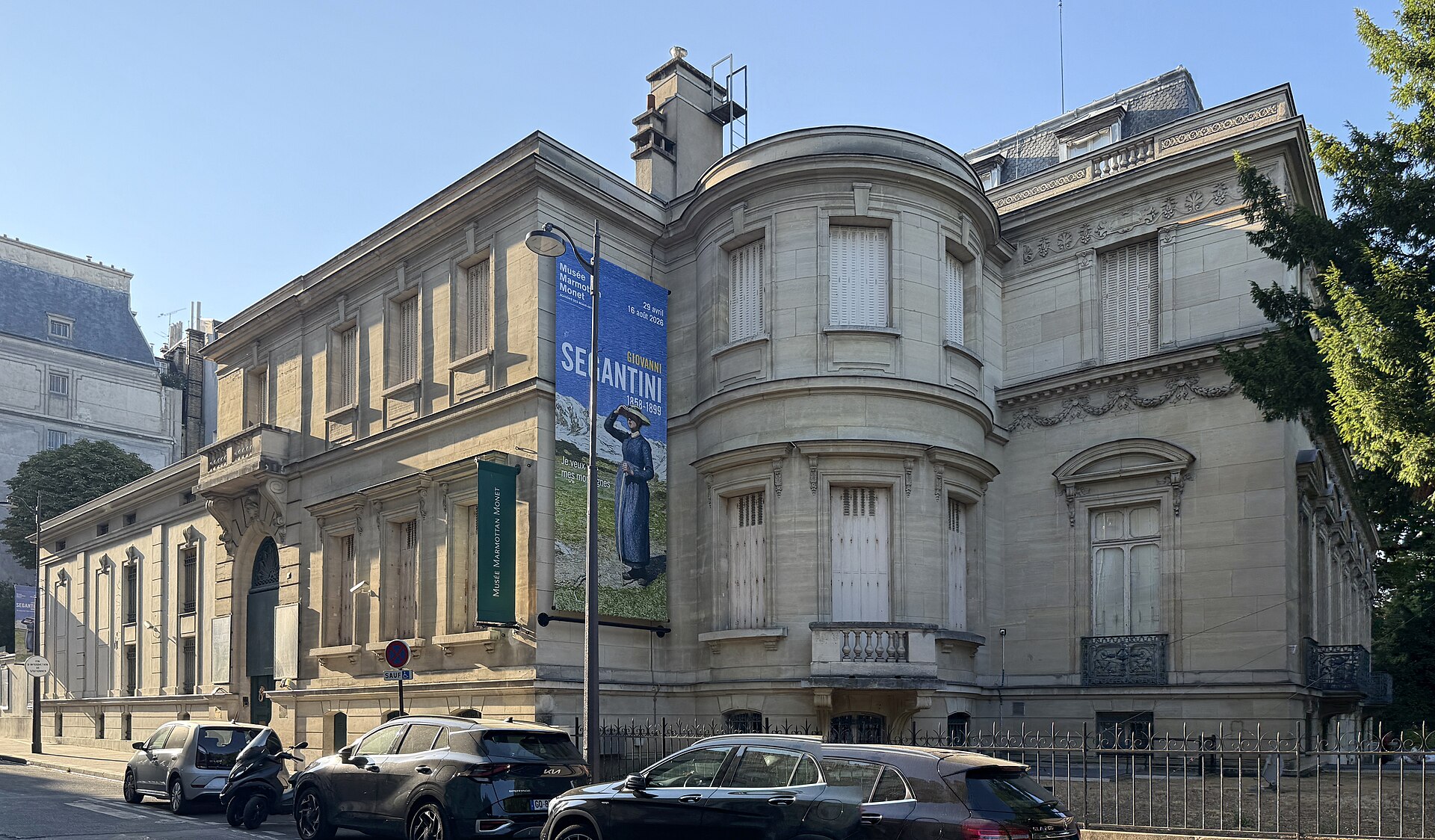
A programme of loan exhibitions distinct from the permanent collection; showing Giovanni Segantini, I Want to See My Mountains, 29 April to 16 August 2026, the first Paris monograph on the Symbolist and Divisionist painter.
What to see first
Impression, soleil levant
Claude Monet, 1872The painting that gave Impressionism its name, after the critic Louis Leroy mocked its title in an 1874 review; stolen at gunpoint from this museum in 1985 and recovered in Corsica in 1990, a theft and recovery this record documents in full below.7
The large-format Water Lilies panels
Claude MonetMonumental late canvases from Monet's own studio at Giverny that were never shown publicly in his lifetime; this museum gave them their first public exhibition after Michel Monet's 1966 bequest.5
Camille Monet and Her Cousin on the Beach at Trouville
Claude MonetOne of the nine paintings taken in the 1985 armed robbery and recovered with the rest in the December 1990 Corsica raid.8
Eugene Manet on the Isle of Wight
Berthe Morisot, 1875A portrait of the artist's own husband, painted the year they married, and one of the works most often reproduced from the museum's Morisot holdings.6
Self-portrait
Berthe Morisot, 1885A rare self-portrait by the only woman among the core Impressionist group shown at their first exhibitions alongside Monet, Renoir, Degas and Pissarro.6
Napoleon I's bed
Empire cabinetmaking, assembled by Paul MarmottanFurniture from the Tuileries Palace collected by the museum's founder decades before a single Impressionist canvas entered the building, and a reminder that the Marmottan was a First Empire museum before it was a Monet museum.4
Houses of Parliament, London, Reflections on the Thames
Claude Monet, 1905Part of the run of Monet's London series that shows the collection's range beyond Giverny and Argenteuil.5
The Wildenstein illuminations
Various medieval and Renaissance workshops322 manuscript miniatures assembled by one of the twentieth century's most important art dealers and given intact rather than dispersed, a collection most visitors do not expect inside an Impressionist museum.4
Exhibitions on now
- On now24 Sep 2026 to 31 Jan 2027Confirmed , 7 weeks ago
Past exhibitions here
- Closed29 Apr to 16 Aug 2026Confirmed · check before you travel
A First Empire museum that became the world's largest Monet collection by accident of inheritance
The Musee Marmottan Monet is not, in its origin, a Monet museum at all. Jules Marmottan bought a former hunting pavilion belonging to the family of the Duc de Valmy in Paris's 16th arrondissement in 1882 and filled it with roughly forty pre-Renaissance paintings from Italy, Flanders and Germany. His son Paul, a historian of the Consulate and Empire, redecorated the building in Empire style, added furniture that had belonged to Napoleon I and to the Tuileries Palace, and enlarged the pavilion around 1910 to hold what had become a serious collection of Empire-period art. When Paul Marmottan died on 15 March 1932 without an heir, he left the building and everything in it to the Academie des Beaux-Arts, which opened it to the public as the Musee Marmottan on 21 June 1934. For its first years the museum was, in substance, a monument to Napoleonic decorative art. Nothing about its founding collection predicted what it would become.
How the Impressionists actually arrived: a doctor, not the painter's own son
It is a common assumption, encouraged by the museum's own name, that its Impressionist paintings all arrived through Claude Monet's family. Impression, soleil levant did not. The painting was bought in May 1874 by Ernest Hoschede for 800 francs; when Hoschede went bankrupt in 1878 it was sold at auction at the Hotel Drouot in Paris for 210 francs to Dr Georges de Bellio, a Romanian-born physician in Paris who treated and collected from Monet, Manet, Pissarro, Sisley and Renoir and bought directly from them when few others would. On de Bellio's death the painting passed to his daughter, Victorine, who had married into the Donop de Monchy family; she and her heirs bequeathed the picture to the Musee Marmottan along with ten further Impressionist canvases from her father's collection. The museum's own English-language history page dates this bequest to 1940-1947; a separate account published by the Institut de France, the museum's governing academy, gives 1957. Both are the museum's own institutional sources and this record does not resolve the discrepancy rather than silently picking one.
The Michel Monet bequest, which is what most visitors have in mind when they think of the connection between this museum and the painter, came later and separately: Claude Monet's second son died in 1966 and left the museum his property at Giverny and more than a hundred of his father's paintings, including large-format Water Lilies canvases that Monet had never allowed to be shown publicly. The museum built a new underground gallery specifically to hold them. So the picture that named Impressionism and the collection that made this the largest Monet holding in the world reached the same building by two unconnected routes, one generation and one unrelated family apart.
The 1985 robbery
Shortly after the museum opened at 10am on Sunday 27 October 1985, armed men burst in, took the guards and roughly thirty visitors hostage at gunpoint, and stripped nine paintings from the walls in about ten minutes. A contemporaneous wire report quoted the museum's parent institution, the Academie des Beaux-Arts, confirming the works were not insured because of what officials called the ruinous cost of premiums and because the paintings were considered too well known to sell; a museum spokesman valued the nine canvases at a minimum of ten million dollars. The museum's own alarm system had been switched off, on the reasoning that visitors kept triggering it by accident. The nine works taken were five Monets, including Impression, soleil levant, Camille Monet and Her Cousin on the Beach at Trouville, Portrait of Jean Monet, Portrait of Poly, Fisherman at Belle-Ile, and Field of Tulips in Holland; two Renoirs, Bathers and Portrait of Monet; a Morisot, Young Woman at the Ball; and a portrait of Monet by the Japanese painter Naruse. Later published retellings of the case describe three gunmen rather than the five reported at the time by the museum's own manager and curator to wire services within a day of the robbery; this record follows the contemporaneous account over the later, secondhand one, and flags the discrepancy rather than concealing it.
Five years missing, then a raid in Corsica
The nine paintings disappeared for five years. Investigators eventually traced the theft through a member of a Japanese organised-crime network who had served time in a French prison and made contact there with figures connected to the art trade, though how directly that lead drove the eventual recovery is not detailed consistently across the accounts available for this record. On the night of 4 December 1990, acting on a tip, police raided an apartment near Porto-Vecchio in southern Corsica and found all nine paintings together. A contemporaneous news report the following day put the collection's value at roughly twenty million dollars, up from the ten million estimated in 1985, and named a Corsican bartender, Donatien Comiti, among seven people arrested in the raid; most of those detained were later released. The paintings, including Impression, soleil levant, went back on public display at the Musee Marmottan in 1991.
What the theft did to the painting's standing
Impression, soleil levant already carried the distinction of having named an entire movement before 1985; the theft and its five-year disappearance added a second story to the same canvas, one about how close the object that named Impressionism came to vanishing from public knowledge altogether. The painting now travels only rarely: it was lent to the Musee d'Orsay in 2024 and to the National Gallery of Art in Washington later the same year, each loan reported individually because the picture is otherwise a fixture of this one museum rather than a regular loan piece.
Two other collections most visitors do not expect
The museum's Berthe Morisot holdings, twenty-five oils, seventy-five watercolours and a substantial group of pastels and drawings given mainly by the Rouart family, form what the museum states is the largest public collection of her work anywhere, a distinction that follows directly from how little Morisot sold during her own lifetime. Separately, Daniel Wildenstein gave the museum 322 illuminated manuscript miniatures assembled by his father Georges Wildenstein, a medieval and Renaissance decorative-arts collection with no connection to Impressionism at all, shown in the same building as the Water Lilies for no reason beyond a single family's decision to give it here.
What visitors say
What the museum's own account and independent visitor writing converge on, in our own words: this is repeatedly framed as a quieter, smaller alternative to the Musee d'Orsay for seeing major Impressionist work, with the scale of the Water Lilies canvases and the fact of standing in the room where the theft happened both cited as reasons the visit stays with people longer than the museum's modest size would suggest.
What is praised, what is criticised
- Praised: low visitor numbers even in peak season compared with the Musee d'Orsay or the Louvre, repeatedly given as a reason to visit
- Praised: the scale and setting of the large-format Water Lilies panels, shown together in the purpose-built underground gallery
- Praised: the domestic, townhouse feel of the upper rooms, furnished as they were when the Marmottan family lived there rather than laid out as a neutral gallery
- Criticised: the collection is larger and denser than the townhouse building suggests, and more than one visitor account says a short visit undersells it
- Criticised: the museum's own national museum passes and multi-museum passes are not accepted here, which catches visitors who assume a Paris museum pass covers it
Questions about Musee Marmottan Monet
Where is Musee Marmottan Monet?
2 rue Louis-Boilly, 75016 Paris, France.
How much does it cost to visit?
Full price: EUR 14; Reduced (under 18, students under 25): EUR 9; Under 7: free; Combined ticket with Fondation Monet, Giverny, full price: EUR 27; Combined ticket with Fondation Monet, Giverny, reduced: EUR 16. As confirmed 19 August 2026.
When is it open?
Tuesday-Wednesday, Friday-Sunday 10:00-18:00; Thursday 10:00-21:00; Monday closed. Closed: Monday. 1 May. As confirmed 19 August 2026.
How do you get there?
Metro: Line 9, La Muette or Ranelagh; RER: Line C, Boulainvilliers; Bus: Lines 22, 32, 52, 63, 70, PC1.
What should you see first?
Impression, soleil levant (Claude Monet, 1872); The large-format Water Lilies panels (Claude Monet); Camille Monet and Her Cousin on the Beach at Trouville (Claude Monet); Eugene Manet on the Isle of Wight (Berthe Morisot, 1875); Self-portrait (Berthe Morisot, 1885); Napoleon I's bed (Empire cabinetmaking, assembled by Paul Marmottan).
What we could not confirm
- The Donop de Monchy bequest that brought Impression, soleil levant to the museum is dated 1940-1947 on the museum's own English history page and to 1957 on the Institut de France's page for the same museum; this record states both rather than resolving the conflict.
- The number of armed men in the 1985 robbery is given as five in the contemporaneous UPI wire report filed the day after the theft, quoting the museum's own manager and curator, and as three in several later retellings including the Fondation Monet's own published account; this record follows the contemporaneous figure.
- How directly the Yakuza-linked prisoner named in later accounts of the case led investigators to the December 1990 Corsica raid, versus other leads police may have had, is not detailed consistently across the sources available for this record.
Images
Sources
- 1Musee Marmottan Monet, homepage (English), current exhibition and navigation, read 2026-08-07. marmottan.fr/en/
- 2Musee Marmottan Monet, Tarifs (admission prices, ticketing terms, hours), read 2026-08-07. marmottan.fr/tarifs/
- 3Institut de France, page for the Musee Marmottan Monet et Bibliotheque Marmottan (history, hours, holiday closures, transport, historic pricing), read 2026-08-07. institutdefrance.fr/lepatrimoine/le-musee-marmottan-monet-et-la-bibliotheque-paul-marmottan/
- 4Musee Marmottan Monet, The museum and its history (English), read 2026-08-07. marmottan.fr/en/the-museum/the-museum-and-its-history/
- 5Musee Marmottan Monet, Claude Monet collection page, read 2026-08-07. marmottan.fr/en/collections/claude-monet/
- 6Musee Marmottan Monet, Berthe Morisot collection page, read 2026-08-07. marmottan.fr/en/collections/berthe-morisot/
- 7United Press International, 'Nine paintings stolen from the Marmottan Museum, including the...', 28 October 1985. Contemporaneous wire report on the theft. upi.com/Archives/1985/10/28/Nine-paintings-stolen-from-the-Marmottan-Museum-including-the/1889499323600/
- 8Deseret News, '9 Paintings Recovered', 7 December 1990. Contemporaneous report on the Corsica recovery. deseret.com/1990/12/7/18895003/9-paintings-recovered/
- 9Wikipedia, 'Impression, Sunrise', read 2026-08-07. en.wikipedia.org/wiki/Impression,_Sunrise
- 10Wikidata, Musee Marmottan Monet (Q1327886), read 2026-08-07. wikidata.org/wiki/Q1327886
- 11Paris Plus Plus, 'The Musee Marmottan Monet - A Little-Known Gem in Paris', 2021. parisplusplus.com/paris/paris-city-attractions/the-musee-marmottan-monet-a-little-known-gem-in-paris/