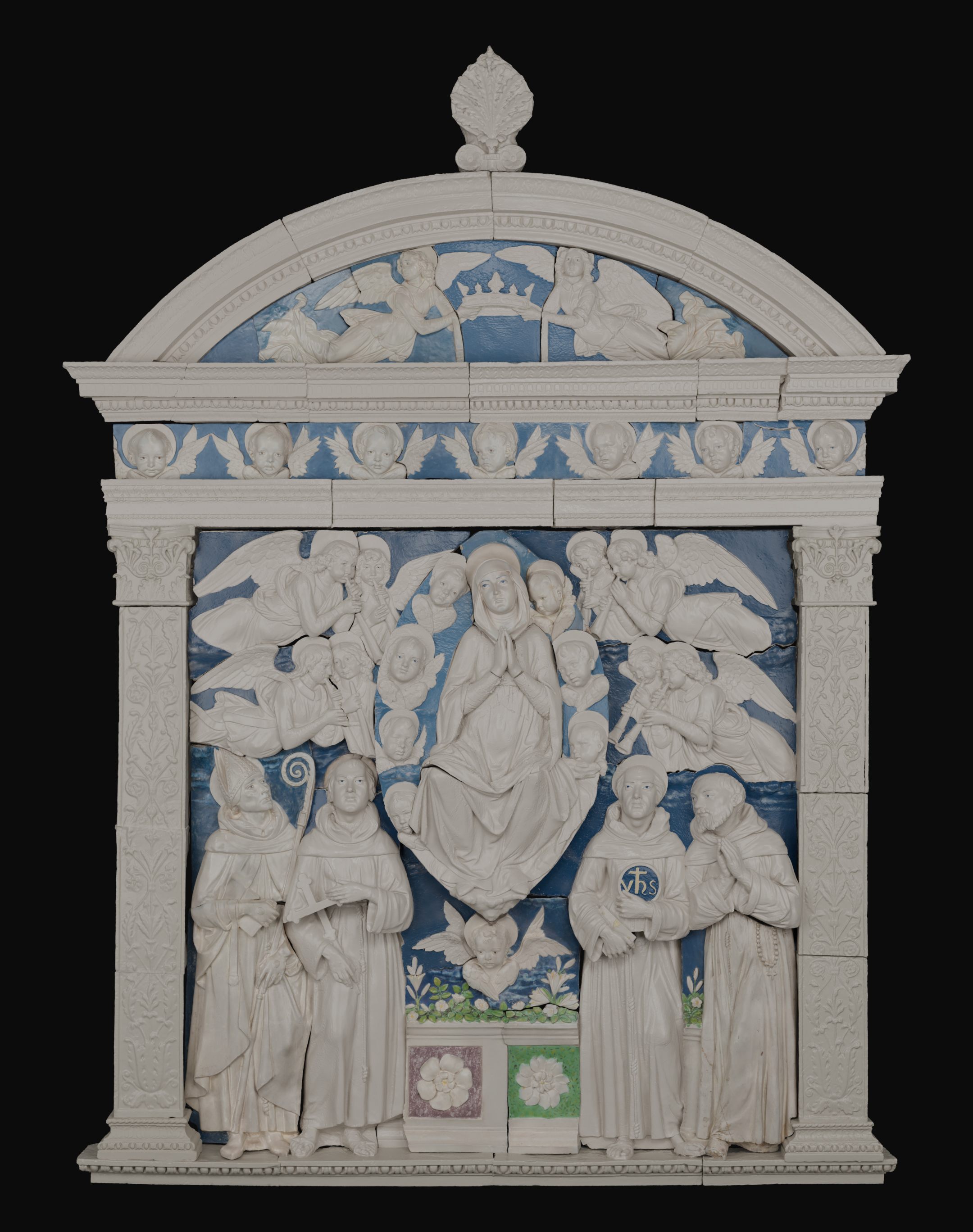
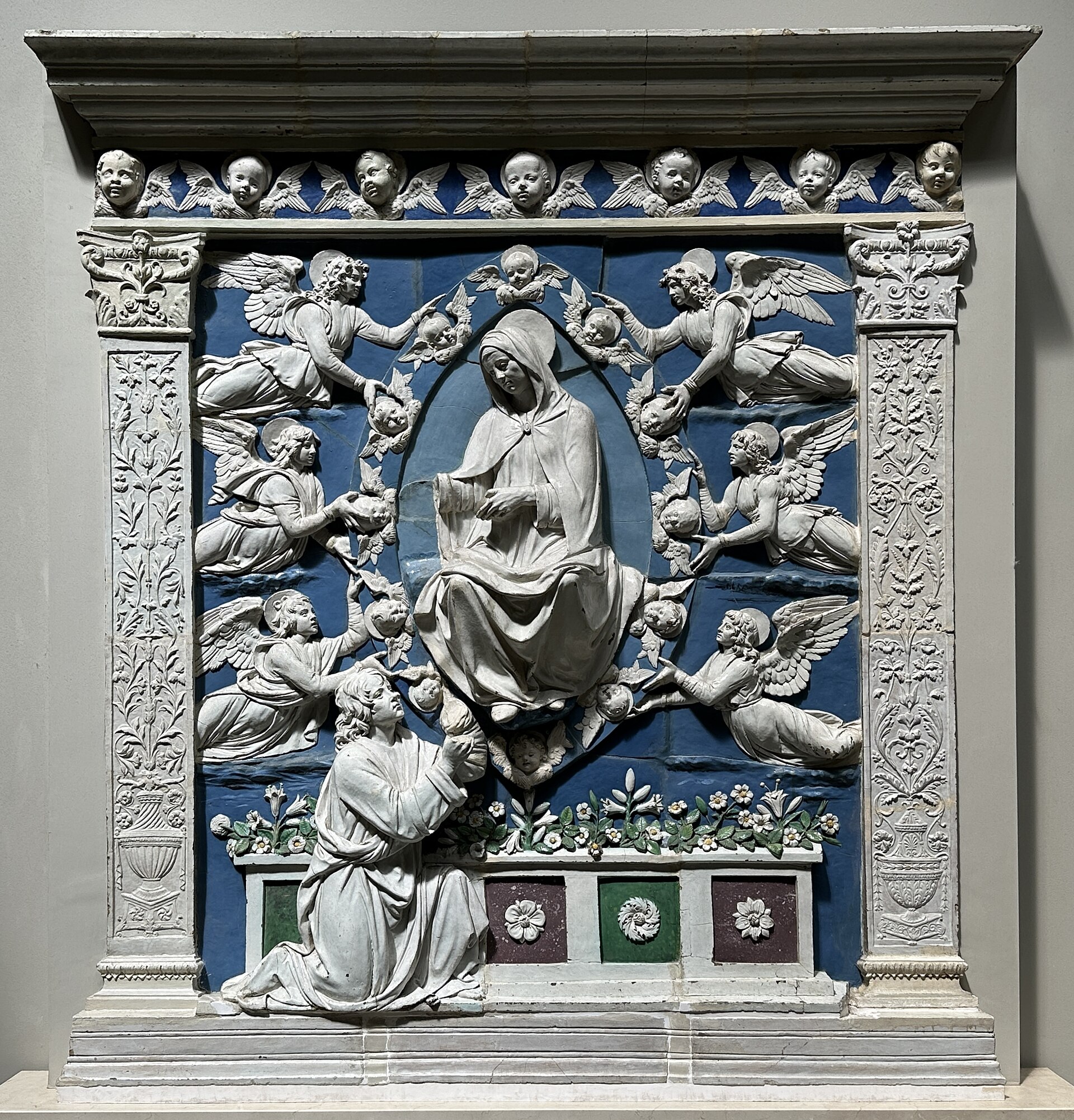
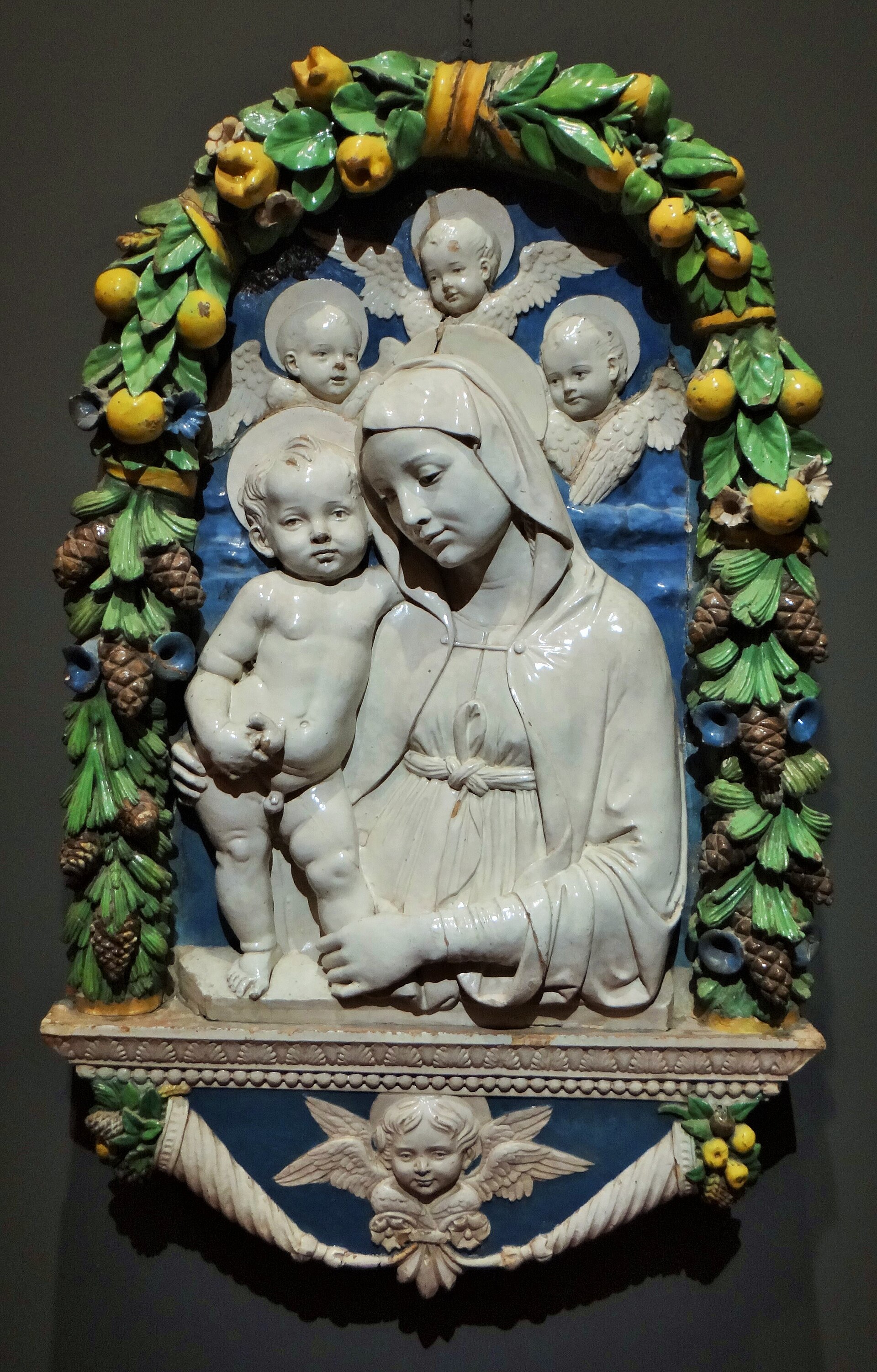
The Assumption of the Virgin (The Marquand Altarpiece)
c. 1485 · Glazed terracotta
Metropolitan Museum of Art, New York
 Florentine · 1435-1525
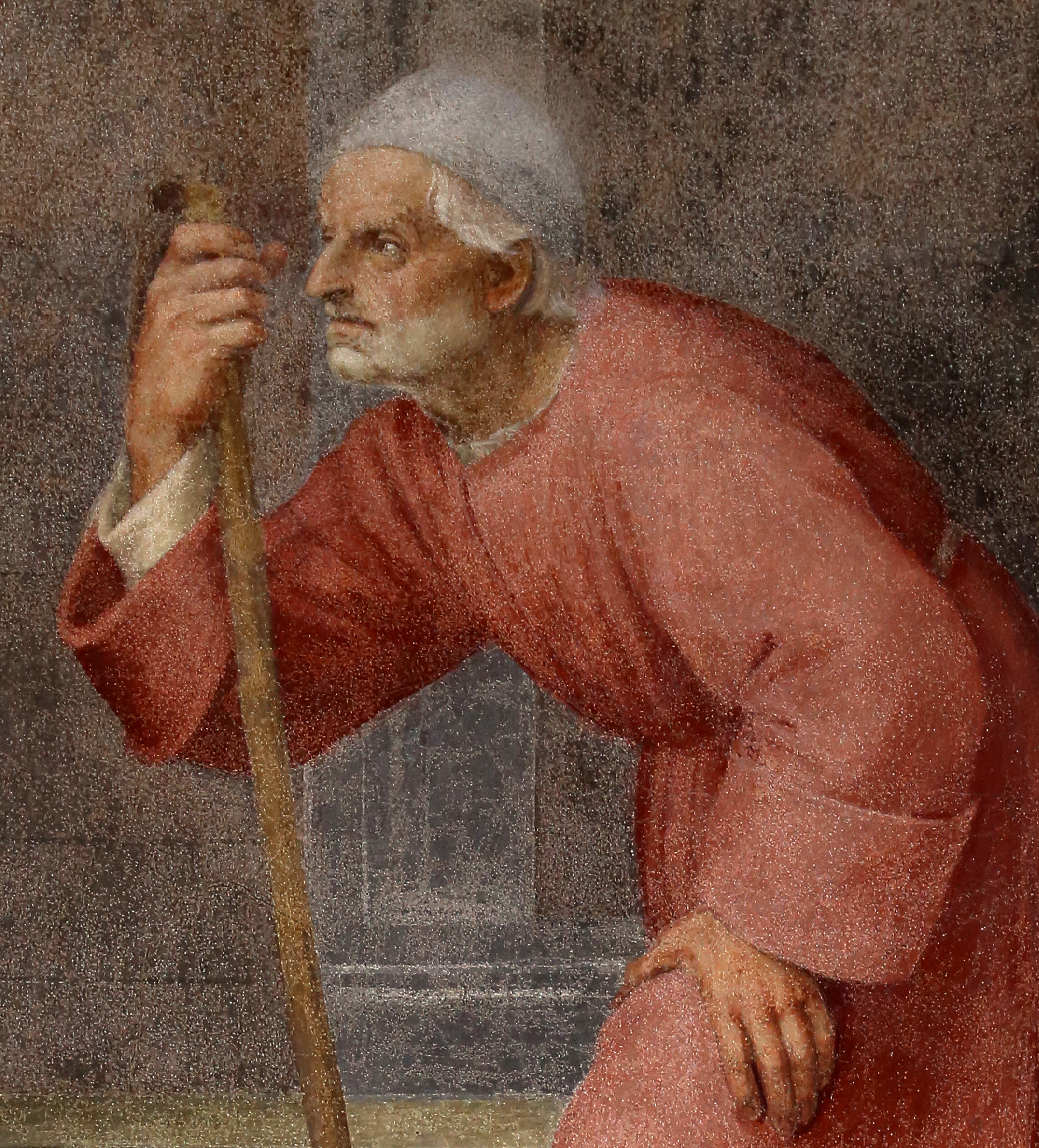
No portrait made of Andrea della Robbia at his own request, or as the primary subject of a work, is known to survive; sculptors working in glazed terracotta rarely sat for one. This is a detail of Andrea del Sarto's 1510 fresco The Devotion of the Florentines to the Relics of San Filippo Benizi, in the Chiostro dei Voti at the Basilica of SS. Annunziata, Florence. According to Giorgio Vasari, the bent old man in red leaning on a staff, shown near his son Luca della Robbia the Younger, is Andrea della Robbia, then about seventy-five years old. The identification rests on Vasari's testimony alone; no inscription or independent contemporary source confirms it, though no source consulted for this record disputes it either.
SS. Annunziata, Florence. Photograph by Sailko, via Wikimedia Commons| Worked as | Sculptor, Ceramicist |
|---|---|
| Born | 20 October 1435 · Florence |
| Died | 4 August 1525 · Florence |
| Nationality | Florentine |
| Movement | Italian Renaissance |
| In this archive | 1 artwork |
| Sources | 30 cited |
| Last verified |
About this page 1 artwork in the archive · Last verified · 30 sources cited
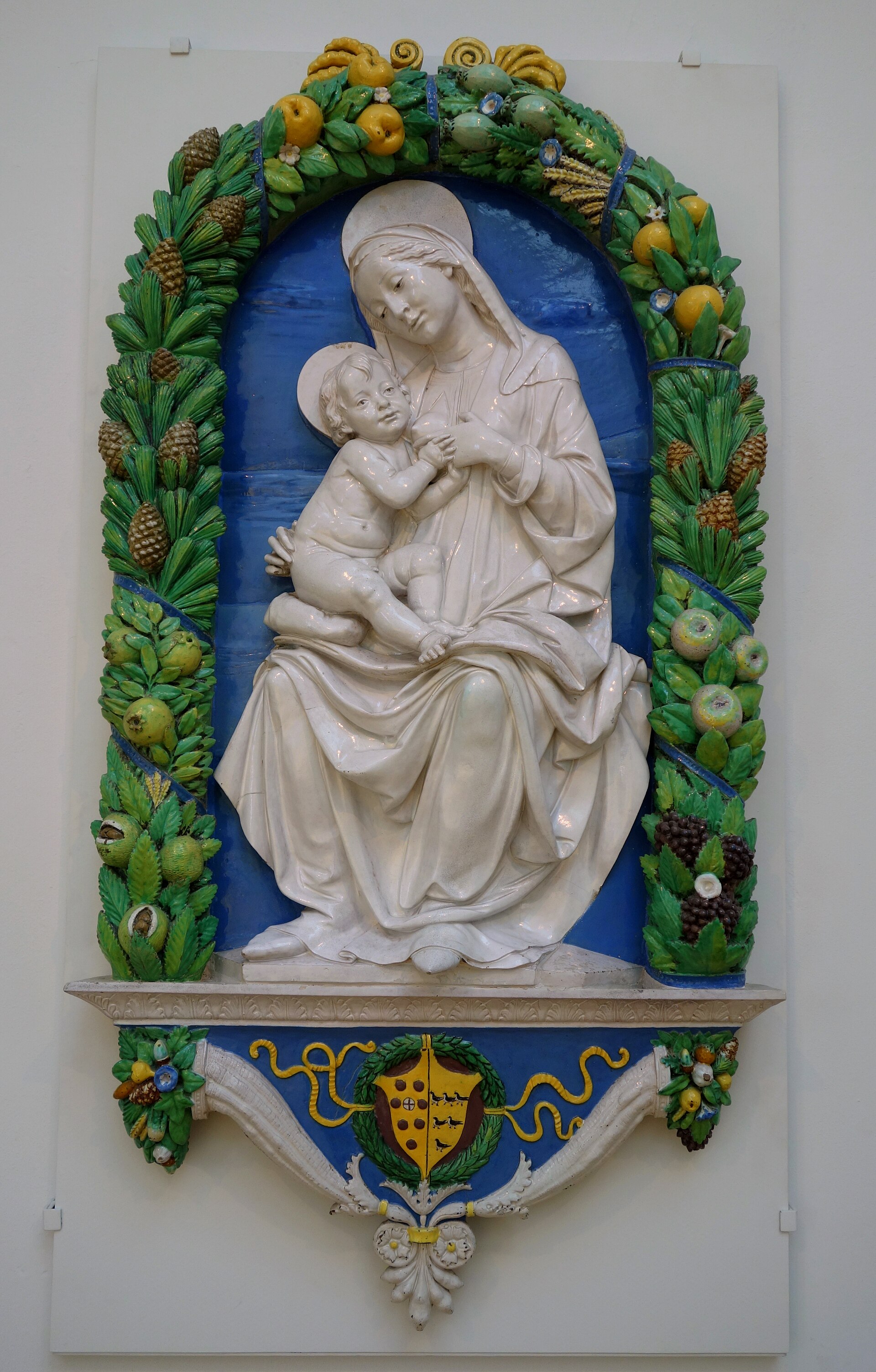
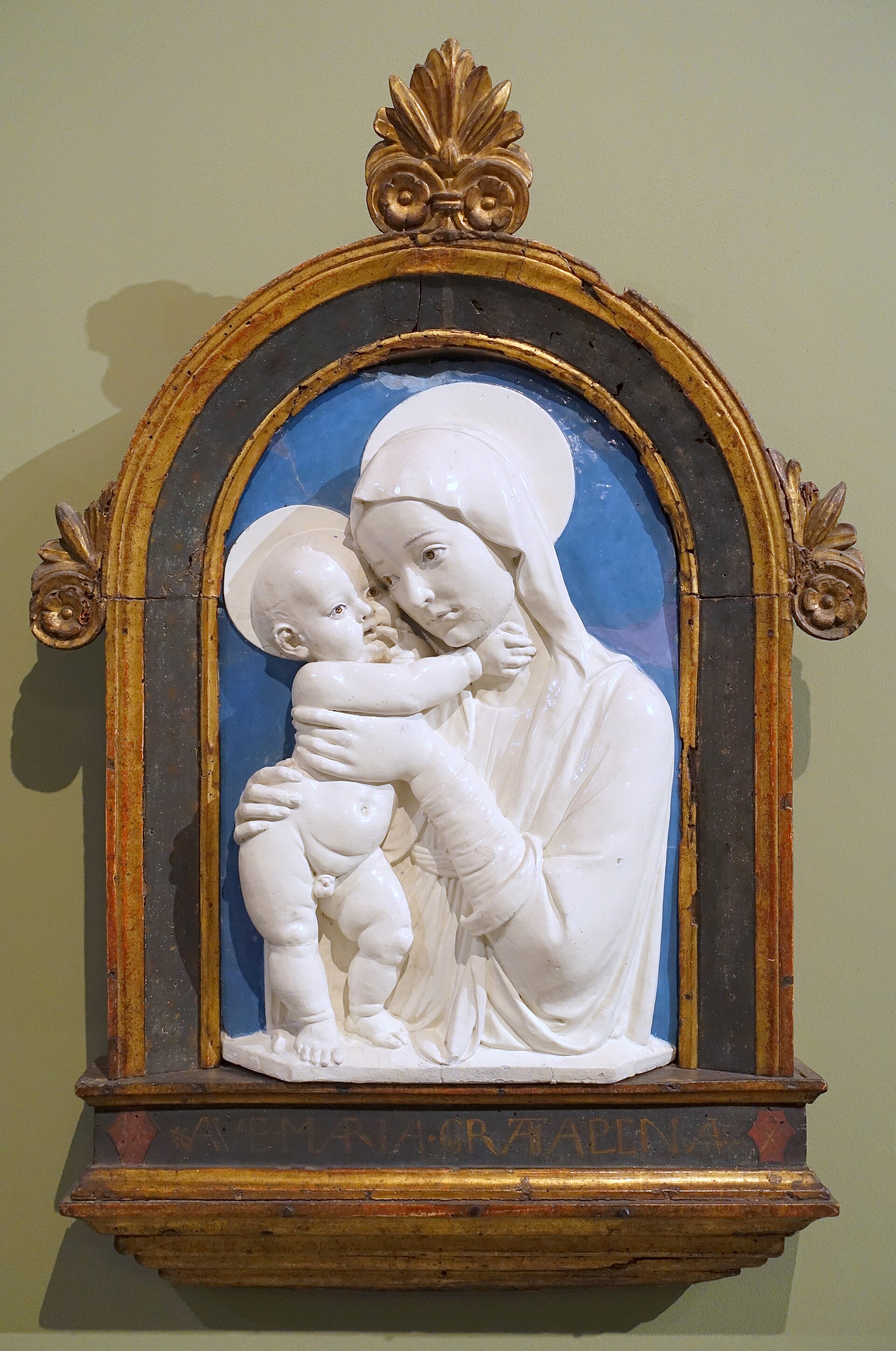
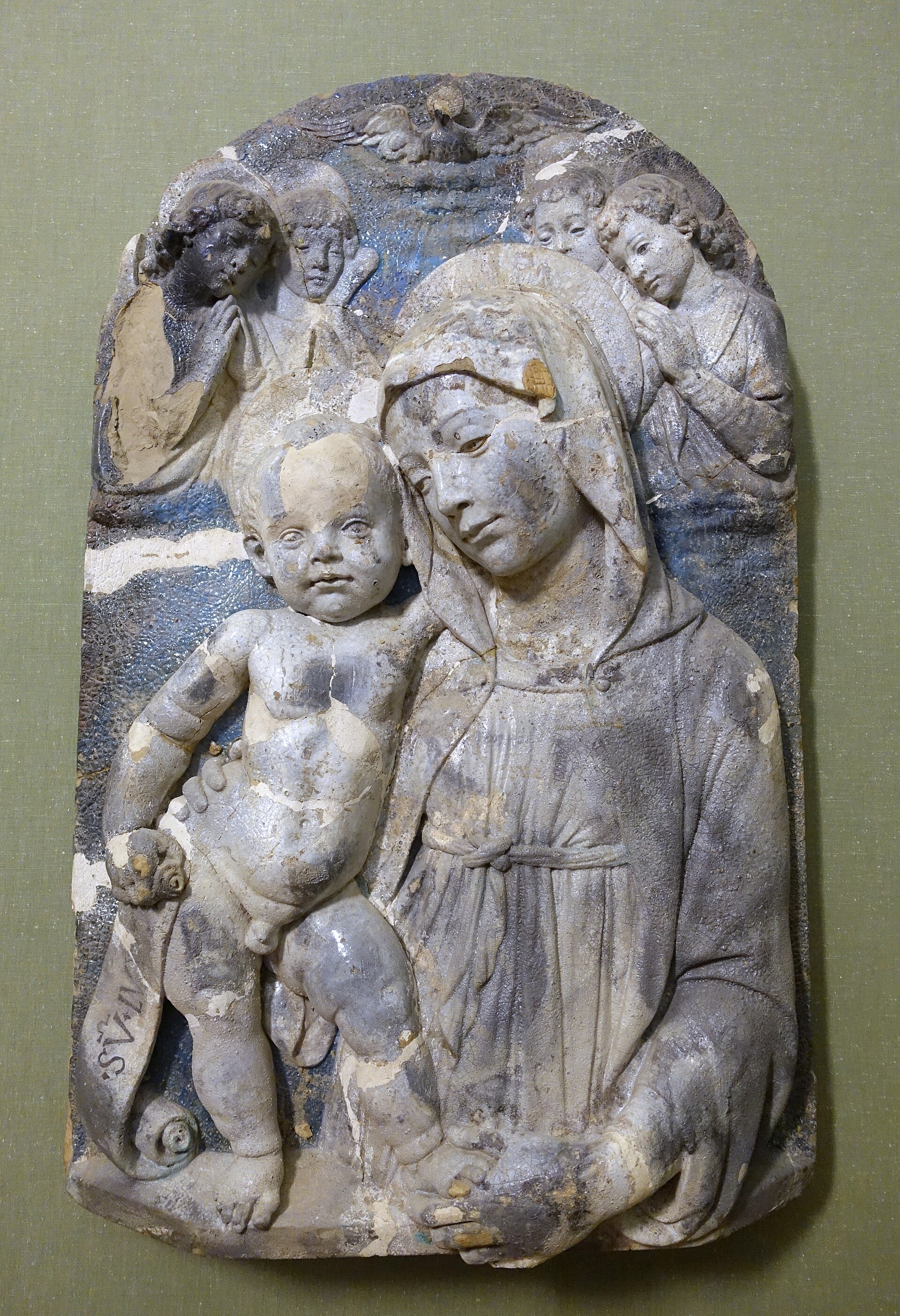
Andrea della Robbia inherited a technique, a workshop and a market from his uncle Luca, and then expanded all three on a scale Luca never attempted. Between about 1470 and his death in 1525 he supplied churches, hospitals, confraternities and private patrons across Tuscany and beyond with glazed terracotta sculpture: a durable, brilliantly colored, comparatively inexpensive alternative to marble and fresco that could survive on an exterior facade for five hundred years. His best known single achievement, the ten roundels of swaddled infants on the facade of the Ospedale degli Innocenti in Florence, became the emblem of the foundling hospital itself and one of the most reproduced images to survive the Florentine Renaissance.
He is a documented, named historical figure with a datable career, unlike many workshop attributions on this site: a birth date, a death date, an inherited house on Via Guelfa and dozens of payment records and dated altarpieces. What has never been settled, across more than a century of scholarship, is which of the hundreds of surviving glazed terracottas carrying his family's name are his own hand, which are an assistant's execution of his design, and which belong to his sons after him. This archive already holds a record for one of the objects at the center of that exact problem: the Metropolitan Museum's Assumption of the Virgin, catalogued for most of its public life as Workshop of Andrea della Robbia and reattributed to Andrea himself only in 2026, on evidence the Museum has not yet published in full.
That reattribution is not an isolated event. It is the latest turn of a movement that runs back to the family's first serious cataloguer, a Princeton scholar whose lifelong study of the della Robbia began, by his own account, with a single altarpiece his father had given away.
Born in Florence on 20 October, son of Marco della Robbia and nephew of Luca della Robbia.922
Executes the Annunciation altarpiece for the Chiesa Maggiore at La Verna, paid for by the Niccolini family, the first of five glazed terracotta altarpieces he supplies to the sanctuary.6
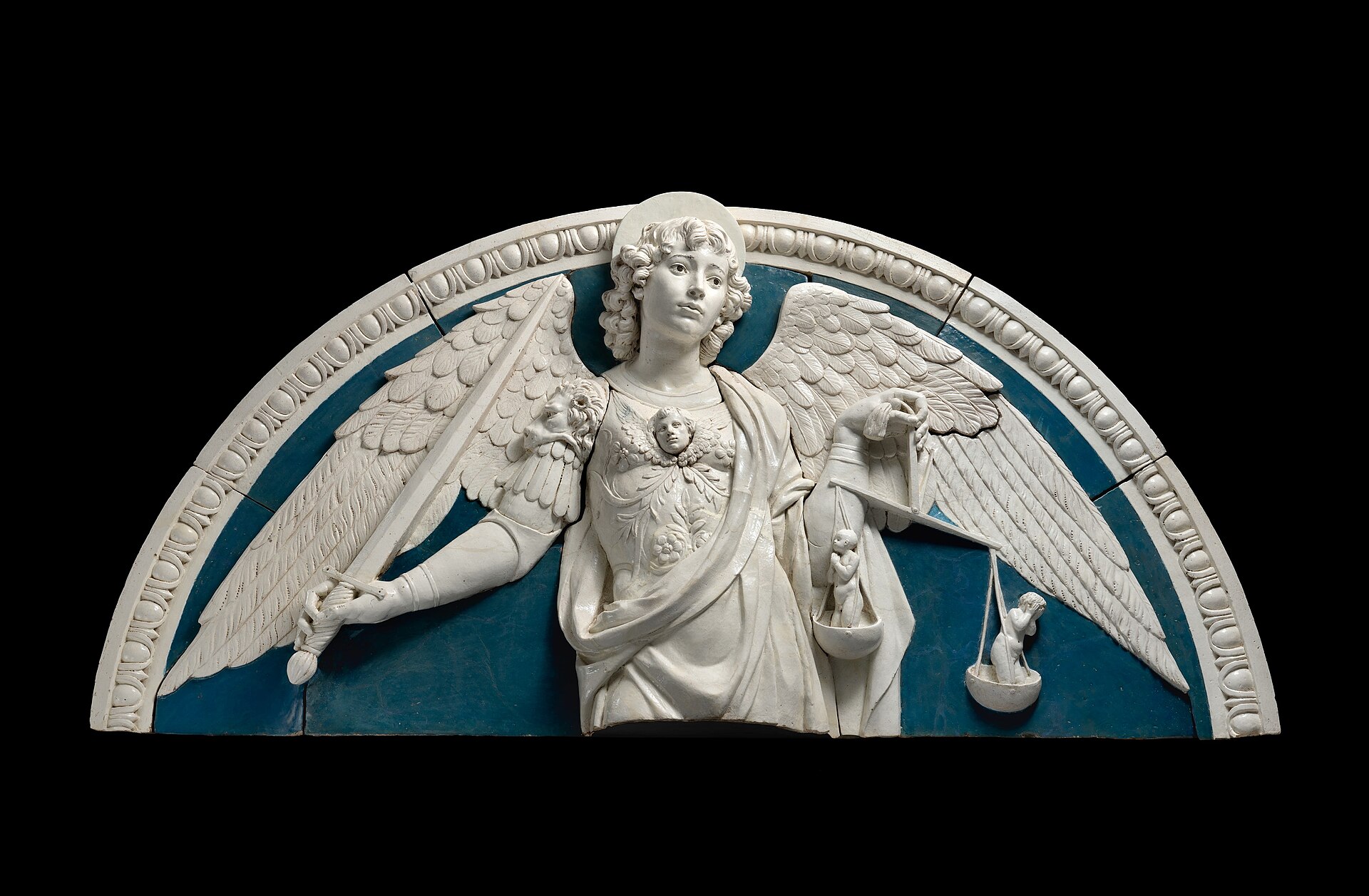
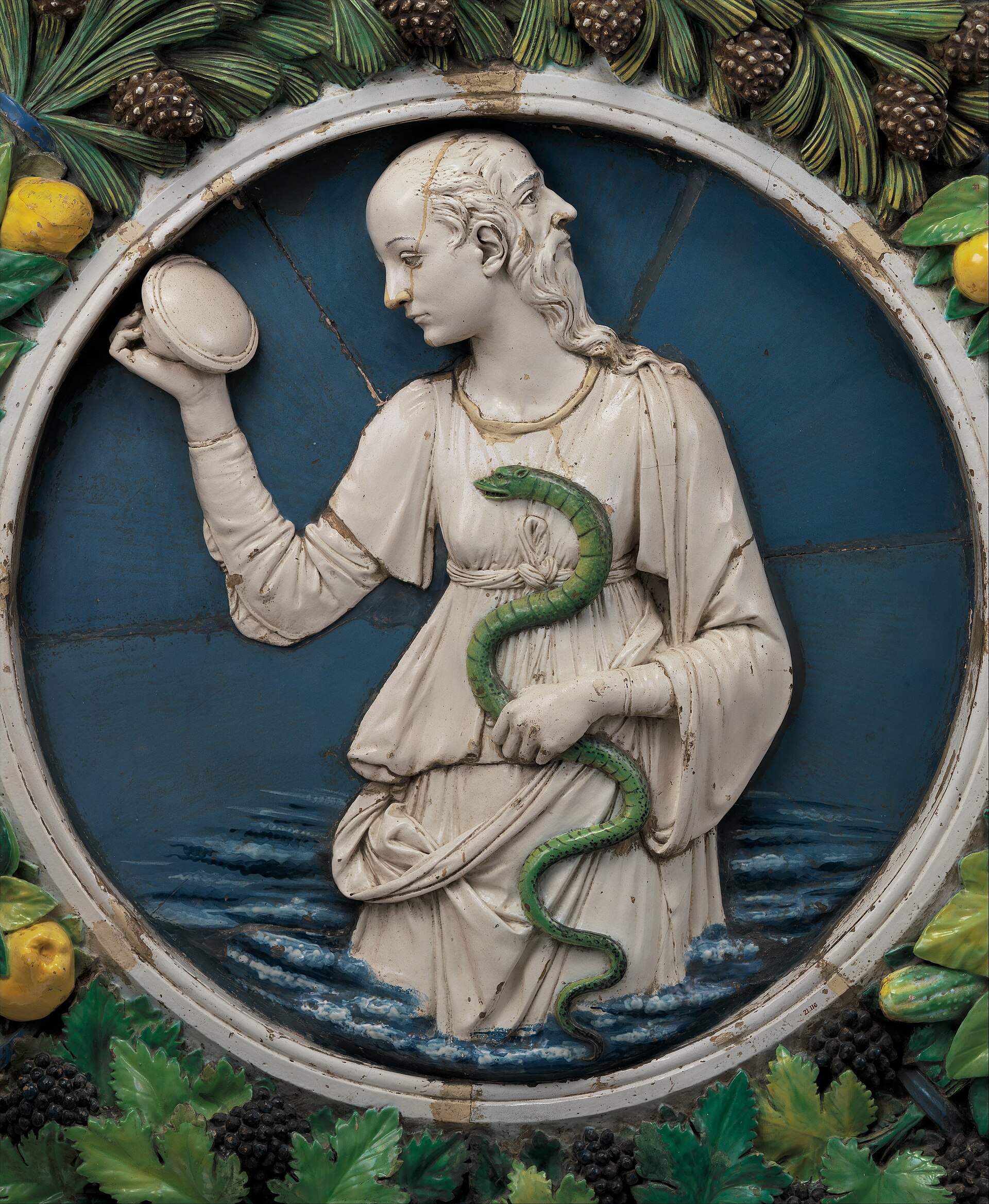
Produces Saint Michael the Archangel and Prudence, now both at the Metropolitan Museum, while Luca's health is failing and Andrea is the workshop's effective head.123
Completes the dated Adoration of the Child altarpiece for La Verna, paid for by Jacopo Brizi of Pieve Santo Stefano.6
The La Verna monastery's own account book records payment involving the patron Tommaso Alessandri and Andrea della Robbia by name, the year given to the Crucifixion altarpiece in the Chapel of the Stigmata.6
Luca della Robbia dies; Andrea inherits half the family house and workshop on Via Guelfa, Florence, and eventually becomes sole owner.3
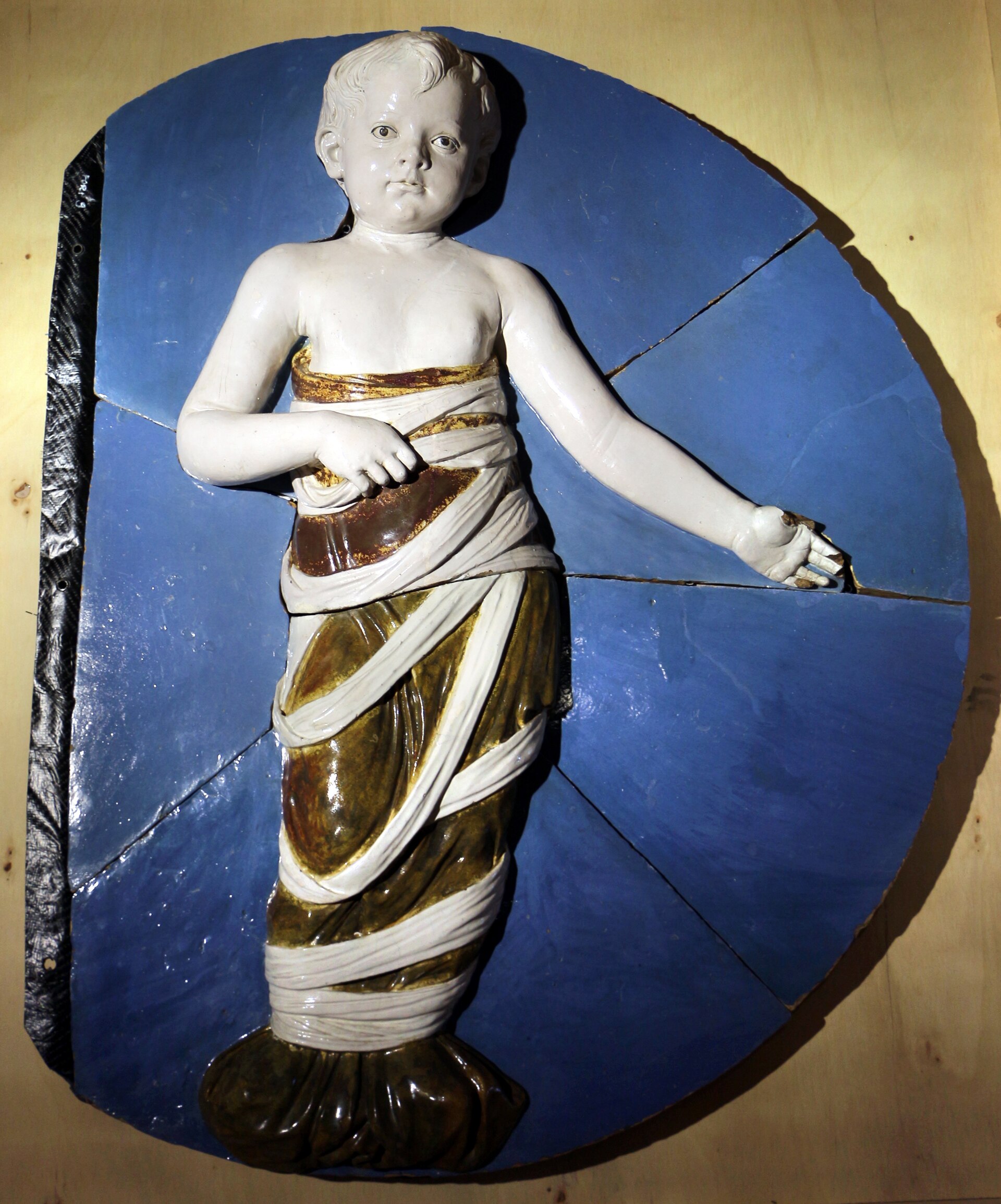
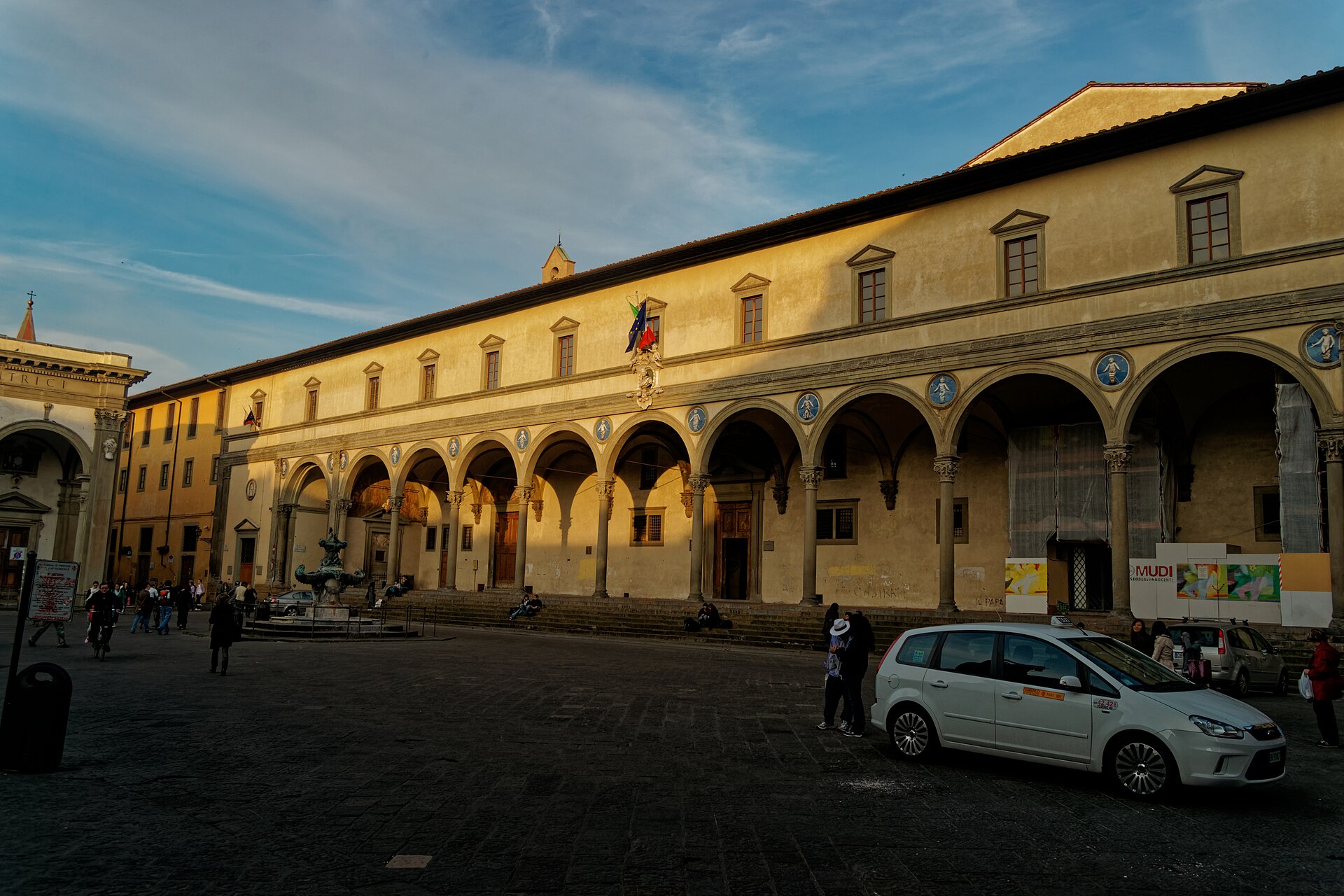
Installs ten glazed terracotta roundels of swaddled infants on the facade of the Ospedale degli Innocenti, Florence.5
The Madonna della Cintola altarpiece is in place at La Verna's Santa Maria degli Angeli, its predella carrying the arms of the Bartoli and Rucellai families following their intermarriage.6
Paid twenty gold florins, worth roughly two hundred and sixty-six days of an unskilled Florentine laborer's wages by one numismatic society's labor-cost method, for a relief of the Virgin and two angels for the Opera del Duomo, Florence, and begins work at Prato Cathedral.1023
Allan Marquand, son of the altarpiece's donor, publishes his first scholarly study of the Metropolitan Museum's Assumption of the Virgin in the American Journal of Archaeology, the start of his lifelong della Robbia scholarship.1819
Makes a medallion of the Virgin in Glory for Pistoia Cathedral.10
Aged about seventy-five, appears, according to Vasari, as a portrait figure in Andrea del Sarto's fresco The Devotion of the Florentines to the Relics of San Filippo Benizi at SS. Annunziata, Florence, and produces a bust for a church in Viterbo the same year.102627
Dies in Florence on 4 August, having accepted major commissions into his seventies.922
Andrea's son Girolamo della Robbia leaves for France to enter the service of King Francis I.20
Giovanni della Robbia, Andrea's most productive successor in Italy, dies.3
Allan Marquand publishes his catalogue of the family workshop across several volumes, completing Andrea della Robbia and His Atelier in 1922; the final volume appears in 1928, after Marquand's own death in 1924.1819
Girolamo della Robbia dies in France, the last of Andrea's sons active in the trade; the family's guarded technical knowledge is lost within a relatively short time afterward.320
John Pope-Hennessy reattributes the Metropolitan Museum's Prudence tondo from Luca della Robbia to Andrea, on stylistic grounds, in his monograph on Luca.330
Giancarlo Gentilini publishes I Della Robbia: La Scultura Invetriata nel Rinascimento, the modern standard two-volume catalogue of the family's work.3
The Metropolitan Museum's Saint Michael the Archangel lunette falls from its wall mount on 1 July and shatters; its multi-year reconstruction reveals fingerprints, tool marks and a fifteenth-century glaze repair inside the clay.3
Della Robbia: Sculpting with Color in Renaissance Florence, the first North American museum exhibition dedicated to the family, opens at the Museum of Fine Arts, Boston, and travels to the National Gallery of Art, Washington.37
A Luca della Robbia Madonna long kept at Santa Fiora sells at Sotheby's New York for $2,016,500 amid a public repatriation appeal from the comune of Santa Fiora.1729
A Workshop of della Robbia glazed terracotta armorial roundel sells at Bonhams, London, for GBP 15,300 including premium.15
Andrea della Robbia's market runs on two tiers that rarely meet. At the top, a small number of autograph pieces with clean modern provenance have sold in the high six or low seven figures: the market aggregator MutualArt records the artist's auction high as $1,650,500, for a pair of relief portraits of youths sold at Sotheby's New York in 2012, and a terracotta roundel made for the palace of Poggio Reale near Naples was estimated at $200,000 to 400,000 at Sotheby's in April 2017. Below that tier, objects catalogued as workshop of, circle of or attributed to Andrea trade for a fraction of the price: a Sotheby's Madonna Adoring the Infant Christ carrying a workshop attribution was estimated at GBP 100,000 to 150,000 in December 2019, and a Bonhams armorial roundel from the workshop sold for GBP 15,300 including premium in July 2022.
Final results for the top tier are frequently not published beyond the pre-sale estimate in the sources available without a subscription login: for three lots checked for this record, a 2015 Sotheby's relief carrying a written Gentilini authentication, the 2017 Poggio Reale roundel and the December 2019 workshop Madonna, no confirmed hammer price could be found. That gap in the public record is itself worth noting rather than papering over with an estimate presented as a result.
The wider family market gives useful scale. Andrea's uncle and teacher Luca della Robbia set the family record in January 2021, when a Madonna long kept in the parish church of Santa Fiora in the Tuscan Maremma sold at Sotheby's New York for $2,016,500 against a public repatriation campaign by the comune of Santa Fiora, which wanted the piece kept in Italy. The campaign did not succeed.
| Date | Sale | Work | Result | Note |
|---|---|---|---|---|
| 13 July 2022 | Bonhams, London | Workshop of della Robbia, glazed terracotta armorial roundel, Florence, early 16th century | Hammer not published separately in the source consulted With premium GBP 15,300 total, including buyer's premium GBP | Catalogued at workshop level, not as Andrea's own hand. |
| 2012 | Sotheby's, New York | A pair of relief portraits of youths | Hammer not published in the sources consulted With premium recorded by MutualArt as $1,650,500 total; not specified whether this is hammer or premium-inclusive USD | Recorded by the market aggregator MutualArt as Andrea della Robbia's auction record. Flagged as a tertiary source pending the original Sotheby's catalogue and sale result. |
| 28 January 2021 | Sotheby's, New York | Virgin and Child ("Friedrichstein Madonna" type), by Luca della Robbia, not Andrea | Hammer not published in the sources consulted With premium $2,016,500 total USD | Included as a family and technique comparandum, not an Andrea della Robbia sale. From the parish church of Santa Fiora, Tuscany, confiscated by the comune in 1866 under the suppression of religious houses, later the Albright Art Gallery, Buffalo, from 1929. Sold amid a public appeal from the comune of Santa Fiora to keep it in Italy. Sotheby's own lot page does not publish the final price without a login; the figure here is corroborated by Italian press coverage of the same sale. |
Hammer is the price at which the bidding stopped; with premium adds the fee the house charges the buyer on top. Hammer price and buyer's premium in the glossary.
| Institution | City | Holdings | Note |
|---|---|---|---|
| Metropolitan Museum of Art | New York | Saint Michael the Archangel (60.127.2), Prudence (21.116), a Lehman Madonna and other reliefs and the Assumption of the Virgin (the Marquand Altarpiece, 82.4), catalogued elsewhere in this archive | The largest single American holding, built across gifts and purchases from 1882 to 1969. |
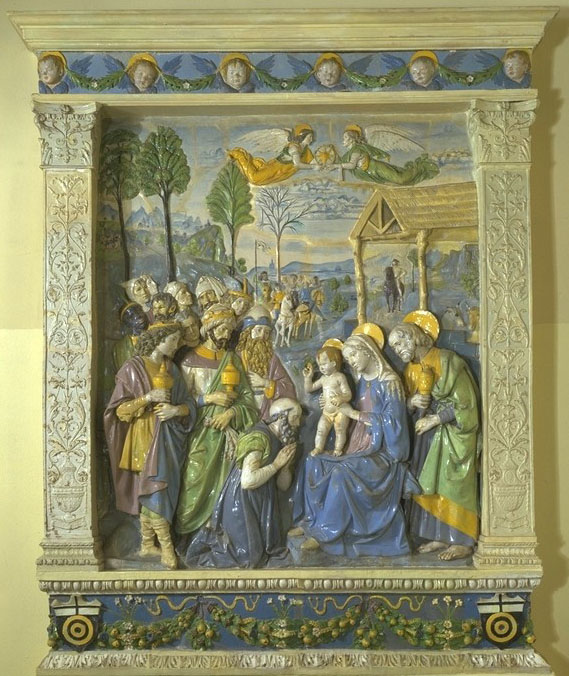
| Victoria and Albert Museum | London | The Adoration of the Magi altarpiece and several Madonna and Child devotional reliefs | |
| Bode-Museum | Berlin | Several Madonna and Child reliefs, including one damaged in 1945 | War damage visible on at least one relief. |
| Ospedale degli Innocenti | Florence | The ten facade roundels of swaddled infants, 1487 | In situ on the building for which they were made, unlike almost everything else in Andrea's corpus. |
| Sanctuary of La Verna | Chiusi della Verna, Tuscany | Five glazed terracotta altarpieces (c. 1476-c. 1493) across the Chiesa Maggiore, Santa Maria degli Angeli and the Chapel of the Stigmata | The largest concentration of documented, in-situ Andrea della Robbia work anywhere, each altarpiece still in its original devotional setting. |
| Museo Nazionale del Bargello | Florence | The Madonna of the Architects and further reliefs | |
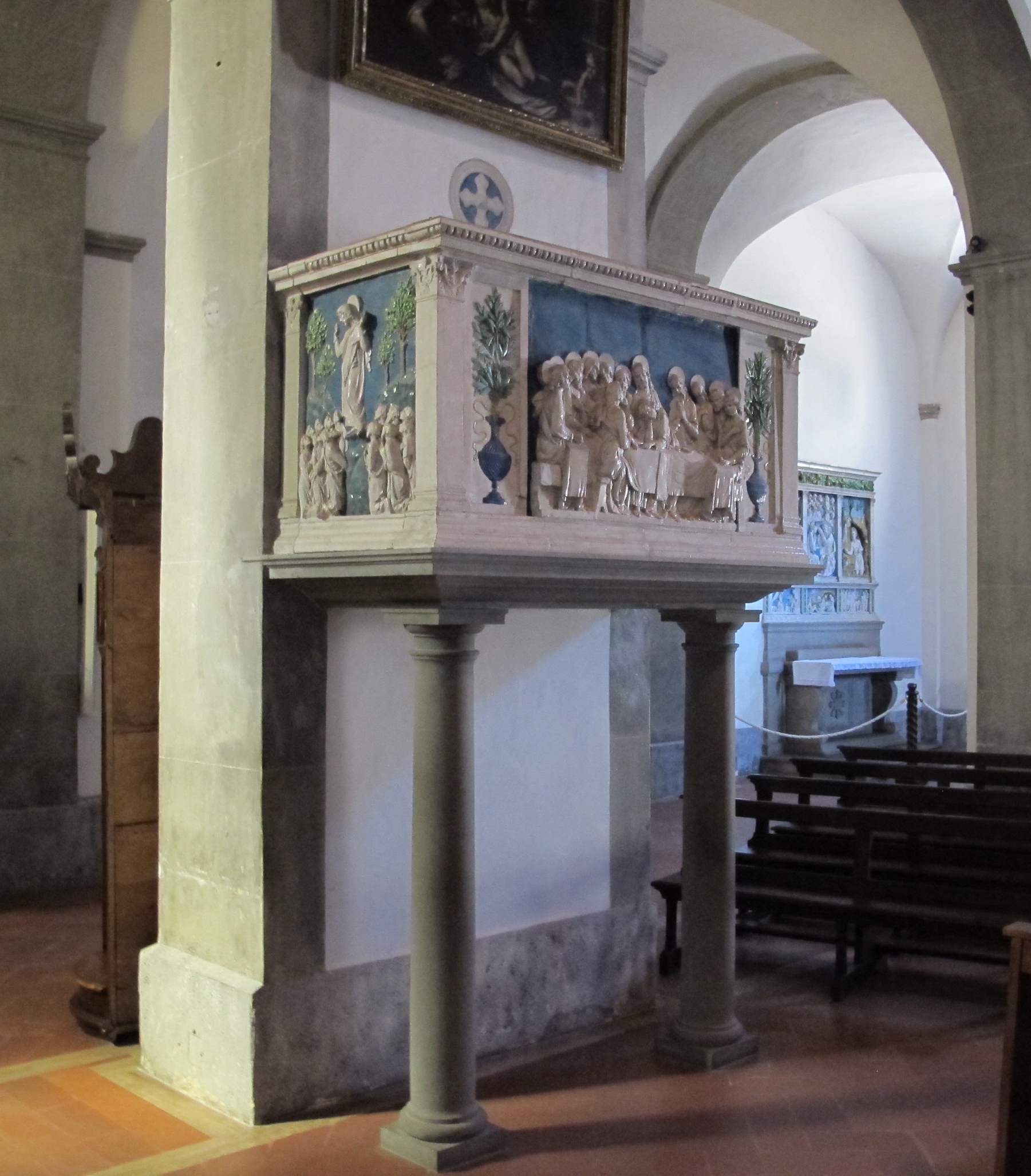
| Pieve delle Sante Flora e Lucilla | Santa Fiora, Tuscany | A glazed terracotta pulpit and further reliefs attributed to Andrea della Robbia and his workshop |
Andrea was born in Florence on 20 October 1435, the son of Marco della Robbia.
Andrea was born in Florence on 20 October 1435, the son of Marco della Robbia. Marco's brother Luca was already the leading sculptor of the family, first trained and celebrated for work in stone and bronze before he began experimenting with glazed clay sometime in the 1440s. Andrea trained under Luca from an early age and had already worked alongside him for more than twenty years by the time he produced his first major independent commissions in the 1470s.
The workshop was also the family's home, a house on Via Guelfa in Florence about a ten-minute walk from the Duomo. When Luca's health failed in the 1470s Andrea effectively took over direction of the business before his uncle's death, and on Luca's death in 1482 he inherited half the house and workshop, eventually becoming sole owner. Where Luca had produced smaller, more restrained reliefs, Andrea pushed the technique into architecture at a scale his uncle never attempted: friezes, fountains, wash basins, facade roundels and multi-section altarpieces assembled from dozens of separately modelled, fired and glazed pieces of clay. He kept accepting major commissions into his seventies, with documented work running to at least 1515, ten years before his death in Florence on 4 August 1525.
The scale of the operation is easy to understate. A single large altarpiece could require dozens of individually molded, hollowed, fired and glazed sections, each one planned so its joins would read as part of the architecture rather than as seams. Religious houses, hospitals, confraternities and aristocratic families across Tuscany all wanted what one modern curator has called a mark of status on their buildings, and clay was cheap: what a patron paid for was the workshop's skill, not the raw material.
The technique itself is well documented by direct scientific analysis of surviving pieces.
The technique itself is well documented by direct scientific analysis of surviving pieces. The clay body is a pale-firing, chalky material the workshop mined from a source along the banks of the Arno that later writers describe as closely guarded; unlike ordinary red terracotta it fires to a buff color, which makes the glaze laid over it read as more luminous, and its rate of expansion and contraction through firing is matched to the glaze, reducing the risk of cracking. Conservators at the Metropolitan Museum, examining two Andrea della Robbia reliefs after treatment, found large voids, uneven wedging and lumps of unmixed clay inside the fired body: evidence that the workshop's own craftsmen worked the material with far less finicky care than a modern ceramicist would, trusting an intimate, practiced knowledge of exactly how far the clay could be pushed.
The glaze itself is a tin-opacified lead glaze: tin oxide for the dense, brilliant white, with cobalt for blue, copper for green and manganese for the plum-purple that recurs across the family's work, confirmed directly by scanning electron microscopy and X-ray spectroscopy on pieces at both the Metropolitan Museum and the Fine Arts Museums of San Francisco. Large works were first modelled whole, then cut into sections designed to fire safely (twelve on the Metropolitan's Saint Michael the Archangel lunette, fifteen on its Prudence tondo), cast from plaster piece molds, hollowed to an even wall thickness to prevent warping, fired once to harden the clay and a second time after the colored glazes were brushed on. Workshop numbering systems, scratched into unglazed clay before firing to record the correct order of assembly, and even finger marks and tool impressions left in soft clay, still survive on pieces that have never been fully dismantled since installation.
None of this was decorative indulgence. Glazed terracotta cost a fraction of carved marble or bronze casting for the same surface area, its colors read clearly from across a nave or a piazza in a way unglazed stone or fading fresco could not, and, most importantly for exterior work, the fired glaze was effectively weatherproof: the Ospedale degli Innocenti roundels and the Saint Michael the Archangel lunette, made for a church facade in Faenza, both survived centuries of direct outdoor exposure with their color intact. For a religious order or hospital that wanted a monumental, legible, durable image and could not afford marble, glazed terracotta was not a compromise. It was the better material for the job.
Giorgio Vasari recorded a story that a woman working in the della Robbia household and shop leaked the family's glaze secrets to Benedetto Buglioni, who went on to run a rival glazed terracotta...
Giorgio Vasari recorded a story that a woman working in the della Robbia household and shop leaked the family's glaze secrets to Benedetto Buglioni, who went on to run a rival glazed terracotta workshop in direct competition with the family that had, on this account, invented the technique. It is a good story and it has been repeated for four centuries. It is also, on the evidence available, probably not what happened.
Modern accounts of the two workshops note instead that Buglioni most likely trained with the della Robbia before setting up on his own business, which would make him a departing apprentice rather than a thief, and that no serious rivalry between the two firms is documented beyond ordinary market competition. A separate, more fundamental question about the technique's origin is unresolved on different terms: some scholars argue that Luca della Robbia did not invent tin-glazing from nothing but revived and adapted a technique already established among Islamic and Hispano-Moresque potters, applying it for the first time at monumental sculptural scale. Whether that argument or a genuine independent Florentine invention is correct is not settled in the sources consulted for this record, and this record does not arbitrate it.
What is documented, rather than legendary, is that the della Robbia family did guard its methods closely and successfully for more than a century. Within a relatively short span after the deaths of Andrea's sons Giovanni (1529 or 1530) and Girolamo (1566), the family's carefully protected technical knowledge of the clay source and the glaze recipe was lost, and no workshop after them ever fully reproduced the specific combination of clay, glaze and firing that had made della Robbia terracotta recognizable at a glance for a hundred years.
Andrea's most famous single work is also his most functional.
Andrea's most famous single work is also his most functional. In 1487 he installed ten glazed terracotta roundels, each about a meter across, on the facade of the Ospedale degli Innocenti, the foundling hospital built to Filippo Brunelleschi's design on Florence's Piazza della Santissima Annunziata. Each roundel shows a single infant in swaddling bands against a blue ground, one arm freed and reaching out, as if beckoning the viewer toward the entrance below. No two are alike: the babies differ in pose, in how far they have worked an arm loose from the wrapping, in expression, giving ten variations on the same basic design rather than ten repetitions of one mould.
The choice of subject was not decorative whimsy. A foundling hospital's entire civic and charitable purpose was announced, in a single glance from across the piazza, by an image of an infant safely bound and protected. The swaddling itself, standard Renaissance infant care rather than a symbolic invention, became through repetition on this one building a recognizable civic mark: the bambini of the Innocenti are still used today as shorthand for the institution itself, more than five centuries after they were fired. That durability was the point of the material as much as the meaning was the point of the image. White figures on a saturated blue ground are legible at a distance in a way carved stone relief rarely is, and the glaze has needed no repainting or restoration of its color since the fifteenth century, a claim few facade decorations in any medium can make.
The richest single body of documented, in-situ Andrea della Robbia commissions anywhere is not in Florence but on the remote Apennine ridge of La Verna, the Franciscan sanctuary where Francis of...
The richest single body of documented, in-situ Andrea della Robbia commissions anywhere is not in Florence but on the remote Apennine ridge of La Verna, the Franciscan sanctuary where Francis of Assisi received the stigmata in 1224. Between about 1476 and 1493 Andrea's workshop supplied five glazed terracotta altarpieces for La Verna's three principal devotional buildings: the Annunciation (about 1476) and the Adoration of the Child (1479, dated by an inscription on its tempietto balustrade) in the Chiesa Maggiore, later joined there by the Ascension of Christ (by 1493, originally the church's own high altarpiece, moved to a side chapel in 1601); the Madonna della Cintola, installed by 1488, in the small entrance church of Santa Maria degli Angeli; and the Crucifixion, dated 1481, in the Chapel of the Stigmata itself, the most sacred space in the complex.
These were not anonymous gifts. Four of the five altarpieces carry inscriptions naming the Florentine families who paid for them: the Niccolini arms flank the Annunciation's inscription, Jacopo Brizi of Pieve Santo Stefano is named on the Adoration, the Alessandri family's arms appear on the Crucifixion and the Bartoli and Rucellai families' crests, tied to an intermarriage completed by 1488, appear on the Madonna della Cintola's predella. The Ascension alone carries no inscription, and is attributed on documentary grounds to Medici patronage of the church's presbytery and choir. Most tellingly, the Crucifixion altarpiece's date is fixed not by style but by an entry in the monastery's own account book for August 1481 that names the patron, Tommaso Alessandri, and Andrea della Robbia together: a rare instance in his whole career where a document, rather than a stylistic argument, puts his name on a specific dated work.
A 2021 study by the art historian Stephanie Miller argues that the Annunciation and Adoration altarpieces were designed with a specific Franciscan devotional experience in mind, encouraging pilgrims arriving at what a 1493 visitor's account called another Jerusalem in the West to read the two images together and to recite prayers, such as the Angelus, whose text echoes the altarpieces' own inscriptions. That is Miller's argument, citable to her and open to revision, not a fact recovered from a document; what is documented independently is the Observant Franciscan community's own emphasis, distinct from the rival Conventual Franciscans, on the Rule of poverty and on devotion to the Virgin, which the choice of an Annunciation and an Adoration as the first two altarpieces in the rebuilt church plainly serves.
Prudence is also a documented case study in exactly how attribution moves inside this corpus.
Prudence is also a documented case study in exactly how attribution moves inside this corpus. The tondo, about a meter and a half across and weighing some 350 kilograms, was catalogued as a work of Luca della Robbia from its first appearance in the modern literature until the art historian John Pope-Hennessy reattributed it to Andrea in his monograph on Luca, published in 1980, arguing from stylistic details: the posture of the figure, the treatment of the drapery folds, the set of the eyelids. Nothing documentary settled the question either way; a connoisseur's argument moved the object from one man's catalogue to another's.
The same movement runs in the opposite direction elsewhere in this archive. This publication's own record for the Metropolitan Museum's Assumption of the Virgin, the Marquand Altarpiece, describes an attribution that spent most of the twentieth century at workshop level, Workshop of Andrea della Robbia, before the Museum's own curators elevated it to Andrea's personal hand for a 2026 exhibition, on a specific technical or archival basis the Museum has not published in the sources available to that record. Read together with Prudence, the pattern is the point: individual objects move between Luca, Andrea, workshop-of-Andrea and, further down the family tree, Giovanni, not as a settled hierarchy but as a live argument that different scholars have reopened in 1980, in the 1990s and again in 2026. No cataloguer working on this family, including Andrea's own family historian discussed below, has ever closed that argument for good.
The single most consequential piece of scholarship on Andrea della Robbia was written by a man who was not primarily an art historian at all, and whose interest in the family began with an object...
The single most consequential piece of scholarship on Andrea della Robbia was written by a man who was not primarily an art historian at all, and whose interest in the family began with an object already in this archive. Allan Marquand (1853-1924) trained as a philosopher at Johns Hopkins under Charles Sanders Peirce before returning to Princeton, where in 1883 he was made the university's first professor of art history and went on to found its Department of Art and Archaeology. His father, Henry Gurdon Marquand, was a New York collector, railroad financier and, from 1889, the Metropolitan Museum of Art's second president; in 1882, while serving as the young museum's treasurer, Henry Marquand gave it an Andrea della Robbia altarpiece, the Assumption of the Virgin, bought that same year from a Florentine dealer.
By Allan Marquand's own account, that gift is what set him on the della Robbia family for the rest of his life. He published his first scholarly analysis of his father's altarpiece in the American Journal of Archaeology in 1891, and over the following decades produced what amounts to the family's first systematic catalogue: Della Robbias in America (1912), Luca della Robbia (1914), Andrea della Robbia and His Atelier (1922, in two volumes, as Princeton Monographs in Art and Archaeology XI) and, published after his death in 1924, The Brothers of Giovanni della Robbia (1928). Erwin Panofsky later cited Marquand's della Robbia volumes among the reliable body of art-historical scholarship known to European researchers before the Second World War. Marquand's own catalogue of Andrea's atelier remains, a century on, the founding reference point against which the modern standard, Giancarlo Gentilini's two-volume I Della Robbia: La Scultura Invetriata nel Rinascimento (Cantini, Florence, 1993), is measured; what specifically Gentilini's catalogue revises from Marquand's counts is not detailed in the sources consulted for this record.
Marquand died in 1924, two years after completing his catalogue of Andrea's atelier, without knowing that the very altarpiece that had started his life's work would still be having its attribution actively argued more than a century later. He is not a footnote to that argument. He is one of its authors.
Sources differ on exactly how many of Andrea's sons worked in the family trade, five by some counts and seven by the account given in the 1911 Encyclopaedia Britannica, but they agree on which two...
Sources differ on exactly how many of Andrea's sons worked in the family trade, five by some counts and seven by the account given in the 1911 Encyclopaedia Britannica, but they agree on which two mattered most. Giovanni della Robbia, the most productive of Andrea's sons, carried the workshop's Italian production forward until his own death in 1529 or 1530, continuing to supply the same market of Tuscan churches, hospitals and private patrons his father had built. Girolamo della Robbia took a different path entirely: in 1528 he left for France and spent nearly forty years in the service of the French crown, decorating the Chateau de Madrid in the Bois de Boulogne for Francis I with terracotta medallions and friezes fired at kilns he set up at Suresnes, later working at Fontainebleau and, after Francis I's death in 1547, on the royal monuments at Saint-Denis. A relief bust of Francis I now at the Metropolitan Museum is catalogued jointly to Girolamo and to another of Andrea's sons, Luca della Robbia the Younger, evidence that more than one of Andrea's children followed the family trade abroad, not only Girolamo alone.
Girolamo died in France in 1566, the last of Andrea's sons still active in the trade. Within what the Metropolitan Museum's own conservators describe as a relatively short time after that, the family's closely guarded knowledge of its clay source and its exact glaze recipe was lost. No later workshop, in Italy or anywhere else, ever fully reconstructed the specific combination that had made della Robbia terracotta instantly recognizable across a church facade for more than a century. What survives is what was already made: a corpus scattered across Tuscan churches, hospitals and confraternities, and, from the late nineteenth century onward, across American and northern European museum collections built by a wave of Gilded Age and Progressive Era donors, Henry Marquand among the earliest of them, who prized exactly the plain, legible, durable qualities the workshop had built the technique to deliver in the first place.
Andrea della Robbia's reputation moved through distinct phases rather than rising steadily.
Andrea della Robbia's reputation moved through distinct phases rather than rising steadily. Nineteenth-century art historians, by the Metropolitan Museum's own conservators' account, tended to treat della Robbia terracottas as mass-produced decorative objects, and early scholarship focused overwhelmingly on attribution and iconography rather than on how the workshop actually made things; only conservation science from the 1870s onward, and especially technical studies published from 2016 onward around the first North American museum exhibition dedicated to the family, reframed the della Robbia as sculptors whose backs and undersides carry as much evidence as their fronts.
The American collecting wave that Henry Marquand's 1882 gift opened continued for decades, and one Sotheby's account of the trade dates its real surge specifically to the 1920s: the Metropolitan Museum bought a Head of a Youth in 1903 with its Rogers Fund and Prudence in 1921 with the Joseph Pulitzer bequest, received further Andrea della Robbia reliefs from the estate of Adele Lehman in 1965 and from the Edith and Herbert Lehman Foundation in 1969, and in 1960 bought the Saint Michael the Archangel lunette at a Parke-Bernet auction in New York after it had passed through a Florentine noble collection, a German collector's estate and an American industrialist's collection in turn. The same appetite reached Luca della Robbia's work as well: a Madonna long kept in the parish church of Santa Fiora in the Tuscan Maremma, confiscated by the comune itself in 1866 under the nineteenth-century suppression of religious houses, passed through Belgian and Berlin dealers before the Albright Art Gallery in Buffalo bought it in 1929, and it resurfaced at Sotheby's New York in January 2021, selling for $2,016,500 against a public appeal from the comune of Santa Fiora to bring it home rather than let it leave Italy again. The appeal did not succeed.
That is the wider pattern this record sits inside: hospitals, convents and parish churches across Tuscany that could not maintain, insure or in some cases even keep their della Robbia terracottas, and a market, first American and now global, that has kept paying to take them elsewhere ever since.
Sculptor; Ceramicist. 1435-1525.
Born 20 October 1435, Florence; died 4 August 1525, Florence.
Metropolitan Museum of Art (New York); Victoria and Albert Museum (London); Bode-Museum (Berlin); Ospedale degli Innocenti (Florence); Sanctuary of La Verna (Chiusi della Verna, Tuscany); Museo Nazionale del Bargello (Florence).
Andrea della Robbia's market runs on two tiers that rarely meet. At the top, a small number of autograph pieces with clean modern provenance have sold in the high six or low seven figures: the market aggregator MutualArt records the artist's auction high as $1,650,500, for a pair of relief portraits of youths sold at Sotheby's New York in 2012, and a terracotta roundel made for the palace of Poggio Reale near Naples was estimated at $200,000 to 400,000 at Sotheby's in April 2017.
What specific technical or archival evidence underlies the Metropolitan Museum's 2026 reattribution of its Assumption of the Virgin from Workshop of Andrea della Robbia to Andrea della Robbia and Workshop. The Museum states the finding but has not published the argument behind it.
Last verified
One artwork and its story every Tuesday, with the picture: who owned it, what it made, and what closes soon in the exhibition calendar. No promotion, and nothing we cannot cite.
We send one email to confirm the address and keep nothing else. Every letter carries a one-click unsubscribe. How we handle your data.