The Assumption of the Virgin (The Marquand Altarpiece)
Andrea della Robbia and Workshop · ca. 1485
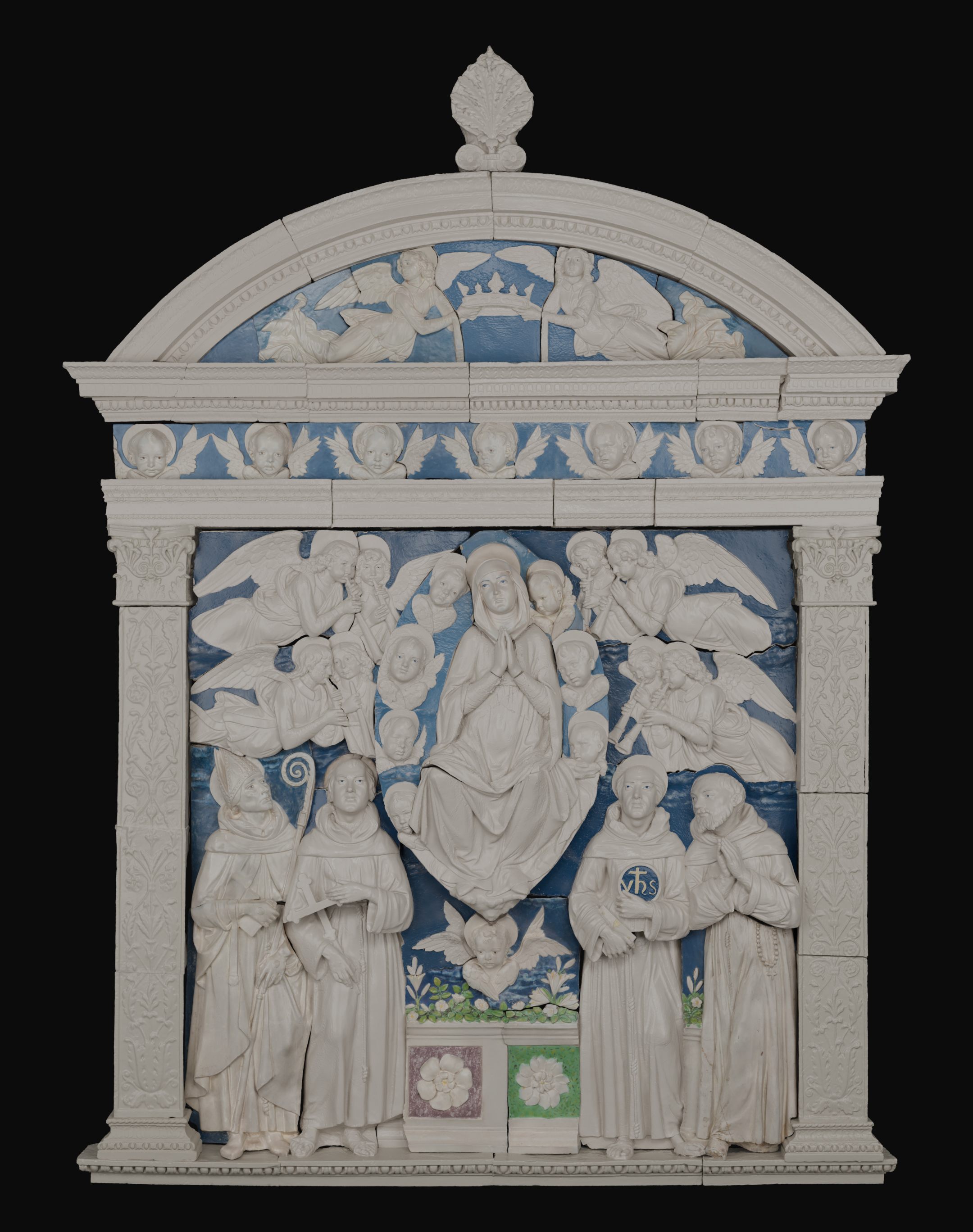
The assembled altarpiece, Andrea della Robbia and Workshop, ca. 1485, glazed terracotta, 66 sections. Metropolitan Museum of Art, accession 82.4. Museum photograph released CC0 through the Open Access programme.
| Artist | Andrea della Robbia and Workshop |
|---|---|
| Date | ca. 1485 |
| Medium | Glazed terracotta |
| Dimensions | 118 1/2 x 88 in. (301 x 223.5 cm), assembled from 66 sections |
| Where it is now | Metropolitan Museum of Art, New York, Gallery 521last confirmed |
| Inventory number | 82.4 |
| Attribution | AcceptedCatalogued for decades as Workshop of Andrea della Robbia. Full note |
| Object type | Ceramic |
| Period | Italian Renaissance, Florentine, fifteenth century |
| Cases | Has a provenance gap |
| Inscriptions | None recorded in the sources consulted. |
| Owners on record | 6 links5 documented, 1 unknown |
| Sources | 20 cited |
About this record Last verified · 20 sources cited · Change log
On this page 10 sections
ContentsClose
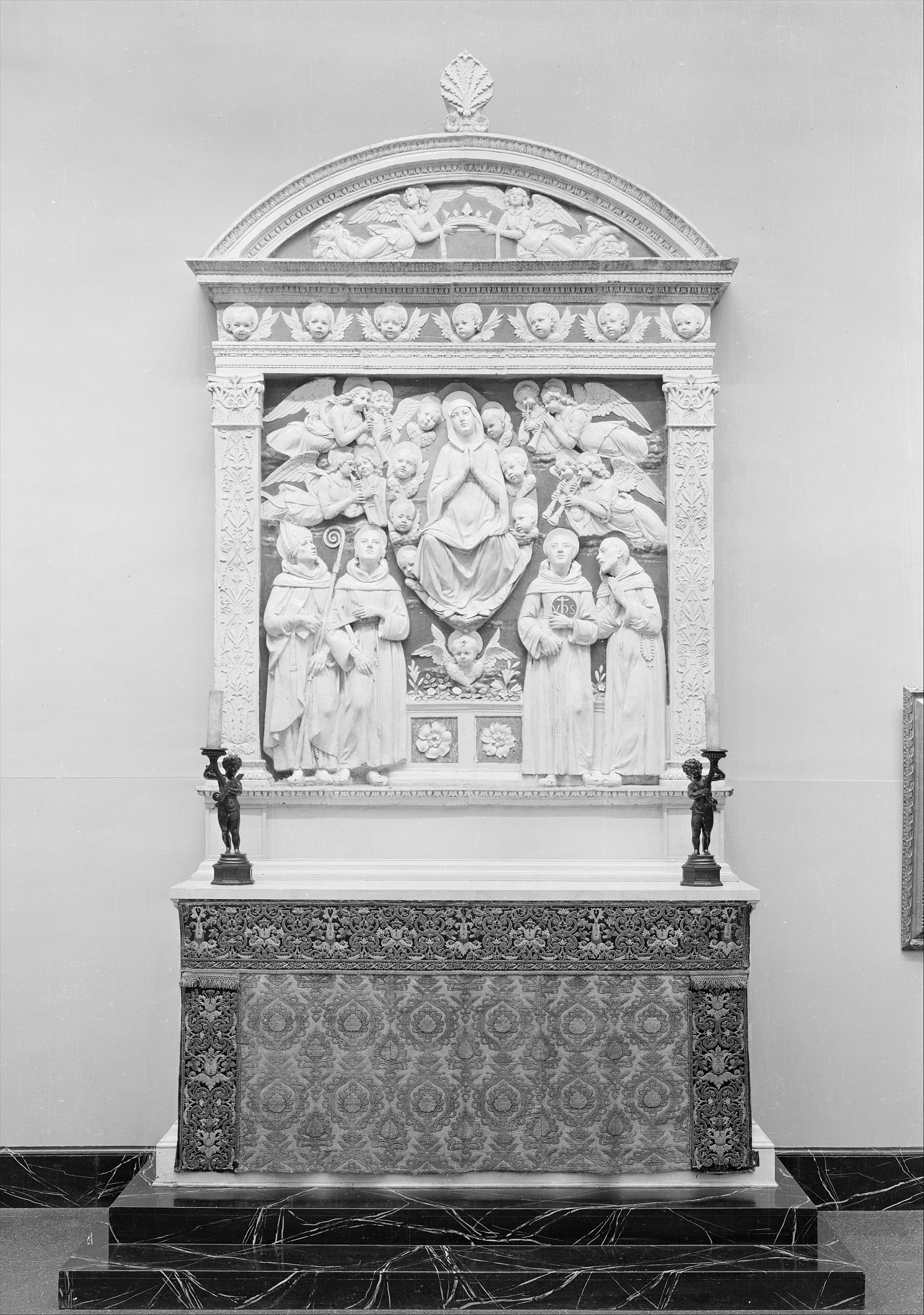
Andrea della Robbia's Assumption of the Virgin, known as the Marquand Altarpiece, is sixty-six separately fired and glazed sections of terracotta that assemble into a wall-sized Franciscan altarpiece nearly ten feet high. Made around 1485 for the Observant Franciscan convent of Monte Muro above Scarlino in the Tuscan Maremma, it left that convent's care after the house was secularized under the Napoleonic suppressions of 1809, resurfaced in a private Florentine collection by 1852, and was bought by the New York collector and future Metropolitan Museum president Henry G. Marquand in 1882, the year he also became the young Museum's treasurer.
For most of its life at the Metropolitan it was catalogued as Workshop of Andrea della Robbia. Research undertaken for the Museum's 2026 exhibition Rediscovering Della Robbia at The Met upgraded that to Andrea della Robbia and Workshop, and returned the altarpiece to public view after roughly seventy years in storage, with about half its sections newly conserved and a scanned three-dimensional reconstruction showing how the whole once fit together. The Museum has stated the fact of the reattribution; it has not, in the sources available to this record, published the specific evidence behind it.
The gap in the record is honestly kept open rather than smoothed over: forty-three years between a suppressed Tuscan convent and a documented Florentine owner, an unnamed set of four Franciscan saints at the Virgin's tomb, and an unpublished technical or archival basis for a headline reattribution. What is documented is unusually rich for an object of this kind: a named convent, a named suppression, a named dealer, and one of the Metropolitan Museum's own founding-era trustees as the donor who gave it to the public in the first place.
Provenance
Each link is graded. Documented: a cited source supports it. Disputed: the identification is argued but not established. Unknown: no owner for that span, and the gap is not smoothed into a narrative. The grades in the glossary.
- ca. 1485 - 1809Convent of Monte Muro (Monte di Muro), Scarlino, Tuscanydocumented
Made, on the Metropolitan Museum's own attribution, for the high altar of this Observant Franciscan convent south of Florence, rebuilt around 1460. The convent was secularized and alienated as a farmhouse in 1809 under the Napoleonic suppression of religious houses in occupied Tuscany.21213
- 1809 - by 1852Unknownunknown
No owner, dealer, or transaction is documented between the convent's 1809 suppression and the altarpiece's appearance in a private Florentine collection by 1852. The general mechanism by which Napoleonic-suppressed convent property entered the Italian art trade is documented; the specific chain of custody for this object in that window is not.1213
- by 1852 - by 1882Charles de Fournier and his wife, Josephine del Drago, Florencedocumented
First documented post-convent owners of record, in Florence.2
- by 1882 - 1882Luigi Barugi, Florence (dealer)documented
Sold the altarpiece to Henry G. Marquand in 1882. No further detail on Barugi's firm or the sale terms is documented in the sources consulted.2
- 1882 - 1882Henry G. Marquand, New Yorkdocumented
Purchased from Barugi and given to the Metropolitan Museum of Art in the same year, 1882, while Marquand was a Museum trustee (he became treasurer that year and the Museum's second president in 1889). Not included in the 1903 estate sale of his remaining personal collection, having already left his possession twenty-one years earlier.121415
- 1882 - presentMetropolitan Museum of Art, New Yorkdocumented
Accessioned as 82.4. Off public view for approximately seventy years at some point in the twentieth century, for reasons not documented in the sources consulted; returned to view in Gallery 521 in August 2026 as the centerpiece of Rediscovering Della Robbia at The Met, with a new attribution to Andrea della Robbia and Workshop.12389
Technical evidence
| Attribution note | Catalogued for decades as Workshop of Andrea della Robbia. Research conducted by the Metropolitan Museum's Department of European Sculpture and Decorative Arts for the 2026 exhibition Rediscovering Della Robbia at The Met upgraded the attribution to Andrea della Robbia and his workshop, describing the altarpiece as made by Andrea himself and his shop around 1485. The Museum's own object record and its press and exhibition materials now carry this attribution. The specific technical, documentary, or connoisseurial evidence behind the change has not been published in the sources available to this record; see open questions. |
|---|---|
| Support and construction | 66 separately modelled, fired and glazed terracotta sections, assembled without a continuous internal armature described in the sources consulted; joints designed to be read as part of the architectural composition rather than concealed.26 |
| Medium | Glazed terracotta, tin-opacified lead glaze colored with metal oxides (cobalt blue, copper green, manganese purple), following the technique developed by Luca della Robbia in the early 1440s and continued in the Andrea della Robbia workshop.19 |
| Dimensions | 118 1/2 x 88 in. (301 x 223.5 cm) as assembled; reported in press coverage as approximately 10 by 7 feet.16 |
| Accession number | 82.4, Metropolitan Museum of Art, Department of European Sculpture and Decorative Arts.12 |
| Credit line | Gift of Henry G. Marquand, 1882.12 |
| Rights status | Public domain (Metropolitan Museum Open Access programme); all image files associated with this object are released CC0.120 |
| Gallery location | Gallery 521, on view as of the 2026 exhibition Rediscovering Della Robbia at The Met.1 |
| Condition | The Museum's own account states the altarpiece suffered extensive damage before entering the collection in 1882, and that only some of its 66 sections have subsequently been conserved; 33 sections were newly conserved for the 2026 exhibition.389 |
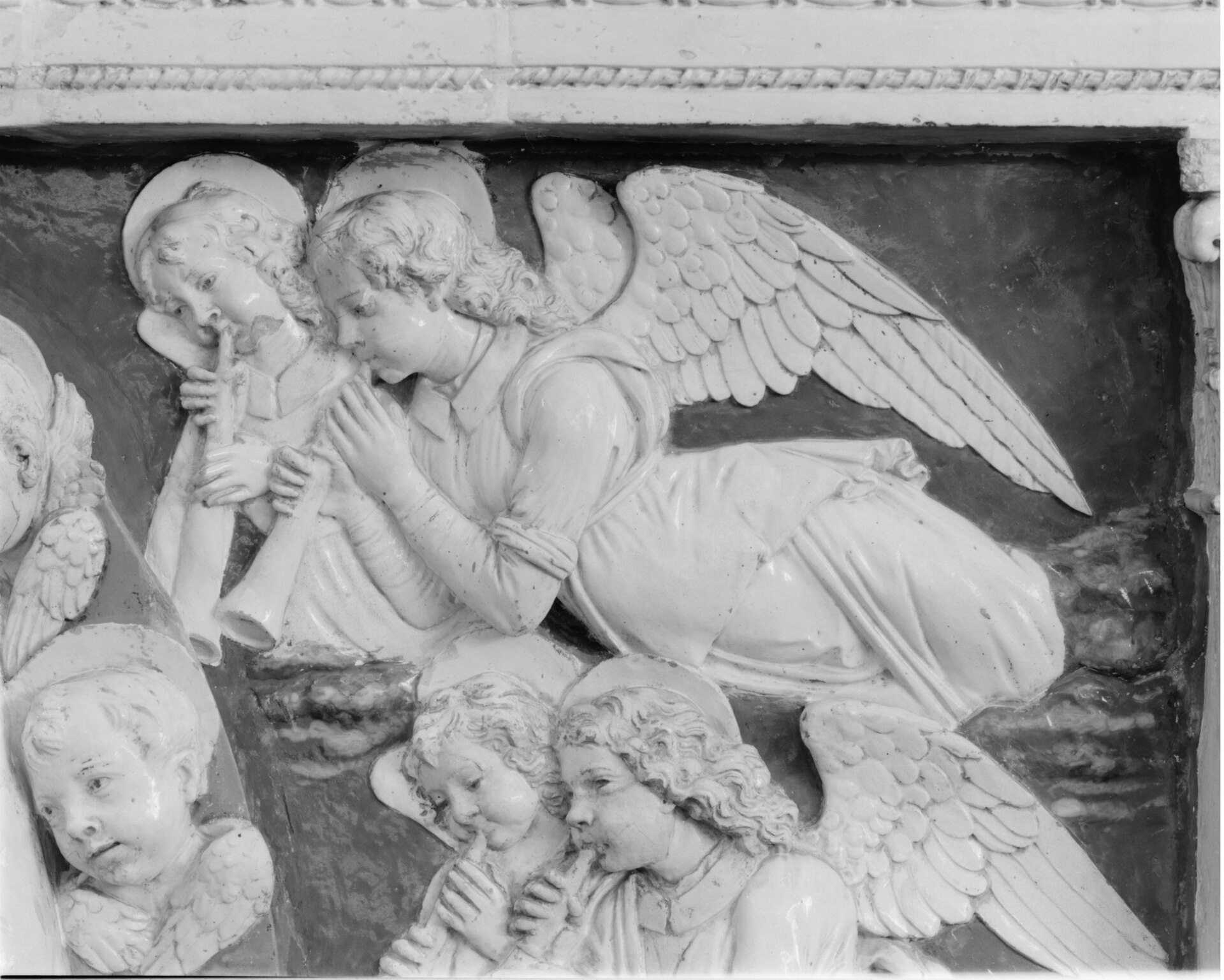
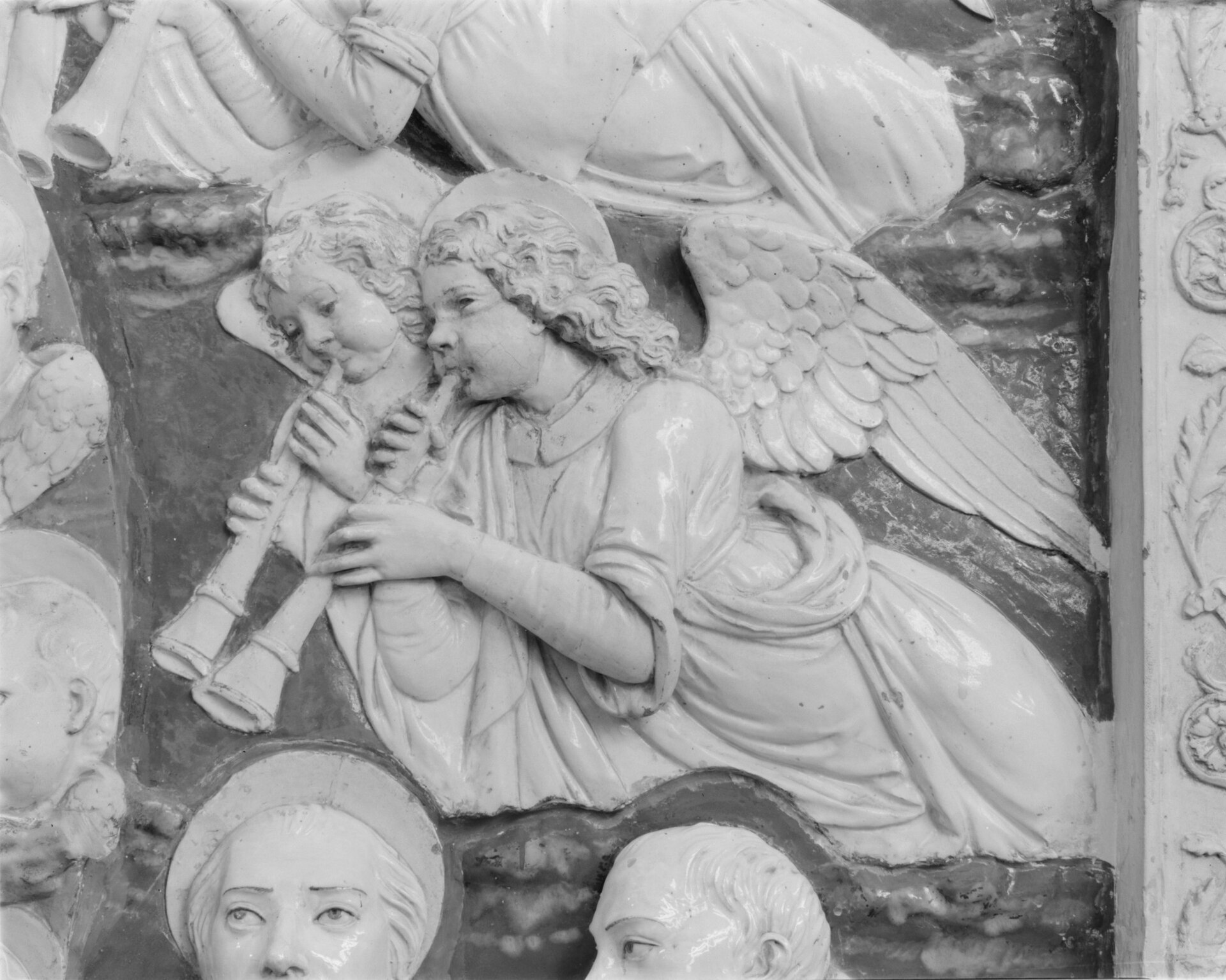
| Iconography | The Virgin Mary rising within a mandorla, borne and surrounded by cherubim and music-making angels; below, four Franciscan saints stand at her open, flower-filled tomb.12 |
Images
The record in full
Chapter 1Sixty-six pieces of clay make one altarpiece
The Assumption of the Virgin is not a single object in the way a painting is.
The Assumption of the Virgin is not a single object in the way a painting is. It is sixty-six separately fired and glazed sections of terracotta, fitted together like a masonry wall, that together form a wall-sized altarpiece nearly ten feet high and seven feet wide (118 1/2 by 88 inches, 301 by 223.5 centimetres). Nothing on this scale can be thrown or modelled as one piece and survive its own firing; the della Robbia workshop's entire monumental practice depended on breaking a design into sections small enough to fire safely and large enough to assemble without the joints reading as joints.
The scene shows the Virgin Mary rising into heaven inside an almond-shaped mandorla, carried and surrounded by cherubim and music-making angels in flight. Below her, on the ground, four Franciscan saints stand around her open tomb, out of which lilies and roses have grown in her place. The composition is read from bottom to top: earthly grief and Franciscan witness at the base, ascending through the ring of angel musicians, to the Virgin herself at the summit, already crowned in glory. The specific identities of the four Franciscan saints are not given in the sources consulted for this record.
Chapter 2What the glaze is, and why it exists at all
Glazed terracotta as a monumental sculptural medium is Luca della Robbia's invention, developed in Florence in the early 1440s and passed down through three generations of his family: to his nephew...
Glazed terracotta as a monumental sculptural medium is Luca della Robbia's invention, developed in Florence in the early 1440s and passed down through three generations of his family: to his nephew Andrea, and from Andrea to Andrea's own sons, of whom Giovanni carried the workshop the furthest before it closed in the late 1520s. The glaze itself was a tin-opacified lead glaze, its base of lead, tin, silica and alkaline earth, colored with metal oxides: cobalt for blue, copper for green, manganese for the plum-purple that appears in many della Robbia grounds. The tin content is what gives the whites their density and brilliance rather than the translucent sheen of an ordinary ceramic glaze.
A persistent studio legend holds that a maid in the della Robbia household stole Luca's formula and passed it to a rival workshop, that of Benedetto Buglioni, which went on to produce glazed terracotta in direct competition with the family that invented it. Some modern scholars are skeptical that any single secret recipe ever existed in the form the legend implies, and argue instead that Luca adapted a tin-glazing technique already known to Islamic and Hispano-Moresque potters and applied it, for the first time at this scale, to sculpted figures. Both the theft story and the Islamic-technique argument are proposals about a process, not documented facts about this altarpiece specifically, and are presented here as exactly that: a workshop legend on one hand, a scholarly argument on the other.
Whichever account of the glaze's origin is correct, the reason it mattered to a patron in 1485 is not in serious dispute: white, blue and green glazed surfaces read as durable, luminous color from across a nave, at a fraction of the cost of marble or bronze on the same scale, and Renaissance commentators already described the results as functionally eternal. For an altarpiece meant to dominate a small convent church, that combination of scale, color and cost was the entire point.
Chapter 3An altarpiece for a Franciscan house on a hill above Scarlino
The altarpiece was made, on the Museum's own attribution, for the convent of Monte Muro (Monte di Muro), on a hilltop in the comune of Scarlino in the Tuscan Maremma, south of Florence.
The altarpiece was made, on the Museum's own attribution, for the convent of Monte Muro (Monte di Muro), on a hilltop in the comune of Scarlino in the Tuscan Maremma, south of Florence. The site's religious history predates the Observant Franciscans who commissioned this altarpiece: it arose in the fourteenth century as a refuge for the Fraticelli, or Frati dell'Opinione, a splinter group of radical Franciscan spirituals condemned as heretical by the papacy. In 1420 the Blessed Thomas of Florence, later called Thomas of Scarlino, settled there, and the community subsequently passed into the mainstream Observant Franciscan reform associated with San Bernardino of Siena; the Blessed Anthony of Stroncone also lived at the house. The convent and its church were completely rebuilt around 1460, a generation before this altarpiece was made, and were attacked and plundered by Saracen raiders repeatedly in the sixteenth century.
An Assumption altarpiece of this scale, installed around 1485, therefore belongs to the second, Observant-Franciscan life of a site whose first religious community had been condemned as heretical fifty years earlier. Nothing in the sources consulted connects the Fraticelli period to the iconography or commissioning of this altarpiece; it is simply the site's earlier history, and this record does not present it as more than that.
The convent did not survive as a religious house into the modern era. In 1809, under the wave of Napoleonic suppressions that dissolved religious orders across occupied Tuscany, Monte Muro was secularized, its community dispersed, and the building itself alienated and converted into a farmhouse. Today its ruins, part of the Italian heritage register I Luoghi del Cuore maintained by the Fondo Ambiente Italiano, preserve the fifteenth-century plan of the convent and its single-nave church, together with a small chapel that held the graves of Thomas of Florence and the Blessed Ladislaus of Hungary. No source consulted for this record documents what happened, at the moment of suppression, to the altarpiece that had stood on the convent's altar for roughly three hundred years.
Chapter 4From a suppressed convent to a Florentine dealer's stock
The documented provenance resumes more than forty years after the 1809 suppression, with the altarpiece in the possession of Charles de Fournier and his wife, Josephine del Drago, in Florence, by...
The documented provenance resumes more than forty years after the 1809 suppression, with the altarpiece in the possession of Charles de Fournier and his wife, Josephine del Drago, in Florence, by 1852. How it travelled from a secularized farmhouse in the Maremma to a private Florentine collection in the intervening decades is not recorded in any source available to this record; it is treated here as an unresolved gap rather than bridged with a guess. The Napoleonic suppressions across Italy are well documented in general as a moment when convent and monastic property, including altarpieces, panels, and liturgical furnishings, entered private hands and eventually the international art trade, but that general mechanism is not the same as a documented chain of custody for this specific object, and this record does not claim more than the general context allows.
By 1882 the altarpiece was with Luigi Barugi, a dealer in Florence, from whom it passed to Henry G. Marquand of New York in the same year. Barugi's role appears in the sources consulted only as the seller of record; nothing further about his firm, his other stock, or the terms of the sale to Marquand has been located.
Chapter 5Henry Marquand and the Metropolitan Museum's first monumental Italian sculpture
Henry Gurdon Marquand (1819-1902) did not start as an art collector.
Henry Gurdon Marquand (1819-1902) did not start as an art collector. He began in his family's New York silversmithing firm, moved into banking and real estate, and made the fortune that funded his collecting through railroads: as an officer of the St. Louis, Iron Mountain and Southern Railway from the 1860s and later its vice-president and president, he sold his stock in December 1880 for roughly one million dollars, an amount contemporaries called an enormous fortune, and effectively retired from business at that point to devote himself to collecting and to the young Metropolitan Museum.
Marquand had joined the Museum's founding provisional committee in 1869, a year before its incorporation, and became a trustee in 1871. He served as treasurer from 1882 and, from February 1889 until his death in 1902, as the Museum's second president. Across those three decades he gave to nearly every curatorial department: pre-Columbian ceramics in 1879, ancient glass in 1881, his first painting gift in 1881, and, most famously, thirty-seven Old Master paintings lent in December 1888 and formally donated in January 1889, including works attributed to Rembrandt, Van Dyck, Vermeer and Filippo Lippi, filling what became known as the Marquand Gallery. His stated reasoning for the 1889 gift, that such paintings would be of far greater service to the public in a gallery than in a private house, reflects the same instinct behind the 1882 gift of this altarpiece, seven years earlier.
The Assumption of the Virgin, bought from Barugi and given to the Museum in 1882, predates the Old Masters gift by seven years and belongs to a different, earlier phase of Marquand's patronage, when the Metropolitan itself was only twelve years old and still building the core of its permanent collection almost gift by gift. The Museum's own materials for the 2026 exhibition describe it as the first glazed terracotta sculpture to enter the Metropolitan's collection, and separate press coverage of the same exhibition describes it as the Museum's first monumental work of Italian Renaissance sculpture of any kind. Both descriptions are given here as reported, from Museum-derived sources, rather than independently verified against the full accession register; either way, the gift arrived very early in the institution's history and set a marker for what an American museum could hold that had, until then, existed only in Italian churches and private Italian and English collections.
Marquand died in 1902. The rest of his personal collection, kept in his own house rather than given away in his lifetime, was sold at the American Art Association in New York in January and February 1903, realizing roughly seven hundred thousand dollars across more than two thousand decorative objects, ninety-eight paintings and over a hundred prints; the top lot, Lawrence Alma-Tadema's A Reading from Homer, brought thirty thousand dollars. The Assumption of the Virgin was not part of that sale. It had already belonged to the public for twenty-one years.
Chapter 6What Franciscan viewers were meant to see
The Assumption of the Virgin, the belief that Mary's body was taken bodily into heaven at the end of her earthly life, was a matter of settled popular devotion and liturgical practice across the...
The Assumption of the Virgin, the belief that Mary's body was taken bodily into heaven at the end of her earthly life, was a matter of settled popular devotion and liturgical practice across the Latin church well before its formal dogmatic definition by the papacy in 1950; a fifteenth-century Franciscan convent commissioning an Assumption altarpiece for its high altar was working within an established feast and an established visual formula, not innovating a new doctrine. The standard composition, apostles or saints gathered in wonder around an empty, flower-filled tomb while the Virgin ascends above them attended by angels, derives from late medieval devotional literature such as the Golden Legend rather than from scripture, which says nothing directly about Mary's death or assumption.
What is specific to this altarpiece, on the evidence available, is the substitution of four Franciscan saints for the more common ring of the twelve apostles, and the placing of that scene inside a Franciscan house. That substitution turns a universal Marian subject into a statement about the order's own claim on the Virgin's protection and glory: the friars who used this altar daily were shown standing in the position ordinarily given to Christ's own apostles. Nothing in the sources consulted names which four Franciscan saints these are or documents a specific textual or theological program behind the substitution beyond the ordinary Franciscan devotion to Mary that any fifteenth-century Observant house would have shared; this record does not assign a more particular meaning than the evidence supports, and the identification of the four figures is recorded as an open question rather than guessed at.
The lilies and roses growing from the empty tomb are conventional attributes of the Assumption legend, standard across Italian Quattrocento treatments of the subject in painting as well as sculpture, and carry Marian associations of purity and coronation that do not require any argument specific to this object.
Chapter 7Andrea della Robbia's hand, and the problem of proving it
Andrea della Robbia was born in Florence in 1435, trained under his uncle Luca, and took over direction of the family workshop after Luca's death in 1482, three years before this altarpiece is dated.
Andrea della Robbia was born in Florence in 1435, trained under his uncle Luca, and took over direction of the family workshop after Luca's death in 1482, three years before this altarpiece is dated. He expanded the workshop's output well beyond Luca's more restrained production, applying glazed terracotta to architectural friezes, fountains, roundels and large-scale retables on a scale his uncle never attempted, and he continued accepting major commissions into his seventies, with documented work running through 1515. His sons, especially Giovanni, carried the technique forward until the workshop finally closed in the late 1520s.
Distinguishing Andrea's own hand from that of his assistants, and from his sons' later work, is a genuinely unresolved problem across the whole della Robbia corpus, not a difficulty specific to this altarpiece. Technical study of other Andrea della Robbia architectural reliefs at the Metropolitan Museum has shown that the workshop's practice involved shared piece-molds, studio assistants finishing and retouching cast elements, and production runs that make it difficult, on style alone, to separate what Andrea modelled personally from what a trusted assistant executed from his design. A documented, dated comparandum for the period of this altarpiece is Andrea's Nativity altarpiece for the Franciscan sanctuary of La Verna, completed in 1479, six years before the Assumption is dated; the La Verna Nativity is accepted as substantially autograph and is the kind of benchmark against which later reattributions of workshop pieces, including this one, are argued.
Against that background, a large share of della Robbia workshop production, including other objects still at the Metropolitan Museum such as a separate Nativity relief (object 208764, not to be confused with this altarpiece) and a Madonna and Child relief (object 200557), remains catalogued as Workshop of Andrea della Robbia rather than as autograph. The market treats that distinction as meaningful: a Workshop of Andrea della Robbia Madonna Adoring the Infant Christ, related in composition to the La Verna Nativity, sold at Sotheby's in December 2019 with an estimate of GBP 100,000 to 150,000, a reminder of what a workshop-level attribution is currently worth against an autograph one, even before any single sale price for this altarpiece is known.
Chapter 8The 2026 reattribution
For most of its documented modern history the Metropolitan Museum catalogued this altarpiece as Workshop of Andrea della Robbia.
For most of its documented modern history the Metropolitan Museum catalogued this altarpiece as Workshop of Andrea della Robbia. That changed with research undertaken for the Museum's 2026 exhibition Rediscovering Della Robbia at The Met, co-curated by Denise Allen, Curator in the Department of European Sculpture and Decorative Arts, and Federica Carta, guest curator and the department's Slifka Foundation Interdisciplinary Fellow. Museum-derived press and exhibition materials state plainly that the altarpiece was previously attributed to the workshop of Andrea della Robbia, but that new research undertaken for the exhibition indicates it was made by Andrea himself and his shop around 1485, and the Museum's own online catalogue entry for the object now names the artist as Andrea della Robbia rather than Workshop of Andrea della Robbia.
What none of the sources consulted for this record specify is the actual evidentiary basis for that change: whether it rests on technical examination (glaze chemistry, tool marks, firing evidence), an archival discovery (a contract, a payment record, a document naming Andrea personally), a fresh stylistic comparison against securely autograph works such as the La Verna Nativity, or some combination of the three. Curator Allen has been quoted describing the exhibition as depending on creative conversation among curators, conservators and digital specialists, which points toward a collaborative technical and connoisseurial process rather than a single archival find, but that is an inference from a general remark about the exhibition, not a documented account of the Marquand Altarpiece's reattribution specifically. This record states the fact of the upgrade, sourced to the Museum's own materials, and records the missing methodological detail as an open question rather than filling it with a guess.
Chapter 9Damage, storage, and a return after seventy years
The Metropolitan Museum's own account of the object states that the altarpiece suffered extensive damage before it entered the collection in 1882, and that only some of its sixty-six sections have...
The Metropolitan Museum's own account of the object states that the altarpiece suffered extensive damage before it entered the collection in 1882, and that only some of its sixty-six sections have since been conserved. At some point in the twentieth century, roughly seventy years before the 2026 exhibition on the sources' own reckoning, it went into storage and stayed there, off public view for a period one piece of exhibition coverage summarized as since before cell phones, the Beatles, or Sputnik. No source consulted gives a specific year for when it came off view, nor a documented reason, whether gallery reinstallation, condition, or simply lack of space for an assembled work of this size; the approximate seventy-year figure is the Museum's own framing, not a precise date this record can independently confirm.
For the 2026 exhibition, thirty-three of the altarpiece's sixty-six sections, roughly half, were newly conserved and mounted in Gallery 521 against a graphic rendering of the full composition, alongside a large-scale, animated three-dimensional virtual reconstruction, built from digital scans, that shows how the entire altarpiece was originally assembled from its separate fired sections. That the exhibition needed a virtual reconstruction to show visitors how the object goes together is itself a statement about scale and complexity: half a century in storage, plus a genuinely modular sixty-six-piece structure, made a full physical reassembly and reinstallation into an exhibition-scale technical project in its own right, not a simple matter of moving a crate.
Chapter 10The exhibition that brought it back
Rediscovering Della Robbia at The Met opened August 10, 2026, and is scheduled to run through January 17, 2028, in the Metropolitan Museum's Department of European Sculpture and Decorative Arts.
Rediscovering Della Robbia at The Met opened August 10, 2026, and is scheduled to run through January 17, 2028, in the Metropolitan Museum's Department of European Sculpture and Decorative Arts. Museum director Max Hollein described the exhibition as reviving celebrated signature pieces with new conservation and scholarship, inviting visitors to witness the scale and emotional resonance of the sculptures; a second reported version of the same remarks emphasizes their role in marking the Renaissance's stylistic transition. The show gathers eleven of the Museum's own della Robbia masterworks across three generations of the family, Luca, Andrea and Giovanni, alongside loans and promised gifts from the Dick Wolf Collection, including a newly introduced work, Giovanni della Robbia's Mystic Mandorla. According to curator Denise Allen, five of Andrea della Robbia's recently conserved works in the Museum's own collection were included, two of them newly reattributed; the Assumption of the Virgin, on the weight of the press coverage specifically naming it as reattributed, is understood to be one of the two, though no source consulted names both objects together in a single list.
The exhibition carries support from the Lilly Endowment, from Met trustees J. Tomilson Hill and his wife Janine Hill through their Hill Art Foundation, from Barbara and Jon Landau, and from the Dick Wolf Collection. It is, by the Museum's own description, the first time in the institution's more than 150-year history that della Robbia work across all three generations of the family has been brought together in one show.
Chapter 11What this altarpiece is worth knowing next to
No auction record exists for this altarpiece; it has been in an American public collection since 1882 and has never been offered for sale.
No auction record exists for this altarpiece; it has been in an American public collection since 1882 and has never been offered for sale. Its comparanda instead come from two directions. The first is Andrea della Robbia's own documented, dated commissions from the years immediately around 1485, chiefly the 1479 Nativity altarpiece for La Verna, which functions as a stylistic anchor for arguments about what is and is not Andrea's own hand. The second is the market for objects that remain catalogued at the workshop level: the Sotheby's Madonna Adoring the Infant Christ of December 2019, estimated at GBP 100,000 to 150,000 and explicitly catalogued as Workshop of Andrea della Robbia rather than autograph, and the Metropolitan's own other Workshop of Andrea della Robbia holdings (a separate Nativity, object 208764, and a Madonna and Child, object 200557), both still carrying the lower, workshop-level attribution this altarpiece has just shed.
Read together, the comparanda make the practical stakes of the 2026 reattribution legible even without a sale price: an autograph Andrea della Robbia altarpiece of this scale and completeness, in a public American collection since the museum's founding decade, occupies a different tier of the corpus than the workshop-level pieces still circulating on the market, whatever the precise multiple in value between the two tiers actually is.
The artist
Andrea della Robbia
Andrea della Robbia inherited a technique, a workshop and a market from his uncle Luca, and expanded all three well beyond what Luca had attempted. He is a documented, named historical figure with a datable career, unlike many workshop attributions on this site, but establishing which surviving objects are his own work rather than his assistants' or his sons' remains a live, unresolved problem across his entire corpus, of which this altarpiece's own attribution history is a direct example.
Exhibited
- 2026-2028Rediscovering Della Robbia at The MetMetropolitan Museum of Art, New York · August 10, 2026 - January 17, 2028. Co-curated by Denise Allen and Federica Carta. The altarpiece is displayed with 33 of its 66 sections newly conserved, alongside a graphic rendering of the full composition and an animated 3D virtual reconstruction.
Related works
| Work | Relation | Where it is |
|---|---|---|
| Nativity altarpiece Andrea della Robbia | Documented, dated (1479) autograph commission for the Franciscan sanctuary of La Verna; used as a stylistic benchmark in arguments about Andrea's personal hand, including this altarpiece's reattribution Completed six years before this altarpiece's ca. 1485 date. | La Verna, Tuscany |
| Nativity (relief) Workshop of Andrea della Robbia | A different Metropolitan Museum object, explicitly not to be confused with this altarpiece Still catalogued at workshop level; illustrates the attribution tier this altarpiece has left. | Metropolitan Museum of Art, New York (object 208764) |
| Madonna and Child (relief) Workshop of Andrea della Robbia | Another Metropolitan Museum holding still carrying a workshop-level attribution Comparandum for the ongoing, unresolved state of Andrea della Robbia workshop attribution generally. | Metropolitan Museum of Art, New York (object 200557) |
| Madonna Adoring the Infant Christ Workshop of Andrea della Robbia | Market comparandum for a workshop-level (not autograph) Andrea della Robbia attribution Estimated GBP 100,000-150,000; related in composition to the 1479 La Verna Nativity. | Sold Sotheby's, London, December 2019 |
| Mystic Mandorla Giovanni della Robbia | Newly introduced work shown in the same 2026 exhibition, from the next generation of the family workshop Represents the workshop's third generation, after Luca and Andrea. | Promised gift, Dick Wolf Collection, shown at the Metropolitan Museum |
Open questions
- What specific technical, archival, or connoisseurial evidence underlies the 2026 upgrade from Workshop of Andrea della Robbia to Andrea della Robbia and Workshop. The Museum's own materials assert the finding but do not publish the underlying argument in the sources available to this record.
- In what year, and for what specific reason (gallery reinstallation, condition, lack of display space, deaccession review), did the altarpiece go into storage. Sources describe only an approximate span of roughly seventy years before the 2026 exhibition.
- How did the altarpiece pass from the suppressed convent of Monte Muro, secularized in 1809, into the hands of Charles de Fournier and Josephine del Drago in Florence by 1852. No source consulted documents an owner, dealer, or transaction in that forty-three-year interval.
- Which four Franciscan saints are depicted standing at the Virgin's tomb. No source consulted names them.
- What price, if any, Marquand paid Luigi Barugi for the altarpiece in 1882, and how that figure would compare to other Italian Renaissance sculpture entering American collections the same year.
- Whether the exhibition's two newly reattributed Andrea della Robbia works (per curator Denise Allen) are this altarpiece and one other named object, or two different objects entirely; no source consulted lists both by name in a single place.
Questions about this object
What is The Assumption of the Virgin (The Marquand Altarpiece)?
The Assumption of the Virgin (The Marquand Altarpiece) is a ceramic, dated ca. 1485. Medium: Glazed terracotta.
Who made The Assumption of the Virgin (The Marquand Altarpiece), and is the attribution settled?
The attribution to Andrea della Robbia and Workshop is recorded here as accepted. Catalogued for decades as Workshop of Andrea della Robbia. Research conducted by the Metropolitan Museum's Department of European Sculpture and Decorative Arts for the 2026 exhibition Rediscovering Della Robbia at The Met upgraded the attribution to Andrea della Robbia and his workshop, describing the altarpiece as made by Andrea himself and his shop around 1485. The Museum's own object record and its press and exhibition materials now carry this attribution. The specific technical, documentary, or connoisseurial evidence behind the change has not been published in the sources available to this record; see open questions.
Where is The Assumption of the Virgin (The Marquand Altarpiece) now?
Metropolitan Museum of Art, New York, Gallery 521. Inventory number 82.4. Last confirmed 3 September 2026. Gift of Henry G. Marquand, 1882. On view in Gallery 521 as the centerpiece of the exhibition Rediscovering Della Robbia at The Met (August 10, 2026 - January 17, 2028), following roughly seventy years off view.
What is still unknown about The Assumption of the Virgin (The Marquand Altarpiece)?
What specific technical, archival, or connoisseurial evidence underlies the 2026 upgrade from Workshop of Andrea della Robbia to Andrea della Robbia and Workshop. The Museum's own materials assert the finding but do not publish the underlying argument in the sources available to this record.
Sources
- 1Metropolitan Museum of Art Collection API, object 186236 (accession 82.4), fetched directly: title, artist, date, medium, dimensions, credit line, accession number, gallery number, isPublicDomain, and primary/additional image URLs. collectionapi.metmuseum.org/public/...
- 2Metropolitan Museum of Art, online collection catalogue entry, 'Andrea della Robbia - The Assumption of the Virgin (The Marquand Altarpiece)', object 186236: attribution, dimensions, iconographic description, and provenance (Monte Muro, Fournier/del Drago, Barugi, Marquand). metmuseum.org/art/...
- 3Metropolitan Museum of Art, Perspectives, 'The Marquand Altarpiece': damage before accession, partial conservation, and the 3D scan reconstruction of the 66-section assembly. metmuseum.org/perspectives/...
- 4Metropolitan Museum Journal, 'Workshop Practice Revealed by Two Architectural Reliefs by Andrea Della Robbia', vol. 54, on shared piece-molds and assistant retouching in Andrea della Robbia's workshop production. journals.uchicago.edu/doi/...
- 5Metropolitan Museum of Art, exhibition page, 'Rediscovering Della Robbia at The Met': dates, gallery number, and scope of the exhibition. metmuseum.org/exhibitions/...
- 6Metropolitan Museum of Art, press release, 'Exhibition at The Met to Shed New Light on Innovative Works of Florentine Renaissance Sculpture by the Della Robbia Family and Workshop': curators, dimensions, 66 sections, reattribution language, and funding credits. metmuseum.org/press-releases/...
- 7Galerie Magazine, 'An Andrea della Robbia Masterpiece Is on View at The Met for the First Time in 70 Years' (2026). galeriemagazine.com/an-andrea-della-robbia-masterpiece-is...
- 8Heni, 'The Met's Della Robbia Makes Its Debut' (2026): reattribution language and Hill Art Foundation support. heni.com/news/...
- 9Ritz Herald, 'Met Exhibition Spotlights Della Robbia Family's Glazed Terracotta Sculptures' (2026): curators, 33 conserved sections, director's quote. ritzherald.com/met-exhibition-spotlights-della-robbia-fam...
- 10City Life Org, 'Exhibition at The Met to Shed New Light on Innovative Works of Florentine Renaissance Sculpture by the Della Robbia Family and Workshop' (2026): curators, reattribution language, director's quote, funding credits. thecitylife.org/2026/...
- 11We The Italians, 'Rediscovering Della Robbia at The Met' (2026). wetheitalians.com/news/...
- 12Wikipedia (Italian), 'Convento di Santa Maria a Monte di Muro': founding, Fraticelli origin, Observant Franciscan period, 1809 Napoleonic suppression and conversion to a farmhouse, current ruined state. it.wikipedia.org/wiki/...
- 13Fondo Ambiente Italiano (FAI), 'I Luoghi del Cuore', entry for Convento di Monte di Muro: same convent history, corroborating the 1809 suppression date. fondoambiente.it/luoghi/...
- 14Journal of Historians of Netherlandish Art, 'Collecting Old Masters for New York: Henry Gurdon Marquand and the Metropolitan Museum of Art' (JHNA 7:2, Summer 2015): Marquand's business career, Met trustee/treasurer/president roles, and the scope and dating of his gifts. jhna.org/articles/...
- 15Wikipedia, 'Henry Gurdon Marquand': biography, railroad fortune, Met leadership, residences, death, and 1903 estate sale total. en.wikipedia.org/wiki/...
- 16Wikipedia, 'Marquand Collection': composition of Marquand's personal collection, the 1889 Old Masters gift, and the 1903 estate sale, including the retable and Alma-Tadema painting results. en.wikipedia.org/wiki/...
- 17Wikipedia, 'Andrea della Robbia': biography, training under Luca, workshop succession to his sons, and career span. en.wikipedia.org/wiki/...
- 18Sotheby's, 'A Rare Renaissance Masterpiece from the Workshop of Della Robbia': the La Verna Nativity altarpiece of 1479 as a dated benchmark, and the December 2019 sale of a related Workshop of Andrea della Robbia Madonna Adoring the Infant Christ. sothebys.com/en/...
- 19Fine Arts Museums of San Francisco, 'Family Business: Della Robbia's Renaissance Workshop': the tin-lead glaze recipe, its metal-oxide colorants, the servant/Buglioni theft legend, and the argument that the technique derives from Islamic and Hispano-Moresque potters. famsf.org/learn-engage/...
- 20Wikimedia Commons, file records and for The Assumption of the Virgin MET 11523.jpg, 146872.jpg, 169157.jpg and 169158.jpg: CC0 licensing confirmed for each, donated by the Metropolitan Museum of Art's Open Access project. commons.wikimedia.org/wiki/...
Last verified · Published
Change log
3 September 2026 - Record created at the house standard: researched narrative, technical evidence, maker dossier, graded provenance chain, prices with hammer and premium separated, related works, open questions and sources.