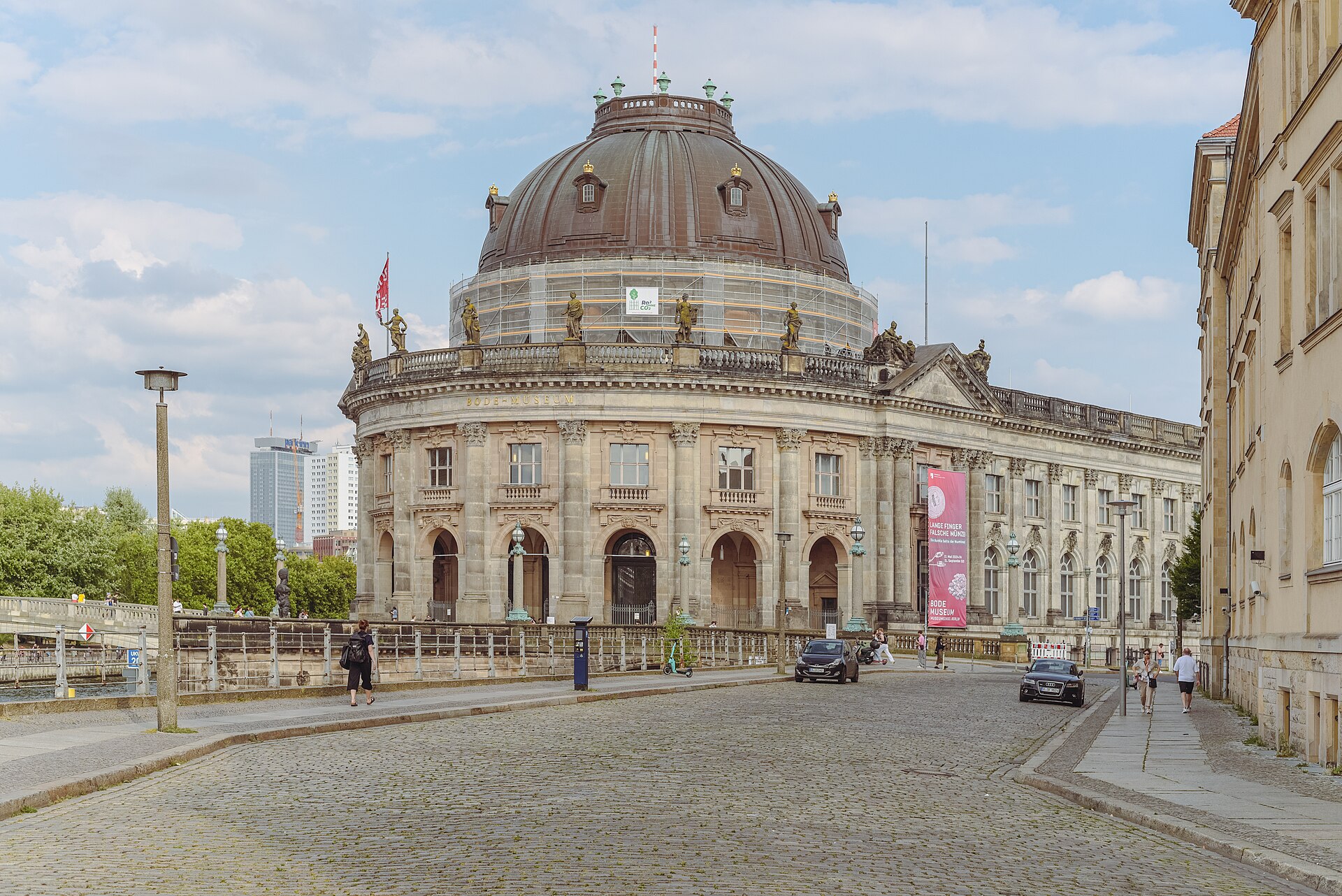
The Bode-Museum seen from the Monbijoubruecke approach, its dome and curved end wall built directly onto the Spree at the northern tip of Museum Island.
Photograph by Flocci Nivis, released CC BY 4.0 · Photograph by FlocciNivisBode Museum
Museum · Bode-Museum · Founded 1904
Open, admission and hours confirmed 20 August 2026 · 15 sources
On this page 15 sections
ContentsClose
The Bode-Museum's strength is Italian Renaissance sculpture shown at a depth few museums outside Florence can match, backed by a Byzantine and late-antique collection and a numismatic collection each individually ranked among the most important in their field. Very little of that depth is well known outside specialist circles, which is a large part of why visitors who do arrive report a museum that rewards unhurried attention more than any single headline object does.
| Local name | Bode-Museum |
|---|---|
| Kind | Museum |
| Founded | 1904 |
| City and country |  Berlin, Germany Berlin, Germany |
| Address | Am Kupfergraben, entrance via the Monbijoubruecke, 10178 Berlin, Germany |
| Website | smb.museum/en/museums-institutions/bode-museum/home |
| Status | Open, confirmed |
| Record last verified |
Visiting
- Hours
- MonClosed
- Tue10:00 to 17:00
- Wed10:00 to 17:00
- Thu10:00 to 17:00
- Fri10:00 to 17:00
- Sat10:00 to 18:00
- Sun10:00 to 18:00
- Closed
- Monday.
- Admission
- AdultEUR 14Single-museum ticket for the Bode-Museum
- ConcessionsEUR 7
- Museum Island day ticket, adultEUR 24Covers Alte Nationalgalerie, Altes Museum, Bode-Museum, Neues Museum and Pergamonmuseum. Das Panorama on one day
- Museum Island day ticket, concessionsEUR 12
- Museum Pass Berlin, 3 days, permanent exhibitionsEUR 32Concessions 16.00 EUR
- Under 18, school classes, enrolled studentsFreeFree
- Tickets
- tickets.smb.museum The museum's own ticket page.
- Do I need to book?
- Not required; online timed tickets are recommended to avoid the counter queue and can be booked up to four weeks ahead
- Address
- Am Kupfergraben, entrance via the Monbijoubruecke, 10178 Berlin, Germany MapU-Bahn Friedrichstrasse
S-Bahn Friedrichstrasse, Hackescher Markt
Tram Am Kupfergraben, Hackescher Markt
Bus Friedrichstrasse, U Museumsinsel - Website
- smb.museum/en/museums-institutions/bode-museum/home
- Telephone
- +49 30 266424242
Before you go how long, access, photography, bags, eating, shop
- How long to allow
- Two to three hours for the sculpture and Byzantine collections; add time for the coin cabinet
- Access
- Not detailed in the sources consulted for this page; the SMB visit pages give access details by building
- Photography
- Not detailed in the sources consulted for this page
- Bags
- Not detailed in the sources consulted for this page
- Eating
- Cafe im Bode-Museum, on site
- Shop
- Museum shop, on site
Prices and hours change. We take them from the institution's own pages and print the day we read them, and you can check the current position at the source we used. Confirm before you travel.
What is inside
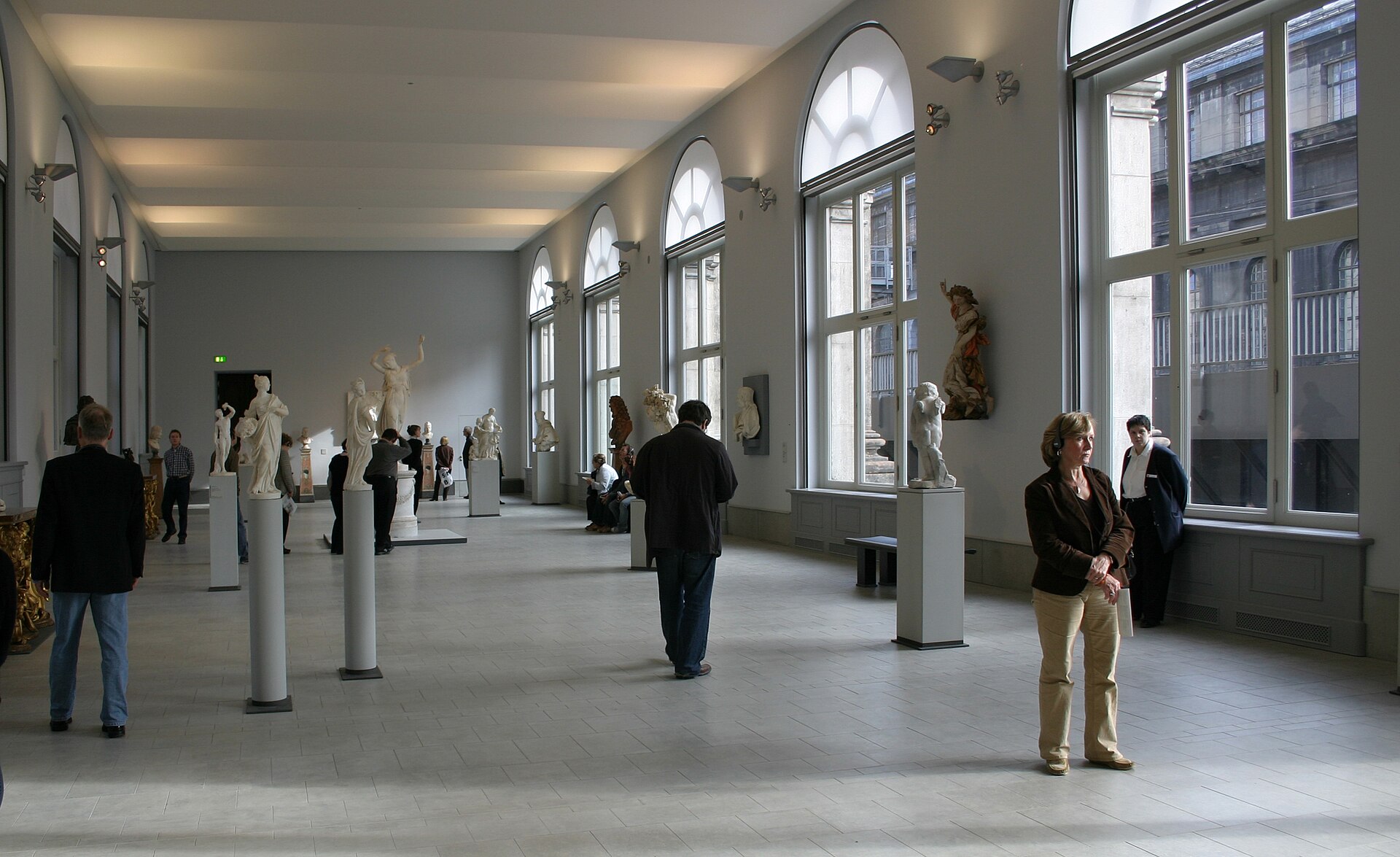
Photograph by Gerd Eichmann · CC BY-SA 4.0 Skulpturensammlung - Italian Renaissance sculpture, ground floor
The sculpture collection is one of the largest in the world, strongest in Italian Renaissance work: Donatello, the della Robbia workshop, Bandinelli, Tacca and Bernini, shown in the domed and colonnaded halls around the building's two courtyards. Since the 2006 reopening, old master paintings from the Gemaeldegalerie hang in the same rooms as the sculpture, a deliberate return to the building's original 1904 idea that painting and sculpture belong in dialogue rather than in separate departments.
Museum fuer Byzantinische Kunst - late antique and Byzantine art
First-class holdings running from the 3rd to the 15th century: Roman and early Byzantine sarcophagi, ivories, and the apse mosaic rescued from the ruined church of San Michele in Africisco in Ravenna, around 545 AD, one of the few Byzantine mosaics of that date outside Italy.
Muenzkabinett - coin cabinet, upper floor
One of the largest numismatic collections in the world, more than half a million coins, medals and minting tools tracing coinage from the 7th century BC to the euro. The gallery survived the Second World War in the neighbouring Pergamonmuseum's air-raid shelter, was seized by Soviet forces in 1945 and was not returned to Berlin until 1958.
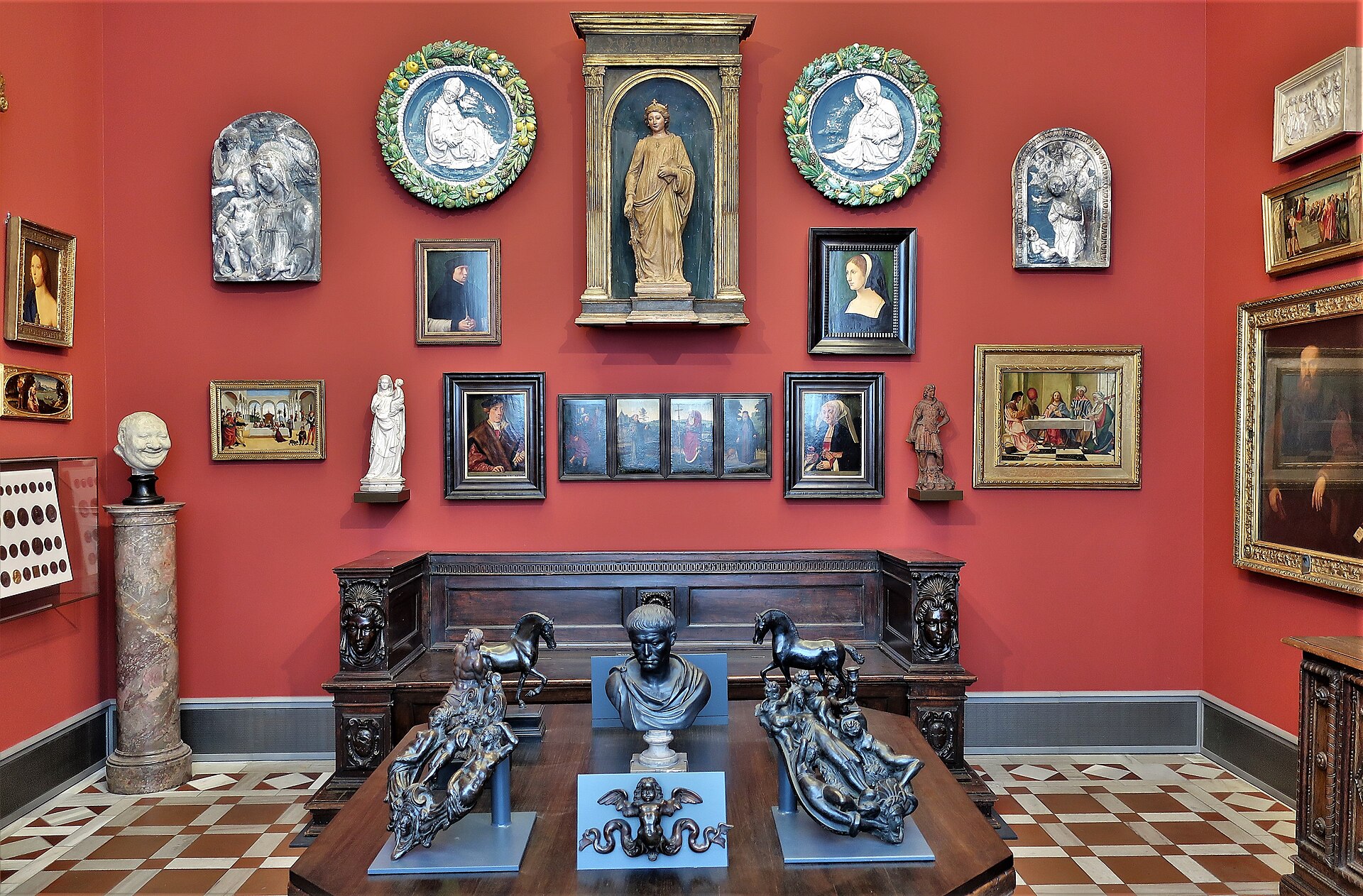
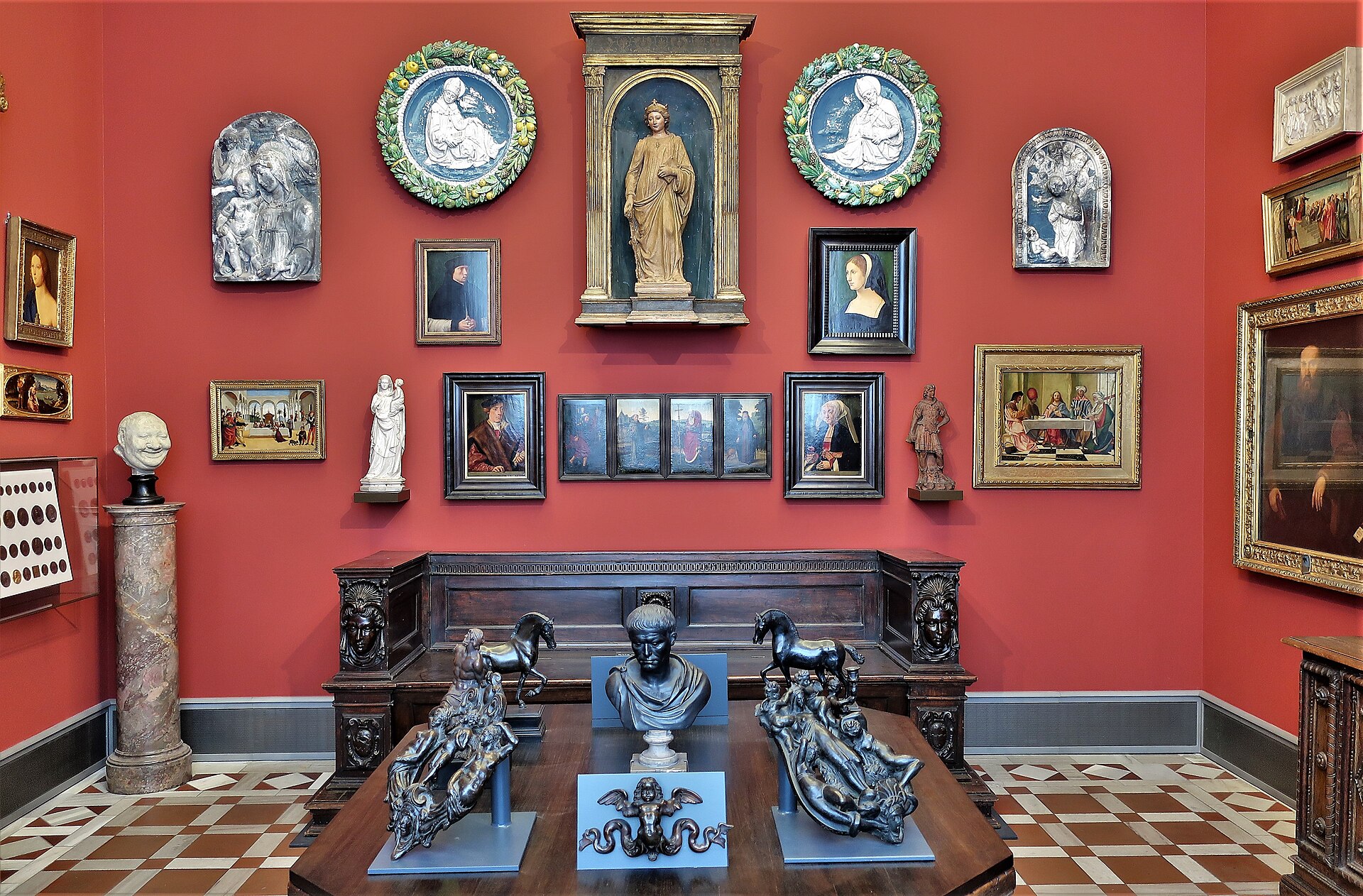
Photograph by Bärwinkel,Klaus · CC BY-SA 4.0 James-Simon-Kabinett - decorative arts and small bronzes
A compact, richly hung room of goldsmiths' work, small bronzes, medals and reliefs named for James Simon, the Berlin textile merchant whose donations built much of the Islamic, Egyptian and Renaissance holdings on Museum Island. It sits inside the sculpture galleries rather than as a separate department.
Kleiner Kuppelsaal and Basilika - the ceremonial rooms
The small domed hall and the basilica-plan hall at the heart of the building were designed by Ernst von Ihne as processional spaces rather than display cases, framing the largest sculptures - among them Bernini's Roman baroque figures - the way the building's floor plan was always meant to be read.
What to see first
Pazzi Madonna
DonatelloA marble relief of the Virgin and Child in Donatello's schiacciato technique, cut in a relief so shallow it reads almost as drawing; one of the sculpture collection's signature Florentine Quattrocento works.7
Bust of Flora
Attributed to Richard Cockle LucasA painted wax bust bought by Wilhelm von Bode in London in 1909 as a work of Leonardo da Vinci and denounced within a year in the English press as an 1846 forgery by a Southampton sculptor. Radiocarbon dating published in 2021 confirmed every tested material postdates 1700, which rules out the Renaissance; no museum has since published a positive attribution to any named maker. This archive holds the object's full record.8
Full record in this archiveApse mosaic from San Michele in Africisco, Ravenna
Unknown Ravenna workshopA monumental mosaic of about 545 AD, removed from a demolished Ravenna church in the 19th century and one of the few Byzantine mosaics of that date to survive outside Italy at all.7
Luke the Evangelist, from the Muennerstadt retable
Tilman RiemenschneiderA limewood figure from Riemenschneider's dismantled high altar of 1490 to 1492, representative of the unpainted, close-carved limewood sculpture that made his Wuerzburg workshop famous.7
Mary with the Sleeping Child
Andrea MantegnaA rare sculptural attribution to a painter chiefly known on canvas and panel, and one of the collection's arguments for showing painting and sculpture together rather than apart.7
Dancer
Antonio CanovaA Neoclassical marble figure balanced on one foot, among the collection's principal 19th-century pieces and a counterpoint to the Renaissance sculpture that dominates the rest of the building.7
Solidus of Theodosius II
Constantinople mint, 437 ADA gold coin from the Muenzkabinett's holdings, chosen by the museum itself to represent a collection whose most famous 21st-century object - the 100-kilogram Big Maple Leaf - was a private loan, not a piece of the permanent collection, and has not been part of any display since it was stolen in 2017.7
Exhibitions on now
- Opening soon24 Nov 2026 to 7 Mar 2027Confirmed , 6 weeks ago
- Opening soon4 Dec 2026 to 17 Oct 2027Confirmed , 6 weeks ago
Past exhibitions here
A building designed to end an argument
The Bode-Museum was built to settle a 19th-century argument about what a museum was for. Crown Princess Victoria of Prussia set out the idea in a memorandum in 1883: painting and sculpture, then treated in Berlin as separate high arts requiring separate buildings, should be shown together, room by room, so a visitor could read a period through both at once. Wilhelm von Bode, the museums' director and the collector who assembled most of what the building would hold, carried the idea into practice. Construction began in 1897 at the northern tip of Museum Island, on a wedge of land where the Spree splits around the island's tip, and the architect Ernst von Ihne set the building directly on the riverbank so that its dome and curved facade appear to rise out of the water.
It opened on 18 October 1904 as the Kaiser-Friedrich-Museum, named for Bode's patron, and did exactly what Victoria's memorandum had asked: paintings and sculpture from the same period and region, hung and displayed in the same rooms, a presentation strategy no other major museum in Europe had committed to at that scale. The building was renamed for Bode himself in 1956, two years after his death, by which point the museum had already lived through the two disasters that still define how it is discussed today.
What the war took and did not give back
The Bode-Museum's own sculpture collection lost part of itself in the last weeks of the Second World War, in a way still only partly resolved eight decades later. To protect them from Allied bombing, the museum's most important Italian Renaissance sculptures, including works by Donatello and Luca della Robbia, were moved into the Friedrichshain flak tower, a fortified anti-aircraft bunker doubling as an air-raid shelter and a store for Berlin's evacuated museum collections. In May 1945, as Soviet forces took the district, fire tore through the tower. Soviet troops removed what remained and shipped it to Moscow as war reparations, under the Red Army's Trophy Brigades, which took an estimated 2.6 million artworks out of eastern Germany in 1945 alone.
In 1958 the Soviet Union returned roughly 1.5 million of those works to East Germany, but the Bode's sculptures were not among them. In 2016 the Pushkin State Museum of Fine Arts in Moscow confirmed it was holding 59 Italian Renaissance sculptures matching pieces missing from Berlin since 1945. Curator Neville Rowley, who examined them, said most were damaged and some survive only in fragments. Russia regards the holdings as compensation for the wartime destruction of Soviet cultural property; Germany maintains its claim of ownership. As of the sources consulted for this page, the sculptures remain in Moscow, and no return has been agreed.
The gold coin nobody has seen since 2017
At around three in the morning on 27 March 2017, thieves broke into the Bode-Museum's second floor and left with the Big Maple Leaf, a 100-kilogram, 99999-fine gold coin minted by the Royal Canadian Mint and on loan to the museum's coin cabinet from a private collector. It has not been seen since. The coin was too large to carry out whole; investigators believe it was cut apart and its gold melted down and sold within days, most likely through the scrap-gold trade, which would explain why nothing has surfaced despite a high-profile trial.
Four young men, one of them a museum security employee, were tried in a Berlin youth court beginning in January 2019. Three were convicted, with sentences reported between three and four years; the fourth case did not result in the same outcome. The coin itself was never recovered. What has not been resolved is who pays for it: the insurer Allianz paid out only 800,000 euros of the coin's insured value of 4.2 million euros, arguing that the Bode-Museum's own security fell short of what the policy required, and has been sued by the coin's owner in a civil case that turns on how much responsibility a public museum bears for a private loan it agreed to display.
Sculpture, Byzantium and half a million coins
Past both disasters, the collection that survives is still one of the deepest of its kind anywhere. The Skulpturensammlung holds European sculpture from late antiquity to the early 19th century, with its centre of gravity in the Italian Quattrocento and Cinquecento: Donatello, the della Robbia family workshop, Bandinelli, Tacca and Bernini, alongside German limewood carving by Tilman Riemenschneider and Neoclassical work by Canova and Houdon. The Museum fuer Byzantinische Kunst, folded into the same building, covers the 3rd to the 15th century with ivories, reliefs and one of the very few Byzantine mosaics of its date to survive outside Italy. The Muenzkabinett, upstairs, is among the largest coin collections on earth: more than half a million coins, medals, seals and minting tools, spanning the 7th century BC to the present.
Since the building's 2006 reopening after a renovation that ran from the 1990s, paintings from the Gemaldegalerie have again been hung inside the sculpture rooms, restoring the display logic Bode and Victoria intended in 1904: a visitor moves through a period rather than through a department.
A collection still being checked
Provenance research at the Staatliche Museen zu Berlin is carried out centrally by the Zentralarchiv, whose researchers investigate the ownership history of objects across the museums of art, archaeology and ethnology, with Nazi-era seizure and forced sale as a standing focus. The Zentralarchiv's holdings and expertise are drawn on by other German and international museums doing the same work on their own collections, and the research has led to restitutions from Berlin's own holdings. Current projects examine auction purchases made by the Staatliche Museen zu Berlin between 1933 and 1945, and the fate of artworks connected to the Dresdner Bank collection of 1935 that may have passed through the same period. None of the sources consulted for this page names a Bode-Museum object currently subject to an active restitution claim, which is a gap in the public record rather than a finding that none exists; a museum whose own galleries were built from Bode's acquisitions across five decades, and whose sculpture rooms already carry one contested attribution in the Bust of Flora, is not a museum whose collection history closes easily.
What visitors say
Visitors consistently rate the Bode-Museum as one of the calmer, less crowded stops on Museum Island, and single out the sculpture halls and the domed spaces of the building itself as much as any individual object. The coin cabinet and Byzantine rooms draw less comment, and more than one visitor has noted that the museum rewards more time than a first-time visitor typically gives it.
What is praised, what is criticised
- Praised: the building's domed and colonnaded interiors, and the low visitor numbers compared with the Pergamonmuseum and Neues Museum
- Praised: the density and quality of the Italian Renaissance sculpture collection
- Praised: the cafe in the building's central hall
- Criticised: some visitors find room after room of devotional sculpture repetitive without a guide or audio commentary
- Criticised: wayfinding between the sculpture, Byzantine and numismatic sections is not always obvious
Ratings on other platforms
Tripadvisor: 4.2 from 615 ratings, read 7 August 2026
A platform average is a tertiary source: it moves, it is not audited, and we quote no visitor's words.
Questions about Bode Museum
Where is Bode Museum?
Am Kupfergraben, entrance via the Monbijoubruecke, 10178 Berlin, Germany.
How much does it cost to visit?
Adult: EUR 14; Concessions: EUR 7; Museum Island day ticket, adult: EUR 24; Museum Island day ticket, concessions: EUR 12; Museum Pass Berlin, 3 days, permanent exhibitions: EUR 32. As confirmed 20 August 2026.
When is it open?
Mon closed; Tue 10:00-17:00; Wed 10:00-17:00; Thu 10:00-17:00; Fri 10:00-17:00; Sat 10:00-18:00; Sun 10:00-18:00. Closed: Monday. As confirmed 20 August 2026.
How do you get there?
U-Bahn: Friedrichstrasse; S-Bahn: Friedrichstrasse, Hackescher Markt; Tram: Am Kupfergraben, Hackescher Markt; Bus: Friedrichstrasse, U Museumsinsel.
What should you see first?
Pazzi Madonna (Donatello); Bust of Flora (Attributed to Richard Cockle Lucas); Apse mosaic from San Michele in Africisco, Ravenna (Unknown Ravenna workshop); Luke the Evangelist, from the Muennerstadt retable (Tilman Riemenschneider); Mary with the Sleeping Child (Andrea Mantegna); Dancer (Antonio Canova).
What we could not confirm
- Whether the 59 Italian Renaissance sculptures held at Moscow's Pushkin Museum since at least 2016 will ever be returned to Berlin is unresolved; Russia and Germany continue to disagree about their legal status.
- The Big Maple Leaf gold coin has never been recovered, and the civil case over whether the Bode-Museum's security measures were adequate, and who bears the insurance shortfall, was unresolved in the sources consulted for this page.
- The Bust of Flora carries no positive attribution to any named maker as of the radiocarbon findings published in 2021; only Leonardo da Vinci has been formally excluded.
Images
Sources
- 1Staatliche Museen zu Berlin, Bode-Museum, Plan Your Visit - Opening Hours smb.museum/en/museums-institutions/bode-museum/plan-your-visit/opening-hours/
- 2Staatliche Museen zu Berlin, Bode-Museum, Tickets & Admission smb.museum/en/museums-institutions/bode-museum/plan-your-visit/prices-tickets/
- 3Staatliche Museen zu Berlin, Bode-Museum, Contact smb.museum/en/museums-institutions/bode-museum/plan-your-visit/contact/
- 4Staatliche Museen zu Berlin, Bode-Museum, Address smb.museum/en/museums-institutions/bode-museum/plan-your-visit/address/
- 5Staatliche Museen zu Berlin, Museumsinsel Berlin, Plan Your Visit (Museum Island day ticket) smb.museum/en/museums-institutions/museumsinsel-berlin/plan-your-visit/
- 6Staatliche Museen zu Berlin, Neue Oeffnungszeiten fuer Altes Museum und Bode-Museum (Tuesday reopening and price change, June 2025) smb.museum/en/whats-new/detail/new-opening-hours-the-altes-museum-and-the-bode-museum-are-open-tuesdays-from-3-june-2025/
- 7Staatliche Museen zu Berlin, Bode-Museum, Collection Highlights smb.museum/en/museums-institutions/bode-museum/collections-research/collection-highlights/
- 8Iconotheca, record: Bust of Flora, Bode-Museum inv. 5951 (this archive's own researched record, citing radiocarbon dating published in Scientific Reports, April 2021) commons.wikimedia.org/wiki/File:Bust_of_Flora_by_Richard_Cockle_Lucas_(1800-1883),_wax_-_Bode-Museum_-_DSC02998.JPG
- 9Staatliche Museen zu Berlin, Bode-Museum, Collections smb.museum/en/museums-institutions/bode-museum/collections-research/collections/
- 10Staatliche Museen zu Berlin, Bode-Museum, Profile (history) smb.museum/en/museums-institutions/bode-museum/about-us/profile/
- 11Coins Weekly, Unresolved Questions in the Case of the Stolen Big Maple Leaf coinsweekly.com/unresolved-questions-in-the-case-of-the-stolen-big-maple-leaf/
- 12London Bullion Market Association, Wonders of Gold: Theft of the 100 kg Maple Leaf from the Bode Museum in Berlin lbma.org.uk/wonders-of-gold/items/theft-of-100-kg-maple-leaf-from-the-bode-museum-in-berlin
- 13The Art Newspaper, Berlin's lost Renaissance sculptures rediscovered in the Pushkin Museum, 19 May 2016 theartnewspaper.com/2016/05/19/berlins-lost-renaissance-sculptures-rediscovered-in-the-pushkin-museum
- 14Wikidata, Bode Museum (Q157825) wikidata.org/wiki/Q157825
- 15Tripadvisor, Bode-Museum, Berlin, overall rating and review count, read 7 August 2026 tripadvisor.com/Attraction_Review-g187323-d624830-Reviews-Bode_Museum-Berlin.html
,_wax_-_Bode-Museum_-_DSC02998.JPG)