Who Signed Oi, and Who Stood Behind Iitsu
Hokusai's daughter Oi signed few paintings and illustrated one book. The Great Wave and Red Fuji carry only Iitsu. What the museums and one scholar actually record.
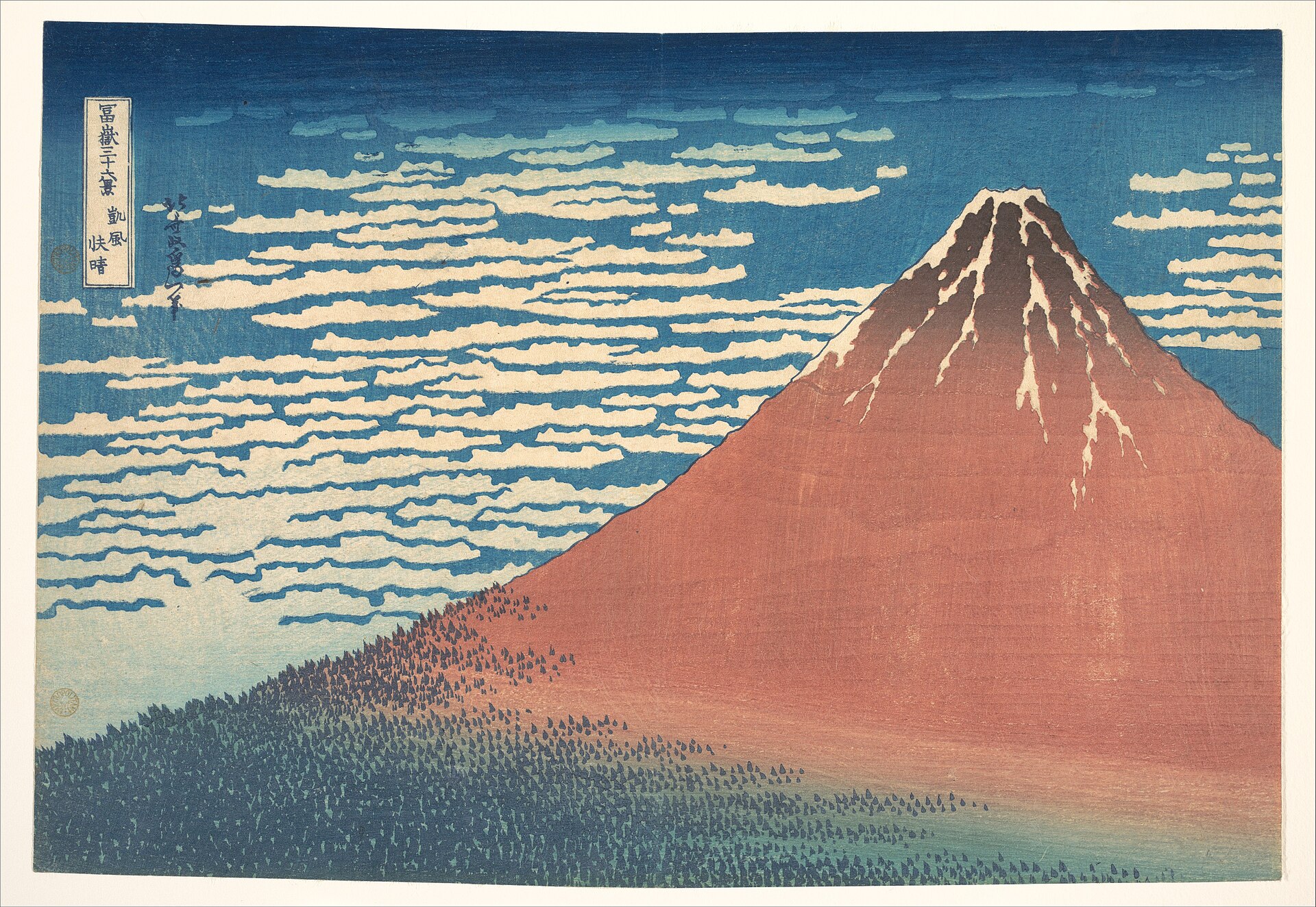
Records in this piece: Under the Wave off Kanagawa (Kanagawa oki nami ura), also known as The Great Wave, from the series Thirty-Six Views of Mount Fuji, South Wind, Clear Sky (Gaifu kaisei), also known as Red Fuji, from the series Thirty-six Views of Mount Fuji
On this page 4 sections
ContentsClose
In short
- Oi's own name is on a short list: the Cleveland scroll 1998.178 is signed brush of Oi, the woman Ei, and the Boston, Tokyo and book entries are catalogued or credited to her, while no sheet of the Thirty-six Views of Mount Fuji carries her name.
- Her art name answers the name Iitsu that signs the Great Wave and Red Fuji, so the signature on the famous prints is the other half of her own.
- Julie Nelson Davis says she collaborated with Hokusai for the last two decades of his life and may have worked as his ghost brush, and the verb is may. No document read for this piece assigns her a Fuji sheet.
- The records give different kinds of dates: about 1800 to after 1857 as a life span at the British Museum and Cleveland, active about 1818 to after 1854 at Boston, so no precise date should be printed without its paper.
Her own name survives on a handful of works, and on none of the famous prints we read
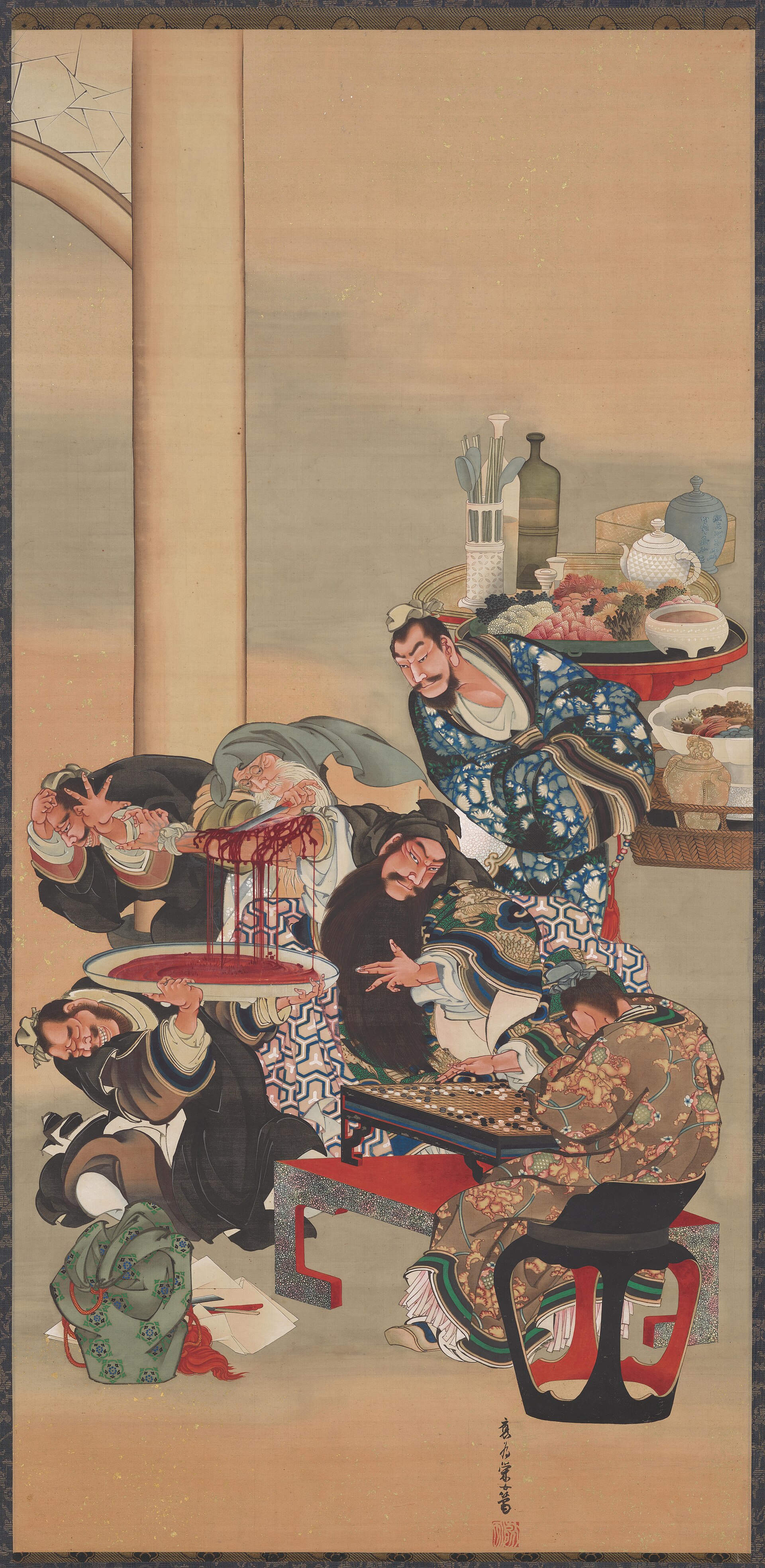
Katsushika Oi, Hokusai's daughter, signed few paintings in her own name and illustrated one book credited to her, and no sheet of the Thirty-six Views of Mount Fuji we read carries her name. The clearest signed work is the hanging scroll Operating on Guan Yu's Arm in the Cleveland Museum of Art, accession 1998.178, which Cleveland dates to the 1840s and which is inscribed in Japanese with the words that Cleveland translates as brush of Oi, the woman Ei, beside a seal reading Katsushika. The scroll is ink, colour and gold on silk, and Cleveland's own text says her talent was allowed to shine through collaboration with her father. Ei, in these sources, is her given name, which Davis writes as Eijo.
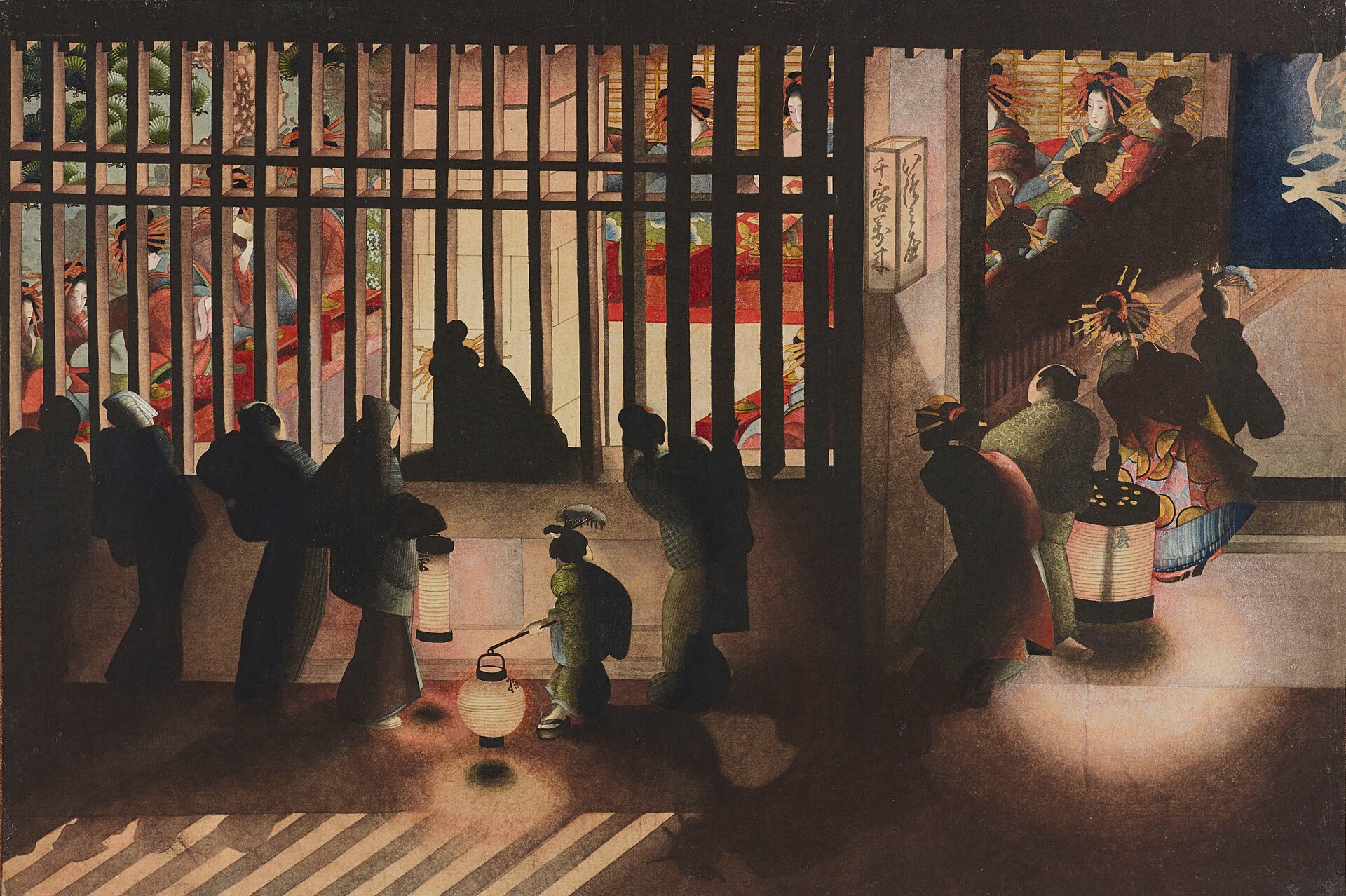
The signed or attributed pieces that can be checked against a museum record are few, and the table sets out what each record actually says. Julie Nelson Davis, writing for the British Museum, reasons from the silk and the saturated pigments that the scroll was ordered by a well-off patron, whose name is not known. That is her inference and no commission document is cited. Of the Yoshiwara scroll (Davis calls it Display room in Yoshiwara at Night) she writes that Oi turned the courtesans, so often shown as fashion plates, into anonymous figures obscured by the lattice.
| Work | Holder and number | What the record gives |
|---|---|---|
| Operating on Guan Yu's Arm | Cleveland Museum of Art, 1998.178 | Hanging scroll in ink, colour and gold on silk, 1840s, signed brush of Oi, the woman Ei, with a Katsushika seal |
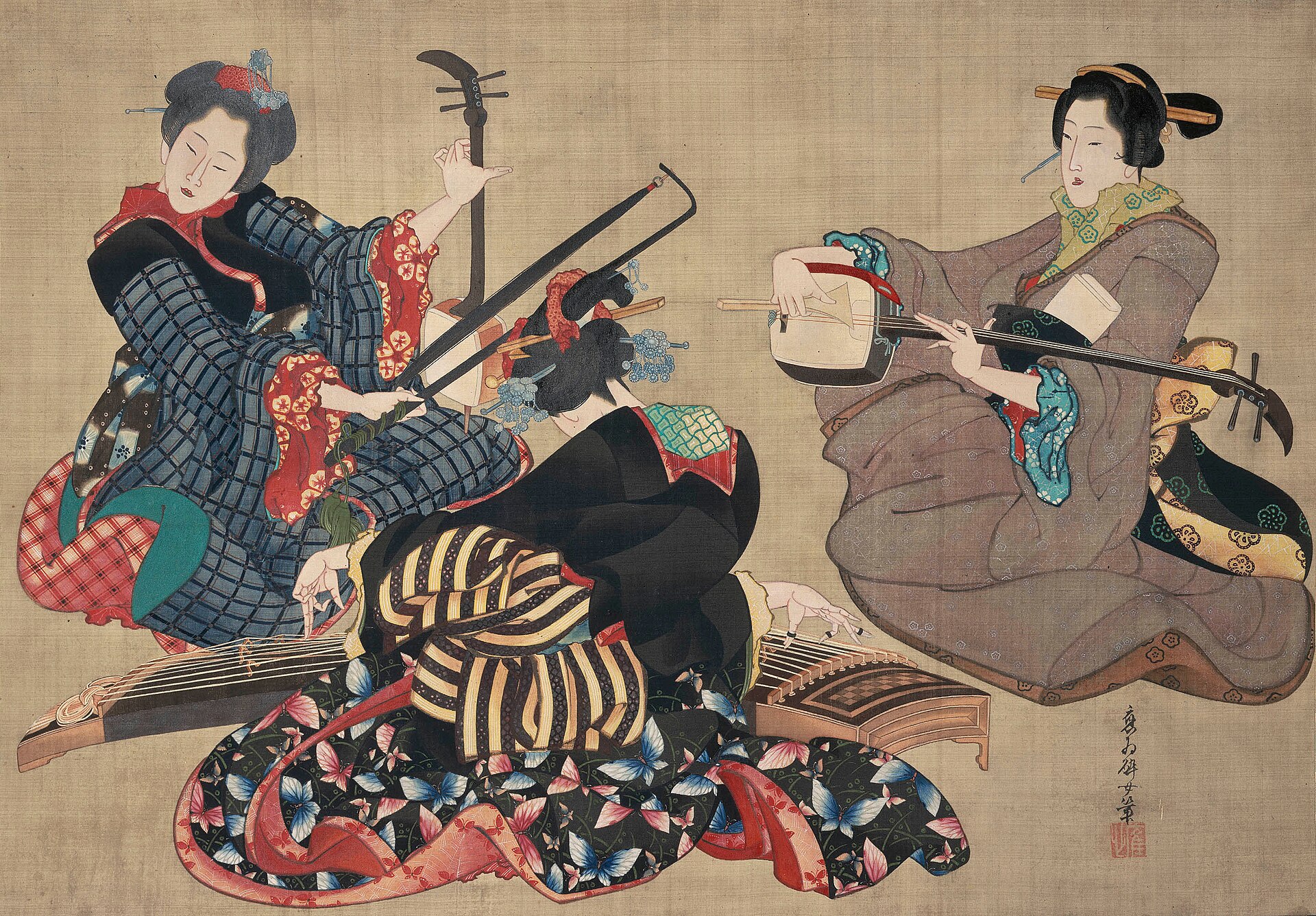
| Three Women Playing Musical Instruments | Museum of Fine Arts, Boston, 11.7689 | Hanging scroll, ink and colour on silk, 46.5 by 67.5 cm, catalogued under Oi and listed in the museum's 2013 Hokusai catalogue as number 142 |
| Night scene in the Yoshiwara | Ota Memorial Museum of Art, Tokyo | Hanging scroll, ink and colour on paper, 26.3 by 39.8 cm, dated by Davis to 1844-54 |
| Onna choho-ki (Treasury of Education for Women) | Illustrated woodblock book, Suharaya, 1847 | Credited by Davis to Oi as illustrator, not described there as signed |
Her working name is made out of his, and his is the name on the Wave
The name Oi was built on the name Iitsu, which is the name printed on the Great Wave. In Davis's account Hokusai took the name Iitsu, meaning one again, after he turned sixty, and Davis writes that he seems to have often called out oi when he wanted his daughter, a shout she turned into an art name written with characters that Davis glosses as loyal to Iitsu. The sentence is a reading of an anecdote that Davis tells and hedges herself, so it should be held as the best-documented account in the sources read and not as a settled fact.
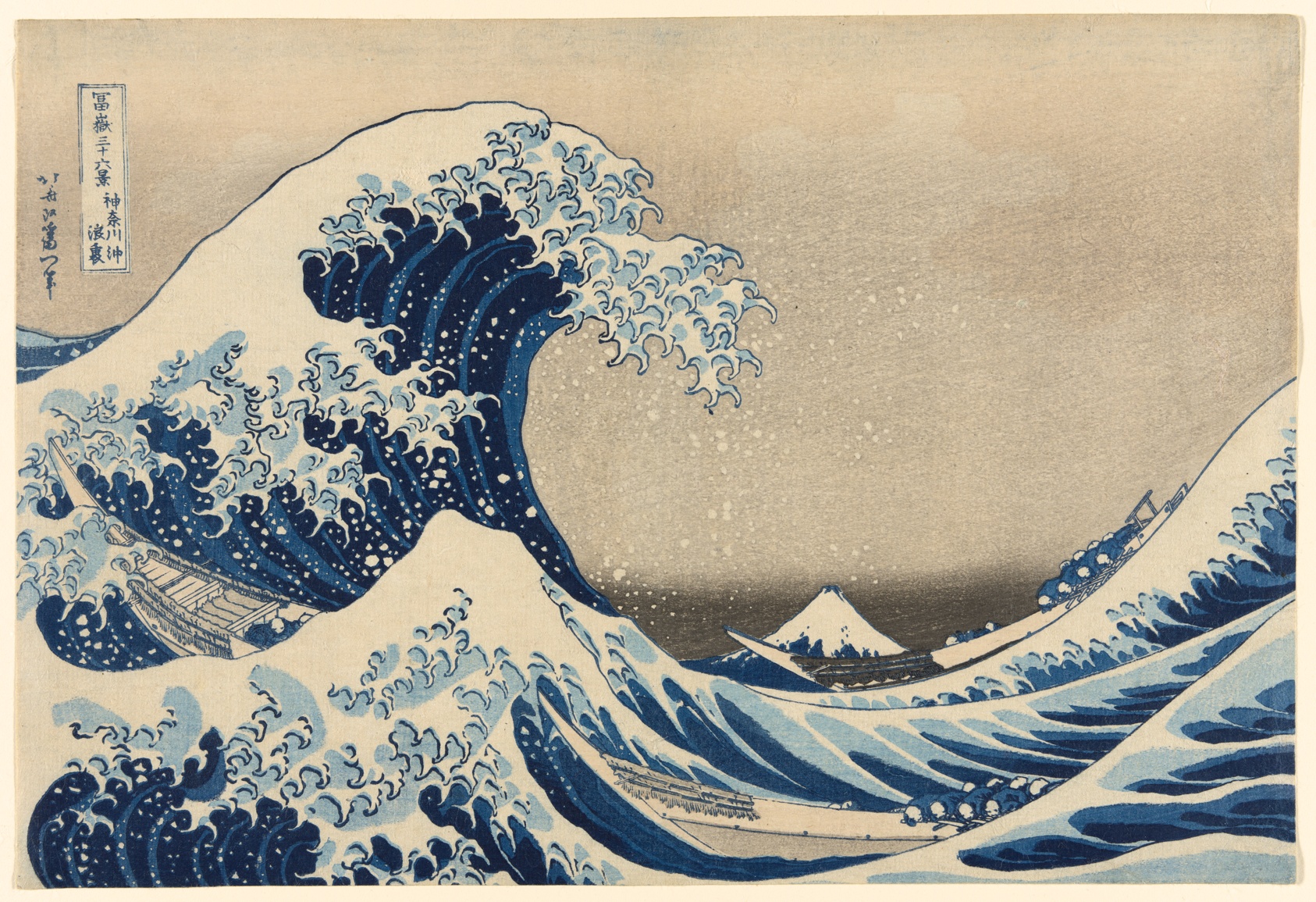
The prints in our two records carry the other half of the pair. The Art Institute of Chicago impression of Under the Wave off Kanagawa is signed Hokusai aratame Iitsu fude, from the brush of Iitsu, formerly Hokusai. The Metropolitan Museum's Red Fuji is signed in the same formula with the final word hitsu. A signature of this kind gives the name the designer used, and the publisher is recorded separately (Nishimura-ya Yohachi on the Art Institute impression). It does not say who drew the outline, who prepared a colour or who checked the cutters' proofs.
The sources call her his collaborator, and the strongest statement of how far it went is a may
Davis, and Cleveland in shorter form, describe Oi as her father's collaborator, and Davis puts it at the last two decades of his life; neither says which designs she touched. Davis says she worked beside Hokusai in those years, after a marriage to the painter Tsutsumi Tomei that lasted from 1824 to about 1827, and that after her mother Kotome died in 1828 she looked after her father. Davis says that working together carried on the Hokusai brand through illustrated books, prints and paintings, and she writes that Oi may even have worked as his ghost brush. The word may is hers, and it is the right strength.
Davis also sets out how the household worked. Hokusai's daughters, Oi among them, were expected to help in the family trade until they married and joined their husbands' households, and their brother apprenticed in the mirror trade. She names Oi's sisters as Miyo, Tatsu and Nao. The essay does not say whether Oi married again, and we have not found a document that does.
Three contemporary or near-contemporary witnesses are reported by Davis and not read by us at source. Davis reports that Hokusai is said to have said that where paintings of beautiful women were concerned he could not compete with her. The artist Keisai Eisen is reported to have written that she was skilled at drawing and had become a professional following her father. A pupil's sketch from before 1893 shows father and daughter in their rented lodgings in the 1840s, with a notice on the wall refusing work for fans and albums. Davis also reports a letter in which she taught a distant pupil to prepare red pigment. Where Hokusai's remark was first recorded is not given in the essay, and we did not trace it.
The years of the Fuji series fall inside her years in the workshop, and no document we read goes further than that
The Thirty-six Views of Mount Fuji was designed from about 1830, and Oi was back in the workshop by then, but no document read for this piece assigns her any of its forty-six sheets. That is the whole of what can be said. Our Red Fuji record already states the biographical fact in one line, resting on a tertiary encyclopedia, that she was a trained painter who worked as his studio assistant in his later years. The scholarly source for the same fact is Davis, and she states the limit herself.
The records give different kinds of dates, and the difference is worth keeping. The British Museum essay and Cleveland give a life span of about 1800 to after 1857. The Boston museum gives an active period of about 1818 to after 1854. Neither source cites a birth or death document, and some popular sources print a death date of about 1866 with no source cited. A reader who finds a precise date elsewhere should ask for the paper it came from.
What is not known is more than what is. We have not opened Eisen's text, a nineteenth-century biography such as Iijima Kyoshin's of 1893 (one candidate for the anecdotes about the household), or the 2005 essay by Kobayashi Tadashi and Julie Nelson Davis on her paintings, whose co-author is the same Davis. They are the next documents to read, and until they are read this archive will not say that she drew the red of Red Fuji or the curl of the Wave.
Questions
No document read for this piece says so. The Great Wave is signed Hokusai aratame Iitsu fude, from the brush of Iitsu, formerly Hokusai, and Davis says only that Oi collaborated with her father in his last two decades and may have worked as his ghost brush.
The Cleveland Museum of Art scroll Operating on Guan Yu's Arm carries an inscription that the museum translates as brush of Oi, the woman Ei, with a Katsushika seal. Other works, such as the Boston scroll and the 1847 Onna choho-ki book, are catalogued or credited to her.
Davis tells it as an anecdote: Hokusai seems to have often called out oi when he wanted her, she turned the sound into an art name that Davis glosses as loyal to Iitsu, the name her father used. It is the best-documented account in the sources read and not a proven one.
The sources give different kinds of dates. The British Museum essay and Cleveland give about 1800 to after 1857 as a life span and the Museum of Fine Arts, Boston gives active about 1818 to after 1854. Neither cites a birth or death document.
Sources
- 1Julie Nelson Davis, 'Hokusai and Oi: art runs in the family', British Museum blog, 18 June 2017. Read in full in a browser. Source of the name anecdote, the marriage and workshop chronology, the reported remarks of Hokusai and Eisen, and the ghost brush suggestion. britishmuseum.org/blog/...
- 2Cleveland Museum of Art, Operating on Guan Yu's Arm, accession 1998.178, open access record including the inscription and its translation. clevelandart.org/art/...
- 3Museum of Fine Arts, Boston, Three Women Playing Musical Instruments, accession 11.7689, collection page read in a browser. collections.mfa.org/objects/...
- 4Art Institute of Chicago, Under the Wave off Kanagawa, accession 1925.3245, for the signature Hokusai aratame Iitsu fude. artic.edu/artworks/...
- 5Metropolitan Museum of Art, South Wind, Clear Sky (Red Fuji), accession JP9, for the signature formula. metmuseum.org/art/...
- 6Wikimedia Commons, file page for Yoshiwara Koshisakinozu by Katsushika Oi, giving the Ota Memorial Museum source, the size 26.3 by 39.8 cm and the public domain tag. commons.wikimedia.org/wiki/...
- 7Kobayashi Tadashi and Julie Nelson Davis, 'The Floating World in Light and Shadow: Ukiyo-e Paintings by Hokusai's Daughter Oi', in Carpenter and others, Hokusai and His Age, Hotei, 2005. Named as the next document to read; not opened. britishmuseum.org/blog/...

More in The Women Behind the Art
The partThree Gifts Countess Gertrude Made, and the One That Names Her Husband
Countess Gertrude of Brunswick had three gifts made that are now in Cleveland. Read what each inscription says, which one names her husband and what...
Who Is the Woman Writing a Letter in Vermeer's Dublin Picture? Four Documents Describe Her and None Names Her
Four documents from 1676 to 1761 describe the woman writing in Vermeer's Dublin picture.
The House She Bought and the 1909 Kandinsky Nobody Places in It
Gabriele Muenter bought the Murnau house in 1909 and kept Kandinsky's pictures in its cellar.