Three Gifts Countess Gertrude Made, and the One That Names Her Husband
Countess Gertrude of Brunswick had three gifts made that are now in Cleveland. Read what each inscription says, which one names her husband and what is not known.
Records in this piece: Portable Altar of Countess Gertrude
On this page 5 sections
ContentsClose
In short
- Of the three objects Countess Gertrude commissioned that Cleveland holds, only one inscription names her husband, Count Liudolf. The altar verse names herself and Christ, and the other cross names two saints.
- Only one inscription links an object to Liudolf, a prayer for his spiritual welfare. It fits the museum's account of a gift after his death but does not itself say he had died. The museum says she gave both crosses to St Blaise after Liudolf died in 1038, and its curator's blog says the same of the altar while misdating his death to 1077.
- On the surviving fragments of a lead plate found in 1668, her epitaph calls her a devoted servant of Christ and mentions no husband, patron's role or treasure.
- The altar is dated shortly after 1038 on one Cleveland page and about 1045 on another, and no source read gives the evidence that separates the two.
One line of Latin names her and no one else
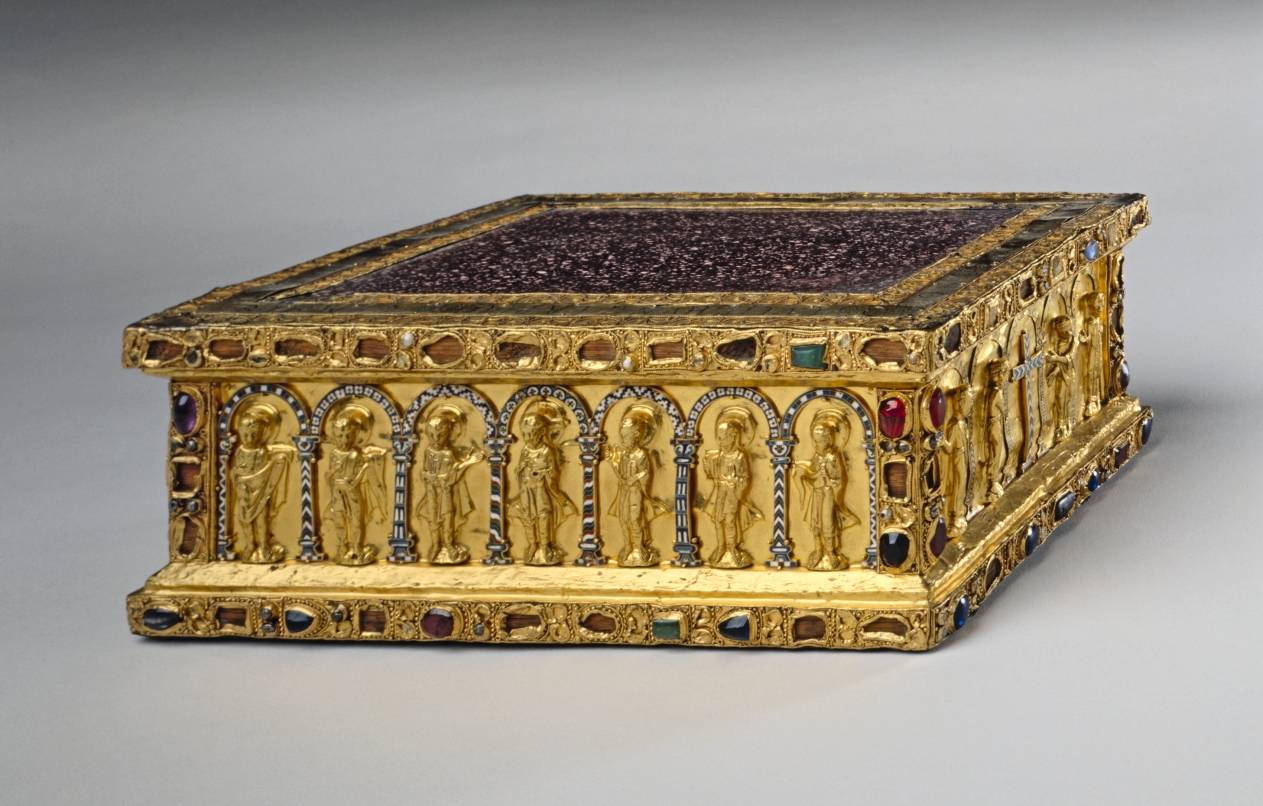
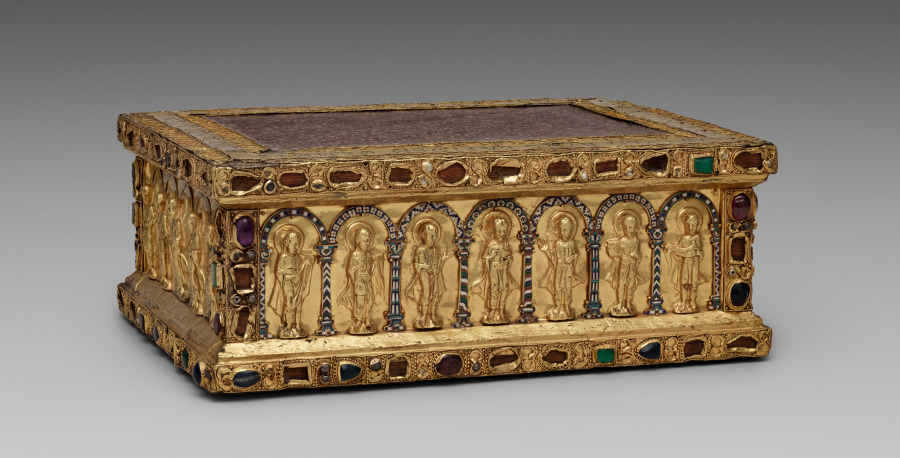
The verse round the stone of the Cleveland altar names Gertrude, Christ and the gift, and it names nobody else. The Latin as Cleveland records it reads GERDRVDIS XPO FELIX VT VIVAT IN IPSO OBTVLIT HVNC LAPIDEM GEMMIS AVROQ NITENTEM. The museum prints two English versions of it: one page says Gertrude offers the stone to Christ "to live joyfully in him", and the open-access record says "In order to live happily in Him".
Both versions put the happiness in the living. The Latin word felix is an adjective, and a reader could equally attach it to her name, as fortunate Gertrude. That is this desk's reading of the grammar and not a scholar's, and it changes nothing about who gave the stone. Cleveland's translations give the purpose as living joyfully or happily in Christ.
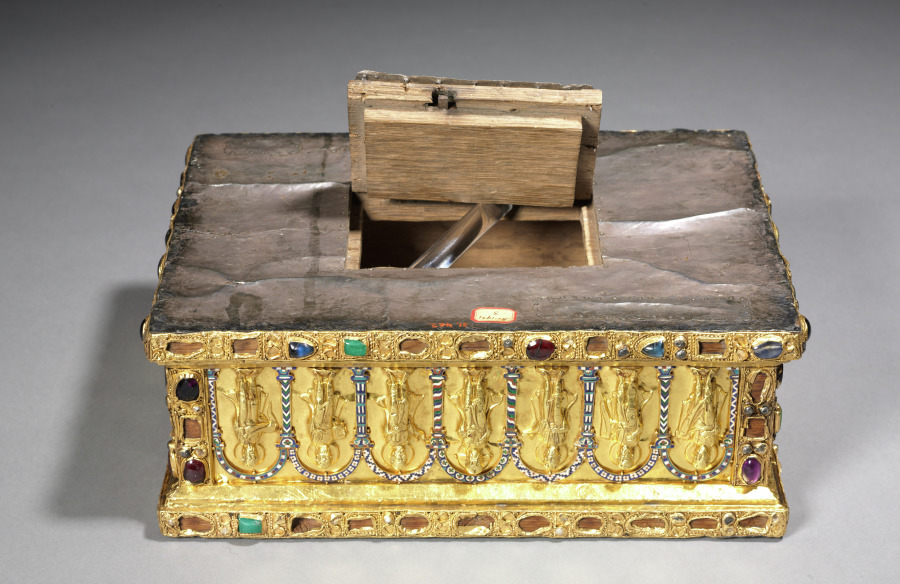
The altar is small, 10.5 centimetres high, and it was made to be opened. A trap door in the base gives onto a cavity that held ten labelled relic bundles, which is how it served as an altar and a reliquary at once. The giver is named in the verse and the museum identifies her as Countess Gertrude of Brunswick. The maker is not: Cleveland gives the culture as Germany, Lower Saxony, with a question mark.
Cleveland also reads the object politically, and says so in its own voice. Its description says the white-speckled porphyry of the stone signals Gertrude's worldly aspirations, because porphyry was an imperial colour used only by the imperial family. It adds that the figures of royal and imperial rank shown with Christ, the Virgin and the apostles stress her political ambitions and her claim of imperial lineage for her own dynasty. That is the museum's interpretation. The verse itself says nothing about rank, and no document read gives her intention, so it stays an argument about the picture programme and not a statement by the patron.
Her two crosses say different things
The two crosses given with the altar carry inscriptions that point at three different purposes. The table sets out what Cleveland publishes as the translation of each, with the museum's own date.
| Object | Cleveland date | What the inscription says | Who it names |
|---|---|---|---|
| Portable altar, 1931.462 | Shortly after 1038 (altar proper) or about 1045 (whole object) | Gertrude offered the stone to Christ so that she may live in him | Gertrude and Christ |
| Ceremonial cross, 1931.55 | 1038 or shortly after | For the relics of the holy apostle Peter and the holy virgin Liutrudis, Countess Gertrude ordered this made | Gertrude, Peter and Liutrudis |
| Cross of Count Liudolf, 1931.461 | Shortly after 1038 | Relics of Bishop Valerius, of the martyr Pancratius and of the stone laid on the tomb of the Lord; Gertrude had this made for the spiritual welfare of Count Liudolf | Gertrude, Liudolf, Valerius, Pancratius and the stone of the tomb |
The museum describes both crosses in the same words: commissioned by Countess Gertrude and given to the church of Saint Blaise after the death of her husband, Count Liudolf of Brunswick, in 1038. For the cross that bears his name the inscription says so. For the other cross the text read here does not mention him.
The Liudolf cross is the only one of the three whose text names him, in a prayer for his spiritual welfare. The museum's account of a gift after his death is its own reading. The other two are linked to the same moment by their style, their shared patron and their dates, which is a fair argument and not a document.
What the life sources give, and what they do not
The reference literature gives Gertrude a long widowhood and no birth date. The German Wikipedia article on Gertrud the Elder of Brunswick, a tertiary source that cites the works below, says that her birthplace and birth year are unknown. It names her husband as Liudolf of Brunswick, count in the Derlingau and the Gundigau and the only son of Brun I and Gisela of Swabia. It gives their children as Bruno, Ekbert I and Ida, also called Irmingart, and says that she outlived Liudolf by almost forty years.
It adds that the two founded the collegiate church of St Blasius beside the Dankwarderode castle in 1030, which is the predecessor of Brunswick Cathedral, and that the church was planned as a burial place for the family. Liudolf, it says, was the first buried there in 1038. Cleveland's own pages say the church was where the altar and crosses went.
For her death the article gives 21 July 1077, citing Duerre's 1861 history of the city. It reports that her grave was opened in 1668 and that fragments of a small lead plate were found, probably part of an epitaph, reading Hic requiescit Gertrudis devota Christi famula, XII Kal. Augusti, or here rests Gertrude, devoted servant of Christ. The twelfth day before the Kalends of August is 21 July, which matches the date the article gives. Both rest on the same page of Duerre. The article says the plate is now in the Herzog Anton Ulrich Museum in Brunswick. We have not seen the plate or the 1861 book, and the lead plate rests on the Wikipedia article's report.
Nothing found names a second husband. The same article says she raised their underage sons after 1038 and tried to keep the family's traditions alive, which the article states without a citation.
How many of her gifts are still in Brunswick
Only one of the four objects that Patrick de Winter attributes to Gertrude is still in Brunswick. The German Wikipedia article reports that de Winter, in his 1986 book on the Guelph Treasure, names four pieces she probably commissioned: the two large crosses, a portable altar and the arm reliquary of St Blasius. It says that only the arm reliquary remains in Brunswick, in the Herzog Anton Ulrich Museum since 1829, and that the altar and both crosses have been in Cleveland since 1931. We have not read de Winter.
Wikipedia says the altar furnishings she gave formed the foundation of the later Guelph Treasure. How the altar was sold out of the House of Guelph is argued in other articles of this archive. Here it matters for a smaller reason: the woman who commissioned the group is known to museum visitors chiefly through objects now in Ohio, and by an inscription that tells them about her hopes and not her husband.
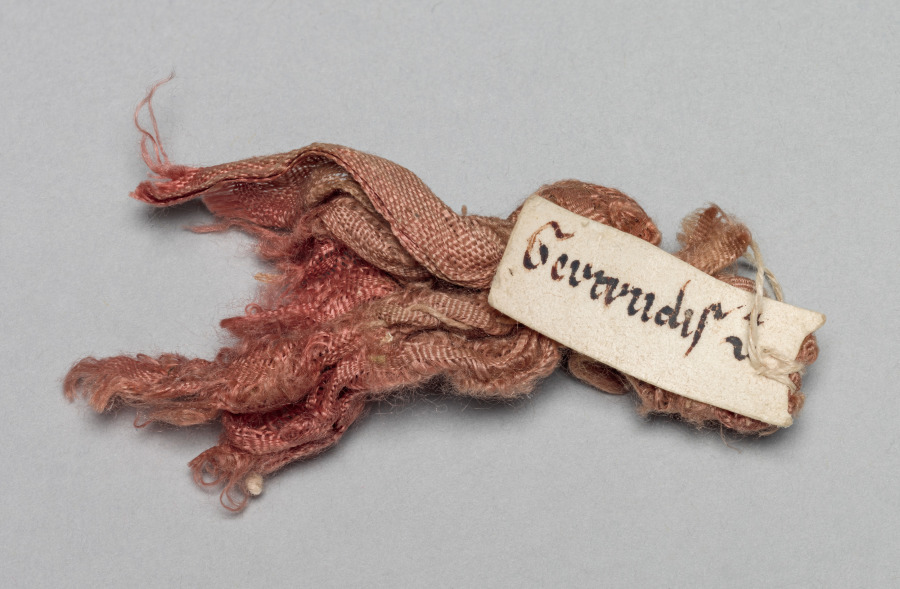
The relic bundles inside carry their own labels, and one reads Gertrude. Cleveland says X-ray showed no solid material inside it, and no source read says which Saint Gertrude is meant. It would be easy to hear the patron's name there, and nothing supports it.
What is not known
Several basic facts about the altar and its patron remain open in the sources read. Nobody read says who made the altar, and Cleveland queries Lower Saxony. The altar's date sits between shortly after 1038 and about 1045 on two museum pages, with no stated reason. None of the sources read cites a deed of gift for the altar entering St Blasius, so that it went to the church after Liudolf's death is the museum's account, drawn from the two cross records and a curator's blog, and not a document read here. The altar's own Cleveland records say only that it was commissioned. Cleveland's 1931 purchase date also differs from the 1930 sale to the United States that Wikipedia gives.
The verse names her wish and does not say who composed it, and the lead plate in her grave does not mention any of the objects. The name Liutrudis on the second cross, a different form from Gertrude, is not explained in any source read here. A search for the Brunswick inscription catalogue, which prints these texts, reached a bot check on the day of writing and was not read.
Questions
She was the wife and later widow of Count Liudolf of Brunswick, who died in 1038, and co-founder of a church with her husband and the patron of crosses and a portable altar. Her birth year and birthplace are not known, and the date commonly given for her death is 21 July 1077.
The Latin names Gertrude as the giver and Christ as the receiver of a stone glistening with gems and gold. Cleveland translates the purpose as to live happily in Him. It does not mention Liudolf.
Of the three in the Cleveland Museum of Art, only the Cross of Count Liudolf, accession 1931.461. Its inscription says Gertrude had it made for the spiritual welfare of Count Liudolf.
Cleveland dates the altar proper to shortly after 1038 and the whole object to about 1045, with a range of 1040 to 1050. The museum does not say what evidence separates the two.
The altar and both crosses are in the Cleveland Museum of Art, and the arm reliquary of St Blasius, which de Winter also attributes to her, is in the Herzog Anton Ulrich Museum in Brunswick.
Sources
- 1The Cleveland Museum of Art Open Access API, record for 1931.462.a, Portable Altar of Countess Gertrude (description, translation of the inscription, date shortly after 1038, culture Germany Lower Saxony?, provenance, CC0). Read 2026-11-25. openaccess-api.clevelandart.org/api/...
- 2The Cleveland Museum of Art Open Access API, record for 1931.55, Ceremonial Cross of Countess Gertrude (description, back inscription translation, date 1038 or shortly after). Read 2026-11-25. openaccess-api.clevelandart.org/api/...
- 3The Cleveland Museum of Art Open Access API, record for 1931.461, Ceremonial Cross of Count Liudolf (description, back inscriptions, date shortly after 1038). Read 2026-11-25. openaccess-api.clevelandart.org/api/...
- 4The Cleveland Museum of Art, 'Portable Altar of Countess Gertrude', accession 1931.462, object page (translation 'to live joyfully in him', credit line). clevelandart.org/art/...
- 5Wikipedia (German), 'Gertrud die Aeltere von Braunschweig', raw wikitext read 2026-11-25. The cited works were not read. de.wikipedia.org/wiki/...
- 6Amanda Mikolic, 'Worshiping in Place through Art: The Hidden Gems of the Portable Altar of Countess Gertrude', Cleveland Museum of Art, 16 July 2020 (relic bundles, lock and key). clevelandart.org/articles/...
More in The Women Behind the Art
The partWho Signed Oi, and Who Stood Behind Iitsu
Hokusai's daughter Oi signed few paintings and illustrated one book. The Great Wave and Red Fuji carry only Iitsu.
Who Is the Woman Writing a Letter in Vermeer's Dublin Picture? Four Documents Describe Her and None Names Her
Four documents from 1676 to 1761 describe the woman writing in Vermeer's Dublin picture.
The House She Bought and the 1909 Kandinsky Nobody Places in It
Gabriele Muenter bought the Murnau house in 1909 and kept Kandinsky's pictures in its cellar.