The House She Bought and the 1909 Kandinsky Nobody Places in It
Gabriele Muenter bought the Murnau house in 1909 and kept Kandinsky's pictures in its cellar. What the documents tie to her, and why the 1909 Amsterdam canvas is not among them.
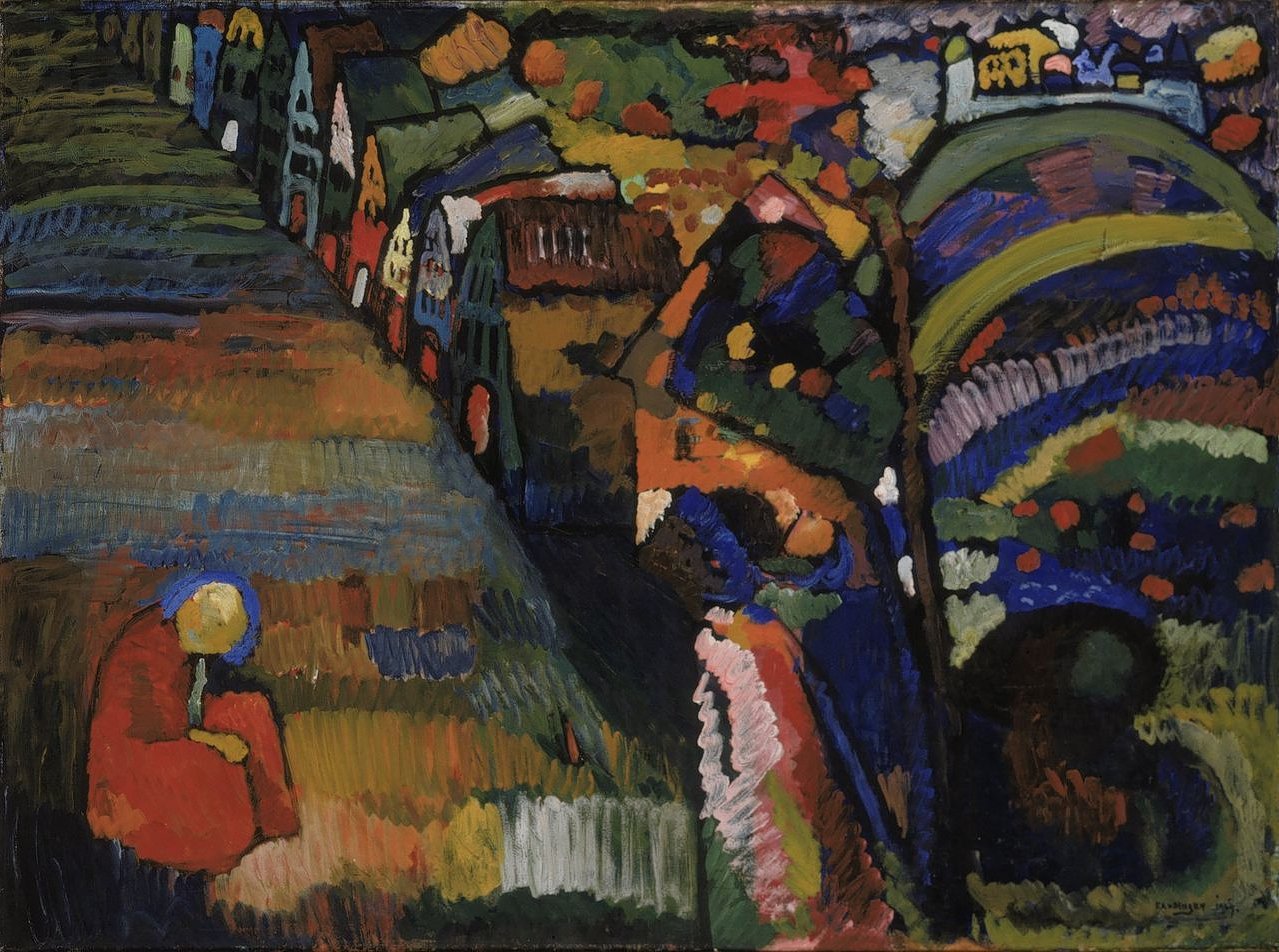
Records in this piece: Bild mit Haeusern (Painting with Houses)
On this page 5 sections
ContentsClose
In short
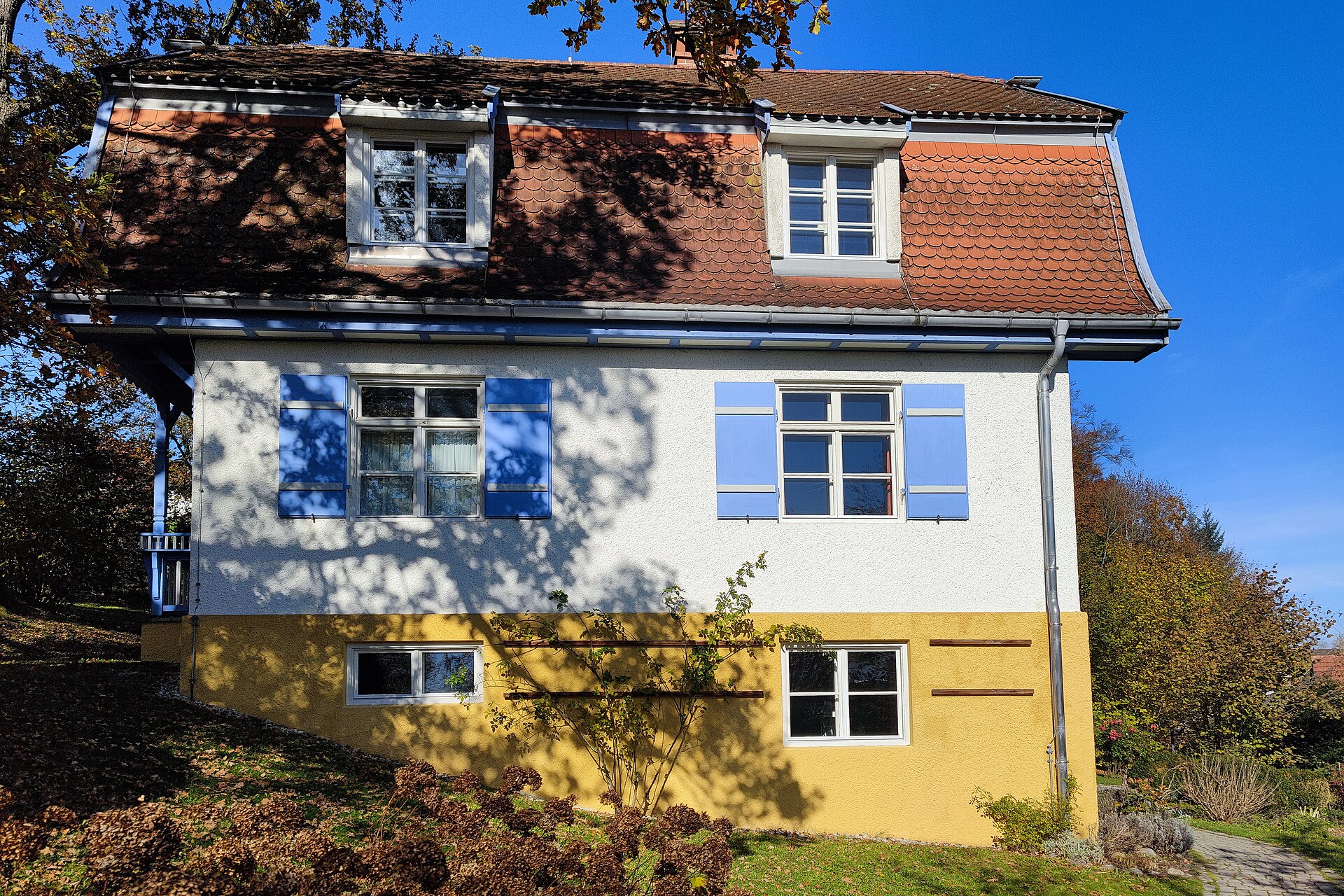
- Gabriele Muenter bought the Murnau house on 21 August 1909 (Lenbachhaus), paying with her inheritance (the town's tourism page), so the house where Kandinsky worked from 1909 was hers.
- No document we opened ties Bild mit Haeusern to Murnau or to her: the 1940 lot entry says Composition, signed and dated 1909, and the Restitutions Committee's English opinion never says Murnau.
- Her documented act for Kandinsky's work is the cellar and the gift: the Lenbachhaus says she stored the paintings in the Murnau basement against the National Socialists and gave significant parts of them on her eightieth birthday in 1957.
- The Amsterdam canvas has a dealer in 1923 and an estate sale in 1940 where the Lenbachhaus's Murnau - Haeusergruppe of 1908 reached the museum with her gift of 1957, which is the difference between a picture the paper ties to her and one it never connects to her.
She bought the house and paid for it
Gabriele Muenter bought the house in Murnau on 21 August 1909, a date the Lenbachhaus gives on the page of the foundation that manages her estate. Kandinsky had first been there with her in the middle of June 1908, and the Museo Thyssen-Bornemisza says that, egged on by him, she bought a house there in August 1909. The town's own tourism page says she paid for it out of her inheritance, so the house was hers in law and in money, and the sources we read never call it his. The Lenbachhaus calls it their country home.
From 1909 to 1914 the two of them stayed there for long periods, according to the Lenbachhaus. In the autumn of 1911 Kandinsky invited Franz and Maria Franck-Marc and August and Elisabeth Macke to Murnau to edit the almanac The Blue Rider. The Lenbachhaus puts the work of the place in two halves: in Murnau Muenter broke through to a new visual idiom, and the motifs Kandinsky found in the surrounding landscape guided him toward abstraction. That is the nearest any source we opened comes to the word muse, and it is not that word. It describes two painters who shared a house and a view.
After 1914 the house stayed hers. She came back from Scandinavia in 1920 and made Murnau her permanent home in 1931, and the Lenbachhaus says her partner Johannes Eichner moved in a few years later. She died there in 1962.
A canvas dated 1909 does not say where it was painted
The Amsterdam canvas of 1909 carries no place name in any document we could open, so nothing we read puts it in Murnau, in her house or in her company. The only catalogue entry of its own time that we have seen is the Frederik Muller sale of 9 October 1940, where lot 205 reads, in the Restitutions Committee's translation, Composition, signed and dated 1909, canvas, 97 by 132 centimetres, with a handwritten note of 160 and the name of the museum director who bought it. The committee's binding opinion of 22 October 2018, as published in English, calls the picture Painting with Houses and never uses the word Murnau. It does not use her name either.
The year does not settle the place. The Thyssen page says that from the summer of 1908 Kandinsky and Muenter divided their time between Munich and Murnau, and the house was not hers until late August 1909, so a canvas dated 1909 could come from either town or from a trip. The Dutch collection record for the painting cites Roethel's catalogue raisonne, volume one, page 256, as one of its references. We have not opened that page, and it may say more about where the picture was made than anything above.
Two different things get said about a picture like this, and they should not be run together. One is that Kandinsky painted Murnau in 1908 to 1910 and that Muenter's house made it possible. The other is that this particular canvas is one of those Murnau pictures. The first rests on the Lenbachhaus and the Thyssen. The second rests, in what we read, on the date and on a title the museum gave it in 1940, Landscape with Houses (Landschap met huizen, per the committee's quotation of the museum's letter of 2 November 1940), which names houses and no place.
The Murnau pictures are tied to the place by title and by view
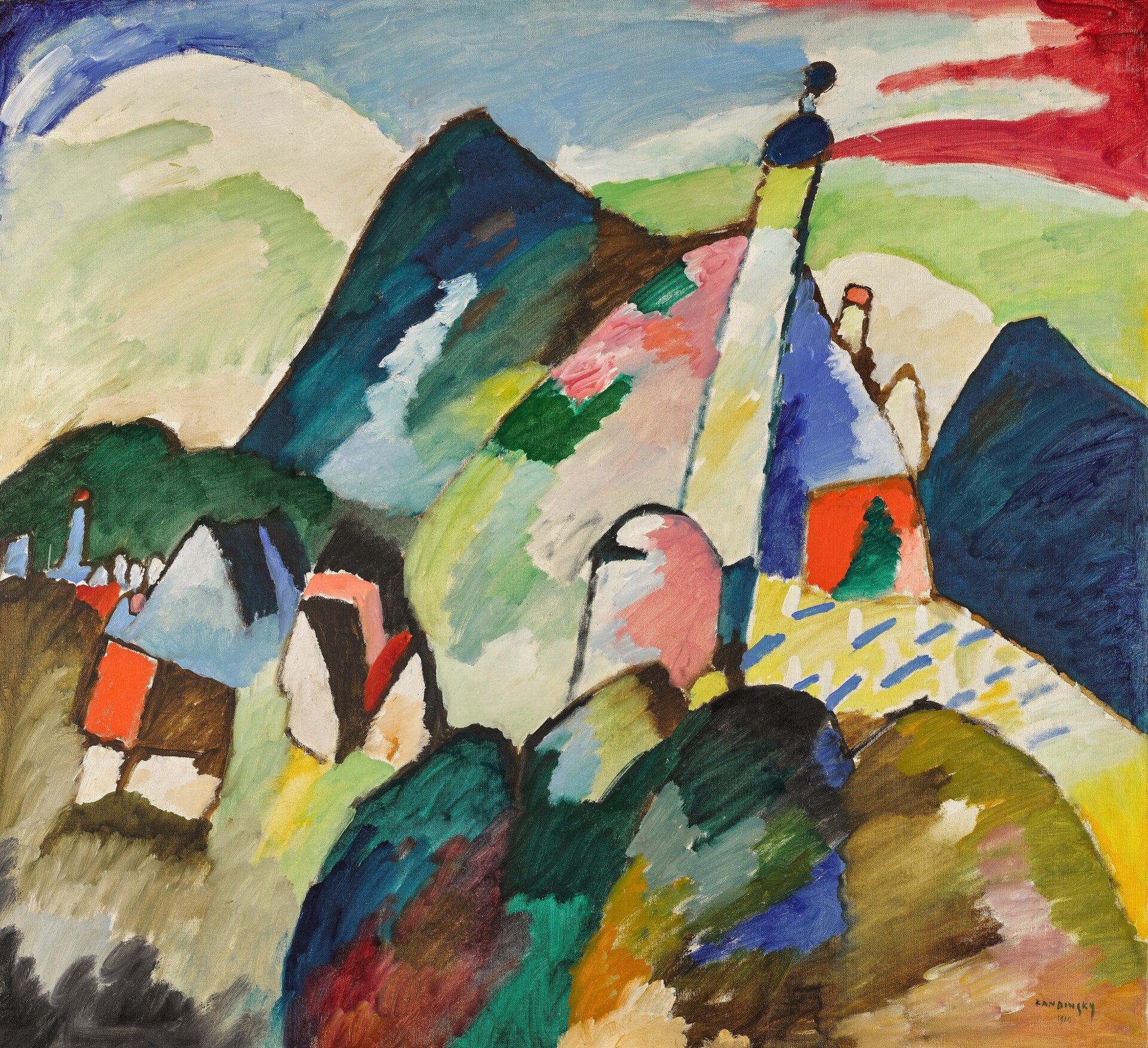
The Murnau pictures that are tied to the place are tied by their titles or by the view itself, and the one at the Thyssen is tied by a spot beside an inn. The Thyssen's account of its 1908 Obermarkt picture says the title is not Kandinsky's but the one given in the catalogue raisonne of Roethel and Benjamin, and that the work is absent from his own handlists, so even the title there comes from a cataloguer; the Thyssen ties the place to the view. What anchors it is that the view can be walked to: the painter's vantage point beside the Griesbraeu inn is still identifiable.
The Lenbachhaus holds a Murnau picture of 1908, Haeusergruppe, whose collection page gives its acquisition as a gift of 1957. That is the year Muenter, on her eightieth birthday, gave the museum a large collection of Kandinsky's works from before 1914, together with her own and other Blue Rider work. The Amsterdam canvas has no such line. Its chain, as the Dutch record gives it, begins with the dealer Paul Citroen, and how Citroen came by it is not established there or in the sources our record uses.
| Picture | Date | What its record says about place | How it reached its holder |
|---|---|---|---|
| Murnau: Houses in the Obermarkt | 1908 | The Thyssen says the vantage point beside the Griesbraeu inn can still be found today | Found by Kandinsky's widow in the Neuilly apartment, wrapped in a Munich newspaper of 1908; Carmen Thyssen Collection |
| Murnau - Haeusergruppe | 1908 | The place is in the title; oil on card, 32.8 by 41.1 cm | Lenbachhaus GMS 32, acquisition given as gift of 1957 |
| Murnau mit Kirche II | 1910 | The place is in the title | Van Abbemuseum, restituted 2022, sold at Sotheby's London 1 March 2023 (our record) |
| Bild mit Haeusern | 1909 | No place in the 1940 lot entry or in the committee's opinion | Dealer Paul Citroen by 1923, then a private Amsterdam collection, then the city of Amsterdam from 1940 |
The cellar and the gift of 1957 are what her papers show
The cellar of the Murnau house is the one place in this story where a document says what she did for Kandinsky's pictures, and it is the Lenbachhaus's own sentence. In 1956, it says, Hans Konrad Roethel was first permitted to see the complete collection of Kandinsky's and Muenter's paintings, which she had stored in the basement of her Murnau house to protect them from the National Socialists. The next year, on her eightieth birthday, she gave significant parts of it to the Lenbachhaus, and the museum's own history page says the gift turned it into a world-class museum.
The Artist Studio Museum site adds that the pictures were kept behind false walls through the Second World War. The Lenbachhaus does not use that detail and gives no years for the hiding, so we carry it as one site's account. That site also says she bequeathed the pictures on her death, which the Lenbachhaus's lifetime gift of 1957 contradicts. The Lenbachhaus also says she met Eichner in 1927, while the Murnau tourism page says New Year's Eve 1928, and nothing we read settles which.
What links the cellar to the Amsterdam picture is only a gap. The picture was in a Dutch dealer's hands by 1923, which is thirty-three years before the cellar was opened to Roethel in 1956, and no document we opened places it in her house at any time.
Why we do not call her the muse of the 1909 painting
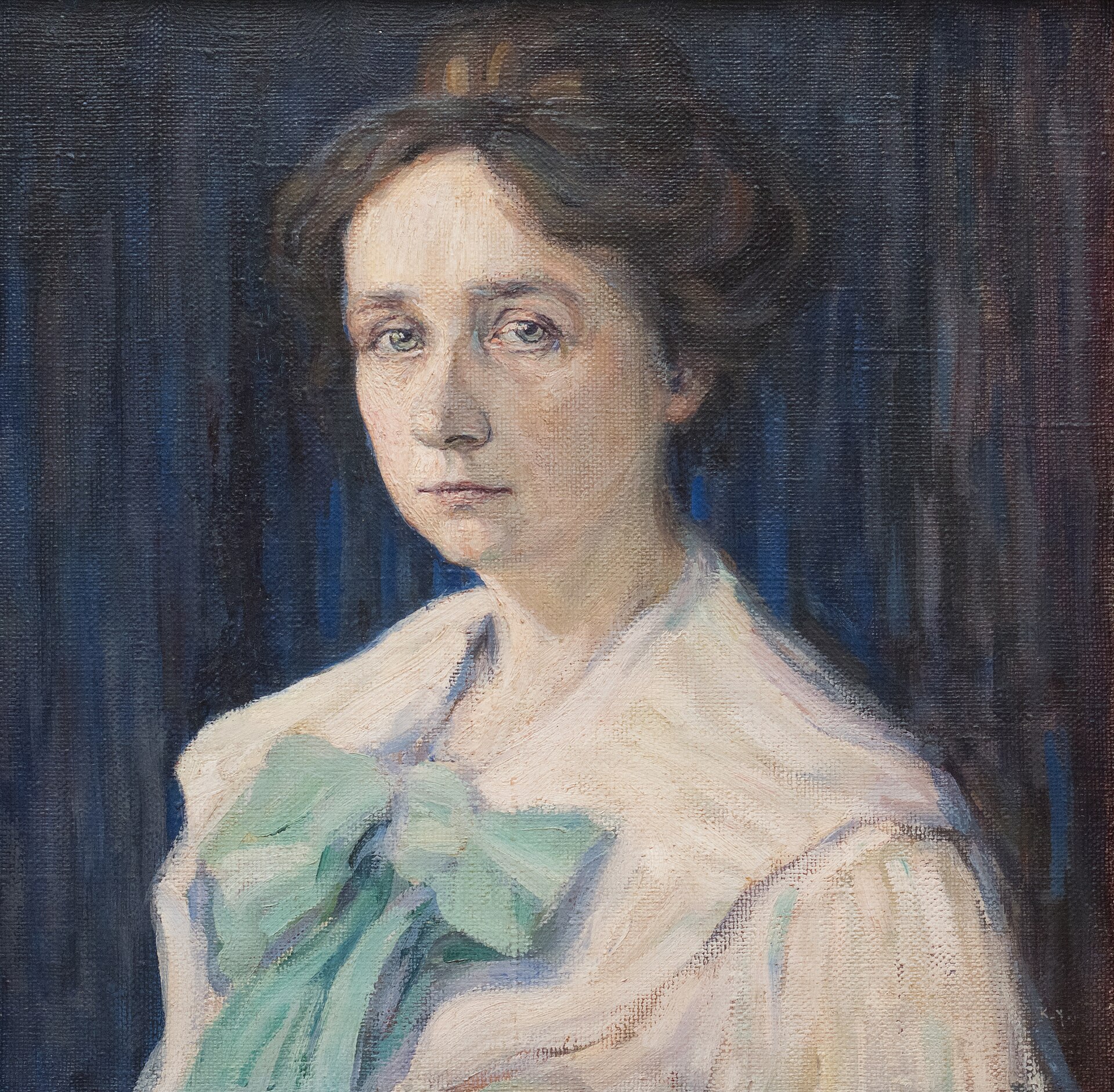
We do not call her the muse of this picture, because no source we read uses that word for her and the documents show her as an owner and a painter. Kandinsky painted her in 1905, and the Lenbachhaus shows that portrait on its history page under her name. The Murnau tourism page calls her one of the great artists of German modernism after 1900 and says she lived in Kandinsky's shadow for almost fifteen years. That second claim is the page's judgment, not a document, and it is the reading this article tests: in the papers that survive, she is the buyer of the house, the keeper of the cellar and the donor of 1957.
What her feelings were about any of it we do not know, and no source we read says. The honest card for this record therefore reads: dated 1909, called a Composition by the 1940 catalogue and Landscape with Houses by the museum that bought it, tied to Murnau by a date and a guess, and not tied to her by anything we have opened.
Questions
Gabriele Muenter bought it on 21 August 1909, per the Lenbachhaus. The Murnau tourism page says she paid with her inheritance.
The Lenbachhaus says she stored the collection in the basement of her Murnau house to protect it from the National Socialists, and that Roethel first saw all of it in 1956. The Artist Studio Museum site adds false walls; the Lenbachhaus gives no such detail.
No document we opened says so. The 1940 sale entry calls it Composition and the Restitutions Committee's English opinion never mentions Murnau. The Roethel catalogue raisonne, which the Dutch record cites, may say more.
Yes, in 1957 on her eightieth birthday. The Lenbachhaus describes a large collection of Kandinsky's works from before 1914, plus her own and other Blue Rider work.
No source we read uses that word for her. The Lenbachhaus and the Thyssen describe two painters who shared Murnau, and the Lenbachhaus says she broke through to a new visual idiom there.
Sources
- 1Staedtische Galerie im Lenbachhaus, 'Gabriele Muenter and Johannes Eichner Foundation' (read): purchase of the house on 21 August 1909, stays from 1909 to 1914, the 1911 almanac, permanent residence from 1931, Eichner, the basement, Roethel in 1956, the 1957 gift. lenbachhaus.de/en/...
- 2Staedtische Galerie im Lenbachhaus, 'History of the museum' (read): the 1957 gift of Kandinsky's works from before 1914 and her own and Blue Rider work; the 1905 portrait caption. lenbachhaus.de/en/...
- 3Museo Nacional Thyssen-Bornemisza, 'Murnau: Houses in the Obermarkt' (read): the June 1908 first visit, the purchase in August 1909, the vantage point, the catalogue title, the newspaper of 1908. museothyssen.org/en/...
- 4Restitutions Committee, binding opinion RC 3.141, 'Painting with Houses' (read, full text searched for Murnau and Muenter): the 1940 lot 205 entry and handwritten note. restitutiecommissie.nl/en/...
- 5Cultural Goods and the Second World War, record A 1740, 'Painting with Houses' (read): provenance from 1923 and the Roethel catalogue raisonne reference, volume I, page 256 (not opened). wo2.collectienederland.nl/doc/...
- 6Lenbachhaus Collection Online, 'Murnau - Haeusergruppe', 1908, GMS 32 (read): oil on card, acquisition gift of 1957. lenbachhaus.de/en/...
- 7Murnau tourism office, 'Gabriele Muenter' (read): purchase with her inheritance, the shadow remark, the meeting with Eichner on New Year's Eve 1928. tourismus.murnau.de/en/...
- 8Artist Studio Museum, 'The Muenter House' (read): the works hidden behind false walls in the basement during the Second World War. Secondary. artiststudiomuseum.org/studio-museums/...
More in The Women Behind the Art
The partWho Signed Oi, and Who Stood Behind Iitsu
Hokusai's daughter Oi signed few paintings and illustrated one book. The Great Wave and Red Fuji carry only Iitsu.
Three Gifts Countess Gertrude Made, and the One That Names Her Husband
Countess Gertrude of Brunswick had three gifts made that are now in Cleveland. Read what each inscription says, which one names her husband and what...
Who Is the Woman Writing a Letter in Vermeer's Dublin Picture? Four Documents Describe Her and None Names Her
Four documents from 1676 to 1761 describe the woman writing in Vermeer's Dublin picture.