Who Is the Woman Writing a Letter in Vermeer's Dublin Picture? Four Documents Describe Her and None Names Her
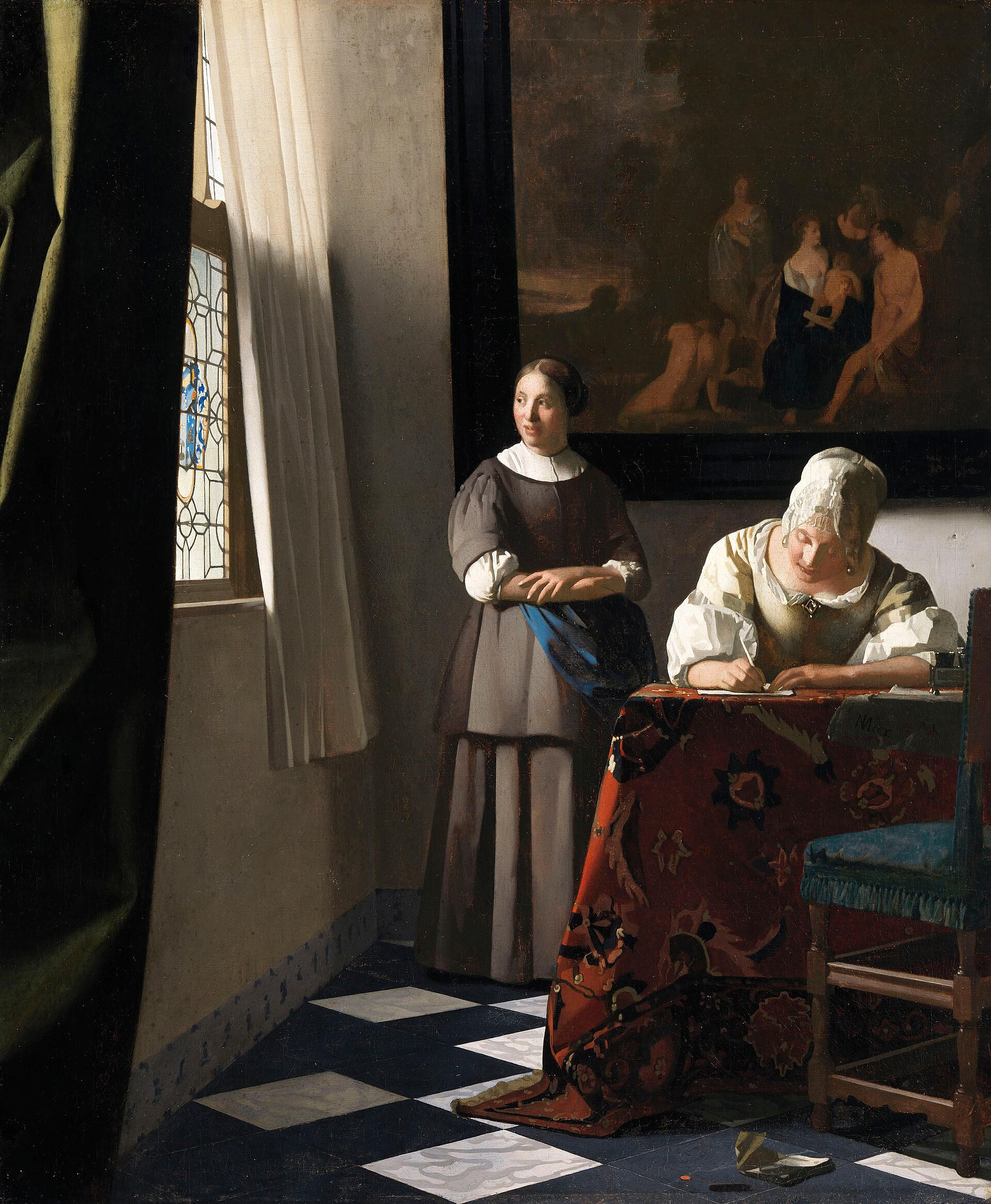
Four documents from 1676 to 1761 describe the woman writing in Vermeer's Dublin picture. None names her, and the household jacket tied to Vermeer's wife belongs to other canvases.
Records in this piece: Woman Writing a Letter, with her Maid, Girl with a Pearl Earring
On this page 5 sections
ContentsClose
In short
- Four documents between 1676 and 1761, as the 1995 Washington and The Hague catalogue prints them, describe the woman writing: two personages, a young lady, a damsel, a writing woman. None gives a name, and the picture made 155 guilders at sale in 1730 and was appraised at 100 and then 30 along the way.
- The link between those documents and this canvas is made by description and size, by the catalogue's own wording, and the earliest one, the 1676 deed, is read differently by Montias, who took it to be the Frick's Mistress and Maid.
- The yellow jacket trimmed with ermine, which the same catalogue says is almost certainly the one in Vermeer's household inventory, is worn by two different models in two other pictures and does not appear in the Dublin one, so it cannot be used to name her.
- The catalogue entry for the Dublin picture does not raise the question of who she is, and the National Gallery of Ireland calls her only the mistress or the lady.
Four documents describe her and none names her
Between 1676 and 1761 four documents describe the woman writing in this picture, and not one of them gives her a name. The 1995 Vermeer catalogue by Arthur Wheelock and Ben Broos prints each one, and the table sets them side by side.
| Date | Document | Words used for her | Money named |
|---|---|---|---|
| 27 January 1676 | Deed in which Vermeer's widow Catharina Bolnes gives the baker Hendrick van Buyten two paintings as security (Montias 1993, doc. 361) | Two personages, of whom one sits and writes a letter | A bread debt of 617 guilders and 6 stuivers |
| 6 September 1730 | Van Belle sale, Rotterdam, lot 92 (Hoet) | A sitting young lady writing a letter, with a maid standing by waiting | 155 guilders |
| 1734 | Estate of Franco van Bleyswijck, Delft, lot A to Hendrick van Slingelandt (Van Slingelandt family archive) | A damsel who writes a letter and a maid next to her | Appraised at 100 guilders |
| 1761 | Appraisal of the Van Slingelandt estate by the painter Aert Schouman | A writing woman | 30 guilders |
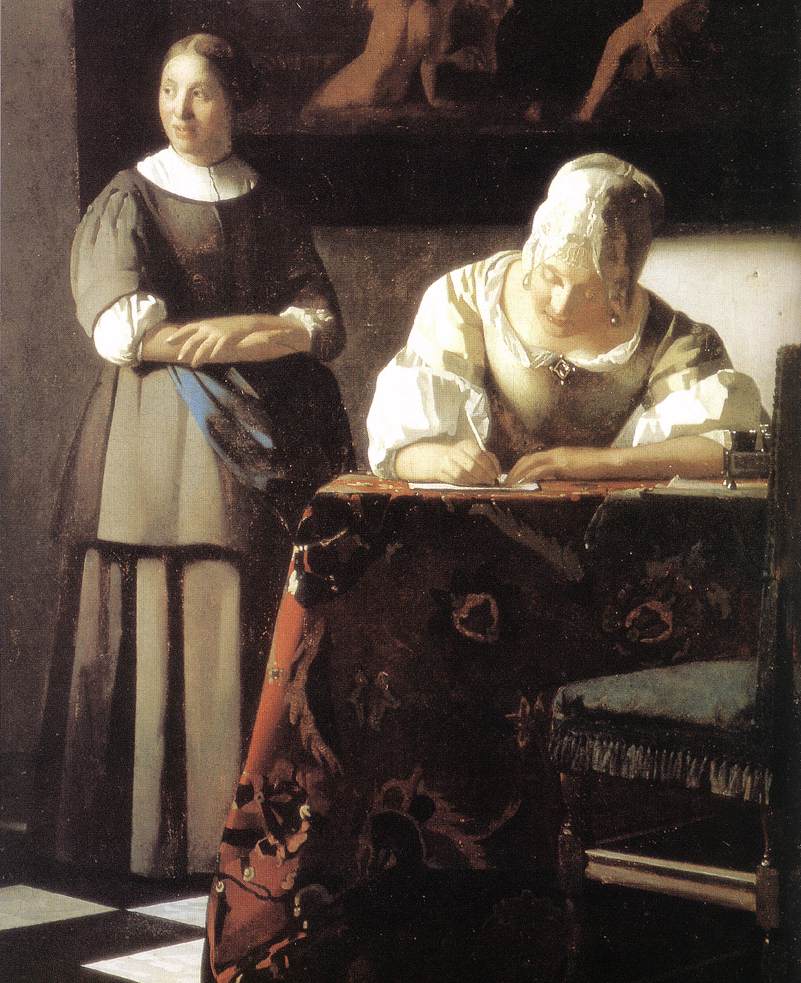
Across eighty-five years she is a personage, a young lady, a damsel and a woman, always by what she is doing and never by who she is. The catalogue says Schouman believed the picture worth no more than thirty guilders, and that one of the two Van Slingelandt daughters, Agatha or Elisabeth Maria, inherited it.
The same catalogue also warns about the matches. It says the dimensions of the Dublin canvas correspond more or less with the 1730 description, and that the large Vermeer Van Buyten left at his death in 1701 was presumably this work. So each row rests on a description fitting a picture, and none rests on a label that survives on the canvas.
The first of the four may describe a different canvas
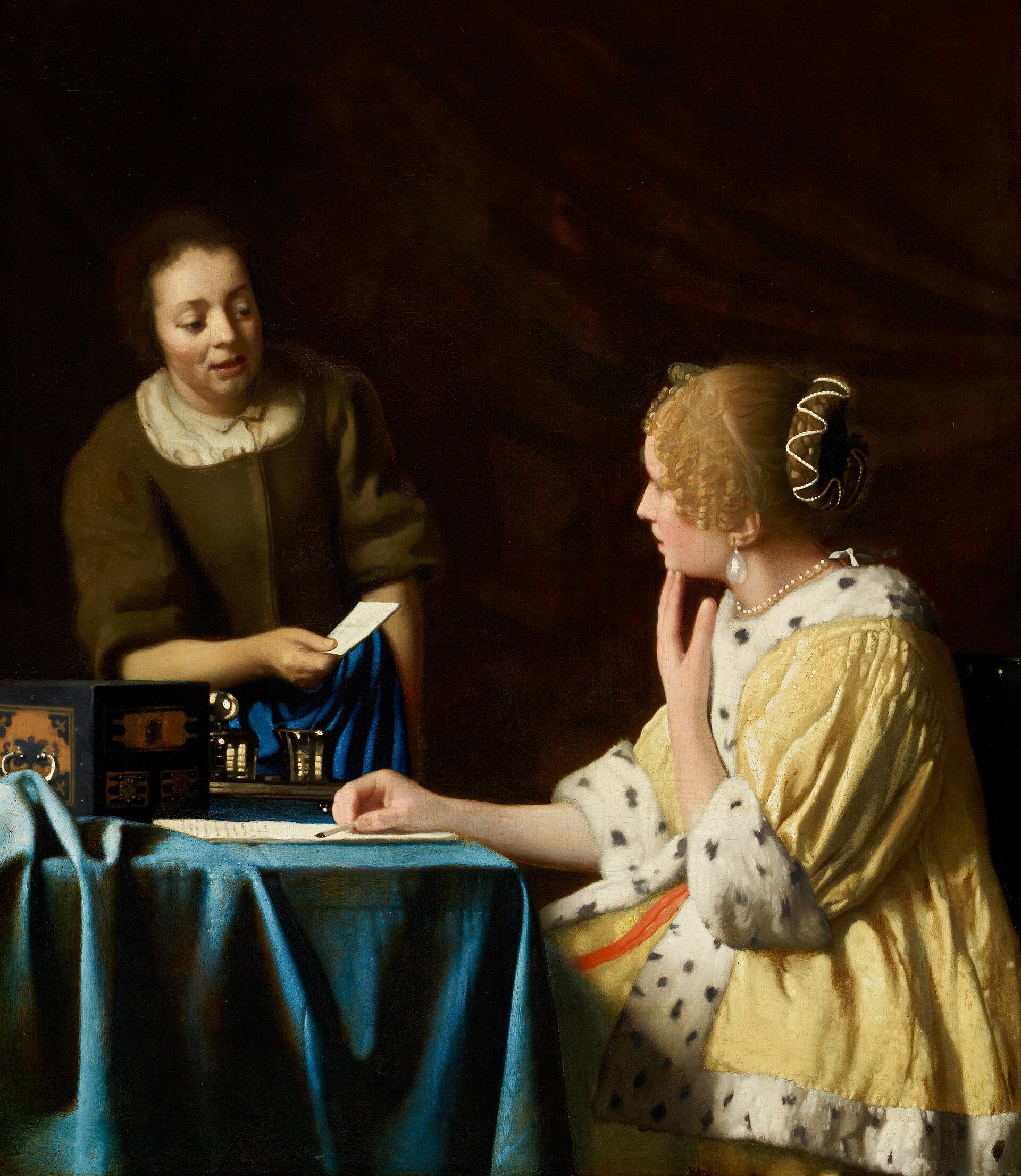
The 1676 deed may not describe this picture at all, and the catalogue says so in a note. Wheelock and Broos read the deed's two personages, one of whom sits and writes a letter, as the Dublin picture, and the 1995 entry treats it as one of the two canvases that went to the baker. Montias, in a footnote the catalogue records, assumed instead that the large painting among Van Buyten's three Vermeers was the Frick's Mistress and Maid.
The catalogue's answer is a description. In the Frick picture, the note says, the woman is not writing but looks up from a letter while a servant brings her a letter. In the Frick picture she also holds a pen above a sheet, which is why the question stays open. On that reading the deed would fit Dublin. Neither side offers a mark or a measurement that settles it, and our record of the Dublin picture carries the point as open.
Whichever way it falls, the document that sits closest to Vermeer's household gives no more than two figures and an act. The deed says that one of them sits and writes, and says nothing of who she is.
A costume proves a wardrobe and not a woman
The 1995 catalogue makes a plain statement on a Vermeer sitter in its entry for a different picture, A Lady Writing in Washington, and the statement is a refusal. Wheelock writes there that the problem of identifying the sitter seems insurmountable. He calls Vermeer's wife, Catharina Bolnes, born in 1631 and so in her early to mid thirties, the most likely possibility, and adds that little else confirms it.
He then separates two facts that popular accounts run together. The yellow satin jacket with white ermine trim in the Washington picture, he says, is almost certainly the one named in the inventory of household effects made after Vermeer's death, yet in Mistress and Maid it is worn by a different model. A garment that appears on different women in different canvases shows a studio or a household wardrobe, and it does not say whose face is under it.
The Dublin entry takes none of this up. It describes the mistress by her posture and her place in the perspective, calls her the mistress and never asks who she was. Nor does she wear the jacket. To call her Vermeer's wife on the strength of that jacket would extend an argument the catalogue itself makes about another canvas and qualifies in the same sentence.
What the picture and its owners do say about her
The picture and its owners give her a role, a place and a title that kept changing. The National Gallery of Ireland, which received the painting in 1987 from Sir Alfred and Lady Beit, calls the figures a maidservant and her mistress and the second one the lady. It reads the objects on the floor, a red seal, a stick of wax and a letter or a letter-writing manual, as things the lady has discarded in some agitation, and it gives the painting's title as Woman Writing a Letter, with her Maid.
The 1995 catalogue puts the name Le Billet doux, the love note, against the picture in its account of the Paris years, so across the centuries the woman has been a personage, a lady, a damsel and a woman, and the picture itself was sold as Le Billet doux, the love note, and the one thing that stays fixed is the act of writing. Wheelock reads her intensity from the way she leans on her arm and from the compressed space between her and the right edge, and the gallery reads her agitation from the objects at her feet. These are readings of a posture, and they are not facts about a person.
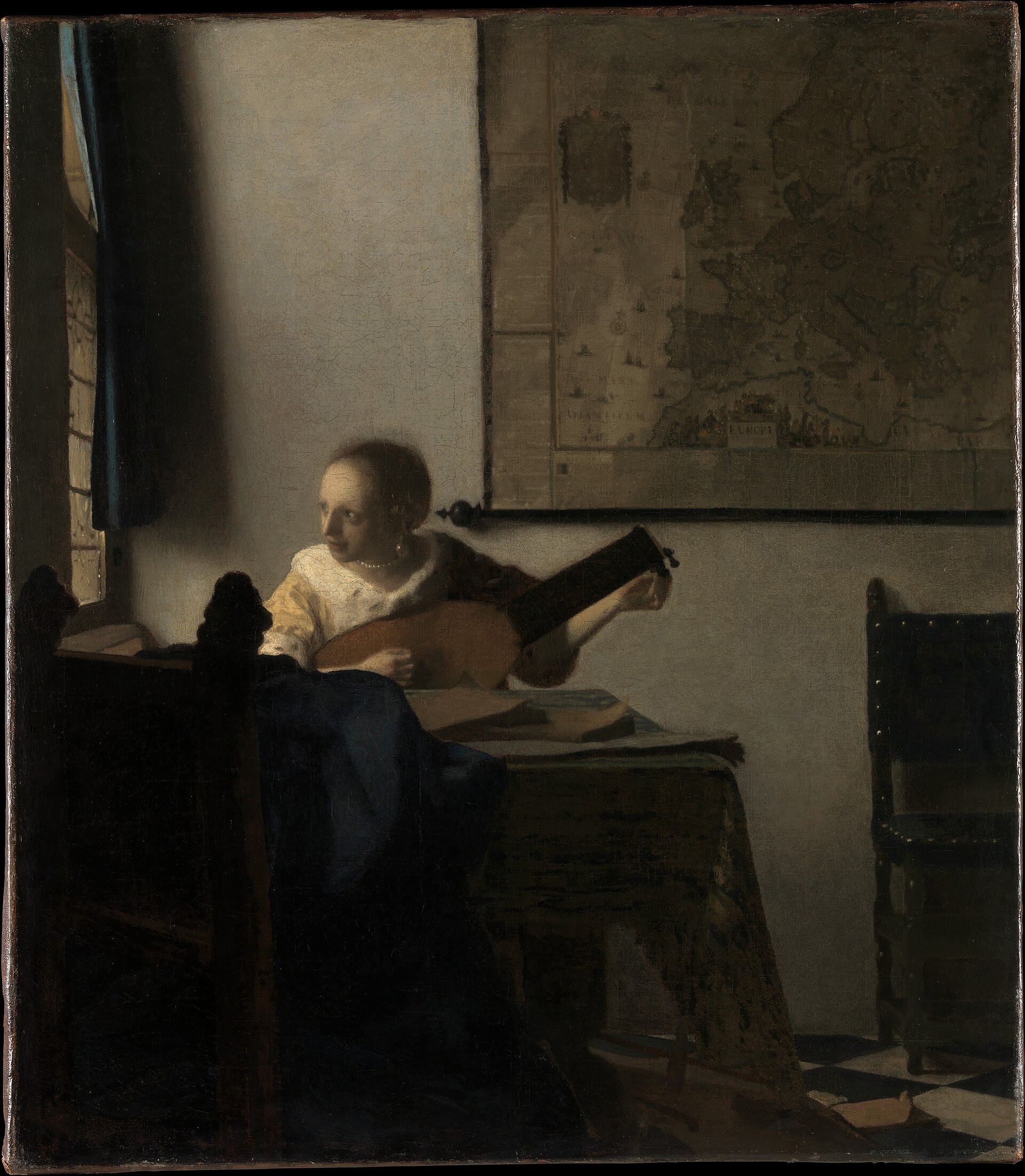
One neighbouring result is worth recording for what it does not show. Liedtke, Johnson and Johnson found in 2012 that the thread density of the much smaller Woman with a Lute in New York, turned on its side, matches the great majority of the vertical warp threads of the Dublin canvas. Their match concerns the cloth and only the cloth. It suggests two canvases cut from related stock, and it does not show that one woman sat for both, and the sources we used give no name for the woman with the lute either.
What the record can honestly say
The honest entry for her sitter field is blank, and that is a finding and not a failure of research. Our record of the Girl with a Pearl Earring reaches a blank by a different road, because a tronie is a study of a head made for no particular sitter. The Dublin woman is not a tronie, so her anonymity has to be explained another way: the catalogue says Vermeer never sold it in his lifetime, and the documents that describe it were drawn up for a security, a sale or an appraisal and not as a biography.
That reading of why the documents are silent is ours and not a statement any of them makes. What the table does establish is narrower and firmer. In every description we can read, from the widow's deed to the Hague appraisal, the woman is defined by her pen, and nobody who handled the picture wrote a name beside it.
Questions
None of the four documents the 1995 catalogue ties to the picture names her. The four descriptions the 1995 catalogue prints, from 1676 to 1761, call her two personages, a young lady, a damsel and a writing woman.
No source we read says so for the Dublin picture. The 1995 catalogue offers Catharina Bolnes as the most likely sitter for a different painting, A Lady Writing in Washington, and adds that little else confirms it.
No. The catalogue says the jacket is almost certainly the one in Vermeer's household inventory, but it is worn by a different model in Mistress and Maid and it does not appear in the Dublin picture.
The deed of 27 January 1676, in which Vermeer's widow gave a baker two paintings against a bread debt. Montias, as the catalogue records, assumed the painting was the Frick's Mistress and Maid, while Wheelock and Broos read it as the Dublin picture.
In the National Gallery of Ireland, Dublin, inventory NGI.4535, presented by Sir Alfred and Lady Beit in 1987.
Sources
- 1Arthur K. Wheelock Jr. and Ben Broos, Johannes Vermeer, exhibition catalogue (Washington and The Hague, 1995): entry 19, Lady Writing a Letter with Her Maid, with its provenance and notes (Montias 1993 docs. 361 and 442, Hoet 1752 no. 92), and the entry for A Lady Writing, National Gallery of Art, Washington. Primary scholarly source, open PDF. nga.gov/content/...
- 2National Gallery of Ireland online collection, Woman Writing a Letter, with her Maid, NGI.4535: description, credit line and provenance. Primary (institution). onlinecollection.nationalgallery.ie/objects/...
- 3Walter Liedtke, C. Richard Johnson Jr. and Don H. Johnson, 'Canvas Matches in Vermeer: A Case Study in the Computer Analysis of Fabric Supports', Metropolitan Museum Journal 47 (2012). people.ece.cornell.edu/johnson/...
More in The Women Behind the Art
The partWho Signed Oi, and Who Stood Behind Iitsu
Hokusai's daughter Oi signed few paintings and illustrated one book. The Great Wave and Red Fuji carry only Iitsu.
Three Gifts Countess Gertrude Made, and the One That Names Her Husband
Countess Gertrude of Brunswick had three gifts made that are now in Cleveland. Read what each inscription says, which one names her husband and what...
The House She Bought and the 1909 Kandinsky Nobody Places in It
Gabriele Muenter bought the Murnau house in 1909 and kept Kandinsky's pictures in its cellar.