The Woman on the Wall and the House That Was Not Hers
Leocadia Zorrilla is named on the Quinta del Sordo wall by one sentence of 1867. Her own papers show a woman with a will to fight and no title to the house.
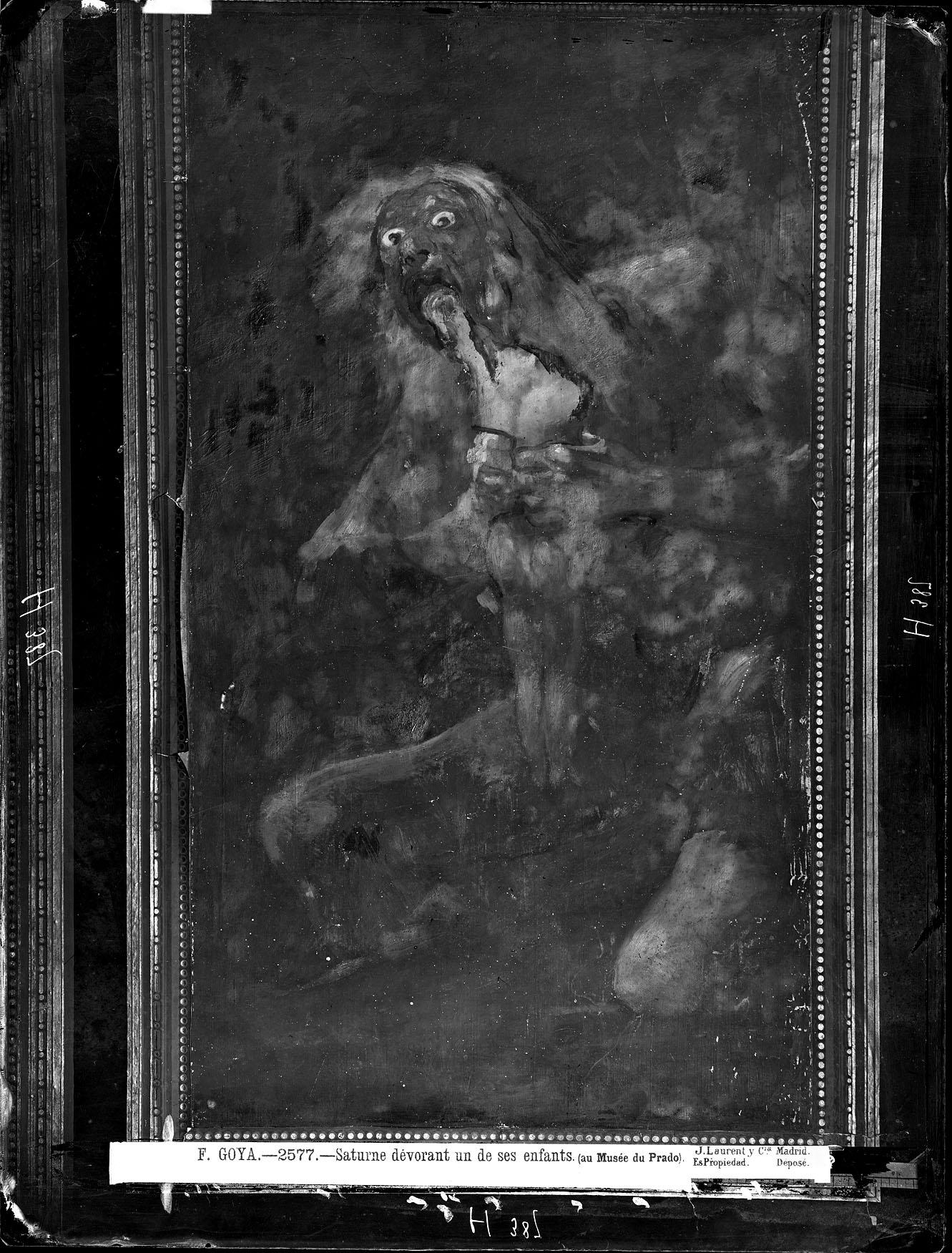
Records in this piece: Saturn Devouring His Son, Plate 69 from "The Disasters of War" (Los Desastres de la Guerra): "Nothing. It will say so" (Nada. Ello dira)
On this page 7 sections
ContentsClose
In short
- The name Leocadia on the Quinta mural reaches print in Yriarte's 1867 guidebook (reliable information, no informant named). A search extract of the Prado's own entry, which we could not open, credits the identification to Brugada, whose inventory is itself disputed. The printed label on Laurent's photograph says Une maja, but that label is late evidence.
- In the deeds and papers read, the house goes from Goya (27 February 1819) to his grandson Mariano (September 1823). Leocadia is not named as an owner or tenant in any of them.
- The documents that carry her own hand are a power of attorney of 8 February 1827 and her letter of 28 April 1828 on Goya's last weeks. Neither is about the paintings.
- Scholars disagree on the dating of the Brugada inventory (1823, after 1828 or 1859 to 1870) and on when she moved to the Quinta, with dates from 1815 to 1821 in the sources we saw. No source read shows she shaped Saturn or the house.
- X-rays reported by the Goya Foundation show the face in La Leocadia was once different, so the identification attaches to the final paint.
Her name reached the wall in a guidebook of 1867
The woman by the door in the Quinta del Sordo is named Leocadia in print first by a sentence in a guidebook. Charles Yriarte, who visited the house in the 1860s, describes a figure whose mantilla falls over her face and writes, in a passage Foradada reprints, that reliable information lets him call her Dona Leocadia. He names no informant. By his date Leocadia Zorrilla had been dead about eleven years.
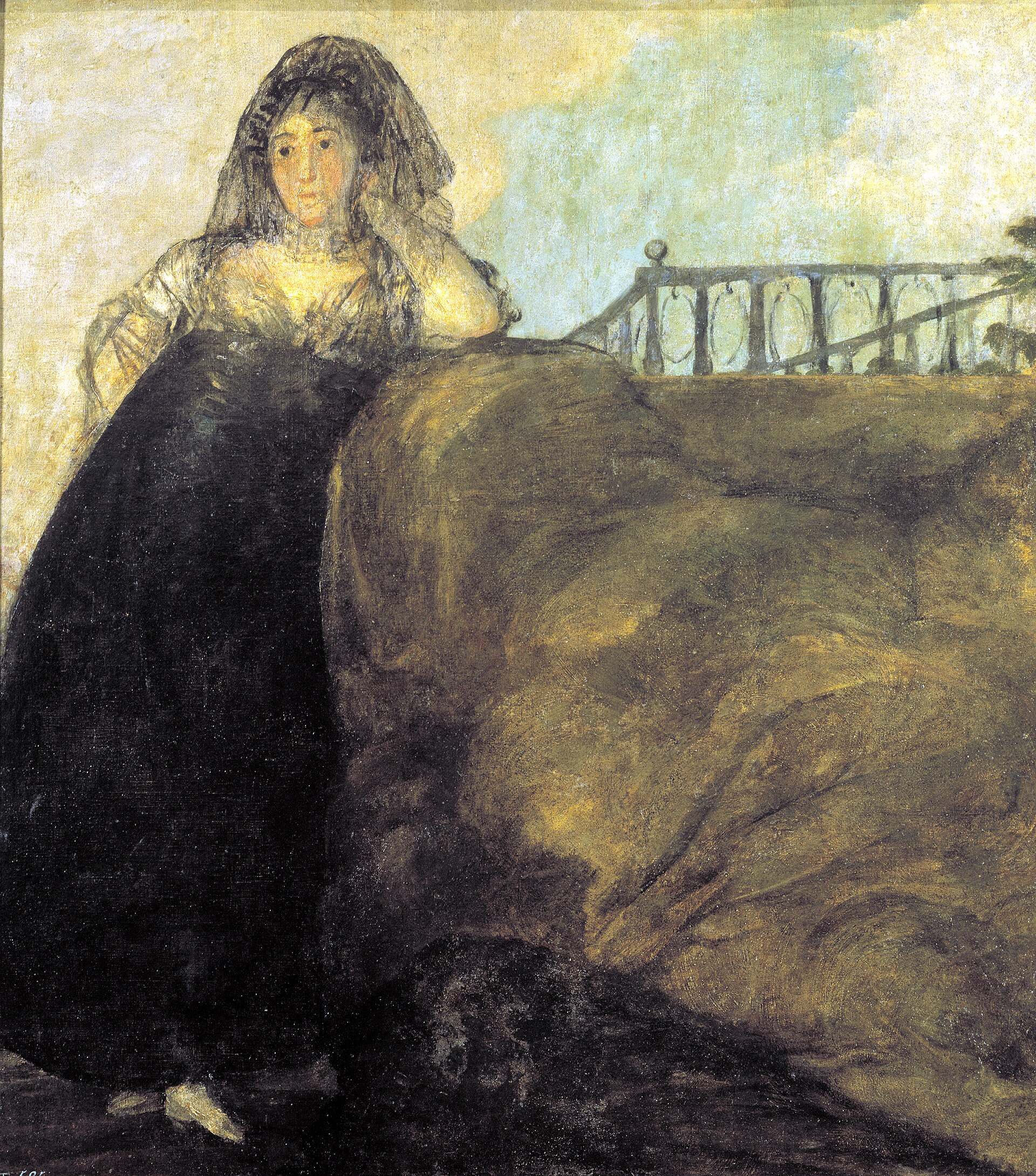
The painting is La Leocadia, now in the Prado, a woman in a black dress leaning on a dark mound that may be a tomb. The Fundacion Goya en Aragon catalogue says the sitter can be identified as Leocadia Zorrilla, and in the same entry notes that X-rays show the picture changed: the face was once different, the veil was added later and the figure first leaned on what looked like a doorframe. So the name belongs to the final surface. Nobody I read says whose face lay under it. The Prado's own catalogue text matters here and I could not open it: its site stopped both browsers I tried with a bot check, which I did not try to defeat. A search extract of it says the sitter was identified by Brugada, who knew her. I have not verified that wording, and the Brugada inventory it points to is itself disputed (section 6).
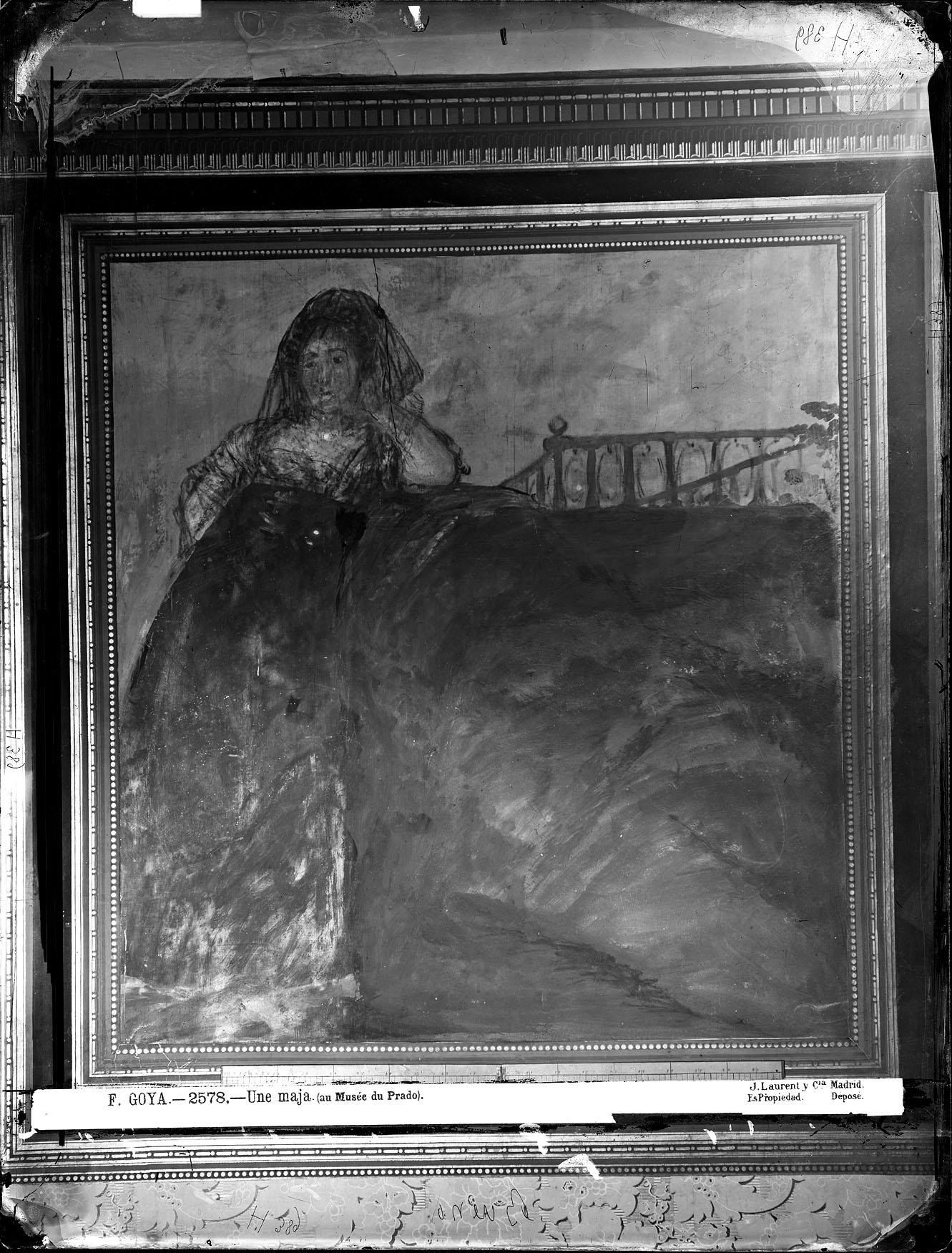
The photographer's label is more cautious than the catalogue. On J. Laurent's sheet of the mural the printed label, which I read off the Commons scan, says 2578, Une maja, at the Prado. Glendinning dates such printed labels to the 1880s, after the move to the Prado, so this is late evidence and does not show what Laurent called the picture in the 1860s. A maja is a type, a fashionable young woman of Madrid, not a person. The Saturn sheet, which our record reads as F. GOYA, 2577, carries the next number. Nigel Glendinning lists the same sheet in his own notes as Dona Leocadia. The sheet itself does not.
What her own papers show
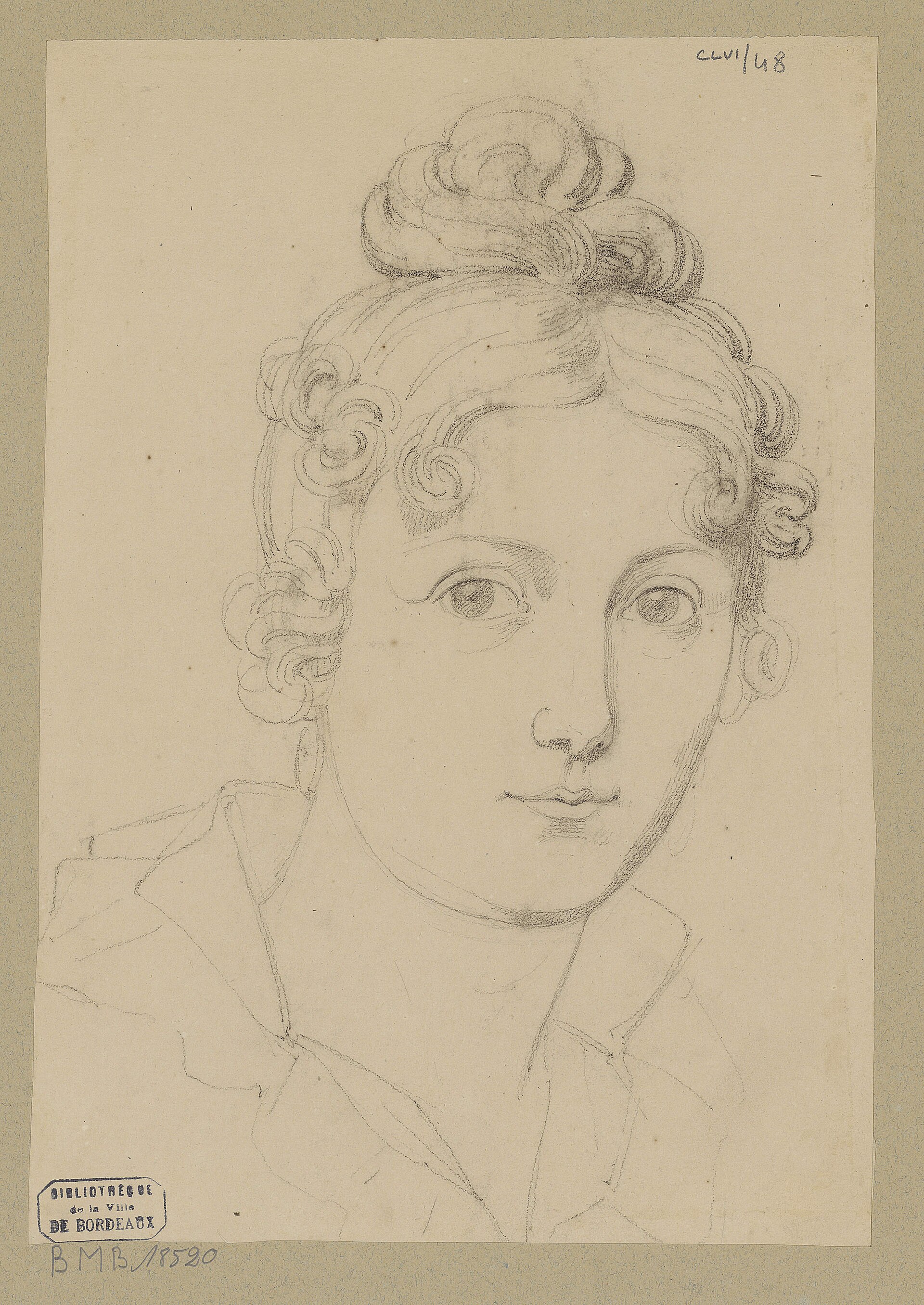
Leocadia Zorrilla was born in Madrid on 9 December 1788 and died there in August 1856. The two Wikipedia articles give those years and Foradada's note on Goya's addresses gives 1788 to 1856 as well. They differ on the day of her death, the sixth in one text and the seventh in the other, so I print only the month. She married Isidoro Weiss in 1807 and had three children, Joaquin, Guillermo and Rosario, born in 1808, 1811 and 1814.
Two things are said about that marriage and both come to us through biographers. Weiss is reported to have sworn out a paper in 1811 (one Spanish text says 1811, another places it two years before Rosario's birth) accusing her of illicit conduct. And since Rosario was born in 1814, writers including Robert Hughes have speculated that Goya was her father. The English Wikipedia article on Rosario says her baptism names Weiss, secondhand. Spanish Wikipedia, citing Bozal, says Weiss recognised paternity on 2 October 1814, and cites Cruz Valdovinos for no proof that the relationship with Goya was amorous. The article on Leocadia says it seems certain he was not the father. I have seen none of the acts themselves, and no document I read settles it.
Then there are the papers she signed herself. On 8 February 1827 she gave a power of attorney before the Spanish consul in Bordeaux to sell her share of a family house in the Carranza valley. Junquera found that it was notarised again in Madrid on 17 May 1827 by Francisco Alcazar, with her husband Isidoro Weiss among the witnesses. His reading is that Goya probably carried it to Madrid. The second paper is her letter of 28 April 1828 to Moratin about Goya's last weeks. Junquera quotes a fragment. Spanish Wikipedia prints more. It says Goya wanted to make a will in their favour and his daughter-in-law answered that he had one already. It is the nearest thing to a voice she has here, and it concerns a will that, as far as we know, did not exist.
The house was never in her name
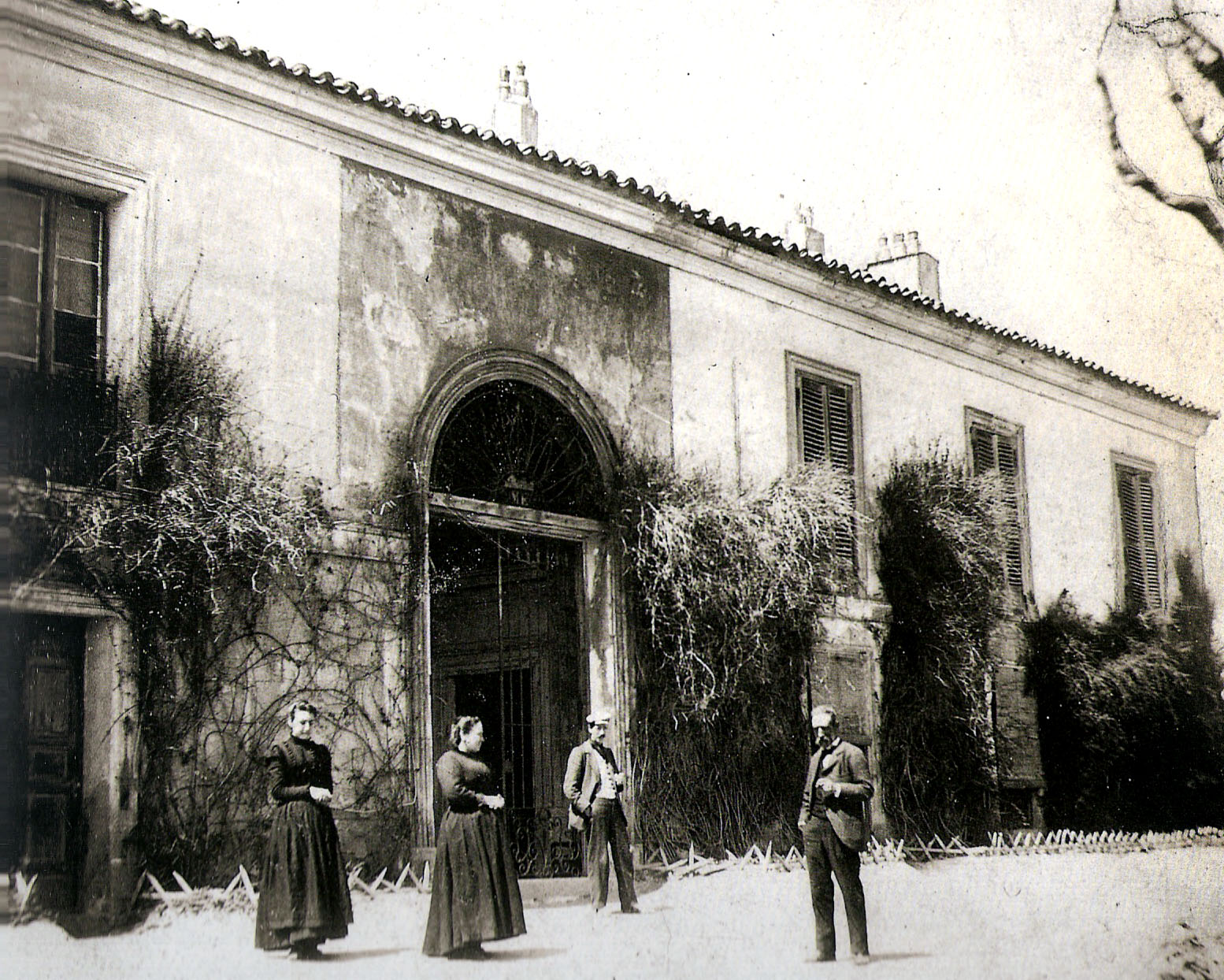
In every document I read about the Quinta, the owner is a man. Goya bought the house and land on 27 February 1819 from Pedro Marcelino Blanco. Glendinning, Foradada and the Goya Foundation all give that date, and Foradada notes that the deed's date comes to us through the 1823 donation. In September 1823 Goya conveyed it to his grandson Mariano, and Foradada reads that as a precaution against confiscation after the French army ended the liberal period. The Foundation adds that Mariano gave it to his father Javier in 1830. Two sources give that last step, the Foundation and Foradada, and they are probably not independent. The Foundation adds that Mariano inherited the house back in 1854.
Leocadia's role at the house is described, not documented. The Foundation calls her Goya's housekeeper in his last years. Foradada says Goya bought the place to live there with her and her two youngest children. Sources give her arrival as 1815, 1817, 1819 or, in a note citing Sesena, with certainty 1821. The date of her move is therefore unsettled, and I cannot show from a deed that she lived at the Quinta on any given day. The sources that say she did are describing a household, not citing a lease or a wage.
| Date | Event | Her part |
|---|---|---|
| 27 February 1819 | Goya buys house and land from Pedro Marcelino Blanco | Not named in the deed as quoted |
| September 1823 | Goya donates it to his grandson Mariano | Not named in the sources read |
| 1830 | Mariano gives it to his father Javier (Foundation and Foradada, probably not independent) | Not named in the sources read |
One neighbour's verdict, and the interest behind its use
Most of what we know of her temper comes from one man. Leandro Fernandez de Moratin, an exile in Bordeaux, wrote to Juan Antonio Melon on 30 September 1824 that Goya was there with his Dona Leocadia and that he saw no harmony between them. On 30 October 1825 he wrote that Dona Leocadia, with her usual intrepidity, grumbled at times and at times enjoyed herself. Junquera gives both as footnotes, citing Canellas Lopez's Diplomatario (nos. 153 and 168). The translations are mine.
Junquera uses them for a larger purpose. He reads in Moratin the portrait of a woman of bad character to whom the old painter's will was subjected, and he suggests that perhaps the main reason so few letters passed between Goya and his son. That is Junquera's inference. Moratin's own words, as quoted, say grumbling, intrepid and unharmonious, which is less. Junquera also says it is wrong to repeat that she was noble: as a Biscayan she counted as hidalga, but her family and her circle, the Muguiro and Goicoechea houses, were bankers and merchants. And he argues that a husband who witnessed her 1827 document in Madrid would hardly have dealt with Goya if the two had been lovers. That is argument from manners, not evidence, and I report it as his.
The will, and the furniture the consul found
After 16 April 1828 the papers turn into a dispute over who would inherit. Junquera says Javier was named universal heir in the will of 1812, and that Goya's quick trip to Madrid in 1827 may have been to change it, though he has not found any such document. He cites powers of attorney for Bordeaux, one in August 1826 and one given by Javier alone on 17 April 1828, the day after Goya died, to claim any inheritance. His reading is that Javier feared a will or codicil favouring Leocadia and her children.
Junquera also reports that at Goya's death the Spanish consul made no inventory. Officially there was nothing in the Bordeaux house but a few pieces of poor furniture which the Goya family said belonged to Dona Leocadia. He asks where the paintings, prints, drawings and copper plates were. Our own record of the Disasters plate 69 says that series stayed unpublished until the Academy issued it in 1863, which is why it is linked here: it is the nearest thing in the archive to the missing prints and drawings the consul did not list. No source I read connects that delay to her.
What happened to her next rests on thinner ground. Spanish Wikipedia says Javier let her keep the furniture and gave her one thousand francs, and that she and Rosario returned to Madrid in June 1833 after the amnesty. Rosario then copied in the Prado, was named a drawing teacher to the infantas in 1840 and died in 1843. Both Wikipedia articles say so, but they are not independent, and I could not check the Madrid and Bordeaux documents they rely on.
What the scholars say she did to the work
No scholar I read says that Leocadia caused Saturn Devouring His Son, or the Black Paintings as a whole. The catalogue's claim is narrower. It calls La Leocadia the starting point for the series, the one image of youth and life among the visions, set where the visitor came in. Arnaiz is cited there for a reading of the figure as melancholy. That is an interpretation of a picture and says nothing about her.
Juan Jose Junquera, in 2003, took the opposite line on authorship. He argued that the Black Paintings may be the work of Goya's son Javier, and that the house was a family property where Javier had the means and the chance. Leocadia enters his paper as one party in an inheritance fight. Nigel Glendinning answered in 2004. His fifth section carries her name in its title and then declines to follow Junquera into the family's later history, since he found no basis for the doubts about authorship. In the pages I read he does not discuss her.
The Prado's own text on La Leocadia I could not open, so I cannot report it. Everything above is the Foundation's catalogue, Junquera, Glendinning, Foradada and two Wikipedias. If the question is whether she shaped the house or the pictures, the answer from those texts is that nobody has shown it, and nobody has shown that she did not.
Brugada's list and a name in her letter
The earliest list of what hung where is the Brugada inventory, and its date is disputed. Baticle, cited by Foradada, thinks it was drawn up in 1823 when Goya gave the house to Mariano. Fauque and Villanueva put it after Goya's death in 1828. Glendinning, who allows 1823, says Junquera wants it as late as 1859 or even 1870. Junquera adds that the painter Antonio Brugada was not in Madrid in 1823 or 1828. I did not see the inventory's wording for the Saturn or for the woman at the door.
The one place where her letter touches the inventory is the deathbed. She writes that Molina and Brugada saw Goya die and that she was in the room until two minutes before. Foradada says Brugada was in Bordeaux in 1828 and a close friend of Goya's there. It is my inference, not a source's, that the Brugada of her letter is the Brugada of the inventory. If that is right, the earliest list of the paintings and the fullest account of Goya's death share a witness, and neither tells us what she thought of the walls.
I do not know what she thought of the paintings, whether she sat for one or what happened to the figure's first face. The documents that survive are about her marriage, her land, a will and a death. They show a woman handling her own affairs across two countries. They do not show her as the reason for the Quinta.
Questions
Leocadia Zorrilla (1788 to 1856) was a Madrid woman, married in 1807 to Isidoro Weiss, who became Goya's companion and housekeeper in his last years and went with him to Bordeaux. The year she joined his household is given as 1815, 1817, 1819 or 1821 by different sources.
The identification appears in print in Yriarte in 1867, who cites unnamed reliable information. The Goya Foundation says she can be identified as the sitter, but X-rays show the face was painted differently at first. A search extract of the Prado's entry, which we could not open, credits Brugada. The Laurent photograph carries a late printed label calling it only a maja.
No document read shows it. He bought the house in 1819 and donated it to his grandson Mariano in September 1823. Junquera argues a codicil may have favoured her in 1827, but he has not found one.
No source read says so. The Foundation presents La Leocadia as the starting point of the series and Arnaiz reads the figure as melancholy, but those are readings of paintings and not documented facts about her.
Spanish Wikipedia says she returned to Madrid with her daughter Rosario in 1833, and Rosario worked as a copyist and drawing teacher until her death in 1843. Leocadia died in August 1856. These details rest on secondary accounts I could not check against the originals.
Sources
- 1Juan Jose Junquera, 'Los Goya: de la Quinta a Burdeos y vuelta', Archivo Espanol de Arte LXXVI, 2003, no. 304, pp. 353-370, esp. pp. 363-366 and footnotes 48 to 55 (Moratin letters, 1827 power of attorney, 1826 and 1828 powers, the consul's missing inventory). xn--archivoespaoldearte-53b.revistas.csic.es/index.php/...
- 2Nigel Glendinning, 'Las Pinturas Negras de Goya y la Quinta del Sordo. Precisiones sobre las teorias de Juan Jose Junquera', Archivo Espanol de Arte LXXVII, 2004, no. 307, pp. 233-245 (Laurent plate numbers; the Brugada inventory; section 5). xn--archivoespaoldearte-53b.revistas.csic.es/index.php/...
- 3Carlos Foradada Baldellou, 'El interior de la Quinta del Sordo', AACA Digital no. 46, 2019 (the 1819 purchase through the 1823 donation, Yriarte's sentence on Dona Leocadia, notes on Brugada and on Leocadia's addresses). zaguan.unizar.es/record/...
- 4Fundacion Goya en Aragon, catalogue entry 'Leocadia (La Leocadia)', record 654 (history, artistic analysis, X-ray finding, conservation). fundaciongoyaenaragon.es/eng/...
- 5Wikipedia (Spanish), 'Leocadia Zorrilla' (: biography, the 28 April 1828 letter, Bordeaux and Madrid years; used only where marked). es.wikipedia.org/wiki/...
- 6Wikipedia (English), 'Leocadia Zorrilla' and 'Rosario Weiss' (: dates, children, the paternity discussion, Rosario's career). en.wikipedia.org/wiki/...
- 7Wikimedia Commons file pages for the Laurent photograph VN-03195 P (CC BY-SA 2.5 es) and the Bordeaux drawing attributed to Rosario Weiss (public domain), read as wikitext and viewed. commons.wikimedia.org/wiki/...

More in The Women Behind the Art
The partWho Stitched the Bayeux Tapestry? What the Documents Say About English Women's Embroidery
No document names who stitched the Bayeux Tapestry. What Domesday, the 1476 inventory and the Queen Matilda story show about English women's...
The Two Women in the Oseberg Ship, and the Queen Nobody Named
Two women lay in the Oseberg ship in 834. What the bones, isotopes and DNA show, and how a queen and a servant were read into a grave that no text...
The Name on the Rim: What Documents Say About Projecta
The Projecta Casket names its bride in one line of Latin. What the British Museum, Dalton 1901, an epitaph and Parliament say about her, and what is...