The Sitter Who Shaped How She Was Seen
According to her own museum, Isabella Stewart Gardner commissioned Sargent, argued through the sittings, kept a Zorn etching back and dodged cameras. What is documented and what is inference.
Records in this piece: The Concert, Christ in the Storm on the Sea of Galilee
On this page 5 sections
ContentsClose
In short
- The Gardner Museum's own labels say Isabella Stewart Gardner saw Sargent's Madame X in his London studio and commissioned her portrait herself, and that she proved a difficult sitter during nearly two months of sittings in Boston from November 1887.
- The museum's labels and Silver and Greenwald's biography both say her husband objected to the 1888 portrait being shown again, but they differ on the reason and on how long it stayed closed: the museum says by invitation only until 1924, the biographers limit his request to his lifetime, and neither prints it.
- The museum reads her keeping of dozens of Zorn's 1894 etchings as a sign she disliked the likeness, and says she appears to have disposed of two painted portraits now known only from photographs without giving a reason. That is the museum's inference from behaviour and no word of hers survives on either.
- Photographs of her are scarce by her own choice according to the museum: only a handful show her face, and the museum's labels say the reasons are unknown.
The sitter commissioned the picture and fought over it
Isabella Stewart Gardner chose John Singer Sargent, asked him for her portrait and then argued with him through the sittings, according to the museum that bears her name. A reader who comes to her through the portraits might take her for a model; the museum's own labels describe a collaborator. They show a woman who commissioned the portrait and was, in the museum's words, a difficult sitter.
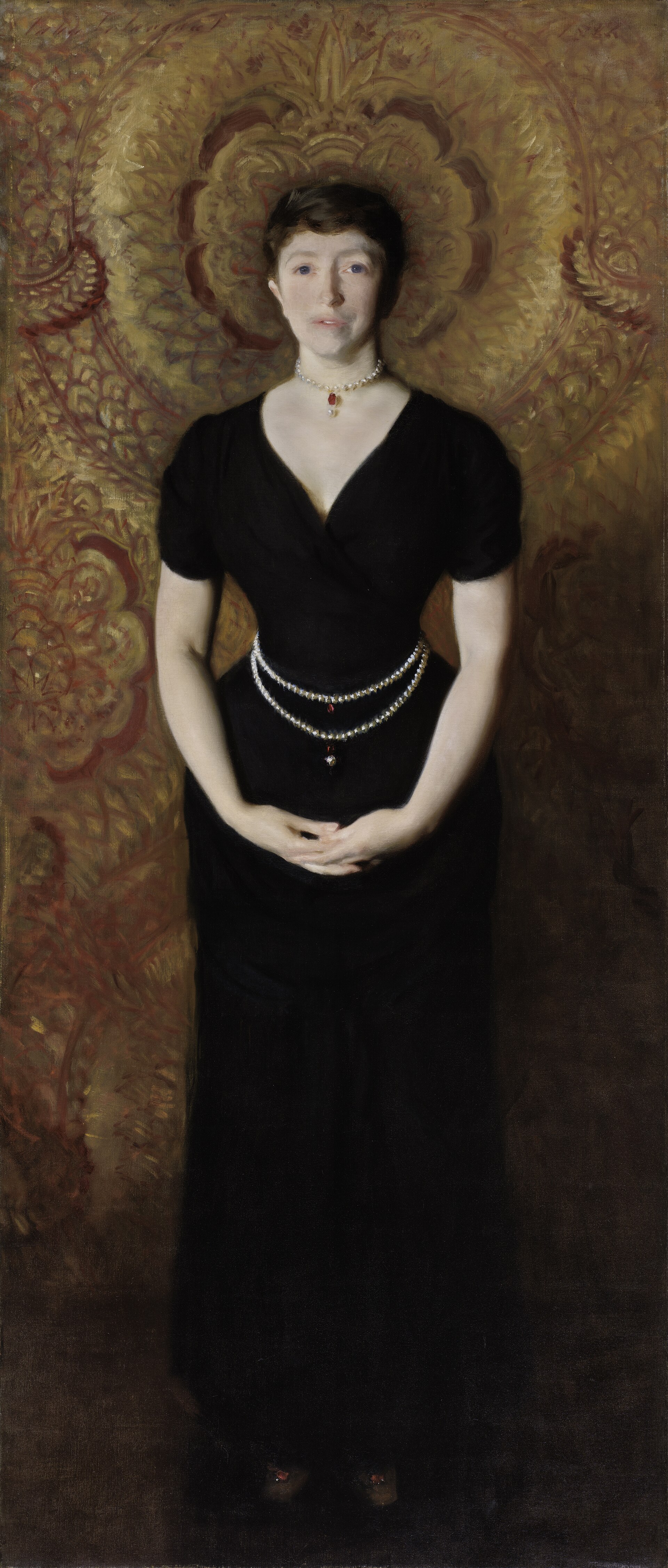
The museum's labels for its exhibition Inventing Isabella say that in 1886 she was determined to meet Sargent, who had just settled in London after the storm over his Madame X. She saw that notorious picture in his studio, in the labels' words, and soon commissioned him to paint her own. Sargent came to Boston in November 1887 and worked for nearly two months in her house on Beacon Street. The labels call his sitter opinionated and difficult, and say progress was contentious. The Art Newspaper's 2023 extract from the biography by Nathaniel Silver and Diana Seave Greenwald agrees on the central point: it calls her decision to commission Sargent unsurprising for a collector of her circle, and says the two met in 1886.
The labels give one more detail about control, and then take it back. Sargent is said to have fussed over the backdrop, and Gardner is supposed to have answered that she knew exactly what the proper background was when she decided to have him paint her. The museum itself says the story may be apocryphal. We therefore leave it as a story. What the labels do state as fact is that the dress was by the Paris couturier Charles Frederick Worth and that the patterned ground behind her head was worked up from an Italian fabric of 1475 to 1525, now in the museum's collection, which Sargent enlarged and modified.
Readers of the finished picture saw different things. The labels quote Henry James, who wrote to a friend of a Byzantine Madonna with a halo. The Art Newspaper extract adds that a collector of Japanese art saw Kannon, the goddess of mercy. Both readings are viewers' impressions. Neither proves what she asked for.
A husband's request kept the portrait out of public view
The portrait was shown publicly in 1888 and not again in her husband's lifetime, and the two sources differ on the reason and on how long the closure lasted. When it appeared at the St. Botolph Club in 1888, the museum's labels say, the public reaction was scandalised and decidedly sexist, and the comments pointed to a rumoured affair with the novelist F. Marion Crawford. The labels print one anonymous comment about the portrait that plays on the name Crawford's Notch, which they say is rumoured and reported in the 1965 book Mrs. Jack. No document of an affair appears in what we read; EBSCO calls it a serious flirtation without a source.
Both our sources then say that John L. Gardner objected. They differ in how sure they are. The museum states that Jack Gardner asked his wife not to show the portrait again publicly and that until her death in 1924 it was officially visible by invitation only. Silver and Greenwald write that he seems to have asked, which is a more careful sentence, and limit his request to the time while he was alive; they add that she kept the portrait in a gallery closed to the public for the rest of her life. The museum says the dress was no more revealing than those of other portrait sitters and blames the comments about an affair; the biographers say the dress was exceptional in what it revealed. Neither source prints his request. We do not know whether it was spoken, written or only understood, and we have not seen a document.
The museum adds one detail from the 1888 period: Isabella also made signed photographic copies of the portrait, which it compares to a personal trading card. The labels do not say who received them.
The etching she kept and the two paintings that vanished
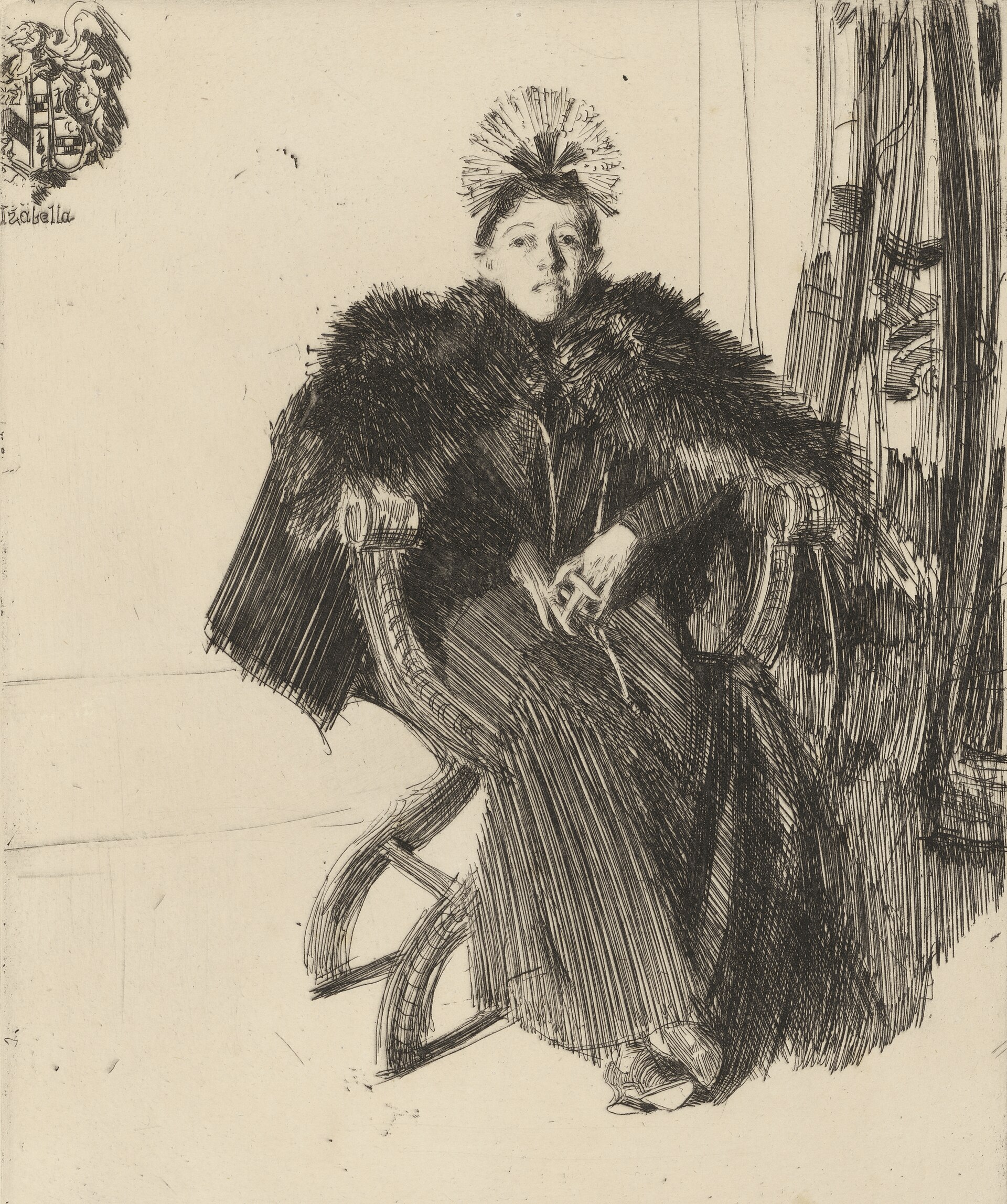
Gardner did not distribute the Zorn etching of her, and the museum reads that as a verdict on the likeness. In 1894 Anders Zorn made an etching from pencil drawings taken in Boston, several months before he finished his Venice portrait of her. The labels describe it as showing a fifty-four year old woman as a Renaissance queen, seated in a throne-like chair, with a fur cape, a headpiece evoking a crown and a crest in the top corner.
Zorn gave her dozens of impressions to hand out. Almost all stayed with her, and more than thirty are still in the museum's collection. The labels conclude that her decision not to give them away suggests she was unhappy with the likeness. That is the museum's inference from a pattern of behaviour, not a statement by Gardner. The labels also note that she often claimed descent from the royal Stuarts, and that this image may have gone too far.
She also seems to have got rid of pictures. Archival photographs, dated 1892 and about 1888 in the labels, show two paintings of her, one by Ludwig Passini and one by Andreas Martin Andersen, whose present locations are unknown. The labels say she appears to have disposed of them herself, by giving them to family or placing them somewhere out of public view. Appears is the museum's word, and the two paintings are known only from the photographs.
| Image | Date in the labels | What the labels say |
|---|---|---|
| Sargent, oil portrait | 1888 | Shown at the St. Botolph Club, then by invitation only until 1924 |
| Passini, painted portrait | 1892 (date of the photograph) | Location unknown; known from an archival photograph |
| Andersen, painted portrait | about 1888 (date of the photograph) | Location unknown; known from an archival photograph |
| Zorn, etching | 1894 | Dozens printed, almost all kept by her, more than thirty still in the museum |
| Zorn, oil portrait in Venice | 1894 | One of the two best-known images of her |
| Sargent, watercolour | 1922 | Usually shown in the room where she posed for it |
She dodged the camera while the press printed other women
Gardner kept herself out of most photographs, and in a letter the museum dates to 1915 she said so in writing. The museum quotes her letter to Edmund Hill of 29 November, to which it assigns 1915: "I am never photographed, unless by some Kodax fiend, who does it on the sly, & without my permission." The same labels quote an unidentified newspaper of 1894 that remarked on the lack of portraits of Mrs. Gardner and called the Sargent portrait and a little porcelain picture of her as a girl about all there were.
The press supplied what she withheld. The labels say that an 1894 article claimed to carry the first photographic likeness of her and in fact printed a drawing of her back as she climbed into a carriage. With no reliable photographs, newspapers published pictures of women who were not Isabella to illustrate stories about her. The museum's own explanation for the veil she began wearing in public is that it may have been to protect her skin, and it says the reasons are unknown.
She did sit for a few formal photographs late in life. Two were taken by Adolf de Meyer, later Vogue's first official fashion photographer. The labels say she allegedly chose one of them to be released as her official photograph after her death, one of a series of instructions she left for her funeral. They add that the press doctored the image anyway. The single word allegedly marks a claim the museum does not document.
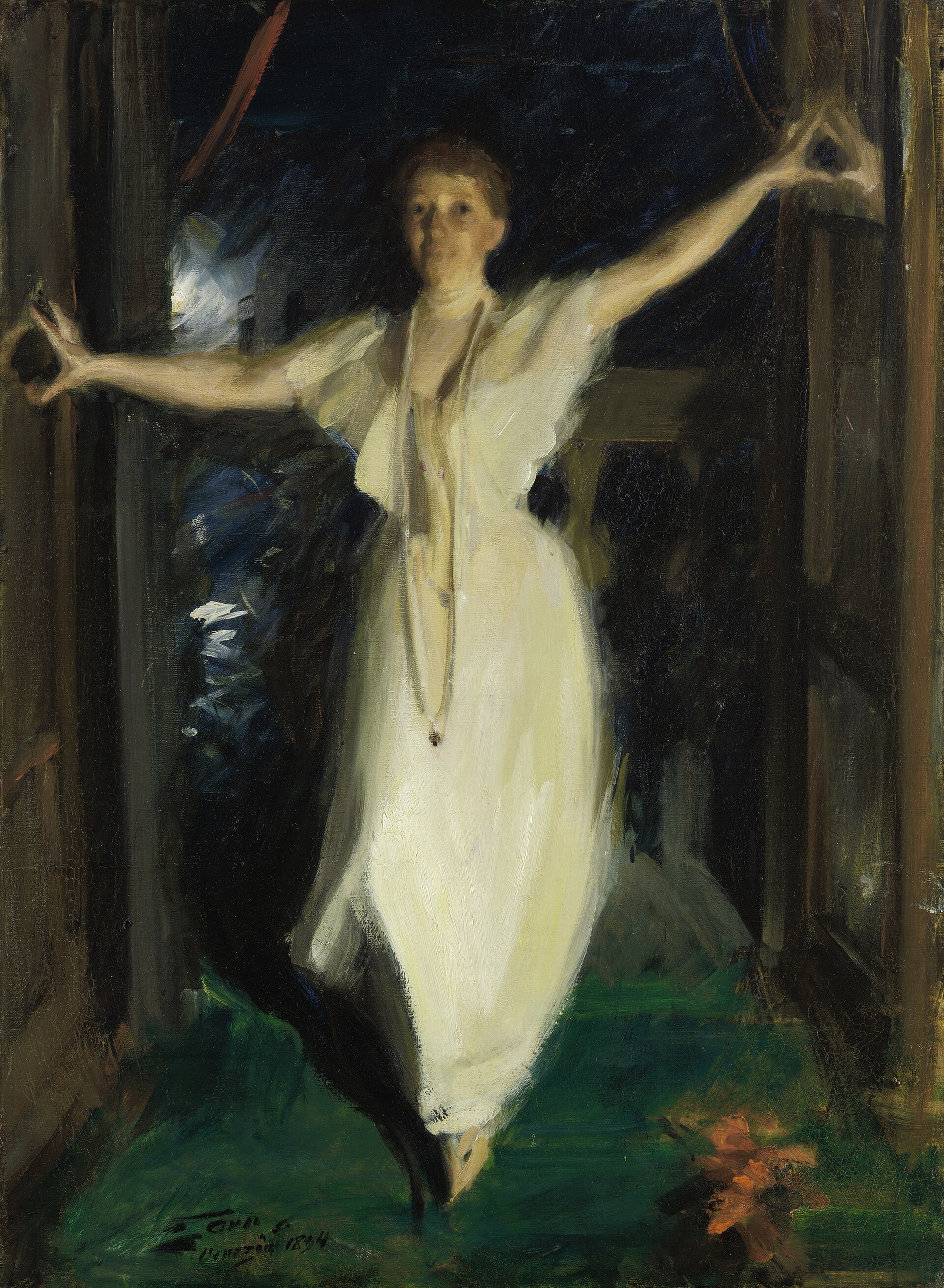
This was not a general shyness about paint. In October 1894, at the Palazzo Barbaro in Venice, the labels say, her husband's diary records her watching fireworks from a balcony and then throwing open the glass doors to call her guests out. Zorn's oil of her in a white evening gown, arms spread wide toward the doors, is the picture of that moment. The museum calls it a counterpart to Sargent's majestic portrayal and says the two paintings are the best-known images of its founder.
The last portrait was made where she posed and shown where she sat
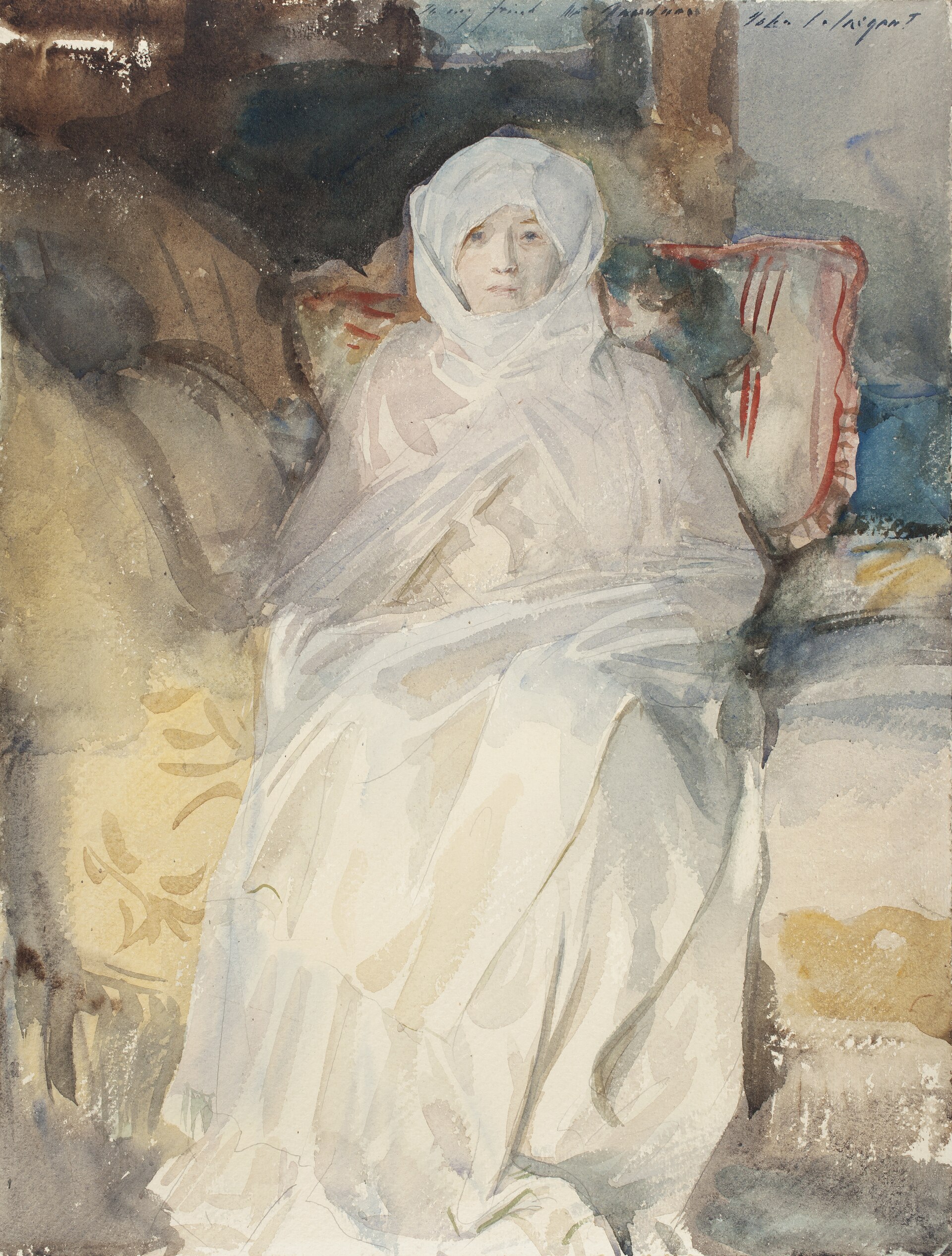
After her stroke in 1919 she still sat for Sargent, and the picture is a very different one from 1888. The labels say she suffered a debilitating stroke that year and withdrew from public life. They add that she continued to control her image by allowing Sargent to paint her. His watercolour of 1922, dated by the museum, shows her draped in white with only her face visible, and it is usually displayed in the MacKnight Room, where she posed for it.
The decorator Elsie de Wolfe, whom the labels quote from 1935 beside the watercolour, described Gardner lying on a couch of white linen with her hair covered, looking like a corpse prepared for burial. She wrote, "in my heart I knew she was not a saint." The EBSCO research starter, written for a different purpose, says the same watercolour does not give adequate testimony to the energy she still felt. Two readers, two views of one drawing, and we cannot choose between them from the picture.
Taken together with the black portrait of thirty-four years before, the museum's reading is that she took part in making both images of herself, the most imposing and the most fragile. Sargent and Gardner exchanged hundreds of letters over the same years, the museum says, and were close from 1887 until she died in 1924.
Her house is the other thing she left. EBSCO says her will asked that the contents of Fenway Court be displayed substantially as she arranged them; we have not read the clause, and our own records of The Concert and the Storm on the Sea of Galilee give a stricter wording, so we leave the exact terms open.
Questions
Her friends and the painters around her admired her, but the museum's labels describe a patron who commissioned the portrait and argued with the artist during the sittings, and a principal artistic collaborator. We read her as a client and collaborator, because that is what the labels document.
The museum says that after public reaction at the St. Botolph Club in 1888 her husband Jack asked her not to show it again and that it was visible by invitation only until 1924. The Art Newspaper's extract says he seems to have asked, limits the request to his lifetime and blames the dress, so the request itself is not documented in what we read.
The museum infers she did not. Zorn gave her dozens of impressions, almost all stayed with her and more than thirty remain in the museum. The museum draws its conclusion from that pattern, and we have found no statement by Gardner on the print.
The museum says she was often photographed when young, then veiled or turned her back as she became famous, and gives no reason: it offers skin protection, propriety or insecurity only as possibilities.
Sources
- 1Isabella Stewart Gardner Museum, Inventing Isabella, large print labels (exhibition labels, PDF dated October 2023), read in full as extracted text, for the commission, the Sargent sittings, the 1888 debut and withdrawal, the Zorn etching and the two lost paintings, the camera-shy years, the 1922 watercolour and the Venice episode. gardnermuseum.org/sites/...
- 2Nathaniel Silver and Diana Seave Greenwald, extract from Isabella Stewart Gardner: A Life (Princeton University Press, 2022), published in The Art Newspaper, 10 January 2023, for the commission, the Henry James and Kannon readings and the husband's apparent request. theartnewspaper.com/2023/...
- 3EBSCO Research Starters, Isabella Stewart Gardner, for her will's proviso on the contents of Fenway Court, the Crawford flirtation and the remark on the 1922 watercolour. ebsco.com/research-starters/...
- 4Whistler Paintings project, University of Glasgow, biography of Isabella Stewart Gardner, for her dates (14 April 1840 to 17 July 1924). whistlerpaintings.gla.ac.uk/catalogue/...
- 5Wikipedia, Isabella Stewart Gardner, read through the encyclopedia's API as raw text, as background only; no claim in the article rests on it. en.wikipedia.org/wiki/...
- 6Wikimedia Commons file records for the Sargent portrait (1888), the Zorn Venice portrait (P17e10), the NPG impression of the Zorn etching and Sargent's Mrs. Gardner in White (1922), read through the Commons API for LicenseShortName (each Public domain) and pixel width. commons.wikimedia.org/wiki/...

More in The Women Behind the Art
The partThe Headline That Named Clara Driscoll Beside a Pay She Never Drew
A 1904 article that named Tiffany designer Clara Driscoll ran under a $10,000 headline. Her pay was about $1,820.
The Widow Who Left the Khalil Collection to Egypt, Under Four Spellings
Four spellings of her name, a deed of 1947 and a will of 1954: what the sources say about the Frenchwoman whose will gave Cairo its Khalil museum...
The Lady in the Unicorn Tapestries: A Sitter Nobody Has Named
No document names the Lady of the Cluny tapestries. What the arms, the museum and the scholars say, which readings fit the dates, and which names...