The Headline That Named Clara Driscoll Beside a Pay She Never Drew
A 1904 article that named Tiffany designer Clara Driscoll ran under a $10,000 headline. Her pay was about $1,820. What her letters and the 1903 settlement show for the Lotus lamp.
Records in this piece: The Bryant Vase
On this page 5 sections
ContentsClose
In short
- The 1904 New York Daily News article that Hofer, Gray and Eidelberg cite as a rare instance of public recognition for Clara Driscoll was headlined "Women Who Make $10,000 a Year or More", while the New York Times gives her wage in 1902 as $35 a week, or $1,820 a year, and the National Gallery of Victoria gives the same $1,820, so the headline figure stands 5.5 times above her pay.
- Her own letters, as published by Hofer, Gray and Eidelberg, are a private ledger: fifteen Wisteria shades ordered at $350 each in February 1902, 123 made by March 1905, and a 1906 letter showing overflow orders going to the men's department at Corona.
- Three sources tell the 1903 union settlement three ways, and the published wording on how much of the firm's shade design the women held varies between all, almost all and most, so a department credit is weaker than a letter naming a design.
- The Lotus lamp is not on the list of models the published accounts say her letters describe, so its Driscoll credit is an inference from her department's remit and not a documented fact.
A 1904 headline named her and overstated her pay more than fivefold
A newspaper article of 17 April 1904 is the clipping the scholars cite as her rare moment of public recognition, and its headline was about money, and that money was not hers. It ran in the New York Daily News under the title "Women Who Make $10,000 a Year or More." Margaret Hofer, Nina Gray and Martin Eidelberg, who published her letters, cite it as a rare instance in which a prize-winning lamp she designed was noted in a newspaper. We have not read the article, so we cannot say what it told its readers about her own pay.
The headline figure is not the pay she drew. The New York Times, in its 2023 "Overlooked No More" obituary, writes that by 1902 she was making $35 a week, or $1,820 a year. The National Gallery of Victoria's essay gives the same $1,820 and notes that the $10,000 was in the article's title, not in her wage. Thirty-five dollars over fifty-two weeks is $1,820, so the two figures are one figure, and the $10,000 in the headline is 5.5 times that wage. Neither source says where the $35 comes from. The Times piece is a newspaper obituary and does not name the source of the weekly figure, and we have not read the letters ourselves.
The wrong number also travelled on its own. Wikipedia says a 2002 book, Tiffany Desk Treasures by George Kemeny and Donald Miller, had already named Driscoll as designer of the Dragonfly shade four years before the 2006 exhibition, and had cited her as earning $10,000 a year. We have not seen that book. If the Wikipedia summary is right, the $10,000 figure was still being quoted beside her name decades later. The New-York Historical Society's own teen blog handles it carefully: it says she was included in the article but that, "it has been said", she more realistically earned $35 a week in 1902.
Why does the pay matter for a lamp record? Because it shows how thin the public trail was. A firm that gave its designers no byline left at least one clipping that scholars cite, and the figure in its headline does not match her wage.
The prize and the headline are linked through one lamp, the Dragonfly
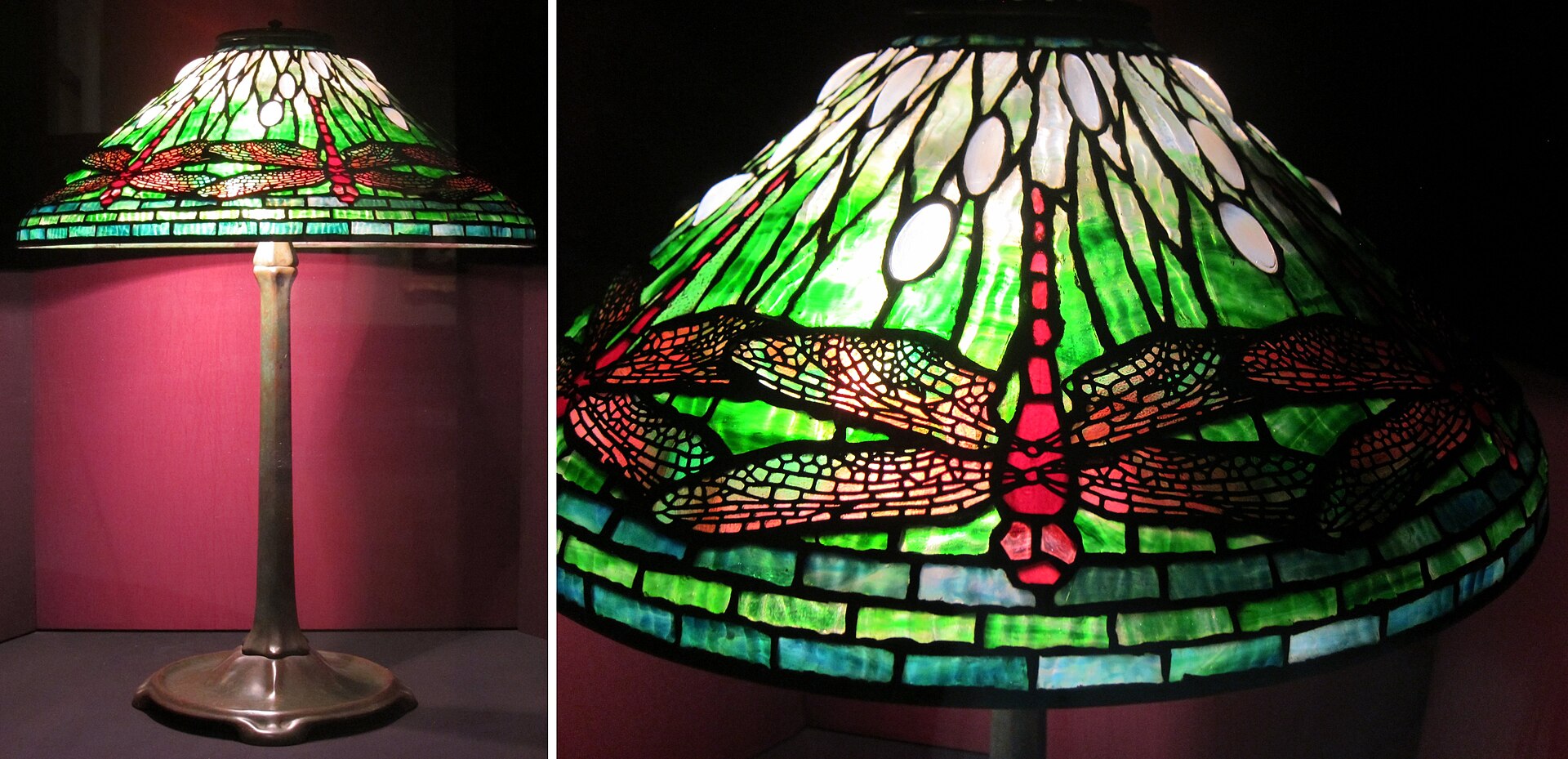
The lamp behind the 1904 clipping is the Dragonfly, and the sources tell its story with slightly different emphasis. Hofer, Gray and Eidelberg place its conception in 1898 and cite her letters of 19 July 1898 and 6 April 1899. They add that the Tiffany managers doubted the expensive lamp would pay, that Louis Comfort Tiffany called it "the most interesting lamp in the place" and ordered examples for London and Paris, and that it won a prize at the Paris World's Fair of 1900.
The New York Times obituary adds that in April 1899 Driscoll and a fellow designer, Alice Gouvy, created the Dragonfly to sell for $250, and that Driscoll would go on to make three more, one for a waiting customer, one for the 1900 Paris fair and one for the Tiffany showroom. So the best-documented model has a second named designer, Gouvy, and the shorthand "Driscoll designed it" leaves her out.
On the public credit the sources part company. The Cleveland Museum of Art essay says that when the Dragonfly won its prize in 1900 she was cited as the designer. Hofer and her co-authors write that mention of the prize in the 1904 newspaper brought her a rare instance of public recognition, which places the naming in 1904. Some accounts add that the Paris organisers asked exhibitors to name the individuals responsible. We found no source for that requirement among the pages read for this article. The two accounts can both be true, since an official list in 1900 and a newspaper in 1904 could each have named her, but only the newspaper is documented here, and only the newspaper can be named with a date.
Her letters kept the count that the firm's records did not
Driscoll's letters show her counting the orders for her own designs, so a family's papers partly replace the firm's missing paperwork. Tiffany Studios destroyed its records after closing in the early 1930s, as the National Gallery of Victoria essay notes, so there is no order book to test any figure against.
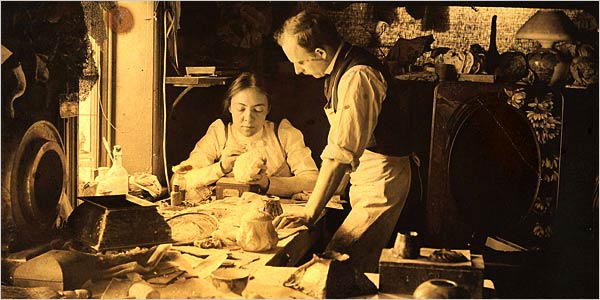
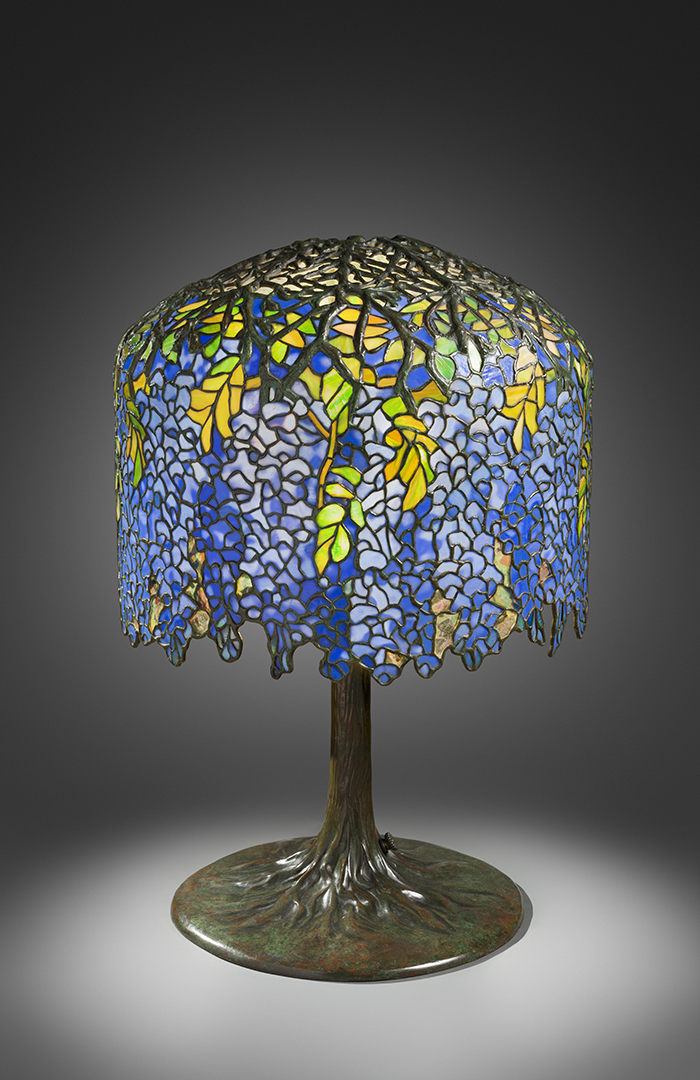
The best example is the Wisteria. In February 1902, according to Hofer, Gray and Eidelberg, Driscoll wrote to her family that fifteen Wisteria shades had been ordered at $350 each, and added that all of it "goes down to my credit, it being my design." On 16 March 1905 she recorded that 123 had been made. The National Gallery of Victoria essay gives the same total of 123 by 1905 and says the templates wore out and had to be remade. The following year, on 15 February 1906, a letter shows that orders for the Wisteria and other shades had outstripped the women's department, so some went to the men's department at the Corona factory in Queens.
Two things follow. What credit meant to her in that sentence, pay, standing or a ledger entry, the published accounts do not say. And the same letter series records the point at which the men's department stepped in to make shades the women had designed. In 1906 the demand for her popular design was larger than her department could make.
The table lists the dollar figures the sources give for these models and for Driscoll herself. They do not describe the same year or lamp size, and the Wisteria appears at $350 a shade in 1902 and $400 as a table lamp in 1906, which are different objects and different years.
| Item | Figure | Year | Source |
|---|---|---|---|
| Dragonfly lamp, intended price | $250 | 1899 | New York Times, 2023 |
| Wisteria shade, each, in an order of fifteen | $350 | 1902 | Driscoll's letter, as given by Hofer, Gray and Eidelberg |
| Wisteria table lamp | $400 | 1906 | National Gallery of Victoria |
| Lotus lamp, retail | $750 | 1906 | Toledo Museum of Art, as recorded in our Lotus record |
| Driscoll's weekly wage | $35 | 1902 | New York Times, 2023 |
| Driscoll's yearly wage | $1,820 | 1902 | New York Times (1902). National Gallery of Victoria gives no year |
| Headline figure for women earning $10,000 or more | $10,000 | 1904 | New York Daily News title |
What the 1903 settlement decided depends on who tells it
The strike of 1903 matters for every shade the women's department made, and the accounts of its outcome do not agree. Hofer, Gray and Eidelberg say the department was formed in the first place in response to an earlier strike by the all-male Lead Glaziers and Glass Cutters Union, which had no women members.
For 1903 the Cleveland Museum of Art says the male union threatened to strike unless the women's department closed, and that Tiffany and the union compromised by capping the women at twenty-seven and confining them to lampshades and small luxury goods. PBS Antiques Roadshow says the union tried to close the department, that Driscoll had to limit its size and that she won the right to design all the lampshades and the small luxury goods, executed by the women. The New York Times says the company gave in to a union demand that only union members, which meant men, make the windows, and that the women kept the small objects such as candlesticks, picture frames and tea screens.
These are three tellings of one event. They agree that windows left the women's hands and that shades and small goods stayed. They differ on whether the union demanded closure or only windows, on whether twenty-seven was a cap and on whether the women's right to design shades was exclusive. Hofer and her co-authors write that Driscoll and her department designed almost all of the leaded shades with nature themes, and in the same piece that she designed most of the firm's lampshades. Almost all and most leave room for shades designed elsewhere in the firm. The National Gallery of Victoria essay adds that only women worked on floral designs for leaded lamps while men took geometric ones.
For the Lotus this matters because some accounts treat the exclusive design right as the fact that credits the lamp to Driscoll's department. The sources read here support a weaker version: floral shades were the women's work, and the department designed the great majority of the firm's shades. A Lotus is a floral shade. That reading is reasonable, and it is also a rule of thumb and not a document.
What this leaves the Lotus lamp with, and what it does not
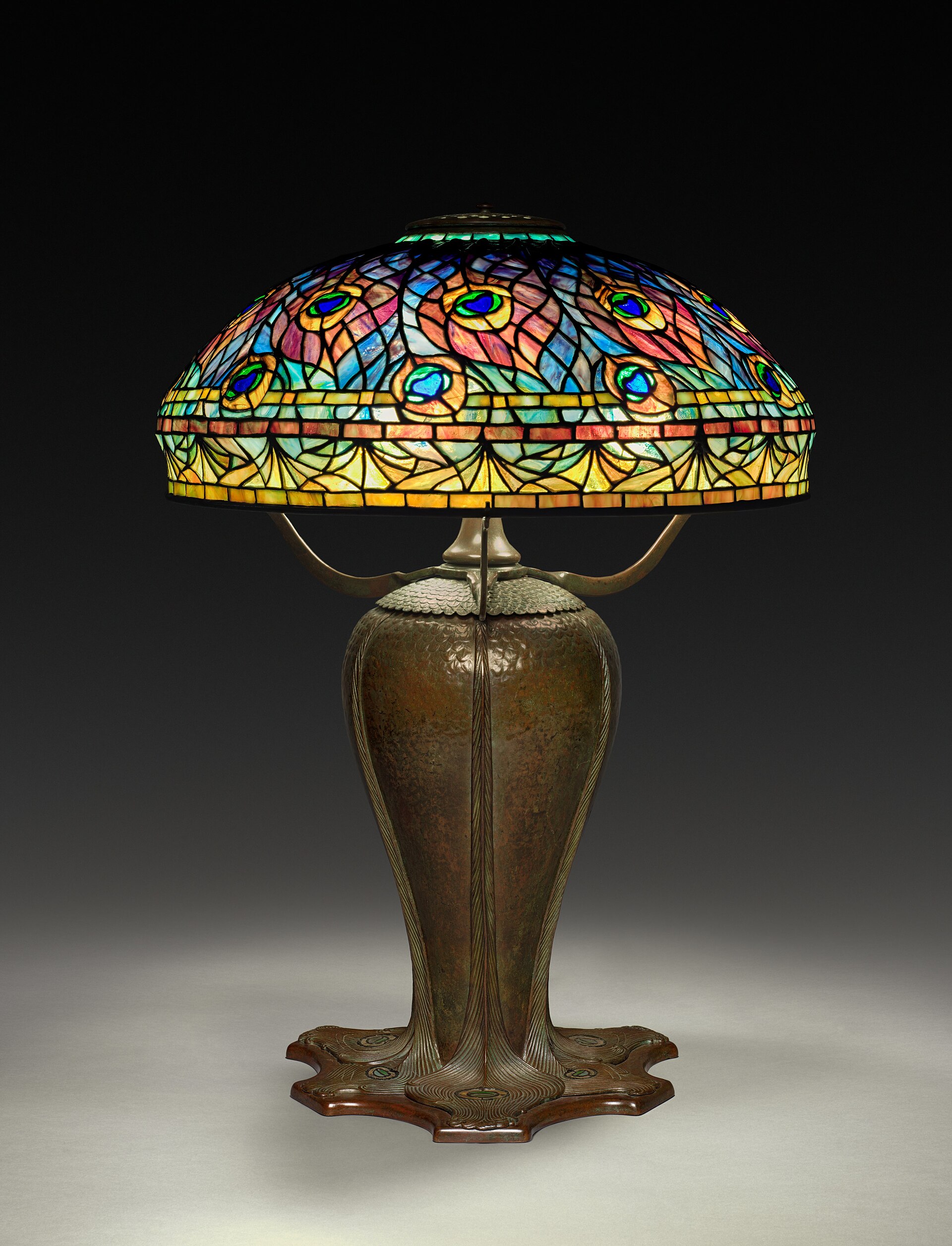
The Lotus lamp sits on the third and weakest of three layers of credit that Driscoll's story shows, and no document yet places it on the first two. The first layer is the public one, a single misleading newspaper headline in 1904. The second is the private ledger of her letters, where the published accounts tie the Dragonfly and the Wisteria to dated letters and say the Peony can be firmly assigned to her. The third is the museum credit line, where a name now appears beside a model because of its department, its date and its subject.
The Lotus, made about 1905 and priced at $750 in 1906 according to our record's source, is a lamp of exactly the years in which Driscoll's letters keep their count of orders and prices. Hofer, Gray and Eidelberg's published article does not list it among the lamps they firmly assign to her, and we have not read the letters ourselves. That silence cannot be treated as an answer. A published article lists models by way of example, not exhaustively. What it does give is a method for deciding: a letter that names the design, an order count, a price, a model number.
Her colleagues are a further complication. The Dragonfly was a joint design with Alice Gouvy on the New York Times account, and Antiques Roadshow notes that Driscoll relied on Gouvy and on Agnes Northrop for much of the drawing. A record that credits the Lotus to Driscoll alone adds a name the sources do not show for it and drops names they do show elsewhere. The more careful wording for the Lotus is what our own record already gives, a lamp designed within her department, with the question of which hand drew it still open.
Our Bryant Vase record notes that Tiffany & Co., maker of that vase, is a different firm from Tiffany Studios, and the confusion is one more reason a lamp's credit needs its own paper trail. The attributions on Tiffany lamps are in the same position: each name on a credit line is only as good as the document beneath it.
Questions
The New York Times gives her wage in 1902 as $35 a week, or $1,820 a year, and the National Gallery of Victoria gives the same $1,820. The $10,000 figure comes from the title of a 1904 New York Daily News article, not from her payroll.
No document read for this article says so. As our Lotus record states, the Toledo Museum of Art lists her as designer of its example, which is an institutional attribution. The sources read here support the weaker statement that the lamp was designed within her department, which Hofer, Gray and Eidelberg say designed almost all the firm's nature-themed leaded shades.
The accounts differ. Cleveland says the women were capped at twenty-seven and kept lampshades and small goods. PBS says Driscoll kept the right to design all shades and small goods. The New York Times says only union members, meaning men, could make windows and the women kept small objects.
Hofer, Gray and Eidelberg cite letters held at the Queens Historical Society and at Kent State University Library. The Times says about 350 survive in the two places.
Sources
- 1Margaret K. Hofer, Nina Gray and Martin Eidelberg, 'The Women of Tiffany Studios', Antiques & Fine Art, Spring 2007, republished on Incollect, with footnotes citing the New York Daily News of 17 April 1904 and letters of 1898, 1899, 1902, 1905 and 1906. incollect.com/articles/...
- 2Louie, Elaine, 'Overlooked No More: Clara Driscoll, Designer of Visions in Glass for Tiffany', New York Times, February 2023, read in the Artdaily republication of 27 February 2023. artdaily.com/news/...
- 3Crombie, Isobel, 'Tiffany Studio: Clara Driscoll', National Gallery of Victoria, 29 April 2021. ngv.vic.gov.au/essay/...
- 4Sentilles, Renee M., 'The Women of Tiffany Studios: Clara Wolcott Driscoll Made Visible', Cleveland Museum of Art, 21 February 2020. clevelandart.org/articles/...
- 5Gaffney, Dennis, 'Who Were the Tiffany Girls?', PBS Antiques Roadshow, 12 January 2015. pbs.org/wgbh/...
- 6Nunez, Genesis, '"Women Who Make $10,000 a Year or More"', New-York Historical Society Teen Historians blog. teenhistorians.nyhistory.org/women-who-make-10-000-a-year...
- 7'Clara Driscoll (glass designer)', Wikipedia, for the 2002 book Tiffany Desk Treasures and the 2006 exhibition. en.wikipedia.org/wiki/...
More in The Women Behind the Art
The partThe Widow Who Left the Khalil Collection to Egypt, Under Four Spellings
Four spellings of her name, a deed of 1947 and a will of 1954: what the sources say about the Frenchwoman whose will gave Cairo its Khalil museum...
The Lady in the Unicorn Tapestries: A Sitter Nobody Has Named
No document names the Lady of the Cluny tapestries. What the arms, the museum and the scholars say, which readings fit the dates, and which names...
The Sitter Who Shaped How She Was Seen
According to her own museum, Isabella Stewart Gardner commissioned Sargent, argued through the sittings, kept a Zorn etching back and dodged cameras.