The Lady in the Unicorn Tapestries: A Sitter Nobody Has Named
No document names the Lady of the Cluny tapestries. What the arms, the museum and the scholars say, which readings fit the dates, and which names have no support.
Records in this piece: The Lady and the Unicorn, The Unicorn Tapestries
On this page 5 sections
ContentsClose
In short
- No source we read names the Lady of the six Cluny hangings; the only identification that holds is of the Le Viste family through the arms, never of the woman.
- Teodorescu's argument, as French Wikipedia reports it, is that arms displayed alone mean an unmarried patron, which would rule out a wife as the Lady; the Cluny page and the AGNSW instead entertain a bride, Jacqueline Raguier.
- The bride reading meets a date problem: the museum dates the set to about 1500 and French Wikipedia gives Antoine's marriage as 1510, so a betrothal gift would have to be ordered years before the wedding.
- Whether the figure is one woman, six personifications or a type depends on the reading of the set, and none of the readings we found needs a named sitter.
No document names the Lady
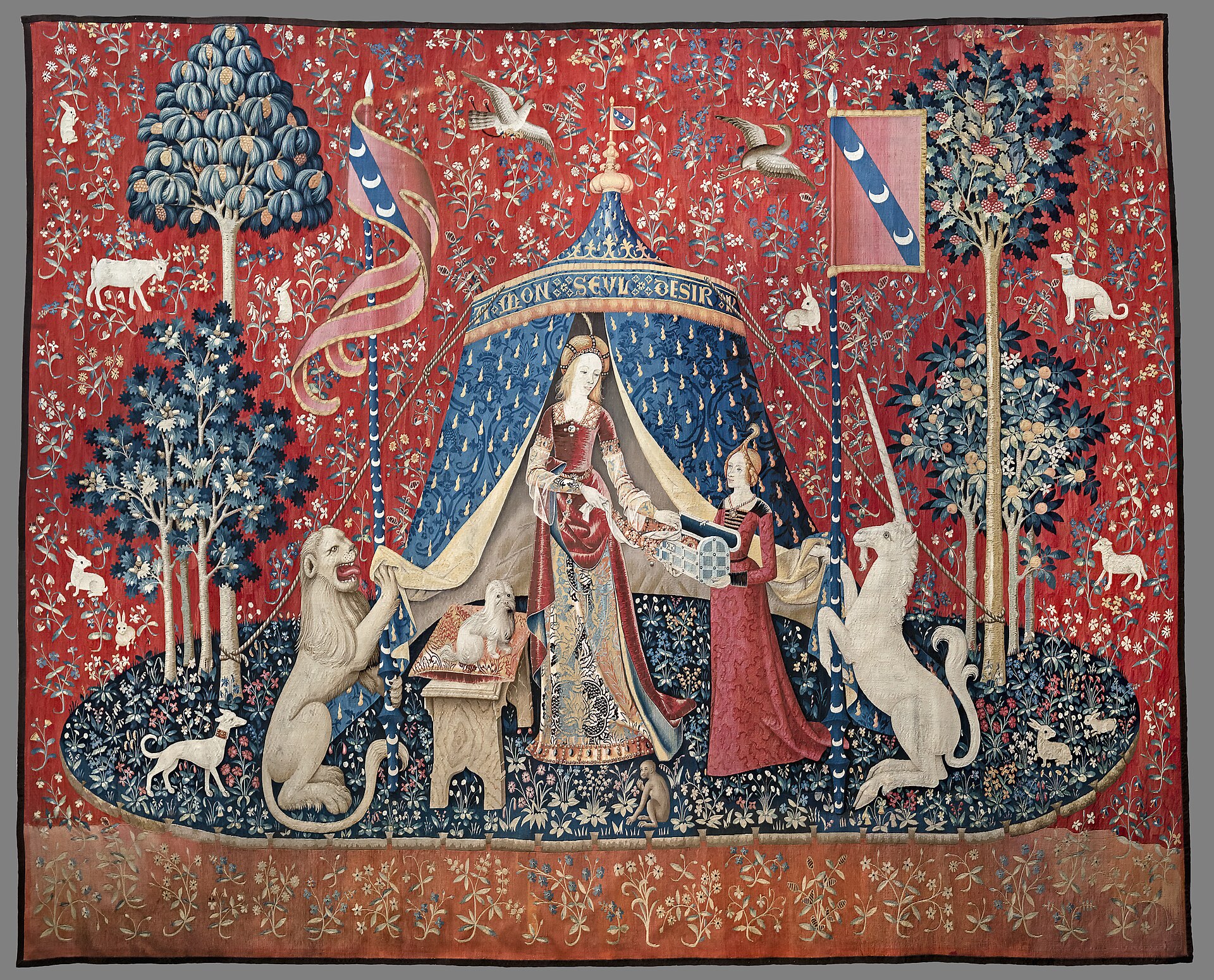
No document we have read gives the Lady of the six Cluny tapestries a name, and the only words woven near her belong to a motto and a man's coat of arms. The museum itself calls her only la Dame, and describes her as elegant, hung with jewels and often helped by a young attendant, standing between a lion and a unicorn that carry banners, capes or shields with three crescents.
Everything that is known about who stands behind her comes from the arms. They are red with a blue diagonal band carrying three silver crescents, and Genevieve Souchal wrote in 1983 that scholars had known for a century they were those of the Le Viste family of Lyon, whom she calls the only family to have borne such arms. The same paper records the earlier romance: George Sand and other writers had tied the hangings to Djem, the captive brother of the Ottoman sultan, an attribution Souchal calls fanciful. So the first identification of the woman was a legend, and the first one that held was of her family, never of her.
The museum's own page also says plainly that the commissioner is still debated: Jean IV Le Viste, who died in 1500, or his nephew Antoine, who died in 1532. The AGNSW calls Antoine Jean's younger cousin, French Wikipedia makes Antoine's father Aubert Jean's first cousin, and French Wikipedia dates Antoine's death to 1534 against the museum's 1532. So even the family tree is read three ways by the three sources we opened. The AGNSW also says the Jean IV commission would fall between 1480 and 1500, a window of twenty years, and that Antoine became head of the family in 1500. The commissioner stays unsettled, and the woman can be no firmer than he is.
Her dress changes and her badge does not
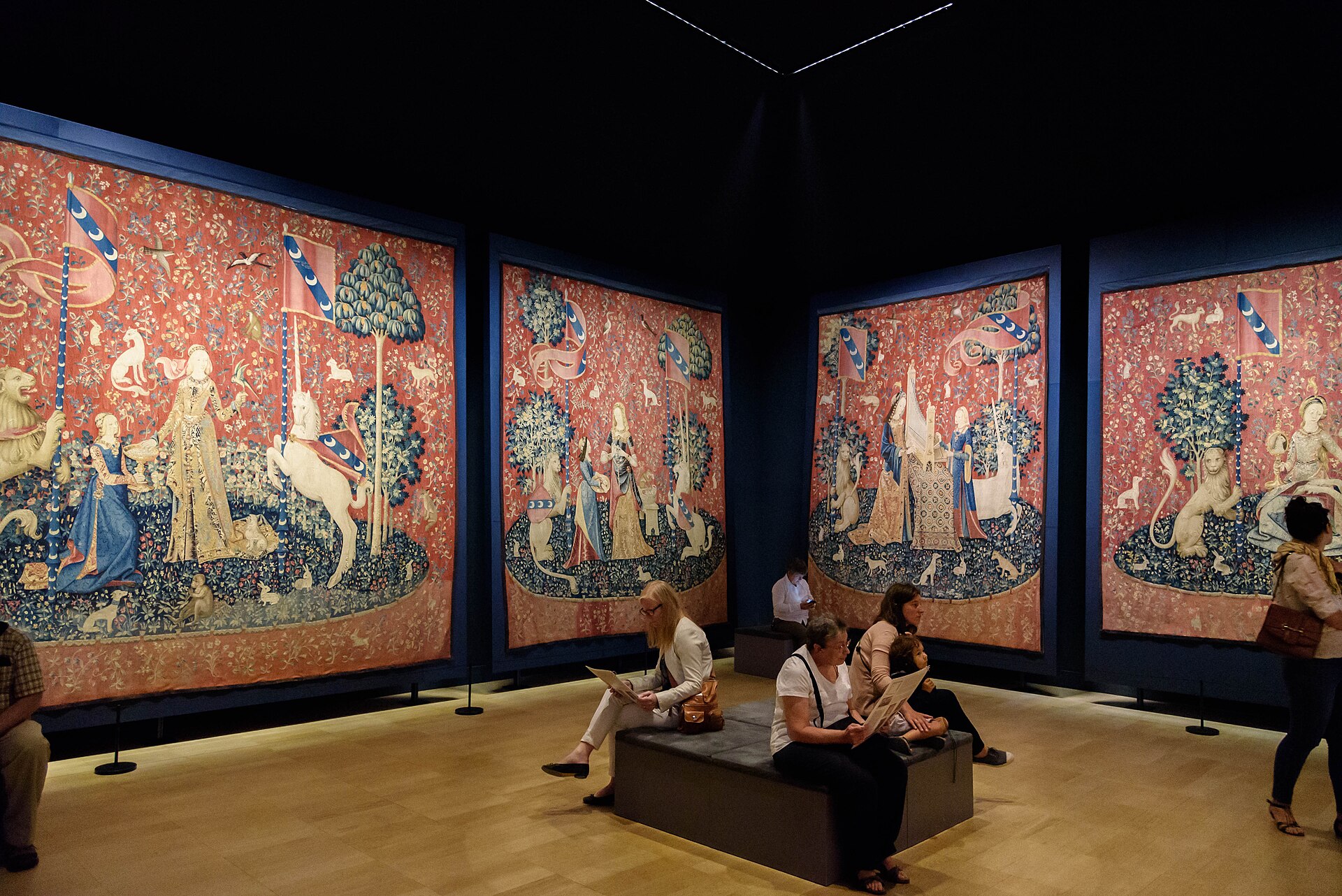
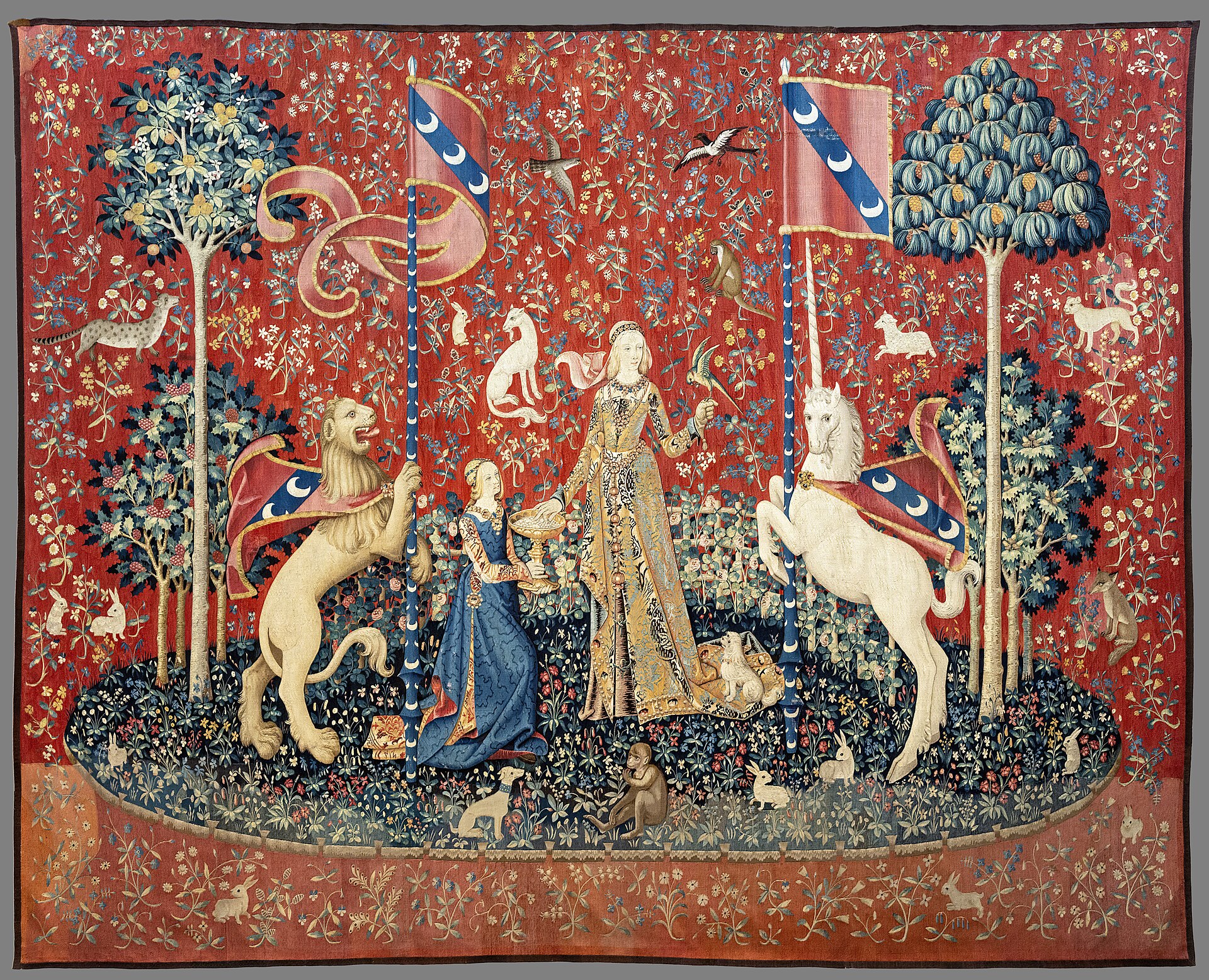
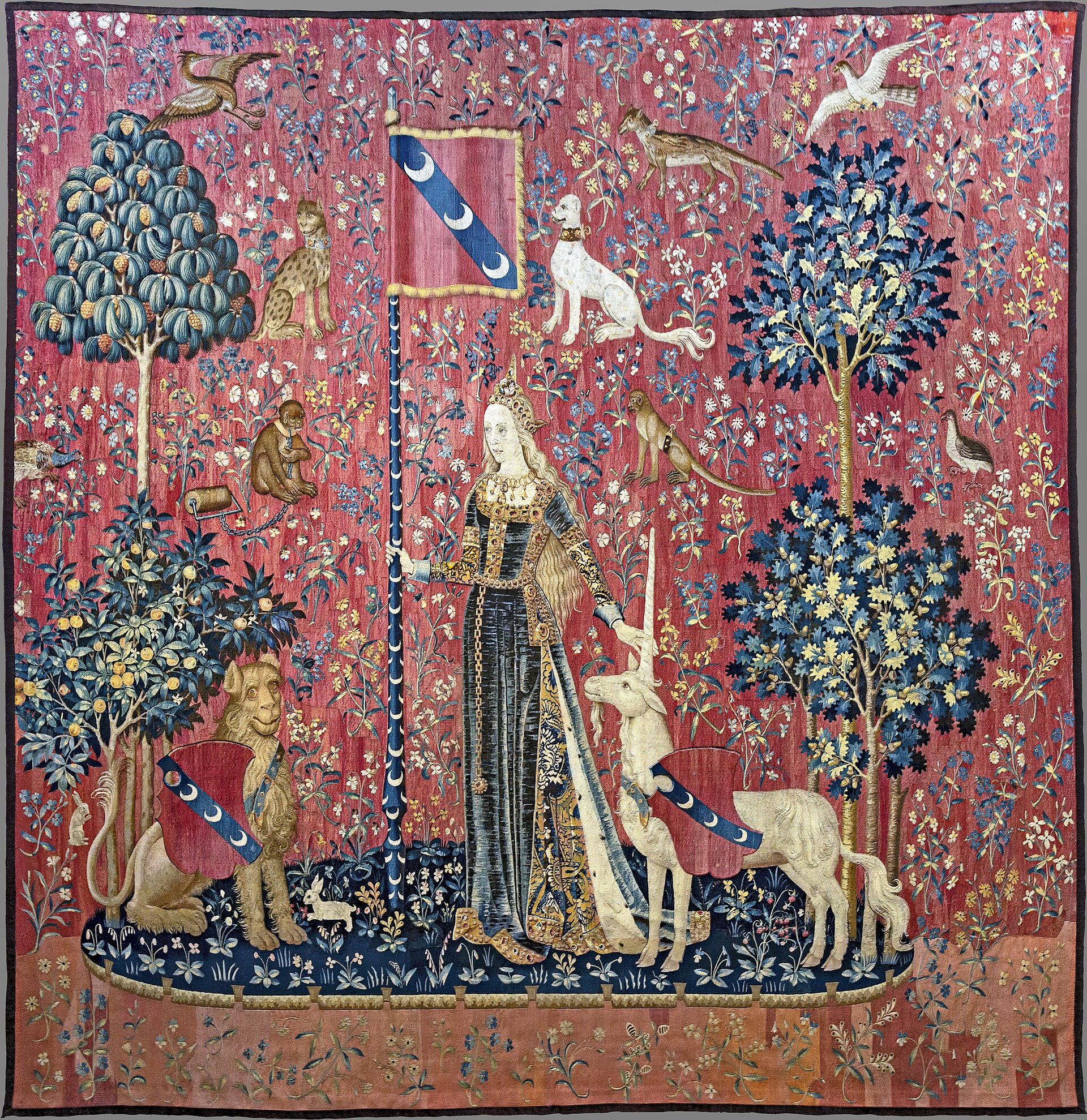
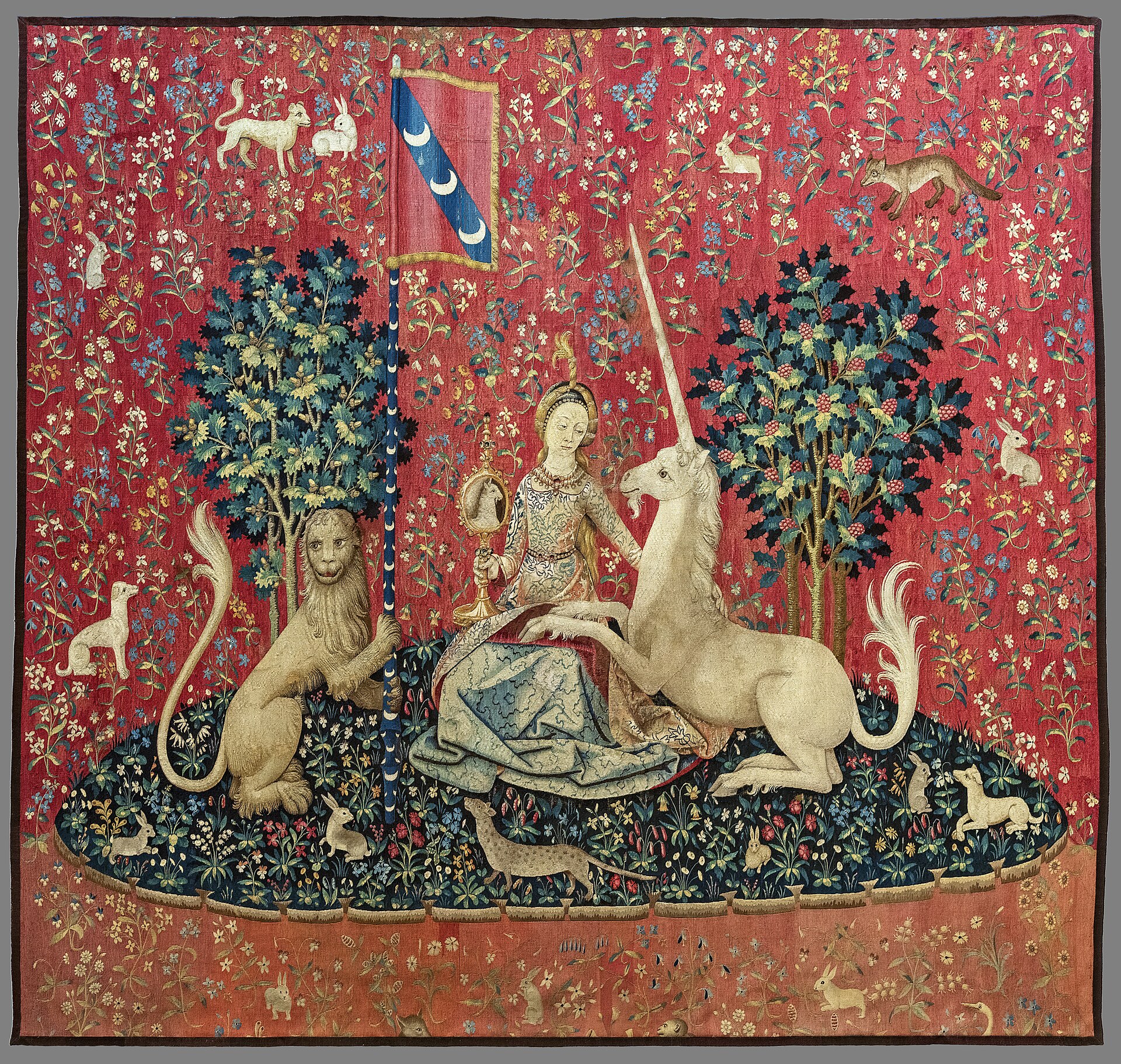
The Lady in the plates changes her clothes, her headdress and her hair from panel to panel, while the arms around her stay identical. In Taste she wears a gold patterned gown and a plain circlet and feeds a parakeet. In Touch she wears a dark velvet gown with a jewelled belt and a crown, with long loose hair. In Sight she is seated in a patterned bodice with a light feathered headdress, holding a mirror. In the sixth panel she stands under the tent in a red velvet gown over a patterned skirt, wearing a jewelled coronet. These are our descriptions of the plates, not the museum's.
French Wikipedia notes that the attendant in Taste is very richly dressed but wears a plain-weave gown with brocade only in her accessories, a difference the caption notes. That she ranks below her mistress is our reading, not the caption's. The tapestries therefore show a household, with the Lady at its head and the woman who serves her one step down. That is a difference the weavers could make without naming anyone.
The museum adds that the large-scale models for the women and animals were drawn by the painter Jean d'Ypres, active in Paris from 1489 to 1508, and that the plants and small animals may come from patterns held by the weavers. If so, the Lady's face is a designer's type, drawn in a Paris workshop for a patron in the Le Viste circle, and woven by people whose city the museum says is not known. Nothing in that chain asks for a sitter.
A man's arms alone, and a bride who may not fit the date
The one argument that tests whether the Lady is a wife starts from the fact that only a man's arms are shown. Carmen Decu Teodorescu, as French Wikipedia reports her 2010 article, is summarised as reasoning that a patron who displays only his own coat was not married when the set was made, and she names Antoine II Le Viste as the likely patron. On that reading the Lady cannot be his wife at the time of ordering. French Wikipedia lists his career dates beside this argument (1493, 1500, 1510) but gives no commission year for her. We have not read her article; we have only this summary of it.
Against it stands the betrothal idea. The Art Gallery of New South Wales, which showed the set in 2018, says the tapestries were either a symbol of status or a betrothal gift, and that some propose Antoine as the commissioner of a gift to his bride-to-be Jacqueline Raguier. The Cluny page asks, as a question, whether the two initials A and I around the motto are the first names of Antoine and his wife Jacqueline. In our plate of the sixth panel the tent valance reads MON SEVL DESIR and we could not make out a second initial at this resolution, so for the pair we have only the museum's word. The AGNSW adds that the letter I stands for the old French J, which is how it reads the pair as Antoine and Jacqueline.
The dates make the bride harder to place. French Wikipedia gives Antoine's marriage to Jacqueline Raguier as 1510, a date we found in that one source, against the museum's date of about 1500 for the set. That is about ten years. A betrothal gift would have to be a very long engagement, or the set would have to be dated later than the museum says. Jean-Bernard de Vaivre rejects her heraldic method and returns the commission to Jean IV in the 1480s or early 1490s, which would remove the bride altogether. No contract, invoice or letter has been cited for either man.
One woman, six women or no woman at all
Whether the tapestries show one Lady, six ladies or a type with no particular person behind her depends on which reading of the set a scholar accepts. The table sets the readings against what each would need.
| Reading | Who she would be | Where we read it | What it needs |
|---|---|---|---|
| Bride or wife of the patron | Jacqueline Raguier | Cluny page, as a question; AGNSW | Antoine as patron, and a date that fits a 1510 marriage |
| Unmarried patron | No wife; an unnamed woman or a figure | Teodorescu, via French Wikipedia | That arms alone show a bachelor |
| Allegory of the senses | One Lady performing each sense, with a sixth sense of the heart | Cluny page; De Vitis, The Conversation | No sitter at all |
| Six courtly virtues | Six different women from the Roman de la Rose | Bruel, via French Wikipedia | The six panels read as six figures |
| Mary Tudor, Queen of France | Mary Tudor | A 1981 article listed in French Wikipedia's bibliography with a question mark | A date after she became queen in 1514, on the date the bibliography gives, later than the museum's date of about 1500 |
The senses reading is the one the museum gives, and in the sixth panel Mark De Vitis describes the Lady returning to the casket the jewels she wears in the other five. That gives one continuous figure across six hangings, which is how the plates look. Marie-Elisabeth Bruel's reading breaks that continuity, since each Lady becomes a different personification. Neither needs a named woman.
The Mary Tudor proposal is the weakest in the table and we give it only because it is in print. Our source for it is a bibliography entry and a self-published website whose front page we read; we have not seen the 1981 article, and the date it would require sits outside the museum's own.
What an honest label would say
An honest label for the figure would say that she is a Lady in a design made for the Le Viste family, whose identity as a person nobody has shown. The records we hold bear this out: the commissioner is disputed between named scholars, the weavers are anonymous and the sixth panel has been read in several ways.
The gap has drawn in names that no document supports, from the captive prince of Sand's time to a queen of 1514. Novels have given her a life, and the French article lists several. What the tapestries can honestly be said to show is a woman presented to be looked at, in the family's colours, beside a motto that has no name attached.
If a document turns up, it is likelier to be a payment, an inventory entry or a marriage settlement of the Le Viste family than anything about her face. Until then the honest entry for her is the one the tapestries themselves give: a Lady, and a family.
Questions
No document names her. The Musee de Cluny calls her only la Dame and says the commissioner, a Le Viste, is still debated between Jean IV and his relative Antoine.
It has been suggested as a question, not shown. The Cluny page wonders whether the initials A and I are Antoine and Jacqueline, and the Art Gallery of New South Wales mentions a betrothal gift, but no document ties her to the figure.
A 1981 article listed in French Wikipedia's bibliography asks the question. We have not read it, and the date it needs, from 1514, is later than the museum's date of about 1500.
They are the only evidence for the patron, and every reading of the Lady passes through the patron. Teodorescu argues that arms alone mean an unmarried man; de Vaivre rejects her heraldic method.
In the senses reading, one Lady in each panel. Bruel reads six different courtly virtues, so six figures. The plates show her dress and headdress changing in each.
Sources
- 1Musee de Cluny, 'Tapisseries de la Dame a la licorne', collection page (read in a browser): the Lady, the arms, the commissioner debate, Jean d'Ypres, the A and I question. musee-moyenage.fr/lieux-et-collections/...
- 2French Wikipedia, 'La Dame a la licorne' (raw wikitext read): Teodorescu 2010, de Vaivre 2015, Bruel, the attendant's dress, the bibliography entry on Mary Tudor. fr.wikipedia.org/wiki/...
- 3Art Gallery of New South Wales, 'The lady and the unicorn: Who were they made for?', 2018 exhibition art board. artgallery.nsw.gov.au/artboards/...
- 4Mark De Vitis, 'Explainer: the symbolism of The Lady and the Unicorn tapestry cycle', The Conversation, 7 February 2018. theconversation.com/explainer-the-symbolism-of-the-lady-a...
- 5Genevieve Souchal, 'Messeigneurs les Vistes et la Dame a la Licorne', Bibliotheque de l'Ecole des chartes 141 (1983), pp. 209-267; the Persee page with the opening of the article (read; the full PDF was not reachable). persee.fr/doc/...
- 6English Wikipedia, 'The Lady and the Unicorn' (raw wikitext read), for the general description. en.wikipedia.org/wiki/...
- 7Jacky Lorette's site on the tapestries and Mary Tudor, front page only (read); proponent source, not independent. tapisseries-damelicorne-huntunicorn.com
More in The Women Behind the Art
The partThe Headline That Named Clara Driscoll Beside a Pay She Never Drew
A 1904 article that named Tiffany designer Clara Driscoll ran under a $10,000 headline. Her pay was about $1,820.
The Widow Who Left the Khalil Collection to Egypt, Under Four Spellings
Four spellings of her name, a deed of 1947 and a will of 1954: what the sources say about the Frenchwoman whose will gave Cairo its Khalil museum...
The Sitter Who Shaped How She Was Seen
According to her own museum, Isabella Stewart Gardner commissioned Sargent, argued through the sittings, kept a Zorn etching back and dodged cameras.