Christ in the Storm on the Sea of Galilee
Rembrandt van Rijn · 1633
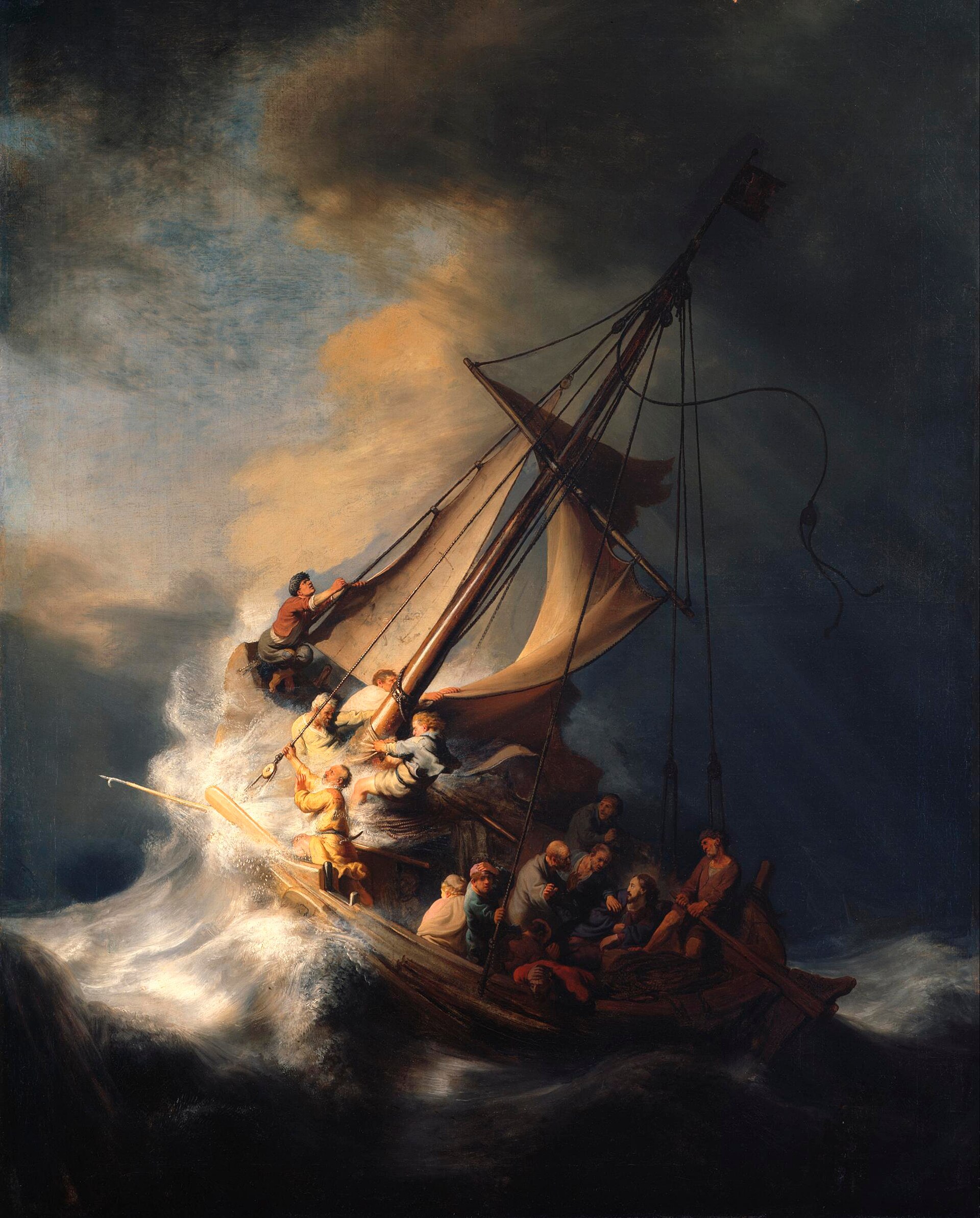
The whole picture, oil on canvas, 160 x 128 cm, as it hung in the Dutch Room before 18 March 1990. Every reproduction known to this record was made before the theft. This file is credited on Commons to the Gardner Museum's website.
| Artist | Rembrandt van Rijn |
|---|---|
| Date | 1633 |
| Medium | Oil on canvas |
| Dimensions | 160 x 128 cm (63 x 50 3/8 in.) |
| Where it is now | Unlocated. Stolen from the Isabella Stewart Gardner Museum, Boston, on 18 March 1990 and not recovered. The Museum is the last recorded owner and no source consulted records any transfer of title.last confirmed |
| Inventory number | P21s24 |
| Attribution | AcceptedSigned and dated 1633 on the rudder, and catalogued by the Rembrandt Research Project as number II A 68 in volume II of its Corpus (1986) and again in the Corpus survey of 2014, both of which the Gardner Museum cites in its own bibliography. Full note |
| Object type | Painting |
| Period | Dutch Golden Age, 1600-1700 |
| Cases | Has a provenance gap |
| Inscriptions | Signed on the rudder, transcribed by the Gardner Museum as: Rembrant. f/1633. (The Commons description of the same signature gives it as Rembrandt. f. / 1633; the museum's transcription is the one used here.) |
| Owners on record | 17 links11 documented, 2 disputed, 4 unknown |
| Sources | 40 cited |
About this record Last verified · 40 sources cited · Change log
On this page 10 sections
ContentsClose
Rembrandt's only known seascape, painted in 1633 in his first Amsterdam years, a 160 by 128 centimetre canvas of Christ and the disciples in a storm, with one disciple looking out at the viewer in a face the Gardner Museum's curators take to be the painter's own. Two men in police uniform cut it from its frame at the Isabella Stewart Gardner Museum in Boston on 18 March 1990, and it has never been recovered. Every image of it is a reproduction made before the theft.
Its recorded history is long and uneven. The Gardner's own provenance runs from a possible owner in seventeenth-century Amsterdam through the Braamcamp sale of 1771, where this picture fetched 4,360 guilders, and well over a century in the Hope banking family, to a bankrupt lord's sale in 1898 and Isabella Stewart Gardner's purchase that September for 6,000 pounds through Bernard Berenson. The early links are uncertain: the Rembrandt Research Project says Houbraken probably confused two Hinloopens, and Wikipedia's dollar price for the 1898 sale is a currency error. The record gives each link its grade.
The FBI said in 2013 that it believes the art went to the Connecticut and Philadelphia regions and that it has identified the thieves, whom it has not named. The museum's reward is 10 million dollars. Nothing has been recovered and CBS Boston reported in March 2026 that no one has been arrested. No source consulted gives a current valuation of the picture alone, because a stolen Rembrandt has none.
Provenance
Each link is graded. Documented: a cited source supports it. Disputed: the identification is argued but not established. Unknown: no owner for that span, and the gap is not smoothed into a narrative. The grades in the glossary.
- 1633 -Rembrandt van Rijn, Amsterdamdocumented
Signed on the rudder and dated 1633 by the Gardner Museum's transcription (Rembrant. f/1633). Painted in Rembrandt's first Amsterdam years, after he moved from Leiden at the end of 1631. No commission, contract or first purchaser is recorded in any source consulted, and Wikipedia citing Walsh says expressly that no record confirms whether it was a commission.12029
- 1633 - 1644Unknownunknown
The first documented owner is dated at least a decade after the painting. Nothing in the sources consulted records who owned it, or where it was, between 1633 and the first name in the Gardner's chain.1
- by 1644 -Possibly Tymen Jacobsz Hinloopen (1572-1637), Amsterdam, as a painting of St. Peter's shipunknown
The Gardner says 'possibly', and gives his dates as 1572-1637 against 'by 1644', which no source consulted explains. Wikipedia's article on the picture states 1644 flatly. No source consulted confirms or rejects this link; the Corpus V note concerns a different Hinloopen.1152025
- by 1653 -Jacques Specx (1588 or 1589 to 1652), Amsterdam, a Governor-General of the Dutch East Indiesdisputed
Named in the Gardner's catalogue entry as in Amsterdam by 1653, which postdates his death on 22 July 1652 by Wikipedia's date, so the date presumably reflects a record made after his death. Wikipedia's article on Specx puts the picture in his collection in 1651 and says he owned five Rembrandts. The underlying inventory was not seen. The two dates are given as the sources give them. The museum and Wikipedia disagree on the date, so the grade is disputed.123
- by 1705 -Jacob Jacobsz Hinloopen (1644-1705), Amsterdam, a burgomaster and sheriffdisputed
Named by the Gardner as in Amsterdam by 1705. Houbraken (1718) puts the St. Pieters scheepje with 'Jan Jakobzen Hinloopen, voorheen Schout en Borgermeester'. Corpus V (note 22 to V 29, p. 646) says the picture was never in Jan's collection and that Houbraken probably confused Jan Jacobsz Hinloopen (1626-1666) with his nephew Jacob (1644-1705). The attachment to Jacob therefore rests on the museum's entry and on that inference, and no inventory was seen. The Corpus cites its own entry II A 68, section 8, which was not read.11516
- Johannes Coop (died 1746), calico-printer, Amsterdamunknown
Named in the Gardner's catalogue entry with no date of ownership, and no document for his ownership was seen. The order of Coop and Braamcamp in the chain is the museum's.1
- before 1750 - 1771Gerrit Braamcamp (1699-1771), Amsterdam, distiller, timber merchant and collectordocumented
The Gardner says he held it before 1750 and Wikipedia says he bought it around 1750. His collection was sold at Amsterdam from 31 July 1771.124
- 1771-07-31 -J. Wubbels, Amsterdamdocumented
Bought at the Braamcamp sale, lot 172, for 4,360 guilders. Whether Wubbels was a dealer or a private buyer is not stated in any source consulted. This is the only auction price recorded for the picture.1
- 1771 - 1784Unknownunknown
The Gardner's catalogue entry names Wubbels at the 1771 sale and John Hope as the next owner without a link between them. The date, price and route by which the picture reached the Hope collection are not recorded in the sources consulted.1
- 1784 - 1794John Hope (1737-1784), Amsterdam, banker and collector, then by descent his widow Philippina Barbera van der Hoeven (died 1790) and his sons Thomas, Adrian Elias and Henry Philipdocumented
The museum gives the descent from John Hope in 1784 to his widow in 1784 to the three sons in 1790, and the two younger sons under the guardianship of their cousin Henry Hope in 1794. Wikipedia's article on the Hope collection says 372 paintings went with Henry Hope when he moved to London in 1794.12126
- 1794 - 1839Henry Philip Hope (1774-1839), London, and his elder brother Thomas Hope (1769-1831)documented
The museum has Henry Philip Hope owning it possibly by 1802 and shows it exhibited at the house of his eldest brother Thomas, London, in 1819.1
- 1839 - 1884Henry Thomas Hope (1808-1862), Surrey, then his widow Adele Bichat Hope (died 1887)documented
A Royal Academy exhibition label of 1881 on the back of the frame names the proprietor as Mrs. Hope, Belgrave Square, which places the picture with the family in 1881.1
- 1884 - 1898Henry Francis Pelham-Clinton-Hope (died 1941), grandson of Adele Bichat Hope, later the 8th Duke of Newcastledocumented
Wikipedia says he was discharged in bankruptcy in 1896 and that most of the Hope Collection of Pictures was sold. The 83 pictures shown at South Kensington in 1891 were sold together in 1898 for 121,550 pounds, paid by Asher Wertheimer, according to Wikipedia. The Hope page says the pictures were sold together and the Gardner says the dealers purchased this one; neither describes an auction. The museum gives 1884 for his ownership and 1887 for his grandmother's death, while Wikipedia's article on him says he inherited her estate in 1884; the two are repeated here without reconciliation.12122
- 1898 - 1898-09Asher Wertheimer and Colnaghi and Company, London, dealersdocumented
The Gardner's provenance says the dealers bought it together from Pelham-Clinton-Hope in 1898. The price paid for this single picture is not published in the sources consulted.121
- 1898-09 - 1924Isabella Stewart Gardner, Boston, through Bernard Berensondocumented
Bought from Colnaghi and Company in September 1898 for 6,000 pounds, about 29,000 dollars at the rate MeasuringWorth implies for 1898. Wikipedia's article on the picture gives 6,000 dollars, which conflicts with the museum and is treated as an error. The same month Gardner paid 13,000 pounds for A Lady and Gentleman in Black.117202728
- 1924 - 1990Isabella Stewart Gardner Museum, Bostondocumented
Catalogued in the Fenway Court catalogue of 1903 and hung in the second-floor Dutch Room. Gardner's will, as summarised by a Tufts University student blog, required the collection to be preserved without alteration. The museum's collection record gives the accession number P21s24.1235
- 1990-03-18 - presentUnknown. The museum is the last recorded owner and no source consulted records a transfer of titledocumented
Stolen between about 1.24 and 2.45 am on 18 March 1990 by two men in police uniform, with twelve other works, according to the Gardner Museum. Nothing has been recovered. The FBI said in 2013 that it believed with a high degree of confidence that the art was taken to Connecticut and the Philadelphia region and that some of it was offered for sale in Philadelphia. The FBI and the museum statements are about the thirteen works as a group, and no source places the Storm itself in either region. The Museum doubled its reward to 10 million dollars in May 2017 and extended it in January 2018. A former FBI agent's book of 2026 and the Associated Press and CBS Boston coverage of it say nothing has been recovered, and CBS reports Kelly saying the alleged main players have died. Press reports of a 2018 federal sentencing in Connecticut touch the investigation and CBS Boston reported in March 2026 that no one has been arrested. Wikipedia says the museum lacked an insurance policy, and no market price exists.2356789101112133940
Prices realised
| Date | Sale | Estimate | Result | Note |
|---|---|---|---|---|
| 31 July 1771 | Amsterdam sale of the collection of Gerrit Braamcamp Held at the lodging Het Wapen van Amsterdam according to the title of the sale catalogue as cited on Wikipedia, lot 172 | None recorded in the sources consulted | Hammer Not stated. The Gardner gives 'for 4360 guilders' without saying whether that is hammer or total With premium Not recorded in the sources consulted Dutch guilders | Price as given by the Gardner: 4,360 guilders, paid by a J. Wubbels, according to the Gardner Museum's provenance. This is the only auction price recorded for the picture. The 1898 sale of the Hope pictures to Wertheimer and Colnaghi and Gardner's purchase from Colnaghi are not recorded as auctions. No auction of the picture after 1771 appears in the Gardner's provenance. It has no current market price because it is stolen. |
Hammer is the price at which the bidding stopped; with premium adds the fee the house charges the buyer on top. Hammer price and buyer's premium in the glossary.
Technical evidence
| Attribution note | Signed and dated 1633 on the rudder, and catalogued by the Rembrandt Research Project as number II A 68 in volume II of its Corpus (1986) and again in the Corpus survey of 2014, both of which the Gardner Museum cites in its own bibliography. No source consulted disputes the attribution. The picture cannot now be re-examined: it has been out of reach of every laboratory since 18 March 1990, so the last laboratory studies this record could identify, Walsh's of 1985 and 1986 and the Corpus II entry of 1986, predate the theft, and the Corpus II entry itself could not be read for this record. |
|---|---|
| Support | Oil on canvas. The Gardner Museum's catalogue record gives the medium as oil on canvas and says nothing further about the weave, the lining or the stretcher.1 |
| Dimensions | 160 x 128 cm (63 x 50 3/8 in.). The Corpus fifth volume gives the same 160 x 128 cm. Some web sources give 127 cm for the width, which is not the museum's figure.11523 |
| Format | Upright. The museum describes it as a vertical oil painting. The Antwerp print of the same subject in the Rijksmuseum is also upright.137 |
| Signature and date | On the rudder. The Gardner Museum transcribes it as Rembrant. f/1633, with no d in the name. The Commons description of the file gives Rembrandt. f. / 1633. The Gardner's bibliography lists Josua Bruyn's study of the signatures of 1632 to 1634 in Corpus II, pp. 102-03, which was not consulted.136 |
| Underpainting | The Rembrandt Research Project's Corpus, volume V, says that the handling of the brush in the roughly laid-in first version beneath another painting is strongly reminiscent of lead-white-containing underpainted areas in the 1633 Storm (for instance to the left of the ship's bow), in the Raising of the Cross of 1632-33 and in a 1633 portrait in New York. No X-radiograph, infrared image or paint sample of the Storm has been seen for this record.15 |
| Light and colour | The museum describes two thirds of the canvas as dark. The light picks out the wave crests, the sails and the figures at the left of the boat, a patch of blue sky breaks through at the left and dark cloud crosses the upper right. Christ's robe and the figure who looks out are both in blue.1 |
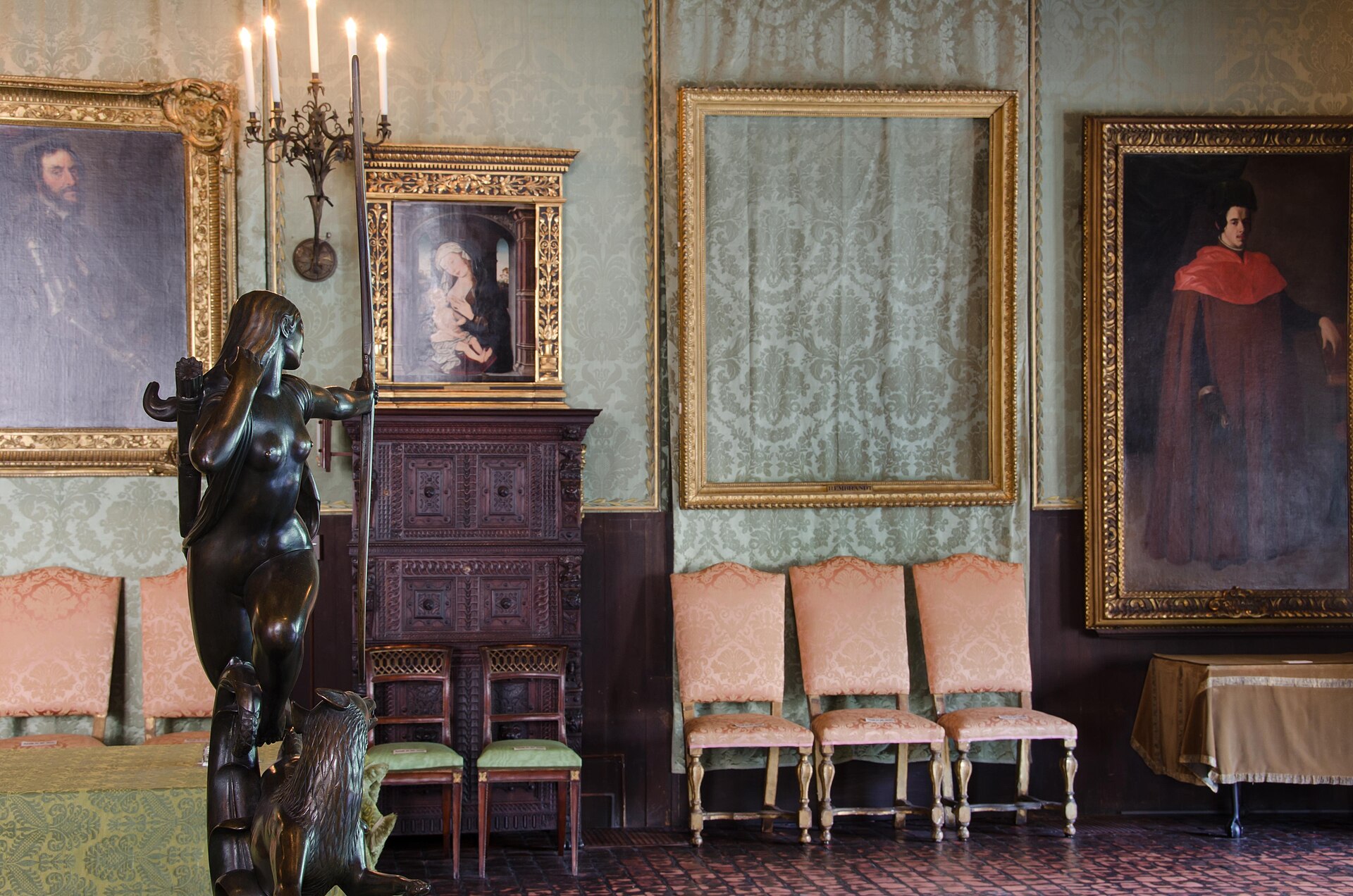
| Frame | British or French, early nineteenth century, with multiple bands of ornament over classical moulding. The museum's conservation blog says material was removed from the inside edge to take a larger picture and that a label on the back names a London frame workshop. The frame dates from about two centuries after the picture and is still on the wall in Boston, empty.438 |
| Labels on the frame | A printed and handwritten Royal Academy Exhibition of the Works of the Old Masters label of 1881, naming Rembrandt as artist, Christ with his Disciples in the storm on the Sea of Galilee as title and Mrs. Hope, Belgrave Square as proprietor. A partial label naming a carver and gilder and a plate-glass dealer at 23 Coventry Street, London.1 |
| Numbers carried | Gardner Museum accession P21s24. Rembrandt Research Project Corpus II A 68. RKDimages record 46845. Number III in the 1898 catalogue of the Hope pictures (Wertheimer 1898), as cited on Wikipedia.1152136 |
| Condition and the theft | The Gardner's audio walk says the thieves cut the Rembrandt canvases out of their frames with a sharp blade, probably a box cutter, leaving deep gashes in the wood supports around the edges of the canvas. Nothing is recorded in the sources consulted about the condition of the canvas before the theft beyond the museum's description of the picture, or after it.3 |
| Technical studies not consulted | The Gardner's bibliography lists John Walsh, Rembrandt's Christ in the Storm on the Sea of Galilee Re-examined, Fenway Court 1986, pp. 6-19, Walsh's 1985 article in Notes in the History of Art, Ernst van de Wetering on the canvas support in Corpus II, pp. 26, 38-39 and 41 and the Corpus II entry itself, pp. 302-310 (A68). Their findings are not reproduced here because they could not be read.120 |
Images
The record in full
Chapter 1It is Rembrandt's only known seascape, and nobody has seen it since 1990
The Isabella Stewart Gardner Museum's own catalogue entry describes Christ in the Storm on the Sea of Galilee as an oil on canvas of 160 by 128 centimetres, upright in format, dated 1633 and signed...
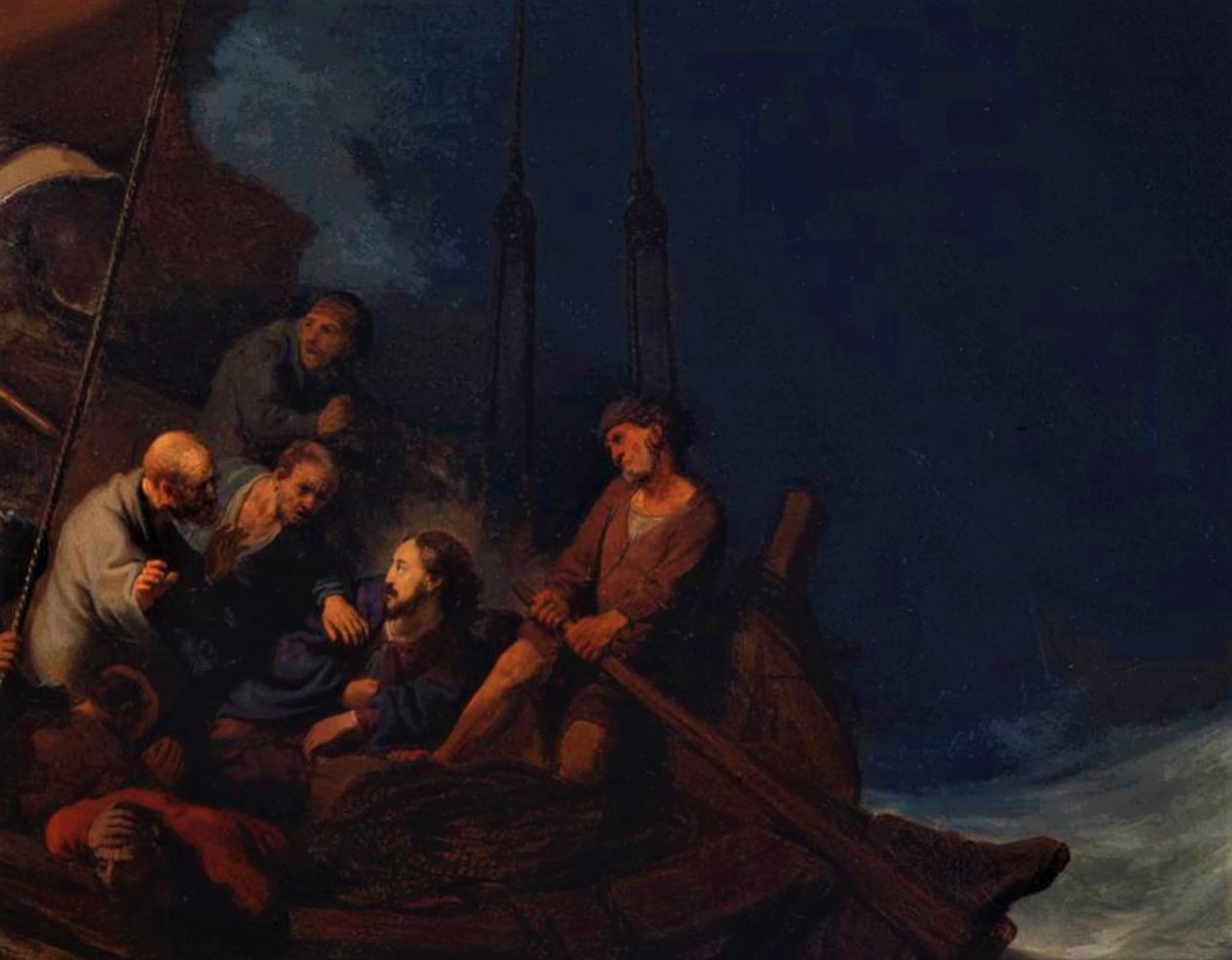
The Isabella Stewart Gardner Museum's own catalogue entry describes Christ in the Storm on the Sea of Galilee as an oil on canvas of 160 by 128 centimetres, upright in format, dated 1633 and signed on the rudder of the boat. It calls the picture Rembrandt's most striking narrative painting in America and his only painted seascape. The museum's own description counts a man at the raised end of the boat, three men around the mast and eight around Christ at the lower end, partly in darkness, and says two thirds of the canvas is in darkness.
The picture has not been seen in public since the early hours of 18 March 1990. The Gardner Museum lists it as one of thirteen works taken that night, and the FBI describes the theft as the largest property crime in United States history. Every photograph of the painting known to this record, including the one at the head of this record, was made before the theft. That matters for how to read what follows. The last laboratory studies this record could identify, John Walsh's of 1985 and 1986 and the Corpus II entry of 1986, predate the theft, and later literature such as the Corpus survey of 2014 treats the picture only through photographs. The condition of the canvas today is unknown, and every statement about what the picture looks like is a statement about a photograph.
Chapter 2A storm told from inside the boat, with Christ as the quietest thing in it
The subject is the calming of the storm, told in Matthew 8:23-27, Mark 4:35-41 and Luke 8:22-25.
The subject is the calming of the storm, told in Matthew 8:23-27, Mark 4:35-41 and Luke 8:22-25. The accounts differ on a point that decides what a painter shows. In Mark, as Wikipedia quotes the text, Jesus rebukes the wind and the sea first and only then asks the disciples why they are afraid. In Matthew the order is reversed: he asks the disciples why they are fearful, calls them men of little faith and then rises and rebukes the winds and the sea. The Gardner Museum's commentary follows the Matthew order, saying that Christ, awakened by the disciples' desperate pleas, rebukes them and then rises to calm the fury of wind and waves. Wikipedia's article on the picture says instead that it aligns closely with Luke 8:22-25, citing Hilliard Goldfarb's 1995 companion guide to the museum. No document consulted records which Gospel Rembrandt worked from, and the picture shows the moment before the sea is stilled in any of them. The museum's reading is a reading of the picture and not a finding about the painter.
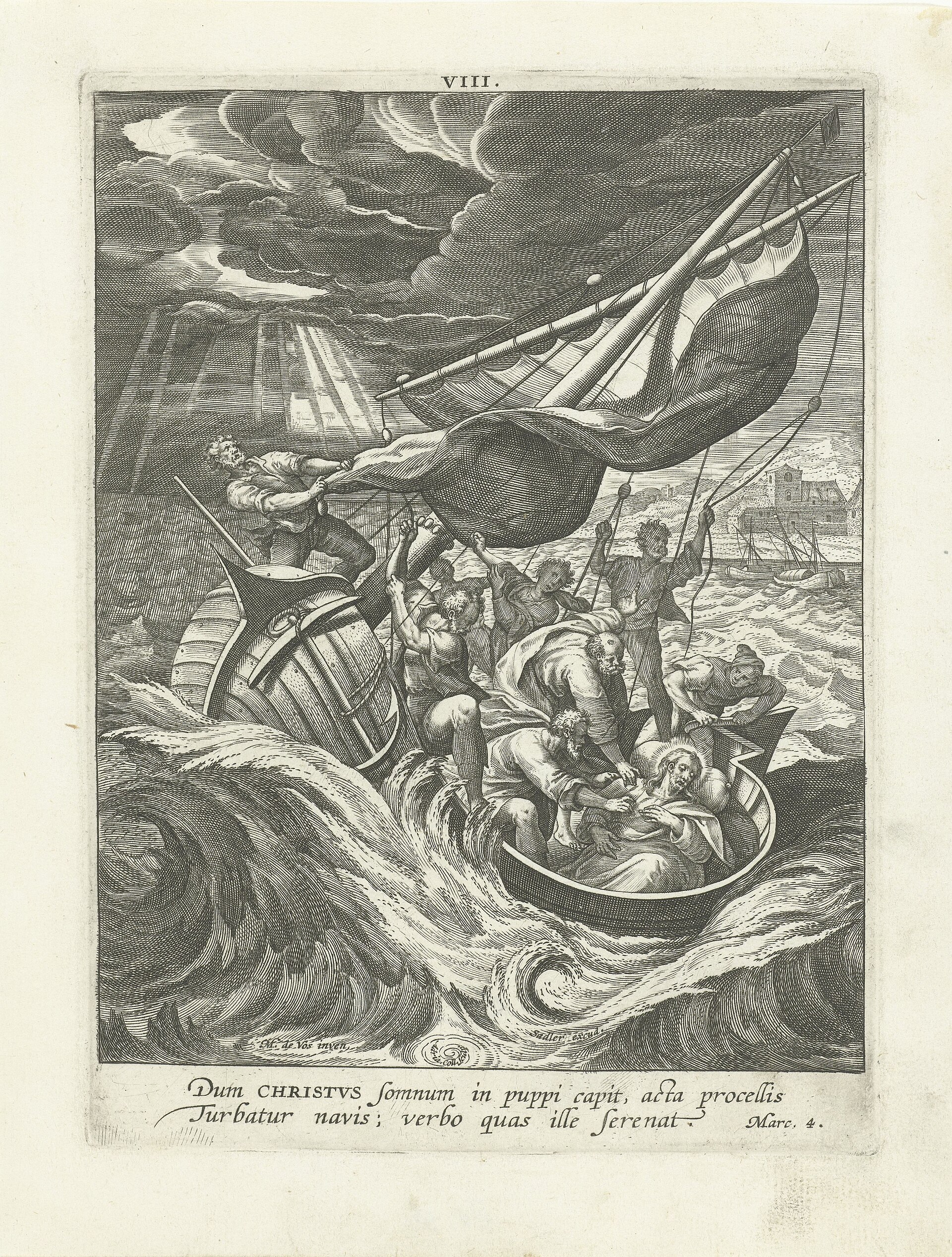
Rembrandt chose a subject that was rare. The Rembrandt Research Project's Corpus, in its fifth volume of 2011, calls the Christ in the storm a rarely depicted subject. The Rijksmuseum holds an Antwerp print of the same story: an engraving by Adriaen Collaert after a design by Maerten de Vos, published by Johann and Raphael Sadeler between 1583 and 1588, number 8 of 12 in a series on the life of Christ and catalogued by the Rijksmuseum under Mark 4:35-41. Wikipedia states that Rembrandt's composition echoes a Collaert print after de Vos in its upright format and its forward-tilting boat, and attributes the observation to G. Unverfehrt. That is an argued comparison from a source this record has not read in the original, and it is graded as such. The print is among the plates so that a reader can judge the resemblance.
What Rembrandt did with the subject is described in the Gardner's catalogue entry by Michael Zell, written for the museum's Eye of the Beholder of 2003. Zell reads the picture as staging the miracle as a contemporary scene, "a fishing boat menaced by a storm", so that the viewer shares the disciples' fear before registering that Christ is about to end it. The same entry says the scene sets nature against human frailty, which is a modern curator's summary of the picture's drama and is kept here as that. Wikipedia reports, on the authority of an article by John Walsh published in 1985 in Notes in the History of Art, that the vessel resembles a hoeker, a North Sea fishing boat, with its hull altered for asymmetry and its mast thickened. That detail has not been checked against Walsh's text.
There is a later devotional reading of the miracle, which Wikipedia's article on the episode quotes from the commentator Justus Knecht: that its purpose was to strengthen the apostles' faith and to teach them and their successors, as fishers of men, that they would meet persecution and affliction but that Jesus would always be with them to hush the storm. It is a later commentator's explanation of the Gospel passage, and no source consulted says Rembrandt or the picture's first owner held it. The record has found no inscription, contract or inventory that attaches a particular meaning to this painting beyond the Gospel story it illustrates. The absence of a documented hidden programme is a finding. What the picture shows is a miracle story told with great narrative force.
Chapter 3The face that looks out of the boat
One figure in the boat does not look at the storm or at Christ.
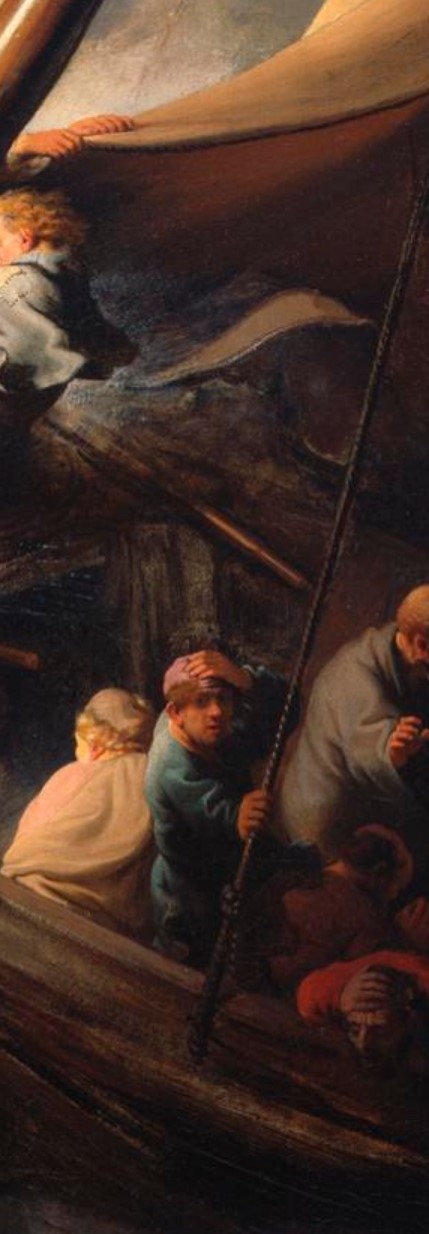
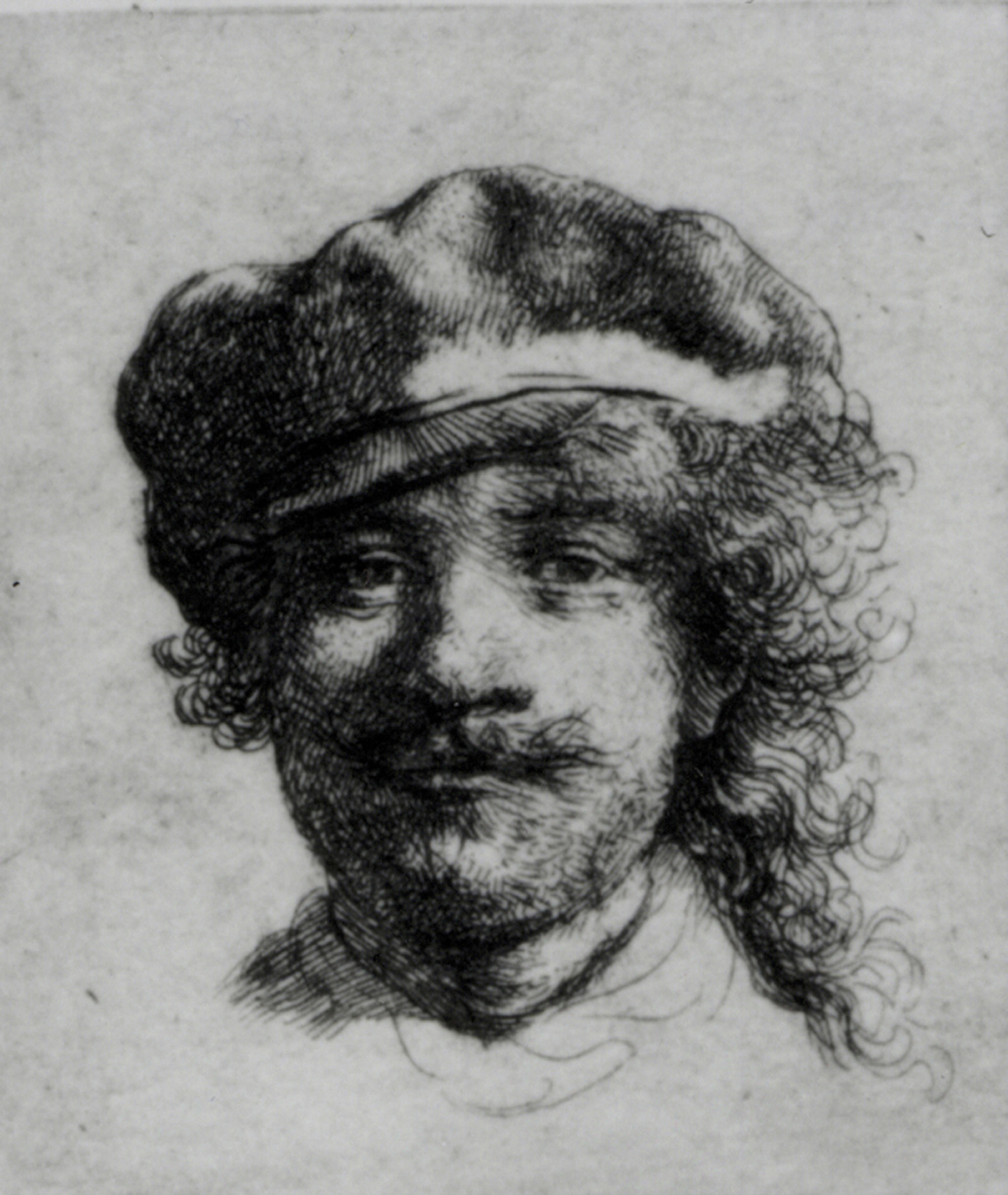
One figure in the boat does not look at the storm or at Christ. As the museum describes him, he steadies himself by grasping a rope, holds on to his cap and looks directly at the viewer. The Gardner's catalogue entry, written by Zell, words the identification as a resemblance: his face seems familiar from Rembrandt's self-portraits. The museum's audio walk about the theft, narrated by its director of security Anthony Amore, goes further and says flatly that it is Rembrandt's own face, a self-portrait he included in the biblical story. Lloyd Schwartz, writing for WBUR in 2018, says he is not sure which disciple the figure is but that it is Rembrandt's face, the same face as in the small self-portrait etching stolen with the painting. Wikipedia's article states the identification without qualification.
That is the extent of what the sources consulted establish. The identification rests on likeness, and no document of Rembrandt's own says he put himself in the boat. It is a proposal held by the museum's curators and security director, stated more or less firmly depending on who is speaking, with no dissent found in the sources read. It is graded argued. The Corpus entry (II A 68, 1986) is where the Rembrandt Research Project would have taken a position, and this record has not been able to read that entry.
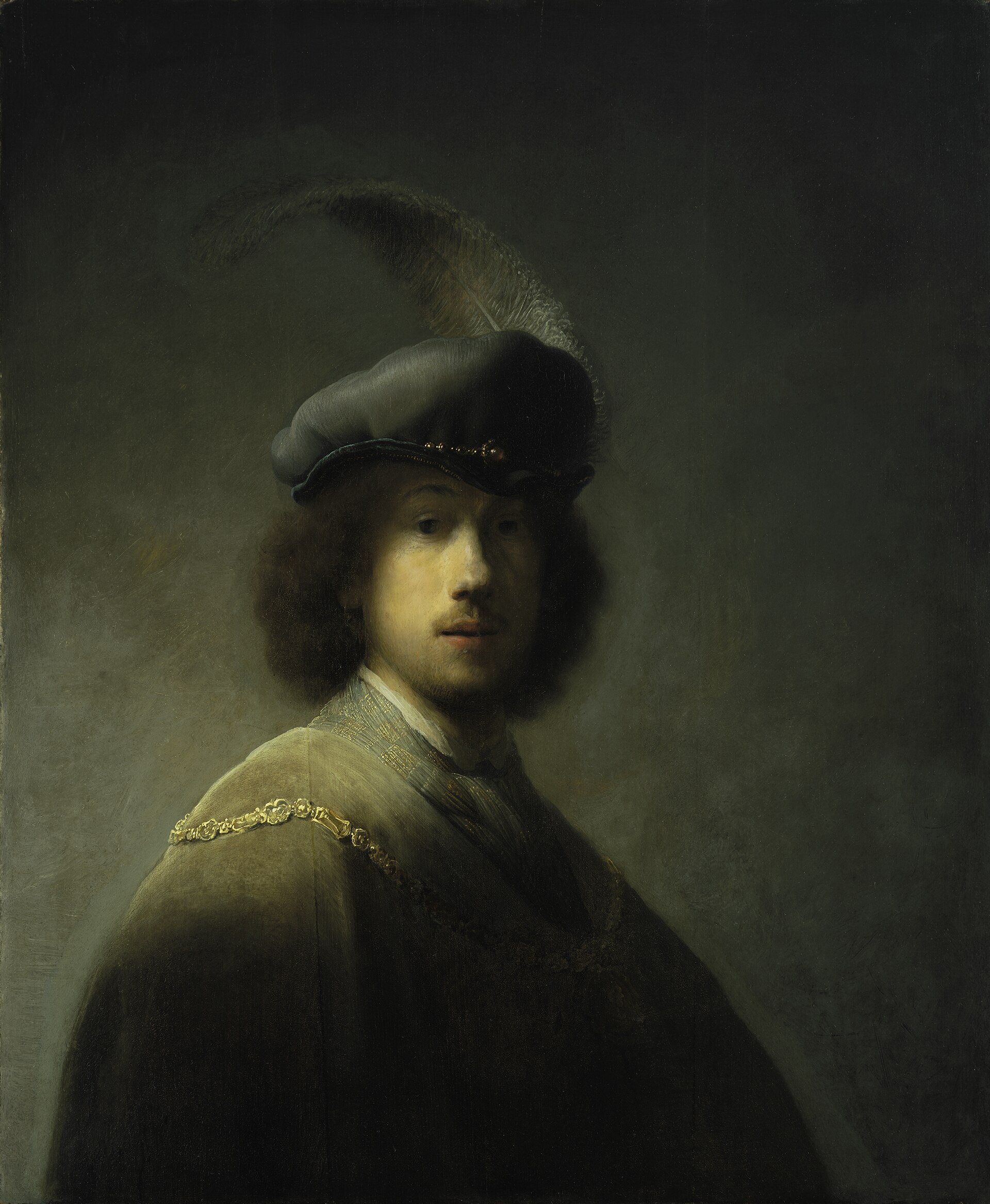
A related reading belongs to the museum and not to Rembrandt. Nathaniel Silver, the Gardner's chief curator, says in the audio walk that the Self-Portrait Aged 23 hung in the Dutch Room on the wall opposite the seascape, and that he cannot help thinking Isabella Gardner deliberately placed the ambitious young Rembrandt facing his older self in the boat. Silver offers it as his own thought. The record keeps it as a modern curatorial reading of how the room was hung and not as evidence of what Gardner or Rembrandt intended. No letter of Gardner's on the point appears in the sources consulted.
Chapter 4Painted in the first Amsterdam years, and nobody knows for whom
Rembrandt was born in Leiden on 15 July 1606.
Rembrandt was born in Leiden on 15 July 1606. Wikipedia's biography says he was apprenticed for three years to Jacob van Swanenburg, spent about six months with the history painter Pieter Lastman in Amsterdam and moved to Amsterdam at the end of 1631, where he lodged with the art dealer Hendrick van Uylenburgh and worked in his studio. In 1634 he married Uylenburgh's cousin Saskia. The same sources place the start of his large, dramatic biblical scenes in strong contrast in these early Amsterdam years and describe the work in Uylenburgh's workshop as supported by assistants. The Storm is dated 1633, so it belongs to the first two years of Rembrandt's Amsterdam life. Lastman, his teacher, died in Amsterdam in 1633 and was buried on 4 April of that year.
No document consulted records who commissioned or first bought the picture. Wikipedia, citing Walsh's 1985 article, says that no record confirms whether it was a commission, and the Gardner's own provenance begins with a possible owner in the seventeenth century and not with a patron. The Corpus fifth volume offers a tentative proposal: that the Christ in the storm could possibly also have originated in the same context as a series of prints the authors are discussing at that point. Separately it suggests that two small grisailles, the Lamentation and the Entombment, may relate to a hypothetical series of Passion subjects. The authors claim no documentary support for either suggestion, and the proposal about the Storm is graded speculative.
A second passage of the same volume ties the picture to a contemporary theory of painting by naming a book. Samuel van Hoogstraten, Rembrandt's pupil, advises in his treatise on painting, the Hooge schoole, that figures of secondary importance should be dressed with care so that the eye is not distracted from the principal work. The Corpus says Hoogstraten was recommending the method Rembrandt had already used with the costumes in his Judas and in the Christ in the storm, which is to adapt the colour of each garment to its place in the pictorial scheme of the figures. The same chapter says Rembrandt brought his way of subordinating colour to a composition defined in light and dark to its fullest expression in the Storm and in the Night Watch.
The Corpus also records a technical detail. In discussing an underlying first version in another painting, the authors compare the way the brush was handled there to what can be made out in the lead-white-containing underpainted areas of the 1633 Christ in the storm, for instance to the left of the ship's bow, and to the 1632-33 Raising of the Cross. This says no more than that those areas are underpainted in lead white and look alike in handling, but it is the only technical observation from the Rembrandt Research Project that this record has seen in print, and it appears as a single, narrow row in the technical table. The Gardner's own bibliography lists the Corpus II treatment of the canvas support and of the signature, and John Walsh's 1986 article Rembrandt's Christ in the Storm on the Sea of Galilee Re-examined in the museum's Fenway Court. None of those could be read for this record.
Chapter 5The sea before Rembrandt: ships, storms and a painter who died near Leiden in 1632
Dutch marine painting did not begin with Rembrandt and he did not set out to start a genre.
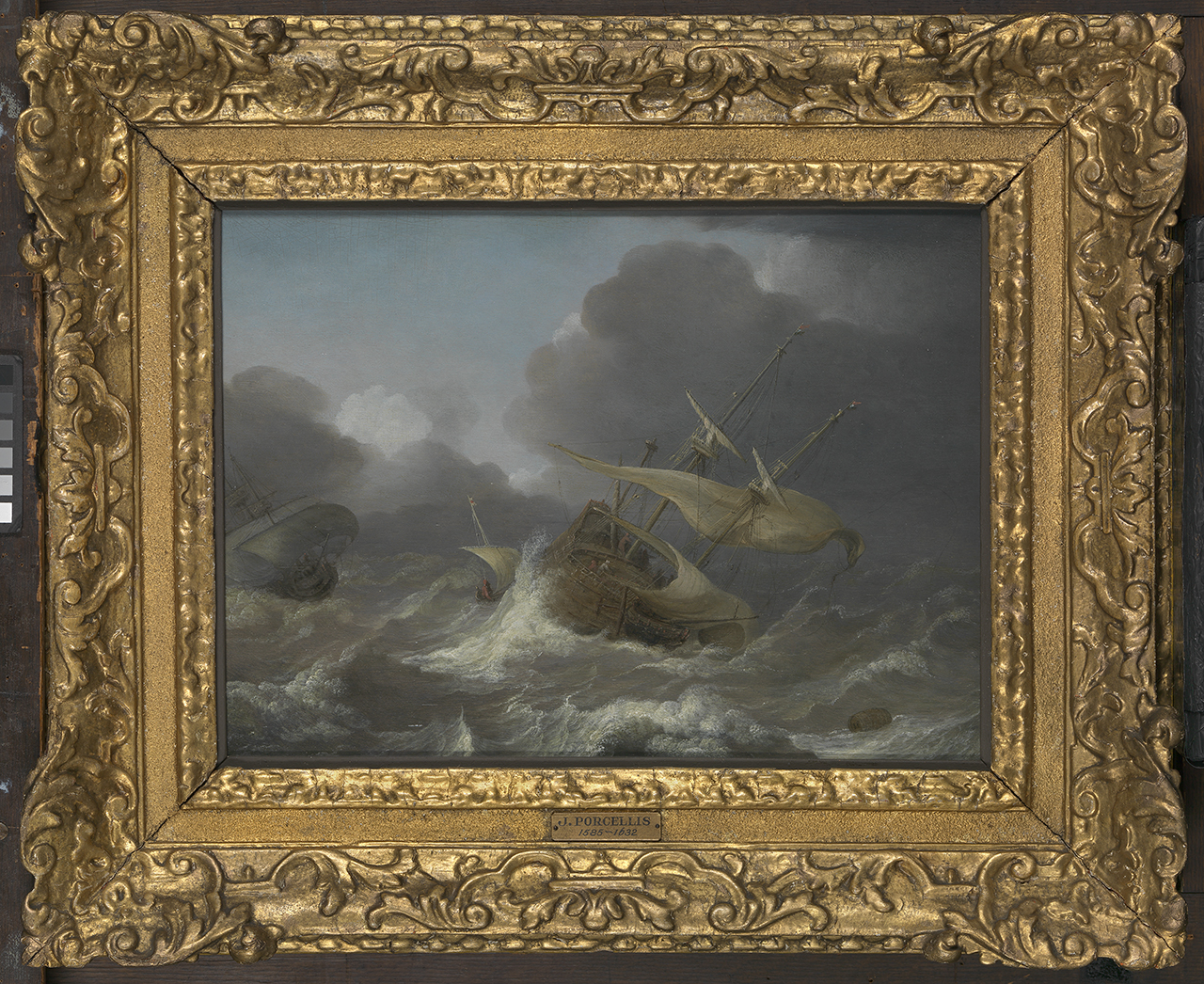
Dutch marine painting did not begin with Rembrandt and he did not set out to start a genre. Wikipedia's account of Jan Porcellis, who died on 29 January 1632 at Zoeterwoude near Leiden, says his work marked a decisive change from early realism to the tonal phase, favouring overcast skies and rough water and moving away from a marine art of grand ships in historical settings. The same article says that most of his surely attributed work before 1620 shows battles, storms and harbour views, that Houbraken made Hendrick Vroom his teacher and that Rembrandt was among the prominent artists said to have collected his pictures. A plate in this record shows a Porcellis of about 1620 from the National Maritime Museum, Greenwich, in which a merchant ship labours in a gale with a mainsail broken loose. It is shown as a neighbour in the genre, and no source consulted says Rembrandt knew that particular picture.
Wikipedia adds that in this period the ship was considered a metaphor for the human soul and a sea voyage a symbol for human life, so that a storm at sea reminded the spectator of human frailty and divine power, and that whether Porcellis's own paintings carry a moral message is uncertain. That is a general reading of the genre by a tertiary source and not a statement about Rembrandt's picture. It is recorded here only so that the reader can see what an informed seventeenth-century viewer might have brought to a storm at sea. The claim that Rembrandt collected Porcellis appears in the same tertiary source with a reference to Slive and has not been checked against the 1656 inventory of Rembrandt's possessions.
The point where Rembrandt departs from the genre is the one the museum stresses. Porcellis and his followers painted anonymous ships in open water. Rembrandt put a fishing boat in a storm and filled it with men, each characterised. The Gardner's commentary praises the individual characterisation of the disciples and calls the detailed rendering, the polished brushwork and the bright colouring characteristic of Rembrandt's early style. It adds that eighteenth-century critics such as Arnold Houbraken often preferred this early period to Rembrandt's later, broader manner. The museum gives no total of figures.
Chapter 6A century and a half in Amsterdam: a whaler, a Governor-General, a burgomaster and a distiller
The Gardner Museum's provenance is the longest published chain for this picture, and it carries its own hedges.
The Gardner Museum's provenance is the longest published chain for this picture, and it carries its own hedges. It begins with a possible owner, Tymen Jacobsz Hinloopen (1572-1637), a leader of the Noordsche whaling company, in Amsterdam by 1644, the painting then being known as a painting of St. Peter's ship. The museum gives his dates as 1572-1637 and the date of ownership as by 1644, seven years after his death, and no source consulted explains the date. Wikipedia's article on the picture states the matter more firmly, saying Hinloopen acquired the picture in 1644, but the museum says only that he possibly did and this record follows the museum. The next owner the museum names is Jacques Specx (1588 or 1589 to 1652), a Governor-General of the Dutch East Indies, in Amsterdam by 1653. Wikipedia's article on Specx says the picture belonged to him in 1651 and that he owned five Rembrandts, a date two years earlier than the museum's. The difference is unexplained.
The third name is Jacob Jacobsz Hinloopen (1644-1705), a burgomaster and sheriff, in Amsterdam by 1705. This is the link that explains the earliest literature. Arnold Houbraken wrote in 1718, in his life of Rembrandt, that in his early period Rembrandt had more patience for finishing his pictures than later, and gave as one proof a piece known as St. Pieters scheepje, which for many years hung in the cabinet of Jan Jacobsz Hinloopen, formerly sheriff and burgomaster of Amsterdam. He adds that the working of the figures and their features is as natural to the incident as can be imagined and far more carefully painted than one is used to seeing from Rembrandt. The Rembrandt Research Project's Corpus says, in a note, that Houbraken's report that this picture was in the collection of Jan Jacobsz Hinloopen is probably based on a misunderstanding: he probably confused Jan Jacobsz Hinloopen (1626-1666) with his nephew Jacob Jacobsz Hinloopen (1644-1705). The note adds that the picture was in fact never in the earlier man's collection and refers to the Corpus II entry, which this record has not read. Houbraken's description of the owner as a former sheriff and burgomaster matches the nephew as the Gardner lists him. The Corpus note makes the nephew the probable owner Houbraken meant, although it was Jan's collection that Houbraken named. The Gardner's first name, Tymen, is a different man and the note does not address him.
After Hinloopen the museum names Johannes Coop (died 1746), an Amsterdam calico-printer, undated, and then Gerrit Braamcamp (1699-1771), in Amsterdam before 1750. Wikipedia describes Braamcamp as a Roman Catholic distiller, timber merchant and collector who built a timber yard and shipyard on the Hoogte Kadijk opposite the Dutch East India Company's own, and says he bought the Storm around 1750. His collection was sold at Amsterdam on 31 July 1771 and following days at the lodging Het Wapen van Amsterdam, according to the title of its sale catalogue as cited on Wikipedia. The Gardner records that at this sale the Storm was lot 172 and was bought by a J. Wubbels for 4,360 guilders. That is the only auction price recorded for the picture. The sources consulted do not say whether Wubbels was a dealer or a private buyer.
There is a maritime thread in this chain that should not be over-read. The possible earliest known owner led a whaling company and Braamcamp ran a timber trade and a shipyard. The East India Company links Specx and, later, John Hope. Nothing in the sources says any of these men bought the picture because of its subject, and the first name is only a possible owner.
Chapter 7The Hope family: bankers, a Dutch cabinet moved to London and a bankrupt lord
The museum next names John Hope (1737-1784) without saying how the picture passed to him from Wubbels.
The museum next names John Hope (1737-1784) without saying how the picture passed to him from Wubbels. Wikipedia describes Hope as an Anglo-Dutch banker with the firm of Hope and Company, a manager of the Dutch East India Company and an art collector. The museum's provenance says the picture descended to his widow Philippina Barbera van der Hoeven, who died in 1790, and then to their three sons Thomas, Adrian Elias and Henry Philip. In 1794 Adrian Elias and Henry Philip were under the guardianship of their cousin Henry Hope and the collection moved to London. Wikipedia's article on the Hope collection says 372 of the family's paintings went with Henry Hope when he left the Dutch Republic for England in 1794. The museum has Henry Philip Hope owning the picture possibly by 1802, and shows it exhibited at the London house of his eldest brother Thomas in 1819. By descent it passed to Thomas's son Henry Thomas Hope (1808-1862), at Surrey from 1839, then in 1862 to his widow Adele Bichat Hope, who died in 1887 and in 1884 to her grandson Henry Francis Pelham-Clinton-Hope. The museum gives 1884 for his ownership and 1887 for his grandmother's death, while Wikipedia's article on him says he inherited her estate in 1884; the record repeats both and does not reconcile them.
There is physical evidence from this stretch that is not in any catalogue. A label adhered to the back of the frame, which the Gardner transcribes, is a printed Royal Academy label filled in for the Exhibition of the Works of the Old Masters of 1881, giving the artist as Rembrandt, the title as Christ with his Disciples in the storm on the Sea of Galilee and the proprietor as Mrs. Hope, Belgrave Square. A second, partial label names a carver and gilder together with a dealer in plate glass at 23 Coventry Street, London. The first label places the picture with the Hope family in 1881. The second is a framer's mark whose significance is taken up below.
The last Hope owner was Lord Francis Hope, later the 8th Duke of Newcastle. Wikipedia's article on him says he led an extravagant lifestyle, married the American actress May Yohe in 1894 and was discharged in bankruptcy in 1896, and it quotes a journal of the day to the effect that the couple sold off most of the Hope Collection of Pictures. The Hope Collection page says that 83 paintings which had been on display at the South Kensington Museum in 1891 were sold together in 1898 for 121,550 pounds, paid by the dealer Asher Wertheimer. The Gardner's provenance says the Storm was bought from Pelham-Clinton-Hope in 1898 by Wertheimer and Colnaghi and Company together. Neither Wikipedia page is a primary source, and both are flagged in the source list for replacement by the 1898 catalogue that the Hope page cites as Wertheimer 1898, where the picture is listed as number III.
Chapter 8Gardner paid 6,000 pounds in September 1898, not 6,000 dollars
The Gardner Museum's provenance says Isabella Stewart Gardner bought the Storm from Colnaghi and Company in September 1898 for 6,000 pounds, through the American art historian Bernard Berenson.
The Gardner Museum's provenance says Isabella Stewart Gardner bought the Storm from Colnaghi and Company in September 1898 for 6,000 pounds, through the American art historian Bernard Berenson. Wikipedia's article on the picture gives the price as 6,000 dollars and calculates a modern equivalent from that figure. That is a currency error, and the conflict is stated here because it has spread. At the exchange rate that MeasuringWorth's conversion implies for 1898, about 4.84 dollars to the pound, 6,000 pounds was roughly 29,000 dollars and not 6,000. The museum is the source for the pounds and this record uses it.
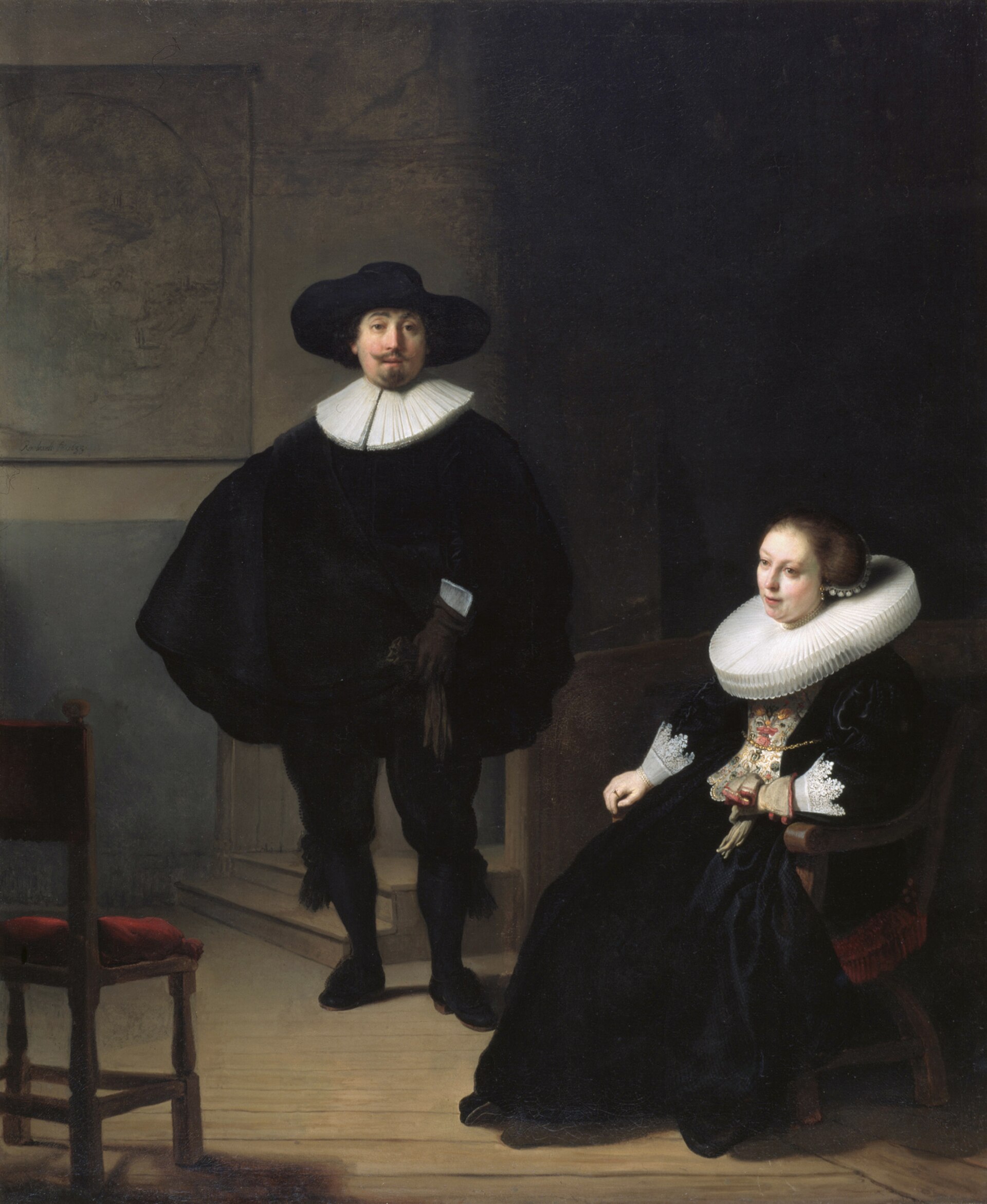
The sum is easier to read beside what Gardner paid for her other Dutch pictures. The museum's own pages give her Self-Portrait Aged 23 at 3,000 pounds from Colnaghi through Berenson by 16 February 1896. The companion Rembrandt in the Dutch Room, A Lady and Gentleman in Black, cost 13,000 pounds, also from Colnaghi through Berenson in September 1898, so she spent 19,000 pounds on the two Rembrandts bought that month. In March 1900 she paid 4,500 pounds for the Landscape with an Obelisk, which she believed was by Rembrandt and which is now given to Govaert Flinck. Her 6,000 pounds for the Storm equals about one twentieth of the 121,550 pounds that Wertheimer paid for all 83 Hope pictures, though a resale price and a wholesale price are not comparable. What Wertheimer and Colnaghi paid for this single picture inside the lump sum is not published in the sources consulted.
The museum's blog on the empty frames adds a detail about the 1898 sale. It says Gardner bought two large Rembrandts that year through a London dealer who likely changed the frames before selling them, and it describes the frame of the Storm as British or French, early nineteenth century, with multiple bands of ornament over classical moulding, a back label identifying a London frame workshop and signs that material was removed from the inside edge to take a larger picture. The 1881 Royal Academy label is described by the museum's catalogue entry as adhered to the back of the frame. If that is the frame the museum still has, the frame was already on the picture in the Hope house in 1881, which sits uneasily with the blog's suggestion that the dealer changed it in 1898. The sources do not reconcile the two and this record does not try to.
MeasuringWorth, whose figures run to 2024, converts 6,000 pounds of 1898 in several ways, and the differences are the point. By the retail price index the value is 901,500 pounds, the real price of the purchase as a commodity. By labour earnings it is 3,335,000 pounds, by relative income value 5,430,000 pounds and by share of national output 10,140,000 pounds. Treated as a project and not a commodity, it has a real cost of 854,300 pounds. The price-index figure asks what the same goods would cost now. The earnings and income figures ask what the purchase meant against what a worker or a household earned, which is the better question for a luxury bought by a very rich buyer. None of the figures is a valuation of the picture.
Chapter 9The Dutch Room, the catalogue of 1903 and a will that forbids change
Fenway Court, the Venetian-palazzo-style building Gardner built in Boston, was catalogued in 1903, and the Storm appears on page 14 of that catalogue according to the Gardner's bibliography.
Fenway Court, the Venetian-palazzo-style building Gardner built in Boston, was catalogued in 1903, and the Storm appears on page 14 of that catalogue according to the Gardner's bibliography. The museum places the picture in the second-floor Dutch Room, where, according to Silver, it hung on the wall opposite the Self-Portrait Aged 23. Where it hung between September 1898 and the opening of the building is not stated in any source consulted.
Isabella Gardner died in 1924. Her will, as a student blog from Tufts University summarises it, required the collection at Fenway Court to be preserved without alteration for the education and enjoyment of the public forever, with nothing moved or sold and no additional artworks added, on pain of the whole collection being dispersed. The Associated Press described the stipulation in 2026 as meaning that nothing in the building was to be changed after her death. The empty frames in the Dutch Room are the visible consequence, and Wikipedia's account of the theft connects the two directly. The museum's blog on the frames says it repaired all five frames left behind and returned them to the walls as placeholders in the hope that the paintings will one day return to them. In March 2025, ahead of the 35th anniversary of the theft, the museum reinstalled the restored empty frame for the Storm in the Dutch Room, according to a Reuters photograph captioned in the AP's 2026 article.
Chapter 10Eighty-one minutes
The Gardner Museum's account of the night is the one this record follows.
The Gardner Museum's account of the night is the one this record follows. In the early hours of 18 March 1990 two men in police uniform rang the intercom at the museum and said they were responding to a disturbance. The guard on duty broke protocol and let them in through the employee entrance and, at the thieves' direction, stepped away from the security desk. He and a second guard were led to the basement and restrained. The museum's audio walk, narrated by Anthony Amore, puts the thieves at the locked door at 1.24 am, says they overpowered the guards, covered their eyes and mouths with duct tape and handcuffed them to pipes in separate basement spaces and says the motion sensors did not register them in the Dutch Room until 1.48 am. They left at 2.45 am, eighty-one minutes after they entered, making two trips to their car. The guards remained handcuffed until police arrived at 8.15 am.
In the Dutch Room, the audio walk says, the thieves went first to the wall that held the two large Rembrandts. They took the seascape down and laid it face up on the floor. They did the same with the double portrait of a Dutch couple, then cut both paintings out of their frames with a sharp blade, probably a box cutter, leaving deep gashes in the wood supports around the edges of the canvas and leaving those supports behind. They went on to the Flinck landscape, which they thought was a Rembrandt, to the Vermeer, to a Chinese bronze beaker and to the small Rembrandt self-portrait etching, which took almost five minutes to unscrew from a cabinet. They left the Self-Portrait Aged 23 leaning against a chest, which Amore says they probably believed they had already taken, because its backing was an additional panel and not the back of the painted panel itself. They spent about forty minutes in the room. In the Short Gallery they took five Degas drawings and the bronze eagle finial from a Napoleonic flag, and from the Blue Room on the floor below they took Manet's Chez Tortoni. The museum's count is thirteen objects.
Amore says the thieves' aim was works by Rembrandt, and adds that every other Massachusetts museum with Rembrandt paintings had been robbed before the Gardner. That is the museum's security director's assessment and not an investigative finding, and the sources consulted give no list of the earlier robberies. The Gardner's blog on the frames adds that four frames in the Dutch Room sustained minor damage when cast aside, and says the thieves presumably wanted to make the paintings easier to transport.
Chapter 11What the FBI has said, and what it has not
The FBI has spoken in public about the case in a handful of dated statements.
The FBI has spoken in public about the case in a handful of dated statements. At a press conference in Boston on 18 March 2013, the 23rd anniversary, Richard DesLauriers, special agent in charge of the Boston office, said the Bureau had determined in the years after the theft that the art was transported to the Connecticut and Philadelphia regions, but that it had not identified where the art was now. The Los Angeles Times reported the same day a longer statement from DesLauriers: that the FBI believed with a high degree of confidence that the art was taken to Connecticut and the Philadelphia region, that some of it was offered for sale in Philadelphia by those responsible and that with the same confidence it had identified the thieves, who it said were members of a criminal organisation based in the mid-Atlantic states and New England. The Bureau did not name them. Carmen Ortiz, then United States Attorney for Massachusetts, said that the statute of limitations on the theft had expired and that she was not promising immunity for the return of the paintings, though she suggested it might be possible under certain conditions.
The Associated Press reported in 2017 that the FBI had told it in 2015 that two suspects were deceased. The Hartford Courant reported in September 2017 and again in February 2018 on the case of Robert Gentile, who was being sentenced in the Connecticut federal court on gun and drug charges. By the Courant's account federal prosecutors said in court that during a sting in 2014 Gentile had suggested to an FBI undercover agent that he had two of the paintings stolen in the Gardner theft. The Courant also reported that a search of his home in 2012 found a list of the stolen Gardner pieces with possible black market prices, that the FBI believes he has information that could help recover the art and that he denies any knowledge of the heist and says he probably obtained the list in connection with a plan to swindle someone who was trying to buy the art. His lawyer told the court that the government had distorted recordings made by informants. The Courant reported on 28 February 2018 that Judge Robert Chatigny had sentenced him the day before to 54 months on federal gun charges. The Courant's reporting does not say which two paintings were meant, and CBS Boston reported in March 2026 that no one has been arrested. This record puts no weight on any of it for the Storm in particular and includes it because it is the only court proceeding consulted that touches the case.
The newest public account is from a former FBI agent. Geoff Kelly, who the AP says led the investigation for more than two decades, has published a book called Thirteen Perfect Fugitives. The AP's summary of it on 26 April 2026 says Kelly publicly identifies men he believes were involved and that key suspects and witnesses were killed in the decades since the robbery. CBS Boston reported in March 2026 that Kelly believes the works were taken by a crew from Dorchester and tracked to Connecticut and Philadelphia, that numerous search warrants turned up nothing and that the alleged main players have since died. Kelly said he has no doubt the paintings still exist. This record does not repeat the names, which are one former investigator's account, and the FBI has not itself named anyone as responsible. In 2024 Amore told WGBH that the museum had information that the works may have been shopped in Philadelphia years ago but none showing that any of them were sold there.
Chapter 12The reward, the valuation and the price nobody can set
The Gardner raised its reward from 1 million dollars to 5 million in 1997, when the museum says it was the largest private reward in the world, and in May 2017 its trustees doubled it to 10 million...
The Gardner raised its reward from 1 million dollars to 5 million in 1997, when the museum says it was the largest private reward in the world, and in May 2017 its trustees doubled it to 10 million dollars with a deadline of midnight on 31 December 2017. In January 2018 the trustees extended it, according to the museum's own announcement. The museum's audio walk of March 2020 and GBH's 2024 report on its interview with Amore both put the reward at 10 million, and the audio walk says it is for information that leads directly to the recovery of all thirteen works in good condition. In 2013 Amore said that a reward could be paid through an attorney to someone who wished to protect their identity. The museum's current theft page says a share of the reward is promised for information leading to the restitution of any individual work or group of works, and adds an additional 100,000 dollars for the eagle finial.
The FBI said in 2013 that the thirteen objects were valued together at approximately 500 million dollars, and the AP in 2026 repeats more than 500 million. The Gardner said in 2018 that the Vermeer and the Storm are among the most valuable stolen objects in the world, and that is the closest any source consulted comes to a valuation of this picture alone. Nobody has published an appraisal. Wikipedia's account of the theft says the museum lacked an insurance policy, so there is no insurer's valuation either. A stolen work has no market price in the ordinary sense. Authorities have said there is no market for the art, according to a report syndicated by Fox News in 2014.
Cohort figures are the only available guide, and they measure something else. The pair of full-length Rembrandt wedding portraits of Marten Soolmans and Oopjen Coppit, painted in 1634, a year after the Storm, were bought jointly by the Rijksmuseum and the Louvre in 2015 and 2016 for 160 million euros, according to Wikipedia, which calls it a record for works by Rembrandt. That is about 80 million euros a picture if the pair is divided equally. Wikipedia adds that the previous most expensive Rembrandt portrait sold was the Portrait of a Foreign Admiral, sold at Christie's in December 2009 for 20 million pounds. Those are prices for portraits that came to market. The Storm is a unique narrative picture that is lost, and this record offers no figure for it.
Chapter 13The names it has gone under, and the numbers
The picture has had at least six names, three reference numbers and a catalogue number, and they are listed because migrating titles are a direct cause of version confusion.
The picture has had at least six names, three reference numbers and a catalogue number, and they are listed because migrating titles are a direct cause of version confusion. In the museum's collection record the title is Christ in the Storm on the Sea of Galilee. On the 1881 Royal Academy frame label it is Christ with his Disciples in the storm on the Sea of Galilee. Houbraken knew it in 1718 as St. Pieters scheepje, St. Peter's little boat, which the Gardner bibliography gives in English as St. Peter's boat. The Rembrandt Research Project's Corpus calls it Christ in the storm on the Lake of Galilee and numbers it II A 68. RKD, the Netherlands Institute for Art History, indexes it, according to the Commons record of the lead plate, as Christus in de storm op het meer van Genesareth (Mattheus 8:23-25), RKDimages record 46845. The FBI and the press call it The Storm on the Sea of Galilee. The museum's accession number is P21s24. Sea and Lake are used interchangeably in the sources, the Gardner and the FBI preferring Sea and the Corpus and the Commons file name preferring Lake.
A catalogue sequence can be drawn from the museum's bibliography. Houbraken, 1718, is the earliest literary mention, as St. Peter's boat. The Fenway Court catalogue of 1903 lists it on page 14. Morris Carter's 1925 book on Isabella Stewart Gardner and Fenway Court discusses it, and Philip Hendy's 1931 catalogue and his 1974 volume on European and American paintings follow, the latter carrying a plate of it as plate XXX. James Howard wrote on it in Fenway Court in 1970, and John Walsh in 1985 and 1986. The Corpus II entry of 1986 has van de Wetering on the canvas support and Bruyn on the signatures. Zell's entry in Eye of the Beholder dates from 2003 and the Corpus survey volume from 2014. This record has seen only the bibliography's entries and not the catalogues themselves, so it cannot give the title or the dimensions each one used.
Chapter 14Reproduction and fame: the picture everyone knows is a pre-theft photograph
The principal image of the painting, the Commons file used here, is credited to the museum's website and is a reproduction of the picture as it hung before the theft.
The principal image of the painting, the Commons file used here, is credited to the museum's website and is a reproduction of the picture as it hung before the theft. It carries a public domain mark because the work is more than a century old. A larger copy on Commons is credited to a Boston Globe opinion page of 2015, which makes its photographic lineage less clear. The lead plate here is the museum-sourced file for that reason. The two look close to identical when viewed side by side at small size. A third file on Commons is a colour-remastered version of the first and has not been used.
The theft has made the picture better known than it ever was on the wall. Wikipedia's list of the painting's appearances in popular culture records that it was used on the cover of Peter Bernstein's 1996 book Against the Gods and as artwork for a 2012 album, and appears in a 2013 film and several television series. None of that has been checked beyond the Wikipedia list. The empty frame has become the image of the loss. The FBI's 2013 photograph of the frame is in the public domain and is among the plates.
The museum has also published its own materials. In January 2018 it announced a first book about the theft called Stolen, to be released that March, a pictorial essay and guide to the thirteen missing works. The audio walk of 2020 can be followed in the building. This record did not find an open image-service manifest for the picture, and the museum's collection records are behind a bot challenge that allowed them to be read only through the Internet Archive.
The artist
Rembrandt Harmenszoon van Rijn
Rembrandt is among the best documented painters of the Dutch seventeenth century, and the Storm is his only known seascape; the Gardner Museum's catalogue entry calls it his only painted seascape and no source consulted contradicts that. The dossier below is limited to what bears on this picture: where he trained, where he was working in 1633 and what the earliest literature says about this painting and about him. Facts about his later life are omitted on purpose, because the Storm was painted in the first Amsterdam years and nothing in them explains it better than the documents about 1631 to 1634.
Related works
| Work | Relation | Where it is |
|---|---|---|
| A Lady and Gentleman in Black Rembrandt van Rijn | Companion Rembrandt in the Dutch Room, dated 1633, bought in the same month and stolen on the same night 131.6 x 109 cm. Gardner paid 13,000 pounds for it from Colnaghi through Berenson in September 1898, against 6,000 pounds for the Storm. Its empty frame hangs on the same wall as the Storm's; WBUR (2018) places the Storm's frame four artworks to the right. | Isabella Stewart Gardner Museum, Boston (P21s9). Stolen 1990; unrecovered |
| Self-Portrait, Age 23 Rembrandt van Rijn | The Rembrandt that survived the theft: the thieves took it down and left it Bought through Berenson from Colnaghi for 3,000 pounds by 16 February 1896. The museum's chief curator says it hung on the wall opposite the Storm. | Isabella Stewart Gardner Museum, Boston (P21n6) |
| Portrait of the Artist as a Young Man (etching) Rembrandt van Rijn | Small self-portrait etching stolen with the painting; Lloyd Schwartz (WBUR, 2018) says its face is the same as that of the man looking out of the boat Described by the museum's audio walk as about the size of a postage stamp. The thieves needed almost five minutes to unscrew it from the side of a cabinet. | Isabella Stewart Gardner Museum, Boston. Stolen 1990; unrecovered |
| Landscape with an Obelisk Govaert Flinck | Stolen the same night and long thought to be a Rembrandt; the museum's security director says the thieves believed it was one Bought for 4,500 pounds in March 1900 as a Rembrandt. Recognised in the 1980s as by his pupil Flinck. | Isabella Stewart Gardner Museum, Boston (P21w24). Stolen 1990; unrecovered |
| The Concert Johannes Vermeer | Taken from the same room on the same night and the best known of the thirteen stolen works Has its own record on this site, with its own provenance chain and its own account of the theft. | Isabella Stewart Gardner Museum, Boston (P21w27). Stolen 1990; unrecovered |
| Storm op het Meer van Galilea, from the series Vita Christi Adriaen Collaert after Maerten de Vos, published by Johann and Raphael Sadeler | Antwerp engraving of the same subject, 1583 to 1588, said on Wikipedia to be echoed in Rembrandt's upright composition Catalogued by the Rijksmuseum under Mark 4:35-41, number 8 of 12, with the plate 195 x 145 mm. The comparison with Rembrandt is attributed on Wikipedia to G. Unverfehrt and has not been checked against his text. | Rijksmuseum, Amsterdam (RP-P-1980-56) |
| Dutch Ships in a Gale Jan Porcellis | Dutch marine storm picture of about 1620 by a painter who died near Leiden in 1632; Wikipedia says Rembrandt was among the artists who collected his work A merchant ship labours before a gale with a mainsail broken loose. Shown as a neighbour in the genre, not as a source for the Storm. | National Maritime Museum, Greenwich |
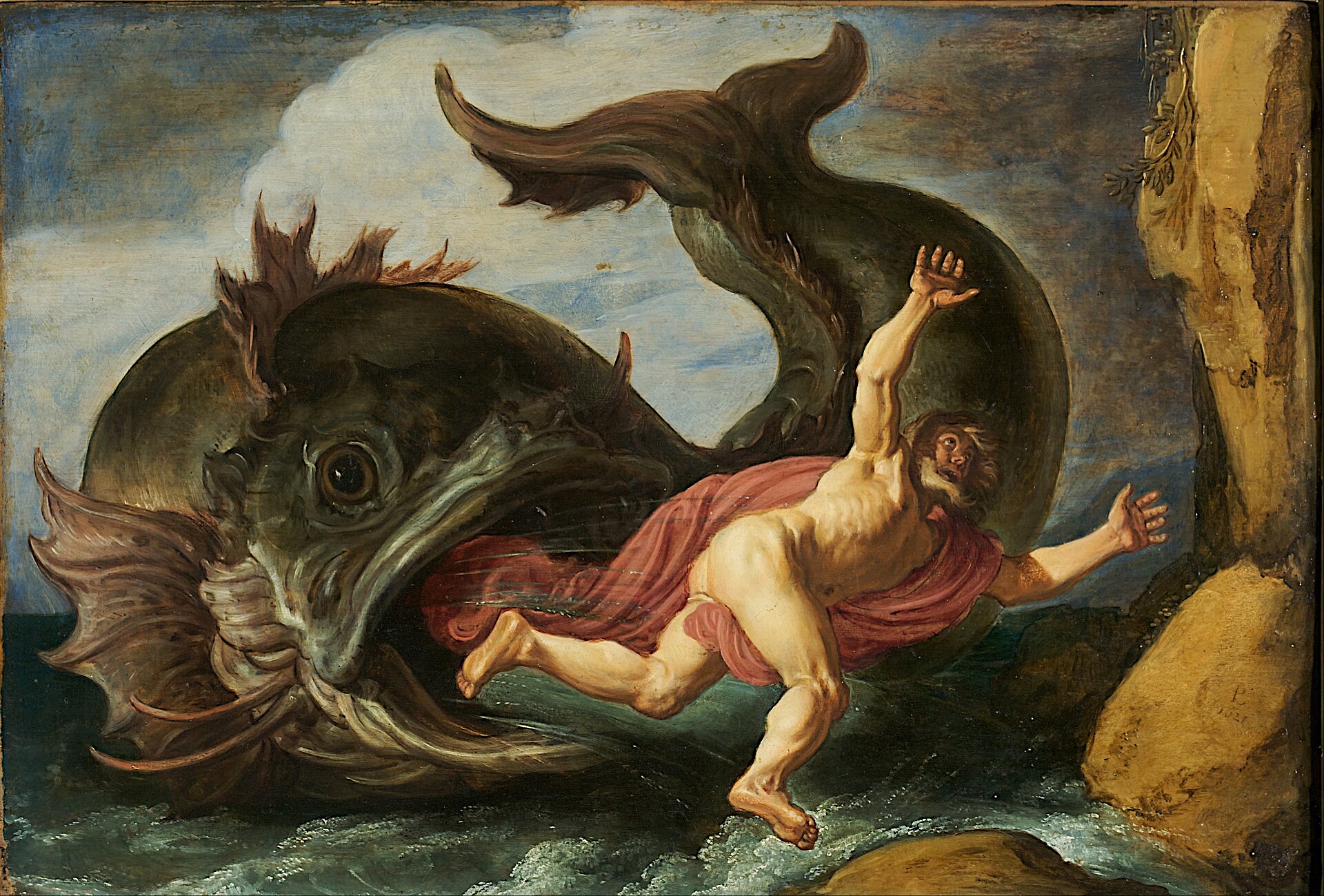
| Jonah and the Whale Pieter Lastman | Painted in 1621 by Rembrandt's teacher, who died in 1633 A biblical sea story by the master Rembrandt left after about six months. No source consulted says the Storm responds to it. | Museum Kunstpalast, Dusseldorf |
| The Raising of the Cross Rembrandt van Rijn | Painting of 1632-33 that the Corpus names, with the Storm, as showing brushwork like the underlying first version of another picture Corpus II A 69. The Corpus makes no claim of date, commission or shared underpainting. | Munich |
| Portraits of Marten Soolmans and Oopjen Coppit Rembrandt van Rijn | Full-length pendant portraits of 1634, a year after the Storm, and the best recent market comparison for a Rembrandt of the 1630s Bought jointly in 2015 and 2016 for 160 million euros for the pair, according to Wikipedia. A portrait pair is not a narrative picture and the comparison is only one of scale. | Rijksmuseum, Amsterdam and Musee du Louvre, Paris, jointly owned |
Open questions
- Who commissioned or first bought the picture in the 1630s, and what is the true sequence of owners before Jacob Jacobsz Hinloopen? The Gardner's chain begins with a possible Tymen Jacobsz Hinloopen who died in 1637 and is dated 1644; the Rembrandt Research Project's note says Houbraken probably confused Jan and Jacob Jacobsz Hinloopen; and Wikipedia's page on Specx dates his ownership to 1651 against the museum's 1653. The Corpus II A 68 provenance section, which the Corpus V note cites, was not read.
- How did the picture pass from the buyer J. Wubbels at the Braamcamp sale of 31 July 1771 to John Hope? The Gardner's provenance names both and gives no link. Corpus V records a J. Wubbels buying at other Amsterdam sales in the 1770s, in 1773 and April 1778, and nothing in the sources consulted says whether he was a dealer.
- What did Wertheimer and Colnaghi pay for this picture inside the 121,550 pounds paid for the 83 Hope pictures, and who bore which share? The Gardner's price of 6,000 pounds is a resale price and the dealers' cost for this single picture is not published in the sources consulted.
- Where did the picture hang in Boston between September 1898 and the opening of Fenway Court in 1903? The sources consulted say only that it was catalogued in the 1903 Fenway Court catalogue, and no photograph of it before 1903 was found.
- Is the figure who looks out of the boat Rembrandt, and who first said so? The museum's catalogue words it as a resemblance and its audio walk as a fact. The Corpus II entry, where the Rembrandt Research Project would have taken a position, could not be read for this record.
- What is the physical condition of the canvas? The Gardner's audio walk describes deep gashes in the wood supports and the thieves cutting the canvas out of its frame, and nothing is published about the condition of the paint layer before or after. A 1985 to 1986 re-examination by John Walsh is listed in the museum's bibliography and was not read.
- Where is the picture now? The FBI said in 2013 that the art was transported to the Connecticut and Philadelphia regions in the years after the theft and that it had not identified where it was then. A former FBI agent said in 2026 that he has no doubt the works still exist. No source consulted gives a location, and the FBI National Stolen Art File entry for the picture could not be retrieved. These statements are about the thirteen works as a group, and no source places the Storm itself in either region.
- Does the Corpus fifth volume's tentative proposal, that the Storm could possibly also have originated in the same context as the series of prints it discusses at that point, rest on anything beyond similarities in the small works it mentions? The authors cite no commission or inventory, and none links the picture to any such series.
Questions about this object
What is Christ in the Storm on the Sea of Galilee?
Christ in the Storm on the Sea of Galilee is a painting, dated 1633. Medium: Oil on canvas.
Who made Christ in the Storm on the Sea of Galilee, and is the attribution settled?
The attribution to Rembrandt van Rijn is recorded here as accepted. Signed and dated 1633 on the rudder, and catalogued by the Rembrandt Research Project as number II A 68 in volume II of its Corpus (1986) and again in the Corpus survey of 2014, both of which the Gardner Museum cites in its own bibliography. No source consulted disputes the attribution. The picture cannot now be re-examined: it has been out of reach of every laboratory since 18 March 1990, so the last laboratory studies this record could identify, Walsh's of 1985 and 1986 and the Corpus II entry of 1986, predate the theft, and the Corpus II entry itself could not be read for this record.
Where is Christ in the Storm on the Sea of Galilee now?
Unlocated. Stolen from the Isabella Stewart Gardner Museum, Boston, on 18 March 1990 and not recovered. The Museum is the last recorded owner and no source consulted records any transfer of title. Inventory number P21s24. Last confirmed 8 October 2026. Theft reported 18 March 1990. The Museum's theft page is headed 'Active and Ongoing Investigation', and in January 2018 the Museum said its 10 million dollar reward was extended; the current theft page promises 'a share of the reward' and gives no amount.
What has Christ in the Storm on the Sea of Galilee sold for?
Hammer Not stated. The Gardner gives 'for 4360 guilders' without saying whether that is hammer or total; with premium, Not recorded in the sources consulted. Amsterdam sale of the collection of Gerrit Braamcamp, 1771-07-31.
What is still unknown about Christ in the Storm on the Sea of Galilee?
Who commissioned or first bought the picture in the 1630s, and what is the true sequence of owners before Jacob Jacobsz Hinloopen? The Gardner's chain begins with a possible Tymen Jacobsz Hinloopen who died in 1637 and is dated 1644; the Rembrandt Research Project's note says Houbraken probably confused Jan and Jacob Jacobsz Hinloopen; and Wikipedia's page on Specx dates his ownership to 1651 against the museum's 1653. The Corpus II A 68 provenance section, which the Corpus V note cites, was not read.
Sources
- 1Isabella Stewart Gardner Museum, collection record for Christ in the Storm on the Sea of Galilee, P21s24: description, signature, labels, the full provenance with the 1898 price of 6,000 pounds, commentary by Michael Zell and bibliography. Read through the Internet Archive copy, because the live page is behind a bot challenge. gardnermuseum.org/experience/...
- 2Isabella Stewart Gardner Museum, 'Isabella Stewart Gardner Museum Theft': the museum's account of the night of 18 March 1990 and the list of the thirteen works. Primary, museum. gardnermuseum.org/about/...
- 3Isabella Stewart Gardner Museum, Theft Audio Walk, transcript (March 2020), narrated by Anthony Amore with Nathaniel Silver: times, the thieves' route, the Dutch Room, the Self-Portrait left behind, the 10 million dollar reward. Primary, museum. gardnermuseum.org/sites/...
- 4Holly Salmon, 'The Five Frames Left Behind', Isabella Stewart Gardner Museum blog, 15 March 2022, updated March 2025: the frame of the Storm, its labels and alterations and the repair of the five frames. Primary, museum. gardnermuseum.org/index.php/...
- 5Isabella Stewart Gardner Museum, press release, January 2018, 'Board of Trustees Extends $10 Million Reward for Return of 13 Works of Stolen Art': the 1997 rise from 1 to 5 million dollars, the 2017 rise to 10 million and the extension. Primary, museum. gardnermuseum.org/node/...
- 6FBI, 'Reward Offered for Return of Stolen Gardner Museum Artwork', 18 March 2013 (published as '$5 Million Reward Offered for Return of Stolen Gardner Museum Artwork'): statements by Richard DesLauriers and Anthony Amore. The FBI site returns 403 to scripted requests, so the page was read through an Internet Archive copy. fbi.gov/news/...
- 7Matt Pearce, Los Angeles Times, 'FBI says it knows who pulled off unsolved 1990 Boston art heist', 18 March 2013: the full DesLauriers statement and the remarks of the United States Attorney, Carmen Ortiz, on the statute of limitations. latimes.com/nation/...
- 8Associated Press via WBUR, 'Gardner Museum Doubles Reward For Stolen Artwork To $10M', 23 May 2017: the doubling of the reward, its deadline and the FBI's 2015 statement to the AP that two suspects were deceased. wbur.org/news/...
- 9Edmund H. Mahony, Hartford Courant, 5 September 2017, report on the Connecticut federal sentencing of Robert Gentile, as hosted by the United States District Court for the District of Connecticut. Press report of court proceedings; the paragraphs on Gentile are attributed in the text to the Courant and to prosecutors. ctd.uscourts.gov/sites/...
- 10Edmund H. Mahony, Hartford Courant, 28 February 2018, report on the sentencing, 54 months on gun charges, as hosted by the United States District Court for the District of Connecticut. ctd.uscourts.gov/sites/...
- 11Leah Willingham, Associated Press via PBS NewsHour, 'What to know about the world's largest art heist from a Boston museum', 26 April 2026: Geoff Kelly's book, the Reuters photograph of the frame reinstalled in March 2025, the statute of limitations, the Dutch Room. pbs.org/newshour/...
- 12CBS Boston, 'Isabella Stewart Gardner Museum in Boston marks 36 years since historic unsolved heist', 18 March 2026: Geoff Kelly's account and the title Thirteen Perfect Fugitives. cbsnews.com/boston/...
- 13GBH (WGBH), '34 years after Gardner heist, the museum's director of security is still on the case', 18 March 2024, Anthony Amore interviewed on the reward, Philadelphia and the search. wgbh.org/news/...
- 14Lloyd Schwartz, 'Christ In The Storm On The Sea Of Galilee, By Rembrandt Van Rijn', WBUR Last Seen, 15 September 2018: a description of the picture, the Matthew passage and the self-portrait remark. wbur.org/lastseen/...
- 15Ernst van de Wetering and others, A Corpus of Rembrandt Paintings V: Small-Scale History Paintings (Springer, 2011), full text on the Internet Archive. Used for the figure captions naming II A 68, the comment on a rarely depicted subject, the Hoogstraten passage, the lead-white underpainting note and the footnote on Houbraken and the two Hinloopens. Scholarly; the Corpus II entry itself was not consulted. archive.org/details/...
- 16Arnold Houbraken, De groote schouburgh der Nederlantsche konstschilders en schilderessen, I (1718), life of Rembrandt, DBNL edition: the St. Pieters scheepje passage (p. 260), the cheese and bread passage and the remark on freedom (p. 273). dbnl.org/tekst/...
- 17Isabella Stewart Gardner Museum, collection record for A Lady and Gentleman in Black, P21s9: the price of 13,000 pounds, September 1898 and the descent through the Hope family. Read on 8 October 2026 through the Internet Archive copy requested as web.archive.org/web/2024/ plus the museum URL. gardnermuseum.org/experience/...
- 18Isabella Stewart Gardner Museum, collection record for Self-Portrait, Age 23, P21n6: the price of 3,000 pounds and the commentary on Gardner's four Rembrandts and the more than eighty surviving self-portraits. Read on 8 October 2026 through the Internet Archive copy requested as web.archive.org/web/2024/ plus the museum URL. gardnermuseum.org/experience/...
- 19Isabella Stewart Gardner Museum, collection record for Landscape with an Obelisk, P21w24: the price of 4,500 pounds in March 1900. Read on 8 October 2026 through the Internet Archive copy requested as web.archive.org/web/2024/ plus the museum URL. gardnermuseum.org/experience/...
- 20Wikipedia, 'The Storm on the Sea of Galilee'. Used for the Walsh and Unverfehrt attributions, the Luke reading and the (erroneous) dollar price; each use is attributed in the text. en.wikipedia.org/wiki/...
- 21Wikipedia, 'Hope Collection of Pictures'. Used for the 83 pictures, the South Kensington display of 1891 and the 121,550 pound sale of 1898. en.wikipedia.org/wiki/...
- 22Wikipedia, 'Francis Pelham-Clinton-Hope, 8th Duke of Newcastle'. Used for the marriage of 1894, the bankruptcy of 1896 and the sale of the pictures. en.wikipedia.org/wiki/...
- 23Wikipedia, 'Jacques Specx'. Used for his office, his death on 22 July 1652 and the statement that the Storm belonged to him in 1651. en.wikipedia.org/wiki/...
- 24Wikipedia, 'Gerrit Braamcamp'. Used for his trades, the date 31 July 1771 and the sale catalogue title. en.wikipedia.org/wiki/...
- 25Wikipedia, 'Thijmen Jacobsz Hinlopen'. Used for his dates, 1572-1637, and the whaling company. en.wikipedia.org/wiki/...
- 26Wikipedia, 'John Hope (banker)'. Used for John Hope's trades and dates. en.wikipedia.org/wiki/...
- 27MeasuringWorth, Purchasing Power of the Pound calculator, result for 6,000 pounds of 1898 in 2024: 901,500 (retail price index), 3,335,000 (labour earnings), 5,430,000 (relative income), 10,140,000 (share of output) and 854,300 (real project cost). Retrieved 8 October 2026. measuringworth.com/calculators/...
- 28MeasuringWorth, Computing Real Value Over Time With a Conversion Between U.K. Pounds and U.S. Dollars (Officer and Williamson), result for 6,000 dollars of 1898: 1,240 pounds, implying about 4.84 dollars to the pound. Retrieved 8 October 2026. measuringworth.com/calculators/...
- 29Wikipedia, 'Rembrandt'. Used for dates, apprenticeships, the move to Amsterdam, Uylenburgh, the early Amsterdam manner and the self-portrait count. en.wikipedia.org/wiki/...
- 30Wikipedia, 'Hendrick van Uylenburgh'. Used for the studio, 1631 and Saskia. en.wikipedia.org/wiki/...
- 31Wikipedia, 'Pieter Lastman'. Used for his dates and his teaching of Rembrandt. en.wikipedia.org/wiki/...
- 32Wikipedia, 'Jan Porcellis'. Used for his dates, his tonal manner and the statements that Rembrandt collected his pictures and that the ship was read as a metaphor of the soul. en.wikipedia.org/wiki/...
- 33Wikipedia, 'Calming the storm'. Used for the three Gospel references, the Mark text and the quoted devotional reading of Justus Knecht. en.wikipedia.org/wiki/...
- 34Wikipedia, 'Oopjen Coppit'. Used for the 160 million euro joint purchase of the 1634 pendants and the 20 million pound Portrait of a Foreign Admiral of 2009. en.wikipedia.org/wiki/...
- 35Tufts University Museum Studies blog, 'The Contested Legal Legacy of the Isabella Stewart Gardner Museum', 4 March 2022: the terms of Gardner's will. sites.tufts.edu/museumstudents/...
- 36Wikimedia Commons file page for the lead plate, Rembrandt Christ in the Storm on the Lake of Galilee.jpg (public domain, 3002 x 3731 px, credited to gardnermuseum.org), with the page of the alternative file "Rembrandt - Christ in the Storm on the Sea of Galilee.jpeg" (4274 x 5315 px, credited to a Boston Globe opinion page) and the RKD art-work number 46845. commons.wikimedia.org/wiki/...
- 37Wikimedia Commons file page for the Rijksmuseum print RP-P-1980-56, Adriaen Collaert after Maerten de Vos, with the Rijksmuseum's description (Mark 4:35-41, 8 of 12, published by the Sadelers, Antwerp, 1583-1588). commons.wikimedia.org/wiki/...
- 38Wikimedia Commons file page for the FBI photograph of the Dutch Room with the empty frame of the Storm, released by the Federal Bureau of Investigation on 18 March 2013 (public domain). commons.wikimedia.org/wiki/...
- 39National Arts Program Foundation, 'Gardner art heist masterpieces have been sighted, FBI agent says', 22 May 2014, a reprint of a Fox News report quoting FBI agent Geoff Kelly and stating that authorities have said there is no market for the art. nationalartsprogram.org/news/...
- 40Wikipedia, 'Isabella Stewart Gardner Museum theft'. Used only for the statements that the museum carried no theft insurance and that the empty frames remain because of Gardner's will. en.wikipedia.org/wiki/...

_Vita_I._Christi_(serietitel),_RP-P-1980-56.jpg)

Last verified · Published
Change log
8 October 2026 - Record created at the house standard: researched narrative, technical evidence, maker dossier, graded provenance chain, prices with hammer and premium separated, related works, open questions and sources.