The Queen the Hours Are Said to Be Made For
Her will says King Charles had the little prayer book made for Madame. What documents show Jeanne d'Evreux ordered, owned and left, and what is only inference.
Records in this piece: The Hours of Jeanne d'Evreux, Queen of France, The Rothschild Prayerbook
On this page 6 sections
ContentsClose
In short
- Jeanne d'Evreux's will, as quoted in the Met's 1971 Bulletin, says King Charles had the little prayer book made for her, so the document that links her to it names her husband as the orderer.
- Delisle's 1907 edition of Charles V's inventories shows her as a real collector: a flyleaf note records her gift of the Psalter of Saint Louis in 1369, and at least seven catalogue entries name her or carry her arms, and a Breviary copied and illuminated for her came to him as well.
- The tie between the Cloisters Hours and the queen's will rests on a lost cover, a crowned praying figure and a bequest we have seen only in quotation. The 1971 Bulletin calls the identification questionable, and says the Cloisters book is probably not the one in the will either, since it is not a petit livret d'oroisons.
- The book has no coat of arms in it, while a prayer book made for Bonne of Luxembourg carries hers thirteen times, so ownership here is shown by a kneeling figure and not by heraldry.
Her own will says the king ordered it
The queen's own will names her husband as the man who had the little prayer book made, and names her as the woman it was made for. That one sentence changes the usual story. The Hours of Jeanne d'Evreux is often described as her commission. The only document that ties her to the book says otherwise.
Jeanne d'Evreux was born in 1310, married Charles IV of France in 1325 and was widowed in 1328. She died in 1371. In her will she left Charles V "un bien petit livret d'oroisons que le roy Charles, dont Diex ait l'ame, avoit faict faire por Madame, que pucelle enlumina." The Metropolitan Museum's Bulletin of February 1971 translates it as a very little book of prayers which King Charles, God rest his soul, had made for Madame, which Pucelle illuminated. Charles V reigned from 1364 to 1380, so he was king when she died, and he is the man the will leaves the book to. That is why the King Charles who ordered it has to be her husband, Charles IV.
So the will gives us an orderer (King Charles, meaning her late husband), a recipient (Madame, whom the usual reading takes to be the queen herself) and an illuminator (Pucelle). It does not say she paid. It does not say she chose the pictures. We read the will only as quoted in the 1971 Bulletin and in a Wikipedia article that repeats the same wording. We have not seen the text of the will itself, and we do not know where its edition is printed.
A book small enough to hold in one hand
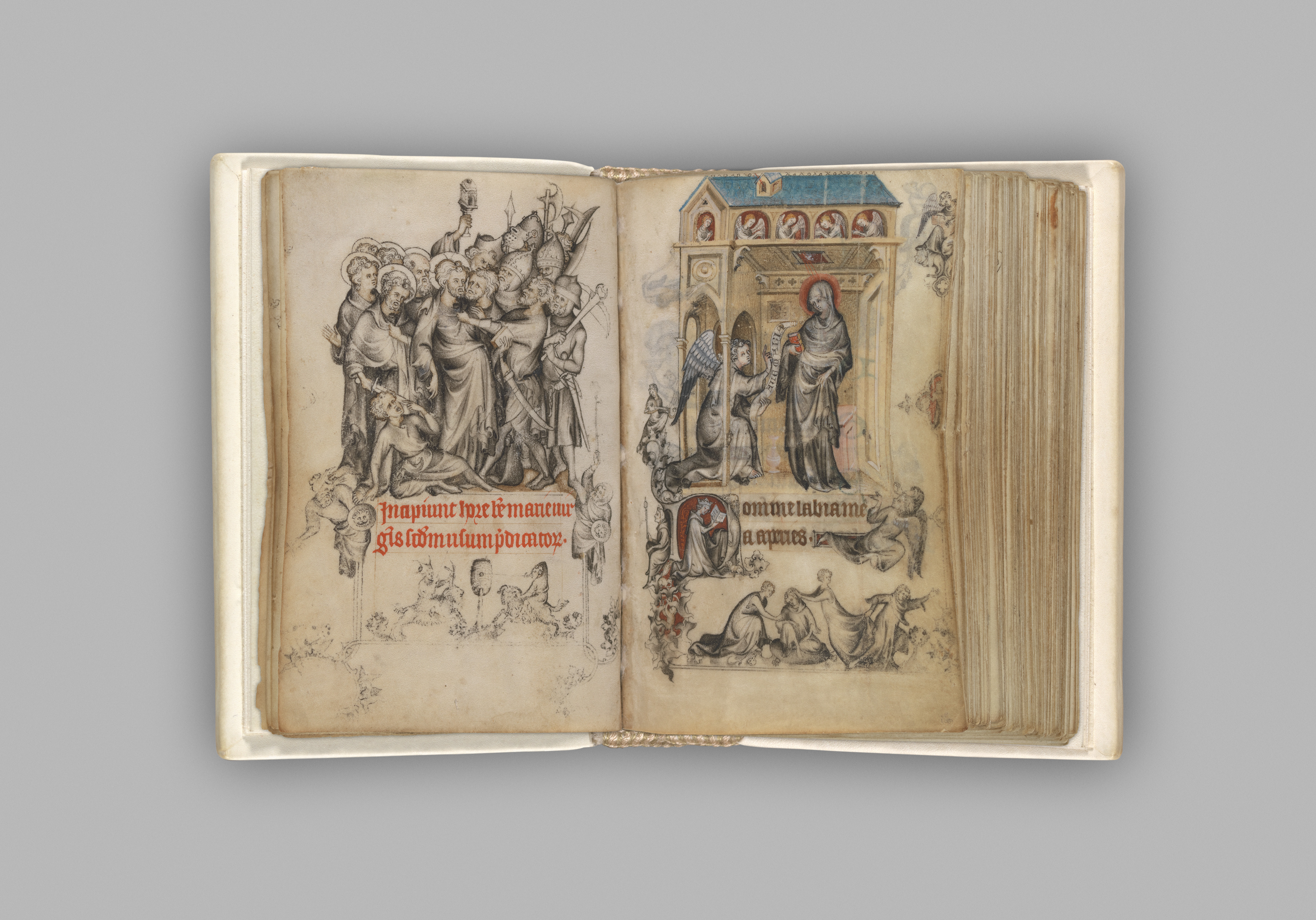
The book was made to be held by one person. Each leaf measures 9.2 by 6.2 centimetres, there are 209 leaves, and the Bulletin counts ten pages of text without illumination. That last count matters for patronage. A book made at royal expense and left with ten plain pages and a calendar full of mistakes looks unfinished, or hurried.
The calendar is the clearest sign. The 1971 Bulletin counts fifteen saints on the wrong day and more than thirty misspelled names. Elizabeth Haight Flinn, who wrote that piece, also notes that the calendar leaves out saints canonised between 1305 and 1325, including Thomas Aquinas in 1323. A book made for a queen married in 1325 should have known about them. The Bulletin does not claim this proves the book was not hers. It goes further on the will. In its words the Cloisters manuscript is "probably not the one mentioned in the queen's will either, since it is not a petit livret d'oroisons." Blum's distinction, which the next section sets out, is the reason.
The praying woman on folio 102 verso
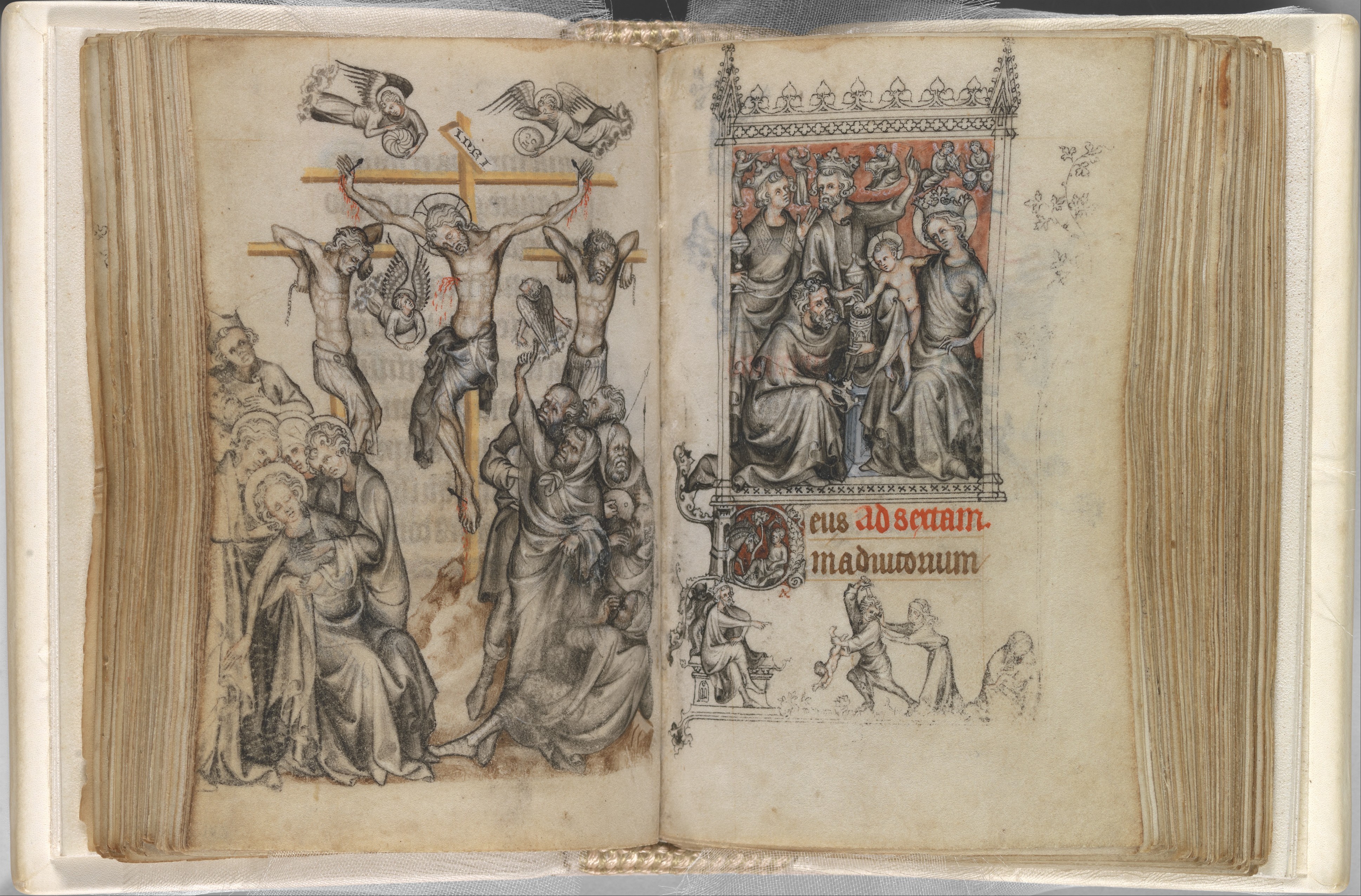
Two miniatures show a woman at prayer, and that is the nearest the book comes to a portrait of its owner. The Bulletin says the praying woman beneath the Annunciation on folio 16 appears again on folio 102 verso, where her devotion is directed to Saint Louis. The discussion of that page is Jeffrey Hoffeld's in the same Bulletin, and he gives two readings of the two men at the saint's feet: Rorimer's, that they are cured of blindness at his tomb, and another, that they are armed guards of a lifelike Louis standing on his tomb lid.
On the folio 102 verso page we looked at, a crowned woman stands in a niche at the left with her hands raised, while a crowned Louis stands over two seated men. She wears a crown, which suggests a queen. Flinn takes the two figures as pointing to a royal commission. That is an inference from the image. No caption, inscription or coat of arms names her.
Compare the book Deuchler discusses in the same Bulletin, a prayer book made for Bonne of Luxembourg, first wife of John II and mother of Charles V. Her arms appear thirteen times in its pages. The Hours of Jeanne d'Evreux has no arms in it at all, though her arms do appear in her Breviary and in the Coronation Book of Charles IV and Jeanne, as the Bulletin says. The owner of this book is shown by a kneeling figure and nothing else.
What she is documented to have owned and handed on
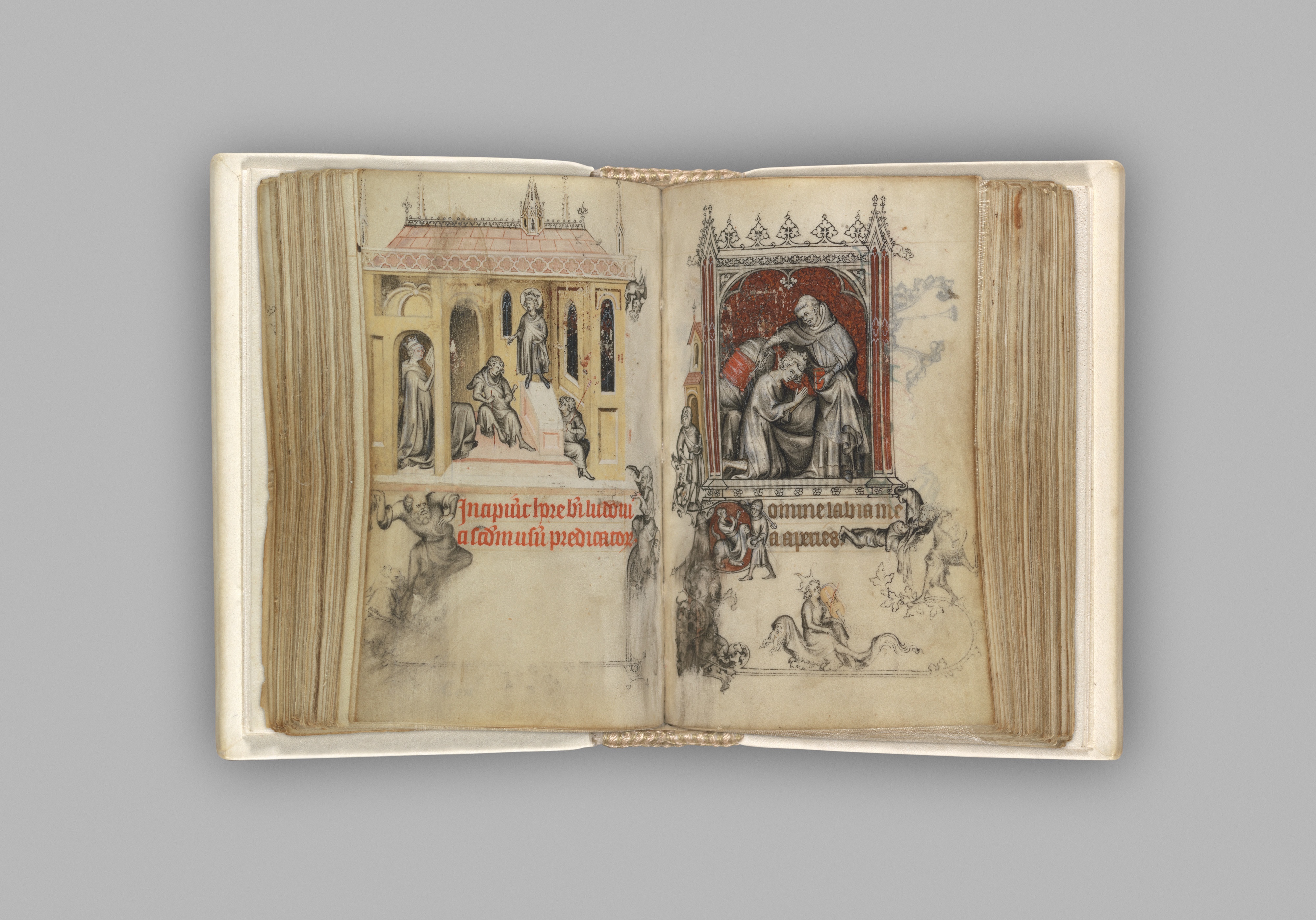
The strongest evidence that Jeanne d'Evreux was a patron of books is in Charles V's inventories, not in the Hours. Leopold Delisle's 1907 study of Charles V's library prints several entries that name her or carry her arms. We read them in the raw scanned text of both volumes.
The Psalter of Saint Louis, now Bibliotheque nationale de France latin 10525, is the best-documented gift. Delisle prints a note on its flyleaf: this psalter was Saint Louis's, and Queen Jeanne d'Evreux gave it to King Charles, son of King John, in the year 1369. Charles V's inventory of 1380 describes it with two gold clasps, one enamelled with the arms of France and one with those of Evreux. The note was written after 1380, since it mentions Charles VI, so it records that she gave the book. It does not show her reasons.
The table lists what Delisle prints in his catalogue entries. The second column is our English paraphrase of Delisle's transcription of the medieval wording.
| Delisle entry | What the entry says | What it shows |
|---|---|---|
| 101 | A fully illustrated Bible that was the queen's | She owned it |
| 110 | A compilation made on the model of a book that was hers | Her book served as an exemplar |
| 164 | A missal with clasps enamelled with her arms and those of Marie of Brabant | Two queens' arms; no order is recorded |
| 188 | Gospel book and epistle book with silver-gilt covers, enamelled with her arms | Her arms on the covers |
| 244 | A book with an embroidered cover in her arms, Hours in the Dominican use | The entry Wikipedia assumes is the Cloisters Hours |
| 338 bis | The Mirror for Ladies, which was the queen's, with silver clasps in her arms | She owned it |
| 372 | A devotional book that was the queen's | She owned it |
Delisle also prints a Breviary, item XXII in his first volume (pages 185 to 187), as copied and illuminated with great care for Queen Jeanne d'Evreux, with some 1,330 initials carrying her arms. It reached Charles V, and entry 153 in his second volume is the same book with a clasp in her arms. That is the nearest the inventories come to a book made for her, and it is a Breviary, not the Hours. Seven entries in one library is a pattern. It still falls short of a commission. A coat of arms on a clasp shows whose book it was. It does not show who paid the goldsmith, and entry 164 carries two queens' arms at once.
Entry 244 and why the match is shaky
The 1380 inventory entry 244 is where the Cloisters Hours and the queen meet, and it does not settle the question. Wikipedia assumes the link, and the 1971 Bulletin never mentions the 1380 inventory. The entry describes a book with an embroidered cover from which the pearls had been removed, bearing the arms of Queen Jeanne d'Evreux, with Our Lady on one side and the Annunciation on the other, containing Hours in the use of the Jacobins and two gold clasps. It stood in the king's study at Vincennes.
The Dominican use fits the Cloisters book. The cover does not help, because that cover is gone: the Cloisters binding is a later replacement, red morocco of the seventeenth century with the Chatelet arms, according to the Bulletin. The entry gives no size and no illuminator.
Flinn lists the doubts. Rudolf Blum, she writes, pointed out that medieval people distinguished little hours of Our Lady from a little book of prayers, so the Hours of Pucelle in the Duke of Berry's inventories and the livret in the queen's will are probably not the same object as each other. At most one of them is the Cloisters book. Her conclusion reads that tying the manuscript to either Queen Jeanne or the Duke of Berry seems questionable, and that the intended owner remains a mystery. Deuchler, in the same issue, writes that he is personally inclined to think that identifying the book in the will with the small volume now at The Cloisters "seems to be a fiction."
Delisle in 1907 put the Hours of Pucelle in a different place again. In an appendix on the books of King John II he lists it among manuscripts attached to the name of Bonne of Luxembourg, then in the hands of the Baroness Adolphe de Rothschild. He refers to another work of his for the reasoning, and we have not read it.
What 'patron' can and cannot mean here
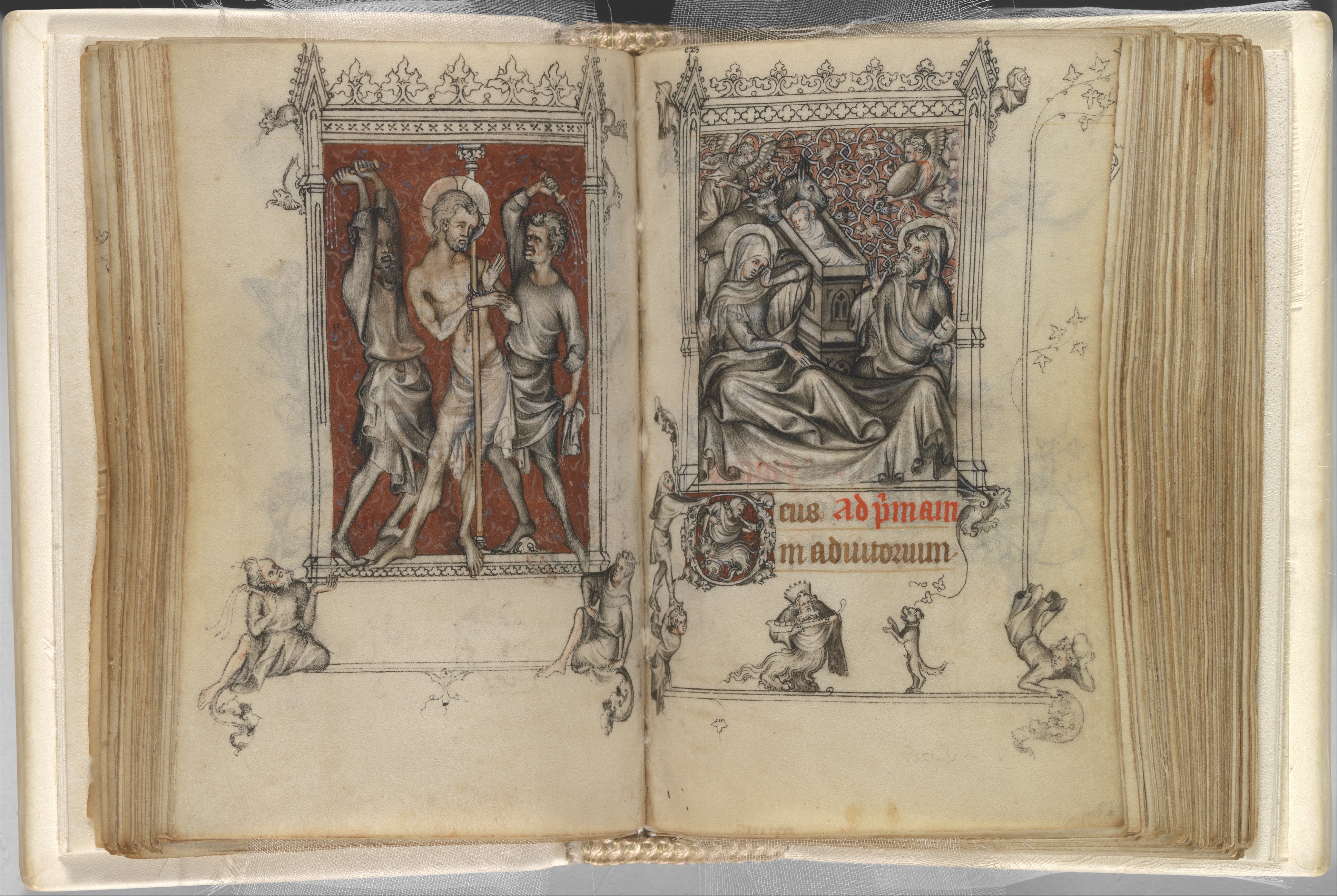
What the documents allow us to say is narrower than the legend. Jeanne d'Evreux owned a small prayer book that her husband had made for her. She kept it for more than forty years of widowhood and left it to Charles V, if the will's livret is this book. She gave Charles V the Psalter of Saint Louis in 1369. She owned or marked at least six other books and objects that reached his collection.
The inferences are these. The praying woman is the queen. The Cloisters manuscript is the book in her will. The entry in the 1380 inventory is the same book. Each is plausible, and the Bulletin's authors doubt the second and third. Each also rests on pictures, on a cover that no longer exists and on one sentence from a will we have only seen quoted.
What we cannot supply is her inner life. No source we read says what she thought of the book, whether she asked for particular scenes or whether she minded that the calendar was wrong.
The price, the order and the workshop contract have not turned up in anything we read. If someone holds the will's edition or a transcription of the royal accounts, those are the three documents that would change this piece.
Questions
The only document tying her to the book, her will as quoted in the Metropolitan Museum's 1971 Bulletin, says King Charles had it made for her. It names her husband as the orderer and her as the recipient. No document we read shows her ordering or paying for it.
We know she left a little prayer book to Charles V by her will. Charles V's 1380 inventory lists a book with her arms and Dominican-use Hours, which Wikipedia assumes is the Cloisters manuscript. The 1971 Bulletin calls the identification questionable, and Deuchler is inclined to think it seems to be a fiction.
Delisle prints a flyleaf note recording that she gave him the Psalter of Saint Louis in 1369. Charles V's 1380 inventory lists that psalter with clasps enamelled with the arms of France and of Evreux.
The Bulletin of 1971 reads her that way, and on folio 102 verso she wears a crown. It is an inference from the image. No inscription or coat of arms in the book names her.
Sources
- 1Elizabeth Haight Flinn, 'A Magnificent Manuscript: A Historical Mystery', and Florens Deuchler, Jeffrey M. Hoffeld (on folio 102 verso), 'Jean Pucelle: Facts and Fictions', The Metropolitan Museum of Art Bulletin 29, no. 6 (February 1971). Read as raw OCR text of the Internet Archive copy: the will quotation, the size and folio counts, the calendar errors, the two praying figures, Blum's distinction and the discussion of Bonne's prayer book. archive.org/details/...
- 2Leopold Delisle, Recherches sur la librairie de Charles V, vol. 1 (Paris, 1907): the flyleaf note on the Psalter of Saint Louis (BnF latin 10525), the Breviary of Queen Jeanne (item XXII, pp. 185-187), the Bonne of Luxembourg appendix. Read as raw OCR text. archive.org/details/...
- 3Leopold Delisle, Recherches sur la librairie de Charles V, vol. 2 (Paris, 1907): catalogue entries 101, 110, 164, 188, 244, 338 bis and 372 entry 153 (the Breviary) and the 1380 inventory of jewels. Read as raw OCR text. archive.org/details/...
- 4The Metropolitan Museum of Art, Open Access API record for object 470309, The Hours of Jeanne d'Evreux, Queen of France, accession 54.1.2: public-domain flag true, 209 additional images, dimensions and credit line. collectionapi.metmuseum.org/public/...
- 5Wikipedia, 'Hours of Jeanne d'Evreux', read as wikitext: repeats the will quotation and cites Flinn; used to confirm the will's wording and as the source of the assumed link between 1380 inventory entry 244 and the Cloisters Hours, not as an independent source. en.wikipedia.org/wiki/...
More in The Women Behind the Art
The partWho Stitched the Bayeux Tapestry? What the Documents Say About English Women's Embroidery
No document names who stitched the Bayeux Tapestry. What Domesday, the 1476 inventory and the Queen Matilda story show about English women's...
The Two Women in the Oseberg Ship, and the Queen Nobody Named
Two women lay in the Oseberg ship in 834. What the bones, isotopes and DNA show, and how a queen and a servant were read into a grave that no text...
The Name on the Rim: What Documents Say About Projecta
The Projecta Casket names its bride in one line of Latin. What the British Museum, Dalton 1901, an epitaph and Parliament say about her, and what is...