The Publisher Was the Sitter
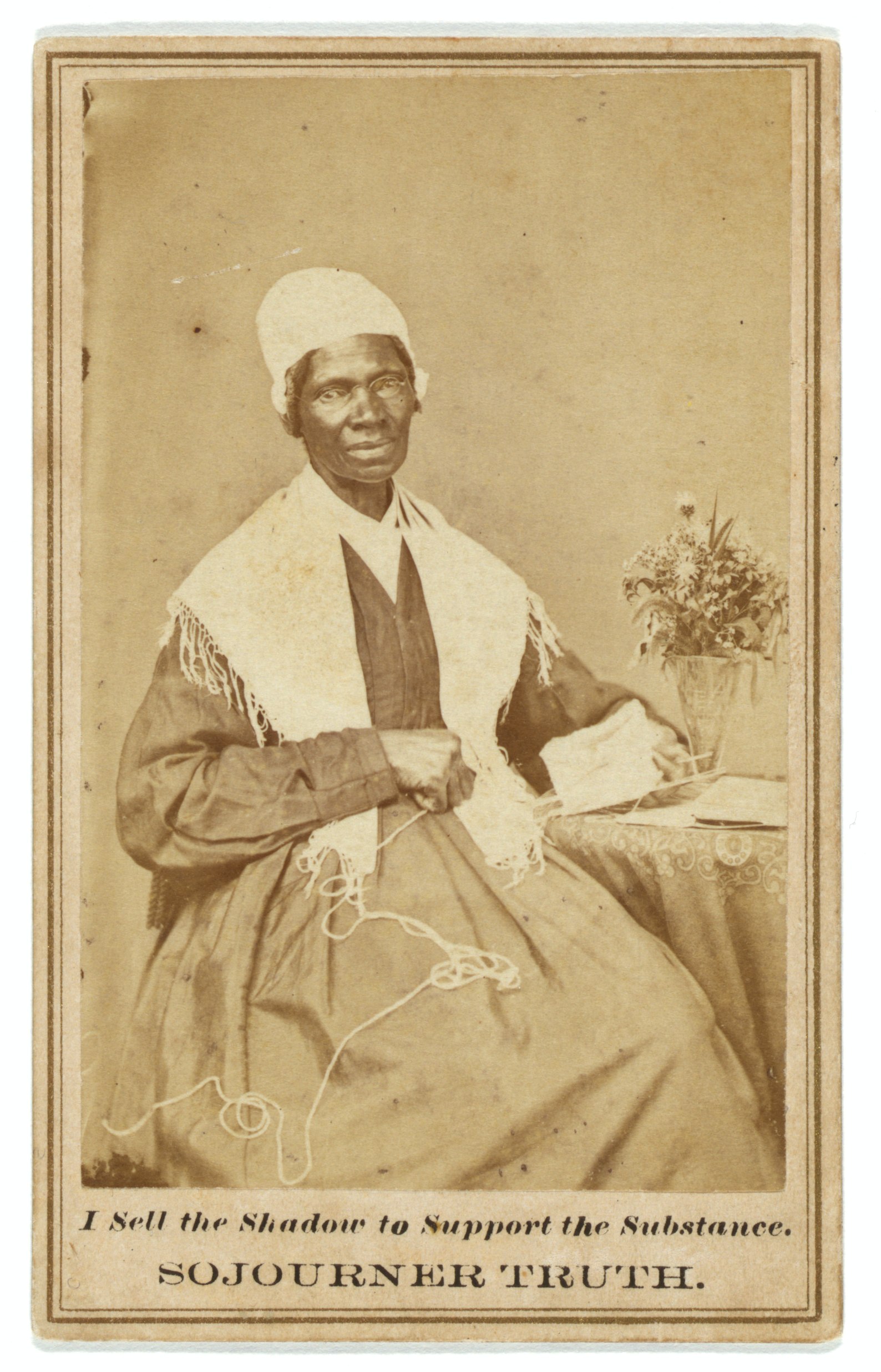
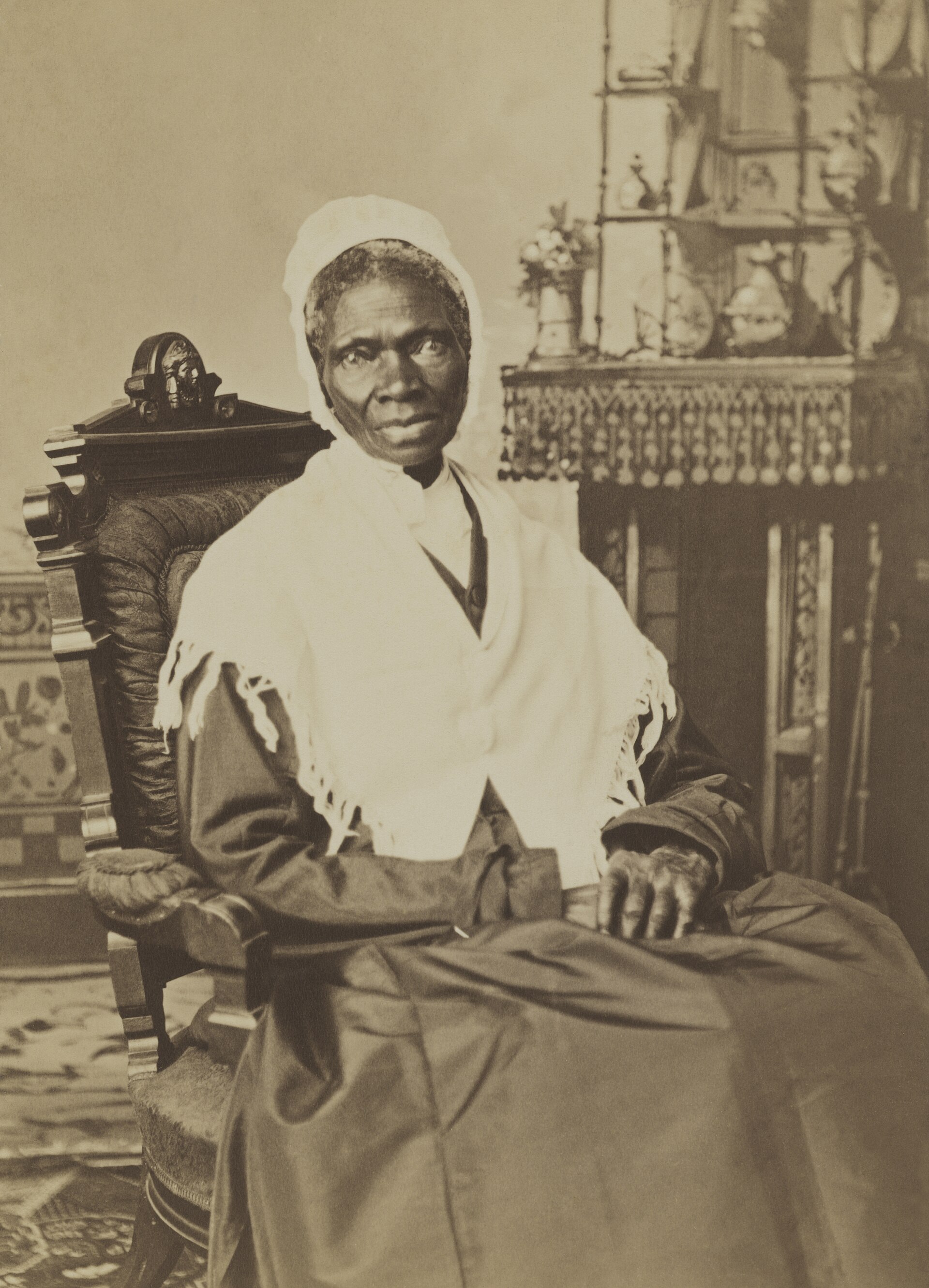
Truth sold her own cartes de visite, registered the copyright in her own name and left the photographer unnamed. In 1864 there was no copyright in photographs to take.
Records in this piece: Carte-de-visite of Sojourner Truth, Sir John Herschel
On this page 6 sections
ContentsClose
In short
- The trade was running seven months before the copyright. On 4 July 1863 the National Anti-Slavery Standard printed her mail-order terms, fifty cents and a three-cent stamp, letters to Battle Creek, Michigan. The February 1864 registration hardened a going concern rather than starting one.
- What she registered was not a photograph. The entry of 16 February 1864 covers the title of an engraving, because photographs had no protected category of their own in United States law until the Act of 3 March 1865.
- Our reading, marked as ours: the photographer is anonymous because she took the space. Her name and caption occupy the part of the mount where a studio imprint belonged, and most institutions holding these cards record no photographer at all. What the sources state, rather than imply, is that Frederick Douglass had a hundred and sixty portraits made between 1841 and 1895 and, unlike Truth, let the photographer's name be printed instead of his own.
- The price is genuinely unsettled and the margin is unknown. Published figures run from twenty-five to fifty cents and two of them descend from the same scholar. No source reached states what a card cost her to have made.
- Her one instrument in her own name is this one. Eleven years later the copyright of her own book was entered in the name of her white manager, Frances W. Titus, at Washington.
- The claim our record made for her was slightly too large. She is the only known sitter of the period to hold copyright in her own photographic likeness, registered under the engraving category, not the only person other than a studio: cartes of the child Fannie Virginia Casseopia Lawrence were copyrighted in 1863 in the name of the woman who had bought her freedom.
The business was running seven months before the copyright
Sojourner Truth was selling photographs of herself by post, at a published price, in the summer of 1863. A dispatch in the National Anti-Slavery Standard of 4 July 1863, written on the occasion of her grandson James Caldwell enlisting in the 54th Massachusetts, closes with the terms of trade. The sentence survives through one modern source, the exhibition text Darcy Grimaldo Grigsby wrote for Berkeley in 2016, and we have found no second witness to the price itself: readers are told that Sojourner will send her photograph by mail to anyone who writes to her enclosing fifty cents and a three-cent stamp, and that letters are to be directed to Battle Creek, Michigan.
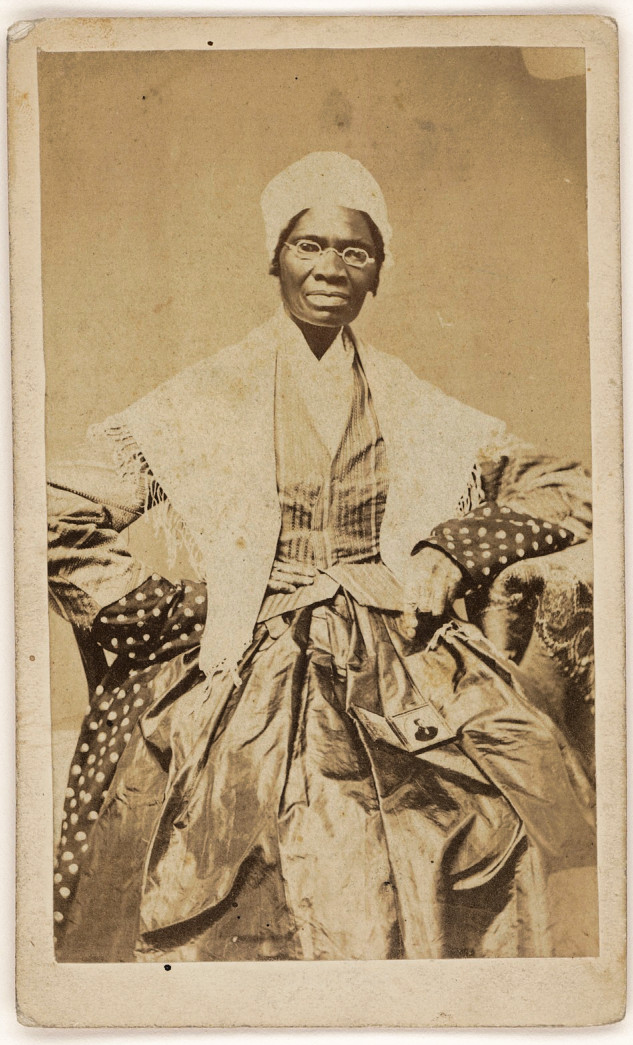
That matters because the copyright is easy to mistake for the beginning of the story. It was not. The registration of 16 February 1864 came more than seven months after the mail-order price was in print, which makes it an instrument brought in to protect an existing operation. The scholarship goes further in the same direction: Darcy Grimaldo Grigsby, whose Enduring Truths is the fullest study of these cards we could reach, establishes that Truth announced the copyright in a letter published before she had actually filed it.
The selling was systematic and the press she cultivated reported it as such. Notices reprinted in her own Book of Life tell readers not to forget that she has photographs of herself for sale, describe them as her only means of support for the expenses of travel, livelihood and a humble home in Michigan, then record on separate occasions that many of her photographs were purchased and that a number of persons went forward and bought copies.
What she registered was not a photograph
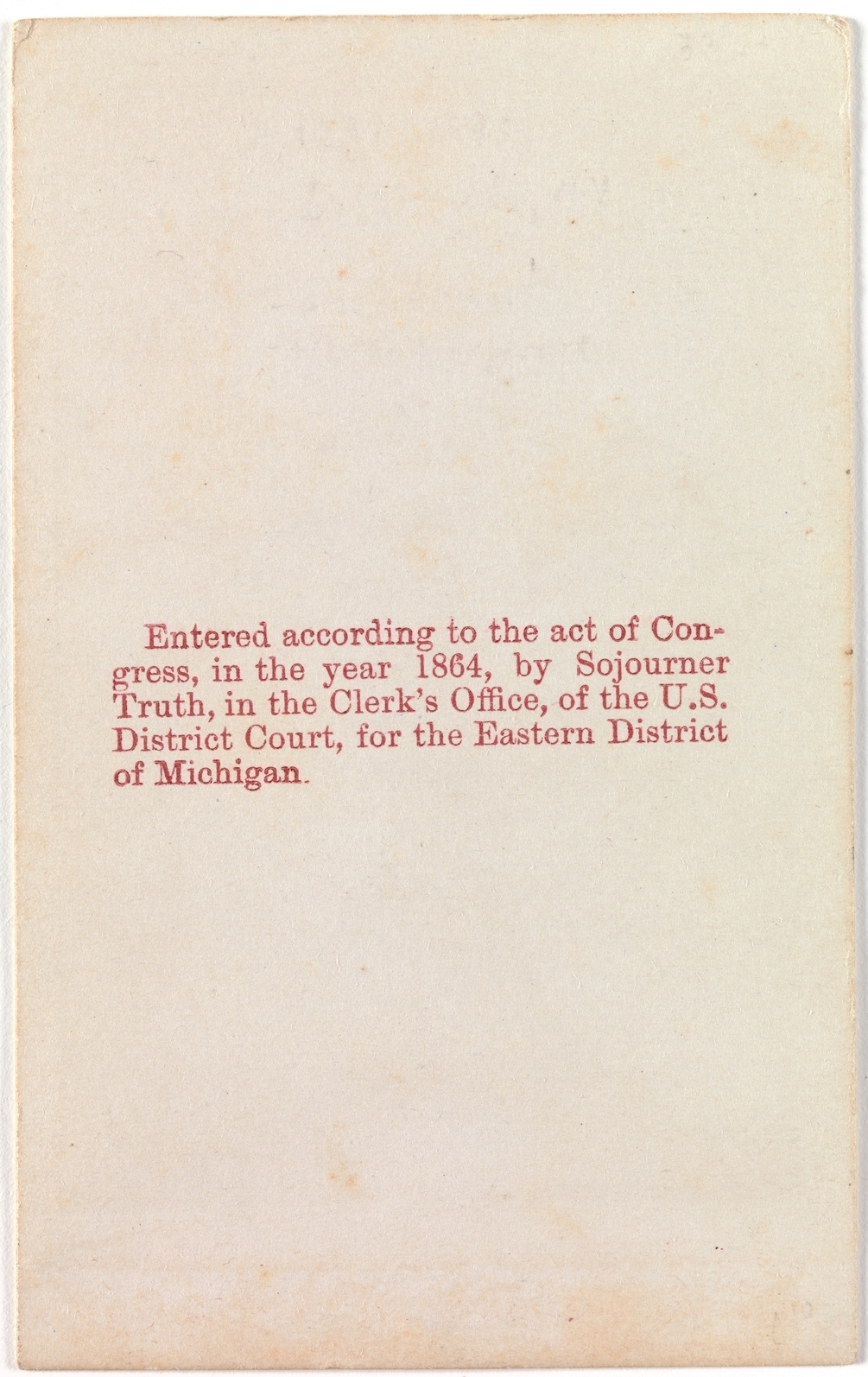
The copyright Sojourner Truth took out in February 1864 does not cover a photograph, because in February 1864 there was no photographic copyright in the United States to take. The entry, made in the Clerk's Office of the United States District Court for the Eastern District of Michigan at Detroit, is for the title of an engraving, and the title it protects is the thing printed on the card: a picture of Sojourner Truth, I sell the Shadow to Support the Substance, Sojourner Truth. Photographs were not brought into the protected categories until the Act of 3 March 1865, just over a year later.
So the legal object she owned was a form of words and an image described as an engraving, filed by a woman who could not read the form. That is not a technicality to be smoothed over. It is the shape of the thing she actually held, and it is more interesting than the version in which she simply copyrighted her photograph, because it shows somebody using the only category the statute offered.
The caption and the copyright line arrived together as one commercial package. Grigsby's finding is that the textual additions to the cards happened all at once, so that any card carrying her name and caption carries her copyright and the reverse holds too. The physical evidence agrees. On the Smithsonian's card 2018.17.12 the front reads I Sell the Shadow to Support the Substance, Sojourner Truth, and the back carries the notice entered according to the act of Congress in the year 1864, by Sojourner Truth, in the Clerk's Office of the US District Court for the Eastern District of Mich.
Our reading: the photographer has no name because she took the space
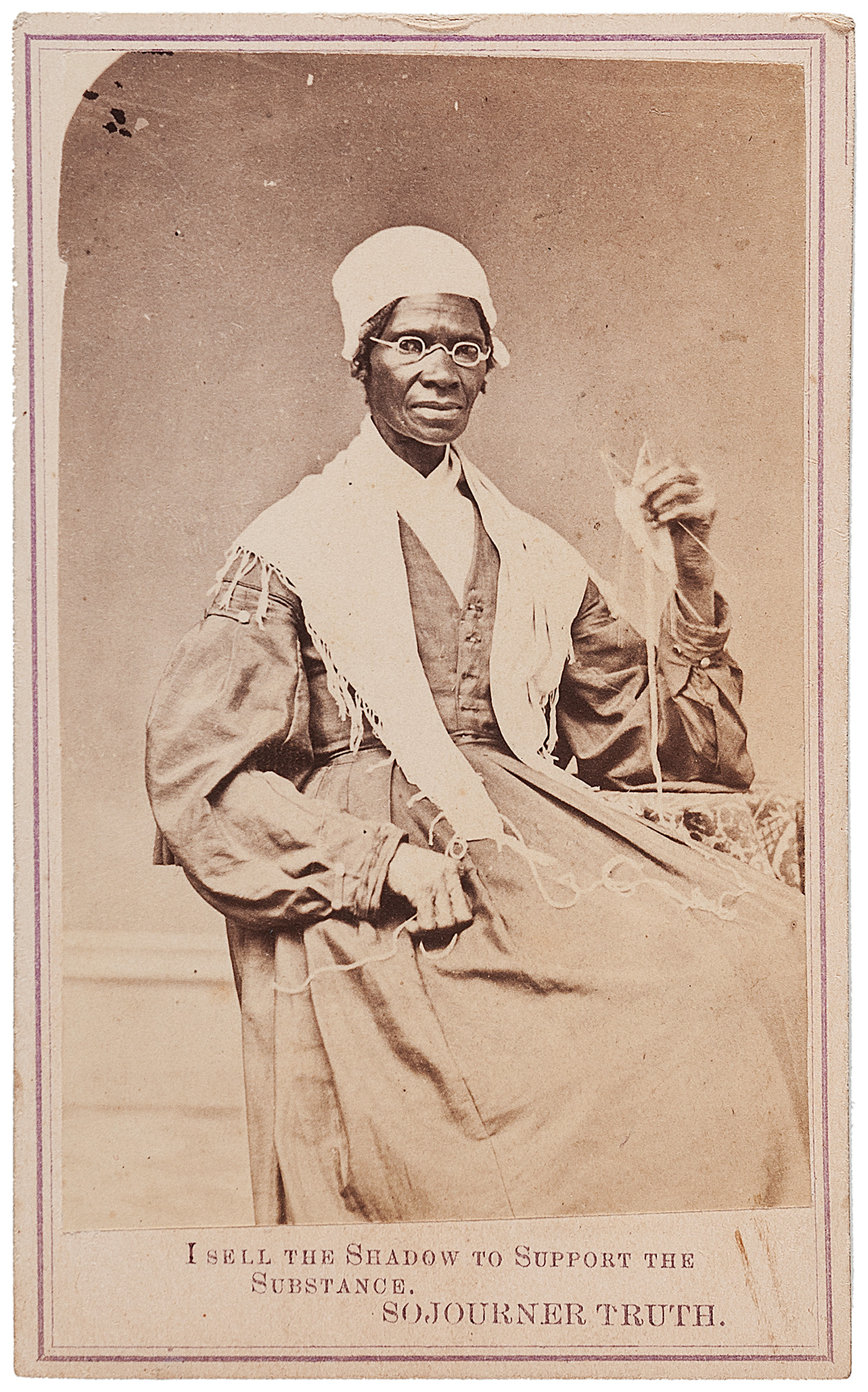
On an ordinary carte de visite of the 1860s the bottom of the mount carries the studio's imprint, and on Truth's captioned cards that space carries her caption and her name instead. The consequence is visible in every modern catalogue. The Metropolitan Museum explicitly records the artist of its 1864 card as Unknown. The Library of Congress record for the Gladstone carte and the Smithsonian's own NMAAHC record for 2018.17.12 simply carry no photographer field at all. The Art Institute of Chicago is the exception and names S. C. Wright as a collaborator. That this was a choice rather than an archival accident is our reading and not a statement any source makes, so we mark it as ours; what the sources do carry is the comparison that makes it legible. Frederick Douglass had a hundred and sixty portraits made between 1841 and 1895 and, like most sitters and unlike Truth, allowed the photographer's name to be printed at the bottom of the card instead of his own.
Only two studios can be attached to her cards at all, and neither attaches to the one this archive holds. The firmest is the Randall Studio of Detroit: the National Portrait Gallery's record NPG.79.220 gives Randall Studio, dates the object to 1864 and printed about 1870, and catalogues it as a cabinet card rather than a carte de visite, so it is not from the captioned carte series at all. The gallery's own attribution carries a question mark on the studio's dates, active 1865 to 1875 with a query, against an object dated 1864. The softer attribution is to Wright's New York Gallery in Battle Creek, which survives as a mount imprint on a card formerly with an auction house, alongside the Art Institute of Chicago's description of its own 1864 to 1865 card as made by Truth in collaboration with S. C. Wright.
Set beside the other woman in this archive who registered her own photographs, the difference is the direction of the claim. Julia Margaret Cameron registered 508 of her photographs at Stationers' Hall as the photographer, which is the ordinary way round: the maker of the image owns it. Truth registered as the sitter, and left the maker of the image unnamed. She was, in trade terms, the publisher of the card, and no source we reached names the maker of the image on it.
The price, the tax stamp and the figure nobody has
Three published figures for what a card cost are in circulation and they do not agree. The honest summary is a range of twenty-five to fifty cents, with the mail price at the top of it and a warning that the sources are not independent of each other: Grigsby stands upstream of at least two of them.
| Figure | Amount | Where it comes from |
|---|---|---|
| Mail order, July 1863 | 50 cents plus a 3-cent stamp | National Anti-Slavery Standard, 4 July 1863 |
| Sold in person | 25 to 50 cents each | United States Copyright Office, reading Grigsby |
| Sold in person | 25 cents | Kathleen Collins, History of Photography, 1983, publisher abstract only |
| Federal tax stamp on a surviving card | 2 cents | Jackie Clay, exhibition review in Panorama, 2017 |
| Retail price a 2-cent stamp implies | 25 cents or less | The 1864 to 1866 photograph tax schedule |
| Cards she sent against a remittance of 2 dollars | 4 | Truth's own dictated letter, Book of Life, page 180 |
| What a card cost her to have made | Not established | No source found |
The tax stamp looks like the most objective of these and it is the shakiest. The Berkeley text records a tax stamp on one of two known cards carrying caption, name, copyright and stamp, but gives no denomination. The only published statement that it is a two-cent stamp is in Jackie Clay's review of that exhibition, and Clay's next sentence calls the stamps postage stamps, which is a different thing from a revenue stamp. The inference below rests on that one loose word. Under the photograph tax in force from 1 September 1864 a two-cent stamp corresponds to a retail price of twenty-five cents or less, with three cents covering twenty-six to fifty. The same guides note that the duty could be assessed on a whole order with one stamp affixed to a single card of the batch, so a two-cent stamp brackets the price rather than fixing it.
Two primary letters show the trade working at the retail end and both show it working loosely. Truth's own dictated letter from Freedman's Village in Virginia says, enclosed please find four shadows, the two dollars came safely. A customer writing from 53 Broadway in New York on 17 January 1868 sends one dollar and asks for as many of your photographs as the money will pay for, adding that if there are two or three different ones he would like one of each. A buyer who has to ask how many a dollar buys is a buyer who has not been told a unit price.
What the money was for is on the record in period print, though the notices about the house do not themselves mention the cards. One reprinted notice says she is trying to pay off a mortgage on her little house in Battle Creek, and another gives what she was working to clear in her later years: it is encumbered with a mortgage of nine hundred dollars, and to clear this place of debt she is now on a visit to her friends. The Copyright Office ties the earlier phase of the selling to raising money for the First Michigan Colored Infantry. And the cards were not her first paper business. In her own recollection, printed in the memorial chapter added to the 1884 edition of her Narrative, she sold printed songs before she sold photographs, for five and ten cents apiece, and William Lloyd Garrison sold a good many of the little songs for her.
Her own, and where that phrase runs out
Truth could not read or write, and the paperwork of her own business was therefore handled by other named people. Nine days after the registration she was in Detroit, where her friend Euphemia Cockrane wrote a letter for her to Mary R. Gale, and the Library of Congress's own exhibition record states plainly that Truth was illiterate and engaged Cockrane to write it. In another letter she names her reader: Sammy, my grandson, reads for them. Whether Truth or an agent physically carried the deposit into the clerk's office at Detroit is not established.
None of that takes the instrument out of her hands, and the reason it does not is a comparison inside her own affairs. In 1875 the Narrative of Sojourner Truth with the Book of Life appended was published, and its title page enters the copyright according to Act of Congress in the year 1875 by Mrs Frances W. Titus, in the Office of the Librarian of Congress at Washington. Titus was her white manager and amanuensis. Her book was registered in somebody else's name. The 1864 card is the one property instrument of her life that stands in her name alone, which is a fair measure of how deliberate it was.
Three things our own record had wrong
This article was written against our record for the card, and the research found three defects in it, all corrected in the same push. The most serious is an attribution. Our record said that the Library of Congress's own account states that Truth captioned, marketed, placed under copyright and sold at least eleven different carte-de-visite portraits of herself. The sentence is real and the count is real, but it is not the Library of Congress's. It belongs to the Library Company of Philadelphia, in its object record for its own captioned carte, and its verb is copyrighted rather than placed under copyright.
The reason this matters beyond tidiness is that a second and different eleven exists, in the United States Copyright Office post we also cite, and that one says something else entirely: that Truth sat for portraits at least eleven times. One is a count of captioned copyrighted cards, the other a count of sittings across her whole carte career, and they are not interchangeable. Our record had effectively merged them under the wrong institution's name. Both are now stated separately and the Library Company is credited. The standing flag on that Copyright Office source, which said the page could not be opened and had been reconstructed from search-engine text, is also discharged: it has now been read in full in an Internet Archive capture.
The second defect is a claim that was a little too large. Our record called her copyright the only known instance of a sitter of that era, rather than a studio, holding copyright in her own photographic image. The sitter claim stands. The wider one does not: cartes de visite of the child Fannie Virginia Casseopia Lawrence were copyrighted in 1863 in the name of the woman who had bought her freedom, so a person other than a studio holding the copyright was not unprecedented. What is unprecedented, so far as anyone has shown, is the sitter holding it herself.
The third is a date. Our record described the Randall Studio portrait as a later, separate sitting from Truth's final decade. The National Portrait Gallery dates its own print to 1864 and printed about 1870, places the studio in Detroit, and catalogues the object as a cabinet card rather than a carte de visite. It is a late print of an early negative, and it is not from the captioned carte series at all.
Questions
She registered a copyright in her own name on 16 February 1864, in the Clerk's Office of the United States District Court for the Eastern District of Michigan at Detroit. Strictly it was not a photographic copyright, because photographs were not a protected category in United States law until the Act of 3 March 1865. The entry covers the title of an engraving, the title being the caption printed on the card.
Between twenty-five and fifty cents, and the sources do not agree on a single figure. Her published mail-order terms of 4 July 1863 were fifty cents plus a three-cent stamp. Figures of twenty-five cents and twenty-five to fifty cents appear in the scholarship, and they are not independent of each other. A surviving card carries a two-cent federal tax stamp, which under the 1864 schedule implies a retail price of twenty-five cents or less.
In almost every case nobody knows, and that appears to have been her choice. Her name and caption occupy the part of the mount where a studio imprint would normally be printed, The Metropolitan Museum explicitly records the artist as Unknown, while the Library of Congress and the Smithsonian's NMAAHC simply carry no photographer field. The Art Institute of Chicago is the exception and names S. C. Wright as a collaborator. Only two studios can be named at all: the Randall Studio of Detroit, on the National Portrait Gallery's record for a cabinet card rather than a carte, and more softly Wright's New York Gallery of Battle Creek.
It paid for her travel and subsistence as a lecturer and for a house. Period notices reprinted in her Book of Life describe the photographs as her only means of support for travel, livelihood and a home in Michigan, and one gives the figure she was working to clear as a nine hundred dollar mortgage on the Battle Creek house. The Copyright Office connects the earlier phase of the selling to raising money for the First Michigan Colored Infantry.
The shadow is the photograph and the substance is the living woman who needs feeding, housing and moving from one lecture to the next. The sentence is a price tag and a statement of ownership at once, and it is the legally registered title of the work rather than a motto added to it. Transcriptions differ slightly between holding institutions in capitalisation and punctuation, so it is worth quoting from a named object.
Sources
- 1Marilyn Creswell, 'Sojourner Truth and the Power of Copyright Registration', United States Copyright Office blog, 8 December 2020, read in full in an Internet Archive capture of 17 December 2025 after loc.gov returned a bot wall at every fetch rung. Used for the registration of 16 February 1864, the verbatim entry text covering the title of an engraving, the in-person price of twenty-five to fifty cents, the sentence that Truth sat for portraits at least eleven times and the connection of the earlier selling to the First Michigan Colored Infantry. Detroit as the place of filing comes from source 4, not from this post. web.archive.org/web/...
- 2Narrative of Sojourner Truth, a Bondswoman of Olden Time ... with a History of her Labors and Correspondence drawn from her Book of Life, Boston, published for the author, 1875, full text. Used for the dictated letter from Freedmen's Village enclosing four shadows against two dollars received (page 180), the customer letter of 17 January 1868 from 53 Broadway sending one dollar (pages 206 to 207), the reprinted notices on selling photographs at lectures and on the nine hundred dollar mortgage, a related Stickney letter of 14 April 1863 in the Appendix at pages 321 to 324, signed Phebe H. M. Stickney, which reports Caldwell's enlistment but carries no price, and the title page entering the copyright in the name of Mrs Frances W. Titus. This volume does NOT contain the 4 July 1863 mail-order sentence, which rests on source 3 alone. archive.org/download/...
- 3Darcy Grimaldo Grigsby, exhibition brochure text for 'Sojourner Truth, Photography, and the Fight Against Slavery', Berkeley Art Museum and Pacific Film Archive, 2016, reproduced in full with object captions. Used for the mail-order terms of fifty cents and a three-cent stamp printed in the National Anti-Slavery Standard of 4 July 1863, the tax stamp, without a denomination, on one of two known cards carrying caption, name, copyright and stamp, the comparison with Frederick Douglass allowing the photographer's name to be printed, and the 1863 copyright on the cartes of Fannie Virginia Casseopia Lawrence in the name of the child's redeemer Catherine S. Lawrence. artblart.com/2016/...
- 4Bauman Rare Books catalogue entry for an 1864 captioned Sojourner Truth carte de visite, quoting Darcy Grimaldo Grigsby, Enduring Truths: Sojourner's Shadows and Substance, University of Chicago Press, at pages 63 to 64. Used for the filing of the copyright at Detroit on 16 February 1864, for Grigsby's finding that Truth claimed her property rights in advance of the copyright in a letter of 3 February 1864, and for her finding that the name, caption and copyright were added to the cards all at once. baumanrarebooks.com/rare-books/...
- 5Smithsonian National Museum of African American History and Culture, catalogue description of carte de visite 2018.17.12 with full recto and verso transcription, read in a mirrored copy after si.edu returned a bot wall. Used for the recto reading I Sell the Shadow to Support the Substance, Sojourner Truth and the verso copyright notice naming the Clerk's Office of the US District Court for the Eastern District of Mich. digital.pitts.emory.edu/s/...
- 6National Portrait Gallery, Smithsonian Institution, object record NPG.79.220, Sojourner Truth, Randall Studio, active 1865 to 1875, albumen silver print, dated 1864 and printed about 1870, place given as Detroit, Wayne County, Michigan. Read in a browser after a direct fetch returned 403. Used to correct our own record's description of the Randall image as a later sitting and to establish that the only firmly named studio in her cartes is in Detroit. npg.si.edu/object/...
- 7Metropolitan Museum of Art, object 301989, Sojourner Truth, 'I Sell the Shadow to Support the Substance', 1864, artist recorded as Unknown, and Art Institute of Chicago object 238249, an 1864 to 1865 card described as by Sojourner Truth in collaboration with S. C. Wright. Used for the cataloguing of the photographer as unknown across holding institutions and for the softer Wright attribution. collectionapi.metmuseum.org/public/...
- 8Anthony J. Cavo, 'The Civil War Sun Picture Tax', Antique Trader, on the photograph tax in force from 1 September 1864 to 1 August 1866, giving a two-cent stamp for images costing up to twenty-five cents and three cents for twenty-six to fifty, with the caveat that the duty could be assessed on a whole order and a single stamp affixed to one card of a batch. antiquetrader.com/collectibles/...
- 9Library of Congress, African American Odyssey exhibition, Civil War section, read in an Internet Archive capture, stating that Truth was illiterate and engaged her friend Euphemia Cockrane to write her letter of 25 February 1864 to Mary R. Gale from Detroit. web.archive.org/web/...
- 10Library of Congress, Prints and Photographs Division, catalogue record for the Gladstone Collection carte de visite, item 98501244, recording the credit as Copyright 1864 by Sojourner Truth with no photographer named. Read in an Internet Archive capture. web.archive.org/web/...
- 11Jackie Clay, exhibition review of 'Sojourner Truth, Photography, and the Fight Against Slavery', Panorama: Journal of the Association of Historians of American Art 3, no. 1, Summer 2017. The only published statement we reached that the surviving stamp is a two-cent one, in a passage that then refers to the stamps as postage stamps, which is why the price inference drawn from it is flagged in the text. Also used for the curators' view that Truth was unique in filing a copyright in her own name as sitter rather than photographer, and for the Douglass carte carrying the photographer's name in embossed script. journalpanorama.org/article/...
- 12Library Company of Philadelphia, Digital Collections, object record Islandora:3252, read in an Internet Archive capture because the live host refuses direct fetches. The true source of the sentence that Truth captioned, marketed, copyrighted and sold at least eleven different carte-de-visite portraits of herself at her lectures and through the mail, which our own record had attributed to the Library of Congress. web.archive.org/web/...
- 13Narrative of Sojourner Truth, 1884 edition with the memorial chapter, full text, for her own recollection of selling printed songs for five and ten cents apiece and of William Lloyd Garrison selling a good many of them for her. This passage is not in the 1875 volume cited at source 2. archive.org/download/...
- 14Smithsonian National Museum of African American History and Culture, object record 2012.46.11, read in an Internet Archive capture because si.edu refuses direct fetches. Used for the identification of the sitter's grandson as James Caldwell of Company H, 54th Massachusetts Infantry, for the daguerreotype on her lap and for the card's dimensions of 10.2 by 6.4 cm. web.archive.org/web/...
More in The Women Behind the Art
The partWhat the Opera Paid Marie van Goethem
The model for Degas's Little Dancer is documented in a payroll and two lines of his handwriting.
The Half That Was Not Sold
Vera Salomons inherited 57 of her father's Breguet watches. Her mother got the other seventy and they were auctioned.
The Picture Her Father Refused
The Peacock Room is built around a portrait of Christine Spartali that her own father declined to buy.