Lady with an Ermine (Portrait of Cecilia Gallerani)
Leonardo da Vinci · c. 1489-1491 (placed between c. 1485 and c. 1508 by different authors)
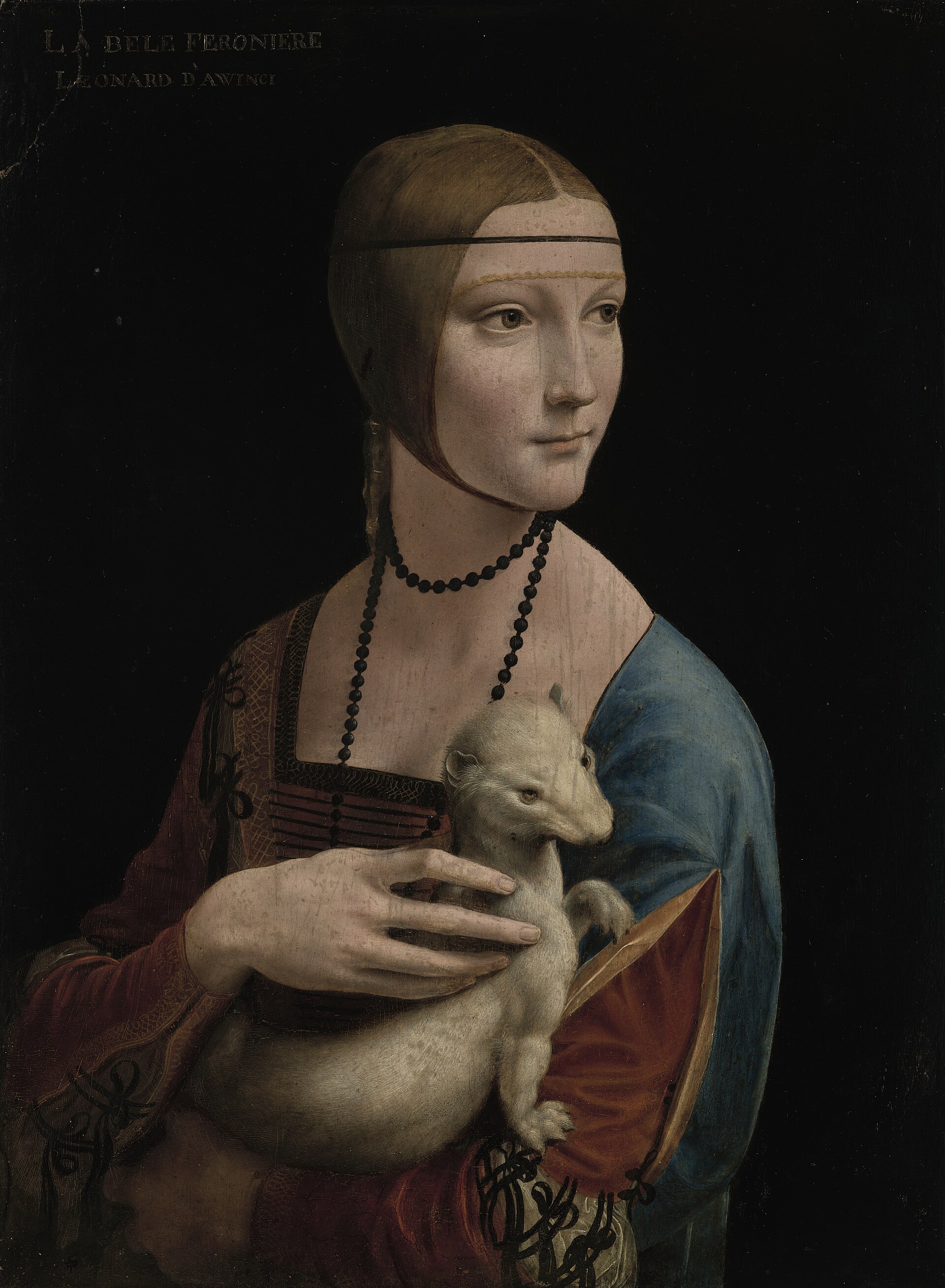
The whole picture, from the National Museum in Krakow's own digital collection (catalogue ID 157417). The black background is later overpaint; the original ground was a dark grey according to the museum's 2012 study.
| Artist | Leonardo da Vinci |
|---|---|
| Date | c. 1489-1491 (placed between c. 1485 and c. 1508 by different authors) |
| Medium | Oil on walnut panel (the museum's catalogue: mixed technique, oil and distemper), on a thin lead-white ground; black overpainted background |
| Dimensions | 53.4 x 39.3 cm (59.5 x 47.2 cm with the small frame), per the National Museum in Krakow; the panel measured c. 40.5 x 55 cm and 4-5 mm thick in 2012 |
| Where it is now | Princes Czartoryski Museum (a branch of the National Museum in Krakow), Krakow; second floor, gallery VII, permanent exhibitionlast confirmed |
| Inventory number | MNK XII-209 |
| Attribution | AcceptedAccepted by the holding museum and the standard Leonardo literature on the evidence of style, the pouncing and underdrawing, the lead-white ground and the handling, not from a document naming the painter for this panel; the museum says the authorship was known from the start. Full note |
| Object type | Painting |
| Period | Italian Renaissance, Milan, late fifteenth century |
| Cases | Has a provenance gap · Seized, looted or confiscated |
| Inscriptions | Upper left, in yellow paint over the black overpaint, a later inscription: LA BELE FERONIERE / LEONARD D'AWINCI (Pulawy, 1800-1809). On the back: label 134; C.EC. / DG.418.; and, at the foot, BURG / 1227. |
| Owners on record | 18 links12 documented, 4 disputed, 2 unknown |
| Sources | 44 cited |
About this record Last verified · 44 sources cited · Change log
On this page 11 sections
ContentsClose
A half-length portrait of a girl of about seventeen turning to look past the viewer, with a white animal in the crook of her arm, painted in oil on a single walnut board in Milan around 1490 and attached by most scholars, though by no document, to Cecilia Gallerani, the mistress of Ludovico Sforza. A portrait of her by Leonardo was in her hands in 1498, when Isabella d'Este borrowed it to compare Leonardo with Giovanni Bellini; the Krakow panel then leaves the record for about 300 years, nothing documenting its owners between 1498 and the purchase in Italy around 1800.
Prince Adam Jerzy Czartoryski bought it in Italy around 1800 for his mother's collection at Pulawy. It was hidden, taken to Paris, brought to Krakow, seized by the Germans in 1939, was in Hans Frank's hands during the war, probably at the Wawel, and was found in Bavaria in 1945. A 2012 museum study found the black background is later overpaint over a plain dark grey; Pascal Cotte's 2014 book, drawing on a 2007 multispectral scan, argued there was once no ermine at all, a thesis the museum's conservators reject.
No price for the picture alone is recorded. On 29 December 2016 the Polish state bought the whole Czartoryski collection, about 86,000 museum objects and 250,000 library items, for 100 million euros, an agreement signed that day according to the Ministry of Culture and Apollo. The picture is now on permanent view at the Princes Czartoryski Museum in Krakow.
Provenance
Each link is graded. Documented: a cited source supports it. Disputed: the identification is argued but not established. Unknown: no owner for that span, and the gap is not smoothed into a narrative. The grades in the glossary.
- c. 1489 - c. 1491Made at the court of Ludovico Sforza, Milan, for a sitter conventionally identified as Cecilia Galleranidisputed
Bucci writes that the portrait was wanted by Ludovico and executed by his favourite painter. No contract, payment or inventory entry for the picture is known. That the sitter is, as the title conventionally has it, Cecilia Gallerani is an inference widely shared but never documented, and the date is placed from 1485 to about 1508 by different authors.1311151
- c. 1491 - 1498Cecilia Gallerani (Countess Bergamina)disputed
In letters of 26 and 29 April 1498 Isabella d'Este asks to borrow, and Cecilia sends, a portrait of Cecilia by Leonardo. She is its owner and lender; Bucci says the picture remained her property. The letters do not describe the picture, so their link to the Krakow panel rests on the identification above.111213
- 1498 - 1498Isabella d'Este, Marchioness of Mantua (on loan)documented
Loan requested 26 April 1498 so that she could compare Leonardo with Giovanni Bellini; Cecilia replied 29 April; her third letter of 18 May answers Isabella's thanks. The Mantua catalogue says the painting was returned after about a month; the letters do not mention the return.11
- 1498 - c. 1536Cecilia Gallerani, presumably until her deathunknown
The 2015 museum paper says she probably owned it until her death in 1536 and cites Marani for the idea; there is no document. Her death date is itself not known (Bucci: 'around 1536').413
- c. 1536 - c. 1798Unknownunknown
No owner is documented for about 260 years. The 2015 paper reads the oak cradle, the partial cleaning and the black ground as work done to prepare it for sale in Italy before the Czartoryski purchase. The Monuments Men and Women Foundation says it came from the Giustiniani collection, without citing a source, and the museum says it was bought at an unknown place in Italy.2421
- 1798-1800 - 1801Prince Adam Jerzy Czartoryskidisputed
The purchase is recorded by the museum, but its date and circumstances are not settled. Bought in Italy in circumstances the museum calls unknown and given to his mother. The date is 1798 in Wikipedia and the 2007 AFP report, 1799 or 1800 in the 2015 paper and about 1800 in the museum's own pages. No price is recorded.24732
- c. 1801 - 1831Princess Izabela Czartoryska, Pulawy (Gothic House from 1809, no. 418)documented
Shown as a portrait of a woman in the manuscript catalogues and printed in her 1828 catalogue as no. 418; given the La Belle Ferronniere inscription at Pulawy between 1800 and 1809.2422
- 1831 - 1882Czartoryski family; hidden at Klemensow and Sieniawa, then at the Hotel Lambert, Parisdocumented
Removed after the fall of Pulawy in 1831; walled up at Sieniawa for eight years (the 2015 paper dates this 1832-40); the family bought the Hotel Lambert in 1843 and the collection reached Paris through Dresden in 1848-49. The museum says it was not exhibited there. Dates differ slightly between the museum's pages and the paper.24
- 1882 - 1914Princes Czartoryski Museum, Krakow (family property)documented
Moved to the museum the family had opened in 1876. English-language sources that say it reached Krakow in 1876 are giving the museum's founding date.2432
- 1914 - 1920Gemaldegalerie, Dresden (on deposit)documented
Sent for safe keeping in the First World War with the Raphael and Rembrandt. Hans Posse tried unsuccessfully to keep the collection in Germany (Monuments Men and Women Foundation).2421
- 1920 - September 1939Princes Czartoryski Museum, Krakowdocumented
Returned to Krakow in 1920; evacuated to Sieniawa in 1939.24
- September 1939 - autumn 1939German occupation authorities: Sieniawa, then Berlin (Muhlmann's office; Kaiser-Friedrich-Museum; a bank deposit box), reporteddisputed
The museum states that this picture was seized, with the Raphael and the Rembrandt, in a pre-planned looting and taken to Germany for the planned Linz museum. The Berlin stations come from the Monuments Men and Women Foundation's card on the Raphael, which treats the three paintings together and says they had 'likely' reached Muhlmann's Berlin office by November 1939, from post-war interrogations. The 2015 paper says only that the painting was exhibited in Berlin in 1939. Goering appointed Muhlmann on 6 October 1939.242021
- 1940 - 1945Hans Frank, Governor General of occupied Poland (Wawel Castle 1940, Breslau 1941, Wawel 1943, Seichau Castle 1944, Bavaria 1945)documented
The museum says the picture came into Frank's hands and was in his possession through the war, probably at the Wawel; the 2015 paper gives the stations. The foundation's card adds that in January 1945 Frank took twenty paintings with him to Bavaria, among them this one.2421
- 1945 - 1946Recovered by US forces in Frank's Bavarian villa; Monuments, Fine Arts and Archives officers; returned to Krakow via Nuremberg and the Waweldocumented
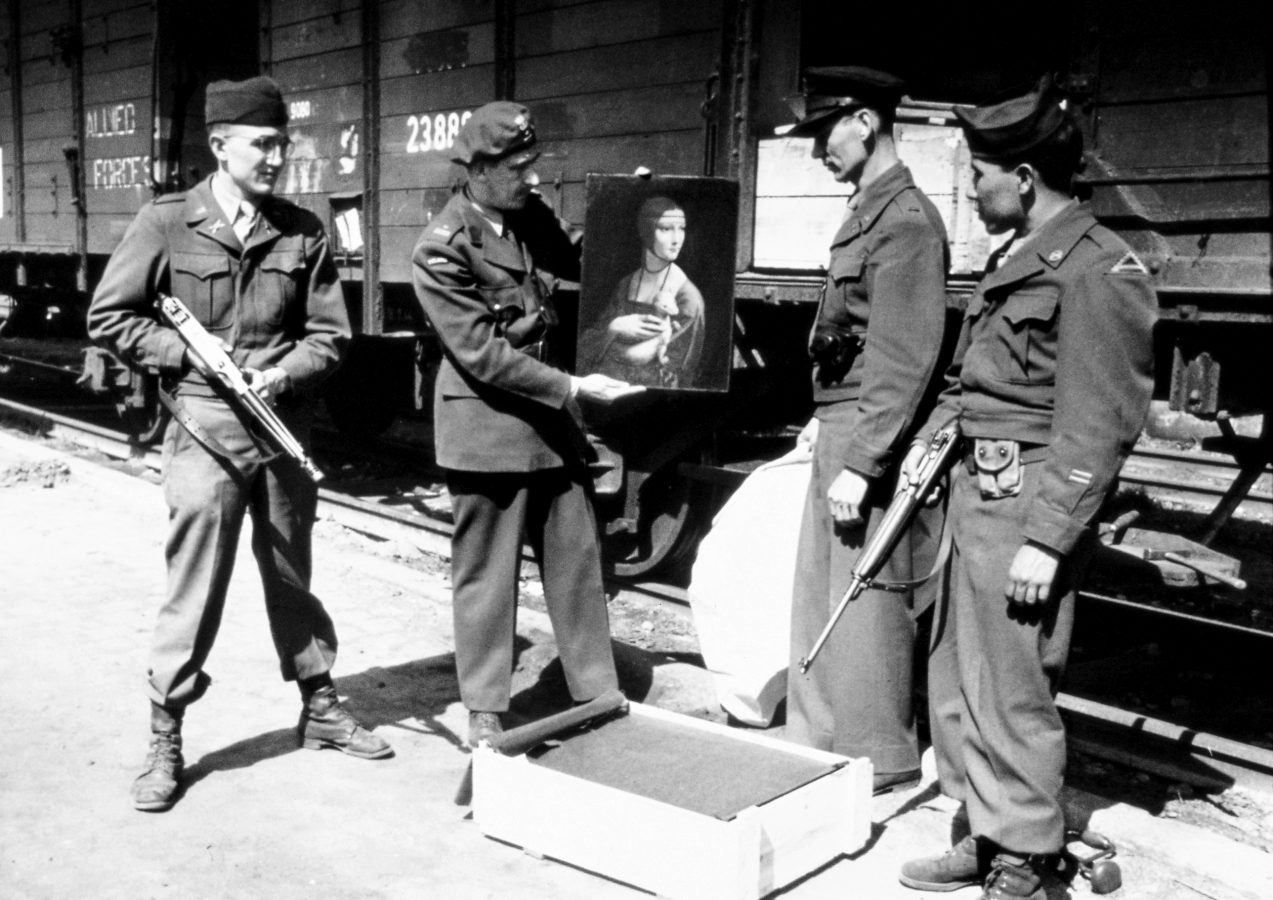
X-rayed at the Doerner Institute, Munich, 1945; train from Nuremberg on 26 April 1946 (Apollo); at the Wawel 30 April to 8 May 1946; photographed in April 1946 with Monuments Men Albright and Lesley, Major Karol Estreicher and Pfc. Espinosa. Wikipedia names Schliersee; the sources read do not.34223237
- 1946 - 23 September 1991Princes Czartoryski Museum, Krakow (National Museum in Krakow), ownership in abeyancedocumented
The owner, Prince Augustyn Czartoryski, was in Spain and died within months of the picture's return (Apollo). A Polish court ruled on 14 March 1991 that Adam Karol Czartoryski was the sole heir, ending about fifty years in which ownership of the collection had been in abeyance.322
- 23 September 1991 - 29 December 2016Princes Czartoryski Foundation, on deposit at the National Museum in Krakowdocumented
Founded by Adam Karol Czartoryski by notarial deed, with the collection left on deposit. The Foundation arranged the foreign loans from 1991 to 2012 and, according to the Ministry of Culture, drew its main income from them.323
- 29 December 2016 - 2017State Treasury of Poland (Minister of Culture and National Heritage, Piotr Glinski)documented
Agreement signed that day for the purchase, with the rest of the Princes Czartoryski Museum and Library, for EUR 100 million (the Ministry and Apollo; no payment date was found), about 86,000 museum objects and 250,000 library items. The price is for the whole collection and is not a valuation of this picture. The Ministry says the Foundation had insured it for EUR 300 million for foreign loans. No auction sale of this picture is recorded in any source read, and no price for the picture alone appears in any source read.222324
- 2017 - presentNational Museum in Krakow (Princes Czartoryski Museum)documented
Transferred to the National Museum in Krakow in 2017; the digital catalogue's origin field reads 'gift, 21 June 2017'. On show at the Wawel from 2012, at the main building from 19 May 2017 to 9 December 2019 and in the Czartoryski Museum since its reopening in December 2019.232338
Technical evidence
| Attribution note | Accepted by the holding museum and the standard Leonardo literature on the evidence of style, the pouncing and underdrawing, the lead-white ground and the handling, not from a document naming the painter for this panel; the museum says the authorship was known from the start. The black background is a later hand. That the sitter is Cecilia Gallerani is an inference, not a documented fact, and a published dissent (Boesten-Stengel, 2021) proposes a different sitter and a much later date. |
|---|---|
| Support | Single board of walnut, 4 to 5 mm thick. In 2012 the sides measured 404.5 mm (top), 406 mm (bottom), 548.5 mm (left) and 550 mm (right); the complete painting weighed 664.9 g. Insect galleries and a weak sapwood zone along the left; the upper left corner broke off and was glued back. An oak cradle, once glued to the back, was removed mechanically (chisel and plane) before 1914.42 |
| Dimensions in the catalogue | 53.4 x 39.3 cm; 59.5 x 47.2 cm with the small frame. The catalogue figures are about a centimetre smaller on each axis than the 2012 measurement of the board; neither source says why.24 |
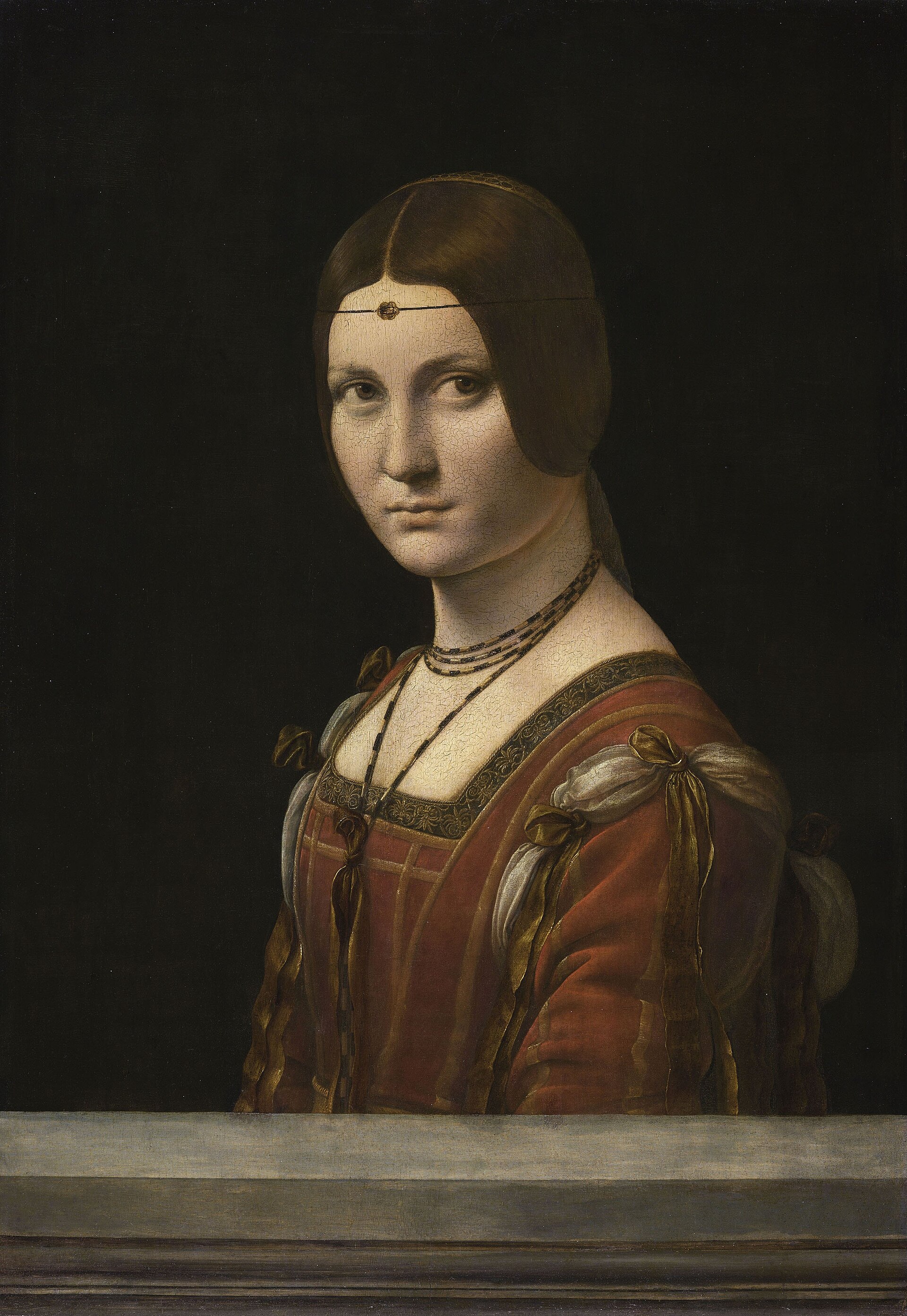
| Ground | Thin layer of lead white on an oil or tempera binding laid directly on the wood, with no gesso (identified by Rudolf Kozlowski in 1952; confirmed by X-ray fluorescence in 2012). A departure from Italian practice and from Leonardo's own in other panels; the Louvre's La Belle Ferronniere, also on walnut, has a gypsum layer.45 |
| Medium and palette | Oil (the museum's catalogue says mixed technique, with distemper). Lead white dominant in the lights; shadows modelled in thin umber layers; vermilion mixed with lead white in the flesh; vermilion and lead-tin yellow in the gown; natural ultramarine in the blue cloak. David Bull (1991-92) also found stil de grain yellow and iron-oxide earths. Smalt was excluded and ultramarine confirmed on the cloak in the 1950s.245 |
| Transfer and underdrawing | Near-infrared and hyperspectral imaging (2012) show pouncing dots from a cartoon, and a brush drawing that corrects it. Changes: the right hand lies a few centimetres from where it was first drawn; a flattened oval on the neckline is unexplained; the neckline was wider on the left and finished in a semicircle; the head of the ermine was first slightly larger; a decorative plait on a sleeve was painted out.4 |
| Handwork | Finger and palm prints in the paint, compared by Bull with those on Ginevra de' Benci. Kwiatkowski's team (1952-55) proposed that Leonardo painted parts of the ermine's fur with his left hand.46 |
| Background | Uniform black overpaint, one layer on the 2012 evidence, with visible brushwork and not covering the whole ground. Original ground dark grey and plain (2012: umber over lead white, no copper pigment, no window or landscape); greyish blue to Bull in 1991-92; deep blue with azurite to Cotte in 2007 (AFP). Two patches of overpaint washed off at the top right and lower right quarter, by an unrecorded hand, visible in photographs of the 1950s.457 |
| Inscription | Upper left, in yellow paint over the black overpaint: LA BELE FERONIERE / LEONARD D'AWINCI. Dated to Pulawy, between 1800 and 1809, by the museum's 2015 paper. Not Leonardo's signature. A 'signature' at the lower left found by Kozlowski in 1952 was judged not authentic by Kwiatkowski and Bull.24 |
| Labels on the back | Pasted label 134; white letters C.EC. / DG.418.; at the foot BURG / 1227. DG.418 is the Pulawy Gothic House number (1828 catalogue). 134 is also the entry number the museum's bibliography gives for the picture in Sichergestellte Kunstwerke im Generalgouvernement (Breslau, 1940), which the museum does not say is the same number. BURG / 1227 is unexplained.24 |
| Frame | A Renaissance frame, property of the State Collections of Art at Wawel Castle and deposited with the National Museum in Krakow (2015); the sources do not say whether it was made for this panel.3 |
| Condition | Paint cracked but firmly adherent; laser interferometry (DSPI) found no delamination in the areas tested; 'very good' overall apart from the overpaint (2012 campaign). Thermography mapped the insect damage. A debate about removing the overpaint, the museum's authors say, could only follow very careful study of the layer beneath.45 |
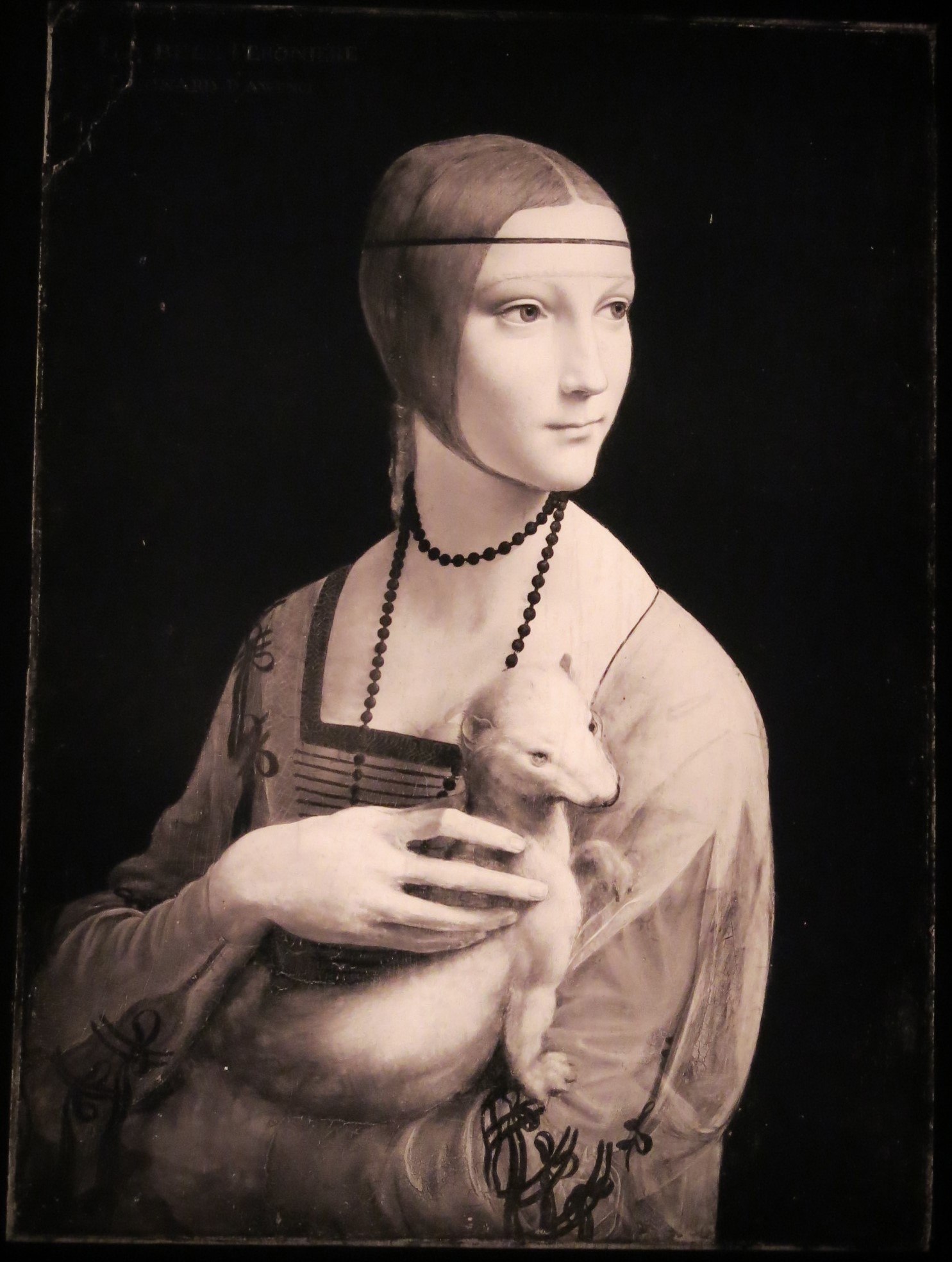
| Imaging on record | X-ray (Munich 1945; Warsaw 1952-55; Washington 1991-92; Krakow 2012), UV, infrared and sodium-light photography (1950s), infrared reflectography (1991-92), multispectral scan of 3 September 2007 (Lumiere Technology), near-infrared and hyperspectral scans, thermography, XRF and absorption-edge radiography (2012).456 |
Images
The record in full
Chapter 1A single walnut board, a lead-white ground and a century of small damage
The picture is painted on one board of walnut, 4 to 5 millimetres thick.
The picture is painted on one board of walnut, 4 to 5 millimetres thick. The National Museum in Krakow's 2012 survey measured its sides at 404.5 mm along the top and 406 mm along the bottom, and 548.5 mm up the left side and 550 mm up the right, with the complete painting weighing 664.9 grams. The museum's digital catalogue gives the picture as 53.4 cm high and 39.3 cm wide, or 59.5 by 47.2 cm with the small frame. The two sets of figures differ by about a centimetre on each axis and neither source says why. The 2015 museum paper records that Kazimierz Kwiatkowski's examination in the 1950s found no ground on the edges of the board, which it reads as showing that the panel was framed and primed before Leonardo painted on it. The catalogue figure may therefore be the painted area. That is a reading of the two sets of numbers, not something either source states.
Under the paint is a thin layer of lead white laid straight onto the wood with no gesso. Rudolf Kozlowski identified it in 1952 and remarked that it was an innovation next to the glue-and-gypsum grounds usual in Italy. The 2015 paper goes further and calls it a radical departure from Italian practice and from Leonardo's own, since samples from the Virgin of the Rocks and the St Anne show him keeping to gesso. Its authors propose that the dense surface of walnut, the ordinary panel wood in Lombardy around 1500, let him do without it. They also note that Louvre researchers found a gypsum layer on La Belle Ferronniere, another Milanese walnut panel, so the Krakow picture may be the exception rather than a rule.
The board has been hurt. Thermography in 2012 mapped galleries bored by wood-boring insects and a structurally weak sapwood zone down the left side, and the upper left corner, which had broken off, was glued back. The panel was once fixed to an oak cradle, and the same paper concludes from tool marks on the back that the cradle was removed mechanically, with a chisel and a plane, before 1914. It describes this as an aggressive intervention that had not been noticed before. Laser interferometry on the face and hand found no sign of delamination, and the paint, though cracked, holds firmly to its ground. The museum's assessment, in its own pages and in the 2015 paper, is that the picture is among the best preserved of Leonardo's paintings once the later black background is set aside.
The front carries a later inscription in yellow paint at the upper left, LA BELE FERONIERE / LEONARD D'AWINCI. The digital catalogue's inscriptions field puts it at the upper left, although one sentence in the descriptive text of the same entry says upper right. Microscopy in 2012 showed the letters were laid over the black overpaint, and the 2015 paper dates the inscription to Pulawy between 1800 and 1809, arguing from Marek Rostworowski that the W in the surname is a Polish spelling, one that could not have been written in Italy or France. The back bears a pasted label numbered 134, white letters reading C.EC. / DG.418. and, at the foot, BURG / 1227. The middle one is the Pulawy Gothic House number, entry 418 in Izabela Czartoryska's catalogue of 1828. The number 134 is also the entry number the museum's bibliography gives for the picture in the German catalogue Sichergestellte Kunstwerke im Generalgouvernement (Breslau, 1940, page 38). The museum does not say the label is that number and I have not seen the German catalogue, so the match is recorded here as a coincidence worth testing. BURG / 1227 is not explained in anything I read.
The frame in which the picture hangs is a Renaissance frame belonging to the State Collections of Art at Wawel Castle and held on deposit by the National Museum, according to the 2015 paper. The paper does not say whether it was made for this panel. The museum's number for the picture is MNK XII-209, and its catalogue releases the image as CC0.
Chapter 2Cecilia Gallerani, who was owed a thousand ducats and may never have been paid
The standard Italian biography is the Dizionario Biografico entry by Carlo Alberto Bucci, which says Cecilia was born in Milan in the first months of 1473, probably in the parish of San Simpliciano...
The standard Italian biography is the Dizionario Biografico entry by Carlo Alberto Bucci, which says Cecilia was born in Milan in the first months of 1473, probably in the parish of San Simpliciano where her parents Fazio Gallerani and Margherita Busti had lived since 1455. English-language sources, among them the Wikipedia article and its infobox, often give Siena. Bucci traces Fazio's family to Sienese patricians who had branched to Milan, which may explain the English-language tradition (my inference), and he does not support Siena as the place of her birth.
Money gives the family's measure. Fazio served the Sforza state as ambassador to Florence from 1467 and to Lucca three years later, and Francesco Sforza had exempted him from all taxes. Bucci stresses that he was not a Milanese patrician and not particularly rich. When he made his will on 29 November 1480, days before his death on 5 December, he named his six sons heirs and left each of his two daughters, Zaneta and Cecilia, 1,000 ducats. Bucci adds that on the evidence he had Cecilia seems still not to have received her thousand in 1508. No modern equivalent is offered here for the ducats: nothing I consulted gives a sourced conversion for Milan in 1480 and the usual methods (wage rates, grain prices, gold content) diverge widely.
In December 1483 her mother promised her to Giovanni Stefano Visconti, a man 24 years her senior, with the wedding to follow when she reached twelve. The promise was formally dissolved in June 1487. Bucci ventures that the failure may have followed a more attractive prospect, her meeting with Ludovico il Moro on a date nobody knows. On 7 May 1489 her brothers petitioned to recover possessions confiscated from the family, probably, he thinks, because they could now count on high protection, and by then Cecilia no longer lived at the family house but in the parish of the Monastero Nuovo, probably in a lodging Ludovico had arranged for their meetings.
On 8 November 1490 the Ferrarese ambassador Giacomo Trotti wrote to Duke Ercole d'Este of Ludovico's 'inamorata', whom he kept in the castle and went to see wherever he went, and who was, in Trotti's words, 'gravida et bella come un fiore': pregnant and beautiful as a flower. Ludovico's marriage to Beatrice d'Este took place on 16 January 1491. By Bucci's account the affair continued, Trotti reporting in February and March that Ludovico had promised to give her up. Cecilia's son Cesare Sforza Visconti was born on 3 May 1491, and on 18 May Ludovico gave her the fief of Saronno, which Bucci calls a reward. She married Count Lodovico Bergamini in 1492, a husband Ludovico found for her, and set up a small court of her own in the Palazzo Carmagnola, which Ludovico had given to the boy. Some English sources date Cesare's birth to 1493; the Italian biography and the museum both give 1491.
She was educated. Bucci credits Bernardo Bellincioni and the learned circle at court with drawing her to letters and says she learned to write Latin verse, as Matteo Bandello reports in one of his novelle. Bucci also records a letter of 1512 to Giangiorgio Trissino, which accompanied a sonnet of hers that is now lost and asked him for his little work on widowhood and the education of children. The museum's catalogue records contemporaries calling her a muse and a donna docta and comparing her with Aspasia, Axiothea and Sappho, and adds that her own poetry has not survived. After Ludovico's fall in 1499, Bucci writes, she and her husband found refuge with Isabella d'Este at Mantua; she soon recovered her property with Isabella's help, went back to Milan and went on, under the French too, living among poets and men of letters. Her death date is not known. Bucci quotes a nineteenth-century genealogist who thought she lived until around 1536.
Chapter 3Ludovico's picture, and what it did to the portrait
Bucci puts the commission plainly: the portrait was wanted by Ludovico, who had his favourite painter execute it, and it stayed Cecilia's own property, which is why a letter of 1498 finds her able to...
Bucci puts the commission plainly: the portrait was wanted by Ludovico, who had his favourite painter execute it, and it stayed Cecilia's own property, which is why a letter of 1498 finds her able to lend it. No contract, payment or account entry for the picture has surfaced in anything I read, so its price is unknown. Leonardo had come to Milan in the spring of 1482, according to the Mantua State Archive's 2019 catalogue, and Gino Benzoni's Treccani biography of Ludovico describes him working for the court until December 1499 as an engineer, a designer of machines and a stage designer as well as a painter.
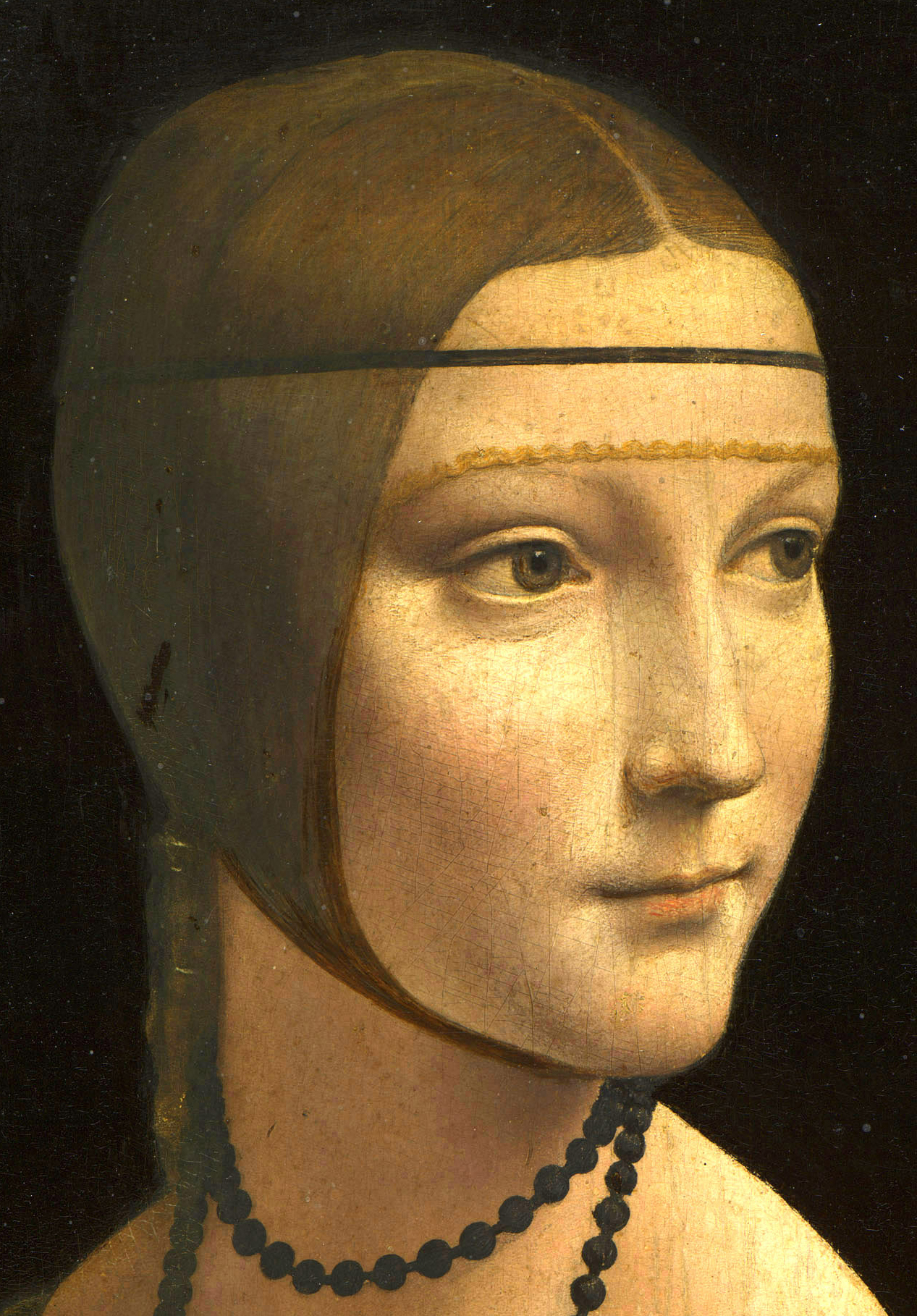
What the picture did is easy to see against what it replaced. The museum's account stresses the three-quarter view where Italian portraits had mostly used the profile, a half-turn produced by the sitter looking toward someone outside the frame, and a single light source, perhaps artificial, falling from above and to the right. The result, the museum says, gave the sitter a vitality portraiture had not shown before. The Globe and Mail reported in 2011 that the National Gallery's curator Luke Syson calls this 'movement of mind', and described the sitter as a woman with plans and ambitions. Cecilia is dressed in the Spanish fashion that reached the Milanese court around 1490. Her hair is parted over the brow and drawn into a long plait down the back, covered with a transparent gauze edged in gold, with a black silk band across the forehead. She wears a deep-cut red gown with separate sleeves tied on with ribbons, a blue cloak thrown over one shoulder with a wide slit for the arm, and a cord of cut agate beads.
The earliest literary notice is a sonnet by Bellincioni, printed in his Rime at Milan on 15 July 1493, the year after his death. In that edition it is headed Sopra il retracto de Madona Cicilia qual fece Maestro Leonardo, 'On the portrait of Madonna Cecilia which Master Leonardo made'. It opens by asking Nature why she is angry and whom she envies, and answers: 'Al vinci che ha ritrato una tua stella', Vinci, who has portrayed one of her stars. It says the picture makes Cecilia seem to listen without speaking ('par che ascolti & non fauella'), bids Nature thank Ludovico and the genius and hand of Leonardo for sharing her with posterity, and ends with a later viewer saying that seeing her alive is enough to understand what nature and art are. The text quoted is from Albert Boesten-Stengel's 2021 article, which prints the 1493 spelling. It matters for two reasons. It is the earliest witness that Leonardo painted Cecilia at all. And it names no animal, a silence Boesten-Stengel makes the pivot of an argument that the sonnet does not describe the Krakow composition, taken up below. Bucci cites the sonnet as the earliest testimony to the portrait; the museum cites it, with the 1498 letters, as the archival basis for knowing that Leonardo painted her.
Chapter 4What an ermine could say at the Sforza court
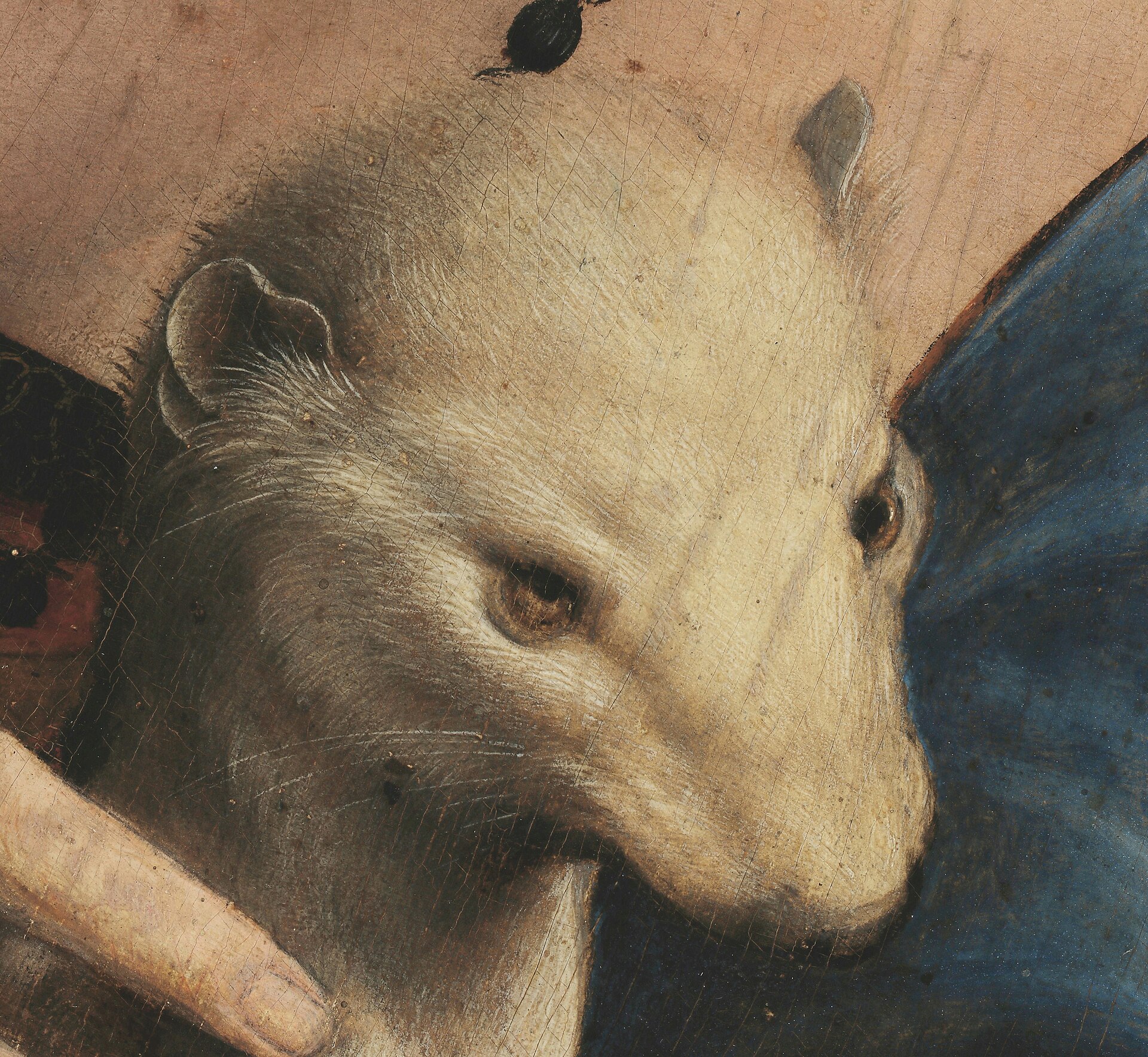
Naming comes before meaning here. The museum calls the creature an ermine and lists the picture under the alternative title Lady with a Weasel.
Naming comes before meaning here. The museum calls the creature an ermine and lists the picture under the alternative title Lady with a Weasel. Rzeczpospolita wrote at the 2019 reopening that scholars struggle with what animal it is because it carries traits of an ermine, a weasel and a ferret. In the manuscript catalogues of the Pulawy Gothic House it was not an ermine at all: the museum records that it was compared to a marten or a dog. The account that follows calls it an ermine, as the museum does.
Documented first is the emblem. King Ferrante of Naples's Order of the Ermine had the motto Malo mori quam foedari, 'I would rather die than be soiled', and Ludovico belonged to it. Benzoni's Treccani biography says Ludovico's support for Ferrante against the barons' conspiracy was rewarded with the order in November 1486. Bucci, following Carlo Pedretti's 1990 study of the portrait as political allegory, and the museum itself both give 1488. Boesten-Stengel gives 1486. The sources do not agree and I did not find the document that settles it. Bucci also reports that in sonnet CXXVII of his Rime Bellincioni calls Ludovico 'l'italico Morel, bianco ermellino', the Italian Moor, the white ermine, and the museum says Ludovico gained the nickname Ermellino Bianco.
Paolo Giovio (1483-1552), the first great collector of emblems, supplies the court meaning of the creature. In his Dialogo dell'imprese militari et amorose, read here in the Lyon edition of 1574, the ermine is King Ferrante's own impresa. Marino, duke of Sessa and the king's brother-in-law, joined Duke John of Anjou in a plan to kill Ferrante at a parliament. When Marino was afterwards taken prisoner Ferrante decided not to put him to death, saying he did not wish to stain his hands with the blood of a relation, traitor and ingrate though he was, and against the advice of many of his counsellors. To declare that clemency the king took an ermine inside a ring of filth, with the motto MALO MORI QUAM FOEDARI over it, Giovio explaining that it is the animal's nature to suffer death by hunger and thirst before it will cross the foul and spoil the whiteness of its precious skin. The same book describes a painting Ludovico had made in the castle. He had Italy painted as a queen in a gold gown embroidered with portraits of cities, with a black Moorish squire standing before her holding a brush. When the Florentine ambassador asked what the servant was for, he was told that he brushed the gown and the cities clean of every filth, to show that the Moor was Italy's arbiter. The ambassador answered that the servant, wielding the brush, would draw all the dust upon himself, which Giovio calls a true prophecy. Giovio adds that many believe Ludovico was called Moro for a dark skin and are wrong, since he was fair. On the pages I read Giovio does not link Ludovico with the ermine.
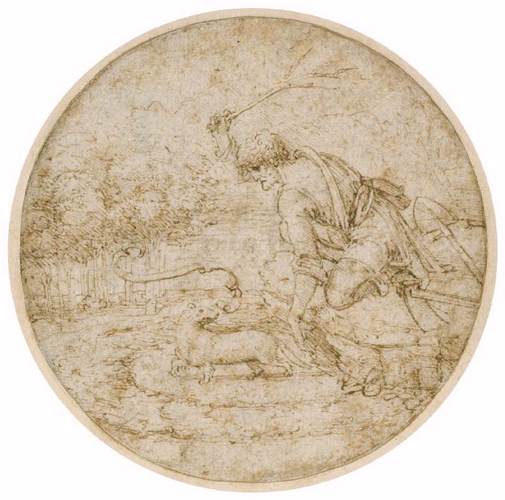
Leonardo wrote the creature down himself. In the notebooks as Jean Paul Richter translated them in 1883, a bestiary entry reads: 'The ermine out of moderation never eats but once in the day; it will rather let itself be taken by the hunters than take refuge in a dirty lair, in order not to stain its purity.' Another reads: 'Moderation checks all the vices. The ermine will die rather than besmirch itself.' Richter's edition as I read it gives no date for either entry. The Fitzwilliam Museum in Cambridge holds a small round drawing in pen and brown ink on paper, 91 mm across, titled The ermine as a symbol of purity, which it dates to about 1494 from the manuscript it relates to. Bucci likewise places a Leonardo manuscript text on the ermine at around 1494. Both therefore post-date the years most scholars give the portrait, so they show what Leonardo thought an ermine meant at some point in the 1490s, not necessarily what he meant by this one.
The pun on the sitter's name is the third reading. The Greek word for the weasel family, galee, resembles Gallerani, and Leonardo had played on a sitter's name before with the juniper behind Ginevra de' Benci (ginepro). The museum says the observation was first used about 1900 to argue that the Krakow panel might be Cecilia's lost portrait. Boesten-Stengel credits J. C. Holmes with first making the Greek point in a note in the Burlington Magazine in 1907 and describes Krystyna Moczulska's 1995 development of it through Ovid's Galanthis, the servant of Alcmene who tricked the goddess of childbirth and was turned into a weasel. On Moczulska's reading the animal is Galanthis and Cecilia a second Alcmene, who bore a ruler a natural son. Bucci presents the pun as the main basis for the identification of the sitter. Boesten-Stengel answers that the pun, however apt for the real Cecilia, cannot bridge the distance between the Krakow picture and a sonnet in which no animal appears.
Two further readings are the museum's and Bucci's. The museum says the creature's presence may refer to the intimacy between Cecilia and the duke and to the possibility that she was already carrying his child, and records that the ermine's reputation for purity and virginity led some to doubt that the duke's mistress could hold one. Bucci reads the animal as a bold display of purity and whiteness by Ludovico's concubine, with the duke himself allegorised heraldically in the ermine she holds. He adds that in Vittore Carpaccio's Young Knight in a Landscape, in the Thyssen collection, painted around 1510, a scroll beside the animal carries the same message of purity. The BBC reported in 2014 that Pascal Cotte's findings had prompted two further ideas, without naming their authors: that Leonardo added the ermine to stand for the sitter's lover and later enlarged it to flatter his patron, or that Gallerani herself asked for it so the court would know of her tie to the duke.
One reading is a proposal and is kept at that. Boesten-Stengel argues that the white ermine, with the picture's colours of white, blue, gold and red, points to the house of Valois and Brittany, that the animal's serpentine pose belongs with Leonardo's drawings of animal locomotion made after about 1504, and that the sitter could be the child Claude de France around 1507. He takes the Neapolitan order's ermine, in his account, from an older Breton order founded in 1381. Earlier writers had already linked the ermine to Brittany: Boesten-Stengel notes that Jerzy Mycielski inferred Anne de Bretagne from it in 1893 and that Giovanni Reina in 2014 raised Claude de France on a condition about the sitter's age. I found no scholar who adopts his dating. What the sources support for the ordinary reading is three court meanings that sit together comfortably: the emblem of an order that the patron held, a stock moral exemplum of purity that Leonardo himself wrote down, and a name-pun of a kind he had used before. I found nothing in the documents that points to a further, concealed doctrine.
Chapter 6April 1498: Isabella d'Este borrows the portrait
The only archival documents that bear on the picture in the sitter's lifetime are three letters in the Gonzaga archive at Mantua, transcribed in the State Archive's 2019 catalogue edited by Stefano...
The only archival documents that bear on the picture in the sitter's lifetime are three letters in the Gonzaga archive at Mantua, transcribed in the State Archive's 2019 catalogue edited by Stefano L'Occaso. On 26 April 1498 Isabella d'Este wrote from Mantua to 'Madonna Cecilia' to say that she had that day seen some fine portraits by the hand of Giovanni Bellini and the talk had turned to Leonardo, 'cum desyderio de vederle al parangone', with a wish to see his works in comparison. She remembered, she wrote, that he had portrayed Cecilia from life ('dal naturale'), and asked her to send the picture by the horseman she had despatched for the purpose, promising that it would be sent back as soon as the comparison was done. She added that she would also gladly see Cecilia's face in it.
Cecilia answered from Milan on 29 April. She had read what Isabella wrote, she said, and was sending the portrait, and would send it more gladly if it looked more like her. The lack of likeness, she insisted, was no fault of the master, for she did not believe there was his equal in the world, but arose because the portrait was made at 'una eta si imperfecta', so imperfect an age, that she had since changed all that likeness, so that nobody seeing the picture and herself together would judge it to have been made for her. (Accents are omitted from the Italian here, as elsewhere in this record.) Julia Cartwright's 1903 English translation of the pair of letters, in her life of Beatrice d'Este, gives much the same sense, adding the word 'young'. A third letter, of 18 May, answers thanks that Isabella had evidently sent: Cecilia says there was no need for Isabella to thank her, since everything she has is at Isabella's pleasure. The catalogue reads the exchange as the loan and its return and says Isabella gave the painting back after about a month; the 18 May letter itself does not mention the picture.
The correspondence is also the sitter's own testimony about a portrait of herself by Leonardo: she thought it a record of an age she had outgrown, not a likeness of the woman she had become. It gives a date by which a Leonardo portrait of Cecilia existed, 1498, and shows it in her hands in Milan, free for her to lend. It does not describe the picture, which is the weak point in tying these letters to the Krakow panel, though no other portrait of her by Leonardo is known to have survived.
Chapter 7How Leonardo built it
Near-infrared images and a hyperspectral scan made in 2012 show two kinds of drawing lying directly on the white ground.
Near-infrared images and a hyperspectral scan made in 2012 show two kinds of drawing lying directly on the white ground. The first is pouncing: small dots left where a drawing on a cartoon was pricked and dusted through onto the panel, a trace the museum says survives in places. The second is a brush drawing that consolidated the outline and corrected it. The two do not agree in every part, so the design changed at this stage. Some pounced lines were repeated in brush and kept; others were abandoned. A flattened oval on the neckline, still unexplained, and the outline of the right hand, which lies a few centimetres further left than the hand now seen, are the examples the museum paper gives. The head of the animal was also altered. Infrared shows the outline of a slightly bigger head, with a distinct dark line around the mouth. Radiography shows that the original neckline was wider on the left side and finished in a semicircle. The coat and gown changed during painting, and a sleeve once carried a decorative plait that Leonardo painted out.
The paint is thin, with lead white dominant in the lights and shadows modelled in thin layers of umber. X-ray fluorescence scans across the face show lead falling where iron and calcium rise, the mark of shadows built from thin layers on the white ground, and small amounts of mercury indicate vermilion mixed with lead white in the flesh. In 1992 the National Gallery of Art's David Bull, working from the picture when it was in Washington, listed lead white, vermilion, ultramarine, lead-tin yellow, stil de grain yellow and iron-oxide earths. Fingerprints and palm prints in the paint, which Bull compared with those on Ginevra de' Benci, show the oil technique and Leonardo's habit of working the paint with his hands. For the robes the 2012 team found vermilion and lead-tin yellow, and natural ultramarine in the blue cloak. The 2015 paper adds that this ultramarine, from lapis lazuli imported from Afghanistan, was as costly as gold, and that contracts for paintings often made the buyer pay for it separately. The ermine itself is built by a different and simpler method. Radiography shows that Leonardo used no extra lead white for the animal but laid its shadows straight onto the white ground, which the paper calls striking in its simplicity.
Kwiatkowski's team, working in Warsaw in 1952-55, proposed that Leonardo painted with both hands, pointing to parts of the ermine's fur as the work of his left hand, and made a technological copy to test the idea. Kozlowski, in 1952, had noticed that the embroidery on the left sleeve had been painted over by Leonardo himself. The picture therefore preserves a record of work in progress at several stages, which is what makes the claims discussed below both attractive and difficult to settle.
Chapter 8The black ground, and what was under it
Everyone who has looked at the picture since the late eighteenth century has seen a uniform black background.
Everyone who has looked at the picture since the late eighteenth century has seen a uniform black background. Almost everyone now agrees it is not Leonardo's. What lay beneath, who painted over it and when are three separate questions with four or five answers.
On the colour underneath the sources split. David Bull's examination at the National Gallery of Art in 1991-92 found fragments of the original ground peeping out beside the outline of the figure where the black had been laid on carelessly, and described it as greyish blue, lighter on the right and darker on the left. Pascal Cotte, scanning the panel with his multispectral camera on 3 September 2007, told Agence France-Presse that the background was 'deep blue, very lightly shaded with earth, and probably an azurite mixed with earth'; the Lumiere Technology page describes the same layer more cautiously as brownish with blue added, modulated to suggest depth. The museum's own 2012 campaign contradicts both, though its digital catalogue entry still repeats the blue-grey description. X-ray fluorescence at 25 points on the dark ground found lead from the priming and iron and calcium from umber, and no copper at all. A specialist absorption-edge radiograph, run over 28 areas totalling 774 square centimetres, showed no concentration of copper pigment anywhere. Its authors conclude that the original background was a plain dark grey that gave an illusion of indefinite space with slight gradations of light and dark, with no window, door or landscape. The window Kwiatkowski thought he saw in ultraviolet in the 1950s has been rejected by Bull and by the 2012 team alike.
On when, the accounts diverge more. The museum's public page and its digital catalogue say the background was repainted in the nineteenth century. Marek Rostworowski, whom the 2015 paper quotes, thought it happened in the 1840s, when someone took the picture out of the hiding place in which it had been walled up for eight years and covered a damaged ground with an even black. Bull argued that the black went on after the later inscription, because a thin black layer lies on the letters, and that the motive was to hide the damage from the broken-off upper left corner. The 2015 paper rejects both points. It holds that the inscription was added on top of the black, that the thin film on the letters is the remains of a local cleaning, and that a single black layer was applied before the purchase, probably in Italy at the end of the eighteenth century, when the thin walnut panel was also glued to its oak cradle and the face partly cleaned. Its authors lay stress on a note Izabela Czartoryska wrote by hand in her French catalogue, that the picture was 'although very old, preserved splendidly', which they take to show she was describing a picture already prepared for sale. They admit that overpainting at Pulawy early in the nineteenth century or at Paris between 1840 and 1876 remains plausible. English Wikipedia says the black went on in the mid-eighteenth century, a date I did not find in the museum's own material.
Black paint was washed off in two places, at the top right and in the lower right quarter, and the original dark grey shows through a dense network of cracks there. Both areas are visible in photographs taken during Kozlowski's work in the 1950s. Estreicher's account has the painting needing only minor treatment when it was taken to Munich in 1945, and the 2015 paper suggests the patches may date either from Munich in 1945-46 or from Kozlowski in 1952; neither man recorded making them. The paper's authors also note that a debate about removing the overpaint could be opened only after very careful study of the original paint beneath. In 2007 Jacques Franck, the art historian who worked with Cotte, said the picture had been masked by bad restoration and perhaps seen as less important than it is. The museum's chief painting conservator Anna Grochowska-Angelus replied that nothing new had been learned that would fundamentally alter the understanding of the work, though the scan did confirm fingerprints that supported the long-held Polish view that the picture was nearly all by Leonardo.
Chapter 92014: the three-stage thesis and the answers to it
In the autumn of 2014 Pascal Cotte published Lumiere on the Lady with an Ermine with Vinci Editions in Paris, the result, he said, of three years working on the 2007 scans with what he calls the...
In the autumn of 2014 Pascal Cotte published Lumiere on the Lady with an Ermine with Vinci Editions in Paris, the result, he said, of three years working on the 2007 scans with what he calls the Layer Amplification Method, which uses 13 wavelengths of light to separate the paint layers. His claim, reported by the BBC and by Art History News, is that Leonardo painted the picture in three stages: first a portrait of Cecilia with no animal, then a slender grey ermine and last the heavier white ermine seen today painted over the first. He also reads changes in the position of the sitter's arm and a blue veil added at the shoulder in the middle stage (Le Petit Journal's summary).
Martin Kemp, speaking to the BBC, called the findings remarkable and said they showed that Leonardo kept fiddling around all through a painting, which helps explain why he found it so hard to finish pictures. Bendor Grosvenor, writing the same week on Art History News, accepted that Cotte's work is a valuable contribution and agreed the images show real changes, including to the embroidered sleeve and to the outline of the ermine. He did not accept the central thesis. The four 'finger' shapes Cotte reads as the sitter's original hand are, to Grosvenor, noticeable only by enhancement and could be anything, including a variation in the ground, and he found the slender first ermine unconvincing. Cotte replied through the same page that his method gives thousands of images rather than one and that his case rests on many details, not on the four fingers, and said that Janusz Walek of the Krakow museum and David Bull had agreed with his findings. I could not verify that last statement independently, and Walek is not among the authors of the museum's 2015 paper that disputes the thesis.
The National Museum in Krakow's conservators answered in print the following year. In the 2015 paper the museum's team argued from the radiograph that the animal was painted thinly using the lead white of the priming, that if the ermine had been a second version laid over a finished gown the lead-white signal in that region would be much stronger, and that if Leonardo had washed out a portion of his own composition to make room for the animal the pouncing traces under it would have gone too. They conclude that the ermine was part of the composition from the beginning and that only its size and posture, with details of the hand and the dress, changed in the course of the work. The same authors accept that Leonardo changed the design: the right hand, the neckline, the head of the animal and the sleeve are changes they document themselves.
Neither side has made its data public in a form I could check. Cotte's images are in his book and on his company's pages. The museum's technical appendix, which the 2015 paper says is on the Laboratory of Analysis and Nondestructive Investigation page of mnk.pl, I did not reach. The disagreement is therefore one between the interpretation of multispectral images and the interpretation of a radiograph and infrared scans, by parties who agree that Leonardo altered the design as he went and disagree about whether any stage of the work lacked the animal. The 2024 article by Julio M. del Hoyo-Melendez and colleagues in Techne, listed in the museum's bibliography, may have moved the question on; I could not access it. Boesten-Stengel, writing in 2021 from a different direction, also concludes that the animal was not added later.
Chapter 10From Cecilia to Pulawy: the centuries nobody recorded
No owner is documented between Cecilia Gallerani and the Czartoryski purchase.
No owner is documented between Cecilia Gallerani and the Czartoryski purchase. The 2015 museum paper says no unequivocal evidence has been found about what happened to the picture from about the middle of the sixteenth century to the end of the eighteenth, and that it probably stayed with Cecilia until her death. It cites Pietro Marani for that conjecture. The museum's digital catalogue says only that the picture was bought at an unknown place in Italy. The Monuments Men and Women Foundation's account of the Raphael says Adam Jerzy Czartoryski bought both the Raphael and the Leonardo from the Giustiniani collection, but the museum's paper has him buying the Raphael at Venice and the Leonardo in unknown circumstances, and I treat the Giustiniani line as unsupported until a source is cited for it.
The panel itself is the only witness. The oak cradle, the partial cleaning, the retouching and the black ground were applied, on the 2015 paper's reading, before it reached Poland, which would make the picture a prepared sale object in late-eighteenth-century Italy. That is an argument from condition, not a record of a dealer or an owner.
The sale is dated differently by different sources. The museum's pages say about 1800; the 2015 paper says Adam Jerzy Czartoryski bought it in 1799 or 1800 during his stay in Italy, in a place and circumstances unknown, and gave it a year later to his mother; Wikipedia, the 2007 AFP report and a 2014 French article say 1798. Adam Jerzy was then the Russian representative at the court of the King of Sardinia, according to the Monuments Men and Women Foundation. His mother Izabela, born Flemming, had begun a collection at Pulawy, which she began to display in 1801, partly, Apollo says, in response to the partitions of Poland. The Leonardo was shown from 1809 in the Gothic House there, entered as number 418 in her 1828 catalogue, hanging with the Raphael and Rembrandt's Landscape with the Good Samaritan, the group the foundation's account calls the Great Three.
It did not arrive as a Leonardo of a named sitter. The museum records that in the Pulawy manuscript catalogues it was entered as a portrait of a woman, with the animal likened to a marten or a dog. A print brought to the house after Leonardo's La Belle Ferronniere in the Louvre, the portrait then thought to show a mistress of Francis I, was probably the reason Izabela identified her picture's sitter with the girl in the engraving, and the inscription LA BELE FERONIERE LEONARD D'AWINCI was painted in the upper corner at Pulawy between 1800 and 1809.
In 1830 the rising against Russia broke out. After Pulawy fell, the museum says, the picture was taken away and hidden in 1831, first at Klemensow, then at Sieniawa. The 2015 paper gives the years 1832 to 1840 and says it was bricked up at Sieniawa for eight years with the Raphael, the Rembrandt and other treasures. The Czartoryskis fled to Paris, where Prince Adam Jerzy bought the Hotel Lambert in 1843. The paper dates the collection's transport through Dresden to Paris to 1848-49. The museum says the picture stayed at the Hotel Lambert unexhibited until the 1880s and was moved to the Princes Czartoryski Museum in Krakow in 1882. English-language sources, Wikipedia among them, say 1876, which is when the museum was founded, not when the Leonardo arrived.
In 1914 it went with the Raphael to the Dresden Gemaldegalerie for safe keeping, and a German seal of the Goluchow entail found on the back, dated by the paper to 1912-14, is read as a trace of that journey. The Monuments Men and Women Foundation says Hans Posse, the gallery's director, who became Hitler's agent for the Linz museum, tried without success to keep the collection in Germany. The museum says the Leonardo returned to Krakow in 1920.
Chapter 111939 to 1946: Berlin, the Wawel and a villa in Bavaria
In September 1939 the Czartoryski family sent the collection to its palace at Sieniawa for safety, the place where the Leonardo had been hidden a century before.
In September 1939 the Czartoryski family sent the collection to its palace at Sieniawa for safety, the place where the Leonardo had been hidden a century before. The museum's catalogue calls what followed a plundering planned in advance. The Monuments Men and Women Foundation, whose account concerns the three great paintings together, says German forces reached Sieniawa on 15 September 1939 and that the annexe was reported looted three days later. On 6 October 1939 Hermann Goering appointed Kajetan Muhlmann special representative for securing art in the former Polish territories, and the Lexikon der oesterreichischen Provenienzforschung records that Muhlmann was soon in overall charge of the looting in Poland. The foundation, whose card is about the Raphael but treats the three paintings together, says that by November 1939 they had 'likely' reached Muhlmann's Berlin office, according to post-war interrogations, and were then moved to the Kaiser-Friedrich-Museum and a Deutsche Bank safe-deposit box. It describes a contest between Goering's man Muhlmann and Hitler's man Posse, and says Posse's side prevailed in keeping them from Goering by having them deposited with the Governor General of occupied Poland, Hans Frank. The museum's own account says the Leonardo was destined for Hitler's planned museum at Linz and then came into Frank's hands.
The 2015 paper gives the movements of this picture alone. In 1939 it was exhibited in Berlin. In 1940 it came back to Krakow, to the Wawel Castle, which was Frank's residence. In 1941 it was in Wroclaw (Breslau), in 1943 it returned to the Wawel, and in 1944 it was evacuated to Seichau Castle in Lower Silesia. The foundation adds that the collections went to the von Richthofen palace at Sichow and then to Morawa, arriving there on 20 January 1945, and that when General Government officials were ordered out of Lower Silesia Frank took twenty paintings with him to Bavaria. These included the Lady with an Ermine and the Rembrandt but not the Raphael, which was too large and, on later testimony, never left Lower Silesia. The paper's last line on the subject says only that the Leonardo was 'finally found in Frank's villa in Bavaria'. English Wikipedia names Schliersee, a tertiary source I could not replace.
The recovery is told in more than one place. A photograph in the American archives, taken in April 1946, shows the Monuments Men Lt. Frank Albright and Capt. Everett Parker Lesley, the Polish liaison officer Maj. Karol Estreicher and Pfc. Joe Espinosa posing with the picture. The first examination of it after the war was an X-ray taken at the Doerner Institute in Munich in 1945, which Estreicher interpreted. Nicholas Hodge's account in Apollo says a train left Nuremberg for Poland on 26 April 1946 carrying works recovered from German castles, mines and shelters, with the Leonardo aboard. The loans chronology in the museum's paper records its stay in the repository of recovered works at the Wawel from 30 April to 8 May 1946, after which it went back to the Czartoryski Museum in Krakow, with the Rembrandt and without the Raphael. Hans Frank was found guilty of war crimes by the International Military Tribunal at Nuremberg in 1946, according to the legal editor Robert Aitken as quoted by JSTOR Daily.
Rostworowski, the Krakow curator who later wrote the picture's biography, counted at least thirty changes of residence, carried by courier saddlebag, carriage, cart, train, car, plane and ferry, and sometimes under an arm. The wartime seizure of this panel, unlike the seizures described for other objects from the same collection, is stated by the museum itself and is not inferred from the fate of the collection. What the sources I read do not give is a dated route for 1939 to 1940, from Sieniawa through Muhlmann's office and the Kaiser-Friedrich-Museum to Frank; the dates above rest on the museum's own summary and on a foundation account that treats three paintings together.
Chapter 12A painting with a passport: the loans, 1946 to 2012
After the war the painting almost never left Krakow.
After the war the painting almost never left Krakow. The loans chronology in the museum's 2015 paper lists a stay in Warsaw from June 1952 to February 1955, when the National Museum there held a Leonardo exhibition and Kwiatkowski's team made its physical and chemical studies; the Wawel in 1955 and from 1956 to 1959 while the Czartoryski building was refurbished; and one trip abroad, to Moscow's Pushkin Museum from 3 October to 22 November 1972. For that journey the case travelled by train to Warsaw and then by plane, but the picture came back by train in a first-class compartment, with two curators and two militiamen. The paper says the ban on lending abroad had lasted since the end of the war and stemmed from the authorities' fear that the Czartoryski family would reclaim the collection if it left Polish soil.
Two events in 1991 changed that. On 14 March the Polish court ruled that Adam Karol Czartoryski was the sole heir of his father, ending nearly fifty years in which ownership of the collection had been in abeyance. On 23 September he signed a notarial deed establishing the Princes Czartoryski Foundation at the National Museum in Krakow and transferring the collection to it, leaving the pictures on deposit with the museum. In between, in April, President George Bush asked President Lech Walesa to 'support the cause' of a loan to the National Gallery of Art in Washington, and the Minister of Culture, Marek Rostworowski, granted it despite protests that included the resignation of the director of the National Museum in Krakow. The picture hung in the exhibition 'Circa 1492: Art in the Age of Exploration' from 12 October 1991 to 12 January 1992. It travelled in a metal case sent by the Americans, with the curator Janusz Walek and the conservator Anna Grochowska, and El Greco's Laocoon came to Krakow in exchange. That is the loan during which David Bull examined it.
Money entered the bargaining next. For the Swedish loan of 1993-94 (Malmo and Stockholm, 'I ponti di Leonardo') the Foundation asked for a donation of not less than 350,000 dollars; after negotiation 390,000 dollars was agreed on top of all costs. The picture then went to Rome, Milan and Florence in 1998-99, to Kyoto, Nagoya and Yokohama in 2001-02 and to Milwaukee, Houston and San Francisco in 2002-03. On 12 March 2001 the Foundation's board resolved to stop foreign loans for seven to ten years after its return from Japan and the United States. The seven years lapsed, and in 2009-10 it went to the Museum of Fine Arts in Budapest, against the advice of the museum's specialists; the monuments conservator allowed it but asked for a ten-year pause afterwards. Budapest sent a Goya to Krakow in return.
The loans of 2010-12 were the most contested. After a stay at the Royal Castle in Warsaw from May 2010 to April 2011, the Foundation proposed Berlin and London. The Lesser Poland monuments conservator refused permission and a committee of experts convened by the National Museum advised against lending. The Foundation appealed to the Minister of Culture, who agreed to London only; then the King of Spain asked for the picture for Madrid. The Foundation's founder Adam Karol Czartoryski is quoted in April 2011 as saying it was hard to refuse the king, especially a first cousin. A broader committee met on 12 April 2011 and its minutes concluded that the majority of experts held that the painting should not be lent. A memorandum signed on 20 April 2011 in the Krakow Cloth Hall nevertheless let it go to Madrid, Berlin and London, on conditions: it would return to Krakow after the London show, be exempt from loans for at least ten years unless all parties decided otherwise, and be the subject of a scientific project. The 2015 paper lists the three exhibitions as Madrid (1 June to 4 September 2011), the Bode Museum in Berlin (25 August to 20 November) and the National Gallery in London (9 November 2011 to 5 February 2012). The ranges overlap and the museum's catalogue gives different ones, so they are the shows' dates, not a route for the panel. In London 'Leonardo da Vinci: Painter at the Court of Milan' drew 323,827 visits, the Gallery's best-attended ticketed show until 2025, and it had an overnight opening, as the Gallery's own press release recalls.
The museum's conservators monitored the loans and found them safe, but their experts' minutes of March 2012 warn that the picture is fragile and 'it would be better if the painting did not travel at all'. It returned to Krakow in February 2012. The paper's postscript of 2015 says that after the return the painting went on show at the Wawel and the comprehensive research project the memorandum called for 'has not commenced yet'. The museum's Google Arts story, written before the 2019 reopening, says it plans no further journeys.
Chapter 13December 2016: one hundred million euros for the whole collection
The 2016 transaction is the only sale price in the picture's history that the sources give, and it is not a price for the picture.
The 2016 transaction is the only sale price in the picture's history that the sources give, and it is not a price for the picture. On 29 December 2016 the Polish Minister of Culture, Piotr Glinski, signed an agreement with Prince Adam Karol Czartoryski under which the State Treasury bought the collection of the Princes Czartoryski Museum and Library, about 86,000 museum objects and 250,000 library items, for 100 million euros. The Ministry's statement of April 2018 says so and adds that the deal also covered the Foundation's claims to cultural goods lost in the Second World War, among them the missing Raphael, and to property taken by postwar nationalisation, such as the Sieniawa palace and park complex, which it valued at over 22 million zloty. It also covered a promise to transfer the museum buildings to the National Museum in Krakow. The Ministry says the collection was then transferred, in 2017, into the ownership of the National Museum in Krakow, and the museum's digital catalogue gives the origin of the picture as 'gift, 21 June 2017'.
The price was set against other figures by the Ministry. It said the Foundation had insured the Lady at 300 million euros for foreign loans, the Rembrandt was valued at 40 million dollars, and Leonardo's Salvator Mundi had sold in 2017 for 450.3 million dollars. By that measure the whole collection cost a third of the Lady's insurance value. In Polish money, the National Bank of Poland's mid rate on 29 December 2016 was 4.4131 zloty to the euro, so the price was about 441.3 million zloty. No modern-equivalent calculation is offered for any earlier price.
The buyer was the Polish state and the collection stayed in Poland. Whether any export licence was ever sought is not stated in any source read. Hodge's piece in Apollo of 27 February 2017 reports rumours that an unnamed Middle Eastern buyer was about to take the collection abroad and records critics doubting them because Polish law forbids export of anything old and valuable without authorisation. The Ministry argued in 2018 that the earlier legislative protection, the List of Heritage Treasures introduced under the previous government, was an ad hoc solution that neither secured the collection nor blocked its sale. Piotr Zuchowski, then a deputy culture minister, had said in 2013 that the Lady and the Rembrandt were the works that should be placed on that list. I did not establish whether either was in the end entered.
The sale was controversial. Hodge reported in Apollo on 27 February 2017 that the museum's managing board resigned in mid-December 2016 with a statement that the head of the family had lost their trust by going over their heads. The Prince and a hurriedly assembled new board called the sale a donation. Critics quoted by Hodge, among them Piotr Pininski of the Lanckoronski Foundation, argued that the money could have bought works abroad (Hodge himself adds that it could have helped derelict manor houses) and worried about what changing a foundation's statute under government pressure meant for other donors. A poll by IBRiS for Rzeczpospolita, reported in Notes from Poland on 21 December 2019 without a poll date, found only 32 per cent of Poles positive about the purchase. The Ministry's answer was that museum people had asked for years for exactly this, that the Foundation's main income had been foreign loans of the Lady while the National Museum bore the costs of looking after the collection, and that the transaction followed public procurement law and was examined by the Supreme Audit Office (NIK). Zofia Golubiew, the former museum director, defended the purchase in an undated Dziennik Polski interview that OKO.press summarised on 11 January 2020, saying the collection was endangered and was at the museum's disposal only in theory.
What happened to the money is the part of the story that remains open. The Foundation said, according to Money.pl in October 2018, that it had transferred the funds it had accumulated, including those from the sale, to a new foundation, Le Jour Viendra, in Liechtenstein, and that three Polish foundations also received part. Money.pl reported on 6 October 2018, relying on RMF FM for the refusal, that NIK suspected an attempt to avoid tax on the proceeds and that Liechtenstein's authorities, which had inspected the new foundation at NIK's request, would not release the result, citing their law. The same article says Vice-minister Jaroslaw Sellin had asked the Warsaw Regional Court to check whether the transfer breached the law and the Foundation's statute. OKO.press, a critical Polish news site, reported on 11 January 2020 that the Foundation's statement blamed Polish rules dating from the communist period for the move, and that the Foundation had applied in January 2018 for liquidation and been refused by the court. I found no published finding by a court or authority that anything unlawful occurred, and none is asserted here; I also found no published outcome of the Sellin request.
Chapter 14Where it hangs now, and how it became famous
From 12 May 2012 (the museum's catalogue events say 8 May) the picture hung in the Wawel Royal Castle while the Czartoryski Museum was being rebuilt, according to the museum's loans chronology, which...
From 12 May 2012 (the museum's catalogue events say 8 May) the picture hung in the Wawel Royal Castle while the Czartoryski Museum was being rebuilt, according to the museum's loans chronology, which lists it as still there in May 2015. From 19 May 2017 to 9 December 2019 it was shown at the National Museum's main building. The Czartoryski Museum reopened in December 2019 after almost ten years. Rzeczpospolita reported that the picture occupies exactly the place it held before, that the reopened palace has 26 rooms, and that the opening campaign included a short film called Lady Is Back, in which a young woman dressed as Cecilia cycles through the Old Town with a pet. In the museum's data it is in the Princes Czartoryski Museum, second floor, gallery VII, permanent exhibition, and the museum's Google Arts and Culture story states that it plans no further journeys. Le Petit Journal Varsovie, a French-language outlet in Warsaw, updated its 2014 article on 30 September 2026 to say the museum confirms the Lady is on permanent view there.
Public attention has followed exhibitions, the loan history and news of its seizure and purchase. The museum's own catalogue record carries the image as CC0, and a Google Art Project file of about 30,894 by 41,545 pixels exists on Wikimedia Commons, so a student can work from a very high resolution picture. The 240-megapixel scans of 2007 are not public. I did not find an open IIIF manifest for the picture, and the museum's technical appendix to the 2015 paper was not reachable. No engraving or early photograph of the Krakow panel turned up; the only print mentioned in the sources is the one after the Louvre's La Belle Ferronniere that misled the Pulawy catalogue. The panel has appeared in fiction since, among them Robert Harris's Fatherland and Laura Morelli's The Night Portrait, as Wikipedia lists, and in Eden Collinsworth's What the Ermine Saw (2023), which Publishers Weekly called an intriguing if occasionally dubious history.
Politics has always been in the story. The 1972 Moscow loan was described in the museum's paper as a brotherly gesture; the 1991 loan followed a presidential request; the 2011 loans followed a royal one. In 2016 the government described the purchase as keeping a national treasure in the nation's hands, and its critics called it an unnecessary use of public money.
The artist
Leonardo di ser Piero da Vinci
Leonardo is the maker of the picture and also, in the sources, its first interpreter. He wrote about the ermine himself, drew it, worked at the court that gave the animal its meaning and left Milan within a decade of painting the portrait. What survives of his hand in this panel has been argued over since the 1950s, and the argument has been about what he painted and what others painted over, not, in the sources read, about whether he painted it (a doubt by Brian Sewell is mentioned in one comment on source 8).
Exhibited
- 1952-1955Leonardo da Vinci, with the physico-chemical studies led by Kazimierz KwiatkowskiNational Museum in Warsaw
- 1972European portrait from the fifteenth to the twentieth centuryPushkin State Museum of Fine Arts, Moscow
- 1991-1992Circa 1492: Art in the Age of ExplorationNational Gallery of Art, Washington
- 1993-1994I ponti di LeonardoMalmo and Stockholm
- 1998-1999Display of the paintingPalazzo del Quirinale, Rome; Milan; Palazzo Pitti, Florence
- 2001-2002Leonardo da Vinci, Lady with an Ermine: Treasures from the Princes Czartoryski MuseumKyoto, Nagoya and Yokohama
- 2002-2003Leonardo da Vinci and the Splendor of PolandMilwaukee Art Museum; Museum of Fine Arts, Houston; Legion of Honor, San Francisco
- 2009-2010From Botticelli to Titian: Two Centuries of Italian MasterpiecesMuseum of Fine Arts, Budapest
- 2010-2011Leonardo da Vinci: Lady with an Ermine and other masterpieces from the Czartoryski MuseumRoyal Castle, Warsaw
- 2011Poland: Treasures and Art Collections (the Golden Age of the Republic)Palacio Real, Madrid
- 2011Gesichter der Renaissance (Renaissance Faces)Bode Museum, Berlin
- 2011-2012Leonardo da Vinci: Painter at the Court of MilanThe National Gallery, London
- 2012-2015 and afterDisplay of the painting while the Czartoryski Museum was rebuiltWawel Royal Castle, Krakow
- 2017-2019Display of the paintingNational Museum in Krakow, main building
- 2019 onwardPermanent exhibition, gallery VIIPrinces Czartoryski Museum, Krakow
Literature
- Izabela Czartoryska, Poczet pamiatek zachowanych w Domu Gotyckim w Pulawach (Warsaw, 1828), p. 40, no. 418. The first printed catalogue entry. Listed in the museum's bibliography; not seen.
- Jan Boloz-Antoniewicz, Portret Cecylii Gallerani przez Lionarda da Vinci w Muzeum Ksiazat Czartoryskich w Krakowie, Pamietnik III Zjazdu Historykow Polskich (Krakow, 1900). First proposed the identification with Cecilia Gallerani. Cited by the museum; not seen.
- Henryk Ochenkowski, 'The Lady with the Ermine: a composition by Leonardo da Vinci', The Burlington Magazine 34 (1919), pp. 186-194. Listed in the museum's bibliography; not seen.
- Kazimierz Kwiatkowski, La Dame a l'hermine de Leonard de Vinci: etude technologique (Wroclaw, 1955), and the 1957 article in Rocznik Muzeum Narodowego w Warszawie. The technical compendium for nearly forty years, according to the 2015 paper. Not seen.
- Carlo Pedretti, 'La Dama con l'ermellino come allegoria politica', in Studi politici in onore di Luigi Firpo (Milan, 1990), pp. 164-165. Cited by Bucci for Ludovico's investiture in 1488 and Bellincioni's 'bianco ermellino'. Not seen.
- Janice Shell and Grazioso Sironi, 'Cecilia Gallerani: Leonardo's Lady with an Ermine', Artibus et Historiae 25 (1992), pp. 47-66. The standard study of the sitter and the documents. Cited by Bucci and the museum; not seen.
- David Bull, 'Two Portraits by Leonardo: Ginevra de' Benci and the Lady with an Ermine', Artibus et Historiae 25 (1992), pp. 67-83. Technical examination at the National Gallery of Art. Abstract only seen; findings taken from the 2015 museum paper.
- Marek Rostworowski, Gry o Dame (Krakow, 1994). The picture's modern biography by the curator who accompanied it to Moscow and Sweden, quoted in the 2015 papers.
- Krystyna Moczulska, 'Najpiekniejsza Gallerani i najdoskonalsza galee w portrecie namalowanym przez Leonarda da Vinci', Folia Historiae Artium, Seria Nowa 1 (1995), pp. 55-86. The Ovid reading of the animal. Known here through Boesten-Stengel; not seen.
- Barbara Fabjan and Pietro C. Marani (eds), Leonardo: La Dama con l'ermellino (Milan, 1998). Exhibition catalogue for Rome, Milan and Florence, with a study by Shell. Not seen.
- Luke Syson (ed.), Leonardo da Vinci: Painter at the Court of Milan (London, National Gallery, 2011), entry 10 on the portrait of Cecilia Gallerani, pp. 111-113. Listed in the museum's bibliography; not seen.
- Pascal Cotte, Lumiere on The Lady with an Ermine by Leonardo da Vinci: Unprecedented Discoveries (Paris: Vinci Editions, 2014). The three-stage thesis. Known through press reports and the museum's reply; not seen.
- Janusz Czop, Joanna Sobczyk and others, in Rozprawy Muzeum Narodowego w Krakowie, Nowa Seria 8 (2015): 'The Travels of the Lady' and 'Leonardo da Vinci Lady with an Ermine - the latest research'. Read in full as OCR text. The best open account of the loans and of the 2012 technical campaign.
- Julio M. del Hoyo-Melendez and others, 'The Lady with an Ermine - Portrait of Cecilia Gallerani: research into Leonardo da Vinci's painting materials and techniques', Techne, hors-serie (2024), pp. 86-99. Listed in the museum's bibliography; not reached.
- Albert Boesten-Stengel, 'Ein Bildnis der Claude de France? Antike und Heraldik in Leonardos Dame mit Hermelin', Folia Historiae Artium, Seria Nowa 19 (2021), pp. 31-62. The dissenting dating and sitter proposal. Read in full.
- Eden Collinsworth, What the Ermine Saw: The Extraordinary Journey of Leonardo da Vinci's Most Mysterious Portrait (2023). Popular history. Known through the Publishers Weekly review, which called it intriguing but occasionally dubious in its anecdotes.
Related works
| Work | Relation | Where it is |
|---|---|---|
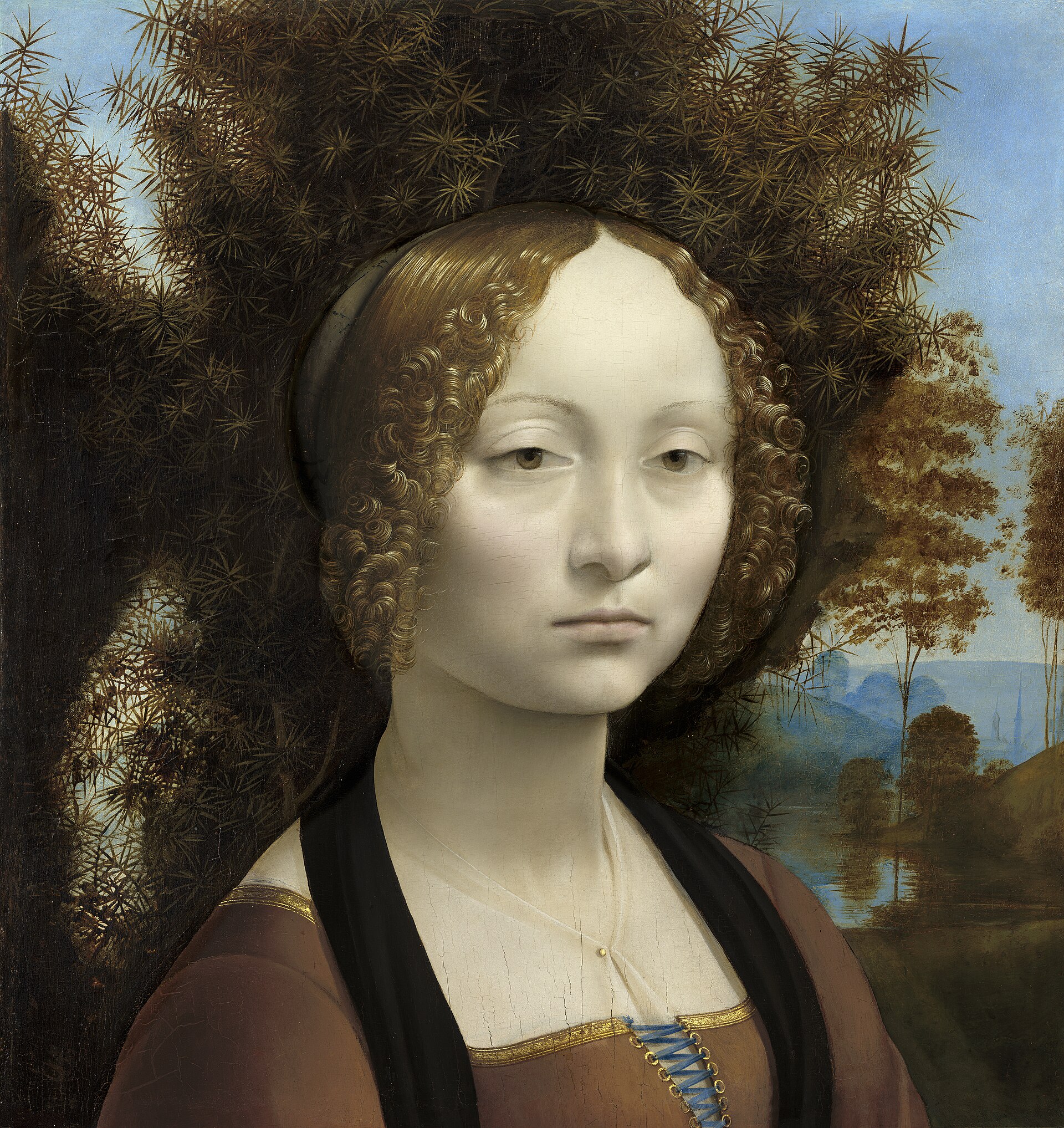
| Ginevra de' Benci Leonardo da Vinci | Earlier Florentine portrait by the same hand; Bull compared the two in Washington in January 1992 Ginevra's name is echoed by the juniper (ginepro) behind her, the precedent most often cited for the ermine's pun on Gallerani. Bull found similar finger and palm prints on both. | National Gallery of Art, Washington |
| La Belle Ferronniere (Portrait of an Unknown Woman) Leonardo da Vinci | Milanese portrait, also on walnut, and the picture whose name the Krakow panel carried at Pulawy The Pulawy inscription LA BELE FERONIERE was painted on the Krakow picture after a print of this portrait. Louvre researchers found a gypsum layer on it, unlike the lead-white ground of the Krakow panel. | Musee du Louvre, Paris |
| The ermine as a symbol of purity Leonardo da Vinci | Leonardo's own drawing of the animal and its moral Pen and brown ink over black chalk, 91 mm across, dated about 1494 from the manuscript. Shown in the 2011 National Gallery exhibition. | Fitzwilliam Museum, Cambridge (PD.120-1961) |
| Portrait of a Young Man Raphael | Companion in the Czartoryski 'Great Three' and in the same wartime seizure Taken from Lower Silesia and never recovered, unlike the Leonardo and the Rembrandt. Covered by the 2016 agreement as a claim, not an object. | Untraced since 1945 |
| Landscape with the Good Samaritan Rembrandt van Rijn | Third of the 'Great Three'; recovered with the Leonardo and returned in 1946 Taken to Bavaria with the Leonardo by Hans Frank, according to the Monuments Men and Women Foundation. | Princes Czartoryski Museum, Krakow (MNK XII-290) |
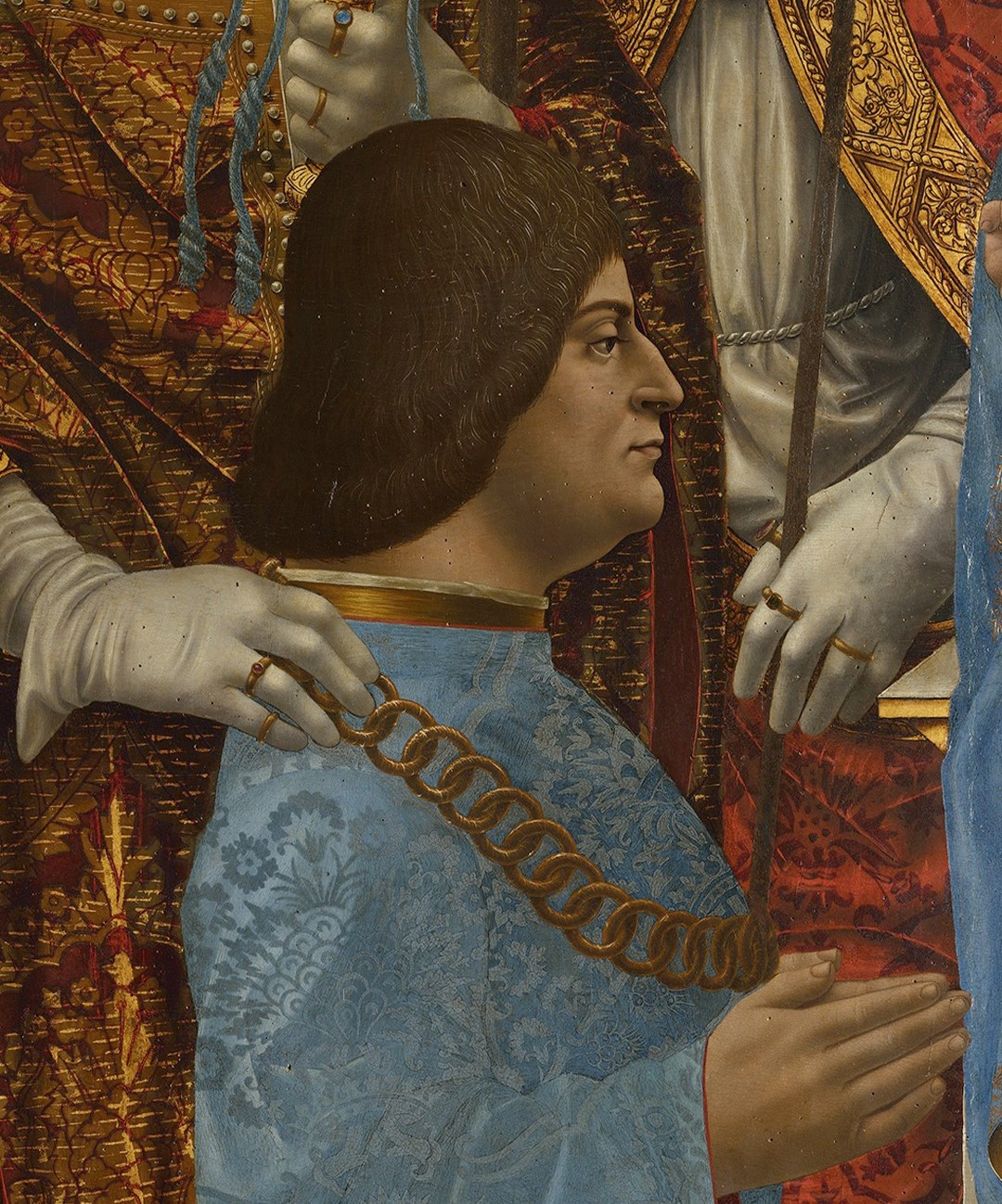
| Pala Sforzesca (Sforza Altarpiece) Master of the Pala Sforzesca | Portraits of Ludovico il Moro, Beatrice d'Este and their sons, from the circle of the court that commissioned the Lady About 1494. Included for the faces of Ludovico and Beatrice. | Pinacoteca di Brera, Milan |
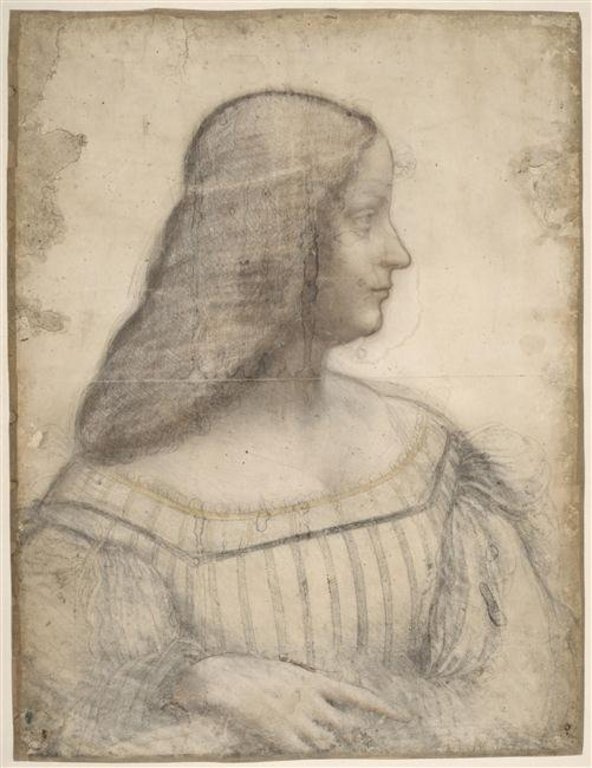
| Portrait of Isabella d'Este Leonardo da Vinci | Drawing of the woman who borrowed Cecilia's portrait in 1498 The Mantua State Archive says Leonardo sketched Isabella at Mantua between December 1499 and March 1500 and took the sketch with him; the Commons record dates the Louvre sheet to about 1499-1500. That this sheet is that sketch is the traditional view; the same Mantua catalogue notes that it is not known which of the two portraits named in the letters it matches. | Musee du Louvre, Paris (MI 753) |
| Young Knight in a Landscape Vittore Carpaccio | Painting around 1510 with an ermine and a scroll on purity, cited by Bucci Bucci reads the scroll as stating the same moral as Leonardo's notebook. | Thyssen collection (so called by Bucci) |
| Lady with a Lapdog Attributed to Lorenzo Costa | North Italian portrait with a small animal, cited by Boesten-Stengel as a dating comparison Dated by Boesten-Stengel's source to 1506-08, the basis of his argument for a late date for the Krakow panel; not accepted by the museum. | Windsor Castle, Royal Collection (RCIN 405762) |
Open questions
- Where was the picture between Cecilia Gallerani's death (probably around 1536) and the Czartoryski purchase in 1798-1800? The 2015 museum paper says no evidence has been found, and the Monuments Men and Women Foundation's line that it came from the Giustiniani collection has no cited source.
- Who painted the black ground, when and why? Candidate answers in the sources: Italy before 1800 (the 2015 paper), Pulawy or Paris in the early or mid nineteenth century, the 1840s after the years walled up at Sieniawa (Rostworowski), or after the broken corner (Bull). The museum's own pages disagree with each other.
- Was there ever a state of the picture without the ermine? Cotte (2014) says yes, in three stages; the museum's conservators (2015) say the radiograph and pouncing traces show the animal was part of the design from the start. Neither side's raw data is open.
- Is the Krakow panel the portrait that Cecilia lent to Isabella d'Este in 1498? Nothing in the letters or in Bellincioni's sonnet describes it, and Boesten-Stengel (2021) argues the sonnet describes a different composition.
- What is the date? Estimates range from 1485-86 (Mantua State Archive catalogue note) through 1488-91 (Bucci, the museum, the 2012 committee minutes) to about 1507-08 (Boesten-Stengel).
- When was Ludovico invested in the Order of the Ermine, 1486 (Benzoni; Boesten-Stengel) or 1488 (Bucci following Pedretti; the museum)? The document that settles it was not found.
- Who removed the two patches of overpaint at the top right and lower right, and when? Munich in 1945-46 and Kozlowski in 1952 are the two candidates in the 2015 paper, which says neither recorded doing it.
- What did Leonardo receive for the portrait? No contract or payment has surfaced, and Cecilia's own 1,000-ducat inheritance seems not to have been paid by 1508.
- What do the label BURG / 1227 on the back and the label 134 mean? The second matches the entry number in the 1940 German catalogue of secured works, which was not seen.
- What did the 2024 Techne article by del Hoyo-Melendez and colleagues on the picture's materials and techniques add? It is listed in the museum's bibliography and was not reached.
- Is the picture on Poland's List of Heritage Treasures? Piotr Zuchowski said in 2013 that it should be; whether it was entered was not established.
- Where did the proceeds of the 2016 sale go? The Foundation says it moved its funds to a Liechtenstein foundation; the Liechtenstein authorities' inspection at the request of Poland's Supreme Audit Office has not been published.
Questions about this object
What is Lady with an Ermine (Portrait of Cecilia Gallerani)?
Lady with an Ermine (Portrait of Cecilia Gallerani) is a painting, dated c. 1489-1491 (placed between c. 1485 and c. 1508 by different authors). Medium: Oil on walnut panel (the museum's catalogue: mixed technique, oil and distemper), on a thin lead-white ground; black overpainted background.
Who made Lady with an Ermine (Portrait of Cecilia Gallerani), and is the attribution settled?
The attribution to Leonardo da Vinci is recorded here as accepted. Accepted by the holding museum and the standard Leonardo literature on the evidence of style, the pouncing and underdrawing, the lead-white ground and the handling, not from a document naming the painter for this panel; the museum says the authorship was known from the start. The black background is a later hand. That the sitter is Cecilia Gallerani is an inference, not a documented fact, and a published dissent (Boesten-Stengel, 2021) proposes a different sitter and a much later date.
Where is Lady with an Ermine (Portrait of Cecilia Gallerani) now?
Princes Czartoryski Museum (a branch of the National Museum in Krakow), Krakow; second floor, gallery VII, permanent exhibition. Inventory number MNK XII-209. Last confirmed 8 October 2026. Collection page and digital catalogue of the National Museum in Krakow; bought by the Polish State Treasury on 29 December 2016 with the Czartoryski collection and transferred to the National Museum in Krakow in 2017.
What is still unknown about Lady with an Ermine (Portrait of Cecilia Gallerani)?
Where was the picture between Cecilia Gallerani's death (probably around 1536) and the Czartoryski purchase in 1798-1800? The 2015 museum paper says no evidence has been found, and the Monuments Men and Women Foundation's line that it came from the Giustiniani collection has no cited source.
Sources
- 1National Museum in Krakow, collection page 'Lady with an Ermine' (entry by Dorota Dec and Janusz Walek; object number MNK XII-209; CC0). Primary institutional source. mnk.pl/en/...
- 2National Museum in Krakow, digital collection catalogue entry 157417, 'Lady with an Ermine - Portrait of Cecilia Gallerani': measurements, inscriptions, history, bibliography and exhibition events. Read through the in-app browser because the catalogue is a script-driven page. zbiory.mnk.pl/en/...
- 3Janusz Czop and Joanna Sobczyk, 'The Travels of the Lady', Rozprawy Muzeum Narodowego w Krakowie, Nowa Seria 8 (2015), pp. 187-212 with chronology of loans after the Second World War. Read as OCR text on the Heidelberg digital library (reached through the in-app browser past a bot check). digi.ub.uni-heidelberg.de/diglit/...
- 4Janusz Czop, Piotr Fraczek, Julio M. del Hoyo-Melendez and eleven co-authors, 'Leonardo da Vinci Lady with an Ermine - the latest research into the artist's painting technique and the state of preservation of the painting', Rozprawy Muzeum Narodowego w Krakowie, Nowa Seria 8 (2015), pp. 229-250. Same volume and route as source 3. digi.ub.uni-heidelberg.de/diglit/...
- 5National Museum in Krakow with Google Arts & Culture, 'What Does the Paint Hide? History of the Examination of Lady with an Ermine' (text by Janusz Czop, Piotr Fraczek, Julio M. del Hoyo-Melendez and others). artsandculture.google.com/story/...
- 6Lumiere Technology, 'Lady with an Ermine - Painter Leonardo da Vinci's painting' (Pascal Cotte's account of the 3 September 2007 multispectral scan and its conclusions). Commercial and interested source for the scan itself. lumiere-technology.com/dame-a-hermine
- 7Agence France-Presse, 'Scientist Strips Lady with Ermine', The Krakow Post, 24 November 2007 (Cotte, Jacques Franck and Anna Grochowska-Angelus quoted). krakowpost.com
- 8Bendor Grosvenor, "'Secrets of Leonardo revealed'?", Art History News, 1 October 2014, with Pascal Cotte's reply (Update IV) and Martin Kemp's remarks as quoted from the BBC. arthistorynews.com/articles/...
- 9Roya Nikkhah, BBC News, 'Leonardo Da Vinci painted three Ermine portraits', 2 October 2014, as reproduced in full on Travis Simpkins' blog. The BBC original was not reachable (domain blocked to the search tool); this is a republication. tsimpkins.com/2014/...
- 10Le Petit Journal Varsovie, 'La Dame a l'hermine - Le celebre portrait du Musee Czartoryski revele ses secrets' (Laura Giarratana, 15 October 2014, updated 30 September 2026), on Cotte's three versions and current display. lepetitjournal.com/varsovie/...
- 11Archivio di Stato di Mantova, 'Leonardo da Vinci nei documenti dell'Archivio di Stato di Mantova', ed. Stefano L'Occaso (Mantua, 2019), section 'Cecilia Gallerani, la Dama con l'ermellino': transcriptions of Isabella d'Este's letter of 26 April 1498 and Cecilia Gallerani's letters of 29 April and 18 May 1498 (Archivio Gonzaga, busta 2992 and busta 1615). archiviodistatomantova.cultura.gov.it/fileadmin/...
- 12Julia Cartwright, Beatrice d'Este, Duchess of Milan, 1475-1497 (London, 1903), Project Gutenberg #25622: English translation of the April 1498 letters and an early account of Cecilia. Out of date on several facts (it gives an implausible 1481 gift of Saronno); used only for the translation. gutenberg.org/cache/...
- 13Carlo Alberto Bucci, 'Gallerani, Cecilia', Dizionario Biografico degli Italiani, vol. 51 (1998), Treccani. treccani.it/enciclopedia/...
- 14Gino Benzoni, 'Ludovico Sforza, detto il Moro, duca di Milano', Dizionario Biografico degli Italiani, vol. 66 (2006), Treccani. treccani.it/enciclopedia/...
- 15Albert Boesten-Stengel, 'Ein Bildnis der Claude de France? Antike und Heraldik in Leonardos Dame mit Hermelin', Folia Historiae Artium, Seria Nowa 19 (2021), pp. 31-62 (with English summary). Prints the 1493 text of Bellincioni's sonnet. pau.krakow.pl/FHA/...
- 16Paolo Giovio, Dialogo dell'imprese militari et amorose (Lyon: Guglielmo Rouillio, 1574), Internet Archive copy 'dialogodellimpr00giov', full text (the passages on Ferrante's ermine and on Ludovico's Moor and brush). archive.org/details/...
- 17The Notebooks of Leonardo da Vinci, translated by Jean Paul Richter (1883), Project Gutenberg #5000: the bestiary entries on the ermine (no. 1234 and no. 1263). gutenberg.org/cache/...
- 18Fitzwilliam Museum, Cambridge, 'The ermine as a symbol of purity', PD.120-1961, Leonardo da Vinci, c. 1494 (record). data.fitzmuseum.cam.ac.uk/id/...
- 19Vatican Library, Humanist Library of Federico da Montefeltro, note 'Ermellino' (the Order of the Ermine, its motto and its collar, citing Giovio's Dialogo p. 56). spotlight.vatlib.it/it/...
- 20Michael Wladika, 'Muhlmann, Kajetan', Lexikon der oesterreichischen Provenienzforschung (his appointment by Goering on 6 October 1939). lexikon-provenienzforschung.org/en/...
- 21Monuments Men and Women Foundation, 'Raphael, Portrait of a Young Man' card, WWII Most Wanted Art: the Czartoryski 'Great Three', Sieniawa, Muhlmann, Posse, Frank and the 1945 evacuation. monumentsmenandwomenfnd.org/wwii-most-wanted-raphael
- 22Nicholas Hodge, 'What the sale of the Czartoryski collection says about Poland today', Apollo, 27 February 2017. apollo-magazine.com/sale-czartoryski-collection-says-pola...
- 23Ministerstwo Kultury i Dziedzictwa Narodowego, communique on the purchase of the Princes Czartoryski collection, 6 April 2018, as republished by niezalezna.pl. niezalezna.pl/221788-komunikat-mkidn-w-sprawie-zakupu-kol...
- 24Martyna Kosko, 'Burza wokol sprzedazy kolekcji Czartoryskich. Ministerstwo kultury zabralo glos', Money.pl, 6 April 2018 (summary of the Ministry's statement). money.pl/gospodarka/...
- 25Money.pl, 'Kontrola w nowej fundacji rodziny Czartoryskich. Wynikow nie poznamy', 6 October 2018 (the Foundation's statement on Le Jour Viendra; NIK's suspicion; Liechtenstein's refusal to release the inspection result). money.pl/gospodarka/...
- 26Witold Mrozek, 'Jak Glinski zaplacil spadkobiercom ksiazat Czartoryskich pol miliarda, a ci oglosili bankructwo', OKO.press, 11 January 2020. Critical commentary; used only for reported facts, attributed. oko.press/jak-glinski-zaplacil-spadkobiercom-ksiazat-czar...
- 27Nicholas Hodge, 'Poland's oldest museum reopens after ten years of closure and controversy', Notes from Poland, 21 December 2019. notesfrompoland.com/2019/...
- 28The National Gallery, London, press release 20 January 2025, 'Van Gogh: Poets and Lovers ... most popular ever ticketed exhibition': gives 323,827 visits for 'Leonardo da Vinci: Painter at the Court of Milan' (9 November 2011 - 5 February 2012) and the night opening. nationalgallery.org.uk/about-us/...
- 29The Globe and Mail, 'Leonardo's paintings, revolutionary' (November 2011), interview with Luke Syson at the National Gallery exhibition. theglobeandmail.com/arts/...
- 30Narodowy Bank Polski, mid rate of the euro, table A no. 251/A/NBP/2016, 29 December 2016: 4.4131 PLN (API record). api.nbp.pl/api/...
- 31Rafal Mundry, 'Budzet 2016 najlepszy od lat', Bankier.pl, 17 January 2017 (planned 2016 budget revenue of 313.8 billion zloty). bankier.pl/wiadomosc/...
- 32Wikipedia, 'Lady with an Ermine'. Wikipedia's own date claims). en.wikipedia.org/wiki/...
- 33Emily Zarevich, 'Lady with an Ermine Meets Nazi Art Thief Hans Frank', JSTOR Daily, 10 December 2023 (quoting Robert Aitken on Frank's conviction at Nuremberg). Popular source. daily.jstor.org/lady-with-an-ermine-meets-nazi-art-thief-...
- 34Artibus et Historiae no. 25 (1992): abstract of David Bull, 'Two Portraits by Leonardo: Ginevra de' Benci and the Lady with an Ermine' (full article not read; its findings are taken from source 4). artibusethistoriae.org/chapter240.html
- 35The National Gallery, London, 'The Virgin of the Rocks' (Leonardo da Vinci), catalogue page: the 1483 contract, the dispute over payment and the final payment in 1508. nationalgallery.org.uk/paintings/...
- 36PAP, 'Krakow: Krajobraz z milosiernym Samarytaninem tylko do niedzieli', dzieje.pl, 30 November 2016 (the Lady at the Wawel; the Foundation's aim of an independent museum; the 2012 letter of intent). dzieje.pl/node/...
- 37Wikimedia Commons file page, 'Return of Lady with an Ermine.jpg' (US Monuments, Fine Arts and Archives photograph, April 1946; source Monuments Men Foundation). commons.wikimedia.org/wiki/...
- 38Monika Kuc, 'Muzeum Ksiazat Czartoryskich po remoncie: Kladka do da Vinci', Rzeczpospolita, 26 December 2019. rp.pl/kultura/...
- 39National Museum in Krakow, 'The Painting Conservation Studio at the Princes Czartoryski Museum' (list of the loans under conservation supervision). mnk.pl/en/...
- 40Publishers Weekly, review of Eden Collinsworth, What the Ermine Saw: The Extraordinary Journey of Leonardo da Vinci's Most Mysterious Portrait (2023). publishersweekly.com/9780385546119
- 41Wikipedia, 'Cecilia Gallerani'. Not relied on for any fact. en.wikipedia.org/wiki/...
- 42Wikimedia Commons file page, 'Infrared reflectograms of the Lady with an Ermine by Leonardo da Vinci.jpg' (photographed 11 December 2019 at the Louvre's Leonardo exhibition by the Commons user Tangopaso; dedicated to the public domain by the photographer). commons.wikimedia.org/wiki/...
- 43Wikimedia Commons file page for the National Museum in Krakow's own digital image of the picture (credit: National Museum in Krakow Digital Collection, digital ID 157417; public domain). commons.wikimedia.org/wiki/...
- 44Federico Giannini and Ilaria Baratta, "Leonardo da Vinci's Lady with an Ermine, the first portrait in modern history", Finestre sull'Arte, 14 January 2023 (partly paywalled; used only for Boloz-Antoniewicz, Suida and Carotti and the 1900 origin of the identification). finestresullarte.info/en/...


_-_Lady_with_an_Ermine_%E2%80%93_Portrait_of_Cecilia_Gallerani_(ca._1473%E2%80%931536)_-_MNK_XII-209_-_National_Museum_Krak%C3%B3w.jpg)
Last verified · Published
Change log
8 October 2026 - Record created at the house standard: researched narrative, technical evidence, maker dossier, graded provenance chain, prices with hammer and premium separated, related works, open questions and sources.