The Projecta Casket
Unknown Roman silversmiths' workshop · c. 380 (British Museum's current dating for this object specifically)
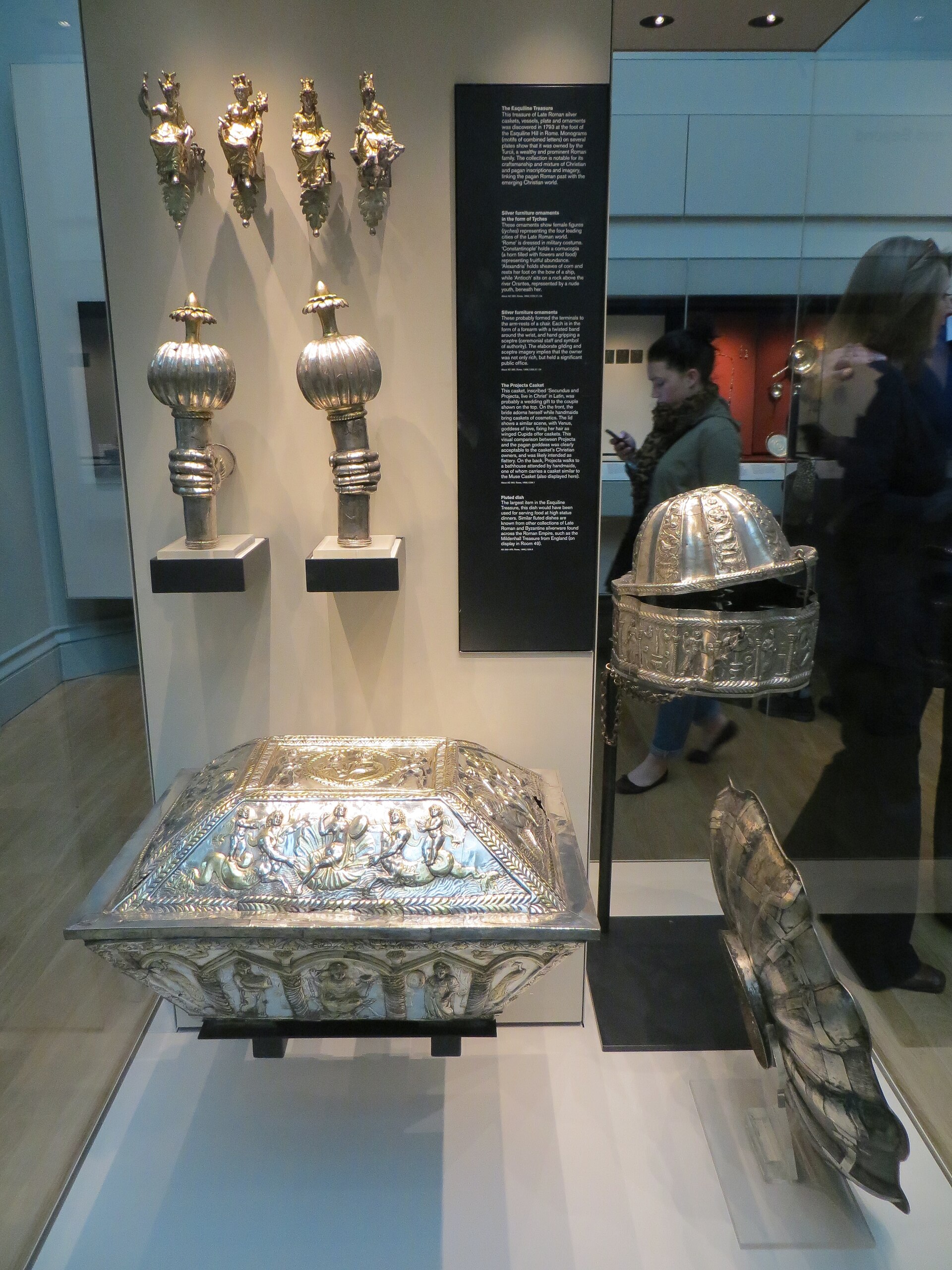
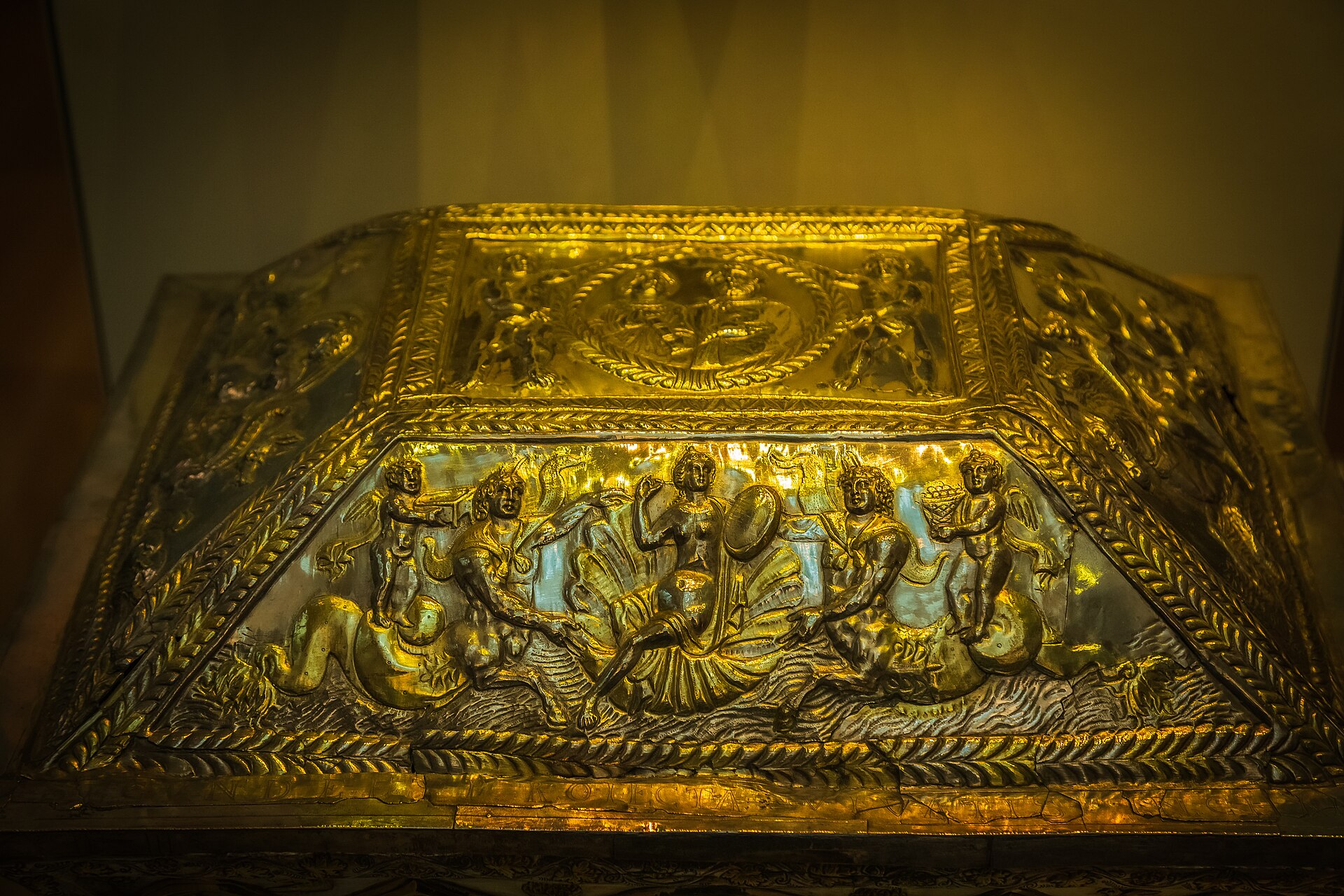
The Projecta Casket in the foreground of its case in Room 41, with other silver furniture fittings from the same Esquiline find visible behind it. Photographed by Jononmac46 in March 2014; do not read the other pieces in the background as part of the Projecta Casket itself, they are separate objects from the same hoard.
Jononmac46, via Wikimedia Commons, CC BY-SA 3.0| Artist | Unknown Roman silversmiths' workshop |
|---|---|
| Date | c. 380 (British Museum's current dating for this object specifically) |
| Medium | Silver, parcel-gilt (silver with gilding), worked in repousse and chased, with engraved and pointille (punched-dot) inscriptions |
| Dimensions | Height 28.60 cm; width 23.40 cm at base, 48.80 cm at the widest point; length 33.20 cm at base, 56 cm at the longest point; weight 8,200 g |
| Where it is now | British Museum, Londonlast confirmed |
| Inventory number | 1866,1229.1 |
| Attribution | UnknownNo maker's name, mark or signature survives on the casket or on any other object in the find. Full note |
| Object type | Silver |
| Period | Late Roman, 4th century AD |
| Cases | Has a provenance gap |
| Inscriptions | Rim of the lid, before the front panel, in large engraved capitals: SECVNDE ET PROIECTA VIVATIS IN CHRISTO ('Secundus and Proiecta, live in Christ'). A second, smaller inscription on the same rim, in pointille capitals: *XXII-III*, read as [Pondo] XXII, III [Unciae], S[emuncia], 'twenty-two pounds, three and one-half ounces' (Roman units) - a weight mark for the silver. |
| Owners on record | 8 links7 documented, 1 unknown |
| Sources | 13 cited |
About this record Last verified · 13 sources cited · Change log
On this page 11 sections
ContentsClose
A silver-gilt bridal casket of about 380 CE, part of the Esquiline Treasure found on Rome's Esquiline Hill in 1793 and bought by the British Museum in 1866 with the rest of the Duc de Blacas's collection. Its lid rim carries a Christian wedding inscription naming a couple, Secundus and Proiecta (the museum's own transcription of the name), while the box itself is covered in resolutely pagan imagery: Venus at her toilette, nereids riding sea monsters, and a procession of bathing and dressing scenes read as preparation for a Roman wedding.
The combination has driven half a century of argument over who Secundus and Projecta actually were, whether the couple's household was pagan, Christian or comfortably both, and whether the box was made in one commission for one wedding or assembled from a workshop's stock of mythological panels. None of the three questions is settled. The casket has never been sold since it left Italy in the early nineteenth century; its only market transaction was as part of a single institutional purchase of an entire private collection.
Provenance
Each link is graded. Documented: a cited source supports it. Disputed: the identification is argued but not established. Unknown: no owner for that span, and the gap is not smoothed into a narrative. The grades in the glossary.
- c. 350-400 -A Roman workshop, probably at Romedocumented
The casket, the domed Muse Casket and a set of silver Tyche furniture fittings from the same find are attributed to one workshop on stylistic and technical grounds. Kathleen Shelton dates the wider treasure to a span of about 330-370, drawn from more than one generation of a family's accumulated silver; the British Museum's own current online catalogue instead dates this specific object to 'about 380', following Alan Cameron's argument tying the casket to the Damasus epitaph for a woman named Projecta who died in 383. The two datings are not reconciled in the sources consulted.131213
- - 1793Unknown (buried in a Roman house on or near the Esquiline Hill)unknown
No owner is named for the roughly four centuries between manufacture and discovery. No coins were recovered with the hoard, so there is no independent check on when it went into the ground. Kent and Painter's suggestion that it was buried shortly before Alaric's sack of Rome in 410 is a proposal drawn from the treasure's apparent completeness and the general pattern of the period, not a documented fact.3
- 1793 - 1793Found on the grounds of the convent of San Francesco di Paola ai Monti, Esquiline Hill, Romedocumented
The British Museum's own findspot field reads: 'Found/Acquired: San Francesco di Paola ai Monti, convent building (ruin of) (grounds)'. The first surviving scholarly notice was made a year later, in 1794, by the antiquarian Ennio Quirino Visconti, later head of the Capitoline Museum. Ronald Ridley's 1996 article in The Antiquaries Journal, built around a previously unpublished letter, is the source this record could identify for filling gaps in the 1793-94 record, but this record accessed only its abstract and a short extract, not the full text.134
- 1793 - by 1793Bishop (later Cardinal) Giulio Maria della Somagliadocumented
The British Museum's own database lists 'Monsignor Guilio Maria della Somaglia' among the object's previous owners. A secondary Italian-language account (romanoimpero.com), not independently checked against Ridley 1996 or any primary record, adds that workmen tried to sell the find privately and that della Somaglia intervened and arranged a sale to benefit the convent. This record treats the bare fact of della Somaglia's involvement as documented (it is in the museum's own field) and the specific narrative of workmen and interception as unverified beyond that one secondary source.16
- 1793 - by 1827Baron von Schellerscheim, a Prussian resident in Florencedocumented
The British Museum's own database lists 'Baron von Schellerscheim' among the object's previous owners, without a date. The same secondary account (romanoimpero.com) gives a price: about 1,014 ounces of silver valued at 1,115.40 scudi, plus a small premium for its antiquity, for a total of 1,450 scudi to the convent. That the treasure was priced substantially as bullion, by weight, rather than as recognised art, is consistent with how little was then known about it; the precise figures are not corroborated in any other source consulted.16
- by 1827 - 1839Pierre Louis Jean Casimir de Blacas d'Aulps, 1st Duc de Blacas d'Aulps (1770/71-1839), French ambassador to the Kingdom of the Two Siciliesdocumented
Schellerscheim resold the treasure to Blacas by 1827, per the same secondary account. The 1st Duc died in 1839.6
- 1839 - 1866Louis, 2nd Duc de Blacas d'Aulps, by inheritancedocumented
The collection passed to the 1st Duc's son on his father's death in 1839. The 2nd Duc died in Venice in 1866; it was his estate that sold the family's entire collection of antiquities to the British Museum. The British Museum's own acquisition field for this object reads 'Purchased from: Louis, Duc de Blacas d'Aulps', which names the 2nd Duc's estate as the immediate seller.1
- 1866 - presentBritish Museum, Londondocumented
The British Museum's own database records 'Acquisition date: 1866' and 'Purchased from: Louis, Duc de Blacas d'Aulps'. Sir Charles Newton examined the whole Blacas collection in France on the Museum's behalf; the purchase was debated in the House of Commons on 18 February 1867, where the government's initial offer of 45,000 pounds was refused, a final price of 48,000 pounds was agreed, and 2,221 pounds was deducted for reserved duplicate specimens, for a Parliamentary vote of 45,721 pounds for the collection as a whole (not this object alone). The same Commons debate singles out, without a clear identifying description, 'a casket of considerable size, ornamented with silver, and holds the entire toilette service in solid silver of a Roman lady' found on the Esquiline in 1793 as one of the collection's outstanding pieces; this record cannot confirm whether the speaker meant the Projecta Casket itself or its companion, the Muse Casket, which is the piece that actually held a set of silver toilet vessels inside it.18
Technical evidence
| Attribution note | No maker's name, mark or signature survives on the casket or on any other object in the find. The Projecta Casket, the Muse Casket and the treasure's silver furniture fittings (four Tyche figures for a great official's chair or litter) are attributed to a single workshop on the grounds of shared style and technique, not any documentary record of a named smith. The British Museum's own findspot record for the workshop location itself carries a question mark: 'Workshop in: Rome (city) (?)'. |
|---|---|
| Object type and form | Casket: a truncated rectangular pyramid body with isosceles-trapezoid sides, fitted with a lid of matching form, joined by three hinges.1 |
| Materials | Silver, parcel-gilt (silver with gold gilding applied selectively to raised figures).1 |
| Technique | Repousse relief worked from sheet silver, refined by chasing; inscriptions engraved (dedicatory text) and pointille, or punched-dot (weight mark).1 |
| Dimensions | Height 28.60 cm; width 23.40 cm at base, 48.80 cm at the widest point; length 33.20 cm at base, 56 cm at the longest point.1 |
| Weight | 8,200 g as currently weighed by the British Museum, against an ancient inscribed weight of 22 Roman pounds, 3.5 ounces (roughly 7,190-7,340 g by published Roman-pound values), a gap of about 900-1,000 g not explained in the sources consulted.1 |
| Inscriptions | Dedicatory text on the lid rim, engraved capitals: SECVNDE ET PROIECTA VIVATIS IN CHRISTO ('Secundus and Proiecta, live in Christ'). Weight mark on the same rim, pointille capitals: *XXII-III*, i.e. [Pondo] XXII, III [Unciae], S[emuncia].1 |
| Construction | Three of an original four corner feet survive; two swing handles are fitted at the short ends of the base for carrying.17 |
| Condition | Described by the British Museum as 'restored'; a secondary source specifies one major restored area, on the right end panel of the lid. Six recorded conservation treatments between 1994 and 2021.17 |
| Metallurgical analysis | Cited by the British Museum against a 1979 energy-dispersive X-ray fluorescence survey of Late Roman and Sassanian silver (Hughes and Hall), covering roughly 200 analyses; that wider survey found average silver fineness of about 95 percent and detectable compositional differences between separately joined parts of single objects. Results specific to this casket were not available to this record.19 |
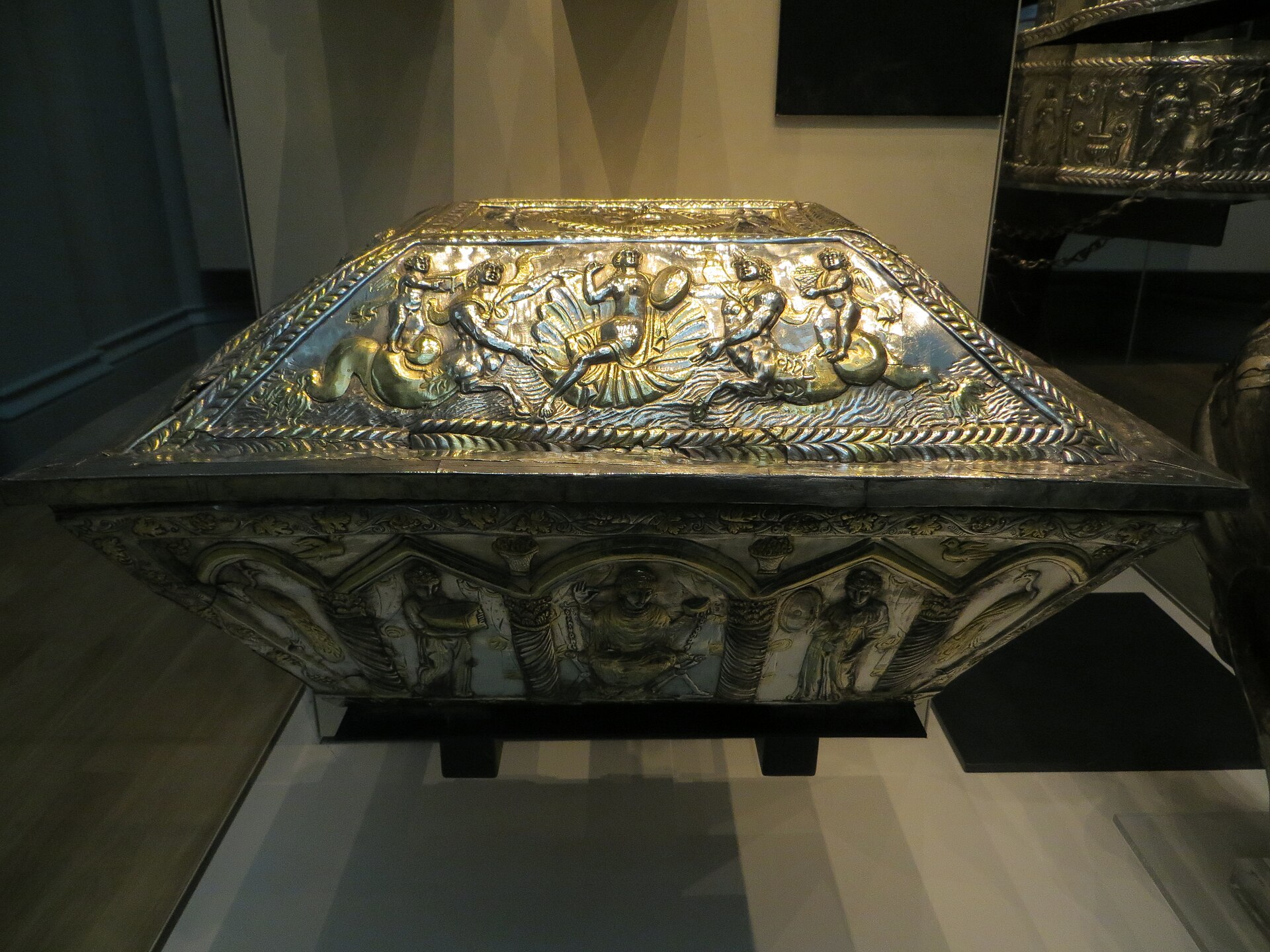
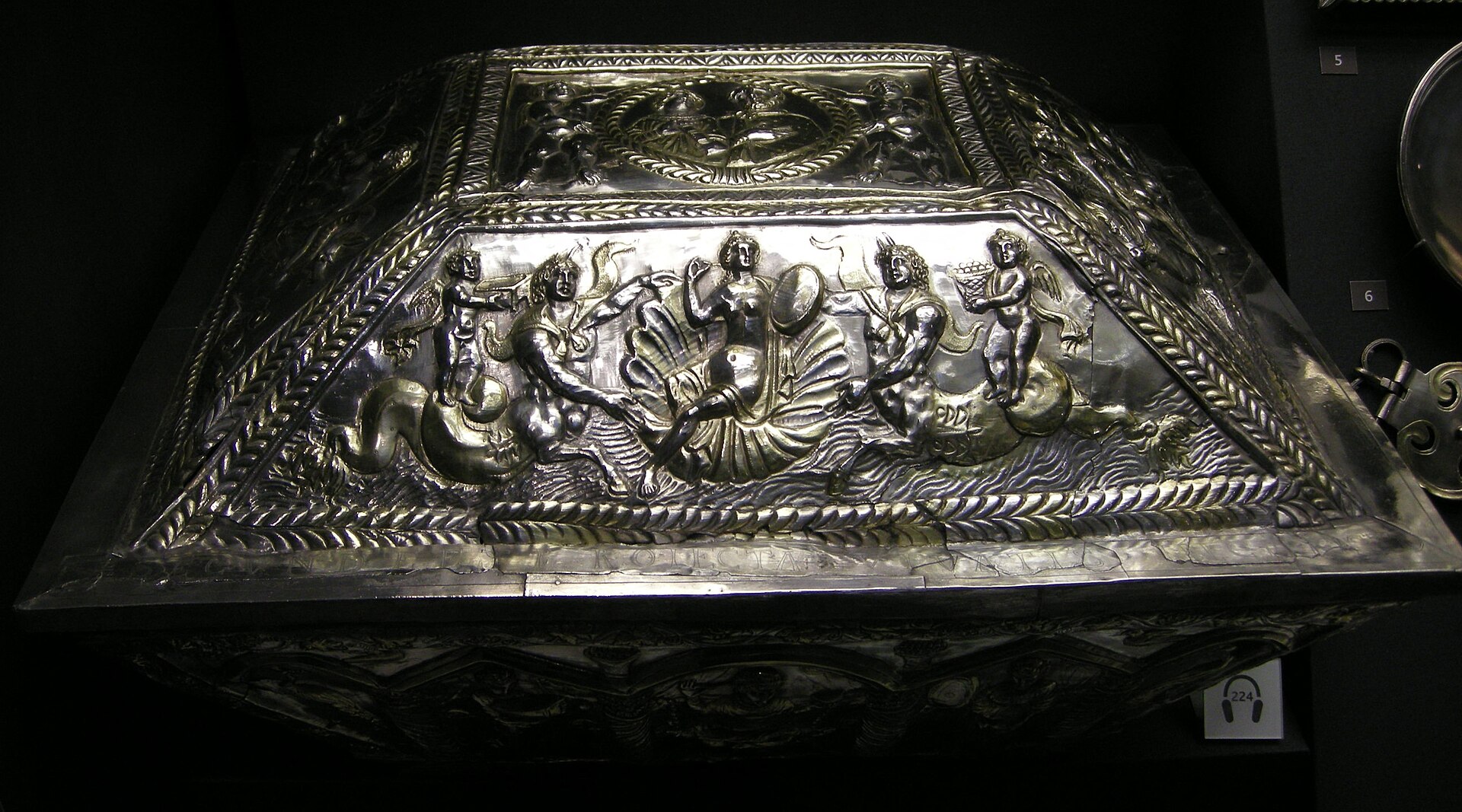
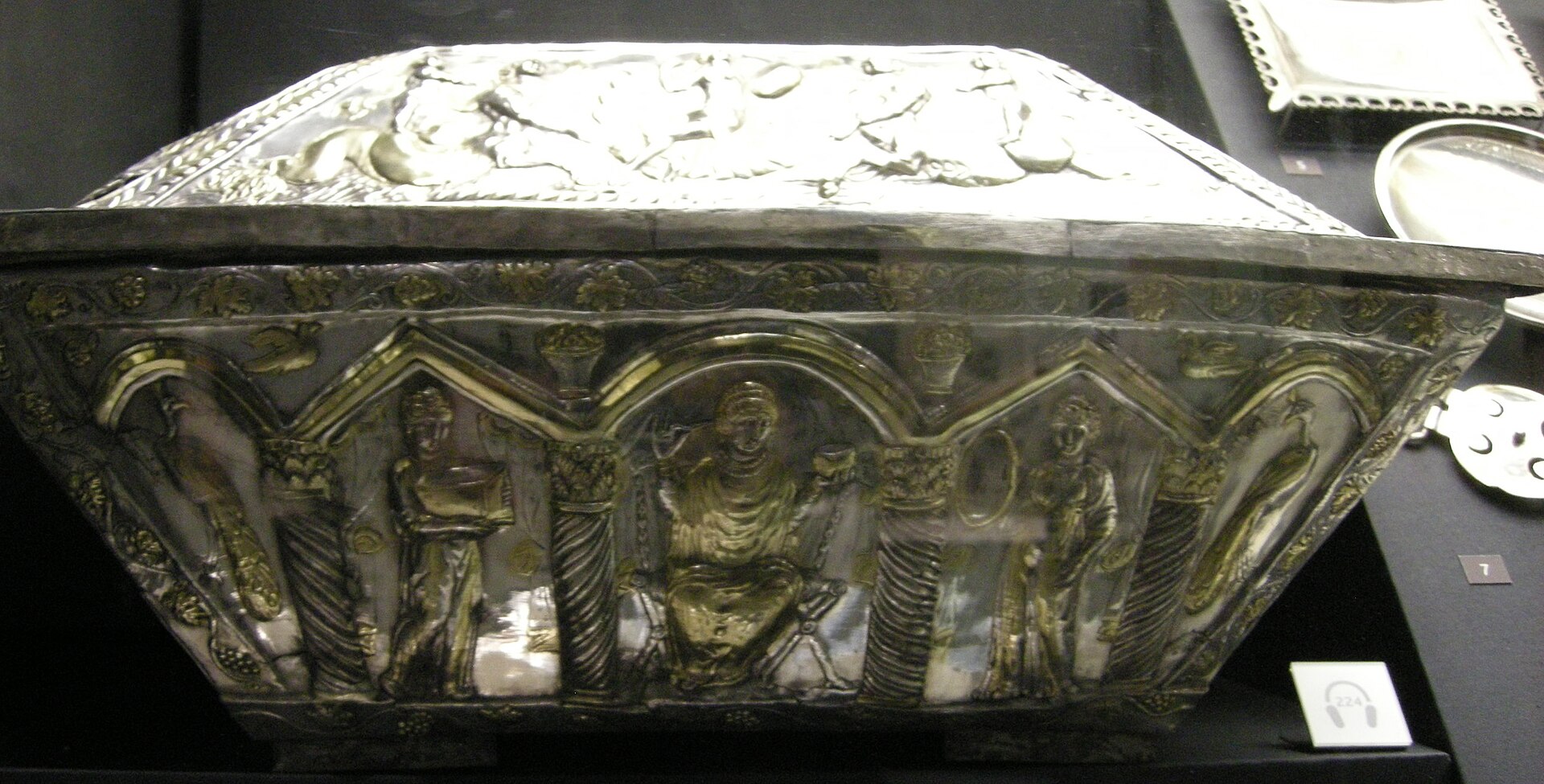
| Iconographic programme | Lid: Venus at her toilette on a cockle shell flanked by a nereid on a hippocampus and a nereid on a ketos, with a wreathed double portrait held by two erotes on the top panel. Body: four panels of bathing and dressing scenes set between columns and arches, read as wedding preparations; the back panel shows a six-figure procession to a domed bath building.135 |
Images
The record in full
Chapter 1What the casket is
The Projecta Casket is a silver box in the shape of a truncated rectangular pyramid, fitted with a lid of the same flared, four-sided form, the whole made from sheet silver rather than cast.
The Projecta Casket is a silver box in the shape of a truncated rectangular pyramid, fitted with a lid of the same flared, four-sided form, the whole made from sheet silver rather than cast. According to the British Museum's own current measurements it stands 28.60 cm high, measures 33.20 by 23.40 cm at its base and widens to 56 by 48.80 cm at its rim, and weighs 8,200 grams. Two swing handles at the short ends allowed it to be carried; three surviving corner feet (of an original four) raised it off whatever surface it stood on.
Silver throughout, it is gilded selectively, so that particular figures and details catch the light against a plain silver ground. That contrast, more than sheer scale, is what makes the object read as a luxury piece rather than plain tableware.
Chapter 2How it was made
The decoration was raised by repousse, hammered up from the reverse of the sheet and then refined and detailed from the front by chasing, the standard technique for high-relief Roman silver figure...
The decoration was raised by repousse, hammered up from the reverse of the sheet and then refined and detailed from the front by chasing, the standard technique for high-relief Roman silver figure work. The lid is joined to the body by three hinges. No maker's name, workshop mark or signature appears anywhere on the object, which is normal for Roman domestic silver of this class; attribution of the casket to a particular workshop rests entirely on comparison with the other pieces found alongside it.
That comparison is a strong one. The Muse Casket, a separate domed box from the same find, and a set of silver furniture fittings shaped as the four Tyches of Rome, Constantinople, Antioch and Alexandria, share enough in style and technique with this casket that all are usually assigned to the same workshop, thought to have worked in Rome itself. The British Museum's own record still qualifies that location with a question mark. Very few Late Roman silver hoards can be tied to a Rome workshop at all; most surviving major finds come from the edges of the empire, in Britain and along the frontier, which is what gives this attribution its interest even though it cannot be proven by any document.
Chapter 3The inscription: Secundus and Proiecta
The casket's dedicatory inscription runs around the rim of the lid, before the front panel, in large engraved capitals: SECVNDE ET PROIECTA VIVATIS IN CHRISTO.
The casket's dedicatory inscription runs around the rim of the lid, before the front panel, in large engraved capitals: SECVNDE ET PROIECTA VIVATIS IN CHRISTO. The British Museum's own transcription and translation read it as 'Secundus and Proiecta, live in Christ' - note that the ancient text itself spells the woman's name with an I, PROIECTA, in classical Latin orthography; the modern English form 'Projecta', used in the object's popular title and in most scholarship, is a conventional modernisation rather than what is actually engraved on the object.
A second, smaller inscription on the same rim, worked in pointille (punched dots) rather than engraved, gives a weight: *XXII-III*, read as twenty-two Roman pounds, three and one-half ounces. Converted using published values for the Roman pound of roughly 322 to 329 grams, that figure comes to somewhere between about 7,190 and 7,340 grams of silver. The casket as it now exists weighs 8,200 grams, some 900 to 1,000 grams heavier than its own ancient weight mark, a discrepancy of very roughly 12 to 14 percent that none of the sources consulted for this record explains. A later repair adding metal is one obvious possibility; so is some uncertainty in exactly which Roman pound standard applied. Neither has been confirmed.
Chapter 4Venus on the lid, a wedding on the body
Above the dedicatory inscription, the lid carries three related mythological scenes across its sloping panels: Venus at her toilette on a cockle shell, flanked by a nereid riding a hippocampus on one...
Above the dedicatory inscription, the lid carries three related mythological scenes across its sloping panels: Venus at her toilette on a cockle shell, flanked by a nereid riding a hippocampus on one side and a nereid riding a ketos, a dragon-like sea monster, on the other. The flat top panel of the lid holds a double portrait: half-length figures of a man and a woman, framed in a wreath supported by two standing, nude erotes. These are read as the couple named in the inscription below.
The four sloping panels of the box itself, set between columns joined by alternating arches and pediments under a scrolling vine frieze, show bathing and dressing scenes generally read as preparation for a grand Roman wedding. One shows a woman seated on an ornate chair holding a box similar in shape to the Muse Casket; the back panel shows a procession of six figures moving toward a domed building read as a bath house, one of them carrying a casket like the Muse Casket again. That repetition, an object depicted on the object, is the main visual evidence connecting this casket to its silver companion.
Chapter 5A Christian inscription over pagan imagery
The plain fact, documented on the object itself, is that a Christian wedding blessing sits directly above scenes of Venus and her mythological retinue, with no attempt to Christianise the imagery...
The plain fact, documented on the object itself, is that a Christian wedding blessing sits directly above scenes of Venus and her mythological retinue, with no attempt to Christianise the imagery underneath it. This was not unusual in Rome up to about the middle of the fourth century, when a specifically Christian visual vocabulary for secular, everyday decoration had not yet been developed; patrons who considered themselves Christian in the sense that mattered to them, such as their wedding vows, still furnished their houses with the same mythological repertoire everyone else used.
Jas Elsner's 2003 study of the casket argues that the visual echo between Venus on the lid and the bride below it was not an oversight but the point: showing the bride's toilette in the same register as the goddess's flattered her, and the whole object functioned within what he calls the female sphere, equipping a woman to be beautified for her husband's pleasure as part of the social business of a Roman marriage. That is an argued reading of intention, not a documented statement by the patrons themselves; no letter, will or contract from Secundus or Projecta survives to confirm what either of them thought the imagery meant.
Chapter 6Who were Secundus and Projecta
An epitaph composed by Pope Damasus I, for a woman named Projecta who died in 383 shortly before her seventeenth birthday, was once displayed in the church of San Martino ai Monti, close to where the...
An epitaph composed by Pope Damasus I, for a woman named Projecta who died in 383 shortly before her seventeenth birthday, was once displayed in the church of San Martino ai Monti, close to where the treasure was found. Alan Cameron has argued that this Projecta is the casket's Projecta, and that her husband was L. Turcius Secundus, reading a difficult line of the epitaph as wordplay in which the husband's name, Secundus (literally 'second'), is punned against 'primo', so that Damasus is saying he was in fact first in quality. Kathleen Shelton rejects the connection outright, arguing the epitaph and the casket name two different women called Projecta, and that the epitaph's 'Primus' is simply the husband's actual name.
Supporting Cameron's identification, two pieces of silver in the wider find carry a monogram read as standing for 'Projecta Turci', and the treasure includes furniture fittings of a kind that would decorate the ceremonial chair or litter of a senior official, a role members of the Turcii family are known to have held. Working against a tidy story, not every monogram in the hoard fits this couple, which is part of why Shelton reads the treasure as accumulated family silver rather than a single wedding's worth of new plate. If Secundus was indeed a Turcius, he belonged to a family that, this deep into the fourth century, still had openly pagan members, which is offered as one explanation for why an aristocratic Roman household might commission a Christian-inscribed object decorated entirely in pagan imagery: not confusion, but a compromise that suited both halves of an intermarried, religiously mixed family.
Chapter 7One wedding gift, or generations of family silver
Kathleen Shelton's case for dating the treasure across a run of twenty to twenty-five years within the broader span of 330 to 370 rests partly on the argument that it is not the product of one...
Kathleen Shelton's case for dating the treasure across a run of twenty to twenty-five years within the broader span of 330 to 370 rests partly on the argument that it is not the product of one commission but family plate built up over more than one generation, only some of which relates to Projecta and Secundus at all. On this reading, the casket and the Muse Casket, linked by the casket-within-a-casket imagery on the back panel, are probably a matched wedding gift, while other pieces in the same find, such as the ewer inscribed for a woman named Pelegrina, belonged to different people at different times and simply ended up buried together as the accumulated wealth of one household.
The British Museum's own current catalogue splits the difference rather than choosing a side: it follows Shelton's 330-370 range for the Muse Casket and the other objects, but dates the Projecta Casket itself to 'about 380', tied to the Damasus epitaph and therefore implicitly to Cameron's argument. That the Museum's own database applies two different working dates to two objects it otherwise treats as products of the same workshop and the same wedding is, itself, a fair measure of how unresolved the question remains.
Chapter 8Discovered on the Esquiline Hill, 1793
In the summer of 1793, excavation on the grounds of the convent of San Francesco di Paola ai Monti, on the Esquiline Hill, uncovered a large collection of Roman silver among the ruins of an earlier...
In the summer of 1793, excavation on the grounds of the convent of San Francesco di Paola ai Monti, on the Esquiline Hill, uncovered a large collection of Roman silver among the ruins of an earlier building. The British Museum's own findspot record for this object confirms that location directly. The first surviving scholarly notice of the find was made the following year, in 1794, by Ennio Quirino Visconti, later head of the Capitoline Museum.
Beyond that, the documented record thins quickly. A secondary Italian-language account used for this record states that workmen tried to sell the silver privately before Bishop, later Cardinal, Giulio Maria della Somaglia intervened and arranged its sale for the convent's benefit; della Somaglia does appear, without further detail, among the object's previous owners in the British Museum's own database, which supports the bare fact of his involvement even though the colourful story of intercepted workmen comes from only one source this record could not check against Ronald Ridley's 1996 study of an unpublished letter on the find, a study this record could access only in abstract.
Chapter 9A Prussian baron, a French duke, and an inheritance
The same secondary account gives a price for the treasure's first sale: roughly 1,014 ounces of silver, valued at 1,115.40 scudi with a small premium added for its antiquity, for a total of 1,450...
The same secondary account gives a price for the treasure's first sale: roughly 1,014 ounces of silver, valued at 1,115.40 scudi with a small premium added for its antiquity, for a total of 1,450 scudi, paid by Baron von Schellerscheim, a Prussian resident in Florence. That the price was calculated essentially as bullion by weight, with only a token addition for age, says something about how little the find's significance was understood at the point of its first sale; it was treated as old silver, not as an important survival of Late Roman craftsmanship.
Schellerscheim sold the collection on, by 1827, to Pierre Louis Jean Casimir de Blacas d'Aulps, the 1st Duc de Blacas d'Aulps, then French ambassador to the Kingdom of the Two Sicilies. On the 1st Duc's death in 1839 the collection passed to his son, the 2nd Duc, also named Louis, who kept it until his own death in Venice in 1866.
Chapter 10The British Museum's purchase of the whole Blacas collection, 1866-67
The 2nd Duc's estate sold his entire collection of antiquities, coins, gems and vases to the British Museum as a single lot.
The 2nd Duc's estate sold his entire collection of antiquities, coins, gems and vases to the British Museum as a single lot. Sir Charles Newton examined the collection in France on the Museum's behalf, and the purchase was debated in the House of Commons on 18 February 1867: an initial government offer of 45,000 pounds was refused, a final price of 48,000 pounds was agreed, and 2,221 pounds was then deducted for duplicate specimens the Museum chose to set aside, leaving a Parliamentary vote of 45,721 pounds for the collection as a whole, not this object individually.
In that same debate, a speaker singled out for the House 'a casket of considerable size, ornamented with silver, and holds the entire toilette service in solid silver of a Roman lady', found on the Esquiline Hill in 1793, as a highlight justifying the price. The description does not identify the object closely enough to be certain which casket is meant: the detail of a box that 'holds' a toilette service in solid silver fits the Muse Casket, which was found containing a set of silver toilet bottles, at least as well as it fits the Projecta Casket, which depicts toilet preparation in relief rather than containing toiletries itself. This record treats the Parliamentary description as evidence that the Esquiline material was used to help sell the purchase to Parliament, without claiming it definitely describes this specific casket.
Chapter 11Condition, conservation, and what is actually on display
The British Museum's own object description ends with a single word of note: 'restored'.
The British Museum's own object description ends with a single word of note: 'restored'. A secondary specialist source used for this record is more specific, describing the casket as surviving in generally excellent condition with one major area of restoration, on the right end panel of the lid. The Museum's conservation log records six separate treatment dates for the object between 1994 and 2021 (8 November 1994; 9 July 1998; 15 May 2007; 19 and 20 June 2012; 20 January 2021), which points to ongoing, incremental conservation work rather than a single historic restoration campaign.
This record searched specifically for evidence that the British Museum has, at any point, displayed an electrotype facsimile of the Projecta Casket rather than the original, since the Museum is known to have used Victorian electrotype reproductions for other objects and other institutions hold electrotype casts of unrelated Elkington-made silver copies that could plausibly be confused with this one at a glance. No such evidence was found. The object's own accession record, 1866,1229.1, identifies its object type as 'casket' and its materials as silver and gold, with no indication anywhere in that record that it is a reproduction; other genuine British Museum electrotypes are catalogued explicitly as such, under their own accession numbers, and this casket's record carries no equivalent flag. The lead photograph used for this record was taken inside Room 41 in March 2014, in a display case matching the location the Museum's own database still gives for the object; on the evidence available, it is treated as showing the original silver casket, not a facsimile, though the point is recorded here as a specific, checked finding rather than an assumption.
Chapter 12Exhibition history
The British Museum's own bibliography and exhibition record for this specific object, rather than the treasure in general, lists eight loans: to the Metropolitan Museum of Art, New York, for the...
The British Museum's own bibliography and exhibition record for this specific object, rather than the treasure in general, lists eight loans: to the Metropolitan Museum of Art, New York, for the 1977-78 exhibition remembered in scholarship as Age of Spirituality; to Rimini in 1996; to New Delhi in 1997-98 and Mumbai in 1998 for The Enduring Image; to Trier in 2007 for a Constantine the Great exhibition marking that emperor's association with the city; to the Royal Academy in London for Byzantium 330-1453 AD in 2008-09; to the Musee de Cluny in Paris in 2009 for an exhibition on bathing and cosmetics from antiquity to the Middle Ages, an obvious fit for an object whose entire decorative programme concerns a woman's toilette; and to the Art Institute of Chicago in 2012-13 for Tradition Transformed, a exhibition of the Museum's Late Roman and early Byzantine holdings.
Chapter 13What the metal itself has shown
The Projecta Casket has been included in at least one programme of scientific analysis beyond ordinary conservation treatment.
The Projecta Casket has been included in at least one programme of scientific analysis beyond ordinary conservation treatment. The British Museum's own curatorial note for the object directs researchers to M.J. Hughes and J.A. Hall's 1979 paper reporting energy-dispersive X-ray fluorescence analysis of Late Roman and Sassanian silver, covering roughly two hundred analyses across material from several hoards. In outline, that survey found the silver used across the period and region studied to run to a high fineness, averaging around 95 percent silver, with measurable compositional differences both between Roman and Sassanian material generally and between different joined parts of single objects, evidence of how such pieces were actually assembled from separately worked components. This record was not able to read the paper's results for the Esquiline material specifically, only its headline findings for the wider corpus it covers, and that gap is recorded rather than filled with a guess.
The artist
An unidentified Roman silversmiths' workshop, active in the second half of the fourth century CE, probably at Rome
Nothing is known of this workshop except what its own surviving output shows. It signed nothing, and no ancient text names it. What can be said comes entirely from comparing the Projecta Casket with its immediate companions from the same find: the domed Muse Casket and a set of silver Tyche furniture fittings, all attributed to the same hands on the basis of shared style and technique rather than any document. That the attribution rests on the objects alone, with no name ever to attach to it, should be read as a limit on every claim below, not a detail to pass over.
Exhibited
- 1977-1978Age of Spirituality: Late Antique and Early Christian Art, Third to Seventh Century (recorded by the British Museum as 'Early Christian Art')Metropolitan Museum of Art, New York, USA (18 Nov 1977 - 12 Feb 1978)
- 1996Dalla Terra Alle GentiSala dell'Arengo, Rimini, Italy (30 Mar - 13 Nov 1996)
- 1997-1998The Enduring ImageNational Museum, New Delhi, India (13 Oct 1997 - 5 Jan 1998)
- 1998The Enduring ImageSir Cowasjee Jehangir Hall, Mumbai, India (9 Feb - 3 May 1998)
- 2007Constantine the GreatRheinisches Landesmuseum, Trier, Germany (2 Jun - 4 Nov 2007)
- 2008-2009Byzantium 330-1453 ADRoyal Academy of Arts, London, UK (25 Oct 2008 - 22 Mar 2009)
- 2009Le Bain et le Miroir: Soins du corps et cosmetiques de l'Antiquite au Moyen AgeMusee de Cluny, Paris, France (20 May - 21 Sep 2009)
- 2012-2013Tradition Transformed: Late Roman and Early Byzantine Treasures from the British MuseumArt Institute of Chicago, USA (11 Nov 2012 - 25 Aug 2013)
Literature
- Kathleen J. Shelton, The Esquiline Treasure, London, British Museum Publications, 1981. (cat. 1)
- O.M. Dalton, Catalogue of Early Christian Antiquities and Objects from the Christian East in the Department of British and Medieval Antiquities and Ethnography of the British Museum, London, 1901. (no. 304)
- David Buckton (ed.), Byzantium: Treasures of Byzantine Art and Culture from British Collections, London, British Museum Press, 1994. (no. 10)
- T. Richard Blurton, The Enduring Image: Treasures from the British Museum, exhibition catalogue, 1997. (no. 187)
- Sonja Marzinzik, Masterpieces: Early Medieval Art, London, British Museum Press, 2013. (no. 3)
- Antony Eastmond, The Glory of Byzantium and Early Christendom, London, Phaidon, 2013. (no. 035)
- Kurt Weitzmann (ed.), Age of Spirituality: Late Antique and Early Christian Art, Third to Seventh Century, exhibition catalogue, New York, Metropolitan Museum of Art, 1979. (no. 310)
- J.P.C. Kent and K.S. Painter (eds.), Wealth of the Roman World: Gold and Silver, AD 300-700, London, British Museum Press, 1977. (no. 88)
- Robin Cormack and Maria Vassilaki (eds.), Byzantium 330-1453, London, Royal Academy of Arts, 2008. (no. 12)
- Jas Elsner, 'Visualising Women in Late Antique Rome: The Projecta Casket', in C. Entwistle (ed.), Through a Glass Brightly: Festschrift for David Buckton, Oxford, Oxbow, 2003, pp. 22-36.
- Richard Hobbs, The Mildenhall Treasure: Late Roman Silver Plate from East Anglia, London, British Museum Press, 2016. (p. 42, pl. 54; p. 43, pl. 55; Rome (Esquiline) cat. 1)
- Cavan Howells, A Catalogue of the Late Antique Gold Glass in the British Museum, London, British Museum Press, 2015. (p. 125)
- Alan Cameron, 'The Date and the Owners of the Esquiline Treasure', American Journal of Archaeology 89 (1985), pp. 135-145.
- Kathleen J. Shelton, 'The Esquiline Treasure: The Nature of the Evidence', American Journal of Archaeology 89 (1985), pp. 147-155.
- M.J. Hughes and J.A. Hall, 'X-ray Fluorescence Analysis of Late Roman and Sassanian Silver', Journal of Archaeological Science 6 (1979), pp. 321-344.
- Exhibition catalogue, Milano capitale dell'impero Romano 286-402 d.C., Palazzo Reale, Milan, 24 January - 22 April 1990. (no. 1g.1d.1, p. 81)
- Jas Elsner, Roman Eyes: Visuality and Subjectivity in Art and Text, Princeton, Princeton University Press, 2007. (pp. 200-224)
Related works
| Work | Relation | Where it is |
|---|---|---|
| The Muse Casket Same Roman workshop (unknown) | Companion piece from the same find, same acquisition and the same accession block A domed silver box suspended on chains, decorated with eight of the Nine Muses, that once held a set of silver toilet bottles. A near-identical casket is shown being carried by an attendant on the Projecta Casket's own back panel, which is the main visual evidence that the two boxes were made for the same wedding. | British Museum, London (1866,1229.2) |
| The four Esquiline Tyche furniture fittings Same Roman workshop (unknown) | Same find, same workshop attribution Silver fittings personifying Rome, Constantinople, Antioch and Alexandria, thought to have decorated the chair or litter of a great official. Members of the Turcii family, to whom the casket's owners have been tentatively linked, held offices of the kind these fittings suggest. | British Museum, London |
| The Mildenhall Treasure Various Roman workshops | Comparandum: another major Late Roman silver hoard held by the British Museum Discussed together with the Esquiline material in Richard Hobbs's 2016 catalogue as part of the small group of surviving major Late Roman silver hoards, most of which are now in the British Museum. | British Museum, London |
| Traprain Law hoard silver Various Roman workshops | Stylistic comparandum used in dating the Esquiline material Cited by specialist literature as comparative material for dating the repousse style of the Projecta Casket and related Late Roman silver. | National Museums Scotland, Edinburgh |
| The Blacas Ewer Shuja ibn Man'a al-Mawsili | No stylistic or subject relation; entered the British Museum through the same 1866 Blacas acquisition An inlaid brass ewer of 1232 CE from Mosul, registered a few numbers along in the same 1866 Blacas-collection accession block as the Projecta Casket. The two objects share nothing but an owner and a single sale to the Museum; see this site's separate record for the ewer. | British Museum, London (1866,1229.61) |
Open questions
- Is the Projecta of the casket the same woman commemorated in Pope Damasus's epitaph for a Projecta who died in 383, wife of a man the epitaph calls 'Primus'? Alan Cameron reads this as wordplay identifying her husband as L. Turcius Secundus; Kathleen Shelton argues they are two different women named Projecta. Neither position is settled.
- What is the casket's actual date? The British Museum's own current online catalogue gives 'about 380' for this object specifically, following Cameron, while continuing to date the Muse Casket and other pieces in the same find to Shelton's broader range of about 330-370. The treasure has not, on the evidence available to this record, been given a single agreed date.
- Was the casket made as one commission for one wedding, or is it, with the rest of the hoard, family silver accumulated across more than one generation? Current scholarship leans toward accumulation for the treasure as a whole, while treating the casket and the Muse Casket specifically as a likely matched wedding pair on visual grounds alone.
- What is the true sequence and date of ownership between the 1793 discovery and the 1827 sale to the Duc de Blacas? The specific names (della Somaglia, Schellerscheim), the prices and the weights given in this record come from one secondary Italian-language account and are not independently checked here against Ronald Ridley's 1996 primary study, which this record could access only as an abstract.
- Why does the casket's modern weighed mass (8,200 g) exceed what its own ancient inscription states (22 Roman pounds, 3 and a half ounces, which converts to roughly 7,200-7,300 g using published values for the Roman pound of about 322-329 g)? The gap of some 900-1,000 g, on the order of 12-14 percent, is not explained in any source consulted; it could reflect a later repair that added metal, or uncertainty in the ancient weight standard.
- Has an electrotype facsimile of the Projecta Casket ever been substituted for the original on display? This record searched specifically for evidence of this and found none: the object's own British Museum accession record describes it, by object type and materials, as the original silver-and-gold casket rather than an electrotype, unlike other Museum holdings that are explicitly catalogued as electrotypes. The lead photograph for this record, taken in the Museum's Room 41 in 2014, is treated as showing the original casket on that basis.
- Was the treasure buried in response to the Visigothic sack of Rome in 410? This is a proposal in older literature based on the apparent completeness of the hoard, not a conclusion supported by any dated object, coin or other independent evidence found with it.
Questions about this object
What is The Projecta Casket?
The Projecta Casket is a silver, dated c. 380 (British Museum's current dating for this object specifically). Medium: Silver, parcel-gilt (silver with gilding), worked in repousse and chased, with engraved and pointille (punched-dot) inscriptions.
Who made The Projecta Casket, and is the attribution settled?
The attribution to Unknown Roman silversmiths' workshop is recorded here as unknown. No maker's name, mark or signature survives on the casket or on any other object in the find. The Projecta Casket, the Muse Casket and the treasure's silver furniture fittings (four Tyche figures for a great official's chair or litter) are attributed to a single workshop on the grounds of shared style and technique, not any documentary record of a named smith. The British Museum's own findspot record for the workshop location itself carries a question mark: 'Workshop in: Rome (city) (?)'.
Where is The Projecta Casket now?
British Museum, London. Inventory number 1866,1229.1. Last confirmed 30 August 2026. The British Museum's own collection database, consulted directly, gives Registration number 1866,1229.1, Department Britain, Europe and Prehistory, and location 'On display (Room 41 - Europe: AD 300-1100, Section 4, The Roman Empire and Beyond, Display Case 7)'.
What is still unknown about The Projecta Casket?
Is the Projecta of the casket the same woman commemorated in Pope Damasus's epitaph for a Projecta who died in 383, wife of a man the epitaph calls 'Primus'? Alan Cameron reads this as wordplay identifying her husband as L. Turcius Secundus; Kathleen Shelton argues they are two different women named Projecta. Neither position is settled.
Sources
- 1British Museum, Collection Online, 'casket' [The Projecta Casket], museum number 1866,1229.1, consulted directly at www.britishmuseum.org (page content and the site's own object API), including description, dimensions, inscriptions, curator's comments, bibliography, exhibition history, acquisition and previous-owner fields, and the conservation treatment log. britishmuseum.org/collection/...
- 2British Museum, object API response for H_1866-1229-1 (the same record's underlying data feed), read directly via the Museum's own site. britishmuseum.org/api/...
- 3Wikipedia, 'Esquiline Treasure', read in full, including its account of the 1793 discovery, the Blacas acquisition, the Damasus epitaph and its Latin text, the Cameron/Shelton dating dispute, and the Christian/pagan iconography discussion. en.wikipedia.org/wiki/...
- 4Ronald T. Ridley, 'The Finding of the Esquiline Silver Treasure: An Unpublished Letter', The Antiquaries Journal 76 (1996), pp. 215-222. Accessed as an abstract and short extract only; the full text is paywalled and was not read for this record. cambridge.org/core/...
- 5Jas Elsner, 'Visualising Women in Late Antique Rome: The Projecta Casket', in Through a Glass Brightly: Festschrift for David Buckton (Oxford: Oxbow, 2003), accessed as a preview with abstract and partial text via academia.edu. The full chapter was not read for this record. academia.edu/6686976/...
- 6romanoimpero.com, 'Il Tesoro dell'Esquilino (Roma)'. An enthusiast Italian-language history site, read for its account of the 1793-1866 chain of custody (della Somaglia, Schellerscheim, the Blacas family). romanoimpero.com/2019/...
- 7The Byzantine Legacy, 'Esquiline Treasure at the British Museum', read for construction detail (hinges, corner braces, the restored area of the lid) and comparison to the Traprain Law hoard for dating. Secondary specialist source. thebyzantinelegacy.com/esquiline-treasure
- 8UK Parliament, Historic Hansard, House of Commons, 'Supply Considered in Committee', 18 February 1867, read directly for the Blacas collection purchase debate, the sums voted, Charles Newton's examination of the collection, and the description of an Esquiline casket presented to the House. api.parliament.uk/historic-hansard/...
- 9M.J. Hughes and J.A. Hall, 'X-ray Fluorescence Analysis of Late Roman and Sassanian Silver', Journal of Archaeological Science 6 (1979), pp. 321-344. Existence, scope (about 200 EDXRF analyses of Late Roman and Sassanian silver, including hoard material) and headline findings (average silver fineness around 95 percent; compositional differences between joined parts of single objects) confirmed via the British Museum's own citation of this paper and the publisher's abstract; the full article was not read for this record. sciencedirect.com/science/...
- 10World History Encyclopedia, 'The Projecta Casket' (image entry by Osama Shukir Muhammed Amin, 2016). worldhistory.org/image/...
- 11Wikimedia Commons file pages and API records for the five images used in this record's gallery, read directly for licence, author, date and category data: File:Esquiline Treasure (1).JPG, File:Esquiline Treasure (4).JPG, File:Arte tardoantica da roma, caschetto di projecta, 380 circa, 01.JPG, File:Arte tardoantica da roma, caschetto di projecta, 380 circa, 02.JPG, and File:2024-03-05 British Museum 51.jpg. commons.wikimedia.org/wiki/...
- 12Alan Cameron, 'The Date and the Owners of the Esquiline Treasure', American Journal of Archaeology 89 (1985), pp. 135-145. Not read directly; his arguments and characterisation of the Damasus epitaph as 'typically lame and frigid' are drawn from Wikipedia's citation and summary of this article. en.wikipedia.org/wiki/...
- 13Kathleen J. Shelton, 'The Esquiline Treasure: The Nature of the Evidence', American Journal of Archaeology 89 (1985), pp. 147-155. Not read directly; her counter-argument to Cameron is drawn from Wikipedia's citation and summary of this article and from the British Museum's own bibliography for the object. en.wikipedia.org/wiki/...
Last verified · Published
Change log
30 August 2026 - Record created at the house standard: researched narrative, technical evidence, maker dossier, graded provenance chain, prices with hammer and premium separated, related works, open questions and sources.