How Often a Famous Scroll Is Allowed to Travel
Qingming left the mainland twice and was then listed as banned from exhibition abroad. Fuchun's two halves met once in 360 years. What the exhibition record shows.
Records in this piece: Along the River During the Qingming Festival (Qingming shanghe tu), the Beijing scroll, Dwelling in the Fuchun Mountains (Fuchun shanju tu)
On this page 5 sections
ContentsClose
In short
- The Qingming scroll has left the mainland twice in the record: Hong Kong in the summer of 2007, where Beijing's rules allowed three weeks at a time, and Tokyo from 2 to 24 January 2012, a run of 23 days.
- Five months after Tokyo, on 11 June 2012, the National Cultural Heritage Administration issued a second list of first-class paintings and calligraphy banned from exhibition abroad. It named 37 items, and the scroll is one of them.
- The two halves of Huang Gongwang's Fuchun scroll were shown together in Taipei from 2 June 2011, for the first time in more than 360 years, on a loan from Zhejiang to Taiwan that was not matched by a loan back.
- An exhibition history is short for objects like these, and the gaps are policy and not neglect. A record has to carry the terms of each crossing as well as the dates.
A famous scroll's exhibition record is a short list of permissions
Two Chinese handscrolls in this archive have exhibition histories short enough to read in one glance, and each line is a decision somebody had to make. Along the River During the Qingming Festival is held by the Palace Museum in Beijing and Dwelling in the Fuchun Mountains is split between the National Palace Museum in Taipei and the Zhejiang Provincial Museum in Hangzhou.
| Scroll | When | Where | What the sources say |
|---|---|---|---|
| Qingming | Summer 2007, to 11 August | Hong Kong Museum of Art | First appearance outside the mainland, in an exhibition of 32 paintings; Beijing's rules allow three weeks on view at a time (Newsweek) |
| Qingming | 2 to 24 January 2012 | Tokyo National Museum | One item in Two Hundred Selected Masterpieces from the Palace Museum, Beijing, which ran to 19 February 2012 (Tokyo National Museum) |
| Qingming | From 11 June 2012 | No venue | Placed on the second list of first-class paintings and calligraphy banned from exhibition abroad (National Cultural Heritage Administration) |
| Fuchun | From 2 June 2011 | National Palace Museum, Taipei | Both sections shown together for the first time in more than 360 years; Zhejiang lent The Remaining Mountain (National Palace Museum) |
The Qingming scroll left the mainland twice and was then listed
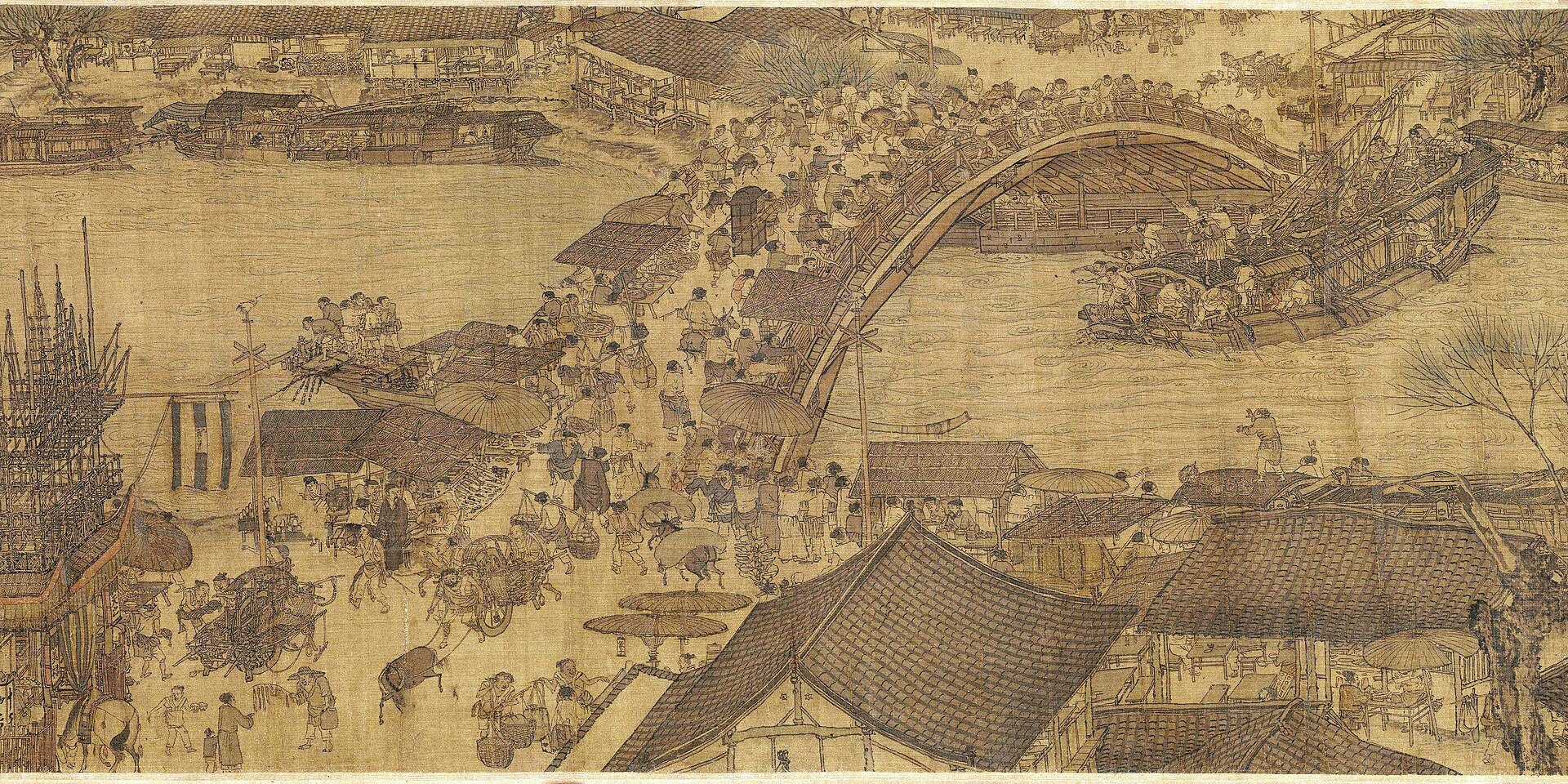
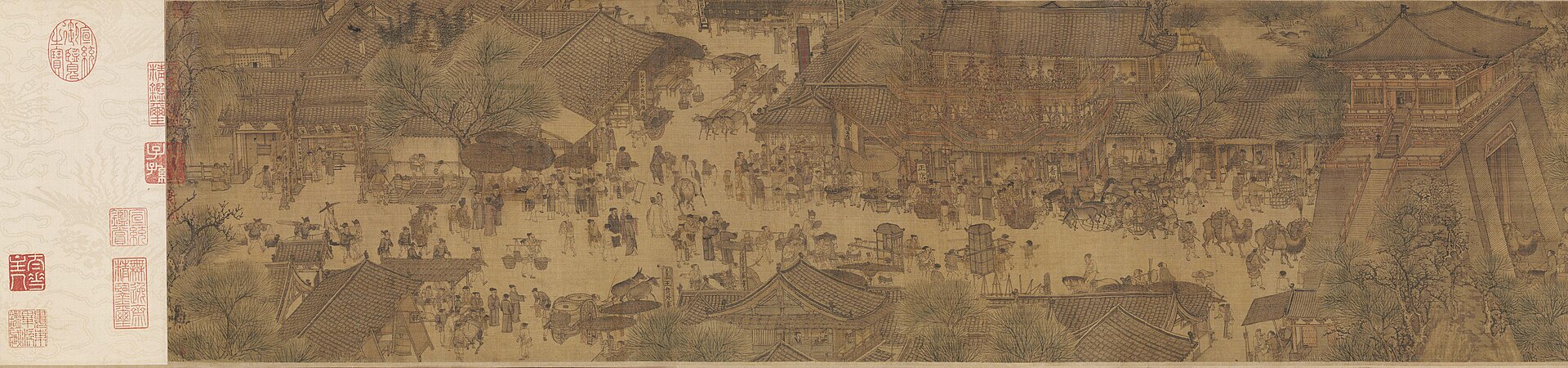
The Qingming scroll's first appearance outside the mainland was in Hong Kong in 2007, according to Newsweek's report of 15 July that year. The exhibition was called The Pride of China, it held 32 paintings from the Palace Museum, and the magazine reported that Beijing's regulations let the scroll be on view for three weeks at a time before it goes back to the vault for years. From 23 July a sixteenth century scroll by Qiu Ying took its place, as the magazine said it would.
The second crossing was to Tokyo. The Tokyo National Museum announced that the scroll would be on display from Monday 2 January to Tuesday 24 January 2012 inside its exhibition of 200 masterpieces from the Palace Museum, a show it tied to the 40th anniversary of normal relations between Japan and China. Twenty-three days is the same three-week window Newsweek had described.
On 11 June 2012 the National Cultural Heritage Administration issued notice 1345, published on 26 June, which put 37 first-class paintings and calligraphies on a second list of works banned from exhibition abroad. The notice says the first list of 2002 named 64 groups and that more overseas exhibitions had raised the chance of damage, and it says the new list exists to protect first-class works that are unique or fragile. The list as Chinese Wikipedia transcribes it includes Zhang Zeduan's scroll, and the archive's record carries that fact in its current-location line.
The order of those events is documented and the reason for it isn't. Nothing in the sources read says Tokyo caused the list, and a record shouldn't say so. It should say what happened on which date and leave the inference to the reader.
The Fuchun scroll's halves met once, on a loan that ran one way
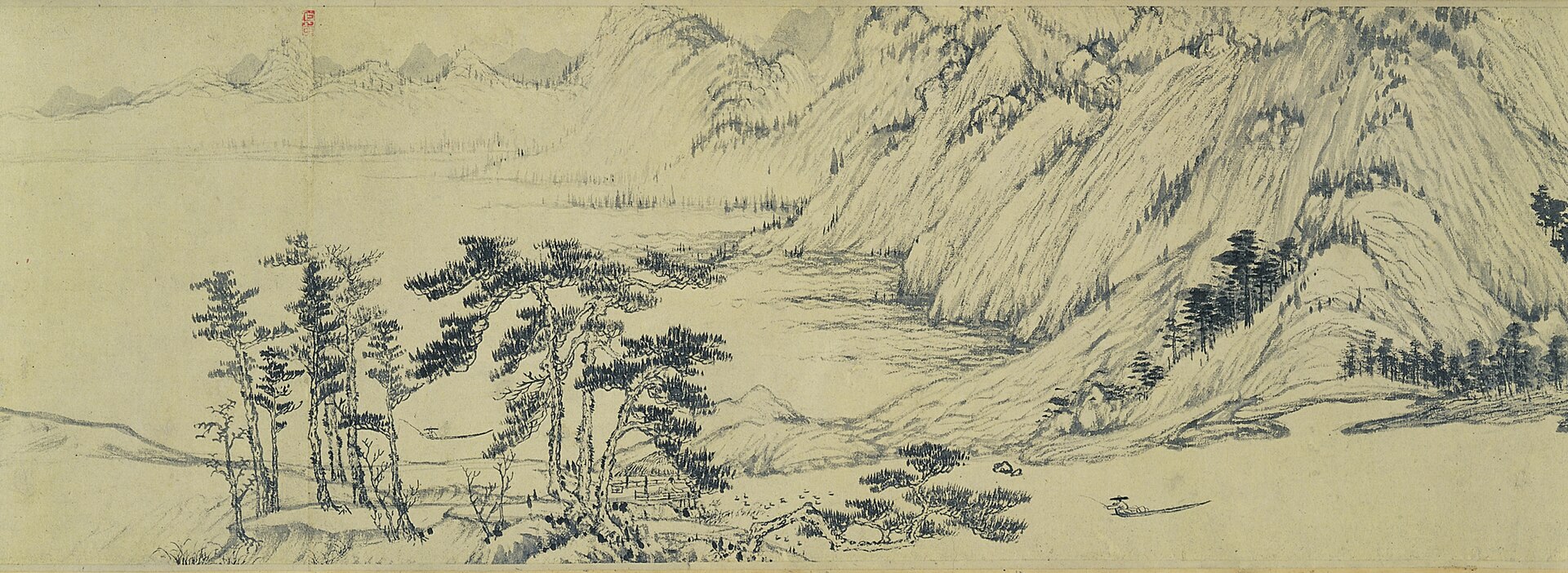
The Fuchun scroll was burned in 1650 by its dying owner Wu Hongyu and saved by a relative, and it came apart into a short first piece and a long second one, the National Palace Museum's exhibition site says. The first piece, The Remaining Mountain, is 51.4 centimetres long and went into the Zhejiang Provincial Museum in 1956. The long section, six sheets of paper and 636.9 centimetres, entered the Qing imperial collection in 1746 and is a national treasure of the Taipei museum. The Taipei museum says the two had not been displayed together for more than 360 years when it opened Landscape Reunited, and that Zhejiang agreed to lend The Remaining Mountain for it.
The Associated Press reported on 22 April 2011 that the exhibition would open on 2 June and that it was widely seen as a gesture by the mainland government in support of Taiwan's president Ma Ying-jeou's efforts to engage the mainland. The Taipei Times reported that Premier Wen Jiabao had said the year before that he hoped the painting could be reunited, and read that as a wish for unification, which is the newspaper's reading and not the premier's words.
What the sources agree on is the mechanics. One piece travelled from Hangzhou to Taipei, the exhibition recreated the original appearance of the scroll for the length of the run, and then the loan ended.

The holder of the long section said what it would need before lending back
The Taipei Times reported on 13 May 2011 that after the Taipei exhibition there would be no reciprocal exchange with Zhejiang. It said the National Palace Museum fears that any national treasure it sent to the mainland could be seized by the authorities, and that it would not lend anything without a guarantee from the Chinese government that it would be returned. The same report said China claims ownership of all the Palace Museum pieces the Nationalists brought to Taiwan at the end of the civil war.
Those are the newspaper's statements about two institutions' positions, and the archive repeats them as such. The facts under them are plain. The Associated Press said the main portion has been stored in Taipei's Palace Museum since 1949, and the Taipei museum's own page says the fragment entered the Zhejiang Provincial Museum in 1956. A loan from east to west in 2011 was possible, and a loan back was not offered.
That makes the scroll's exhibition history unusual in a useful way. Qingming's record shows a rule closing the door from one side. Fuchun's shows a door that opened once for one piece in one direction and, in the sources read, no further.
What an exhibition record has to carry for objects like these
An exhibition entry for a restricted scroll needs four things: the venue, the dates on view, the holder who agreed to the loan and any rule in force on the day. The Tokyo line without the 2012 list would read like an ordinary loan, and the Taipei line without the missing return would read like a reconciliation.
It also needs the number of days. A three-week run is a fact about the object's condition and about the rule that governs it, and a record that says only 'shown in Tokyo, 2012' hides both. The count of crossings is the measure to watch, because for these scrolls it is small enough to list in full: two outside the mainland for Qingming and one for the Fuchun fragment, in everything the sources read.
Questions
Not under the rules as the sources show them. The National Cultural Heritage Administration's second list, issued on 11 June 2012, bans 37 first-class paintings and calligraphies from exhibition abroad, and the list as transcribed on Chinese Wikipedia includes Zhang Zeduan's scroll. Its last recorded showing outside the mainland was in Tokyo from 2 to 24 January 2012.
In Taipei from 2 June 2011, in the National Palace Museum's exhibition Landscape Reunited. The museum said it was the first time in more than 360 years, and that Zhejiang had lent The Remaining Mountain for the show.
The Taipei Times reported in May 2011 that the National Palace Museum feared treasures it sent to the mainland could be seized and would not lend without a guarantee of return from the Chinese government. The same report said China claims ownership of all the Palace Museum pieces taken to Taiwan. Those are the newspaper's account of both positions.
Sources
- 1Alexandra A. Seno, 'A Rare Look at China's Mona Lisa', Newsweek, 15 July 2007. Used for the Hong Kong exhibition, the first appearance outside the mainland and the three-week rule. newsweek.com/rare-look-chinas-mona-lisa-104123
- 2Tokyo National Museum, exhibition page for 'Two Hundred Selected Masterpieces from the Palace Museum, Beijing'. Used for the dates of the exhibition and of the scroll's display, 2 to 24 January 2012. tnm.jp/modules/...
- 3National Cultural Heritage Administration, notice 1345 of 2012, 'Notice on issuing the Second List of Cultural Relics Banned from Exhibition Abroad (painting and calligraphy)', dated 11 June 2012, published 26 June 2012 (Chinese). Used for the 37 items, the 64 groups on the 2002 list and the stated reasons. ncha.gov.cn/art/...
- 4Used for the transcription of the 2012 list that names the Qingming scroll, to be replaced by the notice's attachment. zh.wikipedia.org/wiki/...
- 5Xinhua, 'Qingming shanghe tu meets viewers again after ten years', 30 September 2025 (Chinese). Used for the 2025 display in the Palace Museum's centenary exhibition. xinhuanet.com/20250930/...
- 6National Palace Museum, Taipei, special exhibition site 'Landscape Reunited: Huang Gongwang and Dwelling in the Fuchun Mountains', introduction page (Internet Archive copy). Used for the 1650 fire, the two sections' sizes and dates of entry, and the loan from Zhejiang. web.archive.org/web/...
- 7National Palace Museum, same exhibition site, page 'Huang Gongwang's Dwelling in the Fuchun Mountains' (Internet Archive copy). Used for the two sections' dimensions and the fire of 1650. web.archive.org/web/...
- 8Associated Press, 'Torn pieces of 660-year-old Chinese painting to be reunited', The Guardian, 22 April 2011. Used for the opening date and the political reading. theguardian.com/world/...
- 9'Parts of treasured brush painting to finally be reunited', Taipei Times, 13 May 2011. Used for the absence of a reciprocal loan and the museum's stated conditions. taipeitimes.com/News/...
More in Museums and Exhibitions
The partMost of the Exhibition Record in This Archive Was Written After 1975
Of 233 dated exhibition entries across 69 records, 166 fall in 1975 or later and only 4 before 1850. What that says about an exhibition history.
The Longitude Clocks Are Held on Four Different Terms
Harrison's four timekeepers, H5, Kendall's K1, Le Roy's chronometer and Earnshaw 509 sit in four institutions on four terms: state property, a loan...
The complete object is a temporary arrangement
For a dispersed set, being complete is an event with a date and a duration. Twelve Renaissance tazze were whole and correct for two days in 2014, and...