Along the River During the Qingming Festival (Qingming shanghe tu), the Beijing scroll
Zhang Zeduan · 12th century: Northern Song according to the Palace Museum, with a date after 1127 argued by others

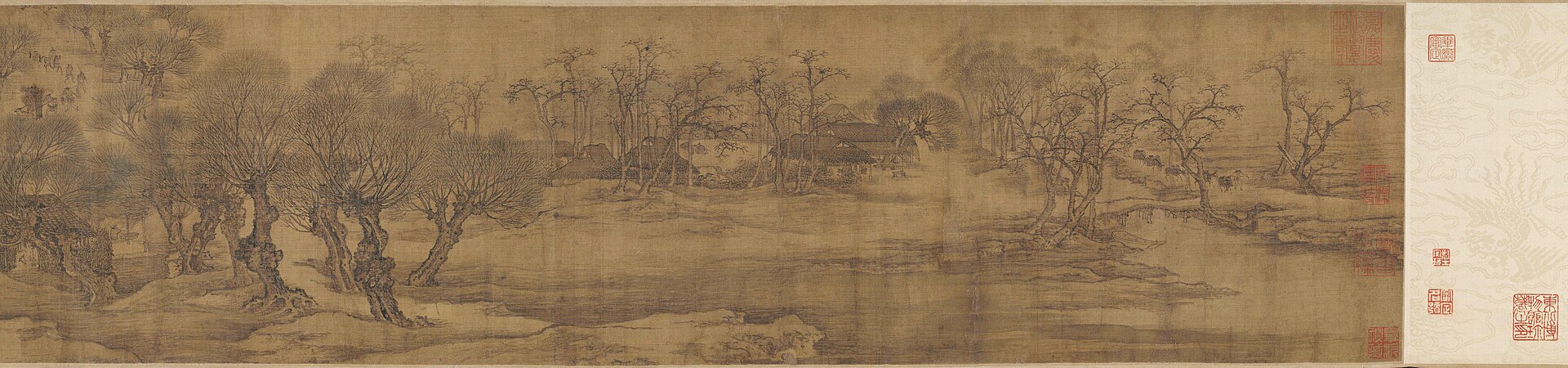
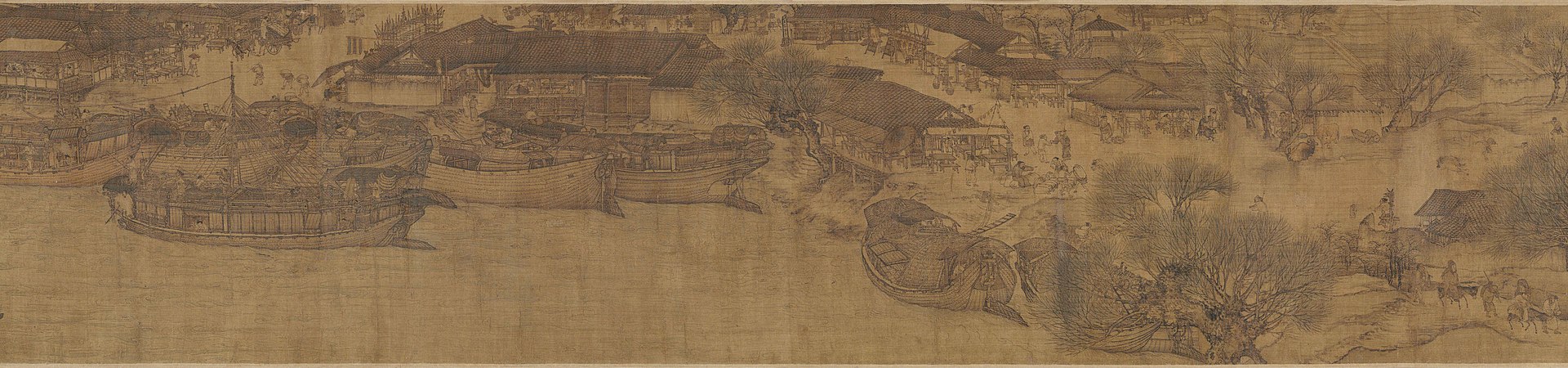
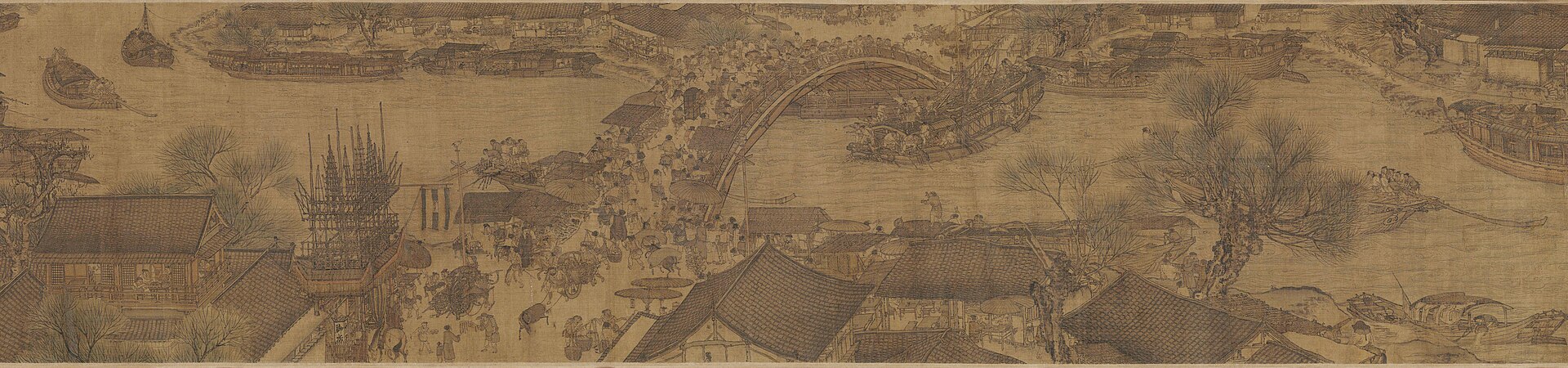
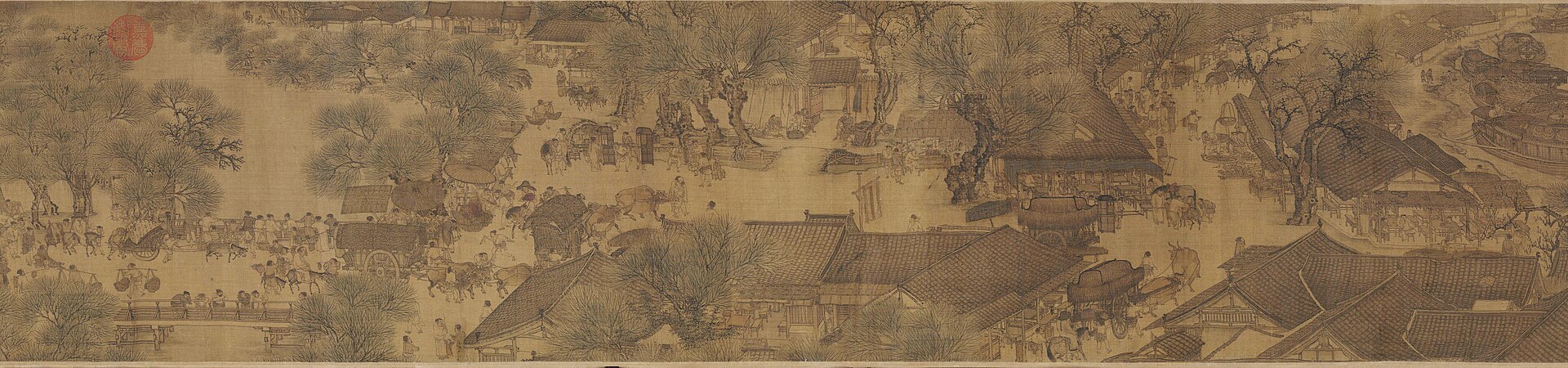
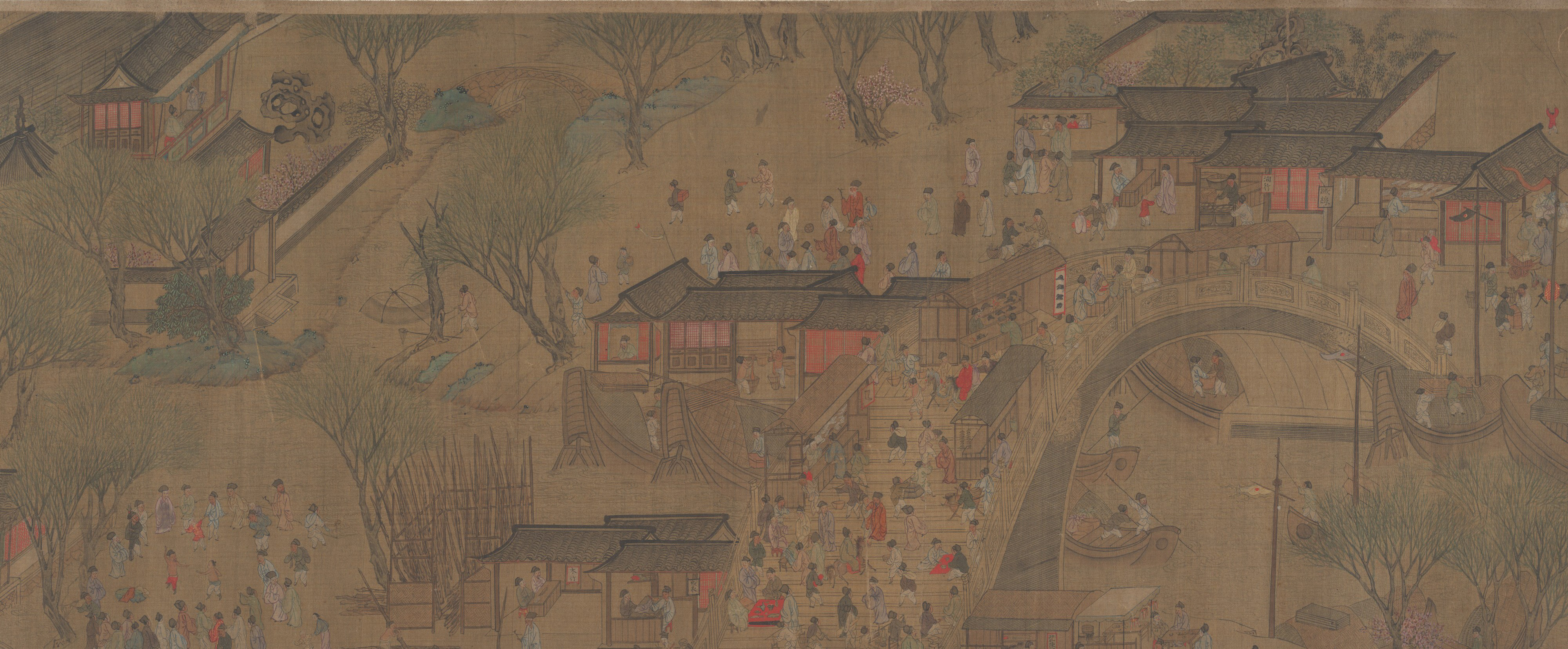
The Beijing scroll in one image, to be read from right to left: open country at the right, the canal and arched wooden bridge in the middle, the city gate and streets at the left. The file is a scan of unidentified origin (credited on Commons to a Chinese web forum) and states a height of 28.2 cm, which disagrees with the museum's 24.8 cm, but its proportions match the museum's 24.8 by 528 cm. Wikidata item Q714802 for the Beijing scroll lists this file as its image and gives the Palace Museum number xin 00087177 and a size of 24.8 by 528 cm. It is not the Qing court version or any Ming copy.
| Artist | Zhang Zeduan |
|---|---|
| Date | 12th century: Northern Song according to the Palace Museum, with a date after 1127 argued by others |
| Medium | Ink and light colour on silk; handscroll |
| Dimensions | 24.8 x 528 cm (Palace Museum) |
| Where it is now | Palace Museum, Beijing (Forbidden City)last confirmed |
| Inventory number | xin 00087177 (Palace Museum collection number) |
| Attribution | DisputedAttributed to Zhang Zeduan by the colophon of Zhang Zhu dated 1186, the earliest text about the painter and the sole biography. Full note |
| Object type | Painting |
| Period | Chinese, 12th century: Northern Song (Palace Museum) or after 1127 (Hansen) |
| Cases | Disputed attribution · Has a provenance gap · Seized, looted or confiscated · Export restricted |
| Inscriptions | Colophon of Zhang Zhu dated 1186 and colophons by twelve other writers (thirteen in all, Palace Museum); 96 seals (Palace Museum). Original Huizong title slip and Song and Yuan seals not extant (Yang Renkai, 1950). |
| Owners on record | 19 links5 documented, 12 disputed, 2 unknown |
| Sources | 49 cited |
About this record Last verified · 49 sources cited · Change log
On this page 10 sections
ContentsClose
A silk handscroll about 24.8 cm high and 5.28 m long in the Palace Museum, Beijing, showing the countryside, a canal with an arched timber bridge and the streets inside a city gate. It is attributed to Zhang Zeduan on the strength of one colophon dated 1186, the earliest text about the painter, and it is among the most copied pictures in Chinese art, so that much of what bears its title is a different object.
Almost everything about it is argued: the painter's dates, whether it was made before or after the fall of the Northern Song in 1127, whether the city is Kaifeng or an invented one, whether qingming names a festival or a peaceful age. The chain of owners runs through Jin, Yuan, Ming and Qing colophons and a famous but unreliable Yan Song story to the Qing palace and then to the emperor Puyi, who took it out of the Forbidden City in the 1920s. From there it passed through a Manchukuo palace, the Northeast Bank and the Northeast Museum in Shenyang, where Yang Renkai appraised it in 1950 or soon after.
Since 2012 it has been on the list of works forbidden from exhibition abroad, and it is shown in full about once a decade. Its last showing ran from 30 September to 29 October 2025. This record separates the Beijing scroll from the 1736-37 Qing court version in Taipei, the Suzhou workshop scrolls, the Qiu Ying type and the two Metropolitan Museum scrolls, and it records the many dates on which the sources disagree.
Provenance
Each link is graded. Documented: a cited source supports it. Disputed: the identification is argued but not established. Unknown: no owner for that span, and the gap is not smoothed into a narrative. The grades in the glossary.
- early 12th century (date disputed) -Painted by Zhang Zeduan (attribution rests on an inscription of 1186)disputed
No patron, commission or date is recorded. The Palace Museum catalogues it as Northern Song; its research director argues 1102 to 1110; Hansen and Cahill argue after 1126; and Tsao Hsingyuan argues about a century earlier than usual. The painter's dates (1085 to 1145 in some catalogues) are not given by the Palace Museum.3131541
- before 1127 (claimed) - 1127Northern Song court, Emperor Huizong and the family of Empress Xiang (claimed)disputed
Chinese Wikipedia says it was in the Northern Song court and then with the family of Empress Xiang, consort of Shenzong. Yu Hui argues that Huizong inscribed the title and gave it to his maternal uncle Xiang Zonghui. Yang Renkai in 1950 accepted from the records that it entered the Xuanhe palace. Hansen says the claimed Huizong title appears in a 1352 colophon, that Huizong's characters do not appear on the scroll and that the claim must be viewed with scepticism.1813152
- 1186 - unknownJin court circle: Zhang Zhu and other Jin colophon writersdocumented
The colophon of Zhang Zhu, a Jin court official who supervised the imperial painting collection, is dated the day after Qingming in the 26th year of Dading (1186). Chinese Wikipedia lists further Jin colophons by Zhang Gongyao, Li Quan, Wang Long and Zhang Shiji, unverified. Whether the owner was the Jin court or a private person is disputed: Hansen's booklet says the Jin imperial collection, her 1996 article says private hands throughout the Jin.121318
- 13th century - unknownJia Sidao, Southern Song chancellor (per Chinese Wikipedia only)unknown
Stated in Chinese Wikipedia without a source. No primary evidence was seen.18
- Yuan - unknownYuan palace collection (claimed); Yuan colophon writers Yang Zhun, Liu Han and Li Qidisputed
Yang Renkai says the records show Yuan palace Tianli seals, though the seals no longer survive. A 1352 colophon exists. Chinese Wikipedia tells of a palace mounter substituting a copy and the original reaching a private owner in Hangzhou. Hansen says it entered the imperial collection only under the Yuan.152181
- c. 1490s - 1499Xu Pu (1429-1499), Grand Secretary, then Li Dongyang (1447-1516)disputed
What is documented is Li Dongyang's two long colophons, noted by Yang Renkai and by Yu Hui, which show he saw and wrote on the scroll. That Xu Pu owned it and gave it to him on his deathbed is reported by one tertiary source, Chinese Wikipedia, which dates the gift to 1451, impossible on its own biographies (Li was born in 1447); a gift of the 1490s would fit. Chinese Wikipedia also names a Ming official, Zhu Wenhui, as an early Ming holder, unverified.1513183435
- by c. 1524 - 1526 or earlierLu Wan (1457-1526)disputed
Lu Wan is named among the colophon writers in Yang Renkai's 1950 report, which shows he saw the scroll; a colophon does not prove ownership. Chinese Wikipedia says the scroll came to him before about 1524, without a source.151844
- c. 1520s - 1560sYan Song (1480-1567) and Yan Shifan, or their circle (in the stories)disputed
Several accounts, as summarised by Chinese Wikipedia: a pledge by Lu Wan's son to a Kunshan family and a later purchase for 1,200 jin (Wen Jia); a purchase from the Lu family of Suzhou for 1,200 jin (Tian Yiheng); a copy sold to the censor Wang Yu and given to Yan Song, denounced by a mounter (Li Rihua and Gu Gongxie). The character is the one meaning gold, not the weight unit jin or catty. No source states which scroll changed hands.184537
- 1560s-1570s - 1578Imperial court, confiscated (Longqing reign)disputed
A 2015 Xinhua feature and Chinese Wikipedia say it was confiscated after the Yan family's fall and entered the court for the third time. Not checked against Ming sources.1618
- 1578 - unknownThe eunuch Feng Bao (claimed)disputed
Stated by the 2015 Xinhua feature and Chinese Wikipedia, the latter adding that he added colophons. No Ming source seen.1618
- late 16th century - mid-18th centuryUnknown private ownersunknown
The scroll is recorded in Zhang Chou's Qinghe shuhua fang (completed 1616), Sun Chengze's Gengzi xiaoxia ji (completed 1660) and the Shigutang shuhua ji, which show it was known and described, but the Palace Museum entry does not name the owner. No owner is documented for roughly a century and a half.3
- mid-18th century - 1790Lu Feichi (1731-1790)disputed
Named in Chinese Wikipedia and the 2015 Xinhua feature as owner who added seals and colophons. Yang Renkai's 1950 report does not list him.18164315
- late 18th century - 1797Bi Yuan (1730-1797), Governor-General of Huguangdocumented
Bi Yuan's seals are listed in the 1950 report; Chinese Wikipedia and the Xinhua feature name him as the last private owner.15181636
- 1799 - 1922Qing imperial household (Jiaqing reign onward)documented
Yu Hui says Bi Yuan's property was confiscated in 1799, that the Jiaqing Emperor stamped the scroll with his viewing seal and that it was recorded in the third compilation of Shiqu baoji. Chinese Wikipedia dates the palace entry to 1797. Yang Xin counts four entries to the palace before the 1950s.13185
- 1922 - 1932Puyi, the abdicated emperor, and his brother Pujiedocumented
Yang Renkai's 1950 report and a 2015 Xinhua feature say Puyi began removing paintings in 1922 in the name of gifts to Pujie. A list of the gifts is said to have been found by the Qing Household Settlement Committee on 31 July 1925 with the scroll in it. Stages: Prince Chun's residence, then the Zhang Garden in Tianjin (Xinhua). Hansen gives 1925 for the move to Manchuria.1516240
- 1932 - August 1945Puyi, Manchukuo palace, Changchundisputed
About 2,000 items in more than a hundred crates were stored in the East Courtyard library of the palace, known as the Little White Building, on the Xinhua feature's account. This rests on one press feature and on Chinese Wikipedia, whose own sentence carries a citation-needed tag; Yang's 2005 interview confirms that the Little White Building held Puyi's crates in general and does not name this scroll.1618
- August 1945 - 1949Chinese forces and then the Northeast Bankdisputed
Puyi left Changchun on 11 August and chose some 120 handscrolls to carry; he was taken prisoner by the Soviet Red Army at Mukden or Shenyang (English Wikipedia; Xinhua feature), and the scrolls passed to the Northeast Democratic Allied Army and the Northeast People's Bank. Yang Renkai's report says, with it is said, that the bank held what was captured at Tonghua in 1945.331615
- 1949 - 1950sNortheast Museum, Shenyang (Liaoning Provincial Museum from 1959)documented
The bank's 120-odd handscrolls went to the Northeast Museum, which opened on 7 July 1949. Yang Renkai's report records an appraisal begun on 30 August 1950. The date of identification is variously given as 1950, 1951 and 1952, and the story that the true scroll lay among forgeries comes from his later recollection and press features.1514131642
- 1954 or 1958 or 1959 - presentPalace Museum, Beijingdisputed
Hansen says Chinese scholars announced the scroll in the Palace Museum in 1954. A Guancha feature says the Cultural Relics Bureau of the Ministry of Culture transferred it in 1958. An undated popular article says 1959. Collection number xin 00087177. No sale at auction or by private treaty is recorded for this scroll in any source consulted, and the only money recorded against it is the Ming figure of 1,200 jin in the Yan Song stories. It is a state-owned first-grade relic on the 2012 list of works forbidden from foreign exhibition. Last shown from 30 September to 29 October 2025.21117361214
Technical evidence
| Attribution note | Attributed to Zhang Zeduan by the colophon of Zhang Zhu dated 1186, the earliest text about the painter and the sole biography. The Palace Museum catalogues the scroll as Northern Song by Zhang Zeduan. Hansen argues for a date after 1126, Tsao Hsingyuan for a date about a century earlier than usual (as reported by the 2005 conference report), Bo Songnian disputes the biographical basis of the attribution and Jonathan Hay proposed two other possible artists (2005 conference). No technical study dating the silk or pigments was found. |
|---|---|
| Support | Silk, as catalogued by the Palace Museum (juan ben, silk-ground). The 1950 appraisal report calls the ground xiaosu silk.315 |
| Medium | Ink with light colour. The Palace Museum describes the brushwork as mixing careful and free line, distinct from ordinary ruled-line painting, with restrained colour. Hansen notes that most colour has faded, leaving a few details such as the green of the willow buds.32 |
| Format | Handscroll, read from right to left an arm's length at a time. Three parts: countryside, canal and bridge, city gate and streets. Bridge scene at the halfway point; the scroll ends abruptly in a city street.23 |
| Dimensions as catalogued | 24.8 cm high by 528 cm long (Palace Museum). Other published figures: 25.5 cm by 5.25 m (Hansen 1996); about 25 by 530 cm (Yang Renkai, 1950 report); length 528.7 cm (2005 report on a stone replica; also the Commons file data). The Commons file also states a height of 28.2 cm, which disagrees with the museum.3215528 |
| Figures and objects counted | More than 500 people (Palace Museum; Hansen). Wikipedia: 814 people, 28 boats, 60 animals, 30 buildings, 20 vehicles, 8 sedan chairs, 170 trees. A 2025 feature: more than 500 people, nearly 100 animals, over 100 houses and 25 boats. Hansen counts about twenty women. Counts are conventions.319111 |
| Colophons | Colophons by thirteen writers according to the Palace Museum, beginning with Zhang Zhu of the Jin dated the day after Qingming in 1186 (Dading 26). Writers named in the 1950 appraisal report: Zhang Zhu (Jin); Yang Zhun, Liu Han and Li Qi (Yuan); Wu Kuan, Li Dongyang and Lu Wan (Ming). All translated in Whitfield's 1965 Princeton dissertation.31512 |
| Seals | 96 seals according to the Palace Museum; just under one hundred seals and colophons together according to Hansen. The 1950 report says the original title slip and the Song and Yuan seals no longer survive and lists Ming and Qing collectors' and imperial seals, among them Bi Yuan's. The Jiaqing Emperor's viewing seal is attested by Yu Hui.321513 |
| Mounting and remounting | Remounted before or around its entry into the Qing palace (Yang Renkai, 1950). A Ming repair pasted a silk fragment bearing a painted ox over brush strokes of a timber bracket; Palace Museum staff removed it in the remounting of 1973. Yu Hui says the head of the scroll was cut off by a late Ming mounter and the white horse near the start lost its front half in the Ming.15513 |
| Condition | Faded to a warm brown, with a few patches and many fine vertical cracks along the grain, in surprisingly good condition for its age (Hansen 1996). No conservation report, pigment study or imaging report was found.2 |
| Original length | The Ming statesman Li Dongyang's colophon, as read by Yang Renkai in 1950, describes the painting as a little over two zhang long, which Yang took as evidence that the scroll had been cut. A 2005 conference report says most scholars hold that half of the original is missing. Neither figure is reconciled with the present 5.28 m.155 |
| Photographic record | The Palace Museum photographed the whole scroll on large plate-glass negatives in 26 black-and-white sections (Hansen 1996). A 1961 People's Fine Arts Publishing replica shows it before the 1973 remount. The large Commons scan is of unidentified origin.23228 |
| Collection number | xin 00087177 (Palace Museum collection number, with the prefix character xin).3 |
| Display protocol | Precious paintings are shown only in spring and autumn for no more than two months and then rest in storage for three years or more (Palace Museum director Shan Jixiang, 2015). Newsweek, 2007, reports that Beijing's regulations allow three weeks at a time.98 |
| Legal status | Listed as item 33 on the second list of cultural relics forbidden from foreign exhibition (National Cultural Heritage Administration notice 1345 of 2012, dated 11 June 2012).646 |
Images


The record in full
Chapter 1A silk scroll of about 5.3 metres that is meant to be walked, not looked at
This record covers one object: the handscroll in the Palace Museum, Beijing, that the museum catalogues as Zhang Zeduan Qingming shanghe tu juan.
This record covers one object: the handscroll in the Palace Museum, Beijing, that the museum catalogues as Zhang Zeduan Qingming shanghe tu juan. The Palace Museum gives it as a Northern Song work in ink and light colour on silk, 24.8 cm high and 528 cm long. Other careful sources measure it differently. Valerie Hansen's 1996 booklet gives 25.5 cm by 5.25 m; the 1950 appraisal report written when it was first identified in Shenyang gave about 25 by 530 cm; and a 2005 report on a true-scale stone replica gave 528.7 cm for the length. None of these is wrong in kind. They reflect different ways of measuring a long, remounted, slightly uneven roll of silk, and anyone quoting a figure should say whose.
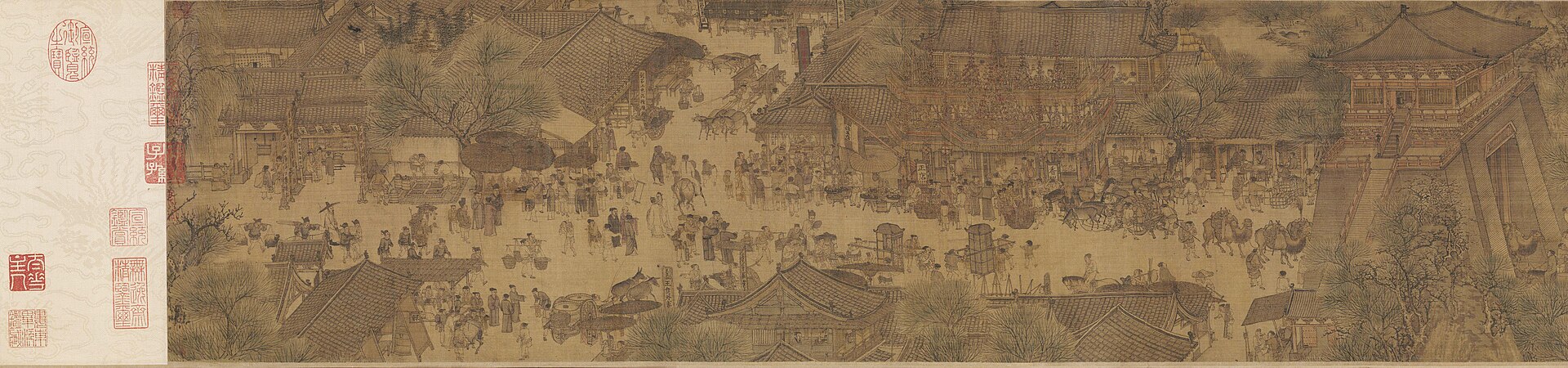
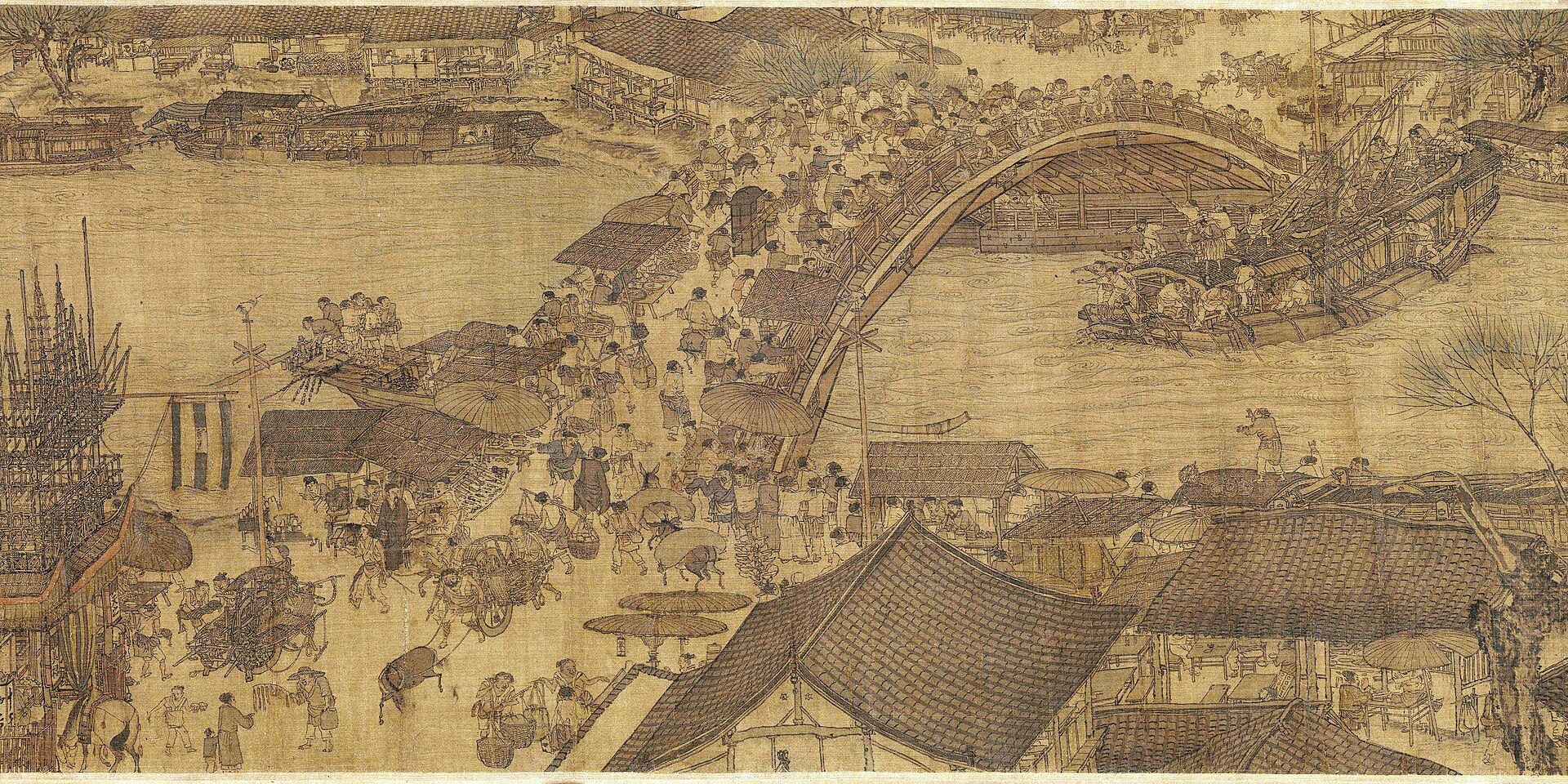
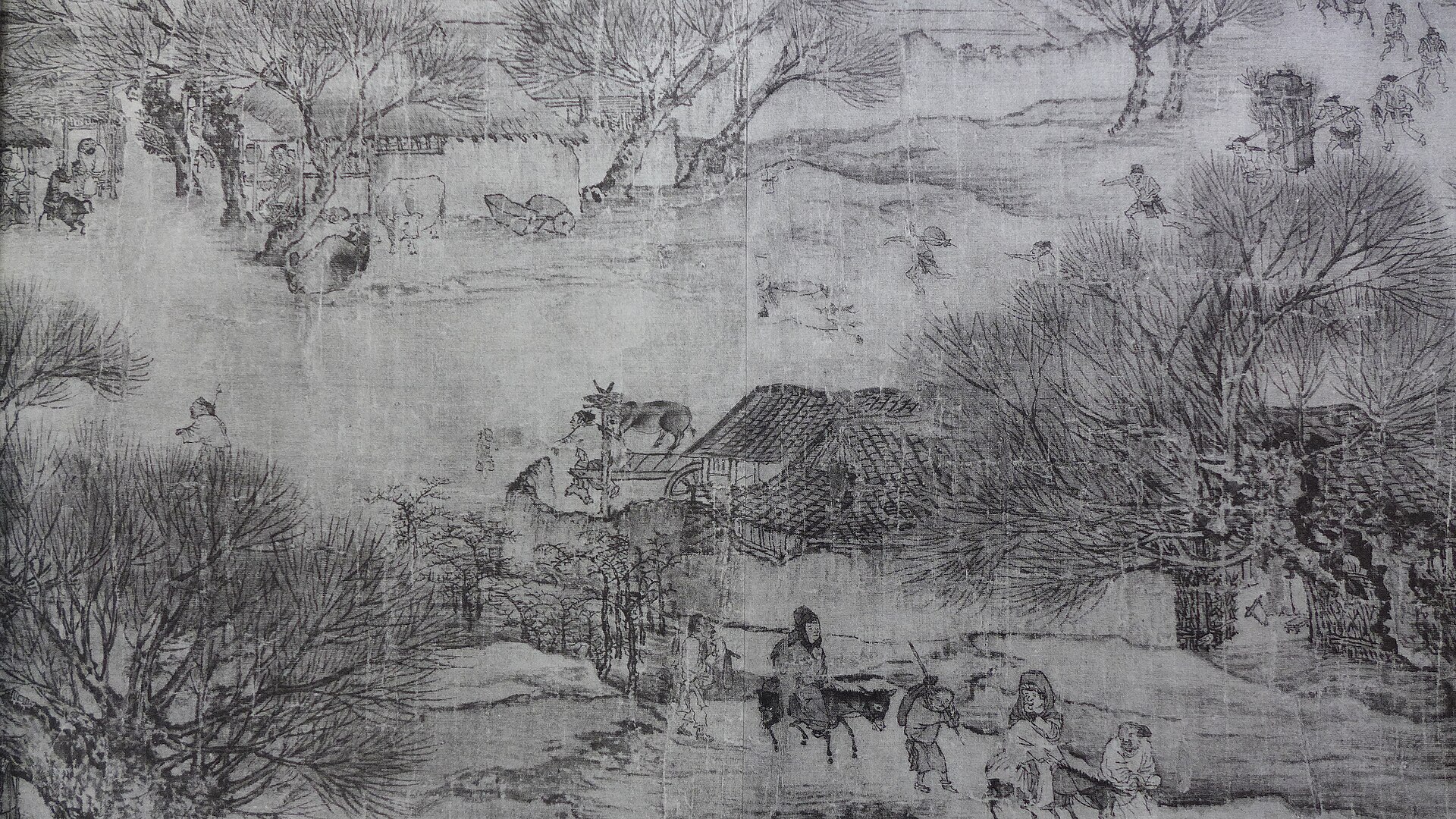
It is read from right to left, an arm's length at a time, which is how handscrolls were made to be handled. Hansen describes the viewer setting the pace and the painter exploiting that, so that a building or a boat can seem to approach and then recede. The composition falls into three parts. The right-hand third is open country: donkeys carrying fuel, bare and budding trees, a path widening into a road. The middle third is the canal and the great timber arch bridge, which Hansen places just at the halfway point of the scroll. The left-hand third is the city: shops, inns, a tax office just inside the gate, the gate tower itself and a run of streets. Hansen notes that the scroll ends rather abruptly, on a gentleman in an elongated hat who seems about to set out on the journey the viewer has just made.
The Palace Museum's own catalogue text, written by the curator Yang Xin, describes the handling as mixing careful and free line with restrained colour, and says it is not ordinary ruled-line painting but something the Zhang Zhu colophon calls a family of its own. It adds that the painting takes a bird's-eye view and shifts its viewpoint along the scroll rather than fixing one vanishing point, and that its figures number more than five hundred. Counts differ by source. Wikipedia lists 814 people, 28 boats, 60 animals, 30 buildings, 20 vehicles and 8 sedan chairs. A 2025 feature by the reporter Ni Wei, republished by Guancha, gives more than 500 people, nearly 100 animals, over 100 houses and 25 boats. Hansen counts about 500 people and about twenty women among them, and in his 2012 lecture Yu Hui speaks of more than eight hundred people. Hansen finds no beggars, while the Palace Museum's own catalogue text lists beggars among the street figures. Counting a painting this dense is a matter of definition, and the discrepancy is a reason to treat any single tally as a convention.
Hansen records that the silk has faded to a warm brown and that only a few details, the green buds of the willows among them, still show colour. It has a few patches and many fine vertical cracks along the grain, and she judged it to be in surprisingly good condition for its age. She also notes that the Palace Museum photographed the whole scroll on large plate-glass negatives in 26 black-and-white sections, a point that matters for its reproduction history below.
Chapter 2Zhang Zeduan, as far as anything is known about him
Everything solid about the painter fits in one colophon.
Everything solid about the painter fits in one colophon. It is dated the day after the Qingming festival in 1186, the 26th year of the Dading reign of the Jin dynasty, and written by Zhang Zhu of Yanshan. Hansen's translation, which follows Roderick Whitfield's, reads in part that Hanlin Zhang Zeduan, styled Zhengdao, was a native of Dongwu, now Zhucheng in Shandong. As a young man he studied and travelled in the capital for further study, later took up painting, was skilled at ruled-line painting and especially liked boats and carts, markets and bridges, moats and paths. The colophon then quotes a lost book, A Record of Mr. Xiang's Views on Paintings, which placed two of his pictures, Regatta on the Western Lake and Qingming shanghe tu, in the highest category, the divine class, and adds that the owner should treasure them. Yu Hui of the Palace Museum counts the colophon at 85 characters and describes Zhang Zhu as a Jin court official who supervised the imperial painting collection.
That is the whole inheritance, and Hansen is blunt about what it leaves out. The colophon does not give Zhang Zeduan's dates. It does not say whether the title hanlin refers to a member of the Hanlin Academy of scholars or to a painter in the imperial painting academy, and Hansen points out that either reading fits the surrounding text. It does not say who paid for the scroll. The Palace Museum's own collection entry says his birth and death years are unknown. The dates 1085 to 1145 that circulate in Wikipedia and many catalogues have no source in anything examined for this record, and they should be read as a convention rather than a finding.
The 1186 text also tells us that Mr. Xiang was an earlier cataloguer whose book no longer exists. Hansen's footnote records that Whitfield cites Xu Bangda as identifying him with Xiang Ruobing, a Song figure who wrote colophons on two paintings now in the Liaoning Museum, and that no supporting evidence is given beyond the surname. Bo Songnian told the 2005 Beijing conference that the few biographical details usually repeated about Zhang Zeduan come from a late and often inaccurate work, Shuhua chuanxi lu, which is why he and others argue against the usual twelfth-century story.
Against this thin record sits a confident reconstruction. In a 2012 public lecture Yu Hui, then director of the Palace Museum's research office, argued that the painter's given name comes from Mencius and his courtesy name from the Book of Rites, that he came from a Confucian family, that he went to the capital to prepare for the civil service examinations, that he failed them and that he turned to ruled-line painting as a livelihood before entering the imperial painting academy. This is an argument built from the colophon's phrase about studying in the capital and from period examination practice. It is not a documented biography, and Hansen draws far more cautious conclusions from the same text.
A second work is named in the colophon but not located. Zhang Zhu's quotation of Mr. Xiang gives the title Regatta on the Western Lake, and Chinese Wikipedia says the Beijing scroll is the only surviving work, while the English article illustrates a Games in the Jinming Pool scroll as another attributed work. The Palace Museum's bibliography for its own entry lists an article on a dragon-boat race painting at Jinming Pool, so the question is live in Chinese scholarship. For the Beijing scroll, attribution rests on a single dated inscription of 1186.
Chapter 3Thirteen colophon writers, ninety-six seals and a missing title slip
The Palace Museum's catalogue entry states that the back of the scroll carries colophons by thirteen writers, beginning with Zhang Zhu of the Jin dynasty and including Wu Kuan of the Ming, and that...
The Palace Museum's catalogue entry states that the back of the scroll carries colophons by thirteen writers, beginning with Zhang Zhu of the Jin dynasty and including Wu Kuan of the Ming, and that the scroll bears 96 seals. Hansen puts the same material at just under one hundred seals and colophons, all translated in Whitfield's 1965 Princeton dissertation. The 1950 appraisal report by Yang Renkai names the colophon writers as Zhang Zhu of the Jin; Yang Zhun, Liu Han and Li Qi of the Yuan; and Wu Kuan, Li Dongyang and Lu Wan of the Ming. Chinese Wikipedia adds Jin colophons by Zhang Gongyao, Li Quan, Wang Long and Zhang Shiji. It does not source that list, and it should be read as unverified until checked against Whitfield.
The colophons do more than praise. Hansen observes that a colophon of 1352 states that the front of the painting originally bore a title by Emperor Huizong, who reigned 1100 to 1126, but that Huizong's characters do not appear on the scroll. She calls the claim unsupported and notes that it would have raised the value of the picture two centuries after the supposed event, so it should be treated with scepticism. Yu Hui reads the same evidence the other way. He says the Ming statesman Li Dongyang, in his colophon, saw a five-character title slip by Huizong carrying only a double-dragon seal. Huizong, Yu adds, habitually put a Zhenghe or Xuanhe reign-period seal on later inscriptions, which shows to him that the painting was made before about 1110. In his account the head of the scroll was then worn and was cut off by a late Ming mounter after Li Dongyang's time. The Ming diary Weishuixuan riji by Li Rihua, as summarised by Chinese Wikipedia, also records a Huizong slip in thin-gold script with a small double-dragon seal and a Huizong poem containing the line about water in the upper river in spring.
Yang Renkai's 1950 report, as quoted by a Guangzhou newspaper in 2022, is explicit that the scroll was remounted before it reached him: around the time it entered the Qing palace the mounting was changed, and the title slip, the Song and Yuan seals and the Song inscriptions are all gone. He adds that Li Dongyang's colophon describes the painting as a little over two zhang long, which he took as evidence that the scroll had been cut, though the silk that remains is intact. The 2005 conference report in China Heritage Quarterly says most scholars agree that half of the original scroll is now missing, a statement that goes further than Yang's and which this record has not found a source for. The measure matters. A Ming zhang has to be converted to centimetres before the missing length can be estimated, and no source fetched for this record does that conversion.
The same report lists a Ming collector's seal, seals of the Qing collector Bi Yuan and seals of the Qing imperial household. Chinese collectors stamped as well as wrote, and the stamp record is a chain of custody in miniature. The Palace Museum researcher Shan Guoqiang gave a conference paper in 2005 on the connoisseurs' and collectors' seals, and abandoned the paper on the day to talk about genre painting instead, so the authenticity of the seals has no published verdict in the sources consulted here.
Chapter 4When it was painted: before 1127, after 1127 or a century earlier
The Palace Museum catalogues the scroll as Northern Song and says it depicts the Qingming season at Bianjing, the Northern Song capital, now Kaifeng.
The Palace Museum catalogues the scroll as Northern Song and says it depicts the Qingming season at Bianjing, the Northern Song capital, now Kaifeng. That date, and its subject, were the working assumptions of most twentieth-century writing. Hansen's 1996 article, which is the sharpest challenge in English, restates them as four long-standing assumptions: that the city is Kaifeng, that the painting predates 1127, that Huizong commissioned it and that qingming means the festival. She argues against each, though on patronage she only asks whether a rich merchant paid, and she argues for dating the scroll after 1126.
Her reasons are specific. The first colophon is dated 1186, so the first historical evidence for the picture is surprisingly late, and the Huizong title is an unsupported claim of the sort that inflates value. Stylistically she compares the scroll with the Jin temple paintings at Yanshan monastery on Mount Wutai, dated 1167, which share its overhead perspective and its habit of cutting figures off behind walls and doors. She cites Robert Maeda, Patricia Karetzky and the art historian James Cahill, who suggested the scroll may have been painted after the northern capital was abandoned to the Jin, as nostalgia. Hansen concludes that Zhang Zeduan was most likely a Chinese artist trained in the Northern Song who painted after 1126.
The Palace Museum's research director gives the reverse. Yu Hui says the scroll was made in the Chongning to Daguan years, 1102 to 1110, early in Huizong's reign. His evidence is the Li Dongyang account of the title slip, the short, loose women's outer coats and fashionable hairstyles which he says were new in those years and the carts in the scroll that carry large cursive calligraphy as covers, which he reads as the discarded scrolls of the banned old-party writers in 1102, when, in his account, the chief minister Cai Jing ordered the books and writings of Su Shi and Huang Tingjian destroyed. This is an interpretation by an expert who has handled the original, but it is not shared by Hansen, and it depends on whether the covers really are the discarded writings.
At the 2005 Beijing conference Tsao Hsingyuan of the University of British Columbia argued for a date about a century earlier than the usual one, Bo Songnian argued against the biographical basis of the standard attribution and Jonathan Hay suggested two other artists who may have painted the work. The conference report says none of the three produced new textual evidence that could irrefutably identify the painter or settle the date. The positions on this record are therefore argued, not established: a Northern Song date near 1100 to 1126 is the Palace Museum's; a date after 1127 is Hansen's and Cahill's; and an earlier Northern Song date is Tsao's. The earliest dated evidence, the colophon of 1186, is itself Jin.
It remains unknown how long the work took. Hansen thinks a team of artists may have needed months, and Yu Hui estimated at least half a year, perhaps a full year, of full-time work. Neither figure comes from a source about the painting itself.
Chapter 5What the title says, and why no two translators agree
Every English title of this scroll is a decision.
Every English title of this scroll is a decision. Shanghe tu is generally read as a picture of going along the river, and the river is the one running through the painting. The dispute is over qingming, literally clear and bright. The first colophon, written the day after the Qingming festival, shows that Zhang Zhu thought it named the grave-sweeping festival that falls about a hundred days after the winter solstice. Hansen points to small hints that fit that reading: willow brooms wedged into a sedan chair in the first frames and a cluster of women round a basket of willow brooms outside an inn near the end.
She then lists what is missing. Song accounts of Qingming describe willow bunches hung on every roof, date dumplings pierced with willow twigs, willow twigs worn in women's hair, paper houses displayed in paper shops and crowds picnicking in gardens and outside the gates. The painting shows one paper shop with its owner and no customers, and a street where the only people drinking are inside inns. Hansen also cites the late-season clues that other scholars have raised: a flag advertising new wine, which she says came on sale only in autumn, shirtless people fanning themselves and a stall on the bridge selling drinks and watermelon. In her account these scholars think the season is more likely autumn, when the heat of summer still lingers, while the trees at the opening, some with green buds and some still bare, look more like early spring.
The alternatives are well known. The first is that qingming in the title means peaceful and orderly, a time of good government. Zou Shencheng argued in the mid-1980s that the word was the painter's own dedicatory phrase, drawing on the phrase in the Hou Han shu about being lucky enough to live in a clear and bright age, and Hansen records Wu Pei-yi's suggestion of Peace Reigns Over the River as the matching English title. The second is that Qingming is a ward, which Chinese Wikipedia describes as the first of three wards in the eastern outer city of Kaifeng, but Hansen objects that the full title would then read awkwardly and single out one district when the scroll shows much more. The third is that the picture shows a day within the Qingming solar term of the calendar and not the festival itself, a position English Wikipedia attributes to Tsao's 2003 article, which was not read for this record, so it is not clear that it is the same thesis as her earlier-date argument.
The title of the scroll has migrated across at least four English renderings in common use: Along the River During the Qingming Festival, Going Up the River at Qingming, Spring Festival on the River and Peace Reigns Over the River. The National Palace Museum in Taipei used A City of Cathay in the late 1960s for its 1736-37 Qing court copy, a title that has no bearing on the Beijing scroll, and the Tokyo National Museum titled the Beijing scroll in 2012 Life along the Bian River at the Qingming Festival. The Metropolitan Museum's accession 47.18.1 is titled Spring Festival on the River too and is a different object entirely, as the versions section below explains. Wherever a record, label or auction note says only Spring Festival on the River, it needs a measurement and a location before it can be assigned to any scroll.
Chapter 6A city nobody can locate and an economy anybody can read
The Palace Museum's catalogue entry says the scroll shows the area inside and outside the Dongjiaozi gate, in the south-east of the inner city of Bianjing, and both banks of the Bian River.
The Palace Museum's catalogue entry says the scroll shows the area inside and outside the Dongjiaozi gate, in the south-east of the inner city of Bianjing, and both banks of the Bian River. The great arch is named as the Shangtu bridge, popularly the Rainbow Bridge. The entry is credited to Yang Xin, who also published a 1979 article on the geographical position of the scene, cited by Hansen. The research director of the same museum said in a 2012 lecture that the picture is a composite: the painter gathered features of four rivers, many arch bridges and several gate towers into one invented port, true to the facts of Bianjing but not to its scenery. The museum's collection page and its research director do not agree.
The strongest sceptical argument is Hansen's, and it is built on omissions. No pagoda, temple, palace or building in the scroll can be identified as a landmark. The restaurant signs read only jiaodian, branch wineshop, and zhengdian, wholesaler, which are categories and not names. The wall in the painting has fallen into disrepair and has a barber's stall built into its foreground, while the actual walls of Kaifeng were manned at all times, and an eleventh-century drawing of a strategic wall from Zeng Gongliang's military manual looks nothing like it. Kaifeng had two walls and fourteen bridges and the scroll shows one of each. She quotes Rene-Yvon d'Argence, who in 1970 judged that the city in the painting feels like a prosperous canal port rather than a capital. Linda Cooke Johnson, in the same journal issue, argued that the scroll does depict Kaifeng and drew on a wealth of data about the city's geography. Whitfield's contribution, which Hansen records, is that where the scroll matches an item in Meng Yuanlao's memoir Dongjing menghua lu it may indicate a later forger who consulted the memoir as easily as a modern scholar.
What the scroll gives that no text supplies is an economy at working scale. Hansen's booklet reads it as a snapshot of the twelfth-century commercial revolution: woodmen leading donkeys loaded with fuel to market in the first scene, a long-distance grain boat staffed by many labourers and directed by a seated merchant, markets that had burst outside the city walls and stayed open day and night and a capital whose population she says exceeded some five hundred thousand by 1100. She notes that the world's first paper money developed from merchants' personal notes and was taken over by the government at the start of the eleventh century. Yu Hui reads the first shop inside the gate as a tax office where, he says, the use of paper notes in place of copper cash can already be seen. He also points to a gang of rice carriers each holding a long bamboo tally, which he reads as piece-rate payment, a custom a Hong Kong museum director recalled seeing on the docks. Yu Hui adds that Bianjing had 72 licensed wholesale wineshops, the zhengdian of the signs, because the state controlled brewing so that grain would not run short.
The scroll equally reports what it leaves out. Hansen finds no obviously suffering or handicapped people, no beggars, almost no soldiers, no crime and few women, about twenty of five hundred, those outdoors on their own being of low status. Everyone's clothing matches their social position and people of different classes eat in the same restaurants without speaking to one another, a point she uses to argue that the picture is an idealised cityscape. Kondo Hidemi argued at the 2005 conference that a few disadvantaged figures are tucked into the crowds, and Yu Hui reads a kneeling man at the gate, whom others took for a beggar, as a butcher sacrificing a goat to the road god before a guest's departure. These are competing identifications of single figures, and they show how much weight the whole interpretation rests on small details.
Chapter 7Festival, eulogy or warning: what readers have made of the scroll, graded
No document records why the scroll was made, who paid for it or what its painter intended.
No document records why the scroll was made, who paid for it or what its painter intended. The reader meets the picture in a long line of interpretations, each of which belongs to someone, and this record keeps them apart. Every reading below is argued by a named scholar in a citable publication unless it is marked as documented.
Documented: how the earliest readers received it. The 1186 colophon places it in the divine class in Mr. Xiang's lost catalogue. A Jin colophon verse quoted in Chinese Wikipedia says the Hanlin presented the picture at that time and the scenery of a peaceful age deserved to be handed down, and the same article records that the Jin colophon writers saw the picture and thought of the former country. The earliest reactions on record, as that article reports them, are thus acts of memory: Jin readers looking at a capital the north had lost.
Argued: a eulogy. Zou Shencheng, in a mid-1980s paper summarised by Chinese Wikipedia, argued that qingming was the painter's dedicatory phrase from the Hou Han shu and that he presented the painting to Huizong as praise of a well-ordered age. On this view the absence of festival activity is explained because it was never a festival picture.
Argued: nostalgia after the fall. James Cahill's suggestion, as reported by Hansen, was that the scroll was painted after the northern capital had been abandoned, and that its romanticisation expressed longing for a lost era and implicit criticism of the powers. Hansen compares it with Meng Yuanlao's memoir, which she and Wu Pei-yi both read as a selective and nostalgic account that ignores crowding, poverty and crime.
Argued: a warning behind the prosperity. This reading has a Ming precedent. A Guancha feature of October 2025 reports that the Ming minister of rites at Nanjing, Shao Bao, said the picture's theme was the aim of watching for danger in an age of brightness and prosperity, and that its incidents touch the eye and alert the heart. Yu Hui develops the reading in detail: a bolting horse in the first market, a fire-watch tower with no watchman, soldiers asleep at a courier post, the near collision of a boat with the bridge, officials quarrelling over the right of way, a clinic whose sign advertises cures for drinking, an undefended gate. He concludes that these add up to a portrait of the late Northern Song social crisis and an implied worry about the state, and he adds his own view that Huizong did not much like the picture and paid little attention to the problems it shows. Alfreda Murck's study of dissent in Song poetry and painting is the framework the 2005 conference report cites for this tradition of understated political comment, and Kondo Hidemi linked the scroll's hidden hardship to Wang Anshi's reforms. Wikipedia also relays a reading that the title is ironic and that the picture hints at weak defences, but its only citation is a 2013 novel by Ma Boyong, so it is not counted among the argued readings here.
Argued: a record. Much Chinese social and economic history uses the scroll as a veracious visual document, and Joseph Needham's volume on civil engineering and nautics draws on its ships and bridge. The 2005 conference report describes the two poles of the field as a semiotic reading and a literal one. The report cites as an example of the literal approach a replica of the Rainbow Bridge built at Jinze outside Shanghai and filmed for American television, and Hansen's closing remark is the reply to it: for all of its riches, the scroll does not offer a photographic portrait of either Song-dynasty Kaifeng or the Qingming festival.
Ordinary custom, not a hidden message. Several details that look enigmatic are, in Yu Hui's reading, plain Song practice: an offering hung from a boat's side to thank the water god after a safe voyage, a sacrifice at the gate to the road god, a fortune-teller's sign near a cluster of young men whom he takes to be examination candidates in the weeks before the national examination. They illustrate daily life and carry no programme beyond it. The record has found no evidence that the maker belonged to a school, a sect or a reading circle, and nothing known about his beliefs. That absence is a finding.
Later readings, kept separate. The Qianlong Emperor's 1742 poem on the Qing court copy is a later reading. The Taipei copy's frontispiece says people once marvelled at the grandeur of the age and that now one laments the fates of Hui and Qin, the Song emperors Huizong and Qinzong. That is how an eighteenth-century emperor read a Qingming picture, and it belongs to the Taipei copy and its lineage and not to the Beijing scroll.
Chapter 8From the Jin court to the Qing palace: a chain of owners with more gaps than names
The history of owners is the best-known part of the scroll's story and the least secure.
The history of owners is the best-known part of the scroll's story and the least secure. The 2005 conference report, citing Yang Xin's 2002 article on the scroll's four exits and five entries through the palace gates, says that the scroll appears to have been acquired for imperial collections on four occasions over some eight centuries, and entered the Forbidden City a fifth time when it was rediscovered in the 1950s. Everything between the Jin colophons and the Qing court is recorded in colophons, seals, Ming and Qing catalogues and anecdotes, and the anecdotes are what most retellings repeat.
Jin and Yuan. The 1186 colophon places the scroll in Jin hands, and Hansen says that the first records of the scroll place it in the Jin imperial collection, though in her 1996 article she writes that it remained in private hands throughout the Jin and entered the imperial collection only under the Yuan. The two statements by the same author are not reconciled in the text. Chinese Wikipedia adds that after 1127 the scroll passed into the Jin court and that, before it, it had belonged to the Northern Song court and the family of Empress Xiang, the consort of Shenzong. Yu Hui's lecture develops the Xiang link: after the painter presented the work, he says, Huizong wrote the title, stamped the double-dragon seal and gave it to his maternal uncle Xiang Zonghui. That is an argument and is not documented. Chinese Wikipedia also names the thirteenth-century chancellor Jia Sidao as an owner, on its own authority and without a source. For the Yuan, the colophon writers named in the 1950 report are Yang Zhun, Liu Han and Li Qi. A 1352 colophon also exists. Yang Renkai says that the records show the scroll passing through the Xuanhe palace and bearing Yuan palace seals of the Tianli period, though the title slip and seals themselves no longer survive. Chinese Wikipedia tells a story in which a mounter in the Yuan palace substituted a copy for the original and the original reached a private owner in Hangzhou.
Ming. The Ming sequence has two points of solid evidence and one famous story. The solid points are that Li Dongyang wrote two long colophons describing the picture and its recent history, and that Lu Wan is named as a colophon writer in the 1950 report. Chinese Wikipedia says the Grand Secretary Xu Pu gave the scroll to Li Dongyang on his deathbed. It dates that gift to 1451, which cannot be right, since the same encyclopedia's biographies give Xu Pu as living 1429 to 1499 and Li Dongyang as born in 1447. A deathbed gift in the 1490s is consistent with those dates. Chinese Wikipedia places Lu Wan's ownership before about 1524, after Li.
The famous story is the Yan Song affair. Two versions survive in Ming and Qing writing, as Chinese Wikipedia summarises them. In one, from Wen Jia's catalogue of the Yan collection, Lu Wan's son owed official debts and pledged the scroll to a family in Kunshan; someone later got it for twelve hundred jin, the character meaning gold and not the weight unit. In another, from Li Rihua's diary, Lu Wan's widow, after his death, sewed the scroll into a pillow and a nephew surnamed Wang copied it and sold the copy at a high price to the censor Wang Yu, who offered the copy to the powerful Yan Song, who was keen to have the picture. A mounter in the Yan household, whom Wang Yu had refused to bribe, denounced it as a forgery, and Yan Song then had Wang Yu put to death. A Qing writer, Gu Gongxie, gives the mounter's name as Tang Chen and says he exposed the copy by the detail that the sparrow on a roof corner stands with one foot on two tiles. A further account, by Tian Yiheng, says Yan Song bought it from the Lu family of Suzhou for twelve hundred jin. These stories agree only that Yan Song wanted the scroll very much and that a copy was in play. Each rests on a late or secondhand account. Which was the real scroll in whose hands is unrecoverable from the sources fetched. The character in the sources is the one meaning gold, not the weight unit jin or catty, and the summaries seen do not say whether silver taels are meant. No price series was fetched for this record, so no conversion to modern money is attempted. For scale, Chinese Wikipedia's article on the confiscation inventory Tianshui bingshan lu says the Yan family's seized property included gold by the tens of thousands of liang and more than two million liang of silver.
After the Yan family fell, Chinese accounts say the scroll was confiscated and entered the palace for the third time under the Longqing reign, and that in 1578 the eunuch Feng Bao took it out of the palace. These come from a 2015 Xinhua feature and Chinese Wikipedia and have not been checked against Ming sources here. The Palace Museum's own catalogue entry lists three Ming-Qing books that recorded the scroll while it was in private hands: Zhang Chou's Qinghe shuhua fang, completed in 1616; Sun Chengze's Gengzi xiaoxia ji, completed in 1660; and the Shigutang shuhua ji. They show that it was known and described by 1616 and 1660, and the entry does not say who owned it.
Qing. Chinese Wikipedia and the 2015 Xinhua feature name two Qing owners. One is Lu Feichi, a Qing official who lived 1731 to 1790 and who added seals and colophons. The other is Bi Yuan, governor-general of Huguang, who lived 1730 to 1797. The 1950 report lists Bi Yuan's seals. Yu Hui says Bi Yuan's property was confiscated in 1799, the year the Qianlong Emperor died, so that Qianlong probably never saw it and wrote nothing on it, while the Jiaqing Emperor did see it, stamped it with his viewing seal and recorded it in the third compilation of the imperial catalogue Shiqu baoji. Chinese Wikipedia dates the scroll's entry to the palace to 1797 and puts it in a pavilion, named Yingchun there and Yanchun in the Xinhua feature. The two dates cannot both be right, and Yu Hui's comes from a Palace Museum lecture. It was catalogued there and stayed in the palace through the Anglo-French attack of 1860 and the Eight-Power invasion of 1900, according to Chinese Wikipedia, until the end of the dynasty.
Chapter 9The emperor who took it, the bank that held it and the museum that found it
In July 1922, according to a 2015 Xinhua feature that draws on the Liaoning Museum's Dong Baohou and on Yang Renkai's writing, the deposed young emperor Puyi began carrying imperial books and...
In July 1922, according to a 2015 Xinhua feature that draws on the Liaoning Museum's Dong Baohou and on Yang Renkai's writing, the deposed young emperor Puyi began carrying imperial books and paintings out of the Forbidden City in bundles, in the name of rewarding his younger brother Pujie. By 12 December 1922 the feature counts 1,285 handscrolls and 68 albums. Yang Renkai's 1950 report puts the total at more than 1,200 scrolls, explains that the pretext was gifts to Pujie and notes that the Palace Museum later published a list of the lost paintings and calligraphy. Dong Baohou, in the same feature, says Puyi kept a catalogue of the gifts with the date of each and the recipient, and that the Qing Household Settlement Committee found it on 31 July 1925, with the Qingming scroll recorded in it. Chinese Wikipedia's article on the Palace Museum says that by the time he left the palace in 1924 Puyi had removed some 1,300 outstanding paintings and calligraphies, that about two thirds of the scattered pieces are now in mainland museums and that about 370 returned to the Palace Museum. The same feature reports that a fire in the Jianfu Palace garden in June 1923 led even well-informed people to think the scroll had burned. It was in fact listed in Puyi's gift catalogue, and the feature does not say on what date it left the palace. Chinese sources including the Xinhua feature and Chinese Wikipedia use words meaning smuggling or theft for the removal. Puyi's pretext, in Yang's account, was that they were gifts.
The objects went first to Prince Chun's mansion and then to the Zhang Garden in the British concession at Tianjin, where Puyi lived from early 1925. In 1932 they went to Changchun, where about 2,000 items in more than a hundred crates were stored in the East Courtyard library of the palace, the Little White Building. Hansen's 1996 article dates Puyi's taking the scroll to Manchuria to 1925, a year in which, on the Xinhua feature's account, he moved to Tianjin. English Wikipedia says 1924 for the removal and 1945 for the recovery. The chain from 1922 to 1945 is documented in outline by these sources, but not by a document that places this scroll in each place.
When the Soviet Union entered the war in August 1945, Puyi left Changchun by train on the night of 11 August with his court and the treasures, according to the English Wikipedia article. The Xinhua feature says he went to Dalizigou in Jilin, chose more than 120 scrolls and some jewels to carry on his flight to Japan and was taken prisoner with them at the Shenyang airport by the Soviet Red Army, after which they were received as spoils by the Northeast Democratic Allied Army. English Wikipedia says the Red Army captured him at Mukden on 17 August. Yang Renkai's own 1950 report says, with the caution of it is said, that the paintings reached the Northeast Bank, which held what the People's Liberation Army had obtained at the capture of Puyi at Tonghua in 1945. It describes 120-odd items, all handscrolls, which were convenient to carry in flight. The accounts agree on the number, the form and the route into the Northeast Bank, and disagree on where the seizure took place.
The scrolls left behind in Changchun fared worse. Yang said in a 2005 interview that after Puyi left, the puppet army took over the Little White Building, that a squad leader there found the crates and that the contents were carried off and sold, perhaps a thousand items in all, though he said no one knew the number. In Dong Baohou's telling Li Gonglin's Three Horses was torn into three pieces in the scramble. In 1952, Yang says, he was sent to Changchun to work with a special body called the Changchun puppet palace cultural relics clearing group, which questioned former palace staff and dealers and drew up rules for requisitioning what had reached private hands.
The 120-odd handscrolls from the bank went into the Northeast Museum in Shenyang, which Wikipedia's article on the Liaoning Provincial Museum says opened on 7 July 1949 as the first museum of the new republic and which took the Liaoning name in 1959. Yang Renkai's report says he began appraising the bank's batch on 30 August 1950 and worked on it for nine days. The report's entry for the scroll gives the painter, the format, a height of 25 cm and a length of 530 cm, the seals, the colophon writers and the opinion that the scroll was the one genuine copy while forgeries of it were beyond counting. The date of the identification then varies with the teller. Yang's own report says 1950; the Palace Museum's Yu Hui says 1951; Yang's 2005 interview and the Xinhua feature say 1952; and Chinese Wikipedia says the winter of 1950.
The story most often told is of discovery among forgeries. In Yang's 2005 interview he says Puyi had carried three Qingming scrolls, not one, and that when he arrived the staff doing the preliminary sorting had picked out the finely painted Ming Suzhou scroll and set the true one aside. He says he recognised it from experience. The dating fit and the content matched the account in Dongjing menghua lu, with a wooden bridge and not a stone one. The other two scrolls, in his words, were obviously workshop goods whose contents did not match the written record. The Xinhua feature adds that one of the three was a copy and one a Qiu Ying-type version, and that the two other scrolls are in the Liaoning Museum today. Yang's 1950 report, as quoted, already contains an entry for the scroll that lists its colophon writers and seals and calls it the one genuine copy, which sits uneasily with an identification in 1952. The sources do not say when the quoted text was finalised.
The step from Shenyang to Beijing is poorly documented. Hansen's booklet says that in 1954 Chinese scholars announced the discovery of a previously unknown scroll in the Palace Museum, where it had been returned from Manchuria. A Guancha feature of 1 October 2025 by the reporter Ni Wei says that in 1958 the Cultural Relics Bureau of the Ministry of Culture transferred it to the Palace Museum, where it has remained. The Guangming Online excerpt of Yang's interview likewise says that the Palace Museum's painting gallery opened in 1954 with the scroll as its showpiece, though it does not date the scroll's transfer. An undated popular article says it was formally allocated in 1959, the year the Northeast Museum took the name Liaoning Provincial Museum. The same popular piece says that Zheng Zhenduo and Xu Bangda authenticated the scroll in Beijing, which no more reliable source fetched confirms. Newsweek's 2007 version, that the painting was missing until it was found in a bank vault in the 1950s, condenses the bank phase and the 1950s identification into a single event. This record treats the transfer date as open and records all three.
Chapter 10The most copied painting in Chinese art: which scroll is which
A great deal of what is published, shown and stamped under this title is not the Beijing scroll.
A great deal of what is published, shown and stamped under this title is not the Beijing scroll. The 2005 conference report says more than forty works in the Qingming oeuvre were known and that they were held in China, Taiwan, Britain, the United States, France, Japan and Korea. The 2026 publisher's note for Cheng-hua Wang's book says more than one hundred handscrolls carry the title, including the original. Yu Hui estimated about a hundred survive, with four or five dozen in museums. The National Palace Museum in Taipei says it alone holds eight handscrolls of the subject. The objects divide as follows.
The Beijing scroll, the subject of this record. Palace Museum, collection number xin 00087177, ink and light colour on silk, 24.8 by 528 cm, with the 1186 colophon of Zhang Zhu and ninety-six seals. It is the one scroll with a Jin colophon.
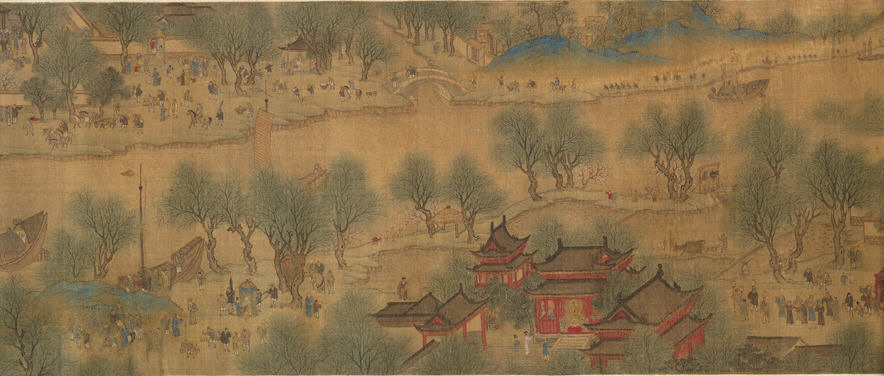
The Qing court version, Taipei. National Palace Museum, accession gu-hua-001110, 35.6 by 1152.8 cm, ink and colour on silk, painted by five court painters (Chen Mei, Sun Hu, Jin Kun, Dai Hong and Cheng Zhidao) and signed as submitted on the 15th day of the twelfth month of the first year of Qianlong, which the museum labels 1736, although that signature date falls in January 1737 in the Gregorian calendar and English Wikipedia gives 15 January 1737 as the presentation date. Wang Cheng-hua's 2020 article says it was commissioned by the Yongzheng Emperor and completed in the second year of Qianlong's reign as one of the most famous works of the Qing court, and Roderick Whitfield's 2021 article says the five painters followed a monochrome cartoon by the court artist Shen Yuan, which bears the seals of Prince Bao, the future Qianlong Emperor. It adds Ming and Qing customs, palace gardens and a Jinming Lake scene, and a frontispiece carries Qianlong's 1742 poem. Wikipedia says it moved to Taipei in 1949, and a 1968 stamp set from Taiwan titled A City in Cathay shows it. It has more than 4,000 figures according to Wikipedia, against about five hundred in Beijing. The big stitched scans on Commons titled Along the River 7-119-3 and Qing Court Version are this object, and both are widely reused on Wikipedia as pictures of the subject.
Suzhou workshop scrolls and the Qiu Ying type. From the late Ming and early Qing, workshops in Suzhou produced numerous scrolls under a forged signature of Zhang Zeduan or Qiu Ying, a phenomenon Su-chen Chang's 2013 Vancouver thesis, as cited by Wikipedia, argues deserves study in its own right. The Taipei example, accession gu-hua-001605, measures 34.8 by 804.2 cm and carries the signature of Qiu Ying of Wumen, imitating Zhang Zeduan's brush, together with colophons attributed to Wen Zhengming and others, in a style the museum calls a conscious emulation by a Suzhou workshop artist. Wikipedia says a Qiu Ying-type scroll of about 30.5 by 987 cm is in the Liaoning Museum, and the Xinhua feature says the two other Qingming scrolls Puyi carried are in that museum. Yu Hui compares this class to the Beijing scroll point by point: bright blue and green colour, a wedding at the opening, a defence office at the gate instead of a tax office, a stone arch with no boat danger.
Metropolitan Museum, New York. Accession 47.18.1, Spring Festival on the River, handscroll, ink and colour on silk, 29.8 by 1004.6 cm, from the collection of A. W. Bahr, Fletcher Fund 1947. Alan Priest published it in 1948 as a Ming scroll after a Song subject, and the museum database now lists it as Qing, 18th century with a question mark. Also in the Met, accession 11.170, Going Upriver on the Qingming Festival, 29.2 by 645.2 cm, Rogers Fund 1911. Neither is the Beijing scroll.
Other copies. English Wikipedia lists a roughly 12 metre late Ming copy in the Museum of Applied Arts in Vienna and a Shen Yuan monochrome scroll is in Taipei, accession gu-hua-001707, 34.8 by 1185.9 cm, ink and light colour on paper. A modern copy at the Palace Museum, made over nearly a decade by the restorer Feng Zhonglian, who died in 2001, is itself treated by the museum as a cultural relic, according to Yu Hui. The English Wikipedia entry mentions a Yuan copy attributed to Zhao Mengfu, for which no extant object was identified here.
One incident shows how easily the objects are confused. Newsweek reported on 15 July 2007 that for the second half of the Hong Kong showing, from 23 July, a sixteenth-century fake by Qiu Ying would take the place of the original Song piece. The report shows that within a single exhibition the visitor could be looking at a different scroll depending on the date.
Chapter 11Remounts, a donkey that became an ox and the rumours that grew round the repair
The scroll has been remounted more than once and what remains is not what its Jin and Ming readers saw.
The scroll has been remounted more than once and what remains is not what its Jin and Ming readers saw. Yang Renkai wrote in 1950 that the mounting had been changed before or around its entry into the Qing palace, which cost it its title slip, seals and Song inscriptions. Yu Hui says the front of the scroll was cut off by a late Ming mounter, and that the white horse near the start lost its front half in the Ming, which is why it appears as half a horse. Both statements are unconfirmed by independent evidence in the sources fetched.
The best-documented intervention is the remounting of 1973. The 2005 conference report says specialists then determined that a small section had been repaired inappropriately in the Ming. The Ming craftsmen had taken brush strokes representing a timber bracket for the horn of a missing ox, pasted a silk fragment onto the scroll and painted an ox on it. Palace Museum staff removed the fragment after much deliberation, and the decision was controversial, because some scholars argued the animal would originally have been a donkey while others thought removing the silk was unnecessary licence. The 2005 conference was first announced as being about the restoration, but the topic was dropped, and only one paper, Xu Zhongling's account of the mounting, dealt with the 1973 work. No conservation report for 1973 was found for this record.
Rumours accumulated in the gap. Yang Xin told the conference that the media had added to the mystery with reports that Lin Biao had removed the original in the Cultural Revolution and substituted a copy, and that the original was inadvertently destroyed by Palace Museum specialists and replaced with a copy. Chinese Wikipedia, citing a 1999 popular book, says instead that Li Zuopeng used his power to take the scroll out of the Palace Museum on forced loan and kept it until after Lin Biao's fall. These claims are not supported by any source examined here, and the conference report lists such stories among the anecdotes and rumours that surround the work. The Palace Museum's research director said in 2012 that the scroll shown at the Shanghai Museum in 2002 was the real Northern Song original and that he had personally handled the handover, in answer to a questioner who had heard it was a copy.
Physical analysis is a gap. No pigment study, silk study or imaging report was found, and the Palace Museum's catalogue entry carries no technical section. Hansen's description of the faded silk and the fine vertical cracks is the nearest thing to a condition report in the open literature consulted.
Chapter 12A national treasure that may not leave the country and is unrolled in full about once a decade
The scroll cannot now travel abroad. On 11 June 2012 the National Cultural Heritage Administration issued notice 1345 of 2012 publishing the second list of cultural relics forbidden from foreign...
The scroll cannot now travel abroad. On 11 June 2012 the National Cultural Heritage Administration issued notice 1345 of 2012 publishing the second list of cultural relics forbidden from foreign exhibition, covering paintings and calligraphy. It states that 37 first-grade items, groups or sets are forbidden to go abroad for exhibition from that day, and the attached list gives Zhang Zeduan, Qingming shanghe tu, handscroll, Northern Song, Palace Museum as item 33. The notice recalls the first list of 2002, which covered 64 groups of first-grade relics, and the scroll does not appear on that list in the Chinese Wikipedia table. Chinese Wikipedia sets out the legal frame: under the 2003 implementing regulations unique and fragile first-grade relics may not be exhibited abroad; the list is published periodically by the State Council's cultural authority; and relics never formally exhibited at home may not go abroad. Nothing found says the scroll has been lent abroad since the notice.
It had gone abroad shortly before. The Tokyo National Museum's exhibition Two Hundred Selected Masterpieces from the Palace Museum, Beijing ran from 2 January to 19 February 2012, and the Song original was on view from 2 to 24 January, after which a replica took its place. The museum's announcement said that for the first time China's national treasure of national treasures was crossing the sea to Tokyo, and added that the scroll had so far been shown outside the Palace Museum only at the Shanghai Museum, the Liaoning Provincial Museum and the Hong Kong Museum of Art. Newsweek calls the 2007 Hong Kong display the first outside the mainland, so the two statements differ about whether Hong Kong counts as abroad. The date of the showing at Liaoning is not given. Wikipedia says the Tokyo display marked the fortieth anniversary of the normalisation of diplomatic relations between China and Japan, and that the 2007 display marked the tenth anniversary of Hong Kong's return to China. The cost of shipping and insuring the scroll for Hong Kong is stated in Wikipedia as tens of millions of dollars and an undisclosed insurance sum, without a source.
The record of public showings is short. In 2002 it was among 72 masterpieces from mainland collections at the Shanghai Museum, where queues sometimes spiralled for three storeys, according to China Heritage Quarterly. In October 2005, for the Palace Museum's eightieth anniversary, it was shown from 10 to 23 October in a small exhibition of 39 items at the Yanxi Palace, where, according to the museum's vice-director Zhu Hongwen, visitors were few and could look as long as they wished. In Hong Kong, at the Hong Kong Museum of Art according to the Tokyo museum's account, it was on view from late June 2007, with the Qiu Ying scroll substituted from 23 July. Newsweek reports that Beijing's regulations allow it to be on view for only three weeks at a time. At Tokyo it was shown for 23 days.
In 2015, for the museum's ninetieth anniversary, the scroll was unrolled in full at Wuying Hall in the Shiqu baoji special exhibition, which opened on 8 September. It was the first full unrolling in ten years, says a Beijing Evening News report distributed by Xinhua. The museum limited the hall to 200 visitors at a time. Zhu Hongwen writes that the scroll was on view until 11 October, that the average queue was four to five hours, that up to 13 hours were recorded on the last day and that closing time was moved to 4 a.m. on 12 October to let the queue through, with an average of about 2,600 visitors a day. The museum's director then, Shan Jixiang, explained the rules: precious paintings are shown only in spring and autumn for no more than two months and must then rest in storage for three years or more.
In 2025, for the centenary of the museum, the scroll was shown again, in the Wumen gallery within the exhibition A Hundred Years of Guardianship, which opened to the public on 30 September. Xinhua describes a flowing, keep-moving viewing mode. Zhu Hongwen writes that the scroll was on view from 30 September to 29 October, and that it returned to storage on 30 October. A Red Star News report of 11 October 2025 quotes visitors waiting three to four hours for a view of a minute or two. By these rules the scroll is resting, and any new showing before late 2028 would break the three-year practice the museum itself stated in 2015. No announcement of a further showing was found for this record.
Chapter 13How the scroll became the most famous painting in China, and what is being done with it now
Its reputation rests partly on rarity and partly on reproduction.
Its reputation rests partly on rarity and partly on reproduction. Hansen notes that the Palace Museum photographed the whole scroll in 26 sections on plate-glass negatives and that a limited-edition reproduction was published, and a Commons plate in this record comes from a 1961 People's Fine Arts Publishing replica of the scroll as it looked before its 1973 remount. The scholar Martin Kemp, quoted in Wikipedia, calls it the most famous painting of a Chinese image-making society second to none before the nineteenth century, and Maxwell Hearn of the Metropolitan Museum told Newsweek in 2007 that it has enormous popular appeal and is a great ambassador for Chinese culture. Wikipedia cites 2007 pieces in the New York Times and Newsweek whose titles use the nickname China's Mona Lisa.
The picture moved into other media in the decades after its rediscovery. The 2005 conference report lists embroidery, carpets, wood carving, a stone bas-relief 528.7 cm long unveiled in Suqian in June 2005, the Qingming Shanghe Park theme park in Kaifeng and an eight-part state television documentary directed by Zhang Mengjun. The Rainbow Bridge was rebuilt for the US programme NOVA under the railway engineer Tang Huancheng, who spoke at the conference. In 2010 a digital version called River of Wisdom, 128 by 6.5 metres and about thirty times the scroll's size, with moving figures and a four-minute day and night cycle, was one of the main displays of the China Pavilion at the Shanghai World Expo, with reservation queues of up to two hours, according to Wikipedia, and toured Hong Kong, Macau, Taipei and Singapore before settling at the China Art Museum in Shanghai. In September and October 2024 a Hong Kong bank's youth brand built a Lego model about 26 metres long from some three million bricks, which Chinese Wikipedia says set a Guinness record. Each of these reproduces the subject. The 1736-37 court version, not the Beijing scroll, is the one on the Taiwan stamps and the NPM publications.
The picture also does political work. Both showings outside the mainland were timed to anniversaries of state events, the handover of Hong Kong and the normalisation of relations with Japan. The 2015 and 2025 exhibitions were part of the museum's anniversary programmes, and the second was built around the idea of guardianship, in which, Zhu Hongwen writes, the scroll appears because of the century's story of loss from the palace, return and restoration, which he says fits the exhibition's theme.
For researchers the open material is thin. The Palace Museum's online gallery offers an interactive viewer in Chinese; the museum's database provides the catalogue entry; and the large Commons scan of the whole scroll comes from an unidentified source on a Chinese forum, with a stated height of 28.2 cm that disagrees with the museum's 24.8 cm. No IIIF manifest was found. What is happening now is mostly scholarly: Cheng-hua Wang's monograph Up the River of Time: The Chinese Painting Tradition of Qingming Shanghe, published by the Harvard-Yenching Institute and the Harvard University Asia Center in June 2026, is described by its publisher as the first study in any language to treat the whole constellation of the original and its later versions as a painting tradition, and as reassessing what counts as reproduction and forgery. No conservation or technical study of the Beijing scroll has been announced.
The artist
Zhang Zeduan, courtesy name Zhengdao
Zhang Zeduan is a name attached to one picture by one dated inscription. The man behind it has no documented birth, death, teacher, patron or other securely attributed work. Chinese scholarship has built a biography from that inscription and from period examination practice, and the biography is more confident than the evidence. An attribution to Zhang Zeduan is an attribution to the author of the Beijing scroll as the 1186 colophon understood him.
Exhibited
- 2002Exhibition of 72 masterpieces of Chinese painting and calligraphy from mainland collections (title not given in the source)Shanghai Museum
- 2005Qingming shanghe tu and Song genre painting exhibition, 10 to 23 OctoberYanxi Palace, Palace Museum, Beijing
- 2007Shown from late June; replaced by a Qiu Ying scroll from 23 July (Newsweek)Hong Kong Museum of Art
- 2012Two Hundred Selected Masterpieces from the Palace Museum, Beijing (scroll shown 2 to 24 January)Tokyo National Museum
- 2015Shiqu baoji special exhibition (scroll shown to 11 October)Wuying Hall, Palace Museum, Beijing
- 2025A Hundred Years of Guardianship: from the Forbidden City to the Palace Museum (scroll shown 30 September to 29 October)Wumen gallery, Palace Museum, Beijing
- undatedShowing noted in the Tokyo museum's 2012 announcement, date not givenLiaoning Provincial Museum, Shenyang
Related works
| Work | Relation | Where it is |
|---|---|---|
| Along the River During the Qingming Festival (Qing Court Version) Chen Mei, Sun Hu, Jin Kun, Dai Hong and Cheng Zhidao | A different object, a 1736-37 court reinterpretation, not a copy of the Beijing scroll in detail 35.6 x 1152.8 cm, ink and colour on silk. Frontispiece with a poem by the Qianlong Emperor of 1742. About 4,000 figures. The most reproduced image of the subject and the one on the 1968 Taiwan stamps. | National Palace Museum, Taipei, accession gu-hua-001110 |
| Along the River During the Qingming Festival (Suzhou Imitation) Unknown Suzhou workshop artist, signed as Qiu Ying | A different object, a Ming workshop scroll under a forged Qiu Ying signature 34.8 x 804.2 cm, ink and colour on silk, with colophons attributed to Wen Zhengming and others. | National Palace Museum, Taipei, accession gu-hua-001605 |
| Qingming shanghe tu, Qiu Ying type After Qiu Ying | A different object, one of the two other Qingming scrolls said to have come to Shenyang with the Puyi paintings Chinese Wikipedia gives about 30.5 x 987 cm. Yu Hui compares it point by point with the Beijing scroll. | Liaoning Provincial Museum, Shenyang |
| Spring Festival on the River Unidentified artist | A different object with the same English title 29.8 x 1004.6 cm, ex collection A. W. Bahr, Fletcher Fund 1947. Published by Alan Priest in 1948 as Ming; now catalogued as Qing, 18th century with a question mark. | Metropolitan Museum of Art, New York, 47.18.1 |
| Going Upriver on the Qingming Festival Unidentified artist | A different object 29.2 x 645.2 cm, Rogers Fund 1911. | Metropolitan Museum of Art, New York, 11.170 |
| Qingming shanghe tu, monochrome cartoon Shen Yuan | The Yongzheng-court monochrome design from which, according to Whitfield, the five court painters worked 34.8 x 1185.9 cm, ink and light colour on paper, signed as respectfully painted by the servant Shen Yuan. | National Palace Museum, Taipei, accession gu-hua-001707 |
| Modern copy of the Beijing scroll Feng Zhonglian (died 2001) | A twentieth-century copy made over nearly a decade by a Palace Museum restorer Treated by the museum as a cultural relic, according to Yu Hui. | Palace Museum, Beijing |
| Admonitions of the Instructress to the Court Ladies Attributed to Gu Kaizhi | Another early Chinese handscroll with its own record in this archive; not a version of this scroll See the separate record for its provenance and attribution. | British Museum, London |
Open questions
- Who painted the scroll and when? The Palace Museum's research office argues a date of 1102 to 1110, Hansen and Cahill argue after 1126, Tsao Hsingyuan a century earlier than usual and Jonathan Hay other artists. The only dated evidence is the Jin colophon of 1186.
- Was the scroll ever in the Song court collection? Yang Renkai in 1950 accepted a Huizong title slip and Xuanhe provenance from the records; Yu Hui argues Huizong gave it to his uncle Xiang Zonghui; and Hansen calls the Huizong claim unsupported and says it remained in private hands throughout the Jin.
- Why does Hansen write both that the first records place the scroll in the Jin imperial collection and that it stayed in private hands under the Jin? The two statements in her 1996 booklet and article are not reconciled.
- Who owned the scroll between the Yan family's fall and Bi Yuan? The Qinghe shuhua fang of 1616 and the Gengzi xiaoxia ji of 1660 record it, and the Palace Museum entry does not say who held it. Lu Feichi is named only in Chinese Wikipedia and a popular feature.
- How much of the Yan Song story is historical? The accounts differ on whether he bought the scroll, received a copy or had a mounter denounce it, and they come from the diary of Li Rihua, the writings of Tian Yiheng and Wen Jia and the later Gu Gongxie, as summarised by Chinese Wikipedia.
- Where and by whom was the scroll seized in 1945? Yang Renkai's report gives Tonghua and a capture of Puyi there; English Wikipedia gives a capture at Mukden on 17 August; and the Xinhua feature gives the Shenyang airport and receipt by the Northeast Democratic Allied Army.
- When was the scroll identified, and was it among forgeries? Yang's report says the appraisal began on 30 August 1950, Yu Hui says 1951, Yang's 2005 interview and the Xinhua feature say 1952. The story of the true scroll set aside among forgeries rests on Yang's later recollection.
- When and by what instrument did the scroll pass from the Northeast Museum to the Palace Museum? Hansen implies it was in Beijing by 1954; a 2025 Guancha feature says 1958 through the Cultural Relics Bureau; and an undated popular article says 1959.
- How long was the scroll originally? Li Dongyang's colophon says a little over two zhang; a 2005 report says half is missing; and the present length is 5.28 m. The conversion of the Ming measure has not been made in the sources found.
- What exactly was done to the scroll in 1973, and has the removal of the Ming ox fragment been reviewed? The only account found is a paper by Xu Zhongling listed in a conference report, and no conservation file is published.
- Were the rumours about a substitute copy ever tested? Yang Xin told the 2005 conference of reports that Lin Biao replaced the original with a copy, and Chinese Wikipedia, citing a 1999 popular book, says that Li Zuopeng took it on forced loan. No source gives evidence for either.
- Is there any technical study of the silk, pigments or underdrawing? None was found, and no IIIF manifest or high-resolution official scan is openly published.
- When did the Liaoning Provincial Museum show the scroll? The Tokyo museum's 2012 announcement lists Liaoning among the places it had been shown outside the Palace Museum, with no date.
Questions about this object
What is Along the River During the Qingming Festival (Qingming shanghe tu), the Beijing scroll?
Along the River During the Qingming Festival (Qingming shanghe tu), the Beijing scroll is a painting, dated 12th century: Northern Song according to the Palace Museum, with a date after 1127 argued by others. Medium: Ink and light colour on silk; handscroll.
Who made Along the River During the Qingming Festival (Qingming shanghe tu), the Beijing scroll, and is the attribution settled?
The attribution to Zhang Zeduan is recorded here as disputed. Attributed to Zhang Zeduan by the colophon of Zhang Zhu dated 1186, the earliest text about the painter and the sole biography. The Palace Museum catalogues the scroll as Northern Song by Zhang Zeduan. Hansen argues for a date after 1126, Tsao Hsingyuan for a date about a century earlier than usual (as reported by the 2005 conference report), Bo Songnian disputes the biographical basis of the attribution and Jonathan Hay proposed two other possible artists (2005 conference). No technical study dating the silk or pigments was found.
Where is Along the River During the Qingming Festival (Qingming shanghe tu), the Beijing scroll now?
Palace Museum, Beijing (Forbidden City). Inventory number xin 00087177 (Palace Museum collection number). Last confirmed 8 October 2026. Palace Museum online collection entry; last on public view 30 September to 29 October 2025 (Wumen gallery); on the 2012 list of cultural relics forbidden from exhibition abroad.
What is still unknown about Along the River During the Qingming Festival (Qingming shanghe tu), the Beijing scroll?
Who painted the scroll and when? The Palace Museum's research office argues a date of 1102 to 1110, Hansen and Cahill argue after 1126, Tsao Hsingyuan a century earlier than usual and Jonathan Hay other artists. The only dated evidence is the Jin colophon of 1186.
Sources
- 1Valerie Hansen, 'The Mystery of the Qingming Scroll and Its Subject: The Case Against Kaifeng', Journal of Sung-Yuan Studies 26 (1996), pp. 183-200 (scanned PDF read page by page; footnotes cite Whitfield's 1965 Princeton dissertation). history.yale.edu/sites/...
- 2Valerie Hansen, 'The Beijing Qingming Scroll and Its Significance for the Study of Chinese History' (Journal of Sung-Yuan Studies booklet, 1996; scanned PDF, introduction pp. 1-6 read). history.yale.edu/sites/...
- 3Palace Museum, Beijing, collection page 'Zhang Zeduan Qingming shanghe tu juan' (text by Yang Xin), collection number xin 00087177, with the museum's related-articles list. dpm.org.cn/collection/...
- 4Palace Museum, Minghuaji (Famous Paintings of the Palace Museum), entry for the scroll: 24.8 x 528 cm, 13 colophon writers, 96 seals, catalogues recording it and the painter's brief biography. minghuaji.dpm.org.cn/paint/...
- 5China Heritage Quarterly No. 4 (Dec 2005), 'International Conference on Qingming shanghe tu and Song Dynasty Genre Paintings, Beijing, 10-12 October 2005', conference report with paper list. chinaheritagequarterly.org/scholarship.php
- 6National Cultural Heritage Administration, notice 1345 of 2012 (dated 11 June 2012, published 26 June 2012), 'Notice on issuing the Second List of Cultural Relics Forbidden from Exhibition Abroad (paintings and calligraphy)'. ncha.gov.cn/art/...
- 7Tokyo National Museum, exhibition page for 'Two Hundred Selected Masterpieces from the Palace Museum, Beijing' (2 January to 19 February 2012), with the scroll's display dates and replica notice. tnm.jp/modules/...
- 8Alexandra A. newsweek.com/rare-look-chinas-mona-lisa-104123
- 9Beijing Evening News, 'The Qingming shanghe tu is unrolled in full for the first time in ten years', 8 September 2015, republished by Xinhua (Shiqu baoji special exhibition; Shan Jixiang on display rules). xinhuanet.com/politics/...
- 10Xinhua, 'Qingming shanghe tu meets viewers again after ten years', 30 September 2025 (Wumen gallery exhibition A Hundred Years of Guardianship). xinhuanet.com/20250930/...
- 11Guancha, 'The treasure among treasures has come', feature by Ni Wei, 1 October 2025 (provenance summary, 1958 transfer, Yu Hui's reading, Shao Bao). guancha.cn/culture/...
- 12Zhu Hongwen (vice-director of the Palace Museum), 'From three showings of Qingming shanghe tu', Guangming Daily, republished 4 January 2026 (2005, 2015 and 2025 display dates and visitor figures). nishan.chinakongzi.org/content/...
- 13Yu Hui (Palace Museum research office), lecture 'Northern Song Zhang Zeduan's Qingming shanghe tu: secrets revealed', Palace Museum Forum, 26 October 2012 (lecture of 22 September 2012). dpm.org.cn/forum_detail/...
- 14Yang Renkai, interview 'I discovered the genuine Qingming shanghe tu', from Daijia 1 (Commercial Press, January 2005), excerpt on Guangming Online, 1 November 2005. gmw.cn/02sz/...
- 15Xinkuaibao (Guangzhou), 'Yang Renkai appraises the Qingming shanghe tu', 4 September 2022, quoting Yang's '1950 appraisal report on the Puyi paintings held by the Northeast Museum' (secondary reprint of a primary text). 163.com/dy/...
- 16Xinhua Daily Telegraph / Kan Tianxia (Zhang Xinming), 'Discovery of the genuine Qingming shanghe tu', republished on Sohu 6 November 2015, drawing on Yang Renkai and Dong Baohou of the Liaoning Museum. sohu.com/a/...
- 17Undated popular article on Sohu, 'five entries to the palace and four times into private hands' (cited only for the 1959 transfer date and the Zheng Zhenduo and Xu Bangda claim; low reliability). sohu.com/a/...
- 18Chinese Wikipedia, 'Qingming shanghe tu' ( source; provenance narrative, colophon list and Yan Song stories; many statements are unsourced and are flagged where used). zh.wikipedia.org/wiki/...
- 19English Wikipedia, 'Along the River During the Qingming Festival' ( source; counts, versions, Hong Kong and Tokyo showings, digital version). en.wikipedia.org/wiki/...
- 20Asia for Educators, Columbia University, 'Two Versions of the Scroll' (excerpt from Hansen 1996: scroll announced in the Palace Museum in 1954). afe.easia.columbia.edu/songdynasty-module/...
- 21National Palace Museum, Taipei, selection article on the Qing court version (35.6 x 1152.8 cm, 1736, five painters). theme.npm.edu.tw/selection/...
- 22National Palace Museum, Taipei, special exhibition 'Up the River During Qingming' (eight handscrolls on the subject; Suzhou imitations; the Beijing original). theme.npm.edu.tw/exh105/...
- 23Cheng-hua Wang, 'One Painting, Two Emperors, and Their Cultural Agendas: Reinterpreting the Qingming Shanghe Painting of 1737', Archives of Asian Art 70(1), 2020 (abstract via Crossref). api.crossref.org/works/...
- 24Roderick Whitfield, 'A Word for Shen Yuan', Archives of Asian Art 71(1), 2021 (abstract via Crossref search). api.crossref.org/works
- 25Harvard-Yenching Institute, publisher's page for Cheng-hua Wang, 'Up the River of Time: The Chinese Painting Tradition of Qingming Shanghe' (Monograph Series 147, June 2026). harvard-yenching.org/research/...
- 26The Metropolitan Museum of Art, open-access API record for 47.18.1, 'Spring Festival on the River' (Fletcher Fund 1947). collectionapi.metmuseum.org/public/...
- 27The Metropolitan Museum of Art, open-access API record for 11.170, 'Going Upriver on the Qingming Festival' (Rogers Fund 1911). collectionapi.metmuseum.org/public/...
- 28Wikimedia Commons file page, 'Alongtheriver QingMing.jpg' (source Baidu Tieba; stated 28.2 x 528.7 cm). commons.wikimedia.org/wiki/...
- 29Wikimedia Commons file page, 'Along the River During the Qingming Festival (Qing Court Version).jpg' (National Palace Museum data, accession gu-hua-001110). commons.wikimedia.org/wiki/...
- 30Wikimedia Commons file page, 'Along the River During the Qingming Festival (Suzhou Imitation).jpg' (National Palace Museum data, accession gu-hua-001605). commons.wikimedia.org/wiki/...
- 31Wikimedia Commons file page, 'Along the River During the Qingming Festival (by Shen Yuan).jpg' (National Palace Museum data, accession gu-hua-001707). commons.wikimedia.org/wiki/...
- 32Wikimedia Commons file page, 'Along the River During the Qingming Festival PRE Restoration Detail.jpg' (source: People's Fine Arts Publishing replica, Beijing, 1961). commons.wikimedia.org/wiki/...
- 33English Wikipedia, 'Puyi' (; flight of 11 August 1945 and capture at Mukden). en.wikipedia.org/wiki/...
- 34Chinese Wikipedia, 'Li Dongyang' (; dates 1447-1516). zh.wikipedia.org/wiki/...
- 35Chinese Wikipedia, 'Xu Pu' (; dates 1429-1499). zh.wikipedia.org/wiki/...
- 36Chinese Wikipedia, 'Bi Yuan' (; dates 1730-1797). zh.wikipedia.org/wiki/...
- 37Chinese Wikipedia, 'Tianshui bingshan lu' (; inventory of the confiscated Yan family property). zh.wikipedia.org/wiki/...
- 38Chinese Wikipedia, 'Cultural relics forbidden from exhibition abroad' (; legal frame and the three lists). zh.wikipedia.org/wiki/...
- 39Old Chinese Paintings on Stamps, 'A City in Cathay' (Taiwan, 1968; Qing court version). artonstamps.org/Countries/...
- 40Chinese Wikipedia, 'Palace Museum' (; about 1,300 paintings and calligraphies removed by Puyi, about 370 returned to the Palace Museum). zh.wikipedia.org/wiki/...
- 41Chinese Wikipedia, 'Zhang Zeduan' (; dates given as 1085-1145). zh.wikipedia.org/wiki/...
- 42Northeast Museum opened 7 July 1949, renamed 1959). zh.wikipedia.org/wiki/...
- 43Chinese Wikipedia, 'Lu Feichi' (; dates 1731-1790). zh.wikipedia.org/wiki/...
- 44Chinese Wikipedia, 'Lu Wan' (; dates 1457-1526). zh.wikipedia.org/wiki/...
- 45Chinese Wikipedia, 'Yan Song' (; dates 1480-1567, fall and confiscation). zh.wikipedia.org/wiki/...
- 46National Cultural Heritage Administration, attachment to notice 1345 of 2012: 'Second List of Cultural Relics Forbidden from Exhibition Abroad (paintings and calligraphy)', item 33. ncha.gov.cn/module/...
- 47English Wikipedia, 'Zhang Zeduan' (; dates 1085-1145). en.wikipedia.org/wiki/...
- 48Red Star News (Fu Yao), 'Qingming shanghe tu shown again at the Palace Museum after ten years', 11 October 2025 (queues and viewing times at the Wumen gallery). news.qq.com/rain/...
- 49Wikidata item Q714802 (Along the River During the Qingming Festival), via the Wikidata API: image Alongtheriver QingMing.jpg, inventory number xin 00087177, height 24.8 cm, width 528 cm. wikidata.org/w/...

.jpg)
.jpg)
.jpg)

Last verified · Published
Change log
8 October 2026 - Record created at the house standard: researched narrative, technical evidence, maker dossier, graded provenance chain, prices with hammer and premium separated, related works, open questions and sources.