Dwelling in the Fuchun Mountains (Fuchun shanju tu)
Huang Gongwang · Begun 1347; the artist's inscription is dated 1350 (a gengyin year); the National Palace Museum dates the work 1347 to 1350

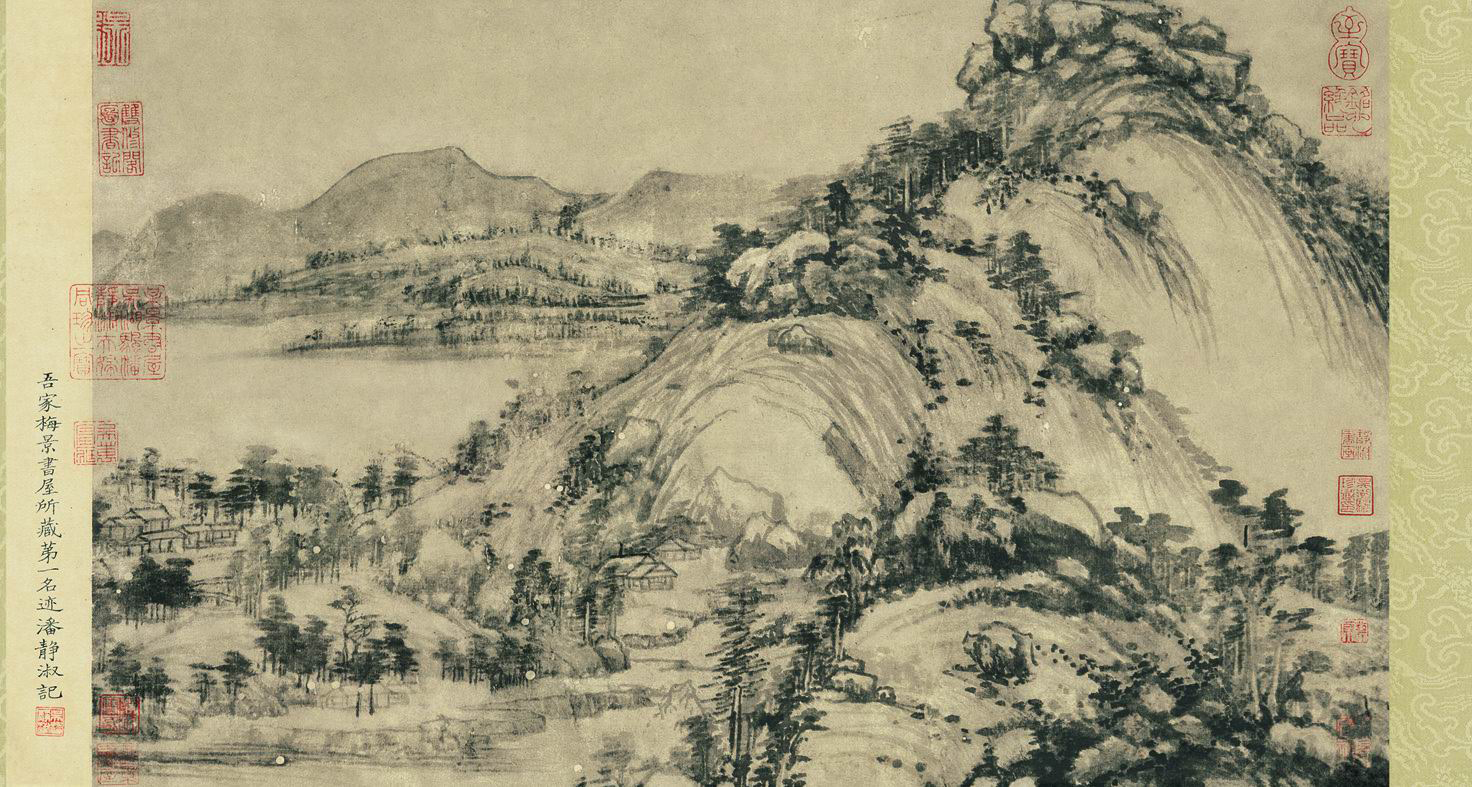
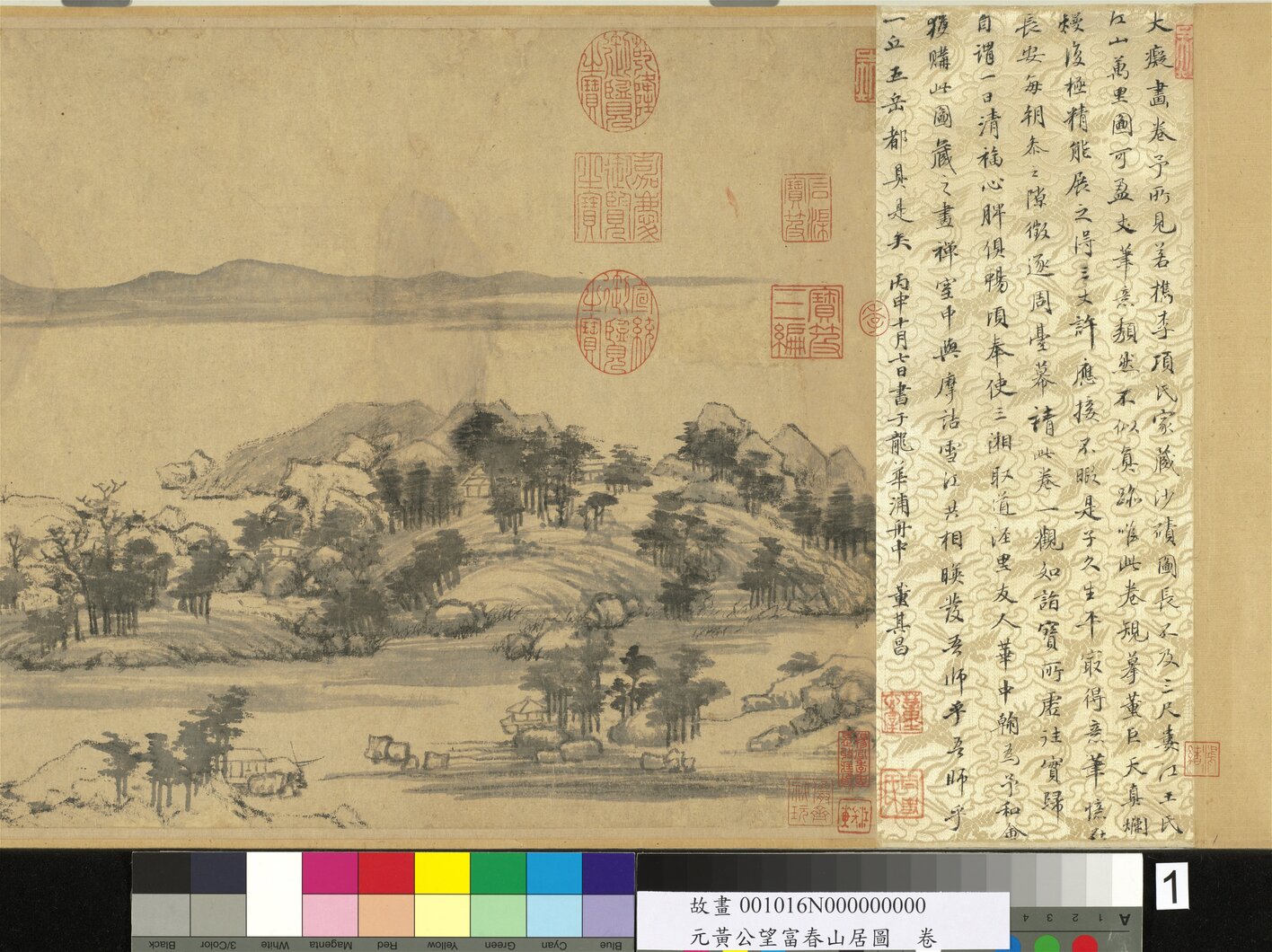
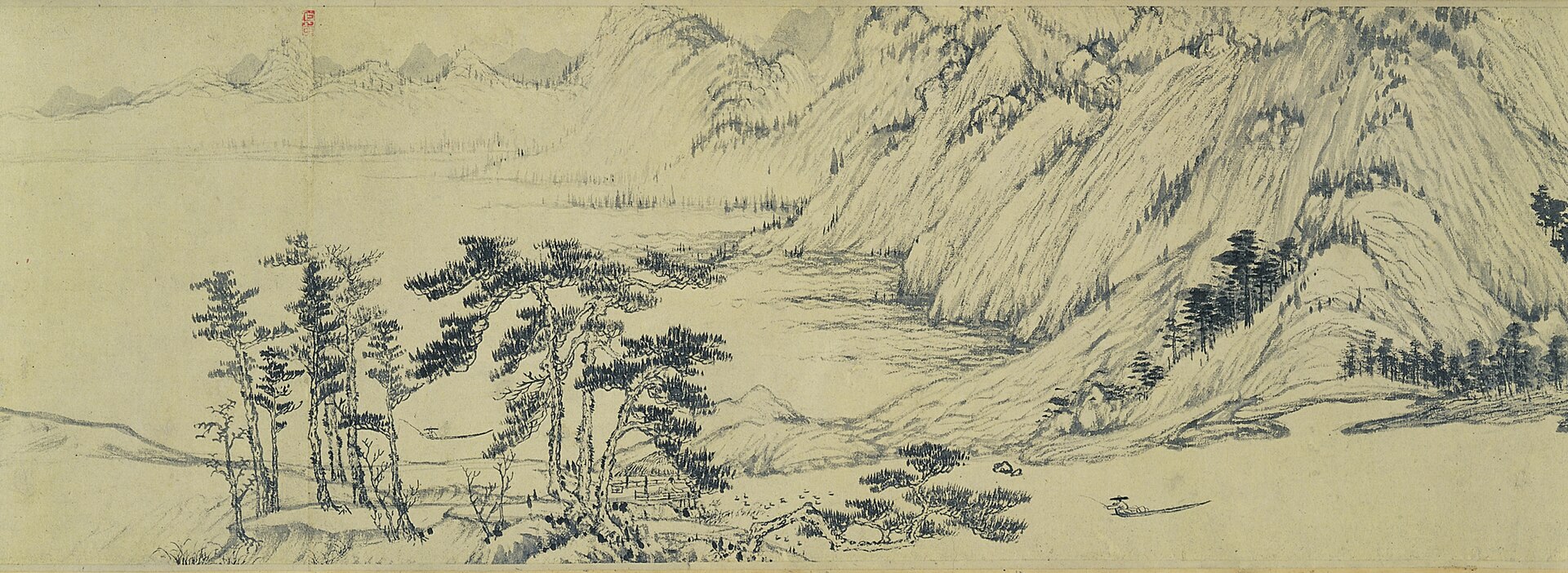
The whole long section, 33 x 636.9 cm, in the National Palace Museum, Taipei (Gu Hua 001016), photographed by the museum and published on its 2011 exhibition site. The landscape runs across the centre and right, and the colophons and their mounts fill the left. This is the long piece of the scroll described in this record, Public domain per the Commons file page, which cites the museum's source and the 33 x 636.9 cm size.
| Artist | Huang Gongwang |
|---|---|
| Date | Begun 1347; the artist's inscription is dated 1350 (a gengyin year); the National Palace Museum dates the work 1347 to 1350 |
| Medium | Ink on paper, handscroll (now two separately mounted pieces) |
| Dimensions | Master Wuyong Scroll: 33 x 636.9 cm (six joined sheets). Remaining Mountain: 31.8 x 51.4 cm. Together 688.3 cm; the Zhejiang Provincial Museum gives about 746 cm for the original length |
| Where it is now | Two holdings of one scroll: the long section (Master Wuyong Scroll) in the National Palace Museum, Taipei; the opening fragment (The Remaining Mountain) in the Zhejiang Provincial Museum, Hangzhou, where it is shown for about a month a year at the Zhijiang branchlast confirmed |
| Inventory number | National Palace Museum: Gu Hua 001016 (long section). Zhejiang Provincial Museum: first-class object; no inventory number found in the sources read |
| Attribution | AcceptedAccepted by both holding museums. Full note |
| Object type | Painting |
| Period | Yuan dynasty, 1347 to 1350 |
| Cases | Has a provenance gap |
| Inscriptions | At the end of the long section, the artist's inscription of 1350, written at the Zhizhi Hall of the Xia family at Yunjian (Songjiang), with two seals of the painter; colophons by Shen Zhou (1488), Wen Peng (1570), Wang Zhideng (1571), Zhou Tianqiu, Dong Qichang (1596, now mounted at the head), Zou Zhilin (1650), Shen Deqian (two) and Liang Shizheng for Qianlong (1746). On the mount of the fragment: Wu Hufan's wrapper title and frontispiece Fuchun yi jiao, Shen Yinmo's title (1939), Wang Tongyu's portrait of Huang, Wang Tingbin's colophon (1669) and Wu Hufan's copies of the Ming colophons. |
| Owners on record | 30 links22 documented, 3 disputed, 5 unknown |
| Sources | 42 cited |
About this record Last verified · 42 sources cited · Change log
On this page 11 sections
ContentsClose
Huang Gongwang's Dwelling in the Fuchun Mountains is a handscroll in ink on paper, begun in 1347 and dated by the painter's own inscription to 1350. It is now two objects. The long section, the Master Wuyong Scroll, 33 x 636.9 cm, is in the National Palace Museum in Taipei. The opening fragment, the Remaining Mountain, 31.8 x 51.4 cm, is in the Zhejiang Provincial Museum in Hangzhou. They were separated in 1650, when the collector Wu Hongyu, dying, ordered the scroll burned and a relative pulled it from the fire.
Before that the scroll was lost by Shen Zhou around 1487 and bought back by another man, bought by Dong Qichang in 1596 and, on Shi Wanzhong's 2023 argument, pledged by him around 1616 or 1617 to the Wu family of Yixing. After the fire the long section went through a dealer, a collector in Danyang, the Ji family of Taixing, the officials Gao Shiqi and Wang Hongxu and the salt merchant An Qi before the Qianlong court bought it in 1746. Qianlong had acquired a copy, the Ziming Scroll, a year earlier, judged it the original and the long section a fake, and wrote on the copy for decades. The fragment resurfaced in 1938 as a leaf from a broken-up album, was matched to the long section by Wu Hufan and sold to the Zhejiang authorities in 1956.
The two pieces were shown together in one case at the National Palace Museum from 2 June to 31 July 2011, after eleven years of proposals, a remark by Premier Wen Jiabao and a dispute over whether Taiwanese loans to the mainland would be safe from seizure. The scroll has no recorded auction history. This record separates what the museums, the colophons and the specialist literature document from the popular story, which differs from them on the pledge, on the fire, on the rescuer's name and on who first called the long section genuine.
Provenance
Each link is graded. Documented: a cited source supports it. Disputed: the identification is argued but not established. Unknown: no owner for that span, and the gap is not smoothed into a narrative. The grades in the glossary.
- 1347 - 1350Huang Gongwang, at Fuchun and Songjiangdocumented
Begun at Fuchun in 1347 and signed off by an inscription of 1350 written at the Zhizhi Hall of the Xia family at Yunjian. The inscription says the scroll was still unfinished after three or four years. The Taipei museum says Huang painted it with the Taoist Zheng Wuyong accompanying him.19363714
- c. 1350 - before the 1460sMaster Wuyong (Zheng Wuyong), a Taoist friend, then unknownunknown
The Taipei museum, Beijing Daily and Baidu Baike say the scroll was made for or given to Wuyong. Shi Wanzhong points out that the inscription says only that Wuyong accompanied the painter and asked for the inscription, so whether the scroll was given to him awaits study. Nothing documents the owners of the scroll for about a century. Shi reads a note by Zhang Chou, around 1616, as saying a colophon by Li Yingzhen was on it, which would be evidence of an unrecorded owner in this period.29183614
- Chenghua era (1465 to 1487) - 1487Shen Zhou, Suzhoudocumented
Shen Zhou's own colophon of 1488 says the scroll was once in his collection but was lost. The Taipei museum places the ownership in the Chenghua era and says Shen asked someone to inscribe it.43714
- 1487 - 1487Lost by Shen Zhou; Shen paints a copy from memorydocumented
The Taipei museum says the inscriber's son seized the scroll and sold it at a high price; English Wikipedia says the inscriber was an unnamed calligrapher, and a People's Daily digest says a friend. Shen's memory copy, painted on the mid-autumn day of 1487, is in the Palace Museum in Beijing. The identity of the person who took the scroll is not documented.4332437
- 1487 - 1488Fan, assistant prefect (jietui) at Suzhou, called Fan Shunju in one accountdocumented
Wen Peng's colophon of 1570 says Fan acquired Shen's memory copy in 1487 and the original in 1488; Shen Zhou's colophon of the first day of summer 1488 says Fan had bought the scroll back. Neither gives the price.371433
- 1488 - 1570Unknownunknown
No owner is documented for about eighty years. Chinese sources give An Shaofang a place here from his seals, but Shi dates his holding only to before about 1591.1436
- by 1570 - 1571 or laterTan Zhiyi (Sizhong) of Wuxidocumented
Wen Peng saw the scroll and Shen Zhou's copy together in Nanjing in April 1570; Wang Zhideng viewed both at Tan's Chenghuai Pavilion at Liangxi after the mid-autumn festival of 1571; Zhou Tianqiu spent a day with both forty-two days later. Shi describes Tan as the son of a governor-general holding a minor post by his father's rank.3714
- 1571 - 1596Possibly Xiang Yuanbian, An Shaofang and a Zhou in Beijing; owners not establishedunknown
Dong Qichang remembered pressing a Zhou in Beijing to show him the scroll, which Shi turns into Zhou Taimu as a holder. An Shaofang's two seals and a possible Xiang Yuanbian are Shi's guesses. A modern book cited by Shi has the scroll pass from Tan to Dong in 1596. The chain between Tan and Dong is not established.1437
- 1596 - c. 1616Dong Qichang, Songjiangdocumented
Dong's colophon of 1596, written on a boat at Longhuapu, says he bought it through his friend Hua Zhongfu on a mission to Hunan and kept it in his Studio of Painting Meditation. His 1614 note still calls it his. The price is not stated.363714
- c. 1616 - 1617Wu family of Yixing, probably Wu Zhengzhi (Wu Zhiju) and his father Wu Daikedisputed
Shen Hao's colophon of 1651 quotes Wu Hongyu: Dong pledged the scroll to his late father for a thousand gold. English and Chinese Wikipedia, Baidu Baike and a People's Daily digest say Dong sold it late in life. Shi Wanzhong argues for a pledge in 1616 or 1617, after the riot at Dong's home town of 1616 and before Wu Zhengzhi's death in the tenth month of 1617, and that Dong still hoped to redeem it in 1621. Zhang Chou's book of around 1616 puts it with the Wu family. The terms of the pledge are not recorded.143736333424
- 1617 - 1650Wu Zhengzhi, then his son Wu Hongyu (Wenqing), Yixingdocumented
Wu Zhengzhi's seals, ten impressions in three designs, include those crossing the joins. Hongyu kept it in a room called the Fuchun Xuan and carried it with him in the upheaval of 1644, according to Zou Zhilin's colophon as printed on Baidu Baike. Sources disagree whether Hongyu was Wu Zhengzhi's third son, his youngest son or his grandson.143624
- 1650 - 1651Wu Hongyu; the scroll saved by a relativedocumented
The Taipei museum says the scroll was scorched in 1650 when the dying collector had it consigned to the fire and that a family member saved it. The earliest accounts read are Shen Hao's colophon of 1651 and Yun Shouping's, as quoted by Beijing Daily. Details, including the rescuer's name, whether only the front half burned and the substituted painting, are disputed. The first sheet was peeled away and a small piece survived as the Remaining Mountain.21418243828
- 1651 - 1652Wu Hongyu's family, possibly offered to Zou Zhilin for a thousand golddisputed
Zhou Lianggong's reading notes, quoted by Shi, say the heir offered the surviving scroll to Zou Zhilin for a thousand gold, Zou could not pay, inscribed the end and returned it. Nothing else documents the sale.14
- by 24 May 1652 - c. 1656Zhang Fanwo (Zhang Bojun) of Danyangdocumented
The dealer Wu Qizhen recorded going on 24 May 1652 to see the scroll at Danyang. Shi's source for this is Wu Hufan's colophon on the fragment, quoting Wu Qizhen's Record of Paintings and Calligraphy. There are no seals of Zhang on the scroll.1419
- c. 1654 - c. 1654Possibly Zhou Bingwen of Wuxiunknown
A seal of Zhou Bingwen, a graduate of 1654, is on the scroll. No text places the scroll in his hands.14
- c. 1656 - before 1693Ji Yuyong of Taixing, then possibly his son Ji Nangongdocumented
Seven seals of the Ji family are on the long section. Cheng Zhengkui viewed and copied it at Ji's house in 1657, according to the court catalogue Shiqu Baoji cited by Shi. Ji Nangong as the next holder, around 1673, is from Liu Peng's 2018 article, which was not seen.1415
- before 1693 - c. 1700Gao Shiqi, Kangxi court officialdocumented
Gao Shiqi recorded the scroll in his catalogue of 1693 and, according to Shen Deqian's colophon, paid 600 gold for it. His own seal on it is unidentified.1415
- c. 1700 - 1723Wang Hongxu, Kangxi ministerdocumented
Wang's seals are on the scroll, and according to Shen Deqian's colophon he paid the same sum as Gao. Wang Hui made his sixth copy with the original before him in 1696 at Wang Hongxu's request. Wang died in 1723.1415
- 1723 - 1735Wang Hongxu's family, then An Qidisputed
Shan Guoqiang says the family sold it to An Qi after Wang's death in 1723. Shen Deqian's colophon says that in 1728 Wang's family was offering it in Suzhou for a thousand gold with no buyer and that it then went toward Yangzhou. He saw it in An Qi's hands in 1735.1514
- by 1735 - 1746An Qi, salt merchant of Tianjin and Yangzhoudocumented
An Qi is documented as holding it in 1735 by Shen Deqian's colophon; his catalogue Moyuan Huiguan of about 1742 records his collection. The account Shi follows has the household in difficulty by 1746.1434
- winter 1746 - 1912Qianlong court, Qing imperial collectiondocumented
Entered the collection in 1746 through the Grand Secretary Fuheng, one year after the Ziming Scroll. Liang Shizheng's inscription gives 'two thousand' together with what was offered for sale; China Daily says taels of gold, Baidu Baike taels of silver. Qianlong judged the scroll a fake and it carries only Liang's note. The Shiqu Baoji and Baoji Sanbian seals and seals of the Jiaqing and Xuantong emperors are on it.41011142636
- 1912 - 1933Palace Museum, Beijing (founded 1925)documented
The Taipei museum's chronicle gives 1925 as the founding year of the Palace Museum. No source read itemises the scroll's transfer from the Qing household to the museum.1219
- 1933 - 1948Palace Museum evacuation: Shanghai, Nanjing, Sichuan, Guizhou, back to Nanjingdocumented
Beijing Daily and the People's Daily digest say the scroll went south with the Palace Museum's best pieces from 1933 and was seen by Xu Bangda in the Shanghai storehouse. The route of this particular scroll is not itemised.1924
- 1948 or 1949 - presentLong section: National Palace Museum, Taipei (Gu Hua 001016)documented
Beijing Daily and the People's Daily digest say the end of 1948; the Guardian and Baidu Baike say 1949. The Taipei chronicle records a first shipment of 320 crates in 1948. Which shipment carried this scroll is not stated. Catalogued in the Gugong Shuhua Lu of 1956, on the restricted-display list from 1992 and shown in the centenary exhibition of 2025.12101319242936
- 1651 - c. 1652Fragment (Remaining Mountain): Wu Qizhen, dealerdocumented
Beijing Daily says Wu Qizhen peeled the burned part away and kept the surviving piece of about one chi five or six cun, which became the Remaining Mountain. This link belongs to the fragment, not to the long section.1814
- 1669 - before 1938Fragment: Wang Tingbin of Guangning; album Sanchao Baohui; later a Chen family of Jiangyinunknown
Wang Tingbin's colophon on the fragment tells the story of the fire; the fragment was mounted in his album. The album later passed to a Chen family in Jiangyin who did not know what it was and sold the leaves separately. The owners between 1669 and the Chen family are not documented.191416
- before autumn 1938 - 1938Fragment: Cao Youqing, Jigu Ge, Shanghaidocumented
Beijing Daily says he bought the leaf from the dismembered album and took it to Wu Hufan.1914
- autumn 1938 - 1956Fragment: Wu Hufan, Shanghai (Meijing Shuwu)documented
Wu acquired it for a bronze vessel from his collection, which Beijing Daily calls a Zhou dun, the People's Daily digest a Shang or Zhou bronze and Baidu Baike a Shang yi. Shen Yinmo's title of New Year's Day 1939 says Wu got the fragment the winter before. Wu matched it to the long section by the join seal, by a photograph of the two pieces and by the scorch marks, and mounted it as a scroll.19162436
- 1956 - presentFragment: Zhejiang Provincial Cultural Relics Management Committee, then the Zhejiang Provincial Museumdocumented
Beijing Daily says Wu Hufan asked 5,000 yuan, which the committee paid, a sum that took most of its annual budget; Sha Menghai arranged it and Li Chengquan decided. The Zhejiang museum page lists the source as sold by Wu Hufan and the Taipei museum says it entered the Zhejiang museum in 1956. The price is reported in one search result as 8,000 yuan, which this record could not check.20162
- 2011 - 2011Fragment: loan to the National Palace Museum, Taipeidocumented
The fragment left Hangzhou on 11 May 2011 in the hands of the China Cultural Relics Exchange Centre and was due to pass, by Chen Hao's account, to Taiwan's Quanta Culture and Education Foundation and the Taipei museum on 18 May; it was valued at RMB 150 million and insured by the Taipei museum. It was shown beside the long section from 2 June to 31 July 2011. The return date is not given in the sources read.222378
Technical evidence
| Attribution note | Accepted by both holding museums. The painter's own inscription of 1350 records the circumstances of the work, and the long section was reclassified from copy to original in modern times. Qianlong judged the other way in 1745 and 1746: he took the Ziming Scroll, now held in Taipei, as the original and the long section as a copy, and wrote only a short note on the long section. The Taipei museum's own 1956 catalogue states that the Master Wuyong Scroll is the original, and the same museum now says modern scholars confirmed the Ziming Scroll as a copy. Accounts of who first reversed the verdict differ (Xu Bangda in 1933 in Beijing Daily, a 1956 editor's note in the Taipei museum's text, the 1970s in a People's Daily digest, 1816 in Baidu Baike and English Wikipedia) and are laid out in the narrative. Fu Shen proposed in 1993, and Shan Guoqiang endorsed in 2013, that the Ziming Scroll is an altered Ming copy. No analysis of the paper or ink of either piece was found in the sources read. |
|---|---|
| Support | Paper. The Taipei museum counts six joined sheets in the long section, with a seal across each join. A China Daily exhibition guide says eight sheets, which contradicts the owner of the scroll. No fibre, sizing or sheet-by-sheet analysis was found in the sources read.2926 |
| Medium | Monochrome ink in the freehand 'sketching ideas' manner. The Taipei text says the composition was laid out in light ink and finished with successive applications of darker and drier brushwork, with altered shapes, strengthened contours and added texture strokes, tree groups and brush dots. Hung Sheng's teaching text names long hemp-fibre texture strokes and alum-head rock strokes.2938 |
| Dimensions | Long section 33 x 636.9 cm; fragment 31.8 x 51.4 cm. The sum is 688.3 cm; English Wikipedia's 691.3 cm does not follow from these figures. Zhejiang News (2025) gives about 746 cm for the original length without showing how it was reckoned.23317 |
| Format and reading | Handscroll, read from right to left. It opens on a great mountain (the fragment), passes through river, hills and marsh, rises to a conical peak and ends in pale distant hills. The pieces are mounted separately; in 2011 they lay in one case of about 16 m, each in its own mount.9382522 |
| The painter's inscription | Dated to the tenth year of Zhizheng, a gengyin year (1350), the day before the Dragon Boat Festival, written at the Zhizhi Hall of the Xia family at Yunjian. It says the scroll was started in 1347, was still incomplete after three or four years, would be added to when leisure allowed, and that Wuyong asked for the inscription so that people would know how hard it was to make. Two painter's seals follow.363714 |
| Colophons | Shen Zhou (1488), Wen Peng (1570), Wang Zhideng (1571), Zhou Tianqiu, Dong Qichang (1596), Zou Zhilin (1650), two by Shen Deqian, and a note by Liang Shizheng for Qianlong (1746). Shen Zhou, Wen Peng, Wang Zhideng, Zhou Tianqiu, Dong Qichang and Zou Zhilin are printed on Baidu Baike and listed in Shi's table.363714 |
| Collectors' seals on the long section | Per Shi's table: An Shaofang 2, Wu Zhiju or Wu Zhengzhi 3, the Ji family of Taixing 7, an unassigned 'Jiang Changgeng' 1, Wang Hongxu 7, Zhou Bingwen 1, Qianlong 5 (including the Shiqu Baoji and Baoji Sanbian seals), Jiaqing 2, Xuantong 1. Wu Zhiju's seals straddle the joins and match across the break with the fragment.1419 |
| Fire damage | Wu Hufan's photograph of the two pieces laid together shows five scorch marks at nearly equal intervals, larger toward the fragment, one directly under the join seal. The first sheet of the long section shows repair marks. The fragment was trimmed and is reported 1.8 cm narrower than the long section, although the museums' heights differ by 1.2 cm.19210 |
| Mounts | Dong Qichang's colophon of 1596, once at the tail, is reported to have been cut off and mounted at the head of the long section (Beijing Daily); the open-data image shows a block signed with Dong's name beside the first landscape. The fragment's mount is Wu Hufan's work of 1939, with frontispiece, portrait of the painter, copied colophons, a photograph and a scorch-mark diagram.191639 |
| Numbers and classification | Long section: National Palace Museum Gu Hua 001016, restricted-display list of 1984 (20 works) widened to 60 in 1992. Fragment: first-class object of the Zhejiang Provincial Museum. Chinese Wikipedia says the long section is a national treasure and the Ziming Scroll an important antiquity in Taiwan's classification.101634 |
| Display conditions, 2011 | Case at 20 to 24 degrees Celsius, 58 to 63 per cent relative humidity and 50 lux. Insurance of 0.1 to 0.3 per cent of the Zhejiang museum's valuation of RMB 150 million, paid by the Taipei museum.2322 |
| Loan terms and legal status | Taiwan's stated conditions for any loan to the mainland in 2010 and 2011 were use of the name National Palace Museum and a clause of judicial immunity from seizure; the National Palace Museum's director said in March 2010 that its relics would not be shown in China unless Beijing amended its laws to guarantee their return. Zhejiang's director replied that the Customs Law and the relics regulations of the People's Republic require objects brought in to leave within six months. No source read says the clause was enacted. The 2011 loan ran one way, from Hangzhou to Taipei.21222723 |
| Attendance and reception | 847,509 visitors, 8,828 a day, at Landscape Reunited, 2 June to 5 September 2011 (The Art Newspaper). A Reuters report of October 2023 describes a People's Liberation Army animated film built on the two pieces; Chloe Estep (2025) analyses the official use of the reunion; the name was borrowed for a 2013 film (Switch) and a 2019 film by Gu Xiaogang.3031324142 |
| Technical imaging | No infrared, X-ray, fibre or pigment study of either piece was found in the sources read. The Taipei museum publishes open-data images, one of which is CC0 on Wikimedia Commons.392 |
Images




The record in full
Chapter 1One scroll now exists as two objects in two museums, and their measurements still add up
The scroll is a handscroll in ink on paper that Huang Gongwang began in 1347 and signed off in an inscription dated 1350.
The scroll is a handscroll in ink on paper that Huang Gongwang began in 1347 and signed off in an inscription dated 1350. Since the fire of 1650 it has been two separately mounted pieces. The long section, known as the Master Wuyong Scroll, measures 33 x 636.9 cm, is made of six joined sheets and belongs to the National Palace Museum in Taipei, which lists it as Gu Hua 001016. The opening fragment, known as the Remaining Mountain, measures 31.8 x 51.4 cm and belongs to the Zhejiang Provincial Museum in Hangzhou. The Taipei museum's own text says the shorter piece is the actual beginning of the painting.
Added together the two pieces come to 688.3 cm. The English Wikipedia article gives 691.3 cm, which does not follow from the museums' figures. In a press report of November 2025 the Zhejiang museum gives about 746 cm for the original length, a figure that must include the part that burned away, although the report does not show how it was reckoned. For what the lost opening looked like the evidence is two copies, not the original. The Taipei museum notes that Shen Zhou's copy of 1487 and the so-called Ziming scroll begin the same way, and takes this to show the front of the original before the fire. Beijing Daily's 2010 account says the burned front showed a city tower and a flat spread of sand where the Fuchun River runs into the Qiantang.
The two pieces have never been joined. In 2011 they lay in one case, each in its own mount, with the fragment's colophons between them, according to the Chinese Wikipedia article. Nothing in the sources read describes any plan to rejoin them physically.
No auction sale of the scroll is recorded anywhere in the sources read. Its known prices come from a pledge, private sales, a court purchase and a state purchase, and they are given below in the units the sources use.
Chapter 2The name Fuchun covers three different objects, and the titles of the two halves have moved around
Four titles belong to this record. The long section is the Master Wuyong Scroll (Wuyong shi juan, also called the Wuyong version), named for the Taoist whom the painter's inscription mentions.
Four titles belong to this record. The long section is the Master Wuyong Scroll (Wuyong shi juan, also called the Wuyong version), named for the Taoist whom the painter's inscription mentions. The fragment is the Remaining Mountain (Shengshan tu). The frontispiece that Wu Hufan wrote for the mount of the fragment reads Fuchun yi jiao, A Corner of Fuchun. The Taipei museum also calls the whole work the Orchid Pavilion of painting, in comparison with Wang Xizhi's Orchid Pavilion Preface.
Two other things carry the same name and are not this scroll. The first is the Ziming Scroll (Ziming juan), 32.9 x 589.2 cm, which the Taipei museum lists as attributed to Huang Gongwang, with an inscription dated autumn 1338 for a recluse called Ziming. It belongs to the National Palace Museum in Taipei. The Palace Museum in Beijing holds a different copy, the one Shen Zhou painted from memory in 1487. The second is a separate painting by Huang, the hanging scroll Fuchun Daling tu (Great Summits of Fuchun) in the Nanjing Museum. The museum's director, Gong Liang, told Xinmin Evening News in 2011 that it was made before the scroll and gave Huang the idea for it.
The two get tangled in Dong Qichang's own writing. He called what he bought in 1596 Fuchun Daling tu, and Shi Wanzhong takes the match between that phrase and Shen Zhou's memory copy as proof that Dong meant the long scroll and not the Nanjing hanging scroll. The Taipei Times, in a wire report of May 2011, retitled the fragment The Broken Mountains, a loose rendering that no museum uses. A. John Hay's 1978 dissertation spells the title Fu-ch'un in Wade-Giles, which is where older English-language literature will be found.
In this record the scroll means the Master Wuyong Scroll and the Remaining Mountain together, and the Ziming Scroll always means the Taipei copy.
Chapter 3Huang Gongwang wrote in 1350 that the scroll was still unfinished
The only dated statement by the painter is the inscription at the end of the long section.
The only dated statement by the painter is the inscription at the end of the long section. The Baidu Baike pages print its text, and the English edition renders it in a machine-like style that is used here only as a check on the Chinese. In substance Huang says that in the seventh year of the Zhizheng reign, 1347, he returned to live in the Fuchun mountains with Master Wuyong, and that on idle days in the South Tower he took up the brush. He was so absorbed that he laid out the design at length and filled it in bit by bit. After three or four years it was still incomplete, because he left it in the mountains while he travelled. He now had it back in his luggage and would add to it whenever he had leisure. Wuyong worried that someone might take it by trickery or force and asked him to inscribe the end of the scroll first, so that people would know how hard it had been to make. The inscription is dated to the tenth year, a gengyin year, the day before the Dragon Boat Festival, and written at the Zhizhi Hall of the Xia family at Yunjian, which is Songjiang.
So 1350 dates the inscription, not necessarily the last stroke. The Taipei museum says the painter began in 1347 and finished three to four years later and elsewhere that the work was completed in 1350 when he was 82 by Chinese reckoning. Its selection page is more careful: he worked on the picture on and off from about 1347 to 1350, when the major portions were completed. Huang lived until about 1354 and the inscription says he meant to keep working. No source read says whether he did.
The Taipei text describes the method. The composition was laid out first in light ink and finished with successive applications of darker and drier brushwork, with shapes slightly altered, contours strengthened and texture strokes or tree groups added here and there, and brush dots scattered across the surface as abstract accents. Taipei's exhibition site calls the brushwork a freehand sketching-ideas type in monochrome ink, with ink tones that trace back to the tenth-century masters Dong Yuan and Juran. The Khan Academy essay by Hung Sheng, a teaching text, names the vocabulary: long hemp-fibre strokes drawn down the mountain faces and angular alum-head strokes for the small rocks at the tops of the hills. The Taipei site describes the leaves on the Remaining Mountain as dotted with a horizontal brush in moist ink.
The handscroll is read from right to left, as a journey. It opens on the great mountain that survives as the Remaining Mountain, runs through river, hills and marsh, rises to a conical peak near the end and ebbs out into pale washes of distant hills over water. The long section is made of six sheets, according to the Taipei museum, with a seal stamped across each join. A China Daily exhibition guide of 2011 counts eight sheets, which contradicts the museum that owns the scroll. No fibre, pigment or sizing analysis of either piece appears in the sources read.
The dedication is a separate question. The Taipei selection page says the painting was made for a fellow Taoist named Master Wuyong, and Beijing Daily and Baidu Baike say Huang gave it to him. Shi Wanzhong observes that the inscription says only that Wuyong went with him and asked for the inscription, so whether the scroll was actually given to Wuyong awaits study. Zhang Guangbin's identification of Wuyong as Zheng Chu, whose style name was Wuyong, is the one Shi reports and Baidu Baike repeats. No source read says what happened to the scroll in the 1350s or in the following century.
Chapter 4Huang was a clerk who went to prison, became a Quanzhen Daoist and took up painting around fifty
Taipei's account is the plainest. Huang was born in 1269 at Changshu in present-day Jiangsu to a humble family and educated himself widely.
Taipei's account is the plainest. Huang was born in 1269 at Changshu in present-day Jiangsu to a humble family and educated himself widely. In his youth he served as a clerk handling documents in the Jiang-Zhe Branch Secretariat and in his middle years was recommended for service in the capital, but he was implicated in a case and sentenced to prison. After serving his time he gave up any thought of rank, went home, became a Taoist by profession and developed his painting. Taipei's selection page adds that he was born Lu Jian and adopted by a ninety-year-old man called Huang Le of Yongjia who had no son, and that the old man's remark, which the Taipei translation renders 'Old Man Huang has always longed for a son', became the basis of the painter's new name. It also says he studied Taoism, became a follower of the Quanzhen sect and made a living in the Songjiang and Hangzhou regions by fortune-telling, with painting as an activity on the side.
He began painting around the age of fifty. The Taipei exhibition site says he was not a painter by profession, that Ming and Qing catalogues list only sixty-odd works in his name and that the surviving paintings are far fewer, mostly from his last years. It names as his principal works the scroll, Nine Pearly Peaks in Green (1346-8, which Wang Feng's inscription says Huang painted for Yang Weizhen), Nine Peaks Clearing After Snow (1349) in Beijing, Calling on Dai at Shan Stream (1349) in Yunnan and Great Summits of Fuchun in Nanjing. It also reproduces Huang's inscription on Cao Zhibo's painting of 1350, in which he admired the archaic plainness of Cao's brush idea. His circle, as Taipei lists it, ran from Zhao Mengfu through Cao Zhibo, Zhang Yu, Yang Weizhen and Ni Zan to Wang Feng.
What the scroll meant to its maker can be graded. Documented: the inscription shows that it was made at Fuchun in the company of a fellow Daoist who feared its seizure, and Taipei's catalogue text says it represents scenery of reclusion in Fuchun and, even more, Huang's idealized image of the landscape after his exploration of nature. Argued: the description attached to the museum's open-data image of the long section, copied onto Wikimedia Commons from the museum's digital archive, says Daoism flourished under the Mongols and sheltered many scholars, that Huang taught painting and that his Xie shanshui jue may have been his teaching notes, so that the scroll for Wuyong, also a Daoist, can be seen as a medium for the two men's discussion. That is the museum's reading, not a statement in any document by Huang.
Later readings should be labelled as such. Baidu Baike reads the picture's small figures, a fisherman, a woodcutter and a reader in a pavilion watching ducks, as roles a literatus of the Yuan could exchange, following the author Jiang Xun's 2012 book, and ties Huang's equanimity to his place in the fourth of the four classes into which the Mongol rulers divided their subjects. Dong Qichang's Southern School theory, which Taipei says fixed Huang in the Southern lineage and made him a model for the Four Wangs of the early Qing, is a reading made two and a half centuries later. The comparison with Wang Xizhi's Orchid Pavilion Preface is older, going back at least to the colophon of 1650 by the painter Zou Zhilin, as Baidu Baike prints it, who called Huang the Wang Xizhi of painting and this scroll his Orchid Pavilion.
The plain finding is that no source read identifies a hidden iconographic programme, a text the scroll illustrates, or a patron's instruction beyond the inscription. The documented meaning is a named landscape painted in the manner of Dong Yuan, Juran and Zhao Mengfu by a Daoist for a Daoist.
Chapter 5Shen Zhou lost it around 1487, painted a copy from memory and saw another man buy the original back
The first documented owner after the painter is Shen Zhou, about 137 years later.
The first documented owner after the painter is Shen Zhou, about 137 years later. Nothing is recorded for the century in between. Shi reads a note by the Ming connoisseur Zhang Chou, written around 1616, as describing this scroll at the Wu family's house with colophons by Li Yingzhen and by Shen Zhou, which would mean an earlier colophon existed that is not mentioned anywhere else in the sources read. Shen's own colophon, dated the first day of summer in the first year of the Hongzhi reign, 1488, says in the English rendering on Baidu Baike that the painter's learning was overshadowed by his painting, that colophons by several famous hands had once been attached but had fallen off, and that the painting alone remained intact. It adds that the scroll 'was once in my collection but was lost', and that Assistant Prefect Fan had now bought it back.
The loss is told in three versions. The Taipei museum says Shen asked someone to inscribe the scroll and that person's son seized it and sold it at a high price. English Wikipedia says the inscriber was an unnamed calligrapher, and a People's Daily digest says it was a friend of Shen's. On the mid-autumn day of 1487, the Taipei text says, Shen painted a copy from memory to record his longing for it. That copy, 36.8 x 855 cm in ink and light colours, is now in the Palace Museum in Beijing, and Taipei calls it the earliest known imitation.
The sequence after that is documented in colophons. Wen Peng, writing in the fourth month of 1570, says Fan, an assistant prefect of Suzhou, acquired Shen's copy in 1487 and the original in 1488, 'truly forming a perfect pair', and that both had now passed to his friend Sizhong, that is Tan Zhiyi of Wuxi. Wen saw the two scrolls when Tan came to Nanjing. Wang Zhideng viewed them at Tan's Chenghuai Pavilion at Liangxi after the mid-autumn festival of 1571 and Zhou Tianqiu, forty-two days later, spent a whole day with both. Shi Wanzhong describes Tan as the son of the governor-general of the Two Guangs, holding a minor post by his father's rank, a calligrapher and a painter of birds and flowers. Fan's identity goes no further in the sources: English Wikipedia calls him Fan Shunju and says he commissioned Shen's inscription.
Between 1571 and 1596 the record thins again. Dong Qichang remembered pressing a Zhou in Beijing to show him the scroll again, and Shi calls this man Zhou Taimu and lists him as a holder. An Shaofang of Wuxi left two seals on it and Shi suggests he held it before about 1591. Shi also floats the collector Xiang Yuanbian as a possible holder, from the hall name in Zhou Tianqiu's colophon, while noting that the scroll bears no seal of his. A modern book by Zhang Yiqing and Cha Lu, cited by Shi, has the scroll passing from Tan to Dong in 1596, but Dong's own colophon names only a go-between, and the link is not documented.
Chapter 6Dong Qichang bought it in 1596, and the popular story that he later sold it is probably wrong
Dong wrote his colophon on the seventh day of the tenth month of 1596, aboard a boat at Longhuapu.
Dong wrote his colophon on the seventh day of the tenth month of 1596, aboard a boat at Longhuapu. He says he had seen few handscrolls by the master that satisfied him, that this one, modelled on Dong Yuan and Juran, had both artless charm and consummate skill, and that when he was in Beijing he used to go to Zhou's establishment during breaks from morning court to ask for another look: 'I went with empty hands but returned enriched.' On a recent mission to Hunan, he continues, he had passed through Jingli, and his friend Hua Zhongfu had arranged the purchase. He kept the scroll in his Studio of Painting Meditation beside Wang Wei's Snow on the River, and he calls Huang 'my teacher'. That is the documented acquisition.
The popular chronology goes on that Dong, in old age, sold the scroll at a high price to Wu Zhengzhi of Yixing. English Wikipedia, Chinese Wikipedia, Baidu Baike and the People's Daily digest all say so. Shi Wanzhong argues that it was a pledge, not a sale, and that it happened around 1616 or 1617, not in Dong's last years, which ended with his death in 1636. This record grades the argument as argued, because it is a modern inference from dated texts.
His evidence runs as follows. A colophon of 1651 by Shen Hao quotes Wu Hongyu saying that Dong, a friend of his father's generation, pledged the scroll to Wu's late father for a thousand gold, followed by a clause that readers took to say that Dong soon died. Shi repunctuates the sentence so that the man who soon died is Wu's father, a court official, and says the dates exclude the first reading. Dong's own note of spring 1614 still calls the scroll his. Zhang Chou's book, finished around the mid-autumn of 1616, places it with the Wu family in Yixing. Wu Zhengzhi, who stamped the scroll with his seals about ten times, died on the twenty-second day of the tenth month of 1617 by the Chinese calendar, according to the Wu clan genealogy as Shi cites it. In 1626 and 1627 Dong wrote that the Fuchun scroll had once been his. Shi connects the timing to the riot of 1616 at Dong's home town, when four of his houses were burned according to a source he quotes, and proposes that he raised money by pledging his best handscroll to a friend of his own examination year. Shi adds that Dong tried to redeem it around 1621 and that the Wu family's elder, Wu Daike, died soon after. These last points are Shi's inferences, and this record carries them as argued.
The money is stated only as 'qianjin', a thousand gold, and no source says what was pledged against or in what weight or coin. Shi takes the figure as a sum. Dong himself later acquired Shen Zhou's memory copy, in the autumn of 1626 by his own account, thirty-one years after he got the original, and wrote that the two scrolls had come together only after that interval. He is the one man known to have owned both, and on Shi's reading he still counted the pledged scroll as his own in 1627.
Chapter 7The Wu family of Yixing kept it for thirty-four years, built a pavilion for it and let their heir order it burned
Wu Zhengzhi, also known as Wu Zhiju, was a classmate of Dong in the examination year.
Wu Zhengzhi, also known as Wu Zhiju, was a classmate of Dong in the examination year. He named his garden Yunqi lou and asked Dong for paintings of it. His seals, including the one that straddles each join of the six sheets, are the physical proof that the scroll was whole in his hands. He left the scroll to his son Wu Hongyu, also called Wenqing, a provincial graduate of 1615. The sources do not agree on whether Hongyu was the third son (Shi's introduction), the youngest son (Shi's appendix) or a grandson (Baidu Baike). The chain is the same either way.
Hongyu gave it a room of its own, the Fuchun Xuan, which different sources place in the Yunqi lou or in his Fengyin garden. Zou Zhilin, whose colophon of 1650 is on the scroll, wrote that Hongyu kept it by his pillow and at his table, and that at the fall of the dynasty in 1644 he cared for nothing and fled barefoot carrying this scroll alone. Baidu Baike, quoting Yun Shouping, adds Zhiyong's Thousand Character Classic as the only other treasure he took. The painter Shen Hao says that around 1630 he was invited to the Yunqi lou, saw the scroll with two friends and was allowed to stay more than a hundred days making a copy.
The fire is told differently in each source and the differences matter. The earliest text read is Shen Hao's colophon of 1651. He had heard that when Hongyu was dying he ordered the scroll consigned to the fire, wishing to take it with him to the realm of fragrance, that the fire had not reached halfway, and that the remains were hurried out of the embers. Yun Shouping's account, quoted by Beijing Daily, says Hongyu had two scrolls he loved, Zhiyong's Thousand Character Classic and the Fuchun scroll, and meant them as burial goods. He wrote an offering text for both, had the Classic burned the day before and watched its ashes, and the next morning poured wine and put the Fuchun scroll to the fire himself, returning to his bedroom when the flames grew fierce; his nephew Wu Jing'an then rushed to the place and drew it out of the red furnace. Zhou Lianggong's reading notes, quoted by Shi, says only the front half burned, that the heir pulled it out and that he tried to sell it to Zou Zhilin for a thousand gold, which Zou could not pay, so Zou inscribed the end and returned it.
The Taipei museum's text says only that the scroll was burned in 1650 when the collector was dying and a family member saved it. English Wikipedia names the nephew Wu Jing'an, Chinese Wikipedia calls him Wu Zhendu, and Shi gives Wu Zi wen, also called Zhenming. The date is also unsettled. Taipei and Wikipedia say 1650, the Taipei Times wire report says 1651, and Shi observes that the twelfth month of that gengyin year ran over into 1651 by the Western calendar, which fits Chinese Wikipedia's statement that Hongyu died on the third day of the twelfth month of the seventh year of Shunzhi.
A fourth version appears in popular retellings, among them the People's Daily digest and the Khan Academy essay: the nephew disobeyed his dying uncle and rescued the scroll by throwing another painting into the flames. No source read dates that version, and the two earliest accounts, by Shen Hao and Yun Shouping, do not contain it. It is carried here as tradition.
What the fire did to the object is better evidenced than why it happened. Beijing Daily says the roll burned through in a row of holes and the front was lost, leaving a large and a small piece. Shi, citing the dealer Wu Qizhen's Record of Paintings and Calligraphy, says the burned first sheet was peeled away and a survivor of about one chi five or six cun, which is roughly the 51.4 cm of the fragment, was kept. Taipei's text says the first sheet of the long section still shows repair marks. Wu Hufan's photograph of the two pieces laid together shows five scorch marks at nearly equal intervals, growing larger toward the fragment, one of them directly under the join seal, which fits across the break. Beijing Daily adds that the fragment is 1.8 cm narrower than the long section because it was trimmed. The museums' figures of 31.8 and 33 cm differ by only 1.2 cm, a discrepancy this record cannot resolve.
Beijing Daily also says that Dong Qichang's colophon, originally at the tail of the scroll, was cut off and moved to the front to hide the fire damage. The paper links this to the scroll's name, a link that does not follow, since the name comes from the painter's own inscription. The Taipei open-data image among the plates here does show a block of inscription ending with Dong's name and a date in the cyclical year bingshen mounted beside a stretch of landscape at the head of the long section, but nothing in the image says when it was moved. Zou Zhilin's colophon already remarks that the year of painting and the year of his visit were both gengyin, and Baidu Baike quotes the scholar Fu Shen as saying the scroll was born, destroyed and made famous in gengyin years. It is a remark about the calendar, not an explanation of anything.
Chapter 8After the fire the long section passed through a dealer, collectors, two court officials and a salt merchant in ninety-five years
The chain of the long section from 1651 to 1746 is documented in outline by colophons, seals and the catalogues of its owners, and in conflict in places.
The chain of the long section from 1651 to 1746 is documented in outline by colophons, seals and the catalogues of its owners, and in conflict in places. Shi Wanzhong's table and Shan Guoqiang's paper, both by specialists, give the same sequence with small differences.
In 1652 the dealer Wu Qizhen, who recorded it in his Record of Paintings and Calligraphy, went on 24 May with a friend to see the scroll in Danyang at Zhang Fanwo's house. Zhang Bojun, as he was also called, was so devoted to collecting that he would pawn land and houses for it. Soon after, around 1656 or 1657, it was in the Ji family of Taixing. Ji Yuyong, whose son Ji Zhenyi became a famous book collector, left several seals on it, and Cheng Zhengkui made a copy at Ji's house in 1657 that the court catalogue Shiqu Baoji later recorded. Shi mentions an owner with the seal 'Zhou Bingwen' around 1654 and a son of Ji, Ji Nangong, around 1673, from Liu Peng's 2018 article in the Palace Museum Journal, which was not seen.
By 1693 it belonged to Gao Shiqi, an official at the Kangxi court, who described it in his catalogue of that year and, according to a colophon of Shen Deqian's, paid 600 gold for it. The same colophon says it passed to Wang Hongxu, a senior Kangxi official, for the same sum. According to Shan Guoqiang, Wang Hongxu summoned the painter Wang Hui to Beijing and Wang Hui made his sixth copy of the scroll in 1696 with the original before him, the first of his copies not taken from another copy. Wang Hongxu died in 1723. Shan has his family selling the scroll to An Qi after that. Shen Deqian's colophon, however, says that in 1728 he saw it at a house in the Huangli lane in Suzhou, where Wang's family wanted a thousand gold for it and no one in Wu had the means, and that it was then taken toward Yangzhou. In the autumn of 1735, lodging in the capital, he saw it again in An Qi's possession, when a friend borrowed it and invited him to look.
An Qi was a salt merchant of Tianjin and Yangzhou, descended from a Korean family enrolled in the Eight Banners, and his father had been a major salt dealer. His Moyuan Huiguan, a catalogue he completed around 1742, records the paintings and calligraphy he owned, and Chinese Wikipedia calls his collection unrivalled within the seas. The account Shi follows, from Zhang Yiqing and Cha Lu, says An's household fell on hard times and that the scroll was sold to the court in 1746 through the Grand Secretary Fuheng.
The prices in this chain are uneven: a thousand pledged around 1616, six hundred paid by Gao and by Wang, a thousand asked in 1728 and two thousand paid in 1746. Every figure is in the unit the source gives, 'jin', and none of the sources says whether it means gold, silver or a conventional large sum. No wage or price series for the period was consulted for a comparison, so none is offered.
Chapter 9Qianlong judged the copy genuine in 1745, bought the real scroll in 1746 and called it a fake
Qianlong wrote all over the copy and left the genuine scroll almost clean.
Qianlong wrote all over the copy and left the genuine scroll almost clean. The Taipei museum states that the Ziming scroll entered the imperial collection in 1745, a year before the Master Wuyong Scroll, and that the emperor regarded the Ziming as the original. Shi quotes the inscription that Liang Shizheng wrote on the long section at the emperor's order. It says that in the winter of 1746 someone offered paintings and calligraphy for sale, many of them true works of famous men, and that this scroll was among them. Placed beside the Ziming scroll, the emperor realised that the one he had held was the true Fuchun Shanju; Dong's colophon was on both without a word changed; the brushwork of this new one was weak, so it was certainly a forgery; but the painting style was elegant and pleasing, like a tracing copy one grade below the genuine, and there was no harm in keeping both. It then says the scroll was kept together with what was offered for sale, for two thousand.
That wording means the figure may have bought a lot of works and not the scroll alone, a point the sources that state two thousand as the scroll's price do not raise. China Daily says two thousand taels of gold and the Baidu Baike page says two thousand taels of silver, and the inscription itself says only 'jin'. If the 1728 asking price of a thousand in Shen Deqian's colophon is on the same scale, the court paid twice the earlier asking price, but only if the sum was for the scroll alone.
The emperor's attachment to the Ziming scroll was long. The Taipei museum says that from about the first southern tour of 1751 he often took it in his luggage and wrote on it at scenic stops, and quotes his inscription of 1784: 'On the six southern tours, the scenery of mountains and rivers I experienced was majestic and grand. At the time I took out this handscroll to corroborate it, (the scenery) matched in every way.' Beijing Daily and Shi count more than fifty places with his writing across forty-eight years; China Daily says about forty poems and cites one of 1794, when he was eighty-four. When no blank was left he wrote on the front separator that he would inscribe it no more. The Wuyong scroll carries only Liang Shizheng's note in the emperor's name, which Chinese Wikipedia observes is why its blank paper survived.
The Ziming scroll was the one inscribed 'for the recluse Ziming' in autumn 1338, a date twelve years earlier than the real scroll's inscription. Its inscription sits in the empty space above the picture and not after it, a placement that Beijing Daily says did not match Yuan practice. Fu Shen proposed in 1993 that the Ziming scroll is a Ming copy on oiled paper that was altered, with the copyist's signature cut off and a new Huang inscription and false colophon added, which would explain why its end is missing. The scroll bears the seals of Qu Shisi and Tang Yuzhao, and Wang Hui's first copy of 1662 was made for Tang from such a scroll. Xu Bangda, according to Shan Guoqiang, held the Qu seals and Tang's to be genuine, and Shan agrees with Fu. This is graded argued: Fu Shen made the case in print, Shan endorses it, and no dissent appears in the sources read.
How the verdict was reversed is told several ways. Beijing Daily says the painter Xu Bangda looked at both scrolls in the Palace Museum's Shanghai storehouse in 1933, noticed the burn and repair marks on the Wuyong scroll and the improper placement of the Ziming inscription, and overturned the Qing judgement; it adds that a view crediting Wu Hufan appears in no biography of him. The People's Daily digest says scholars raised doubts after the dynasty fell and the question was settled in the 1970s. The Taipei museum says its own 1956 catalogue, Gugong Shuhua Lu, published during the Beigou years, listed both scrolls and carried an editor's note that the Wuyong scroll is the original. Baidu Baike and English Wikipedia say the judgement was corrected in 1816 when the third edition of the court catalogue Shiqu Baoji was compiled, while Beijing Daily says that third edition was compiled by Hu Jing and others after the emperor's death and still left the long section unvindicated. Those two statements cannot both be right and this record does not choose between them.
Chapter 10The mounts, colophons and seals are the scroll's own provenance record
The long section carries, beside the painter's inscription, colophons by Shen Zhou (1488), Wen Peng (1570), Wang Zhideng (1571), Zhou Tianqiu, Dong Qichang (1596) and Zou Zhilin (1650), plus Shen...
The long section carries, beside the painter's inscription, colophons by Shen Zhou (1488), Wen Peng (1570), Wang Zhideng (1571), Zhou Tianqiu, Dong Qichang (1596) and Zou Zhilin (1650), plus Shen Deqian's two colophons and Liang Shizheng's note for Qianlong. Shi's seal table records, in order, two seals of An Shaofang, three of Wu Zhiju or Wu Zhengzhi, seven of the Ji family of Taixing, the unassigned Jiang Changgeng seal, seven of Wang Hongxu, one of Zhou Bingwen, five of Qianlong including the Shiqu Baoji and Baoji Sanbian seals, two of the Jiaqing emperor and one of the Xuantong emperor.
Three things follow from the table. The seals of Wu Zhiju straddle the joins of the painting's sheets, which is what let Wu Hufan match the fragment. There are no seals for the owners between Wu Hongyu and the Ji family, so the Danyang stage rests on Wu Qizhen's record alone. And the seals of Wang Hongxu on the join and tail of the colophons lead Shi to think Zou Zhilin's colophon was mounted on the scroll only once it reached Wang's hands, which is his inference. The seal of the Xuantong emperor shows that the last Qing court also handled the scroll.
The fragment is mounted as a separate scroll, which Wu Hufan made. Its wrapper title, in Wu's hand, calls it the true trace of the Fuchun Shanju scroll, a charred remnant, treasure of the Meijing Shuwu. It opens with the frontispiece Fuchun Yi Jiao and a portrait of Huang by Wang Tongyu, who inscribed it as a copy from the Five Hundred Worthies at the age of eighty-five. Shen Yinmo wrote a title in regular script, dated New Year's Day 1939, saying that the scroll had belonged to the Wu family of Jingxi's Yunqi lou, that the front part had perished and the rear part had long gone to the Qing court, and that he and Hufan had seen it while serving on a review of Palace Museum paintings; the previous winter, Hufan had acquired the fragment. The front separator, in Wu Hufan's hand, calls it the first divine work of the master of painting; the rear separator is a note by his wife Pan Jingshu. Behind the picture are Wang Tingbin's colophon, the photograph Wu took of the two pieces joined, a diagram of the scorch marks, his copies of the Ming colophons and his own account of the transmission and a poem. A white seal 'Wu' crosses the join. Beijing Daily calls the whole a panorama of the fragment's history, built so that a few tens of centimetres of painting stand at the end of several metres of paper.
Chapter 11The fragment vanished for 269 years and came back in 1938 as a leaf from an album in a Jiangyin house
After the fire the surviving opening went to the dealer Wu Qizhen, who recorded in 1652 that the burned first sheet, once peeled, still kept a piece of about one chi five or six cun.
After the fire the surviving opening went to the dealer Wu Qizhen, who recorded in 1652 that the burned first sheet, once peeled, still kept a piece of about one chi five or six cun. In 1669 it was in the hands of Wang Tingbin of Guangning, who mounted it in an album titled Sanchao Baohui and wrote the colophon that tells the story of the fire. The Zhejiang museum's page calls the colophon writer Wang Tingbao, a variant of the name.
Then it disappears for two and a half centuries. Beijing Daily and Shi both say that the album ended up with a family named Chen in Jiangyin, who did not know what they had and broke the album up to sell leaf by leaf. In the autumn of 1938 the owner of the Jigu Ge shop in Shanghai, Cao Youqing, brought a battered leaf from that album to Wu Hufan, who was ill at home. Wu Hufan, a painter, collector and connoisseur of the first rank, saw at once what it might be. Beijing Daily and the People's Daily digest say he gave a bronze from his own collection to acquire it, a vessel the Beijing paper calls a Zhou dun, the digest a Shang or Zhou bronze and Baidu Baike a Shang yi. The type is therefore not settled. Both papers add that Wu recovered from a month of illness once he had the fragment, and the Beijing paper says he wrote a poem.
Wu then proved it, by Beijing Daily's account, in three ways. He and Cao went to the Chen house and found Wang Tingbin's colophon among scrap paper. He photographed the fragment and the long section together, which showed that the white square seal of Wu Zhiju at the join closed neatly across the break even though the fragment had been trimmed. And he drew the five scorch marks as one line. The identification of the long section as authentic had been accepted only a few years before, and Beijing Daily says Wu had seen the long section in 1935 while serving on the review committee for the Palace Museum pieces sent to London. From then on he called his house the home of the man with a corner of Dachi's Fuchun mountains.
In 1956 he sold it. Beijing Daily's account, drawn from the recollections of Wang Jiying, then a member of the Zhejiang Cultural Relics Management Committee, says that the committee's Sha Menghai, a calligrapher who knew Wu, worked for the purchase, asked the collectors Qian Jingtang and Xie Zhiliu to help, and that Wu asked 5,000 yuan. That, the paper says, was a very large sum in the 1950s and swallowed most of the committee's annual budget, and the committee, which was not a collecting body, had no fixed fund for acquisitions. Some experts doubted the fragment, and there was a rumour, which Wang Jiying had only heard, that Wu made the sale conditional on the committee also taking a Yuan painting by Wang Meng that nearly everyone thought false. The deputy director, Li Chengquan, decided to buy, and in one of his articles wrote that he strongly urged the purchase of the Fuchun remnant and was slandered on all sides. The Zhejiang museum's own page gives the source of the fragment simply as sold by Wu Hufan and classes it as a first-class object. The Taipei museum says the fragment entered the Zhejiang museum in 1956.
It has been shown rarely. In 2010 the Zhejiang museum's new Wulin branch showed it for three months, which Beijing Daily counted as only the fourth public showing in more than fifty years, against earlier showings of ten days at most and as short as one day. Zhejiang News said in November 2025 that the 11 November to 7 December showing at the Zhijiang branch was the ninth, the third year running there. The museum keeps it in climate-controlled storage at other times.
Chapter 12The long section survived the move south in 1933 and reached Taiwan at the end of 1948 or in 1949
After 1746 the long section lay in the Qing palace for 187 years, in the People's Daily digest's count.
After 1746 the long section lay in the Qing palace for 187 years, in the People's Daily digest's count. The Palace Museum was founded in the Forbidden City in 1925, according to the Taipei museum's chronicle. In 1933, with Japanese forces at Shanhaiguan, the Palace Museum began moving its best pieces south. Beijing Daily and the People's Daily digest agree that the Fuchun scrolls went with more than ten thousand crates to Shanghai and then Nanjing, that in the war years the collection travelled by way of Sichuan and Guizhou, that after the war it came back to Nanjing, and that the long section was shipped to Taiwan at the end of 1948. The Guardian and Baidu Baike say 1949. The Taipei museum's chronicle records a first shipment of 320 crates in 1948 stored at Yangmei, the Beigou storehouse completed in 1950 and the Taipei museum opened in 1965. None of the sources read says which shipment carried this scroll.
In the Taipei museum the long section has been catalogued as Gu Hua 001016. The 1956 Gugong Shuhua Lu confirmed it as the original. In October 1984 the museum designated twenty paintings and calligraphies as restricted display works, and in 1992 raised the number to sixty, with this scroll among them. In 2010 Chen Hao of the Zhejiang museum put the number of works that never leave the museum at seventy, a figure that does not match the museum's own sixty. In 2011 Xinmin Evening News reported, citing the Zhejiang museum's director, that the Taipei museum's rule for its most restricted pieces was a maximum of forty days on show and that it planned to rest the Wuyong scroll for about four years afterwards.
The scroll was shown again in the museum's centenary exhibition Jiazi Wannian, which ran from 4 October 2025 to 4 January 2026, and the museum's pages for that show reproduce its catalogue entry. The sources read do not give the days on which the scroll itself was on view.
Chapter 13The reunion took eleven years of proposals and one unresolved legal fear
The record of the negotiations comes mostly from Chinese-language press, with a few English wire reports and Taipei Times.
The record of the negotiations comes mostly from Chinese-language press, with a few English wire reports and Taipei Times. In July 1999 Yang Jianxin, then head of the Zhejiang Taiwan affairs office, arranged a week of joint copying of the scroll on the Fuchun River by more than thirty painters from both sides, a substitute for the originals' meeting. In 2005 the Zhejiang museum, through the chairman of Phoenix TV, Liu Changle, received an answer from Taiwan: the Remaining Mountain could go first to Taiwan, and whether the long section would come to the mainland was not to be discussed. Yang said Zhejiang wanted a promise of a later return visit, and Taiwan would not give even that. In 2009 the Palace Museum in Beijing lent thirty-seven objects to Taipei for the Yongzheng exhibition, which Xinhua called the first joint exhibition of the two museums.
On 14 March 2010, at the end of the National People's Congress, Premier Wen Jiabao told a Taiwanese reporter that he hoped the two halves of the painting could one day become one: a painting is like this, and how then can people bear it. The People's Daily digest prints the full remark in Chinese, and Xinmin Evening News adds that he said not to lose five thousand years of culture because of fifty years of politics. The Taipei Times reported that local media generally read the remark as a metaphor for his wish for unification of Taiwan and China. The museum's director, Chou Kung-shin, said the next day that the museum was open to bringing the first half to Taiwan, perhaps by 2012, but that Taiwanese-owned relics would not be shown in China unless Beijing amended its laws to guarantee their return. In June 2010 the governor of Zhejiang, Lu Zushan, visited Taiwan and offered to send the Remaining Mountain, and in January 2011 the two museums signed a memorandum at Fuyang, Xinhua and Xinmin report.
The legal fear was the one Chou stated. Xinmin lists Taipei's two conditions for any loan to the mainland as use of the name National Palace Museum and a clause of judicial immunity from seizure. Beijing Daily quotes Chen Hao of the Zhejiang museum saying he found the second concern needless, because the Customs Law of the People's Republic of China and the rules on relics entering and leaving the country require objects brought in to leave again within six months. Xinmin explains that the clause is meant to protect a museum holding disputed objects from legal claims and that adopting such a clause may forfeit the right to recover objects that were looted or stolen. It adds that Taipei's more than 700,000 objects came mostly from the mainland, that the mainland has no such clause, and that a scholar had suggested writing immunity into a cross-strait cultural agreement between the two semi-official bodies. No source read says the clause was ever enacted, and the loan ran one way. The sources read do not describe any Chinese export permit or Taiwanese import permit for the Remaining Mountain.
The handover was staged. On 11 May 2011 the Zhejiang museum, closed for the day, checked the object into a custom case and handed it to the China Cultural Relics Exchange Centre, which would deliver it to Beijing; routes and dates were kept secret. Chen Hao said the handover to Taiwan was planned for 18 May, International Museum Day, to Taiwan's Quanta Culture and Education Foundation, which would pass it to the National Palace Museum, and Xinmin says it was to leave Beijing for Taipei that day. The sources read do not give the arrival date. Chen Hao said the Zhejiang museum valued it at 150 million yuan and that the insurance, set at 0.1 to 0.3 per cent of the valuation, would be paid by the Taipei museum, which by simple arithmetic is a premium of 150,000 to 450,000 yuan. No conversion to another currency is offered here. The conditions asked for were a case at 20 to 24 degrees Celsius and 58 to 63 per cent humidity, with light at 50 lux. Xinmin says it was the first time the fragment had left the museum for display outside the mainland.
Landscape Reunited opened on 1 June with a ceremony and to the public on 2 June, and ran to 5 September. The two scrolls were shown together only in the first rotation, 2 June to 31 July, in one case of about sixteen metres, which Xinhua puts at 16 and Xinmin at 16.5. A three-dimensional animation of the scroll was shown nearby on a 40-metre screen. The Guardian's wire copy called it a 40-day exhibition and Xinhua gave 25 September as the closing date, both inconsistent with the Taipei museum's own dates. The Art Newspaper counted 847,509 visitors, 8,828 a day, for 2 June to 5 September. Lien Chan, honorary chairman of the Kuomintang, called the reunion a historic event, and Li Daoxiang of the Academy of Chinese Culture told Xinhua that without better relations across the strait there would have been no such chance.
How to read this politically is a matter for named people. The Guardian, citing Associated Press, said the exhibition was widely seen as a gesture by the Chinese government in support of President Ma Ying-jeou's efforts to engage the mainland. Chloe Estep, in Comparative Literature in 2025, argues that officials of the People's Republic used the painting to create a false narrative of China's historical national integrity, and sets against that the poem cycle that Zhai Yongming wrote in 2016. In October 2023 Reuters reported that the Eastern Theatre Command of the People's Liberation Army released an animated short on National Day in which two elves, representing the two pieces, came together at the end, with shots of aircraft carriers and fighter jets inserted between. The sources read show no further joint display since 2011.
Chapter 14Its fame is built from copies, a stamp, a museum animation and two films
The Taipei museum lists the Ming and Qing painters known to have copied it: Shen Zhou, Dong Qichang, Zhang Hong, Shen Hao, Zou Zhilin (spelled Zhou Zhilin on the museum's page), Yun Xiang, Wang...
The Taipei museum lists the Ming and Qing painters known to have copied it: Shen Zhou, Dong Qichang, Zhang Hong, Shen Hao, Zou Zhilin (spelled Zhou Zhilin on the museum's page), Yun Xiang, Wang Shimin, Cheng Zhengkui, Wang Hui, Wu Li, Yun Shouping and, in the early twentieth century, Jin Cheng. Some were made from memory, some traced and some from tracings, and they date from both before and after the fire. Wang Hui alone made eight copies, according to Shan Guoqiang, of which three survive: one for Da Chongguang, made in 1672 at the age of forty-one and now in the Freer Gallery in Washington, one of 1686 made from memory and now in the Liaoning Provincial Museum, and one of 1702 now in the Palace Museum in Beijing. Baidu Baike calls the copies by Zhang Hong and Zou Zhilin the closest to the whole scroll before the fire. A later bibliography exists in English, in A. John Hay's 1978 dissertation, which prints the text of the Xie shanshui jue, in Hin-cheung Lovell's 1970 article in Ars Orientalis on Wang Hui's Fuchun scrolls, in Fu Shen's 1993 article on the Freer scroll and in Lou Qiuhua's 2010 two-volume study of true and false Fuchun scrolls. Those were confirmed in the Smithsonian Libraries catalogue and not read.
In the present century it has also become a public emblem. China Post issued six stamps with the whole scroll as their subject in 2010, with a total face value of 9.30 yuan, according to Baidu Baike, with a first-day ceremony at Fuyang on 20 March. Chinese Wikipedia says the Taipei museum stated it had not granted the post office the rights to the Wuyong scroll's image. English Wikipedia lists apartment developments named after the scroll. The 2013 film Switch, whose Chinese title carries the scroll's name, has Andy Lau tracking down a stolen painting. A 2019 drama directed by Gu Xiaogang, titled Dwelling in the Fuchun Mountains in English, borrowed the name and had its premiere at Cannes on 22 May 2019.
A student has some resources. The Taipei museum has published its digital images of the long section under its open-data terms, and a CC0 detail of it is on Wikimedia Commons. The 2011 exhibition catalogue, edited by He Chuanxin (Ho Chuan-hsing), runs to 363 pages. No open IIIF manifest for either piece was found.
The artist
Huang Gongwang (born Lu Jian; style name Zijiu; sobriquets Dachi and Yifeng daoren)
Huang is the maker, and the only recorded voice on the scroll's early life is his own inscription of 1350, which says it was unfinished and that a friend feared it would be taken by trickery or force. He was not a professional painter. His documented life is a clerkship, a prison sentence, Daoist practice and a handful of late paintings, which makes the scroll, in the Taipei museum's wording, his greatest surviving masterpiece.
Exhibited
- 1984 and 1992Select Masterpieces from the National Palace Museum and the restricted-display listsNational Palace Museum, Taipei (the long section was on the list of 60 by 1992)
- 2010Shanshui zhijian: Huang Gongwang's Fuchun scroll and Ming and Qing landscapes in the museum's collection, three months, said to be the fragment's fourth public showing in more than fifty yearsZhejiang Provincial Museum, Wulin branch, Hangzhou
- 2011 (2 June to 5 September)Landscape Reunited: Huang Gongwang and Dwelling in the Fuchun Mountains; both pieces together 2 June to 31 July in one caseNational Palace Museum, Taipei
- 2023, 2024 and 2025Annual one-month showings of the fragment in the Fuchun Shanju hall; the 2025 showing, 11 November to 7 December, was the ninth public showingZhejiang Provincial Museum, Zhijiang branch, Hangzhou
- 2025 to 2026Jiazi Wannian: the National Palace Museum Centenary Special Exhibition, 4 October 2025 to 4 January 2026; the long section is shown in its Meeting the World unitNational Palace Museum, Taipei
Literature
- Shi Wanzhong, 'Dong Qichang zhiya Fuchun shanju tu Wuyong shi juan shijian kao', Shuhua Yishu Xuekan 35, National Taiwan University of Arts (written 2013, published 2021, revised 2023). Read in full. The fullest modern ownership table and seal list for the long section; the argument that Dong pledged the scroll around 1616 or 1617.
- Shan Guoqiang, 'Luelun Wang Hui Lin Huang Gongwang Fuchun shanju tu juan zhu ben', Macao Museum of Art symposium, 2013. Read in full. Wang Hui's eight copies and the Fu Shen hypothesis about the Ziming Scroll.
- Xu Bangda, 'Huang Gongwang zhenwei ben kaobian', Palace Museum Journal, 1984, no. 2, pp. 27-36. Cited on Baidu Baike for the verdict between the two scrolls; not seen.
- Fu Shen (C. Y. F. Shen), 'The Freer Gallery's Fuchun handscroll by Wang Hui and related problems', in Qingchu Siwang huapai yanjiu lunwenji (Shanghai, 1993), pp. 629-653. Smithsonian Libraries record seen; not read. Cited by Shan Guoqiang for the Ziming Scroll hypothesis.
- A. John Hay, Huang Kung-wang's 'Dwelling in the Fu-ch'un Mountains': the dimensions of a landscape (Ph.D. dissertation, Princeton, 1978; typescript copy 1979), with appendices on the text of Xie shanshui jue and on Wu Hongyu's Yunqi lou. Smithsonian Libraries record seen; not read.
- Hin-cheung Lovell, 'Wang Hui's Dwelling in the Fu-ch'un Mountains: a classical theme, its origin and variations', Ars Orientalis 8 (1970), pp. 217-242. Smithsonian Libraries record seen; not read.
- Lou Qiuhua, Fuchun shanju tu zhenwei (Zhejiang University Press, 2010), two volumes. Cited by Shi Wanzhong; Smithsonian Libraries record seen; not read.
- He Chuanxin (Ho Chuan-hsing), ed., Shanshui hebi: Huang Gongwang yu Fuchun shanju tu tezhan / Landscape Reunited (National Palace Museum, Taipei, 2011), 363 pp. Smithsonian Libraries record seen; not read.
- Liu Peng, 'Fuchun shanju tu Qingchu liuchuan kaobian', Palace Museum Journal 2018, no. 2. Cited by Shi Wanzhong for Ji Nangong; not seen.
- Sherman E. Lee and Wai-kam Ho, Chinese Art Under the Mongols: The Yuan Dynasty, 1279-1368 (Cleveland Museum of Art, 1968); James Cahill, 'The Yuan Dynasty', in Three Thousand Years of Chinese Painting (Yale University Press, 1997). Quoted on English Wikipedia; neither was read directly.
- Wu Qizhen, Shuhua ji; Zhang Chou, Qinghe shuhua fang (1616); Zhou Lianggong, reading notes; Yun Shouping, Nantian huaba; Gao Shiqi, Jiangcun xiaoxia lu (1693); An Qi, Moyuan huiguan; Shiqu Baoji and Baoji Sanbian. The period sources behind the ownership chain, all quoted at second hand from Shi Wanzhong, Shan Guoqiang or Beijing Daily; none read directly.
- Chloe Estep, 'Retroactive Continuity: How (Not) to View a Scroll Painting in the Twenty-First Century', Comparative Literature 77, no. 3 (2025), pp. 356-377. Abstract read only.
Related works
| Work | Relation | Where it is |
|---|---|---|
| Dwelling in the Fuchun Mountains, the Ziming Scroll Attributed to Huang Gongwang; a copy | The copy Qianlong took for the original in 1745. Inscribed as made in autumn 1338 for a recluse called Ziming 32.9 x 589.2 cm. The Taipei museum says modern scholars confirmed it as a copy; Fu Shen proposed that it is an altered Ming copy on oiled paper that belonged to Qu Shisi and Tang Yuzhao. Qianlong inscribed it in more than fifty places. It is a different object from the scroll in this record. | National Palace Museum, Taipei |
| In Imitation of Huang Gongwang's Dwelling in the Fuchun Mountains Shen Zhou | Copy painted from memory on the mid-autumn day of 1487 after the scroll was lost; the earliest known imitation according to the Taipei museum 36.8 x 855 cm, ink and light colours. Its opening matches the Ziming Scroll's. Dong Qichang acquired it in the autumn of 1626. It is a different object from the scroll in this record. | Palace Museum, Beijing |
| Wang Hui's copies of the Fuchun scroll Wang Hui | Eight copies made between 1662 and 1702, three of which survive; the sixth of 1696 was the first made with the original before him According to Shan Guoqiang's 2013 paper. Fu Shen's 1993 article on the Freer scroll is the starting point for the Ziming question. | Freer Gallery of Art, Washington (1672, for Da Chongguang); Liaoning Provincial Museum (1686, from memory); Palace Museum, Beijing (1702) |
| Nine Pearly Peaks in Green Huang Gongwang | Contemporary landscape by the same hand, painted for Yang Weizhen according to Wang Feng's inscription Hanging scroll, ink on damask, 79.6 x 58.5 cm, 1346 to 1348. | National Palace Museum, Taipei |
| Fuchun Daling tu (Great Summits of Fuchun) Huang Gongwang | A separate, earlier painting of the same landscape; the Nanjing Museum's director says it gave Huang the idea for the scroll Hanging scroll. Dong Qichang's phrase Fuchun Daling tu in his 1596 and 1626 writing refers, on Shi Wanzhong's reading, to the long scroll and not to this painting. | Nanjing Museum |
| Autumn Colors on the Qiao and Hua Mountains Zhao Mengfu | The Taipei museum's example of the revivalist technique that Huang learned from Handscroll, ink and colours on paper, 28.4 x 93.2 cm, 1295. | National Palace Museum, Taipei |
| Copy by Huang Jin, said to be of 1352 Attributed to Huang Jin | A copy that Chinese Wikipedia, citing auction reports, calls possibly the earliest copy; it was offered at auction in 2005, 2010 and 2016 Contradicts the Taipei museum, which calls Shen Zhou's copy of 1487 the earliest known. Not verified here; the Wikipedia article is a tertiary source and the auction reports were not read. | Private collection, last reported at auction |
Open questions
- Who rescued the scroll from the fire in the winter of 1650 to 1651? The sources give the nephew as Wu Jing'an (English Wikipedia and Baidu Baike), Wu Zhendu (Chinese Wikipedia) and Wu Zi wen, also called Zhenming (Shi Wanzhong), and the Taipei museum says only a family member. The earliest texts read, by Shen Hao in 1651 and Yun Shouping, do not agree on the details.
- Did Wu Hongyu really order the scroll burned, and is the story of a substituted painting any older than the twentieth-century retellings? Shen Hao's colophon of 1651 and Yun Shouping's account, the earliest read, do not contain the substitution.
- Was the scroll ever given to Wuyong? The inscription says only that he accompanied Huang and asked for the inscription (Shi Wanzhong). Zhang Guangbin's identification of Wuyong as Zheng Chu is the usual one, and nothing is known of the scroll in the century after 1350.
- When did Dong Qichang pledge the scroll and what exactly did the Wu family lend him? Shi Wanzhong puts it in 1616 or 1617 and reads Shen Hao's colophon of 1651 accordingly; the popular account has Dong selling it late in life. No source states the terms of the pledge or what 'a thousand gold' was.
- What did Qianlong pay in 1746, in what metal and for what? Liang Shizheng's inscription as Shi quotes it says two thousand 'jin' together with what was offered for sale; China Daily says gold, Baidu Baike silver, and no source separates the scroll from the lot.
- Who first restored the long section's reputation, and when? Xu Bangda in 1933 (Beijing Daily), the editor's note of the 1956 Taipei catalogue, the 1970s (People's Daily digest) and 1816 (Baidu Baike and English Wikipedia) are all reported, and Beijing Daily says the 1816 catalogue edition did not do it.
- What did the opening of the scroll look like before the fire, and how long was the original? The Zhejiang museum's figure of about 746 cm exceeds the surviving 688.3 cm by 58 cm, and the Beijing Daily description of a city tower and flat sand at the mouth of the Fuchun River is the only description of the lost front read.
- Which of the sources' prices for the fragment in 1956 is right? Beijing Daily says Wu Hufan asked, and the committee paid, 5,000 yuan; the sale was reportedly tied to a Yuan painting by Wang Meng that experts thought false, which Wang Jiying said he had only heard. A search result mentioning 8,000 yuan was not opened.
- What bronze did Wu Hufan give for the fragment in 1938? Beijing Daily says a Zhou dun, the People's Daily digest a Shang or Zhou bronze and Baidu Baike a Shang yi, and where it is now is not stated.
- Whether the Ziming Scroll is the altered Ming copy that Fu Shen proposed, and where the copies by Zou Zhilin and Zhang Hong, which Baidu Baike calls the closest to the whole scroll, now are. No source read says.
- Does any physical analysis of the paper, ink or mounts exist, and will the Taipei museum lend the long section to the mainland? Beijing Daily recorded Taipei's demand for a clause of immunity from seizure in 2010. The sources read describe no analysis and show no loan since 2011.
Questions about this object
What is Dwelling in the Fuchun Mountains (Fuchun shanju tu)?
Dwelling in the Fuchun Mountains (Fuchun shanju tu) is a painting, dated begun 1347; the artist's inscription is dated 1350 (a gengyin year); the National Palace Museum dates the work 1347 to 1350. Medium: Ink on paper, handscroll (now two separately mounted pieces).
Who made Dwelling in the Fuchun Mountains (Fuchun shanju tu), and is the attribution settled?
The attribution to Huang Gongwang is recorded here as accepted. Accepted by both holding museums. The painter's own inscription of 1350 records the circumstances of the work, and the long section was reclassified from copy to original in modern times. Qianlong judged the other way in 1745 and 1746: he took the Ziming Scroll, now held in Taipei, as the original and the long section as a copy, and wrote only a short note on the long section. The Taipei museum's own 1956 catalogue states that the Master Wuyong Scroll is the original, and the same museum now says modern scholars confirmed the Ziming Scroll as a copy. Accounts of who first reversed the verdict differ (Xu Bangda in 1933 in Beijing Daily, a 1956 editor's note in the Taipei museum's text, the 1970s in a People's Daily digest, 1816 in Baidu Baike and English Wikipedia) and are laid out in the narrative. Fu Shen proposed in 1993, and Shan Guoqiang endorsed in 2013, that the Ziming Scroll is an altered Ming copy. No analysis of the paper or ink of either piece was found in the sources read.
Where is Dwelling in the Fuchun Mountains (Fuchun shanju tu) now?
Two holdings of one scroll: the long section (Master Wuyong Scroll) in the National Palace Museum, Taipei; the opening fragment (The Remaining Mountain) in the Zhejiang Provincial Museum, Hangzhou, where it is shown for about a month a year at the Zhijiang branch. Inventory number National Palace Museum: Gu Hua 001016 (long section). Zhejiang Provincial Museum: first-class object; no inventory number found in the sources read. Last confirmed 8 October 2026. Taipei museum's own catalogue and centenary exhibition text (long section, shown in the centenary exhibition of 4 October 2025 to 4 January 2026); Zhejiang museum page and Zhejiang News of 11 November 2025 (fragment, shown 11 November to 7 December 2025).
What is still unknown about Dwelling in the Fuchun Mountains (Fuchun shanju tu)?
Who rescued the scroll from the fire in the winter of 1650 to 1651? The sources give the nephew as Wu Jing'an (English Wikipedia and Baidu Baike), Wu Zhendu (Chinese Wikipedia) and Wu Zi wen, also called Zhenming (Shi Wanzhong), and the Taipei museum says only a family member. The earliest texts read, by Shen Hao in 1651 and Yun Shouping, do not agree on the details.
Sources
- 1National Palace Museum, Taipei, special exhibition site 'Landscape Reunited: Huang Gongwang and Dwelling in the Fuchun Mountains', Introduction page (English; read in the Internet Archive copy of 2011 because the live pages are gone). Primary institutional source: dates of the scroll, 1650 fire, the 1746 entry into the Qing collection, the two sections, Huang's career and the two display rotations. web.archive.org/web/...
- 2National Palace Museum, same exhibition site, page 'Huang Gongwang's Dwelling in the Fuchun Mountains' (English, Internet Archive copy): the Master Wuyong Scroll and the Remaining Mountain with dimensions, Zheng Wuyong, and the 1956 entry into the Zhejiang Provincial Museum. web.archive.org/web/...
- 3National Palace Museum, same exhibition site, page 'Huang Gongwang's Treasures of Painting and Calligraphy' (English, Internet Archive copy): Huang as a late starter with few surviving works, Nine Pearly Peaks in Green, the Cao Zhibo inscription, Fuchun Daling tu in Nanjing. web.archive.org/web/...
- 4National Palace Museum, same exhibition site, page 'Copies and Imitations of Dwelling in the Fuchun Mountains' (English, Internet Archive copy): Shen Zhou's 1487 copy, the Ziming Scroll, the Qianlong misjudgement, the list of copyists. web.archive.org/web/...
- 5National Palace Museum, same exhibition site, page 'Huang Gongwang's Heritage and Associations' (English, Internet Archive copy): Dong-Ju lineage and Huang's circle of friends. web.archive.org/web/...
- 6National Palace Museum, same exhibition site, page on Huang Gongwang's influence in the Ming and Qing (English, Internet Archive copy): Dong Qichang's Southern School theory, the Four Wangs, Shen Zhou's inscription. web.archive.org/web/...
- 7National Palace Museum, same exhibition site, home page (Internet Archive copy): First Period 2011/06/02 to 2011/07/31 (galleries 210 and 212) and Second Period 2011/08/02 to 2011/09/05. web.archive.org/web/...
- 8National Palace Museum, same exhibition site, Exhibit List (English, Internet Archive copy): both Fuchun sections listed in rotation A only, the Remaining Mountain 'on loan from the Zhejiang Provincial Museum'. web.archive.org/web/...
- 9National Palace Museum, Selections page 'Dwelling in the Fuchun Mountains (Master Wuyong Scroll)', English edition. Primary institutional source: Huang's adoption and Quanzhen allegiance, work 'on and off' 1347 to 1350, the layering of the ink, 'painted for a fellow Taoist named Master Wu-yung'. theme.npm.edu.tw/selection/...
- 10National Palace Museum, centenary exhibition site 'Enduring Legacy' (Jiazi Wannian), page 3, English edition: accession Gu Hua 001016, the 1956 Gugong Shuhua Lu with its editor's note that the Wuyong scroll is the original, the 1984 and 1992 restricted-display lists, the 2011 reunion. theme.npm.edu.tw/exh114/...
- 11National Palace Museum, exhibition site 'Traveling with Art: Painting and Calligraphy Accompanying the Qianlong Emperor's Southern Tours', page 3 (English): the Ziming version, 32.9 x 589.2 cm, and Qianlong's 1784 inscription. theme.npm.edu.tw/exh106/...
- 12National Palace Museum centenary chronicle (English): 1948 first shipment of 320 crates to Taiwan, 1950 Beigou storehouse, 1965 Taipei opening, 2011 Landscape Reunited. Read through the in-app browser because the page is script-driven. theme.npm.edu.tw/npm100/...
- 13National Palace Museum, Northern Branch, exhibition page 'Jiazi Wannian: the National Palace Museum Centenary Special Exhibition', 4 October 2025 to 4 January 2026, hall 105 and 107 (Chinese). Read through the in-app browser. npm.gov.tw/Exhibition-Content.aspx
- 14Shi Wanzhong (Shih Wan-jung), 'Dong Qichang zhiya Fuchun shanju tu Wuyong shi juan shijian kao' (The timeline of Dong Qichang pledging Dwelling in the Fuchun Mountains, Master Wuyong Scroll), Shuhua Yishu Xuekan no. 35, National Taiwan University of Arts (Chinese, with English abstract title; written 2013, published 2021 and revised 2023). The fullest scholarly chain of ownership for the long section, with the seal table. Read in full as a PDF. cart.ntua.edu.tw/uploads/...
- 15Shan Guoqiang (Palace Museum, Beijing), 'Luelun Wang Hui Lin Huang Gongwang Fuchun shanju tu juan zhu ben' (Wang Hui's copies of the Fuchun scroll), paper for the Macao Museum of Art symposium on Wang Jian, Wang Hui and the Yushan school, 2013 (Chinese). Read as a PDF from the Internet Archive copy. web.archive.org/web/...
- 16Zhejiang Provincial Museum, collection page 'Huang Gongwang Fuchun shanju tu juan' (Chinese, Internet Archive copy of 2005): first-class object, 31.8 x 51.4 cm, source 'sold by Wu Hufan', transcription of the inscriptions on Wu Hufan's mount. web.archive.org/web/...
- 17Zhejiang Online (Zhejiang News), 'Yi nian yi hui shanshui zhi yue ru qi er zhi' (Chinese), 11 November 2025: the Remaining Mountain on show 11 November to 7 December 2025 at the Zhijiang branch, ninth public showing. zjnews.zjol.com.cn/yc/...
- 18Beijing Daily via China News Service, 'Fuchun shanju tu liubai nian lisan lu', part 1 (Chinese), 23 March 2010: Wen Jiabao's remark, the Zhejiang Museum's display of the Remaining Mountain, Huang's life, the 1650 burning as told from Yun Shouping. chinanews.com.cn/cul/...
- 19Same series, part 2 (Chinese): the Remaining Mountain 1652 to 1938, Wu Hufan and Cao Youqing, the seal and scorch-mark proof, Qianlong and the Ziming scroll, Xu Bangda in 1933, the move to Taiwan. chinanews.com.cn/cul/...
- 20Same series, part 3 (Chinese): the 1956 purchase by the Zhejiang Cultural Relics Management Committee, the price of 5,000 yuan, Sha Menghai, Li Chengquan and Wang Jiying. chinanews.com.cn/cul/...
- 21Same series, part 4 (Chinese): the 1999 joint copying event, the 2005 contacts, Chen Hao on the 'judicial immunity from seizure' demand. chinanews.com.cn/cul/...
- 22Xinmin Evening News via China News Service, 'Fuchun shanju tu jiang zenyang miandui guanzhong? Anbao xia dagongfu' (Chinese), 16 May 2011: the 11 May handover, the 16.5 m case, display limits, Taiwan's two conditions, the chronology from Wen Jiabao to the January 2011 memorandum. chinanews.com.cn/cul/...
- 23China Review News Agency (Hong Kong), 'Fuchun shanju tu canjuan qiyun fu Tai' (Chinese), 12 May 2011: the RMB 150 million valuation, insurance of 0.1 to 0.3 per cent paid by the National Palace Museum, display conditions, handover through the China Cultural Relics Exchange Centre. hk.crntt.com/doc/...
- 24People's Daily Digest (Renmin Wenzhai), 'Fuchun shanju tu de qianshi jinsheng' (Chinese), 1 May 2010: Wen Jiabao's full remark, the nephew substitution story, the claim that the verdict on the two scrolls was settled in the 1970s. paper.people.com.cn/rmwz/...
- 25Xinhua via China.org.cn, 'Parts of torn ancient Chinese painting brought together', 1 June 2011 (English): opening ceremony, 16 m case, memorandum of January 2011, Lien Chan, the 3D animation. china.org.cn/arts/...
- 26China Daily, 'Dwelling in the fuchun mountains', 12 June 2011 (English; Internet Archive copy). Exhibition guide with several internal inconsistencies noted in the record. web.archive.org/web/...
- 27Taipei Times, 'Museum keen on displaying missing half of painting', 16 March 2010 (English): Chou Kung-shin on conditions for lending to China. taipeitimes.com/News/...
- 28Taipei Times (Central News Agency), 'Parts of treasured brush painting to finally be reunited', 13 May 2011 (English). Contains errors noted in the record. taipeitimes.com/News/...
- 29The Guardian (Associated Press), 'Torn pieces of 660-year-old Chinese painting to be reunited', 22 April 2011 (English). theguardian.com/world/...
- 30The Art Newspaper, no. 234, April 2012, exhibition and museum attendance figures for 2011 (English; PDF read from the Internet Archive copy): Landscape Reunited, National Palace Museum, 2 June to 5 September, 847,509 visitors, 8,828 a day. web.archive.org/web/...
- 31Reuters via Yahoo News Canada, 'Two elves and a scroll: China military releases animation on Taiwan reunification', 2 October 2023 (English). ca.news.yahoo.com/two-elves-scroll-china-military-0718139...
- 32Chloe Estep, 'Retroactive Continuity: How (Not) to View a Scroll Painting in the Twenty-First Century', Comparative Literature 77, no. 3 (2025), pp. 356-377, Duke University Press (English). Only the abstract is open; read through the in-app browser. read.dukeupress.edu/comparative-literature/...
- 33Wikipedia, 'Dwelling in the Fuchun Mountains' (English; wikitext). en.wikipedia.org/wiki/...
- 34Wikipedia, 'Fuchun shanju tu' (Chinese; wikitext). zh.wikipedia.org/wiki/...
- 35Wikipedia, 'Huang Gongwang' (English; wikitext). en.wikipedia.org/wiki/...
- 36Baidu Baike, 'Fuchun shanju tu' (Chinese edition; read through the in-app browser). baike.baidu.com/item/...
- 37Baidu Baike, 'Dwelling in the Fuchun Mountains' (English edition). baike.baidu.com/en/...
- 38Hung Sheng, 'Huang Gongwang, Dwelling in the Fuchun Mountains', Khan Academy Art of Asia (English). khanacademy.org/humanities/...
- 39Wikimedia Commons, Category 'Dwelling in the Fuchun Mountains' and the file description pages for the plates used here (licence statements, National Palace Museum source links, catalogue label Gu Hua 001016 on the CC0 detail). commons.wikimedia.org/wiki/...
- 40Smithsonian Open Access API search result for 'Dwelling in the Fuchun Mountains' (Smithsonian Libraries catalogue records, English): confirms the existence and details of A. John Hay's 1978 dissertation, Hin-cheung Lovell's 1970 article, C. Y. F. Shen's 1993 article, Lou Qiuhua's 2010 book and the 2011 National Palace Museum catalogue. api.si.edu/openaccess/...
- 41Wikipedia, 'Switch (2013 film)' (English; wikitext). en.wikipedia.org/wiki/...
- 42Wikipedia, 'Dwelling in the Fuchun Mountains (film)' (English; wikitext). en.wikipedia.org/wiki/...
Last verified · Published
Change log
9 November 2026 - Record created at the house standard: researched narrative, technical evidence, maker dossier, graded provenance chain, prices with hammer and premium separated, related works, open questions and sources.