Codex Sinaiticus
Three unnamed scribes (conventionally labelled Scribe A, Scribe B and Scribe D), production location disputed · 4th century, probably c. 325-450
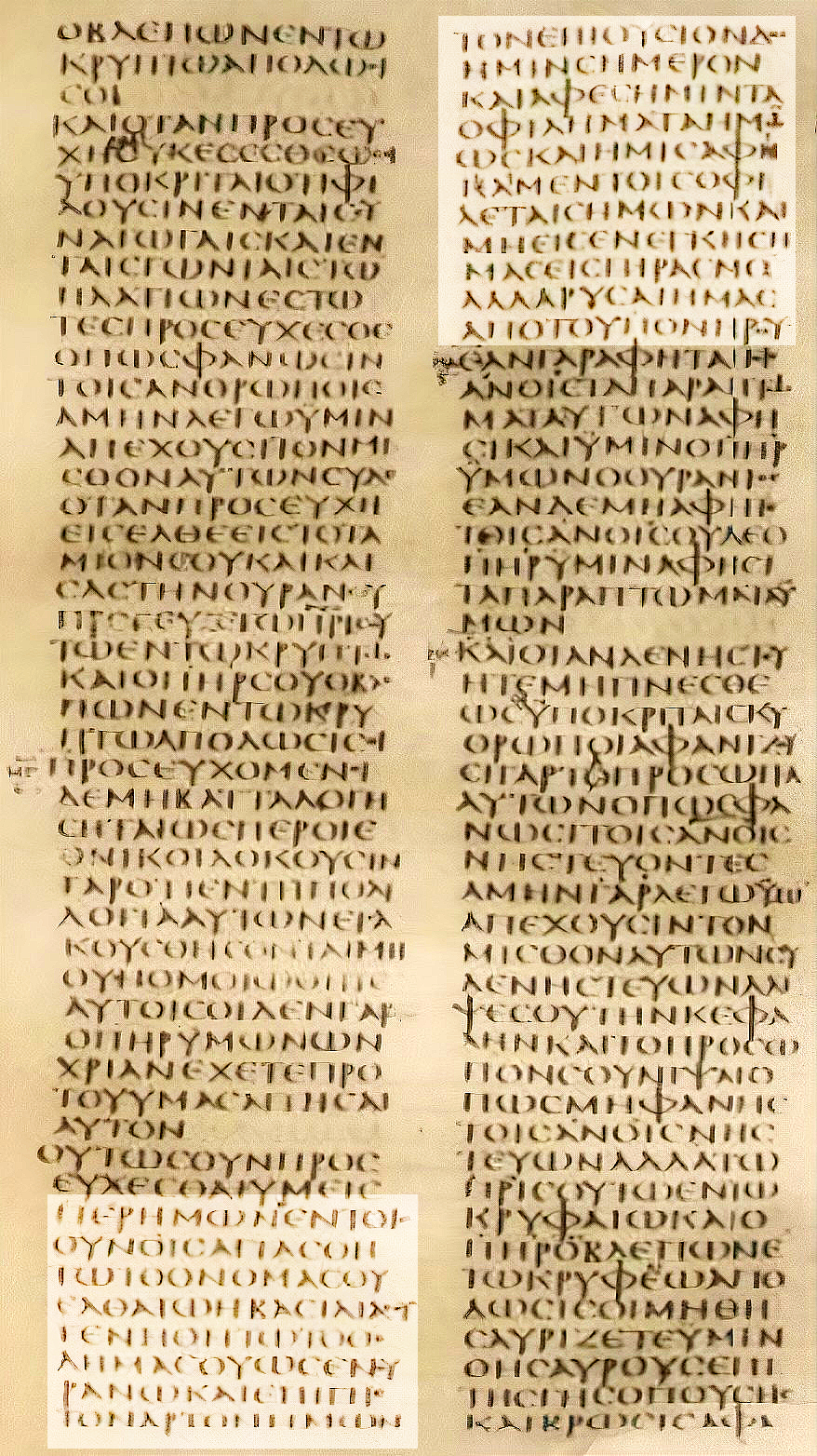
A leaf of the New Testament portion of Add MS 43725, showing the Lord's Prayer (Matthew 6) in Greek uncial script. The New Testament survives essentially complete within the British Library's holding. Credited by the British Library to itself as the digitising institution; no individual photographer is separately named on this file.
London, British Library · CC BY-SA 4.0| Artist | Three unnamed scribes (conventionally labelled Scribe A, Scribe B and Scribe D), production location disputed |
|---|---|
| Date | 4th century, probably c. 325-450 |
| Medium | Ink on vellum (predominantly calfskin, with some sheepskin), Greek uncial script |
| Dimensions | British Library portion (Add MS 43725): 346.5 folios, 694 pages, each leaf approximately 38.1 x 34.5 cm |
| Where it is now | The British Library, Londonlast confirmed |
| Inventory number | Add MS 43725 |
| Attribution | DisputedNo scribe, patron or place of production is named anywhere in the manuscript. Full note |
| Object type | Manuscript |
| Period | Late Antique / Early Christian, 4th-5th century |
| Cases | Disputed attribution |
| Inscriptions | Marginal and interlinear corrections by seven or more correctors working between the 4th and 12th centuries; the Eusebian canon tables accompany the Gospels; a scribal colophon appears after Esther |
| Owners on record | 10 links6 documented, 4 disputed |
| Sources | 13 cited |
About this record Last verified · 13 sources cited · Change log
On this page 9 sections
ContentsClose
Add MS 43725 is the largest surviving share, 347 leaves out of an original whole now split four ways, of a fourth-century Greek Bible that is one of the two oldest more or less complete Christian Bibles in existence, alongside the Vatican Library's Codex Vaticanus. It reached London in 1933 in a straightforward hard-currency sale: the Soviet government of Joseph Stalin, needing foreign capital, sold it to the British Museum for 100,000 pounds.
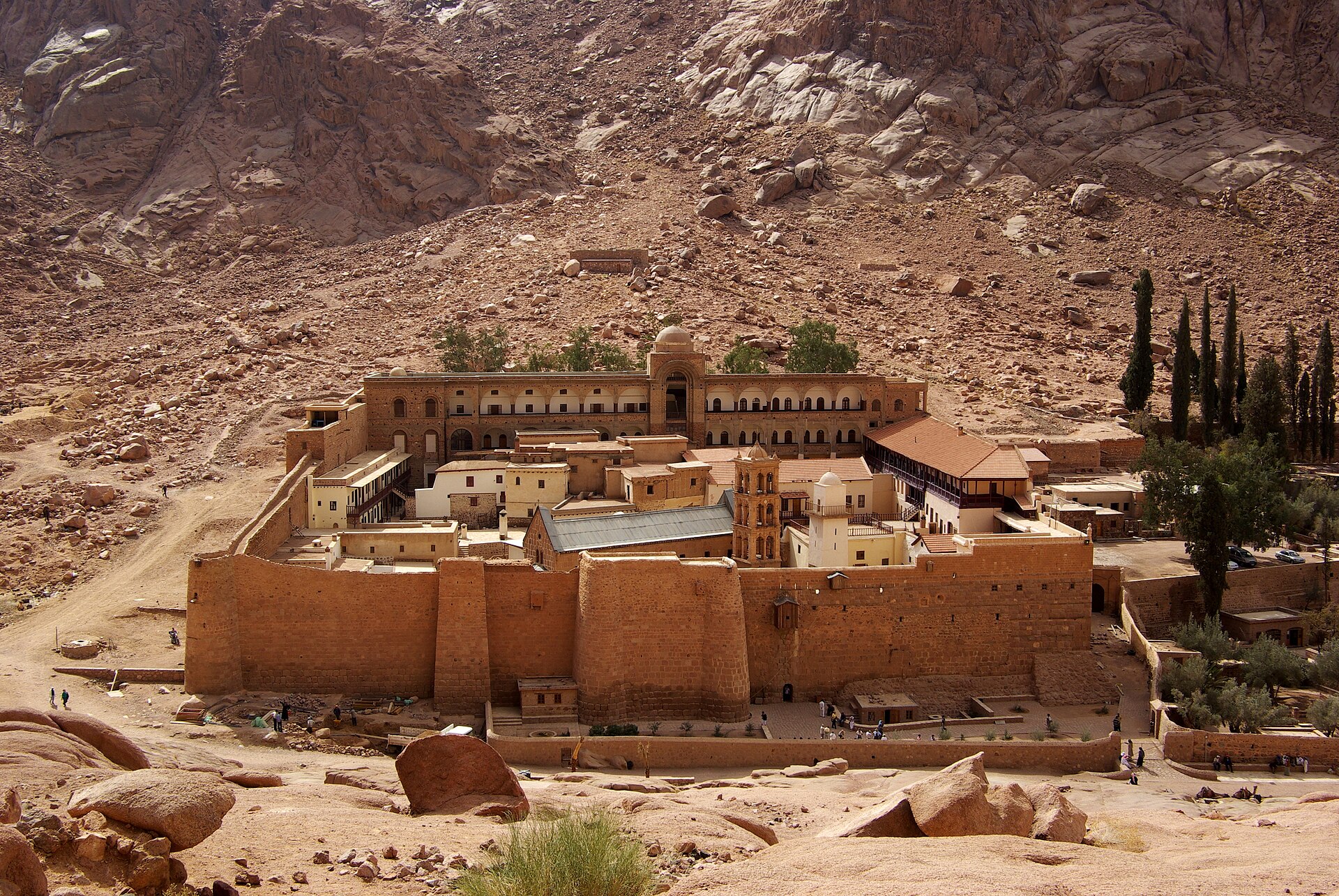
How it got to Russia in the first place is the part of the story that does not resolve cleanly. Constantin von Tischendorf removed 43 leaves from Saint Catherine's Monastery on Mount Sinai in 1844 and the great majority of what remained in 1859, the second time under a signed promise of return that was never honoured. The monastery has maintained ever since that the manuscript was never legitimately given away. Tischendorf's defenders, including a 2015 study drawing on Russian archives, argue the removal was ordinary scholarly practice for the period and that the theft charge is unfair.
No one has settled it. In 2005 the British Library and the monastery agreed to set the ownership question aside and digitise the whole codex jointly with Leipzig University Library and the National Library of Russia, the other two holders of fragments. The site went live in 2009. The dispute did not go with it.
Provenance
Each link is graded. Documented: a cited source supports it. Disputed: the identification is argued but not established. Unknown: no owner for that span, and the gap is not smoothed into a narrative. The grades in the glossary.
- c. 300 - c. 450Unknown scriptorium, place disputeddisputed
Dated on internal evidence to the 4th or possibly early 5th century (it postdates Eusebius's canon tables, c. 325). Its place of production is not recorded and has been argued three ways: Rome (F.J.A. Hort, from the chapter divisions of Acts matching Latin Vulgate manuscripts), Egypt (F.G. Kenyon, followed by Gardthausen, Ropes and Jellicoe, from the letterforms), and Caesarea Maritima (J. Rendel Harris, later Streeter, Milne and Skeat, from links to the library of Pamphilus). No consensus exists. This record adopts none of the three.2
- by 1761 - 1844Saint Catherine's Monastery, Mount Sinaidocumented
The earliest identified reference to the manuscript is the Italian naturalist Vitaliano Donati's 1761 travel journal, describing a Bible 'written in a round and handsome script' in the monastery library. How long it had already been there is not recorded.1
- 1844 - 1844Constantin von Tischendorf, then Leipzig University Librarydisputed
On his first visit (24 May-1 June 1844) Tischendorf was shown 129 Old Testament leaves and took 43 to Leipzig, where they remain. His own later account describes finding leaves in a basket destined for the ovens as kindling; the monastery has firmly denied this version. What is documented is only that 43 leaves left the monastery in his baggage; the circumstances of the monks' consent are contested.126
- 1859-02-04 - 1859-09Constantin von Tischendorf, under a signed promise of return to the monasterydisputed
Under the patronage of Tsar Alexander II, Tischendorf was shown the remaining 347 leaves on 4 February 1859. Russia's ambassador Prince Lobanov wrote on 10/22 September referring to an alleged monastic wish to donate the codex to the Tsar; the monastery's reply of 17/29 September made no explicit reference to donation. Tischendorf signed a receipt on 16/28 September promising return 'intact and as soon as it was requested.' It was not returned. The monastery's own published history states the Lobanov letter and Tischendorf's receipt 'explicitly stated that it was to be returned to the monastery, which remained its rightful owner.' A revisionist reading (Stanley Porter, using Russian archival material) holds the removal was ordinary period practice and the theft characterisation unfair. This record states both positions and resolves neither.12469
- 1862 - 1869Tsar Alexander II / Russian Ministry of Foreign Affairsdocumented
Tischendorf published his facsimile edition in 1862 and presented the manuscript to Alexander II on 10 November that year. It remained with the Ministry of Foreign Affairs until 1869.1
- 1869 - 1869Imperial Public Library, St Petersburgdisputed
Deeds of donation were signed 13/25 and 18/30 November 1869 by Archbishop Kallistratos of Sinai, during a dispute over the succession to the Sinai archbishopric. The monastery's own account, citing archival research conducted 2003-2006, describes 'tragic circumstances... under which the main body of the Codex Sinaiticus manuscript was not returned to the monastery's library, despite its strong wish to the contrary,' and maintains no legitimate transfer of ownership occurred. This record records the acts as historical fact and the monastery's rejection of their legitimacy as its standing, unresolved position.14
- 1869 - 1933Imperial Public Library, then the Soviet statedocumented
- 1933-12 - 1933-12-26The British Museum, Londondocumented
The Soviet government under Stalin sold the manuscript through the London booksellers Maggs Brothers for 100,000 pounds sterling (93,000 pounds from Treasury funds, 7,000 pounds from the Museum's own resources), needing foreign currency. Delivered to London 26 December 1933. A public subscription later returned 53,563 pounds of the Treasury's outlay by October 1935. A documented private sale between two states, brokered commercially, not a gift or a discovery.1
- 1933 - 1973The British Museum, Londondocumented
- 1973 - presentThe British Library, Londondocumented
Transferred with the British Museum's library departments on the creation of the British Library as a separate institution in 1973. This is the portion this record is anchored on.12
Technical evidence
| Attribution note | No scribe, patron or place of production is named anywhere in the manuscript. Palaeographic study by H.J.M. Milne and T.C. Skeat (1938) distinguished three hands, not the four Tischendorf originally claimed. Where the codex was actually written is a live scholarly dispute: F.J.A. Hort argued for Rome from the chapter divisions in Acts; F.G. Kenyon, followed by Gardthausen, Ropes and Jellicoe, argued for Egypt from the letterforms; J. Rendel Harris, later joined by B.H. Streeter, Milne and Skeat, argued for Caesarea Maritima on the strength of links to the library of Pamphilus. This record adopts none of the three and states all of them. |
|---|---|
| Support | Vellum, predominantly calfskin with some sheepskin (not antelope, as Tischendorf himself once speculated). An estimated 360 animal hides were used across the whole original manuscript.2 |
| Format and collation | Quires of eight leaves, cut from full sheets originally around 40 x 70 cm before folding and trimming.2 |
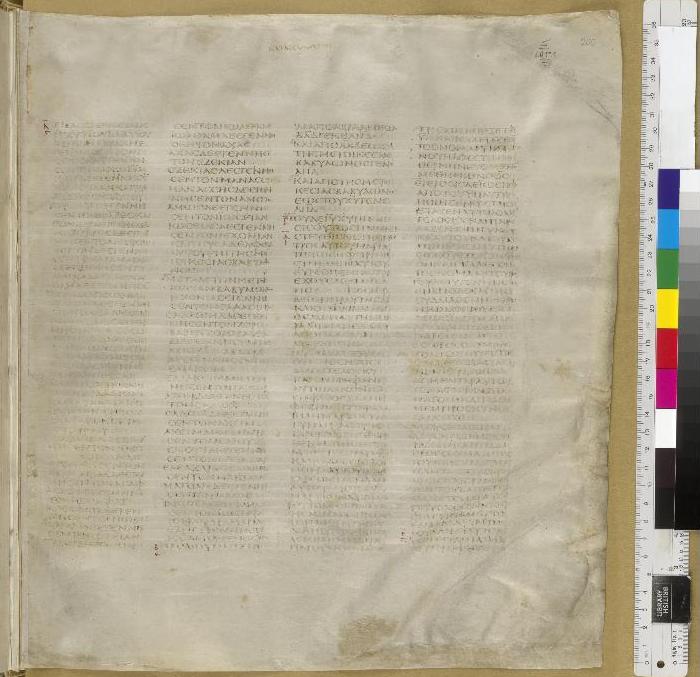
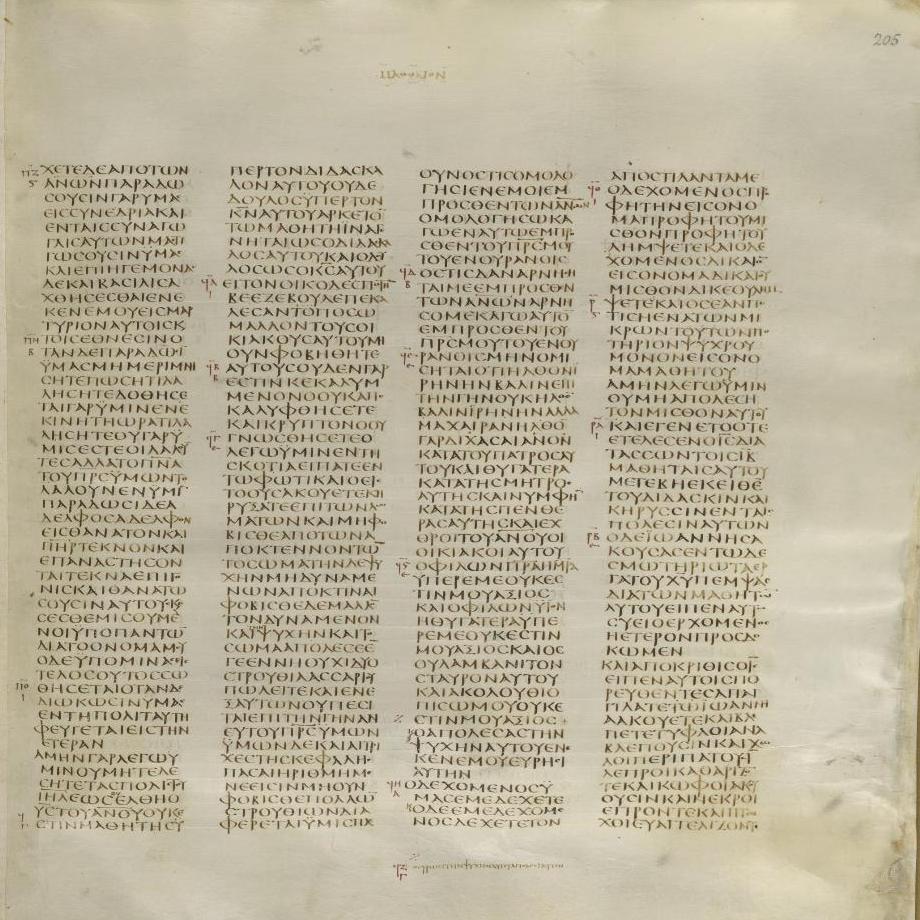
| Script | Greek uncial book hand, written continuously without word spacing (scriptio continua). Prose text runs in four columns per page; the poetical Old Testament books are set in two columns. 48 lines per column.2 |
| Scribal hands | Three scribes identified by H.J.M. Milne and T.C. Skeat (1938), conventionally Scribe A, Scribe B and Scribe D, correcting Tischendorf's original count of four. Scribe A wrote most of the historical and poetical Old Testament and nearly the whole New Testament; Scribe B wrote the Prophets and the Shepherd of Hermas; Scribe D wrote Tobit, Judith and portions of other books.2 |
| Corrections | Seven or more correctors worked on the text between the 4th and 12th centuries. Tischendorf counted roughly 14,800 corrections in the portion then held in Russia alone; modern survey of the whole reunited manuscript estimates approximately 23,000 corrections in total, among the highest of any surviving ancient manuscript.2 |
| Dating evidence | Cannot predate c. AD 325, since it already includes the Eusebian canon tables. Milne and Skeat read an internal cursive note as pointing to c. 360; more recent palaeographic opinion allows a date as late as the early 5th century.2 |
| British Library portion (Add MS 43725) | 346.5 folios, 694 pages, each approximately 38.1 x 34.5 cm. Comprises 199 Old Testament folios and 147.5 New Testament folios (a complete New Testament), plus the complete Epistle of Barnabas and part of the Shepherd of Hermas.12 |
Images
The record in full
Chapter 1What the British Library actually holds
Add MS 43725 is 346.5 folios, 694 pages, the largest single share of a manuscript that no longer exists as one object.
Add MS 43725 is 346.5 folios, 694 pages, the largest single share of a manuscript that no longer exists as one object. Each leaf measures roughly 38.1 by 34.5 centimetres. The portion contains 199 Old Testament folios (about half of the Septuagint text survives across the whole codex, spread over multiple holding libraries), 147.5 New Testament folios that amount to a complete New Testament, and, unusually for a Christian Bible, the complete Epistle of Barnabas and part of the Shepherd of Hermas bound in as scripture.
This is not the whole Codex Sinaiticus. It is the largest of four surviving pieces, and this record is about this piece: the leaves that sit in London, under this shelfmark, with a documented ownership history from 1933 onward and a genuinely disputed one before it.
Chapter 2Where it was made: three arguments, no verdict
The manuscript names no scribe, no patron and no city.
The manuscript names no scribe, no patron and no city. Scholars have argued for three different places of origin and none has won outright. F.J.A. Hort proposed Rome, pointing to chapter divisions in Acts that match Latin Vulgate manuscripts rather than the Greek tradition. F.G. Kenyon argued for Egypt, reading the letterforms as characteristically Egyptian, a position later held by Gardthausen, Ropes and Jellicoe. J. Rendel Harris proposed Caesarea Maritima instead, on the strength of apparent links to the library assembled there by the scholar Pamphilus in the third century, a case later strengthened by B.H. Streeter and then by T.C. Skeat and H.J.M. Milne, the two scholars who did the closest twentieth-century codicological study of the manuscript itself.
Nothing in this record resolves that argument, because nothing in the surviving evidence does. The honest position is that the codex was made somewhere in the Greek-speaking Christian world in the fourth or possibly early fifth century, and that exactly where remains an open scholarly question with three named camps and no consensus.
Chapter 3Dating the hand, not just the text
The manuscript cannot predate roughly AD 325, because it already contains the Eusebian canon tables, the cross-reference system for the Gospels devised after that date.
The manuscript cannot predate roughly AD 325, because it already contains the Eusebian canon tables, the cross-reference system for the Gospels devised after that date. Milne and Skeat, working from a cursive note they judged to be original to the production of the book, proposed a date around 360. More recent palaeographic assessment has been willing to allow a date as late as the early fifth century, which widens rather than narrows the fourth-century consensus most sources still quote.
Three hands did the work, not the four Tischendorf originally counted. Conventionally labelled Scribe A, Scribe B and Scribe D, they split the labour unevenly: Scribe A wrote most of the historical and poetical Old Testament books and nearly the entire New Testament; Scribe B took the Prophets and the Shepherd of Hermas; Scribe D wrote Tobit, Judith and portions of other books, and has been judged by later study the most careful speller of the three. None of the three is named. This is workshop production at scale, not a single author's project, and the record should say so plainly rather than let the singular noun 'Codex Sinaiticus' imply a lone hand.
Chapter 4The physical book: vellum, uncial, and 23,000 corrections
The codex is written on vellum, mostly calfskin with some sheepskin, not the antelope skin Tischendorf himself once theorised.
The codex is written on vellum, mostly calfskin with some sheepskin, not the antelope skin Tischendorf himself once theorised. An estimate for the whole original manuscript runs to about 360 animal hides, cut into quires of eight leaves from full sheets originally around 40 by 70 centimetres. The script is Greek uncial, written continuously without spaces between words (scriptio continua), set in four columns per page for prose text and two columns for the poetical Old Testament books, at 48 lines per column.
What makes the physical object unusual is not the writing but the rewriting. Seven or more correctors worked on the text between the fourth and twelfth centuries, layering emendations onto the original hands over eight hundred years of use. Tischendorf counted about 14,800 corrections in the portion that was then in Russia alone; more recent survey work across the whole reunited manuscript puts the total at roughly 23,000, which makes it one of the most heavily corrected manuscripts to survive from antiquity. A manuscript that was corrected for eight centuries was a working liturgical and scholarly text, not a relic kept sealed from use.
Chapter 5Custody at Sinai before Tischendorf
The earliest identified reference to the manuscript at Saint Catherine's Monastery is not a monastic record but a traveller's diary: the Italian naturalist Vitaliano Donati, visiting in 1761...
The earliest identified reference to the manuscript at Saint Catherine's Monastery is not a monastic record but a traveller's diary: the Italian naturalist Vitaliano Donati, visiting in 1761, described seeing a Bible in the monastery library 'written in a round and handsome script.' Nothing earlier has been identified. How long the codex had already been at Sinai by 1761, and by what route it got there from wherever it was written, is simply not recorded, and this record does not guess at it.
What is documented is the monastery itself: a Greek Orthodox foundation at the foot of Mount Sinai with a continuously operating library since Late Antiquity, one of the oldest working monastic libraries in the world, and the institution whose collection the codex was drawn from when Tischendorf arrived in the 1840s.
Chapter 61844: forty-three leaves to Leipzig
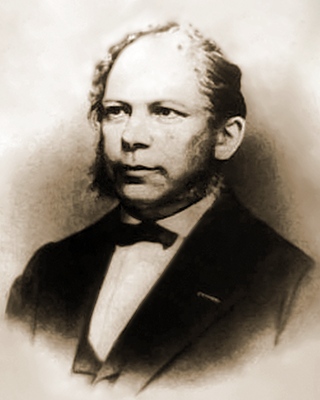
Constantin von Tischendorf, a German biblical scholar touring Near Eastern monasteries for manuscripts, visited Saint Catherine's between 24 May and 1 June 1844.
Constantin von Tischendorf, a German biblical scholar touring Near Eastern monasteries for manuscripts, visited Saint Catherine's between 24 May and 1 June 1844. He was shown 129 Old Testament leaves and left with 43 of them, which he published in 1846 as the Codex Friderico-Augustanus, named for his patron King Frederick Augustus II of Saxony, and deposited at the University of Leipzig, where they remain today under a separate shelfmark and are not part of this British Library record.
Tischendorf's own later account of this visit describes finding leaves in a basket of waste parchment destined to feed the monastery ovens as kindling, a story that dramatizes his rescue of the manuscript from destruction. The monastery has firmly denied that this ever happened. What can be stated without dispute is only the outcome: 43 leaves left Sinai in Tischendorf's baggage in 1844 and reached Leipzig. The circumstances under which the monks agreed to that, and whether Tischendorf's account of how he found them is accurate at all, is exactly the kind of gap this record records as a gap rather than resolving in either direction.
Chapter 71859: the loan that was never returned
Tischendorf returned to Sinai in 1859, this time under the patronage of the Russian Tsar Alexander II, whose government had an interest in Orthodox institutions in the Ottoman world.
Tischendorf returned to Sinai in 1859, this time under the patronage of the Russian Tsar Alexander II, whose government had an interest in Orthodox institutions in the Ottoman world. On 4 February the monastery's steward showed him the remaining bulk of the manuscript, 347 leaves, kept wrapped in a red cloth. Tischendorf's own account of the moment is direct: he wrote that he knew he 'held in my hand the most precious Biblical treasure in existence, a document whose age and importance exceeded that of all the manuscripts which I had ever examined,' and that he took care to conceal his excitement from the monks in the room.
The manuscript moved to the monastery's dependency in Cairo on 24 February, and Tischendorf had access to study and copy it there from March to May. On 16/28 September 1859 he signed a receipt promising the manuscript would be returned to Sinai 'intact and as soon as it was requested.' Russia's ambassador in Constantinople, Prince Lobanov, wrote separately on 10/22 September referring to an alleged wish by the monastic community to donate the codex to the Tsar. The monastery's own reply, dated 17/29 September, made no explicit reference to any donation. It was never returned.
Saint Catherine's Monastery's own published account of this history is unambiguous about which of these documents it considers binding: it states that both the Lobanov letter and Tischendorf's own signed receipt 'explicitly stated that it was to be returned to the monastery, which remained its rightful owner.' A different, revisionist reading has been argued by the scholar Stanley Porter, using material from Russian archives, that removing manuscripts by gift, loan or purchase was unremarkable scholarly practice in the period and that branding Tischendorf a thief is unfair to the norms of his own time. This record states both positions and adjudicates neither. What is not disputed is the plain fact that a promised return did not happen.
Chapter 8From Tischendorf's desk to the Tsar's library
Tischendorf published his facsimile edition of the manuscript in 1862 and presented the codex itself to Tsar Alexander II on 10 November that year.
Tischendorf published his facsimile edition of the manuscript in 1862 and presented the codex itself to Tsar Alexander II on 10 November that year. It sat with the Russian Ministry of Foreign Affairs for seven years before being moved to the Imperial Public Library in 1869. Formal deeds of donation, transferring the manuscript from the monastery to Russia on paper, were signed on 13/25 and 18/30 November 1869 by Archbishop Kallistratos of Sinai, during a period when the succession to the Sinai archbishopric was itself disputed.
Archival research carried out between 2003 and 2006 by scholars in Moscow and Athens, cited in the monastery's own account of its history, describes what it calls the tragic circumstances of the period, 'under which the main body of the Codex Sinaiticus manuscript was not returned to the monastery's library, despite its strong wish to the contrary.' The monastery's position, stated plainly and held to this day, is that no legitimate transfer of ownership ever took place, and that the 1869 acts were signed under conditions that do not constitute a free and valid donation. This record records the acts as historical fact and the monastery's rejection of their legitimacy as its standing, unresolved position. It resolves nothing further, because nothing further has been resolved.
Chapter 91933: a Soviet state sells a Bible for hard currency
The manuscript remained in Russian state custody, through the fall of the Empire and into the Soviet period, until 1933.
The manuscript remained in Russian state custody, through the fall of the Empire and into the Soviet period, until 1933. That year the Soviet government under Joseph Stalin, in urgent need of foreign currency, sold it to the British Museum through the London antiquarian booksellers Maggs Brothers. The price was 100,000 pounds sterling: 93,000 pounds from Treasury funds and 7,000 pounds from the Museum's own resources. The manuscript was delivered to London on 26 December 1933. A public subscription campaign subsequently repaid 53,563 pounds of the Treasury's outlay by October 1935.
This is worth stating for what it plainly was: a state in financial difficulty selling a cultural asset abroad for cash, a documented antecedent to the pattern of Soviet-era sales of Russian and Imperial cultural property that would recur through the twentieth century. It was not a gift, a rediscovery, or an act of scholarship. It was a transaction between two governments, brokered by a commercial dealer, conducted in the full glare of contemporary press coverage precisely because the sum and the object were both extraordinary.
100,000 pounds in 1933 is not a figure that means much on its own. By a composite historical price index (blending the Office for National Statistics series to 1988 with the Consumer Price Index thereafter), 100,000 pounds of 1933 purchasing power converts to approximately 9.29 million pounds in 2026 terms. That scale, not the bare historical number, is the right way to read what Stalin's government was raising and what the British state and public together found to meet it, in the middle of the Depression.
Chapter 101973: from the British Museum to the British Library
The manuscript sat with the British Museum's library departments until those departments were spun off in 1973 to form the British Library as a separate institution.
The manuscript sat with the British Museum's library departments until those departments were spun off in 1973 to form the British Library as a separate institution. Add MS 43725 transferred with them and has remained at the British Library since, now displayed and studied as one of the institution's central biblical and literary holdings alongside Magna Carta and the Lindisfarne Gospels.
Chapter 111975: a sealed room at Sinai
The manuscript was not finished producing history.
The manuscript was not finished producing history. On 25-26 May 1975, during restoration work following a fire, monks at Saint Catherine's discovered a sealed room in the north wall tower that had been used for manuscript storage in earlier centuries. When the monastery's library was moved to a new location in the early eighteenth century, damaged leaves and fragments too poor to be worth relocating had apparently been left behind in that room; at some later point an earthquake brought down the floor above it, burying the room and sealing it from view for roughly two and a half centuries.
Archimandrite Sophronios led the recovery. The room held some 1,148 manuscripts across multiple languages (Greek predominating, with Arabic, Syriac, Slavonic, Georgian, Hebrew, Latin and Ethiopic material also present), of which 305 were found complete. Among them were twelve leaves and roughly twenty-four fragments of Codex Sinaiticus itself, unknown to scholarship until that moment. These 'New Finds' leaves remain at the monastery; they are not part of the British Library's holding and this record does not describe them as such. Their existence is, however, the strongest possible demonstration that the codex's history was not finished being written when the last leaf reached London in 1933, and that further undocumented material could in principle still exist within the monastery's own collection.
Chapter 12Four institutions, one manuscript, one unresolved question
The codex today exists in four physically separate holdings, and keeping them straight matters more here than almost anywhere else on this site.
The codex today exists in four physically separate holdings, and keeping them straight matters more here than almost anywhere else on this site. The British Library holds 347 leaves (694 pages), the portion this record describes, acquired in the 1933 Soviet sale. Leipzig University Library holds the 43 leaves Tischendorf removed in 1844, entirely separate from the 1933 transaction. The National Library of Russia in St Petersburg holds fragments of six leaves, removed independently by the Russian churchman and manuscript collector Archimandrite Porphyry Uspensky and never part of the material sold to the British Museum. Saint Catherine's Monastery itself retains original leaves that never left Sinai at all, plus the twelve leaves and roughly two dozen fragments recovered in the 1975 discovery.
No fact, image or caption in this record should be read as describing any of those other three portions. Where this record says British Library or Add MS 43725, it means specifically the 347 leaves in London.
Chapter 132005-2009: digitising a manuscript without settling who owns it
In March 2005 the four holding institutions, the British Library, Leipzig University Library, the National Library of Russia and Saint Catherine's Monastery, signed a partnership agreement to...
In March 2005 the four holding institutions, the British Library, Leipzig University Library, the National Library of Russia and Saint Catherine's Monastery, signed a partnership agreement to conserve, digitise, transcribe and publish the entire manuscript online as a single virtually reunited object, the Codex Sinaiticus Project. The agreement deliberately did not require any party to concede the ownership question. Archbishop Damianos of Sinai, asked at the time about the monastery's underlying claim, put the position precisely: 'We want to discover the truth, even if it turns out not to support our position. But if at the end of the research there is no firm evidence either way, then we reserve the right to maintain our claim.'
High-resolution images of every surviving leaf and fragment, from all four locations, went live together for the first time on 6 July 2009, accompanied by an exhibition and academic conference at the British Library. It is a genuine act of scholarly cooperation between parties who disagree about who legally owns the underlying object, and it has held for two decades without either side abandoning its position. The digitisation resolved the manuscript's text. It did not, and was never meant to, resolve its custody.
Chapter 14What remains unresolved
Saint Catherine's Monastery's claim has not been withdrawn, tested in any court, or formally answered by the British Library, Leipzig or the National Library of Russia beyond the 2005 agreement to...
Saint Catherine's Monastery's claim has not been withdrawn, tested in any court, or formally answered by the British Library, Leipzig or the National Library of Russia beyond the 2005 agreement to disagree and cooperate anyway. No restitution process is under way for any of the four portions as of this record's last verification date. The manuscript, or rather its four surviving pieces, sits in a state most disputed cultural property does not reach: fully documented, fully digitised, fully accessible to any reader anywhere, and still without an agreed answer to the question of who is entitled to hold the physical leaves.
The artist
Unnamed scriptorium, three identified scribal hands (Scribe A, Scribe B, Scribe D)
Nobody who made this book is named in it. There is no colophon naming a scribe, no dedication naming a patron, and no subscription naming a place. Everything known about the people who produced it comes from the physical evidence of the pages themselves, studied closely enough to separate one hand from another, one corrector from the next, across roughly eight centuries of use. That is the honest starting point for any claim made about its makers, including every one that follows.
Related works
| Work | Relation | Where it is |
|---|---|---|
| Codex Vaticanus Unknown scriptorium, 4th century | The only other manuscript of comparable age and completeness Together with Codex Sinaiticus, the two anchor manuscripts of the Alexandrian text-type used as the base text for nearly every modern critical edition of the Greek New Testament. | Vatican Apostolic Library, Vatican City |
| Codex Friderico-Augustanus (the Leipzig leaves) Same production as the British Library portion | The 43 leaves Tischendorf removed from Saint Catherine's Monastery in 1844 A separate share of the same original manuscript, transferred and published a full 15 years before the 1859 removal and unrelated to the 1933 sale. | Leipzig University Library, Germany |
| Fragments of six leaves Same production as the British Library portion | A small, separately removed share of the same manuscript Removed independently by Archimandrite Porphyry Uspensky, distinct in origin from both the 1859 Tischendorf removal and the 1933 Soviet sale to the British Museum. | National Library of Russia, St Petersburg |
| The Sinai leaves and the 1975 New Finds Same production as the British Library portion | Leaves that never left the monastery, plus material recovered from a sealed room in 1975 Twelve leaves and roughly twenty-four fragments of Codex Sinaiticus were among about 1,148 manuscripts found in a sealed storage room discovered on 25-26 May 1975. | Saint Catherine's Monastery, Mount Sinai, Egypt |
| Codex Alexandrinus Unknown scriptorium, 5th century | Another great early uncial Bible held by the same institution A useful comparison for scale, script and the history of the British Museum and British Library's collecting of early biblical manuscripts, though later in date and with a separate acquisition history. | The British Library, London (Royal MS 1 D V-VIII) |
Open questions
- Did the Sinai community in September 1859 intend an outright gift of the manuscript to Tsar Alexander II, or only a loan for study and copying? The Lobanov letter alleges a wish to donate; the monastery's own reply made no such statement, and Tischendorf's own signed receipt promised the manuscript's return.
- Is Tischendorf's account of finding leaves in a basket destined for the monastery ovens in 1844 literally true, or a dramatized version of events the monastery has always firmly denied?
- How directly did Russian diplomatic pressure connected to the 1866-1869 dispute over the succession to the Sinai archbishopric influence the monastery's decision to sign the 1869 donation acts?
- Could further undocumented portions of the codex still exist within Saint Catherine's Monastery's own collection, given that the 1975 discovery was itself unplanned and followed a building collapse no one had anticipated?
- Will the ownership question that the four holding institutions deliberately set aside in the 2005 partnership agreement ever be formally addressed, or does it remain permanently suspended by mutual, unspoken consent?
- Did any portion, even indirectly, of the 100,000 pounds the British Museum paid the Soviet government in 1933 ever reach Saint Catherine's Monastery, the institution the manuscript is documented to have physically originated from?
Questions about this object
What is Codex Sinaiticus?
Codex Sinaiticus is a manuscript, dated 4th century, probably c. 325-450. Medium: Ink on vellum (predominantly calfskin, with some sheepskin), Greek uncial script.
Who made Codex Sinaiticus, and is the attribution settled?
The attribution to Three unnamed scribes (conventionally labelled Scribe A, Scribe B and Scribe D), production location disputed is recorded here as disputed. No scribe, patron or place of production is named anywhere in the manuscript. Palaeographic study by H.J.M. Milne and T.C. Skeat (1938) distinguished three hands, not the four Tischendorf originally claimed. Where the codex was actually written is a live scholarly dispute: F.J.A. Hort argued for Rome from the chapter divisions in Acts; F.G. Kenyon, followed by Gardthausen, Ropes and Jellicoe, argued for Egypt from the letterforms; J. Rendel Harris, later joined by B.H. Streeter, Milne and Skeat, argued for Caesarea Maritima on the strength of links to the library of Pamphilus. This record adopts none of the three and states all of them.
Where is Codex Sinaiticus now?
The British Library, London. Inventory number Add MS 43725. Last confirmed 31 August 2026. Purchased by the British Museum from the Soviet government of the USSR through the London booksellers Maggs Brothers in 1933; transferred to the British Library on its creation from the British Museum's library departments in 1973.
What is still unknown about Codex Sinaiticus?
Did the Sinai community in September 1859 intend an outright gift of the manuscript to Tsar Alexander II, or only a loan for study and copying? The Lobanov letter alleges a wish to donate; the monastery's own reply made no such statement, and Tischendorf's own signed receipt promised the manuscript's return.
Sources
- 1Codex Sinaiticus Project (British Library, Leipzig University Library, National Library of Russia and Saint Catherine's Monastery), 'History'. codexsinaiticus.org/en/...
- 2Wikipedia, 'Codex Sinaiticus', consolidating the codicological, palaeographic and acquisition literature. en.wikipedia.org/wiki/...
- 3Saint Catherine's Monastery, 'New Finds', on the 1975 discovery of the sealed storage room and its contents. sinaimonastery.com/index.php/...
- 4Saint Catherine's Monastery (Saint Catherine Foundation, via Mused), 'The Modern History of the Codex Sinaiticus', the monastery's own published account of the 1844 and 1859 removals and its ownership position. mused.com/stories/...
- 5The Art Newspaper, 'Sinai monks in historic agreement with British Library over Codex Sinaiticus' (2005), including the Archbishop Damianos quotation. theartnewspaper.com/2005/...
- 6Biblical Archaeology Society, 'Tischendorf on Trial for Removing Codex Sinaiticus, the Oldest New Testament', covering the 1844 and 1859 visits and Stanley Porter's revisionist assessment. biblicalarchaeology.org/daily/...
- 7University of Birmingham, 'The world's oldest bible reunited online' (2009), on the four-partner Codex Sinaiticus Project and its July 2009 launch. birmingham.ac.uk/news-archive/...
- 8officialdata.org, UK Inflation Calculator, for the 1933-to-2026 purchasing-power conversion of GBP 100,000 (composite historical price index to 1988, CPI thereafter). officialdata.org/uk/...
- 9The Bart Ehrman Blog, 'The Discovery of Codex Sinaiticus: One of the Most Important Manuscripts of the New Testament', for Tischendorf's own quoted account of the February 1859 discovery. ehrmanblog.org/the-discovery-of-codex-sinaiticus-one-of-t...
- 10Wikimedia Commons, File:Codex Sinaiticus, GA 01.jpg, file description page (licence and credit metadata). commons.wikimedia.org/wiki/...
- 11Wikimedia Commons, File:Codex Sinaiticus Matthew 1,1-2,5.JPG, file description page (licence and credit metadata). commons.wikimedia.org/wiki/...
- 12Wikimedia Commons, File:Tischendorf um 1870.jpg, file description page (licence and credit metadata). commons.wikimedia.org/wiki/...
- 13Wikimedia Commons, File:Katharinenkloster Sinai BW 2.jpg, file description page (licence and credit metadata). commons.wikimedia.org/wiki/...


Last verified · Published
Change log
31 August 2026 - Record created at the house standard: researched narrative, technical evidence, maker dossier, graded provenance chain, prices with hammer and premium separated, related works, open questions and sources.