The Diamond Sutra
Wang Jie, donor; an unnamed block-cutter and printer · 11 May 868 (the ninth year of the Xiantong reign, Tang dynasty)
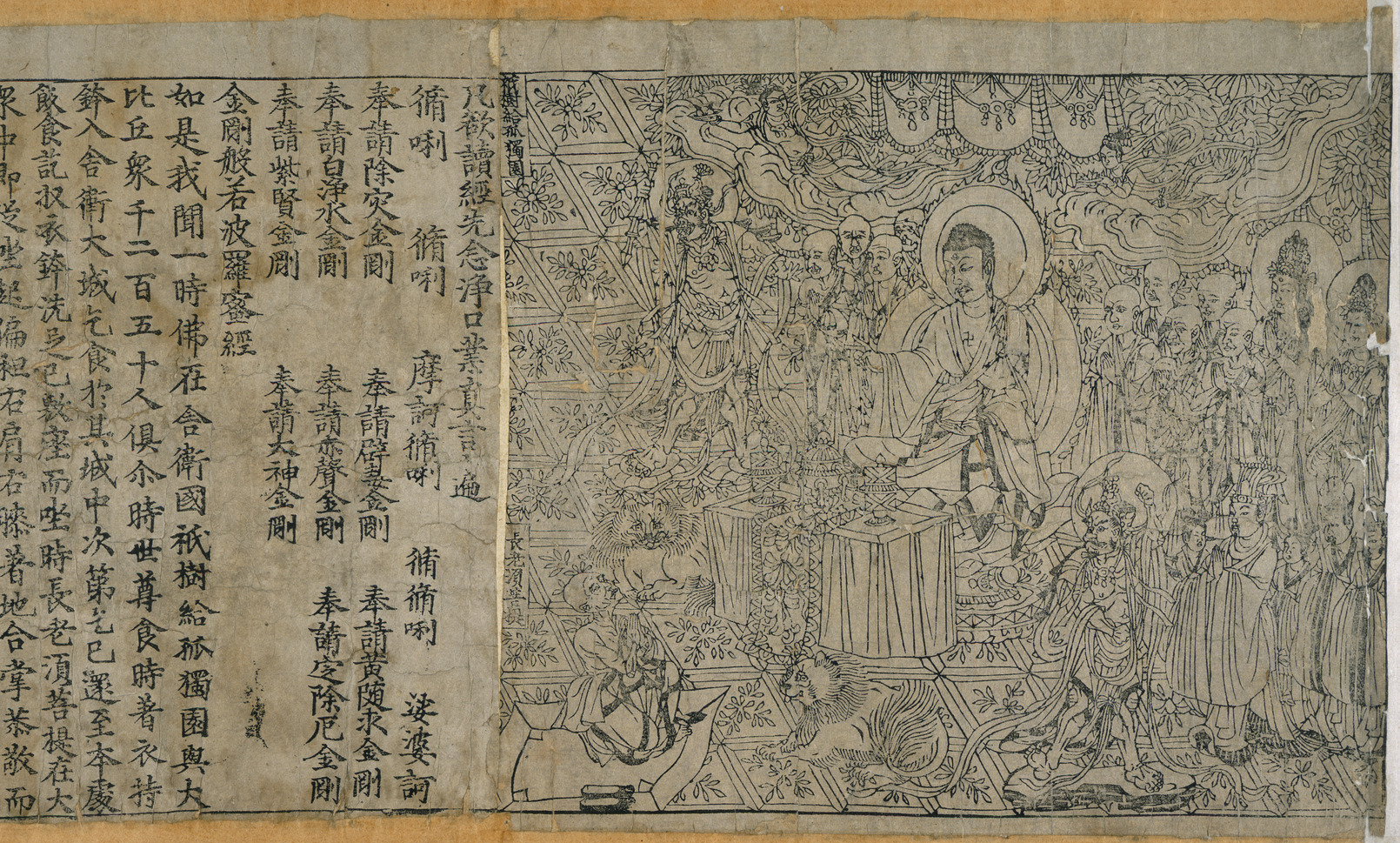
The record subject. The British Library's own digitisation of Or.8210/P.2, released CC0, showing the printed frontispiece of the Buddha preaching to Subhuti and the opening of the text. Dated 11 May 868.
| Artist | Wang Jie, donor; an unnamed block-cutter and printer |
|---|---|
| Date | 11 May 868 (the ninth year of the Xiantong reign, Tang dynasty) |
| Medium | Woodblock-printed ink on seven sheets of yellow-stained paper, pasted end to end into a scroll |
| Dimensions | Approximately 5 m long (given as over 16 ft by the British Library); seven printed panels including the frontispiece |
| Where it is now | The British Library, Londonlast confirmed 4 August 2026 |
| Inventory number | Or.8210/P.2 |
| Attribution | AcceptedThe scroll dates itself. Full note |
| Object type | Manuscript |
| Period | Chinese, Tang dynasty |
| Inscriptions | Colophon at the inner end, translated by the British Library as: Reverently made for universal free distribution by Wang Jie on behalf of his two parents on the 13th of the 4th moon of the 9th year of Xiantong. Other published renderings give the 15th day of the fourth month. Both convert to 11 May 868. |
| Owners on record | 6 links5 documented, 1 disputed |
| Sources | 7 cited |
About this record Last verified 21 August 2026 · 7 sources cited · Change log
On this page 10 sections
ContentsClose
A woodblock-printed scroll about five metres long, made of seven sheets of yellow-stained paper pasted end to end, carrying the Chinese text of the Diamond Sutra behind a printed frontispiece of the Buddha preaching. Its colophon dates it to 11 May 868 and names the man who paid for it, Wang Jie, who commissioned it for free distribution on behalf of his parents. It is the earliest complete survival of a dated printed book.
It was sealed into a side chamber of the Mogao caves near Dunhuang around the beginning of the eleventh century and found by a Daoist caretaker named Wang Yuanlu in 1900. In 1907 it passed to Aurel Stein in a bulk transaction covering roughly ten thousand items, for which about 130 pounds changed hands as a donation towards restoring the temple. No price was ever struck for this scroll on its own. It has been in London ever since, and it has never been offered for sale.
The chain of custody is not in doubt. What is contested is whether that transaction was a sale at all, whether the man who took the money had authority to convey title, and what a digital surrogate is worth as an answer to a claim - a question sharpened when the cyber-attack of October 2023 took the British Library's own online collections, including its Dunhuang portal, out of service.
Provenance
Each link is graded. Documented: a cited source supports it. Disputed: the identification is argued but not established. Unknown: no owner for that span, and the gap is not smoothed into a narrative. The grades in the glossary.
- 868 - ca. 1000Wang Jie, donor; then in circulation and at Dunhuangdocumented
Commissioned by Wang Jie for universal free distribution on behalf of his two parents and dated 11 May 868 in its own colophon. Possibly printed in Sichuan. How and when it reached Dunhuang is not recorded.15
- ca. 1000 - 1900Sealed in Cave 17, Mogao caves, Dunhuangdocumented
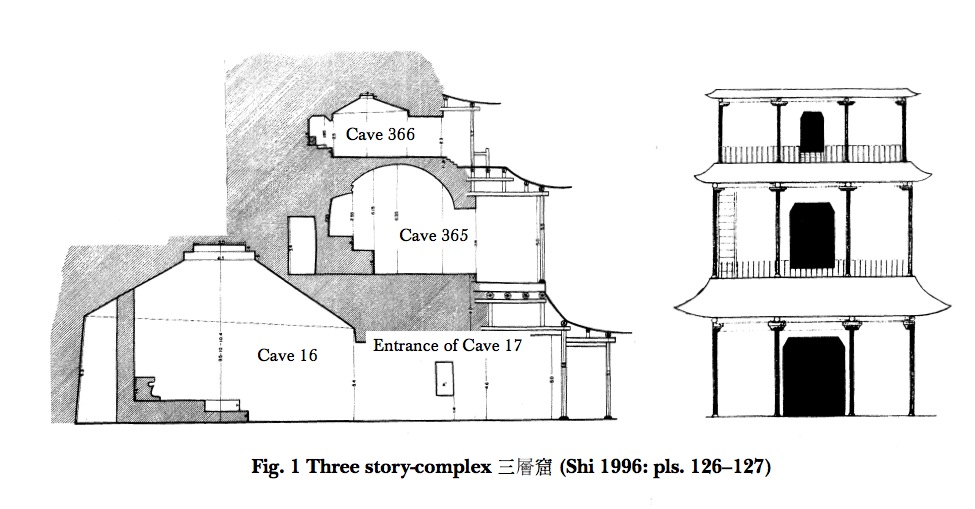
Walled into a side chamber off the corridor of Cave 16 with tens of thousands of other manuscripts, paintings and textiles, and plastered over. The reason for the sealing is disputed. No owner is recorded for roughly nine hundred years.45
- 1900 - 1907Wang Yuanlu, self-appointed caretaker of the Mogao cavesdocumented
Opened the chamber on 25 June 1900. Took specimens to the Gansu provincial authorities hoping to raise funds; the response was an order to lock the material back in the cave, with no money and no staff. He held the cave and its contents in fact, without title in law.45
- 1907 - 1907Aurel Stein, acquiring at Dunhuang for the British Museum and the Government of Indiadisputed
Obtained in a bulk transaction between 21 May and 6 June 1907, roughly ten thousand items for about 130 pounds framed as a donation towards temple restoration. Graded disputed: the transfer itself is fully documented, but whether it was a valid sale is contested. Chinese scholarship treats it as theft in the form of a purchase, on the ground that Wang Yuanlu had no authority to convey title; a revisionist reading treats Wang as a rational actor whose approaches to the state had been ignored. This scroll was not itemised or separately priced.1457
- 1907 - 1973The British Museum, Londondocumented
Held by the British Museum from the arrival of the Stein Dunhuang collection until the library departments were separated in 1973. Backed and mounted under early twentieth-century museum practice, a treatment the modern conservation campaign partly reversed. Nothing about this sixty-six-year period is contested; the dispute attaches to the 1907 acquisition, not to the museum's custody.125
- 1973 - presentThe British Library, Londondocumented
Passed with the British Museum library departments to the newly constituted British Library in 1973. Shelfmark Or.8210/P.2. Conserved in a modern campaign led by Mark Barnard. Digitised and published free; that access has been degraded since the cyber-attack of October 2023.126
Prices realised
| Date | Sale | Estimate | Result | Note |
|---|---|---|---|---|
| 1907-05 | Payment to Wang Yuanlu, Taoist priest-custodian of the Mogao Caves library cave (Cave 17), Dunhuang | Stein records that he was privately prepared to offer up to 40 silver horse-shoes, about Rs 5,000, and was resolved to double even that if needed, to secure the whole hidden library. Wang would not part with the whole collection, so the sum actually paid for this consignment was one-tenth of that ceiling. | Hammer Four horse-shoe-shaped silver ingots With premium None; a private exchange with the cave's custodian, not an auction, so no buyer's premium applies Silver (four ingots), valued by Stein at about Rs 500 (Indian rupees) in his own account; no source consulted states a price in sterling at the time | This is a payment for a large body of material, not a price for the Diamond Sutra scroll (Or.8210/P.2) by itself. In his own account of the 1907 expedition, Stein records that four horse-shoe-shaped silver ingots, which he valued at about Rs 500, secured fifty bundles of Chinese text rolls, five bundles of Tibetan texts, and everything he had already set aside from the 'miscellaneous' bundles examined earlier in the same visit: several thousand items in total, among which the Diamond Sutra was one selection. No source consulted prices the Diamond Sutra individually. A rounder figure of about GBP 130 for some 10,000 scrolls from this 1907 visit is widely repeated in secondary literature; that figure does not appear in Stein's own contemporaneous narrative, which states the sum in Indian rupees rather than sterling, and it is not established here whether it also folds in the roughly 230 further bundles that Stein's secretary, Jiang Xiaowan, purchased from Wang Yuanlu in a separate visit that September. |
Hammer is the price at which the bidding stopped; with premium adds the fee the house charges the buyer on top. Hammer price and buyer's premium in the glossary.
Technical evidence
| Attribution note | The scroll dates itself. Its colophon names Wang Jie as the man who paid for it and gives the day of the ninth year of the Xiantong reign, which converts to 11 May 868. The block-cutter, the printer and the designer of the frontispiece are not named and are not recoverable. The British Library's own formula is deliberately careful - the earliest complete survival of a dated printed book - and every word of it is doing work, because undated printed material survives from earlier, and dated printing survives in fragments. |
|---|---|
| Structure | Seven sheets of yellow-stained paper, each printed from a carved wooden block, pasted end to end into a continuous scroll. Six sheets of text plus a printed frontispiece.35 |
| Length | Approximately 5 m. The British Library's own caption gives over 16 ft.15 |
| Date | 11 May 868, from the colophon: the ninth year of the Xiantong reign of the Tang dynasty. The day is given as the 13th of the fourth moon in the British Library's translation and as the 15th in other published renderings; the conversion to 11 May is not disputed.15 |
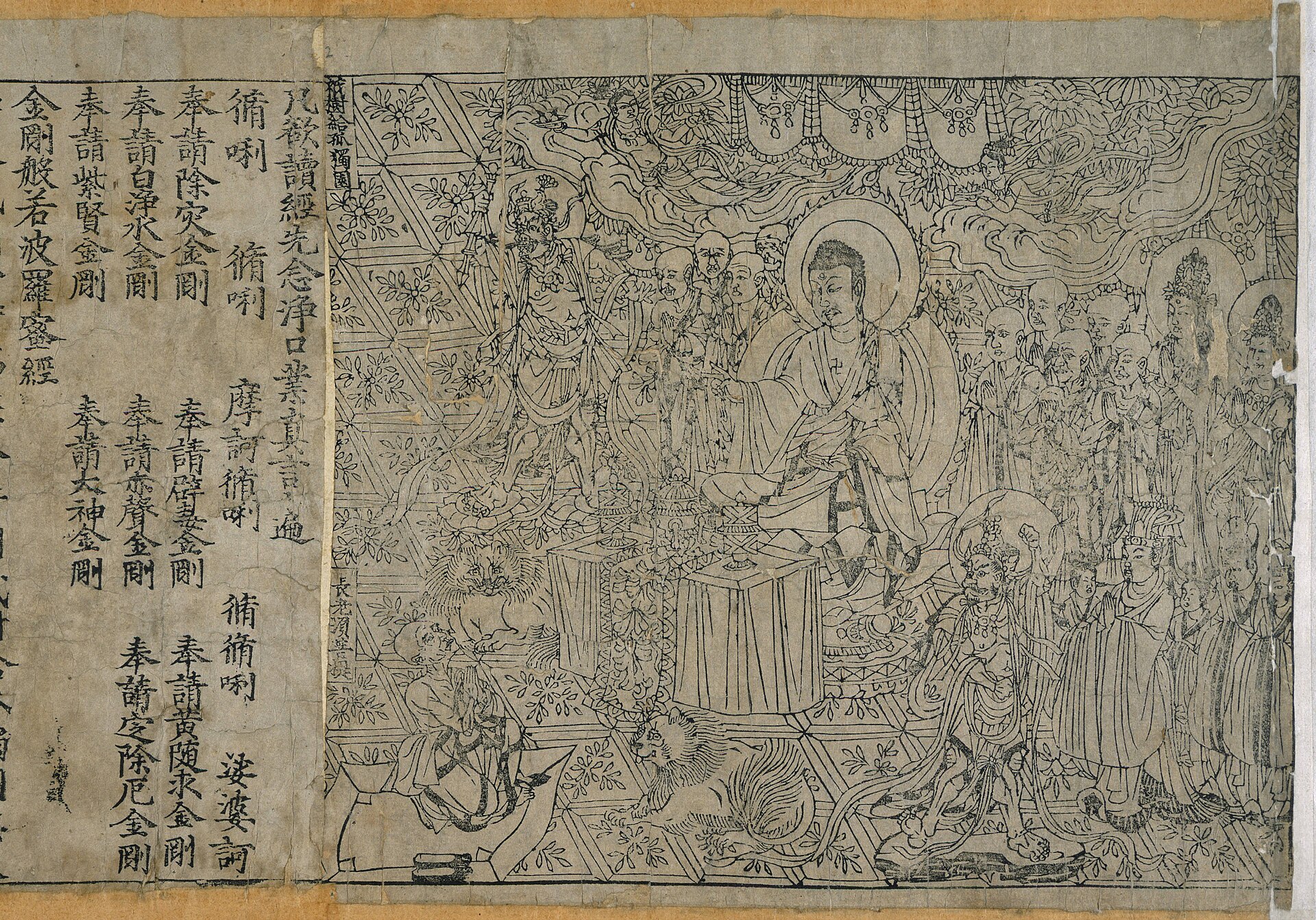
| Frontispiece | A printed illustration of the Buddha Sakyamuni preaching to the elder Subhuti, with attendant monks and guardian figures. Printed from a block, not drawn by hand.15 |
| Shelfmark | Or.8210/P.2. The Or.8210 series is the Stein Dunhuang collection at the British Library; the P prefix marks printed items within it.15 |
| Findspot | Cave 17, the library cave, opening off the corridor of Cave 16 at the Mogao caves near Dunhuang, Gansu. Sealed around the beginning of the eleventh century and opened on 25 June 1900.45 |
| Conservation | Backed and mounted under early twentieth-century British Museum practice; conserved again in a modern campaign led by Mark Barnard, reported as seven years to 2010 and as a decade-long project completed January 2013. The 2010 book by Wood and Barnard cannot be the source for the 2013 completion date, which comes from the later reporting.25 |
| Rights status of the photograph | The British Library has released its own digitisation of the scroll under CC0 through Wikimedia Commons. Verified per file against extmetadata LicenseShortName on 4 August 2026.1 |
Images
The record in full
Chapter 1What the object physically is
Seven sheets of paper, stained yellow, each printed from a carved wooden block and then pasted end to end to make a continuous roll approximately five metres long.
Seven sheets of paper, stained yellow, each printed from a carved wooden block and then pasted end to end to make a continuous roll approximately five metres long. Six carry the text of the sutra in Chinese; the first carries a printed illustration.
The frontispiece shows the Buddha Sakyamuni seated and preaching to the elder Subhuti, who kneels before him, surrounded by monks, guardian figures and attendants. It is a picture printed from a block, which is a considerable thing in 868: the image is not an afterthought or a hand-added decoration but part of the same industrial act as the text, cut, inked and pulled in the same way.
The scroll form matters as much as the printing. This is not a book in the sense of leaves bound at a spine. It is a roll, read by unwinding, and the colophon sits at the inner end, which is to say at the place a reader reaches last, after the whole text has passed through their hands.
Chapter 2What the text says, and why printing it was the point
The Diamond Sutra is a short work of the Perfection of Wisdom literature, in the Chinese translation associated with Kumarajiva.
The Diamond Sutra is a short work of the Perfection of Wisdom literature, in the Chinese translation associated with Kumarajiva. Its argument is that all appearances are provisional, that the categories a mind uses to grasp reality are themselves empty, and that clinging to any of them, including to the idea of merit, is the error.
It also does something more immediately relevant to this object: it repeatedly declares that the merit generated by copying and transmitting the text exceeds the merit of material offerings. That instruction is why the sutra survives in such quantity from Dunhuang, and it is why this particular copy exists in this particular form.
Wang Jie did not print one copy for himself. The colophon says the scroll was made for universal free distribution, on behalf of his two parents. Woodblock printing is here not a commercial technology looking for an application; it is a devotional technology, and it is doing exactly what the text told the donor to do. The world's earliest dated printed book is a religious giveaway, and the fact that mass reproduction was put to work for merit rather than for profit is among the most interesting things about it.
Chapter 3The claim to be first, stated precisely
The British Library's phrasing is the earliest complete survival of a dated printed book, and every qualifier is load-bearing.Printing on paper is older.
The British Library's phrasing is the earliest complete survival of a dated printed book, and every qualifier is load-bearing.
Printing on paper is older. The Korean Pure Light Dharani Sutra found in the Seokgatap pagoda at Bulguksa is generally placed in the first half of the eighth century but carries no date. The Japanese Hyakumanto darani, the million printed charms commissioned by Empress Shotoku, are datable by court record to around 770 but are single sheets rather than books, and their dating rests on the record rather than on the objects. Fragments of dated Chinese printing survive from before 868.
What no other object supplies is all four conditions at once: printed, a book, complete, and dated on itself. That is a narrower claim than the popular one, the world's oldest printed book, and this record uses the narrow version, because the popular version is what starts the arguments between the Chinese, Korean and Japanese claims and none of those arguments are about this scroll.
Chapter 4The cave it came out of
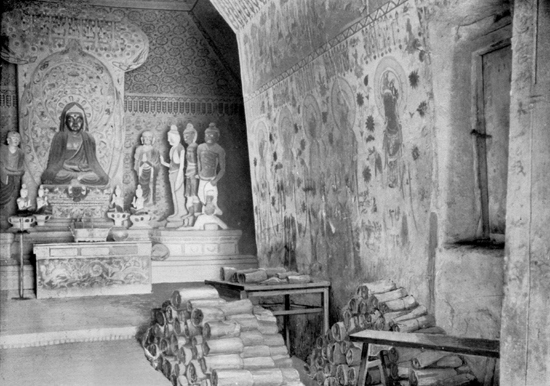
Cave 17 at Mogao, near Dunhuang in Gansu, is a small side chamber opening off the corridor of the larger Cave 16.
Cave 17 at Mogao, near Dunhuang in Gansu, is a small side chamber opening off the corridor of the larger Cave 16. At some point around the beginning of the eleventh century it was filled with manuscripts, paintings and textiles, tens of thousands of items, then walled up and plastered over. Why it was sealed is still argued: a response to an approaching threat, or the orderly disposal of a monastic library's superseded and damaged copies.
It stayed shut for roughly nine hundred years. On 25 June 1900 Wang Yuanlu, an itinerant Daoist priest who had appointed himself caretaker of the derelict Buddhist cave complex and was raising money to restore it, noticed a crack in the plastered corridor and opened the chamber.
What he did next is the part usually left out. He took specimens to the Gansu provincial authorities in the hope of selling them, or at least of proving that the caves were worth funding. The late-Qing administration did not act on the find. The governor-general's response was an order that the documents be locked up in the cave to prevent theft, with no money and no staff attached. That is the position Wang was in when Stein arrived.
Chapter 5The transaction of 1907, and the price that does not exist
Marc Aurel Stein, a Hungarian-born archaeologist working in the service of British India, reached Dunhuang in 1907.
Marc Aurel Stein, a Hungarian-born archaeologist working in the service of British India, reached Dunhuang in 1907. His first transaction with Wang Yuanlu ran between 21 May and 6 June. He obtained roughly ten thousand items for the equivalent of about 130 pounds sterling, framed as a donation towards the restoration of the temple.
Note what that does to the market history of this object. There is no price for the Diamond Sutra. It was not itemised, valued or negotiated over as an individual thing; it came out of the cave inside a bulk consignment, and it has never once been offered for sale in the twelve centuries since Wang Jie paid for it. DERIVED, and given only to show the shape of the transaction rather than any real valuation: 130 pounds across ten thousand items is roughly threepence an item in the money of 1907. That figure is arithmetic, not a price, and no source states it.
Stein could not read Chinese. The selection was made with the help of his Chinese secretary, and the sheer volume meant that neither man knew in detail what was being taken. Nobody present understood that the most important printed object in the world was in the consignment.
Paul Pelliot followed in 1908 and, being a first-rate sinologist, selected far more knowingly and took fewer items of higher scholarly value. In 1910 the Qing court finally ordered the remainder moved to Beijing, and material was pilfered en route. The dispersal was therefore not one event but at least three, and only the first two were foreign.
Chapter 6The dispute, in its actual terms
Chinese scholarship on the dispersal is not neutral and does not pretend to be; the standard framing treats the removals as theft dressed as purchase, and the literature carries titles to match.
Chinese scholarship on the dispersal is not neutral and does not pretend to be; the standard framing treats the removals as theft dressed as purchase, and the literature carries titles to match. The argument is not that no money changed hands. It is that Wang Yuanlu had no title to convey and no authority to sell, that the sum was derisory against what was taken, that Stein represented an imperial power operating inside a collapsing state, and that a payment described as a donation to a temple is a transaction with the form of a gift and the effect of an export.
Against this stands a revisionist reading, associated with the historian Justin Jacobs, which treats Wang and the other Chinese participants as rational actors making defensible decisions in the circumstances they actually faced, rather than as dupes or traitors. Wang had told the authorities. The authorities had done nothing. He spent what he received on the caves.
Both readings can be held at once and this record holds them. The acquisition was legal by no clear law, was made in circumstances of gross power asymmetry, was preceded by a genuine and ignored attempt to interest the Chinese state, and produced the best-conserved corpus of Dunhuang material anywhere. None of those four statements cancels the others.
Chapter 7Two conservations, and what the second one undid
The scroll has been worked on twice in London, and the second campaign was in substantial part a response to the first.Early twentieth-century practice at the British Museum was to back and mount...
The scroll has been worked on twice in London, and the second campaign was in substantial part a response to the first.
Early twentieth-century practice at the British Museum was to back and mount Dunhuang scrolls to make them handleable and displayable, an intervention that stabilised objects in the short term and locked them into a structure later conservators judged inappropriate. The modern campaign was led by Mark Barnard of the British Library's conservation section and published with the sinologist Frances Wood in 2010. It ran for years - reported as seven years to 2010, and as a decade-long project completed in January 2013 - and involved reversing earlier treatment and remounting the scroll panel by panel.
The conservation is itself a provenance event, and it is the argument the holding institution makes for itself: that the object survives in this condition because of what London did to it and spent on it. That argument is real. It is also the standard argument of every retaining museum, and it is not a title.
Chapter 8The digital answer, and the month it stopped working
The British Library's answer to the Dunhuang question for the last thirty years has effectively been the International Dunhuang Project: photograph everything, publish it free, and reunite in data...
The British Library's answer to the Dunhuang question for the last thirty years has effectively been the International Dunhuang Project: photograph everything, publish it free, and reunite in data what cannot be reunited in fact. Material scattered across London, Paris, Beijing, St Petersburg and Tokyo can be read side by side by anyone with a connection, which is more than could be said for it in any period when it was whole.
In October 2023 the British Library was hit by a cyber-attack that took down its online services. As of August 2026 the picture is split. The Library's own bl.uk item pages for named collection objects, including this one, still carry a notice that only a limited amount of digital content is available and the interpretative page for the Diamond Sutra does not resolve to actual content. But the International Dunhuang Programme itself - the specialist portal that actually hosts the digitised images and catalogue data, distinct from bl.uk's general site - is substantially restored: its record for Or.8210/P.2 loads with full catalogue metadata and a working image viewer showing 71 of 73 photographed folios, and IDP reports 154,919 catalogue entries and 114,332 digitised items in its database as of 1 January 2026. Wikimedia Commons file pages for British Library images still carry a standing warning that links to the Library's website may be broken while it recovers from the attack.
That is a fact about infrastructure and it is also a fact about the argument. A digital surrogate offered in place of return is a promise of permanent access, and permanent access turns out to be contingent on one institution's servers.
Chapter 9The two dates in the colophon
A small discrepancy runs through the literature and is worth pinning down, because it is the kind of thing that makes one record look like two objects.The translation attached to the British...
A small discrepancy runs through the literature and is worth pinning down, because it is the kind of thing that makes one record look like two objects.
The translation attached to the British Library's own image gives the 13th of the fourth moon of the ninth year of Xiantong. Other published renderings, including the standard encyclopaedic one, give the 15th day of the fourth month. Both are then converted to 11 May 868, and the conversion is not disputed.
This record reproduces both readings and arbitrates neither. It matters because a reader comparing two accounts should know they are looking at one scroll with one colophon and a variant transcription, not at two printings a fortnight apart.
Chapter 10What it would be worth, and why the question is malformed
There is no auction record, no insurance figure in the public domain, no probate value and no offer.
There is no auction record, no insurance figure in the public domain, no probate value and no offer. The object has been in national ownership in Britain since 1907, first through the British Museum and then, from 1973, through the British Library, and British national collections do not deaccession into the market.
Anyone reaching for a comparable should be careful about what the comparison establishes. Manuscript and early-printing records at auction establish what the market pays for an object that can be sold. This one cannot be, which makes any figure a thought experiment rather than a valuation. The useful diligence statement is the opposite one: no Dunhuang material of this rank is legitimately available, and anything of comparable claim appearing on the market should be treated as a fragment, a forgery or a title problem until proved otherwise.
The artist
Wang Jie, donor, and the anonymous printing shop that executed his commission
The person named on the world's earliest dated printed book is not its maker. Wang Jie paid for it, and the colophon records the merit as his and his parents'. Nothing else about him is known: no office, no place, no other commission, no dates. The block-cutter who carved six sheets of text and one full illustration in reverse, and the printer who pulled and pasted them, left no name at all. The object therefore documents a system of credit in which the money and the intention were recorded and the skill was not, which is the same convention that governs Chinese Buddhist cave sculpture, and it is worth noticing that it governed the print shop too.
Related works
| Work | Relation | Where it is |
|---|---|---|
| The Stein Dunhuang collection, Or.8210 Various, 5th to 11th centuries | The consignment this scroll arrived in Roughly ten thousand items obtained by Aurel Stein from Wang Yuanlu between 21 May and 6 June 1907 for about 130 pounds. The Lotus Sutra manuscripts in the same shelfmark series are among the most reproduced. | The British Library, London |
| The Pelliot Dunhuang collection Various | The second removal, one year later Paul Pelliot, a trained sinologist, selected in 1908 with far more knowledge than Stein and took fewer but more significant items. The comparison between the two collections is the standard illustration of what expertise does to a looted corpus. | Bibliotheque nationale de France and Musee Guimet, Paris |
| Pure Light Dharani Sutra Unknown, Silla Korea | Rival claimant for earliest printing, undated Generally placed in the first half of the eighth century and therefore earlier, but it carries no date on itself, which is precisely the gap the British Library's formula is written around. | Found in the Seokgatap pagoda, Bulguksa, Gyeongju |
| Hyakumanto darani Commissioned by Empress Shotoku, Japan | Rival claimant, datable but not a book The million printed charms of about 770, dated by court record rather than by the objects themselves, and single sheets rather than a book. | Horyuji and dispersed |
| Wall paintings removed from Mogao by Langdon Warner Anonymous, Mogao caves | The same site, a later and more destructive removal Warner's removals are the reference point most often cited in Chinese accounts of foreign collecting at Dunhuang, and are named alongside the Longmen removals in the same literature. | Harvard Art Museums and elsewhere |
Open questions
- Why was Cave 17 sealed around the beginning of the eleventh century? The two standing explanations - a response to an external threat, and the orderly disposal of a monastery's superseded copies - are still unresolved.
- Where was the scroll actually printed? Sichuan has been proposed; Dunhuang is only where it was deposited.
- Who was Wang Jie? No office, place, family or other commission is attached to the only named person on the world's earliest dated printed book.
- Does the colophon read the 13th or the 15th day of the fourth moon? Published translations differ; both convert to 11 May 868.
- What did Wang Yuanlu actually receive, and in what form? The figure of about 130 pounds is an equivalence; the currency, the instalments and the accounting are not established in the sources consulted here.
- Has any Chinese authority made a formal restitution demand for the Stein Dunhuang collection, and on what legal basis, given that both the 1970 UNESCO and 1995 UNIDROIT instruments postdate the removal by decades?
- When will the British Library's own bl.uk item page for the Diamond Sutra be restored after the October 2023 cyber-attack? (As of 21 Aug 2026 the Dunhuang portal itself - the International Dunhuang Programme at idp.bl.uk - is substantially restored, with full catalogue and image access to Or.8210/P.2 verified live; it is specifically the bl.uk collection-items page that remains degraded.) The digital-access argument for retention depends on which of the two systems a claimant or reader means.
Questions about this object
What is The Diamond Sutra?
The Diamond Sutra is a manuscript, dated 11 May 868 (the ninth year of the Xiantong reign, Tang dynasty). Medium: Woodblock-printed ink on seven sheets of yellow-stained paper, pasted end to end into a scroll.
Who made The Diamond Sutra, and is the attribution settled?
The attribution to Wang Jie, donor; an unnamed block-cutter and printer is recorded here as accepted. The scroll dates itself. Its colophon names Wang Jie as the man who paid for it and gives the day of the ninth year of the Xiantong reign, which converts to 11 May 868. The block-cutter, the printer and the designer of the frontispiece are not named and are not recoverable. The British Library's own formula is deliberately careful - the earliest complete survival of a dated printed book - and every word of it is doing work, because undated printed material survives from earlier, and dated printing survives in fragments.
Where is The Diamond Sutra now?
The British Library, London. Inventory number Or.8210/P.2. Last confirmed 4 August 2026. Transferred with the British Museum library departments on the founding of the British Library in 1973; collected by Aurel Stein at Dunhuang in 1907.
What has The Diamond Sutra sold for?
Hammer Four horse-shoe-shaped silver ingots; with premium, None; a private exchange with the cave's custodian, not an auction, so no buyer's premium applies. Payment to Wang Yuanlu, Taoist priest-custodian of the Mogao Caves library cave (Cave 17), Dunhuang, 1907-05.
What is still unknown about The Diamond Sutra?
Why was Cave 17 sealed around the beginning of the eleventh century? The two standing explanations - a response to an external threat, and the orderly disposal of a monastery's superseded copies - are still unresolved.
Sources
- 1Wikimedia Commons file record for the British Library's reproduction of Or.8210/P.2, carrying the Library's own caption, its translation of the colophon, the shelfmark, the date 11 May 868, the proposed Sichuan printing, and the standing notice that British Library links may be broken following the October 2023 cyber-attack. Licence read per file from extmetadata LicenseShortName on 4 August 2026. commons.wikimedia.org/wiki/...
- 2Frances Wood and Mark Barnard, The Diamond Sutra: The Story of the World's Earliest Dated Printed Book (London: The British Library, 2010), ISBN 9780712350907. The curator's and the conservator's own account of the object and its treatment. NOTE: some library catalogues record this ISBN under Frances Wood alone, with Barnard credited on the later Chinese edition; the co-authorship should be checked against the book itself before the record is cited for it. worldcat.org/isbn/...
- 3World Archaeology, review notice of Wood and Barnard, The Diamond Sutra, describing the scroll as seven strips of yellow-stained paper printed from carved wooden blocks and pasted together. world-archaeology.com/books/...
- 4The China Project, 'Abbot Wang Yuanlu of Dunhuang: Villain or...?', 23 June 2021. The discovery of 25 June 1900, Wang's approach to the Gansu authorities and the order to lock the material back in the cave, Stein's purchase of about ten thousand scrolls for the equivalent of 130 pounds, and Justin Jacobs's revisionist reading of the Chinese participants. thechinaproject.com/2021/...
- 5Wikipedia, 'Diamond Sutra', consolidating the date, the colophon in the fifteenth-day rendering, the scroll's length and woodblock printing, Wang Yuanlu's discovery, Stein's 1907 acquisition and the modern conservation. TERTIARY: to be replaced with Wood and Barnard 2010 and the British Library catalogue entry once the Library's online services are restored. en.wikipedia.org/wiki/...
- 6The British Library, public notice on its website that it is recovering from a cyber-attack and that only a limited amount of digital content is currently available; item pages for named collection objects do not resolve. Read 4 August 2026. bl.uk/collection-items/...
- 7'An Unforgettable Distressing History: The Stolen Course of the Dunhuang Documents', chapter in a Chinese scholarly volume on the dispersal (Springer), cited for the framing of the removals in Chinese scholarship. Consulted at abstract level; the full chapter sits behind an institutional login. link.springer.com/chapter/...

Last verified 21 August 2026 · Published 4 August 2026
Change log
2 August 2026 - Record deepened to the house standard: narrative sections, technical evidence, artist dossier, related works and open questions added; provenance chain and auction results replaced with the researched versions; sources rebuilt.
4 August 2026 - Record created at the house standard: researched narrative, technical evidence, maker dossier, graded provenance chain, prices with hammer and premium separated, related works, open questions and sources.
21 August 2026 - Re-verified. Location, custody and the core acquisition narrative unchanged; no new repatriation development. All 7 cited sources still resolve (200 OK), no dead links. Refined the digital-access finding: the bl.uk 'collection-items' page is still showing the October 2023 cyber-attack degraded-content notice (unchanged), but the International Dunhuang Programme portal itself (idp.bl.uk) - which holds the actual digitised images - is substantially restored: verified live via browser that the Or.8210/P.2 catalogue record and a 71/73-folio Mirador image viewer both load, and IDP's own December 2025 quarterly update reports 154,919 catalogue entries / 114,332 digitised as of 1 Jan 2026. The record's blanket claim that recovery 'was still incomplete' has been split accordingly. Also fixed a pre-existing data defect found in the same pass: auction_results[0].sources cited indices 8 and 9, which do not exist in this record's sources[] array (only 1-7 are defined) - dropped the two dangling references, kept the one valid citation (source 4).