Boy with Thorn (Spinario)
Unknown Greco-Roman bronze-caster · Disputed: 1st century BC (Musei Capitolini) or 1st century AD (Wolfgang Helbig); the body reproduces a Hellenistic type of the 3rd-2nd century BC, the head is adapted from, or copied after, a Greek archaic-style prototype of about the 5th century BC
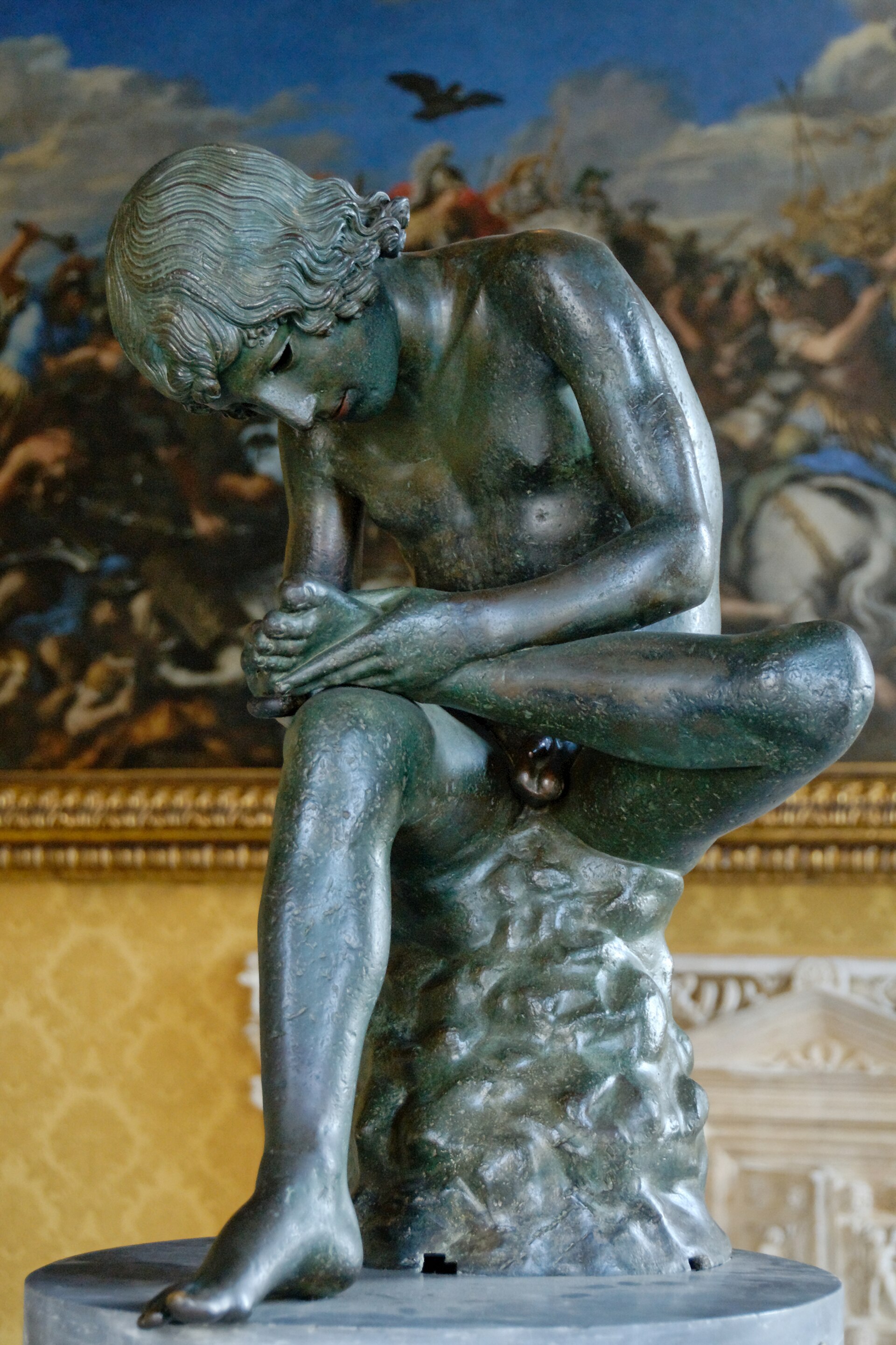
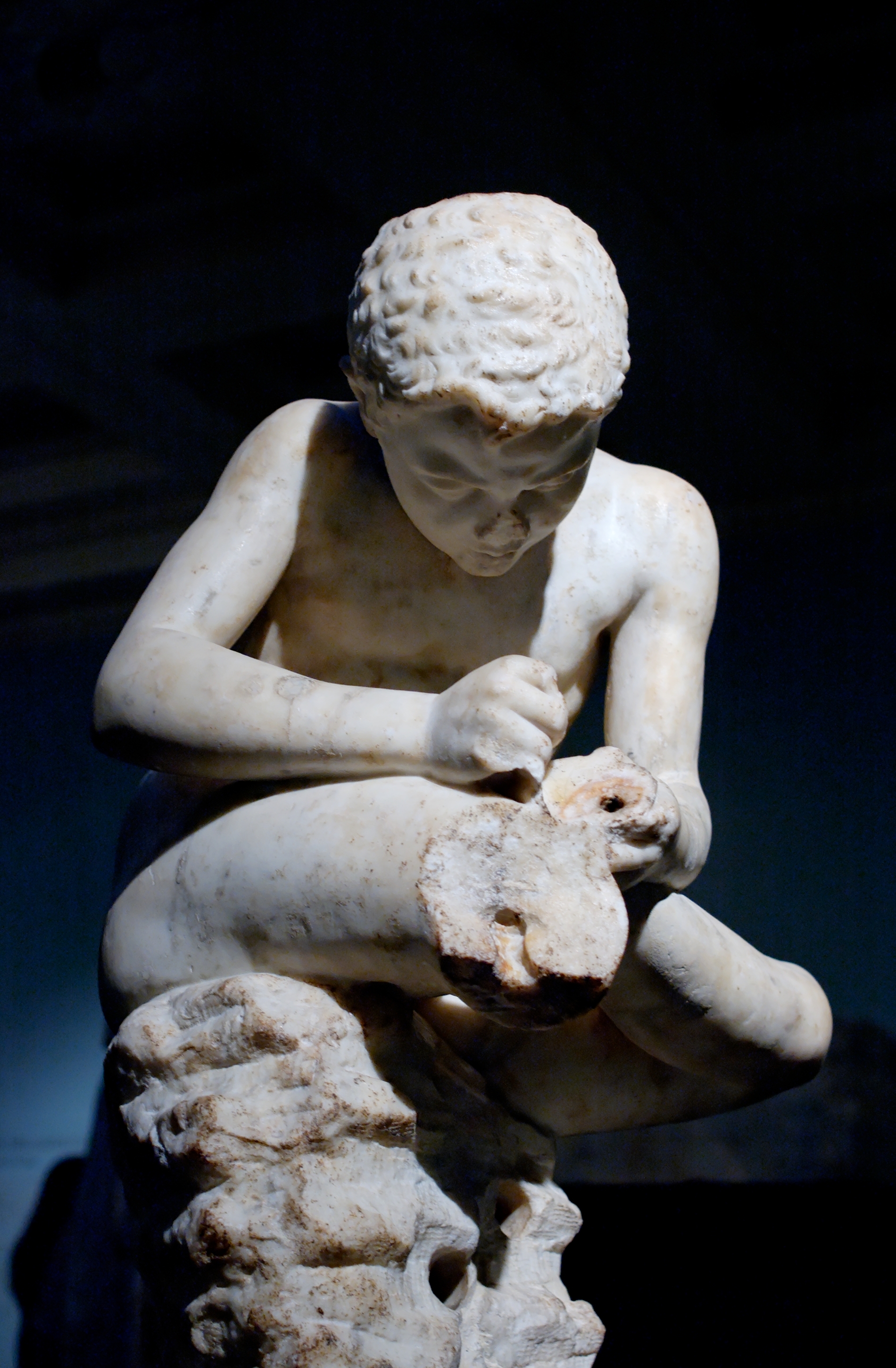
The bronze itself, inventory MC1186, Musei Capitolini. Public domain photograph by Marie-Lan Nguyen ("Jastrow"), 2009.
| Artist | Unknown Greco-Roman bronze-caster |
|---|---|
| Date | Disputed: 1st century BC (Musei Capitolini) or 1st century AD (Wolfgang Helbig); the body reproduces a Hellenistic type of the 3rd-2nd century BC, the head is adapted from, or copied after, a Greek archaic-style prototype of about the 5th century BC |
| Medium | Bronze, hollow cast |
| Dimensions | 73 cm high (inv. MC1186) |
| Where it is now | Musei Capitolini (Capitoline Museums), Palazzo dei Conservatori, Sala dei Trionfi, Romelast confirmed |
| Inventory number | MC1186 |
| Attribution | DisputedNo ancient text names a maker, and the bronze carries no signature or foundry mark. Full note |
| Object type | Antiquity |
| Period | Hellenistic-Roman, composite |
| Cases | Disputed attribution · Has a provenance gap · Restituted or repatriated |
| Inscriptions | None known |
| Owners on record | 7 links3 documented, 2 disputed, 2 unknown |
| Sources | 17 cited |
About this record Last verified · 17 sources cited · Change log
On this page 9 sections
ContentsClose
A small bronze of a boy pulling a thorn from his foot, 73 centimetres high, that has stood at the center of Rome's civic art collection since Pope Sixtus IV gave it, with the Capitoline Wolf and two other ancient bronzes, to the Roman People in 1471 - an act framed at the time as restitution rather than gift, and widely cited as founding the oldest public museum collection in the world. It had already stood at the Lateran Palace for at least three centuries by then, seen and described, with varying admiration, by a twelfth-century Jewish traveller and an English scholar who called it ridiculous.
The bronze itself is a puzzle scholars have not settled: a naturalistic Hellenistic body paired with a stiffer, archaic-style head that no surviving marble version of the same subject shares, cast either in the 1st century BC, on the Capitoline Museums' own dating, or a century later, on Wolfgang Helbig's. It became one of the first ancient statues systematically copied by Renaissance artists and sent as a diplomatic gift between crowns - to Francis I, to Philip II, to Charles I - and it has never once left Roman, and later Italian, custody to be sold.
Provenance
Each link is graded. Documented: a cited source supports it. Disputed: the identification is argued but not established. Unknown: no owner for that span, and the gap is not smoothed into a narrative. The grades in the glossary.
- Disputed: 1st century BC or 1st century AD -Unrecordeddisputed
The bronze is cast, combining a Hellenistic body type of the 3rd-2nd century BC with a head derived from, or adapted from, a Greek prototype of about the 5th century BC. The Musei Capitolini's own catalogue dates the casting to the 1st century BC; Wolfgang Helbig argued for the 1st century AD. Where, by whom, and for what original setting or function it was made is not established in any source consulted.16
- Casting - 1160sUnrecordedunknown
No text, find record or other source consulted for this entry documents the bronze's location, ownership or use for however many centuries separate its casting from its first appearance in the written record at the Lateran in the twelfth century.
- c. 1165-1167 -Papal Lateran Palace, Romedisputed
Benjamin of Tudela, a Navarrese Jewish traveller, records statues at the Lateran including one he calls Absalom; Paul Borchardt's 1936 study argues for a 1166 visit specifically. Later scholarship identifies this Absalom with the surviving bronze Spinario, but the surviving English translation of Benjamin's Hebrew text does not itself describe a boy removing a thorn, and Borchardt notes that manuscript and translation traditions of the passage vary. This record treats the identification as disputed rather than certain.16171
- Mid-twelfth century or c. 1200 (disputed) -Papal Lateran Palace, Romedocumented
Magister Gregorius, an English scholar, records the same bronze among the ancient bronzes at the Lateran in his De mirabilibus urbis Romae, calling it a highly ridiculous statue and identifying it as Priapus. That he saw and described this specific bronze is treated here as documented; the exact date of his visit and text is disputed among the sources consulted, some placing it in the mid-twelfth century and others around 1200.231
- 1471 -The People of Rome, custody at the Capitolinedocumented
Pope Sixtus IV transfers a group of ancient bronzes formerly at the Lateran - the Capitoline Wolf, the Camillus, the Spinario, and the colossal bronze head, hand and globe now catalogued as Constantine the Great - to the Roman People. An inscription in the Palazzo dei Conservatori frames the act as restitution of the city's own ancient patrimony rather than as a papal gift. The act is widely cited as founding the Capitoline Museums.764
- 1471 - 1499-1500The People of Romeunknown
The Spinario is not itself specifically documented at the Palazzo dei Conservatori until 1499-1500, roughly three decades after the 1471 gift. Its precise location and handling in the interim are not stated in the sources consulted.1
- 1499-1500 - presentThe People of Rome / Musei Capitolini, Palazzo dei Conservatoridocumented
First specifically recorded at the Palazzo dei Conservatori in 1499-1500. The Capitoline Museums opened to public visitors in 1734 under Clement XII. The Spinario has remained on display there, currently in the Sala dei Trionfi, without recorded sale, loss or export, through to the present day.146
Technical evidence
| Attribution note | No ancient text names a maker, and the bronze carries no signature or foundry mark. The figure is universally read by scholars as a composite: a body of a Hellenistic naturalistic type of the 3rd-2nd century BC combined with a head in an archaizing style derived from, or copied after, a Greek prototype of around the 5th century BC. What is disputed is when the surviving bronze itself was cast and by whom it was assembled. The Capitoline Museums' own current catalogue entry dates the casting to the 1st century BC. Wolfgang Helbig, whose position is reported by Haskell and Penny, argued for a Roman bronze of the 1st century AD with a head adapted from an archaic prototype. No surviving Hellenistic marble version of the type carries the same archaizing head, which is the main physical evidence used to argue that the head is a later graft onto an originally more naturalistic Hellenistic figure rather than an integral part of the original invention. |
|---|---|
| Material | Bronze, hollow cast.6 |
| Dimensions and inventory | 73 cm high; inventory number MC1186, Musei Capitolini.613 |
| Casting date (disputed) | Dated by the Musei Capitolini's own catalogue to the 1st century BC. Wolfgang Helbig, as reported by Haskell and Penny, argued instead for a Roman bronze of the 1st century AD. The two positions are not reconciled in the sources consulted.16 |
| Composite construction | Body of a Hellenistic naturalistic type of the 3rd-2nd century BC; head in an archaizing style derived from, or adapted from, a Greek prototype of about the 5th century BC. The hair does not fall naturally, a detail scholars cite as evidence the head is not integral to the body's original conception.16 |
| Comparative marble evidence | No surviving Hellenistic or Roman marble version of the type - including the British Museum's Castellani marble (c. 25-50 AD, after a lost Hellenistic original of the 3rd century BC) and the Uffizi's Medici marble (1st century BC) - carries the bronze's archaizing head, supporting the view that the head is specific to this cast rather than to the original invention of the type.911 |
| Inscriptions and marks | None known. No signature, foundry mark or ancient inscription has been reported in the sources consulted.1 |
| Display location | Sala dei Trionfi, Appartamento dei Conservatori, Palazzo dei Conservatori, Musei Capitolini, Rome.6 |
| Technical and metallurgical study | No published metallurgical analysis, alloy composition study or casting-core investigation specific to this bronze was located in the sources consulted. This is recorded as an open question rather than assumed not to exist. |
Images
The record in full
Chapter 1A boy pulling a thorn from his foot, and why the pose still reads as true
The bronze shows a seated boy bent almost double over his own raised foot, one hand steadying the ankle, the other reaching down to draw a thorn from the sole.
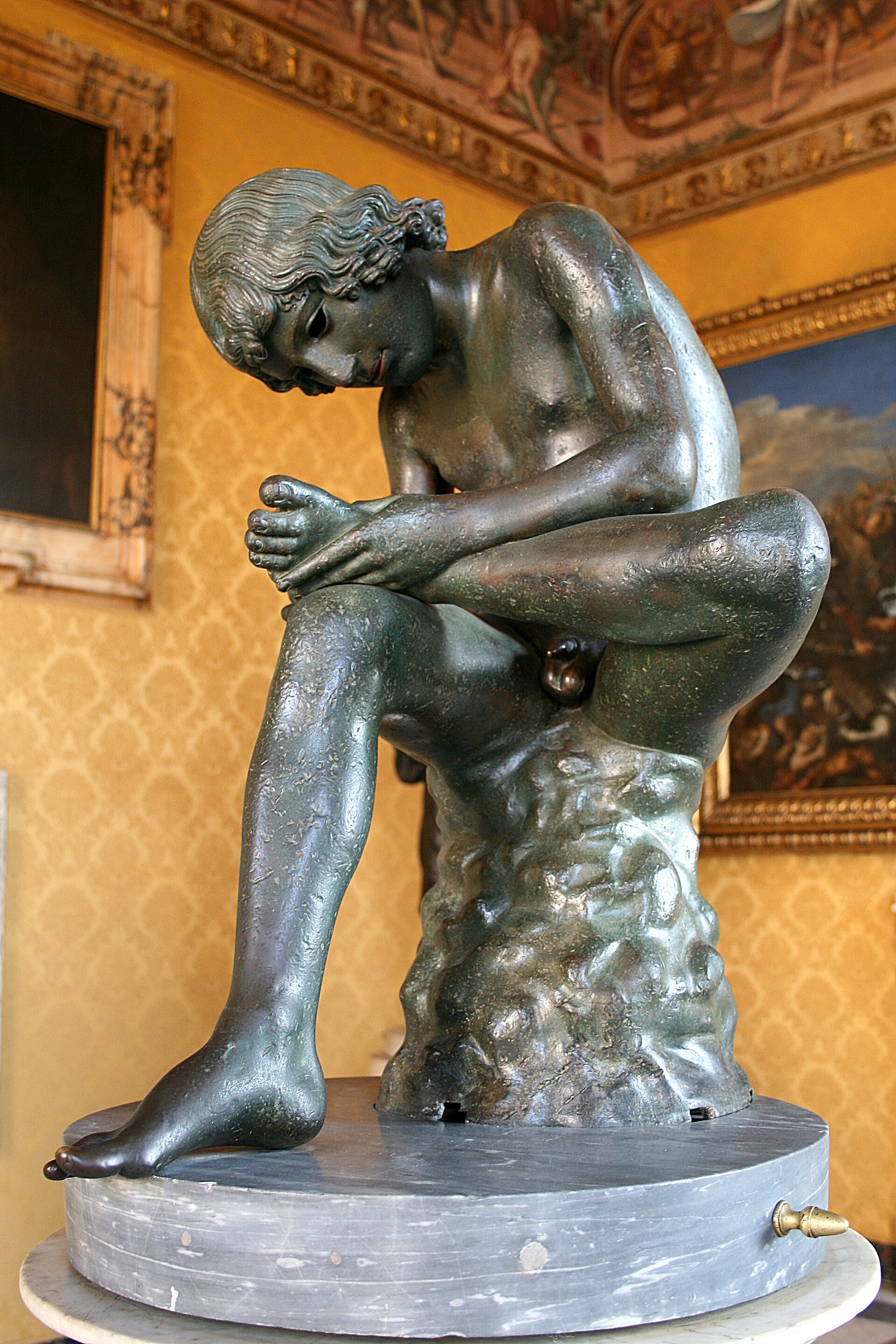
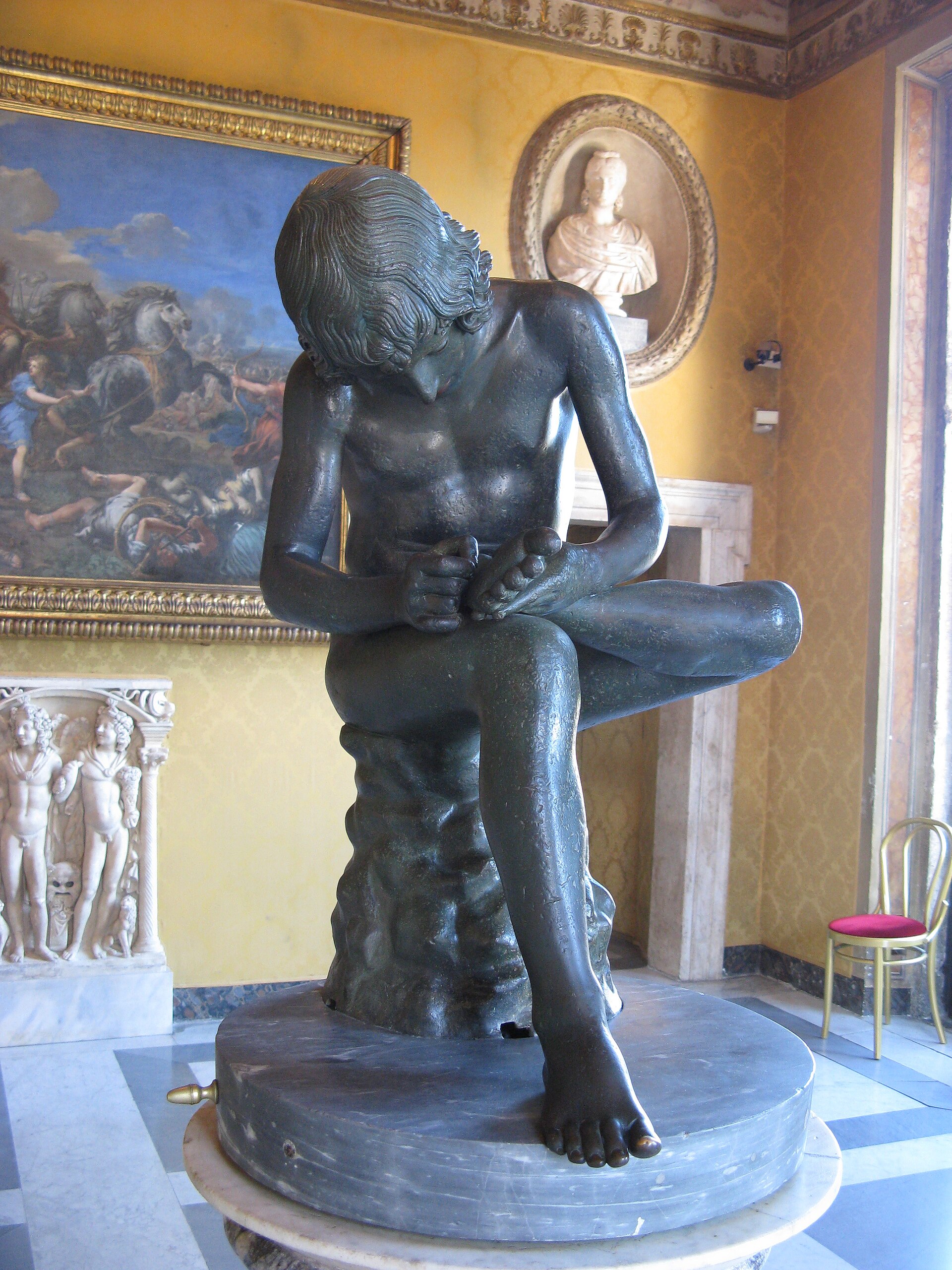
The bronze shows a seated boy bent almost double over his own raised foot, one hand steadying the ankle, the other reaching down to draw a thorn from the sole. He is not posed for a viewer. He is absorbed in a small, private discomfort, and that absorption is the whole point of the figure: it is one of the first works of ancient sculpture to make an ordinary, unheroic moment of the body into a subject worth casting in bronze. The statue stands 73 centimetres high, catalogued at the Musei Capitolini as inventory MC1186, and is currently displayed in the Sala dei Trionfi of the Palazzo dei Conservatori.
Nothing about the pose is symmetrical or frontal in the way earlier Greek sculpture in the round tends to be. The body twists, the weight shifts onto one hip, the head bends down and forward. Renaissance and later viewers repeatedly singled out exactly this: a natural, momentary human posture rendered in the most durable material available to an ancient sculptor.
Chapter 2A head that does not match its body, and what that mismatch has been used to prove
Look closely and the figure splits into two different sculptural languages.
Look closely and the figure splits into two different sculptural languages. The body is soft, naturalistic, anatomically loose in the way that Hellenistic bronze figures of boys and satyrs of the 3rd and 2nd centuries BC characteristically are. The head is stiffer, more schematic, with hair that does not fall the way real hair falls under gravity: it sits in a pattern closer to the formal, decorative hair conventions of Greek sculpture of around the 5th century BC, the period modern scholarship calls Archaic or, when the effect is deliberately imitated later, archaizing.
The Capitoline Museums' own current catalogue entry states plainly that the bronze is an eclectic, composite work, conceived in the 1st century BC by fusing a Hellenistic body type of the 3rd-2nd century BC with a head derived from Greek sculpture of the 5th century BC. Wolfgang Helbig, in his standard guide to the classical collections of Rome, took a different position on the date of the casting itself: a Roman bronze of the 1st century AD, with the head adapted from an archaic prototype rather than newly invented in an archaizing manner. The two positions agree on the essential point - that head and body are stylistically distinct and were brought together by design - and disagree by roughly a century on when the bronze in front of us was actually poured. This record states both positions and does not choose between them.
The strongest evidence for treating the head as a separate problem from the body comes from the wider family of the type. Several Hellenistic and Roman marble versions of a boy removing a thorn survive - the best known is the marble in the British Museum, from the Castellani collection and said to have been found on the Esquiline Hill, itself a Roman copy of about 25-50 AD after a lost Hellenistic original of the 3rd century BC - and none of them carries the Capitoline bronze's archaizing head. If the head were simply how the Hellenistic inventor of the type conceived the boy's face, the marble versions should show some trace of it. They do not. That absence is the reason recent scholarship treats the bronze's head as an addition or a substitution specific to this cast, rather than as evidence about the lost original Hellenistic invention.
Chapter 3What is not known: where it stood, and what it was for, in antiquity
No ancient author names this statue or describes seeing it.
No ancient author names this statue or describes seeing it. No excavation record establishes where in Rome, or in the Greek world, it originally stood, in what building, sanctuary, bath complex or private house, or for what occasion it was made. The composite-dating debate concerns the object's material history - when the bronze now in the Capitoline was cast - and says nothing at all about its original setting or function, because nothing about that survives in any text or find record consulted for this entry.
This is worth stating plainly rather than passing over. A statue this famous invites the assumption that its ancient context must be known somewhere. It is not. The earliest secure fact about its location is medieval, not ancient: it was already standing in front of the Lateran Palace in Rome by the second half of the twelfth century, with nothing connecting that position to antiquity itself. Everything between the casting and the twelfth century - centuries, on either dating - is undocumented.
Chapter 4The first sightings: a Jewish traveller, a bronze equestrian Constantine, and a disputed Absalom
The Navarrese rabbi Benjamin of Tudela passed through Rome in the 1160s, on the itinerary of travels through the Mediterranean and the Near East that he recorded in Hebrew and that survives in the...
The Navarrese rabbi Benjamin of Tudela passed through Rome in the 1160s, on the itinerary of travels through the Mediterranean and the Near East that he recorded in Hebrew and that survives in the manuscript tradition behind The Itinerary of Benjamin of Tudela. Paul Borchardt's 1936 study in the Journal of Roman Studies dates the visit specifically to 1166, using the chronology of Pope Alexander III's contested pontificate and the death of the Armenian ruler Thoros as anchors; other accounts place the visit more loosely between 1165 and 1167.
In the standard English translation of Benjamin's Hebrew text, the passage on the Lateran reads: in front of St John Lateran there are statues of Samson in marble, with a spear in his hand, and of Absalom the son of King David, and another of Constantinus the Great, who built Constantinople and after whom it was called; the last-named statue is of bronze, the horse being overlaid with gold. Later scholarship, following Borchardt, identifies the figure Benjamin called Absalom with the bronze that later sources call the Spinario - but the translated passage as it survives does not itself describe a boy pulling a thorn from his foot, and Borchardt's own article notes that different manuscript and translation traditions of Benjamin's text render the passage differently, including variants over whether a figure held a stone lance or a stone ball. The identification of Benjamin's Absalom with the surviving bronze thorn-puller is therefore a scholarly inference built on this fragmentary and variably transmitted text, not a description that unambiguously matches the object in every surviving version. This record treats it as a disputed rather than a certain link.
A second, independent witness is more securely tied to the object. An English scholar known as Magister Gregorius, a visitor to Rome on business rather than as a pilgrim, wrote an account of the city's antiquities, De mirabilibus urbis Romae, surviving today in a single late-thirteenth-century manuscript at St Catharine's College, Cambridge, first identified by M. R. James in 1917. Gregorius is credited as the first writer to take clear notice of the specific Roman bronze later called the Spinario, then standing among the ancient bronzes at the Lateran - and he did not admire it. He called it a highly ridiculous statue and identified it as Priapus. Sources disagree on when Gregorius wrote: some scholarship places his visit and text in the mid-twelfth century, following James's original dating; other accounts, and the general modern consensus reflected in later editions, place it closer to 1200. This record does not resolve that disagreement and states both positions.
Chapter 51471: a Pope calls it restitution, not a gift
In 1471 Pope Sixtus IV transferred a group of ancient bronze statues that had stood at the Lateran to the people of Rome.
In 1471 Pope Sixtus IV transferred a group of ancient bronze statues that had stood at the Lateran to the people of Rome. The group is consistently named across the Capitoline Museums' own institutional history as four works: the Capitoline Wolf; the Camillus, a bronze statue of a young cult attendant of about the 1st century AD, of a type who assisted a priest at sacrifice; the Spinario; and the surviving colossal bronze fragments - head, hand and globe - of a statue currently catalogued as Constantine the Great. On that last object, later scholarship has debated which earlier emperor's colossal image may originally have been reworked into Constantine's likeness after 312 AD, with a cult statue of Domitian and an uncanonised image of Hadrian both proposed as candidates for the recut original; that debate concerns the Constantine fragments, not the Spinario, and is noted here only to distinguish the two objects precisely, since both entered the collection in the same 1471 group.
An inscription preserved in the Palazzo dei Conservatori frames the act specifically as restitution rather than donation: the Pope judged that these bronze statues, testimony to the ancient greatness of the Roman people who had had them made, had to be returned to that people. The distinction mattered at the time and matters to how the gift is read now. Sixtus IV was not simply enriching a papal art collection; he was placing objects understood as the patrimony of the ancient Roman res publica onto the Capitoline Hill, the historical seat of Rome's civic and religious life, and putting them under civic rather than ecclesiastical custody. The act is widely cited as the founding moment of the Capitoline Museums, on the strength of which the Capitoline is frequently described as the oldest public museum collection in the world, though 'public' in 1471 meant available to the city's institutions and to visitors by request rather than open on the modern model: the museum did not formally open to any member of the public until 1734, under Clement XII.
The Spinario itself is not independently documented at the Palazzo dei Conservatori until 1499-1500, a gap of roughly three decades after the 1471 gift. Where the statue physically stood in the interim - whether it moved directly with the rest of the group, or was held elsewhere before joining them on display - is not stated in the sources consulted for this record. That gap is recorded here rather than smoothed over.
Two other bronze figures often seen alongside the Spinario in the same rooms have separate and later histories, worth stating precisely because visitors and even some secondary accounts blur them together. The so-called Capitoline Brutus, a bronze portrait head, was a gift of Cardinal Rodolfo Pio in 1564, nearly a century after the Sixtus IV group. The Capitoline Antinous, a marble rather than a bronze, entered the collection in 1733 as part of the Cardinal Alessandro Albani purchase that Clement XII made shortly before opening the museum to the public. Neither belongs to the 1471 donation, and neither shares the Spinario's documented twelfth-century history at the Lateran.
Chapter 6No sale, no export, no auction: an unbroken custody stated as a finding
This record carries no auction_results block, and that omission is itself a documented fact rather than a gap in the research.
This record carries no auction_results block, and that omission is itself a documented fact rather than a gap in the research. So far as the sources consulted establish, the bronze has not been sold, has not left Rome, and has not left civic and later state Italian custody at any point since at least the 1471 donation, and very probably not since it was first recorded standing at the Lateran in the twelfth century. No export licence application exists to discuss, because the object has never been offered for sale or presented for export: Italy's notifica regime and the international conventions governing the movement of cultural property, both relevant to many objects in this publication, are simply not triggered by an object that has never changed hands or crossed a border. Where most entries in this archive report a market history, this one reports the deliberate absence of one, in an institution old enough, and a custody unbroken enough, that the absence is itself the notable fact.
Chapter 7A name that keeps changing: Absalom, Priapus, Il Fedele, Spinario
Few objects in this archive have carried so many different names for so many different reasons.
Few objects in this archive have carried so many different names for so many different reasons. In the twelfth century it may have been called Absalom, on the strength of a disputed reading of Benjamin of Tudela's Hebrew text. Around the same period or a little later, Magister Gregorius called it Priapus, apparently reading the boy's bent posture and exposed body in a register nearer to caricature than to reverence. By the early modern period it had acquired the sentimental Italian title Il Fedele, or Fedelino, the faithful little one: the story attached to that name held that a shepherd boy, sent as a messenger to the Roman Senate, delivered his urgent message before stopping to remove a thorn from his own foot, and that the Senate commemorated his loyalty with this statue. Paolo Alessandro Maffei's Raccolta di statue antiche e moderne of 1704 already treated that story as invented rather than historical, which places its debunking a good two centuries before most of the popular guidebooks that still repeat it.
The name that has stuck in scholarly use, Spinario, is simply the Italian for thorn-puller and carries none of that legendary freight. In the vernacular literature generated by its European fame it appears as Dornauszieher in German, tireur d'epine or Le tireur d'epine in French, Doornuittrekker in Dutch, and under still other local names on the postcards, prints and plaster casts that circulated it far beyond Rome. A modern, considerably more cautious identification, seen chiefly in exhibition texts and general guides rather than in the scholarly literature examined for this record, proposes that Roman-period viewers or copyists associated the boy-shepherd type with Ascanius, also called Iulus, the son of Aeneas and legendary ancestor of the Julian line. No specific named scholar making that argument in a citable publication was identified in the course of this research, and the claim is recorded here as an unattributed, speculative reading rather than an established one, flagged for verification against a citable art-historical source rather than a museum-guide summary.
Chapter 8The most copied ancient bronze of the Early Renaissance
Once it was visible and admired at the Palazzo dei Conservatori, the Spinario became one of the very first Roman sculptures that Renaissance artists systematically reproduced.
Once it was visible and admired at the Palazzo dei Conservatori, the Spinario became one of the very first Roman sculptures that Renaissance artists systematically reproduced. The workshop tradition of small bronze reductions of famous antiquities, aimed at collectors rather than public display, took the Spinario as one of its earliest and most repeated subjects. Bronze reductions are recorded from the workshop of Severo da Ravenna, and from Pier Jacopo Alari Bonacolsi, called L'Antico for the refined finish of his classicizing bronzes. Antico cast a version for Isabella d'Este around 1501, now in the Galleria Estense in Modena, and is recorded as having followed it with a second, untraced pendant that may have reversed the pose. In 1500 the Sicilian sculptor Antonello Gagini made a full-size bronze variant for a fountain in Messina; Wikipedia's account of the Boy with Thorn tradition states that this is probably, though not certainly, the bronze version now in the Metropolitan Museum of Art, a hedge this record preserves rather than resolving into a firm identification.
Study of the antique original, or of the Medici's own Roman marble copy kept among the antiquities gathered in the San Marco gardens in Florence - a collection Lorenzo de' Medici opened to young artists, among them the young Michelangelo - fed directly into figure studies by more than one Renaissance master. It has been debated in the scholarly literature, notably by Richard Cocke in a 1980 article on the reception of the antique in Renaissance painting, whether Masaccio's own figures owe more to the Medici marble in Florence or to the bronze Cocke argues he is likely to have seen in Rome in the 1420s; Cocke does not claim a settled answer, and this record does not either. A more secure case is Filippo Brunelleschi's 1401 bronze relief panel The Sacrifice of Isaac, his trial piece for the competition to design the doors of the Baptistery of San Giovanni in Florence, in which the pose of the left-hand attendant figure is generally accepted as an adaptation of the Spinario's posture - a debt from one of the founding works of Florentine Renaissance sculpture to this specific antique bronze.
Chapter 9Ambassadorial bronzes: gifts to the kings of France, Spain and England
By the sixteenth century a fine bronze cast of the Spinario had become a gift substantial enough to pass between crowns.
By the sixteenth century a fine bronze cast of the Spinario had become a gift substantial enough to pass between crowns. Francis I of France received a version whose casting was overseen by the sculptors Giovanni Fancelli and Jacopo Sansovino and whose transfer to France was handled by the goldsmith and sculptor Benvenuto Cellini, acting for the donor Cardinal Ippolito II d'Este; some later secondary accounts render the donor's name inconsistently, and this record follows the citation traceable to Haskell and Penny's 1981 catalogue in preferring Ippolito II d'Este, a cardinal, over the alternative 'Alfonso d'Este' that appears in some looser modern summaries and whose documentation this research could not independently verify. That French royal cast is now held between the Musee du Louvre and the Chateau de Fontainebleau, as part of the same wave of bronze reproductions of antiquities that brought Primaticcio's Vatican casts to Fontainebleau in the 1540s.
Philip II of Spain received a separate cast from Cardinal Giovanni Ricci. In the following century Charles I of England commissioned a bronze Spinario from the French sculptor Hubert Le Sueur, who supplied the English court with several such antique bronze reproductions. A further, later link in the chain sits in Spain: the Museo Nacional del Prado holds a bronze Spinario documented in the Royal Alcazar in Madrid by 1700 and later in the New Royal Palace by 1747 and 1789, itself cast in Madrid from a Spinario of around 1560 attributed to Guglielmo della Porta that remains today at the royal palace of Aranjuez. The Prado's cast is therefore a copy of a copy, at two removes from the Capitoline bronze, and its catalogue makes no claim that it was cast directly from the Roman original.
This chain of named casts - Antico's, Gagini's probable Metropolitan bronze, the Fancelli-Sansovino-Cellini cast for Francis I, Le Sueur's for Charles I, della Porta's Aranjuez version and the Madrid cast made from it - forms a genuine comparanda cohort distinct from the mere fact of the Spinario's popularity: a collector or scholar wanting to know which surviving early cast sits closest to the Roman original, and whether any of them was taken directly from the Capitoline bronze rather than from an intermediate cast, is asking a real and, on the sources examined here, still unanswered question.
Chapter 10Not the original: the marble copies at the British Museum, the Uffizi and beyond
Because the Spinario type was reproduced so often, and in more than one material, keeping the original bronze distinct from its many copies matters more here than almost anywhere else in this archive.
Because the Spinario type was reproduced so often, and in more than one material, keeping the original bronze distinct from its many copies matters more here than almost anywhere else in this archive. Two marble copies deserve to be named precisely because they are sometimes mentioned in the same breath as the Capitoline bronze without the distinction being made explicit.
The Uffizi Galleries in Florence hold a Roman marble version of the subject, worked in Greek marble with later additions in Carrara marble, dated by the Uffizi's own catalogue to the 1st century BC and drawn from the Medici collections. It is displayed in a corridor of the gallery among the museum's antiquities and is not the bronze described in this record.
The British Museum holds a marble Thorn-puller from the Castellani collection, said to have been found on the Esquiline Hill in Rome, worked with its base carved as a rock and pierced for a fountain pipe, and catalogued as a Roman copy of about 25-50 AD after a lost Hellenistic original of the 3rd century BC. As already noted, this marble lacks the Capitoline bronze's archaizing head entirely, which is part of why scholars treat that head as a feature added to, or substituted onto, the bronze specifically rather than as evidence of how the Hellenistic inventor of the type first conceived the boy's face. This marble, too, is not the object described in this record.
Anyone assembling images or copies of the Spinario for study should treat any marble example, any full-scale garden cast, and any of the many nineteenth-century Grand Tour bronze reductions that circulated through English country houses as later reproductions, and should confirm the depicted location and collection given in a source before treating an image as the Capitoline original.
Chapter 11In print, in paint, and in a Venetian novella: how the fame was carried
Reproduction in two dimensions carried the Spinario's fame further than any single bronze cast could.
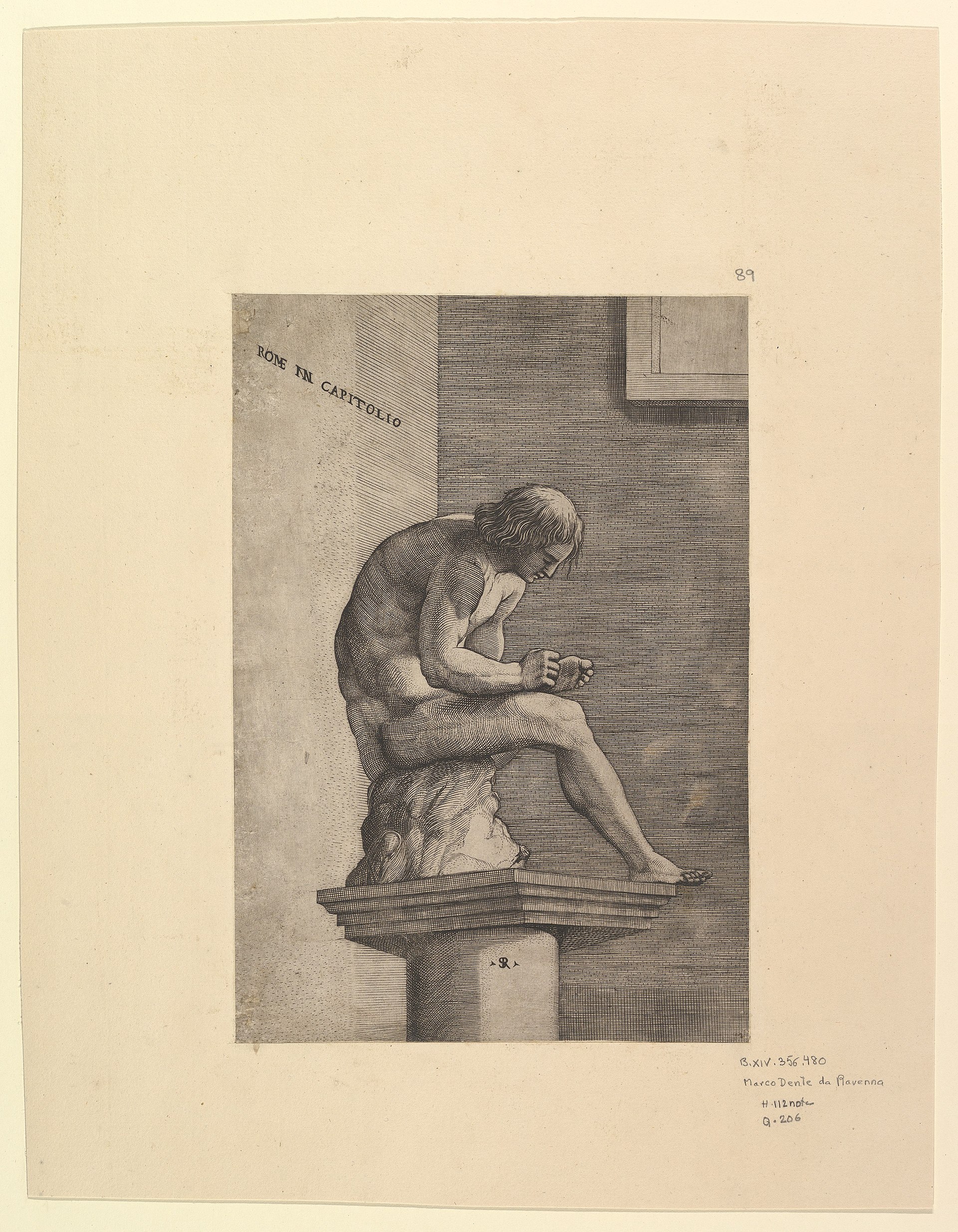
Reproduction in two dimensions carried the Spinario's fame further than any single bronze cast could. An engraving of the subject, Man Removing a Thorn from his Foot, attributed to the engraver Marco Dente, who died in 1527, was later issued as part of the large composite print series known as the Speculum Romanae Magnificentiae, the mirror of Roman magnificence, which circulated engraved views of Rome's antiquities across educated Europe from the sixteenth century onward. A copy of this print is held by the Metropolitan Museum of Art.
The image had also become enough of a fixture of connoisseurial taste by the 1620s to appear inside another artist's picture as a kind of visual shorthand for that taste. Pieter Claesz's Vanitas with the Spinario, an oil on panel of 1628 now in the Rijksmuseum in Amsterdam, includes a small plaster or bronze reproduction of the Spinario among the luxury objects and mortality symbols of its still-life composition - the antique bronze doing duty as one more marker of a life of refined possessions about to be undone by death, the standard argument of a vanitas picture.
The statue's later literary afterlife includes its appearance in Thomas Mann's 1912 novella Death in Venice, where the narrator Gustav von Aschenbach compares the beauty of the boy Tadzio to the Spinario - a use of the statue as a byword for a particular, morally loaded kind of youthful physical perfection, entirely a twentieth-century reading and no guide at all to what the object meant to whoever commissioned or cast it in antiquity.
Chapter 12What is happening to it now
The most recent dedicated scholarly and public engagement with the object identified in the course of this research is the exhibition Spinario.
The most recent dedicated scholarly and public engagement with the object identified in the course of this research is the exhibition Spinario. Storia e fortuna, held at the Musei Capitolini from 5 February to 25 May 2014 and curated by Claudio Parisi Presicce, then the museum's own archaeological superintendent. It brought together some forty-five works - ancient replicas, Renaissance and later bronze and marble copies, drawings, prints and paintings referencing the subject - drawn from Italian and international collections, with an accompanying catalogue of scholarly entries. That exhibition is, on the sources examined here, the most recent occasion on which the Spinario's own history of reproduction was itself made the subject of a dedicated museum study, rather than a footnote to an account of Renaissance taste in general.
No published account located in the course of this research addresses whether the bronze was moved, hidden or otherwise specially protected during the 1527 Sack of Rome or during the Allied bombing and German occupation of Rome in 1943-44, and none was found describing any dedicated modern metallurgical or alloy analysis of the bronze itself. Both absences are recorded as findings in the open questions below rather than passed over.
The artist
Maker unrecorded; conventionally discussed as an anonymous Hellenistic or Roman bronze-casting workshop
No ancient source names whoever cast this bronze, and no signature or foundry mark survives on the object itself. What can be discussed is not a person but a problem: the bronze appears to combine the work, or the visual conventions, of two different periods of Greek sculpture, and the scholarly literature is really an argument about how and when that combination happened, not about who carried it out. This dossier covers that argument, and the workshop tradition of named early modern copyists whose own attributions, by contrast, are firmly documented - a useful contrast, since it shows what a documented attribution to a maker actually looks like next to this bronze's undocumented one.
Related works
| Work | Relation | Where it is |
|---|---|---|
| Marble statue of a boy, the so-called Spinario (Thorn-puller) Unknown Roman copyist | Roman marble copy, c. 25-50 AD, after a lost Hellenistic original of the 3rd century BC; from the Castellani collection, said to have been found on the Esquiline Hill; lacks the Capitoline bronze's archaizing head Not the object described in this record. | British Museum, London (museum no. 1880,0807.1) |
| Boy with Thorn (Lo Spinario) Unknown Roman copyist | Roman marble version, 1st century BC, worked in Greek marble with Carrara-marble additions; from the Medici collections Not the object described in this record; displayed in a museum corridor among the Uffizi's antiquities. | Uffizi Galleries, Florence |
| Spinario Pier Jacopo Alari Bonacolsi, called L'Antico | Renaissance bronze reduction after the Capitoline original, made for Isabella d'Este around 1501 One of the earliest documented Renaissance copies; Antico is recorded as having followed it with an untraced pendant. | Galleria Estense, Modena |
| Spinario (bronze cast given to Francis I of France) Cast overseen by Giovanni Fancelli and Jacopo Sansovino; transfer handled by Benvenuto Cellini; donor Cardinal Ippolito II d'Este | Sixteenth-century ambassadorial bronze cast of the Capitoline original Some secondary sources give the donor's name inconsistently; this record follows the citation traceable to Haskell and Penny (1981). | Musee du Louvre / Chateau de Fontainebleau, France |
| Spinario Cast made in Madrid after a Spinario of c. 1560 attributed to Guglielmo della Porta | A copy of a copy: cast from a version that itself remains at the royal palace of Aranjuez Two removes from the Capitoline bronze; not claimed by the Prado to have been cast directly from the Roman original. | Museo Nacional del Prado, Madrid; documented in the Royal Alcazar by 1700 and the New Royal Palace by 1747 and 1789 |
| Man Removing a Thorn from his Foot Attributed to Marco Dente (d. 1527) | Engraving of the subject, later issued within the composite print series Speculum Romanae Magnificentiae A print reproduction, not a cast or copy of the statue itself; documents the image's early circulation in two dimensions. | Metropolitan Museum of Art, New York |
| Vanitas with the Spinario Pieter Claesz | 1628 still-life painting incorporating a small reproduction of the Spinario among vanitas symbols The Spinario appears here as a studio prop and status symbol, not as the sculpture itself. | Rijksmuseum, Amsterdam (SK-A-3930) |
| Capitoline Wolf; Camillus; colossal bronze head, hand and globe of Constantine Unknown ancient makers; the Constantine fragments possibly reworked in antiquity from an earlier imperial image | Companion objects transferred to the Roman People in the same 1471 Sixtus IV donation as the Spinario Separate objects with their own attribution and dating histories; not to be confused with the later-acquired Capitoline Brutus (1564 gift) or Capitoline Antinous (1733 purchase), neither part of the 1471 group. | Musei Capitolini, Palazzo dei Conservatori, Rome |
Open questions
- Where in antiquity did the bronze originally stand, and for what purpose or in what setting? No ancient text or find record consulted for this entry addresses the question at all.
- Was the bronze cast in the 1st century BC, as the Musei Capitolini's own catalogue states, or in the 1st century AD, as Wolfgang Helbig argued? The two positions are not reconciled in the sources consulted.
- Is the head a later graft onto an already-cast Hellenistic body, or was the whole composite figure conceived and cast together as a deliberate archaizing pastiche from the outset? The absence of any matching head on the surviving marble versions of the type argues for some form of graft or substitution, but does not by itself settle which.
- Does the identification of Benjamin of Tudela's 'Absalom' (visited c. 1165-1167) with the surviving bronze Spinario hold up against the full manuscript tradition of his Hebrew text, which Paul Borchardt's 1936 study shows varies between versions? The English translation consulted for this record does not itself describe a boy pulling a thorn from his foot.
- When did Magister Gregorius actually visit Rome and write De mirabilibus urbis Romae - the mid-twelfth century, as M. R. James's original identification suggested, or around 1200, as later accounts place it? Sources consulted for this record disagree and the question is not resolved here.
- Where was the Spinario physically located between the 1471 Sixtus IV donation and its first specific documentary record at the Palazzo dei Conservatori in 1499-1500 - a gap of roughly three decades?
- Does any published metallurgical, alloy-composition or casting-core study of this specific bronze exist in the Italian conservation literature? None was located in the course of this research.
- Was the bronze moved, hidden or otherwise specially protected during the 1527 Sack of Rome, or during the Allied bombing and German occupation of Rome in 1943-44? No account addressing either episode was located.
- Which, if any, of the named early modern bronze casts (Antico's, the Fancelli-Sansovino-Cellini cast for Francis I, Le Sueur's for Charles I, Guglielmo della Porta's Aranjuez version) was taken directly from the Capitoline original, as against from an intermediate cast? The sources consulted do not establish this for any of them.
Questions about this object
What is Boy with Thorn (Spinario)?
Boy with Thorn (Spinario) is an antiquity, dated disputed: 1st century BC (Musei Capitolini) or 1st century AD (Wolfgang Helbig); the body reproduces a Hellenistic type of the 3rd-2nd century BC, the head is adapted from, or copied after, a Greek archaic-style prototype of about the 5th century BC. Medium: Bronze, hollow cast.
Who made Boy with Thorn (Spinario), and is the attribution settled?
The attribution to Unknown Greco-Roman bronze-caster is recorded here as disputed. No ancient text names a maker, and the bronze carries no signature or foundry mark. The figure is universally read by scholars as a composite: a body of a Hellenistic naturalistic type of the 3rd-2nd century BC combined with a head in an archaizing style derived from, or copied after, a Greek prototype of around the 5th century BC. What is disputed is when the surviving bronze itself was cast and by whom it was assembled. The Capitoline Museums' own current catalogue entry dates the casting to the 1st century BC. Wolfgang Helbig, whose position is reported by Haskell and Penny, argued for a Roman bronze of the 1st century AD with a head adapted from an archaic prototype. No surviving Hellenistic marble version of the type carries the same archaizing head, which is the main physical evidence used to argue that the head is a later graft onto an originally more naturalistic Hellenistic figure rather than an integral part of the original invention.
Where is Boy with Thorn (Spinario) now?
Musei Capitolini (Capitoline Museums), Palazzo dei Conservatori, Sala dei Trionfi, Rome. Inventory number MC1186. Last confirmed 21 August 2026. In continuous, documented institutional custody since Pope Sixtus IV's 1471 donation of the Lateran bronzes to the Roman People; first specifically recorded at the Palazzo dei Conservatori in 1499-1500; the Capitoline Museums opened to the public in 1734 under Clement XII.
What is still unknown about Boy with Thorn (Spinario)?
Where in antiquity did the bronze originally stand, and for what purpose or in what setting? No ancient text or find record consulted for this entry addresses the question at all.
Sources
- 1Wikipedia, 'Boy with Thorn', aggregating and citing Francis Haskell and Nicholas Penny, Taste and the Antique: The Lure of Classical Sculpture, 1500-1900 (Yale University Press, 1981), cat. no. 78, pp. 308-310; Paul Borchardt, 'The Sculpture in front of the Lateran as described by Benjamin of Tudela and Magister Gregorius', Journal of Roman Studies 26 (1936), pp. 68-70; Roberto Weiss, The Renaissance Discovery of Classical Antiquity (1969), p. 7f; Richard Cocke, 'Masaccio and the Spinario, Piero and the Pothos', Zeitschrift fuer Kunstgeschichte 43.1 (1980), pp. 21-32; Phyllis P. Bober and R. Rubinstein, Renaissance Artists and Antique Sculpture: A Handbook of Sources (London and Oxford, 1986), p. 235, no. 203; and Wolfgang Helbig, Fuehrer durch die oeffentlichen Sammlungen klassischer Altertuemer in Rom, 4th ed. (Tuebingen, 1963-72), vol. II, pp. 266-68. en.wikipedia.org/wiki/...
- 2Wikipedia, 'De mirabilibus urbis Romae'. B. C. Huygens's critical edition (Brill, 1970) or John Osborne's English translation and commentary, The Marvels of Rome. en.wikipedia.org/wiki/...
- 3Wikipedia, 'Magister Gregorius'. en.wikipedia.org/wiki/...
- 4Wikipedia, 'Capitoline Museums', for the 1471 founding narrative, the 'restitution' inscription, and the separate acquisition histories of the Capitoline Wolf, Capitoline Brutus and Capitoline Antinous. en.wikipedia.org/wiki/...
- 5Wikipedia, 'Bronze colossus of Constantine', for the scholarly debate over which earlier imperial image the surviving bronze head, hand and globe may have been reworked from. en.wikipedia.org/wiki/...
- 6Musei Capitolini (official website), catalogue entry 'Spinario': material, dimensions, inventory MC1186, dating to the 1st century BC as a composite of a Hellenistic body type and an archaic-derived head, and display location. museicapitolini.org/en/...
- 7Musei Capitolini (official website), 'Foundation and first acquisitions', on the 1471 Sixtus IV donation, the objects named, the 'restitution' framing, and the 1734 public opening. museicapitolini.org/en/...
- 8Musei Capitolini (official website), exhibition page for 'Spinario. Storia e fortuna', 5 February - 25 May 2014, curated by Claudio Parisi Presicce. museicapitolini.org/en/...
- 9Wikimedia Commons, File:Spinario BM 1755.jpg, description of the British Museum's marble Thorn-puller (Castellani collection, said found on the Esquiline, Roman copy c. 25-50 AD after a lost Hellenistic original of the 3rd century BC), photograph by Jastrow, 2006. commons.wikimedia.org/wiki/...
- 10Museo Nacional del Prado, catalogue entry 'The Boy with the Thorn (The Spinario)': the Madrid-cast bronze after a c. 1560 Spinario attributed to Guglielmo della Porta, itself remaining at Aranjuez, and the Prado cast's documented presence in the Royal Alcazar (by 1700) and New Royal Palace (1747, 1789). museodelprado.es/en/...
- 11Uffizi Galleries, catalogue entry 'Boy with Thorn, also known as Spinario': the Uffizi's own Roman marble version, 1st century BC, from the Medici collections, distinct from the Capitoline bronze. uffizi.it/en/...
- 12Wikipedia, 'Vanitas with the Spinario', on Pieter Claesz's 1628 painting, Rijksmuseum, Amsterdam (SK-A-3930), which incorporates a small reproduction of the Spinario. en.wikipedia.org/wiki/...
- 13Wikimedia Commons, File:Spinario Musei Capitolini MC1186.jpg, photograph by Marie-Lan Nguyen ('Jastrow'), 2009, public domain, confirming inventory number and dating description. commons.wikimedia.org/wiki/...
- 14Wikimedia Commons, File:0 Spinaro - Palazzo dei Conservatori, Musei Capitolini (1).JPG, photograph by Jean-Pol Grandmont, 2011, CC BY-SA 3.0. commons.wikimedia.org/wiki/...
- 15Wikimedia Commons / Metropolitan Museum of Art, File:Speculum Romanae Magnificentiae- Man Removing a Thorn from his Foot MET DP820276.jpg, engraving attributed to Marco Dente (d. 1527), CC0. commons.wikimedia.org/wiki/...
- 16Benjamin of Tudela, The Itinerary of Benjamin of Tudela: Travels in the Middle Ages, trans. Marcus Nathan Adler, reproduced in the Project Gutenberg edition, for the primary-source passage on the statues of Samson, Absalom and Constantine before the Lateran. gutenberg.org/files/...
- 17Cambridge Core, abstract of Paul Borchardt, 'The Sculpture in front of the Lateran as described by Benjamin of Tudela and Magister Gregorius', Journal of Roman Studies 26 (1936), pp. 68-70, consulted for Borchardt's dating of Benjamin's visit to 1166 and his discussion of variant manuscript traditions of the passage. cambridge.org/core/...


.JPG)

Last verified · Published
Change log
21 August 2026 - Record created at the house standard: researched narrative, technical evidence, maker dossier, graded provenance chain, prices with hammer and premium separated, related works, open questions and sources.