Statue of a Victorious Youth
Unidentified Greek bronze caster; attributed by some scholars to Lysippos of Sikyon · About 300-100 BC
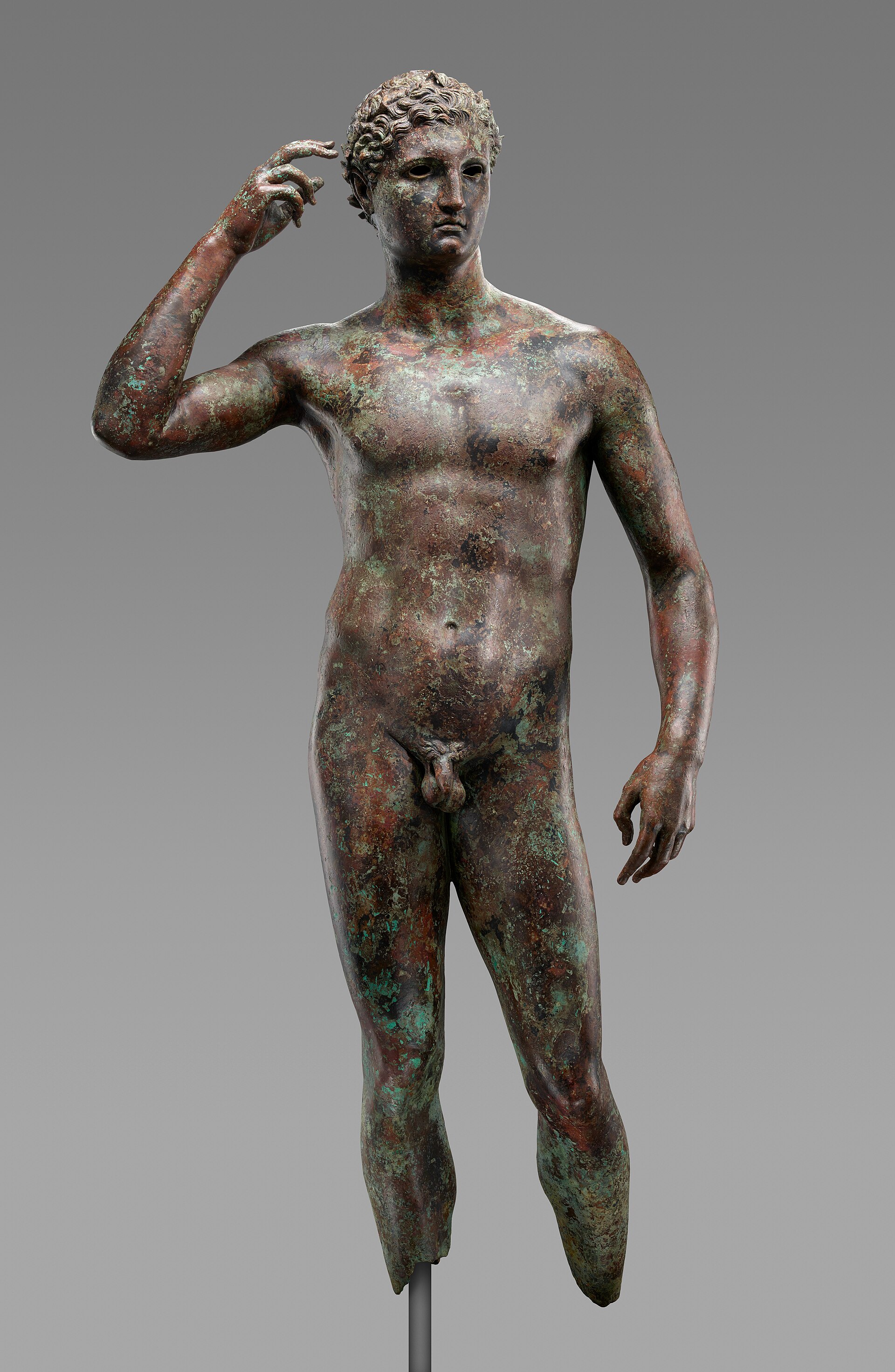
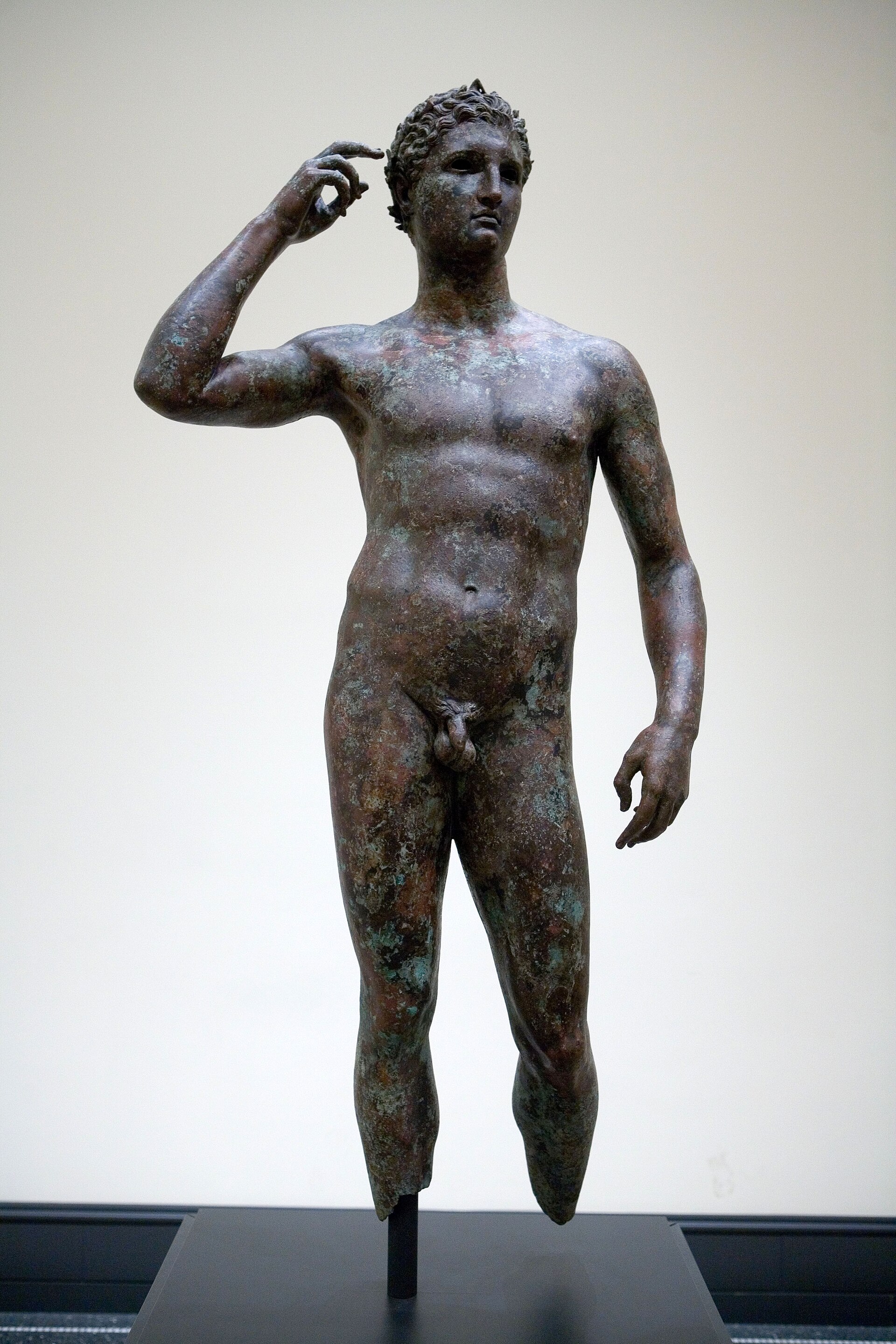
The record subject, object 77.AB.30. The right arm is raised to set a wreath, probably olive, on the head; the lower legs and feet are lost. Photographed and released by the holding museum itself under CC0.
| Artist | Unidentified Greek bronze caster; attributed by some scholars to Lysippos of Sikyon |
|---|---|
| Date | About 300-100 BC |
| Medium | Bronze, hollow cast by the lost-wax process; eyes originally inlaid with coloured stone or glass paste; nipples inlaid with copper |
| Dimensions | About 1.52 m high as it survives; the lower legs and feet are lost |
| Where it is now | J. Paul Getty Museum, Getty Villa, Los Angeles, object number 77.AB.30, Gallery 111, The Hellenistic Worldlast confirmed 3 August 2026 |
| Attribution | DisputedThe J. Full note |
| Object type | Antiquity |
| Period | Greek, Hellenistic |
| Cases | Disputed attribution · Has a provenance gap |
| Inscriptions | None recorded |
| Owners on record | 10 links7 documented, 1 disputed, 2 unknown |
| Sources | 5 cited |
About this record Last verified 13 August 2026 · 5 sources cited · Change log
On this page 11 sections
ContentsClose
One of a very small number of life-size Greek bronzes to survive from antiquity, pulled out of the Adriatic in the summer of 1964 in the nets of a fishing boat working out of Fano. The fishermen were paid about 5,600 dollars. The statue was hidden in a field and then, by several accounts, in a priest's house, and it left Italy. In 1977 the J. Paul Getty Trust bought it for 3.95 million dollars from a Luxembourg company, and it has been in Los Angeles ever since.
Everything that has happened since turns on one sentence in an Italian criminal judgment. On 8 November 1970 the Court of Appeal in Rome quashed the convictions of the fishermen and the dealer Giacomo Barbetti because the prosecution had not established that the statue was found in Italian waters. That is a finding about the state of the evidence, not a declaration of clean title, and the Getty treated it as the latter. In May 2024 the European Court of Human Rights said so in terms, holding that relying on an acquittal for want of proof fell short of the diligence required and that the Getty had implicitly accepted the risk of confiscation without compensation.
Italian courts ordered the bronze forfeited in 2010, again in 2012, again on 8 June 2018 at Pesaro, and the Court of Cassation rejected the final appeal. The European Court found no violation of the Getty's property rights in that order. None of it has moved the statue. A forfeiture order is not a repatriation and not a conviction; enforcement depends on a request to the United States Attorney General made in 2019 under the mutual legal assistance treaty, which was still pending when the Strasbourg court gave judgment.
Provenance
Each link is graded. Documented: a cited source supports it. Disputed: the identification is argued but not established. Unknown: no owner for that span, and the gap is not smoothed into a narrative. The grades in the glossary.
- c. 300-100 BC -Made in the Greek world, patron and location unknownunknown
The holding museum states that the origin of the statue is unknown and offers Olympia or the victorious athlete's home town as possibilities. No findspot, sanctuary, base or inscription connects the figure to any place. The attribution to Lysippos of Sikyon is a scholarly proposal that the museum does not adopt in its own record.43
- 1st century BC or AD - 1964Lost at seaunknown
THE UNGRADED LINK. The museum's own reconstruction is that Romans carried the statue off during the first century BC or AD and that the ship transporting it foundered. There is no wreck excavation, no cargo assemblage and no recorded position, because the statue was not raised by archaeologists. Whether the point at which it was raised lay inside Italian territorial waters is the single unresolved question on which the entire legal history depends, and it has never been established by any court.41
- 1964 - 1964Crew of the fishing trawler Ferruccio Ferri, Fanodocumented
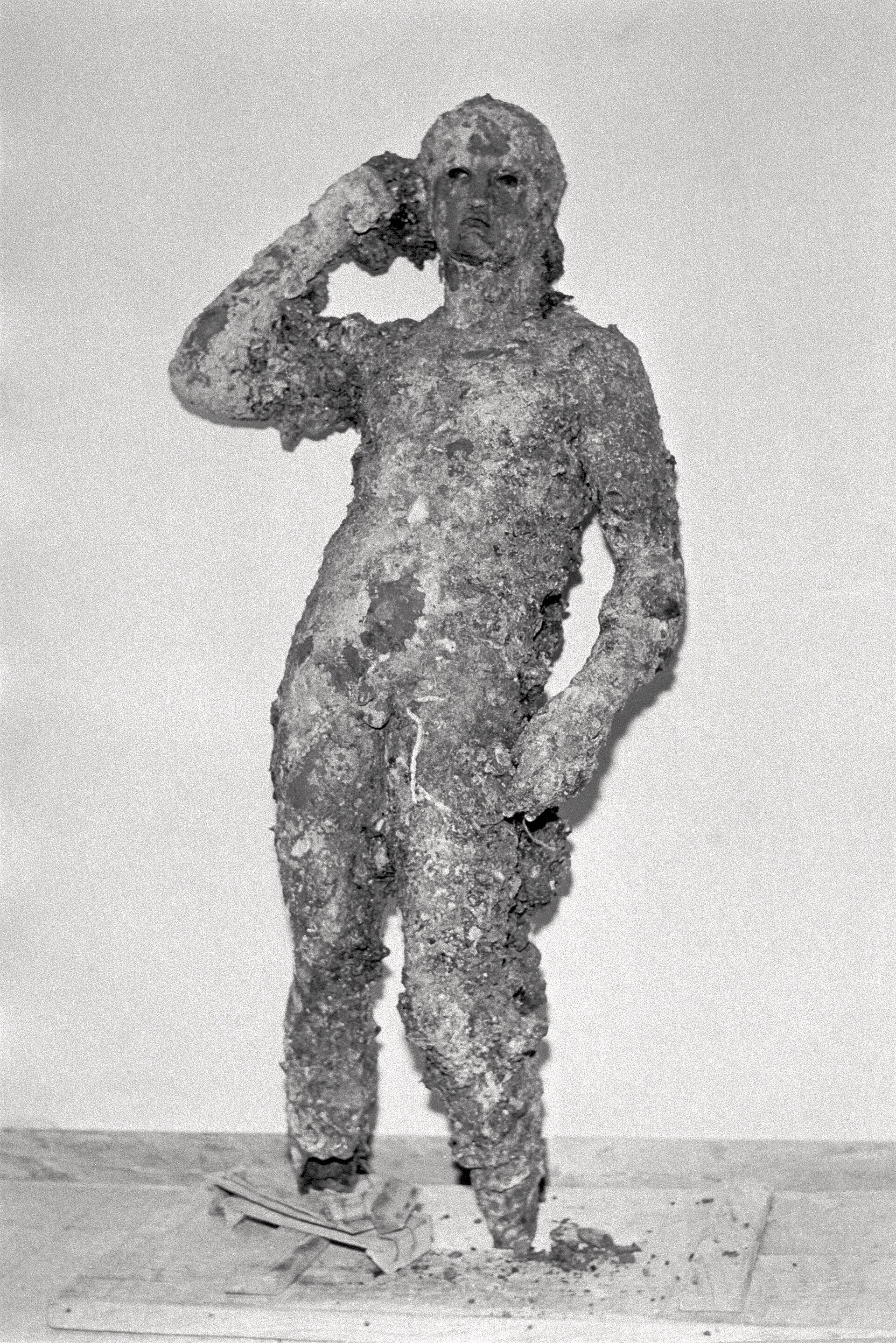
Netted in the summer of 1964 off Fano on the Adriatic coast. Italian art dealers paid the fishermen about 5,600 dollars. The find was not declared to the Italian authorities.31
- 1964 - c. 1965Giacomo Barbetti and associatesdocumented
The dealer Giacomo Barbetti bought the statue and concealed it, by the accounts on record first in a cabbage field and afterwards in a priest's house, one widely repeated version placing it in a bathtub. He then sold it on, in the Geneva Art-Law Centre chronology to an unidentified buyer in Milan, after which it changed hands more than once.13
- 1966 - 1970Subject of Italian criminal proceedingsdocumented
The fishermen, Barbetti and others were charged under Article 67 of Law No. 1089 of 1 June 1939 with handling stolen property. On 8 November 1970 the Court of Appeal in Rome quashed the convictions, holding that the prosecution had not established that the statue was found in Italian waters or that it was of artistic and archaeological interest. This is an acquittal for insufficiency of proof and is not a finding of clean title; the European Court of Human Rights so held in 2024.12
- 1972 - 1974Heinz Herzer, Munichdisputed
The statue surfaced in 1972 at the Munich premises of the dealer Heinz Herzer, who sold it to Artemis in 1974 on the Geneva Art-Law Centre chronology. Wikipedia reverses the order, having the object emerge under Artemis ownership in 1971 and be stored with Herzer. Graded disputed because the two published sequences conflict on who held title when.13
- 1974 - 1977Artemis, a Luxembourg corporationdocumented
Artemis sold the statue to the J. Paul Getty Trust in 1977. Interpol informed the Italian authorities of the sale in the same year, so the source state had contemporaneous notice of the transaction.1
- 1977 - presentJ. Paul Getty Trust, J. Paul Getty Museum, Los Angelesdocumented
Purchased in 1977 for 3.95 million dollars. On public display from 1978. Italy's Minister of Cultural Heritage requested its return in 1989 and the Getty declined. The statue was excluded from the 2007 agreement under which the Getty returned forty objects to Italy. It remains at the Getty Villa as object 77.AB.30.13
- 2010 - presentDeclared property of the Italian State by forfeiture order; possession unchangeddocumented
Forfeiture ordered by the pre-trial judge at the Tribunal of Pesaro on 10 February 2010; remitted by the Court of Cassation on 18 January 2011; upheld 3 May 2012; constitutional questions referred 10 June 2014 and the relevant Code of Criminal Procedure articles held unconstitutional on 15 June 2015; confirmed after public hearing at Pesaro on 8 June 2018; final appeal rejected by the Court of Cassation, dated 2 January 2019 by the Geneva Art-Law Centre and November 2018 by Wikipedia. Italy asked the United States Attorney General to enforce the order in 2019 under the mutual legal assistance treaty; the request was recorded as still pending in 2024. The statue has not moved.123
- 2024 - presentPosition unaltered by the European Court of Human Rightsdocumented
The J. Paul Getty Trust and Others v. Italy, application no. 35271/19, lodged 28 June 2019. First Section of the European Court of Human Rights, deliberated 19 March 2024, judgment 2 May 2024, 92 pages: no violation of Article 1 of Protocol No. 1, reported as unanimous on the operative holding. The Court held the confiscation justified because the Getty's acquisition conduct was negligent and it had implicitly accepted the risk of confiscation without compensation. Judge Wojtyczek gave a separate opinion, described as partly dissenting and partly concurring in one account and as a dissent in another. The judgment does not order the statue's return; it decides only that Italy's order does not breach the Convention.25
Prices realised
This statue has never been sold at public auction and has no hammer price. Every figure attached to it is a private transaction: about 5,600 dollars paid to the fishermen by dealers in 1964, and 3.95 million dollars paid by the J. Paul Getty Trust to the Luxembourg corporation Artemis in 1977, a sale reported to the Italian authorities by Interpol in the year it took place. No premium applies to either, because neither was an auction, and no published estimate exists.
Technical evidence
| Attribution note | The J. Paul Getty Museum catalogues the statue as Greek and dates it about 300 to 100 BC without naming a sculptor; its own published record states that the origin of the statue is unknown. A body of scholarship attributes it to Lysippos of Sikyon, court sculptor to Alexander, and the Italian campaign for its return has adopted that attribution to the point of calling the object simply Lisippo. The attribution is not incidental to the legal case: the Getty argued in the Italian proceedings that the statue was made in Greece and has no genuine connection to Italian patrimony, while the town of Fano's claim on it rests on the fame that the Lysippos name confers. |
|---|---|
| Material and construction | Bronze, hollow cast. Because it is one of the few life-size Greek bronzes to survive, it is a primary source for the technology of ancient bronze casting.4 |
| Inlays | The eyes were originally inlaid with coloured stone or glass paste; the nipples were inlaid with copper, producing naturalistic colour contrasts now entirely lost to corrosion.4 |
| Dimensions and losses | About 1.52 m high as it survives. The lower legs and feet are missing.3 |
| Attribute | The youth crowns himself with a wreath, probably olive. Olive was the prize for a victor at the Olympic Games, which is what identifies the figure as an athlete rather than a divinity.4 |
| Date and culture as catalogued | Greek, about 300-100 BC, in the museum's own record. No sculptor is named by the museum, which states that the origin of the statue is unknown and proposes Olympia or the athlete's home town as possible.4 |
| How it reached the Adriatic | The museum's own explanation is that Romans probably removed the statue from its original location in the first century BC or AD, during the height of Roman collecting of Greek art, and that the ship carrying it may have foundered, which preserved it in the sea.4 |
| Object number and location | 77.AB.30, J. Paul Getty Museum, Getty Villa, Gallery 111, The Hellenistic World.4 |
| Photography licence | The J. Paul Getty Museum publishes its own photographs of this object under CC0. Licence verified per file from the Commons API extmetadata LicenseShortName. This is why this record carries a verified lead image where the other two antiquity records in this wave do not.4 |
Images
The record in full
Chapter 1What it is, and why so few of them exist
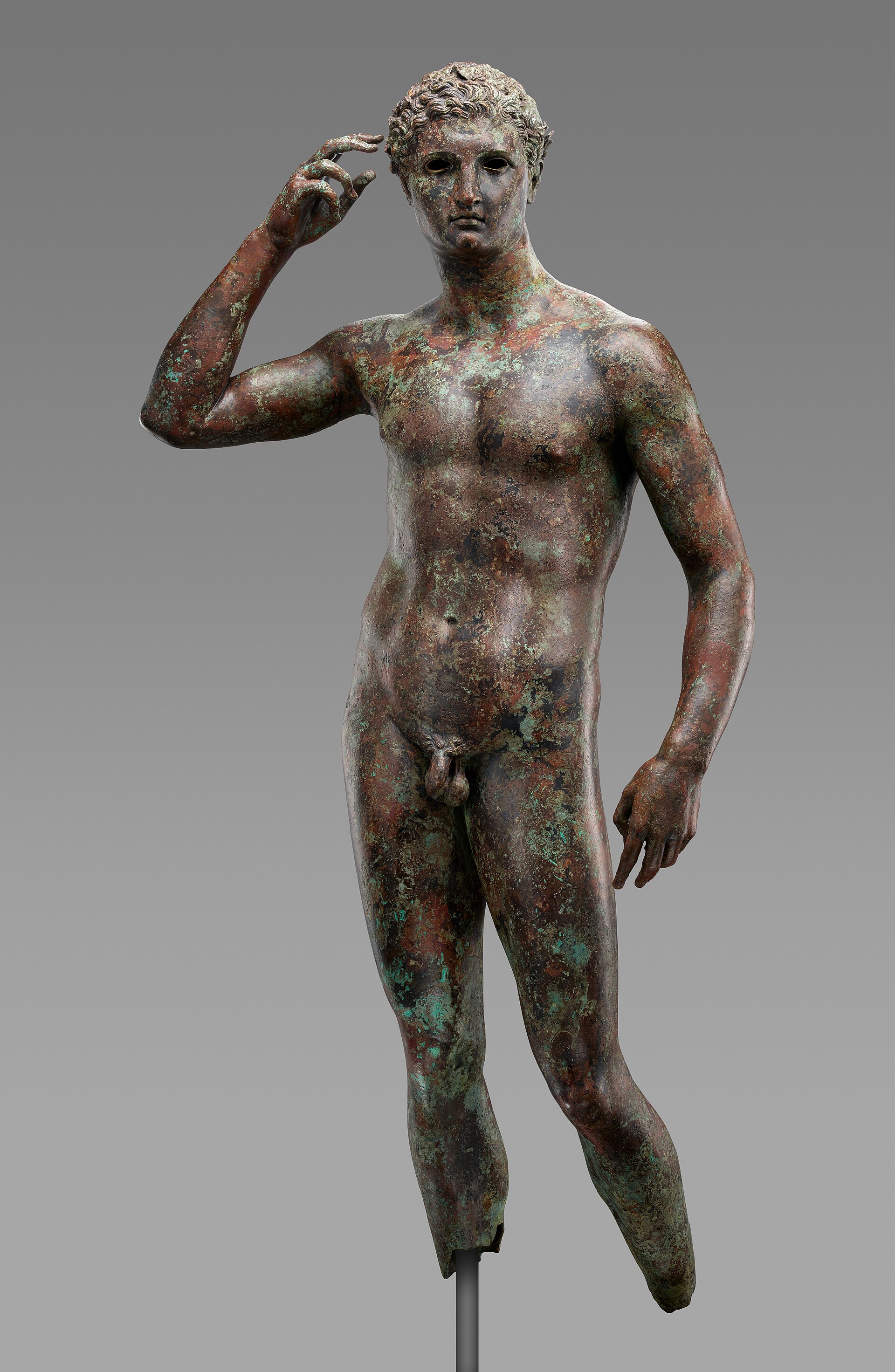
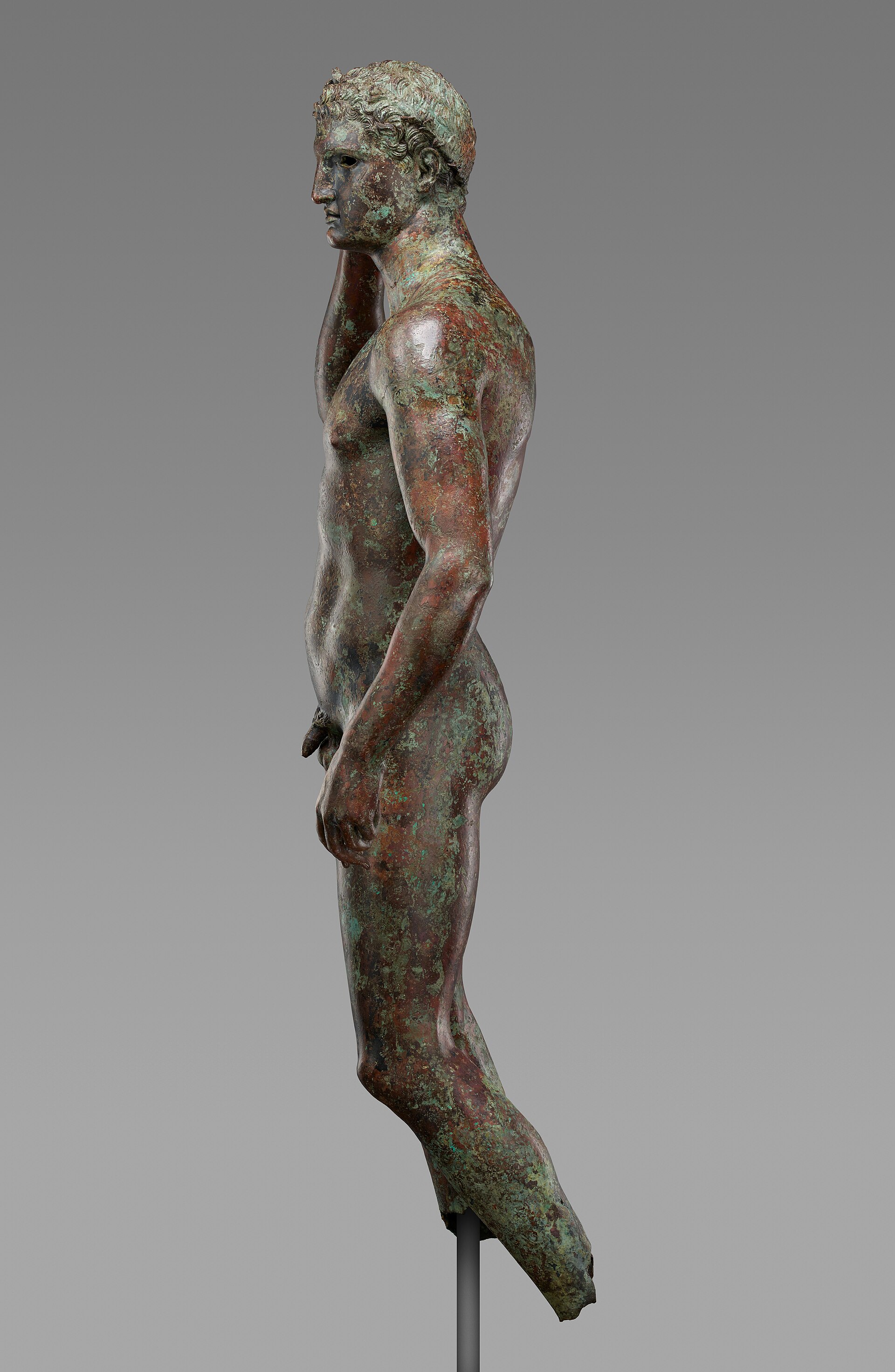
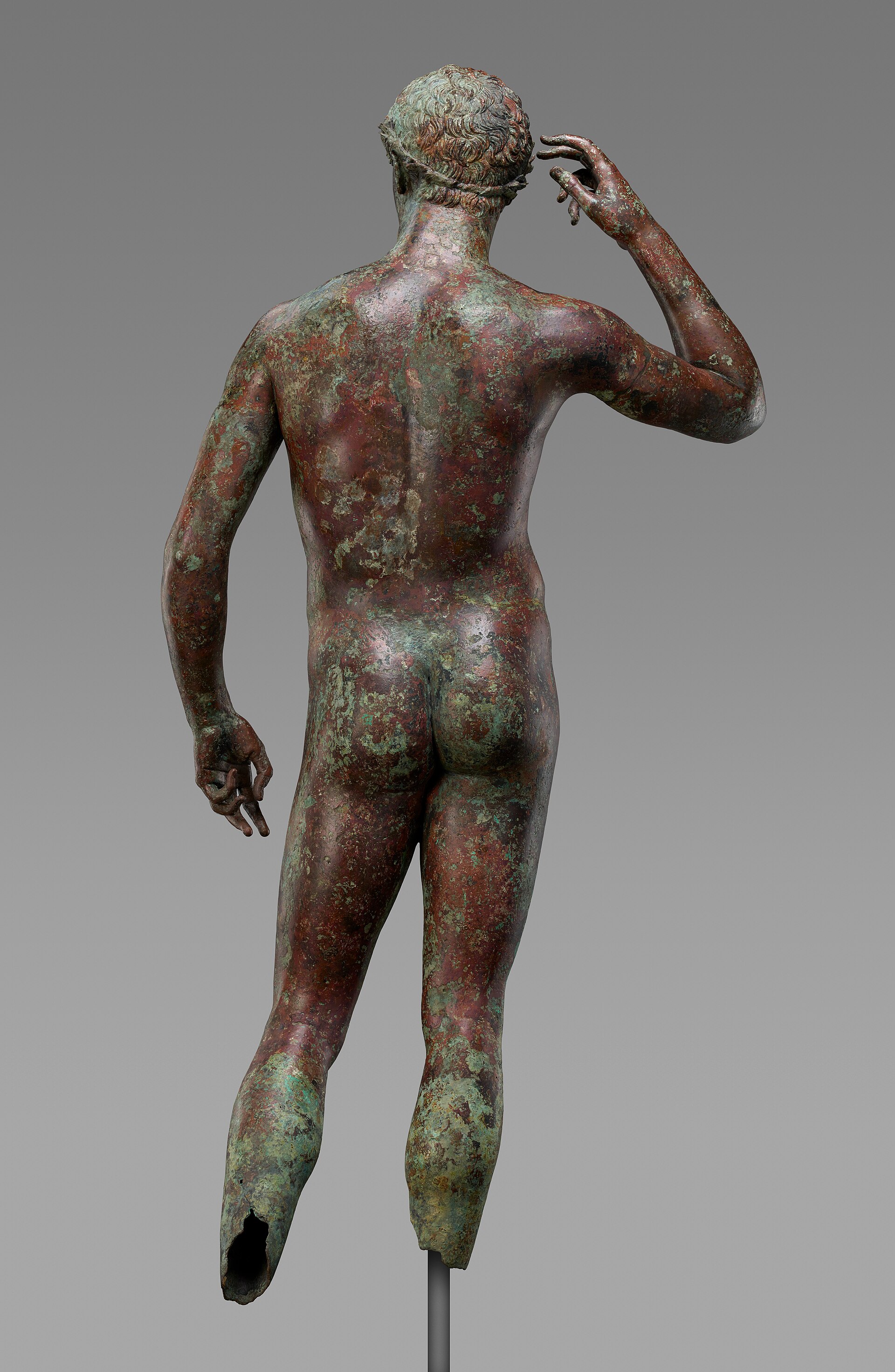
A naked youth stands with his weight on his right leg, his right hand raised to set a wreath on his own head.
A naked youth stands with his weight on his right leg, his right hand raised to set a wreath on his own head. The wreath is probably olive, and olive was the prize at Olympia, which is what identifies him as a victorious athlete rather than a god or a prince. The eyes were originally inlaid with coloured stone or glass paste and the nipples with copper, so the figure as made was polychrome in a way the corroded green surface now conceals entirely.
It survives to about 1.52 metres. The lower legs and the feet are gone. It is hollow cast, and because it is one of the very few life-size Greek bronzes to have come down to us at all, it carries an amount of technical information about ancient bronze casting out of proportion to its size.
Almost every large Greek bronze was melted down. Bronze is a raw material with a standing resale value, and a statue is a convenient billet. The handful that survive survive because they went into the sea: the Riace bronzes, the Antikythera youth, the Marathon boy, the Croatian Apoxyomenos, this figure. The sea is the reason there is anything to argue about, and it is also, as it turned out, the reason the argument has lasted sixty years.
Chapter 2The net, 1964
In the summer of 1964 the statue came up in the nets of an Italian fishing trawler working the Adriatic off Fano, on the Marche coast.
In the summer of 1964 the statue came up in the nets of an Italian fishing trawler working the Adriatic off Fano, on the Marche coast. The boat is recorded as the Ferruccio Ferri. Italian art dealers paid the crew about 5,600 dollars for it.
What happened next is the part that no document fixes precisely and that every account tells slightly differently. The dealer Giacomo Barbetti bought it and it was concealed: in a cabbage field, and afterwards in a priest's house, where one widely repeated version has it hidden in a bathtub. It was then sold on, in the ArThemis chronology to an unidentified buyer in Milan, and it changed hands more than once before it left the country.
Nobody wrote any of this down at the time, which is the ordinary condition of a find that is not declared. Under Italian law of the period, an antiquity found in Italian territory belonged to the state from the moment it was found. A crew that lands one and sells it for cash has not made a private sale; it has disposed of state property. Whether that law reached this object depends entirely on where the net was when it closed, and no one on the boat was taking a position.
Chapter 3The 1970 acquittal is the document this whole case runs on, and it is not a title deed
Between 1966 and 1970 the fishermen, Barbetti and others were prosecuted under Article 67 of Law No.
Between 1966 and 1970 the fishermen, Barbetti and others were prosecuted under Article 67 of Law No. 1089 of 1 June 1939, the Italian cultural property statute, for handling stolen property. On 8 November 1970 the Court of Appeal in Rome overturned the convictions. The stated grounds were that the prosecution had not established that the statue was discovered in Italian waters, and had not established that it was of artistic and archaeological interest.
Read that carefully, because the next fifty years depend on it. It is an acquittal for insufficiency of proof. It does not find that the statue came from international waters. It does not find that the statue is not of archaeological interest. It finds that the state failed to prove either proposition to a criminal standard against those particular defendants in 1970. An acquittal on the evidence is not a declaration that the opposite is true, and it certainly is not a conveyance of good title from the Italian state to whoever holds the object.
The Getty, on the advice of the vendor's lawyers, treated the 1970 judgment as clearing the statue for purchase. The European Court of Human Rights addressed that reasoning directly in 2024 and rejected it, holding that reliance on an acquittal that merely reflected insufficient evidence, rather than clear title, did not meet the high standard of diligence required of a major institutional buyer.
This is why the object belongs in this archive. The case is not a connoisseurship dispute and it is not really about Lysippos. It is about what a court document does and does not say, and about an institution that read a criminal judgment as a commercial warranty.
Chapter 4Munich, Luxembourg, Malibu
The statue surfaced in 1972 in Munich at the premises of the dealer Heinz Herzer.
The statue surfaced in 1972 in Munich at the premises of the dealer Heinz Herzer. In 1974 Herzer sold it to Artemis, a Luxembourg corporation. In 1977 Interpol informed the Italian authorities that Artemis had sold the bronze to the J. Paul Getty Trust for 3.95 million dollars. It went on public display in 1978.
The sequence is not agreed in every detail. Wikipedia's account has the statue emerging under the ownership of the Artemis consortium in 1971 and being stored with Herzer, which reverses the order given in the Geneva Art-Law Centre chronology. Both agree on Herzer, on Artemis and on the 1977 sale price. This record does not arbitrate between them; the disagreement is recorded because it sits exactly where a provenance chain most often goes soft, between the dealer who holds an object and the corporate vehicle that sells it.
What is agreed and rarely emphasised is the year. The 1970 UNESCO Convention was three years old when the object reached Munich and seven years old when the Getty bought it. Italy had prosecuted people over this statue within living memory of the purchase, and Interpol was circulating the sale as it happened. The Getty did not buy in the dark.
Chapter 5The museum states the contested fact in its own tombstone
The J. Paul Getty Museum's published record for object 77.AB.30 begins its account of the object's history with a plain declarative: found in the sea in international waters.
The J. Paul Getty Museum's published record for object 77.AB.30 begins its account of the object's history with a plain declarative: found in the sea in international waters. The rest of the entry is candid about how little is known. The origin of the statue is unknown; Olympia or the athlete's home town are both possible. Romans probably carried it off during the first century BC or AD, when Roman collecting of Greek art was at its height, and the ship carrying it may have foundered, which is what preserved it.
All of that is careful, hedged museum prose. The one thing stated without hedge is the single fact that Italian courts have refused to accept for fifty years and that the 1970 acquittal did not find. A visitor reading the label learns the legal conclusion the museum needs, presented as background.
This is worth recording precisely because it is not a forgery, a smuggler's story or a fake licence. It is a large, well-funded, professionally curated institution publishing a contested jurisdictional finding as a settled fact of provenance, in the one place where a general reader will take it on trust.
Chapter 6Twelve years of Italian procedure, in sequence
Italy's Minister of Cultural Heritage asked for the statue back in 1989.
Italy's Minister of Cultural Heritage asked for the statue back in 1989. The Getty declined. In 2007 Italy and the Getty Trust concluded an agreement under which forty objects were returned and a programme of cultural cooperation was set up. The bronze was not in it. In the same year proceedings at the Tribunal of Pesaro concerning the illicit export lapsed on limitation.
That is where most narratives stop, and it is where the case actually begins. In 2009 the prosecutor at Pesaro asked instead for forfeiture, a remedy directed at the object rather than at any person. On 10 February 2010 the pre-trial judge at Pesaro ordered the statue forfeited. The Getty appealed. On 18 January 2011 the Court of Cassation sent the case back to Pesaro because the earlier appeal had been procedurally misqualified. On 3 May 2012 the pre-trial judge upheld the forfeiture order. The Getty appealed again. On 10 June 2014 the Court of Cassation referred constitutional questions to the Constitutional Court about the procedure being used. On 15 June 2015 the Constitutional Court held the relevant articles of the Code of Criminal Procedure unconstitutional and sent the matter back to Pesaro for a public hearing. On 8 June 2018 the Tribunal of Pesaro heard it in public, rejected the Getty's case and confirmed the forfeiture. The Court of Cassation then rejected the Getty's final appeal.
The date of that last decision is reported two ways. The Geneva Art-Law Centre gives 2 January 2019; Wikipedia gives November 2018. Both cannot be the date of the same act, and the discrepancy is the ordinary one between the hearing and the filing of an Italian judgment. This record does not guess which is which.
Nine judicial decisions in twelve years, two of them from the Court of Cassation and one from the Constitutional Court, and at the end of them the statue is exactly where it was in 1978.
Chapter 7Forfeiture, repatriation, settlement and conviction are four different things
The words are used interchangeably in press coverage of antiquities cases and they have nothing like the same consequences.
The words are used interchangeably in press coverage of antiquities cases and they have nothing like the same consequences. This case contains three of the four and it is worth naming which is which.
Nobody has been convicted in relation to this statue. The only criminal convictions ever recorded, of the fishermen and Barbetti, were quashed in 1970, and the later Pesaro proceeding on illicit export expired on limitation in 2007. The 2007 agreement under which forty other objects went back to Italy was a negotiated settlement, and this object was excluded from it. What Italy holds is a forfeiture order: an order in rem, made against the thing, declaring it property of the Italian state and requiring its confiscation. It binds an Italian court. It does not by itself move an object that is in California.
A repatriation is what happens when a holder transfers an object, whether by agreement, by court order it chooses to obey, or by enforcement. None of those has occurred here. Italy asked the United States Attorney General's office to enforce the order in 2019 under the mutual legal assistance treaty between the two countries, and that request was recorded as still pending when the European Court gave judgment in 2024. American courts have not ruled on it.
So the correct statement of the position, as at this record's verification date, is that the statue is Italian state property as a matter of Italian law, remains in the lawful physical possession of the J. Paul Getty Museum as a matter of fact, and that no court in the jurisdiction where it sits has ordered anything.
Chapter 8Strasbourg, 2 May 2024
The J. Paul Getty Trust and fourteen American nationals lodged application no.
The J. Paul Getty Trust and fourteen American nationals lodged application no. 35271/19 against Italy on 28 June 2019, complaining that the confiscation order violated Article 1 of Protocol No. 1 to the European Convention on Human Rights, the guarantee of peaceful enjoyment of possessions. The First Section of the European Court of Human Rights deliberated on 19 March 2024 and gave judgment on 2 May 2024, in a text running to 92 pages. It found no violation.
The reasoning matters more than the result. The Court accepted that the Getty had acquired a proprietary interest through more than forty years of continuous possession and that the confiscation order interfered with it. It then held the interference justified, on the ground that the Getty's conduct at acquisition had been negligent and possibly worse. Four failures were identified: relying solely on experts supplied by the vendor rather than commissioning an independent assessment; failing to contact the Italian authorities despite knowing there was a provenance problem; treating the 1970 acquittal as if it established title when it established only that the prosecution had failed; and falling short of the high standard of diligence expected in a transaction of that size. The Court concluded that the Trust had implicitly accepted the risk of confiscation without compensation. The Italian findings the Court reviewed were that the statue was protected by Italian cultural heritage and customs law, that it had been unlawfully exported, and that the Trust had bought it negligently in the absence of any export licence.
The compensation point is the sharpest part of the judgment for anyone in the market. Both the 1970 UNESCO Convention and the 1995 UNIDROIT Convention contemplate compensating an innocent possessor who exercised proper diligence. The Court noted that framework and then held that it did not rescue the Getty, because the diligence was not there. Buying carefully is not a formality that produces a paper trail; on this reading it is the condition of ever being paid anything if the object is taken.
Judge Wojtyczek appended a separate opinion, characterised in one account as partly dissenting and partly concurring and in another simply as a dissent; the operative holding is reported as unanimous. The judgment does not order the Getty to hand the statue over. It decides only that Italy's order does not breach the Convention, which leaves the object where it has been since 1978 and the order where it has been since 2010.
Chapter 9What a museum's diligence file is actually for
Read as a practical document rather than a human rights judgment, the 2024 decision is a specification for a purchase file, written by a court, using a real institution's failures as the negative...
Read as a practical document rather than a human rights judgment, the 2024 decision is a specification for a purchase file, written by a court, using a real institution's failures as the negative example.
An expert opinion obtained by the seller is not diligence, because the seller chose the expert. A criminal judgment in the source country is not a title search, because criminal courts decide whether the prosecution proved its case and not who owns the object. Not asking the source country is not neutrality, because the question of whether a state claims an object is answered only by asking the state. And the standard rises with the price: the Court expressly tied the level of diligence required to the scale of the transaction.
None of those propositions is novel to anyone who has run a title search on a building. What is novel is that a court has now applied them to an art purchase and attached the consequence: the buyer who skipped them can be stripped of the object and is not entitled to be paid for it.
Chapter 10Fano, and what a town is claiming
The statue is known in Italy as the Atleta di Fano, and the town has campaigned for its return for decades, to the point that the object is often referred to locally as simply Lisippo.
The statue is known in Italy as the Atleta di Fano, and the town has campaigned for its return for decades, to the point that the object is often referred to locally as simply Lisippo. That is a claim built on an attribution the holding museum does not itself assert, to an object that, on all accounts, was never made in Fano, never displayed in Fano and reached Fano's waters, if it reached them at all, in the hold of a Roman ship that sank.
The Italian position has never been that the statue is Italian art. It is that the object became Italian state property at the moment it was raised in an Italian boat's nets, on the argument that a fishing vessel's net is an extension of the vessel and therefore of the flag state's territory. That is a technical proposition about jurisdiction, and it is the whole of Italy's case; the Getty's answer is that the find was in international waters and that a Greek statue has no genuine connection to Italian patrimony beyond a brief clandestine passage across it.
The two positions are not really about the same thing. One is about where a net was. The other is about where a sculptor lived. They have been argued past each other for sixty years.
Chapter 11Where it stands
The bronze is on view at the Getty Villa in Gallery 111, catalogued as Greek, about 300 to 100 BC, object number 77.AB.30.
The bronze is on view at the Getty Villa in Gallery 111, catalogued as Greek, about 300 to 100 BC, object number 77.AB.30. It is Italian state property under an Italian forfeiture order that the European Court of Human Rights has declined to disturb. Italy's request to the United States Attorney General to enforce that order, made in 2019, was still pending when Strasbourg ruled. The Getty is reported to have cancelled a planned loan to Florence for fear the statue would be seized once it was inside Italian jurisdiction, which is the clearest indication available of how both sides read the position.
A collector doing diligence on any comparable object should take two things from this record. The first is that a favourable criminal judgment in the source country is worth very much less than it looks, and that a court has now said so at the highest level available in Europe. The second is that an unenforced forfeiture order does not decay. It has been outstanding since 2010, has survived a constitutional challenge and a human rights application, and the object cannot be sold, lent across a border or insured against seizure while it stands.
The artist
Unidentified Greek bronze caster; the attribution to Lysippos of Sikyon
The honest position is the one the holding museum takes in its own record: the origin of the statue is unknown. There is no signature, no base, no sanctuary and no inscription. What exists is a body of scholarship proposing Lysippos of Sikyon, the sculptor Alexander is said to have preferred, and an Italian public campaign that has adopted the proposal so completely that the object is called Lisippo in the town that wants it back. Both the scholarship and the campaign are facts about people arguing, not facts about the caster, and this record keeps them apart. The one thing the bronze itself testifies to is technical: it is among the very few life-size Greek bronzes anywhere, and that makes it a primary document for how such figures were made.
Exhibited
- 1978Placed on public display after acquisitionJ. Paul Getty Museum, Malibu
- 2026Permanent display, Gallery 111, The Hellenistic WorldGetty Villa, Los Angeles
Related works
| Work | Relation | Where it is |
|---|---|---|
| The Riace Bronzes Unidentified Greek bronze casters | Comparandum; life-size Greek bronzes recovered from the sea Found off Riace in 1972 in Italian waters, declared, excavated and retained by Italy. The clean counter-example to this object at every stage. | Museo Archeologico Nazionale, Reggio Calabria |
| The Croatian Apoxyomenos Unidentified Greek bronze caster | Comparandum; a sea-found bronze athlete with an uncontested modern history Located by a diver in 1999 off Losinj, reported, raised by the state and conserved in public hands. A bronze athlete found in the Adriatic thirty-five years later, handled the other way. | Museum of Apoxyomenos, Mali Losinj, Croatia |
| Apoxyomenos Roman marble copy after Lysippos | The comparison on which the Lysippos attribution rests The best-known reflection of Lysippos's manner and proportions. No original by Lysippos survives, so every attribution to him is an argument from copies. | Vatican Museums, Rome |
| The Antikythera Youth Unidentified Greek bronze caster | Comparandum; life-size Greek bronze from a documented wreck Raised from the Antikythera wreck from 1900, with the cargo recorded, which is exactly what this statue lacks. | National Archaeological Museum, Athens |
| The forty objects returned to Italy in 2007 Various | The negotiated settlement from which this object was excluded The 2007 Getty-Italy agreement returned forty antiquities and set up a cooperation programme. The bronze was kept out of it, which is why litigation continued for another twelve years. | Italian state collections |
Open questions
- Was the statue raised inside Italian territorial waters? Sixty years of proceedings have not established it. The 1970 Italian acquittal found only that the prosecution had failed to prove it, which is not a finding that the opposite is true.
- Who was the Milan buyer, and who held the statue between about 1965 and 1972? The chain between Barbetti's sale and the appearance at Herzer's premises in Munich is described in the sources as multiple changes of hand with no names.
- Did Herzer sell to Artemis in 1974, or did Artemis already own the statue in 1971 with Herzer holding it? The Geneva Art-Law Centre and Wikipedia give incompatible sequences.
- What is the date of the final Court of Cassation decision? It is given as 2 January 2019 by the Geneva Art-Law Centre and as November 2018 by Wikipedia. Both may refer to the same act at different procedural stages, but neither source states which.
- Will the United States act on Italy's 2019 mutual legal assistance request? It was still pending when the European Court ruled in May 2024. No American court has ruled on the forfeiture order.
- Is the attribution to Lysippos sustainable? The holding museum does not make it. Italian officials have publicly questioned it while Italy's own campaign for the statue's return trades on it.
- Where are the lower legs and feet? No account consulted records whether they were lost in antiquity, lost in the sea, or separated after 1964.
- What did the Getty's 1977 diligence file actually contain? The European Court found reliance on vendor-supplied experts and on the 1970 acquittal, but the file itself has not been published.
- How should Judge Wojtyczek's separate opinion be classified? The Center for Art Law describes it as partly dissenting and partly concurring; ARCA reports the ruling as unanimous with a dissenting opinion. The judgment text itself could not be retrieved for this record.
Questions about this object
What is Statue of a Victorious Youth?
Statue of a Victorious Youth is an antiquity, dated about 300-100 BC. Medium: Bronze, hollow cast by the lost-wax process; eyes originally inlaid with coloured stone or glass paste; nipples inlaid with copper.
Who made Statue of a Victorious Youth, and is the attribution settled?
The attribution to Unidentified Greek bronze caster; attributed by some scholars to Lysippos of Sikyon is recorded here as disputed. The J. Paul Getty Museum catalogues the statue as Greek and dates it about 300 to 100 BC without naming a sculptor; its own published record states that the origin of the statue is unknown. A body of scholarship attributes it to Lysippos of Sikyon, court sculptor to Alexander, and the Italian campaign for its return has adopted that attribution to the point of calling the object simply Lisippo. The attribution is not incidental to the legal case: the Getty argued in the Italian proceedings that the statue was made in Greece and has no genuine connection to Italian patrimony, while the town of Fano's claim on it rests on the fame that the Lysippos name confers.
Where is Statue of a Victorious Youth now?
J. Paul Getty Museum, Getty Villa, Los Angeles, object number 77.AB.30, Gallery 111, The Hellenistic World. Last confirmed 3 August 2026. Purchased 1977; subject to an Italian forfeiture order upheld by the Court of Cassation and to a 2024 European Court of Human Rights judgment finding no violation in that order. The statue has not moved.
What is still unknown about Statue of a Victorious Youth?
Was the statue raised inside Italian territorial waters? Sixty years of proceedings have not established it. The 1970 Italian acquittal found only that the prosecution had failed to prove it, which is not a finding that the opposite is true.
Sources
- 1Art-Law Centre, University of Geneva, ArThemis platform, case note 'Victorious Youth - Italy v. J. Paul Getty Museum'. Chronology of the 1964 find, the 1966-1970 criminal proceedings and the 8 November 1970 Rome Court of Appeal judgment, the Munich and Artemis transfers, the 1977 sale price, the 2007 agreement and the forfeiture orders of 2010, 2012, 2018 and the final Cassation decision, together with the legal basis relied on by each side. plone.unige.ch/art-adr/...
- 2Center for Art Law, 'Case Review: Getty v. Italy (2024)'. The European Court of Human Rights judgment of 2 May 2024 in application no. 35271/19: the holding on Article 1 of Protocol No. 1, the four findings on the Getty's diligence, the treatment of the 1970 acquittal, the UNESCO and UNIDROIT compensation framework, Judge Wojtyczek's separate opinion, and the pending mutual legal assistance request. itsartlaw.org/art-law/...
- 3Wikipedia, 'Victorious Youth'. Tertiary source, used for the trawler Ferruccio Ferri, the 5,600 dollars paid to the fishermen, the concealment accounts, the surviving height and the alternative Artemis chronology. Flagged for replacement with the Getty's published provenance and the Pesaro and Cassation judgments themselves. en.wikipedia.org/wiki/...
- 4J. Paul Getty Museum object record for Statue of a Victorious Youth, 77.AB.30, quoted verbatim on the Wikimedia Commons page for the museum's own CC0 photograph, which also carries the object number, the gallery, the source link to getty.edu and the licence. Licence verified per file from the Commons API extmetadata LicenseShortName. commons.wikimedia.org/wiki/...
- 5ARCAblog, Association for Research into Crimes against Art, report of the European Court of Human Rights decision of 2 May 2024. The First Section composition, the deliberation of 19 March 2024, the 92-page length, the unanimous operative holding, Judge Wojtyczek's separate opinion, the Italian findings on cultural heritage and customs law and the absence of an export licence, and the Trust's stated concern about recognition and enforcement of the confiscation in the United States. art-crime.blogspot.com/2024/...
.jpg)
Last verified 13 August 2026 · Published 4 August 2026
Change log
13 August 2026 - Re-verified: no change to custody (still Getty Villa, 77.AB.30) or legal status since the 2 May 2024 ECtHR judgment and the January 2025 Osanna attribution comment already recorded. No MLAT enforcement action, US court ruling, seizure, or transfer located through August 2026 - Italy's 2019 mutual legal assistance request remains unresolved, consistent with the open question already on file. All five cited source URLs re-resolved live.
2 August 2026 - Record deepened to the house standard: narrative sections, technical evidence, artist dossier, related works and open questions added; provenance chain and auction results replaced with the researched versions; sources rebuilt.
6 August 2026 - Re-verified: no change to custody (still Getty Villa, 77.AB.30) or legal status since the 2 May 2024 ECtHR judgment; no new ruling, seizure, transfer, or MLAT enforcement action found; Getty's found-in-international-waters position unchanged; all previously cited source URLs re-resolved. Updated the Lysippos-attribution open question with a January 2025 development: Italy's own Director General of Museums, Massimo Osanna, publicly cast doubt on the attribution, undercutting the branding Fano's restitution campaign has relied on.
4 August 2026 - Record created at the house standard: researched narrative, technical evidence, maker dossier, graded provenance chain, prices with hammer and premium separated, related works, open questions and sources.