
The Antikythera Mechanism
c. 150-100 BC · Bronze plates and gearing in a wooden case
National Archaeological Museum, Athens
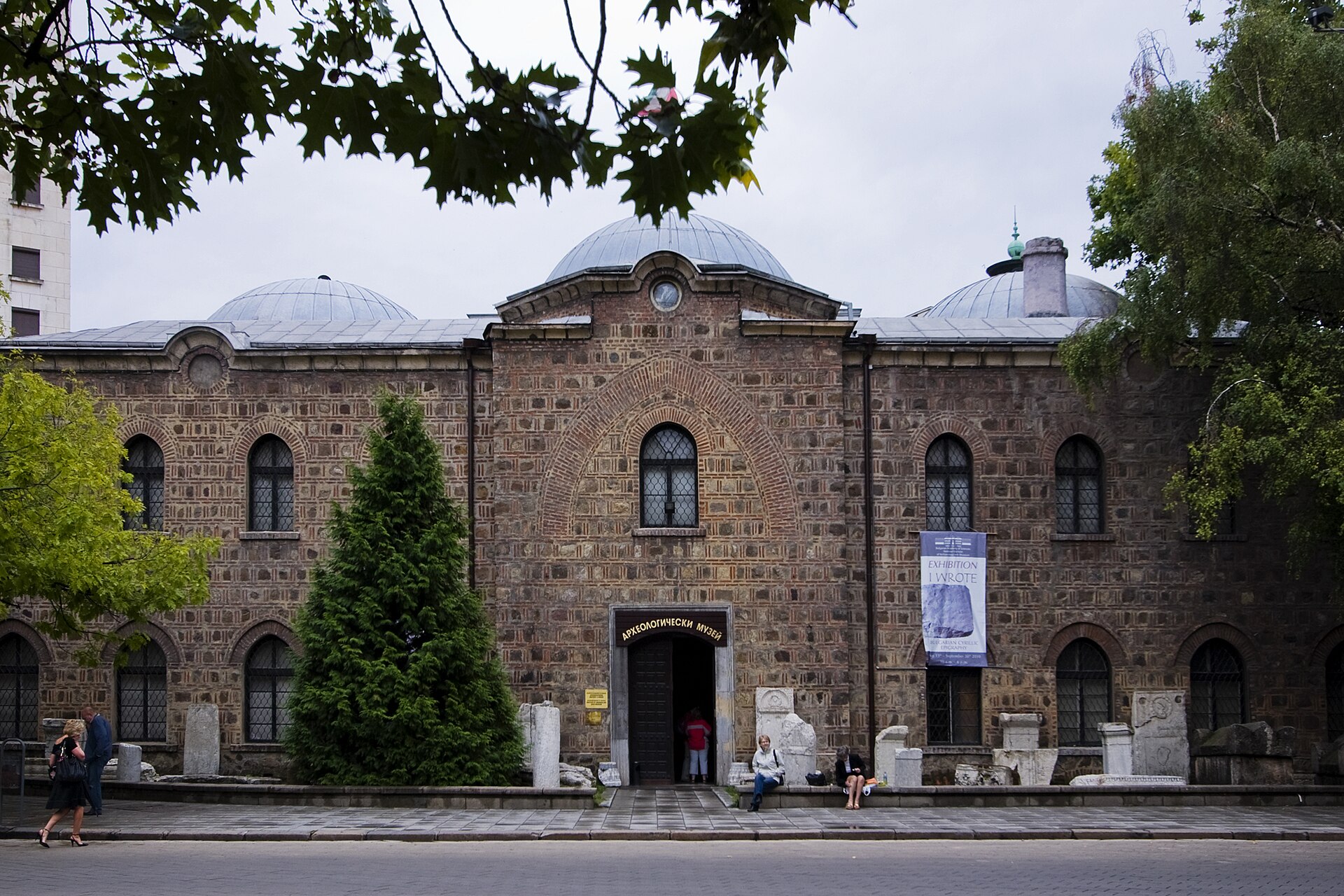
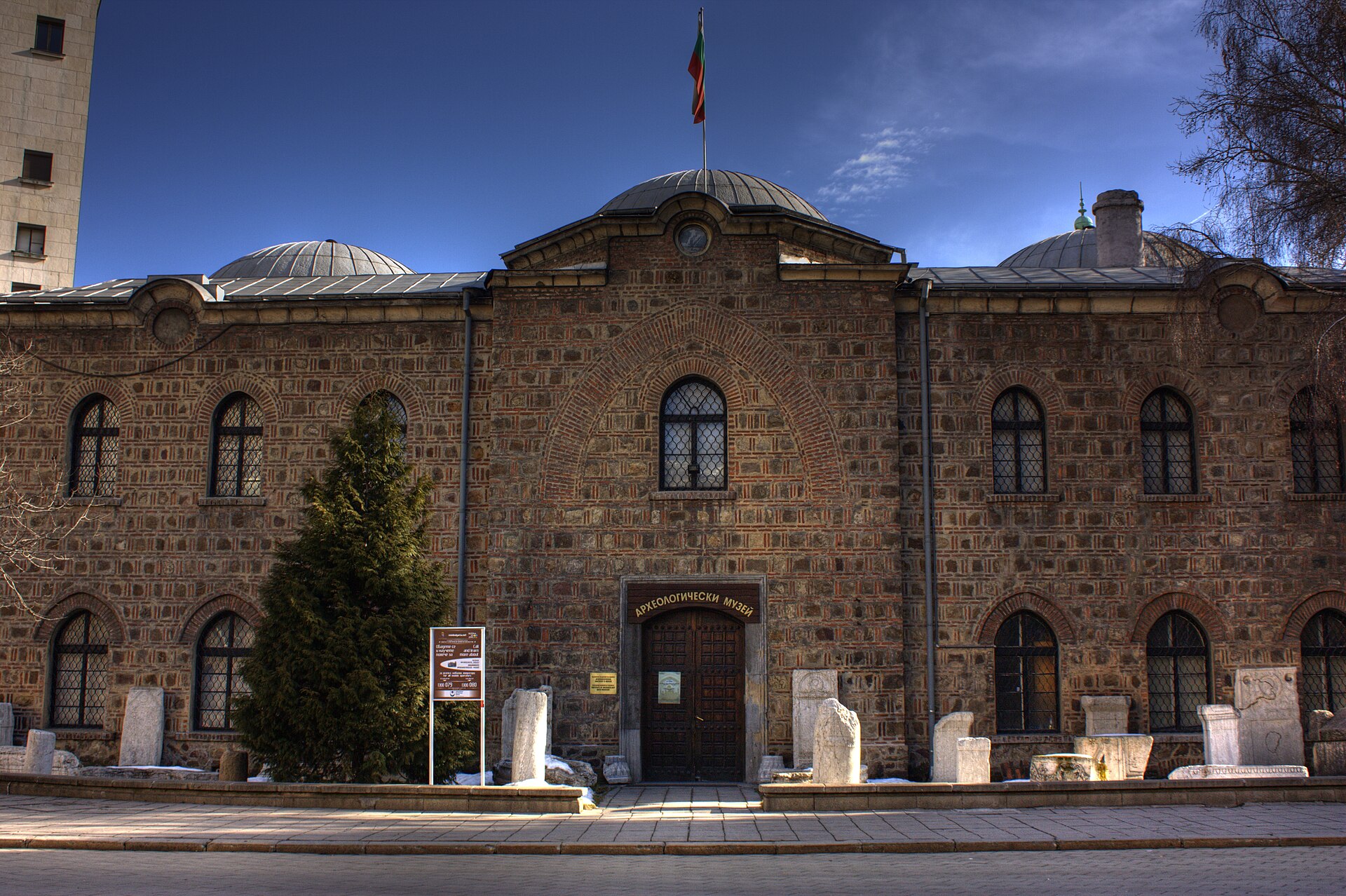
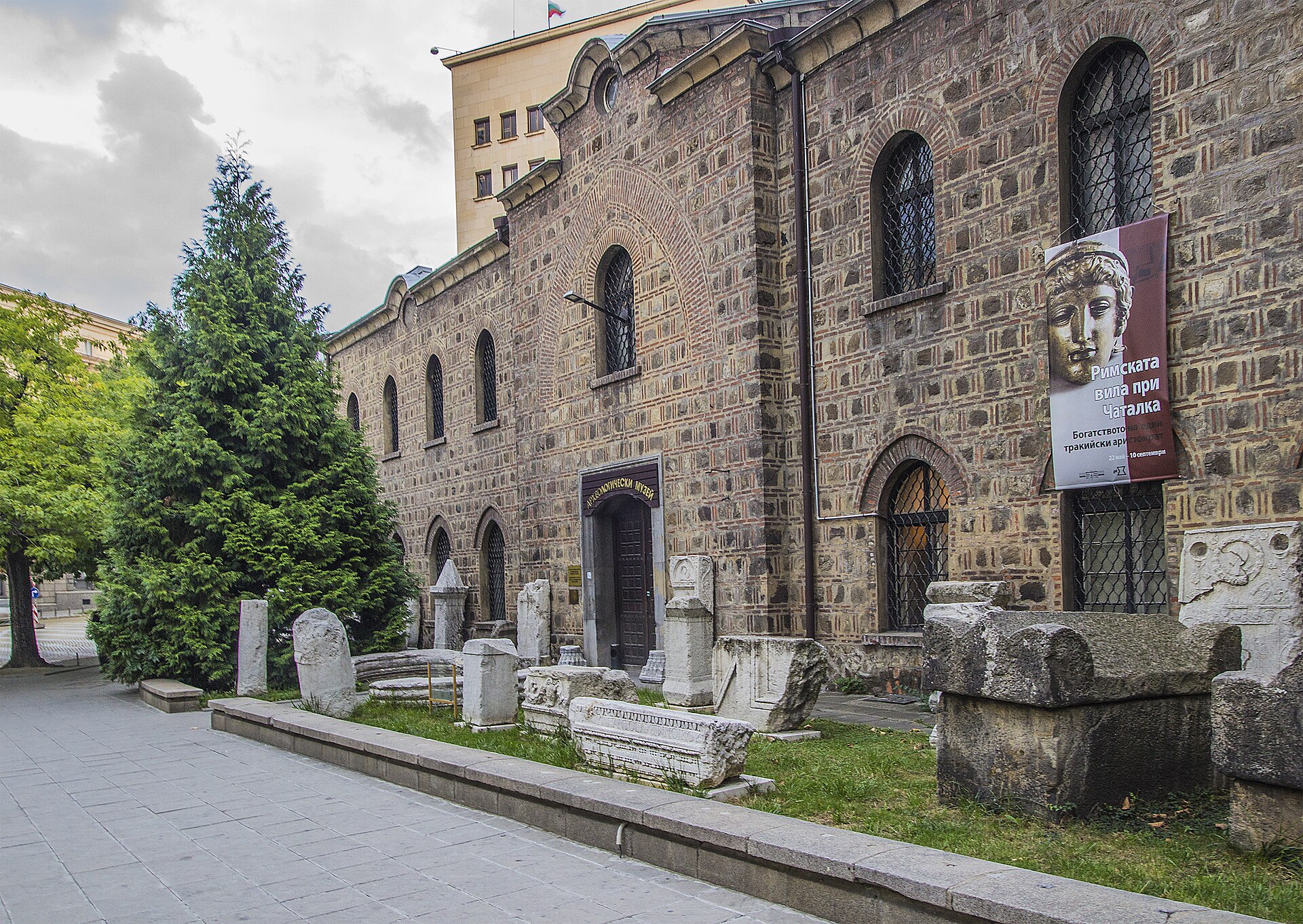
The museum's entrance on Atanas Burov Square, its Ottoman-era brick and stone banding and the sign reading Archaeological Museum in Bulgarian clearly visible above the door.
Ann Wuyts · CC BY 2.0Museum · Nacionalen arheologicheski muzey · Founded 1892
Open, admission and hours confirmed 24 August 2026 · 22 sources
The strength of the collection is Thracian: named gold and silver hoards spanning the Bronze Age to the Hellenistic period, drawn from tumulus excavations across northern and central Bulgaria, sit alongside a prehistory sequence that the museum, with reasonable justification, calls among the most complete on the Balkan peninsula. The medieval holdings are narrower but include material, such as the early Cyrillic epitaph from Veliki Preslav, that speaks directly to the emergence of Slavic literacy in the First Bulgarian Empire.
| Local name | Nacionalen arheologicheski muzey |
|---|---|
| Kind | Museum |
| Founded | 1892 |
| City and country |  Sofia, Bulgaria Sofia, Bulgaria |
| Address | 2 Saborna Street, 1000 Sofia, Bulgaria (entrance at Atanas Burov Square No 1) |
| Website | naim.bg/en/home |
| Status | Open, confirmed |
| Record last verified |
Prices and hours change. We take them from the institution's own pages and print the day we read them, and you can check the current position at the source we used. Confirm before you travel.
Ground floor, northern wing. Runs from the Lower Palaeolithic to the Bronze Age: an engraved animal bone from Kozarnika cave, among the earliest traces of human presence claimed for Europe; Middle Palaeolithic leaf-shaped spearheads; Upper Palaeolithic ornament of shell, tooth and bone; Neolithic polished stone tools and a decorated figurine of a bull with a rider from Kapitan Andreevo; Chalcolithic gold jewellery the museum describes among the world's earliest, alongside the Karanovo seal, read by the museum as an early device for recording information; and Bronze Age daggers, hammer-axes and pottery from the tell at Ezero.
Second floor, eastern building, built to hold treasures and grave goods from the Late Bronze Age to Late Antiquity. Three named hoards anchor it: the Vulchitrun treasure of gold vessels and disks from the Pleven region; the Lukovit treasure, silver horse-harness plates from the Lovech region; and the Nikolaevo treasure of Roman-period gold, silver and coin. Alongside them stand finds from six warrior graves at Trebenishte, a gold funerary mask from the Svetitsa tumulus near the village of Kran, and a bronze portrait head from the Golyama Kosmatka tumulus at Shipka, which the museum's own gallery text associates with the burial of an Odrysian Thracian ruler.
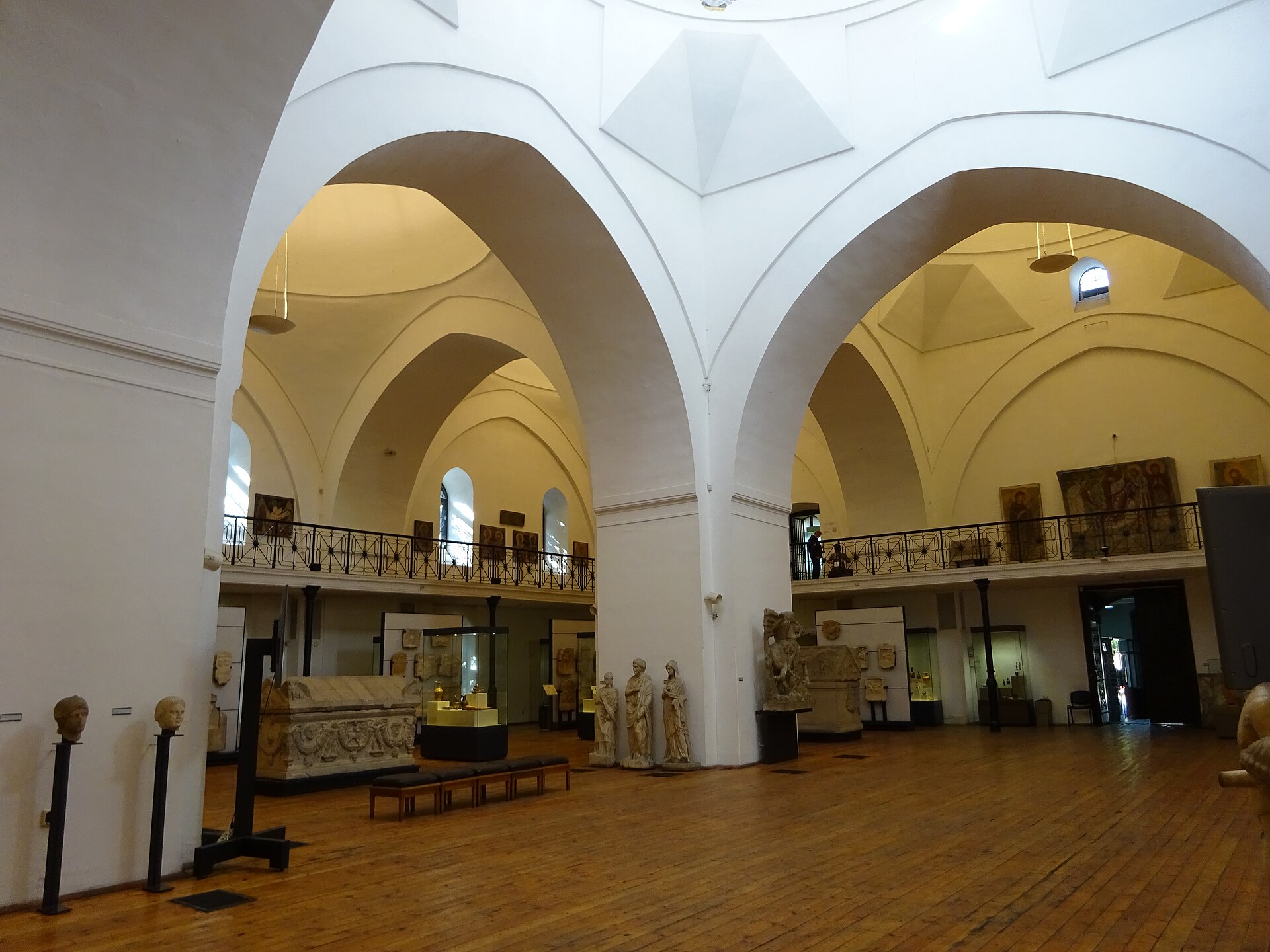
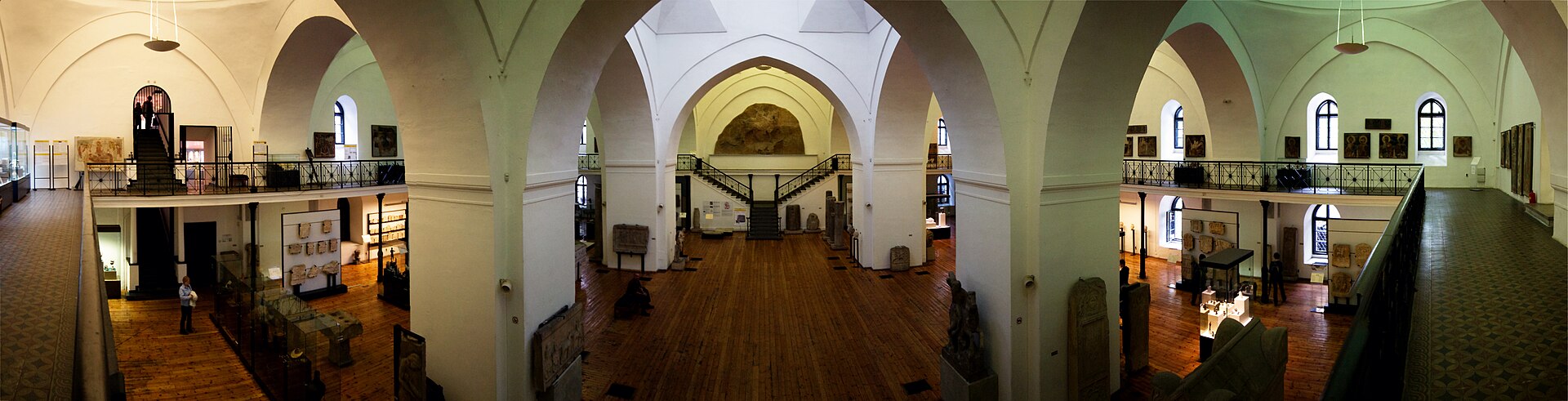
Two floors under the mosque's main domes, Late Bronze Age to Late Middle Ages, arranged in three sections. Section I covers Thracian material of the late 2nd to 1st millennium BC on one side, Aegean and Black Sea coastal material from Apollonia Pontica and Odessos on the other. Section II, 1st to 4th century AD, holds Roman grave stelae, portrait statues under the central dome, and church material including finds from St Sophia basilica. Section III, 5th to 7th century AD, covers the early Christian period through architectural fragments, wall paintings and material left by Gothic and Hunnic as well as local populations.
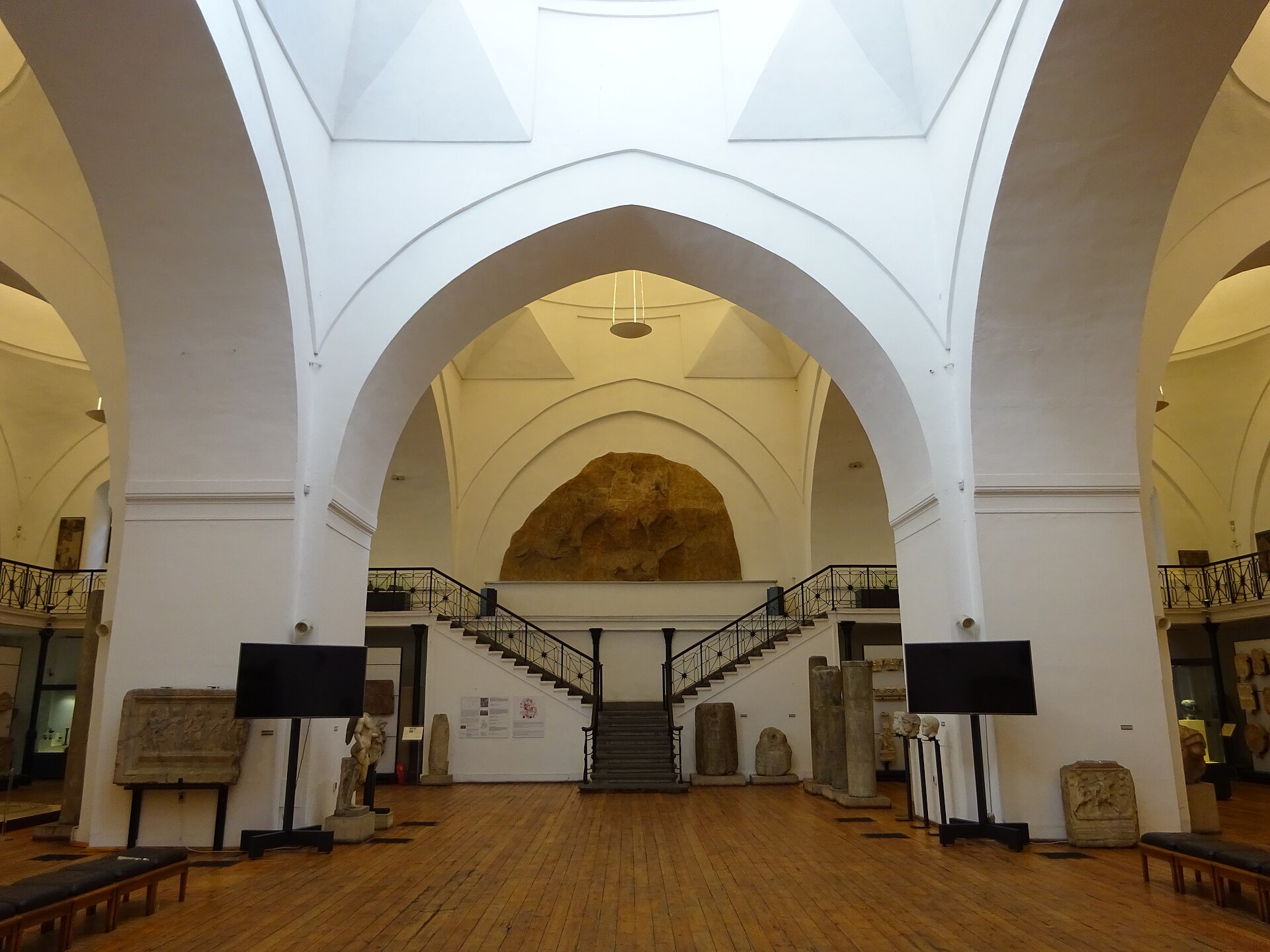
Reached across the central staircase and gallery, 681 AD to the 14th century. A cast of the Madara Horseman, the only replica the museum displays, fills the arch above the stairs. The hall also holds 12th-century wall paintings from St Nikola church in Melnik, a gold cross-reliquary from Pliska, a 10th-century ceramic icon of St Theodore from Veliki Preslav, a 14th-century icon donated by a relative of Tsar Ivan Alexander, and what the museum describes as the earliest known stone inscription in Cyrillic, an epitaph from Veliki Preslav.
Thirteen gold vessels weighing 12.5 kilograms, found by two brothers in their vineyard near the village of Valchitran in 1924 and dated to about 1300 BC; one of the earliest and heaviest gold hoards from the Balkans.7
A 673 gram solid gold mask from a grave near the village of Kran, excavated in 2004, cast and finished by forging and chiselling; the museum's own exhibit notes describe it as the mask of the Odrysian king Teres.11
Found in the same grave as the funerary mask, its engraved plate shows a seated athlete resting with javelins; part of the same elite Thracian burial assemblage.11
Excavated at Shipka in 2004 and held by the museum's own Vault gallery text to be a portrait connected to an Odrysian Thracian ruler; a rare survival of Hellenistic bronze portraiture from the region.8
Silver plates, phiales, ewers and gilded horse-harness fittings found near Lukovit in 1953, decorated with lions, griffins and mounted riders typical of Thracian metalwork.8
The museum's only replica, set in the arch over the central staircase; it stands in for the 8th-century rock relief carved into a cliff near Shumen and gives the Middle Ages Hall its centrepiece.9
A decorated gold reliquary from the First Bulgarian Empire's capital, part of the Middle Ages Hall's case on aristocratic and church metalwork.9
A small stamp seal from the Karanovo tell that the museum's own Prehistory Hall text reads as among the earliest known devices for recording information, predating writing proper.6
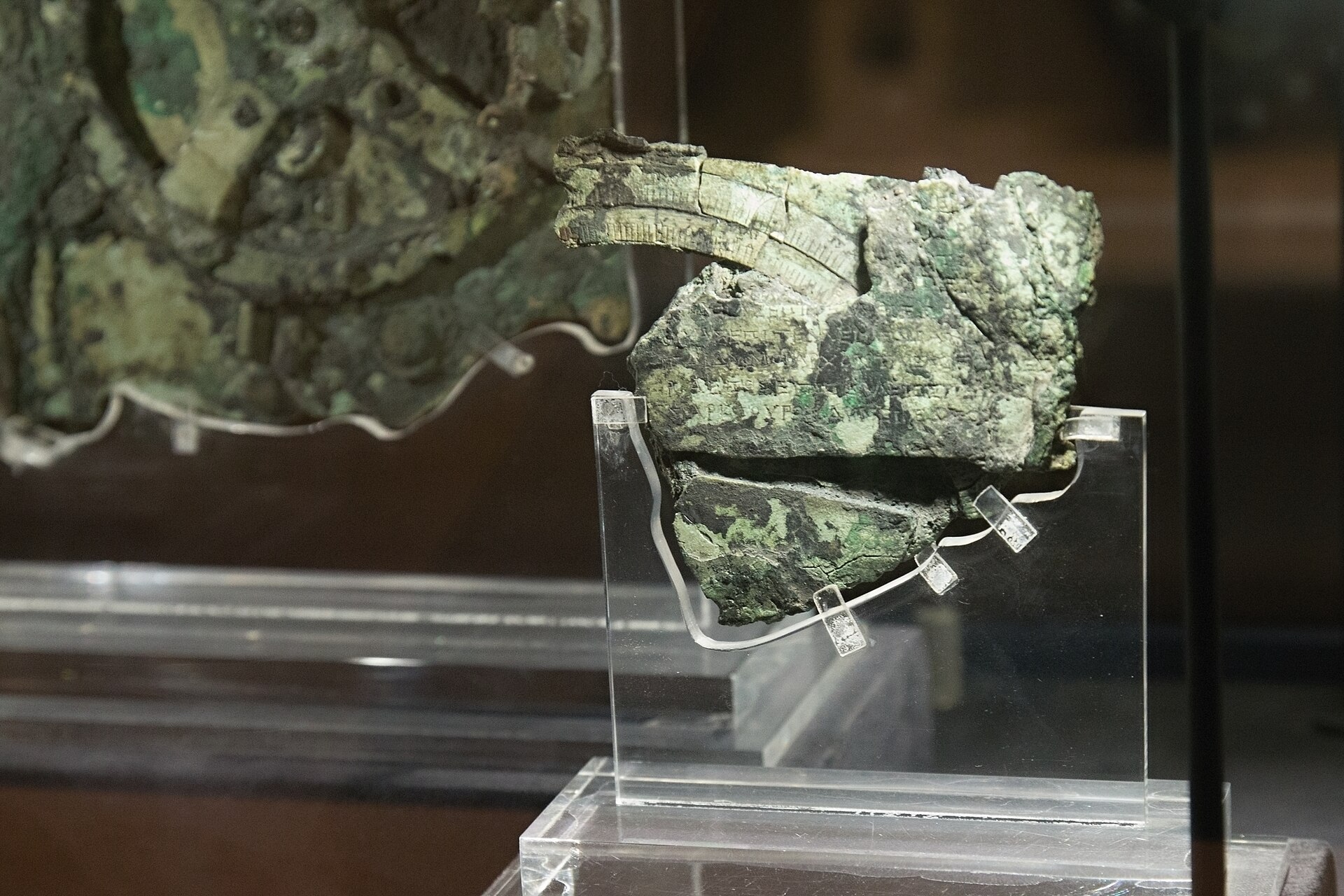
c. 150-100 BC · Bronze plates and gearing in a wooden case
National Archaeological Museum, Athens
c. 205 BC · Cast and hand-cut bronze
National Archaeological Museum, Athens
The building the museum occupies is older than the institution itself by more than four centuries. Construction of what was then the Koca Mahmud Pasha mosque, known locally as the Buyuk or Grand Mosque, began in 1451 under the Ottoman grand vizier Mahmud Pasha and was not finished until 1494, more than twenty years after his death. It is built on a square plan 36.6 metres to a side, its interior divided by four piers into nine bays, each carrying its own dome, an arrangement the museum's own account of the building calls characteristic Ottoman cell construction in small stone blocks, rough cast and brick banding. The mosque functioned for roughly four centuries before it was abandoned as a place of worship. During the Russo-Turkish War of 1877 to 1878 the empty building served as a hospital, and at the end of 1879, with Bulgaria newly independent, the Ministry of National Education handed it to the young National Library, which opened for readers inside the former prayer hall on 2 March 1880. The Library moved out again in 1893, and the building was given over to the museum collection that has occupied it ever since, first opening its doors to visitors on 18 May 1905.
The institution's own account traces its beginnings to 1869, when the Bulgarian Literary Society first argued for a standing Antiquities Committee. After independence that committee's holdings passed into the new Public Library with Museum Collection, which was reorganised as the independent People's Museum in 1892, the year the museum now gives as its founding date. A separate Archaeological Institute was created in 1920 under Bogdan Filov, Bulgaria's first professional archaeologist to hold the post of institute director, and the two bodies were merged in 1948 and 1949 into the National Archaeological Institute with Museum, placed inside the Bulgarian Academy of Sciences, where it remains. The museum describes itself today as the country's central coordinating body for archaeological fieldwork, exercising what its own site calls scholarly and methodological control over excavation nationwide, and reports a staff of about 146, more than 90 of them research archaeologists, running two accredited doctoral programmes in prehistory and archaeology. It calls its own holdings among the richest in south-eastern Europe, a claim borne out by the range on display: from stone tools eight hundred thousand years older than farming to fittings from Ottoman-period Chiprovtsi silversmiths.
The permanent display is organised into four halls that together carry the story from roughly 1.6 million years before the present to the end of Ottoman rule. The Prehistory Hall occupies the ground floor of the northern wing and runs from an engraved bone from Kozarnika cave, among the oldest traces of human presence claimed anywhere in Europe, through Neolithic farming settlements and Chalcolithic gold jewellery to Bronze Age metalwork. The Vault, on the second floor of the eastern building, is built specifically to show treasure: named hoards from Vulchitrun, Lukovit and Nikolaevo sit alongside grave goods from Trebenishte and the Svetitsa tumulus. The Central Hall fills two floors under the building's main domes with material from the late Bronze Age Thracian world through Rome to the early Christian centuries, arranged so that a visitor moving through it passes from Thracian tumulus goods to Aegean coastal imports to Roman portrait sculpture without leaving the same room. The Middle Ages Hall, reached up the staircase the mosque's own architecture puts at the centre of the building, closes the sequence with the 8th to 14th centuries of medieval Bulgaria, under a plaster cast of the Madara Horseman set into the arch above the stairs, the only replica the museum shows among otherwise original material.
What draws most visitors, by their own account, is the Vault. The Vulchitrun treasure is the oldest of its named hoards: thirteen gold vessels weighing 12.5 kilograms between them, found in 1924 by two brothers working their vineyard near the village of Valchitran, and dated by the museum to around 1300 BC, making it one of the heaviest and earliest Bronze Age gold finds anywhere in the Balkans. The Lukovit treasure is later and smaller but no less worked: silver plates, drinking vessels and gilded horse-harness fittings from the 4th century BC, found near the town of Lukovit in 1953, decorated with lions, griffins and mounted riders in a style the museum's own text calls typical of Thracian art. Two further objects come from a single grave excavated in 2004 at the Svetitsa tumulus near the village of Kran: a 673 gram gold funerary mask, cast and then finished by forging and chiselling, and a gold signet ring engraved with a resting athlete. The museum's own exhibition notes describe the mask as belonging to the Odrysian king Teres. A separate bronze portrait head, excavated the same year at the Golyama Kosmatka tumulus near Shipka, is presented in the same gallery text as connected to an Odrysian Thracian ruler; readers should note that other published accounts of this specific head place it in a different Bulgarian collection, a discrepancy this record flags rather than resolves.
The mosque-turned-museum has not had an easy twentieth century. Major reconstruction in 1938 to 1940, tied to construction work at the adjoining National Bank, saw the domes recovered in lead sheet. In 1944 the building was seriously damaged by bombing, and the room holding the numismatic collection burned; repairs dragged on until the museum reopened in 1948. Italian foreign aid funded a further overhaul of the electrical and heating systems in 1993 and 1994, and the most recent major restoration ran from 2003 to 2005. Even so, secondary sources on the building note it still runs high on moisture in summer, a structural legacy of a masonry mosque adapted rather than purpose-built for museum climate control. Visitors reviewing the museum today describe the same tension in the display cases themselves: cited consistently for the strength of the Thracian holdings, and just as consistently for a presentation style, lighting and signage that several reviewers say has not kept pace with museums renovated more recently elsewhere in Europe.
The museum sits in the centre of Sofia at 2 Saborna Street, its public entrance on Atanas Burov Square, close enough to the Serdika metro interchange that most visitors reach it on foot from there. Summer hours, May through October, run 10am to 6pm daily; winter hours, November through April, run 10am to 5pm and the museum closes on Mondays. It is shut on 25 December and 1 January, and keeps shortened hours, 10am to 2pm, on 24 and 31 December. Adult admission is 11.73 leva, quoted by the museum itself as about 6 euro; students and pupils pay 2.93 leva. Admission is free for visitors with disabilities and one companion, for ICOM cardholders, for pensioners on the second Thursday of each month, and for everyone on the last Sunday of the month. Guided tours can be booked on top of the entry ticket, in Bulgarian or in English. Visitor reports put a typical visit at one to two hours, enough to walk all four halls without rushing but short enough that the museum works well alongside the rest of central Sofia's old town in a single day.
Visitors consistently single out the Thracian gold in the Vault and the building itself, a working 15th-century mosque converted to museum use, as the reasons to come. The recurring complaint is presentation rather than content: several reviewers describe the display style and lighting as dated next to museums that have been redone more recently, and say English labeling, while present throughout, is thinner and less consistent in some rooms than others.
Tripadvisor: 4.4 from 678 ratings, read 24 August 2026
A platform average is a tertiary source: it moves, it is not audited, and we quote no visitor's words.
2 Saborna Street, 1000 Sofia, Bulgaria (entrance at Atanas Burov Square No 1).
Adult: BGN 11.73; Student or pupil: BGN 2.93; One parent with child or children up to 16: BGN 11.73; Two parents with child or children up to 16: BGN 15.65; Jubilee ticket: BGN 19.56. As confirmed 24 August 2026.
Daily, May-October 10:00-18:00; Tue-Sun, November-April 10:00-17:00; 24 and 31 December 10:00-14:00. Closed: Monday, November through April. 25 December. As confirmed 24 August 2026.
Metro: Serdika station (lines M1 and M2), about a 5 minute walk.
Vulchitrun (Valchitran) gold treasure (Unknown Late Bronze Age Thracian workshop); Gold funerary mask from the Svetitsa tumulus (Unknown Thracian goldsmith, 5th century BC); Gold signet ring from the Svetitsa tumulus (Unknown Thracian goldsmith, late 5th century BC); Bronze portrait head from the Golyama Kosmatka tumulus (Unknown Hellenistic sculptor, 4th century BC); Lukovit silver treasure (Unknown Thracian workshop, 4th century BC); Madara Horseman cast (Early 20th-century plaster reproduction).
One artwork and its story every Tuesday, with the picture: who owned it, what it made, and what closes soon in the exhibition calendar. No promotion, and nothing we cannot cite.
We send one email to confirm the address and keep nothing else. Every letter carries a one-click unsubscribe. How we handle your data.
.jpg)


