The Traprain Law Treasure
Unknown Roman silversmiths (multiple workshops, Gaul and the Mediterranean) · Individual vessels late 3rd century to mid-5th century AD. The hoard was assembled over decades and concealed in the ground in the early-to-mid 5th century AD.
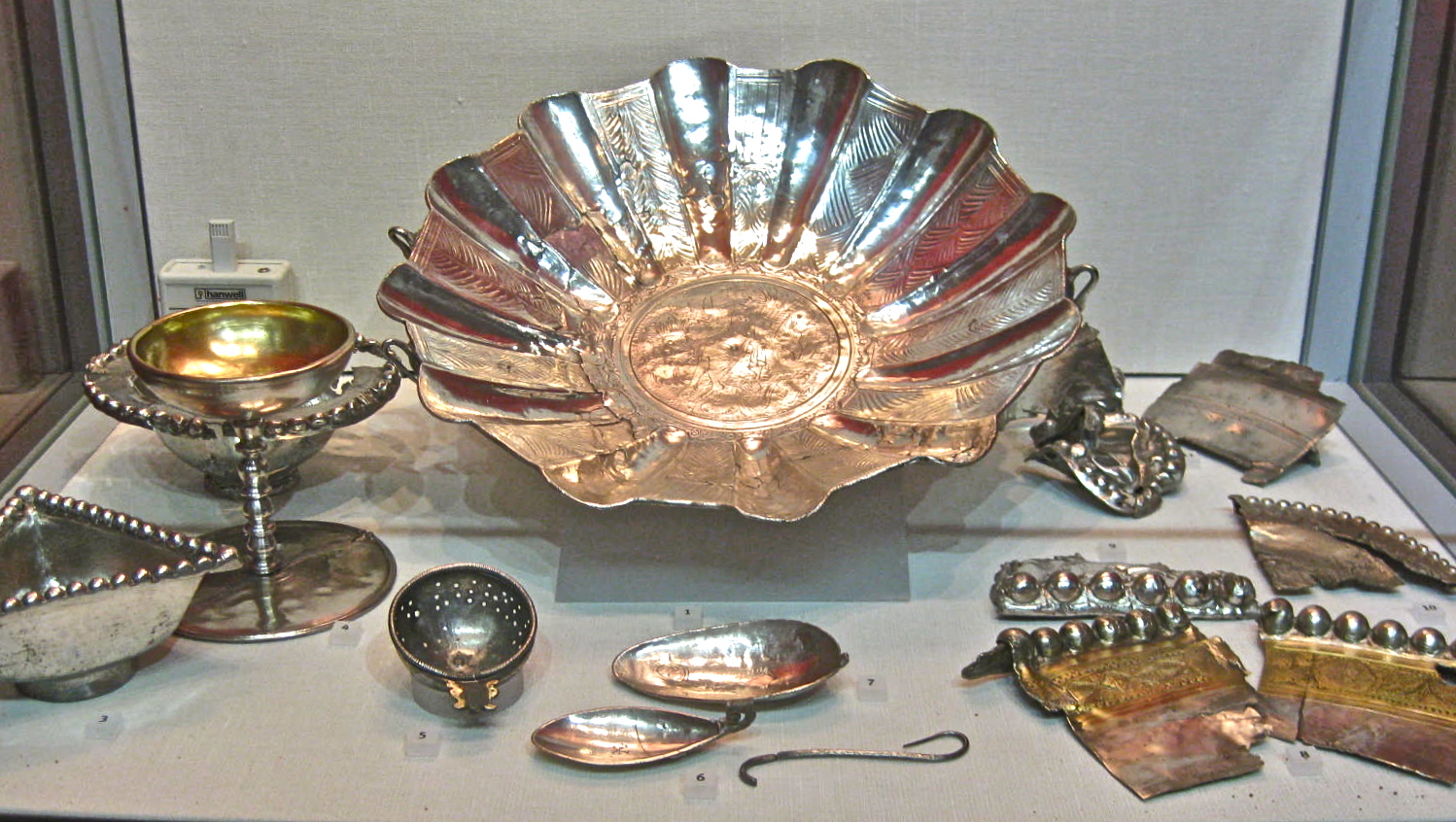
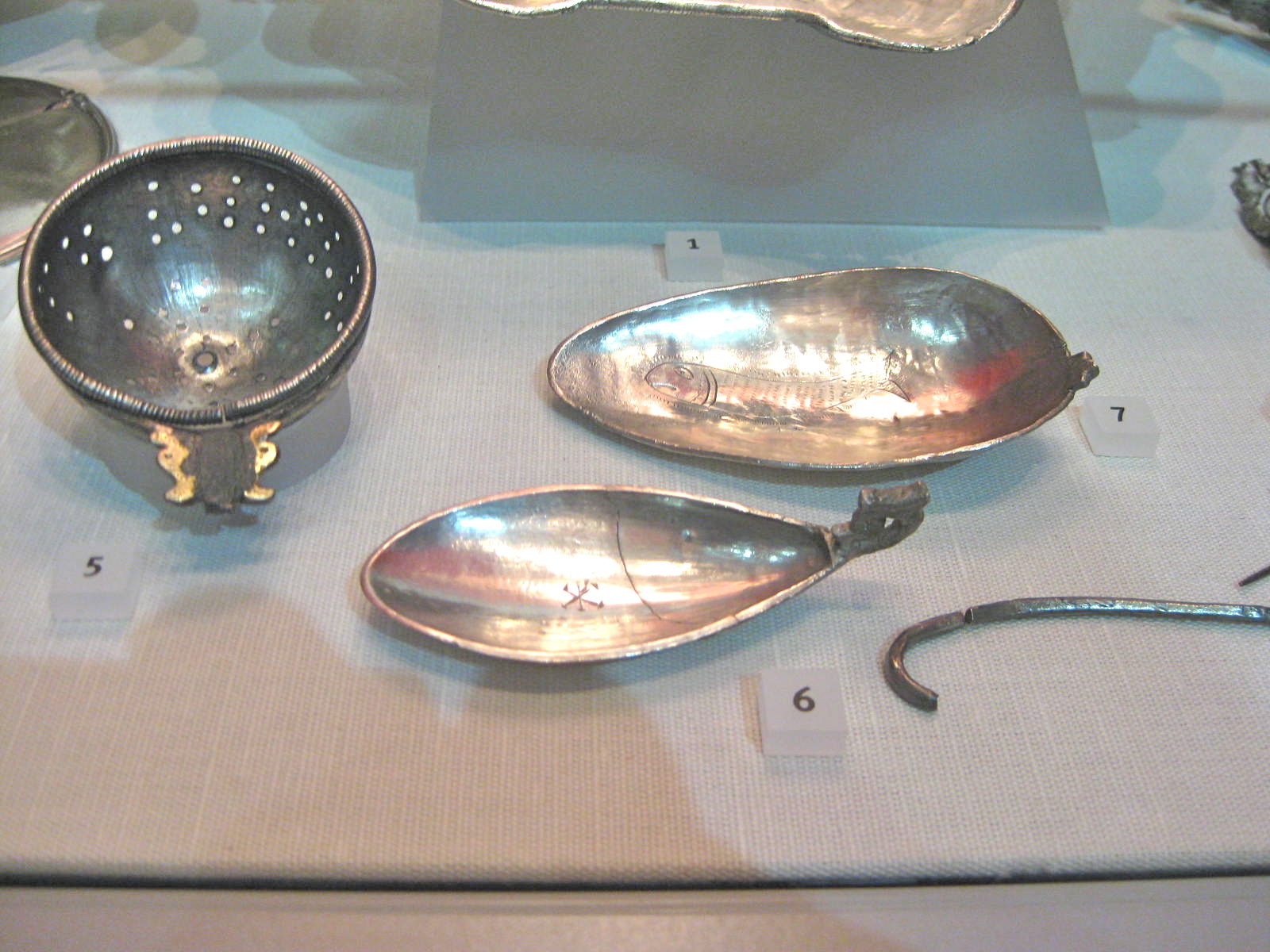
A group of pieces from the Traprain Law Treasure, National Museums Scotland. This record covers the hoard as a whole rather than a single object; this plate shows a representative selection of the silver as displayed.
National Museums Scotland; photograph by Tyssil, Wikimedia Commons, CC BY-SA 4.0| Artist | Unknown Roman silversmiths (multiple workshops, Gaul and the Mediterranean) |
|---|---|
| Date | Individual vessels late 3rd century to mid-5th century AD. The hoard was assembled over decades and concealed in the ground in the early-to-mid 5th century AD. |
| Medium | Silver and silver-gilt vessels and personal objects, most deliberately cut, folded or crushed into hacksilver (bullion fragments), with associated clipped silver siliquae (coins) |
| Dimensions | Total weight approximately 23 kg (51 lb), equivalent to about 71 Roman pounds. 327 individual fragments, representing an estimated 129 to 171 separate vessels and objects. A few pieces survive complete or nearly so; most are fragments. |
| Where it is now | National Museums Scotland, National Museum of Scotland, Chambers Street, Edinburgh (Early People gallery)last confirmed 23 September 2026 |
| Inventory number | Registered in the National Museums Scotland collection under the X.GVA prefix for individual fragments (for example X.GVA.36, a fragment of the plate bearing the head of Hercules). A. O. Curle's 1923 catalogue numbers remain in use alongside this as the museum's own working reference system for individual pieces. |
| Attribution | UnknownNo maker's stamp or signature survives on any piece in the hoard. Full note |
| Object type | Silver |
| Period | Late Roman / Late Antique manufacture, deposited in native Iron Age Votadinian Scotland beyond the frontier of Roman Britain |
| Cases | Has a provenance gap |
| Inscriptions | Owner graffiti scratched onto at least twenty pieces, including the names Amabilis, Emilius and a female owner, Victorina. A fragmentary inscription on a beaded-rim bowl reads approximately SAVI...TISAL...P, tentatively read as part of a phrase wishing the owner long life. A large silver plate carries an incised hare among acanthus leaves and the head of a Molossian hound. |
| Owners on record | 6 links4 documented, 1 disputed, 1 unknown |
| Sources | 21 cited |
About this record Last verified 23 September 2026 · 21 sources cited · Change log
On this page 9 sections
ContentsClose
In May 1919 an excavation on Traprain Law, an Iron Age hillfort in East Lothian, turned up 23 kilograms of Roman silver plate, most of it deliberately cut, folded and crushed into bullion. It remains the largest hoard of Late Roman hacksilver known anywhere, found not within the Roman Empire but at a native British settlement beyond its formal frontier, the power centre of the Votadini tribe.
Alexander Ormiston Curle, who directed the dig, read the damaged silver in 1923 as barbarian loot. A century of subsequent research, most fully set out by Fraser Hunter, Annemarie Kaufmann-Heinimann and Kenneth Painter, has built a different and better evidenced case: that Roman plate was reduced to bullion inside the Roman world during economic crisis and sent north repeatedly, over generations, as subsidy or payment for military service, accumulating at Traprain Law like a long-running account before its final, unrecovered burial in the early fifth century.
An earlier attempt to name the culprits, Irish raiders under Niall of the Nine Hostages, collapsed once modern scholarship redated Niall himself half a century later than the theory required. What survives among the fragments, alongside the classical imagery of Hercules and a sea Nereid, is one of the earliest Christian objects found in Scotland, a small gilt jug carrying scenes from Genesis and Exodus to the Gospels. The treasure remains on display at the National Museum of Scotland, and the question that matters most about it, exactly how and why it crossed from Roman hands to a hillfort beyond the frontier, is still argued rather than settled.
Provenance
Each link is graded. Documented: a cited source supports it. Disputed: the identification is argued but not established. Unknown: no owner for that span, and the gap is not smoothed into a narrative. The grades in the glossary.
- late 3rd century AD - early-mid 5th century ADRoman elite owners across Gaul and the Mediterranean world, and within Roman Britaindocumented
The vessels in the hoard were made across roughly a century and a half by multiple workshops, primarily placed by style in Gaul and the Mediterranean. Owner graffiti scratched onto at least twenty pieces names individual Roman owners, including Amabilis, Emilius and a woman, Victorina, direct evidence of real personal ownership within the Roman world before any of this silver reached Traprain Law.3
- uncertain, within the manufacture period - early-mid 5th century ADunknown - the mechanism by which the silver passed beyond Roman controldisputed
How and why Roman table silver, already partly reduced to bullion, reached a native British hillfort beyond the formal frontier is the central disputed question of this record. Three positions have been argued: Curle's 1923 reading of the hoard as loot taken by barbarian raiders, explicitly linked by him to the Teutonic migrations of the period; a 1924 proposal by William Ridgeway identifying the raiders as Irish forces under Niall of the Nine Hostages around AD 403-405, shown by Kenneth Painter in 2012 to fail on chronological grounds, since Niall is now dated roughly half a century later; and the subsidy/payment-for-service hypothesis, first proposed by Eric Birley and Malcolm Todd (1985) and developed in detail by Fraser Hunter, Annemarie Kaufmann-Heinimann and Kenneth Painter (2013, 2022), under which the silver was cut into bullion within the Roman world during economic crisis and sent north repeatedly, over decades, as diplomatic payment or reward for military service to the Votadini elite at Traprain Law.1235613
- early-mid 5th century AD - early-mid 5th century ADVotadini elite of Traprain Lawdocumented
The physical act of burial, in a pit dug into an occupied house-cluster on the hillfort's western shoulder, is documented by the 1919 excavation itself and dated by the accompanying clipped coins of Valens, Arcadius and Honorius to the closing years of Roman Britain. The motive for concealment, and whether it represents one act or the final act in a series, is not documented.115
- early-mid 5th century AD - 12 May 1919no owner - undisturbed in the groundunknown
No record of any kind survives for roughly one and a half thousand years. Traprain Law was abandoned as a major settlement in the early 5th century, close to the hoard's likely concealment date, and Votadini power is thought to have shifted afterward to Din Eidyn, later Edinburgh; whether that abandonment and the treasure's concealment are connected is not established.18
- 12 May 1919 - 1923Society of Antiquaries of Scotland excavation, directed by Alexander Ormiston Curle, on the estate of A. J. Balfourdocumented
Found during a systematic excavation the Society of Antiquaries of Scotland had run on Traprain Law since 1914, not by chance civilian discovery. Foreman George Pringle loosened the first vessel with a pick-axe on 12 May 1919. Curle reported the find in The Antiquaries Journal in 1921 and published the full catalogue, The Treasure of Traprain, in February 1923.1154
- 1919-1923 - presentNational Museum of Antiquities of Scotland, now National Museums Scotland, Edinburghdocumented
The hoard passed into the national collection Curle himself directed. The National Museum of Antiquities of Scotland's collections transferred to National Museums Scotland on that institution's 1985 formation. The treasure has remained in the national collection continuously since 1919-23, restored in the early 1920s by the Edinburgh silversmiths Brook and Son, and is currently displayed in the Early People gallery of the National Museum of Scotland, Edinburgh. The precise legal mechanism of the original 1919-23 transfer from excavation to national collection was not established from the sources consulted for this record.419
Technical evidence
| Attribution note | No maker's stamp or signature survives on any piece in the hoard. The finest vessels are placed by style and technical comparison in workshops active in Gaul and around the Mediterranean during the fourth and earlier fifth centuries, the same circle of production studied through the parallel Kaiseraugst hoard in Switzerland. The hoard is the work of many hands over roughly a century and a half, not of one workshop or one moment. |
|---|---|
| Total weight | Approximately 23 kg (51 lb), equivalent to about 71 Roman pounds.314 |
| Composition | 327 individual fragments, representing an estimated 129 to 171 separate vessels and personal objects; a few pieces survive complete or nearly so, most are fragments.315 |
| Date range of manufacture | Late 3rd century to mid-5th century AD across the assemblage as a whole; individual vessels are dated by style and comparison to Continental parallels.315 |
| Coin evidence | Silver siliquae of the emperors Valens, Arcadius and Honorius found with the hoard, all clipped at the edge, a practice typical of coin circulating in Britain after the end of formal Roman rule around AD 410. This dates concealment to the closing years of Roman Britain, most likely the first quarter of the 5th century.11315 |
| Metal purity | The silver is of high purity with no significant deliberate debasement, consistent with good-quality Roman plate rather than degraded scrap.9 |
| Findspot | Recovered from a pit roughly two feet (c. 0.6 m) in diameter and two feet deep, dug within a cluster of houses on the uppermost occupation level of the western shoulder of Traprain Law, with no evidence of a container; the pieces were jumbled together.115 |
| Evidence for deliberate cutting | Systematic weighing of the fragments (K. Painter, 2009) shows that many correspond closely, though rarely exactly, to standard Roman weight units, indicating deliberate reduction to bullion rather than random destruction.3 |
| Museum registration | Individual fragments are registered under the National Museums Scotland X.GVA prefix (for example X.GVA.36, part of the Hercules plate); Curle's 1923 catalogue numbers remain in parallel use as the museum's working reference system.10 |
Images
The record in full
Chapter 1A hoard, not a single object
This record covers the Traprain Law Treasure as a whole rather than anchoring on one vessel.
This record covers the Traprain Law Treasure as a whole rather than anchoring on one vessel. That is a deliberate choice, not a default. The treasure is not a single masterpiece with a supporting cast; it is 327 fragments from an estimated 129 to 171 separate vessels and objects, weighing just over 23 kilograms, and the questions that matter most about it - why it was cut up, and how it came to be buried at a native hillfort outside the Roman frontier - are questions about the assemblage, not about any one plate within it. National Museums Scotland itself displays and studies it as a single find, and the two major modern publications on it (2013 and 2022) treat it as one integrated object of study. A handful of individual pieces are unusually well documented and are discussed here by name - a large decorated dish reconstructed by laser scanning, a small gilt jug with biblical scenes, a plate bearing the head of Hercules - but they are treated as evidence about the hoard, not as the record's actual subject.
It is, on the current evidence, the largest hoard of Late Roman hacksilver known anywhere: cut, folded, crushed and battered silver plate, reduced from finished tableware toward bullion. Nothing comparable in scale has been found within the frontiers of the former Roman Empire, let alone beyond them.
Chapter 2How it was found
The Society of Antiquaries of Scotland had been excavating Traprain Law, a hillfort in East Lothian roughly thirty kilometres east of Edinburgh, since 1914, on land then belonging to the former prime...
The Society of Antiquaries of Scotland had been excavating Traprain Law, a hillfort in East Lothian roughly thirty kilometres east of Edinburgh, since 1914, on land then belonging to the former prime minister Arthur James Balfour. On 12 May 1919 the excavation foreman, George Pringle, was clearing one of the site's occupation levels with a pick-axe when he loosened and pulled out a Roman silver vessel. Alexander Ormiston Curle, the excavation's director, reported the find the following year in the first volume of the newly founded Antiquaries Journal: the hoard had been buried in a pit roughly two feet across and two feet deep, dug into a cluster of houses on the uppermost occupation level of the hill's western shoulder, with the pieces jumbled together and no trace of any container. Prolonged burial had left the silver, in Curle's words, with a dull leaden hue tinged with purple.
This was not a metal-detector find or a chance discovery by a member of the public; it emerged from a controlled, ongoing archaeological excavation, recorded stratigraphically against the site's several occupation floors. That context is part of why the hoard has remained so useful to scholarship a century later: its findspot, depth and immediate surroundings were documented at the time, even though the reasons the silver was buried there were not.
Chapter 3Curle and the 1923 catalogue
Alexander Ormiston Curle (1866-1955) trained as a lawyer before moving into archaeology, publishing eleven archaeological papers between 1896 and 1908 and serving as secretary to the Royal Commission...
Alexander Ormiston Curle (1866-1955) trained as a lawyer before moving into archaeology, publishing eleven archaeological papers between 1896 and 1908 and serving as secretary to the Royal Commission on the Ancient and Historical Monuments of Scotland, for which he cycled some three hundred miles recording sites for the Commission's first county inventory. He became Director of the National Museum of Antiquities of Scotland in 1913, succeeding Joseph Anderson, and also directed the Royal Scottish Museum from 1916 to 1931. The Traprain hoard was, by a wide margin, the most important find of his career.
His full monograph, The Treasure of Traprain: A Scottish Hoard of Roman Silver Plate, appeared in February 1923, illustrated with expensive photogravure plates and described by later reviewers as a masterpiece of contemporary analysis. Its interpretation, however, was a product of its moment: writing four years after the First World War, in a climate saturated with narratives of Germanic invasion, Curle read the hacked and crushed condition of the silver as the loot of barbarian raiders with no interest in the objects' aesthetic value, and explicitly connected the hoard to the Teutonic migrations that had overrun the Rhine frontier. Excavation at Traprain Law continued after the treasure's discovery; a further campaign in the summer of 1923 was reported separately in the Proceedings of the Society of Antiquaries of Scotland by James F. Curle, whose relationship to Alexander Ormiston Curle this record has not been able to confirm from the sources consulted, beyond the fact that Alexander's own archaeologist brother was also named James Curle and the two are jointly commemorated as pioneering figures in Scottish archaeology.
Chapter 4Traprain Law and the Votadini
Traprain Law had been a place of human activity for a very long time before any Roman object reached it.
Traprain Law had been a place of human activity for a very long time before any Roman object reached it. The hill was already used for burial by around 1500 BC, and shows evidence of ramparts from around 1000 BC onward. At its greatest extent the hillfort enclosed about sixteen hectares, making it one of the largest in Scotland. By the Roman Iron Age it was generally accepted as a - and probably the - major settlement of the Votadini, the British tribe Rome recorded in the region in the first century AD and whose principal place Ptolemy names as Curia.
The Votadini's relationship with Rome shifted over roughly three centuries. Southern Scotland came under direct Roman military occupation for a period in the mid-second century, but for most of the third and fourth centuries the Votadini functioned as a client or buffer people beyond the formal frontier, receiving the benefits of association with Rome - imported goods prominent among them - without direct Roman rule. Traprain Law's occupation and its receipt of Roman material intensified through the late Roman period even as other native sites in the region declined, suggesting the hillfort was consolidating a special relationship with the Roman world rather than a generic one. That relationship, and its price, is the real subject standing behind the treasure. The hillfort was abandoned as a major centre in the early fifth century, and the Votadini's seat of power is thought to have shifted afterward to Din Eidyn, the rock that became Edinburgh.
Chapter 5What the hoard actually contains
The bulk of the treasure is domestic and personal silver of a wealthy Roman household: platters, bowls, jugs and spoons for dining; toilet silver including mirror fragments, cosmetic containers and...
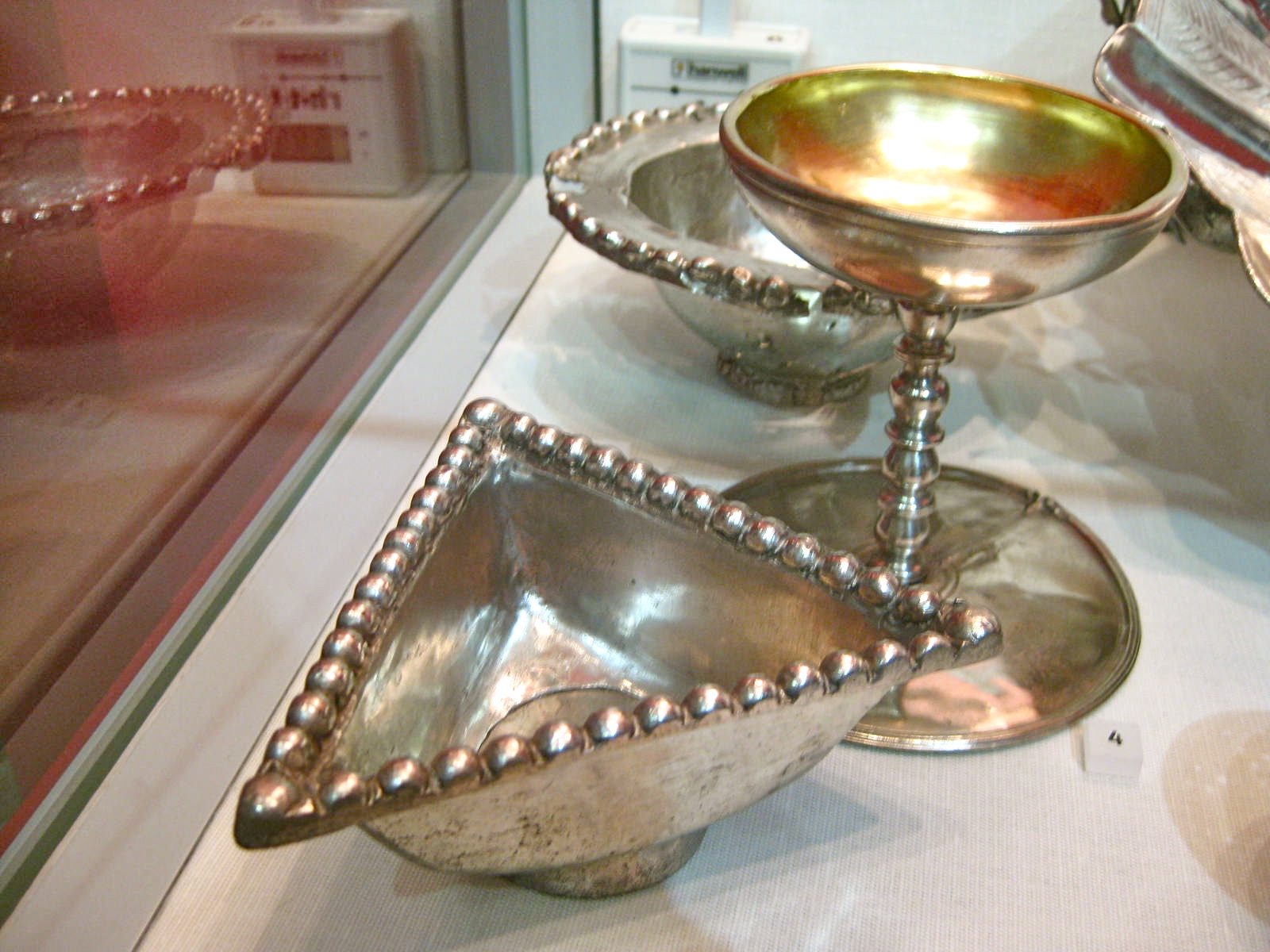
The bulk of the treasure is domestic and personal silver of a wealthy Roman household: platters, bowls, jugs and spoons for dining; toilet silver including mirror fragments, cosmetic containers and water basins; belt fittings and a brooch; and coinage. A handful of pieces survive whole or nearly whole. Most do not.
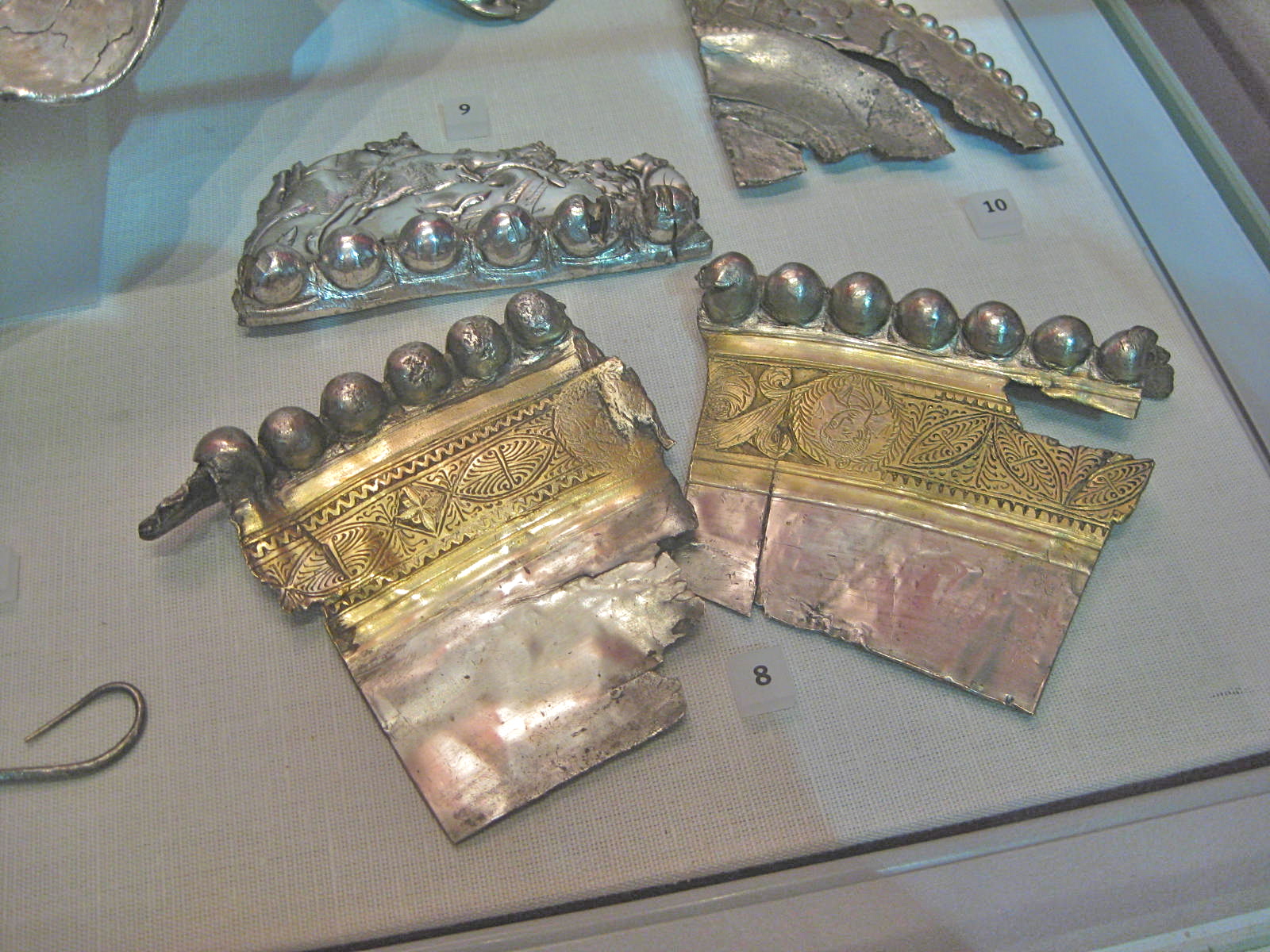
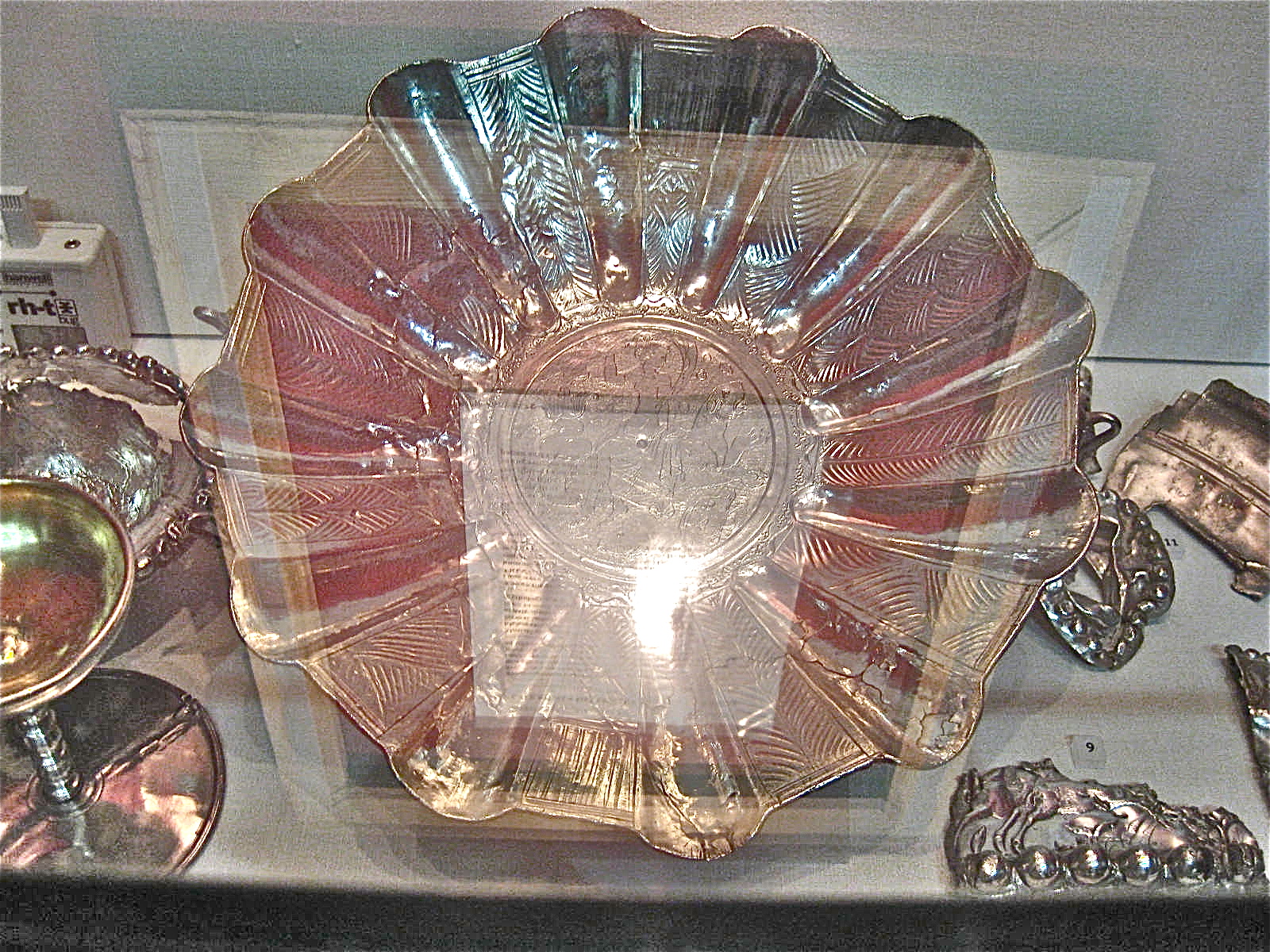
Among the better-documented individual fragments is a large silver dish, roughly 70 centimetres in diameter when complete, of which only two edge fragments survive - together weighing almost exactly eight Roman ounces, itself a sign of deliberate cutting to a weight rather than casual destruction. National Museums Scotland used laser scanning to digitally reconstruct the dish's full form from those fragments, recovering a beaded rim, a geometric border with floral ornament and gilded, niello-inlaid sections, and portrait busts; the reconstructed central medallion is necessarily speculative, modelled on a comparable complete dish from Switzerland. A separate plate fragment preserves part of the head of Hercules. A washbasin carries a high-status pagan scene of a Nereid seated on a marine panther. A military buckle is decorated with the Christian letters Alpha and Omega. A spoon and a strainer carry the Chi-Rho monogram. And a small gilt-silver jug, discussed below, carries a sequence of biblical scenes and is usually described as the earliest Christian object yet found in Scotland.
Analysis of the metal itself found the silver to be of very high, largely undebased purity - consistent with good Roman plate rather than adulterated or reused scrap of poor quality, which matters for how the hoard is read: whoever cut it up was not working with already-degraded material.
Chapter 6Hacksilver: cutting plate into bullion
Hacksilver is the term for precious-metal objects deliberately cut, bent or crushed so that they function as bullion or currency by weight rather than as finished goods.
Hacksilver is the term for precious-metal objects deliberately cut, bent or crushed so that they function as bullion or currency by weight rather than as finished goods. For decades after Curle, the condition of the Traprain silver was read simply as violence: barbarians smashing loot they did not value as art. A 2009 conference paper by Kenneth Painter reframed the evidence. Measured systematically, the fragments correspond - closely, though rarely exactly - to standard Roman weight units, rather than being chopped and sheared at random. The 71 Roman pounds of silver in the hoard is equivalent to roughly 11,600 siliquae, the standard small silver coin of the late fourth and early fifth centuries; in a Britain where fresh Roman coin was increasingly hard to come by after about 410, silver by weight could substitute directly for coin as a means of payment.
That reframing does not mean the silver was cut thoughtlessly wherever a weight target happened to fall. Many fragments still preserve enough of their original imagery - a head, a hunting scene, a fold of drapery - to be read and admired, and it is precisely because so much decoration survives on so many pieces that the vessels can be dated, attributed to workshop traditions and, in places, digitally reconstructed at all. The practice sits between two poles: silver being treated purely as metal, and silver still carrying enough of its original meaning that whoever handled it in its final form - cutting it, carrying it, eventually burying it - still recognised what it had been.
Chapter 7The old theory: barbarian loot
Curle's 1923 verdict, loot taken by piratical barbarians indifferent to craftsmanship, was the dominant reading of the hoard for most of the twentieth century and is still the version many general...
Curle's 1923 verdict, loot taken by piratical barbarians indifferent to craftsmanship, was the dominant reading of the hoard for most of the twentieth century and is still the version many general accounts repeat. It fit the intellectual climate of the early 1920s and required no evidence beyond the silver's damaged condition. It is now regarded by the specialists who have worked most closely on the material as insufficient: it does not explain the careful weight-based cutting Painter identified, it does not explain why so much of the silver was buried rather than melted immediately, and it does not explain the presence of Roman coins in a plausible, datable sequence rather than a single opportunistic grab.
Chapter 8The Irish pirates episode, and its collapse
In 1924 the classicist William Ridgeway proposed a specific version of the raiding theory: that the Traprain hoard, together with the roughly contemporary Coleraine-Ballinrees hoard found in Ireland...
In 1924 the classicist William Ridgeway proposed a specific version of the raiding theory: that the Traprain hoard, together with the roughly contemporary Coleraine-Ballinrees hoard found in Ireland, represented booty taken in a joint raid by Irish, Pictish and Saxon forces around AD 403-405 under the legendary Irish king Niall of the Nine Hostages, and connected the episode to the later mission of St Patrick. The theory had genuine appeal: it gave the archaeology a named historical actor and a precise date drawn from Irish tradition.
It did not survive later scholarship on Irish chronology. Kenneth Painter examined the argument in detail in a 2012 paper in The Antiquaries Journal and showed that modern dating places both Niall and Patrick roughly half a century later than Ridgeway assumed - Niall's own sons are attested active around AD 440-485, which pushes Niall's death to not earlier than about AD 450, well after the Traprain hoard is thought to have been buried. Painter's stated conclusion is that the argument connecting the Traprain Law treasure with Irish pirates fails. The episode remains useful chiefly as a caution: a vivid, source-backed-sounding historical identification can rest entirely on a chronology that later research quietly demolishes, and the identification should always be checked against the current dating of the named individuals, not assumed from the literature that first proposed it.
Chapter 9Subsidy, service and the buffer-state theory
The alternative that has gained ground since the mid-twentieth century treats the hoard not as plunder but as payment.
The alternative that has gained ground since the mid-twentieth century treats the hoard not as plunder but as payment. Eric Birley proposed that the treasure represented compensation to the Votadini for keeping the peace, or supplying fighting men, north of Hadrian's Wall - in effect, protection money paid by Rome to a frontier people whose loyalty was worth buying rather than worth fighting. Malcolm Todd made a related argument in 1985, that the hoard represents payment to a barbarian leader specifically. Neither required the silver to have been stolen at all.
The fullest current statement of this position comes from the research programme led by Fraser Hunter of National Museums Scotland with Annemarie Kaufmann-Heinimann and Kenneth Painter, published as a conference volume in 2013 and as a full catalogue and reassessment in 2022. Their argument is that the hacking happened within the Roman world itself, at a time of economic and military crisis, as a deliberate policy: valuable but no-longer-affordable plate was converted into bullion-weight silver so that it could be used in frontier diplomacy, as tribute or ransom, or as payment to buy off or hire groups from beyond the empire's formal control - among them, on this reading, the Votadini elite at Traprain Law. On this view the treasure is not evidence of Rome's weakness collapsing into random plunder; it is evidence of a functioning, if desperate, late imperial system for managing an frontier it could no longer garrison directly, using silver as the instrument.
Chapter 10A savings account, not a single gift
The 2022 catalogue adds a further, structural argument that changes how the whole find should be read.
The 2022 catalogue adds a further, structural argument that changes how the whole find should be read. Because the vessels in the hoard span roughly a century and a half of manufacture, from the late third century to the middle of the fifth, they cannot represent one payment handed over on one occasion. Hunter, Kaufmann-Heinimann and Painter's reassessment proposes instead that the silver accumulated at Traprain Law over generations, functioning something like a savings account: pieces were added as new payments or gifts arrived, and, the evidence of cutting suggests, pieces were also periodically withdrawn and used as bullion, before what survived was concealed for the last time in the early-to-mid fifth century and never recovered.
That model reframes the entire relationship between Traprain Law and Rome. Rather than a single transaction - a raid, a ransom, a one-off subsidy - it describes a working, decades-long relationship in which Roman silver moved north repeatedly, was drawn on as needed, and was still being added to and drawn from right up to the period when formal Roman authority in Britain was ending. The final burial, on this reading, may simply be the last deposit into an account whose owners, for reasons the evidence does not preserve, never came back to spend it.
Chapter 11Pagan gods and Christian scenes on the same table
The hoard's imagery does not sort neatly into a single religious world.
The hoard's imagery does not sort neatly into a single religious world. The washbasin with its Nereid riding a marine panther, and the plate fragment bearing the head of Hercules, belong to the standard classical mythological vocabulary of Roman elite dining silver, in use for centuries with no necessary religious commitment attached to it by the fourth or fifth century. Set beside them are unmistakably Christian pieces: a spoon and a strainer carrying the Chi-Rho monogram, a military buckle marked with Alpha and Omega, and, most fully worked out, a small gilt-silver jug whose principal register carries a sequence of biblical scenes.
Three of the jug's four scenes are generally agreed: Adam and Eve, Moses Striking the Rock, and the Adoration of the Magi. The fourth had resisted confident identification until a 2025 study in the Proceedings of the Society of Antiquaries of Scotland proposed reading it as the Miracle of the Manna - an argued identification, not yet a settled consensus, and this record treats it as such. Read together, the four scenes run on a shared theme of divine provision of food and drink in the wilderness and at a feast, which fits a vessel that was itself made to be used at a Roman banquet. The jug is usually described as the earliest Christian object so far found in Scotland, though it reached the site as part of a mixed hoard, not as evidence of Christian practice among the Votadini themselves.
What the combination documents is not a hidden programme but an ordinary one: the household silver of a Christianizing but still classically literate Roman elite in the early fifth century, for whom mythological and biblical imagery coexisted on the same table without apparent tension. Reading that mixture as evidence of secret pagan survival, or of a single coherent theological statement, would be reading more into it than the objects themselves, made across different decades by different workshops for what were probably different owners, can support.
Chapter 12Restoration and a century of replicas
The badly deformed vessels were restored, so far as the early 1920s allowed, by the Edinburgh silversmiths Brook and Son, who annealed and reshaped fragments and, with the Museum's permission...
The badly deformed vessels were restored, so far as the early 1920s allowed, by the Edinburgh silversmiths Brook and Son, who annealed and reshaped fragments and, with the Museum's permission, produced authorised reproductions of a number of pieces - some direct copies, others adapted to contemporary taste. A replica of the jug with biblical scenes, sometimes called the Adam and Eve jug, was presented to Balfour in June 1921 in recognition of the find having been made on his land. Brook and Son continued producing hallmarked Traprain Treasure reproductions into the mid-1930s; because so few of the originals survive complete, these replicas are necessarily interpretive rather than exact copies. They now circulate as collectible silver in their own right at Scottish auction houses, stamped Authorised Reproduction and dated, a minor but genuine strand of the object's afterlife independent of the ancient hoard itself.
Chapter 13A century of reassessment
The scholarly literature on the treasure falls into three phases matched almost exactly to Curle's own centenary.
The scholarly literature on the treasure falls into three phases matched almost exactly to Curle's own centenary. Curle's monograph appeared in 1923, four years after discovery. Ninety years later, Fraser Hunter and Kenneth Painter edited Late Roman Silver: The Traprain Treasure in Context (Society of Antiquaries of Scotland, 2013), a conference volume that set the hoard against comparable Continental material and reopened the interpretive questions in a systematic way. In 2022, on the hundredth anniversary of Curle's own publication, Hunter, Annemarie Kaufmann-Heinimann and Painter published the full catalogue and reassessment, The Late Roman Silver Treasure from Traprain Law (National Museums Scotland, some 700 to 784 pages depending on the count used, with contributions from twenty-one specialists in late antique archaeology, history and conservation science). That volume has since been noticed in the Scottish Archaeological Journal (2023), the Archaeological Journal (2024) and Gnomon (2025); this record was able to confirm the existence, authorship and general subject of each notice but could not obtain the full text of any of the three reviews, which sit behind institutional paywalls, so their specific critical judgements are not represented here and should be checked directly before being cited.
Chapter 14What is still unresolved
A century of study has replaced Curle's simple loot narrative with a far better documented and more plausible account, but it has not closed the case.
A century of study has replaced Curle's simple loot narrative with a far better documented and more plausible account, but it has not closed the case. The central question - whether the silver moved north as subsidy, as payment for service, as accumulated diplomatic gift, or by some mixture of all three across a century and a half - remains an argument from pattern and comparison, not a documented transaction. No text names the payment, and no single piece in the hoard carries an inscription that settles the question. What has changed is the quality of the argument, not the presence of a definitive answer.
The artist
Unknown Roman silversmiths, multiple workshops, Gaul and the Mediterranean, late 3rd - mid 5th century AD
No signature, workshop stamp or hallmark of the kind found on some other Late Roman plate survives on any piece in the Traprain hoard, so nothing here identifies an individual maker. What can be said rests on style, technique and comparison with better-documented Continental material, above all the Kaiseraugst treasure in Switzerland, whose own definitive catalogue was co-authored by Annemarie Kaufmann-Heinimann, one of the three editors of the current Traprain reassessment. The makers were working within the same late Roman culture of elite dining silver studied through that parallel hoard, not as an isolated British phenomenon.
Related works
| Work | Relation | Where it is |
|---|---|---|
| The Great Dish from the Mildenhall Treasure Unknown Roman workshop | Comparable Late Roman silver hoard, but found within the frontier of Roman Britain and not hacked; the standard comparandum for intact table silver of the same broad period Already a published Iconotheca record. Traprain and Mildenhall are frequently discussed together as the two great British Late Roman silver finds, but they represent opposite conditions of survival, intact display plate against hacked bullion, and this record does not restate Mildenhall's own facts. | British Museum, London |
| The Sevso Treasure Unknown Roman workshop(s) | Comparable Late Roman elite silver hoard, sometimes discussed alongside Traprain for its scale and decorative repertoire; a Hungarian National Museum comparanda page suggests decorative motifs on some Traprain fragments resemble those on Sevso's geometric ewers, a claim this record has not independently verified Already a published Iconotheca record with its own separate discovery and ownership history; this record uses it only as comparandum, not as a source of Traprain-specific fact. | Hungarian National Museum, Budapest |
| The Kaiseraugst Treasure Unknown Roman workshop(s) | The closest scholarly parallel used to interpret Traprain's workshop origins and elite dining function; catalogued by Annemarie Kaufmann-Heinimann, co-editor of the 2022 Traprain reassessment Not currently a separate Iconotheca record; referenced here as the comparative benchmark repeatedly used in the Traprain literature. | Augusta Raurica Museum, Augst, Switzerland |
| The Corbridge Lanx Unknown Roman workshop | Another Late Roman silver dish associated with Roman Britain's northern frontier zone, useful comparandum for elite silver in a frontier context Already a published Iconotheca record; listed here as regional comparandum only. | British Museum, London |
Open questions
- Why was Roman table silver, already partly reduced to bullion within the empire, sent north to Traprain Law specifically: as subsidy, as payment for military service, as accumulated diplomatic gift over generations, or some mixture of all three? The current scholarly consensus favours a subsidy/payment model over Curle's original loot theory, but no document names the transaction, and the argument rests on pattern and comparison rather than direct record.
- Why was the hoard buried rather than spent, melted or handed on, and why was it never recovered? Traprain Law was abandoned as a major centre at roughly the same period the hoard is thought to have been concealed; whether the two events are connected is not established in the sources consulted.
- Who were Amabilis, Emilius and Victorina, the owners named in graffiti scratched onto individual pieces, and how did objects bearing their personal marks end up together in a hoard buried in Scotland? Their relationship to each other and to the hoard's final owners is unknown.
- Was the treasure concealed in a single act, or, as the 2022 reassessment's savings-account model suggests, was it drawn down and added to repeatedly over decades before a final, otherwise unremarkable deposit that simply happened never to be reopened? The physical evidence supports gradual accumulation of manufacture dates; it cannot by itself prove how many separate burial and recovery episodes occurred before the final one.
- What was the exact legal process by which the 1919 find passed from an excavation on A. J. Balfour's private estate into the National Museum of Antiquities of Scotland's collection? This record was unable to confirm the mechanism, whether Scots treasure trove law, a direct agreement with the landowner, or the terms of the Society of Antiquaries' excavation licence, from the sources consulted.
Questions about this object
What is The Traprain Law Treasure?
The Traprain Law Treasure is a silver, dated individual vessels late 3rd century to mid-5th century AD. The hoard was assembled over decades and concealed in the ground in the early-to-mid 5th century AD.. Medium: Silver and silver-gilt vessels and personal objects, most deliberately cut, folded or crushed into hacksilver (bullion fragments), with associated clipped silver siliquae (coins).
Who made The Traprain Law Treasure, and is the attribution settled?
The attribution to Unknown Roman silversmiths (multiple workshops, Gaul and the Mediterranean) is recorded here as unknown. No maker's stamp or signature survives on any piece in the hoard. The finest vessels are placed by style and technical comparison in workshops active in Gaul and around the Mediterranean during the fourth and earlier fifth centuries, the same circle of production studied through the parallel Kaiseraugst hoard in Switzerland. The hoard is the work of many hands over roughly a century and a half, not of one workshop or one moment.
Where is The Traprain Law Treasure now?
National Museums Scotland, National Museum of Scotland, Chambers Street, Edinburgh (Early People gallery). Inventory number Registered in the National Museums Scotland collection under the X.GVA prefix for individual fragments (for example X.GVA.36, a fragment of the plate bearing the head of Hercules). A. O. Curle's 1923 catalogue numbers remain in use alongside this as the museum's own working reference system for individual pieces.. Last confirmed 23 September 2026. Excavated by the Society of Antiquaries of Scotland's Traprain Law campaign, directed by Alexander Ormiston Curle, on the estate of former prime minister A. J. Balfour, and passed into the National Museum of Antiquities of Scotland, the institution Curle himself directed from 1913. That museum's collections passed to National Museums Scotland on its 1985 formation. The exact legal mechanism of the 1919-23 transfer (treasure trove process, an agreement with Balfour as landowner, or excavation-licence terms) is not detailed in the sources consulted for this record.
What is still unknown about The Traprain Law Treasure?
Why was Roman table silver, already partly reduced to bullion within the empire, sent north to Traprain Law specifically: as subsidy, as payment for military service, as accumulated diplomatic gift over generations, or some mixture of all three? The current scholarly consensus favours a subsidy/payment model over Curle's original loot theory, but no document names the transaction, and the argument rests on pattern and comparison rather than direct record.
Sources
- 1A. O. Curle, 'The Recent Discovery of Silver at Traprain Law', The Antiquaries Journal, vol. 1, issue 1 (January 1921). cambridge.org/core/...
- 2Kenneth Painter, 'The Traprain Law Treasure and Irish Pirates', The Antiquaries Journal, vol. 92 (5 July 2012). cambridge.org/core/...
- 3Chris Catling, 'Piecing together the puzzle: understanding the Late Roman hacksilver from the Traprain Hoard', Current Archaeology 393 / The Past (2 November 2022). the-past.com/feature/...
- 4National Museums Scotland (Jim Tate and Lore Troalen), 'Investigating the Traprain Law Roman treasure'. nms.iro.bl.uk/concern/...
- 5Fraser Hunter, Annemarie Kaufmann-Heinimann and Kenneth Painter (eds), The Late Roman Silver Treasure from Traprain Law, National Museums Scotland (NMSE Publishing), Edinburgh, 2022. ISBN 9781910682234. nms.iro.bl.uk/concern/...
- 6Fraser Hunter and Kenneth Painter (eds), Late Roman Silver: The Traprain Treasure in Context, Society of Antiquaries of Scotland, Edinburgh, 2013. ISBN 978 1 908332 02 8. cambridge.org/core/...
- 7Review notice, Fraser Hunter, Annemarie Kaufmann-Heinimann and Kenneth Painter, The Late Roman Silver Treasure from Traprain Law, Scottish Archaeological Journal 45.1 (2023). Full text was not accessible; used only to confirm the review's existence and subject. euppublishing.com/doi/...
- 8East Lothian Antiquarian and Field Naturalists' Society, 'The Roman Treasure from Traprain Law' (December 2022), announcing a talk by Dr Fraser Hunter. eastlothianantiquarians.org.uk/2022/...
- 9History Hit, 'Beyond the Frontier: Unearthing the Secrets of Scotland's Roman Hoard'. historyhit.com/beyond-the-frontier-unearthing-the-secrets...
- 10National Museums Scotland blog, 'A century of silver: the Traprain Treasure on its hundredth birthday' (2019); page returned an access error on direct fetch, the X.GVA accession format is drawn from the page's own URL and a search-index snippet rather than a full read of the article. blog.nms.ac.uk/2019/...
- 11The History Blog, 'Traprain Law silver dish digitally reconstructed' (February 2013). thehistoryblog.com/archives/...
- 12Mikhail Treister, review of Fraser Hunter, Annemarie Kaufmann-Heinimann and Kenneth Painter (eds), The Late Roman Silver Treasure from Traprain Law, Gnomon 97.2 (2025), 396-401. Full text was not accessible; used only to confirm the review's existence. academia.edu/129917020/...
- 13The Classical Association in Northern Ireland, 'Paid to Behave: The Traprain Law Hoard' (20 May 2018). classicalassociationni.wordpress.com/2018/...
- 14Scottish History website, 'The Traprain Treasure: A late Roman silver hoard found in Scotland'. scottishhistory.org/articles/...
- 15Wikipedia, 'Traprain Law Treasure'. Tertiary source, flagged for replacement with primary NMS catalogue citations. en.wikipedia.org/wiki/...
- 16Journal notice, 'The Traprain Law jug with biblical scenes', Proceedings of the Society of Antiquaries of Scotland (2025). Full text and author name were not accessible on direct fetch; content drawn from the journal's own listing and a search-index summary. journals.socantscot.org/index.php/...
- 17McTears, 'Tokens of the Traprain Treasure', on Brook and Son's authorised reproductions. mctears.co.uk/news/...
- 18Wikipedia, 'Votadini'. Tertiary source, flagged for replacement. en.wikipedia.org/wiki/...
- 19Wikipedia, 'Alexander Ormiston Curle'. Tertiary source, flagged for replacement with Society of Antiquaries of Scotland obituary material. en.wikipedia.org/wiki/...
- 20Wikimedia Commons, Category:Trapain Law Treasure, five photographs by user Tyssil, CC BY-SA 4.0, with per-file extmetadata confirming licence and description. commons.wikimedia.org/wiki/...
- 21Review notice, 'The late Roman silver treasure from Traprain Law', Archaeological Journal, vol. 181, no. 1 (2024). Full text was not accessible; used only to confirm the review's existence. tandfonline.com/doi/...
Last verified 23 September 2026 · Published 23 September 2026
Change log
23 September 2026 - Record created at the house standard: researched narrative, technical evidence, maker dossier, graded provenance chain, prices with hammer and premium separated, related works, open questions and sources.