The Corbridge Lanx
Unknown Late Roman silversmith (Mediterranean, North African, or Asia Minor workshop, disputed) · 4th century AD
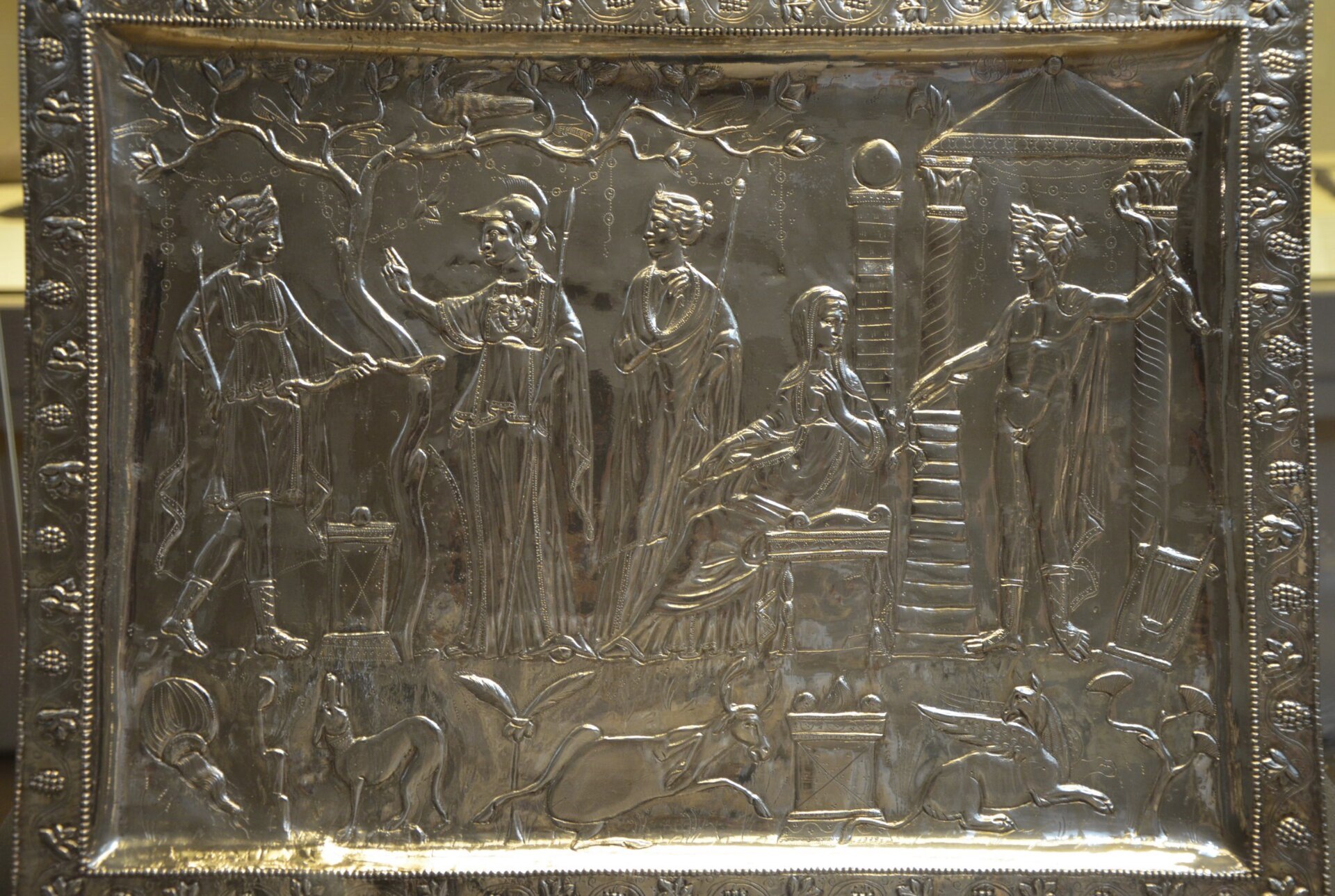
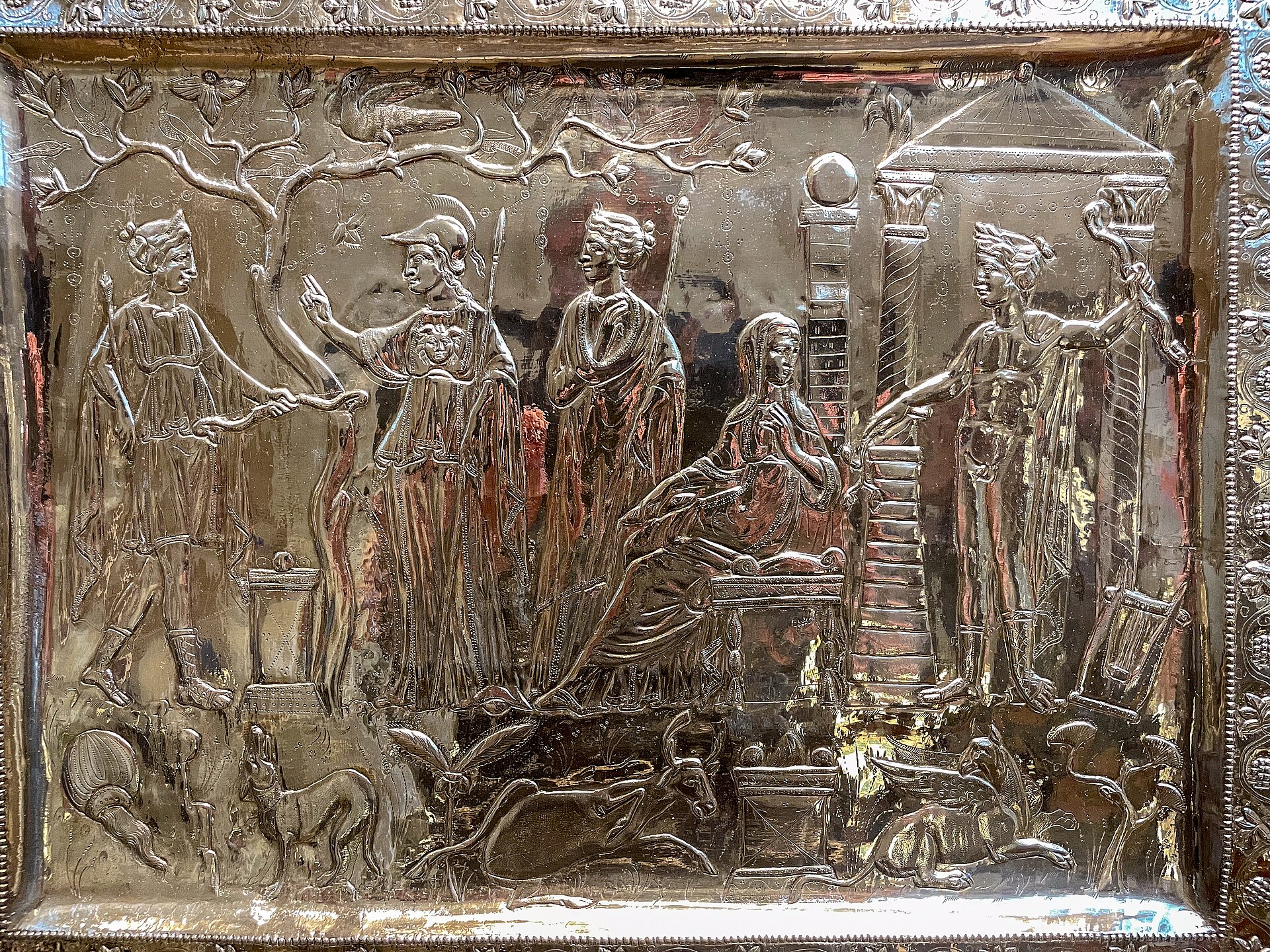
The genuine object, British Museum 1993,0401.1, photographed on display. Independently confirmed via the Wikimedia Commons file page and the Commons API (licence CC BY-SA 2.0) and cross-checked against the British Museum's own collection record before use; this is not the modern facsimile displayed at Corbridge Roman Town Museum.
Carole Raddato · CC BY-SA 2.0| Artist | Unknown Late Roman silversmith (Mediterranean, North African, or Asia Minor workshop, disputed) |
|---|---|
| Date | 4th century AD |
| Medium | Silver, worked in relief (repousse/chasing; a plate-specific technical account of the working method was not found in the sources consulted) |
| Dimensions | 503 x 380 mm (British Museum measurement); weight 4600 g. An earlier published figure of 482.5 x 381 mm appears in the Roman Inscriptions of Britain catalogue entry; the British Museum's own current record is treated here as authoritative. |
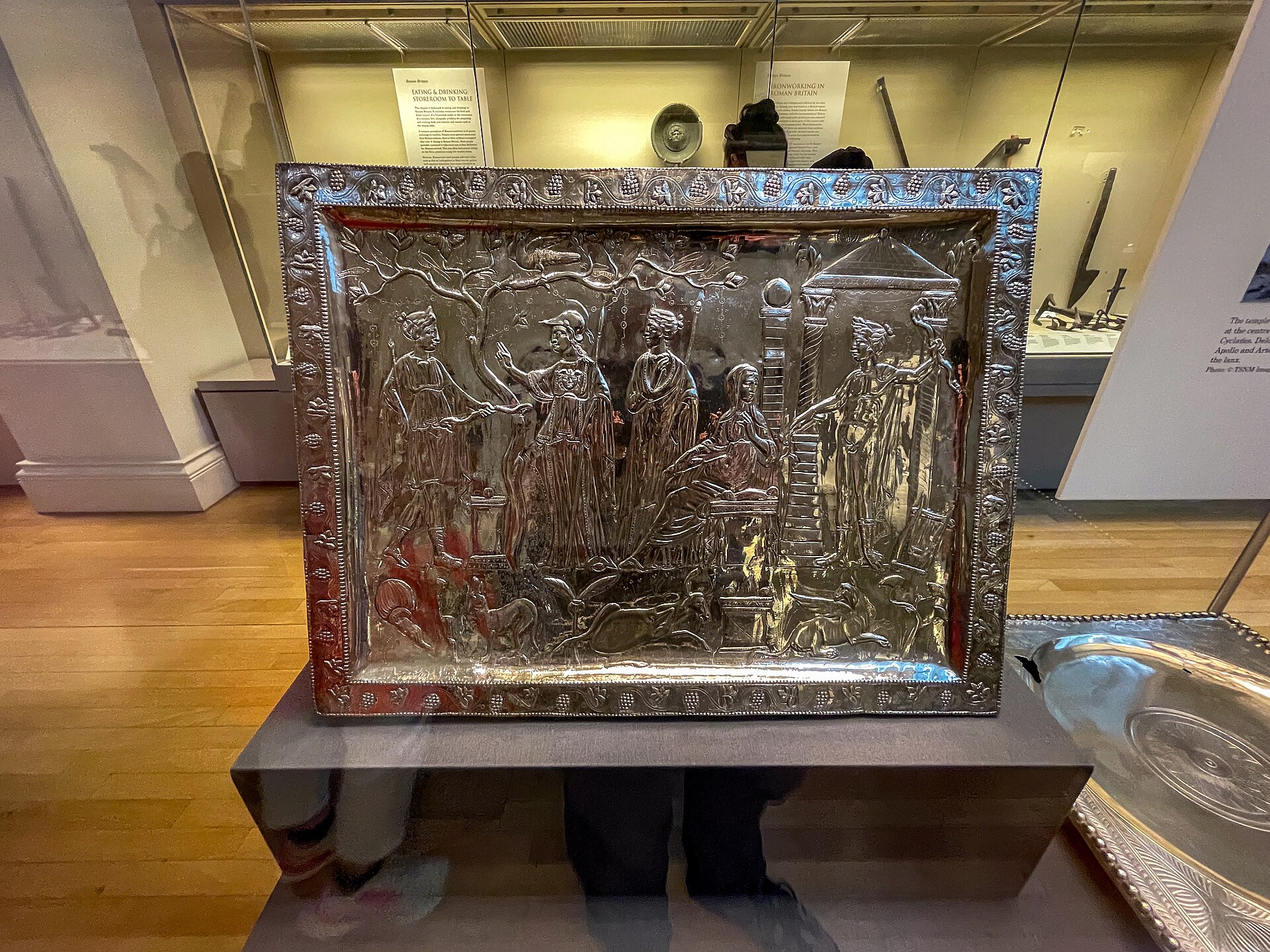
| Where it is now | British Museum, London (on display, Room 49, Roman Britain, Display Case 17)last confirmed |
| Inventory number | 1993,0401.1 |
| Attribution | UnknownNo maker, workshop, or place of manufacture is named or marked on the object. Full note |
| Object type | Silver |
| Period | Roman Britain, 4th century AD |
| Cases | Has a provenance gap |
| Inscriptions | A graffito in punched dots on the base, near the corner of the (now separated) footstand, reading p(ondo) (librae) XIIII (unciae) III (scripula) II - 'Weight fourteen (pounds) three ounces and two scruples' in Roman measure. Calculated out this gives approximately 4,668.5 g, close to but not identical with the vessel's actual weight of 4,600 g. |
| Owners on record | 11 links7 documented, 1 disputed, 3 unknown |
| Sources | 24 cited |
About this record Last verified · 24 sources cited · Change log
On this page 9 sections
ContentsClose
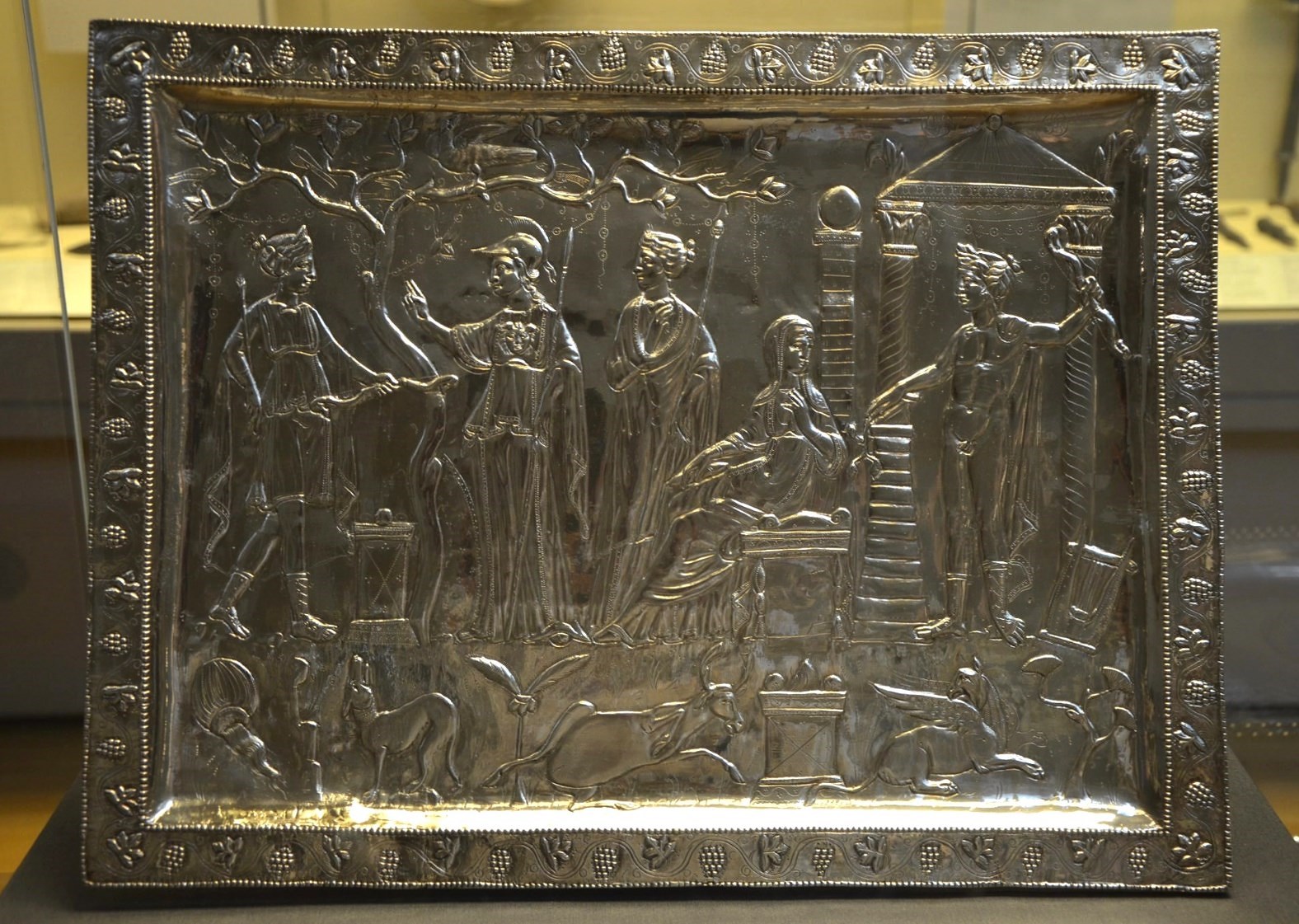
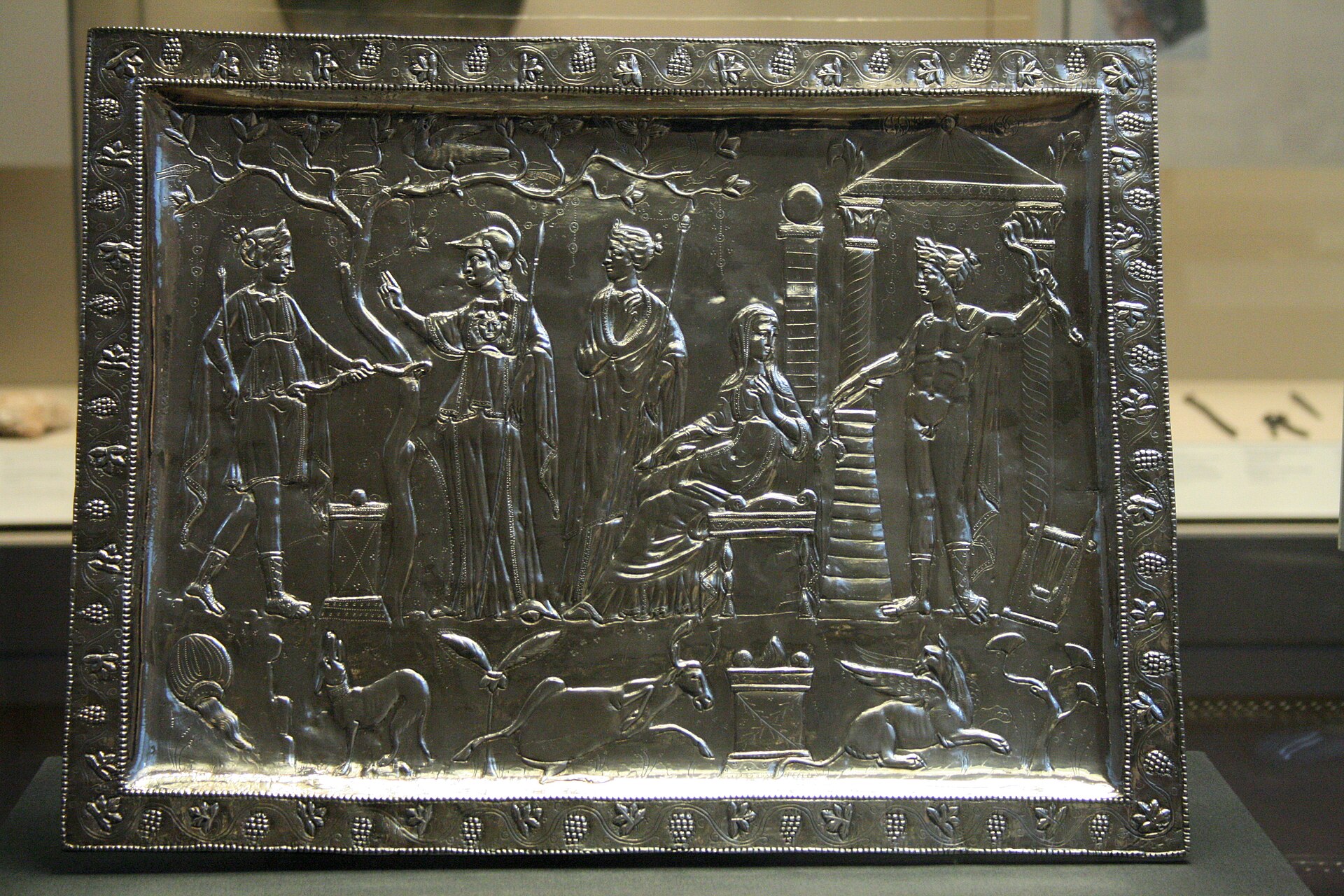
A large rectangular silver dish, 4600 grammes of Roman silver worked in relief with a scene of Apollo at a shrine flanked by Artemis and Athena and two other female figures whose identity is still argued over. It was found by a nine-year-old girl, Isabel Cutter, in the bank of the River Tyne at Corbridge in February 1735, immediately became the subject of one of English law's founding cases on treasure trove, and then passed into the private collection of the Dukes of Northumberland at Alnwick Castle, where it stayed for close to two hundred and fifty years.
Three other silver vessels were reportedly recovered from the same stretch of riverbank between 1731 and 1760. All are lost. Only the lanx survived, and only because it was fought over in Chancery within months of being found rather than melted down like at least one of its companions. The British Museum bought it from the 11th Duke of Northumberland in 1993 after two spells on loan going back to the Second World War.
What the scene actually shows has never been settled. The god and two of the goddesses are secure; the two remaining women are not, and neither is the dish's place of manufacture. This record treats both as open questions rather than closing them for the sake of a tidy caption.
Provenance
Each link is graded. Documented: a cited source supports it. Disputed: the identification is argued but not established. Unknown: no owner for that span, and the gap is not smoothed into a narrative. The grades in the glossary.
- 4th century AD -Unknown workshop, place of manufacture disputedunknown
Dated to the 4th century AD on stylistic grounds. The British Museum's own record gives the production place only as 'Africa (? North Africa?)', 'Turkey (?)' and 'Mediterranean (?)' - three unresolved possibilities, not a finding. Ephesos has been proposed for its cults of Artemis, Apollo and Leto, but this rests on subject matter rather than technical or archaeometric evidence.19
- 4th century AD - 1735Unknown - buried or lost near Corbridge as part of an apparent hoardunknown
How and when the dish came to be in or near the River Tyne at Corbridge is not documented. It is inferred, from other silver reportedly recovered nearby over the following decades, that it was part of a larger fourth-century deposit gradually exposed by river erosion, but no excavation record exists and the inference is the field's, not this record's invention.156
- 10 February 1735 - 10 February 1735Isabel Cutter, finderdocumented
Found 'appearing white above the earth' in the north bank of the Tyne about 150 yards below Corbridge bridge, while the finder was gathering firewood. A Corbridge manor Court Leet presentment, quoted by Haverfield (1914) from the original record, names the finder as 'Isabel Cutter, daughter of Thomas Cutter of Corbridge, blacksmith, aged nine years'. The British Museum's own catalogue names the finder identically as 'Miss Isabel Cutter'. Wikipedia and several sites that follow it instead describe her father as 'a local cobbler' - a claim this record could not verify against any primary source and which conflicts with the manor court record as reported by Haverfield. This record follows the documented court record (blacksmith) and flags the cobbler claim as an unverified, likely erroneous, popular variant.12511
- 15 February 1735 - 1 March 1735Isaac Cookson, Newcastle goldsmithdocumented
Thomas Cutter first broke off and sold the plate's rim or footstand (8 ounces) on 15 February for thirty-six shillings, then sold the remainder on 1 March for thirty guineas - a total of about GBP 33 6s for 148 troy ounces of silver. The Court Leet later fined Cutter sixpence and declared the plate treasure trove belonging to the lord of the manor. This is also the 'Cookson' of the resulting Chancery case, Duke of Somerset v Cookson.5711
- 1735 - 12 November 1735Algernon Seymour (styled Earl of Hertford; from 1748, 7th Duke of Somerset), as lord of the manor of Corbridgedocumented
Algernon Seymour, lord of the manor of Corbridge (he did not become Duke of Somerset himself until his father's death in 1748, but is conventionally referred to by that later title in accounts of the case), claimed the lanx as treasure trove. Cookson resisted and sought compensation rather than surrender. Lord Chancellor Talbot granted an injunction on 19 July 1735 and the equity suit concluded on 12 November 1735, after which Somerset's agents took possession and compensated Cookson beyond his original outlay (the amount is not given in the sources consulted). The case, Duke of Somerset v Cookson (1735), is treated by legal historians as a founding authority on Chancery's power to order the specific return of a unique chattel rather than mere damages, and later Percy-family treasure trove claims to the same manor are read by scholars in light of it.57
- 1735 - 1750Algernon Seymour, Earl of Hertford, from 1748 7th Duke of Somersetdocumented
Held by Seymour following the 1735 decree. In 1736 he commissioned or permitted an antiquarian record of the piece: a drawing by William Shaftoe, engraved by Gerard van der Gucht, dedicated to Somerset and inscribed with the finder's account and the plate's dimensions ('20 Inches by 15').1213
- 1750 - 1993Dukes of Northumberland (Percy family), Alnwick Castledocumented
Algernon Seymour's daughter and heir, Elizabeth Seymour, married Sir Hugh Smithson. On Seymour's death in 1750, Smithson inherited the Percy earldom of Northumberland by special remainder through his wife, changed his name and arms to Percy, and was created 1st Duke of Northumberland in 1766. This is the documented mechanism by which the Percy/Northumberland family came to hold what had been Seymour property; every source consulted states that the lanx passed into Northumberland ownership and remained there until 1993, but none of the sources found for this record states the exact year the object itself changed hands within that inheritance, as distinct from the title and estates generally. That specific date is recorded here as unknown.2171819
- July 1940 - 16 September 1949On loan to the British Museumdocumented
The British Museum's own acquisition notes record a first loan running from July 1940 to 16 September 1949 - almost certainly connected to wartime and immediate postwar arrangements for evacuated or centrally held collections, though the museum's record does not itself explain the reason for the loan or its 1949 return. This loan does not appear in most popular accounts of the object's history, which move directly from 1735 to a single loan beginning in the late 1970s.1
- 1949 - 1978Dukes of Northumberland, Alnwick Castleunknown
No source consulted explains why the 1940-49 loan ended when it did or what happened to the object between 1949 and its return to public display in the late 1970s beyond an inference that it remained at Alnwick.1
- 1978 - 1993On loan to the British Museumdisputed
The British Museum's own collection record states the second loan began 'again since 1978'. Several secondary sources (repeated across press and heritage-fund summaries) instead give 1979 as the year the 'late Duke of Northumberland' placed the lanx on loan for display in the Roman Britain gallery. This record follows the museum's own primary record (1978) and flags the one-year discrepancy rather than silently picking the more commonly repeated figure.14
- April 1993 - presentBritish Museum, Londondocumented
Purchased from Henry Percy, 11th Duke of Northumberland, registered 1993,0401.1. The Art Fund states the total acquisition cost as GBP 1,858,000, of which the Art Fund itself (as the National Art Collections Fund) contributed GBP 150,000; other summaries round this to 'in excess of GBP 1.8 million'. The National Heritage Memorial Fund's own specific grant figure could not be independently confirmed: its project page (memorialfund.org.uk, formerly nhmf.org.uk) returned an access error (HTTP 403) on direct fetch, and only a search-engine summary of it was available, which is flagged here as a source needing a direct primary check. The British Museum's own funder list also credits British Museum Friends (as the British Museum Society) and the Trustees of the British Museum itself as contributors.134
Technical evidence
| Attribution note | No maker, workshop, or place of manufacture is named or marked on the object. The British Museum's own catalogue entry gives the production place only as 'Africa (? North Africa?)', 'Turkey (?)' and 'Mediterranean (?)', i.e. undetermined between three broad candidate regions. Ephesos has been proposed by some scholars because of its documented cults of Artemis, Apollo and Leto, but this is a proposal based on subject matter, not on a mark, a stylistic fingerprint tied to a known workshop, or a scientific provenance study of the metal. Whether the dish is a Mediterranean import carried to Britain or a product of a provincial workshop working in an imported style is unresolved in the sources consulted. |
|---|---|
| Material | Silver.1 |
| Dimensions | Length 503 mm, width 380 mm (British Museum measurement). An earlier published figure of 482.5 x 381 mm appears in the Roman Inscriptions of Britain catalogue entry.16 |
| Weight | 4,600 g as currently weighed. An ancient punched-dot inscription on the base records the weight in Roman measure as 14 pounds, 3 ounces, 2 scruples, which calculates to approximately 4,668.5 g - close to, but about 68 g more than, the object's present weight.16 |
| Silver content | Given in the Roman Inscriptions of Britain entry as 92.6 percent silver. The method behind this figure (modern assay versus a documentary or weight-based inference) is not stated in the source and was not independently confirmed elsewhere in this research.6 |
| Footstand | The dish originally had a rectangular silver footstand approximately 25.5 mm high. Thomas Cutter broke this off and sold it separately, for thirty-six shillings, on 15 February 1735, seventeen days before selling the remainder of the dish. Its current whereabouts, or whether it survives at all, is not stated in the sources consulted.56 |
| Rim decoration | A running vine-scroll worked in relief decorates the raised rim, framing the central figural scene.3 |
| Inscription | Latin weight graffito in punched dots on the base, near the corner of the (separated) footstand: p(ondo) (librae) XIIII (unciae) III (scripula) II, 'Weight fourteen (pounds) three ounces and two scruples'. This is a Roman-period working mark, not a later addition.16 |
| Findspot | North bank of the River Tyne at Corbridge, Northumberland, approximately 150 yards downstream of the modern bridge, found 10 February 1735.156 |
| Conservation record | The British Museum's own online record lists a series of conservation treatment entries against this object, but the public-facing record does not describe their nature or dates in the portion accessible during this research.1 |
Images
The record in full
Chapter 1What it is
The Corbridge Lanx is a large, heavy, rectangular sheet-silver dish, 503 by 380 millimetres and weighing 4.6 kilograms, its raised rim framed by a running vine-scroll and its floor worked in relief...
The Corbridge Lanx is a large, heavy, rectangular sheet-silver dish, 503 by 380 millimetres and weighing 4.6 kilograms, its raised rim framed by a running vine-scroll and its floor worked in relief with a crowded mythological scene. The Latin word 'lanx' simply means a flat dish or tray; it was applied to objects of this shape by eighteenth-century antiquarian scholars rather than being a term the Romans necessarily used for this specific class of vessel, and it has stuck as the object's name ever since.
What it was actually for is not settled. Its size and weight would suit either a serving dish for an especially grand Roman table or a tray used to carry offerings - fruit, the parts of sacrificed animals, small votive objects - to an altar, and scholars have proposed both. It was made to be looked at as much as used: this is one of a recognised class of late-Roman silver 'picture plates', flat vessels whose primary purpose was pictorial display rather than everyday dining, of which some eighty examples are known across the later Roman world.
Chapter 2The scene, read left to right
The composition is read, by the British Museum's own description, left to right: the goddess Artemis, holding a bow, appears to enter the scene from one side; the helmeted goddess Athena stands with...
The composition is read, by the British Museum's own description, left to right: the goddess Artemis, holding a bow, appears to enter the scene from one side; the helmeted goddess Athena stands with one hand raised as if in conversation; a standing female figure and, beside her, a seated female figure occupy the centre; and the god Apollo stands at the entrance to a shrine, his bow in hand and his lyre resting at his feet. In the foreground an altar is flanked by Artemis's hunting hound, a stag that has already fallen, and a griffin, a creature conventionally associated with Apollo.
Three of the five figures are not in doubt. Apollo, Artemis, and Athena are identified consistently across every source consulted for this record. The other two women are the problem the scene has posed to scholars for close to three hundred years, and it has not been solved.
Chapter 3Two women nobody can name for certain
The British Museum's own catalogue text offers one possibility, carefully hedged: if the shrine shown is that of Apollo and Artemis's birthplace, the Greek island of Delos, then the older seated...
The British Museum's own catalogue text offers one possibility, carefully hedged: if the shrine shown is that of Apollo and Artemis's birthplace, the Greek island of Delos, then the older seated woman, shown spinning, may be Leto, mother of the twin gods, and the standing woman beside her may be her sister Ortygia, who myth held was transformed into the island of Delos itself. Ephesos has been suggested as the dish's place of manufacture partly because that city, too, maintained cults of Artemis, Apollo, and Leto, which would make the Delos reading consistent with a plausible origin for the object.
That is one proposal among several, not a settled reading. In 1914, the classicist Percy Gardner argued for a different subject altogether: a late variant of the Judgment of Paris, moved from Mount Ida to Delphi and with Apollo standing in as arbiter rather than the Trojan prince Paris. O. Brendel's 1941 study of the piece in the Journal of Roman Studies, the paper still treated as the founding modern scholarly treatment of the dish, laid out two broad interpretive camps current in his day: one reaching for mystical or Neoplatonist cosmological readings, the other content with a plainer classical-legend explanation resting on the presence of named Olympian deities. Neither, in his own assessment, closed the case. No source consulted for this record claims the matter has been settled since.
Chapter 4Where it was made: an argument nobody has won
The dish carries no maker's mark, no dedication, and no signature.
The dish carries no maker's mark, no dedication, and no signature. The British Museum's own production-place field for the object lists three candidates and resolves none of them: North Africa, Turkey (Asia Minor), and 'the Mediterranean' generally. The Ephesos proposal is the most specific version of the Asia Minor case, built on the coincidence between the city's known cults and the deities apparently shown, but a coincidence of subject matter is an argument, not a find-spot, a workshop mark, or a chemical signature in the metal.
The deeper question underneath all of this is whether the dish was made somewhere in the Mediterranean world and carried, whole, to Britain as an existing luxury object, or made by a provincial workshop that had learned or imported a Mediterranean pictorial vocabulary. This research did not locate any published metallurgical, isotopic, or trace-element analysis of the silver that might help settle it. Given that such analysis is one of the few ways this specific debate could ever move past style and iconography, its apparent absence from the published record is itself worth recording rather than passing over.
Chapter 5The girl who found it
On or about 10 February 1735, a nine-year-old girl was gathering firewood on the north bank of the River Tyne, about a hundred and fifty yards below the bridge at Corbridge, when she saw something...
On or about 10 February 1735, a nine-year-old girl was gathering firewood on the north bank of the River Tyne, about a hundred and fifty yards below the bridge at Corbridge, when she saw something white showing through the earth and gravel at the water's edge. She pulled it free and carried it home to her father. A Corbridge manor Court Leet presentment, quoted in full by the antiquarian scholar F. Haverfield in his 1914 Journal of Roman Studies paper, names her precisely: 'Isabel Cutter, daughter of Thomas Cutter of Corbridge, blacksmith, aged nine years'. The British Museum's own current catalogue record independently names the finder the same way, as 'Miss Isabel Cutter'.
Wikipedia's article on the object, and a number of sites that repeat it, instead describe Thomas Cutter as 'a local cobbler'. This record could not trace that claim to any primary source, and it directly conflicts with the manor court record as reported by Haverfield, an academic source working from the original eighteenth-century document. Rather than silently picking one version, this record follows the documented primary source (blacksmith) and records the popular variant as unverified and probably mistaken.
Chapter 6A treasure fought over within weeks
Thomas Cutter did not keep the dish intact.
Thomas Cutter did not keep the dish intact. On 15 February 1735 he broke off its footstand, eight ounces of silver, and sold it to Isaac Cookson, a Newcastle goldsmith, for thirty-six shillings. On 1 March he sold Cookson the remaining 140 ounces for thirty guineas. Between the two sales, Cutter had disposed of roughly 148 troy ounces of ancient Roman silver for a little over thirty-three pounds sterling.
It did not stay Cookson's for long. The manor of Corbridge belonged to Algernon Seymour, styled Earl of Hertford at the time (he inherited the dukedom of Somerset itself only on his father's death in 1748), and as lord of the manor he claimed the dish as treasure trove. The Corbridge Court Leet duly fined Cutter sixpence and declared the plate treasure belonging to the lord of the manor; Cookson, who had paid good money for it, refused to hand it over without compensation and the dispute went to the Court of Chancery. Lord Chancellor Talbot granted an injunction on 19 July 1735 and the equity suit concluded that November, after which Seymour's agents took possession and paid Cookson something beyond his original outlay, an amount not stated in the sources consulted.
Legal historians still cite the resulting case, Duke of Somerset v Cookson (1735), as an early and important authority for the principle that a court of equity can order the specific return of a unique object rather than simply awarding damages for its value - a genuinely different remedy, because damages would let the loser keep the thing and pay for it, while specific delivery forces the object itself back into the rightful owner's hands. A unique fourth-century Roman silver dish, the courts reasoned, could not be adequately replaced by money. The same manor's later treasure trove disputes, raised by Somerset's Percy successors, are read by legal scholars in the light this 1735 case sets.
Chapter 7The wider hoard: what survived, and what did not
Isabel Cutter's find was very probably not an isolated loss.
Isabel Cutter's find was very probably not an isolated loss. Haverfield's 1914 account records three further silver vessels reportedly recovered from the same stretch of the Tyne over the following quarter-century: a silver basin found around 1731, before the lanx itself, later melted down for its metal; a two-handled cup found in 1733 at the same spot, sold for a single guinea to a Roman Catholic priest of the Howard family of Corby, its later history unrecorded; and a silver bowl found in the summer of 1736 on the opposite bank, twenty ounces in weight, decorated with a scroll pattern and, notably, a Chi-Rho monogram - a Christian symbol, on an otherwise pagan-looking hoard, exactly the combination the British Museum's own commentary compares to the mixed pagan and Christian silver of the Mildenhall Treasure. A further silver vase, inscribed 'Desideri vivas', turned up four miles downstream at Bywell in 1760 and was likewise claimed by the lord of the manor.
None of these four objects can be traced today. No excavation ever took place; each was a chance river find reported after the fact, and the connection between them and the lanx rests on rough proximity and roughly compatible dates, not on any archaeological record of a single sealed deposit. What can be said honestly is only this: something valuable in silver was coming out of that riverbank for at least thirty years, most of it was destroyed or dispersed within living memory of its discovery, and the Corbridge Lanx survived only because it was fought over in a court of law rather than melted down by a goldsmith who had bought it for its weight in silver.
Chapter 8From Seymour to Percy: two centuries at Alnwick
Algernon Seymour held the dish from 1735, becoming 7th Duke of Somerset in his own right in 1748.
Algernon Seymour held the dish from 1735, becoming 7th Duke of Somerset in his own right in 1748. He died in 1750 without a surviving son, and his titles and estates passed to his daughter, Elizabeth Seymour, and through her to her husband, Sir Hugh Smithson. Smithson inherited the earldom of Northumberland from his father-in-law by a special remainder written into the original grant, changed his own family name and coat of arms to Percy, and was created 1st Duke of Northumberland in 1766.
That is the documented mechanism by which a Seymour possession became a Percy one. What none of the sources consulted for this record state explicitly is the exact date the lanx itself, as a physical object, moved from one family's hands to the other's within that broader inheritance of titles and estates - only that, by every later account, it had become Northumberland property and remained so, at Alnwick Castle, for close to a quarter of a millennium.
One footnote to this family history is worth recording on its own terms rather than as trivia: Hugh Smithson (Percy)'s illegitimate son, James Smithson, later endowed the institution in Washington that bears his name, the Smithsonian. The connection to this object is only genealogical, not evidentiary, and this record does not claim more for it than that.
Chapter 9Two loans and a sale
The dish's final path into public ownership was not a single clean transaction.
The dish's final path into public ownership was not a single clean transaction. The British Museum's own acquisition record shows a first loan running from July 1940 to 16 September 1949 - years that overlap the Second World War and its immediate aftermath, though the museum's own record does not explain the reason for the loan or why it ended when it did, and no other source consulted fills in that gap. The object then returns to a documentary silence of nearly thirty years before a second loan, which the museum's own record dates to 1978 (several secondary and heritage-fund sources instead say 1979, a discrepancy this record notes rather than resolves), placing it on public display in the Roman Britain gallery.
The purchase itself came in April 1993. Henry Percy, 11th Duke of Northumberland, sold the lanx to the British Museum outright, ending 258 years of private family ownership. The Art Fund states the total cost as GBP 1,858,000, toward which the Art Fund itself contributed GBP 150,000; other summaries round the figure to 'in excess of GBP 1.8 million'. The British Museum's own funder credits also name the National Heritage Memorial Fund, British Museum Friends (then styled the British Museum Society), and the Trustees of the British Museum itself as contributors. The National Heritage Memorial Fund's own account of its specific contribution could not be checked directly during this research: its project page returned an access error on every fetch attempt, direct and browser-based alike, and only a search-engine summary of its content was available. That is recorded here as a gap needing a primary check, not filled in by assumption.
Chapter 10What the money meant
Thomas Cutter's roughly GBP 33 6s for the plate and its severed foot is a hard figure to feel the weight of nearly three centuries later.
Thomas Cutter's roughly GBP 33 6s for the plate and its severed foot is a hard figure to feel the weight of nearly three centuries later. Contemporary day-rate evidence for English craftsmen in the early eighteenth century runs from roughly eighteen to thirty-two pence a day. At those rates, GBP 33 6s (7,992 pence) represents somewhere between about 250 and 440 days of a skilled craftsman's labour - the better part of a working year, and in some readings more than a full one, for a nine-year-old's chance find of a piece of ancient silver.
The 1993 purchase price is easier to place, using a stated method rather than a bare modern-equivalent figure: applying a UK consumer-price inflation calculator's cumulative change from 1993 to the present (a reported increase of approximately 164 percent over that period), GBP 1,858,000 in 1993 corresponds to roughly GBP 4.9 million today. That figure is a price-index conversion, not an estimate of what the dish would fetch on the open market now; the two are different questions, and this record does not conflate them.
Chapter 11How the image outlived the custody chain
The lanx was drawn from life in 1736 by the antiquarian William Shaftoe and engraved by Gerard van der Gucht, in a print dedicated to the Duke of Somerset and inscribed with an account of the find...
The lanx was drawn from life in 1736 by the antiquarian William Shaftoe and engraved by Gerard van der Gucht, in a print dedicated to the Duke of Somerset and inscribed with an account of the find and the plate's dimensions, given as twenty inches by fifteen. That print, not the object itself, is what carried the dish's image around the eighteenth-century world of scholars and collectors. It is also, by a route independent of the object's own ownership history, what produced a small group of Chinese export porcelain tea trays, made at Jingdezhen around 1737 to 1748 in underglaze cobalt blue, copying van der Gucht's composition; one survives at the National Trust's Cotehele, another at Drum Castle in Aberdeenshire. A silver dish found in a Northumberland riverbank ended up, within a decade or so, as the pattern on Chinese porcelain destined for English collections - a small, well-documented case of exactly the kind of image circulation this archive tries to track rather than assume.
The same engraver, in the same year, also produced the only surviving record of a second Romano-British lanx: the Risley Park find of 1729, in Derbyshire, lost after its own discovery and known today only through his print. That original vessel is significant here for a second, less happy reason. In the early 1990s a forged silver dish, made by Shaun Greenhalgh from melted Roman coins and passed off as a rediscovered original, was displayed at the British Museum as the genuine Risley Park Lanx before analysis exposed it as modern work in 2005. It is recorded in this record's related_works, not its images, as the clearest real example of the exact mistake a record like this one exists to prevent: an image or an object correctly bearing a hoard's name while not actually being the object described.
Chapter 12What remains unresolved
Set against the unusual richness of its documented custody history, since 1735, the Corbridge Lanx's meaning is still argued rather than known.
Set against the unusual richness of its documented custody history, since 1735, the Corbridge Lanx's meaning is still argued rather than known. Two of its five human figures cannot be named with confidence. Its place of manufacture is a list of three unconfirmed possibilities rather than a conclusion. No modern scientific analysis of its silver appears to have been published. And even its recent institutional history carries small, honest gaps: a wartime loan that most popular accounts omit entirely, a one-year discrepancy over when its second loan began, and a funding breakdown for its 1993 purchase that this research could not fully verify against a primary source.
None of that diminishes what is documented. A nine-year-old's find, a Chancery case that still gets cited, and a family's two-and-a-half centuries of custody are as solidly established as anything in this archive. What is not known is recorded here as not known, which is the more useful thing to leave a reader with than a smoothed-over certainty the evidence does not support.
The artist
No named maker. Attribution is to an unidentified workshop within the corpus of late-antique silver 'picture plates'.
The Corbridge Lanx carries no maker's mark and no signature, and none of the sources consulted for this record name an individual craftsman or a specific workshop. What exists instead is a scholarly attribution dispute of exactly the kind this archive exists to document: not who made it, but where, and within what tradition. The dish belongs to a defined and catalogued class of object - the late-Roman silver 'picture plate', flat, rectangular or round, decorated with a mythological scene in relief and made for display or ceremonial use rather than everyday dining - and the question scholars actually argue over is which part of the Roman world produced that class, and this piece in particular.
Related works
| Work | Relation | Where it is |
|---|---|---|
| Risley Park Lanx (lost original) and its 1990s forged replacement Unknown Roman workshop (original); Shaun Greenhalgh (forged replacement) | The other Romano-British lanx, found in Derbyshire in 1729, six years before the Corbridge find, and the closest documented comparandum for the type in Britain Its own inscription named a bishop, Exuperius, and a church, unlike Corbridge's plain weight mark. The forgery episode is the single closest real-world parallel to the version-confusion risk this archive is built to prevent, and is recorded here for that reason as well as for comparanda. | Original lost after 1729 (known only from Gerard van der Gucht's 1736 engraving); a forged replacement was displayed at the British Museum from 1992 until exposed as modern work by Shaun Greenhalgh in 2005 |
| The Great Dish (Oceanus Dish), Mildenhall Treasure Unknown Roman workshop | Comparable late-Roman silver picture plate; comparable pattern of an apparently mixed pagan and (elsewhere in the same hoard) Christian silver deposit Found at West Row, near Mildenhall, Suffolk, in 1942. At 60.5 cm diameter and 8.256 kg it is substantially larger and heavier than the Corbridge Lanx. The Commons file description for the Corbridge Lanx's lead image itself draws this comparison, on the basis that the lost Corbridge hoard reportedly included a bowl bearing a Chi-Rho monogram alongside overtly pagan silver. | British Museum, London |
| Porcelain tea tray copying the 1736 engraving of the Corbridge Lanx Unknown Chinese porcelain workshop, Jingdezhen | A direct eighteenth-century reproduction of the Corbridge Lanx's design, made for the export trade from Gerard van der Gucht's print rather than from the object itself Made in underglaze cobalt blue, circa 1737-1748, from the same 1736 engraving commissioned by antiquarian circles around the Duke of Somerset. Demonstrates how quickly and by what route the image of the dish circulated, independent of the object's own physical custody history. | National Trust, Cotehele (object 347543.1); a second known example is at Drum Castle, Aberdeenshire |
| Three further silver vessels reportedly found near the Corbridge findspot, 1731-1760, now all lost Unknown Roman workshop(s) | Possible companions from the same original deposit as the Corbridge Lanx Per Haverfield (1914): a silver basin found around 1731 near Corbridge bridge, later melted down; a two-handled cup found in 1733 at the same spot, sold to a Roman Catholic priest of the Howard family of Corby for a guinea, fate thereafter unknown; a silver bowl bearing a Chi-Rho monogram and scroll decoration, found in summer 1736 on the opposite (south) bank, weighing 20 ounces, fate unknown; and a silver vase found in 1760 at Bywell, four miles downstream, inscribed 'Desideri vivas' and claimed by the lord of the manor, fate unknown. None can be independently verified as part of the same original deposit as the lanx; the connection is inference from proximity and approximate date, not excavation record. | Untraced |
Open questions
- Was Isabel Cutter's father a blacksmith or a cobbler? The only primary source located, a manor Court Leet presentment quoted by Haverfield (1914), says blacksmith; the widely repeated modern claim that he was a cobbler could not be traced to any primary source and may be a later error that has propagated through Wikipedia and sites that copy it.
- Who are the two central female figures in the scene? Neither the British Museum's own tentative Leto/Ortygia reading nor Percy Gardner's 1914 Judgment-of-Paris-at-Delphi proposal has become a scholarly consensus, and O. Brendel's 1941 study, still the standard reference, left the question open.
- Where was the dish actually made? North Africa, Asia Minor (Ephesos has been specifically proposed), and 'the Mediterranean' generally are all live candidates in the sources consulted, and none is preferred by the British Museum's own catalogue record.
- What happened to the other silver vessels reportedly found near the same spot between 1731 and 1760? All are untraced; one is recorded as deliberately melted down for its metal value.
- Is the Isaac Cookson who bought the plate from Thomas Cutter in 1735 the same Isaac Cookson (1679-1743) who founded the Newcastle iron, lead, and glass business that became the Cookson dynasty? Both were Newcastle men of business active in exactly this period, but no source consulted for this record explicitly confirms they are one and the same.
- Exactly when, within the 1750 Percy inheritance of the Somerset estates and titles, did physical custody of the lanx itself pass from the Seymour to the Percy family? Every source agrees on the eventual fact of Percy ownership; none dates the object's own transfer specifically.
- Did the second British Museum loan begin in 1978, as the museum's own collection record states, or in 1979, as several secondary sources state? The discrepancy is one year and unresolved in the sources consulted.
- What was the National Heritage Memorial Fund's specific contribution to the 1993 purchase price? Its own project page could not be accessed directly during this research (HTTP 403 on every fetch attempt) and only a search-engine summary was available; a direct primary check is needed.
- Has the dish's silver ever been subjected to a published modern metallurgical or isotopic analysis? None was located in this research, despite this being one of the few methods that could independently test the competing places-of-manufacture proposals.
Questions about this object
What is The Corbridge Lanx?
The Corbridge Lanx is a silver, dated 4th century AD. Medium: Silver, worked in relief (repousse/chasing; a plate-specific technical account of the working method was not found in the sources consulted).
Who made The Corbridge Lanx, and is the attribution settled?
The attribution to Unknown Late Roman silversmith (Mediterranean, North African, or Asia Minor workshop, disputed) is recorded here as unknown. No maker, workshop, or place of manufacture is named or marked on the object. The British Museum's own catalogue entry gives the production place only as 'Africa (? North Africa?)', 'Turkey (?)' and 'Mediterranean (?)', i.e. undetermined between three broad candidate regions. Ephesos has been proposed by some scholars because of its documented cults of Artemis, Apollo and Leto, but this is a proposal based on subject matter, not on a mark, a stylistic fingerprint tied to a known workshop, or a scientific provenance study of the metal. Whether the dish is a Mediterranean import carried to Britain or a product of a provincial workshop working in an imported style is unresolved in the sources consulted.
Where is The Corbridge Lanx now?
British Museum, London (on display, Room 49, Roman Britain, Display Case 17). Inventory number 1993,0401.1. Last confirmed 4 September 2026. Purchased in 1993 from Henry Percy, 11th Duke of Northumberland, with contributions from the National Heritage Memorial Fund, the Art Fund (as the National Art Collections Fund), British Museum Friends (as the British Museum Society) and the Trustees of the British Museum. Verified independently against the British Museum's own online collection record (object H_1993-0401-1) on 2026-09-04.
What is still unknown about The Corbridge Lanx?
Was Isabel Cutter's father a blacksmith or a cobbler? The only primary source located, a manor Court Leet presentment quoted by Haverfield (1914), says blacksmith; the widely repeated modern claim that he was a cobbler could not be traced to any primary source and may be a later error that has propagated through Wikipedia and sites that copy it.
Sources
- 1British Museum, Collection Online, 'lanx' (The Corbridge Lanx), museum number 1993,0401.1. britishmuseum.org/collection/...
- 2Wikipedia, 'Corbridge Lanx'. en.wikipedia.org/wiki/...
- 3Art Fund, 'The Corbridge Lanx'. artfund.org/our-purpose/...
- 4National Heritage Memorial Fund (now trading as the National Heritage Memorial Fund at memorialfund.org.uk), 'Corbridge Lanx'. Flagged for a direct primary re-check. memorialfund.org.uk/projects/...
- 5F. Haverfield, 'Roman Silver in Northumberland', Journal of Roman Studies 4 (1914), pp. 1-12. Primary academic source for the manor court presentment, the sale to Isaac Cookson, the Chancery proceedings, and the other silver vessels reportedly found nearby between 1731 and 1760. penelope.uchicago.edu/Thayer/...
- 6Roman Inscriptions of Britain, RIB 2414.38, 'Corbridge Lanx'. romaninscriptionsofbritain.org/inscriptions/...
- 7Norma M. Dawson, 'The Double Life of Duke of Somerset v Cookson, or a Legal Excavation of the Corbridge Lanx', Journal of Legal History 35:3 (2014), pp. 258-280. Abstract and publication metadata consulted; full text is paywalled and was not read in full for this record. pure.qub.ac.uk/en/...
- 8O. Brendel, 'The Corbridge Lanx', Journal of Roman Studies 31 (1941), pp. 100-127. The founding modern scholarly study of the dish's iconography; abstract/extract consulted via publisher listing, full text paywalled and not read in full for this record. cambridge.org/core/...
- 9J.M.C. Toynbee and K.S. Painter, 'Silver Picture Plates of Late Antiquity: A.D. 300 to 700', Archaeologia 108 (1986), pp. 15-65, the standard catalogue of the class of object to which the Corbridge Lanx belongs. Catalogue listing and description consulted; full text not read in full for this record. cambridge.org/core/...
- 10Wikimedia Commons, file description page for the lead image, reproducing the British Museum's own curatorial text in full, including the Leto/Ortygia identification proposal and the comparison with the Mildenhall Treasure. commons.wikimedia.org/wiki/...
- 11Edithorial (blog), 'Nine-Year-Old Girl Finds Roman Treasure in 1735'. A secondary source, but one that quotes the manor court deposition directly and identifies the Wikipedia 'cobbler' claim as inconsistent with the primary record; cross-checked here against Haverfield 1914, which independently confirms 'blacksmith'. edithorial.blogspot.com/2020/...
- 12Prints and Principles, 'Gerard van der Gucht's etching, "The Corbridge Lanx", 1736'. printsandprinciples.com/2019/...
- 13Thorvaldsens Museum Catalogue, entry E1482, for Gerard Vandergucht's 1737 print after William Shaftoe's drawing, quoting its dedication and inscription in full. kataloget.thorvaldsensmuseum.dk/en/...
- 14National Trust Collections, 'Tray', object 347543.1 (Cotehele), a Chinese export porcelain tea tray of c. 1737-1748 copying van der Gucht's engraving of the Corbridge Lanx. nationaltrustcollections.org.uk/object/...
- 15Wikipedia, 'Risley Park Lanx'. en.wikipedia.org/wiki/...
- 16Wikipedia, 'Shaun Greenhalgh', for the 1990s forged replacement of the (separately) lost Risley Park Lanx, exposed in 2005 after display at the British Museum from 1992. en.wikipedia.org/wiki/...
- 17Wikipedia, 'Algernon Seymour, 7th Duke of Somerset'. en.wikipedia.org/wiki/...
- 18Percy Family History, 'Percy to Seymour. Smithson to Percy'. percyfamilyhistory.com
- 19Wikipedia, 'Hugh Percy, 1st Duke of Northumberland' (born Sir Hugh Smithson). en.wikipedia.org/wiki/...
- 20Wikipedia, 'Mildenhall Treasure', for the comparanda dish (the Great Dish, or Oceanus Dish) used for comparison of picture-plate form and mixed pagan/Christian hoard content. en.wikipedia.org/wiki/...
- 21inflationtool.com, UK inflation calculator, value of GBP 1 from 1993 to present, used for the period-money comparison in this record with the calculation method (cumulative CPI-based price index change) stated explicitly. inflationtool.com/british-pound/...
- 22Co-Curate (Newcastle University), resource page for 'The Corbridge Lanx, 4th century AD, from Corbridge, Northumberland, Roman Britain, British Museum'. co-curate.ncl.ac.uk/resources/...
- 23Wikipedia, 'Isaac Cookson (foundryman)', consulted only to flag an unconfirmed possible identity with the Newcastle goldsmith Isaac Cookson of the 1735 case; the two are not confirmed as the same individual in the sources consulted. en.wikipedia.org/wiki/...
- 24Wikimedia Commons, Category:Corbridge Lanx, and the extended metadata () of each file in it, queried directly via the Commons API to verify licence and to confirm each image depicts the genuine British Museum original rather than the modern replica at Corbridge Roman Town Museum. commons.wikimedia.org/wiki/...
.jpg)
Last verified · Published
Change log
4 September 2026 - Record created at the house standard: researched narrative, technical evidence, maker dossier, graded provenance chain, prices with hammer and premium separated, related works, open questions and sources.