The Great Dish from the Mildenhall Treasure
Unknown Late Roman silversmith's workshop · 4th century CE (300s AD)
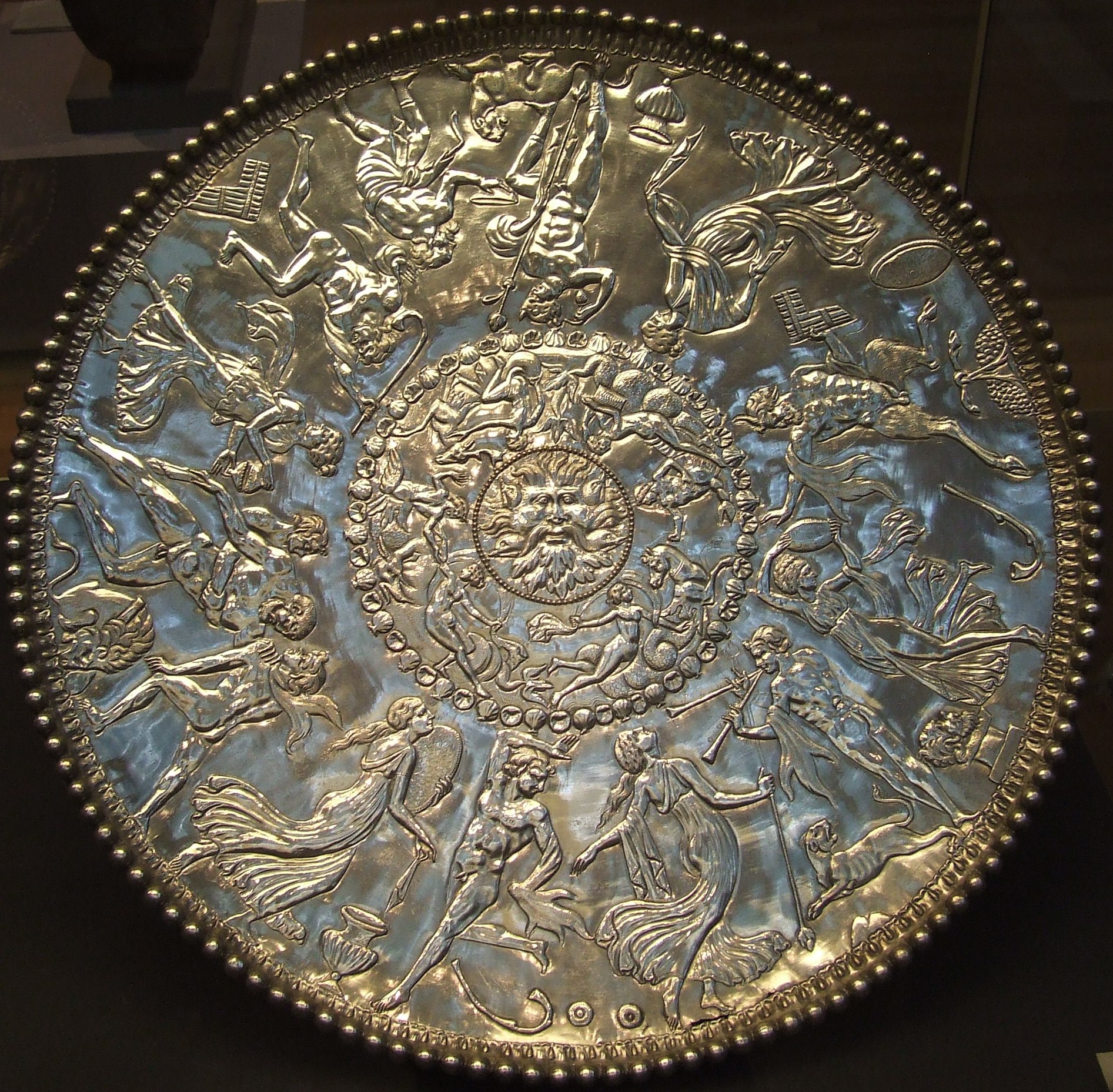
The Great Dish photographed on display at the British Museum. The Oceanus mask sits at the centre, surrounded by the Nereid frieze and the outer band of Bacchic revellers.
Photograph by JMiall, own work, 4 June 2010, via Wikimedia Commons · CC BY-SA 3.0| Artist | Unknown Late Roman silversmith's workshop |
|---|---|
| Date | 4th century CE (300s AD) |
| Medium | Silver, decoration worked in low relief and engraved line, parcel gilding on some raised elements |
| Dimensions | 605 mm diameter; weight 8.256 kg |
| Where it is now | British Museum, Londonlast confirmed |
| Inventory number | 1946,1007.1 |
| Attribution | UnknownNo maker's mark or workshop stamp survives on the dish. Full note |
| Object type | Silver |
| Period | Late Roman Britain, 4th century CE |
| Cases | Has a provenance gap · Seized, looted or confiscated |
| Inscriptions | None on the dish itself. Two of the smaller Bacchic platters elsewhere in the same hoard carry the scratched inscription 'eutheriou', read as '(the property) of Eutherios' - a wider-hoard detail, not a mark on this object. |
| Owners on record | 7 links5 documented, 2 unknown |
| Sources | 11 cited |
About this record Last verified · 11 sources cited · Change log
On this page 9 sections
ContentsClose
The largest and most heavily decorated piece in the Mildenhall Treasure, a hoard of thirty-four Roman silver vessels struck by a ploughman's blade in a Suffolk field in January 1942. A mask of Oceanus stares from the centre of the dish, ringed by sea nymphs and, in the widest band, a full Bacchic procession complete with musicians. The dish was kept as undeclared household silver for over four years, at times doing duty as a fruit bowl, before being reported to the British Museum in 1946 and declared treasure trove.
The documented record, drawn from the coroner's inquest and from British Museum correspondence, corrects a persistent popular myth: the reward was split equally between the finder, Gordon Butcher, and his employer, Sydney Ford, at 1,000 pounds each, not unevenly as is often repeated. Roald Dahl's famous fictionalised account of the discovery, published in America in 1947 and later reworked into a well-known illustrated book, took real liberties with both men's characters; Dahl said so himself, and this record treats his version as reception history, not as a source for what actually happened.
Where the dish was made, exactly when its owner buried it, and why, remain open. The British Museum commits only to 'the general Mediterranean region' for its manufacture; the usual reading that it was hidden amid the instability of the end of Roman Britain is an argued interpretation, not a fact fixed by any evidence recovered with the hoard itself. The precise spot where Butcher's plough struck it has never been found again.
Provenance
Each link is graded. Documented: a cited source supports it. Disputed: the identification is argued but not established. Unknown: no owner for that span, and the gap is not smoothed into a narrative. The grades in the glossary.
- 4th century CE - c. 380-430 CE (estimated)Unknown Roman owner in Britaindocumented
The dish's fourth-century date is the scholarly consensus, based on style and on the presence of a post-313 chi-rho monogram elsewhere in the hoard.3910
- 4th century CE - c. 380-430 CE (estimated)Unknown Roman owner in Britainunknown
The identity of the owner and the exact date of burial are not documented; a general burial-date range in the late fourth to early fifth century has been argued by comparison with other late Roman silver hoards, not fixed by evidence found with the Mildenhall hoard itself.3910
- c. 380-430 CE - January 1942No owner; buried in the groundunknown
Approximately fifteen centuries with no documented custody. The reason for burial (commonly read as safekeeping amid the instability of the end of Roman rule in Britain) is an argued interpretation, not a documented fact; no destruction layer, coin or inscription at the findspot confirms a specific triggering event.3
- January 1942 - 21 June 1946Gordon Butcher (finder) and Sydney Ford (employer, of Grove Villa, West Row, Mildenhall)documented
Struck by Gordon Butcher's plough at a depth of about 254 mm (10 inches) in a field under the tenancy of Fred Rolfe (Ordnance Survey plot 1673, landowner Mrs Sophie Aves), while Butcher was working for Sydney Ford. The two men dug the hoard out together and took it to Ford's house. Ford kept it undeclared for over four years, cleaning it over a period he described as nearly two years, and eventually displayed pieces including the Great Dish openly on his sideboard.36
- 21 June 1946 - 1 July 1946Crown, pending inquestdocumented
Reported to Mildenhall police on 21 June 1946 after Sydney Ford was persuaded by the antiquarian Dr Hugh Fawcett; seized by police the same day; examined by British Museum staff (Kendrick, Hawkes, Plenderleith) ahead of a coroner's inquest.3
- 1 July 1946 - 19 July 1946Crowndocumented
Declared treasure trove by a twelve-man coroner's jury at Mildenhall police station, chaired by Robert Pizzey. A reward of 2,000 pounds was set, split equally between Sydney Ford and Gordon Butcher at 1,000 pounds each, paid via their solicitor on 16 August 1946 - the documented figure, correcting the popular but unsupported claim of a grossly unequal split.3
- 19 July 1946 - presentBritish Museum, Londondocumented
Delivered to the British Museum under armed guard on 19 July 1946 and placed on public display the following day in the Edward VII gallery. Registration number 1946,1007.1. Displayed within the Museum's Roman Britain and late antique collections since; specific gallery location has changed over successive rehangs and should be confirmed against the Museum's current floor plan rather than this record.123
Technical evidence
| Attribution note | No maker's mark or workshop stamp survives on the dish. The British Museum states only that manufacture 'somewhere in the general Mediterranean region' is a safe surmise; other scholarship has proposed the eastern Mediterranean or Gaul as candidates. None of these is established. The attribution here is to an unidentified late Roman workshop, not to a named individual. |
|---|---|
| Material | Silver, with raised decoration in low relief and fine engraved line across the entire obverse face.12 |
| Diameter | 605 mm (approximately 60.5 cm / 23.8 in).12 |
| Weight | 8.256 kg (approximately 18.2 lb).12 |
| Registration number | British Museum 1946,1007.1, the first of thirty-four registration numbers (1946,1007.1-34) covering the whole Mildenhall Treasure.124 |
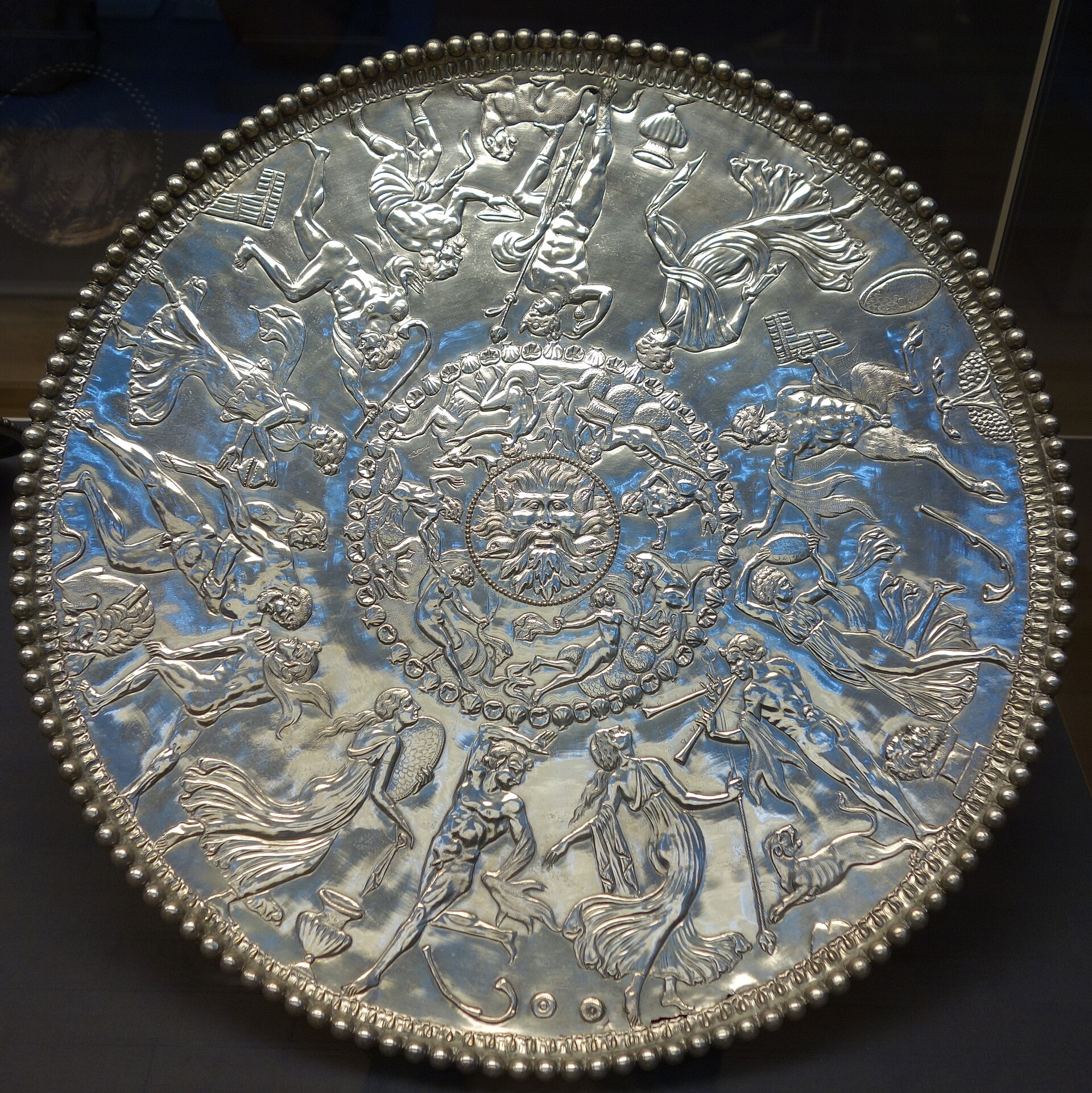
| Central register | A frontal mask of Oceanus, dolphins in the hair, beard rendered as seaweed fronds.12 |
| Inner register | Nereids riding a seahorse, a triton, a sea stag and a ketos (sea monster), inside a border of scallop shells.12 |
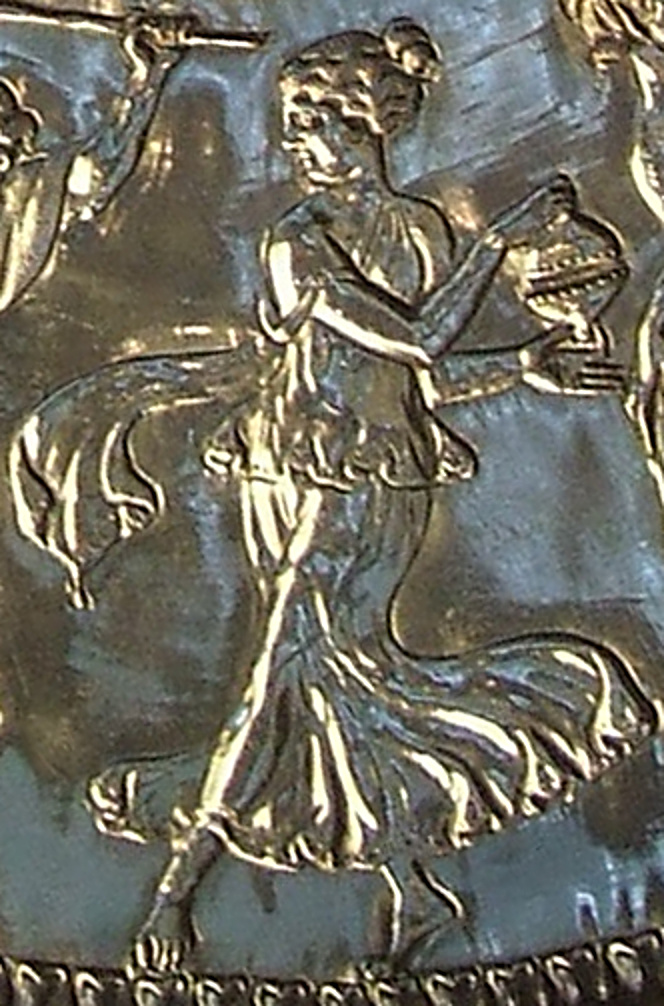
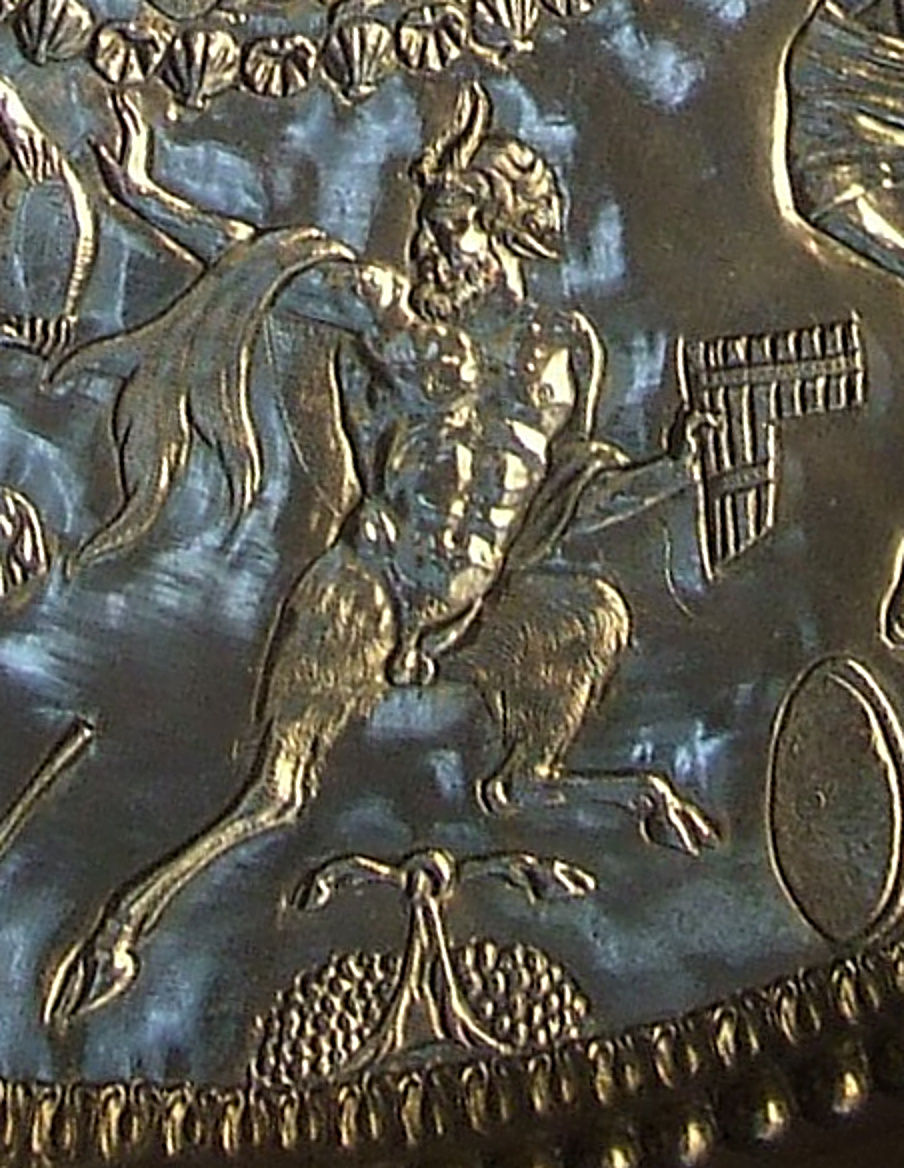
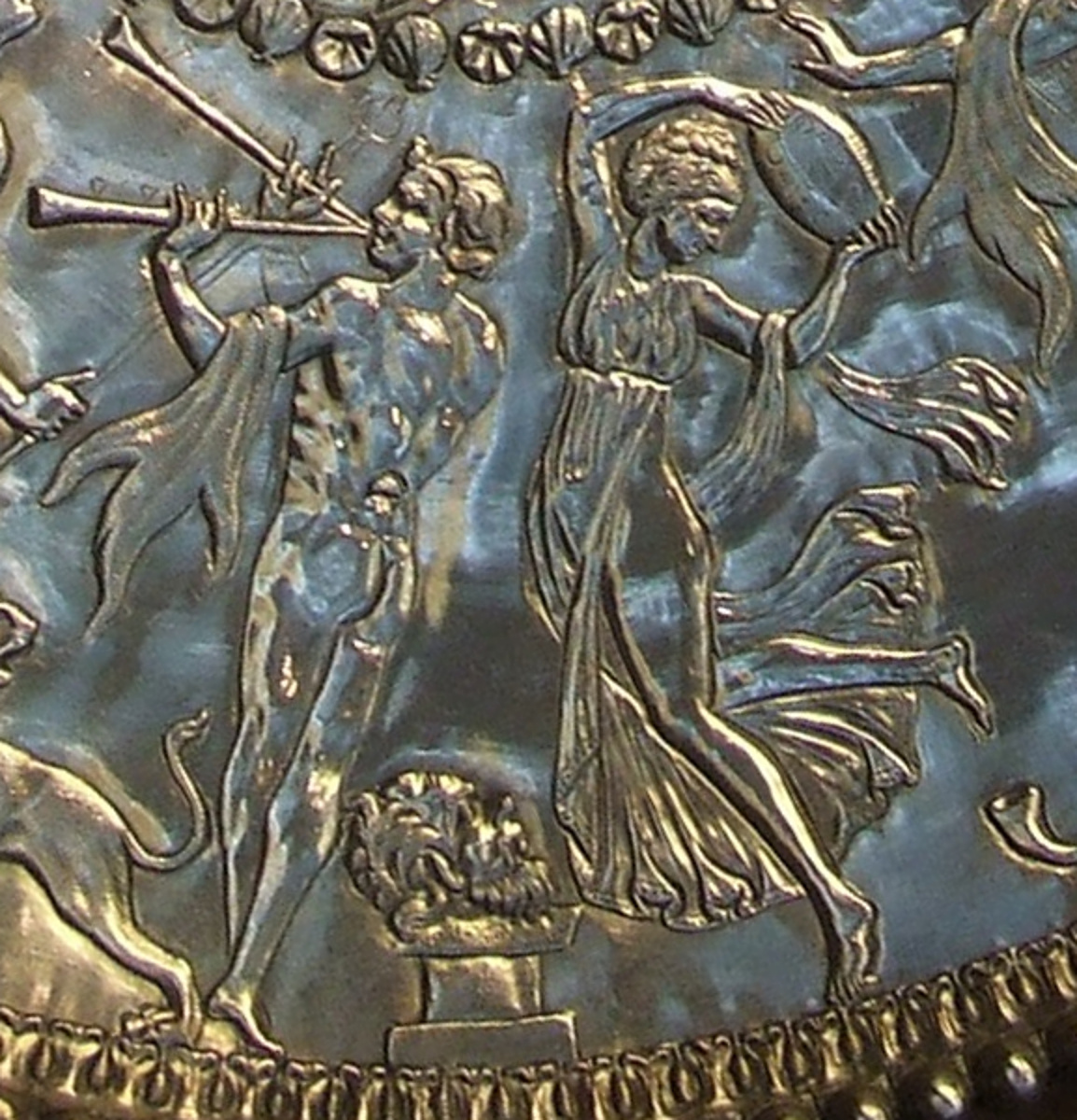
| Outer register | A Bacchic procession: Bacchus, Hercules supported by two satyrs, Pan, maenads and dancing figures playing cymbals, panpipes, the aulos, a tambourine and a frame drum.123 |
| Bullion value at seizure (1946) | The whole thirty-four-piece hoard was calculated at 191 pounds 2 shillings 6 pence in silver bullion value on 26 July 1946, against a full antiquarian valuation of roughly 20,000 pounds - the gap between the two figures measures what was actually being paid for.3 |
Images
The record in full
Chapter 1What it is
A shallow silver serving dish 605 millimetres across and weighing 8.256 kilograms, the largest and most heavily decorated object in the Mildenhall Treasure, a hoard of thirty-four pieces of late...
A shallow silver serving dish 605 millimetres across and weighing 8.256 kilograms, the largest and most heavily decorated object in the Mildenhall Treasure, a hoard of thirty-four pieces of late Roman silver tableware found in Suffolk in 1942. The decoration is worked in low relief and engraved line across the whole face of the dish, organised in three concentric zones.
At the centre a staring mask represents Oceanus, the personification of the ocean, with dolphins rising from his hair and a beard rendered as fronds of seaweed. Around him, inside a border of scallop shells, an inner frieze shows Nereids, sea nymphs, riding a menagerie of marine creatures: a sea horse, a triton, a sea stag and a ketos, a dragon-like sea monster. The outer and widest zone carries a band of Bacchic revelry - Bacchus, Hercules staggering drunkenly and held up by two satyrs, Pan, maenads and dancers, several playing instruments identifiable in the relief as cymbals, panpipes, the aulos, a tambourine and a frame drum.
Nothing else in the hoard approaches it in scale, weight or the density of its imagery. Every study of the object treats it as a single deliberate statement piece rather than an ordinary serving vessel, though its size and slightly domed profile are also consistent with actual use in serving food at a formal table.
Chapter 2The hoard it belongs to
The Great Dish is one of thirty-four silver objects recovered together and registered as a single find, the British Museum's registration numbers running 1946,1007.1 to .34.
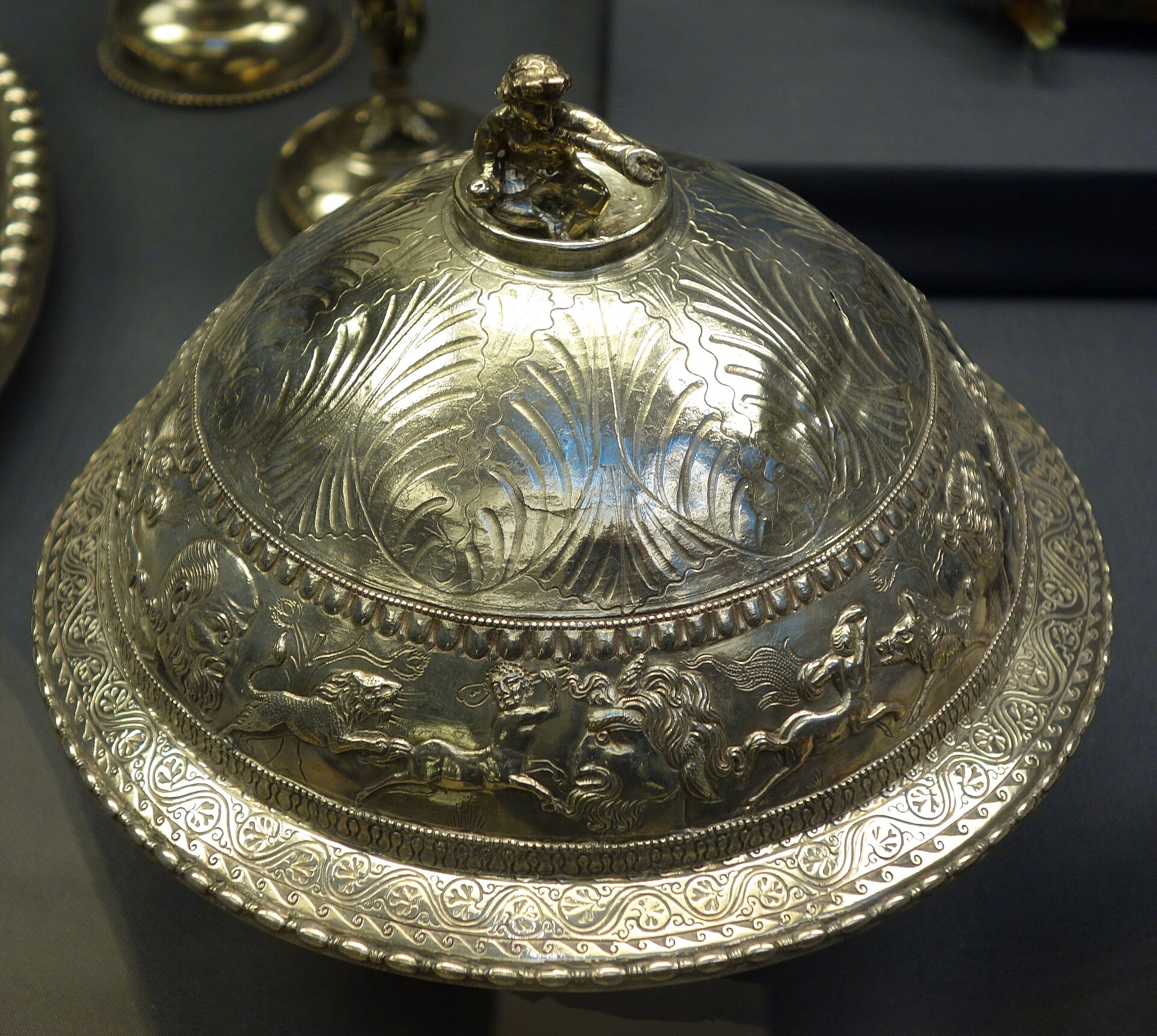
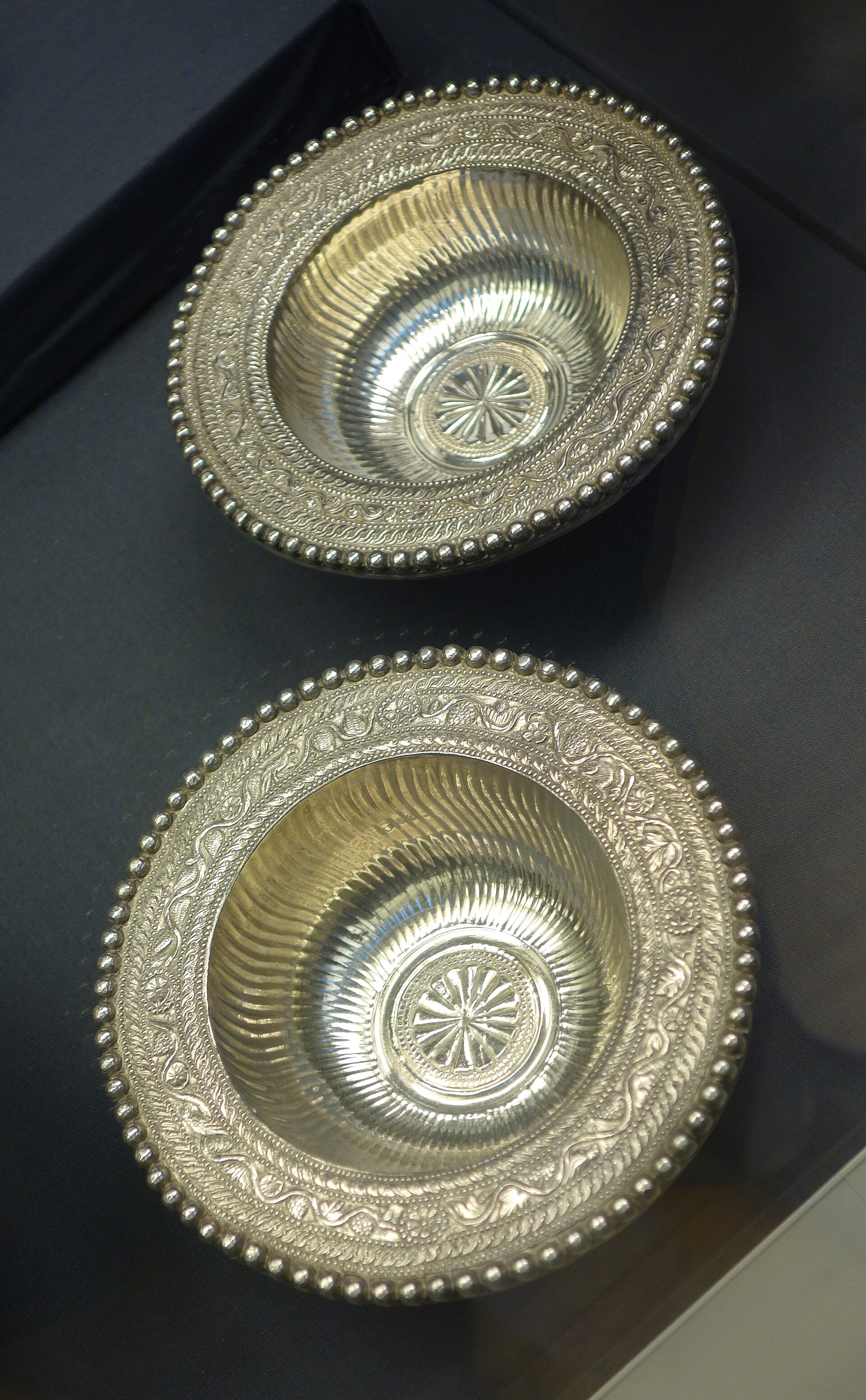
The Great Dish is one of thirty-four silver objects recovered together and registered as a single find, the British Museum's registration numbers running 1946,1007.1 to .34. The dish itself carries the first number in that sequence. The coroner's inquest summary of the find, read into the record on 1 July 1946, described the assemblage as two large silver dishes, four large flanged bowls with beaded rims, two smaller similar bowls, one large flanged bowl with a niello rim and cover, two shallow dishes with beaded rims, one large fluted hanging bowl, two small wine cups on pedestals, five spoons with dolphin handles and eight long-handled spoons.
The second large dish, plain and undecorated, is a companion piece to the Great Dish in scale but carries none of its imagery; the two should not be confused. Every claim in this record concerns the Great Dish specifically. Facts about the pedestalled platters, the flanged bowls, the spoons or the hanging bowl are given only where they illuminate the hoard's wider context, and are labelled as such.
One feature of the hoard is itself informative: it contains no coins. A group of thirteen siliquae published in the Numismatic Chronicle in 1942 has been floated as a possible related find, but no documentation survives connecting them to Mildenhall, and the British Museum's own archive search failed to identify who submitted them. The likelihood is that they are unconnected. Without coin evidence, the hoard cannot be dated by association in the way many Roman hoards are, and its date rests instead on the style of the vessels themselves.
Chapter 3How it was found
In January 1942 the ploughman Gordon Butcher was working a field near West Row, Mildenhall, Suffolk, for the engineering contractor Sydney Ford.
In January 1942 the ploughman Gordon Butcher was working a field near West Row, Mildenhall, Suffolk, for the engineering contractor Sydney Ford. The field, Ordnance Survey plot 1673, was under the tenancy of Fred Rolfe, whose landlord was Mrs Sophie Aves. Butcher had been asked to plough deeper than usual, to a depth that struck the hoard roughly 254 millimetres (ten inches) below the surface, because the field was being prepared for a root crop. At his own testimony to the 1946 inquest, Butcher confirmed he found the treasure in January 1942, that the field belonged to Rolfe, and that he and Ford dug the objects out together before taking them to Ford's house.
The pieces were black with corrosion. Ford believed at first that they were pewter, or possibly lead. He kept them at his home, Grove Villa, West Row, and spent what he described at the inquest as nearly two years cleaning the largest tray alone, working the crust off piece by piece. He then arranged a number of objects, including the Great Dish, on the sideboard in his front room, where family photographs from around 1944 show them on open display next to the fireplace.
Sydney Ford's grandson, also named Syd Ford, told the BBC in a 2002 episode of Meet the Ancestors that the Great Dish served as a fruit bowl at Christmas, piled with apples, oranges, pears and nuts, and that one of the silver spoons from the hoard was used at the family table for breakfast and dinner. This is the specific, sourced version of the story: an object of major art-historical importance handled as ordinary household silver for years. No source consulted for this record substantiates the more colourful claim, sometimes repeated online, that pieces were used as ashtrays; that detail is dropped here for lack of a citation.
Chapter 4Four years of silence and the 1946 inquest
Ford did not report the find. His household had a longstanding acquaintance with Hugh Alderson Fawcett, a Buckinghamshire general practitioner and amateur antiquarian who shared Ford's interest in...
Ford did not report the find. His household had a longstanding acquaintance with Hugh Alderson Fawcett, a Buckinghamshire general practitioner and amateur antiquarian who shared Ford's interest in flint tools and had visited the family through the war years without being shown the treasure. At Easter 1946, probably 22 April, Ford finally showed Fawcett the hoard, by then split between two rooms of his house. Fawcett urged him to report it and, over the following weeks, arranged for the British Museum to examine a handful of pieces Ford was willing to part with. Christopher Hawkes and Thomas Kendrick of the Museum's Department of British and Medieval Antiquities, and Harold Plenderleith of the Museum's research laboratory, confirmed the metal was silver, not pewter as Ford still believed.
Ford remained reluctant, writing to Fawcett on 13 June 1946 that he would 'rather put them back where they came from than part with them on these terms' and that he did not feel he had 'committed a crime by picking up something of value off my land'. Once the British Museum forwarded him the official treasure trove regulations, however, his position changed abruptly. On 21 June 1946 he reported the find to the police at Mildenhall, who seized the hoard the same day; his covering letter to Fawcett read, in full: 'I reported the find to the police at Mildenhall on the 21st inst, who promptly came along and pinched the lot.'
The coroner's inquest was held at Mildenhall police station on Monday 1 July 1946 at three in the afternoon, before a jury of twelve local men chaired by the bank manager Robert Pizzey. Ford and Butcher each gave evidence, and each admitted that an earlier statement they had given police on the day of seizure had been made 'to mislead others': Ford had initially claimed to have found the treasure alone, on land he co-owned with his brother, and dated the discovery to January 1943; Butcher's first statement, given after Ford briefed him, matched this false account. Under oath at the inquest both men corrected the record: the true finder was Butcher, the true date was January 1942, and the true landowner was Rolfe, not Ford. The jury declared the hoard treasure trove, vesting it in the Crown.
Chapter 5The reward: what the record actually shows
Popular retellings of this story, including some that circulate widely online, describe Ford walking away with most or all of the reward while Butcher, the actual finder, received a token sum.
Popular retellings of this story, including some that circulate widely online, describe Ford walking away with most or all of the reward while Butcher, the actual finder, received a token sum. The documentary record does not support that version. British Museum correspondence examined by Richard Hobbs in the Museum's own archive shows that the Museum's Secretary, Edgar Forsdyke, proposed a reward equal to the full market value of the find, then assessed at roughly 20,000 pounds, before recommending a 90 per cent reduction because the finders had concealed the discovery for four years. The figure that resulted, 2,000 pounds, was split equally: two separate payment orders were sanctioned, one for Sydney Ford and one for Gordon Butcher, each for 1,000 pounds, sent to their solicitor on 16 August 1946.
Press coverage from 27 August 1946 onward, in the London News Chronicle, The Times, the Daily Telegraph and other papers, reported the equal 1,000-pound reward to each man. Both were quoted as satisfied. Butcher told a reporter, 'I didn't expect to get anything like as much.' Against an average working-class wage of about five pounds a week in 1946, a thousand pounds was several years' income - a genuinely large sum for both men, not a windfall for one and a pittance for the other.
The intrinsic silver value of the entire thirty-four-piece hoard, calculated by Plenderleith on 26 July 1946 at the standing bullion price of 44 pence per troy ounce, came to only 191 pounds two shillings and sixpence. Forsdyke made the same point to the press at the time: 'The intrinsic value [of the hoard] is about 190 pounds.' The gap between that figure and the roughly 20,000-pound valuation of the find as an antiquity is the clearest illustration of what the Museum was actually paying for: history and craftsmanship, not metal.
What is documented as genuinely contentious is not the split of the reward but the four years of concealment that preceded it, and the reduced reward that concealment cost both men jointly.
Chapter 6The find that was never relocated
Archaeologists were not satisfied that the story ended with the inquest.
Archaeologists were not satisfied that the story ended with the inquest. Tom Lethbridge, a Cambridge lecturer in Anglo-Saxon and Roman antiquities, and Major Gordon Fowler, an experienced Fenland archaeologist, both gave expert testimony at the inquest and returned to the field afterward hoping to locate the exact findspot and search for any part of the hoard that might remain in the ground. Ford supplied a sketch map at the inquest, then a different account of the spot's location on at least two later occasions; when Lethbridge and Fowler dug at each location he indicated, they found no sign that a hole had ever been disturbed there.
The failure to relocate the findspot, despite a proper scheduling of the site by the Ministry of Works and a further organised excavation once the 1946 crop was cleared, fed real suspicion among archaeologists that Ford's account was incomplete or false. Lethbridge and Fowler came to suspect a connection to an unrelated, unresolved local rumour from the early 1920s about treasure supposedly buried decades earlier by a farmer known locally as 'Black Jack' Seaber. Richard Hobbs's 2008 examination of the British Museum's internal correspondence traced this theory in detail and found no evidence connecting it to the Mildenhall find; he concluded the likelier explanation is an unrelated, older cache of coins on the same land, if anything was buried there at all. A separate theory that the treasure was flown into the wartime airbase at Mildenhall from North Africa or Italy and buried near the runway is contradicted by the plain fact that Butcher's plough struck the hoard well away from the airfield, on Rolfe's farmland.
No part of the hoard beyond the thirty-four registered pieces has ever surfaced, and the precise spot where Butcher's plough struck it has never been rediscovered.
Chapter 7Roald Dahl's version, and why it is not this record
The writer Roald Dahl learned of the discovery from a newspaper report in April 1946, drove from his home in Great Missenden to interview Gordon Butcher, and sold an account of the story to the...
The writer Roald Dahl learned of the discovery from a newspaper report in April 1946, drove from his home in Great Missenden to interview Gordon Butcher, and sold an account of the story to the American magazine the Saturday Evening Post, which published it on 20 September 1947 under the title 'He Plowed Up $1,000,000'. Dahl revised the piece and republished it as 'The Mildenhall Treasure' in the 1977 collection The Wonderful Story of Henry Sugar and Six More, and it was issued again in 1999 as a standalone illustrated book by Jonathan Cape, illustrated by Ralph Steadman. This record found no evidence of a BBC television dramatisation of the story and none is claimed here; if one exists it was not located in the sources consulted.
Dahl built the piece as a deliberate literary contrast, casting Butcher as guileless and honest - 'a good, sharp, lean face, which was without a trace of malice or cunning or greed' - against a Ford drawn as calculating - 'middle-aged or a little older, baldheaded, long-nosed, with a clever, foxy look about his face.' Richard Hobbs's 1997 study in the journal Antiquity, examining Dahl's account against the documentary record, found that none of the specific claims Butcher made to Dahl were contradicted by other testimony, but that Dahl's characterisation of the two men was a conscious authorial choice rather than reporting. Dahl said as much himself, writing to a correspondent after the 1977 republication: 'the fact that my story may not be at all accurate doesn't worry me in the least. I am a fiction writer anyway and my job is to entertain... This is about the only non-fiction story I have ever written, so it is hardly surprising it turned out to be partly fiction.'
Dahl's story is culturally significant and is recorded here as reception history. It is not a source for any factual claim in this record about the discovery, the inquest or the reward; those rest on the coroner's inquest record and the Museum's own archived correspondence as reconstructed by Hobbs.
Chapter 8Dating and the question of manufacture
The dish's date rests on stylistic comparison rather than an inscription or a dated hoard context.
The dish's date rests on stylistic comparison rather than an inscription or a dated hoard context. When Christopher Hawkes of the British Museum first examined photographs of the hoard in June 1946, he initially proposed a third-century date and speculated that the hoard was buried during the Allectus usurpation of the 290s. He revised this after seeing the full assemblage, and the chi-rho monogram found on some of the hoard's spoons, a Christian symbol that could not have been used before Constantine's toleration of Christianity in 313, ruled out any date before the fourth century. The consensus since has been that the material principally dates to the fourth century CE, matching the British Museum's own current dating of the Great Dish to the 300s.
Where in the empire the dish was made is not settled. The British Museum's own published position is deliberately cautious: 'We cannot yet say where objects such as the Great Dish were manufactured, but it seems safe to surmise that it would have been somewhere in the general Mediterranean region.' Other scholarship has proposed the eastern Mediterranean specifically, on stylistic grounds, or Gaul, noting that at least one other piece in the same hoard, a flanged bowl with a niello-decorated cover, is separately catalogued by the Museum as made in Gaul. Neither the eastern Mediterranean nor Gaul is established for the Great Dish itself; both remain arguments, not documented findings, and this record treats them as such.
The comparison most often drawn is with the Seuso Treasure, a larger hoard of late Roman silver of disputed find circumstances now partly in Hungary's national collection, whose Dionysus ewer shares a high degree of stylistic similarity with the Bacchic frieze on the Mildenhall dish. The similarity supports a shared artistic environment across the fourth-century Roman world, without pinning down a single workshop for either object.
Chapter 9Why it was buried, and what is inferred versus known
The standard reading of the Mildenhall hoard, repeated in most popular accounts, is that it was buried for safekeeping amid the instability of the last decades of Roman rule in Britain and never...
The standard reading of the Mildenhall hoard, repeated in most popular accounts, is that it was buried for safekeeping amid the instability of the last decades of Roman rule in Britain and never recovered by its owner. The Roman garrison began its final withdrawal from Britain in the early fifth century, and burial dates for the hoard in the range of roughly 380 to 420 to 430 have been proposed on stylistic grounds by specialists working on comparable late Roman silver hoards, though this range is an estimate rather than a fixed date drawn from an inscription or coin.
The 'intention to recover' reading is also the legal foundation of the find's treasure trove status: at the 1946 inquest, both Lethbridge and Fowler argued as expert witnesses that the assemblage represented a hoard buried for later retrieval, not grave goods or a votive deposit, a distinction that mattered because English treasure trove law at the time required proof of an intention to recover for the Crown to claim ownership. They contrasted this explicitly with the Sutton Hoo ship burial of 1939, discovered only seven years earlier, which was not declared treasure trove precisely because its contents were interred as grave goods, never meant to be dug up again.
Beyond that legal argument, the causal link some archaeologists drew at the time between a specific documented period of unrest, such as the Allectus usurpation of 296, and the burial has since been abandoned along with the third-century dating that produced it. Hobbs, writing in 2008, is explicit that the reasoning connecting hoard burial to any one crisis was 'natural' for archaeologists working in 1946, shaped in part by the recent memory of a Nazi invasion threat, but that 'today it is recognised that a more complex range of interpretations might be invoked.' No documented evidence - a coin, an inscription, a dated destruction layer at the findspot - fixes either the exact burial date or the specific crisis, if any single crisis, that prompted it. This record treats the burial-for-safety reading as the argued consensus explanation, not a documented fact.
Chapter 10The local landscape
The find took place at the edge of the Fens, a low-lying wetland margin that was more agriculturally productive in the Roman period than its later reputation as marginal land suggests.
The find took place at the edge of the Fens, a low-lying wetland margin that was more agriculturally productive in the Roman period than its later reputation as marginal land suggests. Two long-distance Roman-period routes, the Icknield Way and Peddars Way, crossed the wider area and connected it to the rest of Roman Britain. In 1932, ten years before the treasure surfaced, Lethbridge and a collaborator named Leaf had excavated the remains of a small Roman building on the same landholding, about 27 to 55 metres from the spot Ford eventually indicated as the findspot, depending on which of his several conflicting accounts is used. The building had underfloor heating (a hypocaust), brick piers and a stokehole, but consisted of only two small rooms and an outbuilding, closer to a substantial cottage or a farm building than a villa in the grand sense; painted wall plaster and a scatter of late Roman pottery were the only other finds.
A separate and later excavation at Beck Row, in the same general area, uncovered the remains of a very large timber structure interpreted as a barn or grain store attached to a substantial farming estate. No excavation has established a confirmed structural connection between the Great Dish's owner and either building; both are offered in the literature as evidence for a genuinely prosperous late Roman presence in the immediate area, capable in principle of having owned an object of this quality, without proving that either specific building was that owner's residence.
Chapter 11Who might have owned it
No inscription on the Great Dish itself names an owner.
No inscription on the Great Dish itself names an owner. Elsewhere in the hoard, two of the smaller Bacchic platters carry the scratched inscription 'eutheriou', read as Greek for '(the property) of Eutherios'. Kenneth Painter, author of the British Museum's first full catalogue of the treasure in 1977, proposed that the hoard, or at least this inscribed pair, may have belonged to a Roman general named Lupicinus, sent to Britain from Gaul in 360 CE by the emperor Julian to put down barbarian incursions, on the basis that a senior official named Eutherios is recorded in Julian's circle. Painter's own presentation of the theory treats it as unproved, and it has an obvious weakness: Lupicinus was recalled to Rome, fell from imperial favour, and was arrested there, meaning that if the silver was his, he was never in a position to return to Britain and recover it, which is at least consistent with the hoard never being reclaimed.
A second, separate line of argument rests on the chi-rho Christian monogram found on some of the hoard's spoons, taken by some scholars as evidence that the owner, or at least part of the household, was Christian - plausible for a person of rank in fourth-century Britain after Constantine, but not something the Great Dish's own purely classical, non-Christian iconography confirms or denies. Both theories concern the hoard's ownership in general. Neither is a documented fact about the Great Dish specifically, and this record grades both as argued rather than established.
The artist
Unidentified late Roman silversmith's workshop, location undetermined
No maker's name, workshop stamp or hallmark survives on the Great Dish or elsewhere in the Mildenhall hoard identifying who made it. Silver plate of this period was not routinely marked with an assayer's or maker's stamp in the way later European silver was, so the absence of a mark is itself unremarkable and not evidence against high status. Everything said here concerns the workshop tradition the object belongs to, not a named individual.
Related works
| Work | Relation | Where it is |
|---|---|---|
| The pair of pedestalled platters, Mildenhall Treasure Same hoard, maker undetermined | Two smaller Bacchic-decorated platters from the same find, inscribed 'eutheriou' The only inscribed pieces in the hoard and the basis for the disputed Lupicinus ownership theory. Not the Great Dish; do not confuse the two. | British Museum, London (1946,1007.13-14) |
| Flanged bowl and cover Gaulish workshop (attributed) | Companion piece from the same hoard, separately attributed to Gaul Evidence that the thirty-four-piece hoard was assembled from more than one production source, not necessarily made as a single set. | British Museum, London |
| Corbridge Lanx Unknown Roman workshop | Comparable high-quality Roman silver serving dish found in Britain Found on the bank of the Tyne in the eighteenth century; cited by Hobbs as one of the very few individual pieces of comparable quality known from Roman Britain before Mildenhall. | British Museum, London |
| Seuso Treasure, Dionysus ewer Unknown Roman workshop | Closest stylistic comparandum for the Bacchic frieze A separate and much larger late Roman silver hoard with its own long-disputed and unresolved find history. | Hungarian National Museum, Budapest |
| Sutton Hoo ship burial Not applicable | Contemporary reference point in English treasure law, not a stylistic comparison Discovered 1939, seven years before Mildenhall was declared. Not treasure trove, because its contents were grave goods never intended for recovery - the direct legal contrast cited at the Mildenhall inquest to establish 'intention to recover'. | British Museum, London |
Open questions
- Where exactly was the hoard buried? Despite repeated organised excavation by Lethbridge and Fowler in 1946-47, using locations Sydney Ford himself pointed to on at least three separate occasions, no disturbed ground or burial pit was ever found. The precise findspot remains unlocated.
- In what year was the hoard actually buried by its Roman owner? No coin or dated inscription fixes this. The commonly cited range of roughly 380 to 420-430 CE rests on stylistic comparison with other late Roman hoards, not on independent dating evidence from Mildenhall itself.
- Where was the Great Dish manufactured? The British Museum has not committed beyond 'the general Mediterranean region'. Eastern Mediterranean and Gallic origins have both been argued for pieces in the hoard, but neither is established for the dish itself.
- Who owned it? The Lupicinus theory rests on an inscription found on different pieces in the same hoard, not on the Great Dish, and its proposer treated it as unproved. No documented owner exists for this specific object.
- Was any part of the hoard ever recovered from the ground beyond the thirty-four registered pieces? Gordon Fowler and others suspected an incomplete find at the time; the coroner's own inquest summary contains an apparent transcription oddity ('one large pented hanging bowl') that has never been fully resolved against the surviving object.
- Did Roald Dahl's fictionalised account ever receive a television adaptation, as is sometimes claimed? No BBC or other broadcast dramatisation was located in the sources consulted for this record; if one exists, it should be added with a citation.
Questions about this object
What is The Great Dish from the Mildenhall Treasure?
The Great Dish from the Mildenhall Treasure is a silver, dated 4th century CE (300s AD). Medium: Silver, decoration worked in low relief and engraved line, parcel gilding on some raised elements.
Who made The Great Dish from the Mildenhall Treasure, and is the attribution settled?
The attribution to Unknown Late Roman silversmith's workshop is recorded here as unknown. No maker's mark or workshop stamp survives on the dish. The British Museum states only that manufacture 'somewhere in the general Mediterranean region' is a safe surmise; other scholarship has proposed the eastern Mediterranean or Gaul as candidates. None of these is established. The attribution here is to an unidentified late Roman workshop, not to a named individual.
Where is The Great Dish from the Mildenhall Treasure now?
British Museum, London. Inventory number 1946,1007.1. Last confirmed 29 August 2026. Declared treasure trove and vested in the Crown by coroner's inquest, 1 July 1946; transferred to the British Museum and on permanent public display since 20 July 1946.
What is still unknown about The Great Dish from the Mildenhall Treasure?
Where exactly was the hoard buried? Despite repeated organised excavation by Lethbridge and Fowler in 1946-47, using locations Sydney Ford himself pointed to on at least three separate occasions, no disturbed ground or burial pit was ever found. The precise findspot remains unlocated.
Sources
- 1British Museum collection online, object 1946,1007.1, 'dish' (the Great Dish from the Mildenhall Treasure). Registration number, dimensions (605 mm diameter, 8256 g), culture (Romano-British), date (300-399 CE) and description confirmed via the Museum's own data as mirrored on its Google Arts and Culture partner page. artsandculture.google.com/asset/...
- 2British Museum, object description text for the Great Dish (iconography of Oceanus and the Bacchic frieze, low relief and engraved line technique, and the statement on manufacture location), as reproduced via web search of britishmuseum.org content. britishmuseum.org/collection/...
- 3Richard Hobbs, 'The Secret History of the Mildenhall Treasure', The Antiquaries Journal, vol. 88 (2008), pp. 376-420. The primary source for this record's account of the discovery, the four-year concealment, the 1946 inquest testimony, the reward correspondence and figures, the failed searches for the findspot, the conspiracy theories, and Roald Dahl's 1977 letter on the accuracy of his story. suffolkher.esdm.co.uk/media/...
- 4Wikipedia, 'Mildenhall Treasure', consolidating the hoard composition, registration number range, and bibliography. en.wikipedia.org/wiki/...
- 5Wikipedia, 'The Mildenhall Treasure', on Roald Dahl's 1947 Saturday Evening Post article 'He Plowed Up $1,000,000' and its later book publications. en.wikipedia.org/wiki/...
- 6Mildenhall Museum, 'The Mildenhall Treasure' collections page, for local landscape context including the Icknield Way, Peddars Way, and the Beck Row timber structure, and for the Lupicinus ownership theory summary. mildenhallmuseum.co.uk/collections/...
- 7Roald Dahl Fans, 'The Mildenhall Treasure', on the story's publication history across the Saturday Evening Post (1947), The Wonderful Story of Henry Sugar and Six More (1977), and the standalone illustrated edition (Jonathan Cape, 1999, illustrated by Ralph Steadman). roalddahlfans.com/dahls-work/...
- 8Richard Hobbs, 'The Mildenhall Treasure: Roald Dahl's ultimate tale of the unexpected?', Antiquity, vol. 71, no. 271 (March 1997), pp. 63-73. Cited via its abstract and via its summary in source 3; the scholarly examination of Dahl's account against the documentary record. Flagged for direct consultation of the full article. cambridge.org/core/...
- 9Web search synthesis of scholarship proposing eastern Mediterranean or Gallic manufacture for pieces in the Mildenhall Treasure. Cited cautiously and graded as an argued position, not a documented fact, and flagged for direct verification against Kenneth Painter's 1977 catalogue and Richard Hobbs's 2016 British Museum Research Publication 200, neither of which could be fetched in full text during this research pass. britishmuseumshoponline.org/the-mildenhall-treasure.html
- 10Seuso Treasure Museum (Hungarian National Museum), 'The Mildenhall Treasure', comparative overview citing the stylistic similarity between the Mildenhall Great Dish's Bacchic frieze and the Dionysus ewer of the Seuso Treasure, and giving an estimated burial-date range of c. 380 to 420-430 CE. seuso.mnm.hu/en/...
- 11Wikimedia Commons file description, 'Flanged bowl and cover, made in Gaul, Mildenhall, 200s AD, silver and niello - British Museum - DSC01393.jpg', for the separate Gaulish attribution of a different piece in the same hoard. commons.wikimedia.org/wiki/...

Last verified · Published
Change log
29 August 2026 - Record created at the house standard: researched narrative, technical evidence, maker dossier, graded provenance chain, prices with hammer and premium separated, related works, open questions and sources.