The Sevso Treasure
Late Roman silversmiths, workshops unidentified · Late fourth or early fifth century AD
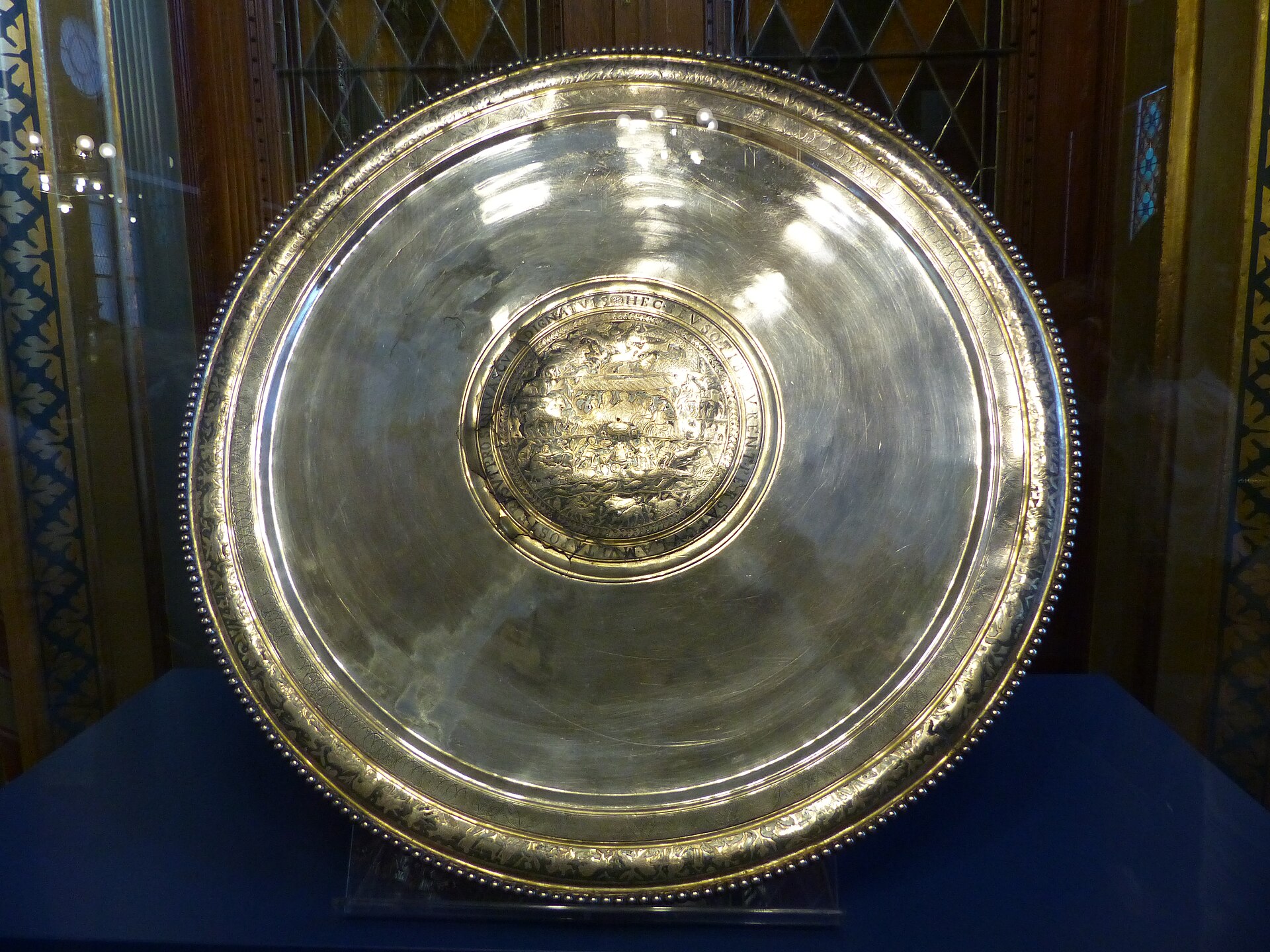
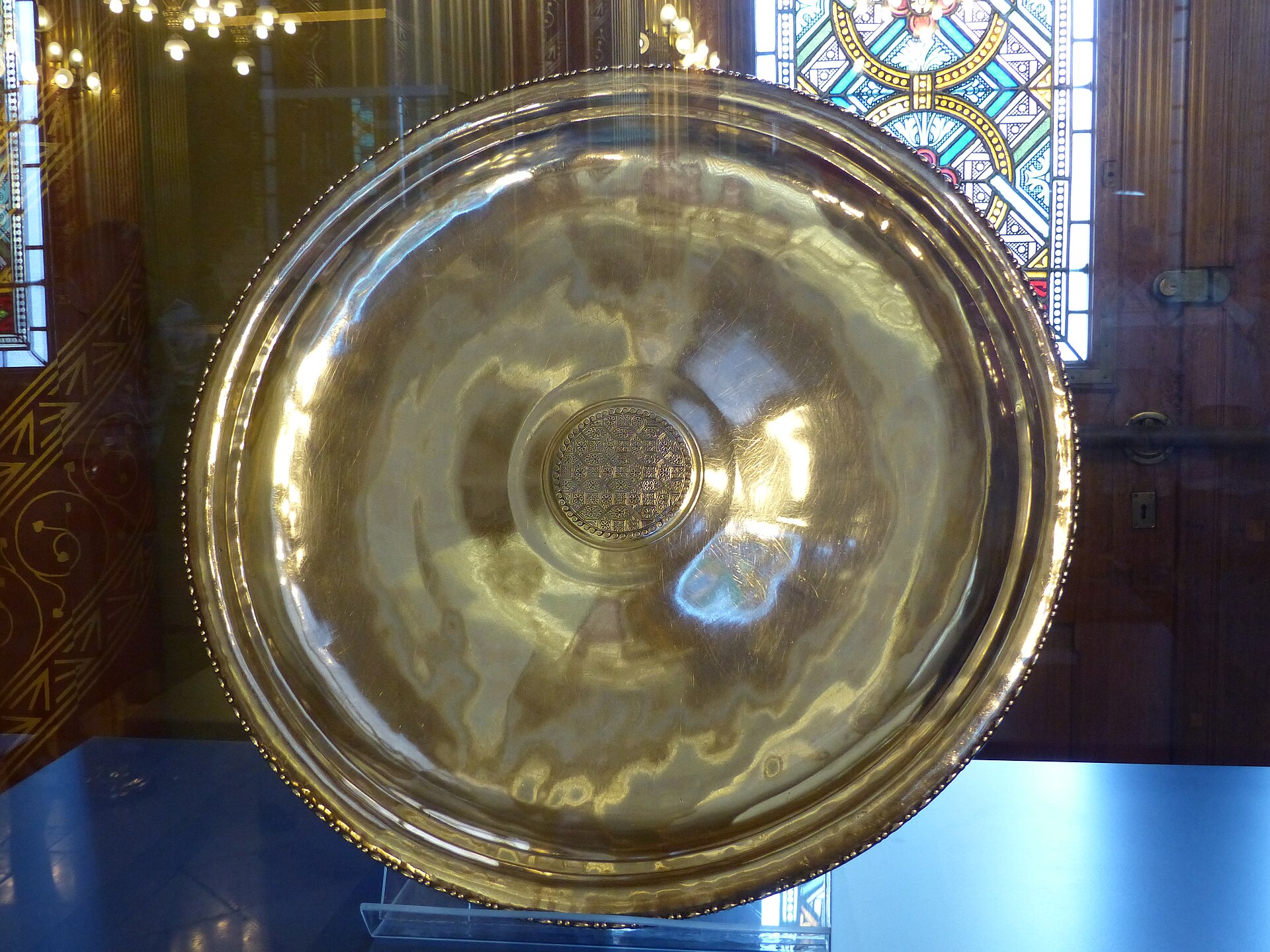
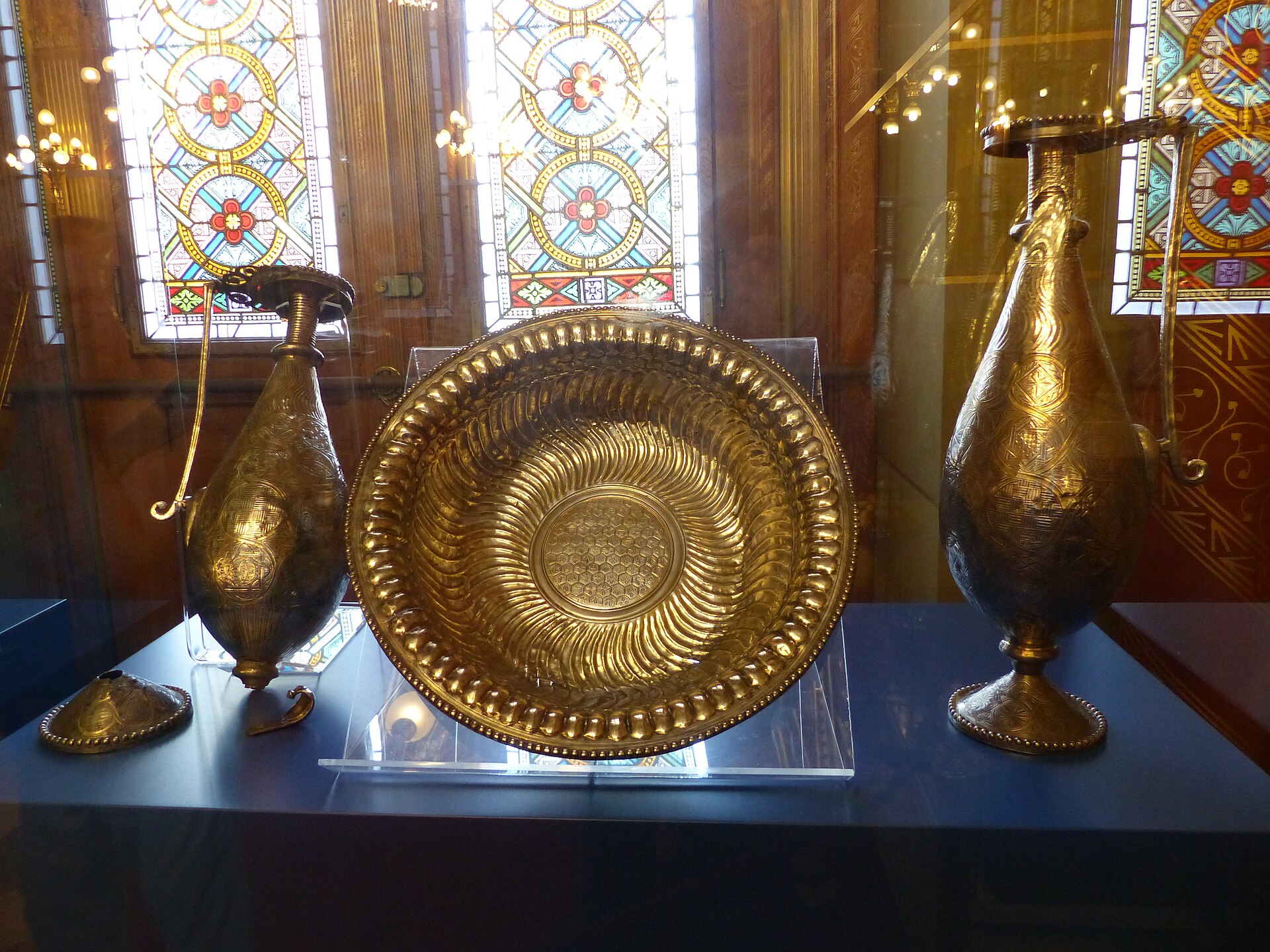
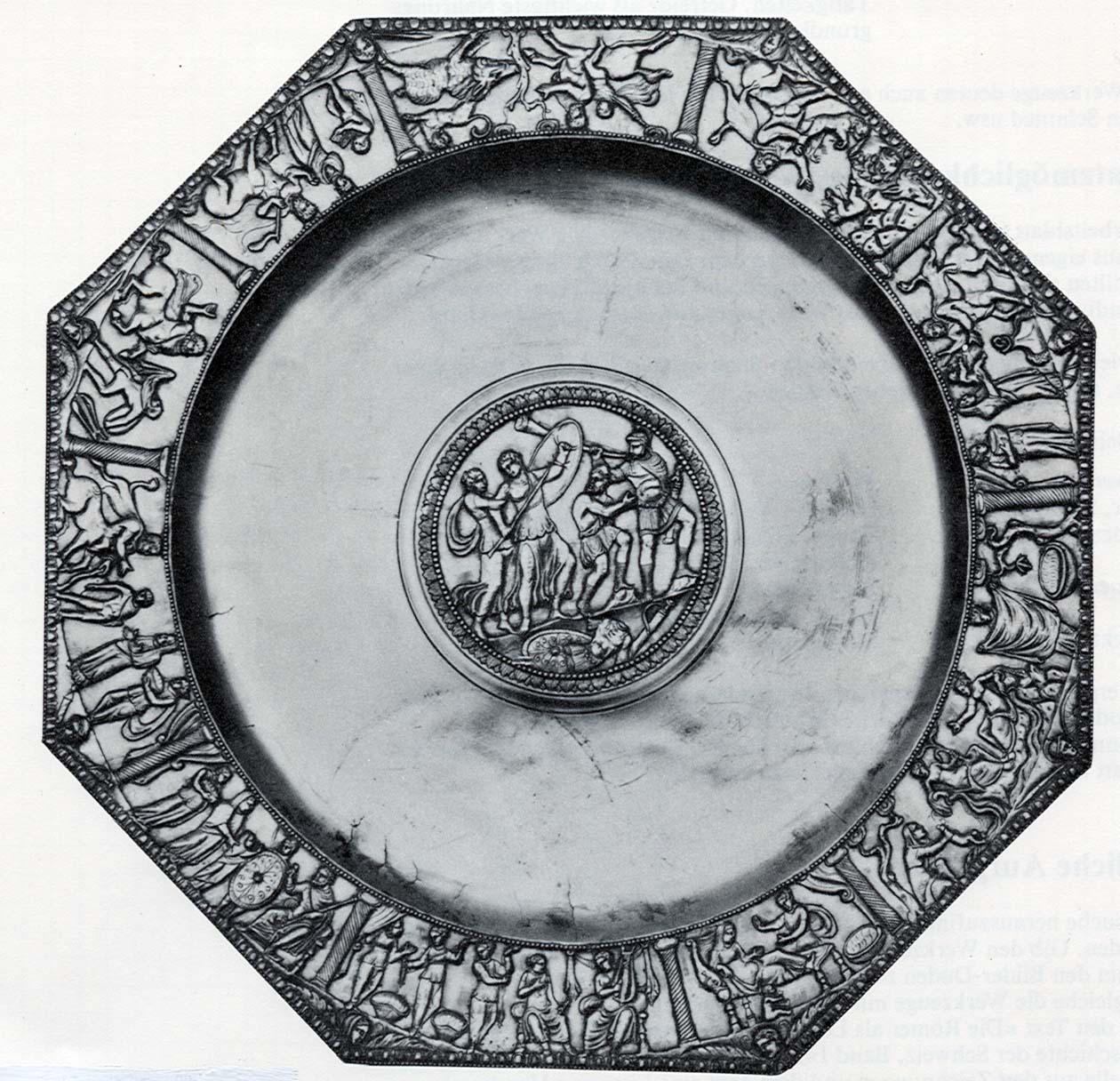
The Hunting Plate, the largest flat dish of the group after the Achilles Plate: 70.5 cm across and 8.8 kg of silver. The central medallion holds an open-air banquet ringed by hunting scenes, and around it runs the hexameter couplet that gives the treasure its name and the lake labelled PELSO. Photographed in the Hungarian Parliament building in July 2017, after the second tranche came to Hungary.
Hungarian National Museum, Budapest. Photograph by Elekes Andor, CC BY-SA 4.0.| Artist | Late Roman silversmiths, workshops unidentified |
|---|---|
| Date | Late fourth or early fifth century AD |
| Medium | Silver, partly gilt, with engraving, repousse and niello; buried in a copper alloy cauldron |
| Dimensions | Fourteen vessels; the Hunting Plate about 70 cm in diameter and close to 9 kg; the Achilles Plate about 72 cm across; the Meleager Plate close to 70 cm |
| Where it is now | Hungarian National Museum, Budapestlast confirmed 3 August 2026 |
| Attribution | WorkshopNo maker is named and none has been identified. Full note |
| Object type | Antiquity |
| Period | Late Roman, fourth to fifth century |
| Cases | Has a provenance gap |
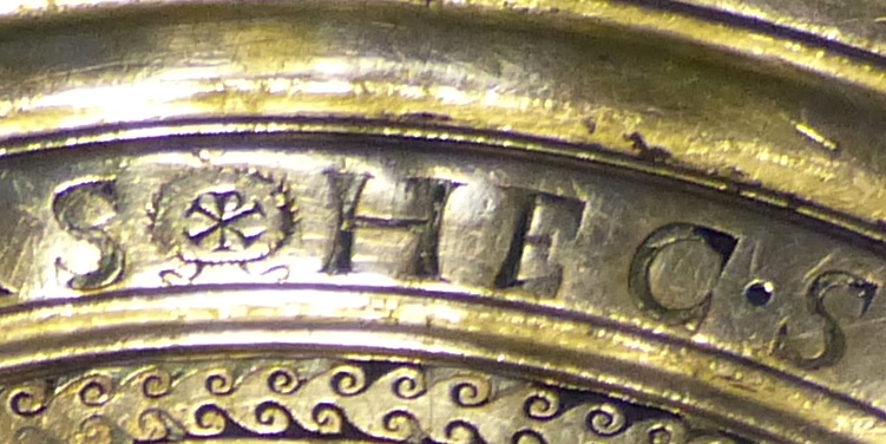
| Inscriptions | On the Hunting Plate, in a wreath above the central scene: HEC SEVSO TIBI DVRENT PER SAECVLA MVLTA / POSTERIS VT PROSINT VASCVLA DIGNA TVIS, with a Chi-Rho monogram. In the medallion below, the lake is labelled PELSO, the Roman name for Lake Balaton. |
| Owners on record | 10 links8 documented, 1 disputed, 1 unknown |
| Sources | 9 cited |
About this record Last verified 13 August 2026 · 9 sources cited · Change log
On this page 12 sections
ContentsClose
Fourteen pieces of late Roman silver and the copper cauldron they were buried in, weighing between them more than most surviving Roman hoards, and carrying on the largest plate a hexameter couplet naming an owner, Sevso, whom no other document mentions. The same plate labels a lake in its hunting scene PELSO, the Roman name for Lake Balaton, which is why a Hungarian scholar who saw it in 1984 knew where it came from.
It is the best documented provenance forgery in the antiquities market, and the documentation exists because the forgery was bought twice. Lebanese export licences produced in 1981 were found to be forged by the J. Paul Getty Museum in March 1984; a second set was commissioned in 1985 at a cost of 628,000 pounds in expenses, and a third in 1987 for a further 460,000 dollars. Sotheby's announced the sale in New York on 10 February 1990 at an estimate of 40 to 70 million dollars. It was never sold. Lebanon sued within five days, the silver was impounded, and no hammer ever fell.
Three states claimed it. A New York jury in November 1993 found that neither Hungary nor Croatia had proved ownership, without ever ruling that the Marquess of Northampton had good title, and without hearing the soil comparisons, the police file or the Polgardi silver stand that Hungary had assembled. Hungary got the silver back anyway, twenty-one and twenty-four years later, by paying 15 million euros and then 28 million euros in two private transactions the Hungarian state calls compensation rather than purchase. The find-spot has still never been established by any court.
Provenance
Each link is graded. Documented: a cited source supports it. Disputed: the identification is argued but not established. Unknown: no owner for that span, and the gap is not smoothed into a narrative. The grades in the glossary.
- Late 4th or early 5th century AD -Sevso, otherwise unrecordeddocumented
The Hunting Plate names its owner in a hexameter couplet and marks him a Christian with a Chi-Rho. No other source of any kind mentions a Sevso. The name is the only thing known about him; his rank, office and dates are inferred from the weight and quality of the silver alone.42
- - c. 1975-1978Buried, find-spot never judicially establishedunknown
THE UNGRADED LINK, AND IT IS THE WHOLE CASE. Hungary says Polgardi, sixteen kilometres east of Lake Balaton, on the strength of the PELSO inscription, the 1878 Koszarhegy quadripus, comparative soil and silver analysis and the pit in the wine cellar that the copper cauldron fits. Croatia says Barbariga in Istria near Pula, citing its own soil analysis. Lebanon said Tyre and Sidon on documents later proved forged. A New York jury in 1993 found that neither Hungary nor Croatia had proved its case, on a record from which Hungary's physical evidence had been excluded. No court has ever found where this treasure came out of the ground.1234
- c. 1975-1978 - 1980Jozsef Sumegh (alleged)disputed
Sumegh, a twenty-four-year-old coin and antiquities collector from the Polgardi district, was said locally to have found a large silver treasure before beginning compulsory military service. He was found hanging in a wine cellar in December 1980. The death was recorded as suicide and later reinvestigated as murder; the file is open. The connection to the treasure rests on the pit in the cellar floor and the cauldron that fits it, not on any admission, sale record or witness to the find itself.24
- by 1980 - 1980-1981Anton Tkalec, Halim Korban and Mansur Mokhtarzadedocumented
By 1980 the Vienna-based dealer Anton Tkalec controlled some or all of the material. The Lebanese dealer Halim Korban and the London dealer Mansur Mokhtarzade were in the chain. Korban obtained the first Lebanese export permit in June 1981, after the selling had begun, and the J. Paul Getty Museum established in March 1984 that its authorising signatures were forged and that Korban was not a dealer registered with the Lebanese authorities.1
- 1980 - 1982Art Consultancy Ltd, Guernsey, owned by Peter Wilson and Rainer Zietzdocumented
Peter Wilson had retired as chairman of Sotheby's shortly before. Recorded purchases: geometric ewer 48,000 pounds, November 1980; Hunting Plate 225,000 pounds, November 1980 to January 1981; Achilles Plate 525,000 pounds, May 1981; geometric plate 180,000 pounds, September 1981; Hippolytus situla 525,000 pounds, December 1981. These are private transaction prices, not auction results.1
- 1982 - 1987The Abraham Trustdocumented
Formed 15 September 1982 on the suggestion of the solicitor Peter Mimpriss, who acted for both Wilson and the Marquess of Northampton. It took the eight pieces Wilson and Zietz held plus two more that Northampton bought for 500,000 pounds. In 1985 Mimpriss approached Ramiz Rizk for replacement Lebanese documentation at 628,000 pounds in expenses, the first set having been exposed as forged the year before.1
- 1987 - 2014 and 2017The Marquess of Northampton 1987 Settlement Trustdocumented
In 1987 Northampton bought four further pieces from Korban and Tkalec for a combined 8.7 million dollars, with export permits obtained through Rizk for a further 460,000 dollars, and the 1987 Settlement Trust became sole owner. The trust, not the man, was the defendant in New York. After the failed Bonhams viewing in October 2006 the hoard was divided into two parts, one remaining with Northampton and one passing to or remaining with the heirs of Peter Wilson.132
- 1990 - 1994Impounded under order of the New York State Supreme Courtdocumented
Lebanon sued on 15 February 1990; a temporary restraining order followed on 20 February and the treasure was impounded in March. Lebanon abandoned its claim on the eve of trial once the export licences were shown to be forged. After a seven-week trial from September 1993 the jury rejected the Hungarian and Croatian claims. The Appellate Division affirmed in 1994 and the silver went back to London.132
- 2014 - presentHungarian State, Hungarian National Museum, Budapestdocumented
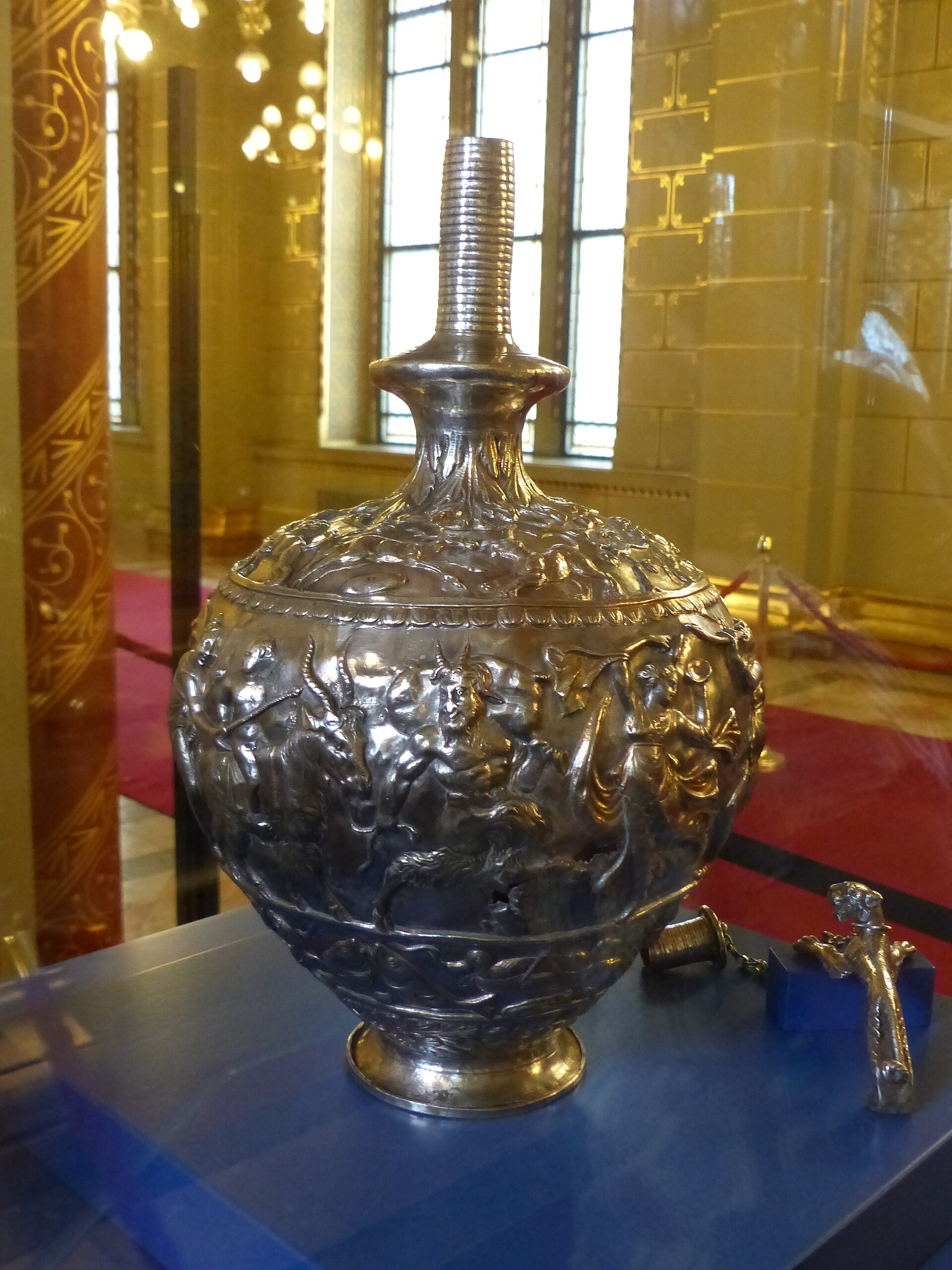
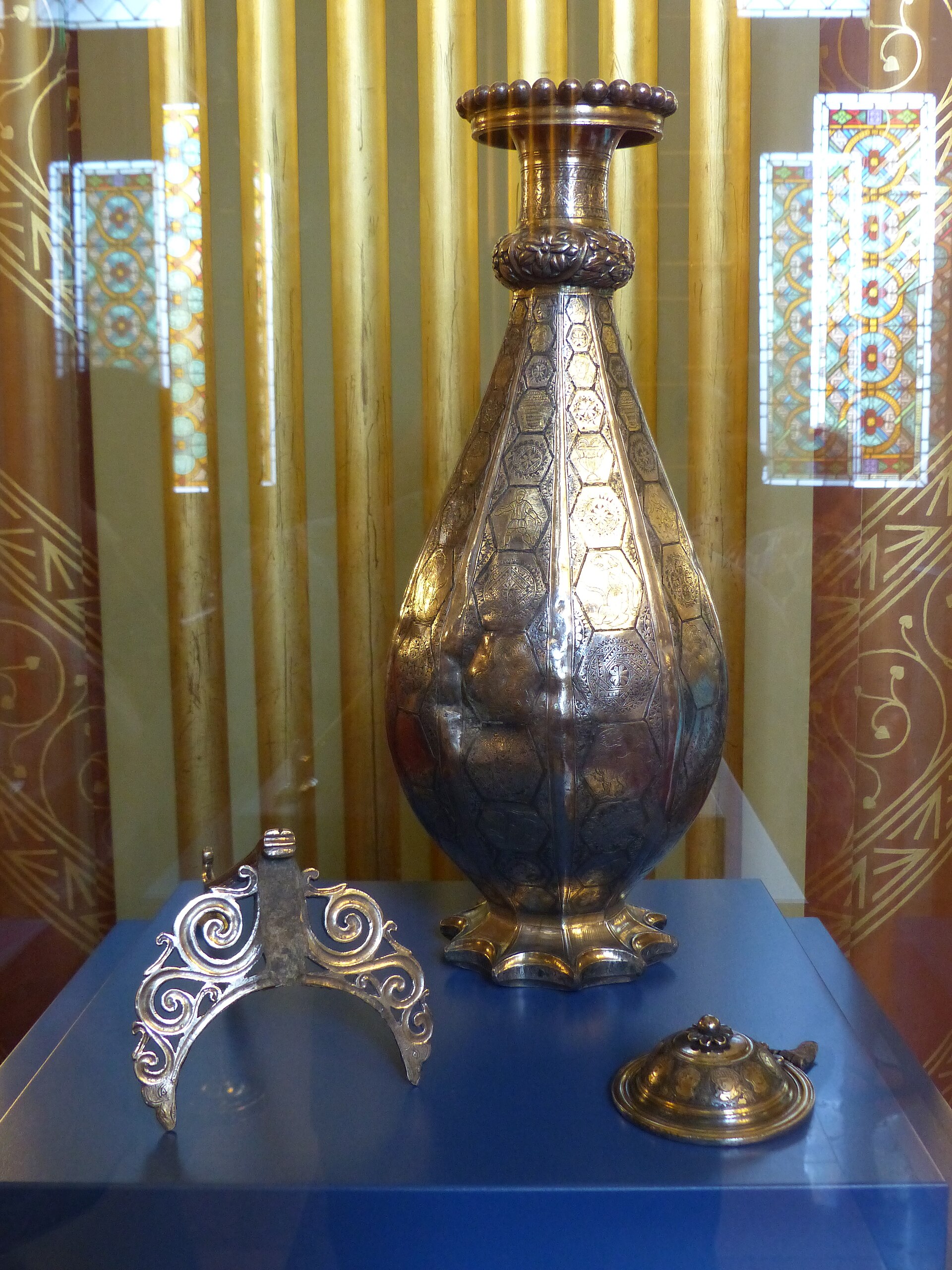
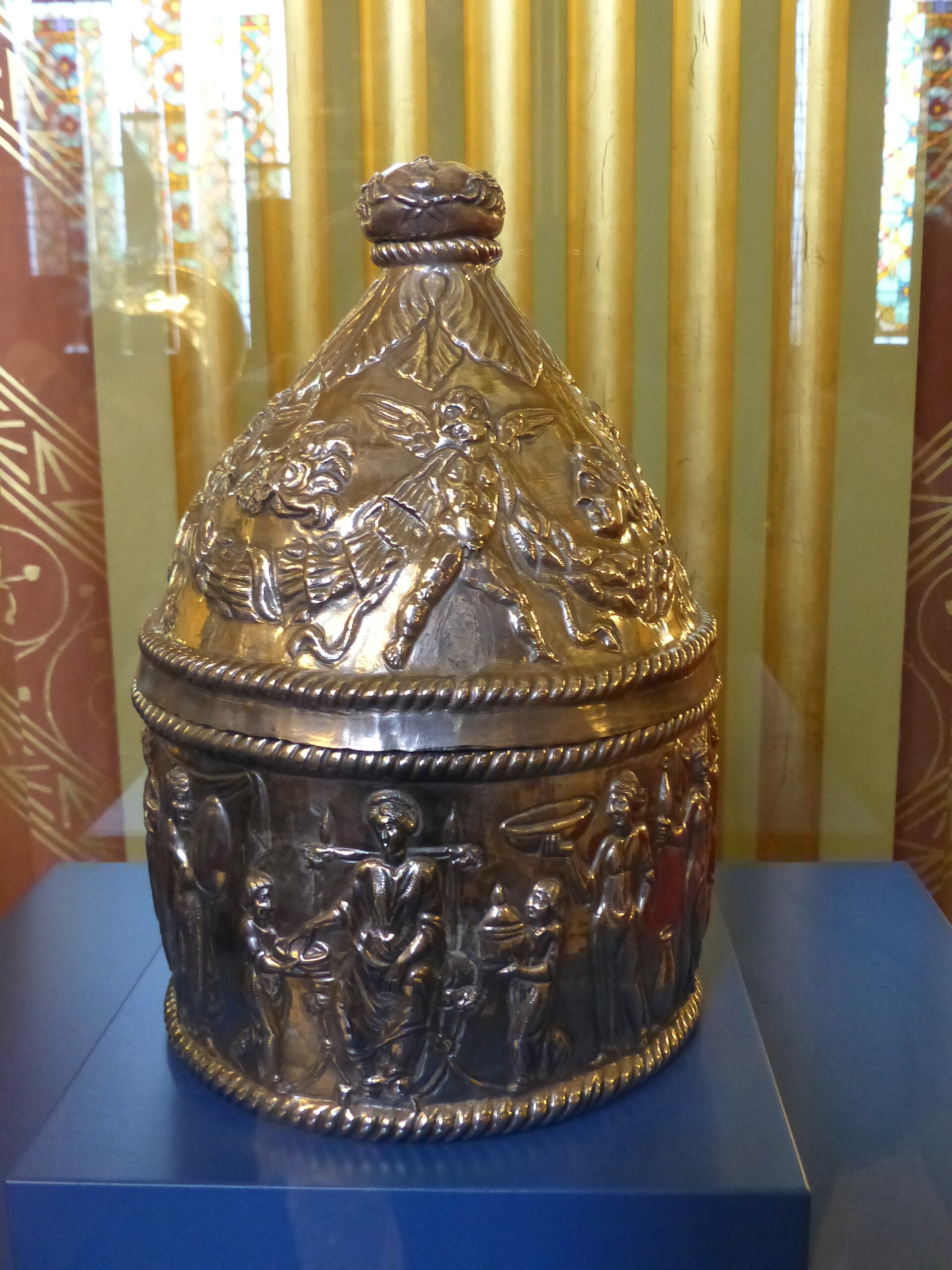
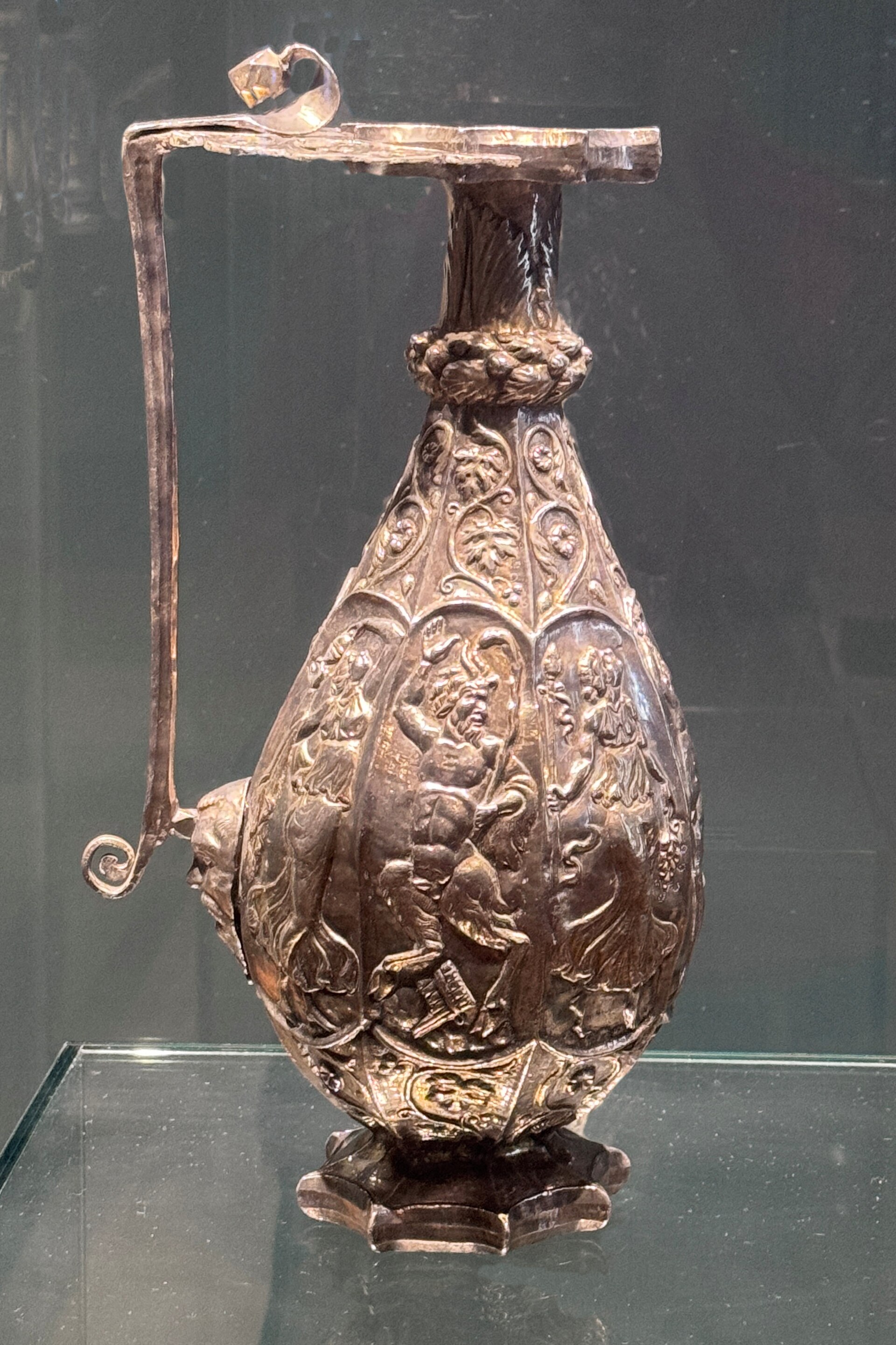
Seven silver pieces and the copper cauldron, including the Hunting Plate, the geometric plate, both geometric ewers, the basin, the casket and the Dionysiac ewer. Acquired in spring 2014 from a trust benefiting the two sons of Peter Wilson, not from the Marquess of Northampton, a distinction most accounts miss. Unveiled in the Hungarian Parliament building by Viktor Orban and Jozsef Palinkas and moved to the Hungarian National Museum in July 2014. The sum is given as 15 million euros by the holding museum, which calls it a compensation fee rather than a purchase price, and as a 20.7 million dollar retention fee by Artnet News reporting The Art Newspaper.129
- 2017 - presentHungarian State, Hungarian National Museum, Budapestdocumented
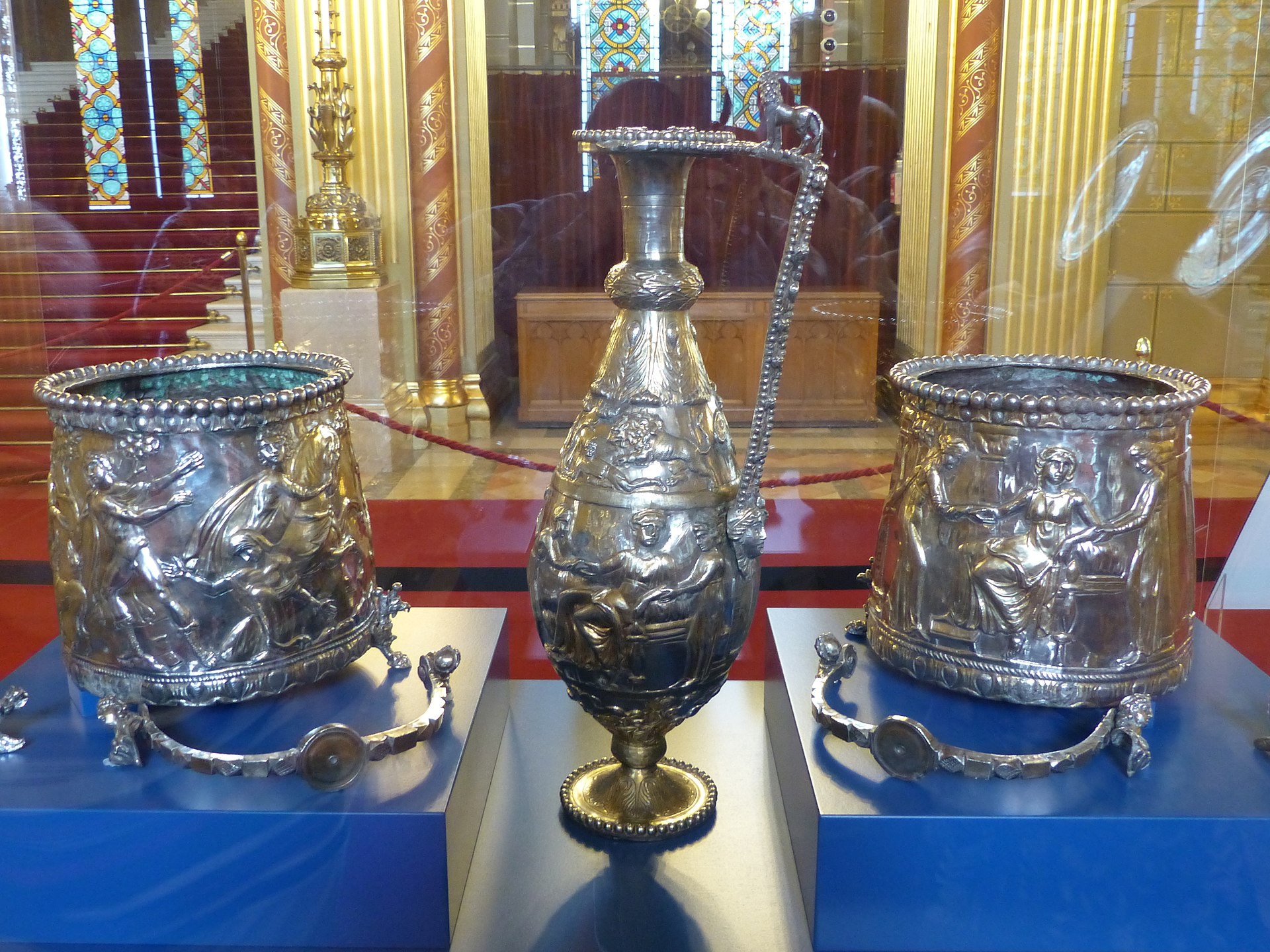
The remaining seven pieces, held by the Marquess of Northampton: the Achilles and Meleager plates, the animal-decorated ewer, the Dionysiac amphora and the three vessels of the Hippolytus set. Repatriated in summer 2017 and announced on 12 July, presented in the Hungarian Parliament building and afterwards toured before joining the rest at the Hungarian National Museum. 28 million euros, making 43 million euros for both tranches. Described by the Hungarian side as compensation to family foundations for relinquishing the treasure rather than as a purchase, a distinction that preserves Hungary's position that the holders never had good title.247
Prices realised
The Sevso Treasure has never been sold at auction and there is no hammer price for it. It was offered once, by Sotheby's in New York, announced on 10 February 1990 at a published estimate variously reported as 40 to 70 million dollars and 50 to 100 million dollars. Lebanon sued on 15 February, a restraining order followed on 20 February and the treasure was impounded in March. No lot was ever knocked down. A second showing, at Bonhams in London in October 2006, was a private viewing for an invited audience and not an auction; it produced no sale.
Every 1980s figure attached to this treasure is a private transaction price between dealers and trusts, not a market result: 48,000 pounds for a geometric ewer in November 1980, 225,000 pounds for the Hunting Plate, 525,000 pounds for the Achilles Plate in May 1981, 180,000 pounds for a geometric plate in September 1981, 525,000 pounds for the Hippolytus situla in December 1981, 500,000 pounds for two pieces bought by Northampton in 1982, and 8.7 million dollars for four pieces in 1987. A further 628,000 pounds in 1985 and 460,000 dollars in 1987 were spent not on objects but on Lebanese export documentation.
The 2014 and 2017 payments by the Hungarian state are private transaction sums under negotiated agreements and are not auction results, estimates or valuations. They are reported in three incompatible legal registers and this record keeps all three: 15 million euros and 28 million euros, called a compensation fee by the Hungarian National Museum and described in the Hungarian government's account of 2017 as compensation to two family foundations for relinquishing the treasure; 20.7 million dollars for the first tranche, called a retention fee by Artnet News reporting The Art Newspaper in April 2014; and a purchase in most press coverage. The euro and dollar figures for the first tranche are the same money reported in two currencies at two conversion dates. None of this is a price for the treasure and none of it should be quoted as its value.
One genuine auction result touches this record without being a result for this object. In 1985 the Marquess of Northampton sold Mantegna's Adoration of the Magi at Christie's in London to the J. Paul Getty Museum, reported at 10.5 million dollars and described as a then record auction price for the artist. The source consulted does not state whether that figure is the hammer or the total with buyer's premium, and the currency of the sale room was sterling while the figure is quoted in dollars. It is recorded here only because it places the same seller and the same museum in the same room one year after the Getty rejected his Roman silver as improperly documented.
Technical evidence
| Attribution note | No maker is named and none has been identified. The fourteen vessels are not the product of one hand or one shop: scholars distinguish restrained Western engraving on some pieces from exuberant Eastern repousse on others, which is why the set is read as an accumulated household service rather than a single commission. The only personal name on any of it is the owner's, Sevso, cut into the rim of the Hunting Plate. |
|---|---|
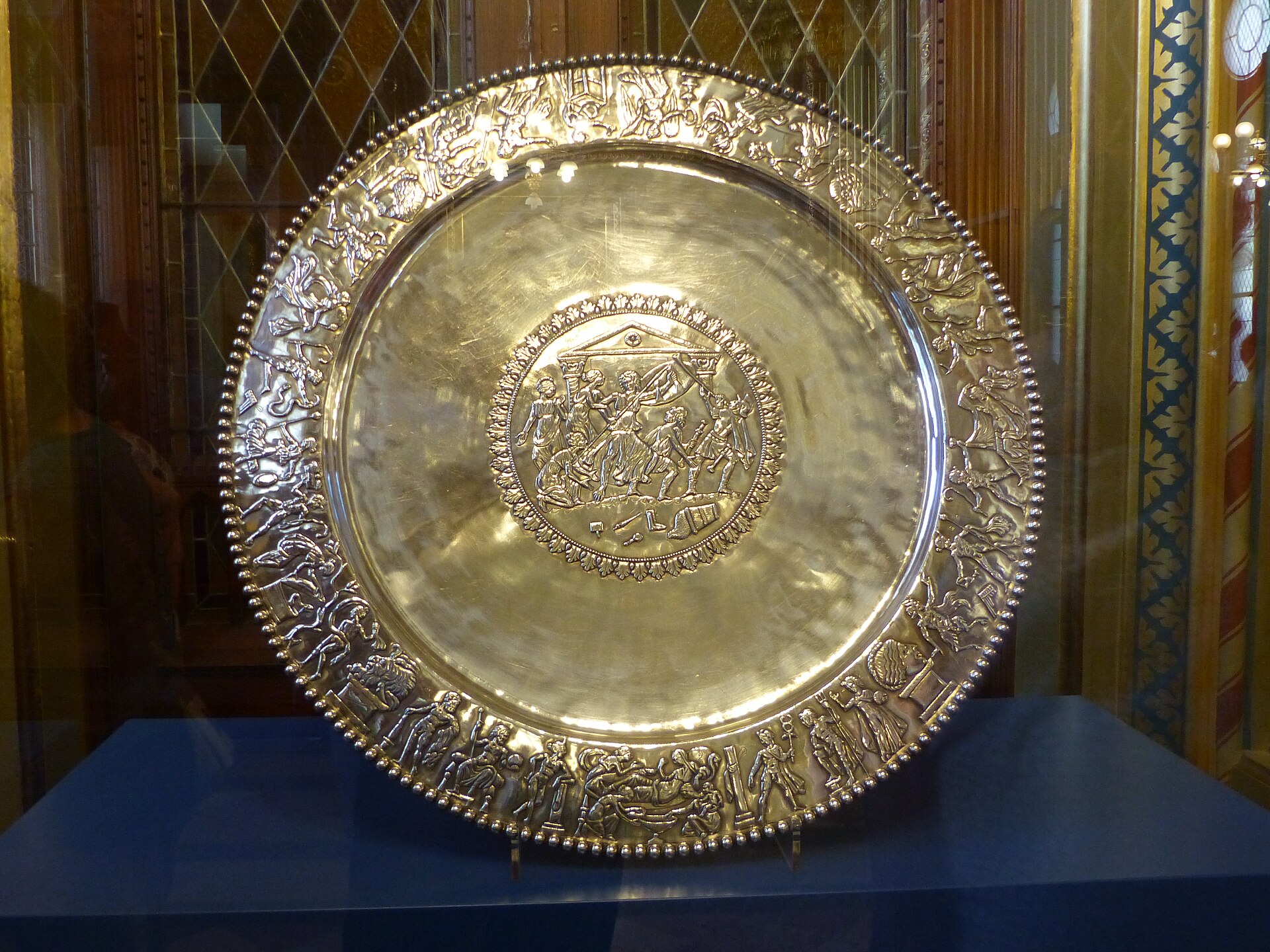
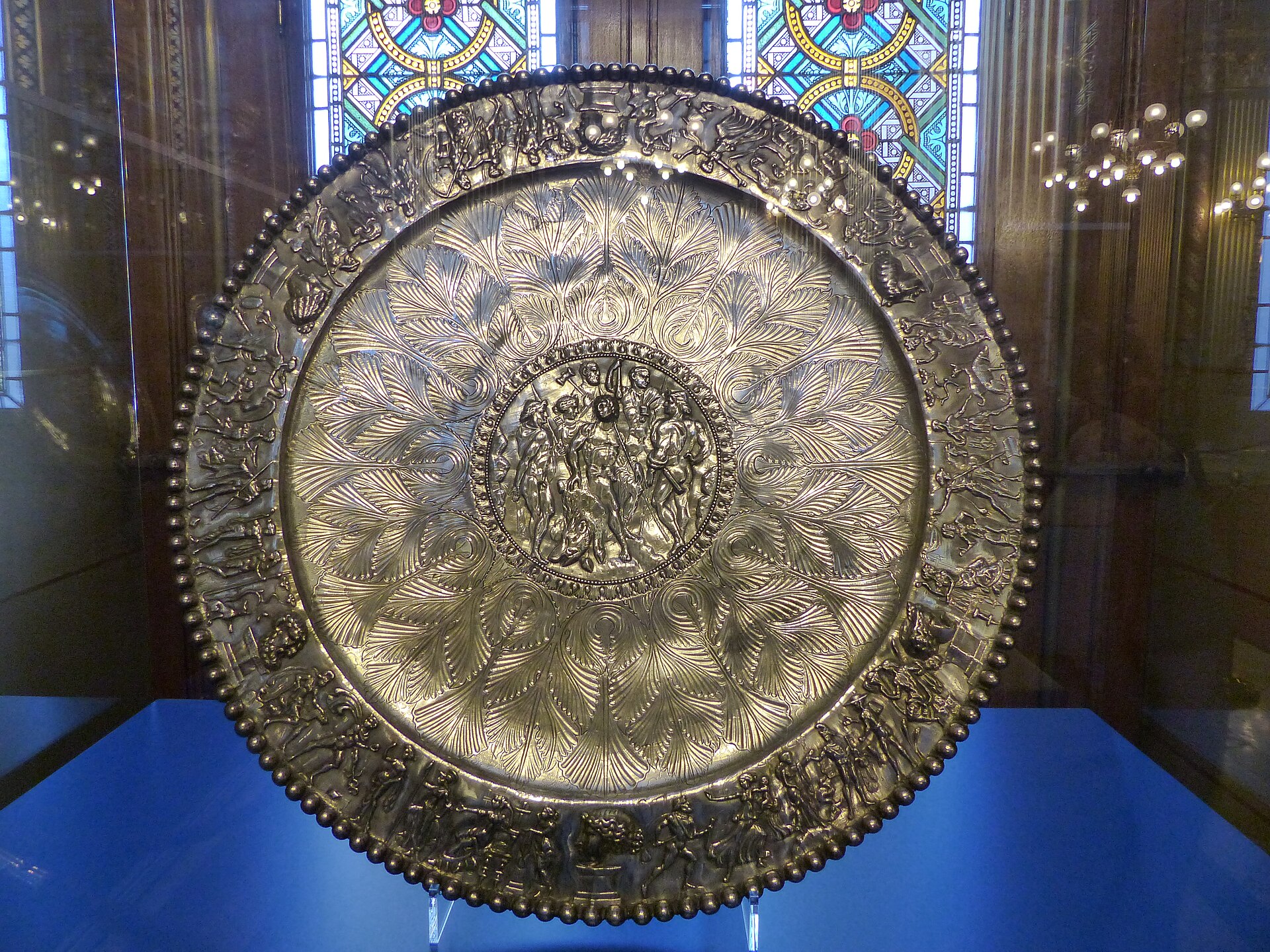
| Composition of the group | Fourteen silver vessels and one copper alloy cauldron. The silver includes the Hunting or Sevso Plate, the Achilles Plate, the Meleager Plate, a geometric plate, two geometric ewers, the Dionysiac ewer, the animal ewer, the Dionysiac amphora, the Hippolytus set of three vessels comprising one ewer and two situlae, a washing basin and a perfume casket.152 |
| The Hunting Plate | About 70 cm in diameter and close to 9 kg. It carries the Sevso inscription, the Chi-Rho and the medallion in which a lake is labelled PELSO. It is the piece on which the identification of the whole group rests.42 |
| The inscription | HEC SEVSO TIBI DVRENT PER SAECVLA MVLTA / POSTERIS VT PROSINT VASCVLA DIGNA TVIS. A hexameter couplet wishing that the vessels endure for Sevso through many ages and serve his descendants worthily.4 |
| The Chi-Rho | A Chi-Rho monogram is set with the inscription on the Hunting Plate, making the owner a Christian and placing the object after the Constantinian settlement.4 |
| The Achilles Plate | About 72 cm across, showing scenes from the life of Achilles including his birth, the contest between Poseidon and Athena, and the moment on Skyros at which he is revealed as male. Acquired by Art Consultancy in May 1981 for 525,000 pounds.51 |
| The Meleager Plate | Close to 70 cm in diameter, depicting the Calydonian boar hunt. Among the seven pieces that came to Hungary in 2017.5 |
| The Hippolytus set | Three silver-gilt vessels, one ewer and two situlae, illustrating the myth of Hippolytus and Phaedra, including the youth rejecting his stepmother's letter. The Hippolytus situla was bought by Art Consultancy in December 1981 for 525,000 pounds.51 |
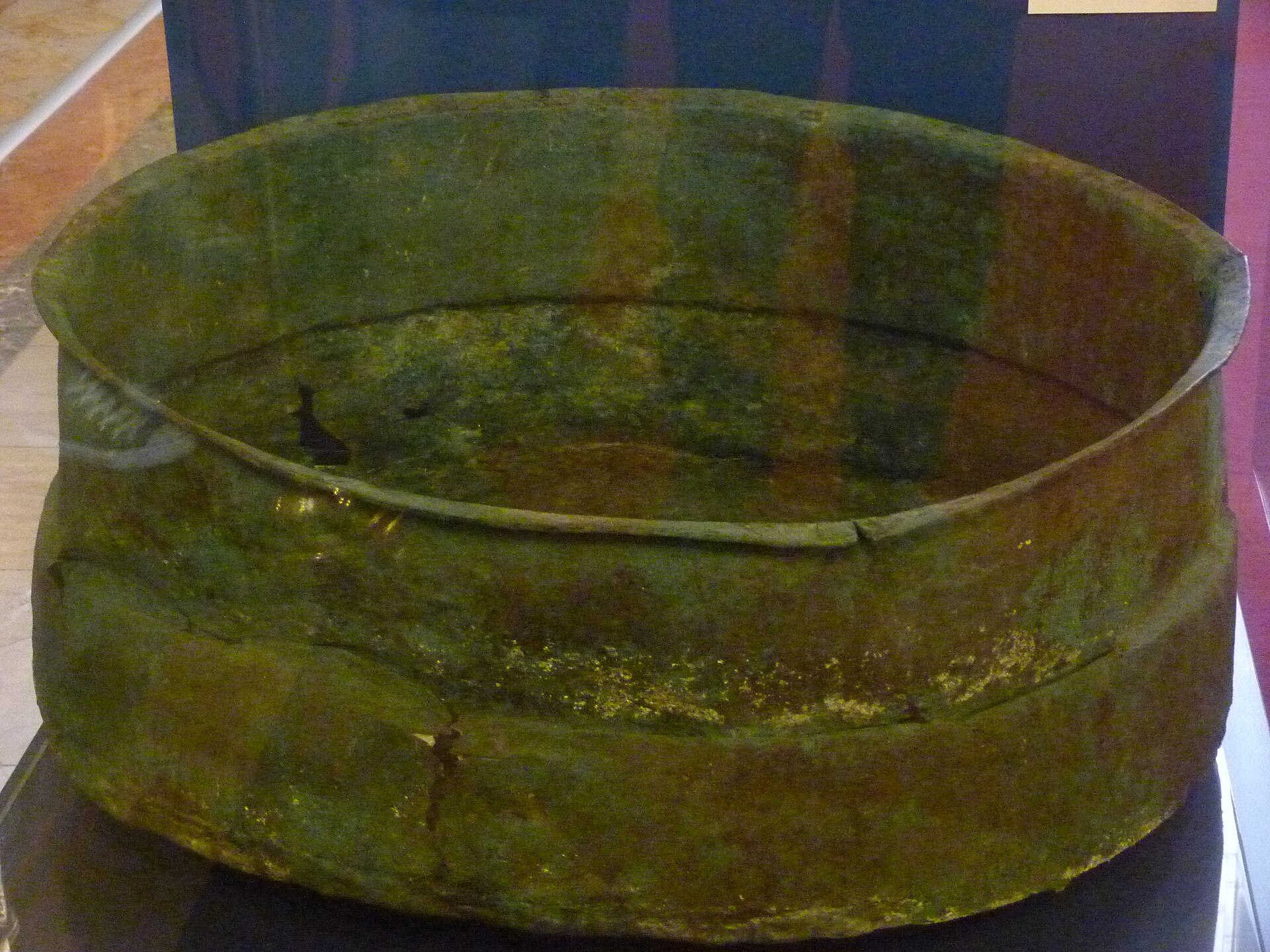
| The copper cauldron | Undecorated copper alloy vessel in which the silver was buried. Its dimensions match a filled-in pit found in the floor of the wine cellar near Polgardi where Jozsef Sumegh's body was found in December 1980, a fit the Hungarian National Museum says has been confirmed by an authentication excavation.2 |
| Technique and workshop division | The group combines restrained engraving of a Western character with exuberant repousse associated with Eastern workshops, which is why it is read as an accumulated service rather than a single commission from one shop.5 |
| Dating | Late fourth to early fifth century AD is the common position; proposals in the literature run from the middle of the fourth century to the early fifth.14 |
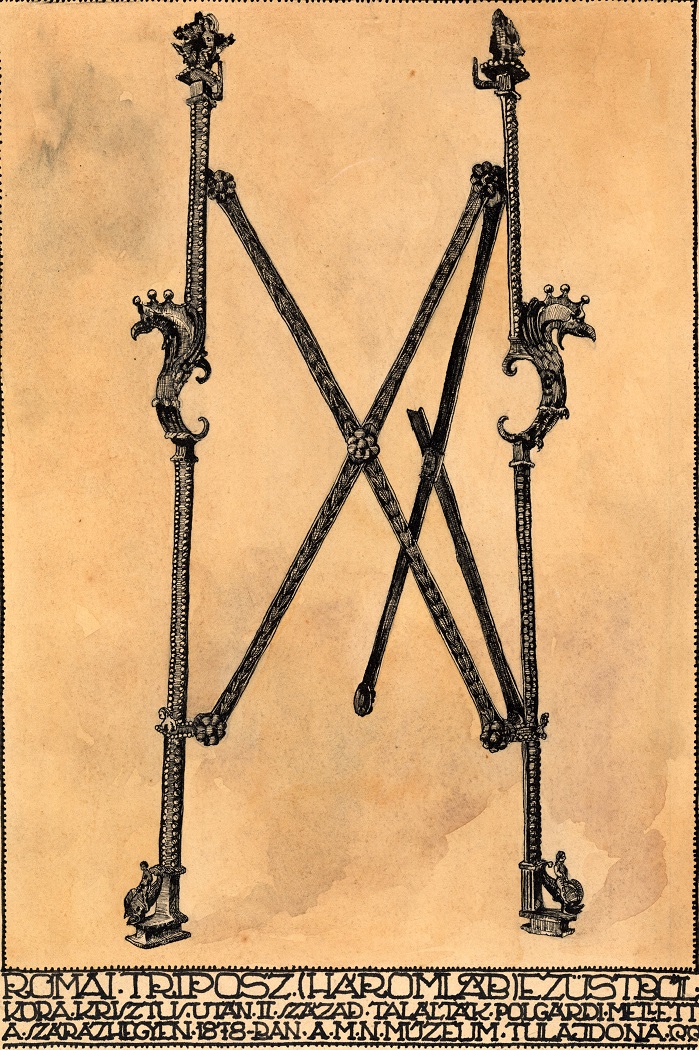
| The associated quadripus | A four-legged folding silver stand found in fragments in 1878 on Szarhegy, in the parish of Koszarhegy near Polgardi, and in the Hungarian National Museum ever since. It matches the treasure in ornament, subject matter and scale. No further fragments have been recovered despite excavation at the site in the nineteenth and twentieth centuries. The 1878 drawing of the stand made for the Hungarian National Museum after its first restoration is reproduced on this page.26 |
Images
The record in full
Chapter 1The object is a document about itself
Most Roman silver is anonymous. This is not.
Most Roman silver is anonymous. This is not. Across the top of the Hunting Plate, inside a wreath and flanked by a Chi-Rho monogram, runs a two-line hexameter couplet: Hec Sevso tibi durent per saecula multa, posteris ut prosint vascula digna tuis. May these vessels endure for you, Sevso, through many ages, and serve your descendants worthily. It is a dedication, a blessing and, as it turned out, an inventory label that survived its owner by sixteen centuries and made the whole hoard identifiable as a single group.
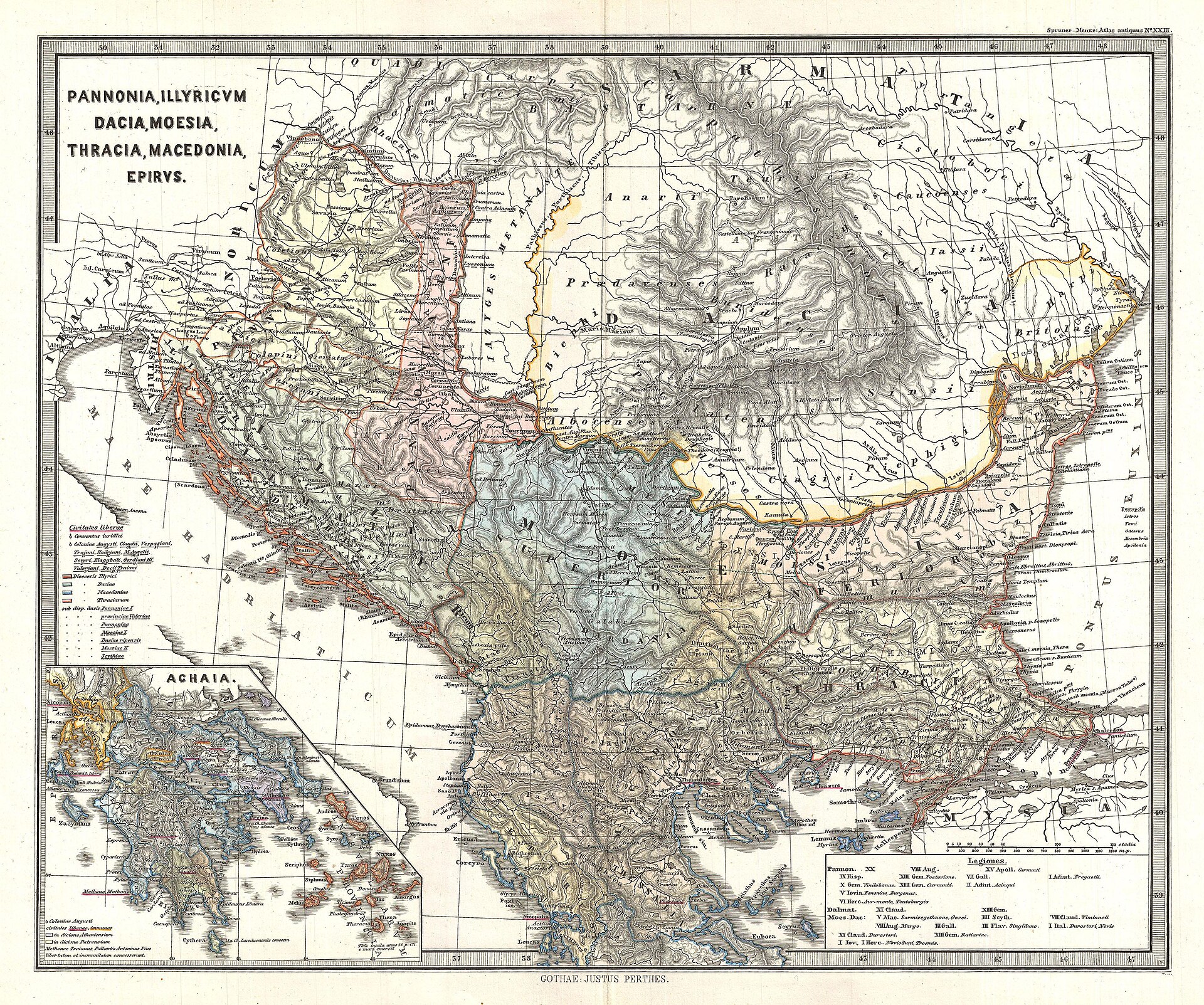
Directly below it, in the medallion at the centre of the plate, a picnic scene is set beside water, and the water is named. The letters read PELSO. That is the Roman name for Lake Balaton, in the province of Pannonia, in what is now western Hungary. A late Roman silversmith labelled the lake on his patron's dinner service, and in doing so put a place name on an object that would spend the 1980s travelling on paperwork claiming it came from Tyre and Sidon.
Nothing else about Sevso is known. He appears in no inscription, no list of officials, no letter. The name is not common. The Chi-Rho makes him a Christian, the silver makes him very rich, and the scale of the service - fourteen vessels, several of them close to seventy centimetres across - makes him rich at the level of a senator or a provincial governor rather than a merchant. Beyond that the archive is empty, and the emptiness is itself the point: the object names its owner and the historical record cannot corroborate the name.
Chapter 2A Hungarian scholar read the find-spot off the plate in 1984 and nothing happened
This is the part of the story that almost every account of the Sevso affair leaves out, and it is the part that matters most to anyone assessing how provenance failures actually occur.In 1984 the...
This is the part of the story that almost every account of the Sevso affair leaves out, and it is the part that matters most to anyone assessing how provenance failures actually occur.
In 1984 the treasure was offered for sale to the J. Paul Getty Museum in Los Angeles. Janos Gyorgy Szilagyi, then head of the Collection of Classical Antiquities at the Museum of Fine Arts in Budapest, happened to be at the Getty while it was there. He looked at the Hunting Plate and saw the word PELSO. He knew immediately what it meant, because a Hungarian classical archaeologist knows the Roman name of Lake Balaton the way a British one knows Verulamium. On returning to Budapest he told the archaeologist Andras Mocsy.
That was the moment Hungarian scholarship first learned that a major late Roman treasure with Pannonian lettering on it was circulating on the market. The Hungarian National Museum's own account of the affair states plainly what followed: no official steps were taken. Six years passed. The state made no enquiry, filed no notice, alerted no police force and told no auction house. When Sotheby's announced the sale in February 1990, Hungary's claim rested on data it had held since 1984 and done nothing with.
The Getty did not buy it either, and its reason is the second half of this record. The two facts belong together: in 1984 an institution rejected the treasure because its papers were forged, and a scholar identified its likely homeland from an inscription, and neither event produced any action for six years.
Chapter 3The licence was the product
Between November 1980 and December 1981 a Guernsey company called Art Consultancy, jointly owned by the recently retired Sotheby's chairman Peter Wilson and the dealer Rainer Zietz, bought piece...
Between November 1980 and December 1981 a Guernsey company called Art Consultancy, jointly owned by the recently retired Sotheby's chairman Peter Wilson and the dealer Rainer Zietz, bought piece after piece through a chain running from the Vienna-based dealer Anton Tkalec and the Lebanese dealer Halim Korban, with the London dealer Mansur Mokhtarzade involved. The recorded prices are precise and they are worth reading in sequence: a geometric ewer at 48,000 pounds in November 1980; the Hunting Plate itself at 225,000 pounds between November 1980 and January 1981; the Achilles Plate at 525,000 pounds in May 1981; a geometric plate at 180,000 pounds in September 1981; the Hippolytus situla at 525,000 pounds in December 1981.
The silver came first. The paperwork came afterwards. In June 1981, seven months into the buying, Korban produced a Lebanese export permit, and it was applied retrospectively to material already in hand. That is the structural fact this record exists to record: the licence was not a condition of the purchase, it was a product commissioned to cover one.
In March 1984, when the treasure was offered to the J. Paul Getty Museum, the Getty examined the permit and established two things. The authorising signatures were forged, and Korban was not recognised by the Lebanese authorities as a registered dealer at all. The Getty declined.
What happened next is the reason this case is not merely a story about a bad document. In 1985 Peter Mimpriss, the solicitor acting for both Wilson and the Marquess of Northampton, approached a Lebanese businessman named Ramiz Rizk to obtain replacement documentation, at a cost recorded as 628,000 pounds in expenses including taxes. In 1987, when Northampton bought four further pieces from Korban and Tkalec for a combined 8.7 million dollars, export permits were obtained through Rizk for a further 460,000 dollars. Three sets of Lebanese papers, one of them proven forged by a museum before the second was commissioned, and a running total in the low seven figures spent on nothing but provenance. Not on the silver. On the story about the silver.
Chapter 4What Northampton actually acquired, and when
Spencer Compton, seventh Marquess of Northampton, did not buy the treasure in one transaction and did not own all of it from the start.
Spencer Compton, seventh Marquess of Northampton, did not buy the treasure in one transaction and did not own all of it from the start. Mimpriss, who acted for both parties, suggested in November 1981 that Northampton might invest. The Abraham Trust was formed on 15 September 1982 and took ownership of the eight pieces Wilson and Zietz had already acquired, together with two more that Northampton bought for 500,000 pounds.
In 1987, acting on his own, Northampton bought four further pieces from Korban and Tkalec for 8.7 million dollars. The Marquess of Northampton 1987 Settlement Trust became the sole owner of the whole group, and it is that trust, not the man, that was the defendant in New York.
The distinction is not pedantry. It explains why the treasure could later be split: after the failed 2006 attempt to sell, the hoard was divided into two parts, one of which was in the hands of the heirs of Peter Wilson and one of which remained with Northampton. Hungary bought them separately, from different holders, three years apart. Accounts that describe Hungary as buying the treasure back from the Marquess of Northampton describe only the second half.
Chapter 5The buyer, and the museum that turned him down and then paid him
Spencer Douglas David Compton, born 2 April 1946, became seventh Marquess of Northampton in 1978 on the death of his father.
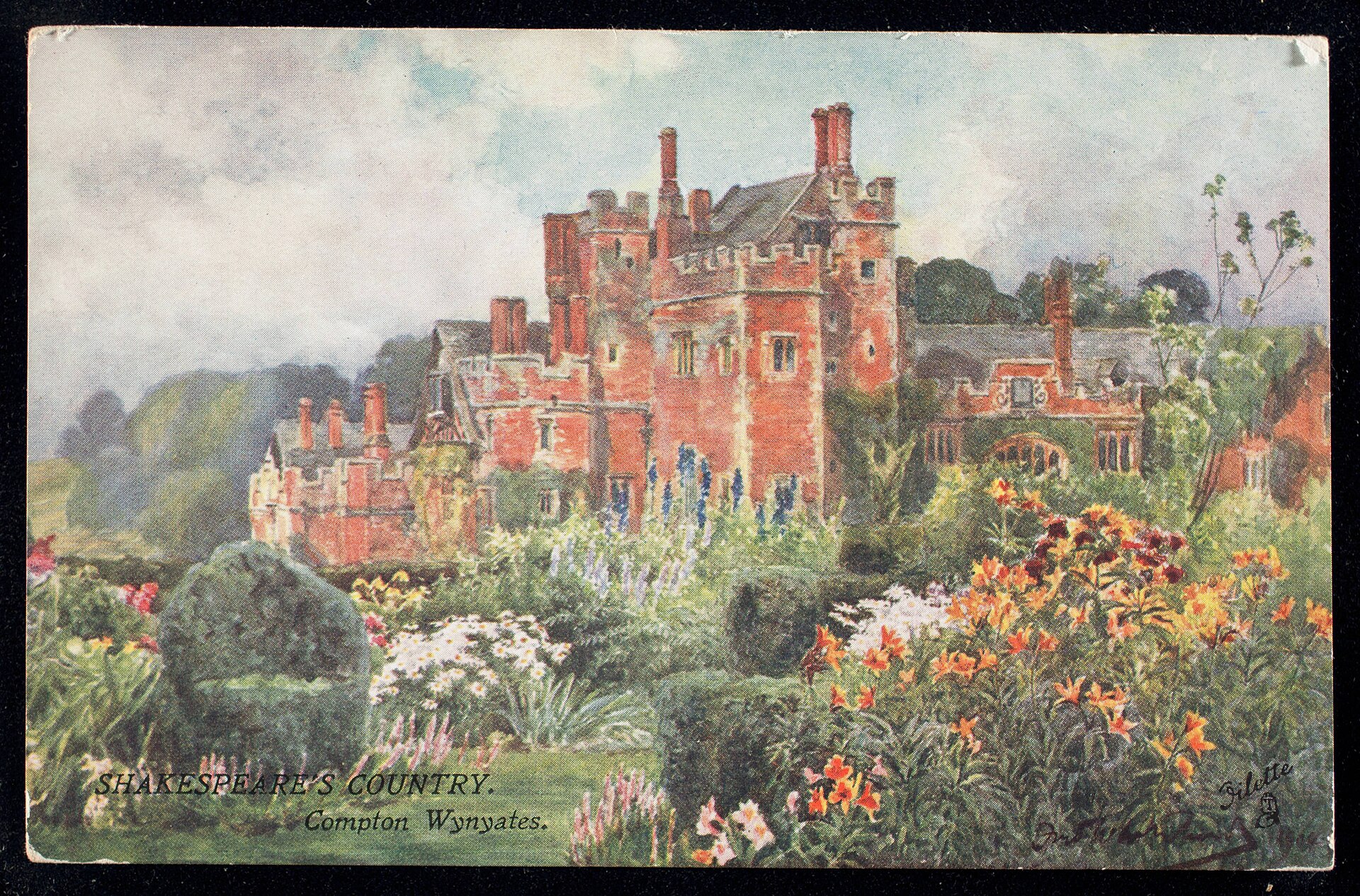
Spencer Douglas David Compton, born 2 April 1946, became seventh Marquess of Northampton in 1978 on the death of his father. The family holds two seats, Castle Ashby in Northamptonshire and Compton Wynyates in Warwickshire, and his fortune was assessed in 2017 at around 110 million pounds. He was, in other words, exactly the kind of private buyer a dealer with an unprovenanced Roman service would want to find: solvent enough to hold an illiquid object indefinitely, advised by a City firm, and represented by a solicitor who was already acting for the seller.
One transaction in his record deserves setting beside the Sevso chronology, because the two touch. In 1985 he sold Mantegna's Adoration of the Magi at Christie's in London, and the buyer was the J. Paul Getty Museum. The reported figure is 10.5 million dollars, described as a then record auction price for the artist; the source consulted does not say whether that is the hammer or the price with premium, and this record will not guess.
The sequence matters. In March 1984 the Getty examined the Sevso export licences, found the signatures forged and the named dealer unregistered, and declined the treasure. In 1985 the same museum paid eight figures at auction for a picture from the same owner. In the same year, that owner's solicitor was commissioning a second set of Lebanese papers at 628,000 pounds. A museum's diligence operates object by object, and there is nothing improper in buying a well-documented Mantegna from a man whose Roman silver you have just refused. But a collector reading a provenance chain should register how narrow the refusal was: the Getty rejected the paperwork, not the seller, and it told nobody.
Chapter 6It was withdrawn, not sold: there is no hammer price for this object
On 10 February 1990 Sotheby's announced in New York that it would sell the treasure, and held a private view at its New York headquarters.
On 10 February 1990 Sotheby's announced in New York that it would sell the treasure, and held a private view at its New York headquarters. The consignor was the consortium headed by Northampton. The published estimate was 40 to 70 million dollars in some accounts and 50 to 100 million in others; both figures are estimates and neither is a price. Sotheby's, to its credit, notified twenty-nine countries whose territory had lain inside the fourth-century Roman Empire, together with UNESCO, Interpol, IFAR and ICOM.
The notification produced the opposite of a clean sale. On 15 February 1990, five days after the announcement, Lebanon filed suit in the New York State Supreme Court alleging that the export documentation was forged. A temporary restraining order followed on 20 February. By March the treasure was impounded. It never reached an auction room.
Every figure attached to the Sevso Treasure in general circulation is therefore one of three things and none of them is a hammer price: a 1980s private purchase price paid by dealers or by the trust, a 1990 pre-sale estimate for a sale that did not happen, or a twenty-first century payment by the Hungarian state under a private agreement. This record keeps them apart, because conflating them is how a withdrawn lot acquires an imaginary auction record.
Chapter 7Three claimants, one jury, and the evidence Hungary was not allowed to show
Lebanon claimed first, on the strength of the export licences, and abandoned the claim on the eve of trial once those licences were shown to be forged.
Lebanon claimed first, on the strength of the export licences, and abandoned the claim on the eve of trial once those licences were shown to be forged. The irony is exact: the forged document that was manufactured to give the treasure a Lebanese origin was the only basis of Lebanon's own claim, and its exposure destroyed the claim it was invented to support.
Yugoslavia, and after 1991 Croatia as successor state, claimed on the basis that the silver had been found near Barbariga in Istria, not far from Pula, and smuggled out in the late 1970s, citing soil analysis. Hungary claimed from 1991 that it had been found near Polgardi, some sixteen kilometres east of Lake Balaton.
The trial ran for seven weeks from September 1993. The jury found that neither Hungary nor Croatia had proved that the treasure was found within its borders, and possession stayed with the Northampton trust. Two things about that verdict are consistently misreported. First, the court did not rule that Northampton had good title; it ruled that the claimants had not established theirs, which is a different finding with different consequences. Second, and more seriously, the Hungarian National Museum records that the comparative silver and soil samples, the results of the Hungarian police investigation and the Koszarhegy silver stand were not put before the jury: the court did not permit it, on procedural grounds. The Appellate Division affirmed the dismissal in 1994.
A jury verdict that a claimant has failed to prove a fact is not a finding that the fact is false. It is a finding about the state of the record in that courtroom on that day. Where the strongest part of a claimant's record was excluded before it reached the jury, the verdict tells a provenance researcher considerably less than its citation suggests.
Chapter 8The murder in the wine cellar
In December 1980 the body of a twenty-four-year-old Hungarian named Jozsef Sumegh was found hanging in a wine cellar near Polgardi.
In December 1980 the body of a twenty-four-year-old Hungarian named Jozsef Sumegh was found hanging in a wine cellar near Polgardi. His compulsory military service was ending. He collected coins and antiquities, and he was said locally to have found a large silver treasure before he was called up. The death was recorded as suicide. It was later reinvestigated as murder, and the criminal file has never been closed.
What connects the death to the silver is not rumour but a hole in the ground. During the investigation, traces of a filled-in pit were noticed in the floor of the wine cellar where the body was found. The pit was later excavated by archaeological method. The copper cauldron in which the Sevso silver was buried - the cauldron that came back to Hungary with the first tranche in 2014 - fits the pit. The Hungarian National Museum states that the fit has since been verified by an authentication excavation.
The cauldron is the single most important object in the group for provenance purposes and it is the one nobody photographs. It is not decorated, it carries no inscription, and it would not be worth recording as an object of art. It is worth recording as evidence, because a vessel that matches the void it was lifted out of is a better provenance link than any signature.
Chapter 9The silver stand that had been in the museum since 1878
In 1878, fragments of a four-legged folding silver stand, a quadripus, were found on Szarhegy, in the administrative area of the village of Koszarhegy, a few kilometres from Lake Balaton and close to...
In 1878, fragments of a four-legged folding silver stand, a quadripus, were found on Szarhegy, in the administrative area of the village of Koszarhegy, a few kilometres from Lake Balaton and close to Polgardi. It went into the Hungarian National Museum, where it has been ever since, and it was regarded as a unique and slightly inexplicable object: a piece of late Roman display silver of a scale and quality with no local comparison.
During the New York proceedings in 1993 Hungarian researchers made the connection. The stand matches the Sevso vessels in the style and subject matter of its ornament and in its scale, and it was found in the district that the plate's own inscription points to. Read together with the cauldron and the pit, the quadripus is the strongest circumstantial argument that the treasure is Pannonian. Zsolt Mrav published the case at length in 2012.
Excavations were conducted at the stand's find-spot in both the nineteenth and twentieth centuries, and no further fragments of it have ever been found. That absence is part of the evidence too, and this record does not resolve it: the museum's own position, published on its Seuso research site, is that all of this points to a Hungarian find-spot only indirectly, and that the question will be settled if at all by the scientific programme begun in 2014 and by the police investigation, not by anything already known.
Chapter 10The only person who was paid damages was the buyer
Under pressure from Yugoslavia, the Metropolitan Police in London opened a criminal investigation in early 1990.
Under pressure from Yugoslavia, the Metropolitan Police in London opened a criminal investigation in early 1990. By July the police considered the evidence to suggest a conspiracy to defraud. Northampton was interviewed in October 1990 and was treated as a victim rather than a suspect, cleared of criminal intent. Attention moved to Mimpriss. In 1991 the Foreign Office and the Crown Prosecution Service recommended that the investigation be wound down for want of evidence, and it was, against Northampton's own wishes.
In March 1991 Northampton sued Mimpriss and the law firm Allen and Overy for fraud, deceit and misrepresentation over the acquisitions between 1981 and 1990, on the ground that the treasure had been rendered unsaleable by the forged licences and the publicity. The action was settled out of court in 1999, with Northampton reported to have received 15 million pounds.
Take the money in this case as a whole. The dealers were paid. The producers of the export documents were paid twice, in 1985 and 1987. The buyer recovered a reported 15 million pounds in damages from his own solicitors. The state that says the treasure was dug out of its soil recovered nothing in court and then paid 43 million euros to get the objects. Nobody was convicted of anything, and the man who is thought to have found the silver was buried in 1980.
Chapter 11One payment, three names for it
After the trial the objects were legally in the possession of a trust and commercially worthless, because no museum could buy them and no private collector could ever show them.
After the trial the objects were legally in the possession of a trust and commercially worthless, because no museum could buy them and no private collector could ever show them. In October 2006 the hoard was brought back together and shown for a few days to an invited audience at Bonhams in London. It was a viewing, not a sale, and it failed. The group was then divided in two. In 2012 a Hungarian private individual attempted to buy the treasure and failed.
The Hungarian state then negotiated directly, and it negotiated with the Wilson side first. The half that included the Hunting Plate and the copper cauldron was held not by the Marquess of Northampton but by a trust benefiting the two sons of Peter Wilson, the Sotheby's chairman who had started the buying in 1980. That tranche came to Hungary in spring 2014, was unveiled in the Parliament building by Viktor Orban with Jozsef Palinkas of the Hungarian Academy of Sciences, and moved to the Hungarian National Museum in July of that year. The second and, on the museum's own assessment, more richly decorated half was Northampton's, and it followed in summer 2017, announced on 12 July.
Now the money, and this is the part that no single account gets right. The sums are 15 million euros for the first tranche and 28 million euros for the second, 43 million euros in all. They have been published under three different legal descriptions. The Hungarian National Museum calls them a compensation fee, paid in harmony with the international agreements on illegal art trade. Artnet News, reporting The Art Newspaper in April 2014, called the first payment a retention fee and gave it in dollars, at 20.7 million. Most of the press has simply called both of them purchases. The Hungarian government's own framing, in the account of the 2017 tranche, is that two family foundations received compensation for relinquishing the treasure.
These are not synonyms. A purchase price concedes that the seller had title to sell. Compensation concedes nothing about title and characterises the payment as the price of ending a dispute. A retention fee is different again and implies payment for possession rather than for ownership. Hungary has never conceded that the holders owned the silver, having spent a seven-week trial arguing that it did, and the vocabulary it uses is the residue of that position. A reader who sees 43 million euros described as the price Hungary paid for its own national treasure is reading a characterisation that the paying state itself declines.
Viktor Orban, presenting the second tranche in Parliament, used the language of family property rather than acquisition: the government believed the place for the family silver was in Hungary, and it had done its duty and got it back.
Chapter 12What is still missing, and what has never been decided
Fifteen objects are in Budapest: fourteen silver vessels and the cauldron.
Fifteen objects are in Budapest: fourteen silver vessels and the cauldron. Persistent reports, repeated in the specialist literature on the case, hold that the known group is only part of what came out of the ground, with perhaps eight further vessels and as many as 185 spoons unaccounted for. No court and no excavation has confirmed or dismissed this. If the reports are right, a second Sevso Treasure exists somewhere and has never surfaced.
The find-spot has never been established judicially. The New York jury did not find that the silver came from Hungary; it found that Hungary had not proved it, on a record from which Hungary's physical evidence had been excluded. The Croatian claim was dismissed on the same basis and has never been withdrawn as a matter of scholarship. The Hungarian criminal investigation into Jozsef Sumegh's death remains open. The scientific programme the museum began in 2014 - archaeological, art-historical and archaeometric - is the only route by which the question is now likely to be answered.
The treasure is in the Hungarian National Museum, complete as far as anyone knows it, bought back by a state that a court had told, twice, that it had not proved its case. That is the settlement: not a judgment, not a restitution and not a repatriation in any legal sense, but a private purchase which the buyer insists on calling something else.
The artist
The silversmiths of the Sevso service, unidentified
There is no maker to write about, and pretending otherwise would be the first false note in a record about falsified documents. What can be established is narrower and more useful: what kind of workshops produced silver like this, what the objects were for, and why an owner had his name cut into the rim of a dish. Late Roman display silver was not tableware in the domestic sense. It was portable capital, status made visible at the moment of use, and in many recorded cases imperial largesse handed down to office-holders. A service of this weight is a statement about rank, and the inscription is the part of that statement the owner paid a letter-cutter to make permanent.
Exhibited
- 1990Private view before the announced saleSotheby's, New York
- 2006Private viewing for an invited audience of academics, curators, collectors and dealersBonhams, London
- 2014Display of the first tranche after repatriationHungarian Parliament Building, Budapest
- 2017Presentation of the second tranche and subsequent national tourHungarian Parliament Building and regional museums, Hungary
Literature
- Toth, E. and Nagy, M., 'The Seuso treasure: The Pannonian connection?', Minerva 1 (1990), 5-11.
- Mrav, Zs., 'A polgardi osszecsukhato ezustallvany es a Seuso-kincs / The late Roman silver folding stand from Polgardi and the Seuso treasure', in Visy, Zs. and Mrav, Zs. (eds), A Seuso-kincs es Pannonia / The Seuso treasure and Pannonia, Pecs 2012, 80-106.
- Hajdu, E., 'A Seuso-kincs es Magyarorszag / The Seuso treasure and Hungary', in Visy, Zs. and Mrav, Zs. (eds), A Seuso-kincs es Pannonia, Pecs 2012, 23-34.
- Nagy, M., 'A Seuso-kincs pannoniai kapcsolatai / Connections of the Seuso treasure to Pannonia', in Visy, Zs. and Mrav, Zs. (eds), A Seuso-kincs es Pannonia, Pecs 2012, 49-63.
Related works
| Work | Relation | Where it is |
|---|---|---|
| The Polgardi (Koszarhegy) silver quadripus Late Roman silversmith, unidentified | Argued to belong with the treasure; the strongest physical argument for a Pannonian find-spot Found in fragments in 1878 a few kilometres from Lake Balaton. Matches the Sevso vessels in ornament, subject and scale. No further fragments recovered despite repeated excavation. | Hungarian National Museum, Budapest |
| The Kaiseraugst Treasure Late Roman silversmiths, unidentified | Closest excavated comparandum, with a documented find-spot Found in 1961-1962 inside a Roman fort at Kaiseraugst. Includes its own large Achilles plate. The contrast with Sevso is the point: same class of object, same century, one with a recorded context and one without. | Roemermuseum Augst, Switzerland |
| The Mildenhall Treasure Late Roman silversmiths, unidentified | Comparandum; late Roman silver service from a hoard Ploughed up in Suffolk in 1942 and declared treasure trove in 1946, after a delay that produced its own inquiry into how and when it was actually found. | British Museum, London |
| The Esquiline Treasure Late Roman silversmiths, unidentified | Comparandum; a named late Roman household service Found on the Esquiline in Rome in 1793. The Projecta casket carries an inscription naming its owners, the closest parallel to the Sevso inscription's function. | British Museum, London, with pieces in Paris and Naples |
| The Traprain Law hoard Late Roman silversmiths, unidentified | Comparandum; late Roman silver recovered by excavation Excavated in 1919, largely hacked into bullion. It shows what usually happened to late Roman plate and therefore why an intact service of fourteen vessels is exceptional. | National Museums Scotland, Edinburgh |
Open questions
- Where was the treasure found? No court has decided it. Hungary argues Polgardi, Croatia argues Barbariga in Istria, and the 1993 jury found only that neither had proved its case, on a record from which Hungary's soil analysis, police file and quadripus comparison had been excluded.
- Why did Hungary do nothing between 1984 and 1990? Janos Gyorgy Szilagyi identified the PELSO inscription at the Getty in 1984 and told Andras Mocsy. The Hungarian National Museum records that no official steps followed. The reason has not been published.
- Is the known group complete? Reports repeated in the specialist literature hold that perhaps eight further vessels and as many as 185 spoons came out of the same find and have never surfaced. Neither excavation nor prosecution has tested this.
- Who killed Jozsef Sumegh, and did he find the silver? The death was recorded as suicide in December 1980 and later reinvestigated as murder. The file is open. No sale record, admission or eyewitness ties him to the treasure; the link is the pit in the cellar floor and the cauldron that fits it.
- What is the legal character of the 2014 and 2017 payments? Hungary calls them compensation rather than purchase, which avoids conceding that the holders had title. No published agreement states what either party formally accepted about ownership.
- Who forged the Lebanese export licences, and were they ever prosecuted? Three sets of Lebanese documentation were produced between 1981 and 1987, one of them proven forged by the Getty in March 1984. No prosecution for the forgery has been located.
- What became of the Croatian claim? It was rejected in 1993 and the dismissal affirmed in 1994, but Artnet News reported in April 2014 that Croatia had still not relinquished it, and no withdrawal or refutation has been located since. Croatian soil comparisons have never been published alongside the Hungarian ones for direct comparison.
- Has the 2014 scientific programme reported? The Hungarian National Museum stated that the find-spot question can only be resolved by the archaeological, art-historical and archaeometric analyses begun in 2014. No published conclusion from that programme was located for this record.
- Was the 10.5 million dollars reported for the 1985 Christie's sale of Northampton's Mantegna to the J. Paul Getty Museum a hammer price or a price with premium? The source consulted gives one figure and does not say, which is the ordinary defect this archive exists to correct.
- Did the J. Paul Getty Museum report its March 1984 finding that the Sevso export licences were forged to anyone - to Lebanon, to Interpol, to the Art Loss Register or to any other museum? No account consulted records that it did, and a second set of Lebanese papers was commissioned the following year.
- Was the 2014 payment 15 million euros or 20.7 million dollars, and is it a compensation fee, a retention fee or a purchase price? The holding museum and the trade press use different sums in different currencies under different legal descriptions for what appears to be one transaction. No agreement has been published.
Questions about this object
What is The Sevso Treasure?
The Sevso Treasure is an antiquity, dated late fourth or early fifth century AD. Medium: Silver, partly gilt, with engraving, repousse and niello; buried in a copper alloy cauldron.
Who made The Sevso Treasure, and is the attribution settled?
The attribution to Late Roman silversmiths, workshops unidentified is recorded here as workshop. No maker is named and none has been identified. The fourteen vessels are not the product of one hand or one shop: scholars distinguish restrained Western engraving on some pieces from exuberant Eastern repousse on others, which is why the set is read as an accumulated household service rather than a single commission. The only personal name on any of it is the owner's, Sevso, cut into the rim of the Hunting Plate.
Where is The Sevso Treasure now?
Hungarian National Museum, Budapest. Last confirmed 3 August 2026. Fourteen silver vessels and the copper cauldron acquired by the Hungarian state in two tranches, spring 2014 and summer 2017.
What is still unknown about The Sevso Treasure?
Where was the treasure found? No court has decided it. Hungary argues Polgardi, Croatia argues Barbariga in Istria, and the 1993 jury found only that neither had proved its case, on a record from which Hungary's soil analysis, police file and quadripus comparison had been excluded.
Sources
- 1Trafficking Culture, 'Sevso Treasure' case study, University of Glasgow. Consolidates the purchase chronology, the recorded dealer prices, the Getty's March 1984 finding that the Lebanese permit signatures were forged, the trust structure, the Metropolitan Police investigation and the Mimpriss litigation. traffickingculture.org/encyclopedia/...
- 2Hungarian National Museum, Seuso Research Project, 'Recent history of the treasure trove'. The holding institution's own account: the 1984 identification of PELSO by Janos Gyorgy Szilagyi at the Getty, the Koszarhegy quadripus, the Sumegh investigation and the pit, the exclusion of Hungary's evidence at trial, and the description of the 2014 and 2017 payments as compensation. seuso.mnm.hu/en/...
- 3Art-Law Centre, University of Geneva, ArThemis platform, case note 'Sevso Treasure - Lebanon et al. v. Marquess of Northampton'. Chronology of the New York proceedings, the February 1990 filings, the seven-week trial and the 1994 appellate affirmance. plone.unige.ch/art-adr/...
- 4Wikipedia, 'Seuso Treasure'. Tertiary source, used for the inscription text, the composition of the group and the 2014 and 2017 sums. Flagged for replacement with Visy and Mrav (eds), A Seuso-kincs es Pannonia, Pecs 2012, and with the Hungarian National Museum catalogue. en.wikipedia.org/wiki/...
- 5Blue Guides, 'The Seuso Saga'. Descriptions of the individual vessels acquired in 2017, the division of engraving and repousse work, and the characterisation of the 2017 payment as compensation for custodianship rather than purchase. blueguides.com/the-seuso-saga
- 6Wikimedia Commons file page for the 1878 drawing of the Polgardi silver stand, giving the date, the National Museum illustrator and the PD-old licence. Licence verified from extmetadata LicenseShortName at fetch time. commons.wikimedia.org/wiki/...
- 7Daily News Hungary, 'Hungary acquires another seven pieces of Seuso Treasure', 12 July 2017. The seven objects in the second tranche, the 28 million euro figure, the description of the payment as compensation to two family foundations for relinquishing the treasure, Viktor Orban's remarks, Laszlo Baan's statement that the government had pursued the treasure since 1990, and the display in the Parliament building before transfer to the Hungarian National Museum. dailynewshungary.com/hungary-acquires-another-seven-piece...
- 8Wikipedia, 'Spencer Compton, 7th Marquess of Northampton'. Tertiary source, used for his dates, succession in 1978, the two family seats, the 2017 wealth assessment and the 1985 Christie's sale of Mantegna's Adoration of the Magi to the J. Paul Getty Museum. Its account of the 1993 New York outcome is inaccurate and is not relied on here; see the editor's note. Flagged for replacement with Debrett's and the Christie's sale record. en.wikipedia.org/wiki/...
- 9Cascone, Sarah, 'Controversy Still Haunts Sevso Ancient Roman Silver Stolen From Hungary', Artnet News, 30 April 2014, reporting The Art Newspaper. The 2014 payment described as a 20.7 million dollar retention fee; the seller identified as a trust benefiting Peter Wilson's two sons; the statement that Croatia had not relinquished its claim; the unveiling of the Hunting Plate by Viktor Orban and Jozsef Palinkas; and the move from the Parliament building to the Hungarian National Museum in July 2014. news.artnet.com/market/...

Last verified 13 August 2026 · Published 4 August 2026
Change log
13 August 2026 - Re-verified: no change to custody (Hungarian National Museum, Budapest, both tranches) or legal status since the 2017 second acquisition. All nine cited source URLs re-resolved live. Checked specifically for movement on the open questions: no published result located from the find-spot scientific programme begun in 2014; no withdrawal or renewed assertion of the Croatian claim located since the April 2014 Artnet News report already cited; no prosecution record located for the forged Lebanese export licences. One minor operational note: the Hungarian National Museum's Seuso permanent exhibition is temporarily closed for renovation from 2 December 2025, expected to reopen spring 2026 (per the museum's own site, mnm.hu) - does not affect the object's ownership or custody, not added to the record body as it is a visitor-logistics fact rather than a provenance one.
2 August 2026 - Record deepened to the house standard: narrative sections, technical evidence, artist dossier, related works and open questions added; provenance chain and auction results replaced with the researched versions; sources rebuilt.
4 August 2026 - Withheld from publication. This archive lists an object only when a photograph OF THAT OBJECT can be reproduced under a free licence. No such photograph has been found for this one, so the record is held rather than published beside pictures of other things. It will be released if a free reproduction appears.
4 August 2026 - Record created at the house standard: researched narrative, technical evidence, maker dossier, graded provenance chain, prices with hammer and premium separated, related works, open questions and sources.