The Bloody Massacre perpetrated in King Street Boston on March 5th 1770 by a party of the 29th Regt.
Paul Revere · 1770 (published about 26 to 28 March 1770); the date this sheet was printed is not documented
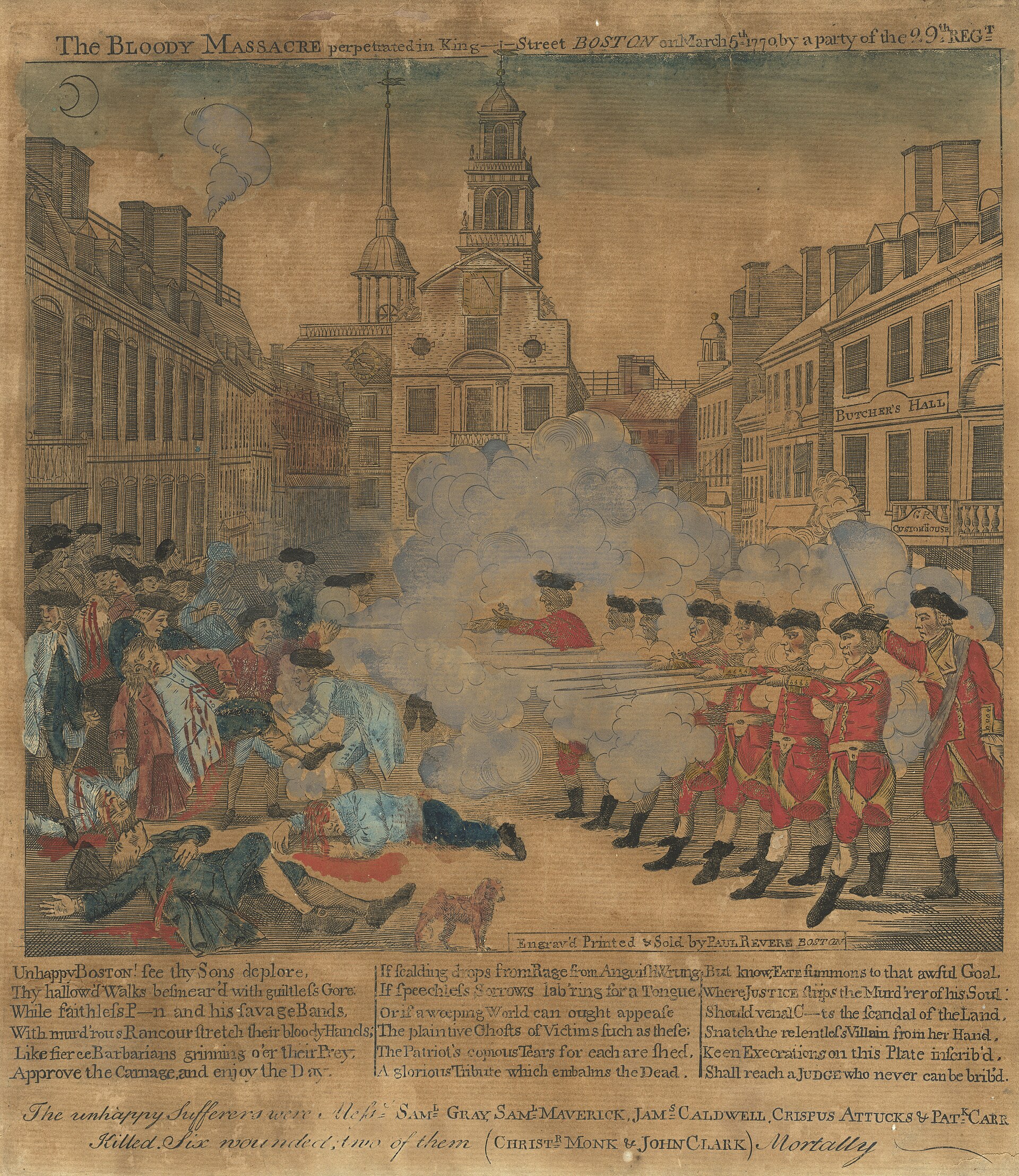
The subject of this record: the National Gallery of Art's impression, accession 1943.3.9042, Rosenwald Collection. Engraving with hand coloring on laid paper, image 20 x 21.91 cm, sheet 27.31 x 23.81 cm. The gallery's open-access photograph, CC0.
| Artist | Paul Revere |
|---|---|
| Date | 1770 (published about 26 to 28 March 1770); the date this sheet was printed is not documented |
| Medium | Engraving with hand coloring on laid paper (National Gallery of Art wording) |
| Dimensions | Image 20 x 21.91 cm; sheet 27.31 x 23.81 cm (National Gallery of Art) |
| Where it is now | National Gallery of Art, Washington (Rosenwald Collection)last confirmed |
| Inventory number | 1943.3.9042 (NGA object 11550) |
| Attribution | AcceptedEngraved, printed and sold by Paul Revere, whose imprint is on the plate. Full note |
| Object type | |
| Period | American colonial, 1770 |
| Cases | Has a provenance gap |
| Inscriptions | Above the image: The BLOODY MASSACRE perpetrated in King-Street BOSTON on March 5th 1770 by a party of the 29th REGt. In the image, lower right: Engrav'd Printed & Sold by Paul Revere BOSTON. Below, in three columns, eighteen lines of verse beginning Unhappy BOSTON! see thy Sons deplore and ending Shall reach a JUDGE who never can be brib'd. Below the verse, in script: The unhappy Sufferers were Messrs Saml Gray, Saml Maverick, James Caldwell, Crispus Attucks & Patrick Carr Killed. Six wounded two of them (Christr Monk & John Clark) Mortally. Read on the gallery's image; the gallery's own data transcribes the verb as perpetuated and one field titles the print The Boston Massacre. |
| Owners on record | 4 links3 documented, 1 unknown |
| Sources | 48 cited |
About this record Last verified · 48 sources cited · Change log
On this page 9 sections
ContentsClose
Paul Revere's engraving of the shooting in King Street on 5 March 1770 was on sale in Boston about three weeks later, at eight pence, and became the standard picture of the Boston Massacre. It was copied from a design by Henry Pelham, who wrote to Revere on 29 March accusing him of taking his work, and who advertised his own print a week after Revere's appeared. This record anchors itself to one impression, the National Gallery of Art's hand-colored sheet from the Rosenwald Collection (1943.3.9042), and keeps every other impression, copy and restrike apart from it.
The plate exists in two states; one impression of the first state and at least thirty-nine of the second were known by 1967, and this sheet shows the second-state corrections. The print departs from the testimony on who ordered the firing, on whether there was a volley and on the sign on the Custom House, and the record sets those departures beside what the Library of Congress, the Massachusetts Historical Society, the National Park Service and the Boston Athenaeum say of them.
What is not known is as important as what is: no owner is recorded between 1770 and Lessing J. Rosenwald, the colourist is unidentified, the Day Book entries for 200 impressions are read in conflicting ways, and no modern auction result could be verified.
Provenance
Each link is graded. Documented: a cited source supports it. Disputed: the identification is argued but not established. Unknown: no owner for that span, and the gap is not smoothed into a narrative. The grades in the glossary.
- 1770 -Paul Revere, Bostondocumented
Revere engraved, printed and sold the plate. The Athenaeum says he advertised it on 26 March 1770 and the Library of Congress says it appeared on or about 28 March. The date this sheet was pulled is not documented.162081
- 1770 - before 1943Unknownunknown
The gallery's data records no owner between publication and Lessing J. Rosenwald. How and when the sheet came to Rosenwald is not recorded in anything fetched.1
- before 1943 - 1943Lessing Julius Rosenwald, Jenkintown, Pennsylvaniadocumented
The National Gallery's provenance text names Rosenwald, who from 1939 collected full time and in 1943 pledged his collections.137
- 1943 -National Gallery of Art, Washington (Rosenwald Collection)documented
Acquired 1943; accession number 1943.3.9042. Shown in the Graphic Survey Show (1986-87) and a touring exhibition of American prints (2016-17). No gallery location is listed.1237
Technical evidence
| Attribution note | Engraved, printed and sold by Paul Revere, whose imprint is on the plate. The design is credited to Henry Pelham by the National Gallery of Art (Revere after Pelham), the Library of Congress and Pelham's own letter of 29 March 1770; Revere is not recorded as answering. William Loring Andrews (1901) left open whether the design was Revere's, Pelham's or Christian Remick's. The hand colouring of this sheet is by an unknown hand. |
|---|---|
| Process | Line engraving on a copper plate, printed from the plate and finished by hand colouring. Revere cut it in the Boston silver shop, where engraving on silver had been his trade; Goss (1891) calls him entirely self-taught on copper plate.11413 |
| Support | Laid paper. The National Gallery's record notes a watermark it transcribes only as W.1 |
| Colour | Hand applied, sheet by sheet, so it varies between impressions. The gallery's description of this sheet gives red uniforms and blood, blue and brick-red clothing on the townspeople, a blue-tinted sky and a brown dog. The Library of Congress catalogues its sheet as engraving with watercolor.3120 |
| Dimensions | Image 20 x 21.91 cm (7 7/8 x 8 5/8 in.); sheet 27.31 x 23.81 cm (10 3/4 x 9 3/8 in.). Other institutions measure differently: the Massachusetts Historical Society gives 22.8 cm x 20 cm and the Metropolitan Museum 26 x 23.2 cm for its image, so figures are not comparable between catalogues.11824 |
| Title line | Reads The BLOODY MASSACRE perpetrated in King-Street BOSTON on March 5th 1770 by a party of the 29th REGt on the sheet. The National Gallery's data transcribes the verb as perpetuated and its inscription field calls the title The Boston Massacre; the sheet and the Library of Congress, the Middendorf catalogue and Andrews all read perpetrated.413201213 |
| Imprint | Engrav'd Printed & Sold by Paul Revere BOSTON, inset in the lower right of the image. It credits no designer.1220 |
| Verse and list | Eighteen lines of verse in three columns, then a script line listing the five dead and two of the six wounded who were mortally hurt. Verse spellings differ between states.2013124 |
| State | The gallery gives no state. The sheet shows parentheses around the names of the mortally wounded and the spellings their and speechless, which the Middendorf catalogue ties to the second (ten o'clock) state. The first state is known in one impression.41224 |
| Edition size | Not documented. Goss, Andrews and the Middendorf catalogue read a Day Book entry of 200 impressions printed for Edes and Gill, but they disagree on whether it was the Massacre print or the coffin cuts for the Gazette of 12 March, and on its date. At least 40 Revere impressions were located by 1967.141312 |
| Plate | Andrews (1901) reports, qualified by I am informed, that the Massacre copper, minus the inscriptions, with money engravings on its back, was held by Massachusetts; impressions and restrikes were taken at about the Centennial. Its present whereabouts were not verified.13 |
| Digital image | 5261 x 6068 px image on the National Gallery's IIIF service; the gallery's file on Commons is 3468 x 4000 px and CC0.36 |
| Condition | The gallery's data has no condition statement. The images show a toned sheet with staining and handling creases.14 |
Images
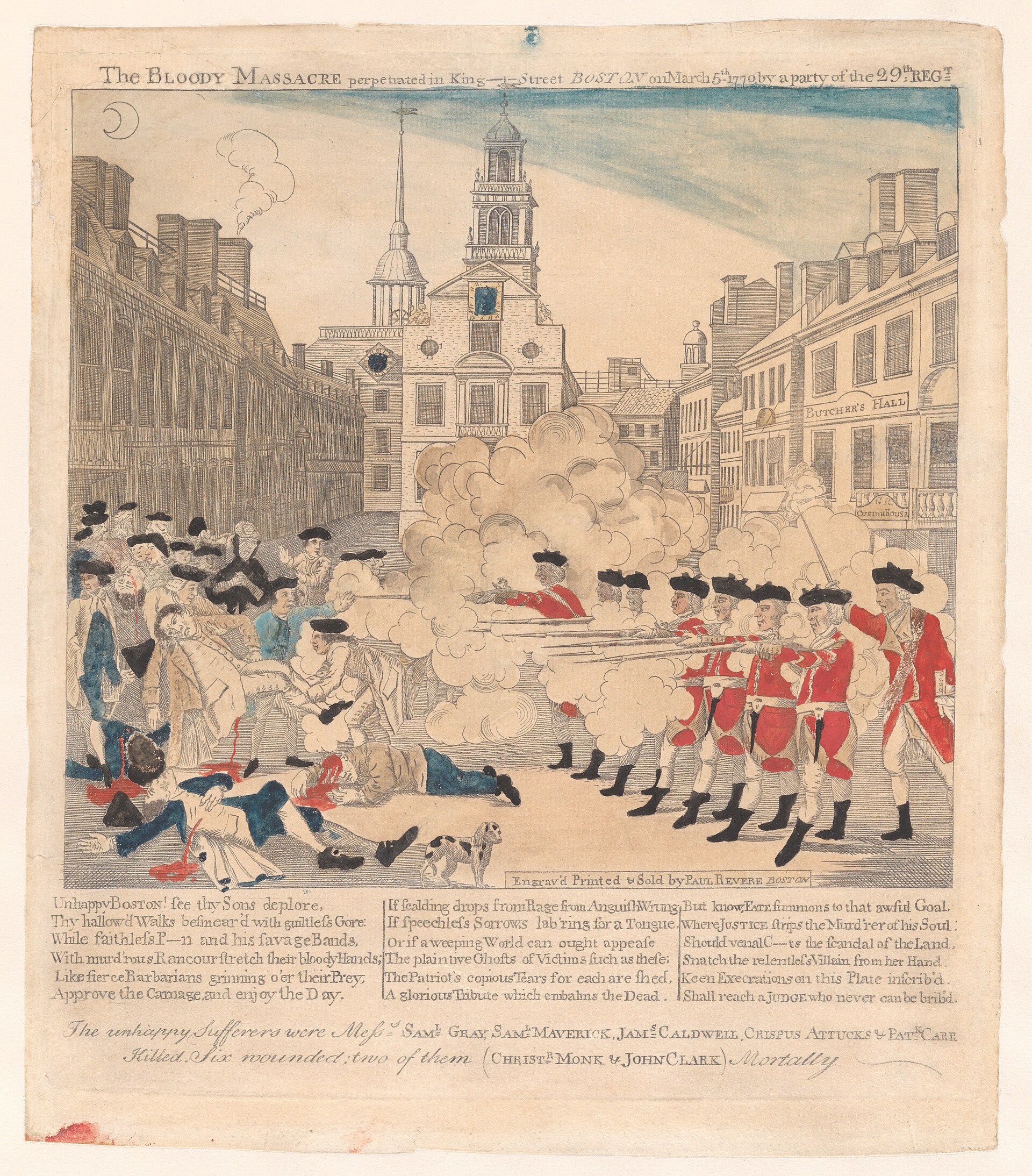
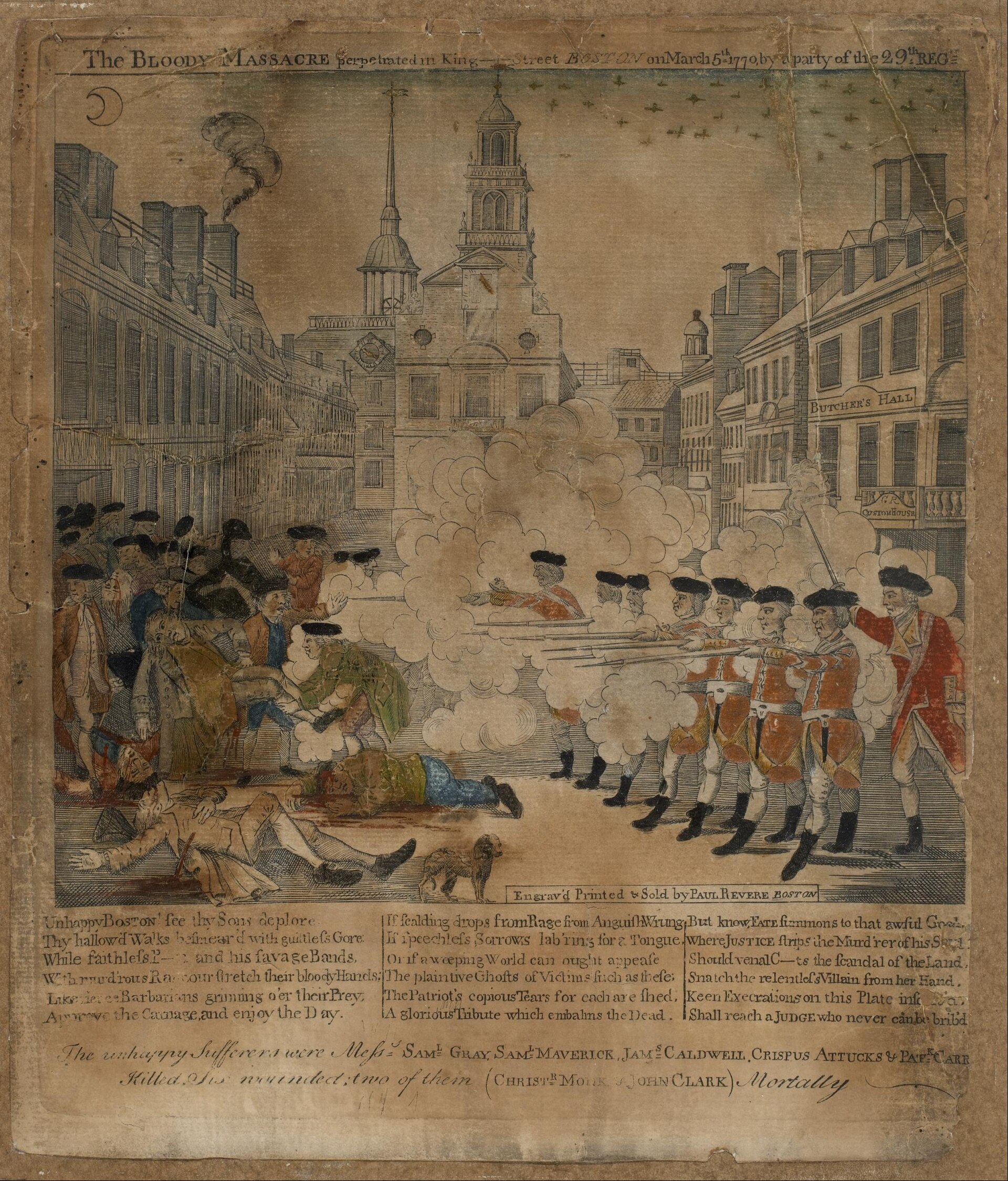
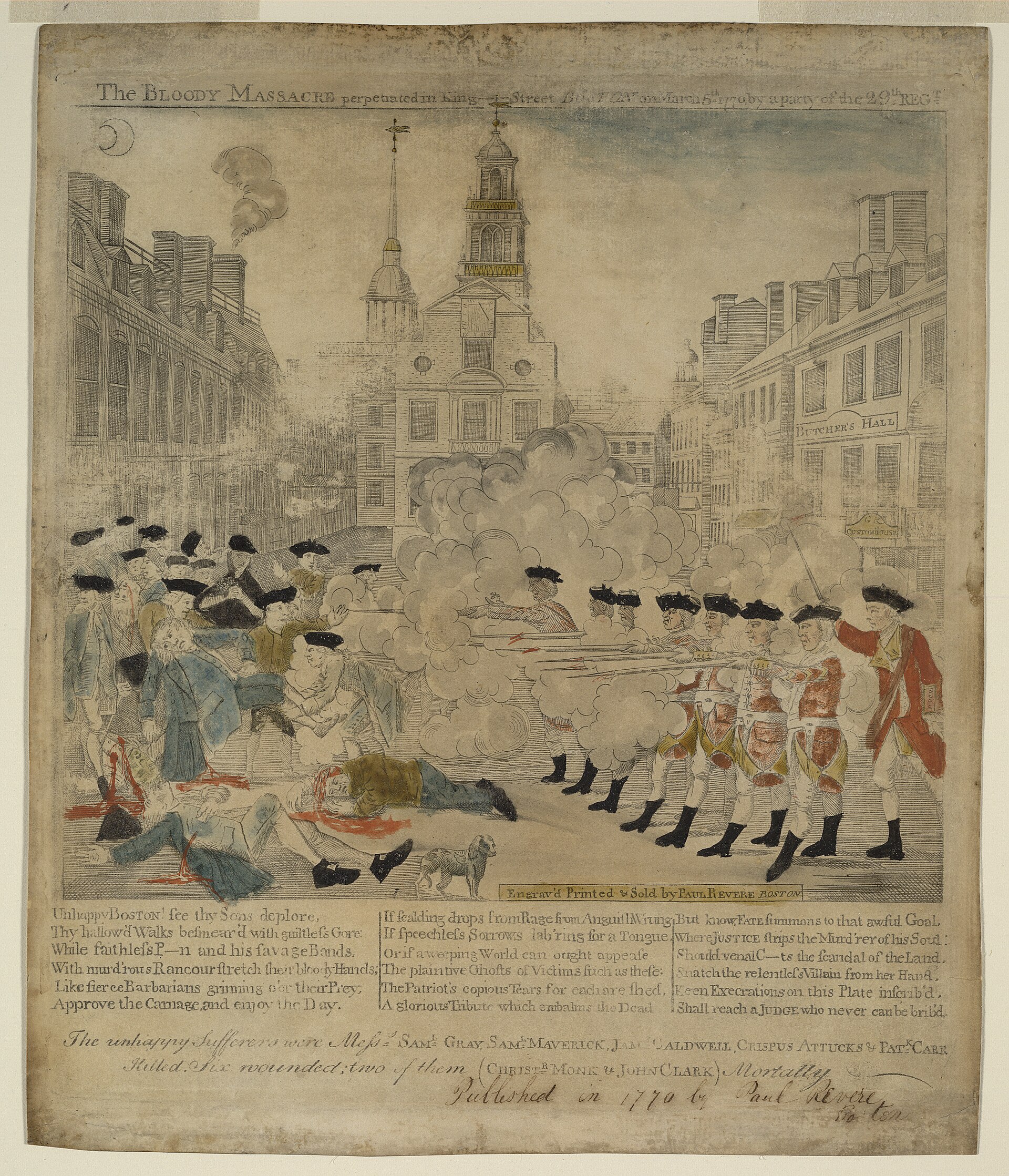
The record in full
Chapter 1One sheet in Washington, and the other impressions it must not be confused with
This record describes a single physical object: the impression held by the National Gallery of Art in Washington under accession number 1943.3.9042 (the gallery's object number 11550), Rosenwald...
This record describes a single physical object: the impression held by the National Gallery of Art in Washington under accession number 1943.3.9042 (the gallery's object number 11550), Rosenwald Collection. The gallery catalogues it as The Boston Massacre, by Paul Revere after Henry Pelham, dated 1770, engraving with hand coloring on laid paper. Its published measurements are 20 x 21.91 cm for the image and 27.31 x 23.81 cm for the sheet, and its record notes a watermark that it transcribes only as W. The gallery's own open-access photograph, 5261 x 6068 pixels, is the lead plate of this record.
The choice of one sheet is deliberate. Revere's engraving survives in dozens of impressions, and much of what is printed about the Boston Massacre print runs together the design, two states of Revere's plate, Henry Pelham's different plate, a Newburyport copy, London copies, a Boston facsimile of 1832, restrikes taken from the old copper in the nineteenth century and a re-engraving of 1908. The Metropolitan Museum's catalogue of the Middendorf collection (1967), which cites Clarence Brigham's Paul Revere's Engravings of 1954, reports one surviving impression of the first state of Revere's plate and at least thirty-nine of the second. The Library of Congress notes that Brigham could locate only two impressions of Pelham's own print.
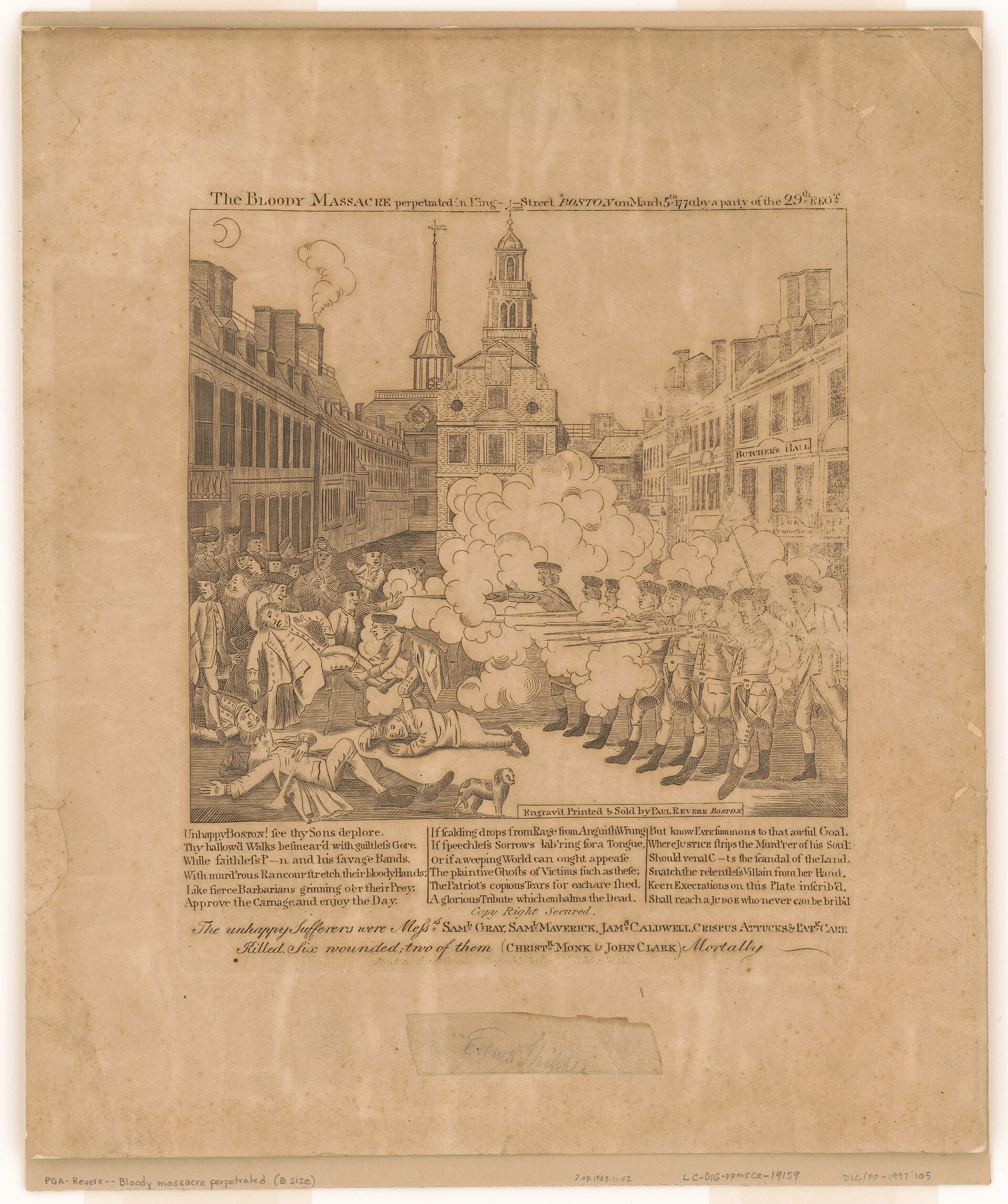
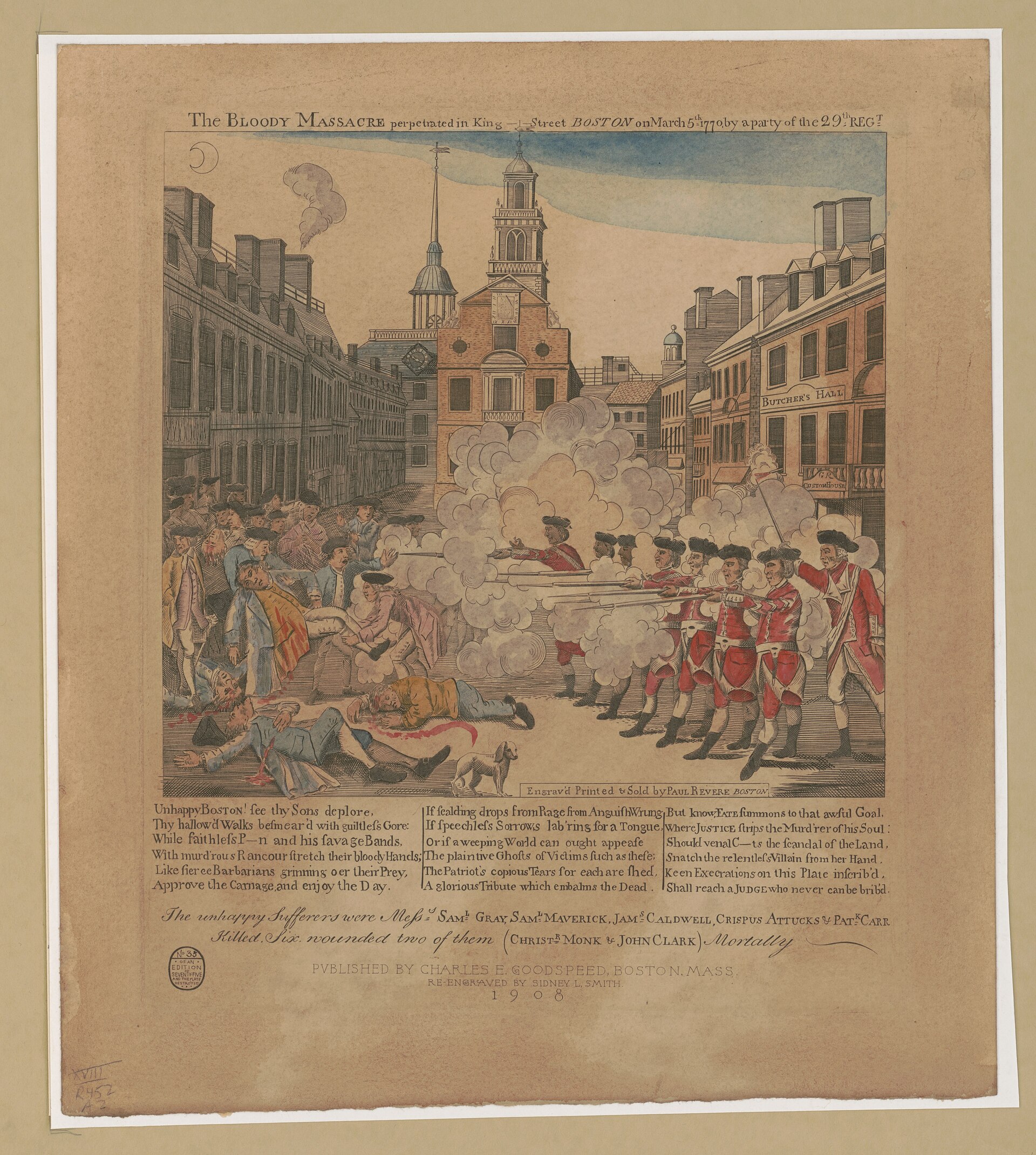
Where a statement below belongs to the design it is made of the print; where it belongs to a sheet the sheet is named. Every other picture in the plate list of this record is a different object and is captioned as one, including the Metropolitan Museum's second-state impression, the Houston and Library of Congress hand-colored sheets, the Library of Congress restrike and Pelham's print in the New York Public Library.
Chapter 2What the sheet shows, and how it is lettered
The picture is a street scene in King Street, Boston, now State Street.
The picture is a street scene in King Street, Boston, now State Street. The Library of Congress catalogue describes it as a row of seven uniformed soldiers on the right firing into a crowd at the left on the signal of an officer, with three men lying bleeding in the street and two others lifted by the crowd. The National Gallery's own description of its sheet adds that an eighth man behind the line raises a sword, that a small brown dog stands by one of the dead near the foot of the composition, that the sky is tinted blue along the top and that a crescent moon sits in the upper left corner. Behind the soldiers is the Royal Custom House, which in the Library of Congress's words bears the sign Butcher's Hall; the First Church and the Town House close the view. On the sheet in Washington the coats and the blood are red and the townspeople wear blue and brick-red clothes.
Above the picture runs a title line which, read on the gallery's high-resolution image, says: The BLOODY MASSACRE perpetrated in King-Street BOSTON on March 5th 1770 by a party of the 29th REGt. At the lower right, inside the image, is the imprint Engrav'd Printed & Sold by Paul Revere BOSTON. The gallery's data transcribes the verb as perpetuated and, in one field, calls the title The Boston Massacre; the sheet itself reads perpetrated, which is also what the Library of Congress, the Middendorf catalogue and William Loring Andrews (1901) give.
Below the picture are eighteen lines of verse in three columns. William Loring Andrews transcribes them in 1901 as beginning Unhappy BOSTON! see thy Sons deplore, Thy hallow'd Walks besmear'd with guiltless Gore and ending Keen Execrations on this Plate inscrib'd, Shall reach a JUDGE who never can be brib'd. The verse names no one in full: it speaks of faithless P--n and of venal C--ts. Read in context these are Preston and the courts, but no source fetched for this record glosses them. Beneath the verse, in a flowing script, comes the list of the dead and wounded: Samuel Gray, Samuel Maverick, James Caldwell, Crispus Attucks and Patrick Carr killed, and six wounded, two of them mortally, Christopher Monk and John Clark. Elbridge Goss (1891) says the verse was written by Revere; Charles Gettemy (1905) says it was presumably Revere's. No fetched source documents the authorship.
Chapter 3Where the print and the testimony part company
The print reached the street about three weeks after the shooting and it was made to persuade.
The print reached the street about three weeks after the shooting and it was made to persuade. The Boston Athenaeum's entry (Tom Gearty, 2006) says it was designed to turn a tragic incident into a politically driven calamity, and the Massachusetts Historical Society, which holds an impression, says in plain terms that the scene is historically inaccurate. The departures are specific.
Preston and the order to fire. The Athenaeum notes that both Revere's and Pelham's prints show Captain Thomas Preston ordering his men to fire. The National Gallery's description of its sheet shows an officer behind the line with a raised sword. At Preston's trial, the National Park Service article reports, the testimony that saved him came from several witnesses who swore they had seen him standing in front of the soldiers when they fired, among them the free Black man Newton Prince, who said he heard no order to fire; the jury acquitted Preston on 30 October 1770. Wikipedia, summarising the same trial record, says Preston gave no order and that the shots were a ragged series and not a volley.
The volley and the crowd. The Massachusetts Historical Society says there was no organised military action of the kind drawn and that the civilians were an unruly crowd of about sixty; Wikipedia gives an estimate of between 300 and 400 for the crowd at its largest. Estimates differ between accounts, and the record does not choose between them. The Athenaeum describes the print as showing an unarmed group of slightly more than twenty citizens shot at close range by seven soldiers.
The sign. Butcher's Hall on the Custom House is part of the Revere plate. The Library of Congress suggests it is perhaps a sardonic comment; the Athenaeum says Revere added the name to make his own opinion plain. The Middendorf catalogue, listing the differences between Revere's and Pelham's prints, names the number of columns on the First Church cupola, the direction of the crescent moons and the inscriptions, and does not mention the sign.
The light. The Town's own pamphlet, A Short Narrative of the Horrid Massacre, prints depositions that call the evening moonlit, so a moon is not an invention; the engraved crescent is in the plate, while the National Gallery's description says the sky of its sheet is tinted blue, which describes the hand colouring. The Boston Massacre Historical Society's website, a tertiary and unsourced page, adds that the print shows no snow or ice.
Crispus Attucks. The Athenaeum says no contemporary print shows Attucks, who it describes as of African and Native American descent, as a person of colour, and that the earliest known depiction of him as such is an 1855 drawing by William L. Champney, made into a chromolithograph. Wikipedia says that some copies of the Revere print show a man with two chest wounds and a somewhat darker face matching descriptions of Attucks while others do not. The two statements conflict and the record does not arbitrate; it notes only that the colour on these sheets was applied by hand and varies from sheet to sheet.
Chapter 4Seven months between the print and the verdicts
The facts the print answers can be given briefly.
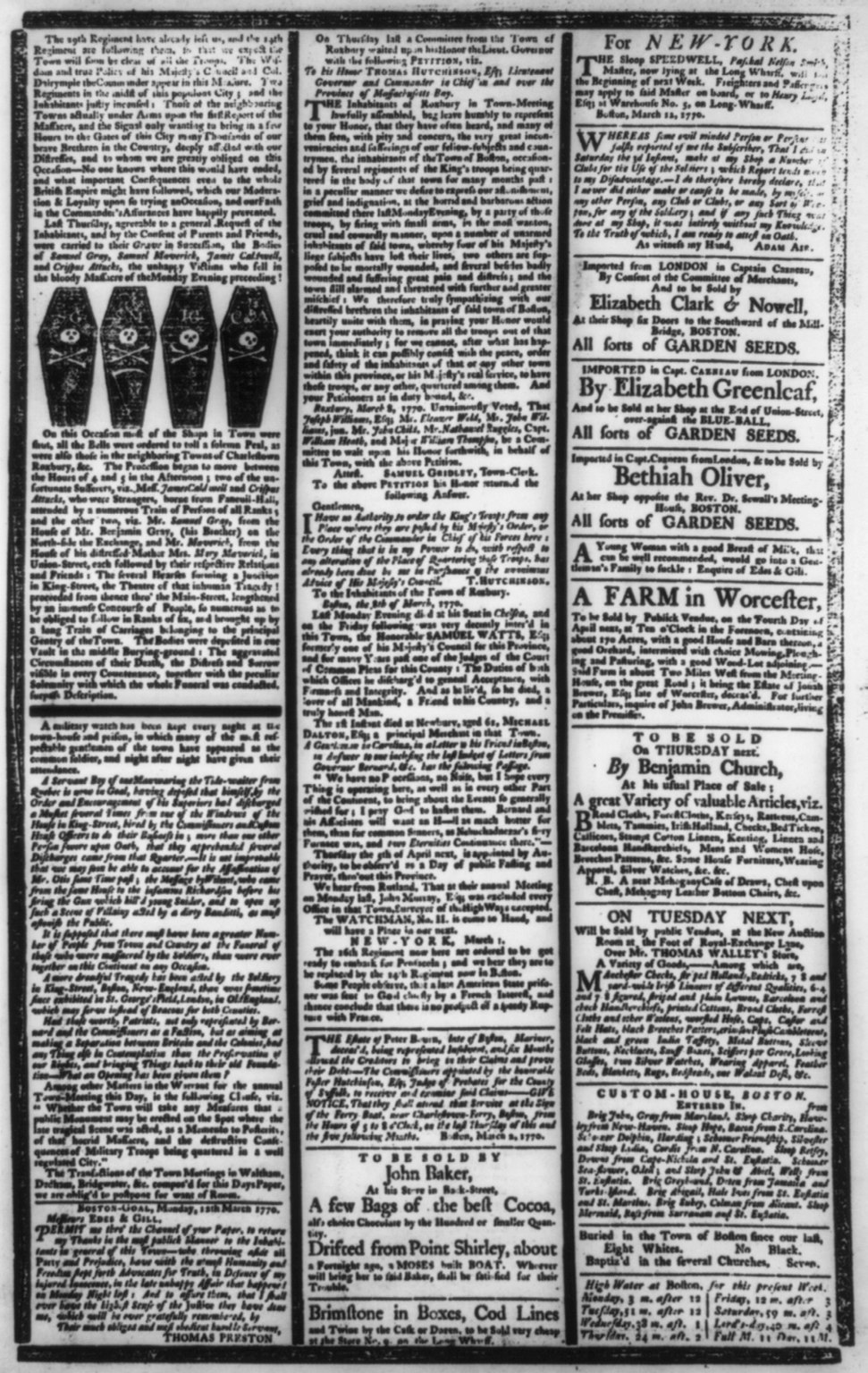
The facts the print answers can be given briefly. On the evening of 5 March 1770 a crowd gathered around a sentry at the Custom House in King Street. According to the Massachusetts Historical Society, Captain Thomas Preston led seven soldiers of the 29th Regiment to reinforce him; shots were fired; three civilians were killed and two more mortally wounded; and within hours Preston and his men were in jail. The Town of Boston prepared a narrative with depositions, which Edes and Gill printed. The Boston Gazette of 26 March 1770 apologises to customers whose advertisements are left out that week because the printers' whole time had been taken up with printing the Narrative and Depositions of the late horrid Massacre, to go by express to England.
John Adams, Josiah Quincy and Robert Auchmuty defended Preston, the National Park Service records, with Robert Treat Paine and Samuel Quincy prosecuting. Preston's trial opened on 24 October 1770 and ended in acquittal on 30 October. The soldiers were tried from 27 November; six were acquitted and two, Hugh Montgomery and Matthew Kilroy, were found guilty of manslaughter and branded on the thumb. In his closing speech, the NPS article reports, Adams told the jury that facts are stubborn things. Adams remarked in 1786, the same article says, that the massacre had laid the foundation of American independence.
The last six lines of the verse engraved under the print warn that venal courts might snatch the relentless villain from justice and promise that execrations on this plate will reach a judge who cannot be bribed. The print had been on sale for seven months when Preston was acquitted. Nothing fetched for this record shows how any buyer read the verdict against the verse.
Chapter 5Pelham drew it and Revere published first
Henry Pelham (1748/9 to 1806) was the son of the Boston engraver Peter Pelham and the half-brother of the painter John Singleton Copley.
Henry Pelham (1748/9 to 1806) was the son of the Boston engraver Peter Pelham and the half-brother of the painter John Singleton Copley. On the morning of Thursday 29 March 1770 he wrote to Paul Revere. The letter is printed in the Massachusetts Historical Society's 1914 volume of Copley-Pelham letters: When I heard that you was cutting a plate of the late Murder. I thought it impossible, as I knew you was not capable of doing it unless you coppied it from mine. Pelham says he had thought he had entrusted it to a person with more regard for honour and justice than to take such an advantage, that he had gone to the great trouble and expense of making a design and paying for paper and printing, and that he found himself deprived of any advantage as truly as if you had plundered me on the highway. A postscript says he is sending back by the bearer the prints he had borrowed of Revere and that his mother wants the hinges and part of the press that Revere had from her returned.
The letter's own history is unsettled. The Middendorf catalogue says the letter is in the Public Record Office in London. Gettemy (1905) reports that Paul Leicester Ford found it there in a bundle labelled America and the West Indies, 449, and observes that either the letter was never sent or the London text is a copy Pelham kept. The Boston Athenaeum says it is not known whether he sent it. No reply from Revere is recorded in anything fetched for this record.
The sequence of publication is better documented than the quarrel. Revere's print was on sale about three weeks after the shooting: the Athenaeum says Revere advertised it on 26 March and the Library of Congress says it appeared on or about 28 March. The Boston Gazette of 26 March carries a notice that Edes and Gill have for sale, price eight pence lawful money, a print of the late horrid Massacre in King-Street; it does not name the maker, and the attribution of that notice to Revere's print rests on the Athenaeum and the Middendorf catalogue. On 2 April the Gazette carries a second notice, by Edes and Gill and by T. and J. Fleet, of The Fruits of Arbitrary Power, an Original Print of the massacre taken from the Spot, price eight pence. That is Pelham's title. His printing bill survives in the same volume of letters: Daniel Rea Junior charged him for printing 575 prints and for paper, and the volume's editor adds that these were probably Pelham's prints of the massacre. On 1 May Pelham sent two of his prints to his brother Charles.
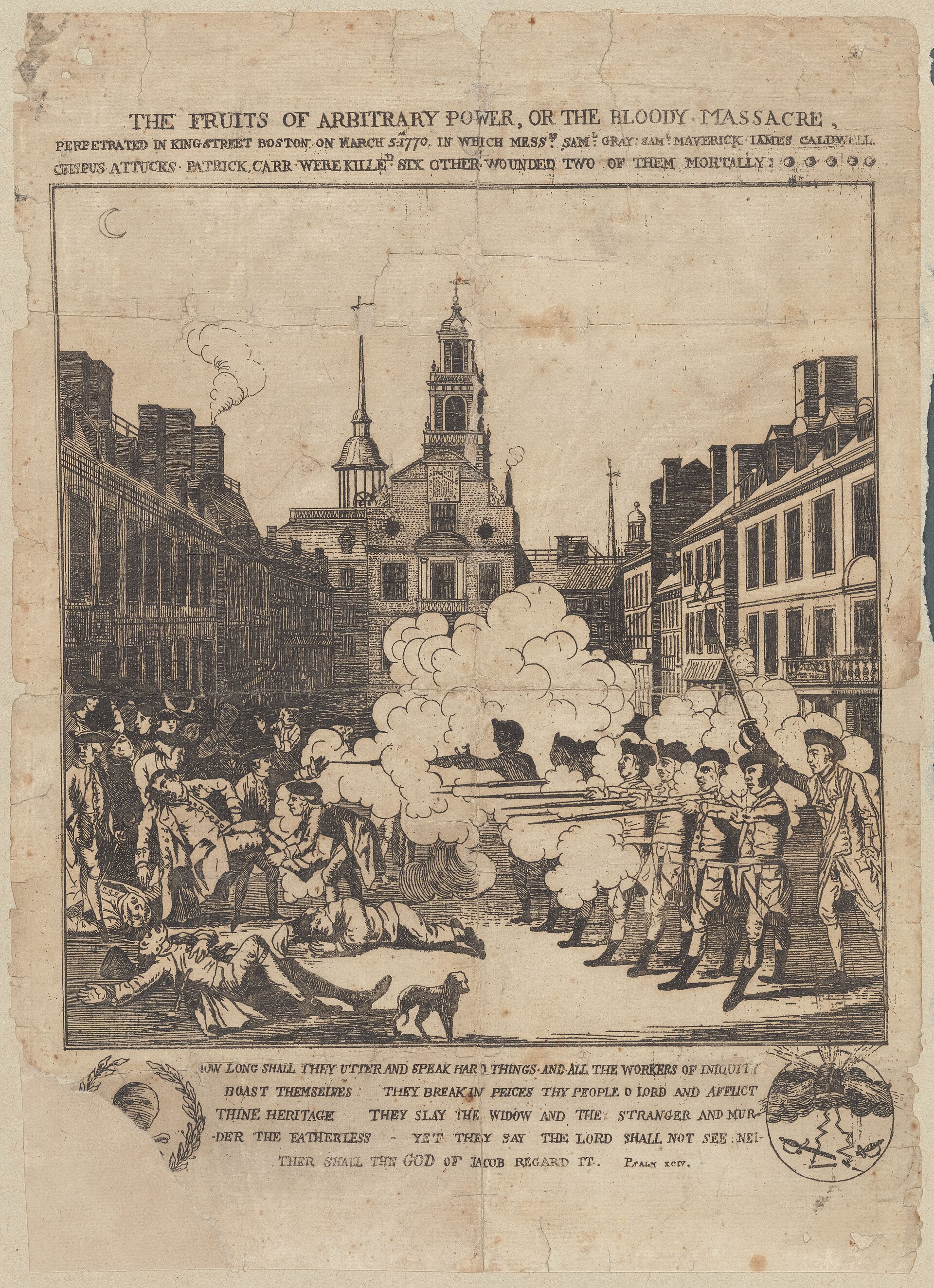
The two prints are close. The Middendorf catalogue calls Pelham's the more competently engraved and says the differences are the number of columns on the First Church cupola, the direction of the crescent moons and the inscriptions. Pelham's title runs across the top of his plate and includes the names of the dead; he adds Psalm 94 text at the foot, as the New York Public Library's impression shows. Revere's imprint says Engrav'd Printed & Sold and names no designer. The National Gallery catalogues its sheet as Revere after Pelham and the Library of Congress says Revere copied a design by Pelham, so both institutions credit the design to Pelham. Andrews (1901) declined to say whether Revere's Massacre came from his own design, from Christian Remick or from Pelham, calling it a knotty point, and Henry Cunningham in 1904 doubted that Revere was an artist at all, a judgment Gettemy repeats. Pelham, a loyalist, left Boston for London in August 1776, Wikipedia records.
Chapter 6Copper, press and price
Revere came to engraving through the silver shop.
Revere came to engraving through the silver shop. Goss (1891) calls him entirely self-taught on copper plate and says the practice of ornamenting silverware led him to it; Andrews (1901) says the same in other words. The plate of the Massacre was therefore cut by a goldsmith's hand on a copper sheet, and the physical evidence about that sheet is late. Andrews writes, in words he qualifies with I am informed, that the copper plate of the Boston Massacre, minus the inscriptions, carries on its back engravings of three Massachusetts Bay money denominations of ten, twelve and eighteen shillings and is in the possession of the Commonwealth, presented by the Revere family at the time of the Centennial of Lexington and Concord. He adds that about then someone obtained temporary possession of the plate and had impressions taken before the authorities recalled it and, it was announced, scratched it. For the engraving on the backs of Revere's plates in general he names as his informant John Woodbury of Boston, to whom the plates were shown by the Secretary of State. Where Revere bought the copper in 1770 is not recorded in any source fetched for this record.
The price of the print is documented. Edes and Gill's notices of 26 March and 2 April both give eight pence; the first says lawful money. On the rate Wikipedia gives for the Massachusetts pound, six shillings to the Spanish dollar, a rate it places in the colony's early paper-money period and not specifically in 1770, eight pence is one ninth of a dollar. Revere's Day Book gives a second set of figures, and the readings conflict. Goss, who reproduced the page in 1891, says the Day Book carries an entry dated 9 March 1770 to Messrs. Edes and Gill for engraving five coffins for the massacre and for printing impressions of it, which Andrews and the Middendorf catalogue both read as 200, made to illustrate the Gazette's account of 12 March, and that a paper pattern of a coffin is pinned to the page. Andrews, reading the same page in Goss's facsimile, gives five pounds sterling for the 200 impressions and six shillings for the five coffins, and takes the entry as the printing of the Massacre plate itself, which would mean Revere needed only four days. The Middendorf catalogue places a charge of five pounds to Edes and Gill for printing 200 impressions of the Massacre two days after the notice of 26 March, which is 28 March. A second wording of what looks like one entry cannot be resolved without the Day Book at the Massachusetts Historical Society, and the record leaves it open.
Other figures give scale. Gettemy says Revere charged Edes and Gill two pounds eight shillings for the engraving in their almanac. The Paul Revere House says the two surviving daybooks record the making of over 5,000 silver objects and almost 24,000 prints. If five pounds bought 200 impressions the printing alone cost six pence each, against the eight pence at which the print was sold, but the currency of the Middendorf figure is not stated and the plate, the paper and the colour are not in it. No sourced figure for a Boston day's wage in 1770 was found, so the print is priced here only against the dollar.
Chapter 7Two states, one of them unique
Revere altered his plate. The Middendorf catalogue, drawing on research by Wendy Shadwell, describes a first state, called the eight o'clock state, in which the hands of the clock stand at about ten...
Revere altered his plate. The Middendorf catalogue, drawing on research by Wendy Shadwell, describes a first state, called the eight o'clock state, in which the hands of the clock stand at about ten past eight, and a second, the ten o'clock state, in which Revere moved them to 10.20, apparently for historical accuracy since the shooting happened after ten. In the second state he also corrected two spelling mistakes in the verse and put parentheses around the names of the two mortally wounded.
The catalogue identifies the impression in the Middendorf collection as the only known example of the first state and traces it to the dealer Rosenbach in 1913. It says the first recorded impression of that state belonged to Francis Lebaron Goodwin, a surgeon's mate in the Revolution, in whose family it stayed for 125 years, and that the print appeared in a Burnham catalogue of 1902, in the Anderson auction of 11 April 1905, in a George D. Smith catalogue of 1908 and in a Rosenbach catalogue of March 1913, probably the same sheet; it adds the owners Mrs. Alexander Hamilton Rice and Dr. Alexander Hamilton Rice of New York and the Kennedy Galleries in 1956. At least thirty-nine impressions of the second state had been located by 1967.
The National Gallery's catalogue entry does not give a state. On the gallery's own image the sheet shows parentheses around Christ. Monk and John Clark in the script line, and the verse reads their Prey and speechless Sorrows, which are the corrected spellings the catalogue ties to the second state. On that evidence this is a second-state impression; the clock hands the catalogue uses as its first test could not be read from the images used, and no source records the gallery's own reading of the state. Almost every surviving sheet is a second state. The Metropolitan Museum's own record for its impression 10.125.103 says second state outright.
Chapter 8The colour is a later hand
Every impression Andrews had seen in 1901 was coloured by hand apart from the one printed into a broadside, and he found red and blue predominant with occasional washes of brown or green.
Every impression Andrews had seen in 1901 was coloured by hand apart from the one printed into a broadside, and he found red and blue predominant with occasional washes of brown or green. The gallery records hand coloring on its sheet, the Massachusetts Historical Society's impression is hand-colored, and the Library of Congress catalogues its sheet as engraving with watercolor. The line engraving was therefore finished by a second operation, done sheet by sheet, and the colour is a separate act from the engraving.
Who coloured Revere's impressions is not settled. Wikipedia says the artist Christian Remick hand-colored some prints and cites page 24 of David Hackett Fischer's Paul Revere's Ride; the Boston Massacre Historical Society's website says Revere employed Remick to colour the print. Neither claim could be checked against its source for this record. What is documented about Remick is narrower. The 1918 Bayley and Goodspeed edition of Dunlap says that three coloured copies it had seen of a 1768 view of British troops landing at Boston are signed Coloured by Christian Remick, that Revere's engraving of the landing is the reverse of that view and was made after an unknown artist, and that Cunningham's 1904 paper suggested Remick had drawn the original. The same entry quotes Remick's advertisement of 16 October 1769 in the Massachusetts Gazette and Boston Post-Boy, in which he does all sorts of drawing in water colours and colours Pictures to the Life. No fetched source puts Remick's brush on a Bloody Massacre impression, and because the colour varies between sheets no single hand can be assigned to the Washington sheet.
Chapter 9A print that organised an anniversary
The print was not the only means by which Revere and the town kept 5 March alive.
The print was not the only means by which Revere and the town kept 5 March alive. The Boston Gazette of 11 March 1771 reports a striking exhibition at the house of Mr. Paul Revere, fronting the Old North Square, on the anniversary. In one chamber window was the ghost of the young Christopher Seider with a finger in his wound and a monument bearing the names of those killed on 5 March, with the lines that Seider's pale ghost fresh bleeding stands and demands vengeance. In the next window, the Gazette says, the soldiers were drawn up firing at the people assembled before them, the dead on the ground and the wounded falling with blood running in streams, over which was written Foul Play. In a third window a woman representing America sat on a tree stump with a foot on the head of a prostrate grenadier. The Gazette says the spectators, many thousands, were struck into a solemn silence, and that the bells tolled until ten.
The Massachusetts Historical Society says that commemorative orations were delivered in Boston every year through 1784. Andrews lists thirteen orators from Thomas Young to Thomas Welsh and shows the title page of Benjamin Church's oration of 5 March 1773, which sets out to commemorate the bloody tragedy of the fifth of March 1770. Peter Thacher's oration at Watertown on 5 March 1776, printed by Benjamin Edes, is titled To commemorate the bloody massacre at Boston. The wording that Revere's title gave the event, a bloody massacre, was in circulation when those orations were printed. The Boston Massacre Historical Society's site says the event was not called the Boston Massacre until 1773; that claim is unsourced and is not relied on.
The word also had a London precedent. Wikipedia's article on the shooting of Wilkes's supporters at St George's Fields on 10 May 1768 carries the same word in its title, the Metropolitan Museum catalogues a bound set of political pamphlets of 1768 to 1770 titled Massacre in St. George's Field and Boston, and Goss describes Revere's silver bowl for the Massachusetts ninety-two as engraved with No. 45 Wilkes and Liberty. Whether Pelham or Revere had the London usage in mind is not known.
Chapter 10Copies, restrikes and facsimiles: the cohort around this sheet
Pelham's plate is a different object. It carries his title, which names the dead, and Psalm 94 text between two small emblems at the foot, as the New York Public Library's impression, whose digital...
Pelham's plate is a different object. It carries his title, which names the dead, and Psalm 94 text between two small emblems at the foot, as the New York Public Library's impression, whose digital image is on Commons, shows. Edes and Gill and the Fleets advertised it on 2 April 1770 at eight pence.
London copies. Andrews describes a copy of the Massacre prefixed to W. Bingley's London reprint of the Short Narrative, headed The Fruits of Arbitrary Power; or the Bloody Massacre, with the Psalm 94 texts added and priced at sixpence; Goss and Gettemy say the Bostonian Society holds a copy and that the London versions ran to three editions. Edes and Gill's own Boston edition of the Short Narrative carries a much smaller engraving of the scene, about 4.25 by 6.75 inches, which Andrews thought not improbably Revere's handiwork but could not identify; the Metropolitan Museum credits its copy's illustrations to Paul Revere Jr.
Newburyport. Jonathan Mulliken (1746 to 1782), a Newburyport clockmaker known for engraved brass clock dials, copied Revere's ten o'clock version; his signature reads Jon: Mulliken Newbury Port Sculpt and his title uses ye. The Middendorf catalogue calls it his only print, thinks it probably issued in Newburyport in 1770 and says Brigham knew seven copies. Andrews, by hearsay, reports a Newburyport reprint of about 1830 with the name Revere taken out and Millikin put in, and the sources do not reconcile the two dates.
The 1832 facsimile. Andrews describes a Boston reprint lettered Copy Right Secured, Boston (Fac-Simile) Republished at 15 Water Street, 1832, so faithful that hand-coloured copies are suspected, he says, only because their condition is too clean. He concluded that a coloured copy he owned and an uncoloured copy in the Lenox Library, whose lettering had a line erased that appeared to bear the date 1832, were this edition offered as originals. The Metropolitan Museum holds two such 1832 facsimiles, one plain and one hand-colored, which it attributes to William F. Stratton; no fetched source ties Stratton to the Water Street imprint. Andrews also records a print without the dog, probably the frontispiece of a third London reprint, and later reprints by Doggett (1849), Kidder (1870) and a process plate of 1882.
Restrikes. Andrews reports rumours that only ten or twelve impressions were taken from the old plates of the Massacre and of the Landing of the Troops at about the Centennial. He notes that the Bostonian Society's impressions are on old Whatman laid paper with a watermark of a crowned fleur-de-lis and letters, which would suggest a date before 1800, but thinks it likelier that a later printer used old account-book paper, says he cannot tell whether before or after the Centennial, and adds that the Massacre plate has been unskilfully retouched, apparently by another hand. The Library of Congress catalogues one sheet as printed by Paul Revere, [1770, printed later], under the heading Restrikes. Sidney L. Smith's re-engraving, published by Charles E. Goodspeed in 1908, is a copy and not a restrike. The Champney and Bufford chromolithograph of 1856 is a reinterpretation.
Market. In 1901 Andrews counted about a baker's dozen of impressions in public and private hands and recorded that a coloured sheet from the library of Frederick W. French, with a family note of 1872 on the back, sold at the sale of French's library in April 1901 for $800, against a private sale of $300 and a Philadelphia sale of $350 two or three years earlier. No hammer and premium were then separated and the auction house is not named in Andrews. No later sale record was verified for this record.
Chapter 11The Washington sheet and what is not known about it
The National Gallery's provenance text for this sheet reads: Lessing Julius Rosenwald, Jenkintown, Pennsylvania; acquired 1943 by the National Gallery of Art.
The National Gallery's provenance text for this sheet reads: Lessing Julius Rosenwald, Jenkintown, Pennsylvania; acquired 1943 by the National Gallery of Art. Rosenwald, Wikipedia records, was the son of the Sears, Roebuck executive Julius Rosenwald, became a full-time collector of rare books and art in 1939 and in 1943 pledged his collections; some 27,000 prints and drawings went to the National Gallery. The credit line is Rosenwald Collection and the accession number carries the 1943 year.
What is not known is how the sheet reached Rosenwald and who held it before. No owner between 1770 and Rosenwald is recorded in the gallery data. The date of printing is also open. The gallery dates the sheet 1770 and records a watermark it transcribes as W; Andrews notes that later restrikes were pulled on old paper with watermarks, and no fetched source separates a 1770 printing from a later one off the same plate for this sheet. The gallery's bibliography for the sheet is plate 14 of the 1969 Atheneum reprint of Brigham, and its exhibition history lists the Graphic Survey Show at the gallery in 1986 and 1987 and a 2016-2017 touring exhibition of three centuries of American prints (Prague, Mexico City, Dallas). The open data lists no gallery location, and the record was last modified on 2026-09-21.
Chapter 12A copyright quarrel with no copyright
Pelham's complaint of 1770 is written in the language of honour, not of law, and the sources explain why.
Pelham's complaint of 1770 is written in the language of honour, not of law, and the sources explain why. Wikipedia's history of United States copyright says the British Statute of Anne did not apply in the American colonies and that no general copyright act was passed in the colonies before 1783. In Britain engravings had been protected by Hogarth's Act, passed in 1735 on the prompting of William Hogarth, which, Wikipedia says, at first protected only engravings of original designs and was soon extended to all. None of the sources fetched says that the Act was invoked, or could have been, in Massachusetts in 1770.
The record therefore has a dispute over priority and credit with no recorded legal remedy. Pelham's complaint rests on a design he says he made at his own expense and entrusted to Revere, on prints he printed and paid for, and on being beaten to the market by about a week. Revere's print carries no designer's credit, which Gettemy calls a serious charge against Revere's honor and Andrews treats as an open question. Neither Pelham nor the printers who sold both prints at the same price, Edes and Gill, are recorded as acting on the matter.
Chapter 13How a disputed picture became the picture
The print's authority as an image of the event outlasted the argument about it.
The print's authority as an image of the event outlasted the argument about it. The National Park Service article on the trial illustrates its account with the Revere print and sets beside it the point that witness testimony suggests Preston stood in front of his soldiers, unlike what the engraving shows. The Massachusetts Historical Society describes it as well known and historically inaccurate and uses it as a teaching document. The Library of Congress's records note its impressions shown in Creating the United States (2008-2009) and, for the hand-colored sheet, in a 2014-2015 exhibition on the Civil Rights Act of 1964. The Paul Revere House sells an 11 x 13 inch reproduction for ten dollars and says Pelham created the original artwork. The National Gallery's own impression was shown in 1986-87 and again in 2016-17. The Boston Athenaeum's entry reads the print as showing how Revere combined business sense with patriotic zeal.
What the documents of 1770 and 1771 show is two near-identical prints from two hands within a week, eight pence apiece, a seven-month wait for verdicts and an anniversary exhibition in Revere's windows. Nothing fetched suggests a meaning in the plate beyond the evident one: an argument that soldiers had murdered and that the courts could not be trusted to say so. The lettering, the verse and the added sign were chosen to carry that argument, by a craftsman who made his living from silver and had produced political prints, Wikipedia says, since 1765.
The artist
Paul Revere (born Boston, 21 December 1734 Old Style, 1 January 1735 New Style; died Boston, 10 May 1818)
Revere was a Boston goldsmith and silversmith who taught himself to engrave on copper and sold political prints from his house in the North End. For this print the relevant Revere is a tradesman of thirty-five in March 1770, with a press and a customer in the printers Edes and Gill, and within five years one of the mechanics watching the British soldiers. What he is not, on the evidence, is the designer of the picture that carries his imprint.
Related works
| Work | Relation | Where it is |
|---|---|---|
| The Fruits of Arbitrary Power, or The Bloody Massacre Henry Pelham | Pelham's own print of the same scene, advertised 2 April 1770; the design Revere is said to have copied A different plate with a different title and Psalm 94 text. Pelham's letter to Revere of 29 March 1770 is printed in the Massachusetts Historical Society's 1914 Copley-Pelham volume. | New York Public Library (Print Collection, Gift of Mr. and Mrs. Edwin Merrill); Brigham located only two impressions, per the Library of Congress |
| The Bloody Massacre perpetrated in King Street, first state (the eight o'clock state) Paul Revere | The earlier state of the same plate The Middendorf catalogue calls it the only known first-state impression. | Middendorf collection in 1967; present owner not verified |
| The Boston Massacre, second state (accession 10.125.103) Paul Revere Jr. | Another impression of the same plate, hand-colored The Metropolitan Museum's record says second state; image 26 x 23.2 cm. | The Metropolitan Museum of Art, New York (Gift of Mrs. Russell Sage, 1910) |
| The Bloody Massacre (Newburyport copy) Jonathan Mulliken | A copy of Revere's ten o'clock version, signed Jon: Mulliken Newbury Port Sculpt Mulliken was a clockmaker who engraved brass dials; this was his only print. | Middendorf collection in 1967; Brigham knew seven copies |
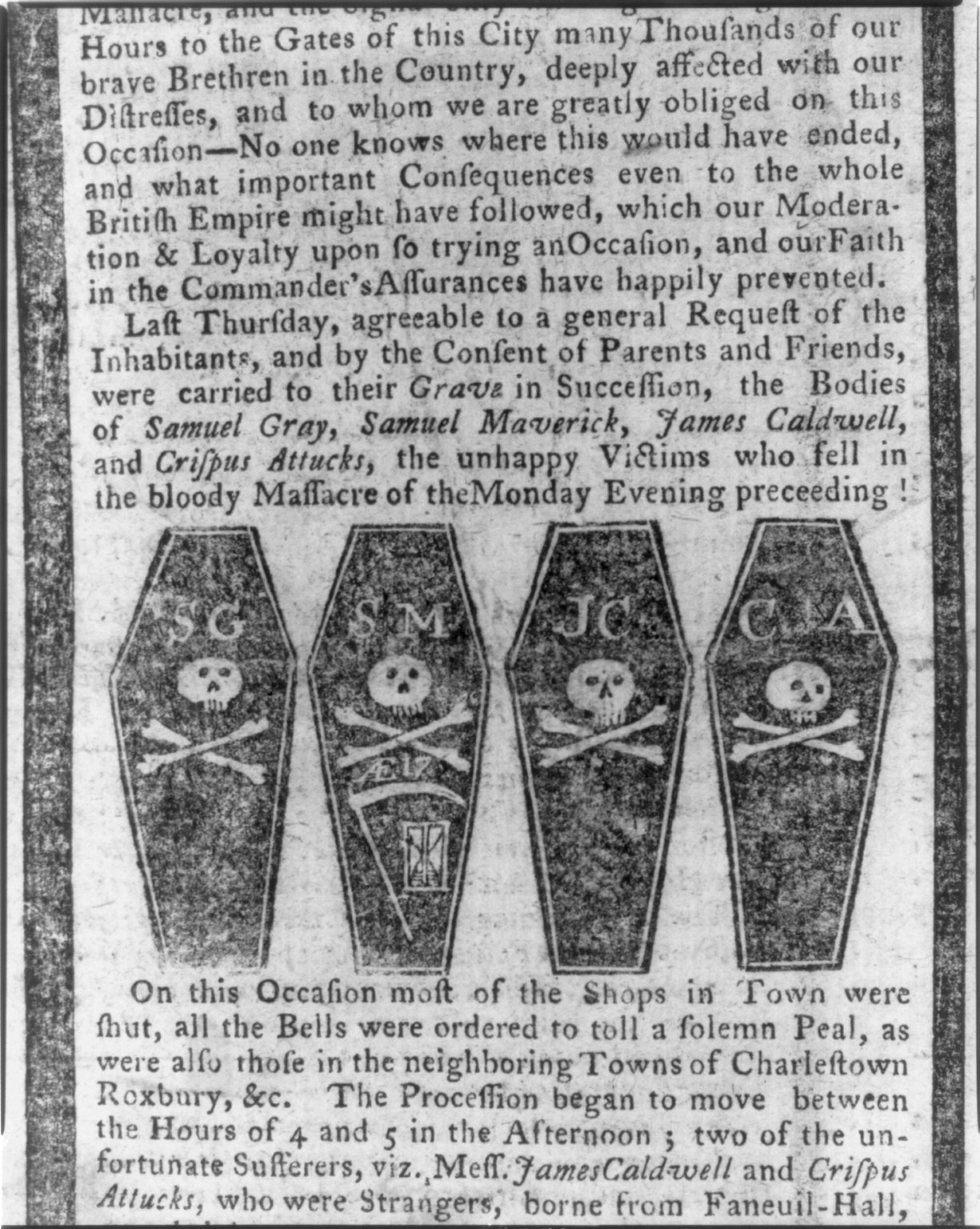
| Four coffins in the Boston Gazette, 12 March 1770 Paul Revere (Gettemy); Revere is credited as engraver by the Library of Congress | The first Revere image of the massacre, cut for Edes and Gill's newspaper account a week after the shooting Not the Massacre print. The Day Book entry that Goss dates 9 March 1770 charges for five coffins. | Library of Congress (LCCN 2004672647) |
| A Short Narrative of the Horrid Massacre in Boston (Boston and London editions, 1770) Printed by Edes and Gill; London edition by W. Bingley | The Town's official account; the editions carry copies of the scene The Boston edition's engraving is about 4.25 x 6.75 inches (Andrews); Bingley's London copy is headed The Fruits of Arbitrary Power. | Metropolitan Museum, accession 24.90.1902, credits its illustrations to Paul Revere Jr. |
| Boston Massacre facsimile, 1832 William F. Stratton (Metropolitan Museum attribution) | A nineteenth-century facsimile, plain and hand-colored, of the Revere print Andrews (1901) reports an 1832 Boston facsimile lettered Republished at 15 Water Street that was sometimes offered as an original. | The Metropolitan Museum of Art, accessions 24.90.1395 and 24.90.1589 |
| The bloody massacre ... re-engraved by Sidney L. Smith Sidney Lawton Smith for Charles E. Goodspeed | A 1908 re-engraving, hand-colored A copy, not a restrike. | Library of Congress (LCCN 2012648847) |
| The Sons of Liberty Bowl (1768) Paul Revere | Revere's earlier political object, Iconotheca record paul-revere-sons-of-liberty-bowl, with No. 45 Wilkes and Liberty engraved on it Cited here only for the circle of 1768 to 1770. | Museum of Fine Arts, Boston (see that record) |
Open questions
- Which Day Book entry belongs to which print? Goss (1891) reads an entry dated 9 March 1770 for engraving five coffins and printing 200 impressions for the Gazette of 12 March; the Middendorf catalogue reads a charge of 5 pounds on 28 March for printing 200 impressions of the Massacre. Only the Day Book at the Massachusetts Historical Society can settle the date, the item and the currency.
- Whose print did Edes and Gill advertise on 26 March 1770? The notice names no maker; the Athenaeum and the Middendorf catalogue assign it to Revere, but Edes and Gill sold Pelham's print a week later at the same price.
- Was Pelham's letter of 29 March 1770 sent? The only text is a copy printed in 1914 and a London copy found by Paul Leicester Ford; no reply from Revere is recorded.
- What exactly did Pelham lend to Revere, a drawing, a plate or a proof, and when? The letter says only that he had entrusted it to Revere and that he borrowed prints from him.
- Who coloured this sheet? Christian Remick is documented colouring a 1768 view of the troops landing at Boston; the claim that he coloured Bloody Massacre impressions rests on Wikipedia's reference to Fischer, p. 24, and a website, and could not be checked.
- Is this sheet an impression of 1770? The gallery dates it 1770 and records a W watermark; Andrews documents later restrikes taken from the old copper and on old paper, and nothing fetched separates a 1770 printing from a later one for this sheet.
- Does the original copper survive? Andrews (1901) put it, with money engravings on the back, in the hands of the Commonwealth of Massachusetts and said it was scratched after the Centennial impressions; no recent catalogue of the plate was found.
- Where is the first-state impression now? The Middendorf catalogue called it unique in 1967; its present owner was not verified.
- Could Hogarth's Act of 1735 have protected an engraved design in Boston in 1770? None of the fetched sources says it was ever claimed there.
- How many impressions exist now? The 1967 count is at least 40; no later census was found.
Questions about this object
What is The Bloody Massacre perpetrated in King Street Boston on March 5th 1770 by a party of the 29th Regt.?
The Bloody Massacre perpetrated in King Street Boston on March 5th 1770 by a party of the 29th Regt. is a print, dated 1770 (published about 26 to 28 March 1770); the date this sheet was printed is not documented. Medium: Engraving with hand coloring on laid paper (National Gallery of Art wording).
Who made The Bloody Massacre perpetrated in King Street Boston on March 5th 1770 by a party of the 29th Regt., and is the attribution settled?
The attribution to Paul Revere is recorded here as accepted. Engraved, printed and sold by Paul Revere, whose imprint is on the plate. The design is credited to Henry Pelham by the National Gallery of Art (Revere after Pelham), the Library of Congress and Pelham's own letter of 29 March 1770; Revere is not recorded as answering. William Loring Andrews (1901) left open whether the design was Revere's, Pelham's or Christian Remick's. The hand colouring of this sheet is by an unknown hand.
Where is The Bloody Massacre perpetrated in King Street Boston on March 5th 1770 by a party of the 29th Regt. now?
National Gallery of Art, Washington (Rosenwald Collection). Inventory number 1943.3.9042 (NGA object 11550). Last confirmed 8 October 2026. National Gallery of Art open data, record last modified 2026-09-21; no gallery location listed.
What is still unknown about The Bloody Massacre perpetrated in King Street Boston on March 5th 1770 by a party of the 29th Regt.?
Which Day Book entry belongs to which print? Goss (1891) reads an entry dated 9 March 1770 for engraving five coffins and printing 200 impressions for the Gazette of 12 March; the Middendorf catalogue reads a charge of 5 pounds on 28 March for printing 200 impressions of the Massacre. Only the Day Book at the Massachusetts Historical Society can settle the date, the item and the currency.
Sources
- 1National Gallery of Art, Washington, Open Data Program, objects.csv, row objectid 11550 (accession 1943.3.9042, title, dates, medium, dimensions, inscription field, watermark, provenance text, credit line). raw.githubusercontent.com/NationalGalleryOfArt/...
- 2National Gallery of Art, Open Data Program, objects_text_entries.csv, rows for objectid 11550 (bibliography and exhibition history). raw.githubusercontent.com/NationalGalleryOfArt/...
- 3National Gallery of Art, Open Data Program, published_images.csv, row for object 11550 (image 37d6f867-673a-4fa1-946f-58ff43ba02d8, 5261 x 6068 px, the gallery's own description of the picture). raw.githubusercontent.com/NationalGalleryOfArt/...
- 4National Gallery of Art IIIF image service, image 37d6f867-673a-4fa1-946f-58ff43ba02d8, viewed at full and cropped resolution to read the title line, verse and list of sufferers on the sheet. api.nga.gov/iiif/...
- 5Wikidata item Q65024291, 'The Boston Massacre', print in the National Gallery of Art (NGA 11550). wikidata.org/wiki/...
- 6Wikimedia Commons, file page 'Paul Revere, after Henry Pelham, The Boston Massacre, 1770, NGA 11550.jpg' (licence CC0, 3468 x 4000, donated by the National Gallery of Art under its Open Access policy). commons.wikimedia.org/wiki/...
- 7Letters and Papers of John Singleton Copley and Henry Pelham, 1739-1776 (Massachusetts Historical Society Collections vol. 71, Boston, 1914), full text: Henry Pelham to Paul Revere, 29 March 1770, p. 83; bill for printing p. 84; Pelham to Charles Pelham, 1 May 1770, p. 86. archive.org/details/...
- 8The Boston Gazette, and Country Journal, no. 781, Monday 26 March 1770 (Internet Archive scan, OCR text read): notice 'To be Sold by Edes and Gill ... (Price Eight Pence Lawful Money)' of a print of the late horrid Massacre in King-Street; printers' note on the Narrative and Depositions sent to England. archive.org/details/...
- 9The Boston Gazette, and Country Journal, no. 782, Monday 2 April 1770 (Internet Archive scan, OCR text read): notice of 'The Fruits of Arbitrary Power, an Original Print' to be sold by Edes and Gill and T. and J. Fleet, price eight pence. archive.org/details/...
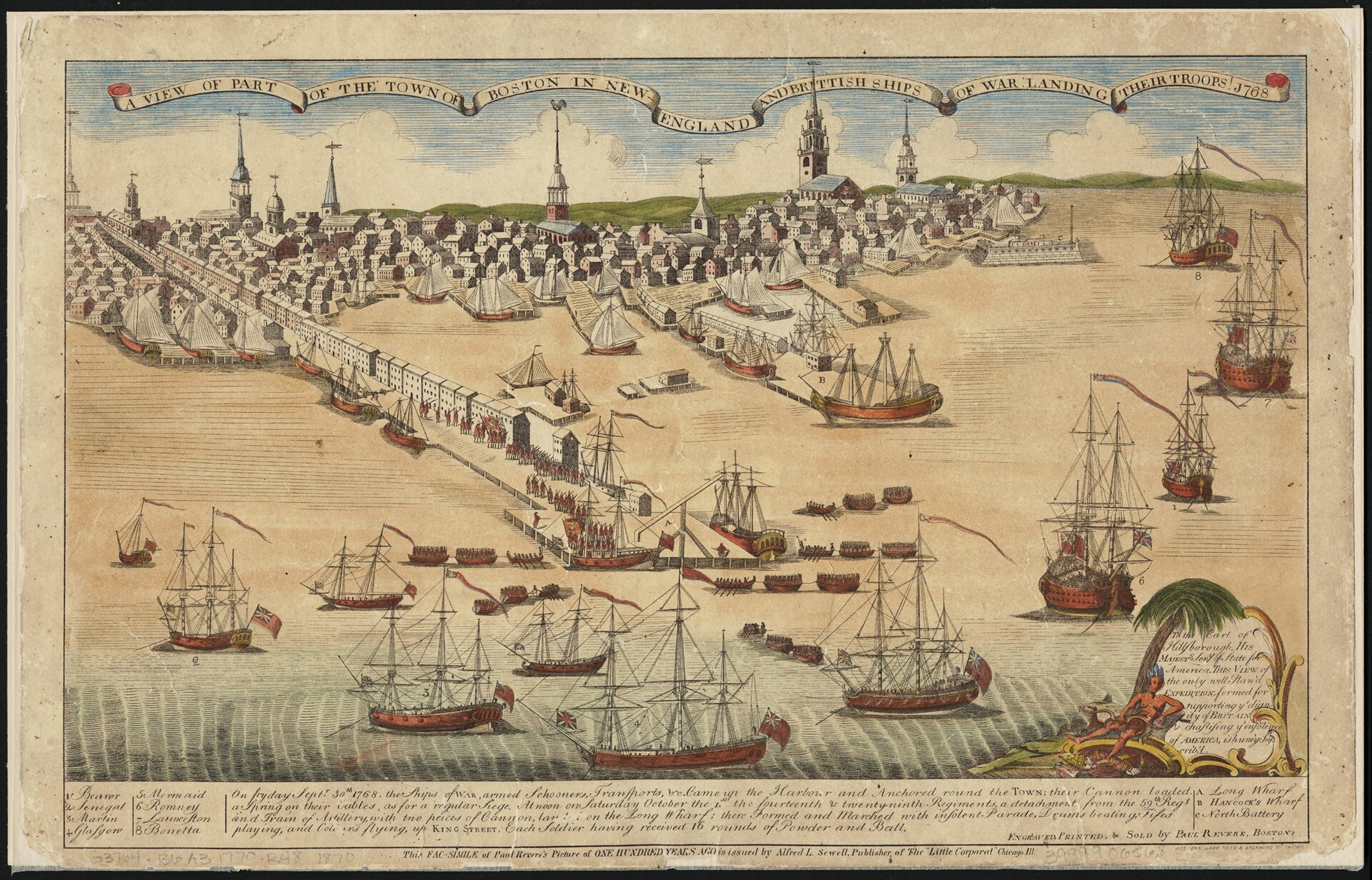
- 10The Boston Gazette, and Country Journal, no. 784, Monday 16 April 1770 (Internet Archive scan, OCR text read): Paul Revere's own notice of a copper-plate print of the town of Boston and British ships of war landing their troops. archive.org/details/...
- 11The Boston Gazette, and Country Journal, no. 831, Monday 11 March 1771 (Internet Archive scan, OCR text read): report of the exhibition at Paul Revere's house on the anniversary of 5 March. archive.org/details/...
- 12American Paintings and Historical Prints from the Middendorf Collection (The Metropolitan Museum of Art, New York, 1967), catalogue entries 60a, 60b and 61 (Revere, Boston Massacre, first and second state; Mulliken copy), full text on the Internet Archive. Modern catalogue, paraphrased only. archive.org/details/...
- 13William Loring Andrews, Paul Revere and His Engraving (New York: Charles Scribner's Sons, 1901), full text on the Internet Archive: chapter on the Boston Massacre print, its copies, restrikes, the plate and the 1901 census of impressions. archive.org/details/...
- 14Elbridge Henry Goss, The Life of Colonel Paul Revere (Boston, 1891), full text on the Internet Archive: Revere as self-taught engraver; the Day Book entry of March 1770; the London copies; Revere's pen-and-ink plan. archive.org/details/...
- 15Charles Gettemy, The True Story of Paul Revere (Boston, 1905), full text on the Internet Archive: Pelham's letter and where it was found; Cunningham's 1904 doubts; the 1771 transparencies; Revere's charges to Edes and Gill. archive.org/details/...
- 16Tom Gearty, 'The Bloody Massacre', in Acquired Tastes: 200 Years of Collecting for the Boston Athenaeum (2006), pp. 296-298, as posted by the Boston Athenaeum (Wayback Machine copy of 6 April 2015). Modern text, paraphrased only. web.archive.org/web/...
- 17Massachusetts Historical Society, The Coming of the American Revolution, topic page 'The Boston Massacre' (introduction by the MHS). masshist.org/revolution/...
- 18Massachusetts Historical Society, Collections Online, 'The Bloody Massacre perpetrated in King Street, Boston on March 5th 1770 by a party of the 29th Regiment' (engraving by Paul Revere, hand-colored, 22.8 cm x 20 cm), description from the Coming of the American Revolution project. masshist.org/revolution/...
- 19National Park Service, 'Boston Massacre Trial' (article with footnotes to Zobel and to Founders Online). nps.gov/articles/...
- 20Library of Congress Prints and Photographs Division, catalogue record LCCN 2008661777 (ppmsca.01657), 'The bloody massacre perpetrated in King Street Boston on March 5th 1770', hand-colored engraving, notes citing Brigham pp. 41-57 (Wayback Machine copy). web.archive.org/web/...
- 21Library of Congress, catalogue record LCCN 2008680173 (ppmsca.19159), Boston: Printed by Paul Revere, [1770, printed later], heading Restrikes (Wayback Machine copy). web.archive.org/web/...
- 22Library of Congress, catalogue record LCCN 2012648847, re-engraved by Sidney L. Smith, Boston: Charles E. Goodspeed, 1908 (Wayback Machine copy). web.archive.org/web/...
- 23World Digital Library (Library of Congress), item 214, 'The Bloody Massacre Perpetrated in King Street, Boston, on March 5th 1770 by a Party of the 29th Regiment' (Wayback Machine copy). web.archive.org/web/...
- 24The Metropolitan Museum of Art, Open Access API, object 365208 (accession 10.125.103), hand-colored engraving and etching, 'second state', Gift of Mrs. Russell Sage, 1910. collectionapi.metmuseum.org/public/...
- 25The Metropolitan Museum of Art, Open Access API, object 394325 (accession 24.90.1395), William F. Stratton, 1832 facsimile after the 1770 original, engraved facsimile copy. collectionapi.metmuseum.org/public/...
- 26The Metropolitan Museum of Art, Open Access API, object 394326 (accession 24.90.1589), William F. Stratton, 1832 facsimile after the 1770 original, hand-colored. collectionapi.metmuseum.org/public/...
- 27The Metropolitan Museum of Art, Open Access API, object 357186 (accession 24.90.1902), A Short Narrative of the Horrid Massacre in Boston, 1770, illustrations by Paul Revere Jr. (engraving, woodcut). collectionapi.metmuseum.org/public/...
- 28The Metropolitan Museum of Art, Open Access API, object 388659 (accession 47.59.6), William L. Champney, The Boston Massacre, March 5, 1770, 1856, color lithograph with hand coloring. collectionapi.metmuseum.org/public/...
- 29The Metropolitan Museum of Art, Open Access API, object 346486 (accession 24.90.1905(1-11)), Massacre in St. George's Field and Boston, etc. [eleven political pamphlets], George Kearsley, 1768-70. collectionapi.metmuseum.org/public/...
- 30Wikipedia, 'Boston Massacre' (; used for the summary of the event and for claims attributed to it in the text, to be replaced by primary or scholarly sources). en.wikipedia.org/wiki/...
- 31Wikipedia, 'Henry Pelham (engraver)' (; biography of Pelham). en.wikipedia.org/wiki/...
- 32Wikipedia, 'Paul Revere' (; birth and death dates, career). en.wikipedia.org/wiki/...
- 33Wikipedia, 'Massacre of St George's Fields' (; the London shooting of 10 May 1768). en.wikipedia.org/wiki/...
- 34Hogarth's Act). en.wikipedia.org/wiki/...
- 35Wikipedia, 'History of copyright law of the United States' (; the Statute of Anne and the colonies). en.wikipedia.org/wiki/...
- 36Wikipedia, 'Massachusetts pound' (; six shillings to the Spanish dollar). en.wikipedia.org/wiki/...
- 37Wikipedia, 'Lessing J. Rosenwald's collecting and his gift to the National Gallery of Art). en.wikipedia.org/wiki/...
- 38Paul Revere House, 'Revere's Silver Shop' (the two surviving daybooks, 1761-1783 and 1783-1797, and what they record). paulreverehouse.org/reveres-silver-shop
- 39Paul Revere House gift shop, 'Boston Massacre Print' (11 x 13 inch reproduction, ten dollars). paulreverehouse.org/boston-massacre
- 40A Short Narrative of the Horrid Massacre in Boston, perpetrated in the evening of the fifth day of March 1770 (Boston: Edes and Gill, 1770), full text on the Internet Archive: depositions describing the evening as moonlit. archive.org/details/...
- 41Peter Thacher, An Oration delivered at Watertown, March 5, 1776: To commemorate the bloody massacre at Boston (Watertown: Benjamin Edes, 1776), Internet Archive record. archive.org/details/...
- 42Wikimedia Commons, file page 'The Fruits of Arbitrary Power, or The Bloody Massacre by Henry Pelham.jpg' (New York Public Library, Print Collection, Gift of Mr. and Mrs. Edwin Merrill; 5944 x 8201 px). commons.wikimedia.org/wiki/...
- 43Wikimedia Commons, file page 'Paul Revere, Jr. - The Bloody Massacre - Google Art Project.jpg' (categorised as a Google Art Project work in the Museum of Fine Arts, Houston). commons.wikimedia.org/wiki/...
- 44William Dunlap, A History of the Rise and Progress of the Arts of Design in the United States, ed. Frank W. Bayley and Charles E. Goodspeed, vol. 3 (Boston, 1918), entry 'Remick', full text on the Internet Archive. archive.org/details/...
- 45Boston Massacre Historical Society, 'Paul Revere's Engraving - Explained' (website, c. 2008; and unsourced, used only for what it asserts about Christian Remick, flagged as such). bostonmassacre.net/gravure.htm
- 46Wikimedia Commons, Category 'The Bloody Massacre by Paul Revere' (list of digitised impressions, copies and details on Commons). commons.wikimedia.org/wiki/...
- 47Wikimedia Commons, file page 'Four coffins of men killed in the Boston Massacre LCCN2004672647.jpg' (Library of Congress; engraver Paul Revere; from the Boston Gazette, 12 March 1770). commons.wikimedia.org/wiki/...
- 48Wikimedia Commons, file page for the Norman B. Leventhal Map Center (Boston Public Library) image of Revere's view of Boston and British ships landing their troops, 1768, publisher Alfred L. Sewell, dated 1770, 1870. commons.wikimedia.org/wiki/...


Last verified · Published
Change log
9 November 2026 - Record created at the house standard: researched narrative, technical evidence, maker dossier, graded provenance chain, prices with hammer and premium separated, related works, open questions and sources.