D'Arenberg Basin
Unidentified Ayyubid metalworking workshop, Damascus · 1247-1249 CE (637-647 AH)
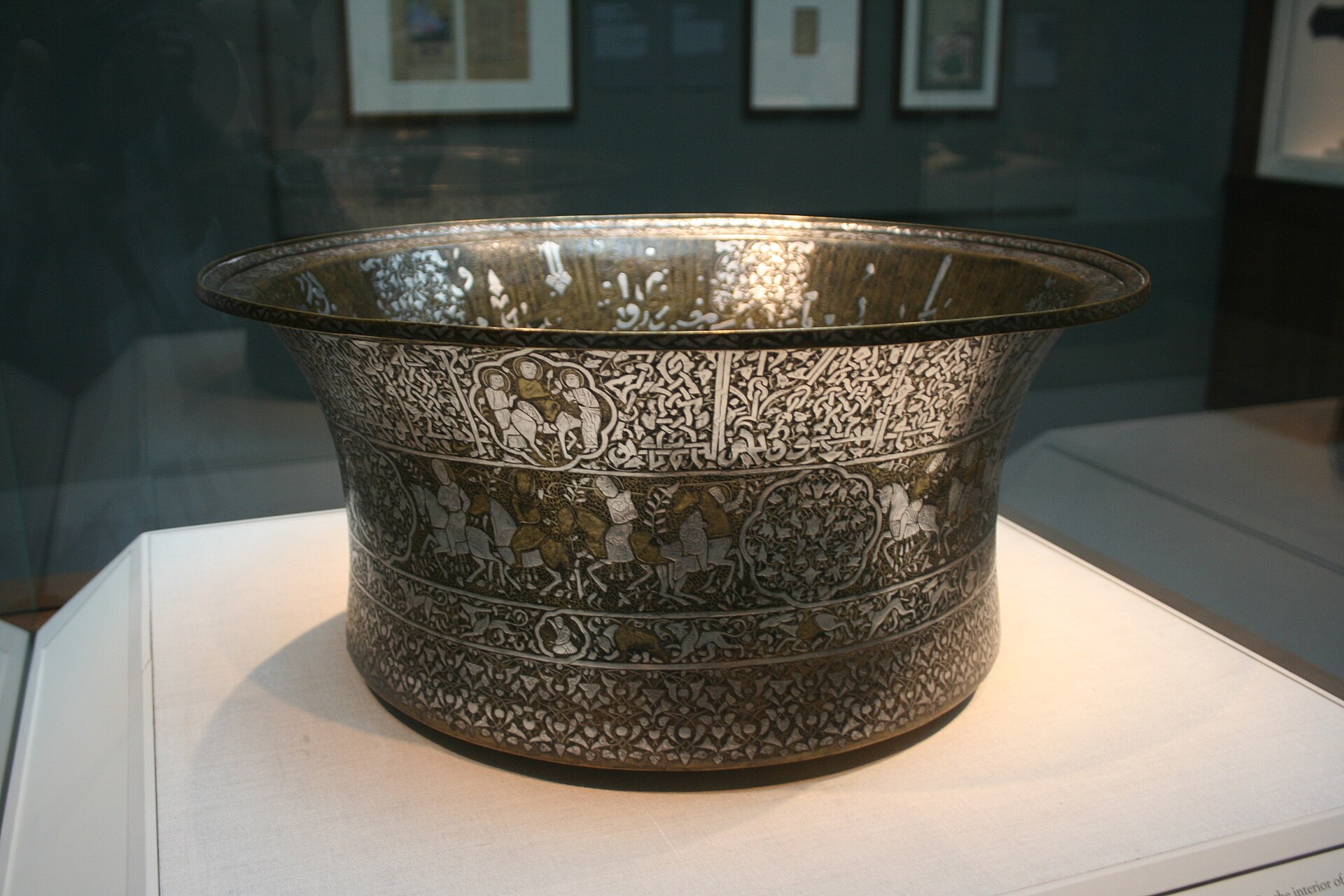
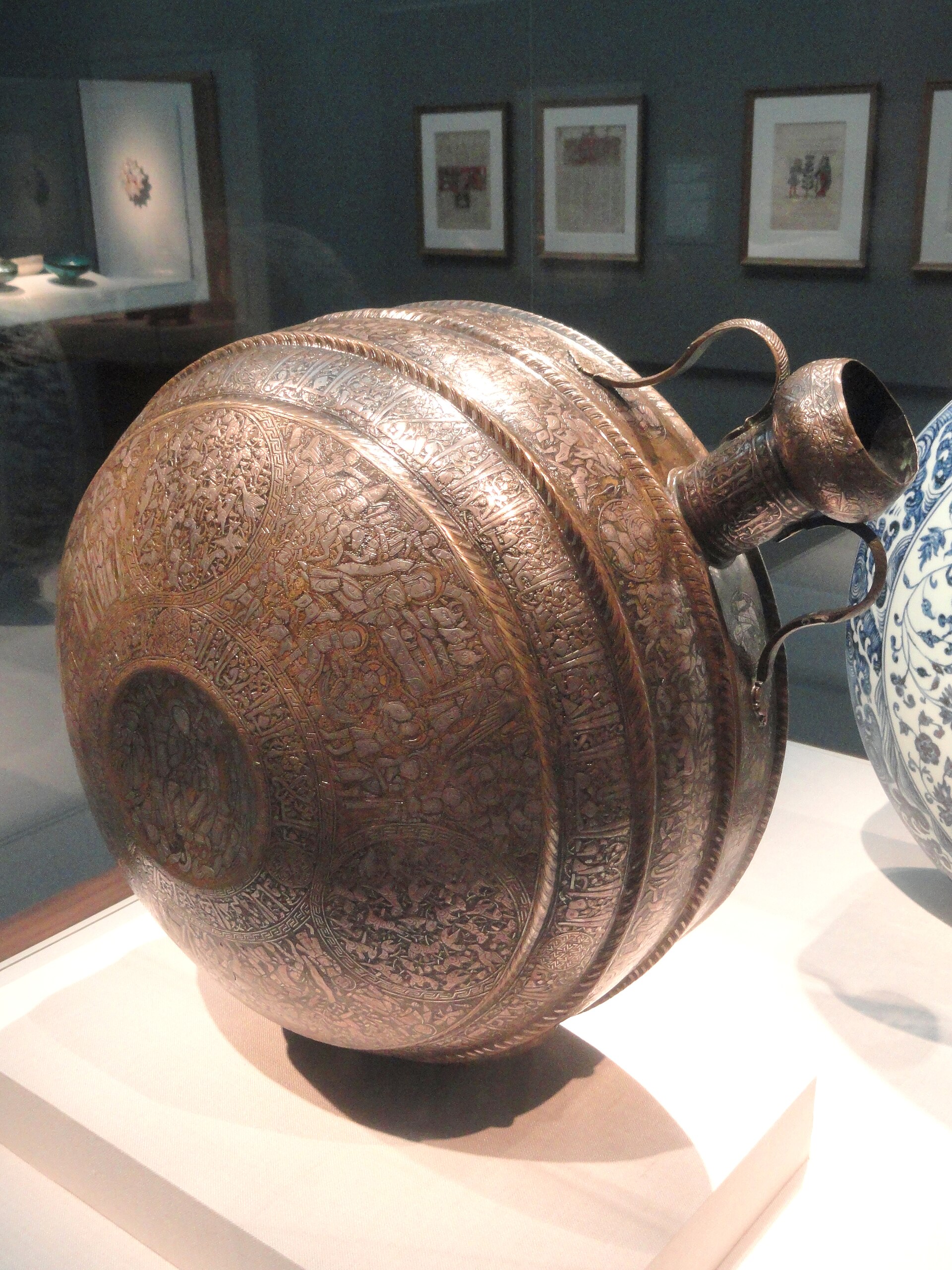
The basin, exterior view, brass inlaid with silver, Ayyubid Syria, 1247-1249. Freer Gallery of Art, F1955.10.
| Artist | Unidentified Ayyubid metalworking workshop, Damascus |
|---|---|
| Date | 1247-1249 CE (637-647 AH) |
| Medium | Brass, inlaid with silver, with niello detailing |
| Dimensions | H x W x D: 22.5 x 50 x 50 cm (8 7/8 x 19 11/16 x 19 11/16 in), per the current Smithsonian catalogue record. Esin Atil's 1975 Freer Gallery catalogue gives maximum height 23.3 cm (9 3/8 in), rim diameter 50.0 cm (19 5/8 in) and base diameter 38.0 cm (15 in); the two sets of figures are close but not identical, most likely reflecting different measuring points on a basin whose rim is not perfectly even. |
| Where it is now | Freer Gallery of Art, National Museum of Asian Art, Smithsonian Institution, Washington, D.C.last confirmed |
| Inventory number | F1955.10 |
| Attribution | UnknownThe basin carries no maker's signature. Full note |
| Object type | Islamic metalwork |
| Period | Ayyubid, mid-thirteenth century |
| Cases | Has a provenance gap |
| Inscriptions | Exterior, in plaited Kufic: Glory to our master, Sultan al-Malik al-Salih, the wise, the illustrious, the learned, the efficient, the Defender [of the Faith], the warrior [of the frontiers], the supporter [of Islam], the victor, Najm al-Din Ayyub Abu Muhammad b. Abu Bakr b. Ayyub. Interior, in naskhi, a longer version repeating many of the same epithets and adding: the conqueror, the victor... the conqueror of the Kharijites and the religious rebels, the establisher of justice in the two worlds, the helper of the weak and unfortunate, the helper of man, the aid of the imam, the sultan of the Arabs and of the Persians, Abu'l-Fath Ayyub b. al-Sultan al-Malik al-Kamil Nasir al-Din Muhammad b. Abi Bakr b. Ayyub. Translation from the Arabic as published by Katzenstein and Lowry (1983). |
| Owners on record | 6 links3 documented, 1 disputed, 2 unknown |
| Sources | 11 cited |
About this record Last verified · 11 sources cited · Change log
On this page 9 sections
ContentsClose
A brass basin inlaid with silver and niello, made in the late 1240s for al-Malik al-Salih Najm al-Din Ayyub, the last Ayyubid sultan to rule both Egypt and substantial parts of Syria before the Mamluks displaced his dynasty in 1250. Its inscriptions name him in full chancery style and its exterior carries polo players, animals and musicians alongside a band of Gospel scenes, the Virgin and Child, the Annunciation, the Entry into Jerusalem, the Raising of Lazarus and one still-disputed fifth scene, repeated again in miniature around the interior.
Why a Muslim sultan's basin carries Christian imagery has been argued since the 1950s without resolution: whether the makers were Christian craftsmen working in an Islamic idiom, Muslim craftsmen drawing on Christian visual sources for their prestige value, or something in between remains a live, named scholarly dispute rather than a settled fact, and this record states it as one.
The basin's popular name comes from its documented presence in the Brussels collection of the Duke of Arenberg by the early twentieth century, but the eighteenth-century coat of arms engraved on its base is not the Arenberg family's own; whose arms they actually are remains only tentatively identified. Bought by the Freer Gallery in 1955 using the endowment Charles Lang Freer had left on his death in 1919, the basin's ownership between its thirteenth-century origin and its eighteenth-century re-engraving, and again between its 1910 exhibition in Munich and its 1955 purchase, is not documented in any source located for this record, and this record says so plainly rather than filling the gap.
Provenance
Each link is graded. Documented: a cited source supports it. Disputed: the identification is argued but not established. Unknown: no owner for that span, and the gap is not smoothed into a narrative. The grades in the glossary.
- 1247 - 1249Made for Sultan al-Malik al-Salih Najm al-Din Ayyubdocumented
Both the exterior and interior inscriptions name this sultan in full chancery style. The interior inscription's title beloved of the Commander of the Believers, first used by him only after his 1247 caliphal investiture, and his death in November 1249, bracket the date. Made by an unidentified workshop, probably at Damascus.13
- 1249 -Unknownunknown
No owner or location is documented between the end of Ayyubid rule (Najm al-Din Ayyub died November 1249; his dynasty was displaced by the Mamluks in 1250) and the engraving of a European coat of arms on the base, most likely in the eighteenth century.4
- 18th century (probable) -Owner bearing a coat of arms tentatively identified as a cadet branch of the Borniol familydisputed
A European coat of arms was engraved into the exterior of the base. The Freer Gallery's own 1975 catalogue states this is not the Arenberg family's arms, and reports an identification by Helmut Nickel of a cadet Borniol branch, an identification Nickel treated as uncertain, based on irregularities in the heraldic hatching. Neither the 1903 nor the 1910 exhibition catalogues that documented the piece in the Arenberg collection mention the arms at all.4
- - 1910Duke of Arenberg, Brusselsdocumented
By the early twentieth century the basin was in the Brussels collection of the House of Arenberg, source of its common name. Exhibited in Paris in 1903 (published in Gaston Migeon's 1905 catalogue of the Exposition des Arts Musulmans) and in Munich in 1910 (published in Sarre and Martin's catalogue of Meisterwerke Muhammedanischer Kunst). Which individual Duke of Arenberg is not named in the sources consulted.4
- 1910 - 1955Unknownunknown
No dealer, sale, or intermediate owner is documented between the 1910 Munich exhibition and the Freer Gallery's 1955 purchase.1
- 1955 - presentFreer Gallery of Art / National Museum of Asian Art, Smithsonian Institutiondocumented
Acquired by purchase using the Charles Lang Freer Endowment, the fund established by Freer's own 1919 bequest for the gallery's continuing acquisitions; Freer himself, who died in 1919, had no personal role in this 1955 purchase. Accessioned as F1955.10.1
Technical evidence
| Attribution note | The basin carries no maker's signature. Attribution to a Damascus workshop rests on the inscriptions naming the patron, on stylistic comparison with signed and dated contemporaries such as the candlestick of Da'ud b. Salama al-Mawsili (1248-49) and the ewer of Ahmad al-Dhaki al-Mawsili (1242), and on the Smithsonian's own current cataloguing, which gives the origin as probably Damascus, Syria. Some Wikimedia Commons file descriptions of this same object instead say probably northern Iraq, reflecting an older attribution current when those photographs were captioned; this record follows the holding institution's present catalogue entry and flags the discrepancy as unresolved. |
|---|---|
| Material and technique | Brass, chased and inlaid with cut silver sheet and wire, with passages of black niello (a fused mixture of copper, silver and lead) used for fine linear detail within the silver.12 |
| Dimensions | H x W x D: 22.5 x 50 x 50 cm (8 7/8 x 19 11/16 x 19 11/16 in) per the current Smithsonian record. Esin Atil's 1975 Freer catalogue instead gives maximum height 23.3 cm, rim diameter 50.0 cm and base diameter 38.0 cm.14 |
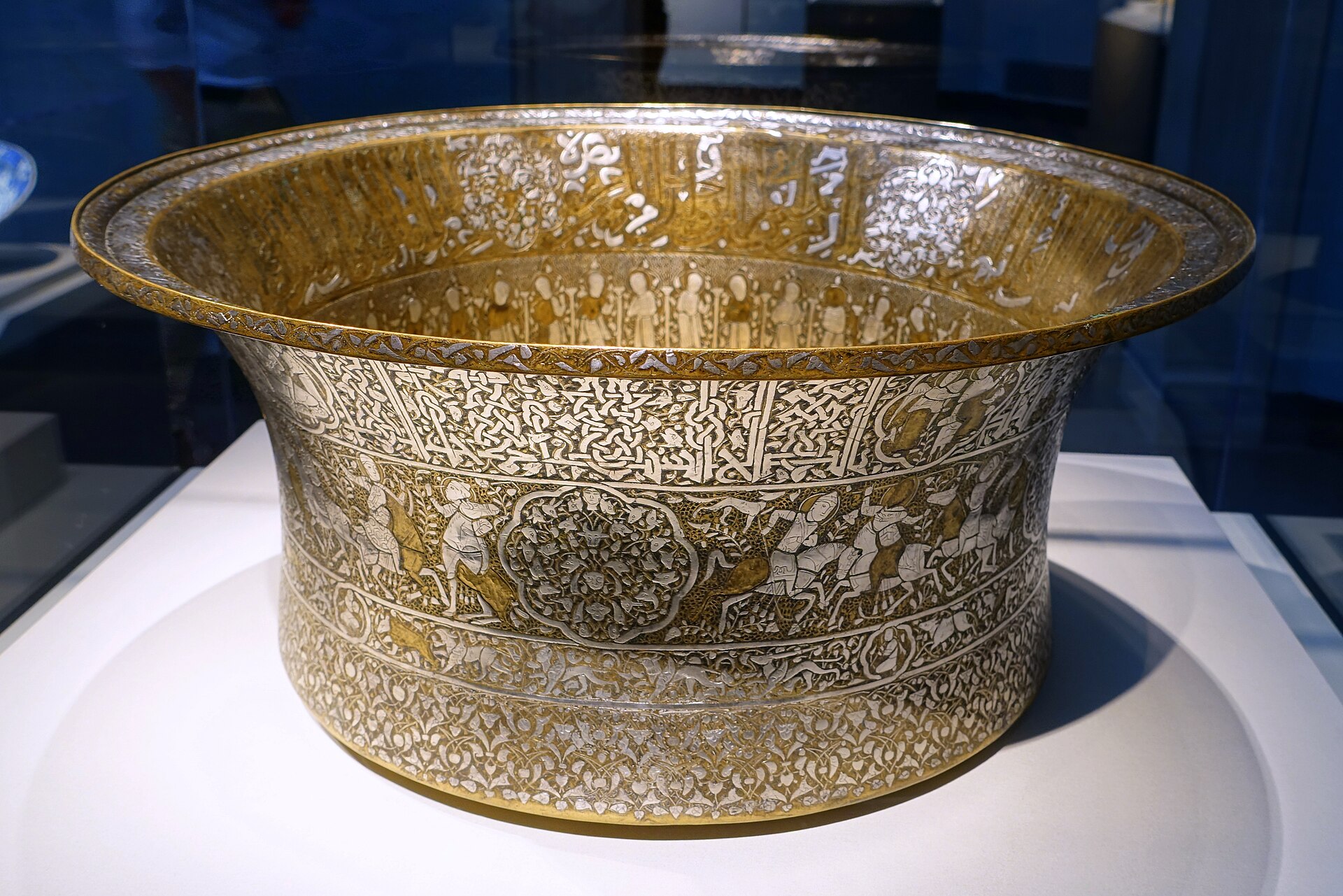
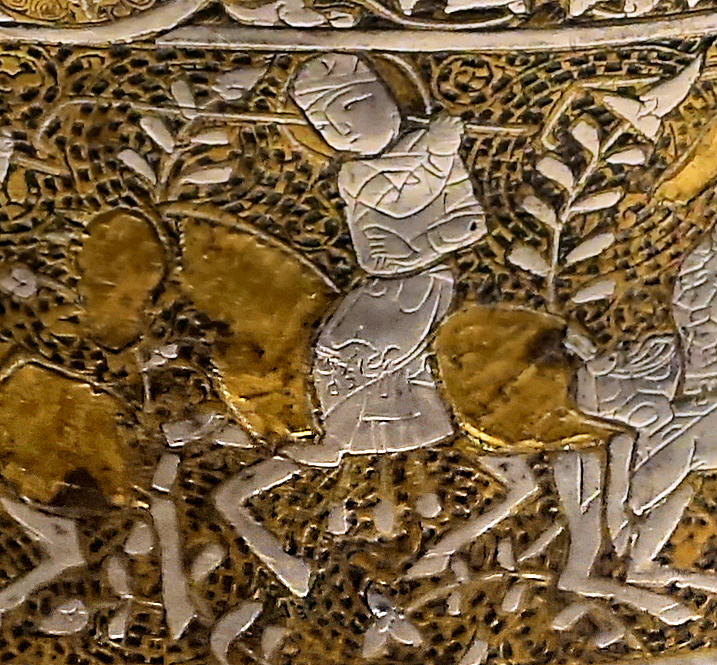
| Exterior decorative program | Four unequal horizontal bands: a plaited Kufic inscription broken by five medallions with scenes from the life of Christ; a band of five panels of polo-playing horsemen, four riders per panel; a narrower frieze of running real and imaginary animals broken by roundels of musicians; a floral arabesque band at the base.34 |
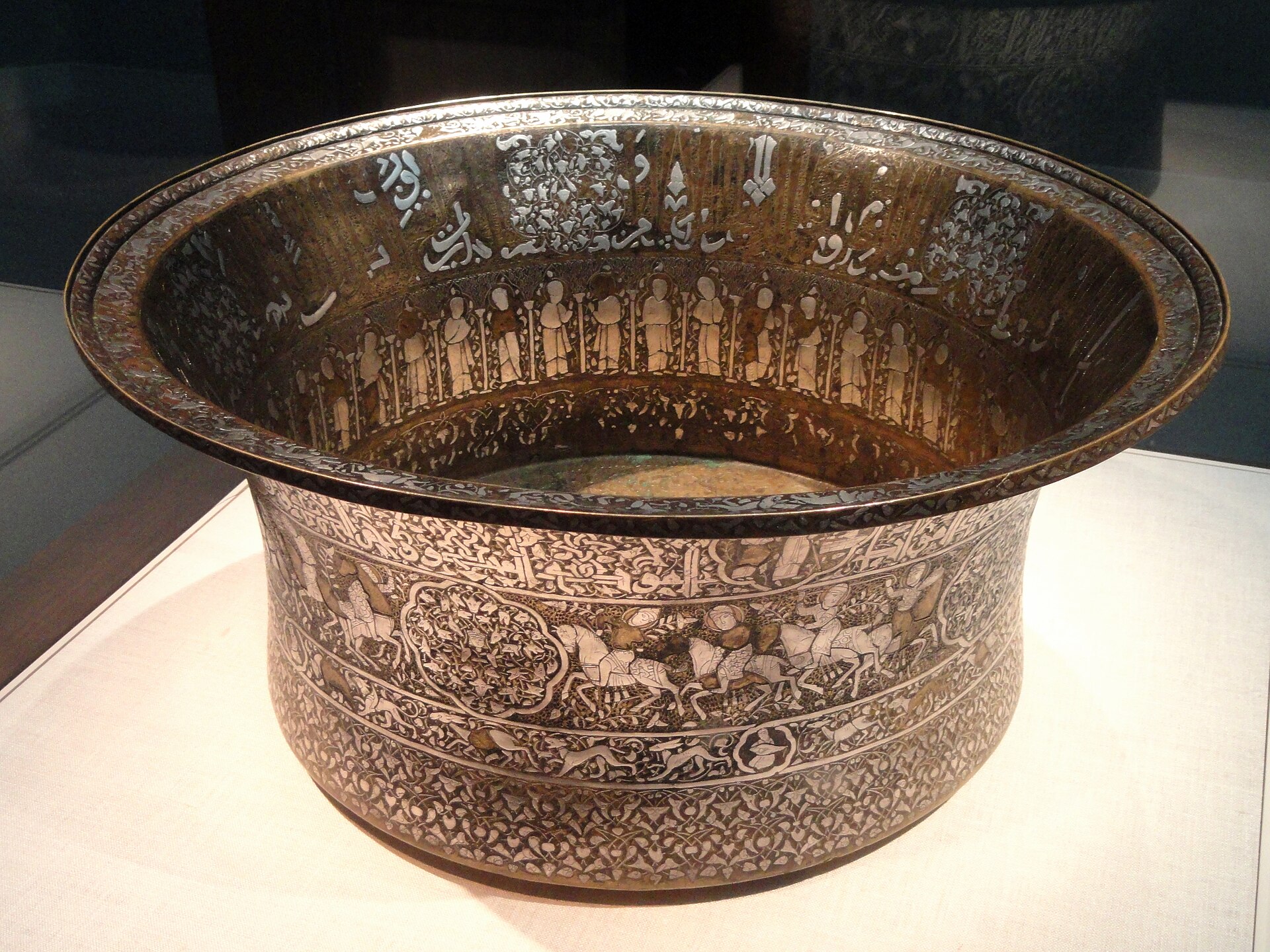
| Interior decorative program | A rim frieze of forty running animals; a naskhi inscription band interrupted by five further Christian medallions; an arcade of thirty-nine standing generic holy figures, one per ogival arch; a floor of arabesque radiating from a central medallion of interlaced animal and human heads.34 |
| Exterior inscription (translated) | Glory to our master, Sultan al-Malik al-Salih, the wise, the illustrious, the learned, the efficient, the Defender [of the Faith], the warrior [of the frontiers], the supporter [of Islam], the victor, Najm al-Din Ayyub Abu Muhammad b. Abu Bakr b. Ayyub.3 |
| Interior inscription (translated) | A longer version of the same titulature, adding: the conqueror of the Kharijites and the religious rebels, the establisher of justice in the two worlds, the helper of the weak and unfortunate, sultan of the Arabs and of the Persians, Abu'l-Fath Ayyub b. al-Sultan al-Malik al-Kamil Nasir al-Din Muhammad b. Abi Bakr b. Ayyub.3 |
| Dating evidence | The interior inscription's title khalil amir al-mu'minin (beloved of the Commander of the Believers) was not used by al-Malik al-Salih before his caliphal investiture in 1247, giving a terminus post quem; his death in November 1249 gives the terminus ante quem. Other titles on the piece came into consistent use only from about 1243-44, supporting a date in the latter part of his reign.3 |
| Condition | Part of the silver inlay has been lost, particularly in the interior inscription band, where none survives on the inner bottom of the basin. No conservation record was located.1 |
| Later addition: coat of arms | A European coat of arms, engraved (most likely in the eighteenth century, on the evidence of the engraving style) into the exterior of the base: a shield with a chevron, two roses and a rampant bull, flanked by two unicorns, a helmet and a second bull, with a Latin motto. Tentatively identified by the arms scholar Helmut Nickel as belonging to a cadet branch of the French Borniol family, not to the Arenberg family whose collection the basin was later part of.4 |
Images
The record in full
Chapter 1A basin built for display, not for washing hands quietly
The D'Arenberg Basin is a large hemispherical brass vessel, roughly 22.5 to 23.3 cm high and about 50 cm across the rim, its entire surface worked in silver inlay with passages of black niello.
The D'Arenberg Basin is a large hemispherical brass vessel, roughly 22.5 to 23.3 cm high and about 50 cm across the rim, its entire surface worked in silver inlay with passages of black niello. It is heavy, wide and covered edge to edge in figures, animals, arabesques and script, the kind of object made to be looked at from every angle rather than used privately. Basins of this Ayyubid courtly type served ceremonial hand-washing at table, paired with a matching ewer that in this case has not survived or has not been identified; the size, the inscriptions naming a reigning sultan, and the density of decoration all point to a piece meant to be seen and admired at a formal Ayyubid court occasion, not a utilitarian washstand.
Four horizontal bands of unequal width divide the exterior. The uppermost carries a plaited Kufic inscription broken by five lobed medallions showing scenes from the life of Christ. Below it, a band nearly as wide holds five panels of courtly horsemen playing polo, four riders to a panel, separated by smaller medallions. A narrower third band carries a frieze of real and imaginary animals running head to tail, broken at intervals by roundels containing musicians. The lowest band is a floral arabesque. The interior repeats the scheme in miniature: a rim frieze of running animals, a band of lengthy naskhi inscription interrupted by five more Christian medallions, an arcade of thirty-nine standing figures in long vestments, each under its own ogival arch, and a floor of arabesque radiating from a central rosette worked from interlaced animal and human heads.
Chapter 2How a Damascus workshop made it
The basin is unsigned, which puts it in the majority rather than the exception for this class of object.
The basin is unsigned, which puts it in the majority rather than the exception for this class of object. Its closest dated relatives are not: a candlestick signed by Da'ud b. Salama al-Mawsili and dated 1248-49, now in the Musee des Arts Decoratifs in Paris; an ewer signed by Ahmad al-Dhaki al-Mawsili and dated 1242, now in the Keir Collection; and, a generation earlier, the Blacas ewer in the British Museum, signed by Shuja' ibn Man'a al-Mawsili and dated 1232 at Mosul. The nisba al-Mawsili, meaning of Mosul, attached itself to metalworkers and their pupils as a mark of trained pedigree even after they had left the city, and scholarship on these workshops has traced the physical migration of Mosul-trained craftsmen into Syria and Egypt across the twelfth and thirteenth centuries as the political center of gravity shifted toward the Ayyubid courts of Damascus and Cairo. The Freer basin's technique, a brass body chased and inlaid with cut silver sheet and wire, finished with engraved detail and passages of niello, is the same technique practiced by these named Mosul-trained masters, and the basin is generally placed among the products of a Damascus workshop working in that tradition during the 1240s.
No document names the individual hand that made this basin, and none is likely to surface; the object's own inscriptions name only the patron, in keeping with the convention of thirteenth-century Ayyubid luxury metalwork, where a maker's signature was the exception a craftsman chose to add, not a requirement he was bound to meet.
Chapter 3The inscription and the sultan it names
Both of the basin's inscriptions name the same man: Sultan al-Malik al-Salih Najm al-Din Ayyub, given his full chancery style, wise, illustrious, learned, Defender of the Faith, warrior of the...
Both of the basin's inscriptions name the same man: Sultan al-Malik al-Salih Najm al-Din Ayyub, given his full chancery style, wise, illustrious, learned, Defender of the Faith, warrior of the frontiers, supporter of Islam, victor. Al-Salih Ayyub ruled Egypt from 1240 until his death on 22 November 1249, and had earlier held Damascus intermittently, briefly in 1239 and then continuously from 1245 to 1249; he is reckoned the last Ayyubid ruler to combine effective rule of Egypt with rule of substantial parts of Syria and Palestine. He built his power on newly purchased Kipchak Turkish slave soldiers garrisoned on an island in the Nile, the corps that took the name Bahriyya and would, within a year of his death, seize the sultanate for themselves as the first Mamluk dynasty.
The dating of the basin to 1247-1249 is not a guess at his reign dates in general; it rests on a specific epigraphic detail. The interior inscription gives al-Malik al-Salih the title khalil amir al-mu'minin, beloved of the Commander of the Believers, a title tied to formal investiture by the Abbasid caliph in Baghdad, which al-Salih did not receive until 1247. Scholarship on the group of objects inscribed to this sultan has used that title, together with the appearance or absence of other honorifics that came into consistent use only from about 1243-44, to place the Freer basin and a companion plate now in the Louvre in the later part of his reign rather than earlier. The evidence is textual rather than documentary in the sense of a dated colophon, and the scholars who established it caution that many Ayyubid rulers used caliphal-sounding phrases loosely, without formal investiture behind them, so the argument is treated as a strong indication rather than an unconditional certainty.
Chapter 4Five scenes from the life of Christ
The exterior's uppermost band and the interior's upper band each carry the same set of five Christian medallions, rendered so summarily that identifying every scene has proved harder than it sounds.
The exterior's uppermost band and the interior's upper band each carry the same set of five Christian medallions, rendered so summarily that identifying every scene has proved harder than it sounds. The clearest are the Virgin and Child flanked by two angels, and the Annunciation, shown with only Gabriel and Mary and none of the customary attributes such as the dove or rays of light. Also clear are the Entry into Jerusalem, with Christ mounted on a donkey and accompanied by a pair of figures, and the Raising of Lazarus, shown as an unusual bust-length figure emerging from a sarcophagus rather than the full-length figure standard in eastern Christian art. The fifth medallion is the disputed one: the Freer Gallery's own 1975 catalogue describes it as Christ holding a bowl and joined by two other figures, possibly representing the Last Supper, while the 1983 scholarly study of the whole group calls it simply a miracle scene, unwilling to commit to an identification at all. No source consulted for this record resolves the disagreement.
The interior arcade of thirty-nine standing figures under ogival arches has been read as a company of saints, but close study of the group finds them undifferentiated: bishops, saints and clerics carrying censers, crosses and gospel books, none of them individually identifiable and none tied to a specific liturgical program. The censers shown are not censing anything in particular; the figures are, in the words of the fullest study of this material, a generic holiness nowhere found in eastern Christian art, the kind of image that could only have been conceived by people in contact with, but not themselves participants in, thirteenth-century Christian religious life.
Chapter 5A genuine and unresolved scholarly argument
Why a sultan's basin carries a band of Gospel scenes has been argued over for seventy years, and the positions do not converge on one answer.The earliest position on record, taken by M.S.
Why a sultan's basin carries a band of Gospel scenes has been argued over for seventy years, and the positions do not converge on one answer.
The earliest position on record, taken by M.S. Dimand in 1954 in a study of a related silver-inlaid bronze canteen, was that objects of this kind must have been made for Christians by Christian craftsmen who followed closely the style of Muhammadan art, reasoning that it seemed improbable a Muslim patron would commission a piece carrying warriors set against imagery associated with a rival faith. A related position, taken by M. Aga-Oglu in a study of a Christian-themed incense burner, ascribed such objects to Christians thoroughly schooled in the principles of Islamic art, again locating the maker's own faith as Christian. Laura Schneider, publishing the fullest study of the related Freer canteen in 1973, explained the same kind of iconographic slips found on this basin as the product of Christian artists who were unfamiliar with the finer points of the Biblical tradition. D.S. Rice took the opposite view of the maker's faith: he suggested the artists were Muslims who deliberately selected Christian themes they judged inoffensive to their Muslim patrons, a reading that keeps the whole transaction, patron and craftsman alike, inside the Islamic court.
The most detailed study of the whole corpus, published by Ranee A. Katzenstein and Glenn D. Lowry in Muqarnas in 1983, rejects a single-cause explanation for any of it. Working through the specific errors on each object, the wrong order of scenes, garments and attributes borrowed from the wrong episode, generic holy figures with no individual identity, they conclude the deviations are too systematic to be occasional misunderstanding by an otherwise competent Christian hand, and too visually literate to be pure ignorance. Their reading is that the makers were Muslim artists in ordinary contact with, but not participants in, the Christian culture of thirteenth-century Syria and Egypt, working within a documented harmonious political and economic modus vivendi between the two communities, and drawing on Christian imagery as one more source of exotic and prestigious visual material, alongside the polo players and musicians on the same object, rather than as an expression of anyone's personal devotion. They support the reading with contemporary Ayyubid court poetry, including verse addressed to al-Salih Ayyub himself, that uses Christ as a literary figure of just and exceptional kingship without any suggestion of Christian belief on the poet's part.
Rachel Ward returned to this basin specifically, together with the related Louvre plate also inscribed to al-Salih Ayyub, in a 2005 essay titled Style versus Substance: The Christian Iconography on Two Vessels Made for the Ayyubid Sultan al-Salih Ayyub. The title alone signals her position, that the Christian scenes function as decorative style on these two vessels rather than as substantive religious content; this record was not able to obtain the full text of the essay and does not attribute more specific claims to it than the published title supports.
The Smithsonian's own current label for the object declines to choose a side: whether commissioned by a Muslim or Christian patron, it states, the combination implies religious tolerance in thirteenth-century Ayyubid Syria. That is an institutional position, not a scholarly resolution, and it is worth recording as exactly that.
Chapter 6The coat of arms that is not the Duke of Arenberg's own
At some point, on the evidence of the engraving's style most likely in the eighteenth century, a European coat of arms was cut into the exterior of the basin's base: a shield bearing a chevron, two...
At some point, on the evidence of the engraving's style most likely in the eighteenth century, a European coat of arms was cut into the exterior of the basin's base: a shield bearing a chevron, two roses and a rampant bull, flanked by two unicorns, a knight's helmet and a second bull, set among floral ornament and ribbons carrying a Latin motto. The motto, deciphered by Walter Angst and quoted in the Freer Gallery's own 1975 catalogue, reads roughly as a declaration that neither the beating of an enemy nor an English rose's advance made its bearer submit, a phrasing that implies the arms were cut to commemorate a French family's stand against an English adversary.
Here the object's history and its popular name pull apart. The basin takes the name D'Arenberg Basin because it was, by the early twentieth century, in the collection of the Duke of Arenberg of Brussels, one of the wealthiest and best-known noble houses of the former Habsburg Netherlands. But the coat of arms on the base is demonstrably not the Arenberg family's own; the Freer Gallery's 1975 catalogue states this outright, and reports an identification by the arms scholar Helmut Nickel suggesting the shield belongs instead to a cadet branch of the Borniol family, counts drawn from the Dauphine, Nivernais, Normandie, Provence and Rouergue regions of France, an identification Nickel himself treated as tentative, resting on inconsistencies in how the shield's colors were hatched rather than on a firm match. Neither of the two exhibition catalogues that documented the basin in the Arenberg collection, in Paris in 1903 and in Munich in 1910, mentions the coat of arms at all; its identification came later; and no source consulted for this record explains how an object bearing the arms of a French provincial family, if that identification is right, passed into the hands of the dukes of Arenberg.
Chapter 7From an unrecorded medieval owner to a documented Brussels collection
Nothing in the sources consulted for this record documents who owned the basin, or where it was, between the end of the Ayyubid period around 1250 and the eighteenth-century engraving of the coat of...
Nothing in the sources consulted for this record documents who owned the basin, or where it was, between the end of the Ayyubid period around 1250 and the eighteenth-century engraving of the coat of arms. That gap runs to roughly five hundred years and is recorded here as exactly that, a gap, not bridged by supposition.
By the early twentieth century the basin was in the Brussels collection of the Duke of Arenberg. It was exhibited in Paris in 1903, at the Exposition des Arts Musulmans held at the Musee des Arts Decoratifs, and published in Gaston Migeon's 1905 catalogue of that show. It was shown again in 1910 at the vast Munich exhibition Meisterwerke Muhammedanischer Kunst, one of roughly 3,600 objects drawn from more than 260 collections that together made the case for Islamic art as a subject of serious art-historical study; the basin appears in the exhibition catalogue prepared by Friedrich Sarre and Friedrich Robert Martin. Both appearances are recorded in the context of the piece being in the Arenberg collection, though neither source names which Duke of Arenberg lent it, and this record does not supply a name that its sources do not give.
Chapter 8The forty-five year gap before the Freer bought it
Charles Lang Freer, who gave his name to the gallery and endowed its founding collection, died in 1919, thirty-six years before this basin entered the collection that bears his name.
Charles Lang Freer, who gave his name to the gallery and endowed its founding collection, died in 1919, thirty-six years before this basin entered the collection that bears his name. The museum's own credit line records the 1955 acquisition as a purchase made using the Charles Lang Freer Endowment, the fund his bequest established for the gallery's continuing acquisitions after his death, administered by the Smithsonian rather than by Freer personally.
What the sources consulted for this record do not supply is the seller. No dealer, auction house or intermediate owner is named in the Smithsonian's public catalogue record, in the Freer Gallery's own 1975 exhibition catalogue, or in any other source located for this record, for the forty-five years between the 1910 Munich exhibition and the 1955 purchase, or for the transaction itself. Whether the Freer bought directly from an Arenberg descendant, through a dealer, or from an intervening private collector is not established here and is recorded as an open question rather than filled with a plausible name.
Chapter 9One object in a documented group of fifteen
The Freer basin is not an isolated curiosity.
The Freer basin is not an isolated curiosity. Katzenstein and Lowry's 1983 study identifies fifteen thirteenth-century Islamic metal objects carrying Christian themes: three pyxes, three incense burners, three ewers, three large plates, a candlestick, a canteen and this basin. Four of the fifteen carry inscriptions naming a patron. Two of those four name the same man as this basin, al-Malik al-Salih Najm al-Din Ayyub: the Freer basin itself and a plate now in the Musee du Louvre. A third, a plainer basin now in the Museum for Islamic Art in Cairo, is inscribed to al-Salih using a different, expanded royal style; a fourth, a worn basin now in the Kelsey Museum of Ancient and Mediaeval Archaeology at the University of Michigan, is inscribed to him more simply still. The candlestick, signed and dated 1248-49, falls within the same few years.
The fifteen objects vary enormously in quality and function, from the ceremonial scale of this basin and the Freer canteen down to small, worn pyxes and incense burners clearly meant for private, repeated use. Katzenstein and Lowry's central argument, that the group's Christian imagery cannot be explained in isolation from the rest of thirteenth-century Ayyubid decorative culture, and must be read alongside the same objects' polo players, musicians, hunters and animal friezes, is built on having assembled and compared all fifteen rather than studying this basin alone.
Chapter 11Condition, exhibition record, and the object today
The Smithsonian's own catalogue record notes that part of the silver inlay has fallen out over time, especially in the interior inscription, where none remains on the inner bottom of the basin at...
The Smithsonian's own catalogue record notes that part of the silver inlay has fallen out over time, especially in the interior inscription, where none remains on the inner bottom of the basin at all; the exterior and rim retain more of their original inlay. No conservation treatment or intervention is described in the sources consulted for this record.
Beyond the 1903 Paris and 1910 Munich showings while the basin was still in the Arenberg collection, the Freer Gallery's own exhibition history for the piece runs from a 1956-1962 centennial-era display through a dedicated 1984-1985 exhibition, Christian Themes in Thirteenth-Century Islamic Metalwork, evidently the exhibition that grew out of Katzenstein and Lowry's 1983 study, to the museum's long-running Arts of the Islamic World installation (1998-2016) and its current placement in the gallery titled Engaging the Senses, on view since 2017. The basin has therefore been on public or scholarly display in some form for most of the last twelve decades, with the sole substantial interruption being the undocumented decades between 1910 and 1955.
The artist
Unidentified workshop, Ayyubid Damascus, mid-thirteenth century
No maker's name appears on this basin, and none is likely to be recovered; this is normal for the class of object, not a gap peculiar to this piece. What can be reconstructed is the workshop tradition it belongs to: a school of inlaid brass metalworking that took shape in Mosul under the Zangid and then Badr al-Din Lu'lu' courts in the early thirteenth century, and that migrated, as craftsmen followed patronage and opportunity, into Syria and Egypt as Ayyubid Damascus and Cairo became the wealthier and more stable markets. The basin is a product of that migration, made for the last effective Ayyubid ruler by hands trained in, or trained by others trained in, that Mosul lineage.
Related works
| Work | Relation | Where it is |
|---|---|---|
| Canteen (the Freer Canteen) Unidentified workshop, probably northern Iraq | A separate object in the same holding institution and the same documented group of fifteen thirteenth-century Islamic metal objects with Christian themes; not this basin Carries its own cycle of Christ's life, including the Nativity, the Presentation in the Temple and the Entry into Jerusalem, studied in detail by Laura Schneider in 1973. A different accession number and a different object from the basin catalogued here. | Freer Gallery of Art, National Museum of Asian Art, Smithsonian Institution, Washington, D.C. (F1941.10) |
| Plate inscribed to al-Malik al-Salih Najm al-Din Ayyub Unidentified workshop, Syria | The other of the two vessels inscribed to this same sultan; discussed together with this basin in Rachel Ward's 2005 study Bears decorative bands and a Christian-figure medallion group comparable to this basin's program. | Musee du Louvre, Departement des Antiquites Orientales, Paris |
| Basin inscribed to al-Malik al-Salih Unidentified workshop, Syria(?) | Comparanda, a plainer basin inscribed to the same sultan with an expanded royal style Published by Wafiyyah Izzi, 1965, in the Creswell festschrift. | Museum for Islamic Art, Cairo |
| Basin inscribed to Najm al-Din Ayyub Unidentified workshop, Syria(?) | Comparanda, a worn basin inscribed to the same sultan with a simpler style, lacking Christian imagery Interior decoration largely lost to wear; exterior carries hunting scenes rather than polo or Christian medallions. | Kelsey Museum of Ancient and Mediaeval Archaeology, University of Michigan, Ann Arbor |
| Candlestick Signed Da'ud b. Salama al-Mawsili | Signed, closely dated contemporary (1248-49) with its own cycle of Christ's-life medallions One of the fifteen objects in the documented group; its Christian medallions include the Presentation in the Temple, the Baptism of Christ, the Christ Child's first bath, and probably a Last Supper. | Musee des Arts Decoratifs, Paris |
| Blacas Ewer Signed Shuja' ibn Man'a al-Mawsili | Earlier (1232) dated product of the Mosul workshop lineage that fed into the Damascus ateliers producing this basin Illustrates the al-Mawsili workshop tradition a generation before this basin was made; no Christian imagery on this piece. | British Museum, London |
| Baptistere de Saint Louis Signed Muhammad ibn al-Zayn | NOT related to this basin. A different, later Mamluk basin of comparable type, included here only to prevent confusion between the two Dated on stylistic grounds to roughly 1320-1340, a Mamluk work made for an entirely different, and still debated, patron. Documented history begins around 1440 at the Sainte-Chapelle de Vincennes; used for French royal baptisms including Louis XIII in 1606. Shares only object type and inlay technique with the D'Arenberg Basin, not a maker, a patron, a sultan or any provenance link. | Musee du Louvre, Paris (inv. LP 16) |
Open questions
- What is the fifth Christ-life medallion? The Freer Gallery's 1975 catalogue calls it possibly the Last Supper; the fullest scholarly study of the group, in 1983, calls it an unidentified miracle scene. No source consulted resolves this.
- Whose coat of arms is actually on the base? Tentatively identified as a cadet branch of the French Borniol family on the basis of inconsistent heraldic hatching, an identification its own proposer treated as uncertain, and no source explains how an object bearing arms unconnected to the Arenberg family came to be in Arenberg hands and to carry the Arenberg name.
- Who owned the basin between the end of Ayyubid rule around 1250 and the eighteenth-century engraving of the coat of arms? No source consulted documents any owner across that roughly five-hundred-year span.
- Who sold the basin to the Freer Gallery in 1955, and through what dealer or intermediary, given that it was still identifiably in or associated with the Arenberg collection as late as the 1910 Munich exhibition? The museum's credit line names only the fund used (the Charles Lang Freer Endowment), not the seller.
- Was the patron or the maker of the basin's Christian imagery in fact Christian, or was it produced by Muslim craftsmen drawing on Christian visual material as one exotic source among several? This is argued rather than settled, with named scholars on more than one side across seventy years of publication.
- Was the basin made in Damascus, as the Smithsonian's current catalogue states, or in northern Iraq, as older Wikimedia Commons file descriptions of the same object independently assert? This record follows the holding institution's current attribution but the discrepancy across sources was not resolved.
Questions about this object
What is D'Arenberg Basin?
D'Arenberg Basin is an islamic metalwork, dated 1247-1249 CE (637-647 AH). Medium: Brass, inlaid with silver, with niello detailing.
Who made D'Arenberg Basin, and is the attribution settled?
The attribution to Unidentified Ayyubid metalworking workshop, Damascus is recorded here as unknown. The basin carries no maker's signature. Attribution to a Damascus workshop rests on the inscriptions naming the patron, on stylistic comparison with signed and dated contemporaries such as the candlestick of Da'ud b. Salama al-Mawsili (1248-49) and the ewer of Ahmad al-Dhaki al-Mawsili (1242), and on the Smithsonian's own current cataloguing, which gives the origin as probably Damascus, Syria. Some Wikimedia Commons file descriptions of this same object instead say probably northern Iraq, reflecting an older attribution current when those photographs were captioned; this record follows the holding institution's present catalogue entry and flags the discrepancy as unresolved.
Where is D'Arenberg Basin now?
Freer Gallery of Art, National Museum of Asian Art, Smithsonian Institution, Washington, D.C. Inventory number F1955.10. Last confirmed 24 August 2026. Purchase, Charles Lang Freer Endowment, 1955, per the museum's own credit line.
What is still unknown about D'Arenberg Basin?
What is the fifth Christ-life medallion? The Freer Gallery's 1975 catalogue calls it possibly the Last Supper; the fullest scholarly study of the group, in 1983, calls it an unidentified miracle scene. No source consulted resolves this.
Sources
- 1National Museum of Asian Art, Smithsonian Institution, object catalogue record for Basin, accession F1955.10. asia.si.edu/object/...
- 2National Museum of Asian Art, Smithsonian Institution, Friday Fave: Brass Basin, curatorial blog post, 26 June 2015. asia-archive.si.edu/friday-fave-brass-basin
- 3Ranee A. Katzenstein and Glenn D. Lowry, Christian Themes in Thirteenth-Century Islamic Metalwork, Muqarnas 1 (1983), pp. 53-67. s3.us-east-1.amazonaws.com/media.archnet.org/...
- 4Esin Atil, Art of the Arab World (Washington, D.C.: Freer Gallery of Art, Smithsonian Institution, 1975), catalogue entry 27, pp. 64-68. archive.org/details/...
- 5Rachel Ward, Style versus Substance: The Christian Iconography on Two Vessels Made for the Ayyubid Sultan al-Salih Ayyub, in Melanie Gibson, ed., The Iconography of Islamic Art: Studies in Honour of Robert Hillenbrand (Edinburgh: Edinburgh University Press, 2005), pp. 309-324. Publication record consulted; full text not obtained, so only the published title is relied upon in the narrative. degruyterbrill.com/document/...
- 6Eva Baer, Ayyubid Metalwork with Christian Images, Studies in Islamic Art and Architecture, Supplements to Muqarnas, vol. 4 (Leiden: E.J. Brill, 1989). Publication record and published review consulted; full text not obtained and not relied upon for specific claims in this record. cambridge.org/core/...
- 7Wikipedia, As-Salih Ayyub. Humphreys, From Saladin to the Mongols: The Ayyubids of Damascus, 1193-1260 (Albany, 1977), which is itself cited as a source within Katzenstein and Lowry (1983). en.wikipedia.org/wiki/...
- 8Wikipedia, Baptistere de Saint Louis. Rice, Le Baptistere de Saint Louis (Paris, 1953). en.wikipedia.org/wiki/...
- 9Wikidata, D'Arenberg Basin, Q107736709. wikidata.org/wiki/...
- 10Wikimedia Commons, Category:Basin with Christian and Islamic motifs (Freer Gallery of Art), including file-level license records (LicenseShortName) for each image used in this record. commons.wikimedia.org/wiki/...
- 11Wikimedia Commons, Category:Canteen with Christian and Islamic motifs (Freer), including file-level license record for the comparison image used in this record. commons.wikimedia.org/wiki/...
Last verified · Published
Change log
24 August 2026 - Record created at the house standard: researched narrative, technical evidence, maker dossier, graded provenance chain, prices with hammer and premium separated, related works, open questions and sources.