Portrait of a Young Man
Raffaello Sanzio, called Raphael · c. 1513-14; dates from c. 1509 to c. 1516 are given in the literature, and the Polish Wikipedia entry follows a dating of c. 1511
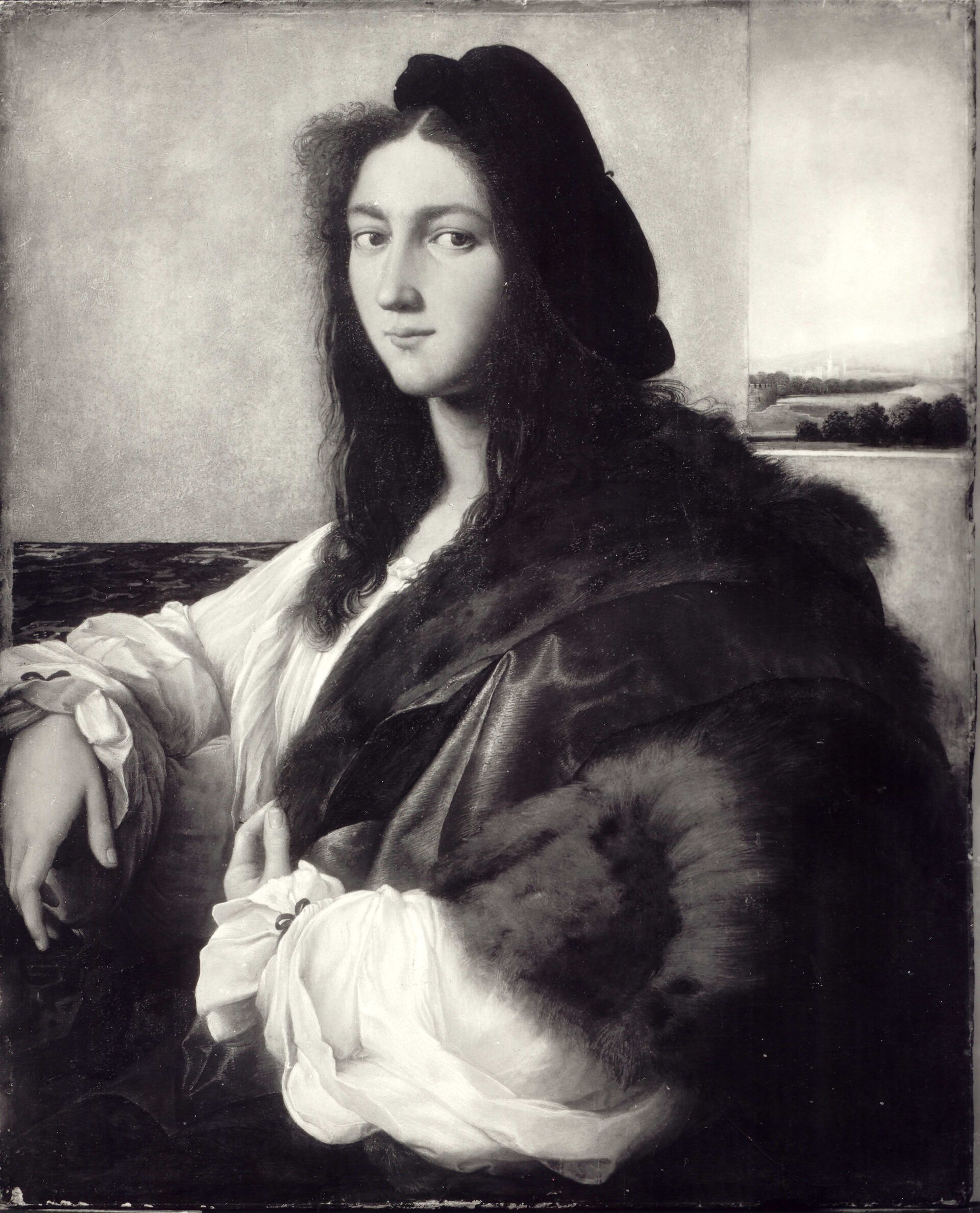
This is a photograph of the painting, not the painting. The panel has not been seen since January 1945, so every reproduction of it descends from photographs made before the war. This plate is the reproduction published in the 1950 Ministry of Culture and Art catalogue of paintings removed from Poland by the German occupation authorities, compiled by Wladyslaw Tomkiewicz, and it has been on Wikimedia Commons since 19 March 2007. Its file page carries the museum inventory number V. 239. The file page's Title field offers two of the proposed sitters, Francesco Maria della Rovere and Margherita Luti; neither identification is established.
| Artist | Raffaello Sanzio, called Raphael |
|---|---|
| Date | c. 1513-14; dates from c. 1509 to c. 1516 are given in the literature, and the Polish Wikipedia entry follows a dating of c. 1511 |
| Medium | Oil on panel (a cradled wooden panel, according to the Polish catalogue description). The Accademia Carrara copy is on canvas; the lost original is not. |
| Dimensions | 75 x 59 cm. The Polish Catalogue of Wartime Losses gives height 75.00 cm and width 59.00 cm, which settles the figure and shows that the ministry article's '59 x 75 cm' is width by height. The English-language Wikipedia entry's 72 x 56 cm is not supported by the catalogue and is recorded here only as a variant in circulation. |
| Where it is now | Missing since January 1945. The picture was last documented at the Morawa (Muhrau) palace in Lower Silesia, and no verified sighting since has been established. The Princes Czartoryski Museum in Krakow displays an empty frame in its place.last confirmed |
| Inventory number | Princes Czartoryski Collection, Krakow, museum inventory number V-239. Card 3095 in the Polish Catalogue of Wartime Losses, which records the object as not recovered. The collection was bought by the Polish state on 29 December 2016 and is administered by the National Museum in Krakow. Under the German occupation the picture was entered as number 141 in the catalogue Sichergestellte Kunstwerke im General Gouvernement. |
| Attribution | DisputedThe panel was catalogued as an autograph Raphael of the Roman years by the Princes Czartoryski Museum, and that is how it entered every register of Polish wartime losses. Full note |
| Object type | Painting |
| Period | Italian, High Renaissance, early sixteenth century |
| Cases | Disputed attribution · Has a provenance gap · Seized, looted or confiscated |
| Inscriptions | No inscription on the painted surface is recorded in the sources consulted, and the panel was not signed. Jerzy Miziolek notes that an inscription on the frame of the sixteenth-century copy in the Accademia Carrara, shown at the 2019 to 2020 Warsaw exhibition, has been read as suggesting that the sitter is a woman in male dress. That inscription belongs to the copy, not to this panel, and nothing is recorded about the lost picture's own frame. |
| Owners on record | 16 links13 documented, 1 disputed, 2 unknown |
| Sources | 36 cited |
About this record Last verified · 36 sources cited · Change log
On this page 13 sections
ContentsClose
A portrait panel of about 1513-14, given to Raphael, bought in Italy by Prince Adam Jerzy Czartoryski at the very end of the eighteenth century and shown in Krakow from 1882 as one of the three treasures of the Princes Czartoryski Museum, beside Leonardo's Lady with an Ermine and Rembrandt's Landscape with the Good Samaritan. All three were hidden at Sieniawa in August 1939 and all three were seized by the German occupation authorities. Two came back. This one did not.
The Polish Ministry of Culture and National Heritage traces it from Sieniawa to Jaroslaw, to a Berlin bank vault, back to Krakow for Hans Frank and then to two country houses in Lower Silesia in the last winter of the war. Its documented trail ends at the Morawa palace between 20 and 29 January 1945. Nothing verified has been recorded since, and it is by most published counts the most valuable painting still missing anywhere in the world.
What survives is a photograph, a set of old engravings, a sixteenth-century copy in Bergamo and an empty frame on a wall in Krakow. This record sets out what is actually documented, what is only asserted and which registers do and do not carry it.
The theft
Still missing
The Polish Ministry of Culture and National Heritage records that the painting was seized from a Czartoryski hiding place in 1939 and last documented in Lower Silesia in January 1945.
- 1801Bought The Ministry of Culture and National Heritage records that Prince Adam Jerzy Czartoryski bought the painting from the Giustiniani family in Italy for his mother's collection at Pulawy.13
- 1939-08Hidden The ministry records that the museum's director Marian Kukiel had the three most valuable paintings evacuated to Sieniawa in late August 1939 and hidden in an annex on the palace grounds.13
- 1939-10Confiscated The ministry records that the Gestapo seized the works in early October 1939 and took them to Jaroslaw, where Kajetan Muhlmann was stationed as Goring's special representative for securing art in occupied Poland.118
- 1939-11Taken The ministry states that the three pictures had in all probability reached Berlin by November 1939, and Hans Posse's travel diary records the painting in his Krakow entry of 27 and 28 November 1939 as having been sent to Berlin.15
- 1943Owned The ministry records that Frank's art adviser Wilhelm Ernst von Palezieux had the three paintings returned to Krakow in mid-1943 for the Governor General's residences.1
- 1944-08Hidden The ministry dates the picture's arrival at the Sichow palace to about August 1944 on the evidence of Palezieux's surviving notes and his post-war testimony.1
- 1945-01-20Hidden The ministry records that the collection was moved to the Morawa palace and that the works arrived there on 20 January 1945.1
- 1945-01-29Lost The ministry records that Gunther Grundmann loaded three truckloads at Morawa on 29 January 1945 and that by his journal and testimony this painting was not among them, and concludes that it disappeared while still in Lower Silesia.18
- 1950Listed The Ministry of Culture and Art published the painting in Wladyslaw Tomkiewicz's catalogue of paintings removed from Poland by the German occupation authorities between 1939 and 1945.19
- 2016-12-29Claimed The Ministry of Culture and National Heritage states that its purchase of the Czartoryski collection covered the Foundation's claims to cultural property lost during the Second World War, naming this painting.13
- 2025-12-09Listed The National Museum in Krakow, announcing the results of its Return of Raphael competition, describes the painting as the most sought-after artwork in the world and built the competition around the empty frame left in its place.21
In the official registers: Catalogue of Wartime Losses, Ministry of Culture and National Heritage, Republic of Poland Catalogue card 3095; museum inventory V-239, Muzeum XX Czartoryskich w Krakowie; recorded as not recovered. · WWII Most Wanted Art, Monuments Men and Women Foundation Raphael (Raffaello Sanzio), Portrait of a Young Man (1513/14); Ace of Spades in the March 2022 playing card deck; reward of up to 25,000 US dollars. Seen this work? Report it to the police or to the register, not to us.
Provenance
Each link is graded. Documented: a cited source supports it. Disputed: the identification is argued but not established. Unknown: no owner for that span, and the gap is not smoothed into a narrative. The grades in the glossary.
- c. 1513-14 - late 18th centuryUnrecorded, with a proposed early line through Giulio Romano and Federico II Gonzagaunknown
The Polish Wikipedia entry reports an early ownership line running from Raphael's pupil Giulio Romano to Federico II Gonzaga, Duke of Mantua, and then to the Giustiniani family. No document supporting that line is cited in any source consulted for this record, and nearly three centuries are unaccounted for. It is recorded here as a gap, not a chain.3
- late 18th century - c. 1798-1801Giustiniani family, Italydisputed
The Ministry of Culture and National Heritage states that Prince Adam Jerzy Czartoryski bought this picture and Leonardo's Lady with an Ermine from the Giustiniani family in Italy; the Polish Wikipedia entry places them in Venice. The seller is consistent across the Polish sources; the date is not, and no price is recorded anywhere consulted.13
- c. 1798-1801 - 1831Princess Izabela Czartoryska and Prince Adam Jerzy Czartoryski, Pulawydocumented
Bought by Adam Jerzy, who was Russian ambassador to Charles Emmanuel IV of Sardinia in 1799 to 1801, for his mother's collection at Pulawy, and displayed in the Gothic House beside the Leonardo and the Rembrandt as one of the Great Three. Izabela Czartoryska's own catalogue entry describes the picture. Dates of 1798, 1799 to 1801 and 1801 all appear in the literature.136
- 1831 - 1843Czartoryski family, in hiding and in transitdocumented
After the November Uprising the most valuable works were hidden in the basement of the Temple of the Sibyl, moved by night by the caretaker Franciszek Kozlowski to the Reformist monastery at Kazimierz, and in May 1832, with Daniel Ruprecht, Jozef Schmidt and the canon Pienkowski, taken to the Zamoyski estate at Klemensow and then to the Czartoryski palace at Sieniawa, where they were kept in an annex on the palace grounds.1
- 1843 - 1882Prince Adam Jerzy Czartoryski, then Prince Wladyslaw Czartoryski, Hotel Lambert, Parisdocumented
Adam Jerzy bought the Hotel Lambert in Paris in 1843 and had the collections brought there. Financial pressure led him to try to sell this painting: the ministry's account gives London in 1850, then Berlin for appraisal, and a return to Paris unsold in 1852; the Polish Wikipedia entry gives London in 1848 at an asking price of 15,000 francs and a return in 1851. Adam Jerzy died in 1861 and Wladyslaw inherited.13
- 1882 - 1914Princes Czartoryski Museum, Krakowdocumented
The Czartoryski Library was installed in a former armoury building in Krakow in December 1876; the ministry dates the arrival of the three paintings to 1882, after which they were on public display for about thirty years. Henryk Ochenkowski's museum catalogue of 1914 fixed the attribution to Raphael as the standard one.13
- 1914 - 1922On deposit, Gemaldegalerie, Dresdendocumented
Placed on deposit at Dresden by Maria Ludwika Czartoryska at the outbreak of the First World War. The ministry records that the gallery's director Hans Posse did what he could to prevent the deposit returning to a sovereign Poland, and that this picture did not reach Krakow again until 1922; the Polish Wikipedia entry gives 1920.13
- 1922 - 1939-08Princes Czartoryski Museum, Krakowdocumented
On display in Krakow beside Lady with an Ermine. Photographed by Stanislaw Mucha in 1930 and by the collections curator Stefan Komornicki in 1934.13
- 1939-08 - 1939-10Czartoryski family, hidden at Sieniawa and then Pelkiniedocumented
On the plan of the museum's director Marian Kukiel, the owner Augustyn Jozef Czartoryski and the curator Stefan Saturnin Komornicki moved the most prized works to Sieniawa in late August 1939 and hid them in the palace annex. German forces reached Sieniawa on 15 September; on 18 September the caretaker Zofia Szmit reported the hiding place plundered of jewellery and a royal coffer, the paintings still present. In late September the remaining works were allowed to move to Witold Czartoryski's palace at Pelkinie.13
- 1939-10 - 1939-11Seized by the German occupation authorities; Kajetan Muhlmann, Jaroslaw and Krakowdocumented
Seized by the Gestapo at Pelkinie in early October 1939 and taken to Jaroslaw, where Kajetan Muhlmann, appointed by Hermann Goring on 6 October 1939 as special representative for securing art in the occupied Polish territories, was stationed. Briefly held in a building of the Jagiellonian Library in Krakow. Entered as number 141 in the catalogue Sichergestellte Kunstwerke im General Gouvernement.118
- 1939-11 - 1943Held in Berlin for the planned Fuhrermuseum at Linzdocumented
In Berlin by November 1939, first in Muhlmann's office, on Eduard Plietzsch's post-war testimony, then at the Kaiser Friedrich Museum, then in a safe deposit box at the Deutsche Bank branch at 27 Unter den Linden. Hans Posse's travel diary records the picture under 27 and 28 November 1939. Reserved for the Linz museum. The Leonardo went back to Krakow in 1940; this painting stayed in the Berlin vault, which the ministry reads as a move to keep it out of Goring's reach after his directive of 5 November 1940 on the division of seized collections.15
- 1943 - 1944-08Hans Frank, Governor General, Krakowdocumented
Frank's art adviser Wilhelm Ernst von Palezieux, appointed 1942, organised the transports from Berlin and got the Great Three back to Krakow in mid-1943 for Frank's residences. The English-language Wikipedia entry treats Frank's Wawel residence as the picture's last recorded location; the Polish ministry's reconstruction does not stop there.14
- 1944-08 - 1945-01-20German evacuation depot, Sichow (Seichau), Lower Silesiadocumented
After the Red Army took Lviv in July 1944 Frank sent Palezieux to find a store in Lower Silesia; Manfred von Richthofen's palace at Sichow near Jawor was chosen. The ministry dates the picture's arrival there to about August 1944 on Palezieux's surviving notes and post-war testimony. The Austrian conservator Eduard Kneisel had charge of the works until January 1945.1
- 1945-01-20 - 1945-01-29German deposit at the Morawa (Muhrau) palace, Lower Silesiadocumented
Frank left Krakow on 17 January 1945; the collection was moved from Sichow to the palace of Hans Christoph and Herta von Wietersheim-Kramsta at Morawa, arriving 20 January. A document of 23 January transferred care to the mayor Robert Schnitzler and to Wilhelm Dressler of the local National Socialist People's Welfare branch. On 25 January Frank's aide-de-camp Helmut Pfaffenroth removed twenty paintings including the Leonardo and the Rembrandt to Bavaria; this picture was left because of the size of its board and does not appear on the February 1945 Neuhaus inventory. Gunther Grundmann reached Morawa on 29 January and loaded three truckloads for Cieplice; by his journal, his post-war testimony and his recollections, this painting was not among them.18
- 1945-01-29 - presentUnknownunknown
No verified sighting since. The ministry concludes the picture must have disappeared while still in Lower Silesia, and notes that no American record, troop report or Allied art team file mentions it reaching Coburg or Neuhaus. Robert Kudelski argues it was taken from Morawa by German officials of lower rank after Pfaffenroth's convoy left, and that one vehicle became separated from that convoy. Leads since 1945 have been pursued in Switzerland, the United States, East Germany, Australia and the Soviet Union and none has produced the object, an authenticated photograph or a document.189
- 2016-12-29 - presentPolish State Treasury, administered through the National Museum in Krakowdocumented
On 29 December 2016 Piotr Glinski signed for the State Treasury with Prince Adam Karol Czartoryski and the Princes Czartoryski Foundation: 100 million euros for 86,000 museum objects, 250,000 library objects and the buildings, together with the Foundation's claims to cultural property lost in the Second World War, this painting named among them, and the Sieniawa palace and park. The picture itself was not transferred, because it has not been found; the claim to it was.1314
Prices realised
This painting has never been sold at auction and has been missing since January 1945. Every figure below is for a different work and is given only as the market cohort. The one price ever attached to this picture is an asking price: the Polish Wikipedia entry records that Prince Adam Jerzy Czartoryski sent it to London to be sold at 15,000 francs and that no buyer was found.
| Date | Sale | Estimate | Result | Note |
|---|---|---|---|---|
| 8 December 2009 | Christie's Old Master and 19th Century Art, London | Sold at about double the pre-sale estimate | Hammer GBP 26,000,000 With premium GBP 29,200,000 GBP | NOT THIS OBJECT. Raphael's Head of a Muse, a black chalk study for the Parnassus fresco in the Stanza della Segnatura. Bought by an anonymous telephone bidder. About 47.5 million US dollars on the day, then a record for any work on paper and among the highest prices ever paid at auction for an Old Master. |
| 2004-03 | Private treaty sale to the National Gallery, London | GBP 35,000,000 offered by the J. Paul Getty Museum in September 2002, blocked by export stop | With premium GBP 22,000,000 GBP | NOT THIS OBJECT, AND NOT AN AUCTION. Raphael's Madonna of the Pinks, NG6596, oil on yew, 27.9 x 22.4 cm, bought from the 10th Duke of Northumberland's Wills Trust. The 22 million pound figure includes a government douceur and is therefore below the market price the Getty had offered; the difference is the tax relief that makes a private treaty sale to a domestic museum worth doing. Funded by the Heritage Lottery Fund at 11.5 million, the American Friends of the National Gallery at 10.5 million from John Paul Getty Junior's endowment, Sir Christopher Ondaatje at 1 million, the National Art Collections Fund at 400,000 and a public appeal at 70,000. The figure is entered under premium because there was no hammer. |
Hammer is the price at which the bidding stopped; with premium adds the fee the house charges the buyer on top. Hammer price and buyer's premium in the glossary.
Technical evidence
| Attribution note | The panel was catalogued as an autograph Raphael of the Roman years by the Princes Czartoryski Museum, and that is how it entered every register of Polish wartime losses. The attribution has never been tested by modern technical examination, because the object has not been available to examine since 1945; everything written about it since rests on photographs and on pre-war connoisseurship. The Polish Wikipedia entry, following Janusz Walek, records that Henryk Ochenkowski gave the picture to Raphael in the catalogue of the Czartoryski Museum collections published in 1914, and that writers questioning the attribution have been in the minority ever since. Earlier and later opinion has been less settled: earlier writers gave it to Raphael's workshop and to Gianfrancesco Penni, S. H. Fraser gave it to Palma Vecchio, Parmigianino and Sebastiano del Piombo have both been proposed, and Jozef Grabski has argued in print that the landscape handling and the Northern elements point away from Raphael altogether and towards a picture made after the artist's death in 1520, proposing Sebastiano del Piombo, Parmigianino or Giulio Romano. This record therefore grades the attribution as disputed and says so in the tombstone rather than in a footnote. |
|---|---|
| Support | Wooden panel, given in the Polish Catalogue of Wartime Losses as deska parkietowana, a cradled panel. Not canvas. The sixteenth-century copy in the Accademia Carrara, by contrast, is on canvas, which is one of the ways the two are told apart in reproduction.32033 |
| Medium | Oil on panel.123 |
| Dimensions | 75 x 59 cm. The Polish Catalogue of Wartime Losses, card 3095, gives height 75.00 cm and width 59.00 cm, which settles the figure and shows that the ministry article's '59 x 75 cm' is width by height. The English-language Wikipedia entry's 72 x 56 cm is unsupported by the catalogue.12433 |
| Signature | Unsigned.3 |
| Technical examination | None. No infrared reflectography, paint analysis, dendrochronology or X-radiography of this panel is recorded in any source consulted, because the object has not been available for examination since January 1945. Every judgement about its authorship rests on photographs and on pre-war connoisseurship.136 |
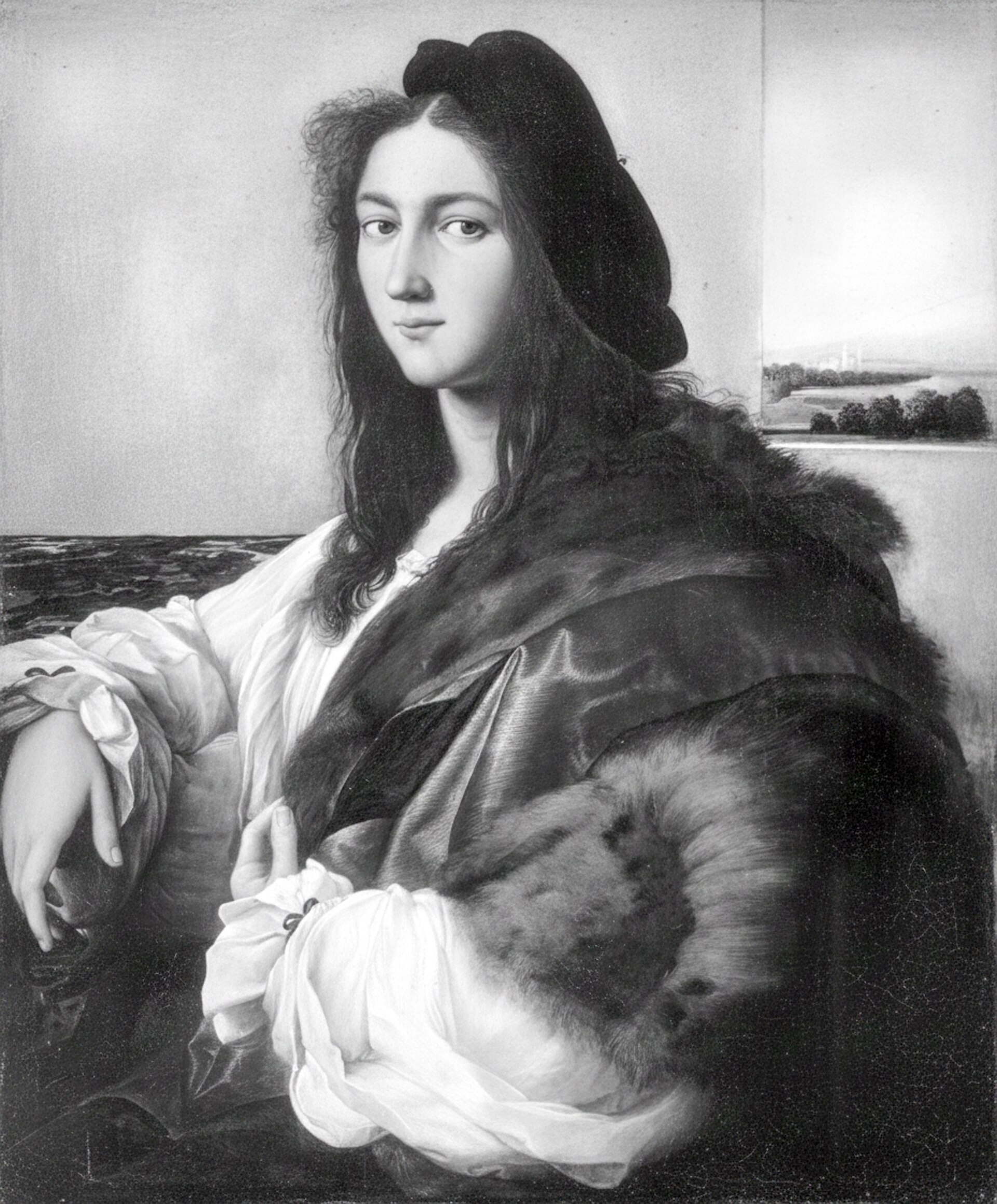
| Photographic record | Photographed by Antoni Pawlikowski before the First World War, by Stanislaw Mucha in 1930 and by the Czartoryski collections curator Stefan Komornicki in 1934. The image reproduced by the Polish government's wartime losses material derives from the 1950 Ministry of Culture and Art catalogue of paintings removed from Poland by the German occupation authorities, compiled by Wladyslaw Tomkiewicz; that plate has been on Wikimedia Commons since 19 March 2007 and its file page carries the inventory number V. 239.319 |
| Inventory and catalogue numbers | Museum inventory V-239, Muzeum XX Czartoryskich w Krakowie. Card 3095 in the Polish Catalogue of Wartime Losses, which records the object as not recovered. Under the German occupation it was entered as number 141 in the catalogue Sichergestellte Kunstwerke im General Gouvernement.11933 |
| Composition | Three-quarter-length seated figure at a cloth-covered table, in a fur-lined coat and dark beret over a white shirt, one hand at the breast holding the garment's hem and the other elbow on the table, a plain wall behind on one side and on the other a window opening onto a landscape of trees, walls and towers, a white church, buildings and distant mountains.3 |
| Known copies and versions | A sixteenth-century copy in the Accademia Carrara, Bergamo, inventory 446, oil on canvas, 77 x 62 cm, attributed to a pupil of Raphael. A free drawn copy by Anthony van Dyck. A painted response by Jan Lievens of about 1665 in the Wawel collection. Engravings from the seventeenth to the nineteenth century, the earliest known being that of Paulus Pontius. A full material reconstruction made in 2021 by Lukasz Nawrocki using early sixteenth-century materials and techniques.67202230 |
Images
The record in full
Chapter 1The object of this record is a photograph of an object
Every other record in this archive describes something a reader could in principle go and look at.
Every other record in this archive describes something a reader could in principle go and look at. This one cannot. The painting has not been seen by anyone who reported it since January 1945, and every statement about its colour, its surface, its condition and its handling now rests on black-and-white photographs taken before the war and on the memories of people who are dead.
That has a direct consequence for how the rest of this page must be read. The attribution cannot be tested. The dimensions cannot be measured, which is why two different sets of figures are still in circulation. The support cannot be examined, the underdrawing cannot be imaged and no dendrochronology has ever been done on the panel. Where a modern catalogue entry for a Raphael would carry a paragraph of technical evidence, this one carries a gap, and the gap is the single most important fact about the object.
Three photographic campaigns are recorded: by Antoni Pawlikowski before the First World War, by Stanislaw Mucha in 1930 and by the Czartoryski collections curator Stefan Komornicki in 1934. Those plates, and the 1950 Polish government catalogue of paintings removed from Poland by the German occupation authorities compiled by Wladyslaw Tomkiewicz, are the reason anyone can still recognise the picture at all.
Chapter 2What the panel showed
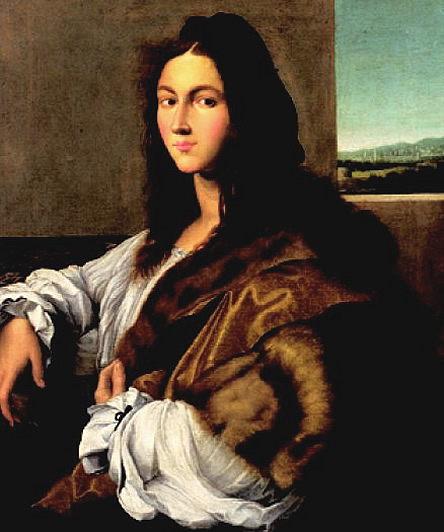
The composition, as the surviving photographs record it, is a three-quarter-length figure turned slightly to one side, seated indoors at a table covered with a patterned cloth.
The composition, as the surviving photographs record it, is a three-quarter-length figure turned slightly to one side, seated indoors at a table covered with a patterned cloth. The sitter wears a dark beret and a fur-lined coat over a white shirt, the left hand raised near the breast and holding the hem of the garment, which is lined in a different material, the right elbow resting on the table. Behind the figure the wall is plain on one side; on the other there is a rectangular window, and through it a landscape of trees, shrubs, towers, defensive walls, a white church, buildings and distant hazy mountains.
The Polish catalogue description records the support as a wooden panel that had at some point been cradled, and gives the size as 75 by 59 centimetres. The picture was not signed. Izabela Czartoryska's own catalogue entry, written around 1800, describes a figure of rare beauty in white clothing with fur at the side, one hand resting and the other lowered, before a window with a distant landscape, and it is recognisably a description of the same object.
Scale matters here in a way it usually does not. When Hans Frank's staff selected what to carry out of Lower Silesia in January 1945, the Leonardo and the Rembrandt went into the crates and this picture did not. The Polish Ministry of Culture and National Heritage records that it was left behind on account of the unwieldy size of the board. The Rembrandt is 46.2 by 65.5 centimetres and the Leonardo smaller still. A panel of 75 by 59 centimetres is not large by any museum standard, but it was large enough to lose it.
Chapter 3Nobody has ever established who the sitter was
The picture has been read as a self-portrait for four centuries, and that reading is itself a documented event rather than a fact about the painting.
The picture has been read as a self-portrait for four centuries, and that reading is itself a documented event rather than a fact about the painting. Paulus Pontius engraved the composition in the first half of the seventeenth century, and Miziolek identifies that print as the earliest known graphic version and the earliest surviving evidence that the image was being understood as Raphael's own likeness. The inscription on it compares Raphael to Apelles. Later states of the plate were still being sold in the twentieth century as being after a Raphael self-portrait from the National Museum in Krakow that disappeared in 1945.
The other candidates are all nineteenth- and twentieth-century proposals, and each has a named author. Giorgio Vasari's remark that Raphael made a portrait for Bindo Altoviti has repeatedly been pulled towards this picture, although the portrait securely identified as Altoviti is a different painting, now in Washington. Gruyer proposed Francesco Maria della Rovere in 1881. Liphardt and Ochenkowski, in the early twentieth century, proposed Federico Gonzaga. Oscar Fischel raised the possibility that the sitter was a woman. Miziolek records the associated suggestion that the figure might be Margherita Luti, the woman known as La Fornarina, in male dress. Janusz Walek's position, after the fullest modern study of the picture the Czartoryski collection has produced, was that the portrait is idealised rather than a likeness of one identifiable person at all.
One name that recurs in secondary accounts belongs to a different object. A separate Raphael Portrait of a Young Man, of about 1504 to 1508 and now in the Museum of Fine Arts in Budapest, oil on panel at 54 by 69 centimetres, is commonly identified as Pietro Bembo, although that identification is itself disputed and Agnolo Doni has been proposed instead. It is a separate picture and is not the panel described here. The two carry the same title in Polish and in English, the Polish encyclopaedia entries on them open with mutual warnings not to confuse them, and that is the reason Bembo's name attaches itself to this one in secondary accounts.
Five candidates, six if the idealised reading counts, and no document. This is not a case where the evidence is thin and a preferred answer is nonetheless available. It is a case where there is no evidence, and the honest entry is that the sitter is unknown.
Chapter 4The attribution is disputed, and has been more than once
The Polish Wikipedia entry, following Janusz Walek, records that Henryk Ochenkowski gave the picture to Raphael in the catalogue of the Czartoryski Museum collections published in 1914, and that...
The Polish Wikipedia entry, following Janusz Walek, records that Henryk Ochenkowski gave the picture to Raphael in the catalogue of the Czartoryski Museum collections published in 1914, and that writers questioning the attribution have been in the minority ever since. That became the standard attribution, the one under which it was shown for a quarter of a century and the one under which it was registered as a wartime loss. It is not the only attribution the picture has carried. Earlier opinion placed it variously in Raphael's workshop and with Gianfrancesco Penni, called Il Fattore, while S. H. Fraser gave it to Jacopo Palma Vecchio; Parmigianino and Sebastiano del Piombo have also been proposed.
The most sustained modern challenge is Jozef Grabski's. Grabski argues against Raphael's authorship on the handling of the landscape, which he reads as simplified and synthetic, and on the presence of Northern European elements, and concludes that the picture was made after Raphael's death in 1520. He names Sebastiano del Piombo, Parmigianino and Giulio Romano as possibilities, and reads the work as an idealised portrait of Raphael commissioned by a wealthy Italian family after he died. On that reading the picture is not a self-portrait, not a portrait of anyone else either, and not by Raphael, which would make the most famous Polish war loss a posthumous homage to the artist it is named for.
There is no way to settle this. An attribution dispute of this kind is normally resolved, or at least narrowed, by infrared reflectography of the underdrawing, by paint sampling and by examination of the panel itself. None of those things can be done to a painting nobody can find. The dispute will stay open for exactly as long as the object stays missing, and that is the position this record takes.
Chapter 5How an Italian portrait became a Polish national object
The collection it belonged to was built by Princess Izabela Czartoryska nee Fleming at Pulawy, and it was built with an explicit programme.
The collection it belonged to was built by Princess Izabela Czartoryska nee Fleming at Pulawy, and it was built with an explicit programme. She was not assembling a picture gallery for its own sake; the aim, as the ministry's own account puts it, was to gather objects that would preserve the memory of momentous events in the history of Poland. The Temple of the Sibyl, completed in 1801 as a replica of the ruined Sibyl temple at Tivoli, carried the phrase The Past to the Future on its front. A second building, the Gothic House, was put up next to it to hold the foreign works.
Her son Prince Adam Jerzy Czartoryski, travelling with his brother Konstanty, was Russian ambassador to Charles Emmanuel IV of Sardinia in 1799 to 1801, and used his travels to buy for his mother's collection. The Ministry of Culture and National Heritage records that his most notable purchases were this picture and Leonardo's Lady with an Ermine, both from the Giustiniani family in Italy. The Polish Wikipedia entry names both Adam Jerzy and Konstanty Czartoryski as the buyers, places the Giustiniani in Venice and, following Grabski, dates the purchase specifically to 1801 on the argument that Adam Jerzy's ministerial duties later restricted his travel. Other accounts give 1798 or the span 1798 to 1801. The purchase price has not been established in any source consulted for this record.
Those two pictures, with Rembrandt's Landscape with the Good Samaritan, went on show in the Gothic House and became known as the Great Three. Around them stood a library of some two and a half thousand manuscripts and a working collection that eventually ran to about sixteen thousand Polish objects and over twenty-two thousand foreign ones. The Raphael was never an isolated masterpiece. It was one leg of a tripod, and the whole point of the tripod was that it stood for a country that had ceased to exist as a state.
Chapter 7The picture nobody would buy
Adam Jerzy fled Poland under a Tsarist warrant, bought the Hotel Lambert in Paris in 1843 and had the collections brought to him there.
Adam Jerzy fled Poland under a Tsarist warrant, bought the Hotel Lambert in Paris in 1843 and had the collections brought to him there. He was then short of money, and he decided to sell this picture along with one of the collection's most important pieces of jewellery. The ministry's account says the painting was sent to London in 1850 and then on to Berlin to be shown to appraisers, that no buyer could be found, and that it came back to Paris in 1852. The Polish Wikipedia entry gives a different chronology for the same episode: sent to London in 1848 with an asking price of 15,000 francs, unsold, returned to Paris in 1851. The two accounts cannot both be right and this record does not choose between them.
What is not in dispute is the outcome. The most valuable painting Poland would ever lose was offered for sale in the two strongest markets in Europe, by an owner who needed the money, and nobody took it. That is a fact about the nineteenth-century market in Raphael attributions, and it is worth holding next to the modern estimate of more than a hundred million dollars. A painting is worth what someone will pay on the day, and on this painting's only recorded day in the market, the answer was nothing.
Adam Jerzy died in 1861. His heir Wladyslaw Czartoryski decided to use the milder political conditions in the Austrian partition to bring the collection home, and in December 1876 the Princes Czartoryski Library was installed in a former armoury building in Krakow. The paintings themselves followed later: the ministry dates the arrival of the Leonardo, the Raphael and the Rembrandt in Krakow to 1882.
Chapter 8Dresden, and a director who did not want to give it back
In 1914 Wladyslaw's daughter-in-law Maria Ludwika Czartoryska put the most valuable pieces on deposit at the Gemaldegalerie in Dresden for safekeeping.
In 1914 Wladyslaw's daughter-in-law Maria Ludwika Czartoryska put the most valuable pieces on deposit at the Gemaldegalerie in Dresden for safekeeping. When the war ended and Poland was a state again, the director of the Dresden gallery did what he could to keep the deposit from going home. The ministry names him: Hans Posse. The picture did not return to Krakow until 1922, and the Polish Wikipedia entry gives 1920 for the return with the same note about Posse's delays.
Posse is not a walk-on part in this story. Seventeen years later he was Hitler's plenipotentiary for the museum planned at Linz, with authority over the pick of everything seized in occupied Europe, and this same picture was reserved for Linz on his say-so. The online scholarly edition of his travel diaries records the painting under 27 and 28 November 1939 in the Krakow entry, notes that it had gone to Berlin with the Leonardo and the Rembrandt for so-called safekeeping, and states plainly that the work remains missing to this day. The man who did not want to release it from Dresden in 1919 was the man who decided where it went in 1939. The sources consulted do not establish that he acted on that history, and this record does not claim that he did; it records the coincidence because it is on the face of the documents.
Chapter 9The crate marked LRR
In 1939 the director of the Princes Czartoryski Museum, the retired general Marian Kukiel, drew up a plan to protect the holdings.
In 1939 the director of the Princes Czartoryski Museum, the retired general Marian Kukiel, drew up a plan to protect the holdings. He advised the collection's owner Augustyn Jozef Czartoryski and its curator Stefan Saturnin Komornicki to move the most prized works to Sieniawa, and selected pieces left Krakow in late August 1939. The Great Three went with them, along with a collection of antique jewellery and objects connected with Polish rulers, and everything was hidden in the annex on the palace grounds that had served the same purpose in the 1830s. The Polish Wikipedia entry records that the three paintings travelled in a crate marked LRR, for Leonardo, Rembrandt and Raphael.
German forces reached Sieniawa on 15 September 1939. On 18 September the estate's caretaker Zofia Szmit reported that the hiding place had been plundered. What went first was the jewellery and a royal coffer holding dozens of objects connected with Polish ruling houses; the paintings were still there. In late September the German authorities allowed what remained to be moved to Witold Czartoryski's palace at Pelkinie, and in early October 1939 the Gestapo seized it there and took it to Jaroslaw.
Chapter 10The men who took it, and the office they worked for
Stationed at Jaroslaw was Kajetan Muhlmann, an Austrian art historian and SS officer, appointed on 6 October 1939 by Field Marshal Hermann Goring, later Reichsmarschall, as his special representative...
Stationed at Jaroslaw was Kajetan Muhlmann, an Austrian art historian and SS officer, appointed on 6 October 1939 by Field Marshal Hermann Goring, later Reichsmarschall, as his special representative for securing art and cultural objects in the former Polish territories. The Lexikon der oesterreichischen Provenienzforschung records that he ran the systematic looting of occupied Poland through organised parties that located and catalogued works and that he assembled five photograph albums covering 521 objects for the Linz museum. He later set up the Dienststelle Muhlmann in The Hague and took a fifteen per cent commission on sales.
The collection went briefly from Jaroslaw to a building of the Jagiellonian Library in Krakow. The ministry's account states that the Great Three were in all probability in Berlin by November 1939 and that they were first kept in Muhlmann's own office, on the post-war testimony of the Dutch art historian Eduard Plietzsch, who worked with him.
Plietzsch is the source of the most persistent false story about this painting. Under one interrogation he said that the building housing Muhlmann's office had burned down after an Allied air raid, and that account is very probably the origin of the post-war belief that the picture was destroyed by fire in Berlin. Under fuller questioning he admitted that the paintings had been moved out before the raids, first to the Kaiser Friedrich Museum and then into a safe deposit box at the Deutsche Bank branch at 27 Unter den Linden. The ministry's own position is that the fire theory rests on ignorance and speculation and that there is no credible evidence for it.
The picture was entered into the German occupation catalogue of works secured in the General Government, the Sichergestellte Kunstwerke im General Gouvernement, at number 141. Muhlmann himself was arrested on 13 June 1945 and interrogated by the US Counter Intelligence Corps, and his testimony was used at Nuremberg. He walked out of a Munich hospital on 16 February 1948 and stayed in Bavaria; Polish extradition requests were not met, and he died in Munich on 2 August 1958.
Chapter 11Two collectors, one painting, and an order of precedence
The Leonardo went back to Krakow in 1940.
The Leonardo went back to Krakow in 1940. The Raphael stayed in the Berlin bank vault with several other paintings, and the reason it stayed there has less to do with security than with a dispute inside the German leadership. Hans Posse had already reserved the Great Three for Linz. Goring, Muhlmann's patron, wanted them for Carinhall.
The ministry's account sets out the mechanism. On 5 November 1940 Goring issued a directive fixing the order in which seized museum collections were to be divided: first works reserved by Hitler for his own use, second works for the Reichsmarschall's collection, third works of use to the planned Hohe Schule or falling under Alfred Rosenberg's jurisdiction and fourth works for German museums, to be inventoried by Rosenberg's staff. In 1942 the Leonardo was taken back to Berlin on the stated ground of protecting it from air raids, which the ministry reads as Goring's attempt to take it for himself.
The consequence for this painting was that Posse, with Hitler's approval, is judged to have put the Great Three on temporary deposit with the Governor General in Krakow specifically to keep them out of Goring's reach. The picture was moved for the third time in three years not because anyone thought it was safer in Krakow, but because two men were competing for it.
Chapter 12Back to Krakow, for Hans Frank
In 1942 the Governor General Hans Frank appointed the Swiss architect Wilhelm Ernst von Palezieux as his personal art adviser.
In 1942 the Governor General Hans Frank appointed the Swiss architect Wilhelm Ernst von Palezieux as his personal art adviser. Palezieux designed the interiors of Frank's residences at Krakow, Krzeszowice and Krynica Zdroj, and organised the transports from Berlin of the paintings that would hang in them. Despite obstruction from Goring's people, he got the Great Three back to Krakow in mid-1943. Frank had them for a matter of months.
This is the period that most short accounts of the picture compress into a single sentence about Hans Frank hanging a Raphael at Wawel. The compression matters, because the English-language Wikipedia entry treats Frank's return of the paintings to Wawel in January 1945 as the last documented sighting of this one. The Polish Ministry of Culture's own reconstruction, published on its wartime losses site and based on Palezieux's surviving notes and post-war testimony, does not end there. It ends more than two hundred kilometres away.
Chapter 13The last three weeks it was seen
In July 1944 the Red Army took Lviv, and Frank began to evacuate the collections held in Krakow.
In July 1944 the Red Army took Lviv, and Frank began to evacuate the collections held in Krakow. He sent Palezieux into Lower Silesia to find a store. The site chosen was Manfred von Richthofen's palace at Sichow, in German Seichau, near Jawor. The ministry dates the picture's arrival there to about August 1944 on the evidence of Palezieux's notes and his post-war testimony. Until January 1945 the works at Sichow, the Great Three among them, were in the care of the Austrian conservator Eduard Kneisel.
On 17 January 1945 Frank left Krakow for Lower Silesia and a provisional General Government office was set up at Sichow. Office space ran short, so the art was moved again, to the palace of Hans Christoph and Herta von Wietersheim-Kramsta at Morawa, in German Muhrau, near Strzegom. The works arrived on 20 January 1945. On 23 January a formal document transferred care of the deposit at Morawa to the town's mayor Robert Schnitzler and to Wilhelm Dressler of the local National Socialist People's Welfare branch.
On 25 January Frank's aide-de-camp Helmut Pfaffenroth took twenty paintings and other valuables out of Morawa in three crates, bound for Bavaria. The Leonardo and the Rembrandt were in them. This picture was not; the ministry records that it was left at Morawa because of the size of the board. The inventory of what Pfaffenroth delivered to Neuhaus in February 1945 does not mention it.
The same day, the Lower Silesian conservator Gunther Grundmann was ordered from Berlin to evacuate the most valuable works in his province into Germany. He reached Morawa on 29 January 1945 and, with soldiers stationed there, loaded three truckloads, which went on 30 January to the Schaffgotsch Library at Cieplice. By Grundmann's own journal, his post-war testimony and his later recollections, this painting was not among them. It follows that it was also not in the consignment Grundmann sent from Cieplice to Coburg in February 1945, which carried sixty-five paintings and several tapestries belonging to Polish museums and which the Americans took over and eventually returned to Krakow in late April 1946.
So the documented window is nine days wide. The picture was at Morawa on 20 January 1945 and it was not at Morawa on 29 January 1945. Nothing in the American records, the reports of US troops or the files of the Allied art teams mentions it reaching Coburg or Neuhaus. The ministry's conclusion is that it must have disappeared while still in Lower Silesia. Robert Kudelski, whose research underlies the ministry's account, has argued that it was taken from Morawa after Pfaffenroth's convoy left, by German officials of lower rank, and notes that one vehicle became separated from that convoy on the road to Bavaria.
Hans Frank was arrested at Neuhaus on 4 May 1945. The Leonardo and the Rembrandt were recovered from his household. This picture was not there, and the reason it was not there is that it had never gone.
Chapter 14Eighty years of leads
The search started immediately. The ministry records that the picture was at the top of the Polish list of wartime losses from 1945, and that Polish, American, German and Swiss officials all...
The search started immediately. The ministry records that the picture was at the top of the Polish list of wartime losses from 1945, and that Polish, American, German and Swiss officials all investigated. Helmut Pfaffenroth was handed to the Polish authorities in late 1946 after American interrogation. Palezieux was picked up in 1947 and tried in Krakow in 1948 over his part in the removal of works of art. Neither trial produced anything usable about this painting.
Karol Estreicher, who had run the Office for the Revindication of Cultural Losses in London during the war and then served as the Ministry of Culture and Art's delegate for tracing Polish monuments in Germany, searched for it with good access to the Allied art units and found nothing; the ministry records that he came to believe the Berlin fire story himself. Stanislaw Lorentz, director of the National Museum in Warsaw, followed leads for years without result. From the early 1950s Stefan Zamoyski, husband of Elzbieta Czartoryska, ran a private search for nearly a decade with support from Ardelia Hall of the US State Department and lawyers in several countries. He traced and interviewed witnesses, including Kneisel, by then in New York. He was due to meet Palezieux in Paris in 1953 and the meeting never happened because Palezieux died in a car accident weeks before it; the National Geographic Polska account gives Palezieux's death as 1955, and the two dates are not reconcilable from the sources consulted. Kneisel was interviewed in the early 1960s and said nothing new, and the investigation, which involved the FBI, seems to have prompted him to leave the United States for Vienna. By the late 1960s Zamoyski had agreed to accept 100,000 marks in compensation from the Federal Republic of Germany. The ministry records that the money was never paid.
The specific leads since are worth listing, because the shape of them is the story. Rzeczpospolita's 2017 survey records: a 1947 Swiss line of inquiry in which the Polish diplomatic mission suspected a transfer to neutral territory and Swiss authorities checked warehouses and banks, which produced a seventeenth-century copy in Zurich and nothing else; an approach in the 1950s or 1960s in which dealers were said to have offered the painting to the Metropolitan Museum in New York, with negotiations that failed; reports placed in the 1970s and 1980s that it was held by state security officials in East Germany, alongside periodic Swiss dealer approaches in those decades with diplomatic checks made in Zurich; a 1977 report in which the historian Sasha Grishin was sent a photograph of the portrait said to be in a safe deposit box in a Brisbane bank, which could not be assessed and which was subsequently lost; a stronger Australian lead in the mid-1980s in which an American visitor showed a photograph to the National Museum in Warsaw and said the painting was in Australia, after which contact was lost, with an Italian dealer separately telling the museum's director it was in a Melbourne vault; and a 1996 suggestion from a Ukrainian museum representative that it had been seen in the residence or office of a Soviet general named Kuznetsov. National Geographic Polska adds the possibility that Soviet trophy brigades under Boris Filipov took it, and records it as unverified.
Not one of these has ever produced the object, a photograph that could be authenticated or a document. They are listed here in full because a reader who encounters any one of them in isolation should be able to see it as one of a long series, every member of which failed in the same way.
Chapter 15What was actually said in 2012
In the summer of 2012 the Polish press reported that the painting had been found.
In the summer of 2012 the Polish press reported that the painting had been found. The Center for Art Law's clipping of the 2 August 2012 report quotes a spokesman for the Office for the Restitution of Cultural Goods at the Ministry of Foreign Affairs saying that the work was not lost in the turmoil of the war, that it had not been burnt or destroyed, that it exists and that it is safely waiting in a region of the world where the law favours Poland. The country was not named. The headlines that followed said the painting was waiting in a bank safe and that the ministry knew where it was.
The correction came within days and was more specific than the story. Money.pl's report of 1 August 2012 records the ministry's plenipotentiary for cultural restitution, Professor Wojciech Kowalski, saying that the reports were an over-interpretation: the ministry had received information suggesting the painting was in a bank safe, but did not know where that safe was. The ministry's formal statement said it did not possess information about the painting's exact location, contrary to what the reporting had implied, while confirming that it was following leads about possible locations. The ministry spokesman Marcin Bosacki said publicly that there was no success to report and that the fact the Raphael survived the war had been known for years.
One further explanation of the loss belongs beside the others and is not in the ministry's account. The Polish Wikipedia entry records that Frank's art plenipotentiary Wilhelm Ernst von Palezieux is alleged to have confused this painting with another work, and that the confusion led to its disappearance. No document is cited for it and it sits in the same class as the rest.
The ministry's own wartime losses site, writing later, describes the 2012 headlines and says flatly that the reports were quickly refuted by the diplomatic service. The English-language Wikipedia entry characterises the whole episode as a hoax report. The narrower and better-supported statement is the one the ministry itself made: an unverified lead about a bank safe of unknown location, reported as a discovery.
Chapter 16Who owns the claim now
On 29 December 2016, at the Royal Castle in Warsaw, the Deputy Prime Minister and Minister of Culture Piotr Glinski signed an agreement on behalf of the State Treasury with Prince Adam Karol...
On 29 December 2016, at the Royal Castle in Warsaw, the Deputy Prime Minister and Minister of Culture Piotr Glinski signed an agreement on behalf of the State Treasury with Prince Adam Karol Czartoryski and the Princes Czartoryski Foundation. The price was 100 million euros for 86,000 museum objects and 250,000 library objects, together with the buildings.
The ministry's own communique makes clear that the transaction was not confined to things that exist. It covered the Foundation's claims to cultural property lost during the Second World War, and it named this painting when it did so. It also covered the historic palace and park at Sieniawa, valued at over 22 million zloty, which is the estate the pictures were hidden at in 1939. The ministry's statement notes that the price was far below the value of individual works in the collection and that the Leonardo alone had been insured by the Foundation at 300 million euros for international loans.
The consequence is straightforward and is often got wrong. Apollo Magazine's account of the sale states that the missing works were not part of the transfer because they had never been recovered. The Polish ministry's communique says otherwise: the claim itself was bought. If this painting is found, the party with the title to pursue is the Polish state, not the Czartoryski family, and it has been since the end of 2016.
Chapter 17Where it is registered, and where it is not
This record checked four registers and found the picture in fewer of them than its reputation would suggest.The Polish catalogue of wartime losses, run since 1992 by the Ministry of Culture and...
This record checked four registers and found the picture in fewer of them than its reputation would suggest.
The Polish catalogue of wartime losses, run since 1992 by the Ministry of Culture and National Heritage and now holding about 70,000 records, carries the picture as card 3095. The entry gives the owner as the Muzeum XX Czartoryskich w Krakowie, the museum inventory number as V-239, the date as 1514, the material as a cradled panel, the technique as oil, the height as 75.00 centimetres and the width as 59.00 centimetres; under the heading recovered it says no. That last line settles the dimensions question: 75 is the height and 59 the width, so the ministry article's figure of 59 by 75 is width by height and the two are the same measurement.
Reaching that entry took four attempts. The catalogue's own domain refused a plain HTTPS request at the origin, timed out on a plain HTTP request with a browser user agent and would not load in the in-app browser. A domain-scoped search returned the object page directly, and the entry was then read in an Internet Archive capture of 1 September 2025. The ministry's longer article on the painting, which is the source of most of the wartime chronology on this page, was read the same way. The museum inventory number V-239 was also printed, all along, on the Commons file page of this record's own lead plate.
The German Lost Art Database at lostart.de was searched directly on 25 September 2026. It has no entry for this painting. A search on the owner's name, Czartoryski, returns exactly three records and none of them is this object; the database does hold ninety-nine records carrying the common title Bildnis eines jungen Mannes, and none of the three Czartoryski records is this painting. That is not an oversight by anybody: lostart.de records German losses and claims filed in Germany, and a Polish state war loss is carried in the Polish catalogue. It is worth stating plainly because the picture is routinely described as being listed in the German database, and on the evidence of a direct search it is not.
INTERPOL's Stolen Works of Art Database holds nearly 57,000 items and is described by INTERPOL as the only international database carrying certified police information on stolen and missing art. Full real-time access requires authorisation; public access is through the ID-Art application. No publicly citable individual record could be confirmed for this object, so no INTERPOL identifier is recorded here.
The Monuments Men and Women Foundation lists the picture in its WWII Most Wanted Art programme, gives it as oil on panel at 75 by 59 centimetres, describes it as not seen since 1945 and widely considered the most important work of art still missing since the Second World War, and offers a reward of up to 25,000 US dollars. The English-language Wikipedia entry records that the Foundation gave the painting the Ace of Spades in the playing card deck it issued in March 2022. The FBI's National Stolen Art File could not be checked: the page returned HTTP 403 to a plain request and no search of the file was possible from here.
Chapter 18What it would be worth, and why that number is soft
The figure in general circulation is more than 100 million US dollars.
The figure in general circulation is more than 100 million US dollars. The English-language Wikipedia entry traces it to Lynn H. Nicholas's The Rape of Europa of 1994, where the suggestion is that if recovered the painting would be worth in excess of that sum; National Geographic Polska and the National Museum in Krakow both repeat it. No method is published behind it in any source consulted, and it should be read as an order of magnitude rather than a valuation.
The market cohort is small and is worth setting out, because it is the only real check available. On 8 December 2009 Christie's in London sold Raphael's Head of a Muse, a black chalk study for the Parnassus fresco, at a hammer price of 26 million pounds, 29.2 million pounds with fees, about 47.5 million US dollars on the day; it was then a record for any work on paper and among the highest prices ever paid at auction for an Old Master. That is a drawing.
The comparison that matters more is the Madonna of the Pinks. The National Gallery in London acquired it in March 2004 for 22 million pounds from the Northumberland estate, after the UK Reviewing Committee on the Export of Works of Art blocked a proposed 35 million pound sale to the Getty Museum in September 2002; the gallery's own catalogue entry names Ralph George Algernon Percy, 12th Duke of Northumberland, as the party who had agreed that sale. The 22 million pound figure is not a market price: it includes a douceur from the government, the tax relief that makes a private treaty sale to a domestic museum worth the seller's while. The Heritage Lottery Fund put in 11.5 million pounds, the American Friends of the National Gallery 10.5 million from John Paul Getty Junior's endowment, Sir Christopher Ondaatje 1 million, the National Art Collections Fund 400,000 and a public appeal 70,000. The picture is 27.9 by 22.4 centimetres, oil on yew.
So the honest cohort reads: a small Raphael Madonna panel at an open-market offer of 35 million pounds in 2002, a Raphael drawing at 29.2 million pounds in 2009 and a full-length signed-off figure of over 100 million dollars for this painting that nobody has tested. There is also a reason to think the number would be higher rather than lower if it ever came up, and it is not connoisseurship. It is that a picture with this provenance would sell as the recovery of the most famous missing painting in the world, and that is a separate commodity from a Raphael portrait.
One period figure is recorded, and it goes the other way. When Adam Jerzy Czartoryski tried to sell it in London, the Polish Wikipedia entry gives his asking price as 15,000 francs. Nobody bought it.
Chapter 19How the picture is still reproduced
Because the object is gone, its copies have become the primary material, and they are better than the situation deserves.The Accademia Carrara in Bergamo holds a sixteenth-century copy, inventory...
Because the object is gone, its copies have become the primary material, and they are better than the situation deserves.
The Accademia Carrara in Bergamo holds a sixteenth-century copy, inventory 446, oil on canvas, 77 by 62 centimetres, which Miziolek describes as probably by one of Raphael's pupils. It is the closest thing to the picture that anyone can stand in front of. The National Museum in Warsaw built its exhibition of 21 November 2019 to 19 January 2020, mounted for the five hundredth anniversary of Raphael's death with the National Museum in Krakow and Wawel Royal Castle, around exactly that canvas. Comparing the Bergamo copy against the surviving pre-war photograph shows small differences, notably in the drawing of the thumb of the right hand, which is the kind of evidence that only exists because both the photograph and the copy survived.
Around it the Warsaw exhibition placed Jan Lievens's Portrait of a Young Man from the Wawel collection, of about 1665, which takes the composition into Flemish baroque handling, and six engravings of the seventeenth to nineteenth centuries. Anthony van Dyck made a free drawn copy of the composition. The engraved tradition starts with Paulus Pontius, whose print is the earliest graphic version known and whose inscription sets Raphael beside Apelles. Later states of the Pontius plate are still traded: one, described as the third state and inscribed as after the Raphael self-portrait that disappeared from the Krakow museum in 1945, was offered at Bassenge on 27 November 2019 as lot 5808, with an estimate of 600 euros.
There is also a modern object that exists because the original does not. In 2021 the painter and researcher Lukasz Nawrocki completed what was described as the only faithful reconstruction of its kind in the world, made with the materials and techniques of the early sixteenth century over nearly a year of work, and based on studies of Raphael's technique rather than on the painting itself. It was shown at the Czartoryski Museum at Pulawy until 31 August 2021 and then returned to its maker.
Chapter 20What is on the wall in Krakow now
The Princes Czartoryski Museum reopened on 19 December 2019 after a long restoration.
The Princes Czartoryski Museum reopened on 19 December 2019 after a long restoration. The Leonardo is there. The Rembrandt is there. In the place where the third picture hung there is an empty frame, and the Polish government's own public statement on wartime losses records that fact and adds that the Polish state will never stop searching for this work and for the other cultural property seized during the Second World War. The Polish Wikipedia entry adds that a photographic reproduction is shown within the frame beside Lady with an Ermine, and flags its own sentence as needing a citation. The English-language entry goes further and says the original empty frame of the painting hangs in the National Museum in Krakow, giving no source for the word original. This record could not confirm from a museum source whether the frame on display is the picture's own historic frame.
The museum is also still working the absence. On 9 December 2025 the National Museum in Krakow announced the results of Powrot Rafaela, the Return of Raphael, an international competition that invited entrants aged seven to seventy-seven to make digital self-portraits using Renaissance technique through the Glaze application. It drew 1,250 entries from four continents, was judged by a panel including representatives of the Metropolitan Museum of Art, the Colnaghi Foundation and Sotheby's Institute of Art; the winning works went on show at the Czartoryski Museum from 8 December. The museum's own framing of the competition calls the painting the most sought-after artwork in the world and builds the whole exercise around the empty frame.
The Ministry of Culture and National Heritage states that nearly 800 objects have been returned to their home collections and that its wartime losses database now holds about 70,000 records. That machinery works, steadily, and it has been running against this one object for eighty-one years without a result.
Chapter 21What can be said and what cannot
Four things are documented well enough to state without hedging.
Four things are documented well enough to state without hedging. The picture existed and was photographed repeatedly before the war. It was taken by the German occupation authorities from a hiding place at Sieniawa in the autumn of 1939, and entered the German catalogue of secured works in the General Government at number 141. It was not at the Morawa palace in Lower Silesia on 29 January 1945. The ministry records the collection arriving there on 20 January; that this panel was among the works that arrived that day is an inference from the ministry naming it at the 25 January decision to leave it behind, and it is a sound one. Nothing verified has been recorded since.
Three things are asserted and should be read as assertions. That it survives is the Polish state's position, restated for decades, and rests on the absence of evidence of destruction rather than on evidence of survival. That it burned in Berlin is a story traceable to one interrogation answer that the same witness later withdrew, and the Polish ministry rejects it. That it was destroyed by a retreating German unit is a scene in a 2014 feature film and has no documentary basis at all.
The rest is a list of leads that went nowhere in Switzerland, New York, East Germany, Brisbane, Melbourne and the Soviet Union. A reader who wants a conclusion can have this one: the object was last in the hands of people whose names are known, in a house whose address is known, in a week that is known to within nine days, and eighty-one years of official searching by four countries has not moved the account past that point.
The artist
Raffaello Sanzio da Urbino, called Raphael
Raphael died at thirty-seven with the largest workshop any Old Master is known to have run, the architecture of St Peter's on his desk and the antiquities of Rome under his authority. That compression is the thing to hold on to when reading any attribution question about him: the Roman decade produced an enormous quantity of work under his name, much of it by other hands in his shop, and the boundary between what he painted and what his workshop painted has been argued over ever since. A disputed Roman-period portrait is not an anomaly in this corpus. It is the normal condition of it.
Exhibited
- 2019-2020Portret mlodzienca. W poszukiwaniu zaginionego arcydziela Rafaela (Portrait of a Young Man. In search of Raphael's lost masterpiece), 21 November 2019 to 19 January 2020. The lost picture was not shown; the Accademia Carrara copy was, with Jan Lievens's Portrait of a Young Man from Wawel and six engravings of the seventeenth to nineteenth centuries.Muzeum Narodowe w Warszawie (National Museum in Warsaw), with the National Museum in Krakow and Wawel Royal Castle
- 2021Lukasz Nawrocki's material reconstruction of the painting, made with early sixteenth-century materials and techniques, shown until 31 August 2021Czartoryski Museum, Pulawy
- 2025Powrot Rafaela (Return of Raphael): winning entries in an international competition built around the picture's empty frame, announced 8 December 2025Princes Czartoryski Museum, Krakow
Literature
- Janusz Walek, Rafaela Portret mlodzienca ze zbiorow Czartoryskich, in Rozprawy Muzeum Narodowego w Krakowie, vol. I; and The Czartoryski Portrait of a Youth by Raphael (1991) The fullest study from the holding collection's own side. Cited at second hand in this record: the PDF on the museum's server returned HTTP 404 on 25 September 2026.
- Jozef Grabski, Zaginiony Portret mlodzienca ze zbiorow XX. Czartoryskich (2003, 2004) The principal published challenge to the attribution to Raphael. Cited at second hand through the Polish Wikipedia entry.
- J. Robert Kudelski, Zaginiony Rafael. Kulisy najwiekszej kradziezy nazistow (2014) The archival reconstruction of the wartime chain, by the author of the Polish Ministry of Culture's own published account of the loss.
- Wladyslaw Tomkiewicz, Catalogue of paintings removed from Poland by the German occupation authorities during the years 1939-1945, vol. 1, Foreign paintings, Ministry of Culture and Art, Warsaw 1950 The founding Polish register of the losses and the source of the most widely reproduced photograph of this picture.
- Lynn H. Nicholas, The Rape of Europa (1994) Source of the figure of more than 100 million US dollars usually attached to the painting. Cited at second hand through the English-language Wikipedia entry; no method is published behind the figure in any source consulted.
Related works
| Work | Relation | Where it is |
|---|---|---|
| Lady with an Ermine Leonardo da Vinci | Taken with it in 1939; recovered in 1945 Bought by Adam Jerzy Czartoryski on the same Italian travels and hidden in the same crate at Sieniawa. Sent to the Kaiser Friedrich Museum in Berlin, returned to Krakow for Hans Frank in 1940, moved to Breslau in 1941, back to Krakow in 1943, carried to Bavaria by Frank's aide-de-camp on 25 January 1945 and found by Allied troops at Frank's house at Schliersee. Returned to Poland in 1946. It is the reason this picture's loss is so often misdescribed as a recovery. | Princes Czartoryski Museum, Krakow |
| Landscape with the Good Samaritan Rembrandt van Rijn | Taken with it in 1939; recovered after the war 1638, oil on oak panel, 46.2 x 65.5 cm, one of only six oil landscapes by Rembrandt. The third of the Great Three. Recovered through Karol Estreicher's work, the same man who searched for the Raphael and found nothing. | Princes Czartoryski Museum, Krakow |
| Portrait of a Young Man, copy after Raphael Anonymous, sixteenth century, possibly a pupil of Raphael | The closest surviving version of this composition Oil on canvas, 77 x 62 cm. It is not the lost picture and the support alone distinguishes them. It was the centrepiece of the National Museum in Warsaw's exhibition of November 2019 to January 2020, which existed because the original could not be shown. | Accademia Carrara, Bergamo, inventory 446 |
| Portrait of Bindo Altoviti Raphael | The sitter most often proposed for the Czartoryski picture, on a different painting About 1512 to 1515, oil on wood, 60 x 44 cm. In the Altoviti family until 1808, then sold to Ludwig I of Bavaria and in the Alte Pinakothek until 1936, when it left Germany and was acquired by Samuel H. Kress. Vasari's mention of a Raphael portrait for Altoviti is repeatedly pulled towards the Krakow picture; this is the painting that actually carries the identification. | National Gallery of Art, Washington |
| Portrait of a Young Man, also called Portrait of Pietro Bembo Raphael | The object most likely to be confused with this one in a search: same artist, same title About 1504 to 1508, oil on panel, 54 x 69 cm. Commonly identified as Pietro Bembo, though the identification is disputed and Agnolo Doni has been proposed instead. The Polish encyclopaedia entries on the two pictures open with mutual warnings not to confuse them. This is the reason Bembo's name attaches itself in secondary accounts to the Krakow picture, for which no source consulted proposes him. | Museum of Fine Arts, Budapest |
| Portrait of a Young Man Jan Lievens | A later painter's response to this composition About 1665. Miziolek reads it as showing deep influence from the Raphael prototype in Flemish baroque handling, and it was hung beside the Bergamo copy in the 2019 Warsaw exhibition. | Wawel Royal Castle, Krakow |
| The Madonna of the Pinks Raphael | Market cohort: the most recent public price for a Raphael painting Oil on yew, 27.9 x 22.4 cm. An export stop in September 2002 blocked a 35 million pound sale to the Getty; the National Gallery bought it in March 2004 for 22 million pounds, a figure that includes a government douceur and is therefore not a market price. | National Gallery, London, NG6596 |
| Head of a Muse Raphael | Market cohort: the auction benchmark for Raphael Black chalk study for the Parnassus fresco. Sold at Christie's London on 8 December 2009 at 26 million pounds hammer, 29.2 million pounds with fees, then a record for any work on paper. | Private collection |
Open questions
- What does the live Polish catalogue entry say now? The object is card 3095, museum inventory V-239, and the entry was read in an Internet Archive capture of 1 September 2025 because the catalogue's own domain refuses connections from this workstation. A read of the live page is still owed.
- Is the empty frame displayed at the Princes Czartoryski Museum the picture's own historic frame? The English-language Wikipedia entry calls it the original frame and gives no source; the Polish entry's sentence about it carries a citation-needed tag. No museum source consulted states it either way.
- What did Adam Jerzy Czartoryski actually pay for the painting, and in what year? Accounts give 1798, 1799 to 1801 and 1801, and no purchase price appears in any source consulted.
- Did the picture leave London in 1848 or 1850, and did it return to Paris in 1851 or 1852? The Polish ministry's account and the Polish Wikipedia entry give different years for the same failed sale.
- When did Wilhelm Ernst von Palezieux die? Rzeczpospolita places his fatal car accident in 1953, weeks before a planned meeting with Stefan Zamoyski; National Geographic Polska gives 1955.
- Does INTERPOL's Stolen Works of Art Database carry a record for this object, and under what identifier? Full access is restricted to authorised users and no publicly citable entry could be confirmed.
- Is the painting recorded in the FBI's National Stolen Art File? The file's page returned HTTP 403 to a plain request and could not be searched from here.
- Who removed the painting from the Morawa palace between 20 and 29 January 1945? Robert Kudelski argues for German officials of lower rank after Helmut Pfaffenroth's convoy left, and notes that one vehicle became separated from that convoy, but the sources consulted name nobody.
- Was the inscription Jerzy Miziolek reports on the frame of the Accademia Carrara copy ever on the lost panel's own frame, or is it a feature of the copy alone? Nothing in the sources consulted describes the original's frame.
- Was the digitally cleaned Commons scan used as this record's second plate restored by hand or generatively? The uploader names no restorer and states no method.
Questions about this object
What is Portrait of a Young Man?
Portrait of a Young Man is a painting, dated c. 1513-14; dates from c. 1509 to c. 1516 are given in the literature, and the Polish Wikipedia entry follows a dating of c. 1511. Medium: Oil on panel (a cradled wooden panel, according to the Polish catalogue description). The Accademia Carrara copy is on canvas; the lost original is not.
Who made Portrait of a Young Man, and is the attribution settled?
The attribution to Raffaello Sanzio, called Raphael is recorded here as disputed. The panel was catalogued as an autograph Raphael of the Roman years by the Princes Czartoryski Museum, and that is how it entered every register of Polish wartime losses. The attribution has never been tested by modern technical examination, because the object has not been available to examine since 1945; everything written about it since rests on photographs and on pre-war connoisseurship. The Polish Wikipedia entry, following Janusz Walek, records that Henryk Ochenkowski gave the picture to Raphael in the catalogue of the Czartoryski Museum collections published in 1914, and that writers questioning the attribution have been in the minority ever since. Earlier and later opinion has been less settled: earlier writers gave it to Raphael's workshop and to Gianfrancesco Penni, S. H. Fraser gave it to Palma Vecchio, Parmigianino and Sebastiano del Piombo have both been proposed, and Jozef Grabski has argued in print that the landscape handling and the Northern elements point away from Raphael altogether and towards a picture made after the artist's death in 1520, proposing Sebastiano del Piombo, Parmigianino or Giulio Romano. This record therefore grades the attribution as disputed and says so in the tombstone rather than in a footnote.
Where is Portrait of a Young Man now?
Missing since January 1945. The picture was last documented at the Morawa (Muhrau) palace in Lower Silesia, and no verified sighting since has been established. The Princes Czartoryski Museum in Krakow displays an empty frame in its place. Inventory number Princes Czartoryski Collection, Krakow, museum inventory number V-239. Card 3095 in the Polish Catalogue of Wartime Losses, which records the object as not recovered. The collection was bought by the Polish state on 29 December 2016 and is administered by the National Museum in Krakow. Under the German occupation the picture was entered as number 141 in the catalogue Sichergestellte Kunstwerke im General Gouvernement.. Last confirmed 25 September 2026. The Polish Ministry of Culture and National Heritage records the loss and states that the Polish state will not stop searching for it; the Monuments Men and Women Foundation lists it as missing and offers a reward of up to 25,000 US dollars for information leading to its recovery.
What is still unknown about Portrait of a Young Man?
What does the live Polish catalogue entry say now? The object is card 3095, museum inventory V-239, and the entry was read in an Internet Archive capture of 1 September 2025 because the catalogue's own domain refuses connections from this workstation. A read of the live page is still owed.
Sources
- 1J. Robert Kudelski, 'Portrait of a Young Man - the story of a lost painting', Ministry of Culture and National Heritage of the Republic of Poland, wartime losses service. Read through the Internet Archive capture of 2 March 2024; the ministry's own domain refused HTTPS, timed out on HTTP with a browser user agent and could not be loaded in the in-app browser on 25 September 2026. web.archive.org/web/...
- 2Monuments Men and Women Foundation, 'Raphael (Raffaello Sanzio) (1483-1520), Portrait of a Young Man (1513/14)', WWII Most Wanted Art. mmwf.org/wwii-most-wanted/...
- 3Wikipedia (Polish), 'Portret mlodzienca', consolidating the attribution dispute, the sitter candidates, the dimensions, the LRR crate and the photographic record. pl.wikipedia.org/wiki/...
- 4Wikipedia (English), 'Portrait of a Young Man (Raphael)'. en.wikipedia.org/wiki/...
- 5Germanisches Nationalmuseum, Kommentierte Online-Edition der funf Reisetagebucher Hans Posses (1939-1942), entry 'Raffaello, Sanzio: Portrat eines jungen Mannes', Krakow, 27-28 November 1939. editionhansposse.gnm.de/wisski/...
- 6Jerzy Miziolek, 'Portret mlodzienca. W poszukiwaniu zaginionego arcydziela Rafaela', Wszystko co Najwazniejsze. wszystkoconajwazniejsze.pl/prof-jerzy-miziolek-portret-ml...
- 7Muzeum Narodowe w Warszawie, exhibition page, 'Portret mlodzienca. W poszukiwaniu zaginionego arcydziela Rafaela', 21 November 2019 to 19 January 2020. mnw.art.pl/wystawy/...
- 8Marek Kozubal, 'Gdzie jest Portret mlodzienca Rafaela Santi, zrabowany z kolekcji Czartoryskich', Rzeczpospolita, 27 April 2017, setting out Robert Kudelski's reconstruction and the table of post-war leads. rp.pl/plus-minus/...
- 9National Geographic Polska, 'Na tropie Rafaela. Gdzie zniknal cenny portret warty ponad 100 mln dolarow?', 23 September 2023. national-geographic.pl/historia/...
- 10dzieje.pl (Polish Press Agency), 'Nieznane losy zaginionego Portretu mlodzienca Rafaela Santi', 28 August 2012, updated 5 April 2017, on Robert Kudelski's archival findings. dzieje.pl/kultura-i-sztuka/...
- 11Money.pl / TOK FM, 'Portret mlodzienca Rafaela odnaleziony? Ministerstwo dementuje', 1 August 2012, quoting Professor Wojciech Kowalski and the ministry spokesman Marcin Bosacki. money.pl/gospodarka/...
- 12Center for Art Law, clipping of the 2 August 2012 report quoting a spokesman for the Office for the Restitution of Cultural Goods at the Polish Ministry of Foreign Affairs. itsartlaw.org/al-clippings/...
- 13Ministerstwo Kultury i Dziedzictwa Narodowego, communique on the purchase of the Princes Czartoryski collection, 29 December 2016, as published by Niezalezna, stating that the purchase covered claims to cultural property lost in the Second World War and naming this painting. niezalezna.pl/221788-komunikat-mkidn-w-sprawie-zakupu-kol...
- 14Apollo Magazine, 'What the sale of the Czartoryski collection says about Poland today', on the 29 December 2016 agreement, the price and the criticism of it. apollo-magazine.com/sale-czartoryski-collection-says-pola...
- 15Republic of Poland, gov.pl, 'Empty Frames - Unhealed Wounds of Polish Museums', on the empty frame in Krakow, the estimate of 516,000 works lost, the Catalogue of Wartime Losses and the state's commitment to keep searching. gov.pl/web/...
- 16Lost Art Database, Deutsches Zentrum Kulturgutverluste. Searched directly on 25 September 2026 for Czartoryski (3 records, none this object) and for Bildnis eines jungen Mannes Raffael (6 records, none this object). The painting has no entry. lostart.de/en/...
- 17INTERPOL, Stolen Works of Art Database. Nearly 57,000 items; full access restricted to authorised users, public access through the ID-Art application, with no publicly citable per-object URL identified. interpol.int/en/...
- 18Lexikon der oesterreichischen Provenienzforschung, 'Muhlmann, Kajetan', on his appointment by Goring on 6 October 1939, the Polish and Dutch operations, his 1945 arrest and interrogation, his 1948 escape from Austrian custody and his death in Munich in 1958. lexikon-provenienzforschung.org/en/...
- 19Wikimedia Commons file page and API metadata for the reproduction taken from Wladyslaw Tomkiewicz, Catalogue of paintings removed from Poland by the German occupation authorities during the years 1939-1945, vol. 1, Foreign paintings, Ministry of Culture and Art, Warsaw 1950. commons.wikimedia.org/wiki/...
- 20Wikimedia Commons file page and API metadata for the Accademia Carrara copy, giving inventory 446, oil on canvas, 77 x 62 cm. commons.wikimedia.org/wiki/...
- 21Muzeum Narodowe w Krakowie, press release, 'Powrot Rafaela: renesans kontra kultura selfie. Prace laureatow konkursu w MNK Muzeum Czartoryskich', 8 December 2025. media.mnk.pl/aktualnosci/...
- 22dzieje.pl, 'Jedyna na swiecie rekonstrukcja Portretu Mlodzienca Rafaela do konca sierpnia w Muzeum Czartoryskich w Pulawach', 26 August 2021, on Lukasz Nawrocki's reconstruction. dzieje.pl/dziedzictwo-kulturowe/...
- 23Associated Press, 'Raphael drawing sells for $48m at UK auction', 9 December 2009, via Boston.com, on the Christie's sale of Head of a Muse at 26 million pounds hammer and 29.2 million pounds with fees. archive.boston.com/ae/...
- 24The National Gallery, London, catalogue entry for Raphael, 'The Madonna of the Pinks', NG6596, with the 2002 export stop, the 2004 purchase price including a government douceur and the list of contributors. nationalgallery.org.uk/paintings/...
- 25Wikipedia (English), 'Raphael', for the biography, the training under Perugino, the Roman appointments, the size of the workshop and the securely dated Roman portraits. en.wikipedia.org/wiki/...
- 26Veterum Sapientia Institute, 'Cardinal Pietro Bembo: The Renaissance Humanist Who Shaped Italian and Latin Style', giving the Latin text of Bembo's epitaph for Raphael in the Pantheon and an English rendering. veterumsapientia.org/cardinal-pietro-bembo-a-renaissance-...
- 27Wikipedia (English), 'Lady with an Ermine', for the parallel wartime chain and the 1945 recovery at Schliersee. en.wikipedia.org/wiki/...
- 28Wikipedia (English), 'Landscape with the Good Samaritan', for the Rembrandt's medium, dimensions and recovery through Karol Estreicher. en.wikipedia.org/wiki/...
- 29Wikipedia (English), 'Portrait of Bindo Altoviti', for the Washington picture's date, medium, dimensions and provenance. en.wikipedia.org/wiki/...
- 30Polish Art Corner, 'Rafael Santi - Portret mlodzienca - miedzioryt', 26 November 2019, on the Paulus Pontius engraving after the composition, its third state and its inscription, offered as lot 5808 at Bassenge on 27 November 2019 with an estimate of 600 euros. polishartcorner.com/2019/...
- 31Wikimedia Commons file page and API metadata for the cleaned archival scan used as the lead plate. commons.wikimedia.org/wiki/...
- 32Wikipedia (English), 'Czartoryski Museum', for the museum's foundation, the Hotel Lambert, the number of objects missing since the war and the December 2019 reopening. Note that it gives the 2016 purchase price as 105 million euros where the ministry's own communique gives 100 million. en.wikipedia.org/wiki/...
- 33Catalogue of Wartime Losses, Ministry of Culture and National Heritage of the Republic of Poland, object entry for Portret mlodzienca, Rafael wl. Raffaello Santi: Nr karty 3095, Dzial Malarstwo obce, Data powstania 1514, Material deska parkietowana, Technika olej, Wlasciciel Muzeum XX Czartoryskich w Krakowie, Nr inwentarza V-239, Wysokosc 75.00 cm, Szerokosc 59.00 cm, Odzyskane: nie. The live page is at dzielautracone.gov.pl/katalog-strat-wojennych/obiekt?obid=3095 and was found by domain-scoped search; the domain itself refuses connections from this workstation, so the entry was read in the Internet Archive capture of 1 September 2025. web.archive.org/web/...
- 34Ministerstwo Kultury i Dziedzictwa Narodowego, 'Restytucja dobr kultury', gov.pl, stating that nearly 800 objects have been returned to their home collections and that the wartime losses database holds about 70,000 records. gov.pl/web/...
- 35Wikipedia (English), 'Portrait of Pietro Bembo (Raphael)', for the Budapest picture: c. 1504, oil on wood, 54 x 69 cm, Museum of Fine Arts Budapest, with the debate over whether the sitter is Bembo. en.wikipedia.org/wiki/...
- 36Wikipedia (Polish), 'Portret mlodzienca (obraz Rafaela)', the article on the Budapest picture, dated c. 1508, oil on panel, 54 x 69 cm, Museum of Fine Arts Budapest, carrying a mutual hatnote with the article on the Czartoryski picture. pl.wikipedia.org/wiki/...

_-_copy_in_Academia_Carrara.jpg)

Last verified · Published
Change log
25 September 2026 - Record created at the house standard: researched narrative, technical evidence, maker dossier, graded provenance chain, prices with hammer and premium separated, related works, open questions and sources.