A View of the Pleasures of the Taiko and His Five Wives at Rakuto
Kitagawa Utamaro · 1804
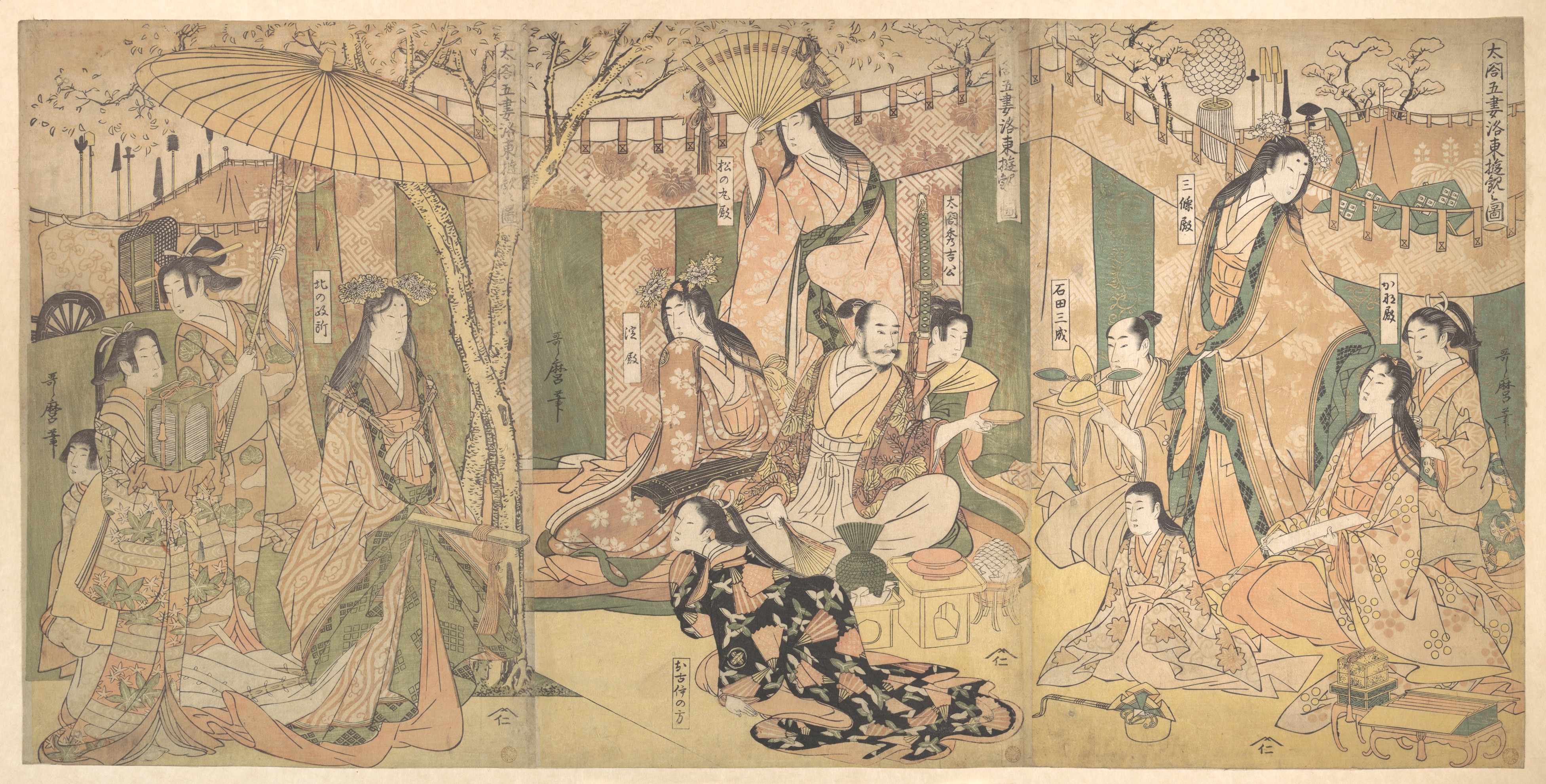
The record subject: the Metropolitan Museum's impression, JP992. Full-color woodblock triptych, 1804. Confirmed public domain directly against the Met's own collection API.
| Artist | Kitagawa Utamaro |
|---|---|
| Date | 1804 |
| Medium | Triptych of woodblock prints (oban format); ink and color on paper |
| Dimensions | 38.1 x 76.2 cm (15 x 30 in.), overall, three sheets joined |
| Where it is now | Metropolitan Museum of Art, New York, Department of Asian Artlast confirmed 18 September 2026 |
| Inventory number | JP992 |
| Attribution | AcceptedGiven to Kitagawa Utamaro without dispute in the Metropolitan Museum's own catalogue record and in every other institutional catalogue consulted for this record (Art Institute of Chicago, Museum of Fine Arts Boston, Honolulu Museum of Art). Full note |
| Object type | |
| Period | Japan, Edo period (1615-1868) |
| Cases | Has a provenance gap |
| Inscriptions | Not recorded in the sources consulted for this record. |
| Owners on record | 4 links3 documented, 1 unknown |
| Sources | 12 cited |
About this record Last verified 18 September 2026 · 12 sources cited · Change log
On this page 9 sections
ContentsClose
A triptych of full-color woodblock sheets, cut in 1804, showing the dead warlord Toyotomi Hideyoshi at the center of the cherry-blossom party he threw at Daigo-ji in the spring of 1598, ringed by the women of his household in the poses ukiyo-e normally reserved for courtesans. Within months of prints like it entering circulation, the Tokugawa shogunate arrested Kitagawa Utamaro and manacled him for fifty days for putting a named historical ruler, and the women around him, into the pleasure-quarter idiom. Utamaro was dead within two years.
This impression has a plainer story after 1804: it belonged to the American painter Samuel Isham, and passed to the Metropolitan Museum of Art in 1914 as a gift of his estate, where it has been catalogued ever since as JP992. What is not plain, and what this record tries to be honest about, is whether this specific impression is one of the images the censors actually cited, or a surviving pull of a design that simply belongs to the same dangerous subject and the same year.
Provenance
Each link is graded. Documented: a cited source supports it. Disputed: the identification is argued but not established. Unknown: no owner for that span, and the gap is not smoothed into a narrative. The grades in the glossary.
- 1804 -Kitagawa Utamaro (design); publisher not identified in the sources consulteddocumented
Dated 1804 and attributed to Utamaro without dispute in the Metropolitan Museum's own catalogue record.12
- Unknownunknown
No owner is documented between the print's creation in 1804 and its presence in Samuel Isham's New York collection by the time of his death in 1914. How and when this impression left Japan, and who held it in between, is not recorded in the sources consulted.7
- - 1914Samuel Isham (1855-1914), New Yorkdocumented
Isham, an American portrait and figure painter, assembled a collection of Japanese color prints during his lifetime, reported at 236 prints in total. The date, dealer, or price for this specific impression is not documented in the sources consulted.127
- 1914 - presentMetropolitan Museum of Art, New Yorkdocumented
Received as a gift of the Estate of Samuel Isham in 1914, per the Met's own credit line. Accession number JP992, object ID 37278.12
Technical evidence
| Attribution note | Given to Kitagawa Utamaro without dispute in the Metropolitan Museum's own catalogue record and in every other institutional catalogue consulted for this record (Art Institute of Chicago, Museum of Fine Arts Boston, Honolulu Museum of Art). Utamaro was already the most famous living designer of bijin-ga when this triptych was cut, and the design is one of a documented group of Toyotomi Hideyoshi subjects he produced around 1803-1804. No question of workshop hands or later copying was found in the sources consulted; the print is dated 1804 by the Met. |
|---|---|
| Support | Paper, in three joined oban sheets forming a continuous triptych composition.12 |
| Medium | Full-color woodblock print (nishiki-e technique), ink and color on paper.12 |
| Dimensions (Met impression) | 38.1 x 76.2 cm (15 x 30 in.) overall, per the Metropolitan Museum's own measurement.2 |
| Dimensions (Art Institute of Chicago impression, for comparison) | 36.6 x 73.5 cm (14 7/16 x 28 15/16 in.) overall. The difference from the Met's figure reflects trimming variance between impressions, not a different print.5 |
| Classification | Catalogued by the Metropolitan Museum under classification "Prints," object name "Print," within the Department of Asian Art.12 |
| Accession and credit line | JP992. Gift of the Estate of Samuel Isham, 1914. Object ID 37278 in the Met's own collection API.12 |
| Rights status | The Metropolitan Museum's collection API records isPublicDomain: true for this object, confirmed directly against the API rather than assumed.2 |
Images
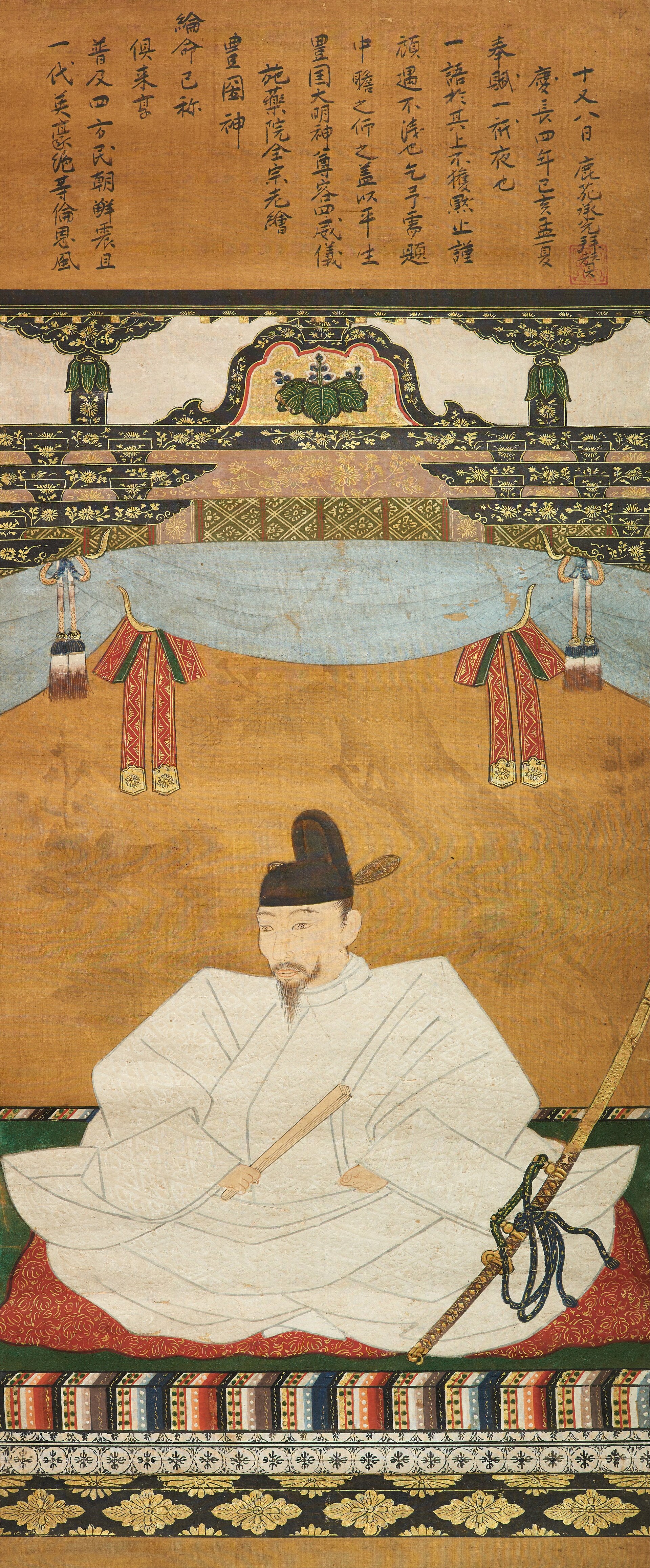
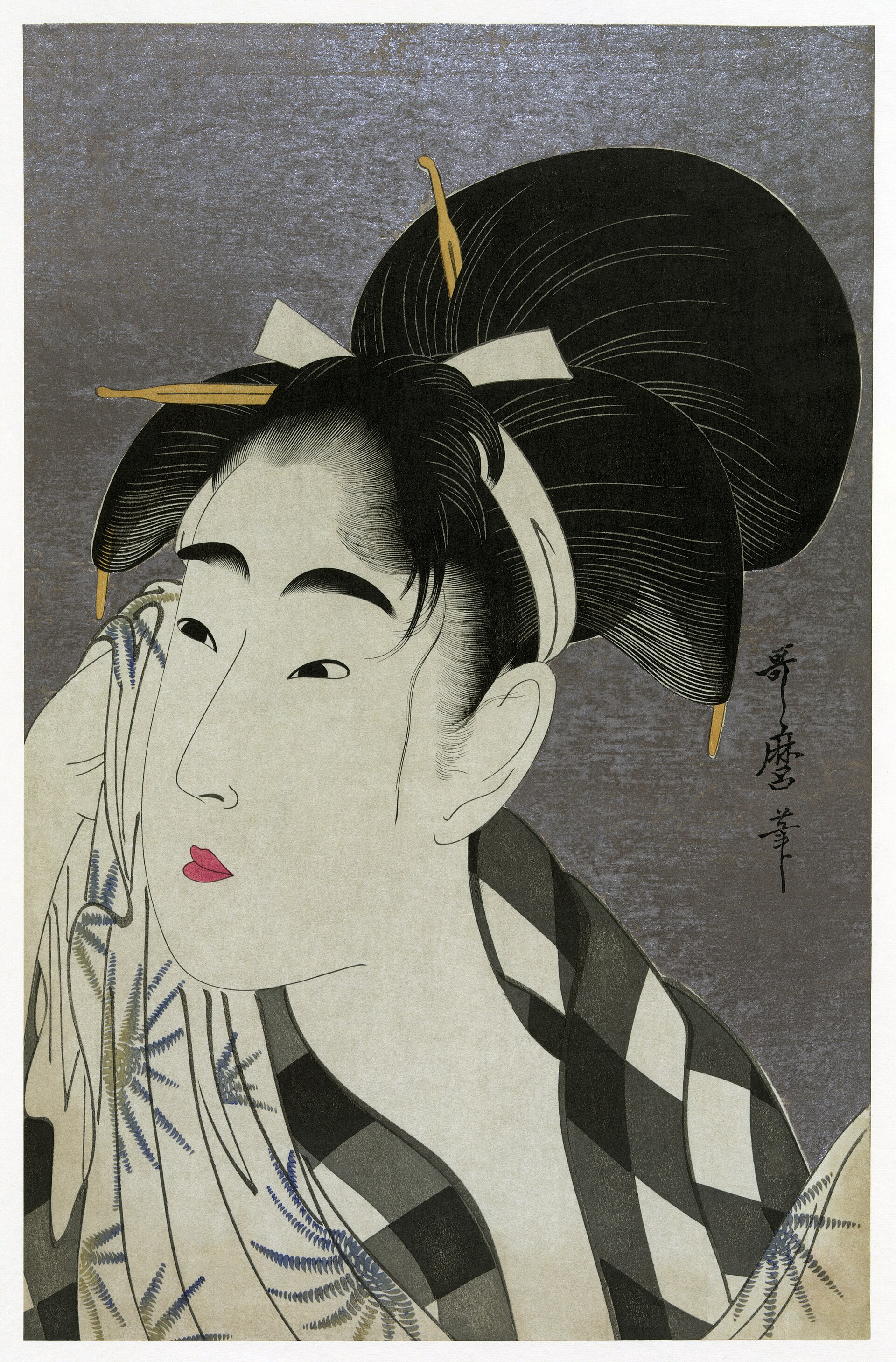
The record in full
Chapter 1What the triptych shows
Three oban sheets, printed in full color and meant to be read as one continuous scene, show Toyotomi Hideyoshi seated at the center of an outdoor party under blossoming cherry trees, surrounded by...
Three oban sheets, printed in full color and meant to be read as one continuous scene, show Toyotomi Hideyoshi seated at the center of an outdoor party under blossoming cherry trees, surrounded by women of his household in elaborate dress. The Metropolitan Museum catalogues the subject plainly as Hideyoshi and his five wives viewing cherry blossoms; other institutions holding impressions of the same design render the title as a picture of Hideyoshi and his five wives viewing cherry blossoms at Higashiyama, the hills on Kyoto's eastern edge. The overall sheet measures 38.1 by 76.2 centimeters as mounted at the Met, though an impression of the same design at the Art Institute of Chicago is trimmed slightly smaller, at 36.6 by 73.5 centimeters, which is ordinary for woodblock sheets cut down at different points in their history rather than evidence of a different print.
The design belongs to Utamaro's late, ambitious phase: large-format, multi-figure, full-color triptychs rather than the single-sheet half-length portraits of beauties that had made his name in the early 1790s. It is not a fantasy scene. Every element in it points to one specific, datable historical event.
Chapter 2The party it depicts
In the spring of 1598 Toyotomi Hideyoshi, the warlord who had unified Japan under his rule, held an enormous cherry-blossom viewing party at Daigo-ji, a temple southeast of Kyoto, centered on the...
In the spring of 1598 Toyotomi Hideyoshi, the warlord who had unified Japan under his rule, held an enormous cherry-blossom viewing party at Daigo-ji, a temple southeast of Kyoto, centered on the Sanbo-in sub-temple and its garden, which he had had rebuilt for the occasion. Daigo-ji's own institutional history states that some seven hundred cherry trees were planted for the event and that roughly thirteen hundred guests attended, including Hideyoshi's son Hideyori, his wife, and his mistresses; Wikipedia's account of the temple corroborates that the Sanbo-in garden was laid out under Hideyoshi in 1598 for what is called the Daigo no hanami, the Daigo flower viewing. Hideyoshi died a few months later, in the autumn of 1598, which makes the party one of the last great public displays of his rule rather than an incidental garden party.
That is the historical scene Utamaro's triptych restages, roughly two hundred years after the fact, with Hideyoshi's household rendered in the visual language of the Yoshiwara pleasure quarter.
Chapter 3Why Hideyoshi was dangerous to draw
Hideyoshi was not a safely distant historical figure to the Tokugawa shogunate that governed Japan in 1804.
Hideyoshi was not a safely distant historical figure to the Tokugawa shogunate that governed Japan in 1804. The Tokugawa house had defeated the faction loyal to Hideyoshi's heir at Sekigahara in 1600 and finally extinguished the Toyotomi line at the siege of Osaka Castle in 1615; the dynasty that commissioned the censorship of this print was, in a direct sense, the dynasty that had unmade the one Hideyoshi founded. A wave of popular affection for Hideyoshi as a folk hero, expressed through cheap illustrated books, prints, and the kabuki and joruri stage, put a rival political memory back into circulation in a form the government did not control.
Utamaro's triptych does not merely depict Hideyoshi. By setting him among women posed as courtesans and, by scholarly account, naming each of them, it flattens a state-founding warlord into ukiyo-e subject matter, exactly the kind of casual, marketable familiarity the shogunate's censors treated as disrespect.
Chapter 4The Ehon Taikoki fashion
The proximate cause of the wave of Hideyoshi prints, including this one, was the Ehon Taikoki, an illustrated chronicle of Hideyoshi's life published between 1797 and 1802, which was adapted for the...
The proximate cause of the wave of Hideyoshi prints, including this one, was the Ehon Taikoki, an illustrated chronicle of Hideyoshi's life published between 1797 and 1802, which was adapted for the kabuki and joruri stage between 1799 and 1804. Its popularity created a commercial appetite for Hideyoshi-themed prints and books that a number of artists and publishers moved to satisfy. Utamaro was one of several leading print designers who answered that appetite directly.
Chapter 5The arrest of 1804
In the early summer of 1804 the shogunate moved against the artists and publishers who had capitalized on the Ehon Taikoki vogue.
In the early summer of 1804 the shogunate moved against the artists and publishers who had capitalized on the Ehon Taikoki vogue. Utamaro was manacled for fifty days alongside the print designers Kitagawa Tsukimaro, Utagawa Toyokuni, Katsukawa Shuntei and Katsukawa Shun'ei, and the writer Jippensha Ikku; their publishers were fined heavily, and the Ehon Taikoki itself was banned and its stock confiscated. Secondary accounts differ on the exact shape of Utamaro's own punishment: some state fifty days of manacled house arrest outright, others describe three days of imprisonment followed by fifty days in handcuffs. This record could not resolve which is correct from a primary source and flags the discrepancy rather than picking one.
Chapter 6The legal basis, so far as it survives
The offense, as later scholarship reconstructs it, was identifying named historical and contemporary figures of rank, and using their crests, in commercial prints, which the Tokugawa authorities...
The offense, as later scholarship reconstructs it, was identifying named historical and contemporary figures of rank, and using their crests, in commercial prints, which the Tokugawa authorities treated as a form of lese-majeste toward the political order rather than as harmless entertainment; this sat inside a longer-running body of Edo-period sumptuary and publishing restriction that had already targeted current-events reporting, unorthodox opinion, and extravagant printing since at least the Kyoho era of the early eighteenth century, and had been tightened again in the Kansei reforms of the 1790s. Wikipedia's account of Utamaro, drawing on the art historian Julie Nelson Davis's 2007 study of the incident, states plainly that the government's own documents from the 1804 prosecution do not survive. That means the precise article or edict invoked in Utamaro's case is not recoverable from the record as this record's compilers were able to access it, and it is stated here as an open question rather than papered over.
Chapter 7Which prints the censors actually meant
Multiple Hideyoshi subjects by Utamaro circulated in this period, not one.
Multiple Hideyoshi subjects by Utamaro circulated in this period, not one. Secondary accounts of the 1804 prosecution, again drawing on Davis's research, describe at least three distinct censored images: Kato Kiyomasa watching Korean dancers at a party, Hideyoshi shown holding hands with his page Ishida Mitsunari in a sexually suggestive manner, and Hideyoshi viewing cherry blossoms with his five consorts at Daigo-ji, each consort identified by name and posed in the manner of a courtesan. That third description matches the subject of this triptych closely: Hideyoshi, five women of his household, a cherry-blossom party at the historical Daigo location.
What this record cannot do is confirm, from a source it was able to read in full, that the Metropolitan's own impression, JP992, is a surviving pull of that specific censored image rather than a separate but closely related Utamaro design on the same subject and from the same year. The scholarly account that would settle this, Davis's 2007 Japan Forum article, was only accessible here as an abstract; its full text, and the primary Bakufu-era sources it discusses, were not read. This record therefore states the connection as probable, on the strength of subject match, and not as established fact.
Chapter 8Two years to the grave
Utamaro died on 31 October 1806, a little over two years after his release from manacles, at around fifty-two or fifty-three years old.
Utamaro died on 31 October 1806, a little over two years after his release from manacles, at around fifty-two or fifty-three years old. Popular accounts of his life routinely state that the arrest broke his health or his spirit and caused his death; several of the sources consulted for this record repeat that claim in similar language. None of them, including the ones that present it most confidently, cite a contemporary medical record, a documented cause of death, or a named scholar making the causal case in a peer-reviewed venue. The two-year gap is real and documented. Whether it is cause and effect, or two unrelated facts sitting next to each other in a short biography, is treated here as unresolved.
Chapter 9Samuel Isham, painter and collector
Samuel Isham (1855-1914) was an American portrait and figure painter, trained first in law at Columbia before he left legal practice for art and studied at the Academie Julian in Paris in the...
Samuel Isham (1855-1914) was an American portrait and figure painter, trained first in law at Columbia before he left legal practice for art and studied at the Academie Julian in Paris in the mid-1880s. He was elected to the National Academy of Design in 1906, won a silver medal at the 1904 St. Louis World's Fair, served on the art jury of the 1901 Pan-American Exposition, and in 1905 published The History of American Painting, his best-known written work. He died in 1914 of an aneurysm on the golf course of the Maidstone Club in East Hampton, New York.
Isham was also a collector of Japanese color prints. On his death his estate gave a substantial group of them, reported at 236 prints, to the Metropolitan Museum of Art, of which this triptych is one. The sources consulted for this record do not document when, from whom, or at what price Isham acquired this specific impression; his broader collecting activity and its place in the wave of American collecting of Japanese prints in this period would need separate research to establish.
Chapter 10One impression among several
Woodblock printing pulls many impressions from the same carved blocks, and this design survives in more than one public collection, which matters for keeping this specific object straight from its...
Woodblock printing pulls many impressions from the same carved blocks, and this design survives in more than one public collection, which matters for keeping this specific object straight from its siblings. The Art Institute of Chicago holds an impression in the Clarence Buckingham Collection, with a documented modern provenance through the Paris dealer Charles Jacquin, sold at the Walpole Galleries in New York in January 1921 to Kate Sturges Buckingham, who gave it to the museum in 1925. The Museum of Fine Arts, Boston, and the Honolulu Museum of Art each hold an impression under close variants of the same title, and an impression is recorded at the British Museum as well, through the online aggregator ukiyo-e.org. None of these is the Met's impression, JP992, and none of the catalogue text for those other holdings beyond their own titles and institutional attribution could be independently confirmed by this record's compilers; they are named here as the documented comparandum group, not described in further detail than that.
Chapter 11The record's limits
This record is built from the Metropolitan Museum's own collection data, from Wikipedia's account of Utamaro (itself drawing on a peer-reviewed 2007 study this record could not read in full), and...
This record is built from the Metropolitan Museum's own collection data, from Wikipedia's account of Utamaro (itself drawing on a peer-reviewed 2007 study this record could not read in full), and from a handful of institutional catalogue pages for related impressions that returned only a title and a holding institution to automated retrieval. The precise edict invoked against Utamaro, the exact terms of his sentence, whether this exact impression was among the censored images, and the medical or circumstantial facts of his death two years later are all treated here as open rather than resolved, because that is what the sources available to this record actually support.
The artist
Kitagawa Utamaro (born Kitagawa Ichitaro)
Utamaro was, by the account of nearly every source consulted for this record, the most celebrated designer of bijin-ga, pictures of beautiful women, working in Edo in the 1790s, and one of the very few ukiyo-e artists to become famous across Japan during his own lifetime. His origins are genuinely obscure. His late career, including the print this record describes, was shaped directly by an act of state censorship that popular accounts link to his death two years later, a link this record treats as asserted rather than proven.
Related works
| Work | Relation | Where it is |
|---|---|---|
| Picture of Hideyoshi and His Five Wives Viewing Cherry Blossoms at Higashiyama (Taiko gosai rakuto yukan no zu) Kitagawa Utamaro | Another documented impression of the same triptych design, printed from the same or closely related blocks Not the Met's impression. Documented modern provenance: Charles Jacquin, Paris; sold Walpole Galleries, New York, 20-22 January 1921, to Kate Sturges Buckingham (1858-1937), Chicago; given to the Art Institute of Chicago, 1925. Trimmed to 36.6 x 73.5 cm, slightly smaller than the Met sheet. | Art Institute of Chicago, Clarence Buckingham Collection |
| The Taiko and His Five Wives on an Excursion to the East of Kyoto (Taiko gosai Rakuto yukan no zu) Kitagawa Utamaro | Another impression of the same design, under a variant English title Confirmed only by the museum's own page title in the sources consulted; the full catalogue entry could not be retrieved for this record and should be checked directly before further claims are added. | Museum of Fine Arts, Boston |
| Taiko gosai rakuto yukan no zu Kitagawa Utamaro | Another impression of the same design Identified through the ukiyo-e.org aggregator rather than the British Museum's own catalogue, which returned a redirect to this record's compilers; flagged for direct verification against the museum's own collection record. | British Museum, London |
| Picture of Hideyoshi and His Five Wives Viewing Cherry-blossom at Higashiyama Kitagawa Utamaro | Another impression of the same design Confirmed only by the museum's own page title in the sources consulted; full catalogue text was not accessible to this record's compilers. | Honolulu Museum of Art |
Open questions
- Was this specific impression, Met JP992, among the images the Tokugawa censors actually cited in the 1804 prosecution, or is it a surviving pull of a closely related but distinct Utamaro design on the same Hideyoshi-and-cherry-blossoms subject? The subject matches the print described in secondary accounts of the case closely, but this record could not read the primary scholarly study (Davis, 2007) in full to confirm it image by image.
- What specific edict or statute was invoked against Utamaro in 1804? Secondary sources agree the government's own case documents do not survive, which leaves the precise legal basis unrecoverable from what this record could access.
- Did the fifty-day punishment contribute to Utamaro's death in 1806, or is the two-year interval coincidental? Widely repeated in popular sources as cause and effect; no source consulted here supplies a contemporary medical record or a named scholar making the causal argument in a peer-reviewed venue.
- When, from whom, and under what circumstances did Samuel Isham acquire this impression? Not documented in the sources consulted for this record.
- Was Utamaro's sentence fifty days of manacled house arrest outright, or three days of imprisonment followed by fifty days in handcuffs? Secondary accounts give both versions and this record could not resolve the discrepancy from a primary source.
Questions about this object
What is A View of the Pleasures of the Taiko and His Five Wives at Rakuto?
A View of the Pleasures of the Taiko and His Five Wives at Rakuto is a print, dated 1804. Medium: Triptych of woodblock prints (oban format); ink and color on paper.
Who made A View of the Pleasures of the Taiko and His Five Wives at Rakuto, and is the attribution settled?
The attribution to Kitagawa Utamaro is recorded here as accepted. Given to Kitagawa Utamaro without dispute in the Metropolitan Museum's own catalogue record and in every other institutional catalogue consulted for this record (Art Institute of Chicago, Museum of Fine Arts Boston, Honolulu Museum of Art). Utamaro was already the most famous living designer of bijin-ga when this triptych was cut, and the design is one of a documented group of Toyotomi Hideyoshi subjects he produced around 1803-1804. No question of workshop hands or later copying was found in the sources consulted; the print is dated 1804 by the Met.
Where is A View of the Pleasures of the Taiko and His Five Wives at Rakuto now?
Metropolitan Museum of Art, New York, Department of Asian Art. Inventory number JP992. Last confirmed 18 September 2026. Received as a gift of the Estate of Samuel Isham in 1914, per the Metropolitan Museum's own credit line and collection API record (object ID 37278).
What is still unknown about A View of the Pleasures of the Taiko and His Five Wives at Rakuto?
Was this specific impression, Met JP992, among the images the Tokugawa censors actually cited in the 1804 prosecution, or is it a surviving pull of a closely related but distinct Utamaro design on the same Hideyoshi-and-cherry-blossoms subject? The subject matches the print described in secondary accounts of the case closely, but this record could not read the primary scholarly study (Davis, 2007) in full to confirm it image by image.
Sources
- 1Metropolitan Museum of Art, collection page for Kitagawa Utamaro, 'A View of the Pleasures of the Taiko and His Five Wives at Rakuto,' accession JP992. metmuseum.org/art/...
- 2Metropolitan Museum of Art, Collection API, object record for object ID 37278 (accession number, credit line, medium, dimensions, classification, and public-domain status verified directly against this endpoint). collectionapi.metmuseum.org/public/...
- 3Wikipedia, 'Utamaro,' for biography and the 1804 arrest, itself citing Julie Nelson Davis's 2007 study of the incident. Tertiary source; flagged for replacement with Davis's article and primary museum catalogues. en.wikipedia.org/wiki/...
- 4Julie Nelson Davis, 'The trouble with Hideyoshi: censoring ukiyo-e and the Ehon Taikoki incident of 1804,' Japan Forum, vol. 19, no. 3 (2007), pp. 281-308. Existence and abstract verified; full text was paywalled and not read for this record. tandfonline.com/doi/...
- 5Art Institute of Chicago, Collection API, artwork 21530, 'Picture of Hideyoshi and his Five Wives Viewing Cherry Blossoms at Higashiyama (Taiko gosai rakuto yukan no zu),' including its own provenance text. api.artic.edu/api/...
- 6Artelino, 'Utamaro Kitagawa - Punishment.' Tertiary popular source with no cited scholarly references; flagged for replacement. artelino.com/articles/...
- 7Wikipedia, 'Samuel Isham,' for biography and the bequest of his Japanese print collection to the Metropolitan Museum in 1914. Tertiary source; flagged for replacement with an obituary or the Met's own accession records. en.wikipedia.org/wiki/...
- 8Museum of Fine Arts, Boston, collection record for their impression of the same design. Page title confirmed; full catalogue text could not be retrieved by this record's compilers (automated access returned no readable body content). collections.mfa.org/objects/...
- 9ukiyo-e.org, aggregator record for the British Museum's impression of the same design. Tertiary aggregator; flagged for replacement with the British Museum's own catalogue record. ukiyo-e.org/image/...
- 10Honolulu Museum of Art, collection record for their impression of the same design. Page title confirmed via search index; full catalogue text could not be retrieved by this record's compilers. honolulu.emuseum.com/objects/...
- 11Daigo-ji (temple), official website, event history for the 1598 Daigo no hanami cherry-blossom viewing. Institutional source with promotional framing; flagged for cross-check against a scholarly account of Hideyoshi's life. daigoji.or.jp/events/...
- 12Wikipedia, 'Daigo-ji,' corroborating the 1598 Sanbo-in garden and the Daigo no hanami. Tertiary source; flagged for replacement with a scholarly account. en.wikipedia.org/wiki/...
Last verified 18 September 2026 · Published 18 September 2026
Change log
18 September 2026 - Record created at the house standard: researched narrative, technical evidence, maker dossier, graded provenance chain, prices with hammer and premium separated, related works, open questions and sources.