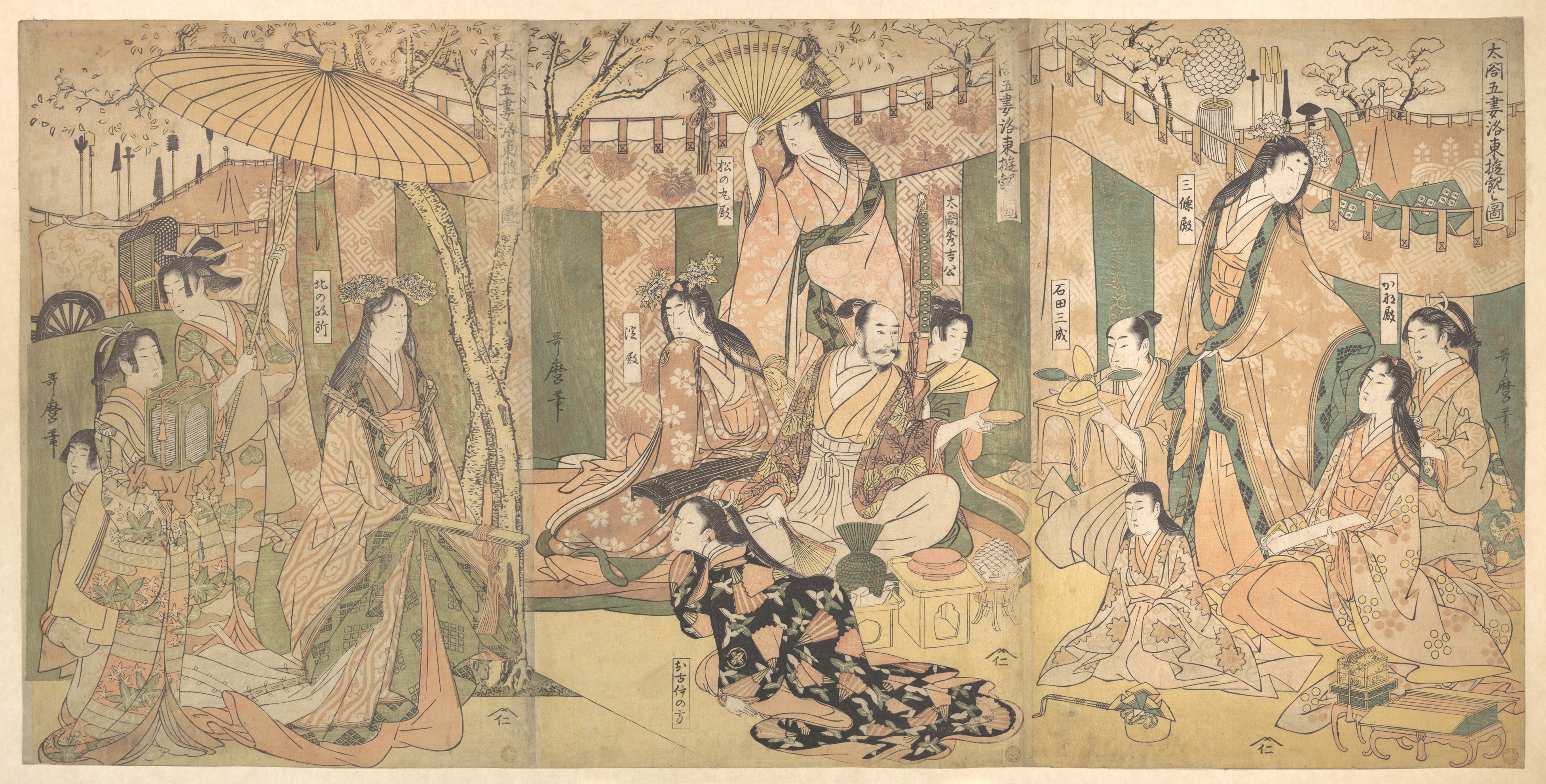
A View of the Pleasures of the Taiko and His Five Wives at Rakuto
1804 · Triptych of woodblock prints
Metropolitan Museum of Art, New York
 Japanese · 1753-1806
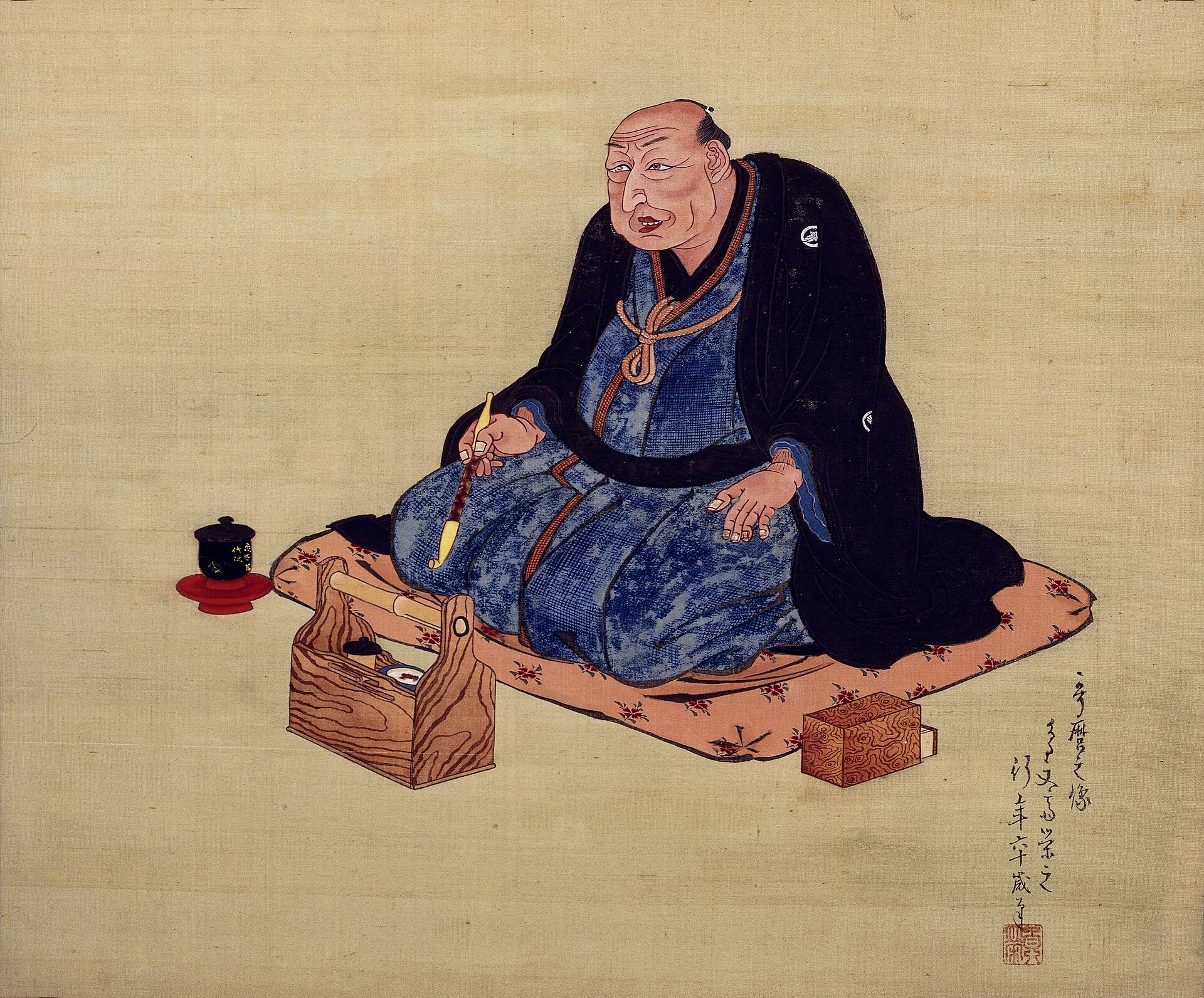
A hanging-scroll portrait inscribed as a likeness of Utamaro and signed by the painter Chobunsai Eishi in a date equivalent to 1815, nine years after Utamaro died. The British Museum, which owns the picture, calls the attribution and the sitter's identity controversial and unexplained in its own catalogue, dates the physical object itself as probably mid-19th century rather than genuinely from 1815, and lists the sitter as possibly Utamaro II rather than Utamaro himself, each identification marked with a question mark. This is a disputed, probably posthumous painting, not a confirmed likeness of Utamaro made in his lifetime; no such likeness is known to survive.
British Museum, London| Full name | Kitagawa Utamaro, born Kitagawa Ichitaro |
|---|---|
| Worked as | Ukiyo-e print designer, Painter, Book illustrator |
| Born | c. 1753 · Unverified |
| Died | 1806-10-31 · Edo (modern Tokyo) |
| Nationality | Japanese |
| Movement | Ukiyo-e |
| In this archive | 1 artwork |
| Sources | 19 cited |
| Last verified |
About this page 1 artwork in the archive · Last verified · 19 sources cited
Kitagawa Utamaro is the artist against whom every other master of bijin-ga, pictures of beautiful women, is still measured, and the first ukiyo-e designer to become famous across Japan in his own lifetime rather than only in Edo. His half-length okubi-e portraits of courtesans and teahouse waitresses from the 1790s set a format later designers worked inside for a generation, and his illustrated books of insects, shells and birds turn the same close attention on nature rather than on the pleasure quarters. He is credited with more than two thousand known prints under one name, yet not one of his celebrated portraits is a portrait of him: no securely documented likeness of Utamaro made in his own lifetime survives, and the single disputed painting that claims to show his face was signed nine years after he died, by another artist, and is treated with open suspicion by the museum that now owns it.
What the standard account gets wrong is the shape of his fame. Utamaro is usually introduced as the poet of intimate femininity, and by the pictures alone that reading holds up. But his most celebrated solo print names a real teahouse waitress at a real shop in Asakusa, and his most famous group portrait names two more real Edo women by their real family and business names. These were not generic beauties; they were advertising, produced for or around actual establishments in a city that would soon make it illegal to name an ordinary woman in a print at all. In 1804 the same appetite for a real, named, identifiable subject, this time the sixteenth-century warlord Toyotomi Hideyoshi, dead two centuries but still politically sensitive under the Tokugawa shogunate, put Utamaro in manacles for fifty days. The print connected to that arrest, showing Hideyoshi with his five consorts, is the reason this maker has a page in this archive at all.
Almost everything else about him is contested, approximate, or missing outright: his birthplace, his wife, the extent of his own hand against his pupils' and imitators', and even whether the paintings now called his greatest surviving works were made for a patron or, as one of the two curators who reunited them argues, to build a persona for a Paris market he never lived to see.
Born Kitagawa Ichitaro; his birthplace is claimed variously as Kyoto, Osaka, the Yoshiwara district of Edo, and Kawagoe in Musashi Province, and none of the four has been verified.1
First securely dated works appear under the name Kitagawa Toyoaki, including the cover of a kabuki playbook distributed at the Nakamura-za theatre in Edo.1
At a banquet hosted by the publisher Tsutaya Juzaburo, Utamaro announces his new art name and distributes a specially printed self-portrait bowing before a screen naming his guests; no surviving impression of that print was located for this record.1
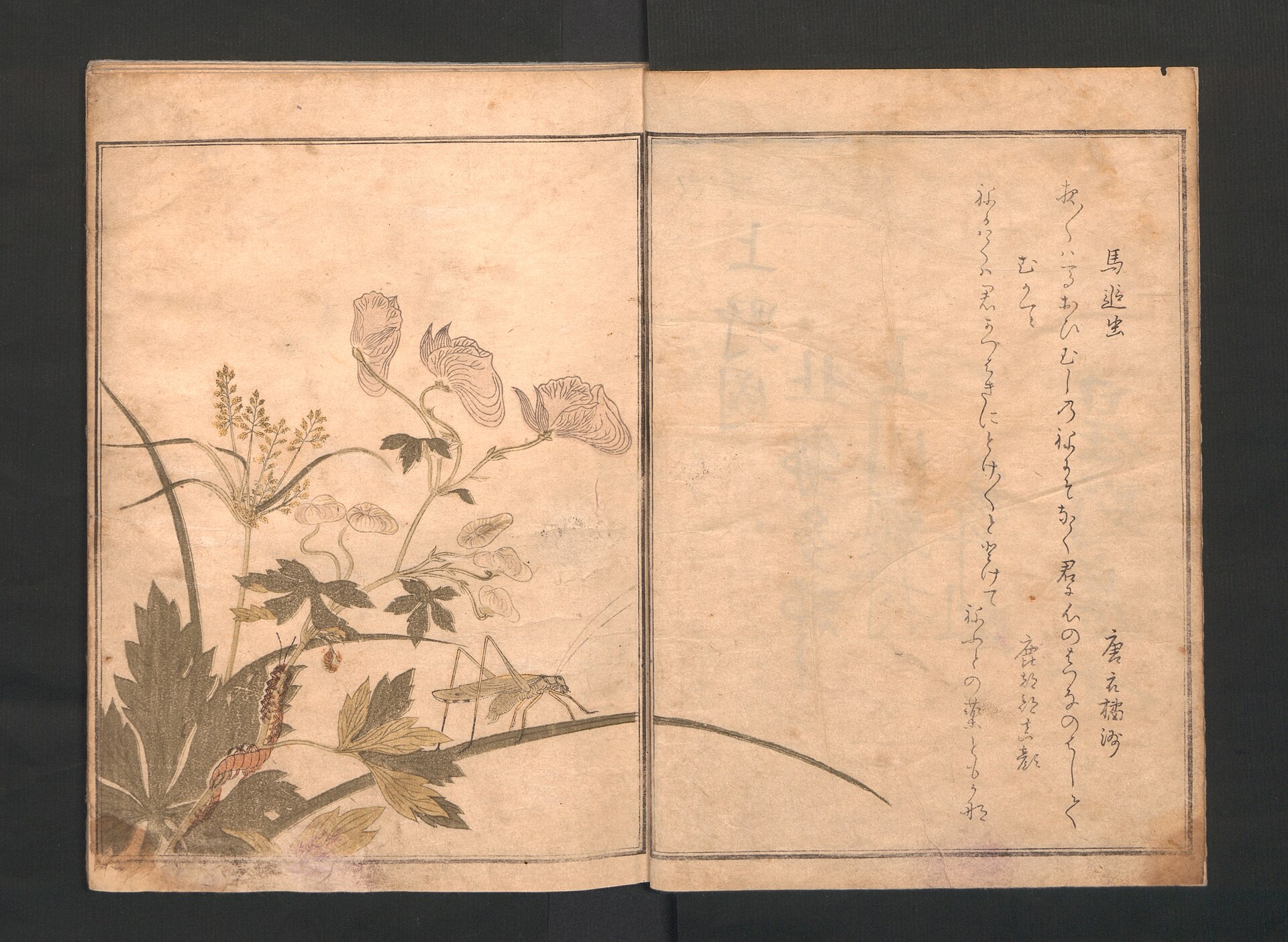
Publishes Ehon Mushi Erami (Picture Book of Crawling Creatures), his first illustrated book pairing insects with kyoka verse, and the shunga book Utamakura.110
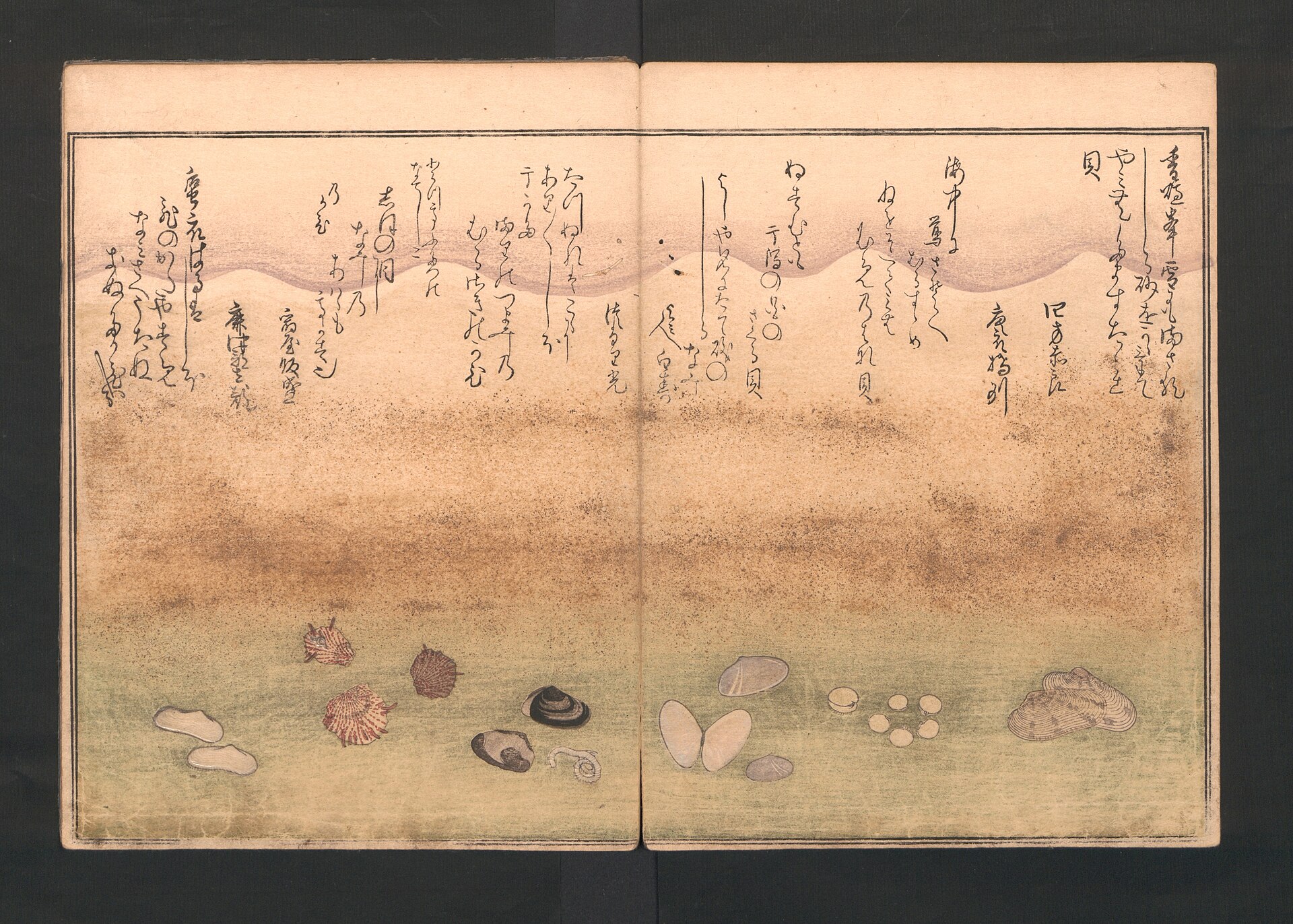
Publishes Shiohi no Tsuto (Gifts from the Ebb Tide), thirty-six shell studies paired with thirty-six poems by thirty-six poets.11
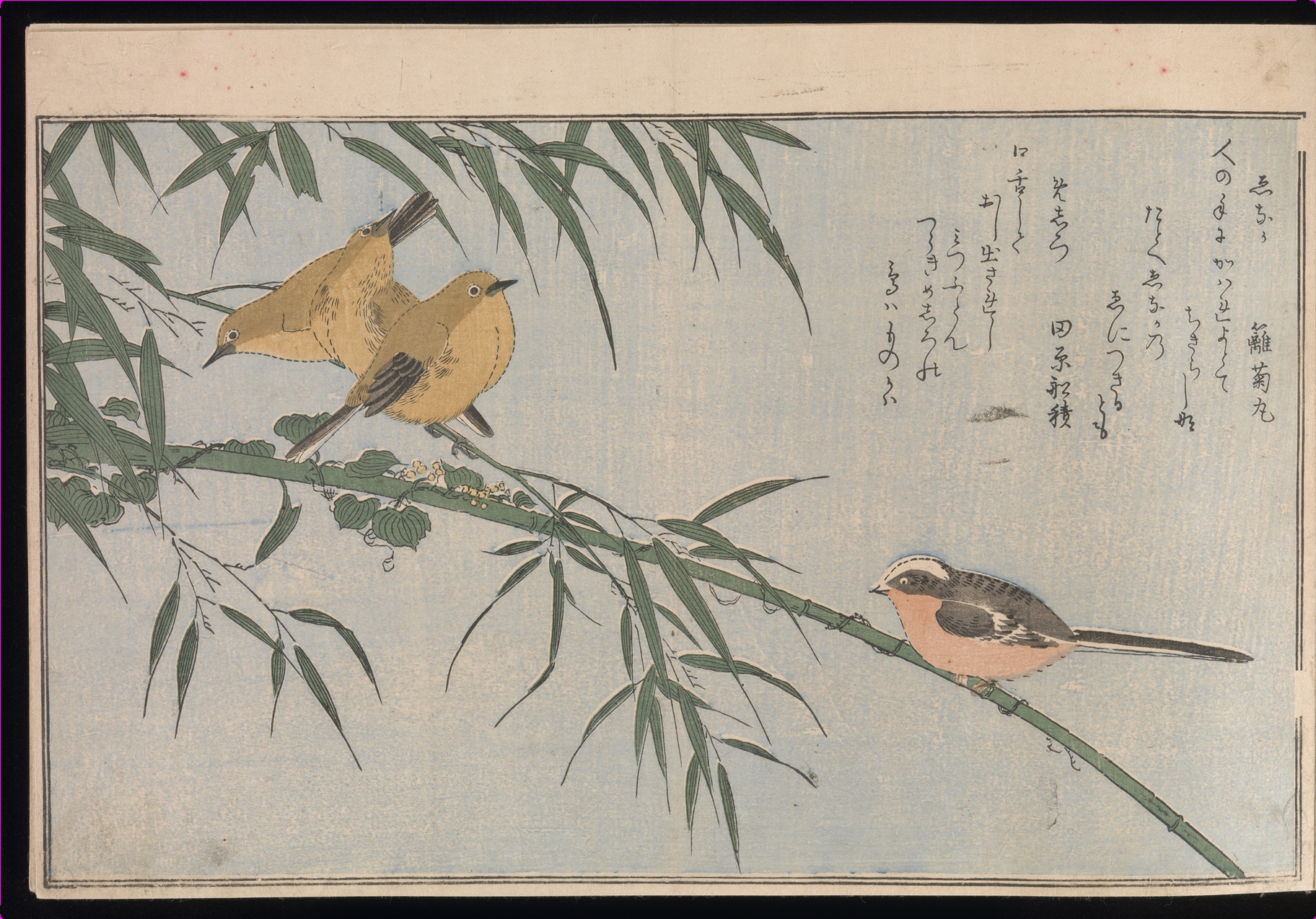
Publishes Momo Chidori Kyoka-awase (Myriad Birds), a two-volume bird and verse anthology, and begins concentrating on half-length okubi-e portraits in place of full-figure groups.112
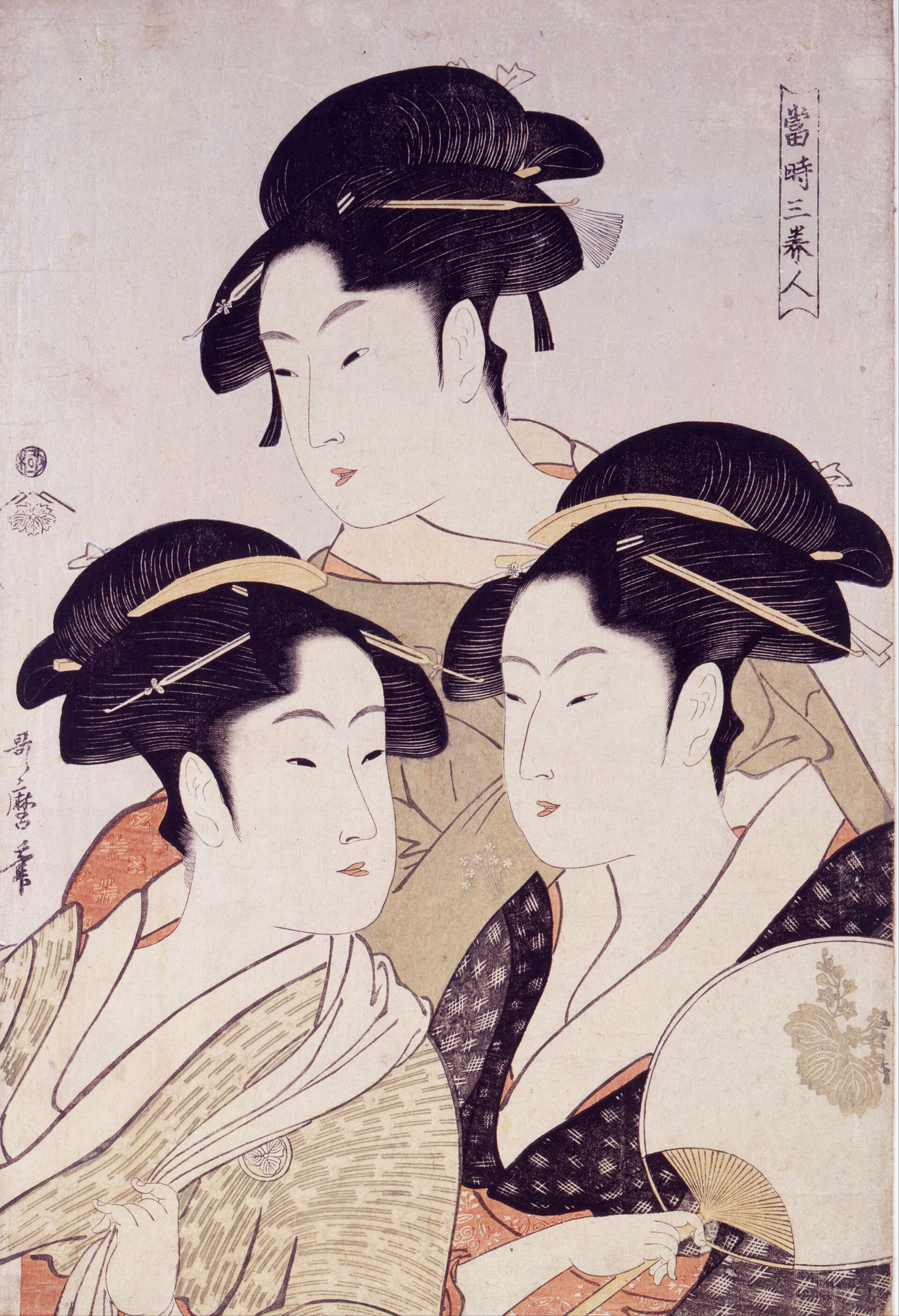
Achieves independent recognition; his semi-exclusive arrangement with Tsutaya ends. Produces Toji San Bijin (Three Beauties of the Present Day), naming three real Edo women by family and shop.18
Tsutaya Juzaburo dies. Several writers cited in the sources consulted hold that Utamaro's work never fully recovered its earlier brilliance afterward, a judgment of taste this record does not treat as settled fact.1
Arrested and manacled for fifty days with the artists Tsukimaro, Toyokuni, Shuntei and Shun'ei and the writer Jippensha Ikku, over prints depicting Toyotomi Hideyoshi drawn from the banned Ehon Taikoki; the government's own case papers do not survive.12
Dies in Edo, apparently without an heir; given the Buddhist posthumous name Shoen Ryoko Shinshi and buried at the temple Senkoji.1
Three of his largest paintings, Snow at Fukagawa, Moon at Shinagawa and Cherry Blossoms at Yoshiwara, are last recorded together in Japan before leaving for Paris.4
General reference accounts describe the Paris dealer Siegfried Bing organising a major exhibition of Utamaro's prints, a landmark in the French vogue for Japanese art known as Japonisme.1
Admirers restore Utamaro's decayed, untended tomb at Senkoji, more than a century after his death.1
Snow at Fukagawa, missing since a brief 1948 showing, resurfaces and is acquired by the Okada Museum of Art in Hakone.4
The three monumental paintings are reunited for the first time in nearly 140 years at the Smithsonian's Arthur M. Sackler Gallery, in the exhibition Inventing Utamaro: A Japanese Masterpiece Rediscovered.4
Snow at Fukagawa sells at Sotheby's Hong Kong for HKD 55,275,000 with premium, a record for the artist and, on the saleroom's own account, for any ukiyo-e painting at auction.6
Two very different markets sit under Utamaro's name. His large hanging-scroll paintings are close to unobtainable: only a handful are known to survive at all, and when one changes hands the result is a record for the artist and, on the saleroom's own account, for any ukiyo-e painting sold at auction. His woodblock prints are, by contrast, genuinely collectable at every level, from worn later impressions worth very little to a first-state proof of an iconic okubi-e design in strong, unfaded colour, which is what actually commands the six- and seven-figure sums reported in the press. Condition, impression order and completeness of a series matter to the price at least as much as the subject.
| Date | Sale | Work | Result | Note |
|---|---|---|---|---|
| 22 November 2025 | Sotheby's Hong Kong | Snow at Fukagawa (Fukagawa no Yuki), from the painted triptych Snow, Moon and Flowers | Hammer HKD 45,000,000 With premium HKD 55,275,000 (reported at the time as approximately USD 7.1 million) HKD | A hanging-scroll painting, not a print; estimate HKD 6,000,000 to 8,000,000. Sold as part of a single-owner sale of 125 lots from the Okada Museum of Art, Hakone, held to help settle legal debts of the museum's founder, Kazuo Okada. Reported as the auction record for the artist and, on the saleroom's own account, for any ukiyo-e painting sold at auction. Provenance given: Kamaya Zenno Ihe (d. 1824), Tochigi; Samuel Siegfried Bing, Paris, late 1880s; Takeo Nagase, Tokyo, from 1939; a private Japanese collection from 2012; the Okada Museum of Art. |
| 21 June 2016 | Beaussant Lefevre, in association with Christie's, Hotel Drouot, Paris | Fukaku Shinobu Koi (Deeply Hidden Love), from the print series Kasen Koi no Bu (Anthology of Poems, the Love Section) | With premium EUR 744,000, inclusive of buyer's premium, per the auction house's own published lot result (reported in the press at the time as EUR 745,000 to 745,800 and approximately USD 841,000 to 844,000) EUR | A single woodblock print, not a painting, against an estimate of EUR 80,000 to 100,000. Reported as the auction record for any Japanese print at the time. From the Portier family collection, held across four generations. The auction house's own lot page (Beaussant Lefevre, lot 6, 21 June 2016) gives only a total inclusive of fees, 744,000 EUR TTC, and does not separately publish the hammer price; this record's earlier draft had relied only on press totals of 745,000 to 745,800 EUR, which the auction house's own page does not support. |
Hammer is the price at which the bidding stopped; with premium adds the fee the house charges the buyer on top. Hammer price and buyer's premium in the glossary.
| Institution | City | Holdings | Note |
|---|---|---|---|
| Metropolitan Museum of Art | New York | One of the largest open-access Utamaro holdings anywhere; the Museum's collection database returns well over two hundred Utamaro-attributed objects, the large majority released for reuse as CC0 or public domain, spanning single-sheet prints, the natural-history and courtesan-guide illustrated books, and further impressions connected to the Toyotomi Hideyoshi triptych discussed in this archive's linked object record. | |
| British Museum | London | A major print holding, and the disputed painted portrait attributed to Chobunsai Eishi (museum number 1913,0501.0.402) discussed under Portrait above. | |
| Museum of Fine Arts, Boston | Boston | Deep print holdings across Utamaro's career, including one of the impressions of the earliest printing of Three Beauties of the Present Day named in the literature consulted for this record. | |
| Toledo Museum of Art | Toledo, Ohio | An impression of Three Beauties of the Present Day (accession 1951.290), acquired through the Carrie L. Brown Bequest Fund, reproduced in this record's gallery. | |
| Smithsonian National Museum of Asian Art, Freer Gallery | Washington, D.C. | Moon at Shinagawa, one of the three monumental Snow, Moon and Flowers paintings, acquired by Charles Lang Freer in 1903. | Under the terms of Freer's bequest the painting may not leave the Freer building; a facsimile stood in for it at the other two venues of the 2017 reunion exhibition. |
| Wadsworth Atheneum Museum of Art | Hartford, Connecticut | Cherry Blossoms at Yoshiwara, the second of the three monumental paintings, acquired in the late 1950s. | |
| Okada Museum of Art | Hakone, Japan | Held Snow at Fukagawa, the third of the three monumental paintings, from its 2014 rediscovery until the painting's sale at auction in November 2025. | Whether the painting remains on public view following that sale to a private Japanese collector was not established in the sources consulted for this record. |
Utamaro's 1793 print usually translated Three Beauties of the Present Day groups three women in half-length: Tomimoto Toyohina, a well-known geisha of the Tamamuraya house; Naniwaya Okita, reported...
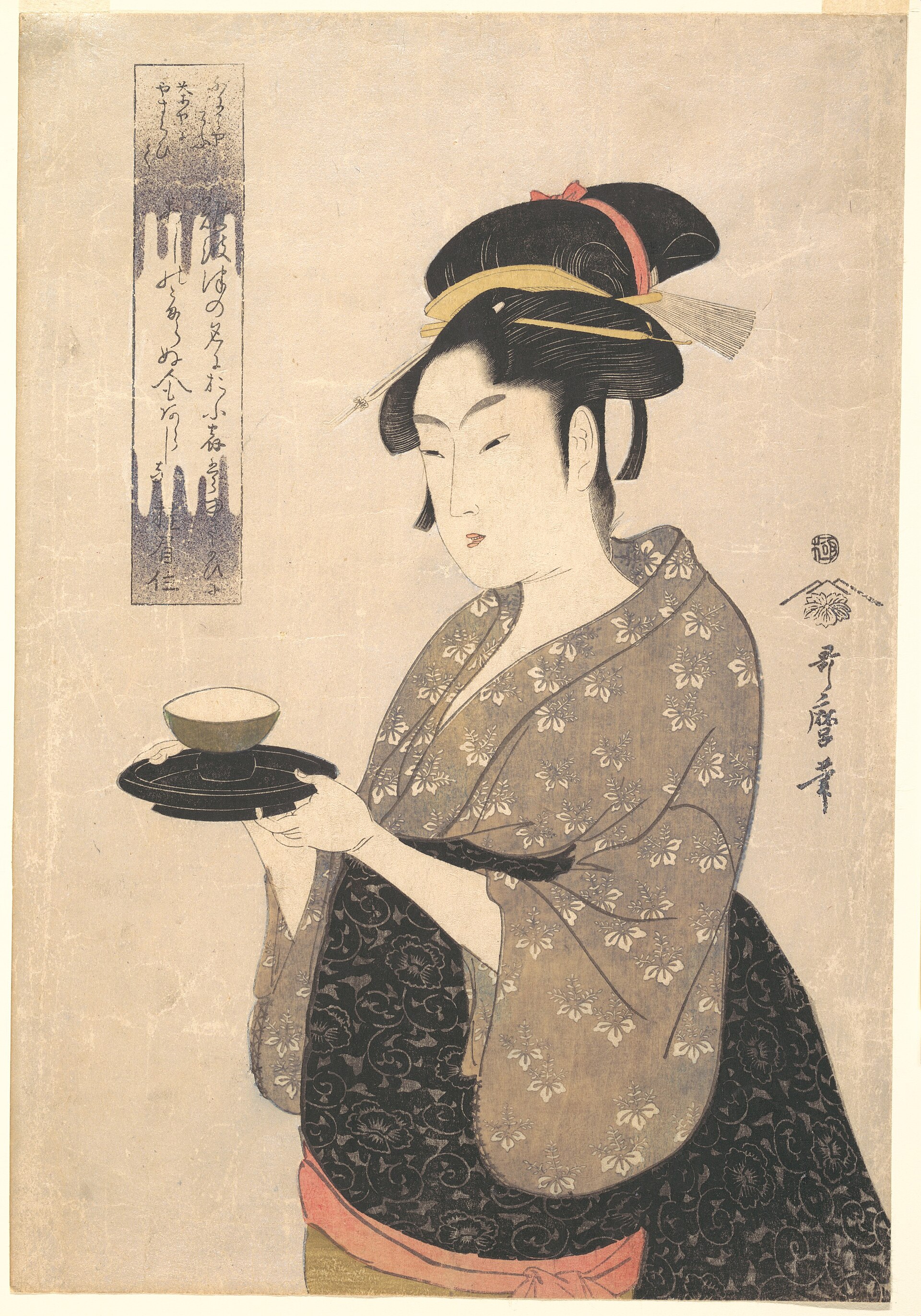
Utamaro's 1793 print usually translated Three Beauties of the Present Day groups three women in half-length: Tomimoto Toyohina, a well-known geisha of the Tamamuraya house; Naniwaya Okita, reported to be about fifteen and the daughter of a teahouse keeper in Asakusa; and Takashimaya Ohisa, the eldest daughter of a rice-cake shop owner in Ryogoku. Each carries her own identifying family crest printed into the design. They are not composites or types. They were real, locatable people attached to real, locatable businesses, and the print functioned as much as advertising for those shops as it did as art.
Utamaro had already made Okita famous on her own in a solo half-length portrait, and both prints belong to a genre of ukiyo-e that traded on naming specific women the way a modern poster names a specific brand. The Tokugawa authorities did not read this as flattering. Within a few years of Utamaro's height of fame, restrictions tightened on naming ordinary women, women outside the licensed pleasure quarters, in commercial prints at all, on the reasoning that an artist should not be free to turn any woman in the city into a public commodity without her or her family's control over the fact. The same instinct that made Okita's fortune returned against Utamaro in 1804, when he named a different kind of real subject and paid for it in manacles.
He was born Kitagawa Ichitaro around 1753.
He was born Kitagawa Ichitaro around 1753. As an adult he used the given names Yusuke and then Yuki before adopting the art name Utamaro in 1782. Nothing about his origin is settled. Early accounts place his birth in Kyoto, Osaka, the Yoshiwara pleasure district of Edo, or Kawagoe in Musashi Province, and none of the four has been verified against a document. His parents are not named in any source consulted for this record; one line of speculation makes his father a Yoshiwara teahouse keeper, another makes his teacher, Toriyama Sekien, functionally his family, since Sekien later wrote of the boy playing in his garden as a child.
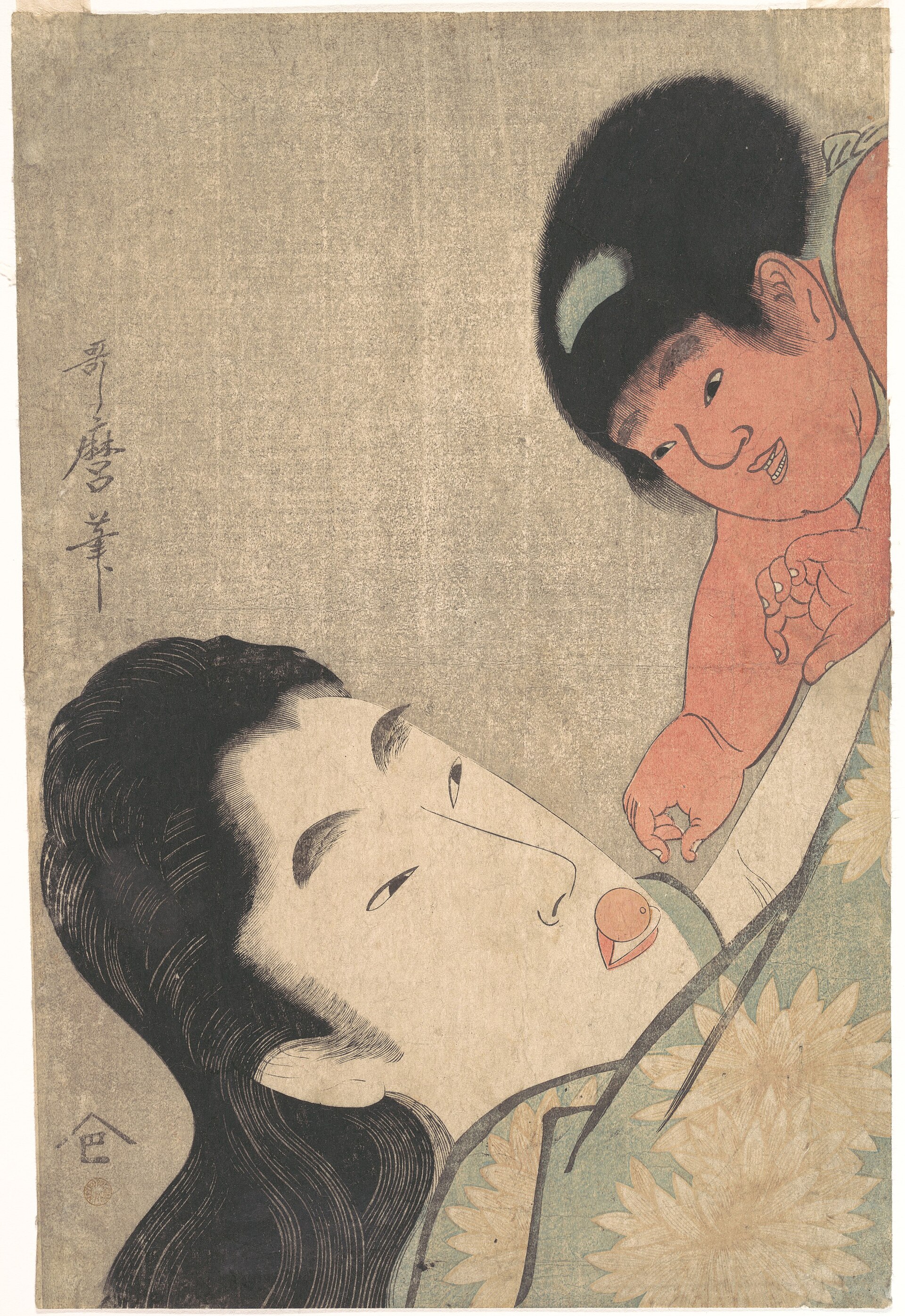
Utamaro was married, but almost nothing is recorded about his wife, and there is no record of the couple having had children. That absence sits oddly beside his output: across the 1790s he returned again and again to a single woman with a small child, in scenes of washing, feeding and play repeated over several years, images later writers have wanted to read as observed rather than invented. This record treats that reading as unverified. A resemblance across a run of prints is not a birth record.
Utamaro's teacher, Toriyama Sekien, had trained in the elite, shogunate-sponsored Kano school of Japanese painting before turning, in middle age, to ukiyo-e work aimed at Edo's townspeople rather...
Utamaro's teacher, Toriyama Sekien, had trained in the elite, shogunate-sponsored Kano school of Japanese painting before turning, in middle age, to ukiyo-e work aimed at Edo's townspeople rather than its court. That move down the social ladder of genres was itself a statement about where the money and the audience actually were by the mid-eighteenth century, and it shaped the pupil as much as any single lesson: Utamaro inherited a trained hand from the establishment tradition and pointed it entirely at commercial, disposable, popular print culture. Sekien's other pupils included the ukiyo-e artist Eishosai Choki, and Sekien himself is recorded describing the young Utamaro as bright and devoted to art.
Utamaro's earliest traceable work, an eggplant illustration in a 1770 haikai poetry anthology, and his first known prints under the name Kitagawa Toyoaki from 1775, a kabuki playbook cover distributed at the Nakamura-za theatre, both sit inside this same popular, commercial world rather than the painting academy Sekien had left behind.
The publisher Tsutaya Juzaburo enlisted Utamaro in the early 1780s and, in the autumn of 1782, hosted a lavish banquet at which it is believed Utamaro first announced the art name by which he is...
The publisher Tsutaya Juzaburo enlisted Utamaro in the early 1780s and, in the autumn of 1782, hosted a lavish banquet at which it is believed Utamaro first announced the art name by which he is known today. Guests included the leading print designers of the day, Kiyonaga, Kitao Shigemasa and Katsukawa Shunsho, and writers such as Ota Nanpo. Per custom Utamaro distributed a print made specially for the occasion, showing himself bowing before a screen bearing his guests' names, a self-portrait made at the exact moment he adopted the name history knows him by. No surviving impression of that print was located in the research for this record; it survives only as a described event in the secondary literature, and its absence is recorded in this page's open questions rather than assumed away.
Utamaro is believed to have lived with Tsutaya for around five years from about 1783, becoming in effect the house's principal artist, though the record of his output for those years is patchy: nothing from 1790 to 1792 is known to survive at all. The arrangement loosened into something less exclusive by 1793, the year Utamaro's independent fame took off. When Tsutaya died in 1797, several of the writers consulted for this record hold that Utamaro's work never fully recovered its earlier brilliance, a judgment of taste rather than a documented fact, and this record repeats it labelled as such.
Around 1791 Utamaro stopped designing prints for books and turned to single-sheet, half-length portraits of women, okubi-e, in place of the full-figure group compositions favoured by his...
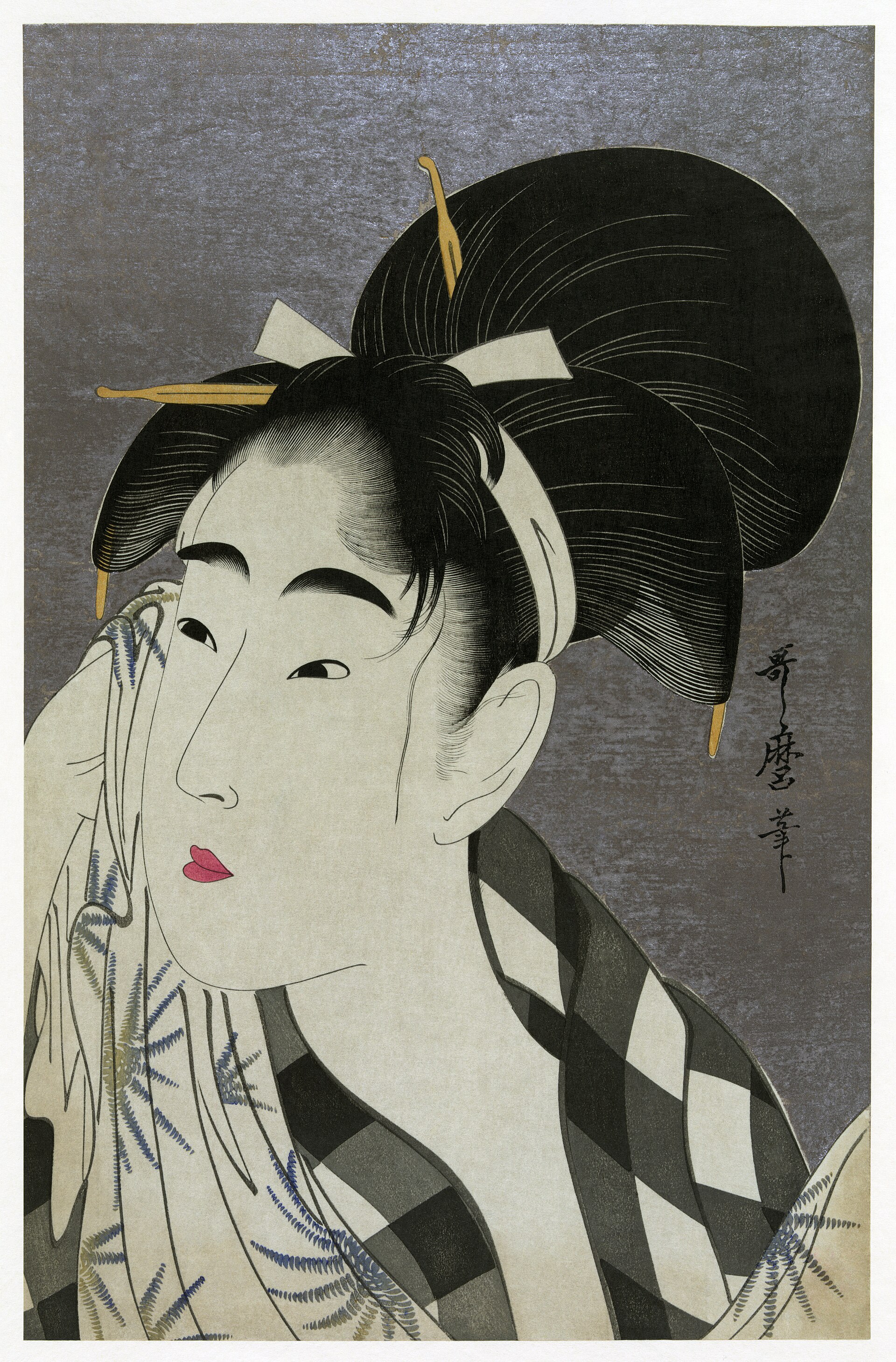
Around 1791 Utamaro stopped designing prints for books and turned to single-sheet, half-length portraits of women, okubi-e, in place of the full-figure group compositions favoured by his contemporaries. The large-headed close-up format itself had been introduced for actor portraits by the Katsukawa school decades earlier; Utamaro's innovation was to turn the same intimate, cropped-in device on ordinary women and courtesans, bringing a viewer into a proximity with an individual sitter that group compositions could not manage.
Through the 1790s the proportions grew more extreme. A German-language survey of Japanese colour woodcuts published the year after his death was already read by later writers as recording this: heads that had begun the decade in roughly natural proportion, by its middle years, were said to run twice as long as they were broad, set on slender necks beneath a coiffure that could nearly outsize the head itself, with facial features reduced to short slits and a small mouth. By around 1800 critics such as Basil Stewart, writing decades later, judged that the exaggeration had gone far enough to cost the figures some of their grace. This record treats that judgment as a period critical opinion, not a fact about the pictures.
Alongside the bijin-ga that made his name, Utamaro produced three linked illustrated books of nature studies in the years just before his rise to okubi-e fame.
Alongside the bijin-ga that made his name, Utamaro produced three linked illustrated books of nature studies in the years just before his rise to okubi-e fame. Ehon Mushi Erami, the Picture Book of Crawling Creatures, appeared in 1788: fifteen double-page spreads pairing insects and small garden creatures, drawn with the same close observation he brought to a face, against kyoka comic verse contributed by leading poets of the day. Shiohi no Tsuto, Gifts from the Ebb Tide, followed in 1789, thirty-six shells paired with thirty-six poems by thirty-six different poets. Momo Chidori Kyoka-awase, Myriad Birds, a two-volume anthology, appeared in 1791, the same year he turned decisively toward the okubi-e format that would define his reputation.
These books are not an aside. They show the same eye that individuated a courtesan's face doing the same work on a katydid or a scallop shell, at a moment when natural history observation and comic verse culture overlapped in Edo's publishing world. Utamaro's reputation as a bijin-ga specialist has crowded this part of his output out of the popular account, but the natural-history books were published by the same house, Tsutaya, in the same luxury printing techniques, and were not a minor sideline.
A woodblock does not print only once, and Utamaro's own books survive in more than one state, a fact easy to lose in a reproduction that shows only one plate with no state noted.
A woodblock does not print only once, and Utamaro's own books survive in more than one state, a fact easy to lose in a reproduction that shows only one plate with no state noted. The Metropolitan Museum's copy of Shiohi no Tsuto is catalogued by the Museum itself as probably the second printing, distinguishable from the first by an added band of metal flakes across the centre of each illustration and a purple wave pattern printed across the top of the page, decorative additions that were not part of the original 1789 pull. The same Museum's copy of Ehon Mushi Erami is catalogued as probably a later edition of about 1823, printed from the 1788 blocks roughly two decades after Utamaro died.
Neither fact is disclosed by the image alone. A reader who wants to know whether a given plate shows Utamaro's own first pull or a posthumous reprint from a worn or altered block has to go to the object record, not the picture, and this is true across his surviving books and prints generally: condition, state and printing sequence are frequently more informative, and more consequential for value, than the design itself.
General accounts of Utamaro's output credit him with more than thirty shunga books, albums and related publications, a substantial share of a career total put at over two thousand prints.
General accounts of Utamaro's output credit him with more than thirty shunga books, albums and related publications, a substantial share of a career total put at over two thousand prints. Shunga, sexually explicit imagery, was not treated in Edo Japan the way explicit imagery was treated in contemporary Europe; it circulated across social classes and was not stigmatised as pornography in the modern Western sense. Utamaro's best-known book in the genre, Utamakura, published in 1788 by Tsutaya, uses embossing, mica dusting and colour-gradation printing to a standard contemporaries and later critics alike singled out; the French critic Edmond de Goncourt later called it Utamaro's most beautiful erotic book, and it has been described in modern scholarship as the first of his three most representative works in the genre. Few complete copies are recorded as surviving, and this record has not located an image that meets its own licensing and version-safety standard for reproduction, so none is shown here.
This part of the corpus matters for one reason beyond content: connoisseurs use shunga states and impressions, exactly like the natural-history books above, to help date and authenticate prints elsewhere in Utamaro's output, since the same luxury printing techniques and the same publishers' practices run across both genres.
The Ehon Taikoki, an illustrated chronicle of the sixteenth-century military ruler Toyotomi Hideyoshi published between 1797 and 1802, was adapted for kabuki and bunraku stages and became genuinely...
The Ehon Taikoki, an illustrated chronicle of the sixteenth-century military ruler Toyotomi Hideyoshi published between 1797 and 1802, was adapted for kabuki and bunraku stages and became genuinely popular. When ukiyo-e artists began producing prints and books that traded on that popularity, depicting Hideyoshi and his household by name and by identifying crest, they ran into a law that forbade exactly that: the depiction of named historical warriors and their insignia in commercial prints. Utamaro's contribution included a print of the general Kato Kiyomasa gazing at a Korean dancer, another showing Hideyoshi holding the hand of his page Ishida Mitsunari in a manner read as sexually suggestive, and the print now in this archive's linked object record, showing Hideyoshi with his five consorts viewing cherry blossoms at Higashiyama, each consort named.
In 1804 Utamaro was imprisoned, then manacled under house arrest for fifty days alongside the artists Tsukimaro, Toyokuni, Shuntei and Shun'ei and the popular writer Jippensha Ikku; their publishers were separately fined. The government's own case papers do not survive, so the precise legal reasoning is reconstructed rather than read directly, and Julie Nelson Davis's 2007 reassessment of the episode, cited throughout the secondary literature on this incident, remains paywalled in the copy consulted for this record. What is documented is the outcome: Utamaro was singled out as the most prominent of the group, and he was dead within two years of his release.
Utamaro died in Edo on 31 October 1806, recorded in the traditional calendar as the twentieth day of the ninth month of Bunka 3, at about fifty-two or fifty-three.
Utamaro died in Edo on 31 October 1806, recorded in the traditional calendar as the twentieth day of the ninth month of Bunka 3, at about fifty-two or fifty-three. He was given the Buddhist posthumous name Shoen Ryoko Shinshi and buried at the temple Senkoji. He appears to have left no heir, and his grave went untended until admirers had it repaired in 1917, more than a century later.
His name did not end with him. His pupil Koikawa Shuncho married Utamaro's widow after his death and continued producing work signed Utamaro, work modern scholarship separates out as Utamaro II, until he switched to his own name, Kitagawa Tetsugoro, around 1820. Other pupils worked under names built from his own, Kikumaro, later Tsukimaro, Hidemaro and Takemaro, and he is recorded as having sometimes allowed them to sign his name outright. He himself, rarely, signed a print the genuine Utamaro to mark it against imitators already circulating in his own lifetime. None of this is unusual for a commercially successful Edo studio; what it means for a modern reader is that a signature reading Utamaro on a print made after about 1806 identifies a school, not necessarily the man.
Utamaro's largest and most ambitious surviving works are not prints at all.
Utamaro's largest and most ambitious surviving works are not prints at all. Snow at Fukagawa, Moon at Shinagawa and Cherry Blossoms at Yoshiwara are three unusually large hanging-scroll paintings, each idealising a different pleasure quarter of Edo, painted across a span the Smithsonian's own exhibition materials date to roughly 1788 through 1802 to 1806. They were last recorded together in Japan in 1879, before travelling to Paris, where the dealer Siegfried Bing separated and sold them individually in the 1880s.
Charles Lang Freer, the Detroit industrialist whose collection founded the Smithsonian's Freer Gallery of Art, bought Moon at Shinagawa in 1903; under the terms of his bequest it has never been permitted to leave the Freer building. Cherry Blossoms at Yoshiwara passed through several further owners before the Wadsworth Atheneum Museum of Art in Hartford, Connecticut, acquired it in the late 1950s. Snow at Fukagawa simply disappeared after a brief public showing at a Tokyo department store in 1948 and was not seen again until the Okada Museum of Art in Hakone announced its rediscovery and acquisition in 2014, nearly seventy years later. In 2017 the Smithsonian's Arthur M. Sackler Gallery became the only venue ever to show all three together again, in an exhibition titled, pointedly, Inventing Utamaro.
The 2017 exhibition's co-curators, James Ulak of the Sackler and Julie Nelson Davis, the same scholar whose work underpins this record's account of the 1804 arrest, built their show around an...
The 2017 exhibition's co-curators, James Ulak of the Sackler and Julie Nelson Davis, the same scholar whose work underpins this record's account of the 1804 arrest, built their show around an explicit thesis: that Utamaro's reputation as a connoisseur of female beauty was itself a constructed brand, deliberately marketed in his own lifetime and then re-marketed by Japanese and Western dealers a century later for a Paris audience hungry for a vanished, idealised old Edo. Ulak has stated the point directly: seeing Utamaro as a successfully fabricated persona in his own time, and again at the moment Freer assembled his collection, reframes how the pictures themselves should be read.
This is an argued scholarly position, held by two named specialists in a museum exhibition and its accompanying materials, not an established consensus and not a claim this record treats as settled fact. It matters here because it reframes a question that otherwise looks purely biographical, who Utamaro really was, as a question about marketing across two different centuries and two different countries, with the pictures themselves as the evidence for both.
Utamaro's prints reached Europe by the mid-nineteenth century and found particular acclaim in France; general reference accounts describe an 1888 Paris exhibition of his work organised by Siegfried...
Utamaro's prints reached Europe by the mid-nineteenth century and found particular acclaim in France; general reference accounts describe an 1888 Paris exhibition of his work organised by Siegfried Bing as a landmark in the vogue that came to be called Japonisme, and credit Monet, Degas, Gauguin and Toulouse-Lautrec among collectors of his prints. Mary Cassatt's 1891 series of ten colour prints, made after she saw a major 1890 Paris exhibition of Japanese ukiyo-e, has been documented by specialist scholarship as drawing specifically on Utamaro among the artists she studied, in its flattened planes, bold outlines, asymmetrical composition and domestic subject matter of women and children; Cassatt is recorded as having owned prints by him directly, not merely having seen them in passing.
The market that grew from that nineteenth-century rediscovery now runs at two very different scales. His paintings are close to unobtainable, and the single sale below shows what happens when one does appear. His prints, by contrast, trade constantly, at prices from a few tens of dollars for a worn later impression to sums that make international auction news for a first-state proof of a major design in strong, unfaded colour. Condition and impression order, not the subject alone, are what separate the two ends of that range.
Ukiyo-e print designer; Painter; Book illustrator. c. 1753-1806.
Born c. 1753, Unverified; early accounts claim Kyoto, Osaka, the Yoshiwara district of Edo, or Kawagoe in Musashi Province; died 1806-10-31, Edo (modern Tokyo).
Utamaro II and the extended signature. After Utamaro's death in 1806 his pupil Koikawa Shuncho married his widow and continued producing prints signed with the Utamaro name, work modern scholarship separates out as Utamaro II, until he adopted his own name, Kitagawa Tetsugoro, around 1820. The signature carved into these later blocks is not a copy of Utamaro's mark; it is, by the family and studio logic of the time, a legitimate continuation of it.
Metropolitan Museum of Art (New York); British Museum (London); Museum of Fine Arts, Boston (Boston); Toledo Museum of Art (Toledo, Ohio); Smithsonian National Museum of Asian Art, Freer Gallery (Washington, D.C.); Wadsworth Atheneum Museum of Art (Hartford, Connecticut).
Two very different markets sit under Utamaro's name. His large hanging-scroll paintings are close to unobtainable: only a handful are known to survive at all, and when one changes hands the result is a record for the artist and, on the saleroom's own account, for any ukiyo-e painting sold at auction.
Which of the four claimed birthplaces, Kyoto, Osaka, the Yoshiwara district of Edo, or Kawagoe, is correct, if any of them is; none has been verified against a document.
Last verified
One artwork and its story every Tuesday, with the picture: who owned it, what it made, and what closes soon in the exhibition calendar. No promotion, and nothing we cannot cite.
We send one email to confirm the address and keep nothing else. Every letter carries a one-click unsubscribe. How we handle your data.

