Mosaic Glass Inlay with Theatre Mask
Unrecorded glass workshop, Egypt (Alexandrian type) · c. 50 BCE-100 CE
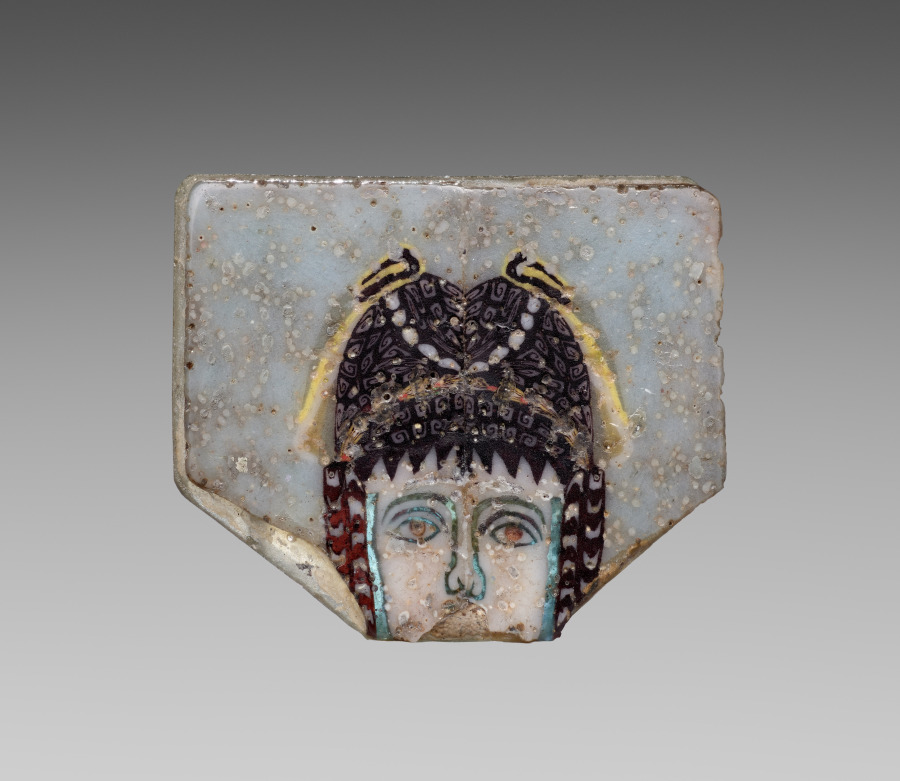
The object described in this record: white, green, yellow and red glass, 2.9 x 3.4 cm, two identical slices joined at the centre. Cleveland Museum of Art primary image, CC0.
| Maker | Unrecorded glass workshop, Egypt (Alexandrian type) |
|---|---|
| Date | c. 50 BCE-100 CE |
| Medium | White, green, yellow and red glass; mosaic glass technique |
| Dimensions | 2.9 x 3.4 cm overall (1 1/8 x 1 5/16 in.) |
| Where it is now | The Cleveland Museum of Art, Cleveland, Ohiolast confirmed |
| Inventory number | 2026.16 (Cleveland Open Access object ID 710166) |
| Attribution | UnknownNo maker or workshop is named or documented. Full note |
| Object type | Glass |
| Period | Roman Egypt, Late Hellenistic to Early Imperial |
| Cases | Has a provenance gap |
| Inscriptions | None recorded. |
| Owners on record | 14 links10 documented, 1 disputed, 3 unknown |
| Sources | 13 cited |
About this record Last verified · 13 sources cited · Change log
On this page 10 sections
ContentsClose
A theatre mask two and a half centimetres across, made in Egypt around the turn of the common era by slicing a single cane of coloured glass and setting the two halves face to face. It is an anonymous piece of trade decoration, probably once set into furniture or a small object, and its documented life starts only in the collection of the Frenchman Julien Greau and then J. Pierpont Morgan, who gave it to the Metropolitan Museum in 1917.
The Metropolitan sold it in 1928 (the buyer is disputed in the published accounts), and after Joseph Klein's New York collection it appeared at Bonhams in 2012 for GBP 6,000, was offered again in 2023 and 2024, and sold at Bonhams in December 2024 for GBP 3,840 before passing through a Basel dealer to the Cleveland Museum of Art in 2026. No find spot, export record or price paid by Cleveland has been published.
Provenance
Each link is graded. Documented: a cited source supports it. Disputed: the identification is argued but not established. Unknown: no owner for that span, and the gap is not smoothed into a narrative. The grades in the glossary.
- c. 50 BCE - c. 100 CEUnrecorded glass workshop, Egypt (Alexandria proposed by some museums for the type)unknown
Cleveland gives Egypt, Roman Period, c. 50 BCE-100 CE. No workshop, find spot or first owner is recorded. The Alexandrian attribution is a probability stated for the type by the Grand Curtius, not a fact about this piece.110
- - by 1895Unknownunknown
No owner or movement is recorded between manufacture and Julien Greau's collection. How the piece left Egypt and when is not recorded.15
- by 1895 - 1895Julien Greau (1810-1895), Francedocumented
Cleveland footnote: illustrated in Froehner's Greau catalogue of 1903, no. 618, pl. LXVII, 3. Christie's cites the same plate. The 1903 volume itself was not consulted; the plate reference is as reported by Cleveland and Christie's.15
- 1895 - 1913John Pierpont Morgan Sr. (1837-1913), Londondocumented
Christie's states Morgan acquired it from Greau's estate after 1895. Cleveland gives 1895-1913.15
- 1913 - 1917John Pierpont Morgan Jr. (1867-1943), New Yorkdocumented
- 1917 - 1928The Metropolitan Museum of Art, New York, accession 17.194.1508documented
Cleveland: part of the Morgan gift offered in April 1910 and accessioned in 1917. Christie's and Bonhams both say gifted 1917. The Metropolitan's online data was not found to list the accession number.15711
- 1928 - 1941?Deaccessioned by the Metropolitan Museum; buyer disputed (W. Gedney Beatty per Cleveland; Anderson Galleries, 20-21 April 1928, per Bonhams and Christie's)disputed
Cleveland: sold to W. Gedney Beatty (1869-1941), 1928-1941? Bonhams 2024: sold by order of the Trustees at Anderson Galleries, lot 3 or 4, each a group of 100 Greau glass fragments. Christie's: same sale, lot 411, 412 or 413. The accounts are not reconciled and no sale record was consulted.157
- possibly by 1941 - 1987Joseph Klein (1899-1987), New Yorkdocumented
Bonhams: Klein collection formed in New York between 1941 and 1980. Cleveland: 'possibly by 1941, by 1980-1987'. Date, seller and price of his acquisition are not recorded.135
- c. 1987 - 2012By descent from Joseph Kleindocumented
Bonhams: 'Thence by descent'. Names of the heirs not published.13
- 2012-10-24 - 2024Buyer at Bonhams, London, lot 21; unnameddocumented
Sold for GBP 6,000 including premium. The Sotheby's 2023 page states that the present owner acquired it at that sale. Buyer's name not published.34
- 2023 - 2024Same unnamed owner; offered at Sotheby's (7 July 2023, lot 281, estimate GBP 3,000-5,000) and Christie's (3 July 2024, lot 27, estimate GBP 6,000-8,000)unknown
The results of both offers were not seen, and no sale is recorded. Both catalogues carry the same Klein and Bonhams provenance.456
- 2024-12-05 - 2024Buyer at Bonhams, London, 5 December 2024, lot 101; unnameddocumented
Sold for GBP 3,840 including premium. Bonhams' provenance lists the 1928 Anderson Galleries sale and the 2012 sale, and calls the consignor the owner who bought in 2012. Buyer not published. Whether the buyer was Galerie Cahn is not stated by any source.7
- 2024 - 2026Galerie Cahn, Basel, Switzerlanddocumented
Stated only in Cleveland's provenance as '-2026'. Date of acquisition, price and seller are not recorded.1
- 2026 - presentThe Cleveland Museum of Art, Cleveland, Ohio, accession 2026.16documented
Accession date 8 June 2026. Credit line The Jane B. Tripp Charitable Lead Annuity Trust. Price not published. Not on view per the museum's page.12
Prices realised
| Date | Sale | Estimate | Result | Note |
|---|---|---|---|---|
| 24 October 2012 | Bonhams | Not shown on the page | Hammer Not stated on the page With premium Result given only as GBP 6,000 including premium GBP | Antiquities, London, New Bond Street, lot 21. 3.5 x 3 cm. |
| 7 July 2023 | Sotheby's | GBP 3,000-5,000 | Hammer Not seen With premium Not seen GBP | Ancient Sculpture and Works of Art, London, lot 281. Page shows 'Lot Closed' and 'Log in to view results'. Christie's cites this sale as 3 July 2023; Sotheby's page shows July 7. Whether it sold is not recorded here. |
| 3 July 2024 | Christie's | GBP 6,000-8,000 (aggregator) | Hammer Not seen With premium Not seen GBP | Lot 27 of live auction 22666 per the Christie's mirror; date and estimate per the VeryImportantLot aggregator. Result not shown. Whether it sold is not recorded here. |
| 5 December 2024 | Bonhams | Not shown on the page | Hammer Not stated on the page With premium Result given only as GBP 3,840 including premium GBP | Antiquities, London, New Bond Street, lot 101. 3 x 3.4 cm. Hammer and premium are conflated on the page; the figure is the inclusive total. |
Hammer is the price at which the bidding stopped; with premium adds the fee the house charges the buyer on top. Hammer price and buyer's premium in the glossary.
Technical evidence
| Attribution note | No maker or workshop is named or documented. Cleveland gives the culture as Egypt, Roman Period. The Grand Curtius proposes an Alexandrian workshop for the type, the Getty allows Egypt or Italy, and the Metropolitan Museum labels comparable inlays 'Roman, probably Egyptian'. |
|---|---|
| Medium | White, green, yellow and red glass; mosaic technique, two identical slices from one cane joined at the centre.1810 |
| Dimensions | Overall 2.9 x 3.4 cm (1 1/8 x 1 5/16 in.) per Cleveland. Bonhams 2012: 3.5 x 3 cm. Bonhams 2024: 3 cm high, 3.4 cm wide. Christie's 2024: 3.5 cm long. The differences are consistent with measurement and orientation but are recorded as published.1357 |
| Subject | Frontal comic theatre mask of a female figure with white face and upswept hair; Cleveland suggests a maenad or hetaira.1 |
| Ground and colours in the sale catalogues | Bonhams 2012: pale blue-grey semi-translucent ground, opaque white face, blue-green features, dark brown-purple hair with white curls and beaded ringlets, red and yellow fillet with white beads, yellow ribbons. Bonhams 2024 lists canes of white, yellow, red, black and purple. Cleveland names white, green, yellow and red.137 |
| Date | c. 50 BCE-100 CE per Cleveland; c. late 1st century BCE-1st century CE per Bonhams and Christie's.137 |
| Culture | Egypt, Roman Period per Cleveland; 'Roman, probably Egyptian' is the Metropolitan Museum's label for its comparable inlays.111 |
| Inscriptions | None recorded.1 |
| Condition | No condition statement published by Cleveland. Bonhams and Sotheby's condition reports not seen.12 |
| Published | Froehner, Collection Julien Greau: Verrerie Antique, Tome I (Paris, 1903), no. 618, pl. LXVII, 3.157 |
| Images | Cleveland lists a primary view and five alternate views (verso, top, right, left, bottom), all CC0 Open Access.1 |
Images
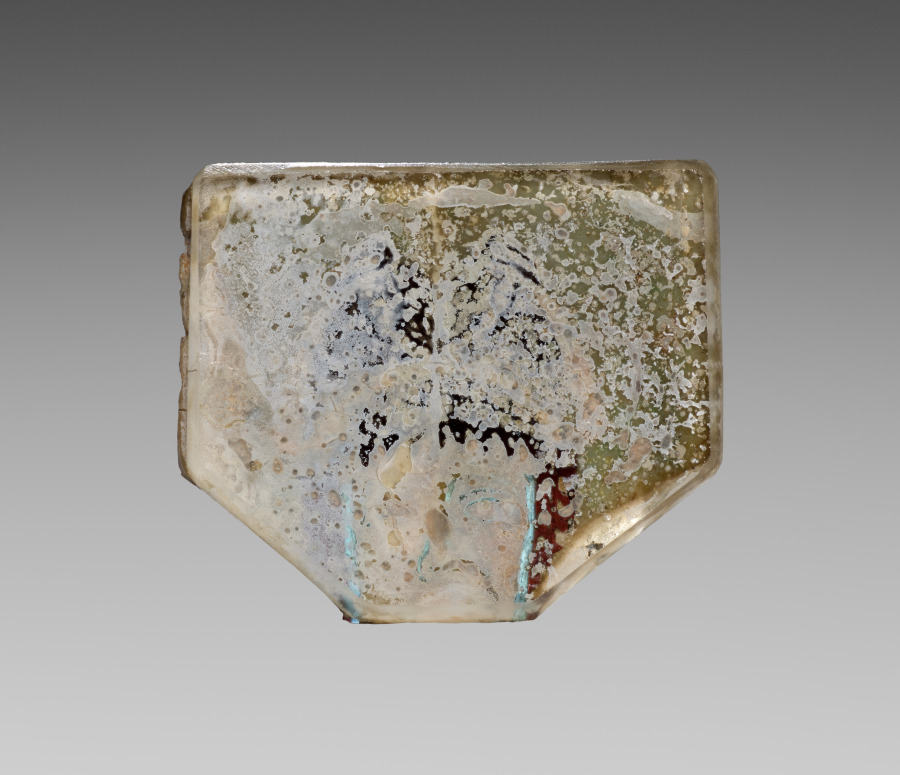
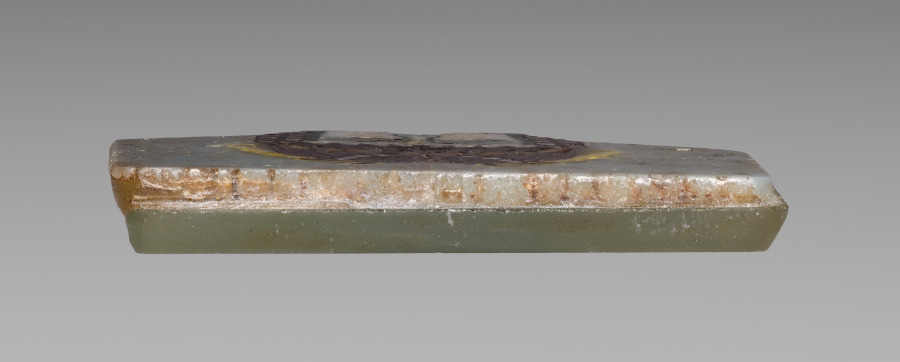
The record in full
Chapter 1A face two centimetres wide, made from one slice of glass twice
The inlay is 2.9 by 3.4 centimetres overall and made of white, green, yellow and red glass (source 1, source 2).
The inlay is 2.9 by 3.4 centimetres overall and made of white, green, yellow and red glass (source 1, source 2). Cleveland describes it as two rectangular glass plaques sliced from a longer multicoloured cane or rod and joined at the centre to form a frontal comic theatre mask. The white face and the complex upswept hairdo indicate a female figure, probably a maenad or a hetaira, a courtesan (source 1). The museum's own one-line summary is that the nearly symmetrical face was made from two identical mosaic glass slices.
That symmetry is the whole method. Only half a face had to be designed. The second half is the same slice turned over, which is why the join runs straight down the centre of the mask. Cleveland suggests the piece was probably made to adorn a vessel or another object, and nothing in the museum's record says what object (source 1).
Chapter 2How a cane becomes a face
The Art Institute of Chicago describes the process for a comparable half-mask: dozens of coloured glass rods are bundled and fused together, the resulting bar or cane is heated and stretched so the...
The Art Institute of Chicago describes the process for a comparable half-mask: dozens of coloured glass rods are bundled and fused together, the resulting bar or cane is heated and stretched so the pattern shrinks, and slices of the cane are set in symmetrical pairs to make a complete face (source 8). The Grand Curtius in Liege puts the consequence plainly: because slicing one rod yields many identical plates, the technique marks the start of serial glass production, and many such plates survive, some forming whole scenes of characters from comic or dramatic plays (source 10).
This explains why dozens of near-identical mask inlays sit in museums and why a single one cannot be identified by its design alone. Chicago, the Getty, the Metropolitan Museum and others hold plaques from the same family of canes and the same trade (sources 8, 9, 11). The Getty places comparable plaques in the late first century BCE to early first century CE and describes them as fashionable inlays, likely made at a single centre within a short period (source 9).
Chapter 3Who made it and where
No maker, workshop or find spot is recorded for this piece.
No maker, workshop or find spot is recorded for this piece. Cleveland gives its culture as Egypt, Roman Period, and its date as c. 50 BCE-100 CE, a wider span than the late first century BCE to early first century CE that other institutions use for the type (sources 1, 9). The Grand Curtius says the workshop for plaques of this kind was probably in Alexandria, under Roman rule (source 10). The Getty is more cautious and allows Egypt or Italy for its own plaque (source 9), and the Metropolitan Museum labels its three small mosaic inlays 'Roman, probably Egyptian' (source 11). The Alexandrian attribution is therefore a probability stated by some museums, not a documented fact about this object.
Chapter 4What the mask shows, and what it was for
The figure is a stock character of the comic stage.
The figure is a stock character of the comic stage. Cleveland reads the white face and the high hairdo as a woman and offers two identifications, a maenad or a hetaira (source 1). The Grand Curtius reads a comparable half-face as a courtesan and notes that her mitre-shaped headpiece and corkscrew curls match the hairstyles of the deities Dionysus and Isis, which is why such masks are catalogued beside inlays of those gods (source 10). Bonhams makes the same comparison, citing masks of Dionysus and Isis in the 1994 Ernesto Wolf Collection catalogue by Stern and Schlick-Nolte, nos. 127-8 (source 3).
Function is the part a reader would most like to know and the part least documented for this specific inlay. The Art Institute of Chicago states that such inlays embellished furniture, boxes and household shrines to the gods (source 8). The Grand Curtius says the plates were probably used as inlay on small pieces of furniture (source 10). Cleveland says only a vessel or another object (source 1). The glass was a decorative surface, set into a bed of something else, and no source reports any ritual or devotional meaning attached to this particular mask. There is no documented hidden programme here. A comic mask in coloured glass is a theatre motif used as decoration, and the identification as maenad or courtesan is a modern art-historical reading of its face and hair.
Chapter 5The Greau and Morgan years
Cleveland's provenance begins with the French collector Julien Greau (1810-1895), with the footnote that the piece is illustrated in Froehner's catalogue of the Greau collection published in 1903 as...
Cleveland's provenance begins with the French collector Julien Greau (1810-1895), with the footnote that the piece is illustrated in Froehner's catalogue of the Greau collection published in 1903 as no. 618 (plate LXVII, 3) (source 1). Christie's lot note gives the same plate reference and the same chain: Greau, then J. Pierpont Morgan Sr. (1837-1913) in London, who acquired it from Greau's estate after 1895, then by descent to J. Pierpont Morgan Jr. (1867-1943) (source 5). I have not seen the 1903 catalogue itself, so the plate reference is taken from Cleveland and Christie's, which agree.
Cleveland records the piece as Metropolitan Museum accession 17.194.1508, part of the large Morgan gift offered in April 1910 and accessioned in 1917 (source 1). Christie's and Bonhams both say it was gifted to the Metropolitan Museum in 1917 (source 5, source 7). The Metropolitan's open data shows other glass from the same gift under the credit 'Gift of J. Pierpont Morgan, 1917', for example the mask applique 17.194.352 (source 11). I did not find 17.194.1508 itself in the Metropolitan's online data, which is not proof of anything because the museum's search is fuzzy and the piece left the collection in 1928.
Chapter 6How it left the Metropolitan Museum: three accounts that do not agree
This is the one place where the published chain splits.
This is the one place where the published chain splits. Cleveland's entry says the piece was deaccessioned and sold to W. Gedney Beatty (1869-1941), with the dates given as 1928-1941? and a question mark (source 1). The Bonhams catalogue of December 2024 instead says it was sold by order of the Trustees of the Metropolitan Museum at the Anderson Galleries, New York, 20-21 April 1928, in a sale titled Cypriote and Classical Antiquities: Duplicates of the Cesnola and Other Collections, Part Two, as lot 3 or 4, each of which consisted of a group of 100 ancient glass fragments from the Greau collection (source 7). Christie's names the same sale but gives lot 411, 412 or 413 (source 5).
Neither Bonhams nor Christie's gives a source for its lot number, and neither mentions Beatty. They can be reconciled only if Beatty bought at the Anderson Galleries sale, and no source I read says that. The record therefore treats the 1928 step as disputed in its details and settled in its outline: it left the Metropolitan Museum in 1928.
Chapter 7Joseph Klein and the Bonhams sale of 2012
Next in the chain is Joseph Klein (1899-1987) of New York.
Next in the chain is Joseph Klein (1899-1987) of New York. Bonhams in 2012 described a Klein collection formed in New York between 1941 and 1980, passing thence by descent; Cleveland dates his ownership 'possibly by 1941, by 1980-1987' (source 3, source 1). The exact year he acquired this piece, and from whom, is not recorded in any source I found.
The piece was sold from the Klein collection at Bonhams, London, on 24 October 2012 as lot 21, 'A Roman mosaic glass inlay of a female theatre mask', for GBP 6,000 including premium. The Bonhams page does not give the hammer price or the estimate (source 3).
Chapter 8Three offers in eighteen months and a price lower than 2012
A Sotheby's lot page for 'Ancient Sculpture and Works of Art', London, July 2023, lot 281, lists a polychrome mosaic glass inlay of a theatre mask of a woman, estimated at GBP 3,000-5,000, with the...
A Sotheby's lot page for 'Ancient Sculpture and Works of Art', London, July 2023, lot 281, lists a polychrome mosaic glass inlay of a theatre mask of a woman, estimated at GBP 3,000-5,000, with the Klein provenance and the statement that the present owner acquired it at the Bonhams sale of 2012. The result is behind a login and was not seen (source 4). A Christie's lot 27, with the full Greau to Sotheby's chain, is dated 3 July 2024 and estimated at GBP 6,000-8,000 by an aggregator, whose listing also shows no result (source 5, source 6). Christie's own page cites the Sotheby's sale as 3 July 2023, while Sotheby's own page shows July 7, so that date differs between sources.
On 5 December 2024 Bonhams offered it again as lot 101, 'An Egyptian mosaic glass inlay of a New Comedy theatre mask', and the page reports it sold for GBP 3,840 including premium (source 7). That is GBP 2,160 below the 2012 figure, but both numbers include a buyer's premium whose rate may not have been the same in the two sales, so they are not a like-for-like comparison. This record does not state that the Sotheby's or Christie's offers failed. The same owner is described as the present owner in 2023 and again in December 2024, which is consistent with unsold lots, but that is an inference and no result page confirms it.
Chapter 9Basel and Cleveland
Cleveland's provenance closes with Galerie Cahn, Basel, Switzerland, dated '-2026', and then the Cleveland Museum of Art from 2026 (source 1).
Cleveland's provenance closes with Galerie Cahn, Basel, Switzerland, dated '-2026', and then the Cleveland Museum of Art from 2026 (source 1). That is the only source for the Basel step, and it gives no date of purchase, price or consignor. Cleveland's data records an accession date of 8 June 2026 and the credit line The Jane B. Tripp Charitable Lead Annuity Trust (source 1). The same trust is credited on an earlier Cleveland acquisition, accession 2006.5 (source 12). The museum's collection page lists the piece as not on view and carries its general caution that provenance information may not be currently accurate (source 2).
I found no acquisition announcement, no exhibition, no publication and no price for the Cleveland purchase. The Cleveland record carries a flag that the object is not Nazi-era provenance, and a legal status of accessioned (source 1).
Chapter 10What the sources do and do not say about export and title
No source I read records a find spot, an excavation, an Egyptian export licence or any restitution or due-diligence statement for this piece.
No source I read records a find spot, an excavation, an Egyptian export licence or any restitution or due-diligence statement for this piece. Its documented history reaches back to the Greau collection by 1895 on the strength of the 1903 catalogue reference, which is earlier than any modern cultural-property regime, but how the glass came out of Egypt, if it did, and when, is not recorded (source 1, source 5). The absence is recorded as a gap, not as a clearance, and no claim of any kind is attached to this object in any source I fetched.
The artist
Unrecorded Egyptian mosaic glass workshop (Alexandrian type)
No maker is named for this inlay or for any of the comparable plaques in other museums. The dossier covers the trade instead: a workshop, or a small number of them, working in Egypt in the decades around the beginning of the common era, producing mosaic canes whose slices were sold or traded as inlay. The attribution of the type to Alexandria is a proposal made by some museums and rests on comparison, not on an excavated workshop.
Related works
| Work | Relation | Where it is |
|---|---|---|
| Fragment of an Inlay Depicting a Theater Mask Egyptian glassworker | Comparandum: half-face mask inlay in mosaic glass Late 1st century BCE-early 1st century CE; the museum explains the cane and paired-slice method and states that such inlays embellished furniture, boxes and household shrines. | Art Institute of Chicago, 1894.783 |
| Fragment of an Inlay with a Female Theater Mask Egyptian or Italian glassworker | Comparandum: half mask on opaque turquoise ground Fused mosaic glass; Egypt or Italy; the catalogue groups such plaques as fashionable inlays likely made at a single centre within a short period. | J. Paul Getty Museum, Los Angeles, 2003.260 |
| Mosaic glass inlays 42.11.37, 42.11.38 and 42.11.39 Unrecorded | Comparanda: small mosaic glass inlays, 'Roman, probably Egyptian' Fletcher Fund, 1942. Different gift, not the Morgan material. | Metropolitan Museum of Art, New York |
| Female theatre mask inlays EA16597 (British Museum) and 26.7.1209 (Metropolitan Museum) Unrecorded | Comparanda named in Christie's 2024 catalogue note for this piece Named only on the strength of the Christie's lot note; the museum records were not retrieved. | British Museum, London; Metropolitan Museum of Art, New York |
| Early Glass of the Ancient World: 1600 B.C.-A.D. 50, Ernesto Wolf Collection, nos. 127-8 E. M. Stern and B. Schlick-Nolte (authors) | Published parallels: mosaic masks of Dionysus and Isis Cited in the Bonhams, Sotheby's and Christie's notes for this piece. | Ostfildern, 1994 |
| Half-face mosaic plaque Unrecorded | Comparandum: courtesan half-mask, probable Alexandrian workshop The museum says the two halves form a complete face when placed face to face and that the hairstyle matches those of Dionysus and Isis. | Grand Curtius, Liege |
| Bonhams 2012 lot 21 (same object per catalogue provenance) Unrecorded | Earlier sale appearance of this piece Dimensions 3.5 x 3 cm; identity with Cleveland 2026.16 rests on the later catalogues' provenance statements, not on a side-by-side image comparison made for this record. | Sold London, 24 October 2012, GBP 6,000 including premium |
Open questions
- Where in Egypt was the piece made or found, and when did it reach France? No find spot or acquisition record for Julien Greau is published in the sources consulted.
- How did it leave the Metropolitan Museum in 1928: sold to W. Gedney Beatty (Cleveland), or in a group of 100 Greau fragments at Anderson Galleries as lot 3 or 4 (Bonhams) or lot 411, 412 or 413 (Christie's)? The three accounts are unreconciled.
- When and from whom did Joseph Klein acquire it? The sources give only a collecting window of 1941 to 1980.
- Did the Sotheby's July 2023 and Christie's July 2024 offers fail to sell? Neither result was seen, and Bonhams in December 2024 names the 2012 buyer as the present owner.
- When did Galerie Cahn acquire the piece, from whom, and at what price? Cleveland gives only the dealer's name and the end date of 2026.
- What did Cleveland pay, and how did the Jane B. Tripp Charitable Lead Annuity Trust fund the purchase? Neither is in the sources consulted.
- Do the 2012 lot (3.5 x 3 cm, pale blue-grey ground) and the Cleveland piece (2.9 x 3.4 cm) match in a side-by-side image comparison? The catalogues state that they are one object; a published comparison of the images would settle the measurement differences.
- What object was the inlay made for? No source ties this piece to a vessel, casket or piece of furniture.
Questions about this object
What is Mosaic Glass Inlay with Theatre Mask?
Mosaic Glass Inlay with Theatre Mask is a glass, dated c. 50 BCE-100 CE. Medium: White, green, yellow and red glass; mosaic glass technique.
Who made Mosaic Glass Inlay with Theatre Mask, and is the attribution settled?
The attribution to Unrecorded glass workshop, Egypt (Alexandrian type) is recorded here as unknown. No maker or workshop is named or documented. Cleveland gives the culture as Egypt, Roman Period. The Grand Curtius proposes an Alexandrian workshop for the type, the Getty allows Egypt or Italy, and the Metropolitan Museum labels comparable inlays 'Roman, probably Egyptian'.
Where is Mosaic Glass Inlay with Theatre Mask now?
The Cleveland Museum of Art, Cleveland, Ohio. Inventory number 2026.16 (Cleveland Open Access object ID 710166). Last confirmed 20 November 2026. Accessioned 8 June 2026; credit line The Jane B. Tripp Charitable Lead Annuity Trust. Listed as not on view on the museum's own page.
What has Mosaic Glass Inlay with Theatre Mask sold for?
Hammer Not stated on the page; with premium, Result given only as GBP 6,000 including premium. Bonhams, 2012-10-24.
What is still unknown about Mosaic Glass Inlay with Theatre Mask?
Where in Egypt was the piece made or found, and when did it reach France? No find spot or acquisition record for Julien Greau is published in the sources consulted.
Sources
- 1Cleveland Museum of Art Open Access API record for accession 2026.16 (object id 710166): tombstone, description, 'did you know' text, 13 provenance entries with footnotes, accession date 8 June 2026, Open Access date 8 July 2026, five alternate views. openaccess-api.clevelandart.org/api/...
- 2The Cleveland Museum of Art, collection page for 2026.16: credit line, measurements, description, 'Not on view', Open Access rights, and the museum's own caution that provenance may not be currently accurate. clevelandart.org/art/...
- 3Bonhams, Antiquities, London, 24 October 2012, lot 21, 'A Roman mosaic glass inlay of a female theatre mask': description, 3.5 x 3 cm, Joseph Klein provenance, sold for GBP 6,000 including premium. bonhams.com/auction/...
- 4Sotheby's, Ancient Sculpture and Works of Art, London, July 2023, lot 281, 'A Polychrome Mosaic Glass Inlay': estimate GBP 3,000-5,000, 3.5 x 3 cm, Klein and Bonhams 2012 provenance. Result behind a login and not seen. sothebys.com/buy/...
- 5Christie's (christies.com.cn mirror), live auction 22666, lot 27, 'A Roman Mosaic Glass Inlay, circa 1st century B.C./A.D.': full provenance from Greau to Sotheby's 2023, Froehner 1903 plate reference, comparanda in the British Museum and the Metropolitan Museum. Sale date, estimate and result not shown on the page. christies.com.cn/lot/...
- 6VeryImportantLot aggregator listing of the same Christie's lot 27: sale date 3 July 2024, London, estimate GBP 6,000-8,000, result not shown. veryimportantlot.com/en/...
- 7Bonhams, Antiquities, London, 5 December 2024, lot 101, 'An Egyptian mosaic glass inlay of a New Comedy theatre mask': 3 x 3.4 cm, full provenance including the 1928 Anderson Galleries sale, sold for GBP 3,840 including premium. bonhams.com/auction/...
- 8Art Institute of Chicago via its public API, 'Fragment of an Inlay Depicting a Theater Mask' (1894.783): technique and function text, medium 'Glass, mosaic glass technique', publication history. api.artic.edu/api/...
- 9J. Paul Getty Museum, Ancient Glass catalogue no. 449 (2003.260), fragment of an inlay with a female theater mask: description, Egypt or Italy, fused mosaic glass, group dated late first century BCE to early first century CE. getty.edu/publications/...
- 10Grand Curtius, Liege, 'Half-face mosaic plaque or one of the first productions in a series': description of the courtesan mask, hairstyle, mosaic technique, serial production, probable Alexandrian workshop, use on small furniture. grandcurtius.be/en/...
- 11The Metropolitan Museum of Art Open Access API, objects 257720, 257721 and 257722 (mosaic glass inlays 42.11.37-39, 'Roman, probably Egyptian', 1st century BCE-1st century CE) and 249589 (glass applique with theatrical mask 17.194.352, Gift of J. Pierpont Morgan, 1917). collectionapi.metmuseum.org/public/...
- 12Cleveland Museum of Art, Cleveland Art July/August 2010: credit line 'Jane B. Tripp Charitable Lead Annuity Trust 2006.5' on an earlier acquisition. Shows only that the same trust gave earlier; says nothing further about the trust. clevelandart.org/magazine/...
- 13Institute for the Study of the Ancient World, NYU, 'Fragment of Inlay Depicting a Theater Mask' (Art Institute of Chicago 1894.783), exhibition highlight from When the Greeks Ruled Egypt (2014). isaw.nyu.edu/exhibitions/...
Last verified · Published
Change log
24 November 2026 - Record created at the house standard: researched narrative, technical evidence, maker dossier, graded provenance chain, prices with hammer and premium separated, related works, open questions and sources.