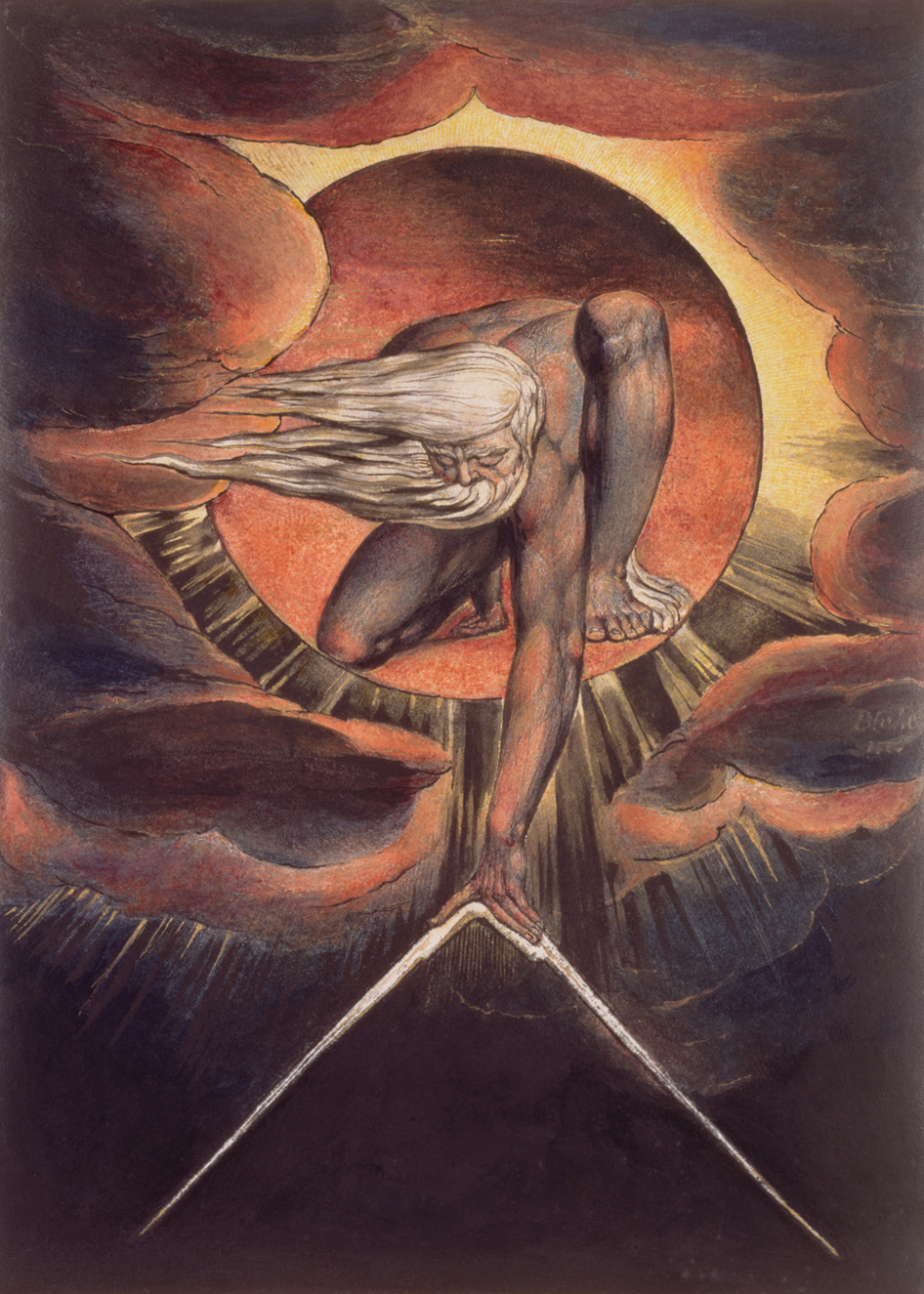
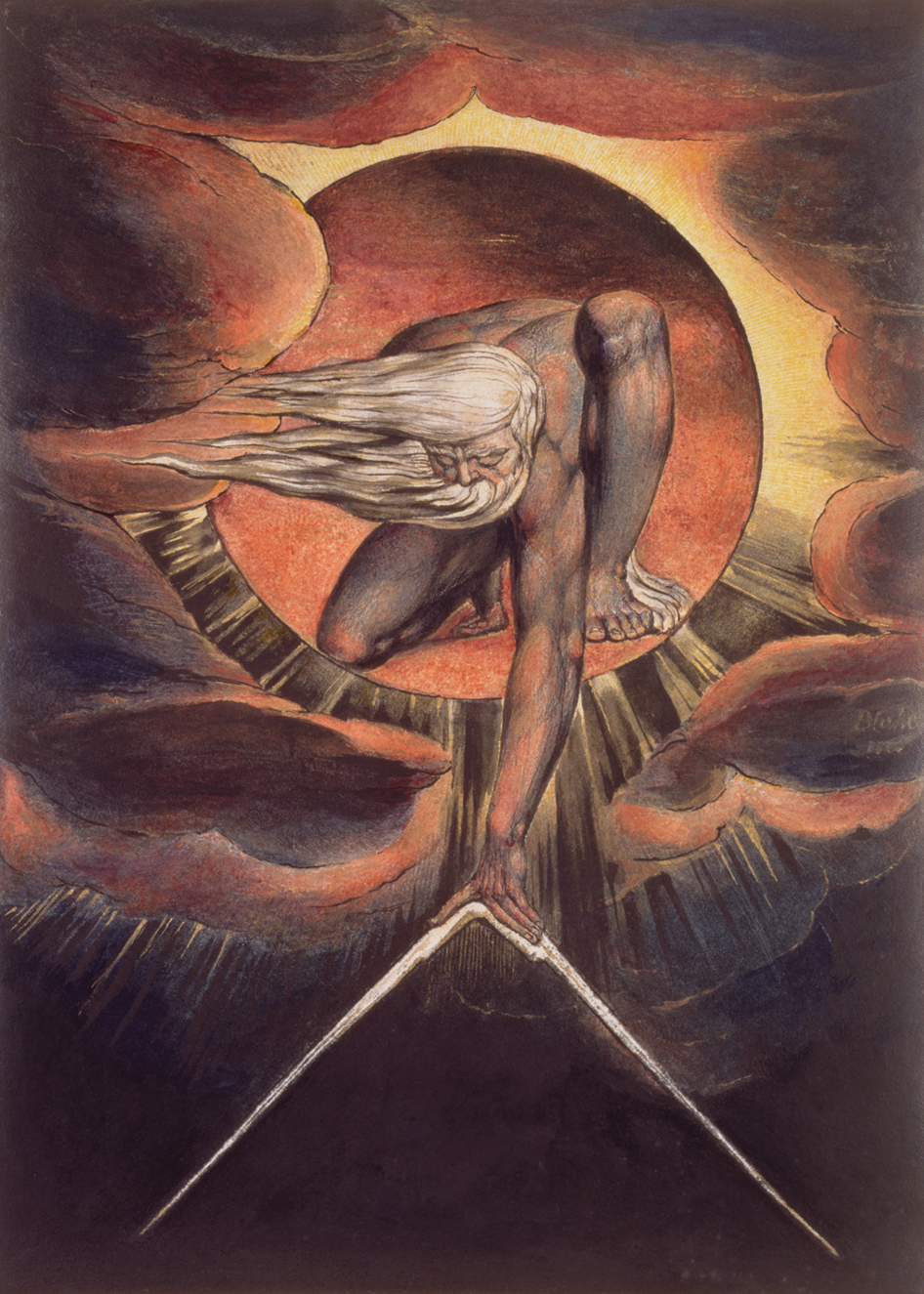
The Ancient of Days
1794 · Relief etching printed in colour
The Whitworth, The University of Manchester
 English · 1757-1827
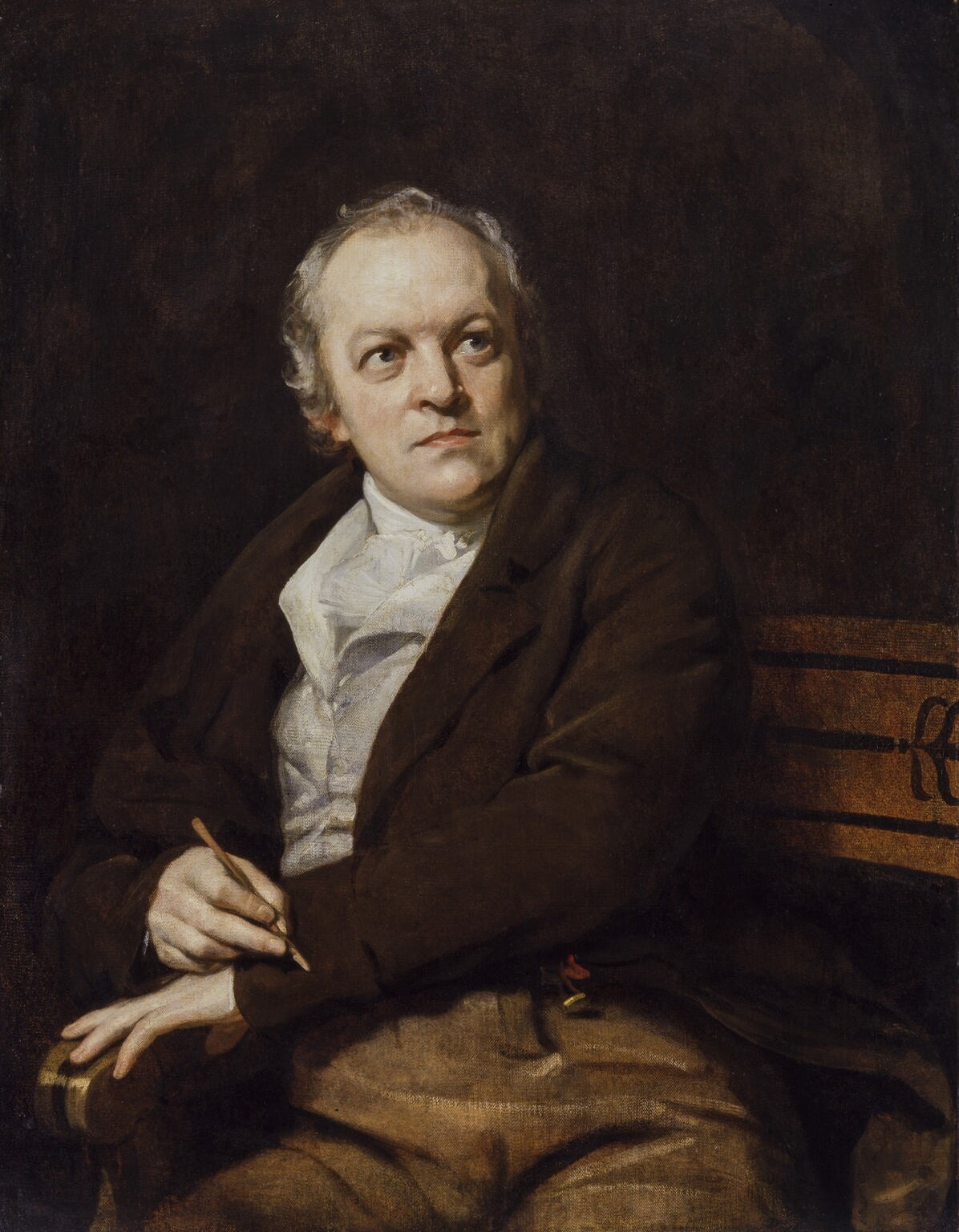
William Blake, painted by Thomas Phillips in 1807 for the engraver and publisher Richard Phillips's series of portraits of authors. The identification of the sitter as Blake is secure and undisputed; this is the portrait reproduced in the great majority of Blake biographies and editions.
National Portrait Gallery, London (NPG 212)| Worked as | Poet, Painter, Printmaker, Engraver |
|---|---|
| Born | 28 November 1757 · 28 Broad Street, Soho, London |
| Died | 12 August 1827 · Fountain Court, Strand, London |
| Nationality | English |
| Movement | Romantic era, largely self-classed and outside the schools of his own time |
| In this archive | 1 artwork |
| Sources | 12 cited |
| Last verified |
About this page 1 artwork in the archive · Last verified · 12 sources cited
William Blake earned his living as a jobbing reproductive engraver and spent most of what that trade paid him on a body of poetry and design that almost nobody bought while he was alive. He invented his own method of printing, wrote and etched his own books by hand with his wife Catherine, built a private mythology of invented gods to say what he thought the churches and the philosophers of his day had got wrong, and was called an unfortunate lunatic in print by the one newspaper that reviewed his only solo exhibition. He died in 1827 owning almost nothing and is now one of the most reproduced image-makers in the English language.
The single fact most readers do not know is how thin the record of his own hand actually is against how much is now attributed to him: a design exists in a family of hand-coloured impressions that Blake pulled and finished himself over decades, so that two copies of the same illuminated book, printed from the same copper plate, can differ in ink colour, extent of colouring and even in which plates are present at all. There is no single original to point to for most of what he made. That is the correct frame for reading every claim on this page, including the market figures.
The other fact worth stating plainly: Blake said, repeatedly and in company, that he saw visions, and this record treats that claim the way it treats every other documented fact about him, reported as what he said and what his contemporaries recorded, not adjudicated as true or false.
Born 28 November at 28 Broad Street, Soho, London, third of five children of a hosier.8
Bound apprentice, aged fourteen, to the engraver James Basire for seven years.
Sent by Basire to draw the medieval tombs and effigies of Westminster Abbey for Richard Gough's antiquarian engravings.
Enters the Royal Academy Schools as a student engraver and painter.
Marries Catherine Boucher, who could not read or write at the time; Blake teaches her to read, write, draw, colour and print.
Blake's younger brother Robert dies; Blake later credits a vision of Robert with revealing the relief-etching process.
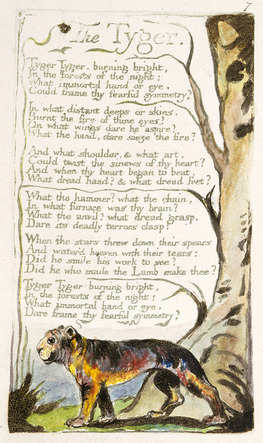
Develops relief etching, printing text and design together from a single etched copper plate.
Songs of Innocence and The Marriage of Heaven and Hell's early plates begin; 14-17 April, Blake and Catherine attend and sign the minutes of the First General Conference of the Swedenborgian New Jerusalem Church.5
Songs of Experience completed and issued combined with Songs of Innocence as Songs of Innocence and of Experience.1
Lives at Felpham, on England's south coast, under the patronage of the poet William Hayley.12
12 August, altercation with the soldier John Scolfield at Felpham leads to an indictment for sedition and assault.12
11 January, tried and acquitted at Chichester.12
First watercolour set of Illustrations of the Book of Job made for the patron Thomas Butts.
Blake's only solo exhibition, above his brother's shop on Broad Street, London; almost no visitors, no recorded sales, and one hostile press notice.7
Second Job watercolour set made; John Linnell begins financing the engraved Job plates.
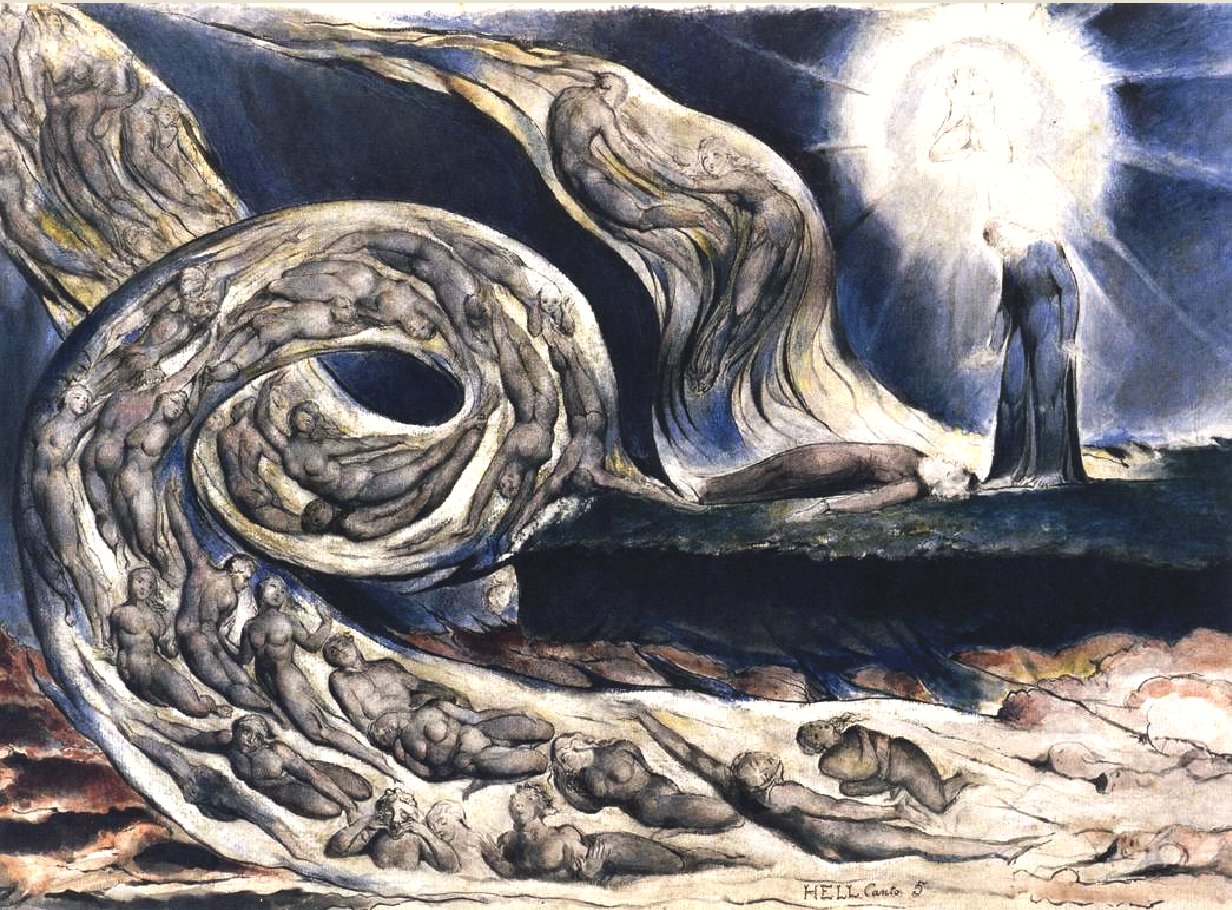
John Linnell commissions the Dante watercolour designs, ultimately 102 sheets, left unfinished at Blake's death.
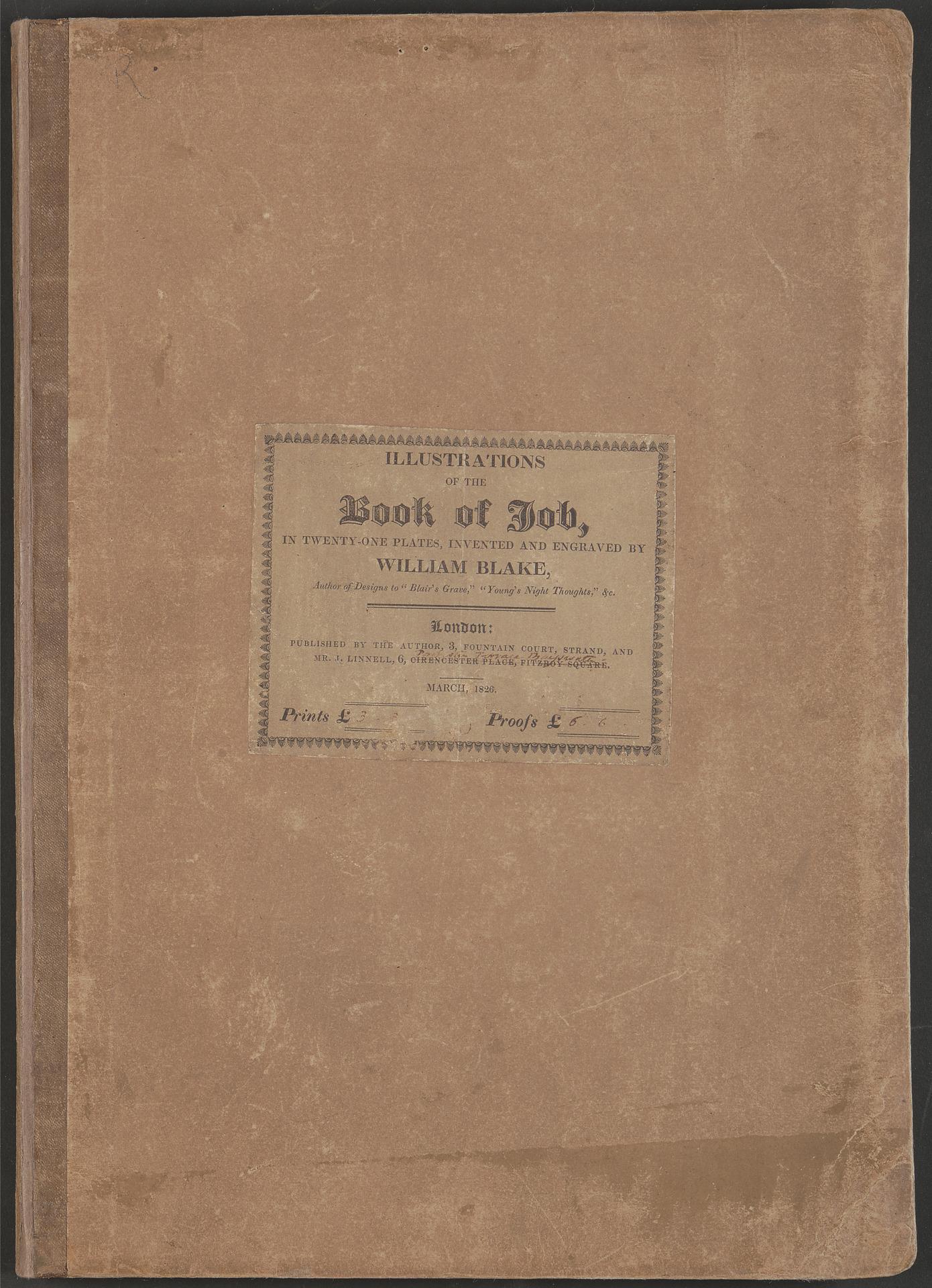
Illustrations of the Book of Job published in engraved form: a title plate and twenty-one plates.
12 August, dies at Fountain Court, Strand; buried at Bunhill Fields without a headstone.9
Catherine Blake dies; Frederick Tatham takes possession of the remaining manuscripts, plates and drawings without a surviving will naming him.10
Tatham prints further posthumous copies of several illuminated books on different paper and ink from Blake's or Catherine's own.1011
Alexander Gilchrist's Life of William Blake, Pictor Ignotus, completed after Gilchrist's death by his widow Anne Gilchrist with Dante Gabriel and William Michael Rossetti, is published and begins Blake's critical revival.8
John Linnell's estate sale disperses the 102 Dante watercolours, through a National Art Collections Fund scheme, across seven public collections including the National Gallery of Victoria, Tate and the British Museum.
G. E. Bentley Jr. publishes Blake Books, the standing census of every known copy of Blake's writings in illuminated printing and conventional type.
David Bindman publishes The Complete Graphic Works of William Blake; the same year, the facsimile plates in Dew-Smith's copy of America are finally identified as reproductions rather than originals.11
Robert N. Essick publishes The Separate Plates of William Blake: A Catalogue.
Luis and Carol Garrido of the Blake Society identify the exact location of Blake's unmarked grave at Bunhill Fields.9
12 August, a memorial stone is unveiled on the identified grave, 191 years after Blake's death.9
26 June, the Tulk-Rothschild copy of Songs of Innocence and of Experience sells at Sotheby's New York for a hammer price of 3,600,000 US dollars, a record for an illuminated book at auction.3
Blake's market runs almost entirely on the illuminated books and the large colour prints, since paintings in the ordinary sense are rare in his output and most of what survives is on paper. Complete or near-complete copies of the major illuminated titles are the trophy category, and because so few change hands, each sale resets what is known about the top of the market rather than confirming an existing trend.
The clearest illustration is Songs of Innocence and of Experience. A copy sold in 1990 made 550,000 US dollars. The next copy to reach auction, the Houghton-Garden Ltd. copy in 1989, had made 1,200,000 dollars hammer, 1,320,000 with premium. Neither of those figures is close to what the Tulk-Rothschild copy made when it appeared, the first copy at auction in thirty-five years, at Sotheby's New York on 26 June 2024: a hammer price of 3,600,000 dollars, 4,320,000 with buyer's premium, a record for any illuminated book at auction. Separate large colour prints have made comparable sums outside the illuminated-book category: The Book of Urizen, copy E, made 2,300,000 dollars hammer in 1999, and the single sheet The Good and Evil Angels Struggling for Possession of a Child made 3,500,000 dollars hammer at Sotheby's New York in 2004. The pattern across all four results is the same: a handful of buyers competing for objects that essentially never return to the market, so that each result is better read as a data point about a specific copy's condition, completeness and provenance than as evidence of a rising Blake index generally.
| Date | Sale | Work | Result | Note |
|---|---|---|---|---|
| 1990 | Not specified in the source consulted | Songs of Innocence, Copy A | Hammer US$550,000 With premium Not specified in the source consulted USD | Figure as reported by Blake/An Illustrated Quarterly's market survey; not stated there whether this is a hammer or all-in figure. |
| 1989 | Not specified in the source consulted | Songs of Innocence and of Experience, Copy D (Houghton-Garden Ltd. copy) | Hammer US$1,200,000 With premium US$1,320,000 USD | The last copy of the combined Songs to reach auction before 2024. |
| 1999 | Not specified in the source consulted | The Book of Urizen, Copy E | Hammer US$2,300,000 With premium US$2,532,500 USD | One of Blake's prophetic books in colour-printed form. |
| 5 May 2004 | Sotheby's | The Good and Evil Angels Struggling for Possession of a Child | Hammer US$3,500,000 With premium US$3,928,000 USD | A large colour print, sold as a single sheet rather than as part of a bound illuminated book. |
| 26 June 2024 | Sotheby's | Songs of Innocence and of Experience, Copy J (the Tulk-Rothschild-Blunt copy) | Hammer US$3,600,000 With premium US$4,320,000 USD | A record for an illuminated book at auction. Bought anonymously; the buyer has not been named in the sources consulted. Sold with an accompanying 1818 letter from Samuel Taylor Coleridge ranking individual poems in the volume, itself part of the lot's provenance. |
Hammer is the price at which the bidding stopped; with premium adds the fee the house charges the buyer on top. Hammer price and buyer's premium in the glossary.
| Institution | City | Holdings | Note |
|---|---|---|---|
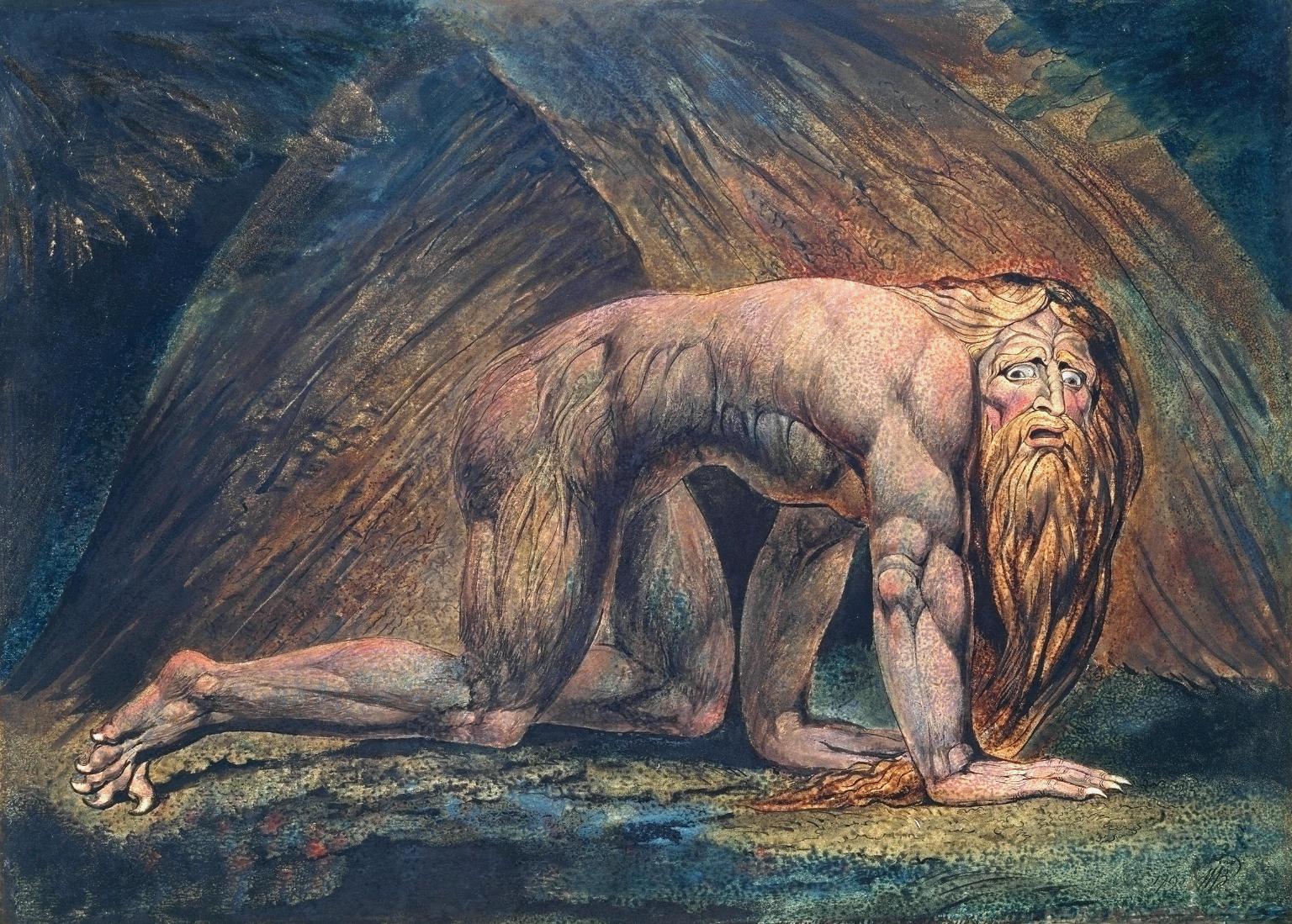
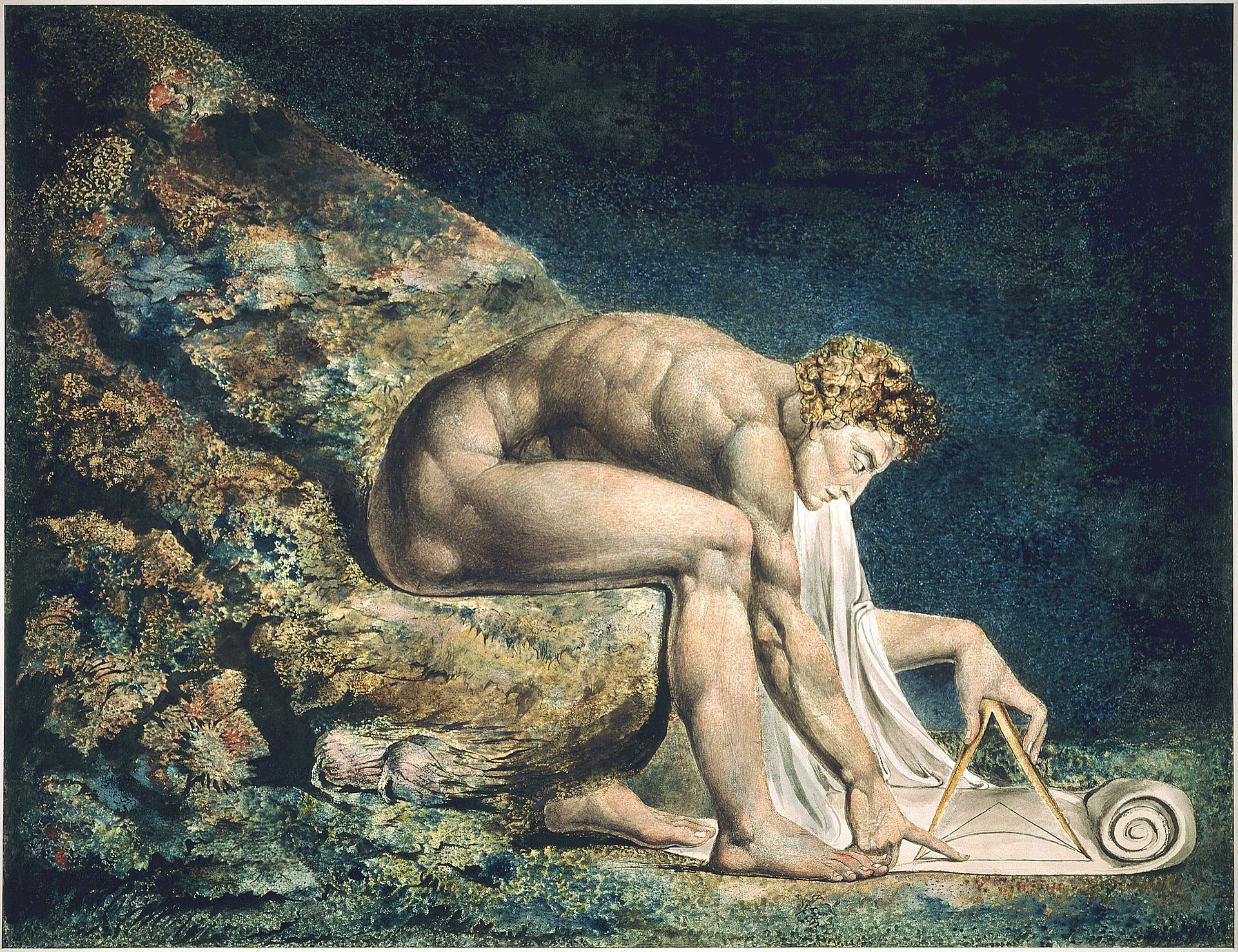
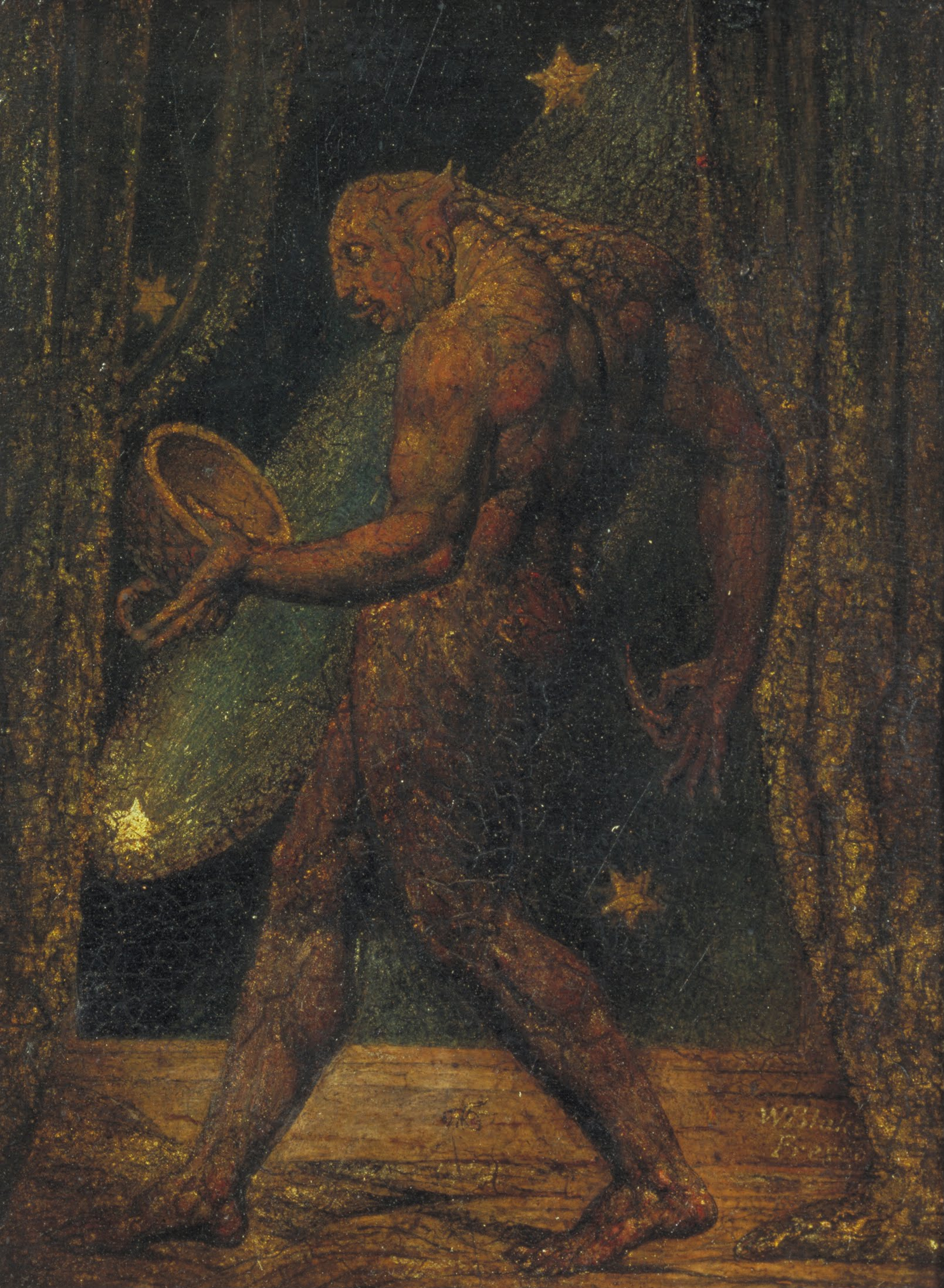
| Tate | London | The largest single public holding of Blake's paintings and colour prints, including Newton, Nebuchadnezzar and The Ghost of a Flea, plus a substantial share of the Linnell Dante watercolours. | |
| British Museum | London | Major holdings of illuminated books, separate plates and a share of the Dante watercolours. | |
| The Whitworth, The University of Manchester | Manchester | An impression of The Ancient of Days traditionally associated with Blake's final days. | Gift of John Edward Taylor, 1892. |
| Fitzwilliam Museum | Cambridge | Illuminated books and separate plates, including impressions of Songs of Innocence and of Experience. | |
| Yale Center for British Art | New Haven | Illustrations of the Book of Job and Jerusalem plates among other holdings. | |
| National Gallery of Victoria | Melbourne | The largest single share, thirty-six sheets, of the 102 Dante watercolours dispersed from John Linnell's estate in 1918. | |
| National Portrait Gallery | London | Thomas Phillips's 1807 portrait of Blake, NPG 212. | |
| Bunhill Fields | London | Blake's grave, identified in 2006 and marked with a memorial stone since 2018. | Not a collecting institution; listed because it is a site a reader can visit. |
Blake was bound apprentice to the engraver James Basire on 4 August 1772, aged fourteen, and served seven years in Basire's Great Queen Street workshop.
Blake was bound apprentice to the engraver James Basire on 4 August 1772, aged fourteen, and served seven years in Basire's Great Queen Street workshop. Reproductive engraving after other men's designs, for booksellers and antiquarian publishers, was the trade that fed him for the rest of his life; painting and poetry were what he did with what was left over. Basire sent his apprentice to Westminster Abbey from 1774 to draw the medieval royal tombs and effigies for engravings destined for Richard Gough's Sepulchral Monuments in Great Britain, and Blake's years spent copying Gothic monumental sculpture at close range left a permanent mark on the flattened, linear, sharply outlined figure style he used for the rest of his career.
He entered the Royal Academy Schools in 1779 and briefly trained as a painter and engraver in the Academy's own system under Keeper George Michael Moser, but never accepted its Reynoldsian hierarchy of the arts or its preference for oil painting and soft modelling in colour over line. He supported himself for the next four decades chiefly by engraving other artists' designs for the print and book trade, work he described in private as drudgery, while writing and etching his own books almost entirely unpaid.
Around 1788 Blake developed relief etching, a method of his own invention that let him combine text and image on a single copper plate and print them together.
Around 1788 Blake developed relief etching, a method of his own invention that let him combine text and image on a single copper plate and print them together. He wrote his text in mirror-image directly onto the plate with a pen and brush in an acid-resistant medium, drew the design around it in the same substance, then bathed the plate in acid so that the untreated copper was eaten away and the text and design were left standing up in relief, printable like a woodblock rather than incised like a conventional engraving. Blake told friends, including the artist and patron John Linnell, that he learned the method from a vision of his dead brother Robert, who had died in 1787.
He then printed each sheet himself, in a range of coloured inks, and went over the pull individually by hand in watercolour, pen and ink, and on his finest late work, gold. His wife Catherine, whom he had taught to read, write, draw and colour after their marriage in 1782, worked alongside him at every stage, printing and hand-finishing plates in a partnership that made the couple's own house, wherever they were renting at the time, the entire production line: author, engraver, printer, colourist and publisher were the same two people. No two pulls of the same plate are identical, because each was a separate finishing act rather than a run off a fixed edition. Sotheby's specialist Selby Kiffer, cataloguing one of the finest surviving copies of Songs of Innocence and of Experience in 2024, put the number of Blake's own lifetime copies of that single title at about twenty-four, printed between 1789, when Songs of Innocence first appeared, and 1827, the year Blake died; only six of those copies are recorded as still in private hands, the rest having passed into institutions. Fine Books & Collections gives a different figure for the same census, about twenty-six copies over the same 1789-to-1827 span, plus a further sixteen copies printed from Blake's original plates after his death; the two specialist counts of the same body of material do not agree, and this record states both rather than picking one.
On 14 April 1789 Blake and Catherine attended the First General Conference of the Swedenborgian New Jerusalem Church, held over four days at a chapel in Maidenhead Lane off Great Eastcheap in the...
On 14 April 1789 Blake and Catherine attended the First General Conference of the Swedenborgian New Jerusalem Church, held over four days at a chapel in Maidenhead Lane off Great Eastcheap in the City of London. A circular letter of 7 December 1788 had called believers in the theological writings of Emanuel Swedenborg to a meeting to found a church distinct and separate from the established denominations; at the conference itself Blake and Catherine signed the minute book alongside the other attendees present, subscribing to forty-two propositions affirming that Swedenborg's doctrines were genuine truths revealed from heaven and that a New Jerusalem Church ought to be established. It is the only meeting of any organised body that Blake is known to have attended in his life, and the signature is a documented fact, not an inference from his art.
The break came almost immediately. If the date Blake later wrote on his own copy of The Marriage of Heaven and Hell is accurate, he was already working on that book within a year or two of signing the conference minutes, and it is a sustained attack on the very writer he had just subscribed to. Blake renamed Swedenborg's claimed Memorable Relations of his travels in the spirit world as Memorable Fancies, a title that strips them of the authority Swedenborg claimed for them, and wrote plainly: "Now hear a plain fact: Swedenborg has not written one new truth. Now hear another: he has written all the old falsehoods." Elsewhere in the same book he casts Swedenborg as a minor figure rather than a prophet: "Swedenborg is the angel sitting at the tomb: his writings are the linen clothes folded up." The scholar Robert Rix reads this as Blake's rejection of Swedenborg as a singular authority on which to build a system of belief, and as Blake's turn toward a more radical, less institutional reading of the visionary tradition the Swedenborgians had opened up for him. Both the signing and the attack are documented; what is argued, by Rix and others, is exactly what drove the reversal so quickly.
From the early 1790s Blake began writing what scholars call his prophetic books, populated by an invented pantheon of his own: Urizen, a cold, law-giving, self-enclosing reason; Los, the blacksmith...
From the early 1790s Blake began writing what scholars call his prophetic books, populated by an invented pantheon of his own: Urizen, a cold, law-giving, self-enclosing reason; Los, the blacksmith of imagination and time; Los's female counterpart Enitharmon; the wrathful, energetic Orc; and, in the two longest late works, Milton and Jerusalem, the sleeping giant Albion, who stands for a fallen, divided humanity and for England at once. Blake never published a key to this system and scholars, notably Northrop Frye and S. Foster Damon in the twentieth century, built one from close reading of the poems themselves; this record treats their identifications of who each figure is and how they relate as argued scholarship, not as something Blake wrote down as a glossary.
What is Blake's own documented statement of intent is a line spoken by Los in Jerusalem: "I must Create a System, or be enslav'd by another Mans; I will not Reason and Compare: my business is to Create." It is Los's speech within the poem, not a signed prose manifesto, but it is the line Blake scholarship returns to more than any other to describe why he built a private mythology instead of working within an inherited one, whether classical, biblical or Miltonic. Reading it as Blake's own credo is the near-universal scholarly convention rather than a claim this record makes unassisted.
Blake's first biographer, Alexander Gilchrist, records that Blake saw his first vision as a child, of eight or ten years old by Gilchrist's own hedge, walking on Peckham Rye: he looked up and saw, in...
Blake's first biographer, Alexander Gilchrist, records that Blake saw his first vision as a child, of eight or ten years old by Gilchrist's own hedge, walking on Peckham Rye: he looked up and saw, in Gilchrist's words, "a tree filled with angels, bright angelic wings bespangling every bough like stars," and on repeating the story at home only his mother's intervention saved him from a beating from his father, who took it for a lie. Blake maintained throughout his life, in company and in writing, that he continued to see and converse with visionary figures, and late in life, from about 1818, the watercolourist and astrologer John Varley encouraged him to sketch these figures directly during a series of late-night sessions at Varley's house on Great Titchfield Street, producing the group of drawings now called the Visionary Heads, intended to illustrate Varley's own Treatise on Zodiacal Physiognomy. Blake's Ghost of a Flea, worked up as a small tempera panel around 1819 to 1820 from one of these sketching sessions, is the best known result: Blake told Varley the flea's spirit had explained to him that fleas housed the souls of bloodthirsty men, kept small so that, sized as horses, they could not drink the country dry of blood.
This record reports the claim as a claim. Nothing in the sources consulted attempts to adjudicate whether Blake experienced these episodes as hallucination, as a deliberate visionary idiom he adopted for artistic purposes, or as something else; what is documented is that he said so repeatedly, that contemporaries who knew him well, including Varley, took the claims at face value and organised working sessions around them, and that at least one specific finished work survives with a first-hand account, from Blake himself, of what a given vision told him.
Blake had almost no market beyond two men.
Blake had almost no market beyond two men. Thomas Butts, a senior civil servant who served as chief clerk to the Commissary General of Musters, began buying from Blake around 1799 and over the following decade, and again from about 1820 to 1827, assembled the largest collection of Blake's work ever formed by a single patron: more than two hundred biblical tempera paintings and watercolours, illustrations to Milton, colour-print drawings, illuminated books and engravings, bought at a pace that at times committed as much as a sixth of Butts's income to a single artist. Butts asked for little beyond the pictures themselves and appears to have bought largely because he wanted the work to exist and to be paid for, rather than to build a fashionable collection.
John Linnell, a younger and more commercially successful painter, took over as Blake's principal support in the 1820s. It was Linnell who financed the engraving of the Illustrations of the Book of Job, borrowing back an earlier set of watercolours Blake had made for Butts around 1805 to 1806, funding a second watercolour set in 1821, and then paying for Blake to cut twenty-one copperplate engravings plus an engraved title page between 1823 and the book's publication in 1826. The Job engravings, in the conventional intaglio technique Blake had learned as Basire's apprentice rather than his own relief method, were both his own summation of a lifetime's biblical illustration and a rare commercial and critical success in his own lifetime. It was also Linnell who commissioned, in 1824, the year Blake turned sixty-seven and three years before his death, the 102 watercolour designs illustrating Dante's Divine Comedy that Blake was still working on when he died.
In 1809 Blake mounted his only one-man exhibition, in a room above his brother James's hosiery shop on Broad Street, showing thirteen works, per the account given in the source consulted for this...
In 1809 Blake mounted his only one-man exhibition, in a room above his brother James's hosiery shop on Broad Street, showing thirteen works, per the account given in the source consulted for this event, including The Ancient of Days-related designs and accompanied by a lengthy printed catalogue arguing for his own theory of art. Almost nobody came. The show was kept open well past its intended closing date and, so far as the sources consulted record, not a single picture sold.
It received one press notice. Robert Hunt, writing in his brother's paper The Examiner on 17 September 1809, called Blake "an unfortunate lunatic, whose personal inoffensiveness secures him from confinement," and dismissed the catalogue itself as "a farrago of nonsense, unintelligibleness, and egregious vanity, the wild effusions of a distempered brain." There is no evidence any other paper reviewed the show at all. Hunt's review is the single most quoted contemporary verdict on Blake precisely because it was, for decades, close to the only verdict there was: it set the terms, eccentric bordering on mad, mostly ignored, in which Blake's own century discussed him.
Blake died on 12 August 1827 at his lodgings in Fountain Court off the Strand and was buried, without a headstone, in the Dissenters' burial ground at Bunhill Fields.
Blake died on 12 August 1827 at his lodgings in Fountain Court off the Strand and was buried, without a headstone, in the Dissenters' burial ground at Bunhill Fields. Catherine survived him by four years and inherited his manuscripts, copperplates, drawings and remaining stock; she supported herself in part by continuing to print and hand-colour surviving copies of the illuminated books from the original plates, a documented fact established by close technical study of paper and ink rather than by report. When Catherine died in October 1831, the young sculptor Frederick Tatham, one of the circle of young admirers around Blake in his last years later called the Ancients, took possession of what remained. The scholar Joseph Viscomi notes plainly that Tatham did not inherit in a strict legal sense: no will by Catherine survives leaving the material to him, and the painter John Linnell contested the transfer, arguing the effects should have passed instead to Blake's surviving sister. Tatham himself went on to print further posthumous copies of several illuminated books between 1831 and 1832, using different paper and ink from either Blake's or Catherine's, a distinction technical examination has since used to separate his printings from the couple's own.
Shortly afterward Tatham joined the Irvingite sect, and the bibliographer G. E. Bentley Jr. assembled documentary evidence, collected across decades of research into Blake's surviving papers and the memories of those who had known him, that Tatham destroyed a substantial quantity of Blake's manuscripts in the conviction that they were the work of the devil. The exact contents and scale of what was burned were never inventoried by anyone before it happened, so the loss can be documented as a real event, argued for at length by Bentley from surviving testimony, without any surviving list of what exactly it took with it.
The Blake market has produced two distinct and well-documented categories of fake, neither of them a modern forger inventing a picture from nothing.
The Blake market has produced two distinct and well-documented categories of fake, neither of them a modern forger inventing a picture from nothing. The first is Frederick Tatham's own posthumous printing practice catching out later scholarship: his copy of Songs of Innocence and of Experience catalogued as Copy e was printed with forty of its fifty-four plates in sepia ink, a colour neither Blake nor Catherine is known to have used but which Tatham did, and the sheets were subsequently hand-coloured by an unidentified nineteenth-century colourist working from another copy as a model. The book was acquired by the collector J. Pierpont Morgan in 1901 and was treated as an authentic Blake-period copy for years before the printing and colouring were correctly separated out from Blake's own work.
The second is an honest restoration that later collectors mistook for the genuine article. The collector A. G. Dew-Smith bought a copy of America a Prophecy, catalogued as Copy B, in 1868, missing two of its plates. He commissioned photolithographic facsimiles of the missing plates 4 and 9 to complete his set, apparently to have a whole book to read rather than to deceive anyone. When Copy B was sold on in 1870, the facsimile plates went with it as though original, and nobody identified them as reproductions until 1978, a gap of a little over a century in which the copy was catalogued, studied and presumably valued as more complete than it actually was.
Blake presents almost none of the attribution problem this house usually documents in early paintings: nothing here rests on connoisseurship trying to separate an autograph hand from a workshop's...
Blake presents almost none of the attribution problem this house usually documents in early paintings: nothing here rests on connoisseurship trying to separate an autograph hand from a workshop's, because Blake worked alone with his wife and signed his intentions into the printing process itself. The real bibliographic problem is different: identifying which specific surviving sheet is which, since the same design recurs across a family of hand-finished impressions produced over decades. The standing reference for that census is G. E. Bentley Jr.'s Blake Books, published by Oxford in 1977 with a supplementary volume in 1995, which assigns each surviving copy of each illuminated title a letter, so that a given copy of Songs of Innocence and of Experience is referred to as, for example, Copy J or Copy Z rather than by a single title alone. The William Blake Archive, an ongoing digital project associated with editors including Morris Eaves, Robert N. Essick and Joseph Viscomi, maintains and updates this census online and is the closest thing Blake studies has to a living authority, in continuous revision rather than closed the way an authentication board can close.
For Blake's separate, non-illuminated graphic output the standing catalogues are David Bindman's The Complete Graphic Works of William Blake (Thames and Hudson, 1978), covering the engraved and etched designs as a body, and Robert N. Essick's The Separate Plates of William Blake: A Catalogue (Princeton University Press, 1983), which specifically excludes the illuminated books and the Job and Dante series to catalogue only the prints Blake issued as free-standing plates. Blake's paintings, watercolours and drawings are catalogued separately again, by Martin Butlin, in The Paintings and Drawings of William Blake (Yale University Press for the Paul Mellon Centre, 1981), the first attempt at a complete catalogue across all three media. No one of these three replaces the others; between them they cover different halves of a single working life.
On 12 August 1803, while living at Felpham on England's south coast under the patronage of the poet William Hayley, Blake found a soldier, Private John Scolfield, in his garden and, on his refusal to...
On 12 August 1803, while living at Felpham on England's south coast under the patronage of the poet William Hayley, Blake found a soldier, Private John Scolfield, in his garden and, on his refusal to leave, marched him off the property by the elbows to the local inn. Scolfield and a fellow soldier retaliated by swearing before their commanding officer that Blake had said, among other things, "Damn the King. The soldiers are all slaves." Blake was indicted for sedition and assault, a True Bill found against him at the Petworth quarter sessions on 4 October 1803, and stood trial at Chichester on 11 January 1804 at the height of the invasion scare of the Napoleonic Wars, when a sedition conviction against a private citizen was a genuinely dangerous prospect. The jury acquitted him quickly, to applause in the courtroom, and a contemporary newspaper noted that the fabricated character of the soldiers' evidence was obvious enough on its own to produce the acquittal. Blake left Felpham for London within the year. It is the one point in his life at which the ordinary business of being a difficult, outspoken tenant came close to a criminal conviction, and it survives only because the indictment and trial record were kept.
Blake was buried at Bunhill Fields, the principal burial ground for Dissenters outside the established church, in a public grave he shared with several other burials and no headstone of his own...
Blake was buried at Bunhill Fields, the principal burial ground for Dissenters outside the established church, in a public grave he shared with several other burials and no headstone of his own; Catherine was buried in the same plot in 1831. The exact position of the grave within the burial ground was lost for well over a century, since parts of Bunhill Fields were later laid out as gardens and the original numbered grid of plots fell out of use. In 2006 Luis and Carol Garrido, members of the Blake Society, spent roughly a year cross-referencing archival burial records against historical plans of the ground and located the specific plot. The Blake Society raised funds by public subscription for a memorial stone, carved by the letter-cutter Lida Cardozo, which was unveiled on the plot on 12 August 2018, the 191st anniversary of Blake's death, before a crowd of several hundred. For nearly two centuries, in other words, the man buried under one of the most reproduced images in English art had no marker at all.
Poet; Painter; Printmaker; Engraver. 1757-1827.
Born 28 November 1757, 28 Broad Street, Soho, London; died 12 August 1827, Fountain Court, Strand, London.
Tatham's sepia Songs of Innocence and of Experience, Copy e. Printed by Frederick Tatham after Blake's death with forty of its fifty-four plates in sepia ink, a colour not used by Blake or Catherine, then hand-coloured later by an unidentified nineteenth-century colourist working from another copy as a model. Acquired by the collector J.
Tate (London); British Museum (London); The Whitworth, The University of Manchester (Manchester); Fitzwilliam Museum (Cambridge); Yale Center for British Art (New Haven); National Gallery of Victoria (Melbourne).
Blake's market runs almost entirely on the illuminated books and the large colour prints, since paintings in the ordinary sense are rare in his output and most of what survives is on paper. Complete or near-complete copies of the major illuminated titles are the trophy category, and because so few change hands, each sale resets what is known about the top of the market rather than confirming an existing trend.The clearest illustration is Songs of Innocence and of Experience.
What exactly Frederick Tatham burned after Catherine Blake's death in 1831, and how much: Bentley's collected testimony establishes that a substantial destruction took place, but no inventory of the lost manuscripts was made before they were destroyed.
Last verified
One artwork and its story every Tuesday, with the picture: who owned it, what it made, and what closes soon in the exhibition calendar. No promotion, and nothing we cannot cite.
We send one email to confirm the address and keep nothing else. Every letter carries a one-click unsubscribe. How we handle your data.
