The Ancient of Days
William Blake · 1794 (plate first etched and printed); this impression traditionally dated to shortly before August 1827
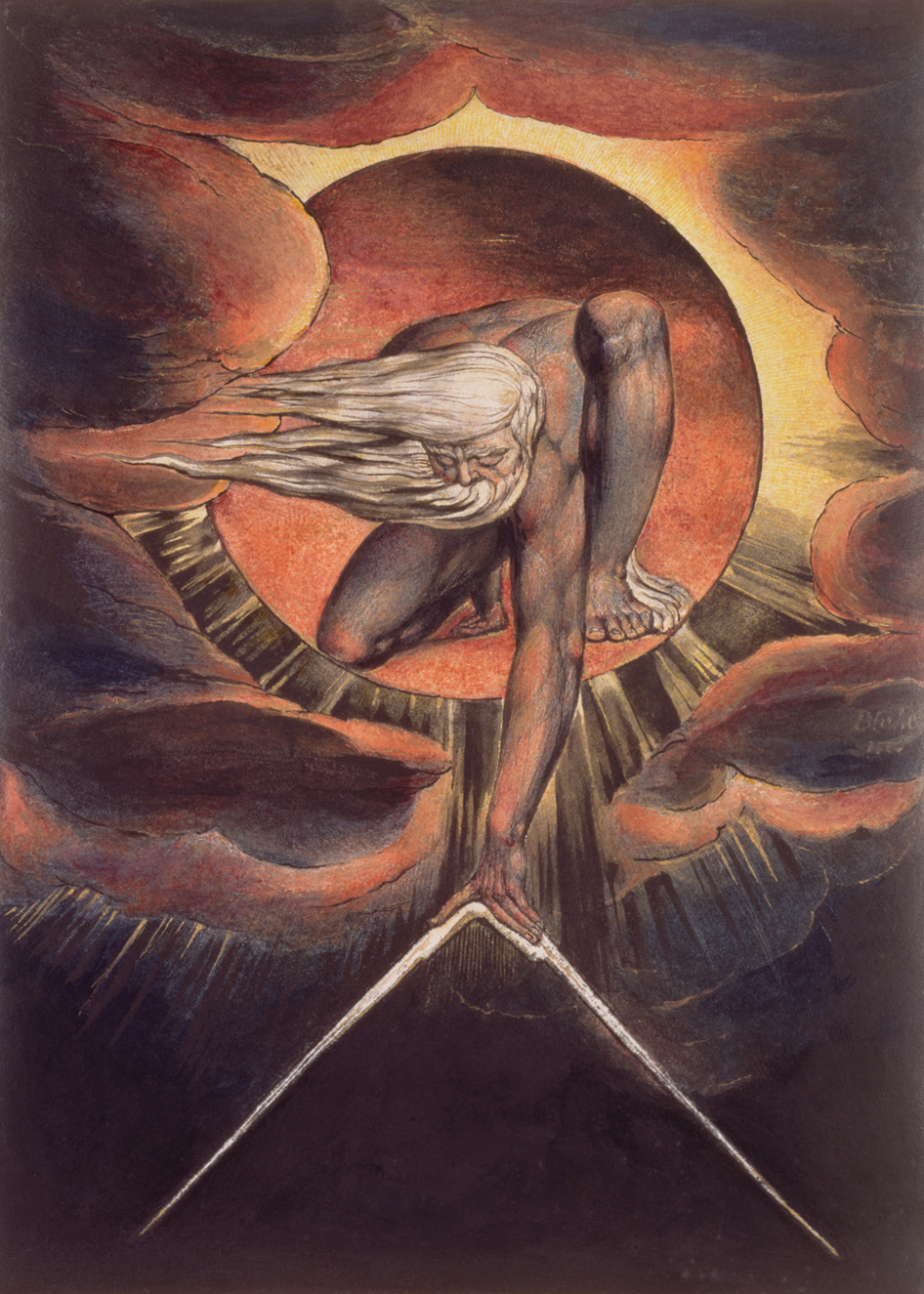
The impression this record is anchored on, held by the Whitworth, The University of Manchester. Traditionally identified, in the Whitworth's own catalogue, as the last impression Blake worked on, days before his death in August 1827, for his friend Frederick Tatham. The dramatic deathbed staging of that story is contested by modern scholarship (see narrative); that Blake finished and coloured this sheet very late in his life is not.
| Artist | William Blake |
|---|---|
| Date | 1794 (plate first etched and printed); this impression traditionally dated to shortly before August 1827 |
| Medium | Relief etching printed in colour, finished by hand in pen and ink, watercolour, body colour and gold, on paper |
| Dimensions | Design approximately 23.3 x 16.8 cm, based on other named impressions of the same plate (British Museum, Fitzwilliam Museum). Full sheet measurements for the Whitworth's own impression, the one this record is anchored on, were not published in the sources consulted. |
| Where it is now | The Whitworth, The University of Manchesterlast confirmed |
| Inventory number | Catalogued online as 'Europe Plate i: Frontispiece, The Ancient of Days'; the specific accession number was not confirmed in the sources consulted |
| Attribution | AcceptedUniversally accepted as William Blake's own design, plate and hand colouring. Full note |
| Object type | |
| Period | British, Romantic era, late eighteenth to early nineteenth century |
| Cases | Has a provenance gap |
| Inscriptions | None on the design itself. Complete bound copies of Europe a Prophecy carry a separately printed title-page, in Blake's own lettering, dated 1794 in every surviving copy regardless of when that particular copy was actually printed and coloured. |
| Owners on record | 4 links2 documented, 1 disputed, 1 unknown |
| Sources | 17 cited |
About this record Last verified · 17 sources cited · Change log
On this page 9 sections
ContentsClose
A single Blake design, etched in 1794 as the frontispiece to his illuminated book Europe a Prophecy, showing his mythological figure Urizen reaching down through cloud and fire to set a pair of compasses against the void: a design widely read as Blake's rejection of a purely rational, Newtonian account of creation, though scholars differ on how far to press that reading. Blake kept reprinting and individually hand-colouring the plate for nearly three decades, so no two surviving impressions are identical and there is no single canonical original.
This record is anchored on one specific, named impression: the sheet held by the Whitworth, The University of Manchester, traditionally identified, on the strength of an account by Blake's friend and executor Frederick Tatham, as the last impression Blake worked on, days before his death in August 1827. Modern scholarship treats the dramatic deathbed staging of that story with real skepticism, even while accepting that Blake did finish a late impression for Tatham around that time; this record reports both the tradition and the doubt.
The Whitworth's sheet entered its collection in 1892 as part of a large gift from the Manchester newspaper proprietor and collector John Edward Taylor. How it reached him from Tatham across the preceding sixty-five years is not documented in the sources consulted, and no recorded market sale of this specific impression was found.
Provenance
Each link is graded. Documented: a cited source supports it. Disputed: the identification is argued but not established. Unknown: no owner for that span, and the gap is not smoothed into a narrative. The grades in the glossary.
- 1794 - 1820sWilliam and Catherine Blake, working from their own householddocumented
Blake first etched and printed the plate as the frontispiece to Europe a Prophecy in 1794, and continued to pull and hand-colour individual impressions of it for decades afterward. The Fitzwilliam's copy K impression carries the 1794 title-page date but its paper is watermarked 1820-1821, direct physical proof that Blake was still printing from the same plate more than a quarter-century after the nominal publication date.72
- 1827 - 1827Frederick Tathamdisputed
By Tatham's own later account, repeated by Alexander Gilchrist, Blake finished and hand-tinted an impression of this print for Tatham in the last days of his life, for a fee higher than he had ever previously been paid for the design, working on it propped up in bed. That Blake made and coloured a late impression for Tatham around this time is not itself disputed. The dramatic staging of the story, that Blake then threw down the finished sheet declaring he could not improve it, sketched Catherine, and sang, is treated with scholarly skepticism by Robson and Viscomi (1996), who argue on medical grounds that Blake was almost certainly too ill in his final hours for such activity, and suggest Tatham dramatized or relocated an episode that likely took place somewhat earlier in his final illness.345
- 1827 - 1892Unknown intermediate owner or ownersunknown
How the impression passed out of Tatham's hands, or out of whatever remained of Blake's estate after Tatham's disputed claim to it, and into the collection of John Edward Taylor is not documented in the sources consulted. Tatham dispersed much of his Blake holdings over the following decades and, by his own later admission after joining an Irvingite sect, destroyed some works he judged diabolically inspired. Whether this sheet passed through the print trade, a private sale, or a more direct route is unknown.1310
- 1892 - presentThe Whitworth, The University of Manchesterdocumented
Given to the Whitworth Institute, now the Whitworth, The University of Manchester, in 1892 by John Edward Taylor (1830-1905), proprietor of the Manchester Guardian, as part of a gift of more than 150 of the finest watercolours and drawings in his collection. Taylor continued giving to the gallery until his death in 1905. The impression remains in the Whitworth's collection, catalogued as Europe Plate i, Frontispiece, The Ancient of Days.6917
Technical evidence
| Attribution note | Universally accepted as William Blake's own design, plate and hand colouring. There is no attribution dispute of the kind that affects unsigned early paintings; the only genuine uncertainty concerns which surviving impression is which, and the exact circumstances under which the impression this record is anchored on was finished, not who made it. |
|---|---|
| Technique | Relief etching printed in colour from copper, finished individually by hand in watercolour, pen and ink, and, on later impressions including this one, gold and body colour.68 |
| Image size | Approximately 23.3 x 16.8 cm for the design itself, based on other named impressions (British Museum, Fitzwilliam). The Whitworth's published record for this specific sheet does not give full sheet measurements in the sources consulted.786 |
| Support and dating evidence | Laid paper. The Fitzwilliam's copy K impression of the same plate is watermarked with paper stock not in production before 1820, proving that copy was pulled around 1820-1821 despite carrying the book's printed 1794 title-page date. No comparable watermark analysis for the Whitworth's own sheet was found in the sources consulted.7 |
| Colour variation across impressions | No two surviving impressions are identical. Ink colour, extent of watercolour finishing, and presence of gold vary from sheet to sheet because Blake hand-finished each pull separately over roughly three decades.16 |
| Inscriptions | None on the design itself. Complete bound copies of Europe a Prophecy carry a separately printed title-page, in Blake's own lettering, dated 1794 in every surviving copy regardless of when that copy was actually printed.27 |
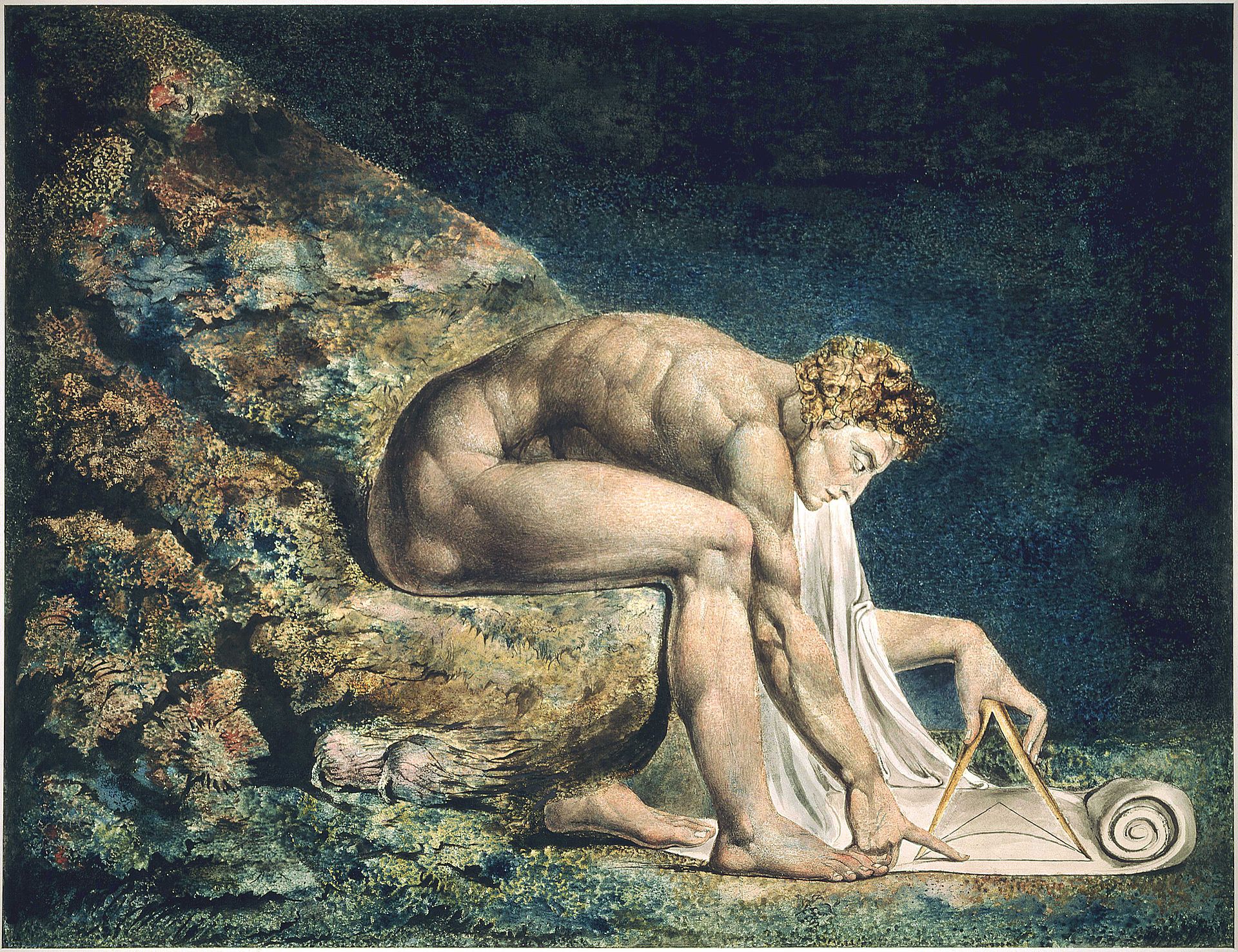
| Related compositional motif | Blake reused the same crouching, compass-wielding pose the following year, 1795, for his large colour print Newton, now in Tate's collection, there applied explicitly to the scientist rather than to the mythological figure Urizen.11 |
Images
The record in full
Chapter 1What it is
The image is a single Blake composition: an old man with streaming white hair and beard kneels within a disc of red-gold cloud and fire, his left hand reaching down out of the circle to set a pair of...
The image is a single Blake composition: an old man with streaming white hair and beard kneels within a disc of red-gold cloud and fire, his left hand reaching down out of the circle to set a pair of compasses against the dark void beneath him. Blake etched the design as the frontispiece to his illuminated book Europe a Prophecy, and it has since become one of the most reproduced single images he ever made, more often seen framed on its own than read as the first page of the poem it was made to introduce.
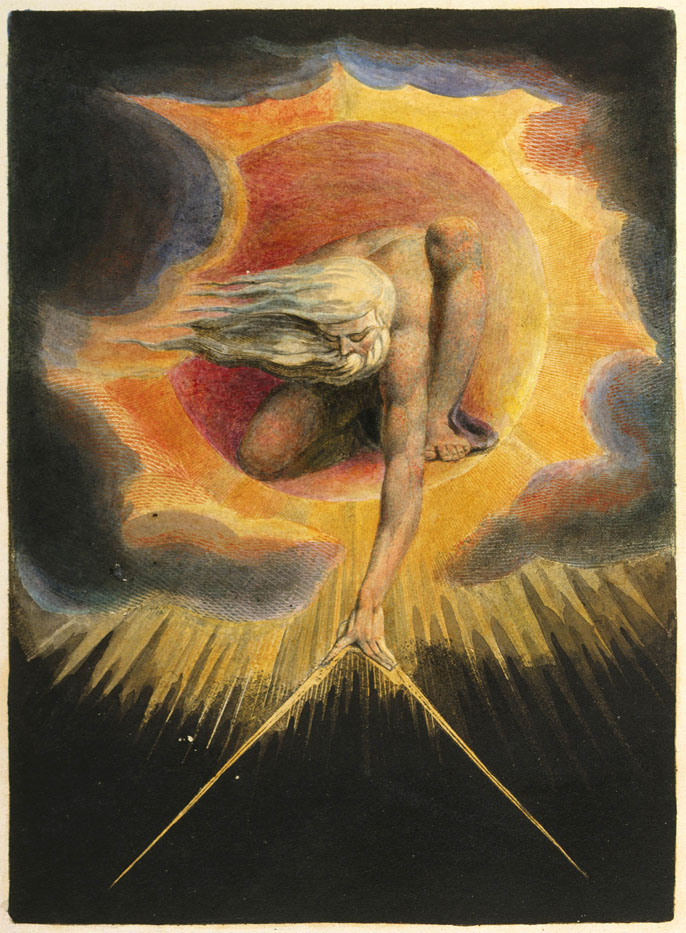
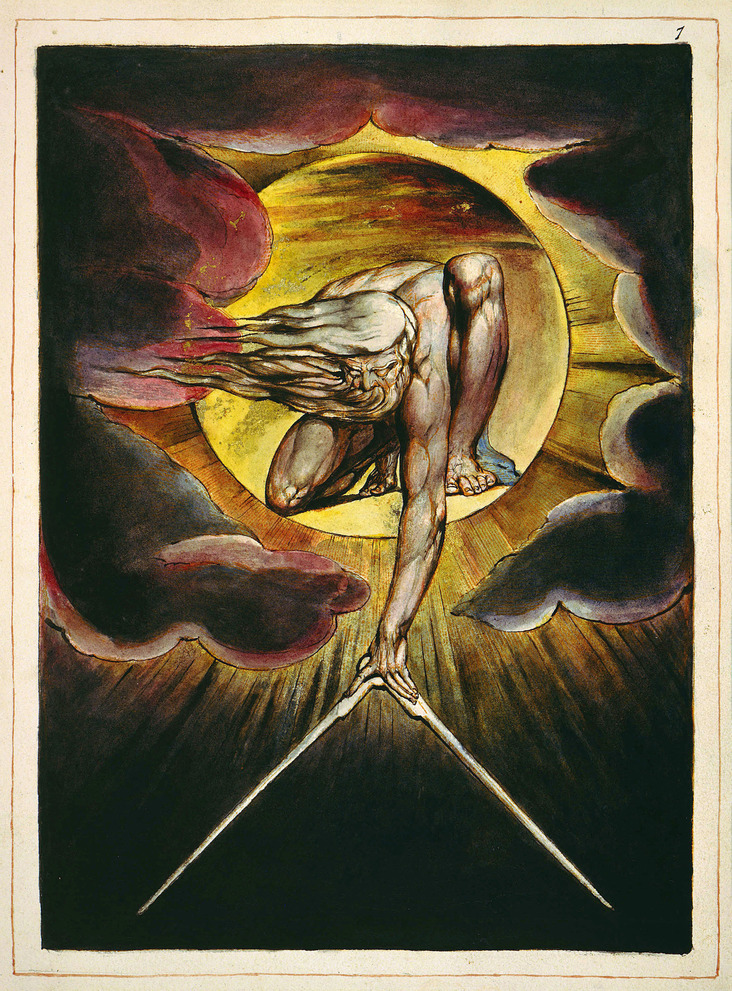
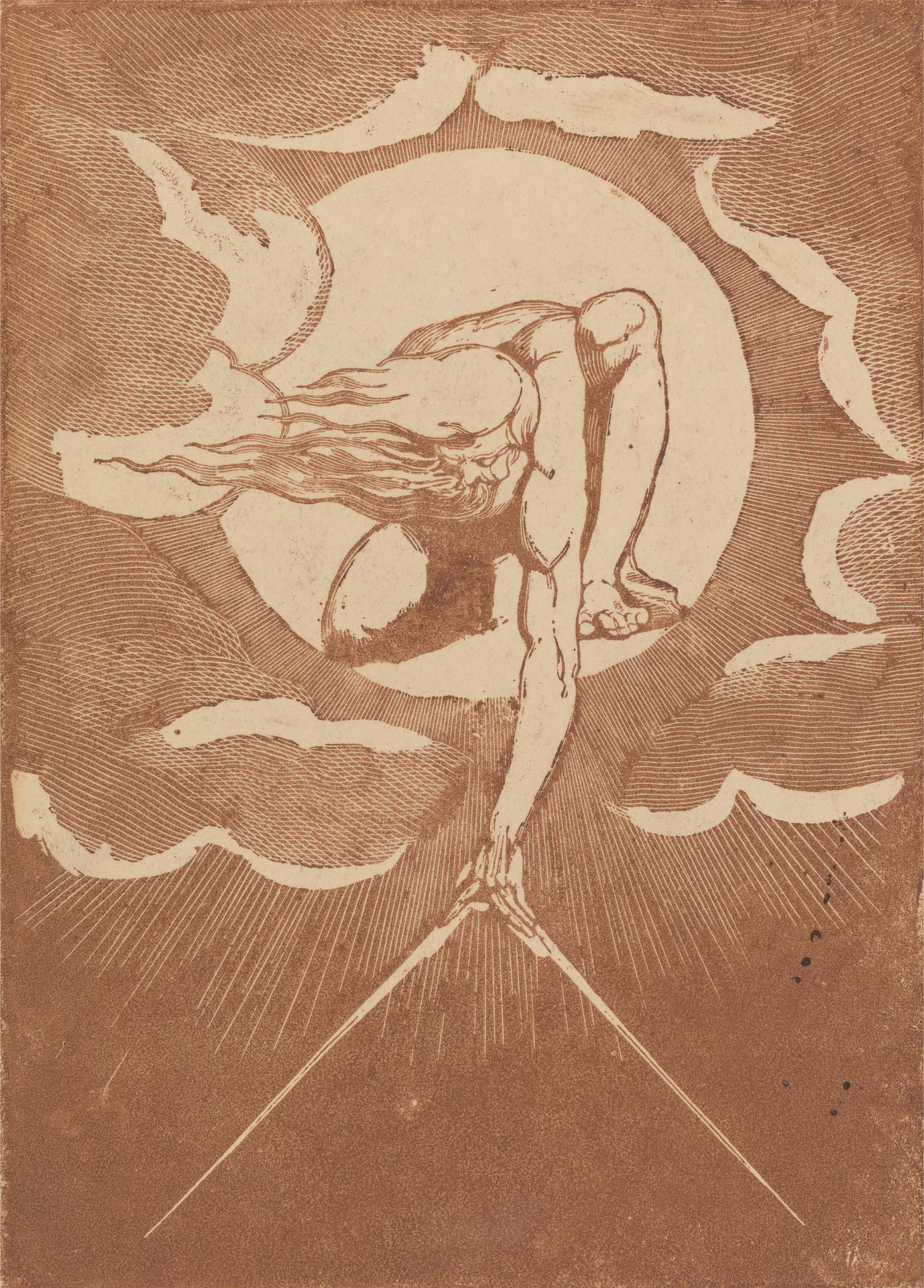
No two surviving impressions of this plate look exactly alike. Blake printed Europe's eighteen plates in relief from copper, in a range of coloured inks, and then went over each pull individually in watercolour, pen and ink, and, on his finer late impressions, gold. He did this himself, sheet by sheet, for the better part of three decades after he first etched the plate in 1794. The result is not an edition in the modern printmaking sense of identical multiples, but a family of related objects that share a design and differ in almost everything else: ink colour, extent of hand colouring, condition of the plate at the moment of pulling, and, in at least one documented case, the actual decade in which a given sheet was printed regardless of the date printed on it.
Chapter 2One plate, many prints, and no single original
This distinction matters more for Blake's late relief prints than for almost any other kind of object this record covers, because there is no single physical painting to point to.
This distinction matters more for Blake's late relief prints than for almost any other kind of object this record covers, because there is no single physical painting to point to. A cataloguer who writes that the Ancient of Days is in the British Museum, and one who writes that it is at the Whitworth, are not disagreeing about a fact; each is correctly describing a different, separately hand-finished sheet pulled from the same plate, potentially decades apart, and coloured to a different standard of finish. Several institutions hold impressions that are individually catalogued, dated and provenanced, and none of them is a copy of another in the sense a photograph is a copy of a photograph.
This record is therefore anchored on one specific, named impression: the sheet held by the Whitworth, The University of Manchester, which the Whitworth's own catalogue identifies as the impression traditionally said to be the last Blake worked on, days before his death in August 1827, for his friend and eventual executor Frederick Tatham. Every image, caption and location statement in this record refers to that sheet unless it explicitly says otherwise. Where other named impressions are discussed below, in the British Museum, the Fitzwilliam Museum or elsewhere, this record says so plainly and does not present them as the same object.
Chapter 3Inside Europe a Prophecy
Blake etched, printed and began colouring Europe a Prophecy in 1794, the same year as its companion volume America a Prophecy.
Blake etched, printed and began colouring Europe a Prophecy in 1794, the same year as its companion volume America a Prophecy. Both belong to the sequence of prophetic, or illuminated, books in which Blake combined his own poetry with plates he etched, printed and coloured by hand, working entirely outside the ordinary trade relationship of publisher, printer and bookseller. Europe runs to eighteen plates and uses the continent's recent history, above all the aftermath of the French Revolution and Britain's war against revolutionary France, as the ground for a mythological narrative involving figures Blake had already introduced that same year in The Book of Urizen.
The frontispiece carries no text. It stands in front of the poem as a single image the reader must confront before a word of the verse has been read, which is part of why it has survived detachment from the book so easily: unlike the plates that follow it, it does not depend on the surrounding text to make its visual statement.
Chapter 4Urizen, and the argument over what he means
The figure is Urizen, one of the four Zoas, or primary beings, in the personal mythology Blake had been developing since the early 1790s.
The figure is Urizen, one of the four Zoas, or primary beings, in the personal mythology Blake had been developing since the early 1790s. His name is usually read as a pun on your reason, though a derivation from the Greek horizein, to limit or bound, has also been proposed; either reading points the same way. Blake consistently drew him as a bearded old man, sometimes holding books of law, sometimes, as here, a pair of compasses. Tate's own published account of Blake's characters describes Urizen as embodying law, repression and restrictive authority, standing against Los, who in Blake's system represents imaginative and creative energy; across the prophetic books Urizen acts in partnership with kings and priests to build, in Blake's own phrase, nets that restrain human freedom and desire.
The specific act shown here, a god-like figure measuring the void with a compass, is widely read as Blake's rejection of a mechanistic, rule-bound conception of creation associated with Isaac Newton and, by extension, with Bacon and Locke, a trio Blake elsewhere names directly as the intellectual authors of a purely rational, non-visionary account of the universe. Blake used an almost identical crouched, compass-wielding pose the following year for his large colour print Newton, now in Tate's collection, where the figure is explicitly identified as the scientist himself, seated at the bottom of the sea and absorbed in a diagram, blind to everything outside his own geometry. The visual echo between the two prints is close enough that Blake scholarship generally treats them as a pair: one figure named as a mythological tyrant, the other as a historical one, shown performing the same act with the same instrument.
Whether Blake intends the Ancient of Days as outright condemnation of the god he depicts is not something the sources consulted treat as settled. Blake's own account of Urizen is not simple villainy; Urizen is also a creator, and the act of measurement is also an act of making a world, however constrained. Readers who take the design as a straightforward parody of a false or tyrannical god sit alongside readers who take it as a more ambivalent image of the necessary, if limiting, work of bringing order out of chaos. This record states both positions rather than choosing between them, because no scholarly consensus resolving the question either way was found.
Chapter 5How Blake made it
Blake's method for his illuminated books, including this plate, was relief etching: rather than cutting an image into a metal plate for ink to sit in, as in conventional etching or engraving, he...
Blake's method for his illuminated books, including this plate, was relief etching: rather than cutting an image into a metal plate for ink to sit in, as in conventional etching or engraving, he wrote and drew in an acid-resistant medium directly onto a copper plate, then bit away the exposed metal around the design with acid so the design itself stood proud of the surrounding surface, like a woodcut, letting him print text and image from the same plate in a single pull. He printed in coloured inks rather than plain black, varying the ink colour between pulls, then finished each sheet individually by hand in watercolour and, on his more elaborate late impressions, pen and red ink outlining and gold. No press run of Blake's illuminated books followed a fixed schedule or a fixed number of copies; he printed and coloured sheets, in small batches, as buyers or his own inclination required, over a working life that in the case of this plate ran from 1794 into the 1820s.
Direct physical evidence of just how long that working life lasted survives on the Fitzwilliam Museum's impression, catalogued as plate 1 of its copy K of Europe. The book's title-page, printed from a separate plate, carries the date 1794 in Blake's own lettering, as it does on every surviving copy regardless of when that particular copy was actually printed. But the paper the Fitzwilliam's copy K is printed on carries watermarks not in production before 1820, meaning this copy could not physically have been printed before 1820 or 1821, more than a quarter of a century after the date printed on it. Blake was still pulling fresh sheets from a nearly thirty-year-old plate late in his life, each one still carrying the year he first designed it.
Chapter 6The last impression, and the story Tatham told
The traditional account of how the Whitworth's impression came to exist begins with Frederick Tatham, a young sculptor and later an Anglican-turned-Irvingite clergyman who belonged to the circle of...
The traditional account of how the Whitworth's impression came to exist begins with Frederick Tatham, a young sculptor and later an Anglican-turned-Irvingite clergyman who belonged to the circle of admirers, later nicknamed the Ancients, who gathered around Blake in his final years. According to Tatham's own later account, repeated and elaborated by Blake's first serious biographer, Alexander Gilchrist, Blake undertook to colour an impression of the Ancient of Days for Tatham in the last days of his life, for a fee larger than he had ever previously been paid for the design, working on it propped up in bed. Gilchrist's narrative has Blake, after long contemplation, throwing the finished sheet from him with an exclamation of triumph, declaring he could not improve it further.
Modern Blake scholarship treats the vivid staging of that account with real caution. In a 1996 article in Blake, An Illustrated Quarterly, Lane Robson and Joseph Viscomi set Tatham's narrative against what is medically inferable about Blake's final illness, most likely liver failure with attendant pulmonary complications, and argue it is unlikely Blake retained the physical capacity, in his last hours, to colour a detailed print, sketch his wife Catherine and sing, as later biographers had him doing in sequence. They suggest Tatham, writing years after the fact and with his own reasons for presenting Blake as transcending ordinary physical limits at the point of death, may have compressed or dramatized events that in fact took place somewhat earlier in Blake's final illness, and that Gilchrist's separate, calmer account of a peaceful death is, on the medical evidence, the more credible of the two surviving narratives.
What this dispute does not do is unmake the better-supported claim beneath it: that Blake did finish and hand-colour an impression of this print for Tatham very late in his life, among the last things he worked on, and that this is the impression the Whitworth's own catalogue identifies as its holding, describing it as thought to be the last that Blake worked on. This record follows that identification while flagging plainly that the theatrical deathbed scene attached to it by Tatham and Gilchrist is contested, and that a reader should not treat the vignette of Blake exclaiming over the finished sheet as an established fact in the way the sheet's late date and its colouring by Blake's own hand are established facts.
Chapter 7Where the named impressions are now
Multiple institutions hold catalogued, provenanced impressions of this design, and the sources consulted do not agree on exactly how many survive in total.
Multiple institutions hold catalogued, provenanced impressions of this design, and the sources consulted do not agree on exactly how many survive in total. One tertiary source states that Europe a Prophecy survives in nine known copies; a separate tally of individually lettered copies drawn from museum and library catalogue records for named holdings runs to something closer to a dozen or thirteen, depending on whether partial or single-plate holdings are counted alongside complete bound copies. No single, dated, authoritative modern census reconciling these two figures was found in the sources consulted, and that discrepancy is recorded here rather than silently resolved in either direction.
What is documented plainly, institution by institution, is this. The British Museum holds an impression as part of its copy D of Europe. The Fitzwilliam Museum, Cambridge, holds an impression as plate 1 of its copy K, watermark-dated to 1820-1821 despite the plate's printed 1794 date, as set out above. The Yale Center for British Art holds a proof impression of the frontispiece. The Whitworth, The University of Manchester, holds the impression this record is anchored on, catalogued as a single plate, Europe Plate i, Frontispiece, The Ancient of Days, rather than as part of a complete bound copy of the book. Further named copies are recorded in other institutional and private hands, consistent with Blake continuing to print and colour the design for different buyers across three decades.
Chapter 8From Tatham to the Whitworth
The documented provenance of the Whitworth's impression has a substantial gap in it.
The documented provenance of the Whitworth's impression has a substantial gap in it. It begins with Tatham, on the traditional account given above, in 1827. It resumes in 1892, when John Edward Taylor, the Manchester newspaper proprietor and collector who then owned and ran the Manchester Guardian, gave the impression to the recently founded Whitworth Institute as part of a gift of more than 150 of the finest watercolours and drawings in his collection. Taylor continued giving to the gallery until his death in 1905.
How the sheet passed from Tatham, or from whatever remained of Blake's estate after Tatham's disputed claim to it, into Taylor's hands over the intervening sixty-five years is not established in the sources consulted for this record. Tatham's own later history complicates the question rather than simplifying it: after Blake's widow Catherine died in 1831, Tatham asserted, without a surviving will to support the claim, that she had bequeathed him Blake's remaining copperplates, drawings and stock of unsold prints, a claim John Linnell, another member of Blake's circle, disputed on behalf of Blake's sister. Tatham held a large body of Blake's work as a result, but later, after joining an Irvingite sect whose teachings led him to conclude some of Blake's work was diabolically inspired, he is recorded as having destroyed an uncertain quantity of it. Whether this particular sheet passed through the ordinary print trade, through a private sale, or by some more direct route between the Tatham household and Taylor's collection is a genuine gap in the record, not a detail this record has chosen to omit.
Chapter 9Cut loose from its book
The Ancient of Days has had a life almost entirely separate from the poem it was made to introduce.
The Ancient of Days has had a life almost entirely separate from the poem it was made to introduce. Early critics who saw it independently of the text praised it in terms far exceeding ordinary notice of a book illustration; one early account, by the writer Richard Thompson as recorded in John Thomas Smith's memoir Nollekens and His Times rather than in Gilchrist's own biography, called it an uncommonly fine specimen of art, approaching the sublimity of Raphael or Michelangelo. Collectors, dealers and framers through the nineteenth and twentieth centuries treated it accordingly, as a stand-alone picture rather than a page one, which is a large part of why individual impressions such as the Whitworth's and the Yale proof exist as single sheets rather than as plates bound into complete copies of Europe.
Its afterlife as a free-floating image of divine or cosmic authority has carried it well outside Blake studies. The design has appeared on the covers of popular science and mathematics books, trading on its immediate legibility as an image of a god-like figure imposing order on a void, an association Blake's original design meant to complicate rather than affirm. It was also used, disconnected still further from its original context, on the cover of a 1978 album by the American funk group Slave. None of these later uses depends on, or generally acknowledges, which physical impression is being reproduced; they work from photographic reproductions of whichever sheet was to hand, which is itself a demonstration of how easily version distinctions of the kind this record insists on get lost once an image this recognisable starts circulating on its own.
Chapter 10What is not settled
Set alongside the object's fame, the documentary record here is thinner than a reader might expect.
Set alongside the object's fame, the documentary record here is thinner than a reader might expect. The market history of this specific print, as opposed to complete bound copies of Europe a Prophecy, is not established in the sources consulted: no publicly recorded auction sale of the Whitworth impression, or of another named single-sheet impression of just this design, with a price attached, was found. That absence is recorded honestly rather than filled with a plausible-sounding figure. Similarly unresolved is the exact scale of the surviving corpus, the exact route the Whitworth's sheet took between Tatham and Taylor, and how much weight the deathbed vignette can bear once set against Robson and Viscomi's medical reading of Blake's final illness.
What is not in doubt is the object's status inside Blake's own life and work: a design he returned to and re-coloured for the better part of three decades, kept working on close to the end of his life, and which every serious later reader of Blake, whatever they make of Urizen's compasses, has treated as one of the defining images to survive from his hand.
The artist
William Blake
Blake earned his living for most of his life as a commercial engraver, not as the painter and poet later ages made of him. He printed, coloured and largely sold his own poetry himself, outside the ordinary trade of publisher, printer and bookseller, because no conventional publisher would have taken it. He died having sold fewer than thirty copies of his most ambitious illuminated work, and it was left to a first biographer writing more than three decades after his death, and to twentieth-century scholarship after that, to establish the reputation the name now carries.
Related works
| Work | Relation | Where it is |
|---|---|---|
| Newton William Blake | Reuses the same crouching, compass-wielding pose the following year, applied explicitly to the historical Isaac Newton rather than to the mythological Urizen Large colour print, first completed 1795, reworked and reprinted 1805. | Tate Britain, London |
| Europe a Prophecy, copy D William Blake | Another named, separately hand-coloured impression of the same frontispiece plate, within a more complete bound copy of the book Not the impression this record is anchored on; illustrates the version cohort directly. | British Museum, London |
| Europe a Prophecy, copy K, plate 1 William Blake | Another named impression of the same plate, watermark-dated to 1820-1821 despite carrying the book's printed 1794 date The physical evidence that Blake kept printing this plate for decades after 1794. | Fitzwilliam Museum, Cambridge |
| Europe a Prophecy frontispiece, proof impression William Blake | A further named single-sheet impression outside a complete bound copy, comparable in status to the Whitworth's Not the impression this record is anchored on. | Yale Center for British Art, New Haven |
| The Book of Urizen William Blake | The illuminated book, etched the same year as Europe, that establishes Urizen as a character and lawgiver within Blake's mythology Gives the figure in this print his name and role. | Various institutions |
Open questions
- How many copies of Europe a Prophecy actually survive. Sources consulted disagree, one giving nine known copies and a separate tally of named institutional holdings running closer to a dozen or thirteen, with no dated modern census reconciling the two figures found.
- Whether Blake literally coloured this impression propped up in bed days before his death, exclaimed over it and then sketched his wife and sang, as Tatham recorded and Gilchrist repeated, or whether that vivid sequence is a later dramatization: Robson and Viscomi's 1996 medical reading of Blake's final illness argues the latter.
- How the Whitworth's impression passed from Frederick Tatham, or from Blake's contested estate, into John Edward Taylor's collection before his 1892 gift. No source consulted documents the intervening sixty-five years.
- Whether any impression of this specific frontispiece, as distinct from a complete bound copy of Europe a Prophecy, has ever changed hands at public auction with a recorded price. None was found in the sources consulted.
- The Whitworth's current formal accession number for the object was not found in the sources consulted; only its online catalogue title and system identifier were available.
Questions about this object
What is The Ancient of Days?
The Ancient of Days is a print, dated 1794 (plate first etched and printed); this impression traditionally dated to shortly before August 1827. Medium: Relief etching printed in colour, finished by hand in pen and ink, watercolour, body colour and gold, on paper.
Who made The Ancient of Days, and is the attribution settled?
The attribution to William Blake is recorded here as accepted. Universally accepted as William Blake's own design, plate and hand colouring. There is no attribution dispute of the kind that affects unsigned early paintings; the only genuine uncertainty concerns which surviving impression is which, and the exact circumstances under which the impression this record is anchored on was finished, not who made it.
Where is The Ancient of Days now?
The Whitworth, The University of Manchester. Inventory number Catalogued online as 'Europe Plate i: Frontispiece, The Ancient of Days'; the specific accession number was not confirmed in the sources consulted. Last confirmed 28 August 2026. Gift of John Edward Taylor, 1892.
What is still unknown about The Ancient of Days?
How many copies of Europe a Prophecy actually survive. Sources consulted disagree, one giving nine known copies and a separate tally of named institutional holdings running closer to a dozen or thirteen, with no dated modern census reconciling the two figures found.
Sources
- 1Wikipedia, 'The Ancient of Days'. en.wikipedia.org/wiki/...
- 2Wikipedia, 'Europe a Prophecy'. E. Bentley's Blake Books or the William Blake Archive's own copy census. en.wikipedia.org/wiki/...
- 3Alexander Gilchrist, Life of William Blake, 'Pictor Ignotus' (London, 1863), vol. 1, pp. 379-380, for the traditional account of Blake colouring the print for Tatham on his deathbed. en.wikisource.org/wiki/...
- 4Lane Robson and Joseph Viscomi, 'Blake's Death', Blake, An Illustrated Quarterly, vol. 30, no. 2 (Fall 1996), pp. 36-49, for the medical and source-critical argument that the deathbed staging of the Tatham story is likely dramatized. bq.blakearchive.org/30.2.robson
- 5Joseph Viscomi, 'Blake's Death', companion summary page to the Robson and Viscomi article. viscomi.sites.oasis.unc.edu/viscomi/...
- 6The Whitworth, The University of Manchester, online catalogue record, ''Europe' Plate i: Frontispiece, 'The Ancient of Days'', for the object's medium, the 'thought to be the last that Blake worked on' identification, and the John Edward Taylor gift. digitalcollections.manchester.ac.uk/view/...
- 7Fitzwilliam Museum, Cambridge, catalogue record for Europe a Prophecy, copy K, plate 1, accession P.127-1950(19), for the medium, the 1794 title-page date, and the 1820-1821 watermark dating. data.fitzmuseum.cam.ac.uk/id/...
- 8British Museum, Collection Online, object P_1859-0625-72, for the British Museum's own impression of the frontispiece. britishmuseum.org/collection/...
- 9Dictionary of National Biography, 1912 Supplement, 'Taylor, John Edward', for Taylor's biography, his 1892 gift of over 150 watercolours and drawings to the Whitworth Institute, and his death in 1905. en.wikisource.org/wiki/...
- 10Wikipedia, 'Frederick Tatham'. en.wikipedia.org/wiki/...
- 11Wikipedia, 'Newton (Blake)'. en.wikipedia.org/wiki/...
- 12Tate, 'William Blake's cast of characters', for the description of Urizen's role and meaning in Blake's mythology. tate.org.uk/art/...
- 13Joseph Viscomi, 'Posthumous Blake: The Roles of Catherine Blake, C. H. Tatham, and Frederick Tatham in Blake's Afterlife', Blake, An Illustrated Quarterly, for the dispersal of Blake's estate after his and Catherine's deaths and Tatham's contested claim to it. blakequarterly.org/index.php/...
- 14Wikimedia Commons, Category:The Ancient of Days by William Blake, and the individual file API records for each image used, for licence verification (LicenseShortName: Public domain in every case checked) and institutional attribution. commons.wikimedia.org/wiki/...
- 15Wikipedia, 'William Blake'. en.wikipedia.org/wiki/...
- 16Wikisource, 'Laocoon (Blake)', for the text of Blake's engraved annotations including 'Science is the Tree of Death. Art is the Tree of Life.' en.wikisource.org/wiki/...
- 17Paul Mellon Centre for Studies in British Art, biography entry 'John Edward Taylor (1830-1905)' in the Thomas Girtin catalogue raisonne project, for the confirmed detail that Taylor gave over 150 of the finest watercolours in his collection to the newly created Whitworth Institute in 1892. Neither the Whitworth's own catalogue record (source 6) nor the Dictionary of National Biography entry (source 9) states this figure or date directly; this source was added to close that gap. thomasgirtin.com/collection/...
Last verified · Published
Change log
28 August 2026 - Record created at the house standard: researched narrative, technical evidence, maker dossier, graded provenance chain, prices with hammer and premium separated, related works, open questions and sources.