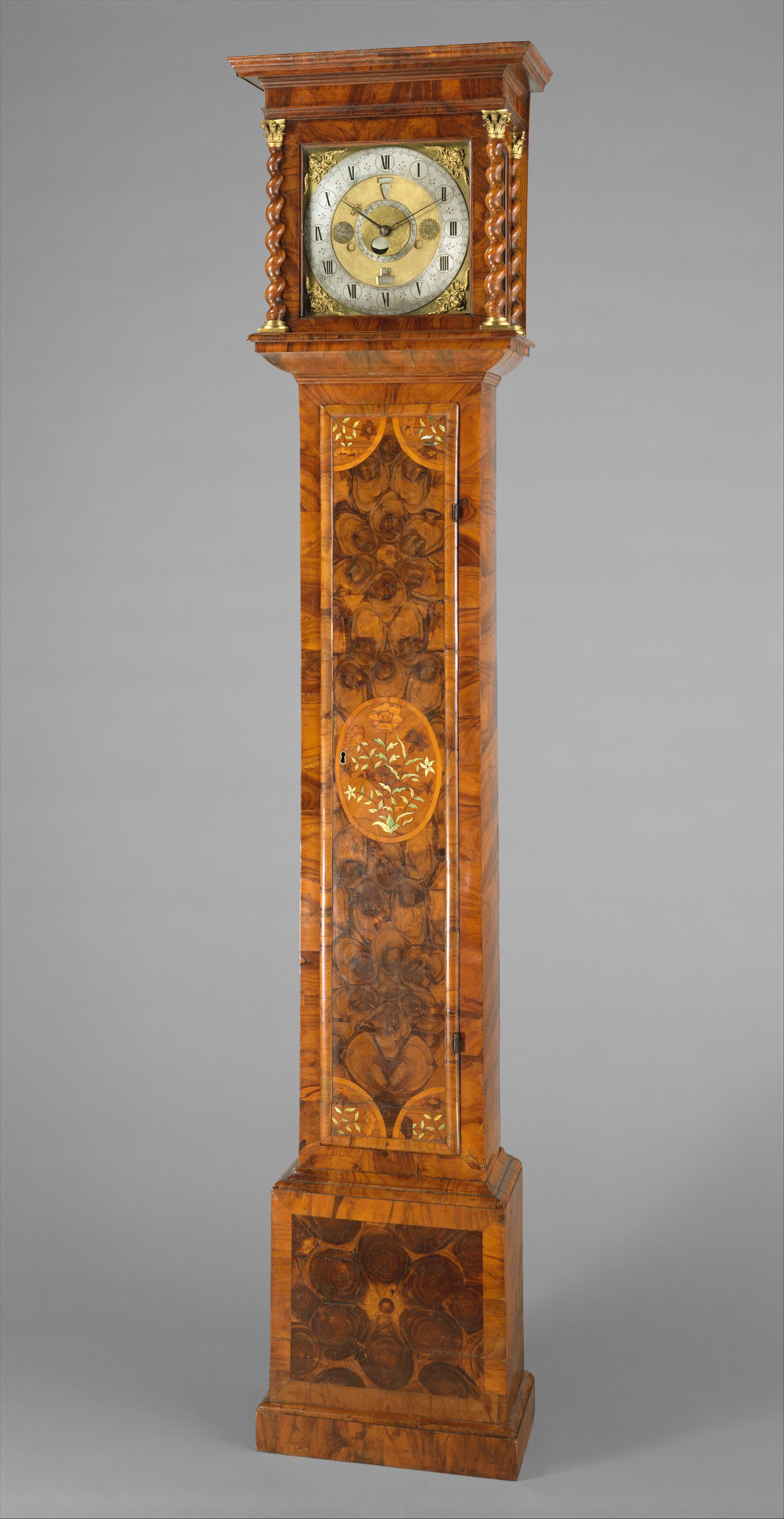
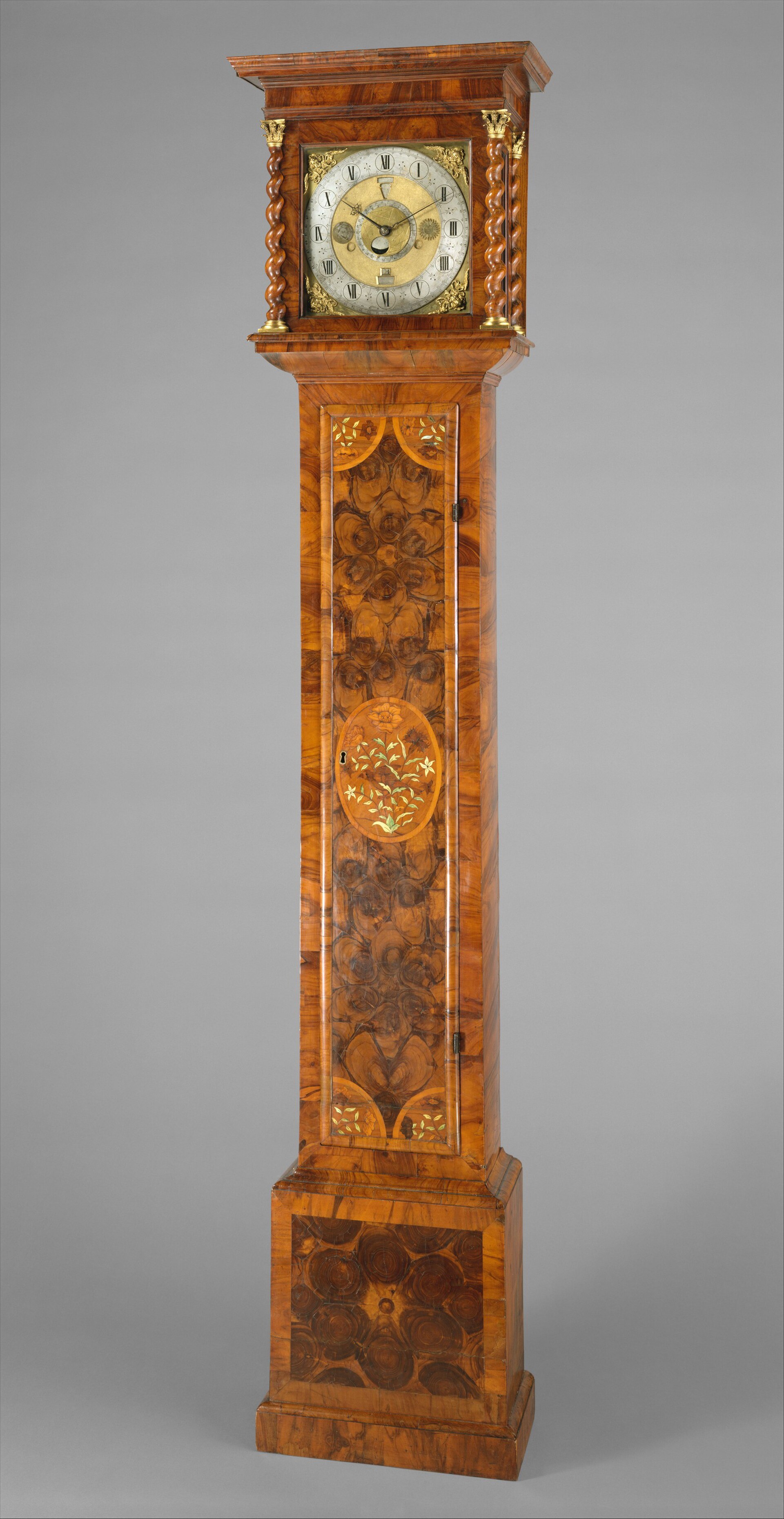
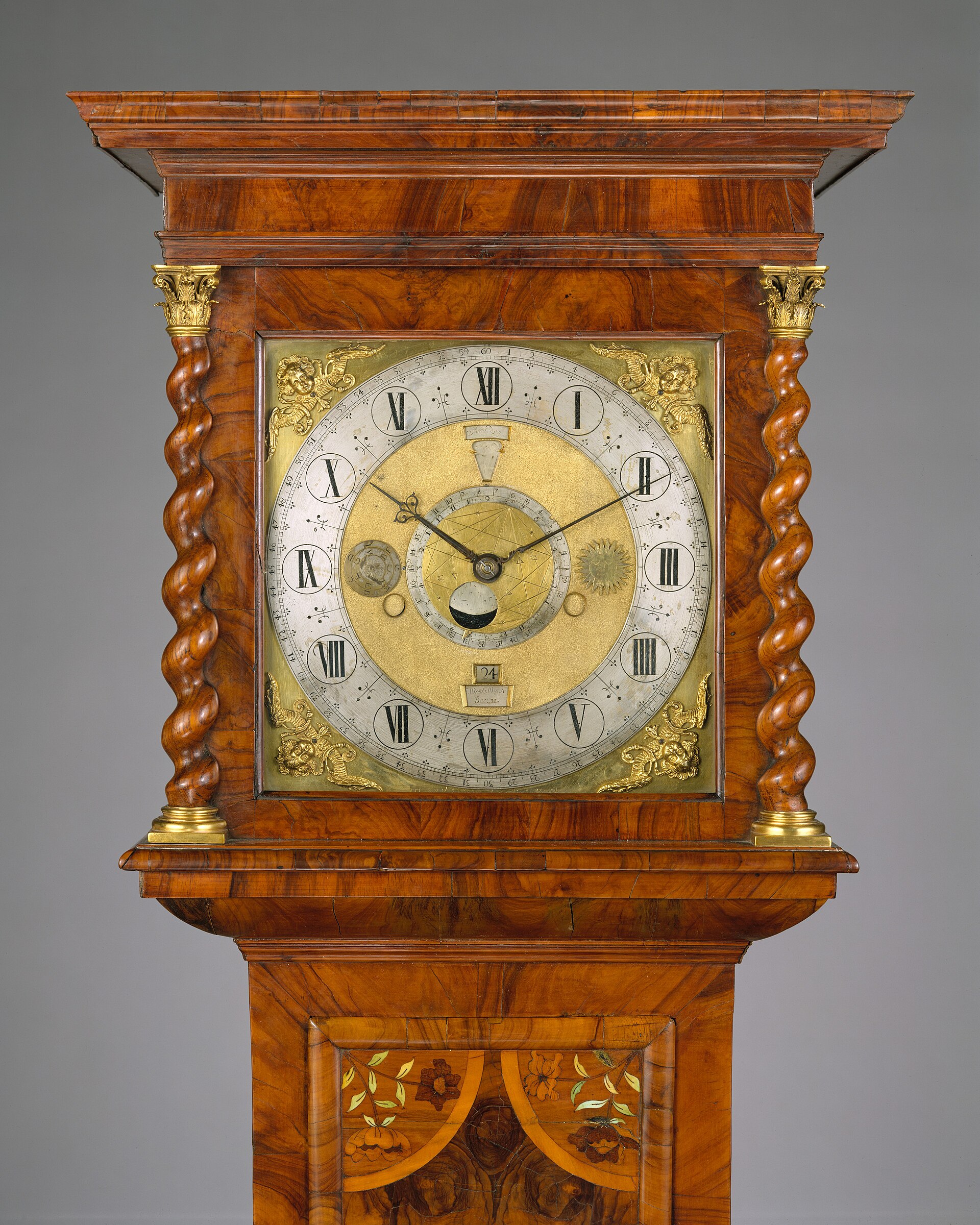
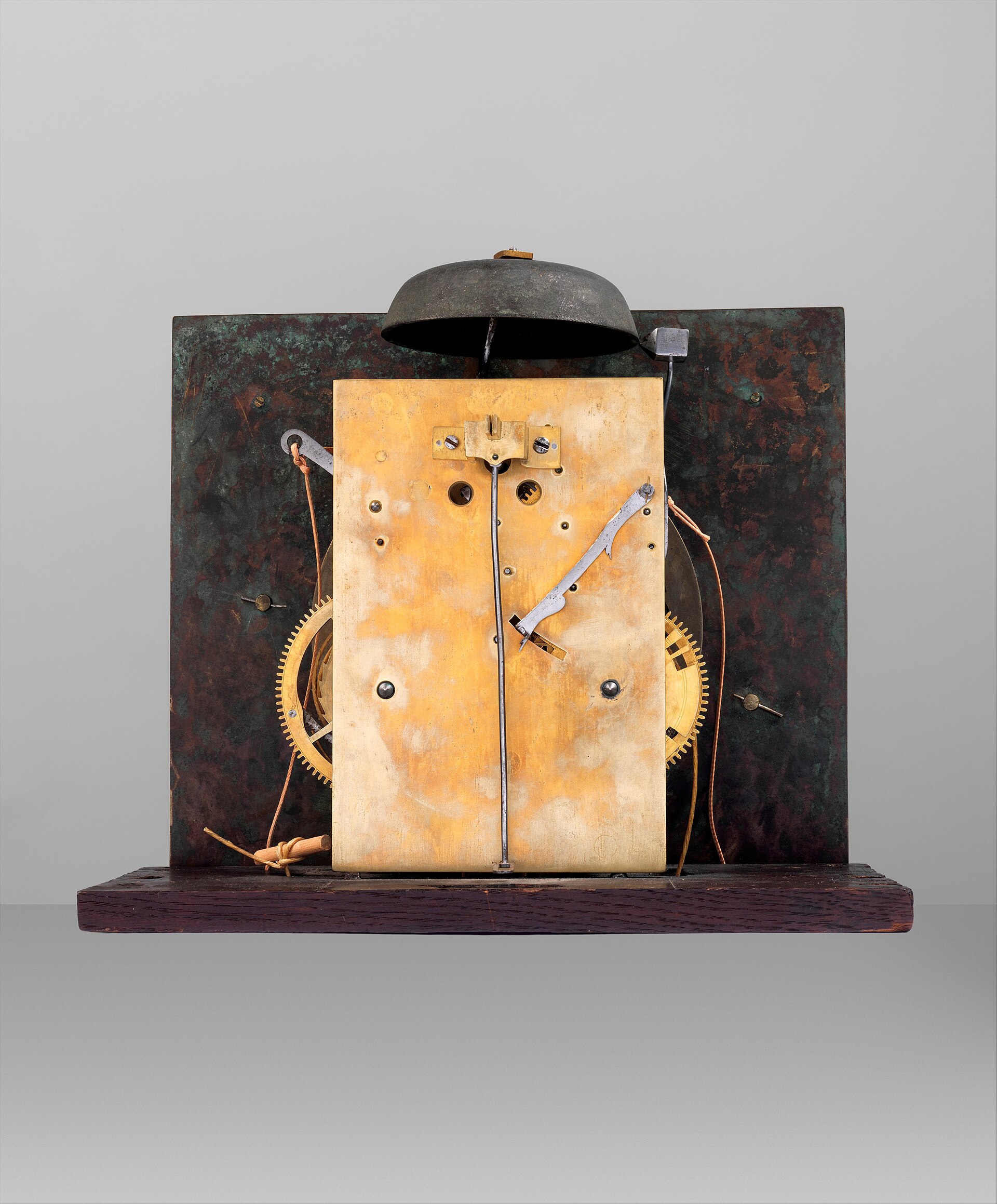
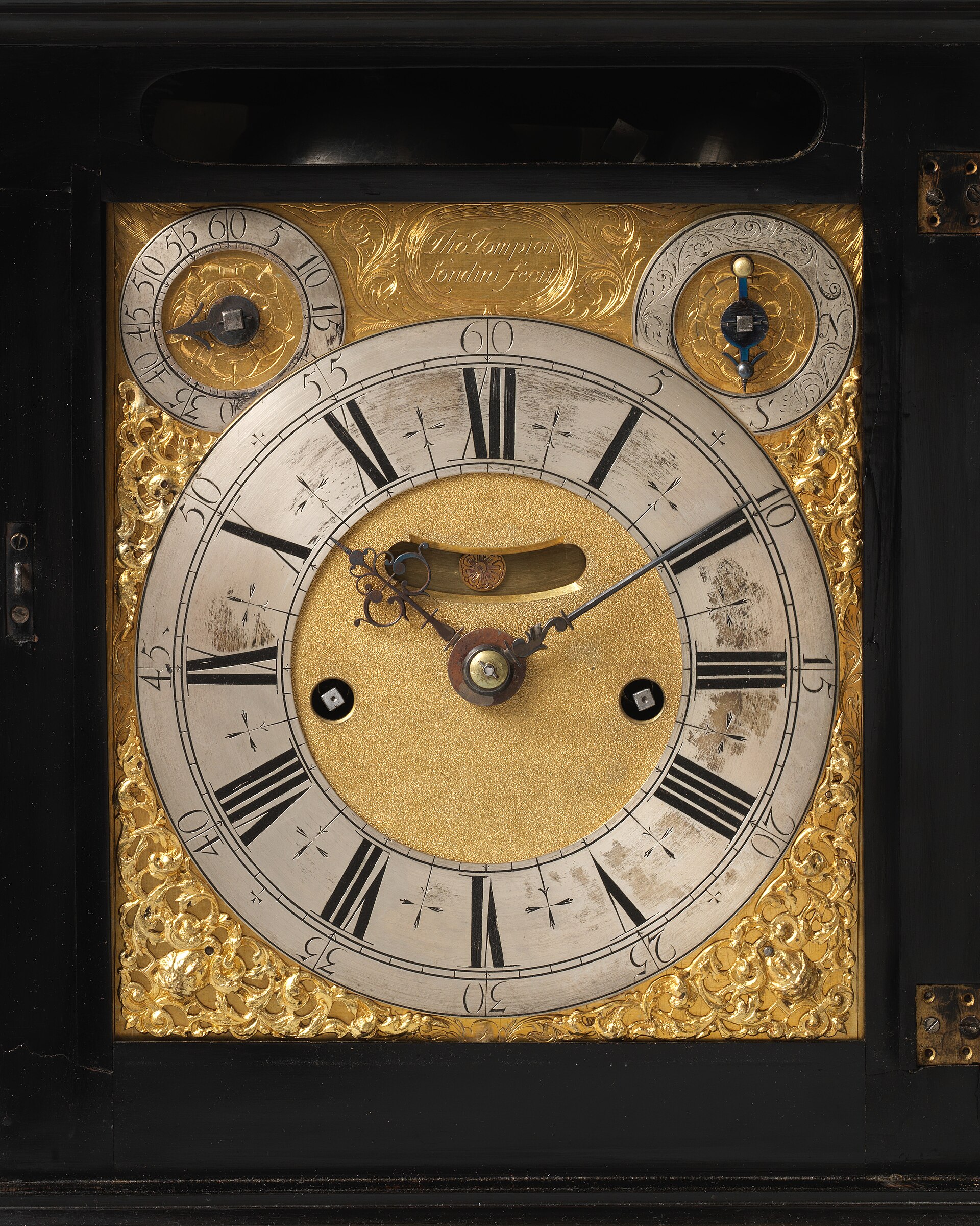
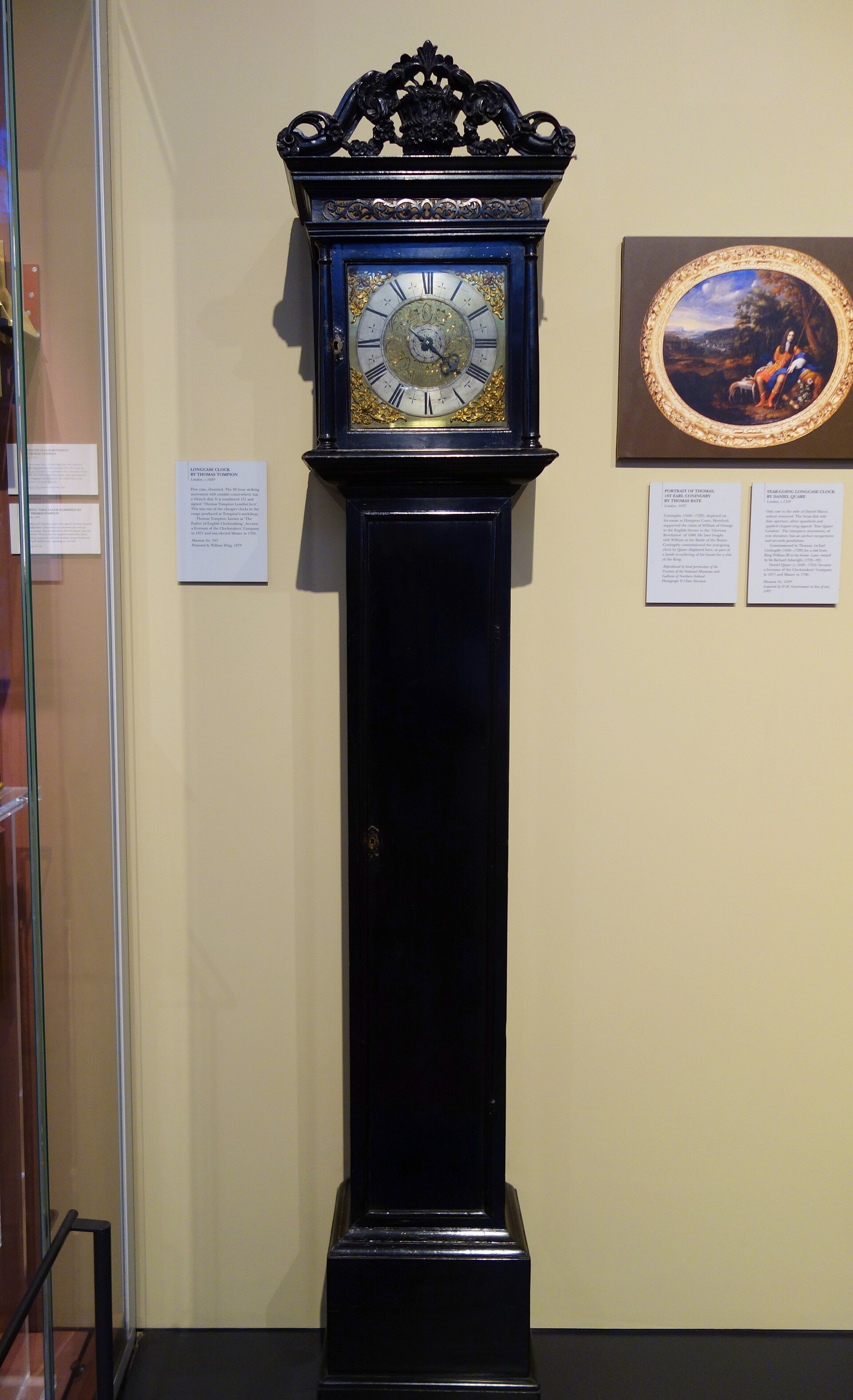
Longcase clock with calendrical, lunar, and tidal indications, also known as the Graves Tompion
c. 1677-80 · Case
Metropolitan Museum of Art, New York
 British · 1639-1713
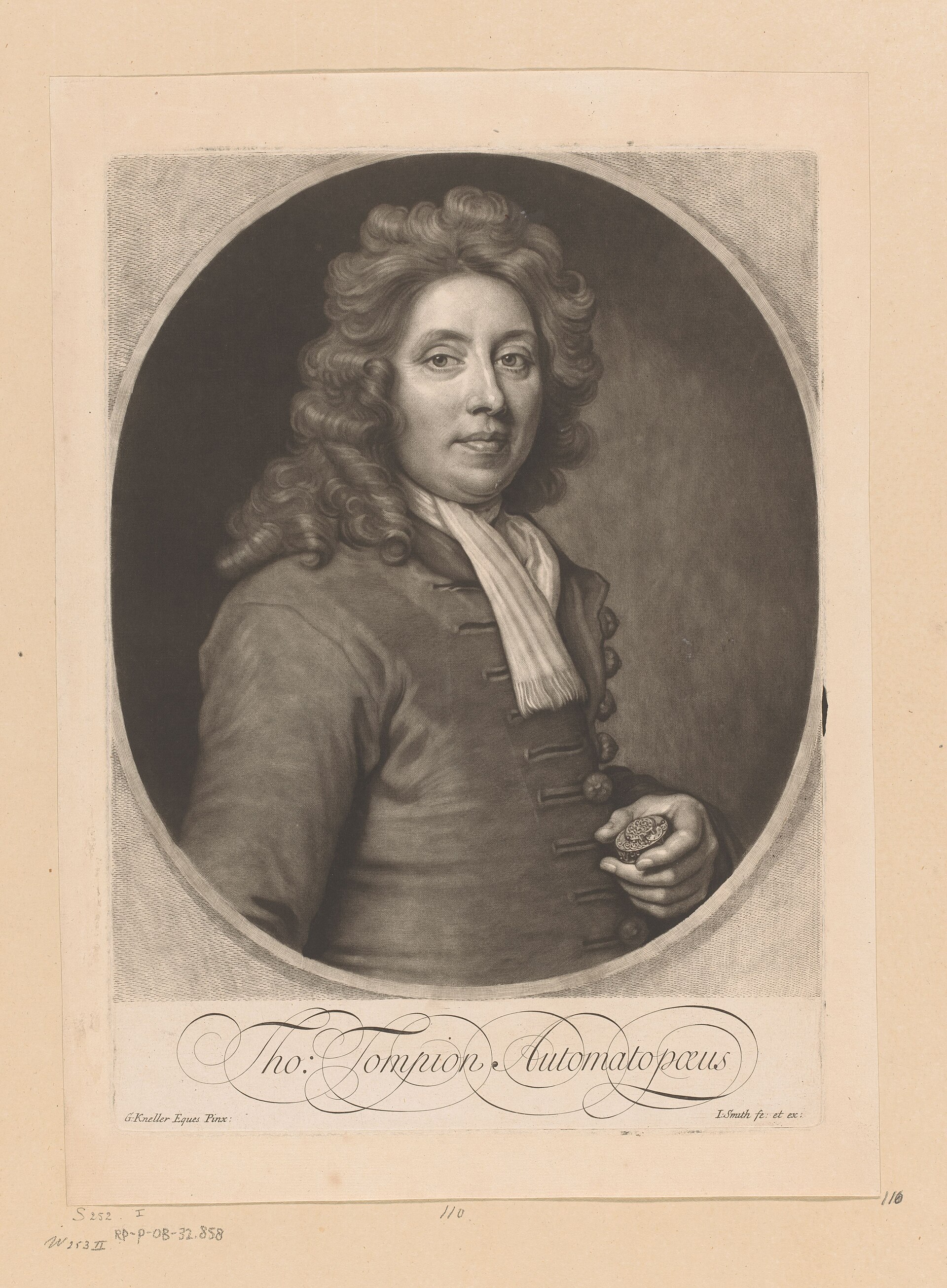
A mezzotint portrait of Thomas Tompion, engraved and published by John Smith after a painting by Sir Godfrey Kneller, the leading court portraitist of Tompion's own lifetime. Held by the Rijksmuseum, Amsterdam (object RP-P-OB-32.858), and catalogued there and independently by the Yale Center for British Art with the sitter identified by name against the standard historical print catalogues of Chaloner Smith and LeBlanc. The underlying painted portrait is not known to survive; this print, made during or close to Tompion's own lifetime by an engraver working directly from Kneller's picture, is the most secure surviving image of him.
Rijksmuseum, Amsterdam| Worked as | Clockmaker, Watchmaker, Instrument maker |
|---|---|
| Born | Baptised 25 July 1639 · Northill, Bedfordshire, England |
| Died | 20 November 1713 · London, England |
| Nationality | British |
| In this archive | 1 artwork |
| Sources | 34 cited |
| Last verified |
About this page 1 artwork in the archive · Last verified · 34 sources cited
Thomas Tompion is called the father of English clockmaking so routinely that the phrase has stopped sounding like a claim and started sounding like a fact of nature. It is not a fact of nature. It is a settled scholarly consensus built on a specific, checkable thing: Tompion was among the first manufacturers of any kind, anywhere, to number his own output and keep a ledger against the numbers, and it is that numbering system, not the reputation alone, that lets a specialist today tell a genuine Tompion from the many pieces that were signed with his name and were not made in his workshop. The ledgers themselves are lost. The numbers, and the two centuries of research needed to make sense of them without the ledgers, are what actually does the work of authenticating his estate today.
The son of a Bedfordshire blacksmith, with no apprenticeship record anywhere in the surviving guild archive, Tompion entered the London trade by paying a fee rather than by serving the customary term, built a workshop at the corner of Fleet Street known as the Dial and Three Crowns, and supplied four successive reigns with clocks, watches, and precision instruments used by the Royal Society's own working scientists. His most technically accomplished early clock, the Metropolitan Museum's Graves Tompion, was made before his numbering system existed at all, which means it is one of his best pieces and simultaneously one of the pieces his own business records, had they survived, would have had nothing to say about.
What follows is not a workshop hagiography. Pieces bearing his name were forged in the nineteenth century and are still occasionally offered as genuine; a documented, if popularised, invention credited to his workshop was not actually his idea; and at least one major partnership in his career ended for reasons no source consulted can explain. The reputation survives contact with all of it, which is the more interesting story.
Baptised 25 July in Northill, Bedfordshire, son of the blacksmith Thomas Tompion Sr.2
Admitted a Brother of the Clockmakers' Company, London, on 4 September, as a Great Clockmaker, for a fee of thirty shillings.2
Granted full freedom of the Clockmakers' Company on 6 April; Robert Hooke's diary begins recording meetings with Tompion the same year.2
Builds two precision regulator clocks with thirteen-foot pendulums for the new Royal Observatory at Greenwich, using the dead-beat escapement designed by Richard Towneley the year before.524
Moves his workshop to the corner of Fleet Street and Whitefriars Street, a shop later known as the Dial and Three Crowns.2
Makes the longcase clock now known as the Graves Tompion, before his numbering system existed; its case is credited, probably, to the cabinetmaker Jasper Braem.12
Begins numbering his clocks and watches to correspond to workshop ledgers, now lost.232
Makes the K and Q clocks for King William III and Queen Mary II; Robert Hooke's diary records seeing both at the workshop.26
Makes the ebony-veneered table or bracket clock now in the Metropolitan Museum (accession 64.101.867).6
Takes Edward Banger into partnership.23
The Banger partnership is dissolved; no source consulted explains why.23
George Graham, working for Tompion since about 1696 and married to his niece Elizabeth since 1704, becomes his outright partner.2
Dies 20 November; buried in Westminster Abbey. George Graham succeeds him at the Dial and Three Crowns, 67 Fleet Street, and continues the numbering system.2
George Graham is elected a Fellow of the Royal Society, an honour Tompion himself never received.2
George Graham dies and is buried alongside Tompion in Westminster Abbey.23
J. Pierpont Morgan's gift to the Metropolitan Museum includes several genuine Tompion watches and one watch later catalogued by the Museum itself as a spurious, much later imitation.89
The Mostyn Tompion, a silver-mounted clock made for William III, passes to the British Museum by private treaty sale rather than public auction.23
The Graves Tompion longcase clock is bequeathed to the Metropolitan Museum of Art by Marilyn Preston Graves.1
Jeremy Evans publishes Thomas Tompion at the Dial and Three Crowns, with a checklist of known clocks, watches and instruments from the workshop.32
Evans, Jonathan Carter and Ben Wright publish Thomas Tompion - 300 Years, the standard modern catalogue.33
Sotheby's London runs The Genius of Thomas Tompion, a sixty-lot sale devoted entirely to his output.28
The Q clock, Tompion number 222, sells at Bonhams for GBP 1,935,062.50 with premium, the auction record for a Tompion timepiece.2627
Tompion pieces are, by a clear margin, the highest-priced English clocks and watches sold at auction, and the record was set in London. Royal provenance moves the price further than anything else documented here: the two highest-profile results both concern pieces made for William III and Mary II. Ordinary, well-attributed workshop pieces without royal history still sell for well into six figures in US dollars when the case attribution and the pre-numbering date can be established, as the Bonhams comparandum below shows.
| Date | Sale | Work | Result | Note |
|---|---|---|---|---|
| 19 June 2019 | Bonhams | The Q clock, silver-mounted quarter-repeating miniature table clock made for Queen Mary II, Tompion number 222 | Hammer GBP 1,512,500 With premium GBP 1,935,062.50 GBP | Sold as part of the Clive Collection of Exceptional Clocks and Watches. The highest price ever paid at auction for a Tompion timepiece, per Bonhams. Robert Hooke's diary records seeing this clock and its companion, the K clock, at Tompion's workshop in 1693. |
| 6 June 2018 | Bonhams | Small olivewood marquetry longcase clock, pre-numbered, case attributed to Jasper Braem | With premium USD 162,500 USD | Sold in New York; hammer price alone not separately published in the sale record consulted. Cited here, as in the Metropolitan Museum's own Graves Tompion record, as the closest known market comparandum for an undecorated pre-numbering longcase clock. |
Hammer is the price at which the bidding stopped; with premium adds the fee the house charges the buyer on top. Hammer price and buyer's premium in the glossary.
| Institution | City | Holdings | Note |
|---|---|---|---|
| Metropolitan Museum of Art | New York | The Graves Tompion longcase clock (1999.48.2), a second longcase clock with calendar (64.101.865), a table or bracket clock (64.101.867), a traveling clock watch with alarm (17.190.1512), a pair-case watch (17.190.1489a,b), and further watches from the 1917 J. Pierpont Morgan gift. | The largest single public collection of Tompion's work consulted for this page; several pieces are Open Access and CC0. |
| British Museum | London | The Mostyn Tompion, a silver-mounted year-going clock made for William III; an early balance-spring pocket watch, one of the earliest surviving watches with the Tompion-Hooke balance spring. | The Mostyn Tompion passed to the Museum by private treaty sale in 1982 rather than public auction. |
| Science Museum Group, Clockmakers' Museum | London | A one-handed longcase clock of about 1670-1685, and watch movements by Tompion held by the Science Museum's wider collection. | The Clockmakers' Company's own museum, the institutional home of the guild Tompion joined in 1671. |
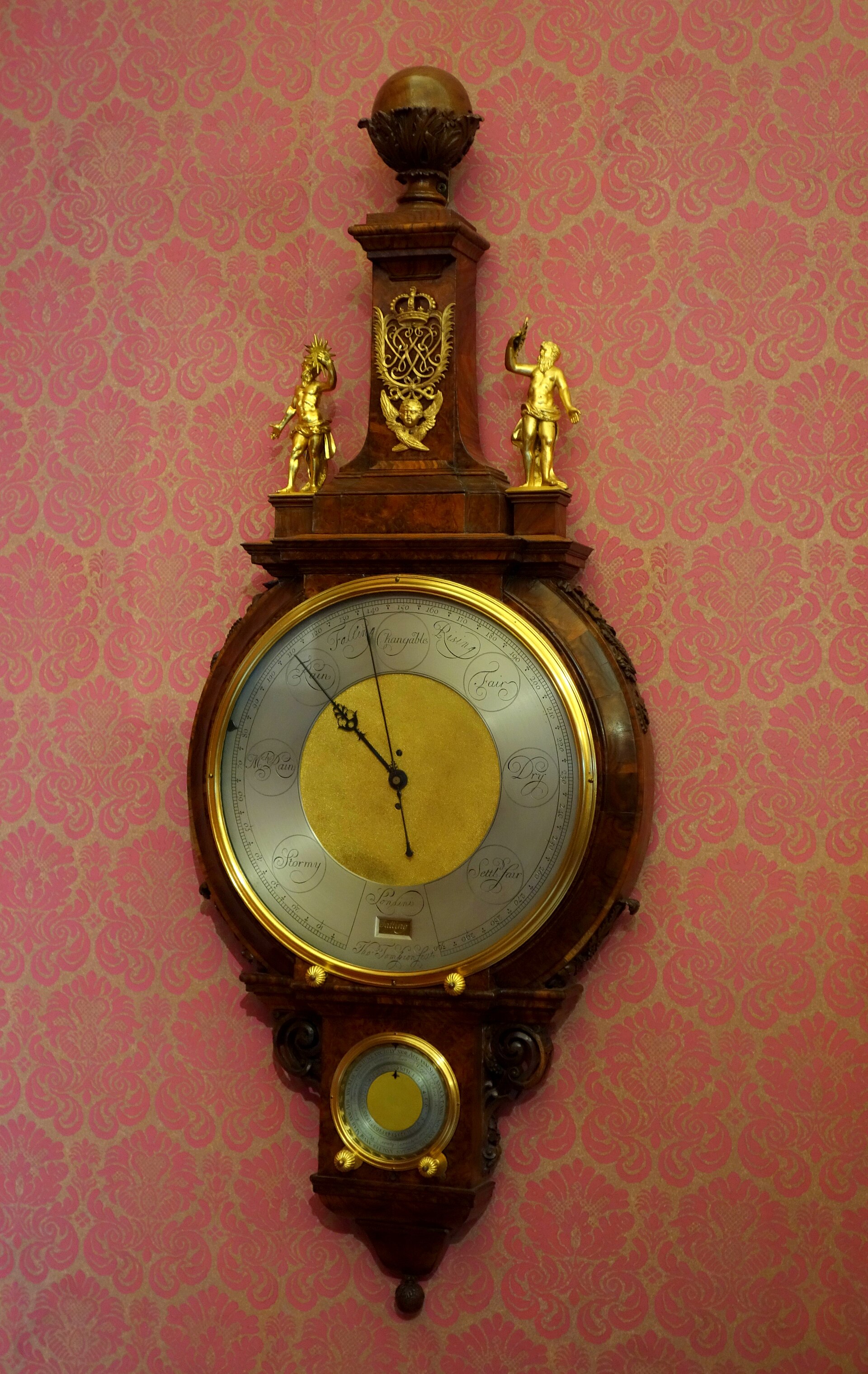
| Historic Royal Palaces, Kensington Palace | London | A walnut and gilt-metal barometer, about 1695-1705. | Displayed among the royal apartments' own furnishings. |
| Royal Collection Trust | London | A year-going equation clock made for William III. | Cited by the Metropolitan Museum's own catalogue as one of Tompion's documented royal commissions. |
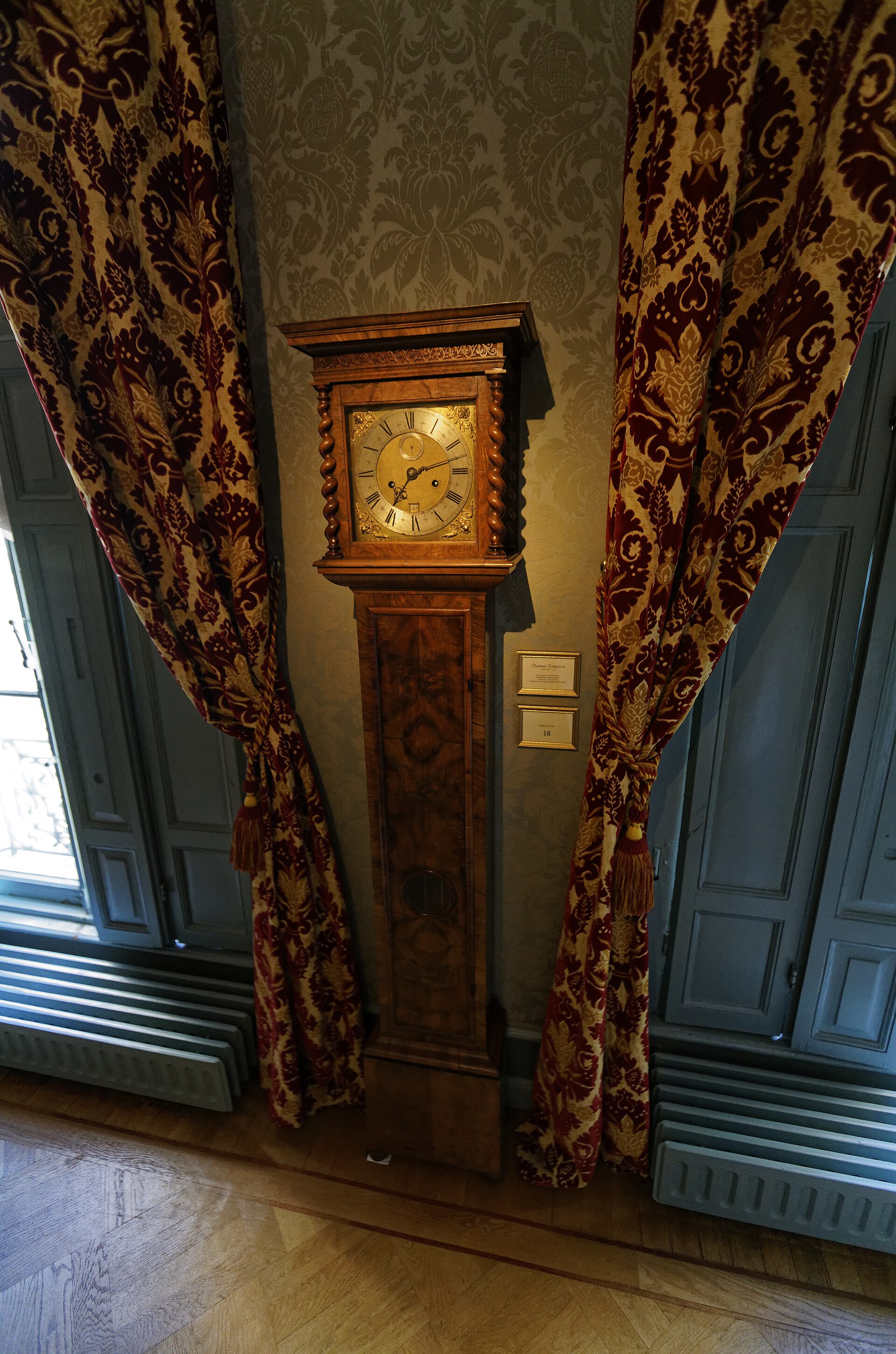
| Museum Bredius | The Hague | A longcase clock. | One of the few Tompion clocks in a continental European public collection identified in the sources consulted for this page. |
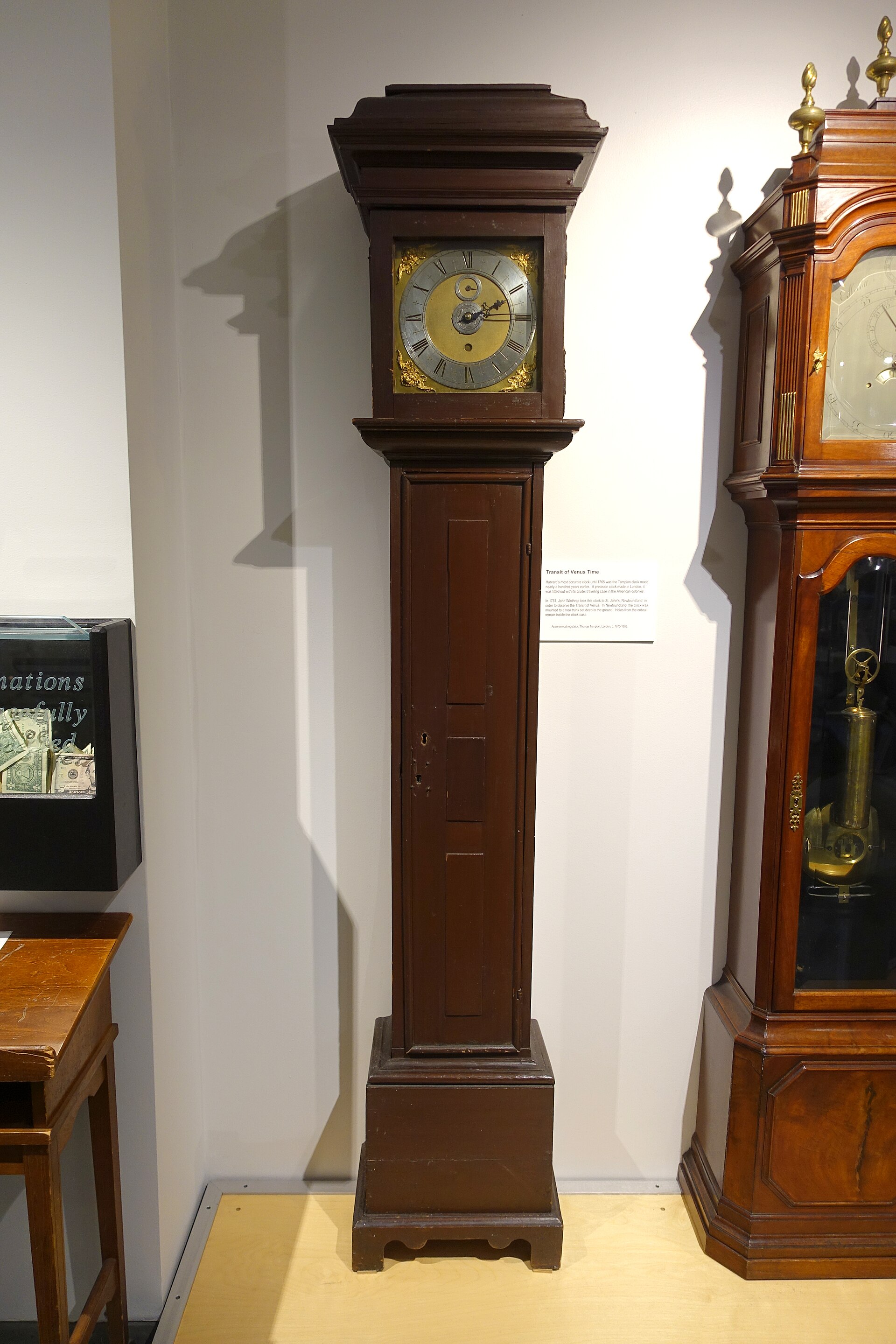
| Harvard University, Putnam Gallery | Cambridge, Massachusetts | An astronomical regulator of about 1675-1685. | Later used, decades after Tompion's death, to observe the 1761 transit of Venus from an expedition site in Newfoundland. |
Thomas Tompion was baptised on 25 July 1639 in Northill, Bedfordshire, son of the blacksmith Thomas Tompion Sr.
Thomas Tompion was baptised on 25 July 1639 in Northill, Bedfordshire, son of the blacksmith Thomas Tompion Sr. and his wife Margaret, a fact drawn from the parish register itself. His first substantial biographer, R. W. Symonds, filled the long gap before Tompion's appearance in London with an account he himself admitted rested mostly on legend. The modern, document-based account is the work of the horologist Jeremy Evans, who has spent more than three decades working in the Clocks and Watches department of the British Museum and is generally regarded as the foremost living authority on Tompion's life and output. Evans's own conclusion, after searching for it, is that no apprenticeship record for Tompion survives with any of the candidate masters proposed over the years, Samuel Knibb, Edward East, or Ahasuerus I Fromanteel, and that Tompion most likely did not enter the trade through the standard apprenticeship route at all.
What is documented is his admission to London's Clockmakers' Company on 4 September 1671, as a Brother, for a fee of thirty shillings, admitting him specifically as a Great Clockmaker, a maker of turret clocks; full freedom of the Company did not follow until 6 April 1674, for a further ten shillings. Those are sizeable sums for the period, and the pattern, paying to enter rather than serving the customary term, is read by Tompion's own cataloguers as evidence that he came into the London trade already skilled, most likely trained informally around his family's forge, rather than through a City guild apprenticeship. By 1671 he was already established in London with what one modern catalogue calls an extensive knowledge of metalworking. Around 1676 he moved to larger premises at the corner of Fleet Street and Whitefriars Street, a shop that became known as the Dial and Three Crowns and was later renumbered 67 Fleet Street.
The clearest evidence of Tompion's place in Restoration London's scientific culture, rather than only its luxury trade, is his documented working relationship with Robert Hooke, Curator of...
The clearest evidence of Tompion's place in Restoration London's scientific culture, rather than only its luxury trade, is his documented working relationship with Robert Hooke, Curator of Experiments to the Royal Society. Hooke's own diary records numerous meetings with Tompion beginning in 1674, in years the two men spent developing a spiral balance spring for watches, an innovation that would let a portable watch regulate itself far more accurately than the unsprung balance wheels then in use. Tompion adopted the spring for the watches he made, in what amounted to a real and documented rivalry with the Dutch scientist Christiaan Huygens for priority in the same invention; Huygens had also been working on a spiral balance spring, and each side had reason to claim the idea first. Nothing in the sources consulted for this page suggests the two men ever corresponded directly or met; the dispute ran through intermediaries and publications, and its resolution belongs to the history of the balance spring generally rather than to Tompion's biography specifically.
What the Hooke relationship establishes cleanly is that Tompion was inside the working circle of London's practical science in the 1670s, supplying and collaborating with the people actually doing the experiments, not merely selling luxury objects to people who funded them. Tompion himself was never elected a Fellow of the Royal Society; the honour went, decades later, to his own successor.
In 1676, Charles II selected Tompion to build two precision clocks with thirteen-foot pendulums for the newly founded Royal Observatory at Greenwich, instruments meant to serve the Observatory's own...
In 1676, Charles II selected Tompion to build two precision clocks with thirteen-foot pendulums for the newly founded Royal Observatory at Greenwich, instruments meant to serve the Observatory's own astronomical programme rather than any private household. The escapement inside those clocks was new, and it was not Tompion's own design. The dead-beat escapement, an improvement on the ordinary anchor escapement that eliminates the small backward recoil of the gear train at each swing of the pendulum and so keeps far steadier time, was designed by the astronomer Richard Towneley around 1675; Tompion was the first maker to actually build it, in the clocks he made for Sir Jonas Moore and in the two Greenwich regulators of 1676. The escapement is popularly associated today with Tompion's own successor, George Graham, who reintroduced and publicised it around 1715, forty years after Towneley designed it and Tompion first built it. The popular credit is a case of the second, better-marketed version of an idea eclipsing the first; the documented sequence runs Towneley, then Tompion, then Graham.
Tompion's business grew large enough that he began keeping ledgers and cutting a serial number into each clock and watch to correspond to an entry in them, a practice historians treat as one of the...
Tompion's business grew large enough that he began keeping ledgers and cutting a serial number into each clock and watch to correspond to an entry in them, a practice historians treat as one of the first serial-numbering systems applied to manufactured goods of any kind. Jeremy Evans's research, published in his 2006 study Thomas Tompion at the Dial and Three Crowns and developed further in the 2013 catalogue Thomas Tompion - 300 Years, written with Jonathan Carter and Ben Wright, dates the start of the numbering system to about 1682. The ledgers the numbers once corresponded to are lost. What survives is the numbers themselves, cut into several hundred surviving pieces, and Evans's own decades of cross-referencing them against each other, against dated commissions, and against the physical construction of the movements is what now lets a specialist assign an undated Tompion piece to within a few years, or catch a number that does not belong.
The system has a practical consequence that shows up on individual objects. A clock or watch carrying no number is not necessarily undocumented; it may simply predate about 1682. The Metropolitan Museum's Graves Tompion longcase clock, made around 1677 to 1682, carries no serial number for exactly this reason, and its own cataloguers have had to date it by circumstantial evidence, the tenancy of the cabinetmaker credited with its case, rather than by the ledger method that works for the roughly three decades of Tompion's output that followed.
Tompion's workshop is estimated in the tertiary literature to have produced in the region of 650 clocks and 5,500 watches over the course of his working life, figures repeated widely in popular...
Tompion's workshop is estimated in the tertiary literature to have produced in the region of 650 clocks and 5,500 watches over the course of his working life, figures repeated widely in popular horological writing but not traced in the sources consulted to a primary count published by Evans himself; they are recorded here as the general order of magnitude reported, not as an audited total, and are flagged for replacement with Evans's own published figures where they can be consulted directly. The 2013 catalogue Thomas Tompion - 300 Years describes 121 individual pieces in full catalogue entries and additionally sets out what its reviewers describe as an exhaustive table of all known surviving pieces; no source consulted for this page states the single total that table arrives at. That the standard modern catalogue can describe 121 objects in depth and still needs a separate summary table for everything else known gives some sense of the size of the surviving corpus without settling it to a number, and the exact current total is recorded here as an open question rather than guessed at.
The Science Museum Group's own collection notes estimate that well over one hundred apprentices and collaborators could have been involved across the workshop's history in designing, producing, finishing, and selling Tompion's output, a figure that underlines how much of what left the Dial and Three Crowns under Tompion's name was, in the ordinary way of any large workshop of the period, made by hands other than his own.
Tompion worked across the reigns of Charles II, James II, William III and Mary II, and Anne, and his most documented royal commissions date from the William and Mary years.
Tompion worked across the reigns of Charles II, James II, William III and Mary II, and Anne, and his most documented royal commissions date from the William and Mary years. A year-going equation clock made for William III remains in the British Royal Collections. A silver-mounted, quarter-repeating miniature table clock made in 1693 for Queen Mary II, known in the trade by its workshop number as the Q clock, Tompion number 222, was displayed with a companion piece, the K clock, in the royal apartments at Kensington Palace; Robert Hooke's own diary records seeing both in the workshop that year, in an entry that reads simply, called at Tompion, saw K and Q clocks. A separate spring-driven clock extravagantly mounted in silver, made for William III and known as the Mostyn Tompion after the family that later owned it, passed by private treaty sale to the British Museum in 1982 rather than through a public auction; the exact price paid and the extent of any public heritage funding involved could not be confirmed in any source that could actually be reached for this page, despite repeated attempts, and is recorded as an open question rather than estimated.
Some of Tompion's most elaborate royal work is associated with the French designer Daniel Marot, who worked for William III and Mary II across furniture, silver, and interiors, though the sources consulted for this page do not establish the precise division of labour between Marot and Tompion's own workshop on any specific surviving piece.
Tompion did not make his own cases, and naming the people who did is one of the more concrete pieces of workshop history to survive.
Tompion did not make his own cases, and naming the people who did is one of the more concrete pieces of workshop history to survive. Research by Jeremy Evans established that in 1677 Tompion was subletting part of his Fleet Street premises to a cabinetmaker, Jasper Braem, a Dutchman active in London from about 1677 to about 1696 with a documented specialism in marquetry described in period sources as done with several coloured woods in resemblance of flowers, leaves and the like. On the strength of that tenancy and that specialism, the Metropolitan Museum's own catalogue credits Braem, on a probable rather than certain basis, with the case of the Graves Tompion longcase clock and several of Tompion's other decorative cases from the same years. Watch cases, a different trade again, were supplied by named specialists including Nathaniel Delander I, credited on the case and dial of at least two Tompion watches now in the Metropolitan Museum, and John Northcott, named alongside Tompion on a repeater watch case in the same collection. None of these names appears on the movement itself; they survive because later cataloguers went looking for them, which is itself worth noting as a pattern. A Tompion clock or watch routinely carries at least two makers' worth of skilled labour under a single signed name, and the case-making half of that labour is only intermittently credited even now.
In 1701 Tompion took Edward Banger into partnership, and watches signed by both names survive from the years that followed.
In 1701 Tompion took Edward Banger into partnership, and watches signed by both names survive from the years that followed. The partnership was dissolved around 1707 or 1708, and no source consulted for this page, tertiary or otherwise, gives a documented reason. It is one of the plainer gaps in an otherwise well-mapped career, and it is recorded here as one rather than smoothed over with a guess.
Tompion's second and far better documented partner was George Graham, who began working for him around 1696 while still nominally apprenticed to the clockmaker Henry Aske.
Tompion's second and far better documented partner was George Graham, who began working for him around 1696 while still nominally apprenticed to the clockmaker Henry Aske. In 1704 Graham married Tompion's niece, Elizabeth; in 1711 he became Tompion's outright partner; and on Tompion's death in 1713 he succeeded him at the Dial and Three Crowns, by then renumbered 67 Fleet Street, continuing Tompion's serial numbering system for the clocks and watches that came out of the workshop afterward. In 1721 Graham became one of the small number of working clockmakers ever elected a Fellow of the Royal Society, an honour Tompion himself never received, reflecting Graham's own later reputation as an inventor in his own right, including his popularising of the dead-beat escapement that Towneley had designed and Tompion had first built decades earlier.
Thomas Tompion died on 20 November 1713 and was buried in Westminster Abbey; George Graham was buried alongside him in 1751.
Thomas Tompion died on 20 November 1713 and was buried in Westminster Abbey; George Graham was buried alongside him in 1751. The distinction was not automatic for a tradesman of the period, and it is read by modern horological writers as a plain marker of the standing he had reached in his own lifetime, independent of anything written about him since. What did not survive him, so far as any source consulted for this page can trace, are his own workshop ledgers, the books that once explained what each numbered clock and watch actually was, who it was made for, and when. Their loss is the single largest reason his catalogue has to be built backward, from the numbered objects and their internal construction, rather than forward from a documented production record, and it is the reason a researcher today spends decades doing by comparison what a surviving ledger would have settled by inspection.
Tompion's name was valuable enough in his own lifetime and after it that objects were signed with it fraudulently, and at least one clear case sits inside a major museum collection today, catalogued...
Tompion's name was valuable enough in his own lifetime and after it that objects were signed with it fraudulently, and at least one clear case sits inside a major museum collection today, catalogued as exactly what it is. The Metropolitan Museum's own Open Access catalogue lists a silver and gilt-metal watch with a wandering-hour dial under the deliberately qualified heading Dubious Watchmaker: Thomas Tompion, and dates the piece itself to the nineteenth or twentieth century, made in imitation of an earlier sixteenth- to early-seventeenth-century style, a period that predates Tompion's own working life entirely. It entered the Museum's collection in the same 1917 gift from J. Pierpont Morgan that brought in several genuine Tompion watches now on view nearby, meaning one of the era's most sophisticated collectors, or the dealers advising him, accepted a spurious Tompion alongside the real ones without evident hesitation.
A second, subtler problem is the married object rather than the outright fake: a piece whose parts are individually old and in some cases individually genuine, assembled into a whole that misrepresents itself. A longcase clock sold at Sotheby's in 2018, its dial signed Tho Tompion Londini Fecit and its movement retaining what the sale catalogue called the original wheelwork throughout, was offered with the frank catalogue note movement and case associated, meaning the case was not made for this particular movement; Sotheby's own condition report specifically declined to guarantee the authenticity of individual component parts. Nothing here impugns the genuine signature or the genuine movement; it is a reminder that a signed dial proves only that the dial is Tompion's, not that everything currently surrounding it left his workshop together.
Tompion pieces are, by a wide margin, the highest-priced English clocks and watches sold at auction, and the current record was set in London rather than New York or Geneva.
Tompion pieces are, by a wide margin, the highest-priced English clocks and watches sold at auction, and the current record was set in London rather than New York or Geneva. The Q clock, Tompion number 222, made in 1693 for Queen Mary II and the piece Robert Hooke's diary records seeing in the workshop the same year, sold at Bonhams on 19 June 2019 as part of the Clive Collection of Exceptional Clocks and Watches; it hammered at GBP 1,512,500 and totalled GBP 1,935,062.50 with buyer's premium, which Bonhams described at the time as the most valuable Tompion timepiece ever sold at auction. A smaller olivewood marquetry longcase clock by Tompion, pre-numbered and dated to about 1680, its case also attributed to Jasper Braem, sold at Bonhams in New York on 6 June 2018 for USD 162,500 including premium; the hammer price alone was not separately published in the sale record consulted. In December 2016, Sotheby's in London ran a sale devoted specifically to Tompion's output, The Genius of Thomas Tompion, sixty lots of verge watches and clock watches spanning roughly 1610 to the early eighteenth century with pre-sale estimates running from about GBP 4,000 to GBP 60,000 a lot; the individual hammer results were not accessible in the source consulted for this page and are not reported here rather than guessed at.
The epithet the father of English clockmaking is repeated across the modern horological and popular literature consulted for this page, and no source traces it to a single original coiner; it...
The epithet the father of English clockmaking is repeated across the modern horological and popular literature consulted for this page, and no source traces it to a single original coiner; it functions as a settled consensus rather than one person's verdict. The horologist Fortunat Mueller-Maerki, reviewing the 2013 catalogue Thomas Tompion - 300 Years, put the consensus plainly: most horological historians of England would agree that the most celebrated craftsman making timekeepers in England during their golden era of clock production is the London based craftsman Thomas Tompion. The verdict rests, on the evidence gathered here, on three separate things that happen to point the same direction: the surviving objects themselves, which are consistently among the best-made English clocks and watches of their period; the scale and organisation of the workshop that made them, run at a size most English trades of the period never reached; and the numbering and ledger system, imperfectly preserved as it now is, that gave every maker who followed him a working model of how to prove what they had actually made.
Clockmaker; Watchmaker; Instrument maker. 1639-1713.
Born Baptised 25 July 1639, Northill, Bedfordshire, England; died 20 November 1713, London, England; buried in Westminster Abbey.
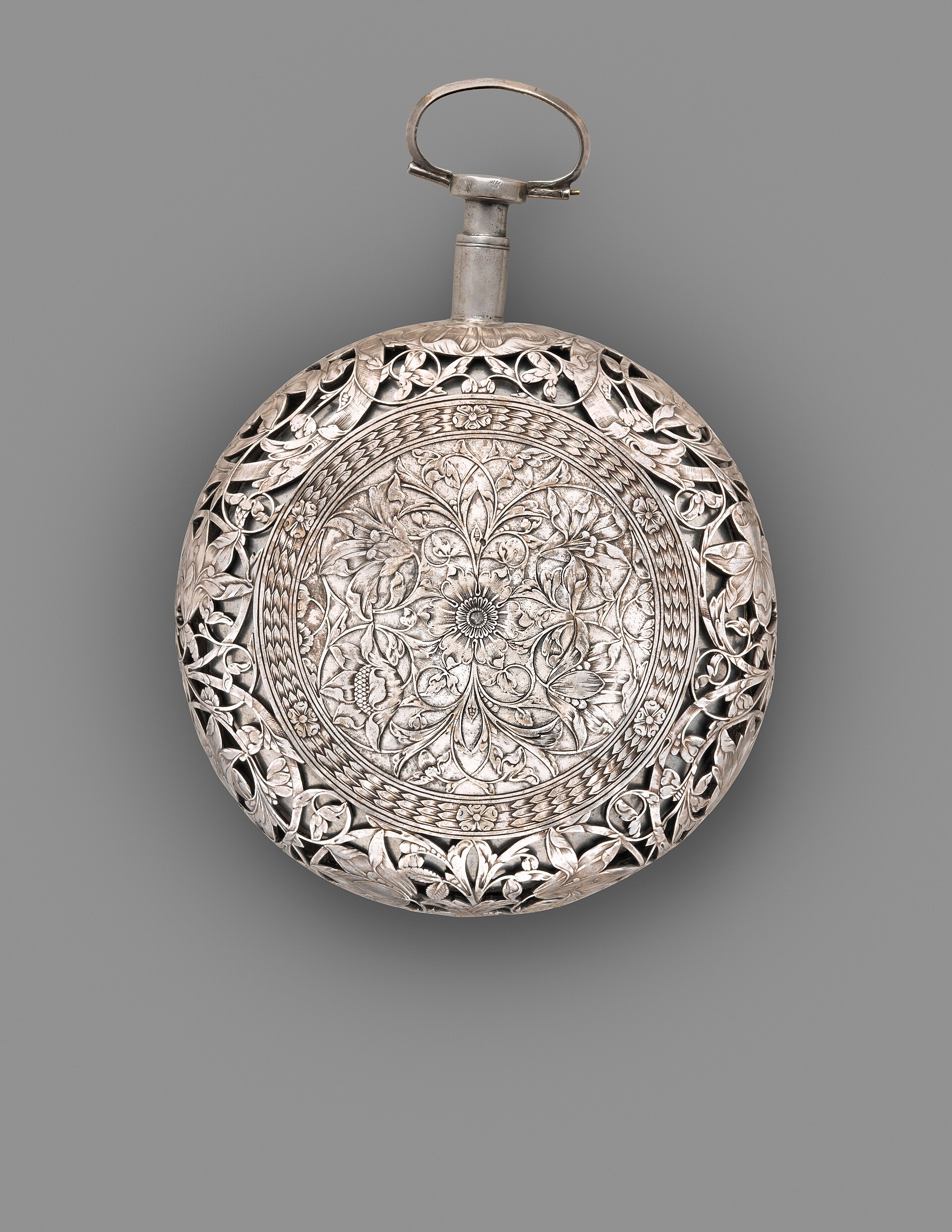
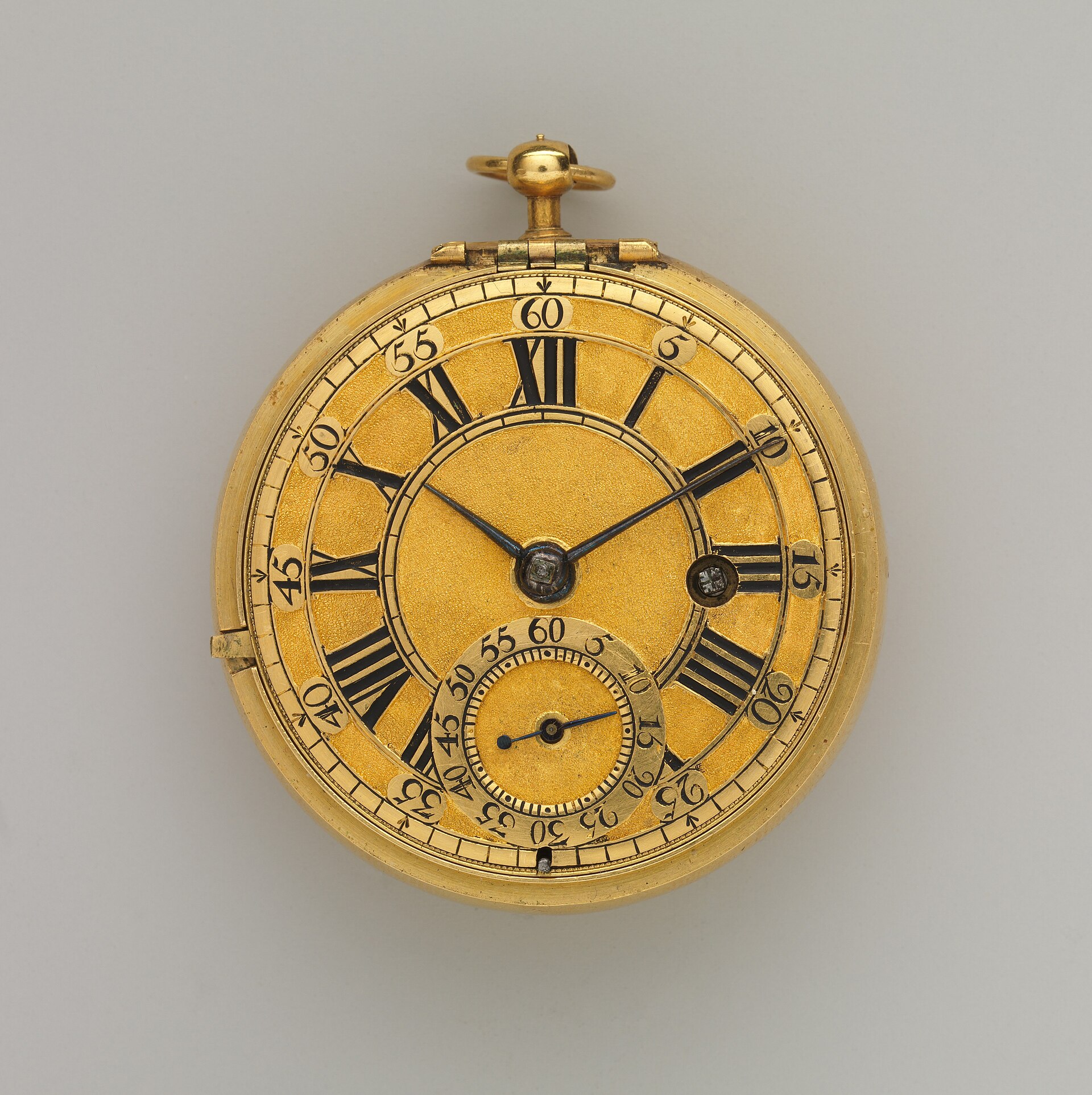
Watch with wandering hour dial, Metropolitan Museum of Art (17.190.1490a,b). A silver and gilt-metal watch signed in Tompion's name, catalogued by the Museum itself under the deliberately qualified heading Dubious Watchmaker: Thomas Tompion. The Museum dates the object's actual construction to the nineteenth or twentieth century, made in imitation of a sixteenth- to early-seventeenth-century wandering-hour style, a form that predates Tompion's own working life.
Metropolitan Museum of Art (New York); British Museum (London); Science Museum Group, Clockmakers' Museum (London); Historic Royal Palaces, Kensington Palace (London); Royal Collection Trust (London); Museum Bredius (The Hague).
Tompion pieces are, by a clear margin, the highest-priced English clocks and watches sold at auction, and the record was set in London. Royal provenance moves the price further than anything else documented here: the two highest-profile results both concern pieces made for William III and Mary II.
What is the current, confirmed total of Tompion clocks and watches accepted as genuine and fully catalogued? The 2013 Evans, Carter and Wright catalogue describes 121 pieces in full and states a further summary table of all known pieces exists; no source consulted for this page gives the single total that table reaches.
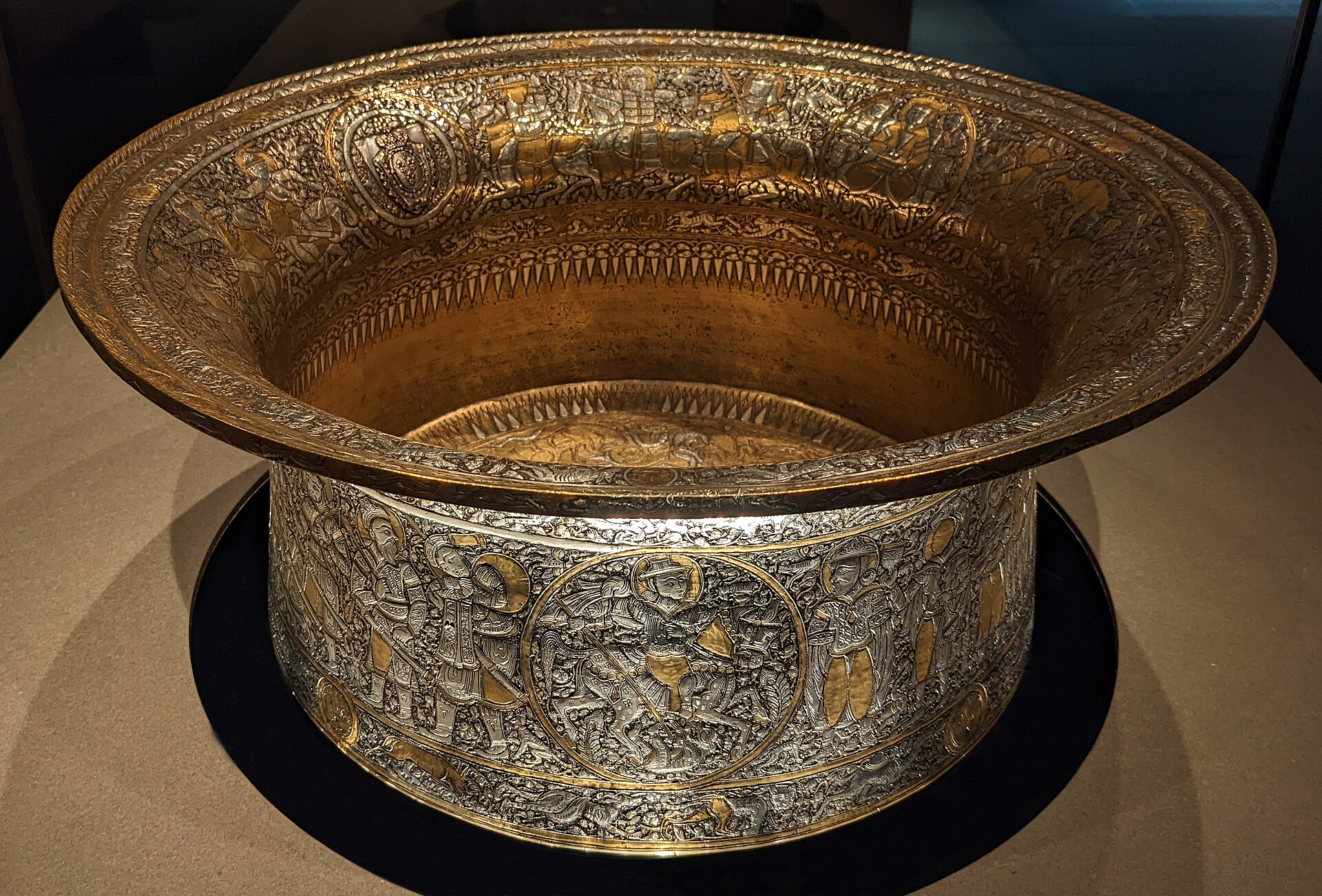
Across this archive the objects that carry a personal name are almost never named for their makers.
9 min read
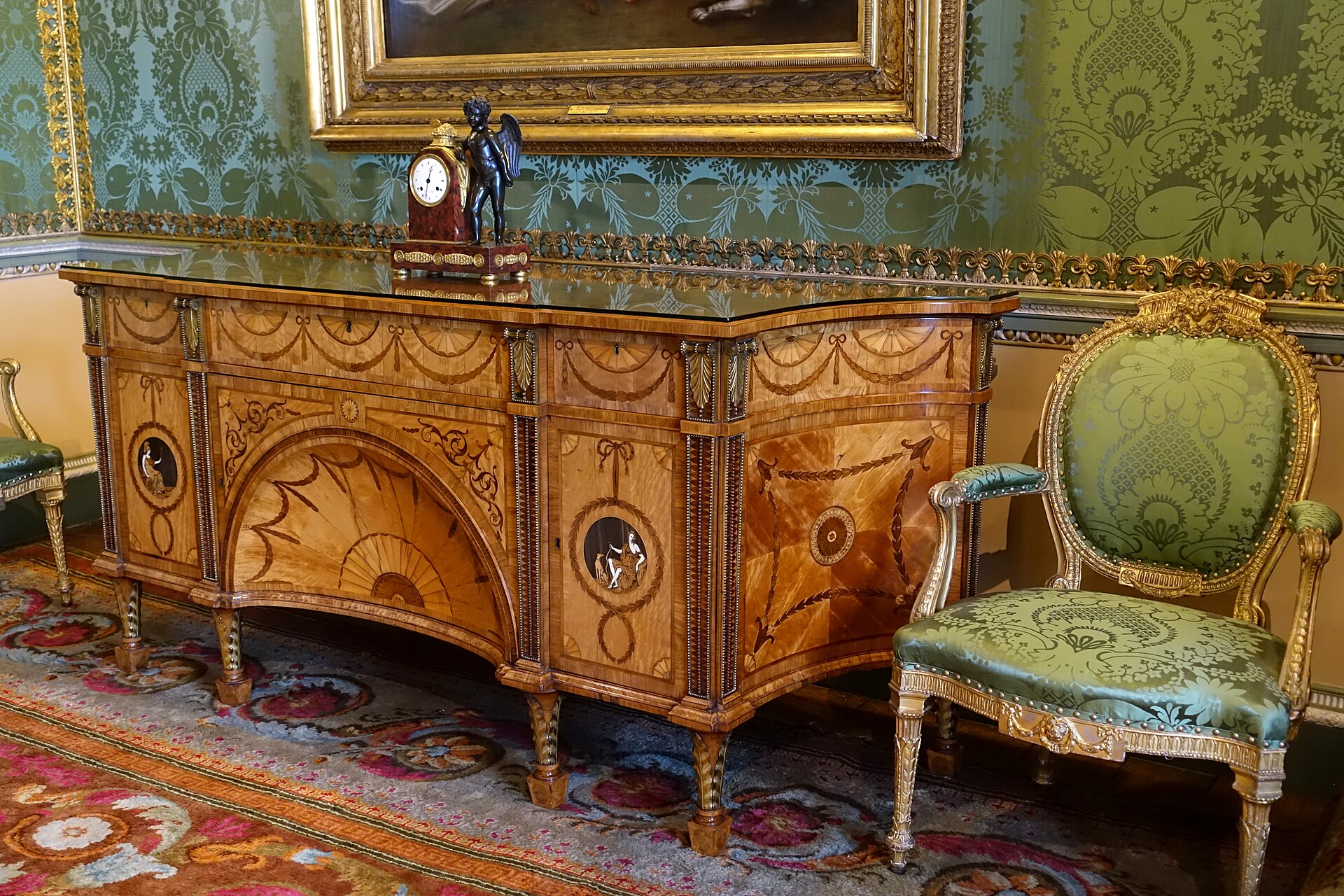
A maker's bill, workbook or memoir is the only provenance document that fixes date, cost and first owner at once.
10 min read
Last verified
One artwork and its story every Tuesday, with the picture: who owned it, what it made, and what closes soon in the exhibition calendar. No promotion, and nothing we cannot cite.
We send one email to confirm the address and keep nothing else. Every letter carries a one-click unsubscribe. How we handle your data.
_MET_DT4371.jpg)
_MET_DT4372.jpg)


_-_Longcase_Clock.jpg)

