Longcase clock with calendrical, lunar, and tidal indications, also known as the Graves Tompion
Thomas Tompion · ca. 1677-80
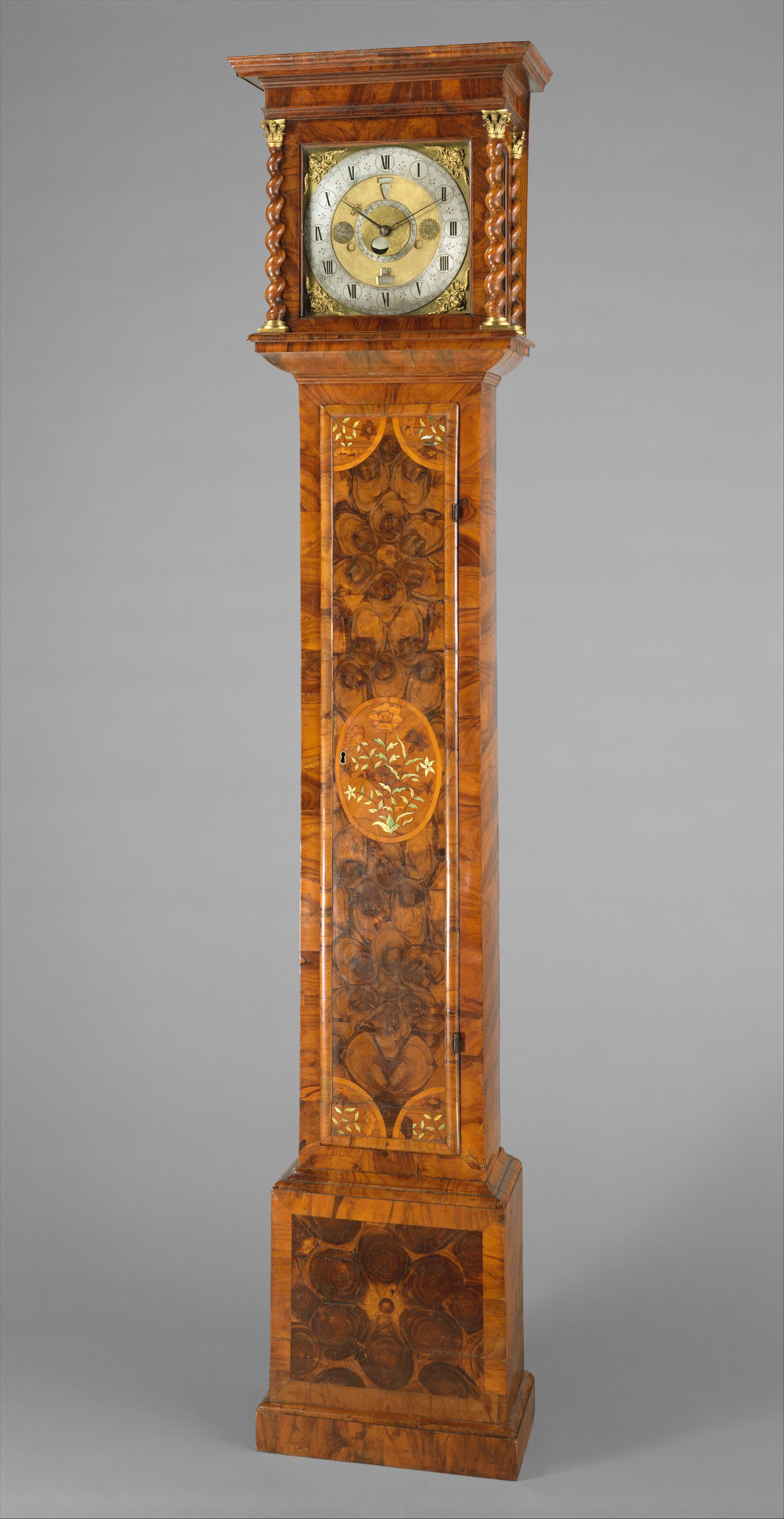
The clock in full, ca. 1677-80: oak case veneered with walnut and oystershell-cut olive wood, marquetry trunk door, and the ten-inch dial with its calendar, lunar, and tidal complications. Metropolitan Museum of Art, 1999.48.2.
| Artist | Thomas Tompion |
|---|---|
| Date | ca. 1677-80 |
| Medium | Case: oak veneered with walnut, panels of oystershell-cut olive wood; marquetry panels of green-stained bone, ivory, and various woods; mounts of gilded brass. Dial: gilded and silvered brass. Movement: brass and steel. |
| Dimensions | Overall: 77 x 17 x 8 in. (195.6 x 43.2 x 20.3 cm); width of dial plate: 10 in. (25.4 cm) |
| Where it is now | Metropolitan Museum of Art, New Yorklast confirmed |
| Inventory number | 1999.48.2 |
| Attribution | AcceptedThe movement and dial are signed and universally accepted as the work of Thomas Tompion's Fleet Street workshop; no source consulted disputes his authorship. Full note |
| Object type | Clocks and instruments |
| Period | British, Restoration period, late seventeenth century |
| Cases | Has a provenance gap |
| Inscriptions | Signed on the dial: Tho Tompion Londini Fecit ("Thomas Tompion made [this] in London"). The Metropolitan Museum's live online object page currently transcribes this as "Tho Thompion Londini Fecit"; the Museum's own 1999 Bulletin gives "Tho: Tompion Londini Fecit" and its own 2015 catalogue gives "Tho Tompion Londini Fecit", both without the extra h, matching Tompion's standard signature on his other surviving work. The website field appears to carry a data-entry variant rather than a second, different reading of the dial. |
| Owners on record | 7 links6 documented, 1 unknown |
| Sources | 12 cited |
About this record Last verified · 12 sources cited · Change log
On this page 9 sections
ContentsClose
A weight-driven longcase clock of about 1677-80, from the earliest and least flamboyant period of Thomas Tompion's career, made before he began numbering his output and therefore untraceable in his own ledgers. Its ten-inch dial does four jobs at once: it tells the hour and minute, it carries the calendar apparatus needed to find the date of Easter, it tracks the moon's phase and age for anyone travelling at night before street lighting, and it predicts the time of high tide at London Bridge, where the wrong tide could kill a waterman. The case, built from oystershell-cut olive wood and floral marquetry, is credited on documentary grounds to Jasper Braem, a cabinetmaker who sublet part of Tompion's own Fleet Street workshop.
The clock disappears from the record for roughly two and a half centuries after it was made, resurfacing only in 1933 in the hands of a London clock dealer's client, Francis Herbert Green. Green sold it to the New York dealer Arthur S. Vernay in 1934, who sold it on to the banker Henry Graves Jr. Graves is better known today for a wristwatch commission: the Metropolitan Museum's own catalogue of the piece states that he also owned the Patek Philippe watch that stood, for fifty-six years, as the most complicated mechanical watch ever made. The Tompion clock stayed in the Graves family until his granddaughter, Marilyn Preston Graves, bequeathed it to the Metropolitan Museum in 1999.
It has never been sold at public auction; every transfer of ownership on record was a private sale or a bequest. It is not the other well-known Tompion associated with a royal sale, the silver-mounted Mostyn Tompion at the British Museum, a different clock entirely, made for a different king, sold at a different sale, and now in a different city's collection.
Provenance
Each link is graded. Documented: a cited source supports it. Disputed: the identification is argued but not established. Unknown: no owner for that span, and the gap is not smoothed into a narrative. The grades in the glossary.
- ca. 1677-82 -Made in Thomas Tompion's workshop, The Dial and Three Crowns, Fleet Street, London; case attributed to the cabinetmaker Jasper Braemdocumented
The movement and dial are signed by Tompion and the attribution is undisputed. The case attribution to Braem, Tompion's documented tenant from 1677, is stated by the Metropolitan Museum's own catalogue as probable, not certain, on the basis of Braem's tenancy and known marquetry specialism rather than a maker's mark.3
- ca. 1682 - 1933Unknownunknown
No owner is documented for roughly two and a half centuries between the clock's making and its first recorded appearance in 1933. No source consulted names an intermediate owner, sale, or location.3
- by 1933 - 1934Francis Herbert Green, London (a liveryman of the Clockmakers' Company; died 1936)documented
Shown as number three in a loan exhibition of Tompion clocks at Green's own premises, 13 Royal Exchange, Cornhill, London, in 1933, reported at the time by the Illustrated London News.3
- 1934 - 1934Arthur S. Vernay, antiques dealer, New Yorkdocumented
Green sold the clock to Vernay on 8 February 1934; a photocopy of the bill of sale is held in the Metropolitan Museum's own files. Vernay sold the clock the same year to Henry Graves Jr.3
- 1934 - 1953Henry Graves Jr., New York (1868-1953)documented
A member of a prominent New York banking family, and, per the Metropolitan Museum's own catalogue, the same collector who owned a Patek Philippe watch described as the most complicated mechanical watch ever made.38
- 1953 - 1999By descent through the Graves family to Marilyn Preston Gravesdocumented
The Metropolitan Museum's own provenance note states the clock "descended through his family" to his granddaughter, Marilyn Preston Graves, without naming intermediate owners.13
- 1999 - presentMetropolitan Museum of Art, New Yorkdocumented
Bequeathed by Marilyn Preston Graves in 1999; accessioned as 1999.48.2. Never sold at public auction at any point in this chain, so far as the sources consulted record.123
Technical evidence
| Attribution note | The movement and dial are signed and universally accepted as the work of Thomas Tompion's Fleet Street workshop; no source consulted disputes his authorship. The case is only attributed, not signed: the Metropolitan Museum's own catalogue credits it to the cabinetmaker Jasper Braem on the strength of Braem's documented tenancy in part of Tompion's premises from 1677 and his known specialism in marquetry, not on a maker's mark, and its own authors qualify the attribution as probable rather than certain ('if the attribution of the case to Jasper Braem is correct'). The going train keeps its original wheels; the anchor, back cock, and crutch are later replacements, and some case veneer has been renewed. None of this is treated by the Museum as affecting the attribution to Tompion, only the object's later repair history. |
|---|---|
| Case construction and materials | Oak carcase veneered with walnut; base and trunk door in oystershell-cut olive wood veneer with five panels of floral marquetry in green-stained bone, ivory, and various woods; gilded-brass mounts; hood flanked by Baroque spiral columns with gilded-brass Corinthian capitals and bases.3 |
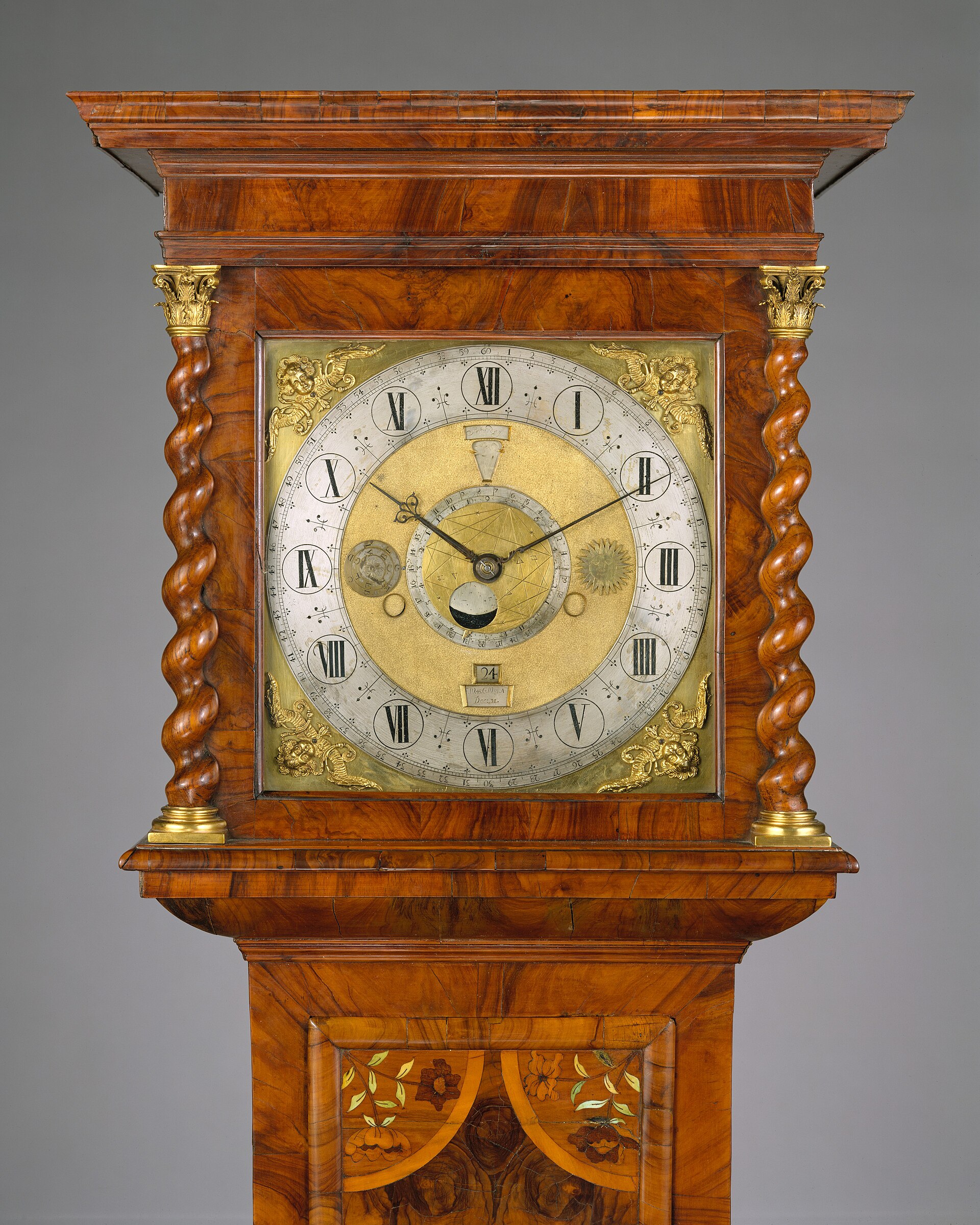
| Dial | Ten-inch dial, gilded brass with a silvered chapter ring; hours in roman numerals, minutes as individual arabic numerals subdivided into ten-second intervals; winged cherub-head spandrels in the four corners.123 |
| Calendar and lunar/tidal complications | Double aperture at 12 o'clock: day of the week paired with its ruling planetary god. Double aperture at 6 o'clock: day of the month, month name and length, and week of the year. Hand-set disk at 9 o'clock: Dominical Letters A-G for calculating Easter, balanced by a decorative sunburst at 3 o'clock. Central revolving disk: lunar aspect, phase, and age (1-29), and tide times (probably for London Bridge).3 |
| Movement (going train) | Eight-day, weight-driven movement; two rectangular brass plates held apart by six latched pillars; going train of three wheels ending in an anchor escapement regulated by a long pendulum; bolt-and-shutter maintaining power. Going train retains its original wheels.3 |
| Movement (striking train) | Four wheels and a fly, controlled by a count wheel mounted on the great wheel; strikes on four bells on two automatically swivelling stands: full hour on a larger, lower bell; half hour, as a repeat of the past hour, on a smaller, higher bell on the same stand; first and third quarters (once and twice) as double blows on a separate pair of smaller bells.3 |
| Signature | Signed on the dial: Tho Tompion Londini Fecit (per the Museum's 1999 and 2015 print publications; the Museum's current website field reads "Tho Thompion Londini Fecit", an apparent transcription variant).134 |
| Serial number | No serial number appears on the movement or case. Tompion's numbering system, used to correspond to workshop ledgers (now lost), is dated by the Museum's 2015 catalogue to about 1682 onward and by its 1999 Bulletin to after 1685; this clock predates either date and was therefore never numbered.34 |
| Recorded alterations | Anchor, back cock, and pendulum crutch are later replacements (dates undocumented). The hood had been modified to slide forward rather than lift; the Museum's conservators restored its original lifting action using the surviving original spring-latch. Veneer on the trunk, plinth, and hood has been replaced both in an earlier undated repair and, more recently, by the Museum's own conservators. The present skirt probably replaces an original; there is insufficient evidence to confirm the originality of the skirt or feet.3 |
| Dating history across Museum publications | 1999 Bulletin: "probably ca. 1675-78". 2015 catalogue: reasoned range "between 1677 and 1682, probably earlier", catalogue heading "ca. 1677-80". Current online record and Open Access API: "ca. 1677-80".234 |
Images
The record in full
Chapter 1What it is
The case stands 77 inches tall, a little over six feet, in oak veneered with walnut and, on the base and trunk door, with oystershell-cut olive wood arranged so the grain reads like the petals of a...
The case stands 77 inches tall, a little over six feet, in oak veneered with walnut and, on the base and trunk door, with oystershell-cut olive wood arranged so the grain reads like the petals of a flower. Five panels of floral marquetry in green-stained bone, ivory, and various other woods run down the trunk door. The rising hood, glazed to let the dial be read from the front, is flanked by Baroque spiral columns with gilded-brass Corinthian capitals and bases, repeated as quarter columns at the back corners, and the hood is finished with a deep profile-moulded wooden cornice. The Metropolitan Museum's own catalogue calls the case "beautifully proportioned" and "an unusually fine product of the late 1670s", and singles it out among Tompion's longcase clocks of the period for its decoration.
The ten-inch dial is gilded brass with a silvered chapter ring of roman numerals for the hours and individual arabic numerals for the minutes, themselves subdivided into ten-second intervals, a degree of precision on the chapter ring that was not routine on domestic clocks of this date. Cherub heads with wings, an early form of a spandrel motif Tompion used throughout his career, fill the four corners. The movement inside is brass and steel: an eight-day, weight-driven going train of three wheels ending in an anchor escapement regulated by a long pendulum, with bolt-and-shutter maintaining power to keep the clock running while it is wound. On its own this would be a good, standard clock for 1677. What makes it unusual is everything the dial is asked to display beyond the time, and the four-bell striking mechanism built to announce it.
Chapter 2The dial: a working almanac
Around the hour chapter, four separate readouts are built into the dial, and none of them is decorative.
Around the hour chapter, four separate readouts are built into the dial, and none of them is decorative. A double aperture at twelve o'clock shows the day of the week paired with the classical planetary god who was held to govern that day, the ordinary learned convention of the period for naming the days: this pairing of weekday and ruling planet, not a private symbol of Tompion's, is simply how an educated Restoration household read a calendar. A second double aperture at six o'clock gives the day of the month, the name of the month with the number of days it runs, and the number of the current week within the year.
At nine o'clock a hand-set disk carries a double ring of the letters A to G, the Dominical Letters. These were the standard tool, inherited from Roman reckoning and still in ordinary ecclesiastical use in the seventeenth century, for calculating the date of Easter and the moveable feast days that follow from it, work that fell to clergy and to anyone keeping a household calendar before printed almanacs made the calculation unnecessary. Its presence on this dial is not evidence of any private or hidden belief on Tompion's part; it is evidence that the clock was built to do a job the Anglican liturgical calendar of its day actually required. A purely decorative gilt sunburst at three o'clock balances the disk visually and does no further work.
The most complex readout is the revolving disk at the centre of the dial, which shows the moon's astrological aspects, its phase, and its age within the lunar month, one to twenty-nine days, together with the time of high tide, one to twelve o'clock and again one to twelve, probably for London Bridge. Both indications had a plain, practical reason to exist in London in the 1670s and neither needs a mystical explanation. Before street lighting, the phase of the moon genuinely determined whether travel after dark was safe or foolish, and the tide at London Bridge was a matter of life and death for the watermen who worked the river: the bridge's narrow arches and closely set stone piers turned the water beneath them into a set of rapids at the wrong state of tide, a hazard Londoners called "shooting the bridge", and drownings there are recorded often enough that the crossing carried its own grim proverb, that London Bridge was built for wise men to cross over and fools to go under. A clock that could tell its owner the state of the tide at a glance was not showing off; it was answering a real question that a Thames-side household asked every day. Taken as a whole, the dial is an ordinary, well-documented civic and ecclesiastical instrument, not a coded one, and saying so plainly is the honest reading of it.
Chapter 3An unusually complicated striking train
Tompion did not stop at the dial. The striking train, driven by four wheels and a fly and controlled by a count wheel mounted on the great wheel inside the plates, rings four bells mounted on two...
Tompion did not stop at the dial. The striking train, driven by four wheels and a fly and controlled by a count wheel mounted on the great wheel inside the plates, rings four bells mounted on two stands rather than the usual one or two. A stand swivels automatically to present the correct bell, which is how two pairs of bells fit inside the relatively small space of the hood. The full hour sounds on a larger, lower-pitched bell; a smaller, higher-pitched bell on the same stand repeats the past hour at the half; and a separate pair of smaller bells, sometimes called ting-tangs, strike the quarters, once at the first quarter and twice at the third, as double blows. The Metropolitan Museum's catalogue calls this "an unusual embellishment" specific to this clock's striking train, and it is the clearest sign in the movement of Tompion working out how to pack extra information into a case no bigger than an ordinary longcase clock needed to be.
Chapter 4The case, and the cabinetmaker who may have built it
Around 1676 Tompion moved his workshop to the corner of Fleet Street and Whitefriars Street, then called Water Lane, a shop that became known as The Dial and Three Crowns.
Around 1676 Tompion moved his workshop to the corner of Fleet Street and Whitefriars Street, then called Water Lane, a shop that became known as The Dial and Three Crowns. Research by the horologist Jeremy L. Evans established that in 1677 Tompion was subletting part of that building to a cabinetmaker, Jasper Braem, a Dutchman active in London from about 1677 to about 1696, whose documented skill lay in marquetry "done with several coloured woods in Resemblance of flowers, leaves etc." On the strength of that tenancy and that specialism, the Metropolitan Museum's catalogue credits Braem with the case of this clock and of some of Tompion's other, more decorative longcase clocks from the same years, while stating the attribution as probable rather than certain: if it is correct, Braem made the case while he was Tompion's own tenant, which would place the cabinetmaker and the clockmaker working under the same roof.
Chapter 5Dating a clock before it had a number
There is no serial number cut into the movement or the case, and its absence is itself evidence rather than an oversight.
There is no serial number cut into the movement or the case, and its absence is itself evidence rather than an oversight. Tompion's business grew large enough that he began keeping ledgers and numbering his clocks and watches to correspond to entries in them, a practice historians treat as one of the first serial-numbering systems applied to any manufactured goods. The Museum's 2015 catalogue of its clock and watch collection, citing Evans's research, places the start of that numbering system at about 1682 and states plainly that this clock predates it. The Museum's own 1999 acquisition Bulletin, written at the time of the bequest, instead placed the start of numbering "sometime after 1685" and dated the clock itself to "probably ca. 1675-78"; by 2015, working from Evans's more developed research and from the 2013 catalogue raisonne of Tompion's output compiled by Evans with Jonathan Carter and Ben Wright, the Museum had revised both figures, reasoning that since Braem is only known to have been Tompion's tenant from 1677, and the clock predates the post-1682 numbering system, it "should be dated, therefore, between 1677 and 1682, probably earlier in that five-year period than later." The clock's own ledgers, which would have settled the question outright, are lost. That two successive scholarly publications by the same institution narrowed the date by revising the same underlying research is the plainest kind of catalogue history: each generation of cataloguing corrected the one before it on documented grounds, not on new speculation.
Chapter 6Thomas Tompion: from a Bedfordshire forge to the Dial and Three Crowns
Thomas Tompion was baptised on 25 July 1639 in Northill, Bedfordshire, the son of the blacksmith Thomas Tompion Sr.
Thomas Tompion was baptised on 25 July 1639 in Northill, Bedfordshire, the son of the blacksmith Thomas Tompion Sr. and his wife Margaret, a fact drawn from the parish register itself rather than from later biography. His first modern biographer, R. W. Symonds, filled in Tompion's early life with an account that Symonds himself admitted was based mostly on legend. Working from the surviving documents rather than the legend, the horologist Jeremy L. Evans has since given what the Metropolitan Museum's catalogue calls "a sober-minded summary" of the real possibilities: Tompion may have trained with Samuel Knibb, whose Newport Pagnell workshop was near the Tompion family forge at Ickwell, or with the London makers Edward East or Ahasuerus I Fromanteel, but no apprenticeship record for him with any of the three has been found, and Evans's own conclusion is that Tompion most likely did not enter the trade through the usual apprenticeship at all.
What is documented is his admission to London's Clockmakers' Company on 4 September 1671, as a Brother, by payment of a fee of thirty shillings, admitting him specifically as a "Great Clockmaker", a maker of turret clocks; full freedom of the Company, with its attached privileges, did not follow until 6 April 1674, by a further ten shillings. Those fees were sizeable, and the Museum's catalogue reads them as evidence that Tompion entered the Company "by redemption" - by payment - rather than by completing a formal apprenticeship, which is consistent with Evans's reading of his early career. By 1671 he was already established in London with, in the Museum's words, "an extensive knowledge of metalworking". Around 1676 he moved his workshop to the corner of Fleet Street and Whitefriars Street, a shop later known as The Dial and Three Crowns, where the clock catalogued here was made within the following few years.
Chapter 7Royal patronage, and Robert Hooke
Tompion worked across four reigns, Charles II, James II, William III and Mary II, and Anne, and his most documented royal commissions date from the William and Mary years: a year-going equation clock...
Tompion worked across four reigns, Charles II, James II, William III and Mary II, and Anne, and his most documented royal commissions date from the William and Mary years: a year-going equation clock made for William III remains today in the British Royal Collections, and a year-going, spring-driven clock extravagantly mounted in silver, known as the Mostyn Tompion, was also made for William III and is now in the British Museum. Its royal commission places it in a different world from the Metropolitan Museum's own longcase clock: the Museum's 2015 catalogue is explicit that its clock "belongs to an earlier, less flamboyant period in the clockmaker's career", made roughly a decade before William and Mary's accession and with no documented royal connection of its own.
The clearest evidence of Tompion's place in the scientific culture of Restoration London, rather than in its court, is his documented association with Robert Hooke, Curator of Experiments to the Royal Society. Hooke's own diary records numerous meetings with Tompion beginning in 1674, in the years the two men worked together on a spiral balance spring for watches, an invention Tompion adopted for the pieces he made, in what amounted to a real, documented rivalry with Christiaan Huygens for priority in the same invention. In the same decade Charles II selected Tompion to build two clocks with thirteen-foot pendulums, finished in 1676, for the newly founded Royal Observatory at Greenwich, precision instruments built to serve the Observatory's own astronomical programme rather than any private household. Both facts place Tompion inside the working circle of the Royal Society's practical science in the 1670s, documented by Hooke's own diary and by the Observatory commission, and neither claim rests on inference from the object catalogued here, which is not itself connected to Hooke or to the Observatory in any source consulted.
Chapter 8George Graham, and the numbering system's afterlife
Tompion took two documented partners late in his career.
Tompion took two documented partners late in his career. In 1701 he went into partnership with Edward Banger, a partnership that lasted until about 1707 or 1708, when it was dissolved in circumstances no source consulted explains clearly. His second and better-documented partner was George Graham, who began working for Tompion around 1696 while still nominally apprenticed to the clockmaker Henry Aske. In 1704 Graham married Tompion's niece, Elizabeth; in 1711 he became Tompion's partner outright; and in 1713, on Tompion's death, he succeeded him at the Dial and Three Crowns, at what by then was numbered 67 Fleet Street. In 1721 Graham became one of the small number of working clockmakers elected a Fellow of the Royal Society, an honour that reflects his own later reputation as an inventor, and he continued Tompion's numbering system for the clocks and watches that came out of the workshop after him.
Chapter 9Buried in Westminster Abbey
Thomas Tompion died on 20 November 1713 and was buried in Westminster Abbey; George Graham was buried alongside him in 1751.
Thomas Tompion died on 20 November 1713 and was buried in Westminster Abbey; George Graham was buried alongside him in 1751. The epithet by which Tompion is still known, "the Father of English Clockmaking", is repeated across the modern horological and popular literature consulted for this record, though no source consulted traces the phrase to a single original coiner. It reflects a settled scholarly consensus rather than a single person's judgement. As the horologist Fortunat Mueller-Maerki put it, reviewing the standard modern catalogue of Tompion's work, "most horological historians of England would agree that the most celebrated craftsman making timekeepers in England during their golden era of clock production is the London based craftsman Thomas Tompion."
Chapter 10From a Cornhill exhibition to a Fifth Avenue gallery
Nothing documents this clock's ownership for roughly two and a half centuries after it was made.
Nothing documents this clock's ownership for roughly two and a half centuries after it was made. It resurfaces in 1933, when it belonged to Francis Herbert Green, a liveryman of the Clockmakers' Company, who showed it as number three in a loan exhibition of Tompion clocks at his own premises, 13 Royal Exchange, Cornhill, London, reported at the time in the Illustrated London News. Green died in 1936; before that, on 8 February 1934, he had already sold the clock to the New York antiques dealer Arthur S. Vernay, a transaction documented by a bill of sale whose photocopy is held in the Metropolitan Museum's own files, a copy the Museum's catalogue thanks the dealer Chris Jussel for providing along with the 1933 exhibition clipping. Vernay in turn sold the clock in 1934 to Henry Graves Jr., a member of a prominent New York banking family. It remained in the Graves family until Henry Graves Jr.'s death in 1953, then passed by descent to his granddaughter, Marilyn Preston Graves, who bequeathed it to the Metropolitan Museum of Art in 1999. At no point in this chain, so far as the sources consulted record, was the clock sold at public auction; every transfer was a private sale between a dealer and a collector, or a bequest.
Chapter 11The banker who also owned the most complicated watch ever made
Henry Graves Jr. (1868-1953) was a New York banker from a family of bankers, and his name is far better known today for a single commission than for this clock.
Henry Graves Jr. (1868-1953) was a New York banker from a family of bankers, and his name is far better known today for a single commission than for this clock. In 1925 he commissioned the Geneva firm of Patek Philippe to build the most complicated watch it could make, in open competition with the automobile manufacturer James Ward Packard, who was pursuing the same title; the resulting watch, completed in 1933 with twenty-four separate complications, stood as the most complicated mechanical watch ever made for fifty-six years. The Metropolitan Museum's own catalogue of its clock and watch collection draws the connection explicitly: discussing the Graves family's ownership of the Tompion clock, it states that "Graves had several other remarkable horological items in his collection, notably a chronograph watch by the Geneva firm of Patek Philippe, said to be the most complicated mechanical watch ever made", citing a 1999 Sotheby's sale catalogue and a 2014 article on the watch published by the National Association of Watch and Clock Collectors. The description matches no other watch of the period; it is, on the Museum's own account, the same Henry Graves Jr. and, in substance, the same collecting instinct that bought both an astronomically complicated Restoration longcase clock and, two and a half centuries later, the most complicated pocket watch of the twentieth century.
Chapter 12What has been repaired
The Metropolitan Museum's catalogue is candid about the clock's repair history, and none of it is hidden or disputed; it is simply recorded.
The Metropolitan Museum's catalogue is candid about the clock's repair history, and none of it is hidden or disputed; it is simply recorded. The going train keeps its original wheels, but the anchor now on the movement replaces an earlier one of a somewhat different shape, and the back cock and crutch that support the pendulum have also been replaced; no source consulted dates any of these three replacements. When the clock entered the Museum's collection, the hood had at some point been modified so that it could slide forward rather than lift in its original manner; because the original spring-latch for securing the hood in its open position was still in place underneath the modification, the Museum's own conservators were able to return the hood mechanism to its original operation. Some veneer on the trunk and plinth had been replaced in an earlier, undated period of repair, and further veneer, missing from the hood and trunk, was replaced by the Museum's own wood conservators after acquisition. The present skirt at the base of the case probably replaces an original one, but the Museum's catalogue states plainly that there is insufficient evidence to be certain whether the current skirt and feet are original, later period replacements, or modern. None of this is presented by the Museum as a marriage of parts from different objects, and no source consulted disputes that the movement and case belong together as made; it is a documented history of ordinary wear, repair, and conservation on a clock now approaching three hundred and fifty years old.
Chapter 13Not the Mostyn Tompion
Two different Tompion clocks are sometimes confused in casual reference precisely because both carry a collector's surname and both have well-documented royal or American connections.
Two different Tompion clocks are sometimes confused in casual reference precisely because both carry a collector's surname and both have well-documented royal or American connections. This record describes only the Graves Tompion: a weight-driven longcase clock in an oak, walnut, and marquetry case, made about 1677-80 with no documented royal commission, bought by an American collector from a New York dealer in 1934, and bequeathed to the Metropolitan Museum of Art in New York in 1999, accession number 1999.48.2.
It is not the Mostyn Tompion, a year-going, spring-driven clock extravagantly mounted in silver that Tompion made for William III, sold at the 1982 dispersal of the Mostyn family collection and now in the British Museum, London, registration number 1982,0702.1. The two clocks share a maker and a period, and nothing else: different mechanism (weight versus spring drive), different material emphasis (oak and marquetry versus silver mounting), different original patron (none documented, versus a king), different modern collection (New York versus London), and different modern provenance (an American banking family versus a Welsh landed family's 1982 sale). No image, fact, or source cited in this record concerns the Mostyn Tompion; it is named here only to prevent the two objects being mistaken for one another.
Chapter 14On view now
The clock is on permanent display at The Met Fifth Avenue, in Gallery 509, alongside other English clocks and watches of the same period, including two other pieces signed by Tompion.
The clock is on permanent display at The Met Fifth Avenue, in Gallery 509, alongside other English clocks and watches of the same period, including two other pieces signed by Tompion. The Museum holds the image rights as public domain and has released photographs of the clock, taken under its own Open Access programme, under a CC0 dedication, which is why this record is able to reproduce them in full. As of the date this record was last verified, the Museum's own online catalogue record, its 2015 print catalogue, and its 1999 acquisition Bulletin remain the three primary sources for everything stated here; no further scholarship specific to this individual clock, beyond its entry in the 2013 catalogue raisonne of Tompion's output, was located.
The artist
Thomas Tompion
Thomas Tompion made no autobiography and left no workshop diary; almost everything known about him beyond his surviving clocks and watches comes from parish, guild, and court records assembled by later horologists, and from the account books and diaries of the people who dealt with him. His first substantial biographer, R. W. Symonds, filled the gaps in that record with legend; the modern, document-based account is the work of the horologist Jeremy L. Evans, whose research underlies most of what the Metropolitan Museum states about Tompion's early life today. He is remembered, without real dispute, as the outstanding English clockmaker of his generation.
Related works
| Work | Relation | Where it is |
|---|---|---|
| The Mostyn Tompion (year-going spring clock made for William III) Thomas Tompion | Same maker; frequently confused with this clock but a different object in every other respect Spring-driven, silver-mounted, made for William III; sold at the 1982 Mostyn family sale. Not weight-driven, not American-collected, and not the clock described in this record. | British Museum, London (registration 1982,0702.1) |
| Year-going equation clock made for William III Thomas Tompion | Same maker; a documented royal commission from later in Tompion's career Cited by the Metropolitan Museum's own catalogue as one of Tompion's commissions from William III, alongside the Mostyn Tompion. | British Royal Collections |
| Longcase clock with calendar Joseph Knibb | Contemporary comparandum; another calendar-complication longcase clock of the same approximate date, shown in the same Metropolitan Museum gallery ca. 1680-85. Listed by the Museum itself among works "in the same gallery" and "in the same medium" as the Graves Tompion. | Metropolitan Museum of Art, New York |
| Traveling clock watch with alarm Thomas Tompion (watchmaker), case and dial by Nathaniel Delander I | Same maker, same collection ca. 1680. One of two other Tompion pieces the Museum itself cross-references from the Graves Tompion's own object page. | Metropolitan Museum of Art, New York |
| Pair-case watch Thomas Tompion (watchmaker), case by Nathaniel Delander I | Same maker, same collection 1682-83, close in date to the Graves Tompion and also cross-referenced from its object page. | Metropolitan Museum of Art, New York |
| Small olivewood marquetry longcase clock, pre-numbered, ca. 1680, case attributed to Jasper Braem Thomas Tompion | Closest known market comparandum: same maker, same approximate date, same case-maker attribution, same pre-numbering period Sold for USD 162,500 including premium. This is a different, smaller clock, offered at public auction; the Graves Tompion itself has never been sold at public auction and this sale is cited only as market context, not as a prior sale of the Museum's clock. | Sold at Bonhams, New York, 6 June 2018, lot 62 |
Open questions
- Where was the clock, and in whose hands, between its making (about 1677-82) and its first documented appearance in 1933 in Francis Herbert Green's collection? No source consulted names an owner across that roughly two-and-a-half-century gap.
- Is the attribution of the case to Jasper Braem correct? The Metropolitan Museum's own catalogue states it as probable, resting on Braem's tenancy in Tompion's workshop and his documented marquetry skill, not on a maker's mark inside the case.
- When were the anchor, back cock, and pendulum crutch replaced, and by whom? The Museum's catalogue records the replacements but gives no date for any of them.
- When, and why, was the hood modified to slide forward rather than lift, a modification the Museum's own conservators later reversed? No source consulted dates this alteration.
- Are the present skirt and feet original, later period replacements, or modern? The Museum's own catalogue states there is insufficient evidence to decide.
- Exactly where in the 1677-1682 window was the clock made? The Museum's 2015 catalogue narrows the range but stops short of a single year, reasoning only that it was probably made earlier in that span than later.
- What are Marilyn Preston Graves's own dates, and what was the precise line of descent from Henry Graves Jr. to her? The Museum's own provenance note states only that the clock "descended through his family" and does not name intermediate owners.
Questions about this object
What is Longcase clock with calendrical, lunar, and tidal indications, also known as the Graves Tompion?
Longcase clock with calendrical, lunar, and tidal indications, also known as the Graves Tompion is a clocks and instruments, dated ca. 1677-80. Medium: Case: oak veneered with walnut, panels of oystershell-cut olive wood; marquetry panels of green-stained bone, ivory, and various woods; mounts of gilded brass. Dial: gilded and silvered brass. Movement: brass and steel.
Who made Longcase clock with calendrical, lunar, and tidal indications, also known as the Graves Tompion, and is the attribution settled?
The attribution to Thomas Tompion is recorded here as accepted. The movement and dial are signed and universally accepted as the work of Thomas Tompion's Fleet Street workshop; no source consulted disputes his authorship. The case is only attributed, not signed: the Metropolitan Museum's own catalogue credits it to the cabinetmaker Jasper Braem on the strength of Braem's documented tenancy in part of Tompion's premises from 1677 and his known specialism in marquetry, not on a maker's mark, and its own authors qualify the attribution as probable rather than certain ('if the attribution of the case to Jasper Braem is correct'). The going train keeps its original wheels; the anchor, back cock, and crutch are later replacements, and some case veneer has been renewed. None of this is treated by the Museum as affecting the attribution to Tompion, only the object's later repair history.
Where is Longcase clock with calendrical, lunar, and tidal indications, also known as the Graves Tompion now?
Metropolitan Museum of Art, New York. Inventory number 1999.48.2. Last confirmed 14 August 2026. On view at The Met Fifth Avenue, Gallery 509, per the Museum's own object page and Open Access API record (object ID 209296). Credit line: Bequest of Marilyn Preston Graves, 1999.
What is still unknown about Longcase clock with calendrical, lunar, and tidal indications, also known as the Graves Tompion?
Where was the clock, and in whose hands, between its making (about 1677-82) and its first documented appearance in 1933 in Francis Herbert Green's collection? No source consulted names an owner across that roughly two-and-a-half-century gap.
Sources
- 1Metropolitan Museum of Art, collection object page, "Longcase clock with calendrical, lunar, and tidal indications, also known as the Graves Tompion", object 209296, accession 1999.48.2, including its Overview, Signatures/Inscriptions/Markings, and Provenance panels. metmuseum.org/art/...
- 2Metropolitan Museum of Art, Open Access Collection API, object record 209296. collectionapi.metmuseum.org/public/...
- 3Clare Vincent and Jan Hendrik Leopold, with Elizabeth Sullivan, European Clocks and Watches in The Metropolitan Museum of Art (New York: The Metropolitan Museum of Art, 2015), entry 22, "Longcase Clock with Calendar (The Graves Tompion)", pp. 108-111. metmuseum.org/met-publications/...
- 4"Recent Acquisitions, A Selection: 1998-1999", The Metropolitan Museum of Art Bulletin, v. 57, no. 2 (Fall 1999), pp. 31-32. metmuseum.org/met-publications/...
- 5Wikimedia Commons, File:Longcase clock with calendrical, lunar, and tidal indications (The Graves Tompion) MET DT4371.jpg, (LicenseShortName: CC0). commons.wikimedia.org/wiki/...
- 6Wikimedia Commons, File:Longcase clock with calendrical, lunar, and tidal indications (The Graves Tompion) MET DT4372.jpg, (LicenseShortName: CC0). commons.wikimedia.org/wiki/...
- 7Wikipedia, "Thomas Tompion". en.wikipedia.org/wiki/...
- 8Wikipedia, "Henry Graves (banker)". en.wikipedia.org/wiki/...
- 9Bonhams, "A Small Olivewood Marquetry Longcase Clock, Thomas Tompion, London, pre-numbered, circa 1680, the case attributed to Jasper Braem", sale of 6 June 2018, New York, lot 62, sold for USD 162,500 including premium. bonhams.com/auction/...
- 10Wikipedia, "Old London Bridge", for the documented danger of "shooting the bridge" and the tidal rapids created by the bridge's piers. en.wikipedia.org/wiki/...
- 11Fortunat Mueller-Maerki, review of Jeremy Evans, Jonathan Carter and Ben Wright, Thomas Tompion - 300 Years: A Celebration of the Life and Work of Thomas Tompion (Stroud, Gloucestershire: Water Lane Publishing, 2013), NAWCC Forums, 21 March 2014. mb.nawcc.org/threads/...
- 12Wikidata, Q116307170, "Longcase clock with calendrical, lunar, and tidal indications". wikidata.org/wiki/...
_MET_DT4371.jpg)
_MET_DT4372.jpg)
Last verified · Published
Change log
14 August 2026 - Record created at the house standard: researched narrative, technical evidence, maker dossier, graded provenance chain, prices with hammer and premium separated, related works, open questions and sources.