Piero della Francesca
Italian (Tuscan) · c. 1415-1492
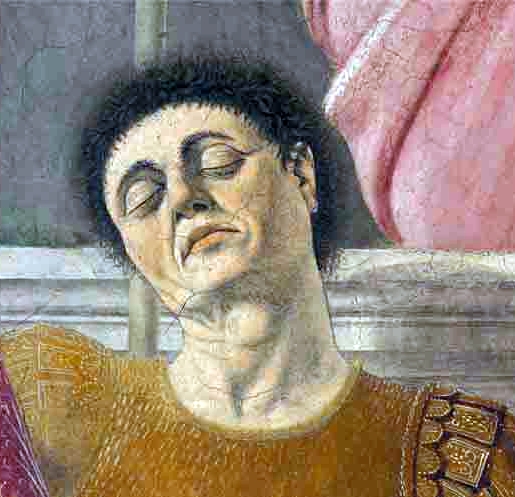
A detail of the sleeping soldier in brown armour at the right of Christ in Piero's Resurrection, Sansepolcro. It is the traditional self-portrait, resting on the tradition and on a comparison with Vasari's woodcut portrait; there is no inscription, label or contemporary document naming Piero, so the identification is traditional and not secure. The Commons file is a small crop (515 x 497).
Museo Civico, Sansepolcro (detail of the Resurrection fresco)| Full name | Piero di Benedetto de' Franceschi |
|---|---|
| Worked as | Painter, Fresco painter, Mathematician, Geometer |
| Born | between about 1407 and 1420 (year disputed · Borgo San Sepolcro (modern Sansepolcro), Tuscany |
| Died | 12 October 1492 · Borgo San Sepolcro (modern Sansepolcro), Tuscany |
| Nationality | Italian (Tuscan) |
| Movement | Early Renaissance |
| Sources | 38 cited |
| Last verified |
About this page Last verified · 38 sources cited
On this page 13 sections
ContentsClose
Piero della Francesca was a painter of Borgo San Sepolcro (modern Sansepolcro, in the upper Tiber valley) who also wrote three treatises on mathematics and perspective. His name is a matronymic that stuck: documents of his own lifetime call him Piero or Pietro di Benedetto, and the "della Francesca" belongs to the way later writers, starting with Vasari, told his story. What he left is small and uneven in survival. The Arezzo fresco cycle, the Resurrection in his home town and the Montefeltro altarpiece in Milan are intact in their places. Much of the rest was lost in Rome, Ferrara and Urbino, split up (the Sant'Agostino altarpiece survives in at least eight pieces held in several cities) or cut out of walls.
The standard biography is thinner than it looks. His birth year is given as anything from about 1407 to 1420 by institutions that all still publish him today, and Vasari's statement that his father died before he was born is contradicted by notarial records in which the father collects payment for the boy's work in the 1430s. The painting that gets called Piero's earliest in London is dated by the National Gallery to 1437-45, a decade or more earlier than the older books say.
The single most useful thing to know before reading further is that almost every popular story about him has a documented version that is stranger and a retold version that is tidier: the Madonna del Parto was cut out of its wall around 1785 and detached again in 1911; the Resurrection fresco has now been shown by its restorers to have been moved from somewhere else; and the blindness of his old age rests on a sixteenth-century tradition that his own will, as Britannica reads it, does not support. This page keeps the documented and the retold apart.
Images
Chronology
- c. 1407-1420
Birth in Borgo San Sepolcro; no baptismal record is cited and sources give years from 1406 to 1422, with 1411/13, 1412, c. 1415 and June 1420 each argued.116282925
- 1430
The painter Antonio d'Anghiari is paid for his first Sansepolcro commission; Piero's father Benedetto witnesses the payment.11
- 1432
On 29 December a notarial document names Pietro, painter, son of Benedetto, as owed wages by Antonio d'Anghiari; the father is alive and collecting.11
- 1438
On 8 January a document signed by Benedetto closes Piero's association with Antonio d'Anghiari.11
- 1439
Piero is linked to payments for Domenico Veneziano's frescoes in Sant'Egidio, Florence (lost).1
- 1442
Elected to the Sansepolcro city council.29
- 1445
Contract for the Misericordia altarpiece for the confraternity in Sansepolcro, his first major independent commission.19
- c. 1447-49
Works for the Este in Ferrara (frescoes lost).1
- 1451
Signed and dated fresco of Sigismondo Malatesta in the Tempio Malatestiano, Rimini.1
- 1452
Called to Arezzo to replace Bicci di Lorenzo on the San Francesco frescoes, finished by 1464 (Wikipedia) or 1466 (Cambridge).291
- 1454
On 4 October contract with Angelo di Giovanni di Simone d'Angelo for the Sant'Agostino altarpiece, eight years to complete.8
- 1458-59
Works in Rome in the Vatican Palace and Santa Maria Maggiore (the Vatican work was destroyed).1
- 1469
First record of Piero in Urbino, called to estimate a painting's value; the Sant'Agostino altarpiece is apparently complete.13
- 1480
Becomes prior of the Confraternita di San Bartolomeo in Sansepolcro.1211
- 1486/87
Will drawn up; Britannica says 1486, Wikipedia and MacTutor say 1487.122911
- 1492
- 1550
Vasari mentions the Sant'Agostino high altarpiece; the Life of Piero in the translation read carries the accusation against Pacioli and the blindness tradition (the date of that text is not stated on the page).310
- 1785
The church at Monterchi is partly demolished for a cemetery and the Madonna del Parto fresco cut out and reset.1918
- 1861
The National Gallery buys the Baptism of Christ at the Uzielli sale, London, 13 April.2
- 1867
The National Gallery buys Saint Michael from Lady Eastlake at the price her husband paid.3
- 1874
The National Gallery buys the Nativity at the Barker sale, 6 June.4
- 1889
On 8 January Vincenzo Funghini recognises the Madonna del Parto as Piero's.18
- 1903-06
Isabella Stewart Gardner acquires the Hercules fresco through Volpi and Joseph Lindon Smith; the Gardner dates the sale to 1903 in one account and the end of 1906 in another.1314
- 1908
The Hercules is imported undeclared by Emily Chadbourne and seized by US customs; Gardner pays a fine.1314
- 1911
The Madonna del Parto is detached from its wall by Domenico Fiscali.1819
- 1927
Roberto Longhi's monograph on Piero.25
- 1936
The Frick buys Saint John the Evangelist from Knoedler for USD 400,000.58
- 1941
Millard Meiss publishes the reconstruction of the Sant'Agostino altarpiece; Longhi independently reaches largely the same result (published 1946).8
- 1944
British officer Anthony Clarke holds fire on Sansepolcro (the sources read give no month); on 14 January the Misericordia polyptych is driven to Florence through an air raid (blog source).222324
- 1951
Kenneth Clark's monograph; his verdict on the Flagellation, 'the greatest small painting in the world'.2521
- 1975
On the night of 5 February the Flagellation and Senigallia Madonna are stolen from Urbino; recovered in Locarno on 23 March 1976.20
- 1990
Franco Polcri finds the 1825 list showing part of the Sant'Agostino altarpiece still in Santa Chiara.8
- 1991-2000
Restoration of the Arezzo cycle.16
- 1992-93
Madonna del Parto restored and moved to a one-work museum at Monterchi.18
- 2013
Frick exhibition shows seven works, six of them from the Sant'Agostino altarpiece.6
- 2018
Opificio delle Pietre Dure restoration of the Resurrection reported; the fresco is shown to have been moved.15
- 2022
Conservation of the National Gallery Nativity completed.4
- 2024
Maintenance of the Arezzo frescoes, January to March; chapel reopens 28 March.17
- 2026
July diagnostics on the Flagellation and Senigallia Madonna; October announcement of the 2027-28 National Gallery exhibition.2726
The market
No autograph painting by Piero has been found at public auction in modern times in any source read, and the only fixed prices that survive are two private sales a century apart. Isabella Stewart Gardner paid 200,000 lire for the Hercules fresco in 1906 through the dealer Elia Volpi, which the Gardner Museum converts to about USD 864,000 in today's money without stating its method. The Frick Collection bought Saint John the Evangelist from Knoedler in 1936 for USD 400,000, which Walter Kaiser called a record at the time, and the picture was found in Vienna in the collection of the von Miller zu Aicholz family. The three National Gallery pictures were bought at an 1861 sale, an 1867 private purchase and an 1874 sale in London, and the price was not given in the sources read. Search snippets from auction-tracking sites, which were not opened, suggest only minor 'circle of' and follower lots. Any picture offered under his name would need examination by the curators who catalogue him before it could be taken seriously.
Recorded without a public price
- 13 April 1861 · The Baptism of Christ (lot 184), sold to the National Gallery · Uzielli sale, London (auctioneer not named in the sources read) · not given in the sources read Bought by Sir J. C. Robinson in 1859 from the bishop and chapter of Sansepolcro for Matthew Uzielli, lent to South Kensington 1860-61, then bought for the National Gallery at the Uzielli sale. The 1859 price is not given.
- 1867 · Saint Michael (Sant'Agostino altarpiece) · Private purchase from Lady Eastlake · private sale, no hammer The Gallery bought it from Lady Eastlake at the price Sir Charles Eastlake had paid; the sum is not given in the extract read. The panel was first surely recorded as a single panel at Fidanza's in Milan in 1861.
- 6 June 1874 · The Nativity (lot 70), sold to the National Gallery · Alexander Barker sale, London (auctioneer not named in the sources read) · not given in the sources read Charles Eastlake had seen the picture in Florence in 1861 and would have bought it himself, the Gallery says, if Barker had not forestalled him.
- 1906 · Hercules (detached fresco), Isabella Stewart Gardner · Private sale via Elia Volpi, Florence, with Joseph Lindon Smith · private sale, no hammer 200,000 lire. The museum gives 'about USD 864,000 today' with no stated method (DERIVED figure, not checked). One museum essay says 1903 for the sale and another 1906; the later account says the purchase finalised at the end of 1906.
- 1936 · Saint John the Evangelist (Sant'Agostino altarpiece), The Frick Collection · Knoedler and Co., New York (private sale) · private sale, no hammer USD 400,000, a record at the time in Kaiser's phrase. The Frick provenance runs through the von Miller zu Aicholz family of Vienna, possibly Frederick Mont, and Knoedler 1935-36, which had found the picture in Vienna.
Where to see the work
| Institution | City | Holdings | Note |
|---|---|---|---|
| Basilica of San Francesco (Bacci Chapel) | Arezzo | The Legend of the True Cross fresco cycle | Maintenance in early 2024; chapel reopened 28 March 2024. |
| Museo Civico | Sansepolcro | Resurrection fresco; Misericordia polyptych; Saint Louis of Toulouse fresco | The Resurrection was restored by the Opificio delle Pietre Dure and reported in 2018. |
| Museo della Madonna del Parto | Monterchi | Madonna del Parto, detached fresco | A one-work museum in a former school since 1993. |
| Galleria Nazionale delle Marche, Palazzo Ducale | Urbino | The Flagellation; the Madonna of Senigallia | Both were stolen in 1975 and recovered in 1976. |
| Pinacoteca di Brera | Milan | Montefeltro Altarpiece (Brera Madonna) | Cut down at the bottom, and possibly at the sides. |
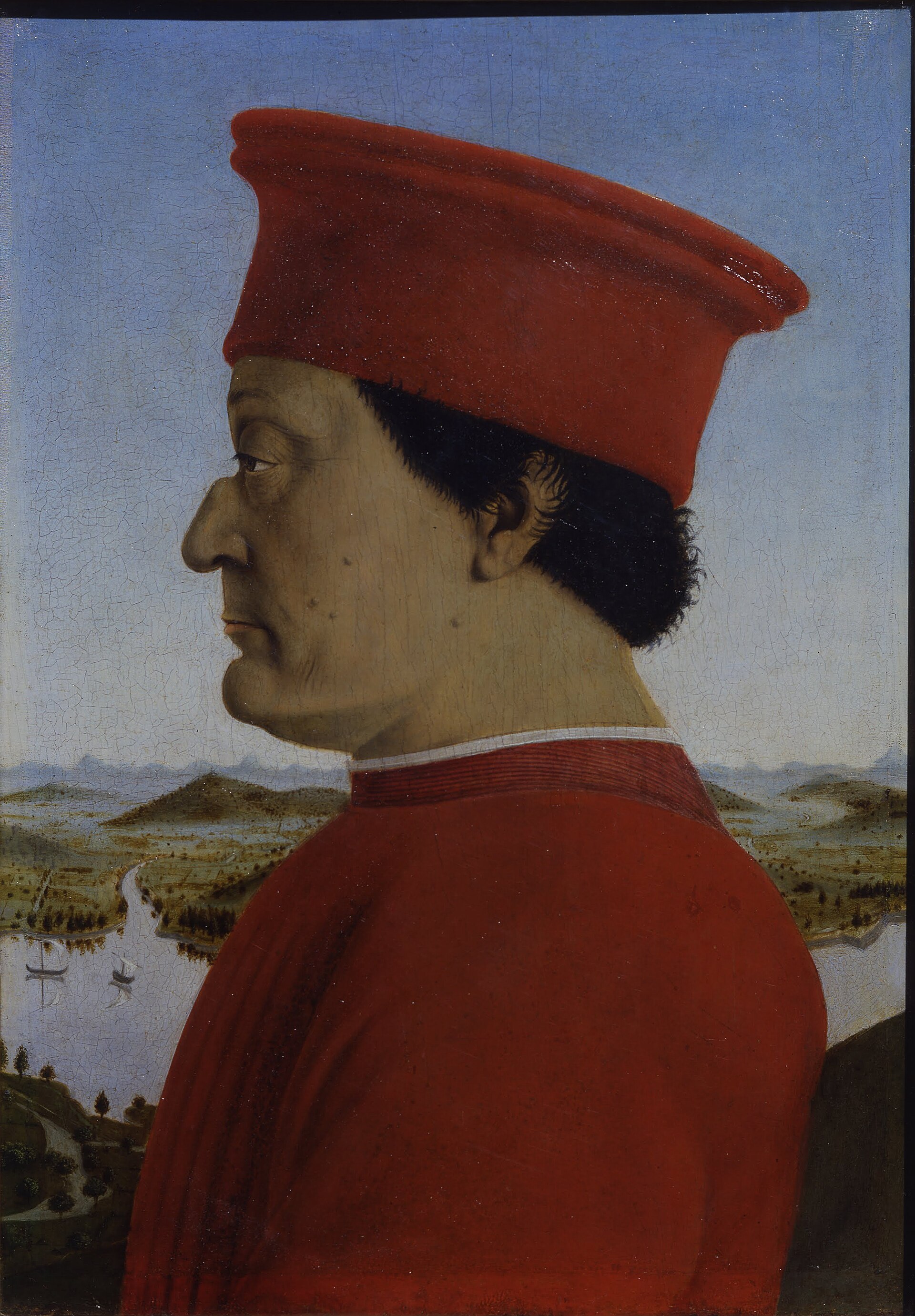
| Gallerie degli Uffizi | Florence | Diptych of Federico da Montefeltro and Battista Sforza | Lent to the National Gallery for 2027-28. |
| National Gallery | London | The Baptism of Christ; Saint Michael; The Nativity | Host of the 2027-28 monographic exhibition. |
| The Frick Collection | New York | Saint John the Evangelist and three small panels from the Sant'Agostino altarpiece | Four of the seven Pieros in American collections. |
| Sterling and Francine Clark Art Institute | Williamstown, Massachusetts | Virgin and Child Enthroned with Four Angels | Described by the Frick as Piero's only intact altarpiece in the US. |
| Isabella Stewart Gardner Museum | Boston | Hercules, detached fresco | The first Piero to reach America. |
| National Gallery of Art | Washington | Saint Apollonia, tempera on poplar, Kress Collection 1952.5.19 | Listed by the Gallery as c. 1455/1460. |
| Museu Nacional de Arte Antiga | Lisbon | Saint Augustine (Sant'Agostino altarpiece) | Made its American debut at the Frick in 2013. |
| Museo Poldi Pezzoli | Milan | Saint Nicholas of Tolentino (Sant'Agostino altarpiece) | |
| Galleria Nazionale dell'Umbria | Perugia | Polyptych of Saint Anthony | Lent to London for 2027-28. |
| Tempio Malatestiano | Rimini | Fresco of Sigismondo Malatesta before Saint Sigismund | Signed and dated 1451. |
| Biblioteca Palatina (Parma) and Biblioteca Riccardiana (Florence) | Parma and Florence | The principal manuscript of De prospectiva pingendi (Parma); the Archimedes manuscript copied by Piero (Florence) | Whether Piero drew the diagrams in the Parma manuscript is disputed. |
Forgeries and misattributions
- A false Mantegna signature on Saint Michael
- When the Saint Michael panel of the Sant'Agostino altarpiece is first surely recorded as a single panel, at Fidanza's in Milan in 1861, it carried a false signature of Mantegna. The panel was bought by Sir Charles Eastlake and sold to the National Gallery in 1867 as Piero's. The extract read says only that the signature was false and that D. S. Robertson wrote an article on the inscription; how it was exposed is not stated. This is a false attribution applied to a genuine work and not a forgery of a Piero.3
- The Louvre Portrait of Sigismondo Pandolfo Malatesta
- Attributed to Piero, c. 1451. Wikipedia says that some Italian critics thought it a neoclassical fake because of its close resemblance to the Tempio Malatestiano fresco, that an Italian ministerial commission declined to buy it in 1969 as part of the Contini-Bonacossi bequest, and that French scholars have accepted it. No technical examination is reported in the source read; the doubt is stylistic and from resemblance. Wikipedia flags the article itself as needing more citations, and the 1969 refusal and the 'neoclassical fake' remark are not corroborated by any other source read, so this is recorded as a contested attribution, not a proven forgery. The Louvre record (a state purchase of 1978) lists Piero as author, with an older attribution recorded as 'd'apres (Battisti)'.3038
- No documented forger of Piero
- No forger, workshop or scandal specific to Piero's paintings was found in any source read. Not applicable; if a specialist knows of one the record should add it.25
The essay
Chapter 1The birth year is a spread of a dozen years, and the father was not dead
No baptismal record for Piero has been found.
No baptismal record for Piero has been found. The sources a reader is likely to meet disagree by a decade or more. The National Gallery in London announced its 2027 exhibition with a life of about 1407/11 to 1492. The Frick Collection gives 1411/13. A Finestre sull'Arte article gives 1412, the year the archival historian James Banker has argued for. English Wikipedia says c. 1415, the Cambridge Companion says ca. 1415/20, and the National Gallery of Art in Washington says c. 1416/1417. The MacTutor biography, which follows James Beck, argues for June 1420 and notes that sources range from 1406 to 1422. None of these has been shown to be wrong and none has a document behind it that settles the matter, so this page records the spread and does not pick.
Vasari opens his Life with the statement that Piero was named for his mother because his father was dead before he was born, and that she brought him up. Banker's archive work, as summarised by MacTutor, points the other way. A notarial document of 29 December 1432 records that the painter Antonio di Giovanni of Anghiari owed Benedetto di Piero di Benedetto fifty-six florins for the wages of "Pietro, painter, son of said Benedetto". The same biography has Benedetto witnessing a payment to Antonio d'Anghiari on 27 May 1430, receiving payments for Piero's work as an assistant in 1431, 1435, 1436 and 1437, and signing a release on 8 January 1438 that closes the association with Antonio. On those documents the father was alive and managing his son's earnings through the 1430s. MacTutor is a tertiary source here and the primary documents are in Banker's publications, which were not read; the claim is graded as documented but second-hand.
The family was prosperous. MacTutor describes Benedetto as a leather and wool merchant who owned land, vineyards and a family house, and Sauerlander calls him a shoemaker, which is a sharper word for the same trade. The Cambridge Companion says the family belonged to the affluent merchant class and that Piero was educated for commerce, with an abacus school. That training is the practical root of everything mathematical that follows.
Chapter 2Training: a local painter, a Florentine summer, and a first commission from neighbours
Piero's apprenticeship is documented only in fragments.
Piero's apprenticeship is documented only in fragments. The Cambridge Companion reports archival records showing him assisting the Sansepolcro painter Antonio d'Anghiari on panels and cloth banners from 1432 to 1438. In 1439 he was hired to paint frescoes in the hospital church of Sant'Egidio in Florence, and his name is tied to payments made for Domenico Veneziano's Birth of the Virgin there; those frescoes are lost. By 1445 he was back in Sansepolcro and signed the contract for the altarpiece of the Confraternity of the Misericordia, which the Companion calls his first major independent commission. The donors were the Pichi family, local nobles, and Piero would later write his Trattato d'abaco for them.
This chain is why Piero is less a court artist than a citizen. He sat on the Sansepolcro city council from 1442 according to Wikipedia (MacTutor has him listed as a council member by June 1441), became prior of the Confraternita di San Bartolomeo in 1480 according to Britannica and MacTutor, and kept a family house in the town that he decorated himself. The Misericordia polyptych, completed in the early 1460s according to Wikipedia, was left unfinished for a time, and the Cambridge Companion says it was left incomplete for "undetermined reasons" while he worked in the north. His patrons in those years were the Este in Ferrara around 1447-49, and Sigismondo Malatesta in Rimini, where a signed and dated fresco of 1451 survives in the Tempio Malatestiano. Vasari's emphasis on the Montefeltro as early patrons is not supported by the record: the Cambridge Companion says Piero is not recorded in Urbino until 1469, and that it is not known how he came to the Duke's notice.
Chapter 3The Sant'Agostino altarpiece: eight pieces, five cities, and a missing centre
In October 1454 Piero contracted with Angelo di Giovanni di Simone d'Angelo to paint a polyptych for the high altar of the Augustinian church in Sansepolcro.
In October 1454 Piero contracted with Angelo di Giovanni di Simone d'Angelo to paint a polyptych for the high altar of the Augustinian church in Sansepolcro. According to Kaiser's review of the Frick catalogue, the contract called for several panels, to be finished in eight years, and recorded that Angelo was fulfilling the wishes of his late brother Simone and Simone's wife. Piero, who was also working at Arezzo and for the pope, took until about 1469 or 1470; the National Gallery gives 1469 as the year it was apparently completed. Kaiser notes that most scholars date the altarpiece to 1460-1470 on stylistic grounds, a decade that covers the working life of the commission and the dispute over where it sits in his development.
The pieces were scattered in two stages, and the second shows how bad provenance can look. The church passed to the Clarissan nuns in 1555 and was remodelled. For years art historians assumed the altarpiece was broken up then. In 1990 the Sansepolcro archivist Franco Polcri found an 1825 list of the town's paintings which still records, under the organ of Santa Chiara, a Virgin with a child, Saint Augustine and Saint Nicholas, so at least some panels stayed in place into the nineteenth century (Kaiser). On that document Kaiser argues the missing centre was a Madonna and Child and not a Coronation of the Virgin, and notes that the Frick catalogue still says "either". The Frick's own curator note repeats the open version, "more likely" a Coronation, so the two positions stand against each other in print and this page does not settle them.
The reassembly is twentieth-century scholarship. Millard Meiss published the reconstruction in 1941; Roberto Longhi independently reached largely the same conclusions, published after the war in 1946 (Kaiser). Kenneth Clark then found the Saint Augustine panel in Lisbon, according to Kaiser. The panels today are Saint Augustine (Museu Nacional de Arte Antiga, Lisbon), Saint Michael (National Gallery, London), Saint John the Evangelist (The Frick Collection) and Saint Nicholas of Tolentino (Museo Poldi Pezzoli, Milan), with small panels in the Frick and, by the Washington gallery's own listing, a Saint Apollonia in the National Gallery of Art. The Frick showed six of the panels together in 2013, the largest number reunited, with Augustine making its American debut.
Chapter 4The Baptism: a date problem that moved by ten years
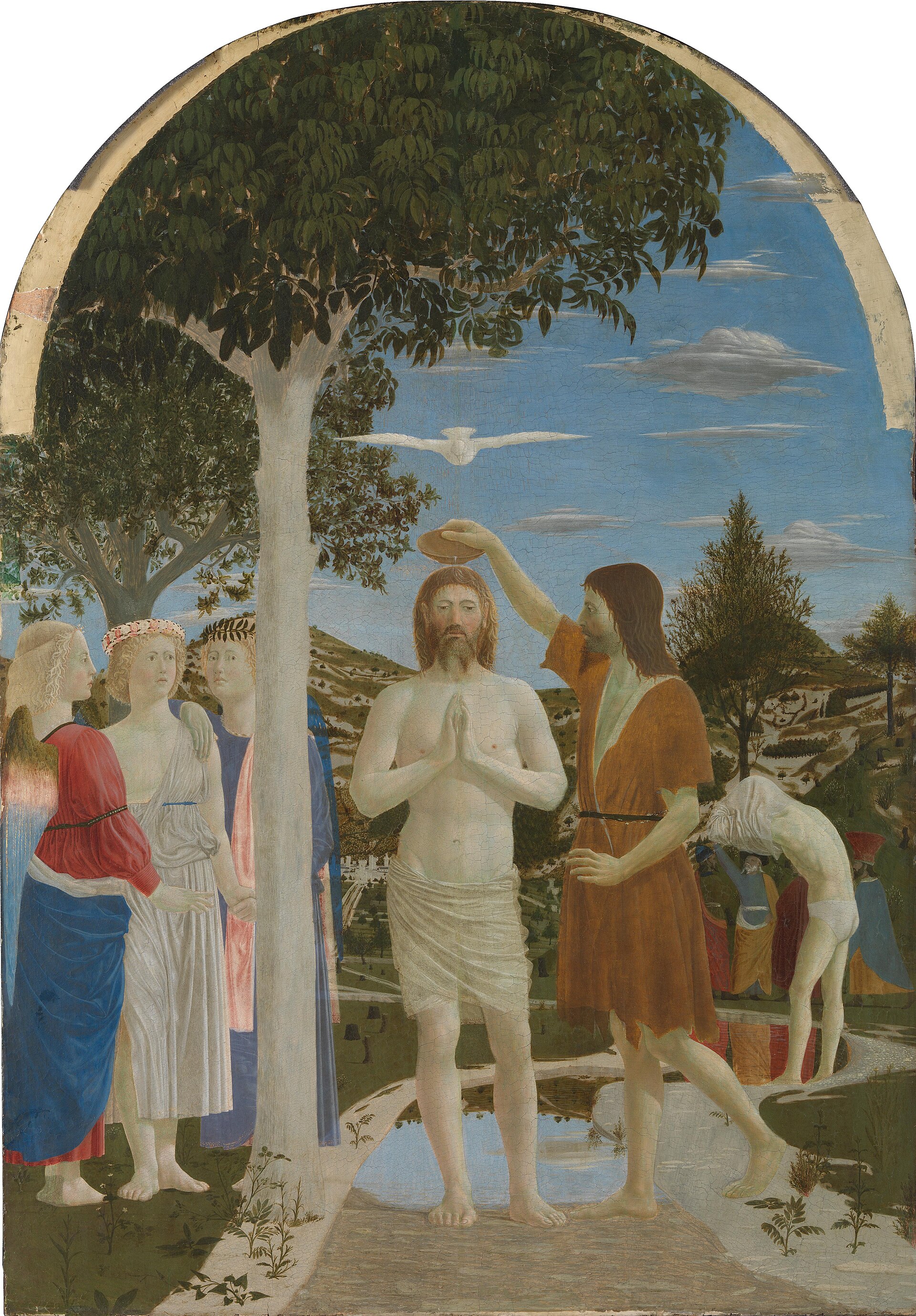
The National Gallery today dates the Baptism of Christ "probably about 1437-1445" and calls it Piero's earliest surviving work.
The National Gallery today dates the Baptism of Christ "probably about 1437-1445" and calls it Piero's earliest surviving work. That is a long way from the c. 1448-50 or c. 1450 that older books and English Wikipedia still print, and Wikipedia's own article on the picture says the dating is controversial, with some giving a very early date, perhaps 1439, and others around 1460. The shift matters for what the picture can be about. An early date puts it in the decade of the Council of Florence (1431-1445), when Greek delegations were in Italy, and the Gallery's own commentary reads the tall hats of the small figures beyond the river as Byzantine headdresses and suggests, with a "might", that they could also be the three kings from the East. Wikipedia adds that the three angels holding hands could allude to the Council's aim of church union, and that the Camaldolese theologian Ambrogio Traversari was a supporter of union; it also offers the Trinity as an alternative reading. The Gallery's bibliography lists M. C. Tanner on "Concordia" in the Baptism and M. Bussagli on a Trinitarian rereading, neither of which was read for this page, so the Council reading is graded argued, not documented.
What is not in dispute is the local setting. The Gallery says the valley, walls and turrets, the mountains and the walnut tree are the landscape of Sansepolcro, and ties the walnut to the town's foundation legend of two pilgrims and a relic from the Holy Sepulchre. The picture was the centrepiece of an altarpiece for the Priory of San Giovanni Battista; the Gallery says Matteo di Giovanni painted the side panels, pilasters and predella in the 1460s. The priory was suppressed in 1808, the pieces went to the sacristy of the cathedral, and the Baptism was bought from the bishop and chapter in 1859 by Sir J. C. Robinson on behalf of Matthew Uzielli, lent to the South Kensington Museum in 1860-61, and bought by the National Gallery at the Uzielli sale in London on 13 April 1861 (lot 184). The sources read do not give the price.
Chapter 5The Resurrection: moved, restored forty times, and saved by a story
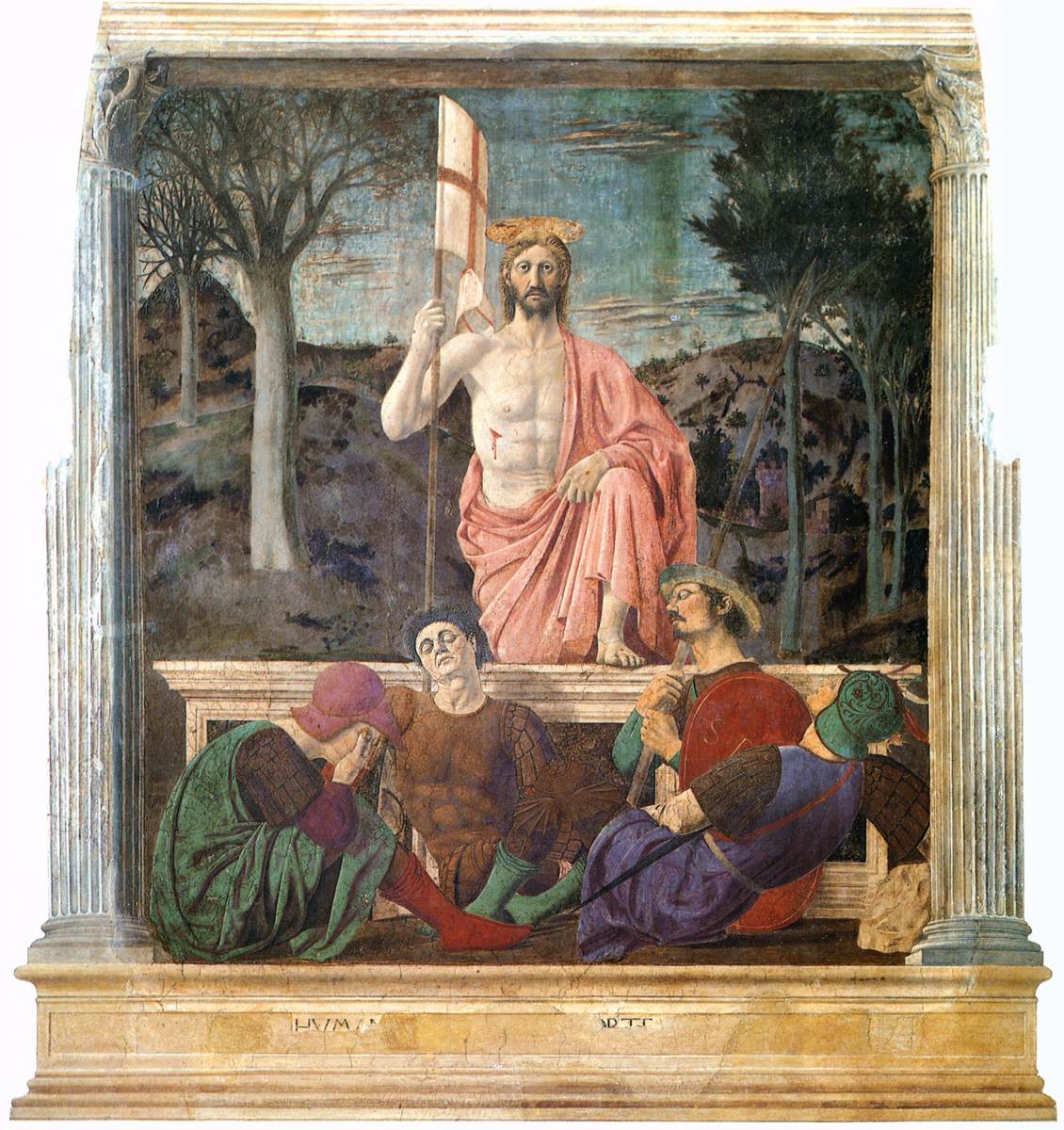
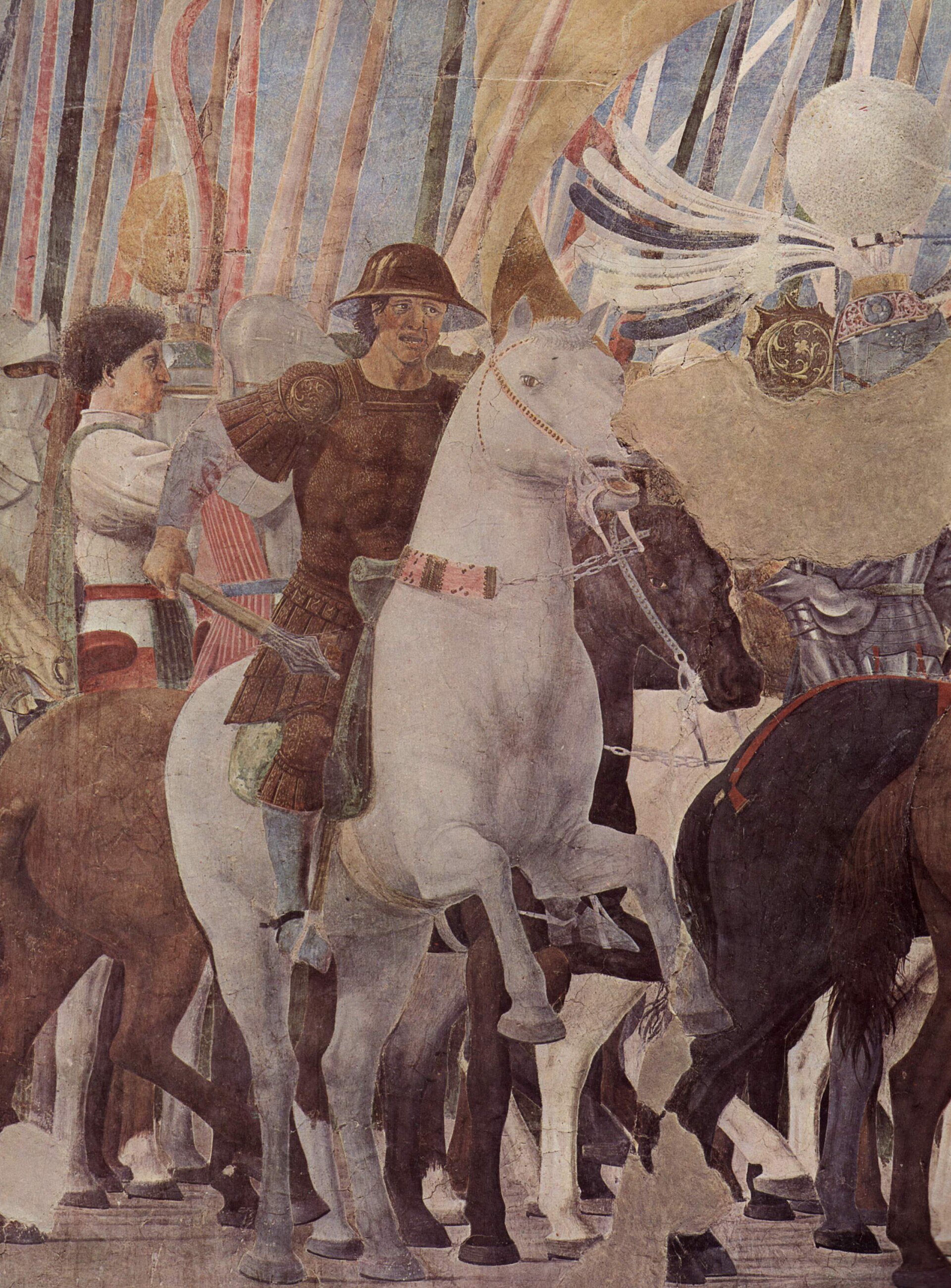
The Resurrection, in the Museo Civico of Sansepolcro, was painted for the town's communal meeting hall; Wikipedia says the Conservatori prayed before it before beginning their councils.
The Resurrection, in the Museo Civico of Sansepolcro, was painted for the town's communal meeting hall; Wikipedia says the Conservatori prayed before it before beginning their councils. Its dating has long been 1450-1465, with the Commons metadata for the WGA image giving 1463-1465. A three-year restoration by the Opificio delle Pietre Dure, reported in March 2018, has unsettled both the date and the location. ANSA quotes Cecilia Frosinini, who directs the Opificio's mural-painting department, saying that the restorers can now affirm with certainty what had long been suspected, that the painting was moved to its present wall from somewhere else, possibly an external wall of the building, and that this makes it one of the oldest and most monumental fresco relocations in the history of art. ANSA reports that new research has shifted the date to about 1470. The restoration also found damage from earthquakes, an exhaust pipe and about forty earlier minor restorations, including a nineteenth-century cleaning with sodium hydroxide, and the restorers concluded that the greens are the weakest colours while the pink of Christ's cloak was meant to be richer. The restoration was carried out with a donation of EUR 100,000 from the Buitoni manager Aldo Osti (ANSA).
The self-portrait tradition attaches to the sleeping soldier in brown armour at Christ's right. Wikipedia says it rests on tradition and on a comparison with the woodcut portrait in Vasari's Lives; Country Life repeats it as "considered to be". There is no contemporary label, inscription or document, so the identification is traditional and no more, and the portrait on this page is marked as unverified.
The wartime story is the best-known thing about the fresco and the least well sourced. In 1944 (the accounts read give no month) a British artillery officer, Anthony Clarke, is said to have held back his battery from shelling Sansepolcro because he remembered Aldous Huxley's 1925 description of the Resurrection as the greatest picture in the world. The accounts differ in detail. Wikipedia says Clarke defied orders and had begun methodical shelling, and that the Germans were in fact already retreating. Country Life says he told his men not to bombard and they entered on foot and found no Germans. ANSA says he decided at the last minute. A street in Sansepolcro bears his name. No primary source, such as Clarke's war diary, was found; this is graded as widely retold and uncorroborated in detail, not as documented. A smaller wartime fact, from a blog and so graded low, is that on 14 January 1944 the restorer Ugo Procacci and an assistant were driving the Misericordia polyptych to Florence for safety when an Allied raid fell around the truck and a bomb landed about thirty yards away.
Chapter 6Arezzo: fourteen scenes, a failing plaster, and fifteen years of repair
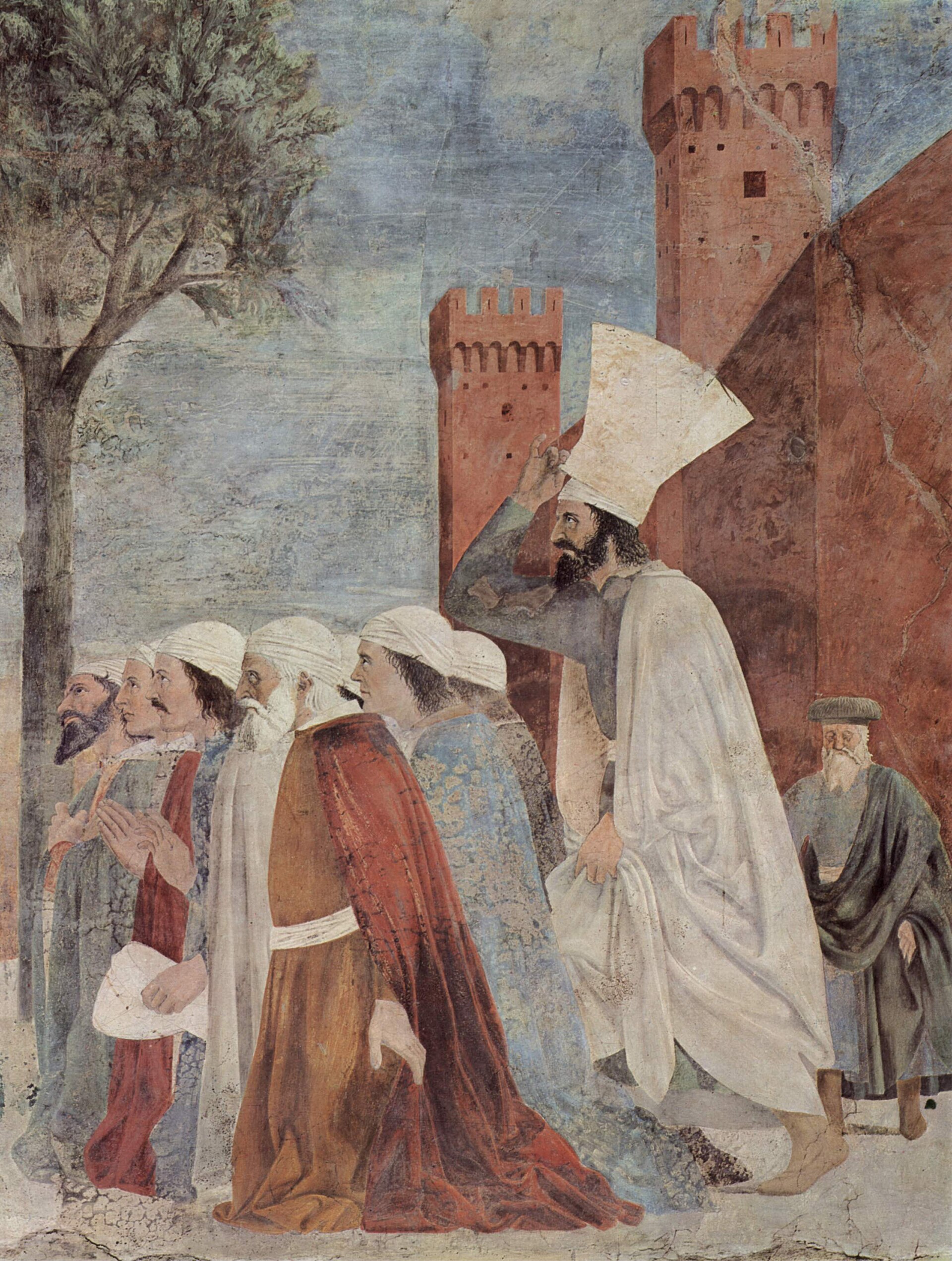
The Legend of the True Cross in the Bacci chapel of San Francesco in Arezzo is the largest thing Piero left.
The Legend of the True Cross in the Bacci chapel of San Francesco in Arezzo is the largest thing Piero left. Wikipedia says he was called in 1452 to replace Bicci di Lorenzo and finished in 1464; the Cambridge Companion gives c. 1452-66. Sauerlander says the commission was the donation of the rich Bacci family and counts fourteen scenes from the death of Adam to the Cross's entry into Jerusalem, probably following the text of the Golden Legend by Jacobus de Voragine, which Wikipedia names as the source of the story. Vasari, in the English translation read here, says Piero came to Arezzo from Loreto and painted the history from the seeds placed under the dead Adam's tongue to the exaltation of the Cross by Heraclius.
The cycle's condition is a documented history of its own. The Web Gallery of Art, citing the Skira volume edited by Anna Maria Maetzke and Carlo Bertelli (2001), says that by the early 1980s the plaster was deteriorating so seriously that the paint layer was bound to be lost. Preliminary studies ran from 1985 to 1990, with centimetre-by-centimetre analysis and monitoring of the chapel's microclimate, and the restoration was carried out from 1991 to 2000. In 2024 a maintenance campaign ran from late January to early March, covered the frescoes, the late thirteenth-century painted Cross and the chapel's window, put visitors on the scaffold for a close view, and reopened the chapel on 28 March (Finestre sull'Arte).
How the scenes were transferred is a technical question this page cannot answer. Bambach's 1999 book on the Italian workshop has a chapter titled "Theory Put to Practice: Piero's Murals at S. Francesco in Arezzo", listed in the contents of the publisher's sample, but only the contents were available, so the transfer method is left as an open question and not asserted.
Chapter 7The Madonna del Parto: cut from the wall in the 1780s, detached in 1911
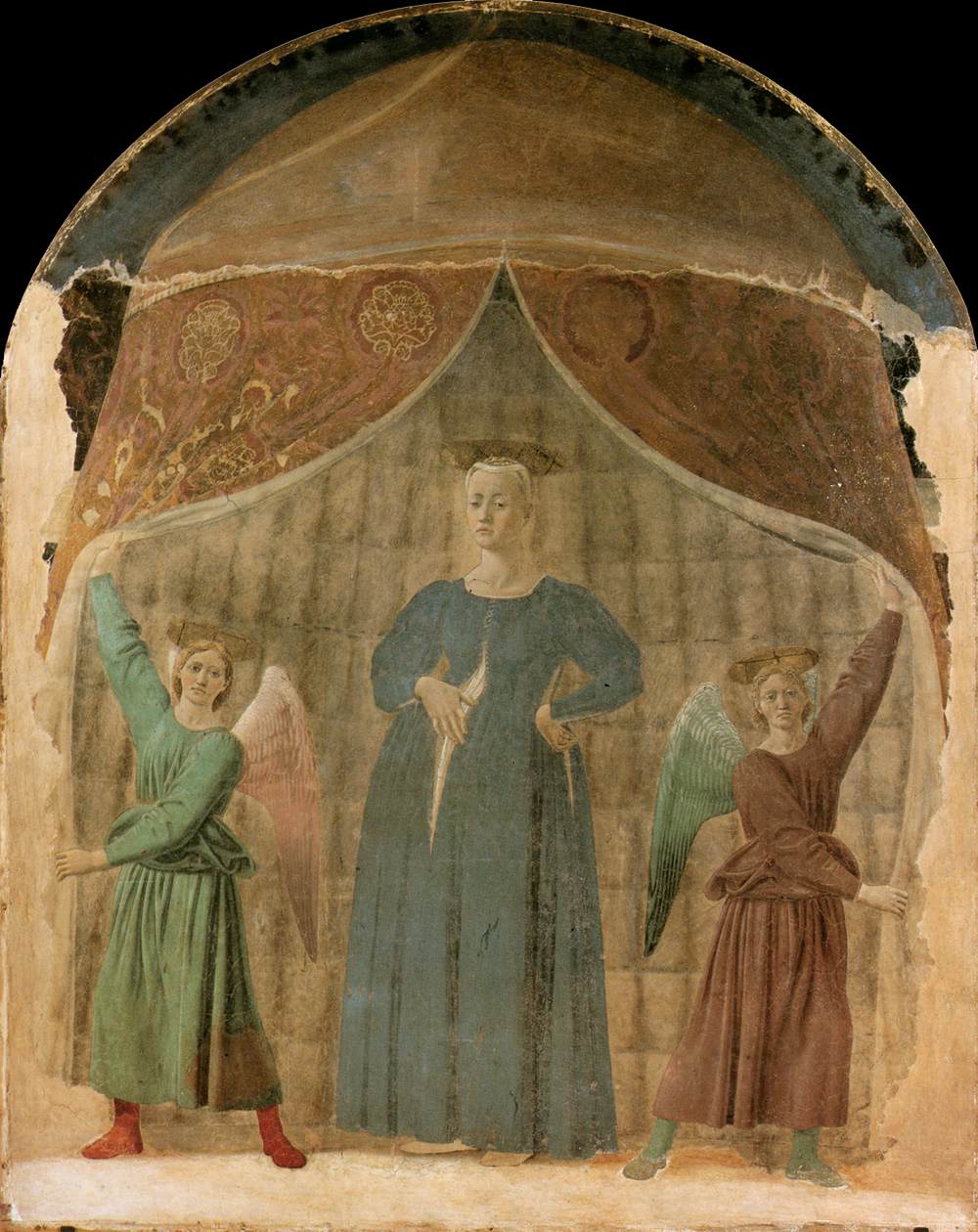
The Madonna del Parto, painted for the chapel of Santa Maria di Momentana at Monterchi, the town of Piero's mother's family, is the clearest case where a retold history and a documented one differ.
The Madonna del Parto, painted for the chapel of Santa Maria di Momentana at Monterchi, the town of Piero's mother's family, is the clearest case where a retold history and a documented one differ. A detachment in 1950, which circulates, is not supported by anything read. The Italian Wikipedia article, corroborated at several points by the regional tourism body Visit Tuscany, gives this sequence: between 1784 and 1786 the church site was taken for Monterchi's cemetery, two-thirds of the church was demolished and the fresco was sawn out with its whole thickness of wall and set in a niche over the altar; the learned local Vincenzo Funghini recognised it as Piero's on 8 January 1889; in 1911 the Soprintendenza decided to detach it, work carried out by the restorer Domenico Fiscali, who remounted it on plaster and wire mesh and in the process revealed a fragmentary fourteenth-century Madonna and Child underneath; the earthquake of 26 April 1917 sent it to a store and then to the Museo Civico in Sansepolcro until September 1922, when it returned; Dino Dini restored it in 1952-53; and the chapel was reoriented in 1956, which changed the light on the picture. Visit Tuscany gives 1785 for the demolition and 1955-56 for the reorientation, so the sources agree to within a year on those.
A restoration for the five-hundredth anniversary of Piero's death (1992 on the Italian Wikipedia's account; Visit Tuscany says only the 1990s and names Guido Botticelli as restorer) was followed by display in a climate-controlled case in the former school at Monterchi that became a one-work museum; the Italian Wikipedia article says that arrangement was meant to be temporary and that the commune, the Soprintendenza and the diocese have been in a dispute over ownership and permanent location since the exhibition, with a diocesan lawsuit begun in 2002 that did not proceed. That is a statement from a tertiary source about a live dispute and is graded accordingly. On the function of the picture the same article says pregnant women made a short pilgrimage from the town down to the church for protection in labour; this is a local tradition, repeated and not documented in the sources read.
Chapter 8Urbino: the Flagellation, the Duke, and a theft that nearly ended it
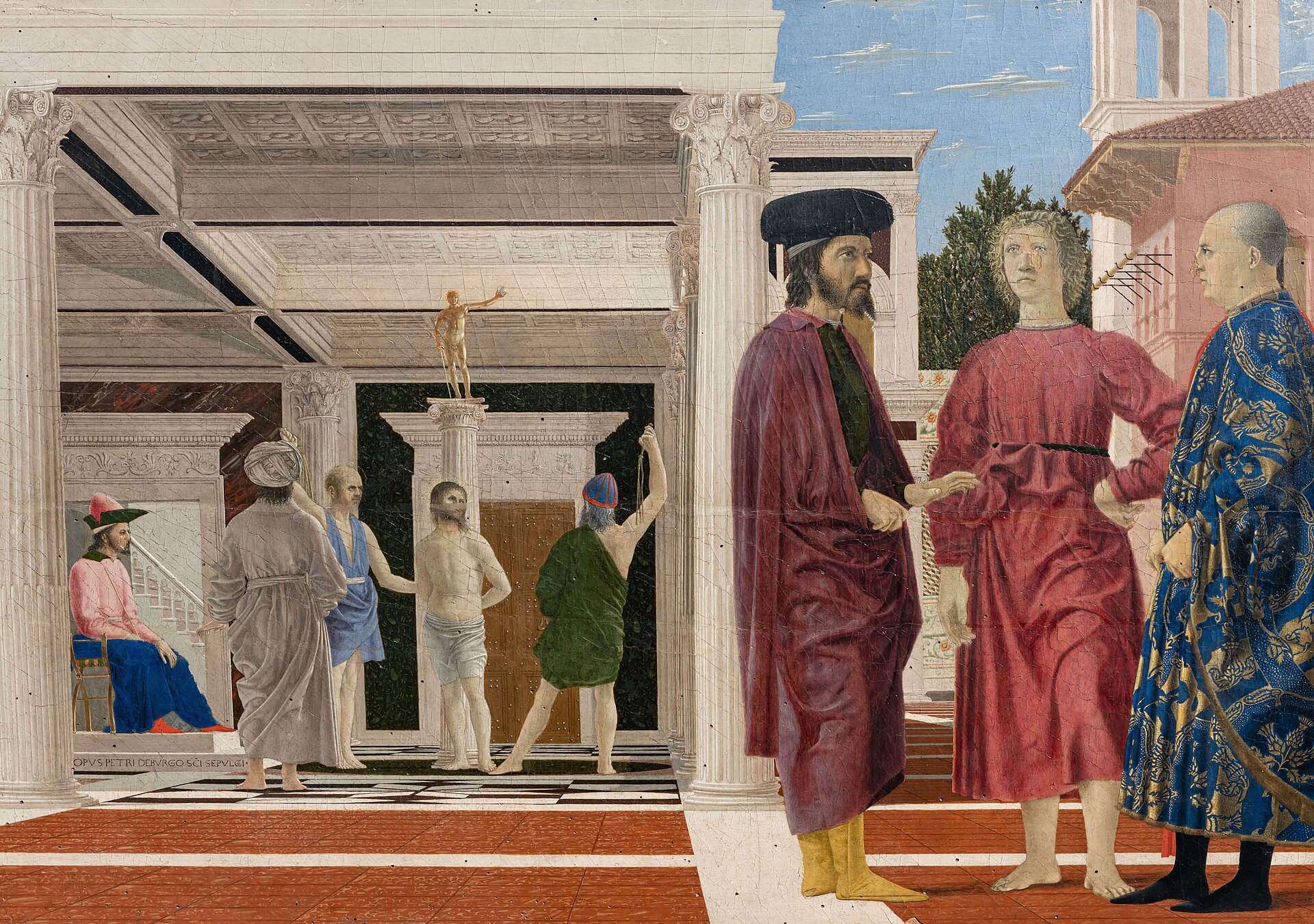
The Flagellation of Christ in Urbino is signed under the seated emperor with the words "OPVS PETRI DE BVRGO SCI SEPVLCRI", and has no documented patron, date or original destination.
The Flagellation of Christ in Urbino is signed under the seated emperor with the words "OPVS PETRI DE BVRGO SCI SEPVLCRI", and has no documented patron, date or original destination. The Cambridge Companion says Piero is not recorded in Urbino until 1469. Wikipedia dates the panel 1459-60 in the article on it and c. 1455-1470 in the article on Piero, and Kenneth Clark's 1951 verdict that it is "the greatest small painting in the world" is the line everyone repeats. What has been written about who the three men in the foreground are fills a shelf, and the readings are incompatible. Each is summarised below as Wikipedia reports it and none was verified against the original book.
The conventional Urbino reading says the three men are Oddantonio da Montefeltro between two advisers murdered with him in July 1444, and that Federico commissioned the picture; Wikipedia notes that a contract in which Federico agreed not to remember the offences, and the lack of a marked grave, count against it. A dynastic reading rests on an eighteenth-century Urbino cathedral inventory naming "the Portraits of Duke Guidubaldo and Oddo Antonio", which Wikipedia says cannot be right as written because Guidobaldo was born in 1472. Carlo Ginzburg, in Indagini su Piero (Einaudi, 1981, or 1982 by the National Gallery's listing; English translation as The Enigma of Piero), argued a political-theological reading in which the seated figure is the Byzantine emperor John VIII Palaiologos, the picture is an invitation from Cardinal Bessarion to Federico to join a crusade, and the youth is Bonconte da Montefeltro, who died of plague in 1458; Silvia Ronchey and others, Wikipedia says, agree on a Bessarion message and identify the foreground men differently. Kenneth Clark, in 1951, identified the bearded man as a Greek scholar and saw an allegory of the Church's suffering after 1453. Marilyn Aronberg Lavin proposed that the men are Ludovico III Gonzaga and the astrologer Ottaviano Ubaldini, each grieving a son, and that the picture was for Ottaviano's chapel in the ducal palace. David A. King argued, from an acrostic found in 2005 on an astrolabe Regiomontanus gave Bessarion in 1462, that the figures have multiple identities and that the picture marks the young astronomer's arrival in Bessarion's circle. Sir John Pope-Hennessy argued the subject is Saint Jerome's dream of being flayed for reading pagan texts. These are argued readings. None is documented, and this page does not choose between them.
Survival is a separate fact. On the night of 5 February 1975 thieves entered the Palazzo Ducale in Urbino through scaffolding and took the Flagellation, Piero's Madonna of Senigallia and Raphael's Mute Woman, leaving only the frames. The Boston Museum of Fine Arts, in its 2013 account, says the Carabinieri art squad followed a tip from a Roman antiques dealer to Switzerland, staged a mock negotiation, found the paintings in a hotel in Locarno on 23 March 1976, and returned them to Urbino on 29 March 1976; four people were arrested. The Senigallia Madonna is a case of the reverse problem: Finestre sull'Arte says no early source mentions it, the first record is an 1822 letter by a scholar who took it for a wooden sketch of the Brera altarpiece, itself then attributed to Fra Carnevale.
Chapter 9Three treatises, a manuscript in Parma, and the charge against Pacioli
Three treatises survive: the Trattato d'abaco, the De prospectiva pingendi and the Libellus de quinque corporibus regularibus.
Three treatises survive: the Trattato d'abaco, the De prospectiva pingendi and the Libellus de quinque corporibus regularibus. The Cambridge Companion says the abacus treatise was written for the Pichi family, the perspective treatise late in his career for the Urbino court (probably for Federico) and that the Libellus is dedicated to Federico's son Guidobaldo. Britannica gives 1474 to 1482 for the perspective treatise and says the principal manuscript, in the Biblioteca Palatina in Parma, was handwritten by the artist himself and illuminated by him with diagrams. J. V. Field, quoted by MacTutor, says the opposite on the illustrations: "none of the known manuscripts has illustrations actually drawn by Piero himself". The two positions are incompatible on one point and this page records both.
Field also states what is new in them. The Libellus presents four truncated Archimedean solids in addition to the two found in the abacus treatise, and he argues Piero invented the notion of truncation in its modern sense. The perspective treatise is the first to deal with the mathematics of perspective as a manual for painters. Piero also copied seven works of Archimedes in the late 1450s, in an 82-leaf manuscript now in the Biblioteca Riccardiana in Florence (Wikipedia). The treatises are the main evidence of what Piero read. MacTutor says he had read Euclid's Elements and some Archimedes and infers that he must have learned enough Latin later in life to do so; no inventory of his books or library was found.
Vasari opens the Life with a charge of theft. In the translation read here he says Piero was "prevented by blindness in his old age from bringing to light the books he had written" and that his pupil Fra Luca dal Borgo, Luca Pacioli, published the old man's works under his own name. Sauerlander says Pacioli incorporated Piero's explanation of solid geometry word for word into his Summa without attribution, "certainly plagiarism, as Vasari charged". MacTutor, again following Field, says much of Piero's algebra appears in Pacioli's Summa (1494) and much of his work on the Archimedean solids in De divina proportione (1509). The Cambridge Companion adds that Vasari's outrage helped later historians recover the writings. None of Piero's mathematics was printed in his lifetime.
Chapter 10The blindness: a sixteenth-century tradition against a will and a date
The picture of a blind old Piero led by a boy, Marco di Longaro, is the best-known image of the last years, and its source is weaker than its fame.
The picture of a blind old Piero led by a boy, Marco di Longaro, is the best-known image of the last years, and its source is weaker than its fame. Vasari says blindness overtook him in old age. Sauerlander calls the boy story a legend. Britannica calls the tradition reliable but argues that, if true, the blindness must date after 1490 because several autographs from that year survive, and says his will of 1486 describes him as aged but sound in mind and body. MacTutor, following Beck, puts the onset after the will of 1487 and says no evidence fixes when it happened. The Cambridge Companion says his eyesight failed "a few years before" his death on 12 October 1492. English Wikipedia says his sight began to fail about 1480 and cites Machtelt Bruggen Israels (2020) for blindness in his last months. The will is dated 1486 by Britannica and 1487 by Wikipedia and MacTutor, and the sources read do not resolve which.
The documented position is therefore narrow. Piero's late works are few (Britannica names the Nativity, the Madonna from Santa Maria delle Grazie near Senigallia and the Perugia altarpiece), he wrote treatises in the 1480s, and he kept a family house in Sansepolcro to the end. No wife or children appear in the will (MacTutor), and he left his possessions to his family and the Church (Wikipedia).
Chapter 11The Hercules and the Nativity: how two of his works left Italy
A detached fresco of the young Hercules, which Wikipedia calls his only known secular work (the Urbino portraits and the Rimini fresco make that claim questionable), came from his own house in...
A detached fresco of the young Hercules, which Wikipedia calls his only known secular work (the Urbino portraits and the Rimini fresco make that claim questionable), came from his own house in Sansepolcro. The Gardner Museum says it was detached from the wall in the 1860s, while English Wikipedia says it was rediscovered in the second half of the eighteenth century and damaged in removal; the two disagree on when it left the wall. The dealer Elia Volpi of Florence sold it to Isabella Stewart Gardner through the painter Joseph Lindon Smith. The museum's essay by its curator Nathaniel Silver says that in 1902 Smith told her of a photograph a dealer had shown him and that the purchase went through at the end of 1906 for 200,000 lire (about USD 864,000 today by the museum's own conversion, method not stated); the 2003 Chong essay the museum also cites says the sale was in 1903. Both are the museum's. In the middle, Italy tightened its export rules and Volpi lobbied ministers to take the picture off a protected list, and for five years Gardner had only a watercolour copy Volpi commissioned. Her friend Emily Chadbourne stored it in London and, returning to the US in 1908, imported it undeclared with her household goods; customs discovered it, there was a press scandal, and Gardner paid a steep fine. It was the first Piero to reach America. The museum says the import was without Gardner's knowledge, or so she claimed. The 2003 essay says the Italian government delayed the export until 1908 and that customs seized the fresco on arrival over duty and fines. The museum adds that the figure's meaning in a private house is a mystery, noting that no other gods or heroes are evidenced in the room and that Piero showed Hercules as a youth.
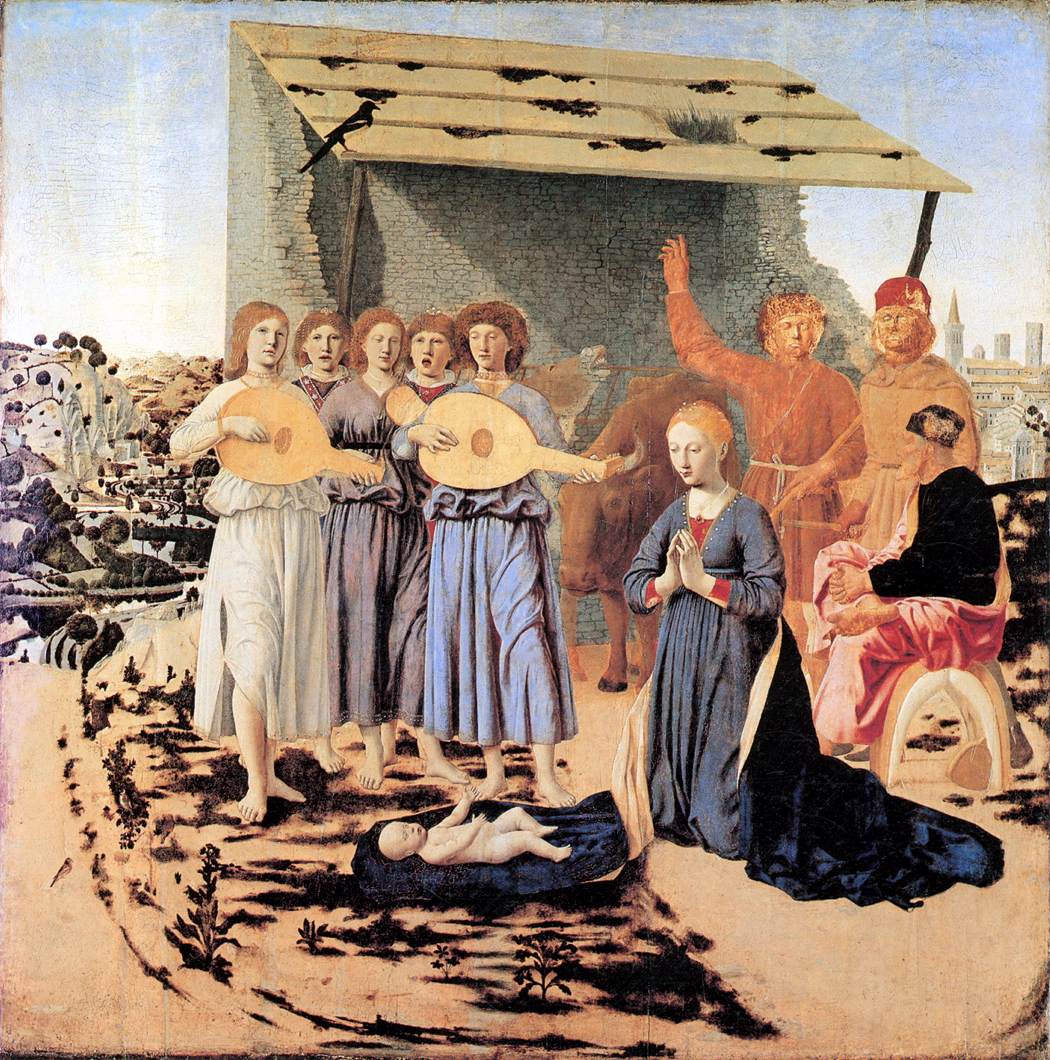
The Nativity has a different chain. The National Gallery says it appears to have stayed with the descendants of Piero's brother Marco in Sansepolcro and was first recorded in 1825 with Giuseppe Marini-Franceschi, who sent it to the Uffizi for storage; in 1836 it was in Florence for sale; Charles Eastlake saw it in 1861 and, the Gallery says, would have bought it himself if Alexander Barker of London had not forestalled him. The Gallery bought it at the Barker sale on 6 June 1874 (lot 70). While still in the family, parts of the paint were badly damaged by overcleaning, which led some to think the picture unfinished; conservation completed in 2022 recovered much of the intended effect.
Chapter 12Fame: a monarch in 1497, a Fra Carnevale in the nineteenth century, a master of the twentieth
Britannica says Piero was described in 1497 as "the monarch of our times of painting and architecture", and the Frick likewise says he was revered in his own time as a monarch of painting.
Britannica says Piero was described in 1497 as "the monarch of our times of painting and architecture", and the Frick likewise says he was revered in his own time as a monarch of painting. Vasari praised him two generations later and gave his reputation a persistent grievance, the Pacioli theft. After that the paintings fell out of the story: the Brera altarpiece was taken for Fra Carnevale's work when rediscovered, according to Wikipedia, because Piero's use of oil was not yet known; Wikipedia says it came to Brera by deposit from Napoleon, and Cambridge notes a strip cut from the bottom, with Ragghianti arguing it was also cut at the sides. Finestre sull'Arte says the Senigallia Madonna was likewise attributed to Fra Carnevale after 1822.
The recovery is a nineteenth- and twentieth-century story. Kaiser cites John Addington Symonds on the "dignity of portraiture" and Berenson on the "inarticulate", and the National Gallery's catalogue bibliography lists L. Cheles's studies of Piero in nineteenth-century Britain. The Gallery acquired its three Pieros between 1861 and 1874. Roberto Longhi's monograph of 1927 and Kenneth Clark's of 1951 are the first two books in the Washington bibliography. In 2013 the Frick showed seven works in its first US monographic exhibition. The National Gallery announced in October 2026 the largest Piero exhibition ever, 2 October 2027 to 30 January 2028, built around its three paintings with loans of the Urbino diptych, the Perugia altarpiece and the Clark Virgin and Child, and co-curated by Laura Llewellyn and Machtelt Bruggen Israels. In July 2026 a campaign of non-invasive diagnostics on the Flagellation and the Senigallia Madonna at Urbino was carried out to feed the catalogue; its results were not yet published in the sources read.
What is documented
Technique
The surviving work
- What is accepted
- No source read gives an agreed total of autograph works. What can be said from the sources: the documented, signed or contracted anchors are the 1445 Misericordia contract, the signed and dated Rimini fresco of 1451, the 1454 Sant'Agostino contract and the signed Flagellation; the Frick counts seven paintings by Piero and his workshop in the United States. Wikipedia's selected list runs to about 20 paintings. There is no catalogue count to cite, and that nobody publishes one is itself the finding.
- What is contested
- Disputed items found: the Portrait of Sigismondo Pandolfo Malatesta in the Louvre (attributed; Wikipedia, which itself needs more citations, says Longhi confirmed the attribution (it also names Giovanni Morelli as the first to give it to Piero, but the Louvre record places the picture in the d'Ancona collection in Milan only in 1930 and Morelli died in 1891, so that claim is not repeated here), an Italian ministerial commission declined to buy it in 1969 on attribution doubts, some Italian critics thought it a neoclassical fake and French scholars have accepted it; the Louvre's own record, which lists it as Piero della Francesca, c. 1451, a state purchase of 1978, also carries an earlier attribution given as 'Piero della Francesca, d'apres (Battisti)'); the identity of the central panel of the Sant'Agostino altarpiece (Madonna and Child on Polcri's 1825 list as read by Kaiser, or a Coronation as the Frick curator says); the dates of the Baptism (1437-45 at the National Gallery against c. 1450 in older books), the Resurrection (1450-65 against about 1470) and the Nativity (c. 1470 against early 1480s); and the identity of the Frick Saint John, which Kaiser says has been called Saint Andrew and Saint Simon Zelotes before general agreement.
- Who rules on attribution
- No active authentication board, estate or committee was found. Attribution is decided in practice by the museums that hold the works and by the curators of the exhibitions that reassemble them: the 2013 Frick show (curated by Nathaniel Silver, with catalogue essays by Banker and Machtelt Bruggen Israels) and the National Gallery's 2027-28 show (Laura Llewellyn and Machtelt Bruggen Israels). A catalogue raisonne with a stated count was not found, so none of the monographs listed carries an authority a buyer could rely on in place of the museum catalogues.
Catalogue raisonne
- Roberto Longhi, Piero della Francesca (Rome: Valori Plastici, 1927); 3rd ed. in Opere complete di Roberto Longhi, Florence, 1963. The monograph that put Piero at the centre of Italian art history. Edition details from the National Gallery of Art, Washington, and the Firenze University Press listing as relayed; its attributions were not read.25
- Kenneth Clark, Piero della Francesca (London: Phaidon, 1951; 2nd ed. 1969). The English-language monograph. The publisher is from secondary listings; the Washington bibliography gives London, 1951 and the 1969 second edition. Source of the 'greatest small painting' verdict on the Flagellation.2521
- Eugenio Battisti, Piero della Francesca, 2 vols (Milan, 1971; 2nd ed. 1992). Two-volume study; edition data from the Washington bibliography; scope and rejections not read.25
- Carlo Ginzburg, Indagini su Piero: il Battesimo, il ciclo di Arezzo, la Flagellazione di Urbino (Turin: Einaudi, 1981 or 1982); English translation The Enigma of Piero (London, 1985). The political-theological reading of the Flagellation. The year is 1981 in one listing and 1982 in the National Gallery's, so both are given.221
- Ronald Lightbown, Piero della Francesca (London and New York, 1992; Italian ed. Milan, 1992). The main English-language monograph of the 1990s; the Washington listing gives London, 1992 and the National Gallery gives New York; the publisher is not confirmed.25
- James R. Banker, The Culture of San Sepolcro during the Youth of Piero della Francesca (Ann Arbor: University of Michigan Press, 2003); and 'Piero della Francesca's S. Agostino Altar-Piece: Some New Documents' (cited in the National Gallery's Saint Michael bibliography); and the commission essay in Nathaniel Silver (ed.), Piero della Francesca in America (The Frick Collection, 2013). The archival record for Piero's home town. Kaiser calls Banker the person who knows more than anyone about Piero's Borgo San Sepolcro. The documents about the father and the 1454 contract rest on Banker.8311
- Anna Maria Maetzke and Carlo Bertelli (eds), Piero della Francesca: The Legend of the True Cross in the Church of San Francesco in Arezzo (Milan: Skira, 2001). The record of the 1991-2000 restoration, as cited by the Web Gallery of Art; not read.16
- Martin Davies, National Gallery Catalogues: The Earlier Italian Schools (London, 1986), and Miklos Boskovits and David Alan Brown, Italian Paintings of the Fifteenth Century (National Gallery of Art, Washington, 2003). The provenance entries for the London pictures are extracted from Davies on the Gallery's web pages; the Washington catalogue covers the Saint Apollonia.225
Questions about Piero della Francesca
Who was Piero della Francesca?
Painter; Fresco painter; Mathematician; Geometer; Author of treatises on perspective and arithmetic. c. 1415-1492 (birth year disputed).
When did Piero della Francesca live?
Born between about 1407 and 1420 (year disputed; no baptismal record cited), Borgo San Sepolcro (modern Sansepolcro), Tuscany; died 12 October 1492, Borgo San Sepolcro (modern Sansepolcro), Tuscany.
How are fakes and misattributions of Piero della Francesca detected?
A false Mantegna signature on Saint Michael. When the Saint Michael panel of the Sant'Agostino altarpiece is first surely recorded as a single panel, at Fidanza's in Milan in 1861, it carried a false signature of Mantegna. The panel was bought by Sir Charles Eastlake and sold to the National Gallery in 1867 as Piero's.
Where can you see work by Piero della Francesca?
Basilica of San Francesco (Bacci Chapel) (Arezzo); Museo Civico (Sansepolcro); Museo della Madonna del Parto (Monterchi); Galleria Nazionale delle Marche, Palazzo Ducale (Urbino); Pinacoteca di Brera (Milan); Gallerie degli Uffizi (Florence).
What does the market for Piero della Francesca look like?
No autograph painting by Piero has been found at public auction in modern times in any source read, and the only fixed prices that survive are two private sales a century apart. Isabella Stewart Gardner paid 200,000 lire for the Hercules fresco in 1906 through the dealer Elia Volpi, which the Gardner Museum converts to about USD 864,000 in today's money without stating its method.
What is still unresolved about Piero della Francesca?
When was Piero born? Seven different years or ranges are in print from museums and scholars (1407/11, 1411/13, 1412, c.
Open questions
- When was Piero born? Seven different years or ranges are in print from museums and scholars (1407/11, 1411/13, 1412, c. 1415, 1416/17, 1415-20, 1420), and no baptismal record has been cited.
- Was the Madonna del Parto cut out of its wall in the 1780s, detached in 1911 and restored in 1952-53 and 1992, and who owns it: the commune of Monterchi, the diocese or the state? The ownership dispute reported in 1995 and 2002 was not followed to a result in the sources read.
- When and where was the Resurrection fresco originally painted, and how does the 2018 shift of the date to about 1470 square with the 1450-65 dating in the older literature?
- Who are the three men in the foreground of the Flagellation, and for whom was it painted? The July 2026 diagnostics at Urbino may add underdrawing, pentimenti and pigment evidence; no results have been published in the sources read.
- How were the Arezzo scenes transferred to the wall? Bambach's 1999 chapter on the Arezzo murals was not available to read, and the Maetzke and Bertelli restoration volume was not read.
- What did the missing centre of the Sant'Agostino altarpiece show: a Madonna and Child (Polcri's 1825 list, as read by Kaiser) or a Coronation, as the Frick still says?
- When did Piero go blind, if he did? Britannica puts the onset after 1490, MacTutor after 1487, and the will is dated 1486 in one source and 1487 in others. No contemporary document describes the blindness, and the Marco di Longaro story has no cited source.
- Did Piero draw the diagrams in the Parma manuscript of De prospectiva pingendi, as Britannica says, or none of the manuscripts, as Field says?
- What did Piero's lost works in Rome, Ferrara and Urbino look like, and what did the Hercules mean in a private house, since the Gardner Museum says no other gods or heroes are known to have decorated the room?
Sources
- 1Jeryldene M. Wood (ed.), The Cambridge Companion to Piero della Francesca (Cambridge University Press, 2002), Introduction by Wood, publisher's excerpt (pp. 1-8 only read). assets.cambridge.org/97805216/...
- 2National Gallery, London, 'The Baptism of Christ', NG665: web catalogue entry with the Provenance section extracted from Martin Davies, National Gallery Catalogues: The Earlier Italian Schools (1986), and the Gallery's audio description. nationalgallery.org.uk/paintings/...
- 3National Gallery, London, 'Saint Michael', NG769: web catalogue entry with Provenance extracted from Davies 1986. nationalgallery.org.uk/paintings/...
- 4National Gallery, London, 'The Nativity', NG908: web catalogue entry with Provenance extracted from Davies 1986 and a note on the conservation completed in 2022. nationalgallery.org.uk/paintings/...
- 5The Frick Collection, 'St. John the Evangelist' (Frick eMuseum object 230): curator note by Giulio Dalvit and provenance. collections.frick.org/objects/...
- 6The Frick Collection, 'Piero della Francesca in America' (exhibition page, 12 February to 19 May 2013). frick.org/exhibitions/...
- 7The Frick Collection, exhibition kiosk page on the Clark 'Virgin and Child Enthroned with Four Angels'. frick.org/exhibitions/...
- 8Walter Kaiser, 'Noble Dreams: Piero', The New York Review of Books, 21 March 2013 (review of the Frick exhibition catalogue by Nathaniel Silver). nybooks.com/articles/...
- 9Willibald Sauerlander, 'The Triumph of Piero', The New York Review of Books, 12 May 2016. nybooks.com/articles/...
- 10Giorgio Vasari, Lives of the Artists, 'Piero della Francesca and Luca Signorelli', English translation hosted by the Fordham Internet History Sourcebooks (translator and edition not stated on the page; a translation of the Life, not the Italian text). fordham.edu/Halsall/...
- 11J J O'Connor and E F Robertson, 'Piero della Francesca', MacTutor History of Mathematics archive, University of St Andrews (; quotes James Banker's archival findings and J V Field on the treatises; replace with Banker's own publications). mathshistory.st-andrews.ac.uk/Biographies/...
- 12Paul F. britannica.com/biography/...
- 13Isabella Stewart Gardner Museum, 'The End Justifies the Means' (Nathaniel Silver, curator), on the purchase and import of Piero's Hercules. gardnermuseum.org/node/...
- 14Isabella Stewart Gardner Museum, art-object essay on 'Hercules', citing Alan Chong, in Eye of the Beholder (Boston: ISGM and Beacon Press, 2003), p. 53. gardnermuseum.org/isgm-rooms/...
- 15ANSA English, "Piero della Francesca's Resurrection restored", 26 March 2018 (news report quoting Cecilia Frosinini of the Opificio delle Pietre Dure and Paola Refice; secondary, Opificio or Soprintendenza report). ansa.it/english/...
- 16Web Gallery of Art, 'Restoration of the fresco cycle' (Arezzo, Legend of the True Cross), citing Maetzke and Bertelli (eds), Skira, 2001. wga.hu/html_m/...
- 17Finestre sull'Arte, 'Arezzo, work on Piero della Francesca's Legend of the True Cross completed', 15 March 2024. finestresullarte.info/en/...
- 18Italian Wikipedia, 'Madonna del Parto (Piero della Francesca)' (; gives dates and named restorers for the fresco's history, with a bibliography including the 1993 Marsilio exhibition catalogue; catalogue). it.wikipedia.org/wiki/...
- 19Visit Tuscany, 'Museum of the Madonna del Parto, Monterchi' (regional tourism body; confirms 1911 detachment, 1785 demolition and the 1955-56 reorientation). visittuscany.com/en/...
- 20Museum of Fine Arts, Boston, press release 'Museum of Fine Arts, Boston, debuts rare painting by Renaissance master Piero Della Francesca' (September 2013), as reproduced by ArtDaily. artdaily.com/news/...
- 21Wikipedia, 'Flagellation of Christ (Piero della Francesca)' (; the interpretations are summarised from the cited authors' books, which were not read; replace each with the primary publication). en.wikipedia.org/wiki/...
- 22Wikipedia, 'Resurrection (Piero della Francesca)' (; the Clarke episode and the self-portrait tradition). en.wikipedia.org/wiki/...
- 23Country Life, 'How the best picture in the world was saved from destruction by a British army officer who refused to follow his orders' (secondary). countrylife.co.uk/luxury/...
- 24Strange History (Beachcombing), 'Misericordia Polyptych meets Allied bombs', 22 November 2014 (a blog; low reliability, cited only for the 14 January 1944 transport story; replace with Procacci's own account). strangehistory.net/2014/...
- 25National Gallery of Art, Washington, artist page 'Piero della Francesca', with bibliography. nga.gov/collection/...
- 26The Art Newspaper, 'Largest ever Piero della Francesca exhibition to open at London's National Gallery', 29 October 2026. theartnewspaper.com/2026/...
- 27Finestre sull'Arte, 'Ahead of the Piero della Francesca exhibition in London, new scientific studies on the masterpieces from Urbino' (2026). finestresullarte.info/en/...
- 28Love London Love Culture, 'The National Gallery announces largest exhibition of work by Piero della Francesca', 31 October 2026 (relays the Gallery's announcement; ). lovelondonloveculture.com/2026/...
- 29Wikipedia, 'Piero della Francesca' (; used for the selected-works list with dates and media, and the 2013 Frick exhibition note). en.wikipedia.org/wiki/...
- 30Wikipedia, 'Portrait of Sigismondo Pandolfo Malatesta' (; flagged by Wikipedia itself as needing more citations). en.wikipedia.org/wiki/...
- 31Wikipedia, 'Montefeltro Altarpiece' (). en.wikipedia.org/wiki/...
- 32Wikipedia, 'The Baptism of Christ (Piero della Francesca)' (). en.wikipedia.org/wiki/...
- 33Wikipedia, 'Hercules (Piero della Francesca)' (). en.wikipedia.org/wiki/...
- 34Carmen C. Bambach, Drawing and Painting in the Italian Renaissance Workshop: Theory and Practice, 1300-1600 (Cambridge University Press, 1999), publisher's sample (front matter and contents only read). assets.cambridge.org/97805214/...
- 35Finestre sull'Arte, 'Piero della Francesca's Madonna of Senigallia: the abstract poetry of light'. finestresullarte.info/en/...
- 36Wikimedia Commons file page 'File:Autoritratto Piero della Francesca.jpg' (description and licence read in the wikitext: PD-old; category Portraits of Piero della Francesca). commons.wikimedia.org/wiki/...
- 37The Frick Collection, exhibition kiosk page on Saint John the Evangelist. frick.org/exhibitions/...
- 38French Ministry of Culture, POP Joconde record for 'Portrait de Sigismond Malatesta (1417-1468)', Louvre, Departement des Peintures (author Piero della Francesca, c. 1451; state purchase 1978; provenance Delarov 1889, d'Ancona 1930, Contini-Bonacossi; earlier attribution given as 'd'apres (Battisti)'). pop.culture.gouv.fr/notice/...


Last verified