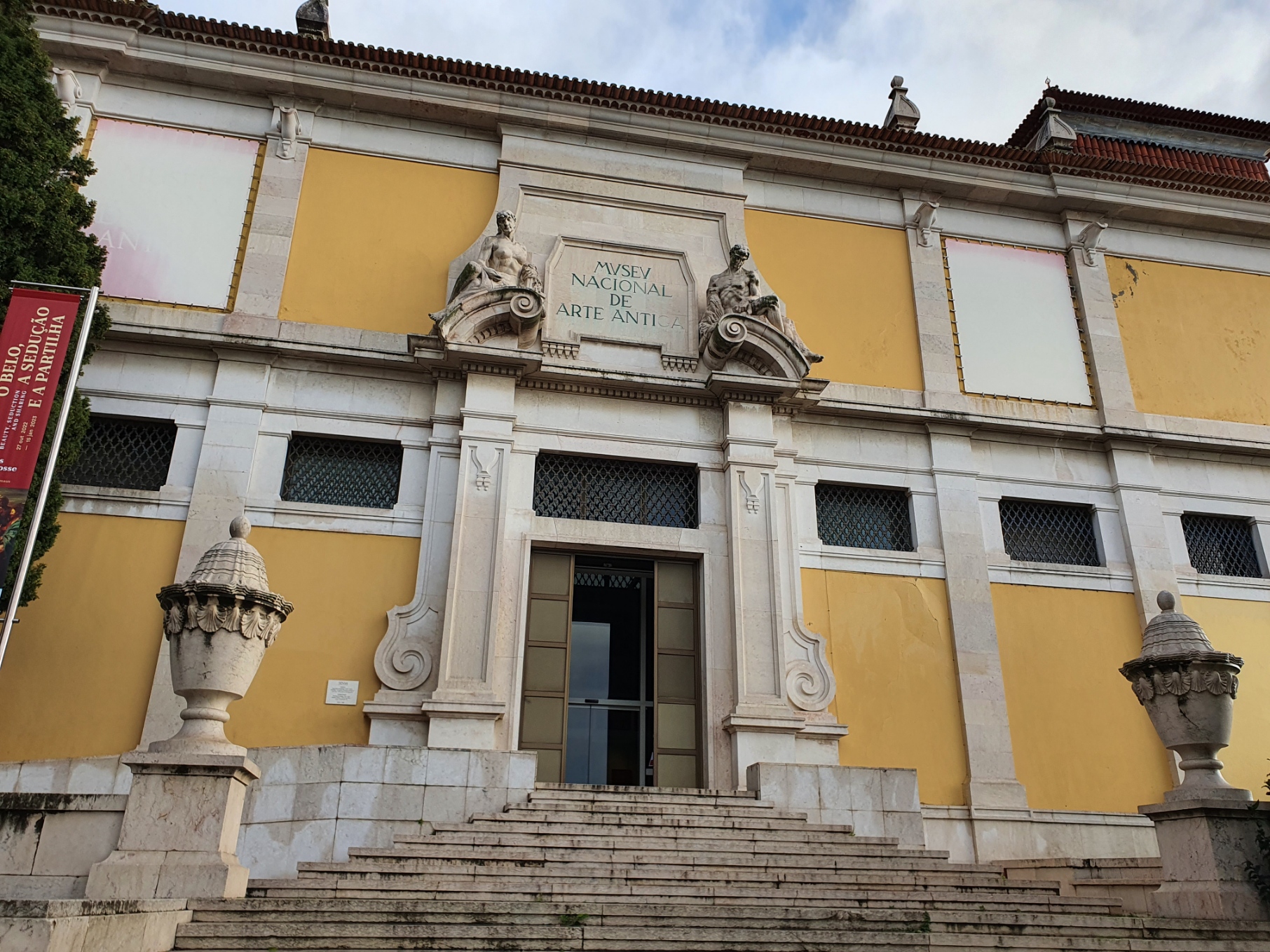
The museum's main entrance on the west facade of the Palacio Alvor, the late seventeenth-century palace it has occupied since its 1884 founding, with MUSEU NACIONAL DE ARTE ANTIGA carved into the pediment above the doorway.
GualdimG, CC BY-SA 4.0National Museum of Ancient Art
Museum · Museu Nacional de Arte Antiga · Founded 1884
Closure confirmed 21 August 2026 · 21 sources
Closed to visitors - not permanently
National Museum of Ancient Art is currently closed. Not open and not permanently closed. The museum's own site states in both its Portuguese and English versions that the MNAA closed to the public on 29 September 2025 for renovation works under Portugal's Recovery and Resilience Plan (PRR), and that reopening is subject to the schedule of that intervention process. The umbrella state portal that also carries the museum's own contact address, museusemonumentos.pt, repeats the same notice at the top of the museum's page (Encerrado para obras de requalificacao) and marks the entry closed while still publishing its pre-closure hours and admission figure. This matches the closed_temporarily pattern set by the Antalya Museum record in this archive: a dated, sourced, temporary closure, not a permanent one.
Expected to reopen: second half of 2026, though the museum's own director says this is not certain · a target, not yet confirmed
Closure confirmed from the institution's own page. We re-check this page on a schedule and will update it, from the institution's own announcement, the moment it reopens.
On this page 14 sections
ContentsClose
More than 40,000 objects, on the museum's own count, spanning painting, sculpture, gold and silverwork, furniture, ceramics, textiles, glass, and drawings and prints from the Middle Ages to the early nineteenth century, drawn overwhelmingly from two sources: the ecclesiastical property released into state hands by the 1834 dissolution of Portugal's religious orders, and successive incorporations from the royal palaces as the monarchy itself receded. The museum states it holds the largest number of works classified by the Portuguese state as 'tesouros nacionais' of any collection in the country, and separately the largest collection of Portuguese furniture. Its European Old Masters holding, while described in published review as solid rather than exceptional on the whole, includes securely attributed single works by Hieronymus Bosch, Albrecht Durer, Raphael and Lucas Cranach the Elder that few museums outside the largest national collections can match; its own signature object, the Saint Vincent Panels, remains a subject of live art-historical debate more than a century after entering the collection. The Art of the Expansion galleries, built from Portugal's own maritime and colonial trade rather than from ecclesiastical or royal inheritance, give the collection a breadth, Japanese Namban screens, Indo-Portuguese furniture, African ivory and metalwork, that most European national galleries simply do not have.
| Local name | Museu Nacional de Arte Antiga |
|---|---|
| Kind | Museum |
| Founded | 1884 |
| City and country |  Lisbon, Portugal Lisbon, Portugal |
| Address | Rua das Janelas Verdes, 1249-017 Lisboa, Portugal |
| Website | museudearteantiga.pt |
| Status | Closed temporarily, confirmed |
| Record last verified |
Visiting
- Hours (pre-closure)
- Tue-Sun10:00 to 18:00The last published hours, on the same state portal page, from before the September 2025 closure. Not currently in effect; the museum is closed to the public as of the date this page was researched.
- Closed
- Monday. 1 January. Easter Sunday. 1 May. 13 June. 25 December.
- Admission (pre-closure)
- Normal (adult)EUR 15The last published figure on the state's own museusemonumentos.pt page for the MNAA, which lists only this single 'Normal' tier and no others. The museum is closed to visitors as of the date this page was researched, so this is recorded as the last standing price rather than a current, payable one; it should be reconfirmed once the museum reopens.
Free entry: No free-admission day is stated on either museudearteantiga.pt or museusemonumentos.pt in the pages read for this record. Portugal's national museums commonly waive admission on specific Sundays or on international days such as 18 May, but no such policy is published for the MNAA specifically in the sources fetched here, so none is asserted.- Do I need to book?
- Not applicable while the museum is closed. Before the closure, individual visitors did not need to book; the museum's own booking form (Marcacoes) exists specifically for guided group visits, requesting the institution's name, group size, age range and a preferred day, month and time.
- Address
- Rua das Janelas Verdes, 1249-017 Lisboa, Portugal MapBus Rua das Janelas Verdes itself is served by routes 713, 714 and 727; Avenida 24 de Julho, a short walk below the museum toward the river, is served by routes 728, 732 and 760 and by trams 15E and 18E.
Tram Trams 15E and 18E stop on Avenida 24 de Julho below the museum; tram 25E stops at Largo de Santos, the nearest square on the Lapa side.
Walking The museum sits in the Estrela/Lapa district between the riverfront Avenida 24 de Julho and the Santos and Estrela neighbourhoods, roughly midway between central Lisbon and Belem, on the route many visitors otherwise walk or bus straight past on the way to the Jeronimos Monastery. - Website
- museudearteantiga.pt
- Telephone
- +351 213 912 800
- [email protected]
Before you go how long, access, photography, bags, eating, shop
- How long to allow
- Not applicable while closed. The museum's own '60 minutos' route through fifteen highlight objects across three floors implies a walk of at least an hour for a highlights-only visit; the full permanent collection of more than 40,000 items across painting, sculpture, gold and silverwork, furniture, ceramics, textiles, glass, drawing and prints, and art of the Portuguese overseas expansion would take considerably longer, on the evidence of the collection's own scale as described on the museum's history page.
- Access
- Not published in the sources read for this record. Neither museudearteantiga.pt nor museusemonumentos.pt carried accessibility detail on the pages fetched here; the museum's own site lists a dedicated 'Acessibilidade' page in its footer, which was not reachable in the course of this research.
- Photography
- Not published in the sources read for this record.
- Bags
- Not published in the sources read for this record.
- Eating
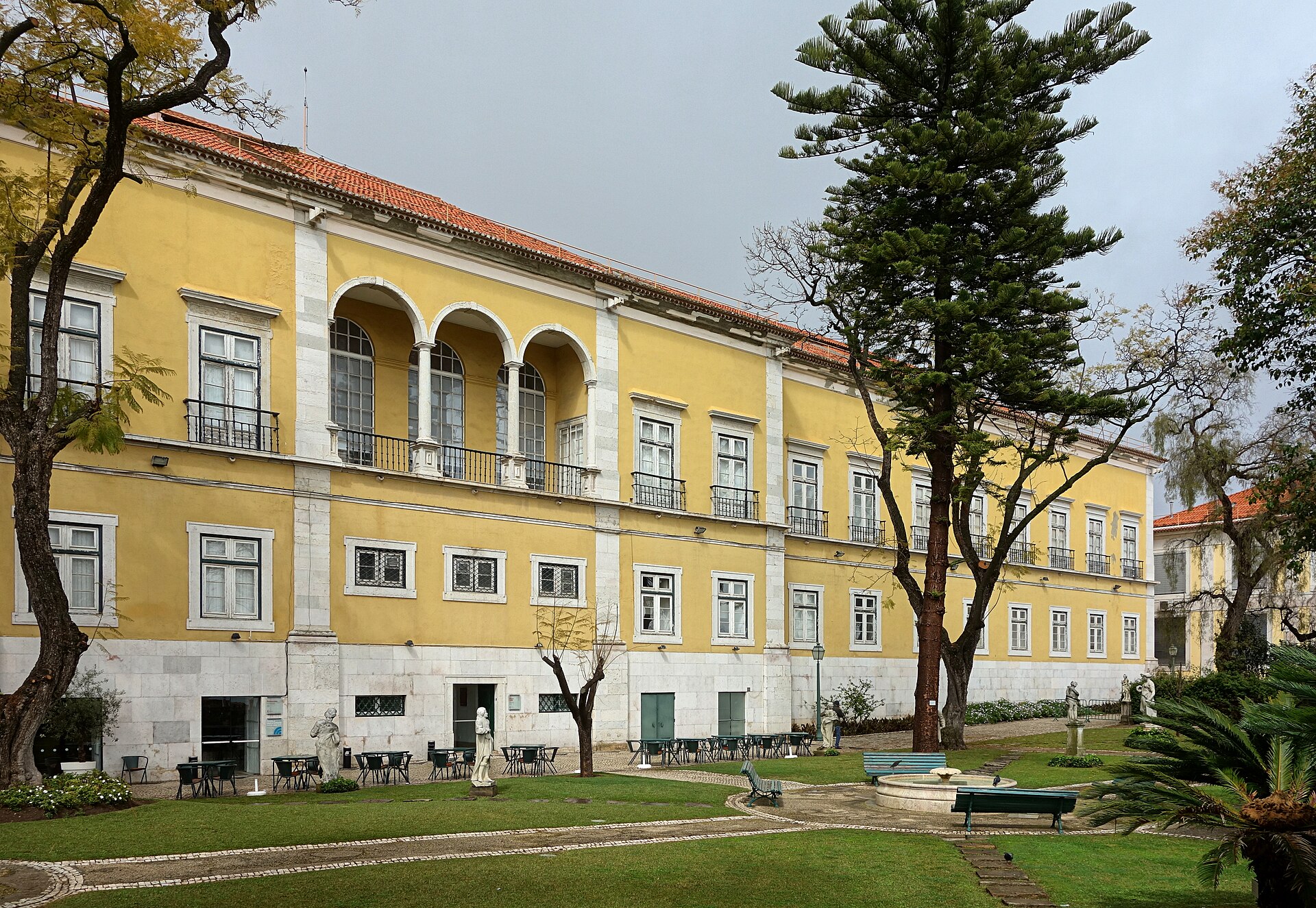
- The museum's rear garden facade, overlooking the Tagus, carries a restaurant terrace (esplanada) directly below an arched loggia, visible in one of this record's own photographs; museusemonumentos.pt's resource list for the museum names a 'Restaurante e esplanada' among its facilities alongside the library, shop and auditorium.
- Shop
- A shop (Loja) is listed among the museum's facilities and has its own staff contact ([email protected]) on the museum's own contacts page.
The museum is closed (see above). These are the figures published before the closure, kept here for a visitor planning ahead rather than presented as bookable today, and you can check the current position at the source we used. We will re-confirm them once it reopens.
What is inside
Portuguese Painting (Piso 3)
The museum's own top floor is given over to Portuguese painting from the Middle Ages to the nineteenth century, and it is here, in Room 2, that the Saint Vincent Panels by Nuno Gonccalves hang: six oak panels of 58 figures gathered around a double image of Saint Vincent, painted around 1470 for the court painter to Afonso V and, on the museum's own account, still only partly understood in what it depicts or who commissioned it. The floor also carries Domingos Antonio de Sequeira's Adoracao dos Magos, Gregorio Lopes' Martirio de Sao Sebastiao, the anonymous 1549 Julgamento Final and Cristovao de Moraes' portrait of Dom Sebastiao, among other works spanning the same centuries.
European Painting (Piso 1)
The ground-floor European Painting galleries, rooms 52 through 69 on the museum's own room numbering, hold the museum's Old Masters from outside Portugal: Hieronymus Bosch's Temptacoes de Santo Antao triptych in Room 61, Albrecht Durer's Sao Jeronimo in the same room, Raphael's Milagre de Santo Eusebio de Cremona, Lucas Cranach the Elder's Salome com a Cabeca de Sao Joao Batista, and further works by Hans Memling and Piero della Francesca named on the museum's own collection pages. This gallery was partially closed and reopened twice in 2025 as PRR renovation works advanced room by room ahead of the museum's full closure that September.
Gold and Silverwork and Jewellery (Ourivesaria e Joalharia, Piso 2, Room 29)
Room 29 holds two of the museum's most-illustrated single objects: the Custodia de Belem, a gold and enamel monstrance made in 1506, attributed to the goldsmith and playwright Gil Vicente, commissioned by Manuel I for the Jeronimos Monastery from gold brought back by Vasco da Gama from the tribute of the ruler of Kilwa in 1503; and the Cruz de Dom Sancho I, a gold, sapphire, garnet and pearl reliquary cross made in 1214 for the Monastery of Santa Cruz in Coimbra to hold a relic of the True Cross, its reverse engraved with the Lamb of God and the symbols of the four Evangelists. The department also holds a wider run of Portuguese and European gold, silver and jewellery, overseen on the museum's own staff list by the curator Luisa Penalva.
Art of the Expansion (Arte da Expansao, Piso 2, Room 14)
This department gathers what the museum's own overseas trade brought into Portuguese hands: a pair of Japanese Namban folding screens from around 1606, attributed to the Kano school, showing the arrival of Portuguese ships at Nagasaki in minute, documentary detail down to the Jesuit missionaries and the cargo being unloaded; alongside Indo-Portuguese furniture, Chinese and Japanese export ceramics, and African ivory and metalwork, including Benin salt cellars carved for the European market. It is the section of the collection most directly built from Portugal's own maritime and colonial trade rather than from ecclesiastical or royal inheritance, and the one that at least one named published review singled out as the museum's most distinctive material, in contrast to the more generic run of European Old Masters elsewhere in the building.
Sculpture (Escultura)
The sculpture department spans medieval to eighteenth-century work: Joaquim Machado de Castro's Santa Ana Ensinando a Virgem a Ler, an anonymous nativity scene from Setubal, an English alabaster panel attributed to a Nottingham workshop, and a Saint Leonard attributed to the Florentine workshop of Andrea and Girolamo della Robbia, among the pieces the museum's own collection pages list under this heading.
Furniture (Mobiliario, Piso 1, Room 36)
The museum states its own furniture holding is the largest collection of Portuguese furniture in the country. Its centrepiece in Room 36 is the Cadeira de Estado, known as the chair of Dom Afonso V: an orthogonal oak chair of around 1470-1475 from the Franciscan convent of Santo Antonio do Varatojo in Torres Vedras, a convent Afonso V himself founded in 1470, preserved by generations of friars as a relic of that royal foundation rather than for ordinary use.
What to see first
Saint Vincent Panels (Paineis de Sao Vicente)
Nuno Goncalves, court painter to Afonso V (active 1450-1491)Six oak panels, painted around 1470, gathering 58 individually characterised figures of the Portuguese court and society around a double image of Saint Vincent in what the museum's own page calls a singular 'collective portrait' in the history of European painting. The work surfaced from storage at the Sao Vicente de Fora monastery and entered the museum's collection in 1913; who the figures are, what the altarpiece originally meant, and even its precise date have been argued over since, with a 2000 study proposing 1445 rather than the conventional c.1470 and a 2018 study revising the identification of one central figure from the Infante Dom Henrique to the Infante Dom Pedro. The panels have been under conservation and study since 2020, and the museum's director has tied their restored return to the display specifically to the museum's eventual reopening.10
Custodia de Belem
Attributed to Gil Vicente, Portugal, 1506A gold and polychrome enamel monstrance, 73 cm high, made for Manuel I to hold the consecrated host at the Jeronimos Monastery, from gold brought to Portugal by Vasco da Gama as tribute exacted from the ruler of Kilwa on his second voyage to India in 1503. Its design, armillary spheres binding an earthly base to a celestial upper register bearing God the Father, is read on the museum's own page as a direct statement of Manueline royal power at the height of Portugal's oceanic expansion. It is attributed to Gil Vicente, better known as the founding figure of Portuguese theatre, in his separate career as a goldsmith.11
Namban Screens (Biombos Namban)
Attributed to the Kano school: first pair sealed by Kano Naizen (1570-1616), second pair attributed to Kano DomiTwo pairs of Japanese folding screens, the earlier around 1606, painted in mineral pigment and gold leaf on paper over a wood and lacquer frame, depicting the arrival of Portuguese carracks at the port of Nagasaki. The museum's own description calls them a unique historical and visual document of the sixteenth and seventeenth-century relationship between Portugal and Japan, recording the Portuguese merchants the Japanese called namban jin, 'southern barbarians', alongside the Jesuit missionaries who followed the trade. Bought on the Paris and Japanese art markets in the early 1950s.12
The Temptation of Saint Anthony (Tentacoes de Santo Antao)
Jheronymus Bosch, signed lower left of the central panel, c. 1500A triptych in oil on oak, its inner faces showing three episodes of Saint Anthony's temptation by demons rendered as monstrous hybrids, its closed outer faces painted in near-monochrome grisaille. The museum's own text calls it central to Bosch's whole output: the solitary just man against a world dominated by evil, given both grotesque and falsely beautiful form. It entered the collection from the Palacio das Necessidades in 1913 and is one of only a small number of paintings securely attributed to Bosch anywhere in the world.13
Saint Jerome (Sao Jeronimo)
Albrecht Durer, 1521Painted during Durer's 1520-1521 journey to the Netherlands and given by the artist himself to Rui Fernandes de Almada, secretary of the Portuguese trading post in Antwerp, this small oak panel shows the scholar-saint as an old man absorbed in meditation on death, a composition the museum's own text calls an innovative departure in how the subject had previously been painted. Four preparatory drawings for it survive, in Vienna's Albertina and Berlin's Museen Dahlem.15
Cross of Dom Sancho I (Cruz de D. Sancho I)
Unknown goldsmith, Portugal, 1214A gold reliquary cross set with sapphires, garnets and pearls, commissioned by King Sancho I for the Monastery of Santa Cruz in Coimbra to hold a relic of the True Cross, tying the cross to the Augustinian canons' own dedication to that relic under the kingdom's founder, Afonso Henriques. Its pierced reverse centres on the Lamb of God, resurrected and standing, surrounded by the symbolic eagle, lion, ox and angel of the four Evangelists. One of the earliest surviving goldsmith's works securely tied to the Portuguese crown.14
State Chair of Dom Afonso V (Cadeira de Estado, dita de D. Afonso V)
Unknown maker, Portugal, c. 1470-1475An orthogonal oak chair with architectural carving, from the Franciscan convent of Santo Antonio do Varatojo, which Afonso V founded in 1470; the museum's own text describes it as one of the oldest known examples of Portuguese furniture-making, kept by generations of friars less as a functional chair than as a physical memory of the king's own foundation of their house.16
Past exhibitions here
- Closed30 May to 4 Oct 2026Confirmed · check before you travel
A viceroy's palace, inherited three times over
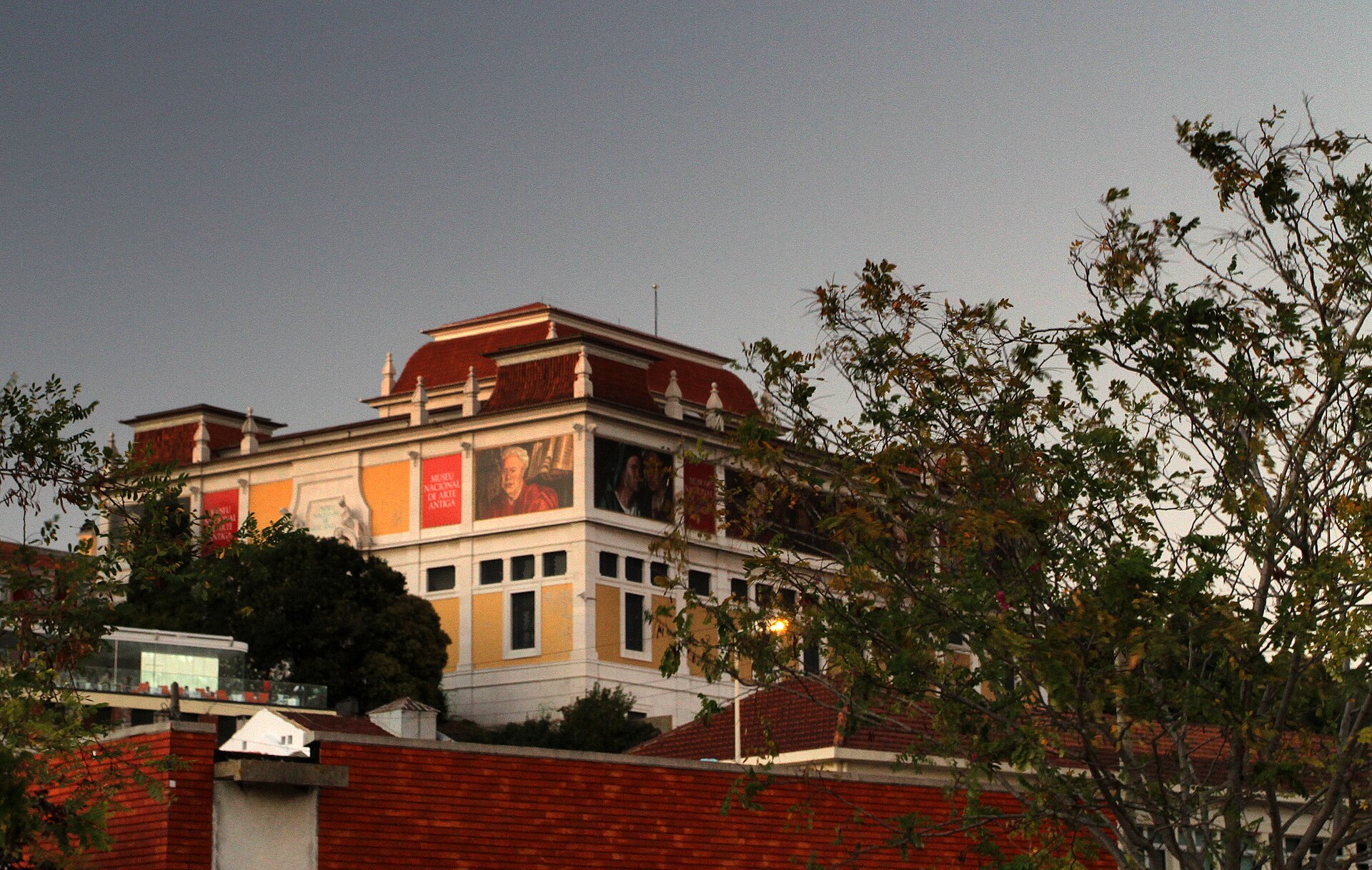
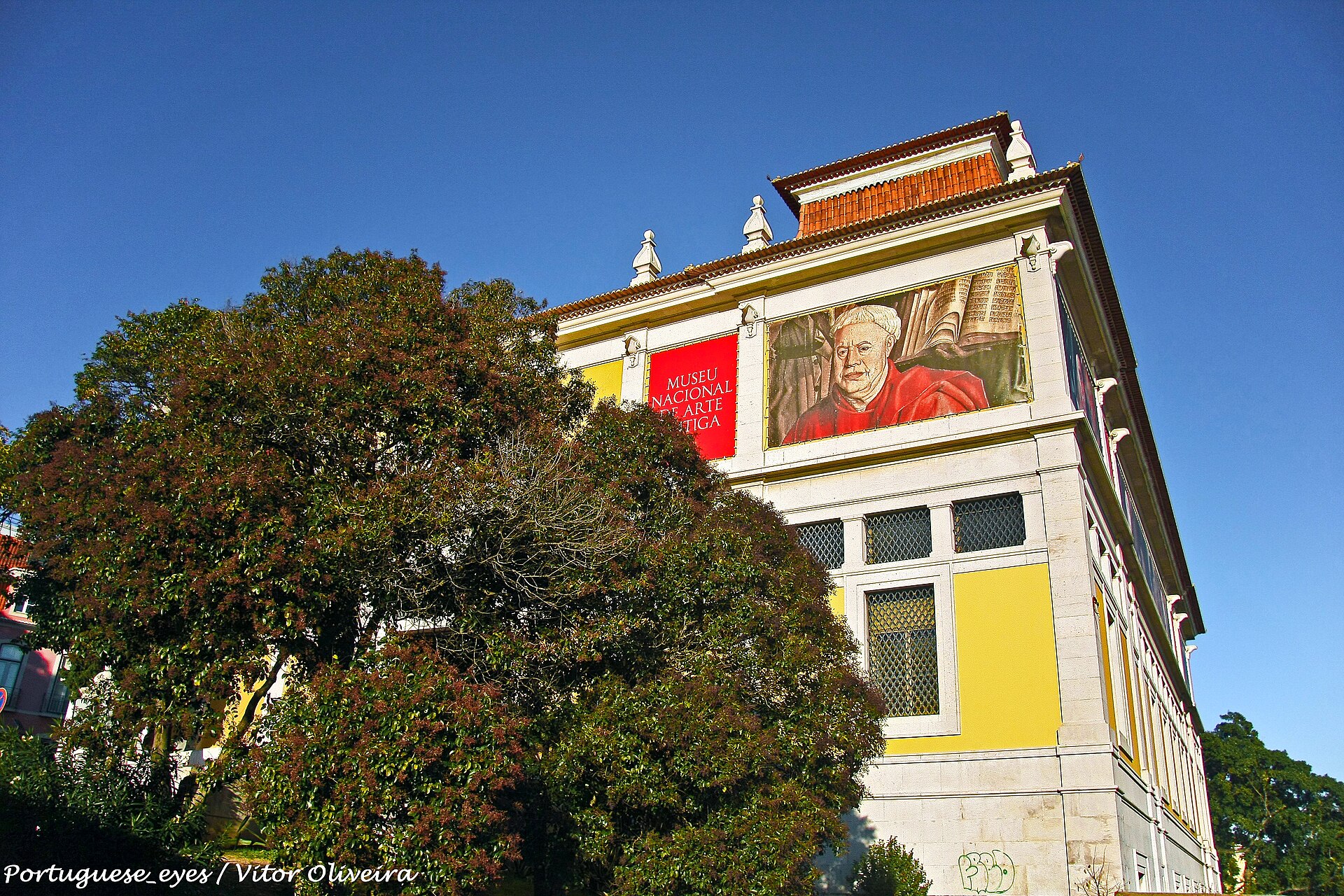
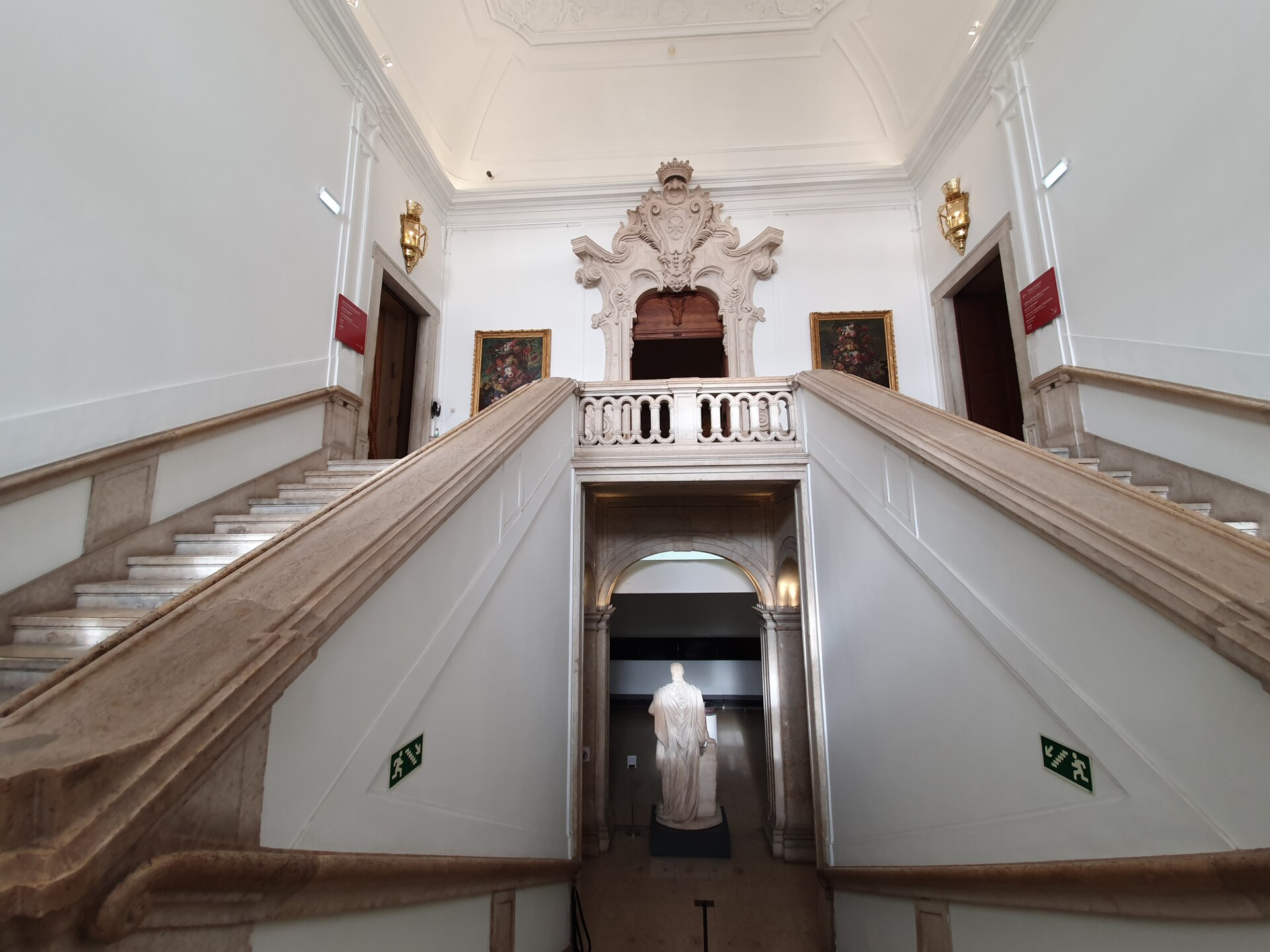
The museum occupies a palace it did not build. In the closing years of the seventeenth century, Dom Francisco de Tavora, the first Count of Alvor, had it built on his return from serving as viceroy of India, and the building the museum's own history page describes is typical of the civil architecture of the period: a long, plain facade running parallel to the street, its severity broken only by the animated Baroque stonework of its two formal portals. Two rooms carry painted quadratura ceilings attributed to the Florentine artist Vincenzo Bacherelli, work that almost certainly dates to the time of the first or second Count of Alvor; other ceilings were later given rocaille stucco ornament attributed to Giovanni Grossi, one of the few surviving traces anywhere in the building of its original decorative programme.
Ownership moved on from the Alvor family in 1744, to Matias Aires Ramos da Silva de Eca, the crown's own mint overseer, who let the house first to the German ambassador and then, from 1762, to Daniel Gildemeester, the Dutch consul and holder of Portugal's diamond-trading contract, who lived there for decades and paid for substantial interior work of his own. On Matias de Aires' death the house passed to Paulo de Carvalho, who bought it at public auction through Gildemeester's own agency in 1768, and from him, by inheritance, to his brother, the Marques de Pombal, in whose family it stayed until the Portuguese state bought it in 1883 specifically to house the new Museu Nacional de Belas-Artes. In between, the palace was also home to the widowed Duchess of Braganca, wife of the future Dom Pedro IV, who died there in 1873. The museum that eventually took the building's name, the Museu Nacional de Arte Antiga, was created the following year, in 1884, and has occupied the same palace, now more than 140 years, ever since.
What the state took from the church and the crown
The museum's own account of its founding traces the collection less to the palace than to the political upheaval that made a national museum possible at all: the 1834 dissolution of Portugal's religious orders, which released monastic altarpieces, plate and vestments into state hands on a scale no single institution had held before. The museum's history page is explicit that this ecclesiastical windfall, together with incorporations from the royal palaces as the monarchy itself receded, forms the backbone of the collection, subsequently built up further by donation and purchase into what the museum's own description calls Portugal's most important public collection across painting, sculpture, gold and silverwork and the decorative arts, both European and drawn from Africa and the East.
The numbers the museum states for itself are substantial: more than 40,000 items in total, including, within their respective categories, the largest number of works classified by the Portuguese state as 'tesouros nacionais', national treasures, of any collection in the country, and, separately, the largest collection of Portuguese furniture anywhere. The museum's own language for its place in Portuguese museology is unusually direct: it describes itself as the country's 'museu nacional normal', the museum that sets the norm other Portuguese museums are measured against, in conservation practice, in museography and, it states, in having pioneered the country's first dedicated museum education service.
A collective portrait nobody has finished reading
If the museum has one object that stands for the whole collection, on the evidence of its own '60 minutos' highlights trail and of how consistently outside sources single it out, it is the Saint Vincent Panels: six oak panels painted around 1470 by Nuno Goncalves, court painter to Afonso V, gathering 58 individually rendered figures of the Portuguese court and clergy in a solemn, crowded assembly around a double image of Saint Vincent. The panels surfaced from among the stored possessions of the Sao Vicente de Fora monastery in the early 1880s and entered the museum's own collection in 1913, and more than a century of scholarship has not settled what they show. The museum's own page states plainly that a full understanding of the work's intention and meaning 'remains problematic'; a study published in 2000 argued the panels were painted a generation earlier than the conventional c.1470 dating, around 1445, and a 2018 study using detailed imaging revised the identification of one of the most debated figures in the crowd, the man in the tall hat previously read as the Infante Dom Henrique, Henry the Navigator, proposing instead his brother the Infante Dom Pedro. The panels have been under active conservation and technical study since 2020, and the museum's current director, Maria de Jesus Monge, has tied the panels' return to display, restored, directly to the reopening of the museum itself.
The rest of the painting collection is arranged around that centrepiece rather than competing with it. The top floor carries Portuguese painting from the Middle Ages onward, including major works by Domingos Antonio de Sequeira and Gregorio Lopes; the ground floor's European Painting galleries, in rooms the museum numbers from the fifties into the sixties, hold Hieronymus Bosch's Temptation of Saint Anthony triptych and Albrecht Durer's Saint Jerome side by side in Room 61, with further works by Raphael, Lucas Cranach the Elder, Hans Memling and Piero della Francesca elsewhere on the same floor. A published review from 2021 judged this general run of Old Masters solid rather than exceptional, 'all rather nice, but not mind-blowing' was the phrase used, precisely because the Bosch and the Durer, like the Saint Vincent Panels a floor above, are doing most of the work.
Gold, ivory and lacquer: what the empire brought back
Two further rooms carry objects that a purely European art-historical museum would not have. Room 29, the gold and silverwork gallery, holds the Custodia de Belem, a 1506 gold and enamel monstrance attributed to the goldsmith and playwright Gil Vicente, commissioned by Manuel I from gold that Vasco da Gama brought back as tribute from the ruler of Kilwa on his second voyage to India in 1503; its design binds an earthly base to a celestial upper register bearing God the Father beneath the king's own armillary-sphere emblem, read by the museum's own text as a direct material statement of royal power at the height of Portugal's oceanic expansion. The same room holds an older, starker object, the Cross of Dom Sancho I: a gold cross set with sapphires, garnets and pearls that Sancho I commissioned in 1214 for the Monastery of Santa Cruz in Coimbra to hold a relic of the True Cross, its reverse pierced with the Lamb of God and the symbols of the four Evangelists.
Room 14, given to Art of the Expansion, is where the collection is least like any other European national gallery's holdings. Two pairs of Japanese Namban screens, the earlier attributed to the Kano school around 1606, show the arrival of Portuguese carracks at Nagasaki in dense, documentary detail, missionaries, cargo and the ship itself all rendered in mineral pigment and gold leaf; the museum's own description calls them a unique historical and visual record of the Portuguese-Japanese relationship that began in 1543. The same galleries hold Indo-Portuguese furniture, Chinese and Japanese export ceramics, and African ivory and metalwork, including Benin salt cellars carved to European taste. It was this material, not the European Old Masters elsewhere in the building, that a 2021 published review singled out as the one part of the museum offering something genuinely unlike a standard national gallery, even as the same review noted it saw little sign of the museum reflecting critically on what that colonial trade actually meant for the people on the other end of it.
A museum stripped for renovation, on a deadline set in Brussels
As of the date this page was researched, none of the above can be seen. The museum's own site states, in both its Portuguese and English versions, that the MNAA closed to the public on 29 September 2025 for works funded under Portugal's Recovery and Resilience Plan (PRR), and that its reopening is 'subject to the schedule of this intervention process', without naming a date. The closure was staged rather than sudden: the museum's previous director, Joaquim Caetano, had already closed the European Painting Gallery in March 2025 in anticipation of works that then failed to start, and, after visitor complaints over the summer, the museum partially reopened and rehung that same gallery in June, only to close the whole building at the end of September once the works were finally confirmed. Reporting from the Lusa news agency puts the funding at 6.57 million euros, of which 1.32 million had been disbursed by September 2025, with the works covering three zones: the Piso 2 galleries of gold and silverwork, jewellery, ceramics and Art of the Expansion, which are due updated display equipment and layout; the European Painting Gallery, due new signage and museography; and the building's own roof and facades, due structural rehabilitation. Conservation of the Capela das Albertas, a chapel within the museum complex, is reported as continuing in parallel, with its own reopening likewise tied to the PRR calendar.
The museum's current director, Maria de Jesus Monge, who took up the post on 1 March 2025, has been candid in interviews about how uncertain the timeline actually is. Speaking to Lusa on the day the closure was announced, she said the works, originally due to start roughly a year earlier, had been repeatedly delayed because 'the tenders kept coming back empty' and a workable contract proved hard to put together; she nonetheless expects the museum to reopen 'certainly in the second half of 2026', while adding immediately afterward, in the same interview, 'but we don't know, because we are dependent on the PRR's own calendars'. Those calendars carry a completion deadline reported as 30 June 2026, a date she has described as unusually firm by Portuguese public-works standards precisely because it is set in Brussels rather than by the museum or its ministry. During the closure the museum's conservation teams are reported to be continuing their work inside the building, including the restoration of the Saint Vincent Panels that began in 2020, which the director has said she expects to be complete and back on display, in her words 'at its very best', for whenever the museum does reopen.
What visitors say
We publish no visitor-review prose, so what follows draws on an aggregate score and one named published review. The MNAA is consistently described, including by the museum's own state parent body, as Portugal's principal public collection of painting, sculpture and decorative arts, holding the largest number of objects classified by the Portuguese state as national treasures. Published visitor accounts describe a museum that rewards patience over spectacle: a standard-format European Old Masters collection, strong but not overwhelming, set inside a former viceroy's palace whose own architecture, gardens and river-facing terrace are part of the appeal, with the Art of the Expansion galleries and the handful of single masterworks, the Saint Vincent Panels, the Bosch triptych, the Belem monstrance, most often singled out as worth the detour from Lisbon's more heavily trafficked museums. Since September 2025 the dominant fact about the museum has been its closure for PRR-funded roof, facade and gallery renovation, with a director-stated hope, not a guarantee, of reopening in the second half of 2026 alongside a newly restored Saint Vincent Panels.
What is praised, what is criticised
- Praised: the Art of the Expansion rooms, named by a published review as the most distinctive part of the collection for showing genuine cultural exchange, Indo-Portuguese furniture, a Japanese screen of the Portuguese arrival at Nagasaki, a Benin salt cellar carved with European faces, rather than a further run of standard European Old Masters
- Praised: the building itself, a late seventeenth-century palace built for the first Count of Alvor on his return as viceroy of India, with surviving painted ceilings attributed to the Florentine Vincenzo Bacherelli and rocaille stuccowork attributed to Giovanni Grossi, plus a riverside garden and terrace that reviewers note as a pleasant space in its own right
- Praised: the depth and rarity of the single masterworks concentrated in a small number of rooms, above all the Saint Vincent Panels, the Bosch triptych and the Belem monstrance, repeatedly named across sources as reasons to visit even by reviewers otherwise unmoved by the general collection
- Criticised: a general sense, in at least one named published review, that the museum sits off Lisbon's main tourist circuit and can feel under-visited and slightly institutional on a quiet day, with the bulk of the non-Portuguese Old Masters collection judged 'rather nice, but not mind-blowing' next to the more distinctive Expansion galleries
- Criticised: the unresolved scholarly gaps in the museum's own signature object, the Saint Vincent Panels, whose date, authorship circumstances and the identities of several of its 58 figures remain disputed more than a century after the panels entered the collection, most recently with a 2018 study revising the identification of one of the central figures
- Criticised: the length and uncertainty of the 2025-2026 PRR renovation itself: the museum's own former and current directors have described construction tenders that repeatedly failed to attract bidders, a start delayed by roughly a year against the original plan, and a reopening the current director describes as expected but not confirmed
Ratings on other platforms
TripAdvisor: 4.5 from 1,330 ratings, read 21 August 2026
A platform average is a tertiary source: it moves, it is not audited, and we quote no visitor's words.
Questions about National Museum of Ancient Art
Where is National Museum of Ancient Art?
Rua das Janelas Verdes, 1249-017 Lisboa, Portugal.
How much does it cost to visit?
Normal (adult): EUR 15. As confirmed 21 August 2026.
When is it open?
Tue-Sun 10:00-18:00. Closed: Monday. 1 January. As confirmed 21 August 2026.
How do you get there?
Bus: Rua das Janelas Verdes itself is served by routes 713, 714 and 727; Avenida 24 de Julho, a short walk below the museum toward the river, is served by routes 728, 732 and 760 and by trams 15E and 18E; Tram: Trams 15E and 18E stop on Avenida 24 de Julho below the museum; tram 25E stops at Largo de Santos, the nearest square on the Lapa side; Walking: The museum sits in the Estrela/Lapa district between the riverfront Avenida 24 de Julho and the Santos and Estrela neighbourhoods, roughly midway between central Lisbon and Belem, on the route many visitors otherwise walk or bus straight past on the way to the Jeronimos Monastery.
What should you see first?
Saint Vincent Panels (Paineis de Sao Vicente) (Nuno Goncalves, court painter to Afonso V (active 1450-1491)); Custodia de Belem (Attributed to Gil Vicente, Portugal, 1506); Namban Screens (Biombos Namban) (Attributed to the Kano school: first pair sealed by Kano Naizen (1570-1616), second pair attributed to Kano Domi); The Temptation of Saint Anthony (Tentacoes de Santo Antao) (Jheronymus Bosch, signed lower left of the central panel, c. 1500); Saint Jerome (Sao Jeronimo) (Albrecht Durer, 1521); Cross of Dom Sancho I (Cruz de D. Sancho I) (Unknown goldsmith, Portugal, 1214).
What we could not confirm
- English Wikipedia dates the museum's formal establishment to 11 May 1884 under the name Museu Nacional de Belas-Artes e Arqueologia; the museum's own site simply states 'Criado em 1884' without a specific day. This page follows the museum's own account and does not resolve the exact date.
- The PRR funding deadline is reported as '30 de junho de 2026' by the ECO/Lusa report used as a source on this page, but as '31 de junho de 2026' in the RTP/Lusa report of the same director interview, also used here; 31 June does not exist as a calendar date, so this page treats 30 June 2026 as the intended figure and flags the discrepancy rather than silently correcting the RTP wording.
- The museum's own object page for the Saint Vincent Panels records their provenance as entering the collection from the Paco de Sao Vicente de Fora in 1913, while other published accounts describe the panels as having been rediscovered among stored monastery property in 1882; this page has not established whether 1882 marks a discovery and 1913 a formal accession, or whether one of the two dates is simply wrong in the source that gives it.
- No source read for this record gives a current total visitor count; the most recent figure located, 423,054 visitors in 2018, comes from English Wikipedia (tertiary) and predates both the pandemic and the 2025 closure by several years, so it is not repeated as a current fact anywhere else on this page.
- Whether any free-admission day applies to the MNAA, as is common practice at other Portuguese national museums, is not stated in either museudearteantiga.pt or museusemonumentos.pt as read for this record.
- Accessibility, photography and bag-check policy are not published on any page read for this record; the museum's own site lists a dedicated Acessibilidade page in its footer navigation that was not reachable during this research.
Images
Sources
- 1Wikidata, National Museum of Ancient Art (Q212459). Verified by label match in English and Portuguese, country Portugal, location Lisbon/Estrela, coordinates 38 42' 19.08" N / 9 9' 38.59" W (converts to 38.7053, -9.16072, matching this record's given coordinates exactly), instance-of art/national museum, founding date 1884, and official website field. Confirmed this is the singular Lisbon institution and not any other 'National Gallery of Ancient Art' worldwide. wikidata.org/wiki/Q212459
- 2Museu Nacional de Arte Antiga, official site, 'Historia' page. The museum's own account of its 1884 founding, its 140-plus years in the Palacio Alvor, its 40,000-plus item collection, the ecclesiastical and royal-palace origin of the collection, and its self-description as Portugal's 'museu nacional normal'. Fetched via the in-app browser, raw page text read directly, 21 August 2026. museudearteantiga.pt/sobre-o-museu/historia
- 3Museu Nacional de Arte Antiga, official site, 'Edificio' page. The full building history: construction for the first Count of Alvor after his return as viceroy of India, ownership passing through Matias Aires Ramos da Silva de Eca, Daniel Gildemeester, Paulo de Carvalho and the Marques de Pombal's family, the 1873 death of the Duchess of Braganca in the palace, the 1883 state purchase, the Bacherelli and Grossi decorative ceilings, the Santo Alberto chapel incorporation, the 1930s-40s west wing by architect Guilherme Rebelo de Andrade, and the 1983 and 1992-1994 renovations by architect Joao de Almeida. Fetched via the in-app browser, raw page text read directly, 21 August 2026. museudearteantiga.pt/sobre-o-museu/edificio
- 4Museu Nacional de Arte Antiga, official site, 'Contactos' page. Address, phone (+351 213 912 800), general email ([email protected]), director's name, and department and curatorial staff by collection area, including facilities such as the shop, library and cedencia de espacos. Fetched via the in-app browser, raw page text read directly, 21 August 2026. museudearteantiga.pt/contactos
- 5Museu Nacional de Arte Antiga, official site, 'The MNAA will close' (English) and 'Encerramento ao publico' (Portuguese) pages. State directly, in both languages, that the museum closed to the public on 29 September 2025 for PRR renovation works and that reopening is subject to the schedule of that process, with no date given. Fetched via the in-app browser, raw page text read directly, 21 August 2026. museudearteantiga.pt/the-mnaa-will-close/
- 6Museu Nacional de Arte Antiga, official site, 'Como Chegar' page. Bus routes 713/714/727 on Rua das Janelas Verdes, bus routes 728/732/760 and trams 15E/18E on Avenida 24 de Julho, tram 25E at Largo de Santos, and the museum's own GPS coordinates. Fetched via the in-app browser, raw page text read directly, 21 August 2026. museudearteantiga.pt/como-visitar/como-chegar
- 7Museus e Monumentos de Portugal (state umbrella body operating the MNAA, sharing its [email protected] contact address), official page for the Museu Nacional de Arte Antiga. States 'Encerrado para obras de requalificacao' at the top of the page, and separately publishes the museum's last standing opening hours (Tuesday-Sunday, 10:00-18:00, closed 1 January, Easter Sunday, 1 May, 13 June, 25 December) and admission price (Normal: 15,00 EUR), plus the director's name, address, phone and email. Fetched via the in-app browser, raw page text read directly, 21 August 2026. museusemonumentos.pt/pt/museus-e-monumentos/museu-nacional-de-arte-antiga
- 8RTP/Lusa, 'Museu de Arte Antiga reabre no 2o semestre de 2026 com Paineis de Sao Vicente restaurados', 22 September 2025. Direct quotation of director Maria de Jesus Monge on the reopening estimate ('Com certeza que sera no segundo semestre de 2026, mas nao sabemos, porque estamos dependentes dos calendarios do PRR'), the delayed start of works, empty construction tenders, the March-to-June 2025 partial closure and reopening of the European Painting Gallery, the PRR completion deadline, and the ongoing restoration of the Saint Vincent Panels since 2020. Fetched via the in-app browser, raw page text read directly, 21 August 2026. rtp.pt/noticias/cultura/museu-de-arte-antiga-reabre-no-2o-semestre-de-2026-com-paineis-de-sao-vicente-restaurados_n1685403
- 9ECO/Lusa, 'Museu Nacional de Arte Antiga encerra a 29 de setembro para obras', 22 September 2025. The 29 September 2025 closure date, a final free-admission week beforehand, the three intervention zones (Piso 2 decorative arts galleries, European Painting Gallery signage and museography, and roof/facade rehabilitation), the parallel Capela das Albertas conservation campaign, PRR funding of 6.57 million euros with 1.32 million disbursed by that date and a 30 June 2026 completion deadline, and the earlier March 2025 partial closure of the European Painting Gallery. Fetched via the in-app browser, raw page text read directly, 21 August 2026. eco.sapo.pt/2025/09/22/museu-nacional-de-arte-antiga-encerra-a-29-de-setembro-para-obras/
- 10Museu Nacional de Arte Antiga, official collection page for the Saint Vincent Panels (Paineis de Sao Vicente). Attribution to Nuno Goncalves (active 1450-1491), c.1470 dating, medium and dimensions of all six panels, 1913 provenance from the Paco de Sao Vicente de Fora, and the museum's own statement that full understanding of the work's meaning 'remains problematic'. Fetched via the in-app browser, raw page text read directly, 21 August 2026; cross-checked against WebSearch results summarising the 2000 and 2018 scholarly re-datings and re-identifications. museudearteantiga.pt/colecoes/pintura-portuguesa/paineis-de-sao-vicente
- 11Museu Nacional de Arte Antiga, official collection page for the Custodia de Belem. Attribution to Gil Vicente, 1506 date, gold and polychrome enamel medium, dimensions, provenance from the Mosteiro dos Jeronimos in 1925, and the museum's own account of the gold's origin as tribute from the Regulo de Quiloa brought back by Vasco da Gama in 1503. Fetched via the in-app browser, raw page text read directly, 21 August 2026. museudearteantiga.pt/colecoes/ourivesaria/custodia-de-belem
- 12Museu Nacional de Arte Antiga, official collection page for the Namban Screens (Biombos Namban). Attribution (first pair sealed by Kano Naizen, second pair attributed to Kano Domi), Momoyama/Edo period dating (first pair c.1606), materials and dimensions, 1952-1954 art-market provenance, and the museum's own description of the screens as a unique historical document of Portuguese-Japanese relations following 1543. Fetched via the in-app browser, raw page text read directly, 21 August 2026. museudearteantiga.pt/colecoes/arte-da-expansao/biombos-namban
- 13Museu Nacional de Arte Antiga, official collection page for the Temptation of Saint Anthony (Tentacoes de Santo Antao). Attribution to Jheronymus Bosch (signed, lower left of the central panel), c.1500 dating, oil-on-oak medium and dimensions, 1913 provenance from the Palacio das Necessidades, and the museum's own description of the triptych's iconography. Fetched via the in-app browser, raw page text read directly, 21 August 2026. museudearteantiga.pt/colecoes/pintura-europeia/tentacoes-de-santo-antao
- 14Museu Nacional de Arte Antiga, official collection page for the Cross of Dom Sancho I (Cruz de D. Sancho I). 1214 date, gold/sapphire/garnet/pearl medium, dimensions, 1916 provenance from the Mosteiro de Santa Cruz de Coimbra, and the museum's own description of the reverse iconography (Lamb of God and the four Evangelist symbols). Fetched via the in-app browser, raw page text read directly, 21 August 2026. museudearteantiga.pt/colecoes/ourivesaria/cruz-de-d-sancho-i
- 15Museu Nacional de Arte Antiga, official collection page for Saint Jerome (Sao Jeronimo). Attribution to Albrecht Durer, 1521 date, oil-on-oak medium and dimensions, 1880 purchase provenance, and the museum's own account of the painting's gift to Rui Fernandes de Almada and the four surviving preparatory drawings in Vienna and Berlin. Fetched via the in-app browser, raw page text read directly, 21 August 2026. museudearteantiga.pt/colecoes/pintura-europeia/sao-jeronimo
- 16Museu Nacional de Arte Antiga, official collection page for the State Chair of Dom Afonso V (Cadeira de Estado, dita de D. Afonso V). c.1470-1475 dating, oak medium and dimensions, 1913 provenance from the Convento do Varatojo in Torres Vedras, and the museum's own account of the chair's association with Afonso V's 1470 founding of that convent. Fetched via the in-app browser, raw page text read directly, 21 August 2026. museudearteantiga.pt/colecoes/mobiliario/cadeira-de-estado-dita-de-d-afonso-v
- 17Museu Nacional de Arte Antiga, official site, '60 minutos' quick-visit route. Lists fifteen highlight objects with their gallery/floor locations, used to cross-check room numbers against the individual object pages and to establish which objects the museum itself treats as its own highlights. Fetched via the in-app browser, raw page text read directly, 21 August 2026. museudearteantiga.pt/60-minutos/
- 18Salterton Arts Review, 'Museu Nacional de Arte Antiga (National Museum of Ancient Art), Lisbon', by Erin Caswell, published 13 November 2021. A named, dated, published review giving a 3/5 rating; praised the Art of the Expansion galleries as the most distinctive part of the museum; described the general European Old Masters collection as 'all rather nice, but not mind-blowing'; noted the museum felt quiet and slightly off the main tourist track, with the Portuguese painting floor closed on the day of the visit. Fetched via the in-app browser, raw page text read directly and in full, 21 August 2026, to confirm every characterisation used on this page against the actual bytes of the page rather than a summarised fetch. saltertonartsreview.com/2021/11/museu-de-arte-antiga-lisbon/
- 19TripAdvisor, attraction page for Museu Nacional De Arte Antiga, Lisbon. Aggregate rating of 4.5 out of 5 from 1,330 reviews, ranked #28 of 1,307 things to do in Lisbon at the time read. Read directly via the in-app browser (not a summarised fetch) to obtain the actual score and count; no review text reproduced. tripadvisor.com/Attraction_Review-g189158-d195736-Reviews-Museu_Nacional_De_Arte_Antiga-Lisbon_Lisbon_District_Central_Portugal.html
- 20English Wikipedia, 'National Museum of Ancient Art'. Cross-checked founding date (11 May 1884, as Museu Nacional de Belas-Artes e Arqueologia), building history (Palacio Alvor-Pombal, 1940 Santo Alberto convent incorporation), and a 2018 visitor figure of 423,054. en.wikipedia.org/wiki/National_Museum_of_Ancient_Art
- 21Wikimedia Commons, Category:Exterior of Museu Nacional de Arte Antiga, Category:Interior of Museu Nacional de Arte Antiga, and the individual file pages for all five images used on this record. commons.wikimedia.org/wiki/Category:Museu_Nacional_de_Arte_Antiga