Mary Cassatt
 American · 1844-1926
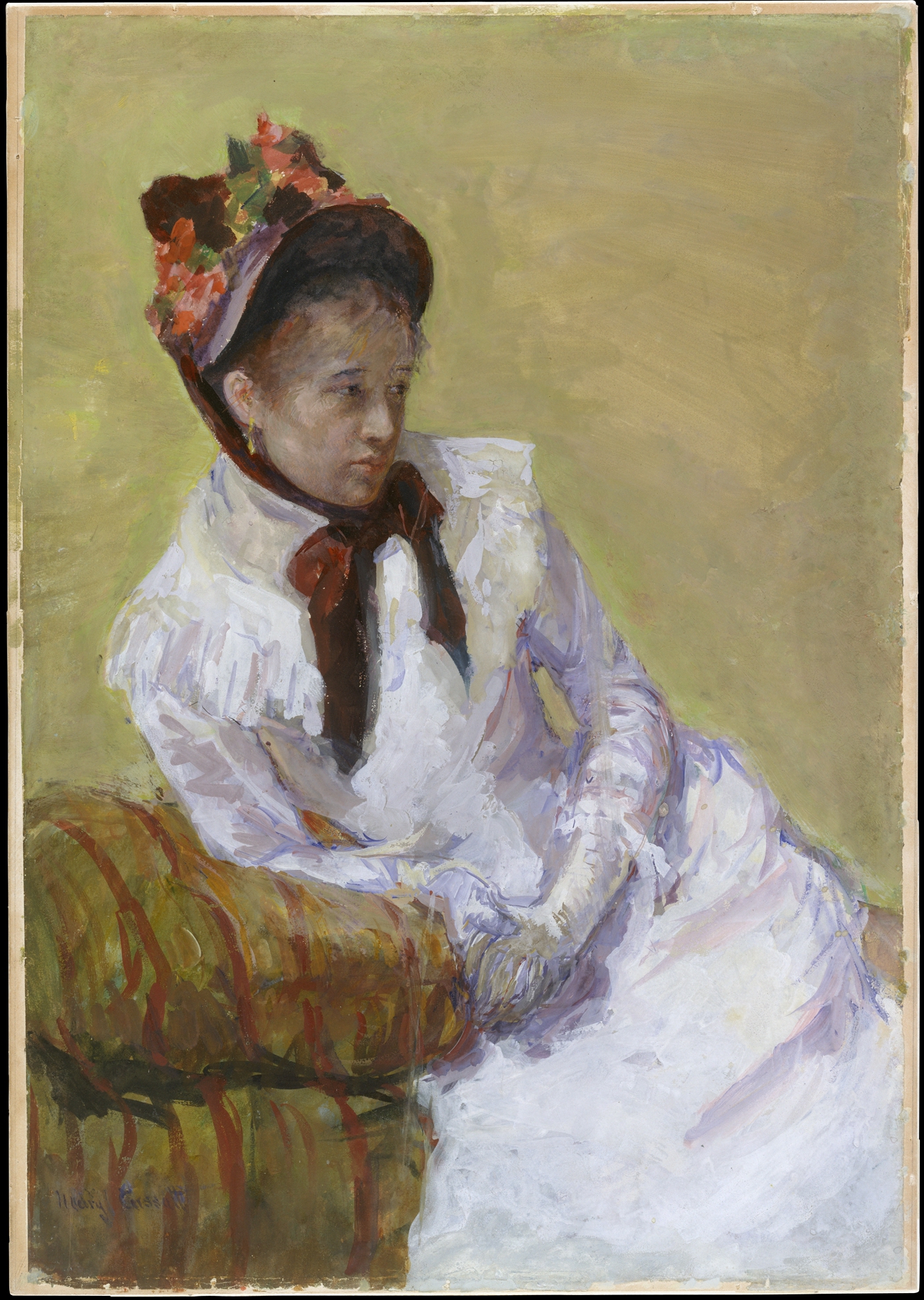
Self-portrait in watercolor and gouache, 1878, made the same year as Little Girl in a Blue Armchair. A second, separate Cassatt self-portrait of about 1880 is held by the Smithsonian's National Portrait Gallery; the two are easily confused but are different objects.
Metropolitan Museum of Art| Full name | Mary Stevenson Cassatt |
|---|---|
| Worked as | Painter, Printmaker, Pastelist |
| Born | May 22, 1844 · Allegheny, Pennsylvania (now part of Pittsburgh's North... |
| Died | June 14, 1926 · Chateau de Beaufresne, near Paris |
| Nationality | American |
| Movement | Impressionism |
| Sources | 15 cited |
| Last verified |
About this page Last verified · 15 sources cited
On this page 13 sections
ContentsClose
Mary Cassatt was the only American to exhibit with the French Impressionists and, with Berthe Morisot and Marie Bracquemond, one of the three women the critic Gustave Geffroy named "les trois grandes dames" of the movement. She spent essentially her entire working life in Paris, was trained there, sold there and is claimed by French art history as a French painter in practice if not in passport; inside France, the National Gallery of Art notes, she has always been regarded as unequivocally American. Both claims are true and neither is the whole story.
What is harder to find than the biography is the mechanism: a working method for color printmaking she invented over less than a year in 1890-91 that a fellow Impressionist called unsurpassed and that a museum is still exhibiting proofs and states of a century and a third later; a decades-long, unpaid advisory role behind one of the largest gifts of Impressionist and Old Master painting an American museum has ever received; a will rewritten in anger that sent some of her best pictures into public collections instead of her own family; and a scholarly catalogue of her work that is still, by the account of the specialist who tried to finish it, unsettled on basic questions of date and sequence because Cassatt herself almost never dated a picture.
She died all but blind, having stopped painting more than a decade before her death, in the country she had chosen over the one she was born in.
Images
Chronology
- 1844
Born May 22 in Allegheny, Pennsylvania, now part of Pittsburgh.4
- 1861-65
Studies at the Pennsylvania Academy of the Fine Arts, Philadelphia, over her family's objections.4
- 1866
Moves to Paris; studies privately with Jean-Leon Gerome, since women could not enroll at the Ecole des Beaux-Arts.4
- 1868
A Mandoline Player accepted to the Paris Salon, making her one of the first two American women to exhibit there.4
- 1870-71
Returns to the United States as the Franco-Prussian War breaks out; loses early paintings in the Great Chicago Fire; briefly considers giving up art altogether.4
- 1874
Settles permanently in Paris.4
- 1875
Sees Degas's pastels in a dealer's window; later says it changed her life.4
- 1877
Both her Salon submissions are rejected; Degas invites her to exhibit with the Impressionists.4
- 1878
Paints Portrait of the Artist, a watercolor self-portrait now at the Metropolitan Museum of Art, along with Little Girl in a Blue Armchair and a portrait of her mother reading Le Figaro.412
- 1879
Exhibits eleven works in her first Impressionist group exhibition, opening April 10; buys a Degas and a Monet with her share of the profits.4
- 1879-80
Works closely with Degas on the abortive print journal Le Jour et la Nuit; he withdraws from it in April 1880.4
- 1882
Her elder sister and frequent model, Lydia, dies; Cassatt is temporarily unable to work.4
- 1883
Louisine Elder marries Henry Osborne Havemeyer; Cassatt becomes the couple's art advisor.5
- 1883-85
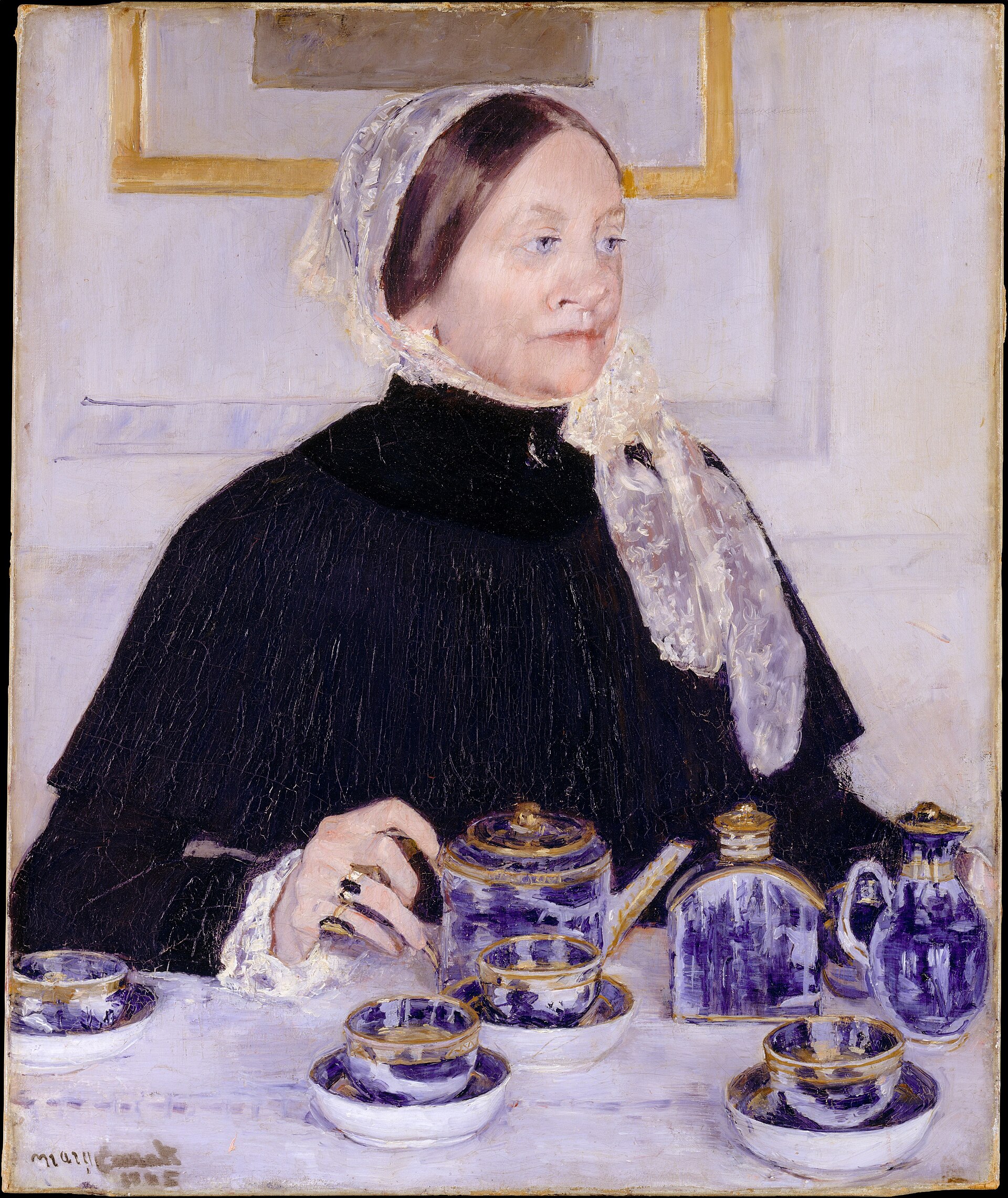
Paints Lady at the Tea Table, a portrait of her cousin Mary Dickinson Riddle that the Riddle family later refuses to accept.11
- c. 1884
Degas paints Mary Cassatt Seated, Holding Cards, the oil portrait she later comes to dislike.4
- 1886
Last group exhibition with the Impressionists; provides two paintings for the first Impressionist exhibition in the United States.4
- 1890 (spring)
Visits a major Paris exhibition of Japanese woodcuts; writes to Berthe Morisot that she can think of nothing but color on copper.1
- 1890-91
Designs and, with the printer Modeste Leroy, prints the Set of Ten color drypoints.1
- 1891 (April)
Durand-Ruel exhibits the Set of Ten in Paris.1
- 1891-93
Paints the mural Modern Woman for the Woman's Building at the 1893 World's Columbian Exposition, Chicago, on commission from Bertha Palmer.47
- 1893
First retrospective exhibition includes sixty-seven of her prints alone.1
- 1899
The Havemeyers pay an unusually high two thousand dollars for Mother and Child (The Oval Mirror).6
- 1904
France awards her the Legion d'Honneur.4
- 1906
Her brother Alexander Cassatt, president of the Pennsylvania Railroad, dies.4
- 1910
Travels to Egypt with her brother Gardner's family; Gardner falls ill and dies soon after their return; the trip and its aftermath leave her creatively and physically shaken.4
- 1911
Diagnosed with diabetes, rheumatism, neuralgia and cataracts.4
- 1913
Writes to Paul Durand-Ruel that she does not want it known she posed for Degas's portrait of her.4
- 1914
Failing eyesight forces her to stop painting.4
- 1915
Shows eighteen works in a New York suffrage benefit organized with Louisine Havemeyer; her own family boycotts it.47
- 1917
Degas dies; the two had continued visiting each other despite the collapse of their print collaboration decades earlier.4
- 1918
Bertha Palmer dies; the Modern Woman mural, last recorded in her possession in 1911, disappears afterward.4
- 1926
Dies June 14 at the Chateau de Beaufresne, near Paris, effectively blind.4
- 1929
Louisine Havemeyer dies; roughly two hundred works from the Havemeyer collection, built with Cassatt's advice, go to the Metropolitan Museum of Art.5
- 1929 (October 1)
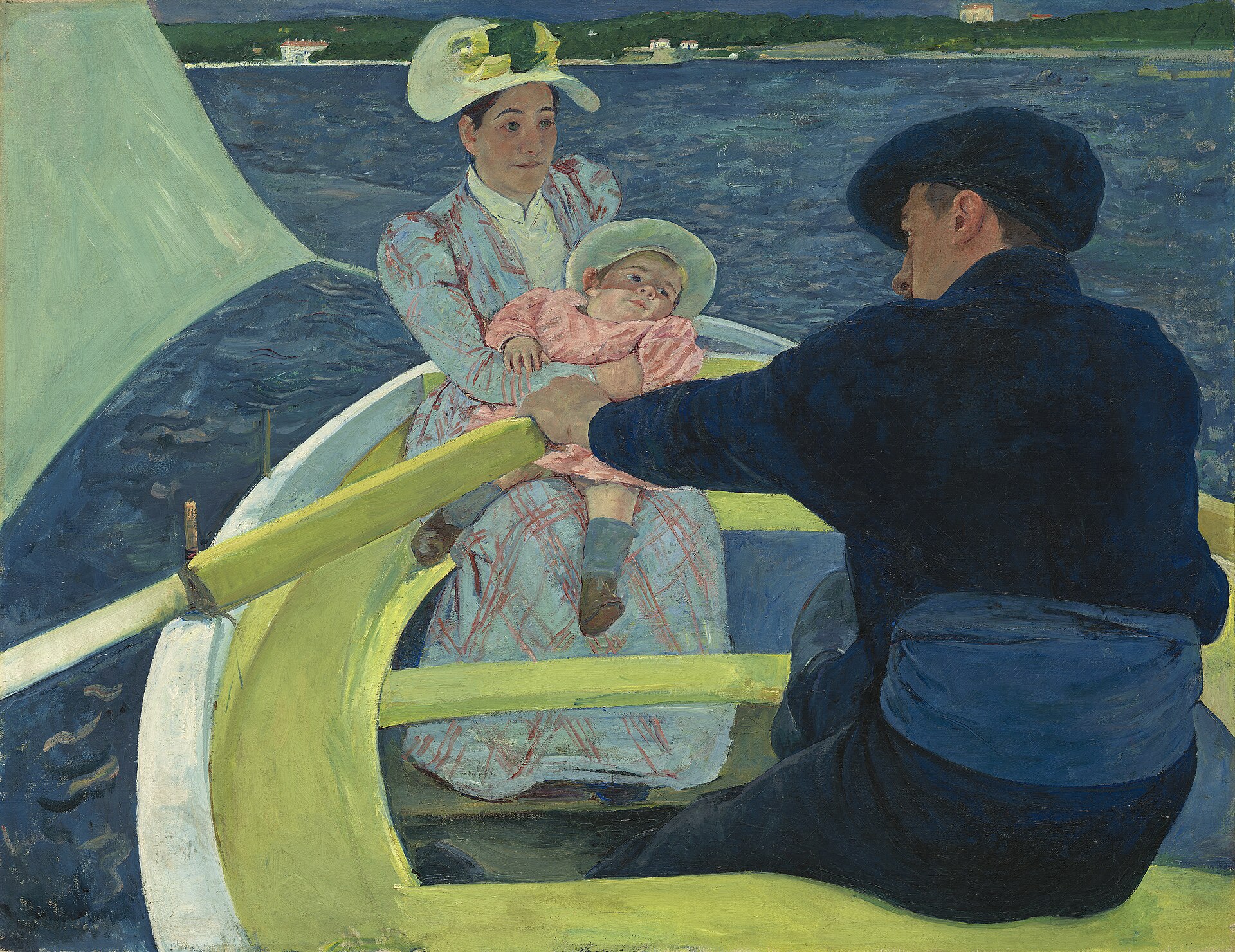
The Boating Party, withheld from Cassatt's own family after the 1915 rupture, is sold by Durand-Ruel to the collector Chester Dale.3
- 1948
Adelyn Breeskin publishes the first catalogue raisonne of Cassatt's graphic work.113
- 1963
Chester Dale's bequest brings The Boating Party to the National Gallery of Art.3
- 1970
Breeskin publishes a catalogue raisonne of the oils, pastels, watercolors and drawings.4
- 1979
Smithsonian Institution Press issues Breeskin's revised graphic-work catalogue raisonne in a signed, limited deluxe edition of two hundred copies.13
- 1984
The National Portrait Gallery, Smithsonian Institution, acquires Degas's oil portrait of Cassatt.4
- 1996 (May 23)
In the Box sells at Christie's, New York, for a reported 4,072,500 dollars, then Cassatt's auction record; surpassed within two years.8
- c. 1997-98
The curator Jay Cantor, funded by Adelson Galleries, begins a five-year project toward a new Cassatt catalogue raisonne.10
- 2022 (October 20)
Young Lady in a Loge, Gazing to Right, a pastel of about 1878-79, sells at Christie's, New York, for 7,489,000 dollars to the Pola Museum of Art, Japan, becoming Cassatt's current auction record.14
- 2026
The National Gallery of Art marks the centennial of her death with the exhibition Mary Cassatt: An American in Paris, February 14 through August 30; a group of her works from the Armand Hammer collection, including Summertime, is estimated above ten million dollars ahead of a November sale at Sotheby's.29
The market
Cassatt's paintings and pastels have historically traded well below the prices commanded by her male Impressionist colleagues, a gap widely attributed in the sources consulted to the decades in which her mother-and-child subjects were read as merely domestic or sentimental rather than as technically and formally ambitious. In the Box, an 1879 oil, brought a reported 4,072,500 dollars at Christie's, New York, in 1996, a figure Christie's own sale record states explicitly is the hammer price plus buyer's premium combined, without separately publishing the hammer figure; the estimate ahead of sale had been 800,000 to 1,200,000 dollars. That price was itself surpassed just two years later, in 1998, and does not stand as her record today: Cassatt's current auction record is 7,489,000 dollars (about 7.5 million), set at Christie's, New York, on 20 October 2022 by Young Lady in a Loge, Gazing to Right, a pastel of about 1878-79 from the Ann and Gordon Getty collection, bought by the Pola Museum of Art in Japan and reported at the time as breaking the artist's prior record of 6.2 million dollars set at Christie's, New York, in 1998. A group of works from the collection of the oil executive Armand Hammer, including Cassatt's 1894-95 painting Summertime, is consigned to a November 2026 sale at Sotheby's in New York, with Summertime alone projected, per reporting on a Los Angeles Times story, to exceed ten million dollars and potentially set a new record.
Recorded without a public price
- 23 May 1996 · In the Box (1879, oil on canvas) · Christie's · not separately published in the source consulted Christie's sale 8408, Important American Paintings, Drawings and Sculpture, New York. Price realized (hammer plus buyer's premium, per Christie's own definition) 4,072,500 dollars against a pre-sale estimate of 800,000 to 1,200,000 dollars; a Cassatt record when set, but surpassed by 1998 and not her record today.
- 20 October 2022 · Young Lady in a Loge, Gazing to Right (c. 1878-79, pastel, gouache, watercolor, charcoal and metallic paint on paper) · Christie's · not separately published in the source consulted Christie's New York, sale of the Ann and Gordon Getty collection. Price realized 7,489,000 dollars (reported in the trade press as about 7.5 million), against a pre-sale estimate of 3 to 5 million dollars; bought by the Pola Museum of Art, Japan. Reported as breaking the prior Cassatt record of 6.2 million dollars set at Christie's, New York, in 1998, and remains her auction record as of this page's research.
Where to see the work
| Institution | City | Holdings | Note |
|---|---|---|---|
| National Gallery of Art | Washington, D.C. | The deepest single public holding of the 1890-91 Set of Ten color prints, drawn largely from the Chester Dale and Rosenwald collections, plus preparatory drawings, states and proofs; major paintings including The Boating Party (Chester Dale Collection, 1963.10.94). | Marking the centennial of her death with the exhibition Mary Cassatt: An American in Paris, February 14 to August 30, 2026. |
| Metropolitan Museum of Art | New York | Lady at the Tea Table (gift of the artist, 1923); the 1878 self-portrait Portrait of the Artist; Mother and Child (The Oval Mirror) and other paintings from the Havemeyer bequest of 1929. | |
| National Portrait Gallery, Smithsonian Institution | Washington, D.C. | Edgar Degas's oil portrait Mary Cassatt Seated, Holding Cards (NPG.84.34), acquired 1984; a separate Cassatt self-portrait of about 1880 (NPG.76.33). | |
| Art Institute of Chicago | Chicago | The Child's Bath (1893), among her best-known mother-and-child paintings. | |
| Philadelphia Museum of Art | Philadelphia | Portrait of Alexander J. Cassatt and His Son, Robert Kelso Cassatt (1884-85). |
Forgeries and misattributions
- In May 1989 Atlanta stockbroker C. Noel Wadsworth sued Aetna Life & Casualty Co. and Florida resident Michael F. Drinkhouse in Fulton County Superior Court, Atlanta, alleging he had been sold a fake painting misrepresented as a Cassatt for 275,000 dollars; the sellers had claimed a prior sale through the Knoedler Gallery. Wadsworth said the work was exposed as fraudulent when he lent it to Atlanta's High Museum of Art for display, and his suit valued the actual painting at about 500 dollars. This record could not confirm the lawsuit's final resolution from the sources consulted, but the filing itself, and the museum's rejection of the attribution, are documented in contemporaneous wire reporting.
- 15
The essay
Chapter 1Training no institution would fully give her
Cassatt began at the Pennsylvania Academy of the Fine Arts in Philadelphia at fifteen, over her family's objections, and studied there from 1861 to 1865.
Cassatt began at the Pennsylvania Academy of the Fine Arts in Philadelphia at fifteen, over her family's objections, and studied there from 1861 to 1865. She later summed up the instruction bluntly: "There was no teaching." Female students were kept from live models longer than male ones and drilled mainly on drawing from plaster casts. Thomas Eakins, later forced out as the Academy's director, was a fellow student.
She left without a degree and moved to Paris in 1866 with her mother and family friends as chaperones. The Ecole des Beaux-Arts did not admit women, so she applied to study privately with masters from the school and was accepted by Jean-Leon Gerome, the Academy's leading exponent of hyper-realistic, exoticized subject painting; Thomas Eakins joined his studio a few months later. She supplemented this with daily copying at the Louvre, the socially sanctioned alternative to the cafes where the avant-garde actually talked, and where a fellow American student, Elizabeth Jane Gardner, met and later married the academic painter William-Adolphe Bouguereau. In 1868 a painting of hers, A Mandoline Player, was accepted to the Paris Salon, making her, with Gardner, one of the first two American women to exhibit there; it is one of only two surviving, documented works from her first decade as a professional.
Commissions kept her afloat when the Salon did not: the Pittsburgh bishop Michael Domenec paid her to copy two paintings by Correggio in Parma, and a group of Spanish subjects followed a stay in Madrid and Seville. She settled in Paris for good in 1874. Her frustration with the Salon's politics grew for years before it broke: in 1877 both her submitted paintings were rejected, and for the first time in seven years she had no work in the Salon at all.
Chapter 2Rejected by the Salon, remade by Degas
That rejection coincided with Edgar Degas's invitation to show with the Impressionists, a group of independent exhibitors then five years into their own annual shows and still, in polite Parisian...
That rejection coincided with Edgar Degas's invitation to show with the Impressionists, a group of independent exhibitors then five years into their own annual shows and still, in polite Parisian opinion, a scandal. A family friend described them as artists "afflicted with some hitherto unknown disease of the eye." Cassatt had already been struck by Degas's pastels in a dealer's window in 1875: "I used to go and flatten my nose against that window and absorb all I could of his art," she recalled. "It changed my life. I saw art then as I wanted to see it."
She accepted enthusiastically, declaring of the group's position: "we are carrying on a despairing fight and need all our forces." The delayed 1879 exhibition, her first with the group, was its most commercially successful yet; the Revue des Deux Mondes singled her out with Degas as the only two artists who "distinguish themselves" among what it otherwise dismissed as pretentious window dressing. She showed eleven works, used her share of the exhibition's profits to buy paintings by Degas and Monet, and went on to exhibit in the 1880 and 1881 group shows before her last, in 1886, when she was already the group's only American member and would remain so.
Berthe Morisot, the Impressionists' other prominent woman member, became a friend and colleague. After 1886 Cassatt stopped identifying with any single movement and began working across a wider range of technique, but the decade inside the Impressionist circle set the direction of everything that followed.
Chapter 3Working beside Degas, and the collaboration that broke
Their studios stood less than five minutes apart, hers at 19 rue Laval, his at 4 rue Frochot, and Degas developed the habit of looking in, offering advice and helping her find models.
Their studios stood less than five minutes apart, hers at 19 rue Laval, his at 4 rue Frochot, and Degas developed the habit of looking in, offering advice and helping her find models. No letters between them survive, so the closeness of the relationship cannot be measured with any precision; what can be measured is the work. Degas introduced her to pastel and to etching, both of which she mastered quickly, and in the fall and winter of 1879-80 the two worked side by side almost daily, Cassatt using his studio, his tools and his press by day and preparing plates by evening for a projected journal of prints, Le Jour et la Nuit, with Camille Pissarro, Felix Bracquemond and Gustave Caillebotte.
The journal never appeared. Degas withdrew from it abruptly in April 1880, and without his backing the project collapsed, leaving Cassatt with a large edition of fifty impressions of a print, In the Opera Box, that had been intended for it and never found its publication. She never again worked with him quite that closely, and the biographer Nancy Mowll Mathews notes she stopped making theater scenes at around the same time. The friendship itself outlasted the setback: they clashed openly over the Dreyfus affair, Cassatt pro- and Degas anti-, traded barbed compliments for decades, and Degas remained a fixture at her dinner table and she at his until his death in 1917.
Cassatt, for her part, was instrumental in selling Degas's work in America and promoting his reputation there, a debt she was in a position to repay because of the collectors she was simultaneously cultivating on his behalf and her own.
Chapter 4The portrait she later wished did not exist
Around 1884 Degas painted her in oils, seated and fanning out a set of photographic cartes de visite, a device some historians read as staging her deliberately as a peer and a working artist rather...
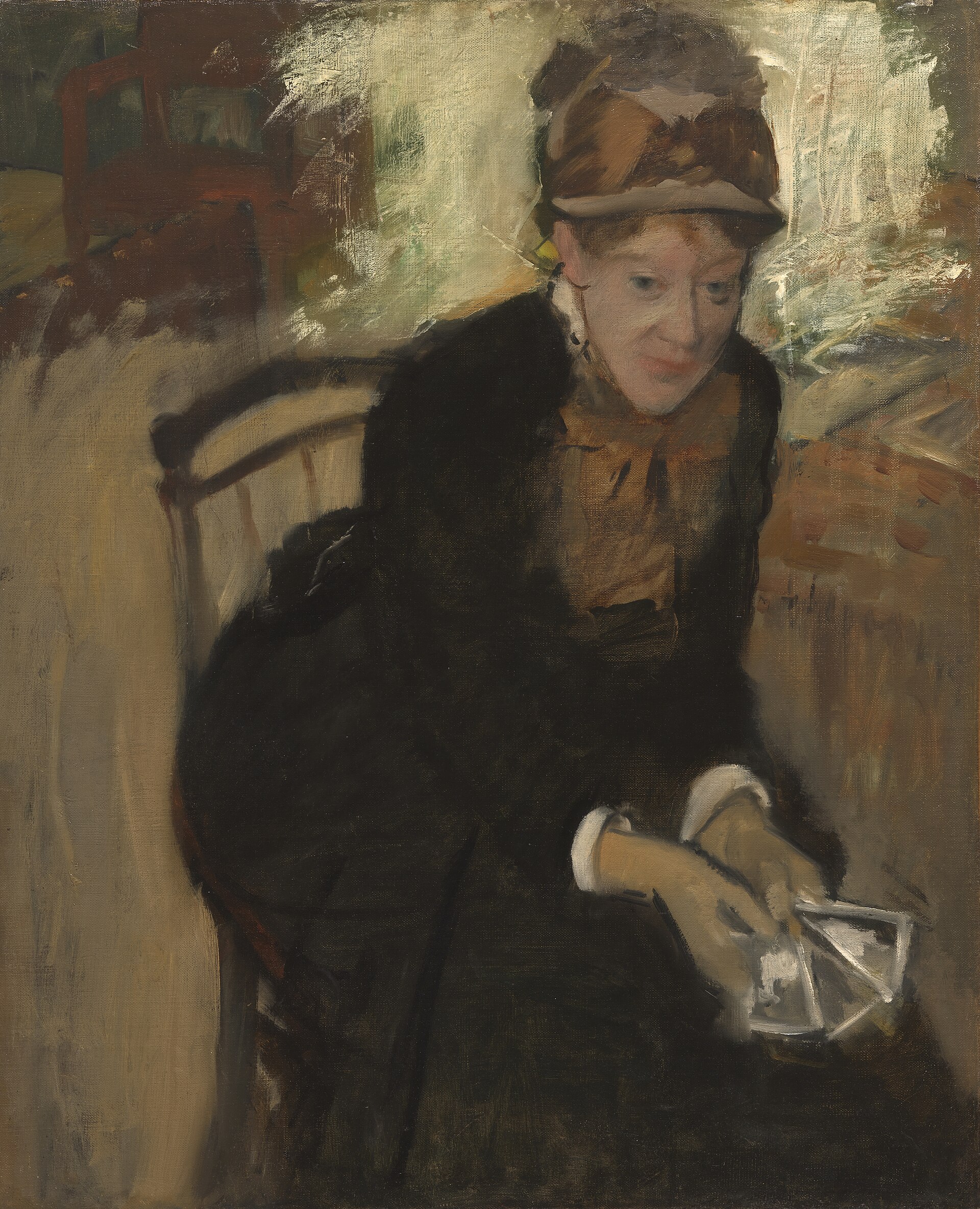
Around 1884 Degas painted her in oils, seated and fanning out a set of photographic cartes de visite, a device some historians read as staging her deliberately as a peer and a working artist rather than a sitter. The picture, Mary Cassatt Seated, Holding Cards, is one of only a handful of documented likenesses of her by another hand and is now in the Smithsonian's National Portrait Gallery, Washington, accession NPG.84.34, which explicitly released its digital photograph of the canvas into the public domain.
Cassatt came to dislike it. Writing to her dealer, Paul Durand-Ruel, in 1912 or 1913, she said plainly: "I don't want anyone to know that I posed for it." She parted with the picture; by the time it reached the National Portrait Gallery in 1984 it had passed through the Paris dealer market and at least one major private collection, though this record could not independently verify that chain against the museum's own object file, which was unreachable during research for this page (see notes_for_editor).
A watercolor and gouache Self-Portrait of about 1880, in the identical hat and dress Cassatt wears in Degas's oil, is also in the National Portrait Gallery's collection (NPG.76.33); the art historian Griselda Pollock has proposed the two works were made in a joint sitting. It is a separate object from Cassatt's earlier, more finished 1878 self-portrait now at the Metropolitan Museum of Art, illustrated on this page, and the two are worth keeping apart: both are watercolor self-likenesses from around the same period, held on opposite sides of the same city divide by the same reclusive sitter, and it would be easy to run them together.
Chapter 5Color on copper: inventing the Set of Ten
In the spring of 1890 a vast exhibition of Japanese woodcuts opened in Paris and, by Cassatt's own account, overtook her.
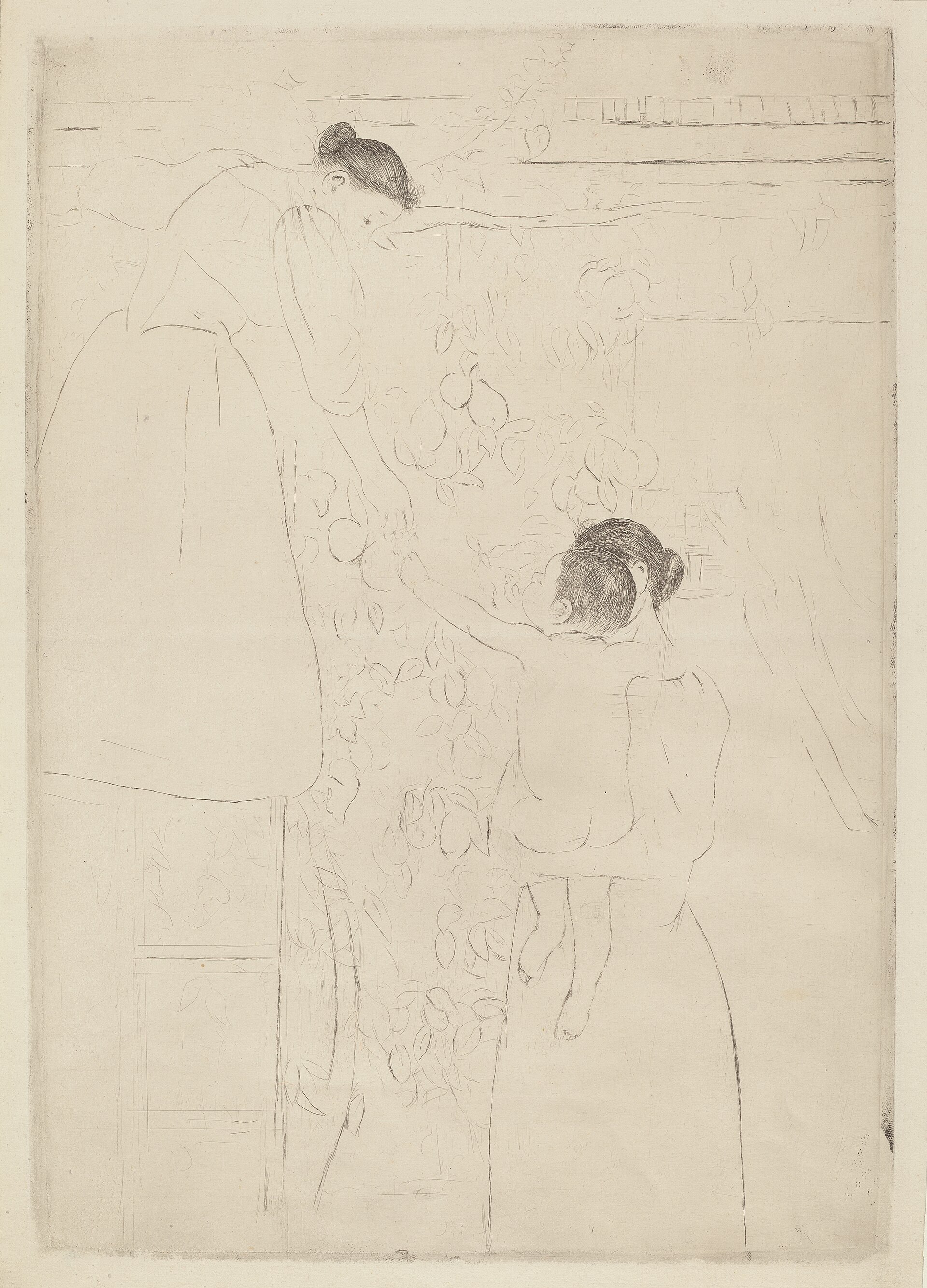
In the spring of 1890 a vast exhibition of Japanese woodcuts opened in Paris and, by Cassatt's own account, overtook her. She wrote to Berthe Morisot that she could think of nothing else "but color on copper." She was already a collector of Japanese prints; what the exhibition gave her was a technical problem worth a year of her life: how to translate the flat color fields, strong outline and asymmetric composition of Utamaro and his contemporaries into a Western intaglio print.
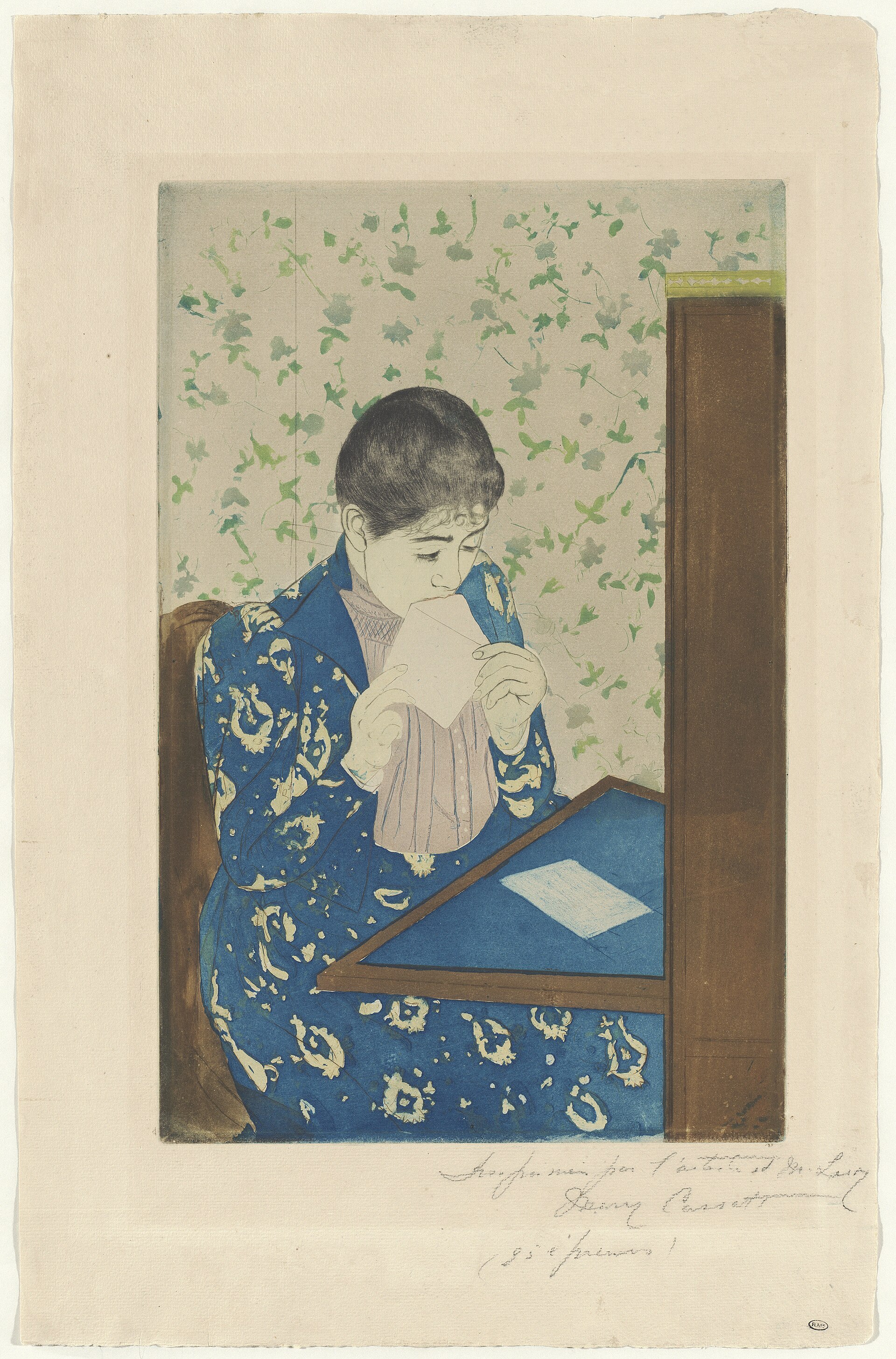
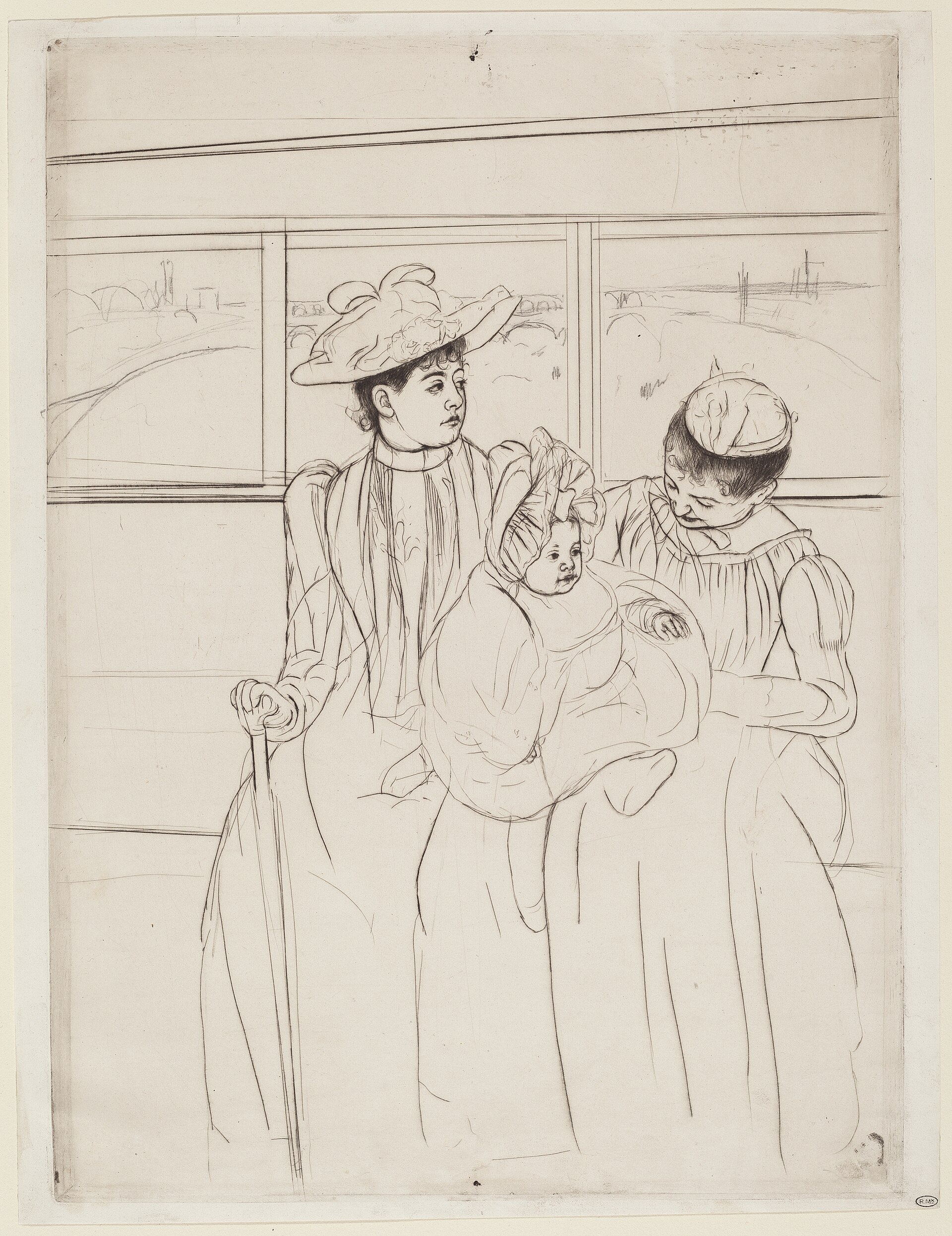
She had no real grounding in color printing when she began. "I was entirely ignorant of the method when I began," she said afterward. She engaged a professional printer, Modeste Leroy, to help realize the work in her own studio, which became, in effect, a laboratory: each of the ten finished images was built from two or three separate copper plates, worked in drypoint, soft-ground etching and aquatint and inked in different colors, printed in careful registration so the color passages aligned. The National Gallery of Art's own unique group of working proofs for one print in the set, In the Omnibus, traces the sequence directly: a chalk-and-graphite drawing wrapped around the plate to transfer the outline; a softground-etched first state; drypoint added to define the figures; aquatint built up passage by passage while Cassatt tested a palette of peach, coral and teal before settling, in the end, on leaving bare paper for the skin tones and reserving color for dress and setting alone.
In under a year she finalized ten images and, working long hours with Leroy, pulled twenty-five impressions of each. She credited him: impressions from the set carry both their names in the lower margin, an unusual acknowledgment of a printer's contribution to a fine-art edition. Durand-Ruel exhibited the group in Paris in April 1891. Camille Pissarro, himself an experienced color printmaker, praised her ability to tame the medium and produce work "as beautiful as Japanese work"; the Cassatt scholar Adelyn Breeskin later called the set her most original contribution to art history, adding that technically, as color prints, they "have never been surpassed." A retrospective two years later, in 1893, included sixty-seven of her prints alone; by the time she stopped, she had made more than two hundred.
Chapter 6The godmother of the Havemeyer collection
Cassatt met Louisine Elder, a young Pennsylvanian studying in Paris, in the mid-1870s through their mutual friend Emily Sartain; the two had studied together at the Pennsylvania Academy years before.
Cassatt met Louisine Elder, a young Pennsylvanian studying in Paris, in the mid-1870s through their mutual friend Emily Sartain; the two had studied together at the Pennsylvania Academy years before. Cassatt took the younger woman in hand and, still in her twenties herself, urged her toward her first serious acquisition: a Degas pastel, Ballet Rehearsal, bought when Louisine was twenty-two. Louisine married the sugar magnate Henry Osborne Havemeyer in 1883, and for very nearly fifty years afterward Cassatt served as the couple's principal art advisor, steering them toward Manet, Courbet, Degas, Rembrandt, Goya and El Greco at a scale few American collectors of the period matched.
Louisine Havemeyer called Cassatt her collection's "fairy godmother" and said outright that the best things she and her husband bought had been bought on Cassatt's advice. The relationship was not simply patron and advisor: Cassatt used it to place work by artists she believed in, Degas above all, into a collection she knew would eventually become public. It did. Louisine Havemeyer died in 1929 and left roughly two hundred works to the Metropolitan Museum of Art; further gifts from her children eventually brought the family's total donation toward two thousand objects, forming one of the deepest holdings of nineteenth-century French painting outside France and a substantial part of why the Met, rather than a European museum, owns so much of it.
The advisory relationship had its own aesthetic consequences that outlived any single acquisition. When Durand-Ruel showed the Havemeyers Cassatt's 1898 painting Mother and Child (The Oval Mirror), he reported that Degas, asked his opinion, called it the finest work Cassatt had ever done, "particularly characteristic of her talent." Louisine Havemeyer later said she learned what Degas had actually said was sharper: "It has all your qualities and all your faults - it's the baby Jesus and his English nurse." A different telling of the same encounter, recounted by the writer Bridget Quinn, has Degas saying on first seeing the canvas that it was "the greatest picture of the nineteenth century... It is the little Jesus and his English nurse." The two accounts cannot both be verbatim; what is not in dispute is that the Havemeyers paid an unusually high two thousand dollars for the picture in 1899, a price attributable in large part to Degas's opinion of it, however exactly he phrased it, and that it entered the Metropolitan Museum with the rest of the Havemeyer bequest in 1929.
Chapter 7A mural for women alone, and its disappearance
In 1891 the Chicago socialite Bertha Palmer commissioned Cassatt to paint a mural, twelve by fifty-eight feet, for the Woman's Building at the 1893 World's Columbian Exposition, an entirely female...
In 1891 the Chicago socialite Bertha Palmer commissioned Cassatt to paint a mural, twelve by fifty-eight feet, for the Woman's Building at the 1893 World's Columbian Exposition, an entirely female undertaking designed by the architect Sophia Hayden with sculpture by Alice Rideout and Enid Yandell. Cassatt worked on it for two years from France. The finished triptych, titled Modern Woman, showed young women gathering the fruits of knowledge and science in its central panel, pursuing fame at left and art, music and dance at right, and included, deliberately, no men at all.
The subject reworked a very old image, women as the agents of the Fall reaching for forbidden fruit, into an image of women passing knowledge to other women. It provoked exactly the reaction that reworking invited. One critic sniffed that the subject was "too trivial and below the dignity of the great occasion." A friend, more bluntly, asked her whether this was "woman apart from her relations to man"; Cassatt told him it was, and added that men, presumably, were being painted in all their vigor on the walls of other buildings. More than two hundred thousand women saw it during the exposition's six months, including Susan B. Anthony and the young Carrie Chapman Catt, who would go on to lead the campaign for the Nineteenth Amendment.
When the Woman's Building came down at the close of the fair, the mural went into storage in Bertha Palmer's possession, where it is recorded as still being as late as 1911. Palmer died in 1918. The mural has not been located since. It remains, so far as the sources consulted for this page establish, the only large-scale public commission by one of the most significant American artists of her generation, and it is simply lost.
Chapter 8The mother and the Madonna
From the 1880s onward, and almost exclusively after 1900, Cassatt's subject was the bond between a mother and a child, rendered with a directness that avoided both sentimentality and the passive...
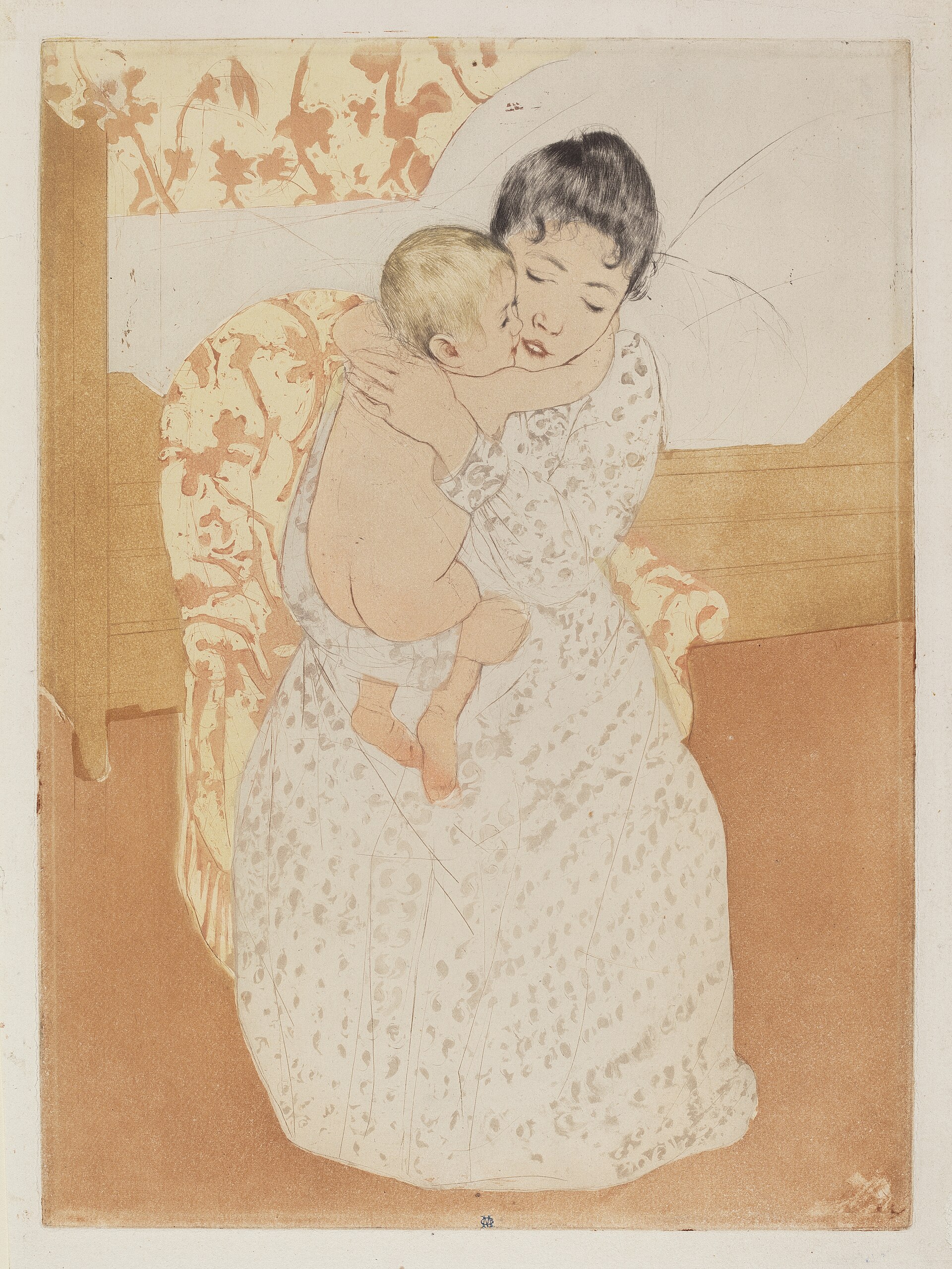
From the 1880s onward, and almost exclusively after 1900, Cassatt's subject was the bond between a mother and a child, rendered with a directness that avoided both sentimentality and the passive, decorative female figures common in other Impressionist painting; her women look, act and hold their children rather than posing for the viewer. The compositional debt is, at points, explicit rather than incidental. In Mother and Child (The Oval Mirror), the child leans on his mother in the same contrapposto pose given the infant Christ in Italian Renaissance images of the Madonna and Child, one hand draped at her neck, the other clasping her hand; the mirror behind their two heads stands roughly where a halo would be. The Havemeyers themselves recognized it and called the picture, in their own household, "The Florentine Madonna."
Scholars disagree about how deliberately that borrowing should be read. The curator Judith Barter reads the composition as a conscious appropriation of Renaissance Madonna iconography. Griselda Pollock argues the opposite: that Cassatt's recurring subject was the relationship between any mother and any child, not a reworking of the Virgin and Christ, and that the religious resemblance is a byproduct of a shared visual vocabulary for tenderness rather than a program. Neither position is dismissible on the evidence, and this record follows the house rule of naming both rather than picking a winner.
Nothing in Cassatt's own letters, so far as this research could establish, states an intention to invoke Christian iconography directly, and there is no record of religious observance or doctrine shaping her choice of subject the way it shaped, for instance, a commissioned altarpiece. What is documented is a repeated formal device, and two informed readings of what it means; recording both, and not more than that, is the honest position.
Chapter 9Suffrage, family rupture and a will rewritten in anger
Cassatt was an outspoken advocate of women's equality from her student years, when she campaigned for equal travel scholarships, through the 1910s campaign for the vote.
Cassatt was an outspoken advocate of women's equality from her student years, when she campaigned for equal travel scholarships, through the 1910s campaign for the vote. In 1915 Louisine Havemeyer, by then a committed and active suffragist, organized a New York exhibition pairing Cassatt's work with Degas's to raise money for the cause; Cassatt agreed at once, telling Havemeyer she relished the idea of putting a feminist thumb in Degas's famously ungenerous eye about women artists (he had once told her, on seeing an earlier picture, that "no woman has the right to draw like that").
Her own family turned against the exhibition. Her brother Alexander's widow and children, and her brother Gardner's widow and daughters, had become active in the organized anti-suffrage movement and boycotted the show, taking Philadelphia and much of New York society with them; because they held much of Cassatt's best early work, their refusal to lend it forced the exhibition to lean heavily on recent pictures, reinforcing, ironically, the public's sense of Cassatt as principally a painter of mothers and children. The show still succeeded, raising money for the cause and, for many Americans, providing their first real look at her work.
Cassatt did not forgive the boycott. She rewrote her will, diverting paintings she had intended for her nieces and nephews toward sale and public collections instead, a decision the writer Bridget Quinn credits with putting a meaningful share of Cassatt's best Impressionist-era work into American museums rather than family houses. Among the casualties of the family rift, by this account, was The Boating Party, one of Cassatt's largest and most ambitious paintings, thought by some to have been inspired by the birth of her niece Ellen Mary; the National Gallery of Art's own provenance record for the picture shows it remained with the artist until at least 1918, went through the Paris dealer Durand-Ruel, and was not sold until 1 October 1929, to the collector Chester Dale, whose bequest brought it to the National Gallery of Art only in 1963. It did not, as some later, looser retellings suggest, go directly "to the National Gallery" at the height of the 1915 rupture; the National Gallery of Art itself did not yet exist in 1915, having been established by Congress only in 1937.
Chapter 10Blindness
According to the account given in Nancy Mowll Mathews's biography, as summarized on Wikipedia (a tertiary source this record flags for replacement with the biography itself), Cassatt was diagnosed...
According to the account given in Nancy Mowll Mathews's biography, as summarized on Wikipedia (a tertiary source this record flags for replacement with the biography itself), Cassatt was diagnosed with diabetes, rheumatism, neuralgia and cataracts in 1911, at the age of sixty-seven. She kept working for several more years. After 1914 her failing sight forced her to give up painting entirely.
Beyond that point the secondary literature consulted for this page does not agree on details. One popular medical-history account places a first eye operation in 1911 with no recovery of sight; another places the first cataract surgery in 1917 and a second, on the other eye, in 1919, naming the Paris ophthalmologist Edmond Landolt as the diagnosing physician and describing as many as five operations by the fall of 1919, each ending in disappointment. This record has not been able to reconcile the two chronologies against a primary or fully scholarly source and presents both only provisionally, flagged as unresolved rather than adopted; what is consistent across every account consulted is that she never painted again after her sight failed in the mid-1910s, and that she was effectively blind for the last years of her life, dying in 1926.
She continued to correspond and to advise collectors after she stopped painting; her advocacy for suffrage, and her friendship with Louisine Havemeyer, both outlasted her working career.
Chapter 11What is accepted, and what is still being sorted
The standard references for Cassatt's work are two catalogues raisonnes by the curator and Cassatt specialist Adelyn Dohme Breeskin: one covering the oils, pastels, watercolors and drawings...
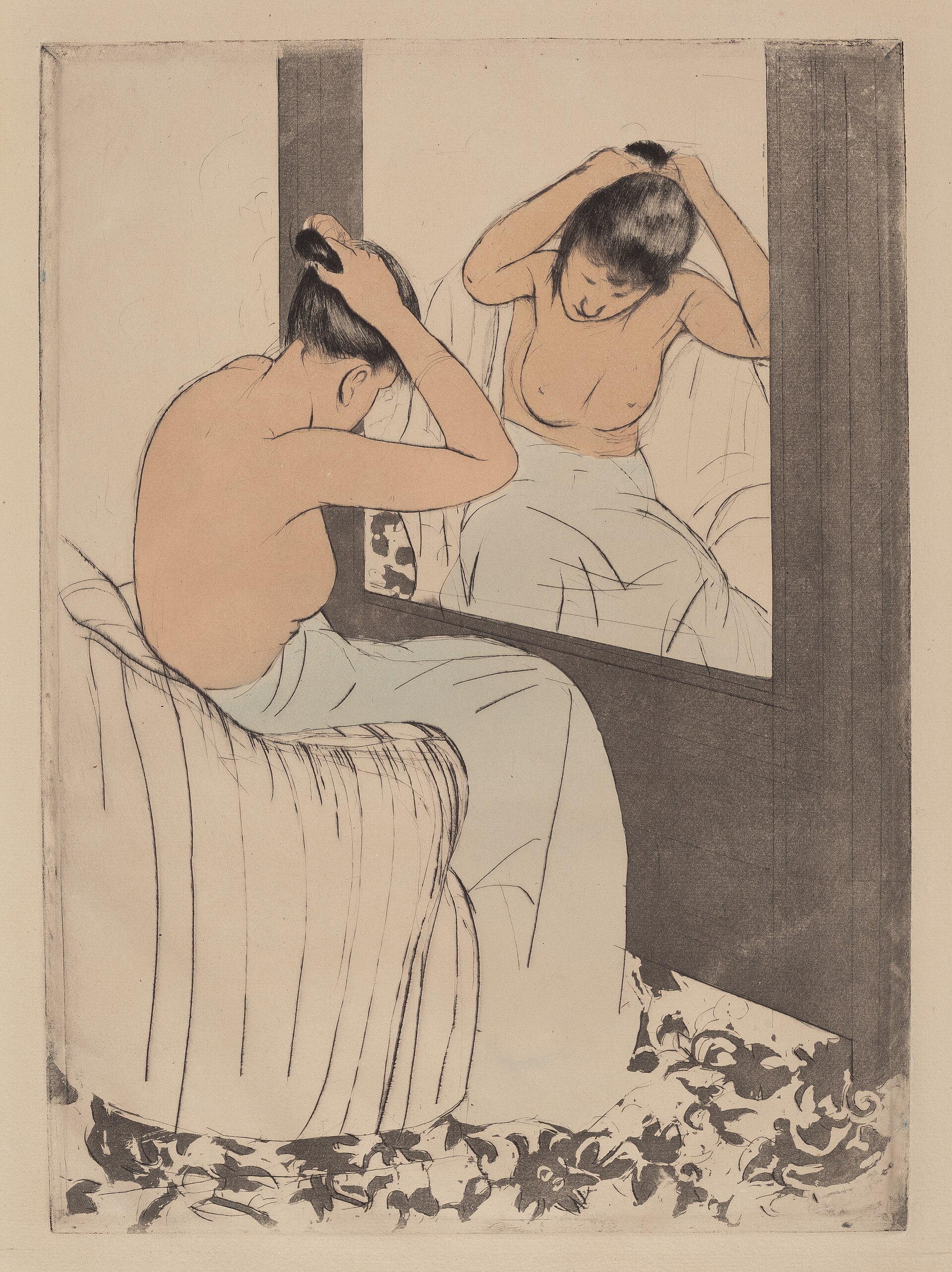
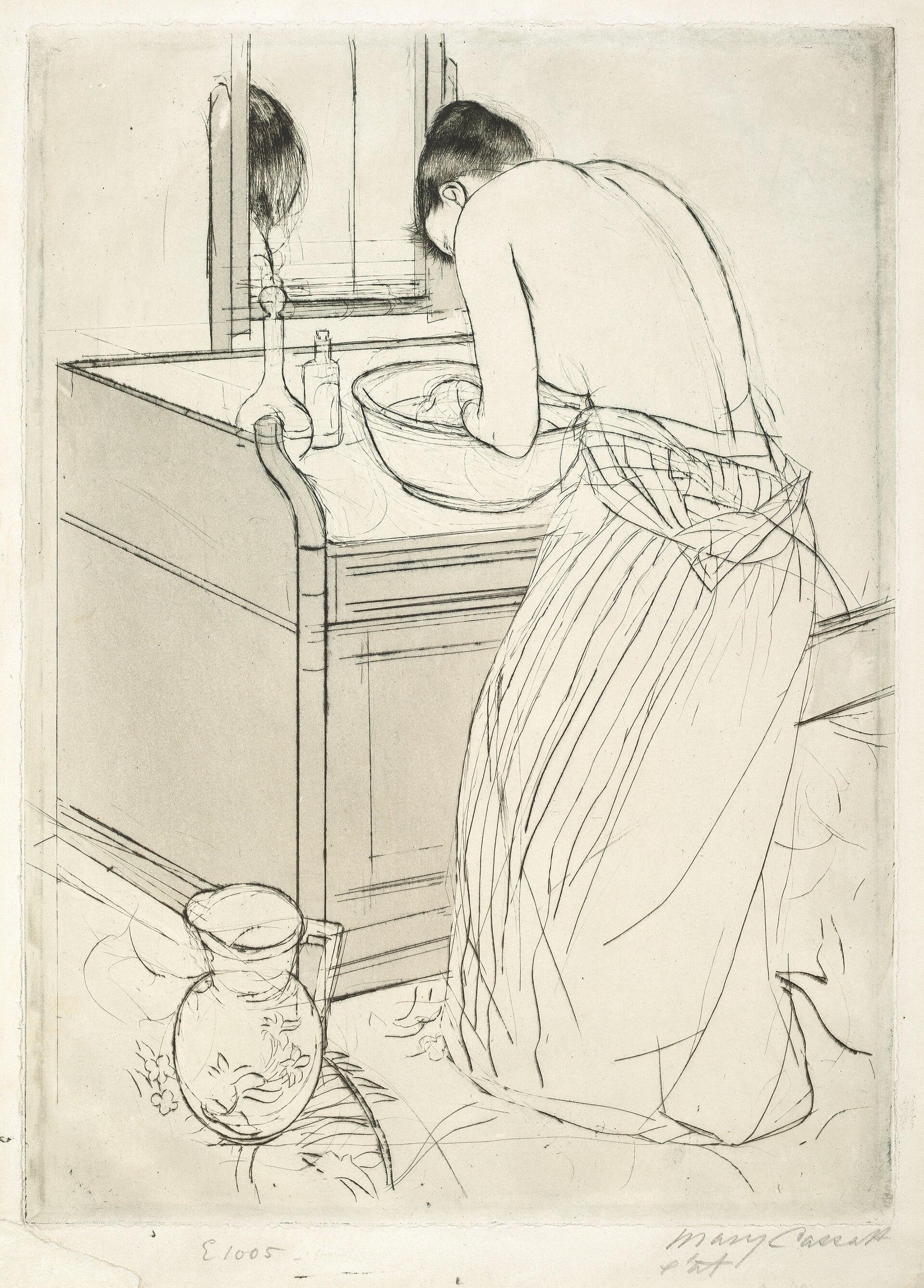
The standard references for Cassatt's work are two catalogues raisonnes by the curator and Cassatt specialist Adelyn Dohme Breeskin: one covering the oils, pastels, watercolors and drawings, published in 1970, and one covering the graphic work, first published in 1948 and revised in 1979 by the Smithsonian Institution Press, the revised edition issued in a signed, limited run of two hundred numbered copies. The National Gallery of Art credits Breeskin's graphic-work catalogue with establishing the print numbers, such as Breeskin 152 for The Coiffure, still used to identify individual prints today.
Those catalogues are not the last word. In the late 1990s the curator Jay Cantor, funded by the New York dealership Adelson Galleries and advised by a group described only as "a committee of curators and historians," began a five-year project to build a new, comprehensive catalogue raisonne, working from the premise that the existing scholarship rested on "incomplete information on dates, subjects and biographical circumstances" more than a century old. Cantor's own diagnosis of the underlying problem, as reported at the time, was blunt: "Cassatt virtually never dated her pictures," leaving the sequence of her working life, in his word, "totally confused," with authentication and sitter identification both still unresolved in numerous cases. Whether that revision project has since been completed or published, and in what form, could not be confirmed from the sources consulted for this page; it is recorded here as an open question rather than assumed finished.
No formal authentication board or committee with published rulings on individual Cassatt attributions was identified in the course of this research, in the manner some other artists' estates or foundations maintain. The working authority, in practice, remains the Breeskin catalogues, read alongside the expertise gathered for the unfinished Cantor and Adelson Galleries revision and the curatorial departments of the museums, chiefly the National Gallery of Art and the Metropolitan Museum of Art, that hold the deepest and best-documented groups of her work. One documented case of a painting sold as a Cassatt and then exposed as fraudulent is on record: a 1989 Atlanta lawsuit over a fake purporting to be an 1897 oil, sold for 275,000 dollars and rejected on examination by the High Museum of Art; see forgeries, above.
Chapter 12What is happening to her now
2026 marks the centennial of Cassatt's death, and two institutions are marking it in very different registers.
2026 marks the centennial of Cassatt's death, and two institutions are marking it in very different registers. The National Gallery of Art opened Mary Cassatt: An American in Paris on 14 February 2026, running through 30 August 2026: some forty works, mostly from the Gallery's own collection, tracing her development from her 1871-74 travels in Italy and Spain through her Paris years and into the experimental printmaking of the 1890s, with five of the Gallery's paintings freshly cleaned and studied for the occasion and rarely shown preparatory drawings, print states and unique proofs displayed alongside the finished plates. A companion library installation, drawn from the Gallery's own archival holdings and running through 15 May 2026, focuses specifically on Cassatt's role as an advisor and cultural intermediary for American collectors and institutions, the same role that built the Havemeyer bequest.
At almost the same moment, the market is being tested. A group of twelve works from the private collection of the oil executive Armand Hammer, including Cassatt's 1894-95 painting Summertime, Edgar Degas's Trois danseuses (jupes jaunes) and a Renoir, is being previewed at Sotheby's in Los Angeles ahead of a November 2026 sale in New York, with the group carrying a combined estimate of twenty-five to thirty-seven million dollars. Summertime alone is projected, according to reporting on a Los Angeles Times story, to exceed ten million dollars and potentially set a new auction record for Cassatt; Hammer had bought the picture in 1971 for one hundred fifty thousand dollars, itself a record at the time both for a work by Cassatt and for a work by any woman artist. As of the drafting of this page the sale had not yet taken place, so no result can yet be recorded; it is noted here as a live, dated fact rather than a completed one, and this record should be revisited once the sale closes.
What is documented
Technique
The surviving work
- What is accepted
- More than two hundred prints are counted in her accepted graphic oeuvre, per the National Gallery of Art. No single settled figure for her combined output across oils, pastels, watercolors and drawings was found in the sources consulted for this page.
- What is contested
- No specific published count of works removed from or added to Cassatt's corpus was identified in this research. The documented uncertainty concerns dating and sequence rather than disputed inclusion: see the dating problem, above.
- Who rules on attribution
- No formal authentication board or foundation with published rulings on individual Cassatt attributions was identified. A revision of Breeskin's catalogue raisonne was undertaken from the late 1990s by the curator Jay Cantor, funded by the New York dealership Adelson Galleries and advised by an unnamed committee of curators and historians; whether it has since been completed or published could not be confirmed from the sources consulted for this page. In practice, working authority rests with the Breeskin catalogues and with the curatorial departments of the museums holding the deepest documented groups of her work, chiefly the National Gallery of Art and the Metropolitan Museum of Art.
Catalogue raisonne
- Adelyn Dohme Breeskin, Mary Cassatt: A Catalogue Raisonne of the Oils, Pastels, Watercolors, and Drawings (1970). Covers the painted and drawn work. Long the standard reference alongside Breeskin's graphic-work catalogue.4
- Adelyn Dohme Breeskin, Mary Cassatt: A Catalogue Raisonne of the Graphic Work (Smithsonian Institution Press, first published 1948, revised 1979). Establishes the Breeskin numbers, such as Breeskin 152 for The Coiffure, still used by museums to identify individual prints. The 1979 revised edition was issued as a signed, limited deluxe run of two hundred numbered copies.113
Questions about Mary Cassatt
Who was Mary Cassatt?
Painter; Printmaker; Pastelist. 1844-1926.
When did Mary Cassatt live?
Born May 22, 1844, Allegheny, Pennsylvania (now part of Pittsburgh's North Side); died June 14, 1926, Chateau de Beaufresne, near Paris; buried in the family vault at Le Mesnil-Theribus, Oise, France.
How are fakes and misattributions of Mary Cassatt detected?
In May 1989 Atlanta stockbroker C. Noel Wadsworth sued Aetna Life & Casualty Co. and Florida resident Michael F. Drinkhouse in Fulton County Superior Court, Atlanta, alleging he had been sold a fake painting misrepresented as a Cassatt for 275,000 dollars; the sellers had claimed a prior sale through the Knoedler Gallery. Wadsworth said the work was exposed as fraudulent when he lent it to Atlanta's High Museum of Art for display, and his suit valued the actual painting at about 500 dollars. This record could not confirm the lawsuit's final resolution from the sources consulted, but the filing itself, and the museum's rejection of the attribution, are documented in contemporaneous wire reporting.
Where can you see work by Mary Cassatt?
National Gallery of Art (Washington, D.C.); Metropolitan Museum of Art (New York); National Portrait Gallery, Smithsonian Institution (Washington, D.C.); Art Institute of Chicago (Chicago); Philadelphia Museum of Art (Philadelphia).
What does the market for Mary Cassatt look like?
Cassatt's paintings and pastels have historically traded well below the prices commanded by her male Impressionist colleagues, a gap widely attributed in the sources consulted to the decades in which her mother-and-child subjects were read as merely domestic or sentimental rather than as technically and formally ambitious. In the Box, an 1879 oil, brought a reported 4,072,500 dollars at Christie's, New York, in 1996, a figure Christie's own sale record states explicitly is the hammer price plus buyer's premium combined, without separately publishing the hammer figure; the estimate ahead of sale had been 800,000 to 1,200,000 dollars.
What is still unresolved about Mary Cassatt?
Whether the Jay Cantor / Adelson Galleries revision of the Cassatt catalogue raisonne, begun in the late 1990s with a projected five-year timeline, was ever completed or published, and in what form.
Open questions
- Whether the Jay Cantor / Adelson Galleries revision of the Cassatt catalogue raisonne, begun in the late 1990s with a projected five-year timeline, was ever completed or published, and in what form.
- The location, or fate, of the mural Modern Woman since it was last recorded in Bertha Palmer's possession in 1911 and disappeared after her death in 1918.
- The precise chronology of Cassatt's cataract operations: secondary sources consulted for this page disagree, placing a first, unsuccessful operation either in 1911 or naming 1917 and 1919 as the two operated years, with as many as five operations by one account; this could not be resolved against a primary or fully scholarly source in the time available.
- The full pre-1984 ownership chain of Degas's oil portrait of Cassatt before it reached the National Portrait Gallery: reported by secondary sources but not independently verified here against the museum's own object file, which could not be reached (see notes_for_editor).
- The final resolution of the 1989 Fulton County Superior Court lawsuit (Wadsworth v. Aetna Life & Casualty Co. et al.) over a painting sold as a Cassatt and rejected as fraudulent by the High Museum of Art; the outcome could not be confirmed from the sources consulted for this page (see forgeries).
Sources
- 1National Gallery of Art, "Mary Cassatt, the Daring Printmaker." nga.gov/stories/...
- 2National Gallery of Art, press release, "Mary Cassatt: An American in Paris." nga.gov/press/...
- 3National Gallery of Art, collection object page and provenance record, "The Boating Party." nga.gov/collection/...
- 4Wikipedia, "Mary Cassatt." ; with Nancy Mowll Mathews, Mary Cassatt: A Life (1994) and Mary Cassatt: A Life (1998), and Judith Barter, Mary Cassatt: Modern Woman (1998), which it cites throughout. en.wikipedia.org/wiki/...
- 5Wikipedia, "Louisine Havemeyer." ; with Frances Weitzenhoffer, The Havemeyers: Impressionism Comes to America (1986), which it cites. en.wikipedia.org/wiki/...
- 6Wikipedia, "Mother and Child (Cassatt)." ; with Judith Barter, Mary Cassatt: Modern Woman (1998), which it cites for the Degas quotation. en.wikipedia.org/wiki/...
- 7Bridget Quinn, "Mary Cassatt's Independent, Feminist Spirit," Hyperallergic, August 17, 2020 (excerpted from Quinn, She Votes: How U.S. Women Won Suffrage, and What Happened Next). hyperallergic.com/583049/...
- 8Christie's, New York, sale 8408, lot 70, Mary Cassatt, "In the Box," 23 May 1996 (archived sale record). web.archive.org/web/...
- 9Ben Levine, "Armand Hammer's $25 Million Art Trove Lands at Sotheby's LA Before Big Sale," Hoodline, September 22, 2026, reporting a Los Angeles Times story. hoodline.com/2026/...
- 10"Creating a Catalog for Mary Cassatt," The Messenger, University of Delaware. www1.udel.edu/PR/...
- 11Metropolitan Museum of Art, collection record, "Lady at the Tea Table," accession 23.101. metmuseum.org/art/...
- 12Metropolitan Museum of Art, collection record, "Portrait of the Artist," 1878 self-portrait. metmuseum.org/art/...
- 13Lost Horizon Books, bookseller description, Adelyn Dohme Breeskin, Mary Cassatt: A Catalogue Raisonne of the Graphic Work, revised edition (Smithsonian Institution Press, 1979), deluxe signed copy. losthorizonbooks.com/pages/...
- 14Apollo Magazine, "Auction highlights: Mary Cassatt gives a star turn in New York," on the October 2022 Christie's sale of Young Lady in a Loge, Gazing to Right. apollo-magazine.com/auction-highlights-mary-cassatt-gives...
- 15UPI, "Broker sues over phony painting," May 11, 1989, on Wadsworth v. Aetna Life & Casualty Co., Fulton County Superior Court, Atlanta. upi.com/Archives/...
Last verified