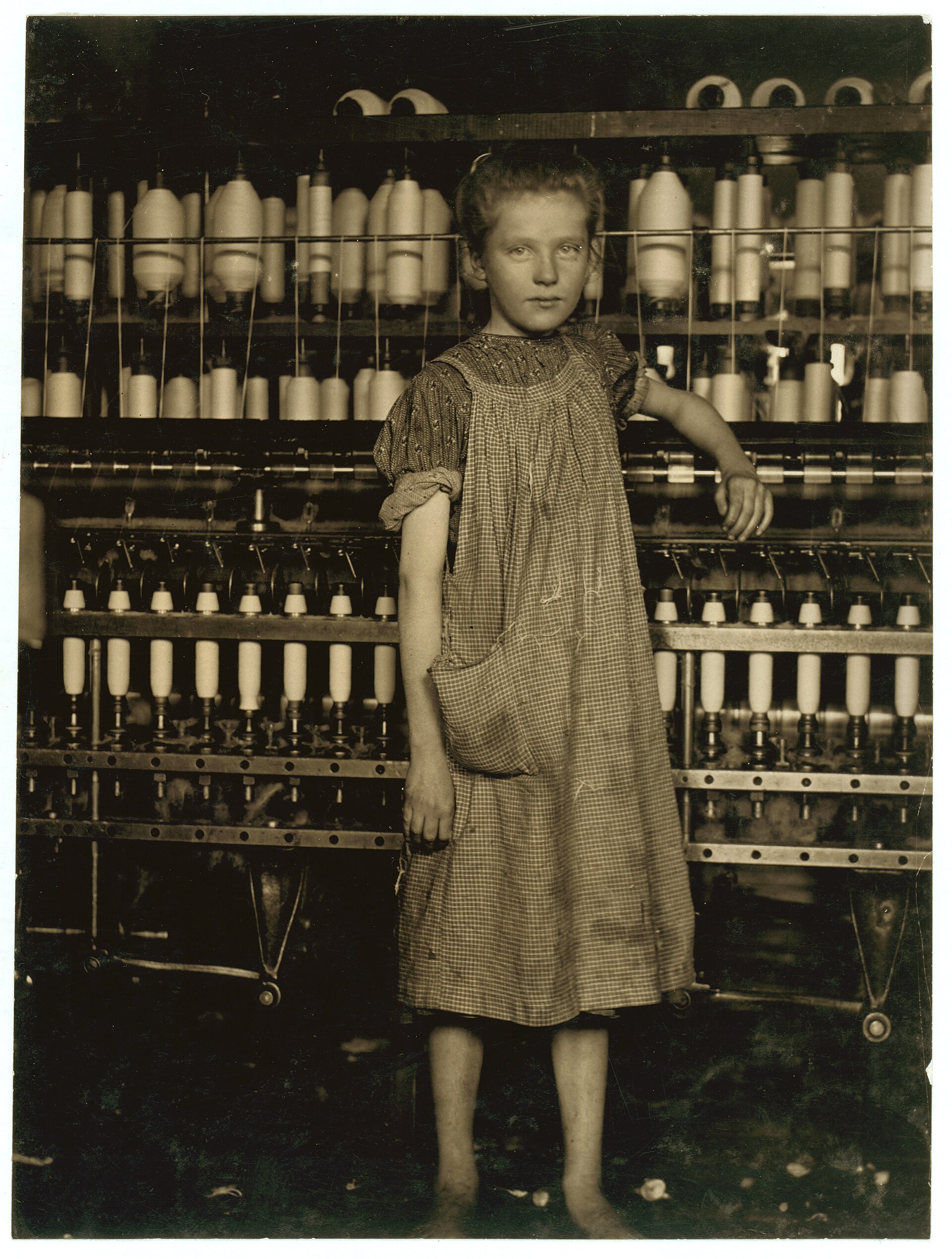
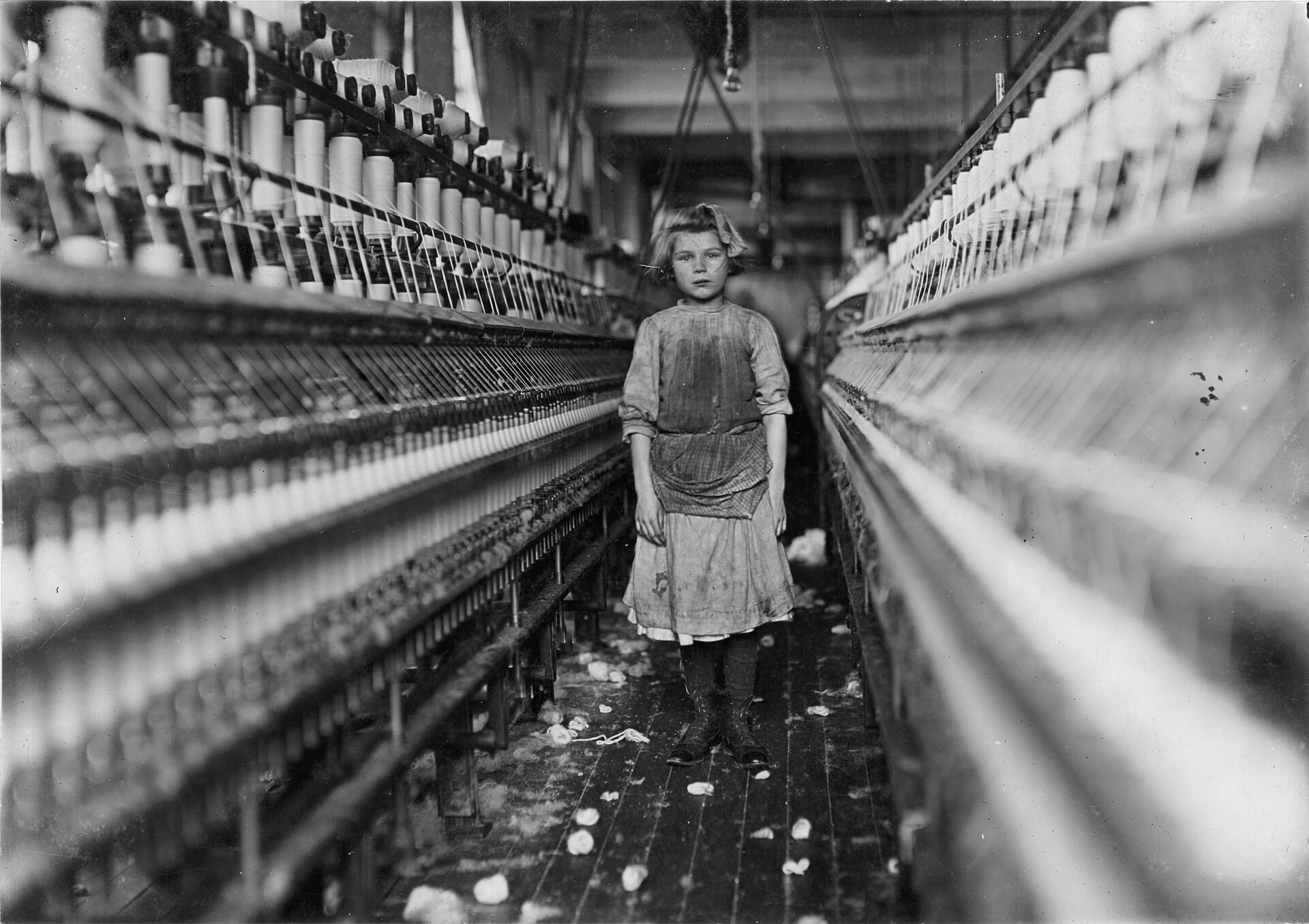
Addie Card, 12 years. Spinner in North Pownal Cotton Mill
1910 · Gelatin silver print. The Library of...
Library of Congress
 American · 1874-1940
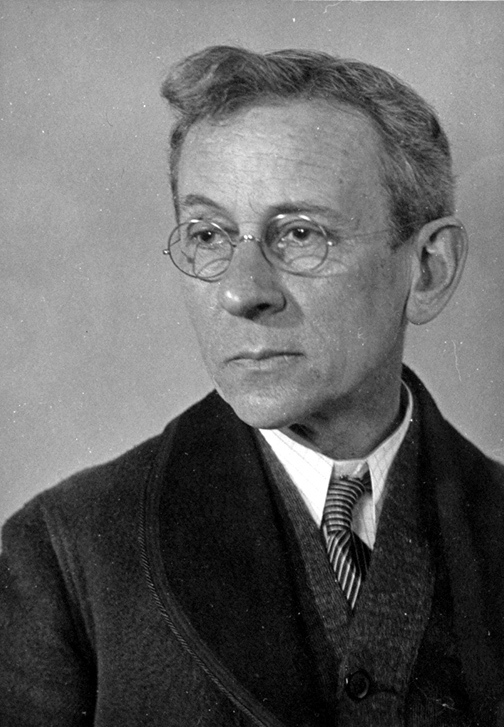
Hine, circa 1930, roughly two decades after the North Pownal investigation behind the Addie Card photograph and a decade before his death in poverty. Held by the George Eastman Museum.
George Eastman Museum| Worked as | Photographer, Sociologist, Investigator |
|---|---|
| Born | 26 September 1874 · Oshkosh, Wisconsin, United States |
| Died | 3 November 1940 · Dobbs Ferry Hospital, Dobbs Ferry, New York, United States |
| Nationality | American |
| Movement | No conventional art-historical school. Hine is the founding figure of American reform and... |
| In this archive | 1 artwork |
| Sources | 17 cited |
| Last verified |
About this page 1 artwork in the archive · Last verified · 17 sources cited
Lewis Hine never called himself an artist. He trained as a sociologist, taught geography and nature study at a New York school built on a specific, documented ethical philosophy, and picked up a camera in 1904 because a colleague thought it might help children pay closer attention to the world. Four years later he left teaching for good to become the staff investigator-photographer of the National Child Labor Committee, and for the next sixteen years he talked his way into mills, mines, canneries and glass factories that did not want him there, wrote down what the children told him, and matched every exposure to a name, an age and a wage.
The thing a reader is least likely to already know is not the pictures. It is what happened around them: that Hine's own name was frequently absent from the pictures that made him famous, both in his lifetime and for decades after; that after his death his negatives passed through a chain of well-meaning hands that ended in one of American photography's ugliest authentication scandals, so that any print offered today has to be dated by the chemistry of its paper before its history can be trusted; and that the man who did more than almost anyone to get children out of American factories died in 1940 on public welfare, unable to get a government job photographing exactly the kind of subject he had spent his career on.
This record anchors on the National Child Labor Committee (NCLC) photographs, most fully represented in this archive by Addie Card, 12 years. Spinner in North Pownal Cotton Mill, and widens from there to the Ellis Island portraits that came before the NCLC work and the Empire State Building series that came after it.
Born 26 September in Oshkosh, Wisconsin.13
Studies at the University of Chicago.13
Moves to New York; hired by Frank Manny, superintendent of the Ethical Culture School, as an assistant teacher of nature study and geography.12
Manny suggests Hine photograph school field trips; Hine, who had never used a camera, begins teaching himself photography and forms a camera club whose members include the future photographer Paul Strand.12
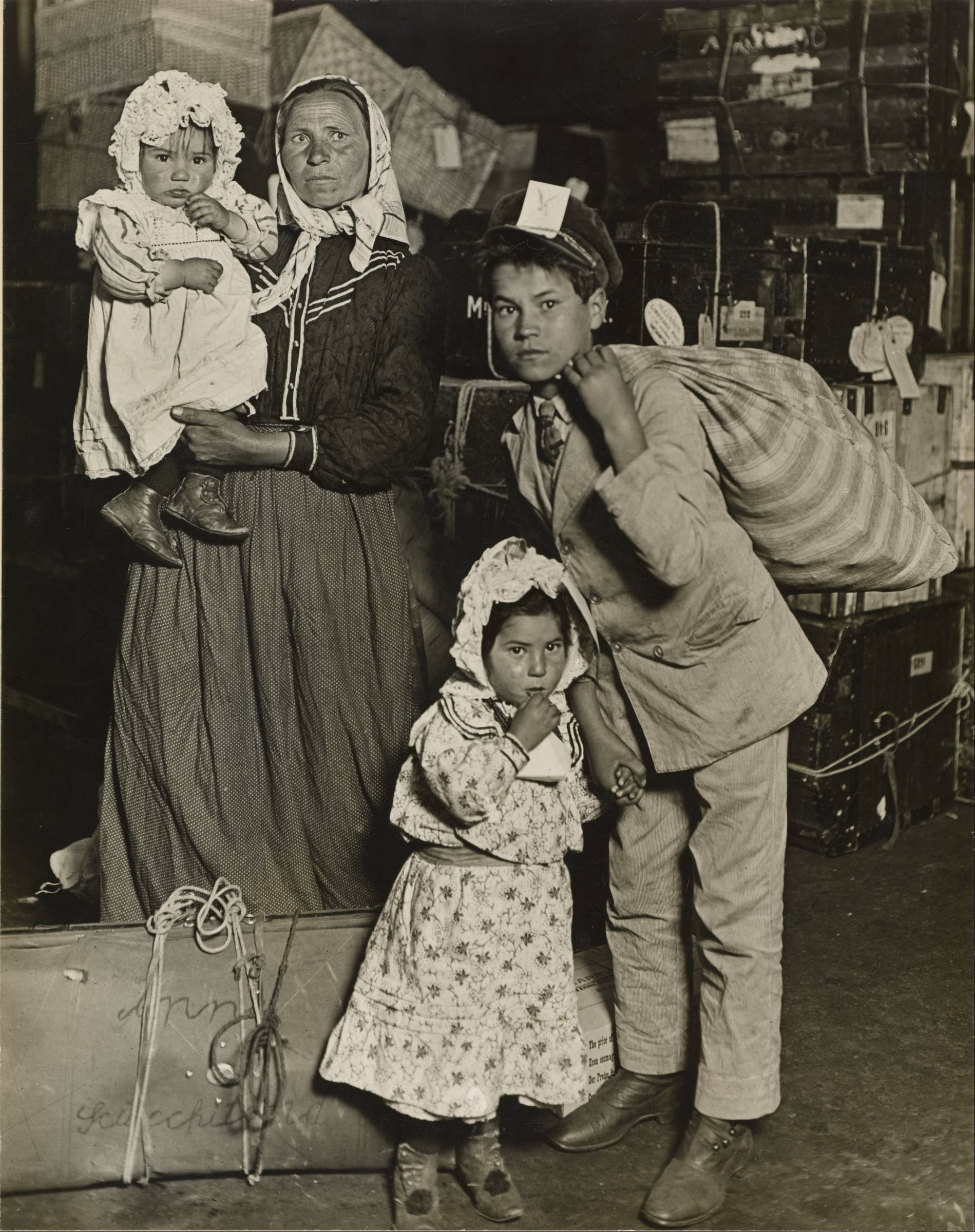
Photographs immigrants at Ellis Island, at Manny's suggestion, as a project intended to teach Ethical Culture's students regard for the immigrant experience.12
Receives a degree in education from New York University.13
Publishes an article arguing that photography made on a school field trip records the conditions visited, an early statement of photography as a research instrument.12
Begins graduate study in sociology at Columbia University and starts photographing for the Pittsburgh Survey of industrial working and living conditions.13
Leaves teaching to become the National Child Labor Committee's staff investigator-photographer, a post he holds until 1924.114
Delivers the lecture 'Social Photography: How the Camera May Help in the Social Uplift' to the National Conference of Charities and Correction in Buffalo, New York, stating his working theory of documentary photography.16
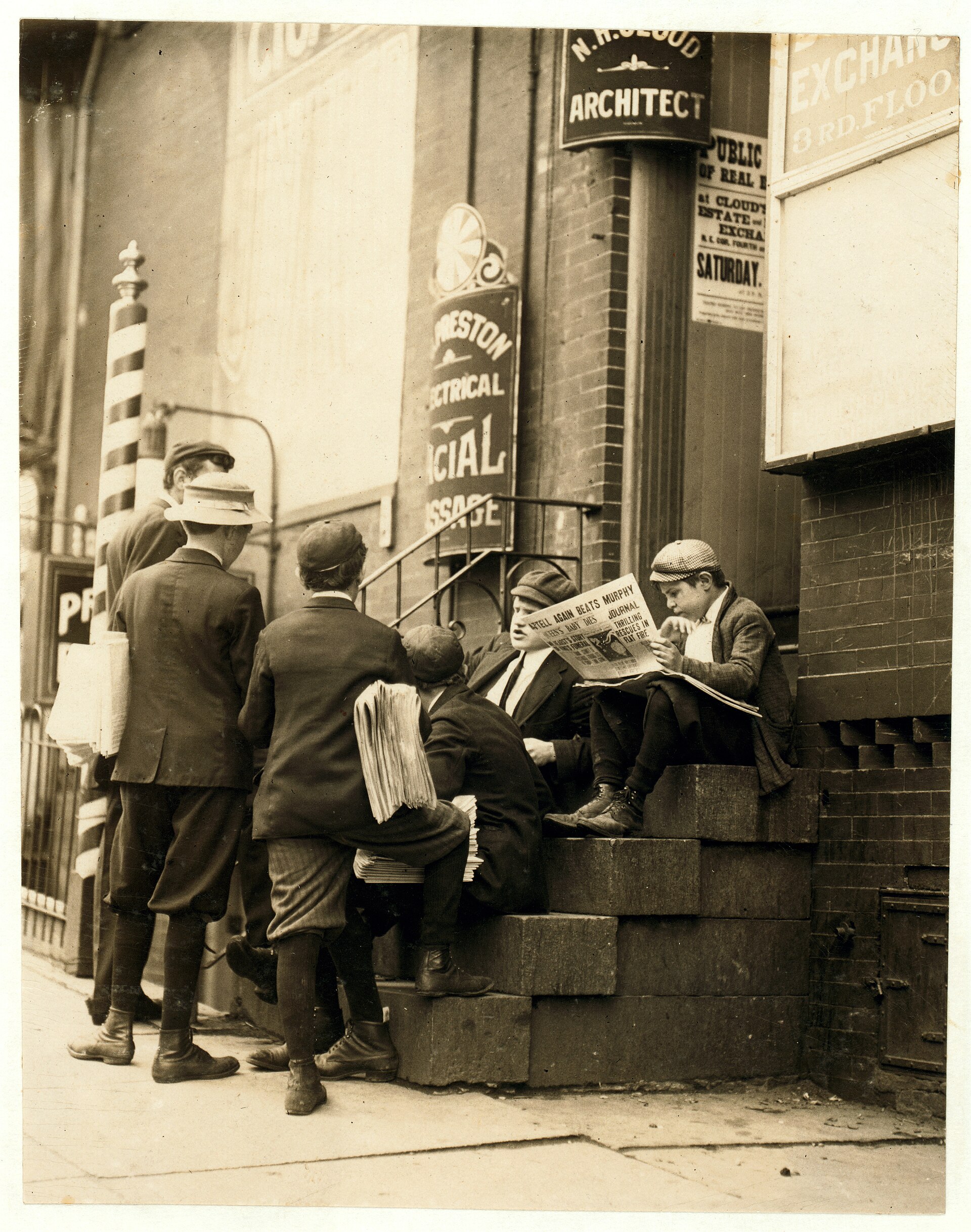
Photographs Addie Card and other children at the North Pownal Manufacturing Company, Vermont, with investigator E.F. Brown, and newsboys in Wilmington, Delaware, the same year.1415
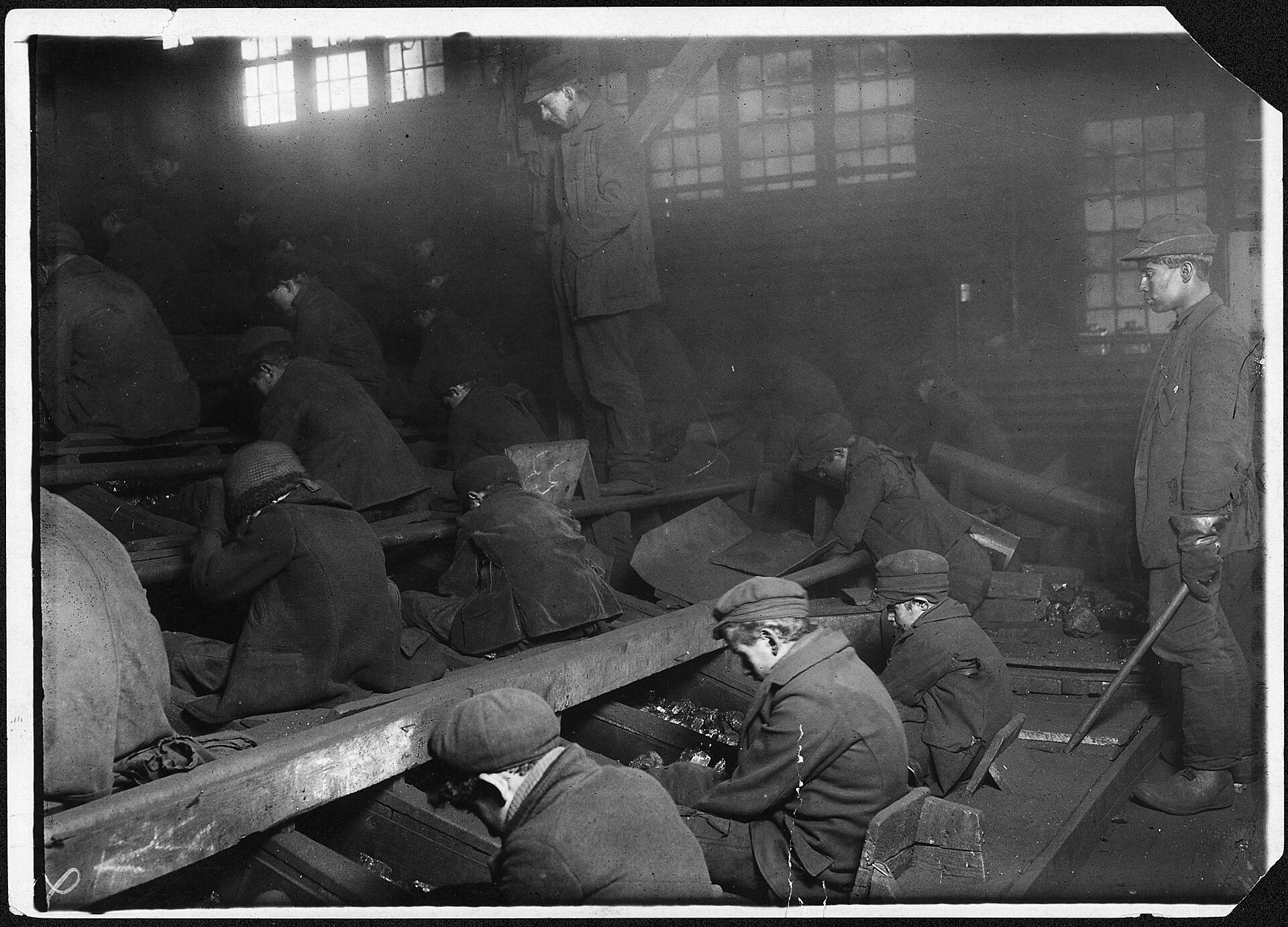
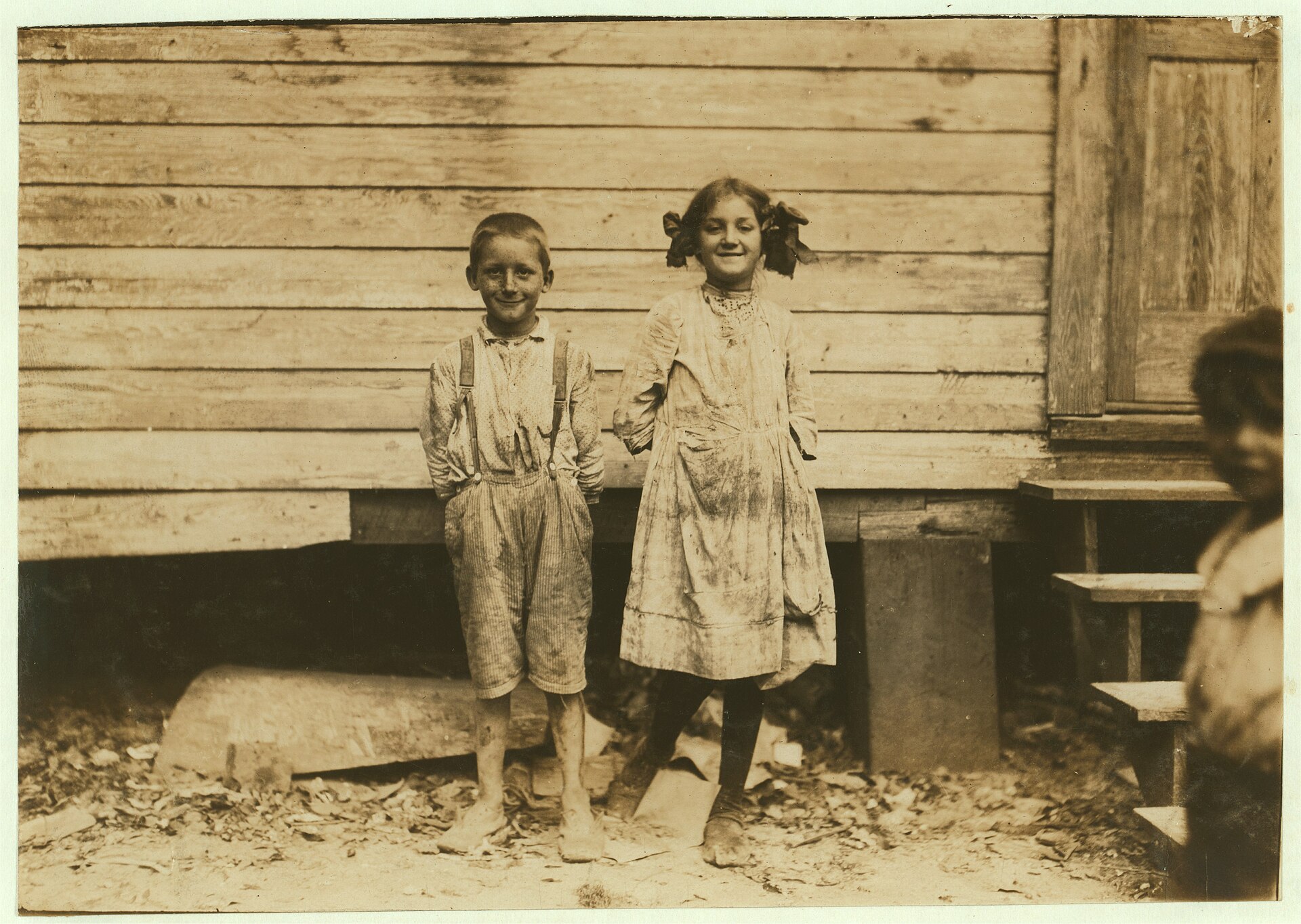
Documents child labor in Gulf Coast oyster and shrimp canneries and Appalachian coal breakers among many other NCLC assignments.1
Photographs for the American Red Cross in Europe during and after the First World War.14
Ends his staff role with the National Child Labor Committee.14
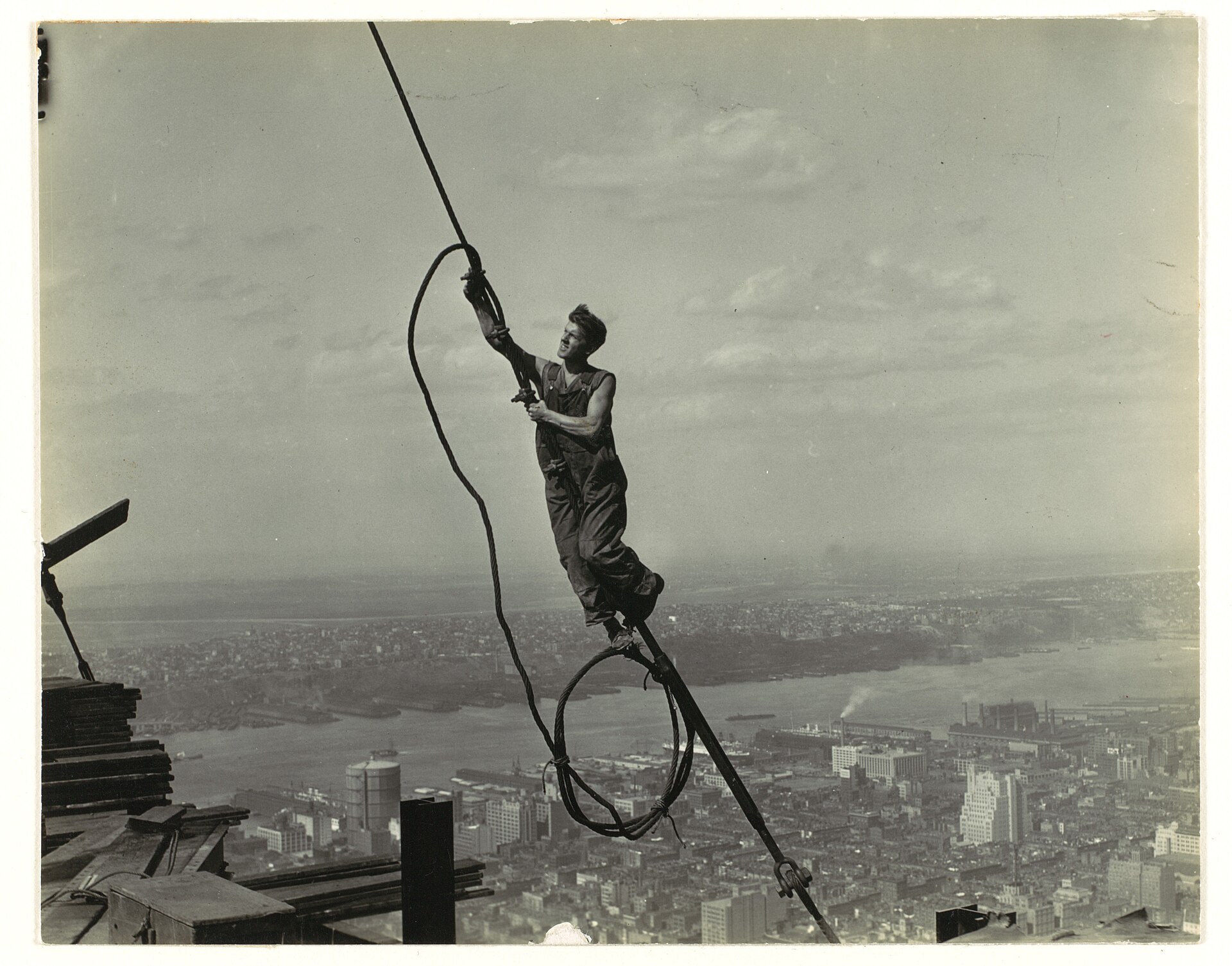
Photographs the construction of the Empire State Building, commissioned through his neighbor Richard Shreve of Shreve, Lamb and Harmon, working from a basket swung out from the rising steel frame.11
Publishes Men at Work: Photographic Studies of Modern Men and Machines, his only book published in his lifetime.11
Photographed at home in Hastings-on-Hudson by Berenice Abbott, part of an effort to secure his reputation.14
Berenice Abbott and Elizabeth McCausland organize a retrospective exhibition of Hine's work at the Riverside Museum, New York, through the Photo League.17
Loses his home in January after falling behind on Home Owners Loan Corporation payments and applies for welfare; dies 3 November at Dobbs Ferry Hospital.1314
More than 4,000 prints and negatives, given by Corydon Hine to the Photo League and held afterward by Walter Rosenblum, reach the George Eastman Museum.5
The National Child Labor Committee gives its archive of more than 5,100 prints and 355 glass negatives to the Library of Congress, through general secretary Gertrude Folks Zimand.114
A collector's paper analysis uncovers more than 250 Hine prints sold as vintage work over the preceding fifteen years that test as posthumous; six New York galleries pursue Walter Rosenblum, and the matter settles out of court in 2001.56
The clearest documented market fact about Hine is not a single record price but a gap: the same photograph, printed at two different dates, sold at the same auction house eleven months apart for radically different sums. Swann Auction Galleries sold a silver print of Powerhouse Mechanic (also catalogued as Mechanic at Steam Pump in Electric Power House) on 20 April 2017 for USD 13,750 against an estimate of USD 10,000 to 15,000; Swann's own listing dates that particular print to the 1940s or 1950s, printed some two decades or more after the 1920-21 negative. On 15 February 2018 Swann sold a second print of the identical image, this one dated circa 1921, close to the negative itself, and carrying Hine's own Interpretive Photography hand stamp from his Hastings-on-Hudson studio; against an estimate of USD 70,000 to 100,000 it sold for USD 81,250. Both figures are stated by Swann's own catalogue to include the buyer's premium, and neither source gives a separate hammer price, a conflation this record notes rather than resolves. A print made close to the negative's own date brought roughly six times a later studio print of the same image.
A widely repeated secondary claim that a Hine print of the same image sold for USD 269,000 in 2014 could not be traced this session to a named auction house, sale date, or hammer-versus-premium breakdown in a primary saleroom record, and is omitted from the results below for that reason.
| Date | Sale | Work | Result | Note |
|---|---|---|---|---|
| 20 April 2017 | Swann Auction Galleries | Powerhouse Mechanic (silver print, 10 x 8 in, dry-mounted; negative 1920-21, this print circa 1940s-1950s) | Hammer Not published separately With premium USD 13,750 (Swann states this figure includes the buyer's premium) USD | Sold within a USD 10,000-15,000 estimate. A later studio print, not close to the negative's own date. |
| 15 February 2018 | Swann Auction Galleries | Mechanic at Steam Pump in Electric Power House (Powerhouse Mechanic; silver print, circa 1921; ex collection Isador Sy Seidman) | Hammer Not published separately With premium USD 81,250 (Swann states this figure includes the buyer's premium) USD | Sold within a USD 70,000-100,000 estimate. A print close to the 1920-21 negative, carrying Hine's own Hastings-on-Hudson studio stamp; extensively published, including on the cover of three Hine monographs and in The Survey Graphic, December 1921. |
Hammer is the price at which the bidding stopped; with premium adds the fee the house charges the buyer on top. Hammer price and buyer's premium in the glossary.
| Institution | City | Holdings | Note |
|---|---|---|---|
| Library of Congress, Prints and Photographs Division | Washington, DC | The National Child Labor Committee Collection: more than 5,100 prints and 355 glass negatives, given whole in 1954. | The single best-documented Hine chain of custody; the archive's own Addie Card record is anchored here. |
| George Eastman Museum | Rochester, New York | More than 4,000 prints and negatives spanning Hine's full career, received in 1952 via Corydon Hine, the Photo League and Walter Rosenblum, including the bulk of the Empire State Building material. | The source institution for the vintage-print authentication standard established after the 1999-2001 forgery investigation. |
| U.S. National Archives and Records Administration | College Park, Maryland | Duplicate NCLC prints transferred to the federal Children's Bureau shortly after its 1912 founding, catalogued under Record Group 102. | An independent paper trail from the Library of Congress holding, useful for cross-checking a given print's institutional history. |
| Metropolitan Museum of Art and National Gallery of Art | New York and Washington, DC | Individual prints acquired later, through the art market rather than institutional transfer; the National Gallery's print of the Addie Card companion negative (Photo #1050) was bought in 2014 through the Pepita Milmore Memorial Fund. | Prints reaching these collections by sale, rather than gift, generally need their own print date established independently of the negative date. |
Hine's formal training was in education and sociology, not art.
Hine's formal training was in education and sociology, not art. He studied at the University of Chicago in 1900 and 1901, took a degree in education from New York University in 1905, and continued graduate study in sociology at Columbia. In 1901 Frank Manny, superintendent of New York's Ethical Culture School, hired him as an assistant teacher of nature study and geography. The school had been founded in 1877 by Felix Adler as the Workingman's School, built on the principle Adler called deed, not creed: that ethical conduct, not doctrinal belief, was the substance of a moral education. It is the documented intellectual home Hine worked inside for the rest of his life, even after he left its payroll.
In 1904 Manny, looking for a way to make school field trips mean more to the students, suggested Hine try photographing them, although Hine had never operated a camera before. Hine took to it fast enough to form a camera club and a photography class at the school; among its student members was Paul Strand, who would become one of the defining photographers of American modernism. Hine took his students to meet Alfred Stieglitz at his gallery. In 1906 Hine published his own article arguing that a photograph made on a field trip served to record the conditions the students had visited, an early statement of the belief that photography was itself a research and teaching instrument, not merely an illustration of one.
The same logic produced Hine's earliest sustained body of work.
The same logic produced Hine's earliest sustained body of work. Manny proposed that Hine photograph immigrants arriving at Ellis Island so that, in Manny's own reasoning, the school's children would come to feel the same regard for Ellis Island that an earlier generation had felt for Plymouth Rock. Hine began the project around 1904 and continued it into 1909, working with a large box camera and glass plates in the crowded registry hall and baggage rooms, photographing families waiting, being processed, and carrying what they had brought with them.
The Ellis Island photographs are frequently read backward, as an early example of the documentary style Hine would later bring to the NCLC. The more exact reading, on the evidence of Manny's own stated purpose, is that they were conceived as civic pedagogy first: images meant to teach Ethical Culture's own students a specific ethical attitude toward strangers arriving in their city, made by a teacher rather than a professional photographer. Hine's Ellis Island prints today sit in institutions including the Metropolitan Museum and the New York Public Library, catalogued individually rather than as a single numbered series, and this record has not located a published total count of how many exposures Hine made there.
Hine left teaching in 1908 to become the National Child Labor Committee's staff investigator-photographer, a post the NCLC's own collection at the Library of Congress dates to 1908 through 1924.
Hine left teaching in 1908 to become the National Child Labor Committee's staff investigator-photographer, a post the NCLC's own collection at the Library of Congress dates to 1908 through 1924. Mill, mine and cannery owners who employed children under the legal age, or worked them longer hours than the law allowed, had every reason to keep a camera off their premises, and accounts consistent across multiple sources describe Hine presenting himself as something other than a labor investigator to get past them: a Bible salesman, a fire inspector or insurance inspector, a postcard photographer, or an industrial photographer documenting machinery. Once inside, by these same accounts, he worked quickly and discreetly, at times learning to write notes with his hand hidden in his pocket so that the numbers a foreman glimpsed him taking would not read as an investigation in progress.
The danger was not incidental. Multiple accounts describe Hine as having been threatened with violence, and on occasion with worse, by factory police and foremen who caught him or suspected him. None of the sources consulted for this record document a specific dated incident with named parties; the threats are described in general terms across several secondary accounts rather than in a single detailed primary report, and this record states that distinction rather than presenting a generic threat as documented event.
What Hine actually produced for the NCLC was never a photograph alone.
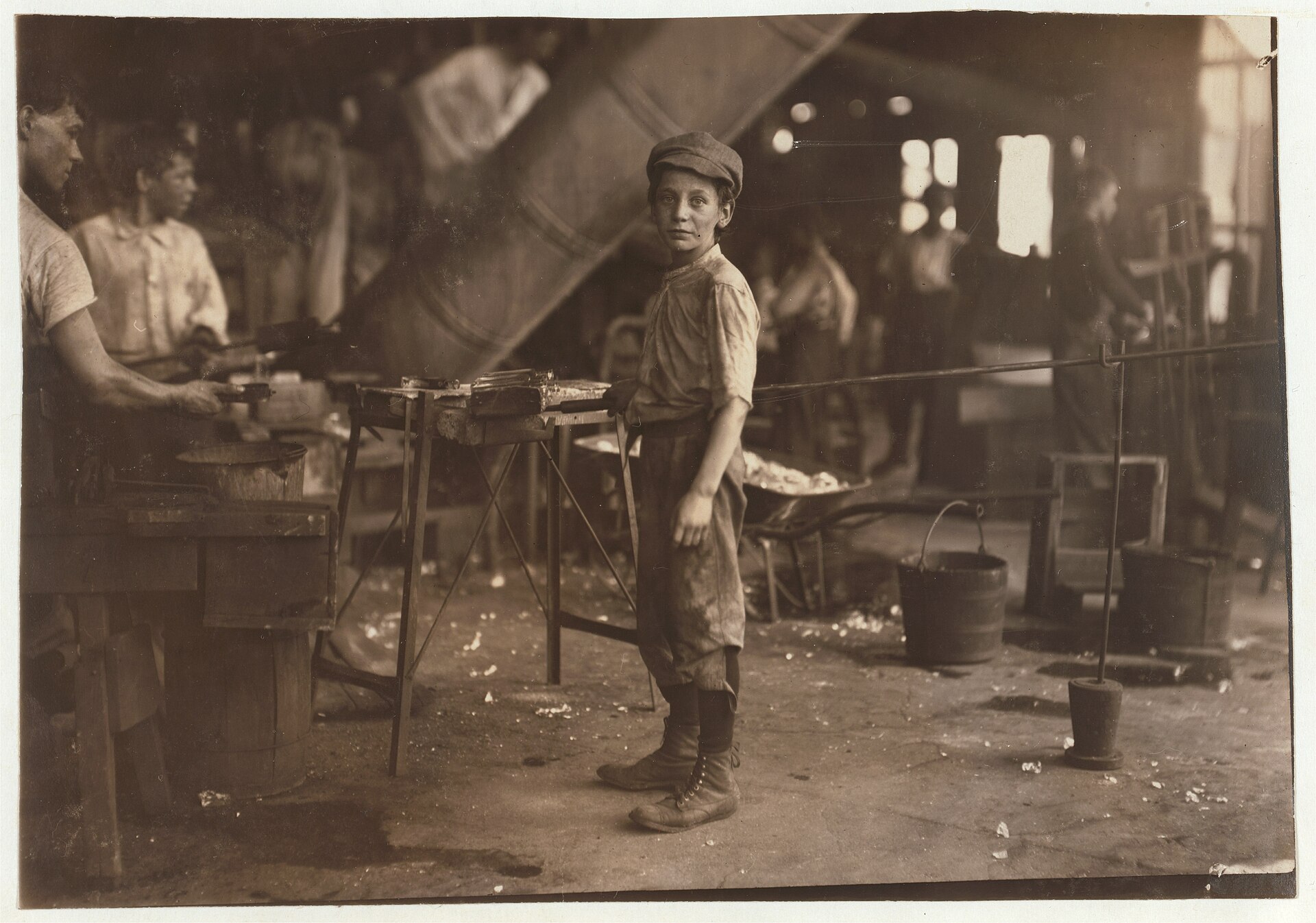
What Hine actually produced for the NCLC was never a photograph alone. It was a photograph paired with an interview, recorded on the spot or from memory shortly after, and the two were filed together as a single unit of evidence. This archive's own record for Addie Card, 12 years. Spinner in North Pownal Cotton Mill shows the method at its most exact: the companion negative from the same 1910 sitting carries Hine's caption reporting that the mill's other workers claimed Addie was ten, below Vermont's legal minimum, while she herself admitted to twelve, and Hine recorded both figures rather than picking one. A photograph of a child at a machine is affecting. A photograph filed with a note that someone lied about her age to keep her working is evidence of the specific practice the NCLC existed to stop.
The North Pownal captions credit a named collaborator, E.F. Brown, elsewhere recorded as the credited investigator on Hine photographs of newsboys made the same year in Wilmington, Delaware, a group portrait captioned with the boys' own request, 'Take our mugs, mister?' The pairing of an investigator gathering testimony with a photographer making the exposure was not unique to North Pownal; it was closer to Hine's normal working method across the NCLC years, wherever an investigator is named in the record.
No single number covers the surviving Hine corpus, because it never passed through one hand and was never consolidated into one archive.
No single number covers the surviving Hine corpus, because it never passed through one hand and was never consolidated into one archive. The National Child Labor Committee's own files, more than 5,100 photographic prints and 355 glass negatives, came to the Library of Congress whole in 1954, given by Gertrude Folks Zimand, the NCLC's general secretary, along with the committee's organizational records; that gift is the best-documented chain of custody of any part of Hine's output and is the basis for the provenance already published on this archive's Addie Card record. A parallel, overlapping set of duplicate NCLC prints, made for the federal Children's Bureau shortly after its 1912 founding, sits today in the National Archives under Record Group 102, independent of the Library of Congress holding.
Separately again, more than 4,000 prints and negatives, covering Hine's work outside as well as inside the NCLC years, passed after his death from his son Corydon to the Photo League, and from the League, through the photographer Walter Rosenblum, to the George Eastman Museum in 1952. None of the sources consulted for this record states how much overlap exists between the Library of Congress holding and the Eastman holding, or gives a single combined figure for how many distinct exposures Hine made across his career; this record states that as an open question rather than adding the published figures together, since prints of the same negative appear in more than one of these collections.
Authorship of the NCLC photographs is not seriously disputed the way an unsigned Renaissance panel's might be; the negatives carry the NCLC's own numbering and Hine is overwhelmingly the photographer...
Authorship of the NCLC photographs is not seriously disputed the way an unsigned Renaissance panel's might be; the negatives carry the NCLC's own numbering and Hine is overwhelmingly the photographer of record. What is genuinely a live problem is credit in circulation. The Library of Congress's own cataloguing of the NCLC collection attributes an image to Hine unless a caption card names a different photographer, and notes that a number of caption cards carry no legible photographer credit at all, a cataloguing gap rather than a stated editorial decision. This archive's own Addie Card record documents the practical consequence in the sharpest case on file: the girl in that photograph circulated under the wrong name, Addie Laird, for roughly sixty years, including on a 1998 United States postage stamp, and Hine's own name traveled with the image far less consistently than his pictures traveled without it.
Some popular accounts of Hine's career go further and state that his name was deliberately withheld from certain published NCLC images specifically to protect him from retaliation or a lawsuit by an identified mill owner. This record could not confirm that specific claim against a primary NCLC organizational document, board minute or contemporary press account in the sources available this session, as against the well-documented general fact that his fieldwork was dangerous and that his name is inconsistently attached to the surviving prints. The distinction matters: one is documented, the other is asserted. It is recorded here as unresolved rather than repeated as settled.
In 1930, at fifty-six, Hine was engaged to document the construction of the Empire State Building, on the proposal of his neighbor Richard Shreve of the architectural firm Shreve, Lamb and Harmon...
In 1930, at fifty-six, Hine was engaged to document the construction of the Empire State Building, on the proposal of his neighbor Richard Shreve of the architectural firm Shreve, Lamb and Harmon, the building's own architects. To get his vantage points he was swung out from the rising steel frame in a specially built basket, by one documented account a quarter of a mile above Fifth Avenue, photographing riveters and derrick men balanced on girders with nothing but the frame itself between them and the street.
The photographs became Men at Work: Photographic Studies of Modern Men and Machines, published in 1932, the only book Hine published in his own lifetime. Its subject is explicitly stated in Hine's own accompanying text: 'Cities do not build themselves, machines cannot make machines, unless back of them all are the brains and toil of men.' It is the same commitment that ran through the NCLC work, redirected from children kept out of the workforce to adult men whose labor Hine believed was being erased by the buildings and machines that labor produced, and it reads today as Hine's own closing statement on what sixteen years of investigative photography had been for.
Reform photography moved on without him.
Reform photography moved on without him. The more candid, less overtly captioned style associated with Roy Stryker's Farm Security Administration photography unit became the dominant documentary mode of the later 1930s, and Stryker, despite repeated approaches from Hine, never hired him. Commissions and government patronage dried up. In January 1940 Hine lost his own home after falling behind on payments to the Home Owners Loan Corporation, and applied for welfare. He died on 3 November 1940 at Dobbs Ferry Hospital, in Dobbs Ferry, New York, close to his home in Hastings-on-Hudson, largely without income, not quite two years after the first organized effort to secure his reputation had begun.
That effort came in 1938 and 1939, from within the same documentary-photography circle his Ethical Culture teaching had helped seed a generation earlier: Berenice Abbott photographed Hine at home in Hastings-on-Hudson in 1938, and in 1939 Abbott and the critic Elizabeth McCausland organized a retrospective exhibition of his work at the Riverside Museum in New York, staged through the Photo League, while Hine was still alive to see some of it. It did not translate into paid work before he died.
Hine's son, Corydon Hine, gave his father's remaining negatives and prints to the Photo League, the same organization that had staged the 1938-39 rediscovery effort.
Hine's son, Corydon Hine, gave his father's remaining negatives and prints to the Photo League, the same organization that had staged the 1938-39 rediscovery effort. The League itself was forced to close in 1951, driven under by its formal listing as a subversive organization during the period's anti-communist investigations. Its Hine holdings, along with correspondence and early prints, passed into the keeping of Walter Rosenblum, a photographer who had trained under Hine and who administered the estate for the Photo League. Rosenblum stored the collection in his own home for roughly a year before placing more than 4,000 prints and negatives with the George Eastman Museum in 1952, where the bulk of Hine's non-NCLC archive, including much of the Empire State Building and Ellis Island material, remains today.
That custodial chain, well-intentioned at every step, is also the direct cause of the authentication problem described below. Rosenblum did not merely preserve the negatives; over the following decades he also printed from them and sold the results, and what he told buyers about when those prints were made became, after his death, a matter for scientific examination rather than institutional memory.
In 1999 the collector Michael Mattis, suspicious of the unusual quality and volume of Hine prints he had bought, had them examined by a Boston paper conservator.
In 1999 the collector Michael Mattis, suspicious of the unusual quality and volume of Hine prints he had bought, had them examined by a Boston paper conservator. The examination read the paper itself: fiber composition under microscopy, and, under ultraviolet light, the presence of optical brightening agents, chemical additives not used in photographic papers before roughly 1945. A print offered as a Hine original made at or near the date of the negative, but fluorescing with brighteners that did not exist yet when that negative was exposed, cannot be what it is sold as, whatever the paperwork around it says.
The subsequent investigation traced more than 250 prints sold as vintage Hine work over a fifteen-year period back to Walter Rosenblum, who, through his attorney, maintained that any prints he had sold were acquired in good faith either from Hine himself or from Corydon Hine, and that it would not have been improper for him to sell modern prints made from Hine's own negatives had he identified himself, rather than Hine, as the printer. Six New York photography galleries, including Howard Greenberg, Edwynn Houk and Robert Mann's galleries, pursued the matter and reached a settlement out of court in 2001. The image at the center of the case, Powerhouse Mechanic (also catalogued as Mechanic at Steam Pump in Electric Power House), made 1920-21, is unrelated to the NCLC period and to the Addie Card photograph already published in this archive, but the forensic method the case established, paper fiber and optical-brightener dating rather than provenance paperwork alone, is now the working standard against which any Hine print's date is checked.
Powerhouse Mechanic also supplies the clearest documented illustration on record of how much a Hine print's date, rather than its image, decides its value.
Powerhouse Mechanic also supplies the clearest documented illustration on record of how much a Hine print's date, rather than its image, decides its value. Swann Auction Galleries sold two silver prints of the same photograph eleven months apart. On 20 April 2017 a print measuring 10 by 8 inches, dry-mounted to a board and dated by Swann's own catalogue to circa 1920-21 but printed in the 1940s or 1950s, sold within its estimate of USD 10,000 to 15,000 for USD 13,750, a figure Swann's listing states includes the buyer's premium; no separate hammer figure is published for this lot in the source consulted. On 15 February 2018 Swann sold a second print of the same image, from the collection of Isador Sy Seidman, carrying Hine's own Interpretive Photography hand stamp from his Hastings-on-Hudson studio and dated circa 1921, close to the year of the negative itself; against an estimate of USD 70,000 to 100,000 it sold for USD 81,250, again stated by Swann to include the buyer's premium rather than as a separate hammer price.
The same image, the same auction house, roughly the same size of print: a contemporary print made close to the 1920-21 negative brought nearly six times what a mid-century studio print of the identical photograph brought. That is the vintage-versus-later premium the 2001 forgery settlement made forensically checkable, expressed in a real, sourced pair of results rather than a general claim about the market.
Several genuine gaps remain, recorded here rather than smoothed over.
Several genuine gaps remain, recorded here rather than smoothed over. No published source consulted for this record gives a single total figure for how many negatives Hine exposed across his full career, as against the separate, better-documented figures for what survives in the Library of Congress's NCLC collection and the George Eastman Museum's broader holding, and this record has not established how much those two holdings overlap. The claim that Hine's name was deliberately withheld from some published NCLC images to protect him from a mill owner's retaliation or lawsuit could not be confirmed against a primary source this session, as against the separately documented facts that his fieldwork was genuinely dangerous and that his name is inconsistently attached to surviving prints. The widely repeated figure of a 2014 sale of a Hine print for USD 269,000 could not be traced this session to a named auction house, a hammer-versus-premium breakdown, or a primary saleroom record, and is not used in this record's market section for that reason. And no catalogue raisonne of Hine's work has been located; the closest scholarly surveys are Judith Mara Gutman's 1967 and 1974 studies and the institutional finding aids at the Library of Congress and George Eastman Museum, none of which functions as a numbered catalogue of the whole corpus.
Photographer; Sociologist; Investigator. 1874-1940.
Born 26 September 1874, Oshkosh, Wisconsin, United States; died 3 November 1940, Dobbs Ferry Hospital, Dobbs Ferry, New York, United States.
The Rosenblum posthumous-print investigation, 1999-2001. More than 250 photographs sold over roughly fifteen years as vintage Hine prints, at prices routinely in the thousands of dollars, were traced back to Walter Rosenblum, the photographer and Photo League figure who had custody of Hine's negatives after 1951 and who, through his attorney, maintained he had acquired and sold the material in good faith from Hine or from Corydon Hine.
Library of Congress, Prints and Photographs Division (Washington, DC); George Eastman Museum (Rochester, New York); U.S. National Archives and Records Administration (College Park, Maryland); Metropolitan Museum of Art and National Gallery of Art (New York and Washington, DC).
The clearest documented market fact about Hine is not a single record price but a gap: the same photograph, printed at two different dates, sold at the same auction house eleven months apart for radically different sums. Swann Auction Galleries sold a silver print of Powerhouse Mechanic (also catalogued as Mechanic at Steam Pump in Electric Power House) on 20 April 2017 for USD 13,750 against an estimate of USD 10,000 to 15,000; Swann's own listing dates that particular print to the 1940s or 1950s, printed some two decades or more after the 1920-21 negative.
No source consulted gives a single total figure for how many negatives Hine exposed across his full career, as against the separately documented survival figures at the Library of Congress (5,100+ prints, 355 negatives) and the George Eastman Museum (4,000+ items); the overlap between the two holdings is not stated in any source found.
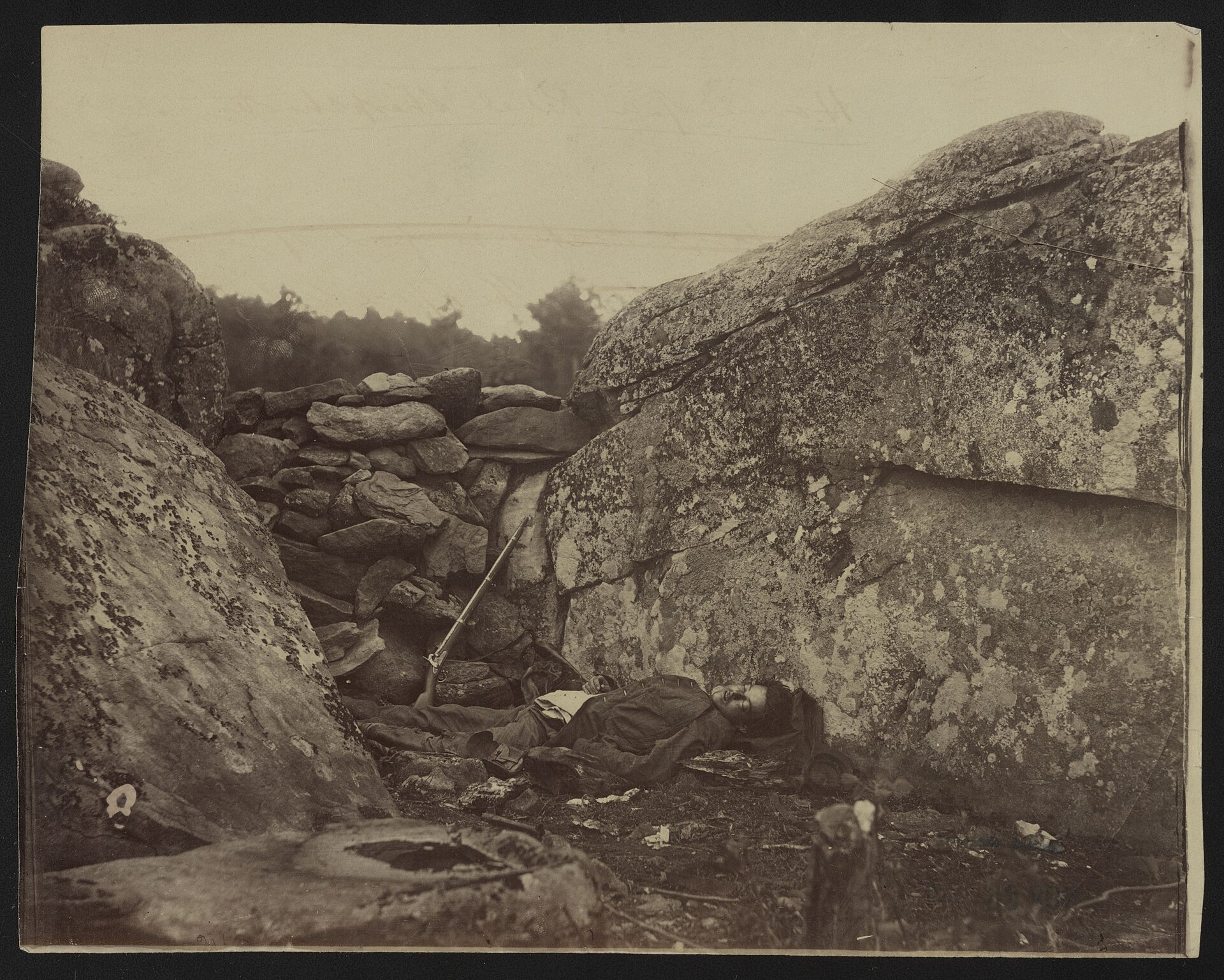
Six canonical documentary photographs in this archive were arranged, retouched or captioned to say more than they showed.
9 min read
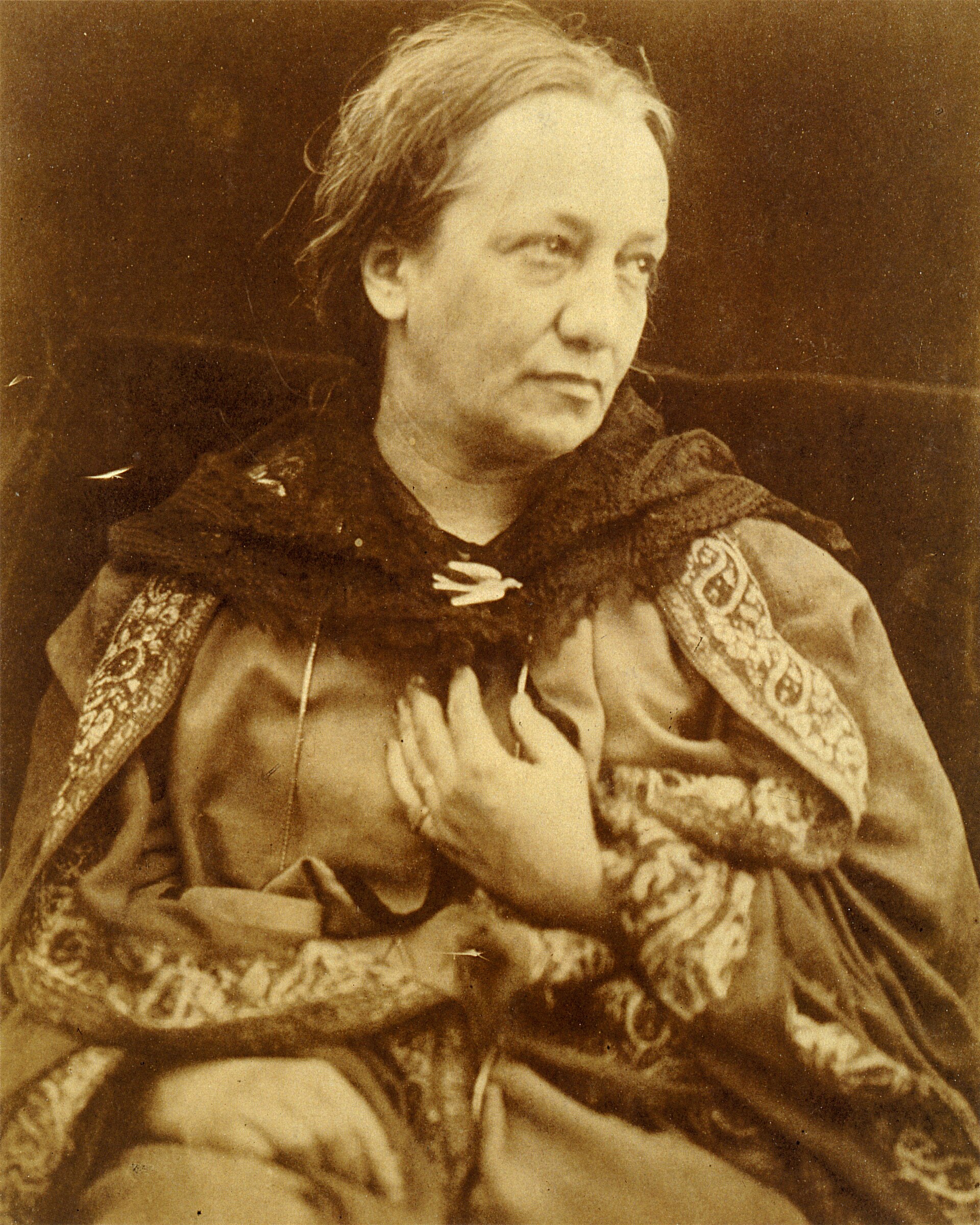
Julia Margaret Cameron registered 508 photographs and never attached a specimen to any of them.
13 min read
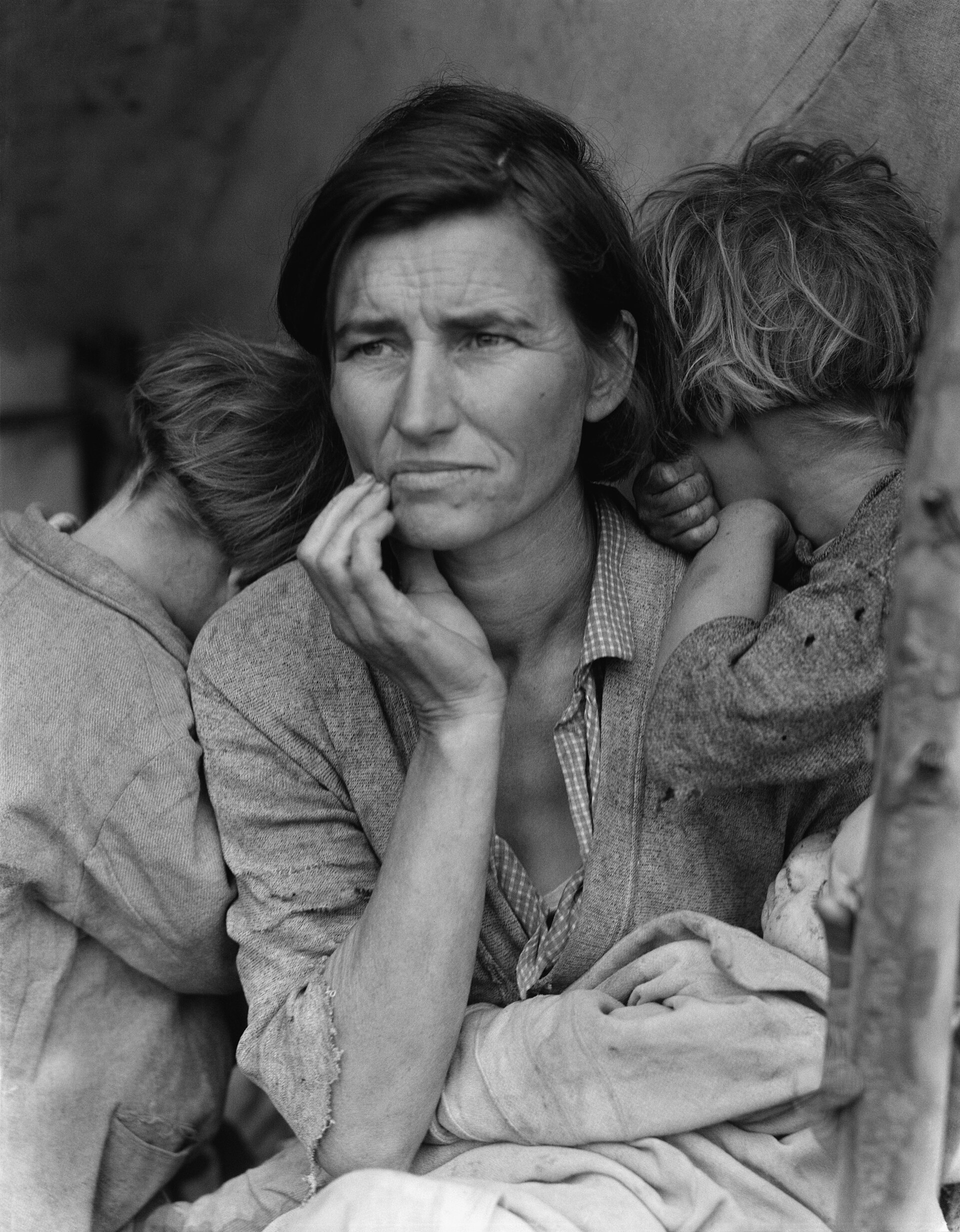
Four famous photographs of women in this archive. Only one of the four is named on the picture, by herself, and she is the only...
10 min read
Last verified
One artwork and its story every Tuesday, with the picture: who owned it, what it made, and what closes soon in the exhibition calendar. No promotion, and nothing we cannot cite.
We send one email to confirm the address and keep nothing else. Every letter carries a one-click unsubscribe. How we handle your data.
