Josiah Wedgwood
 English · 1730-1795
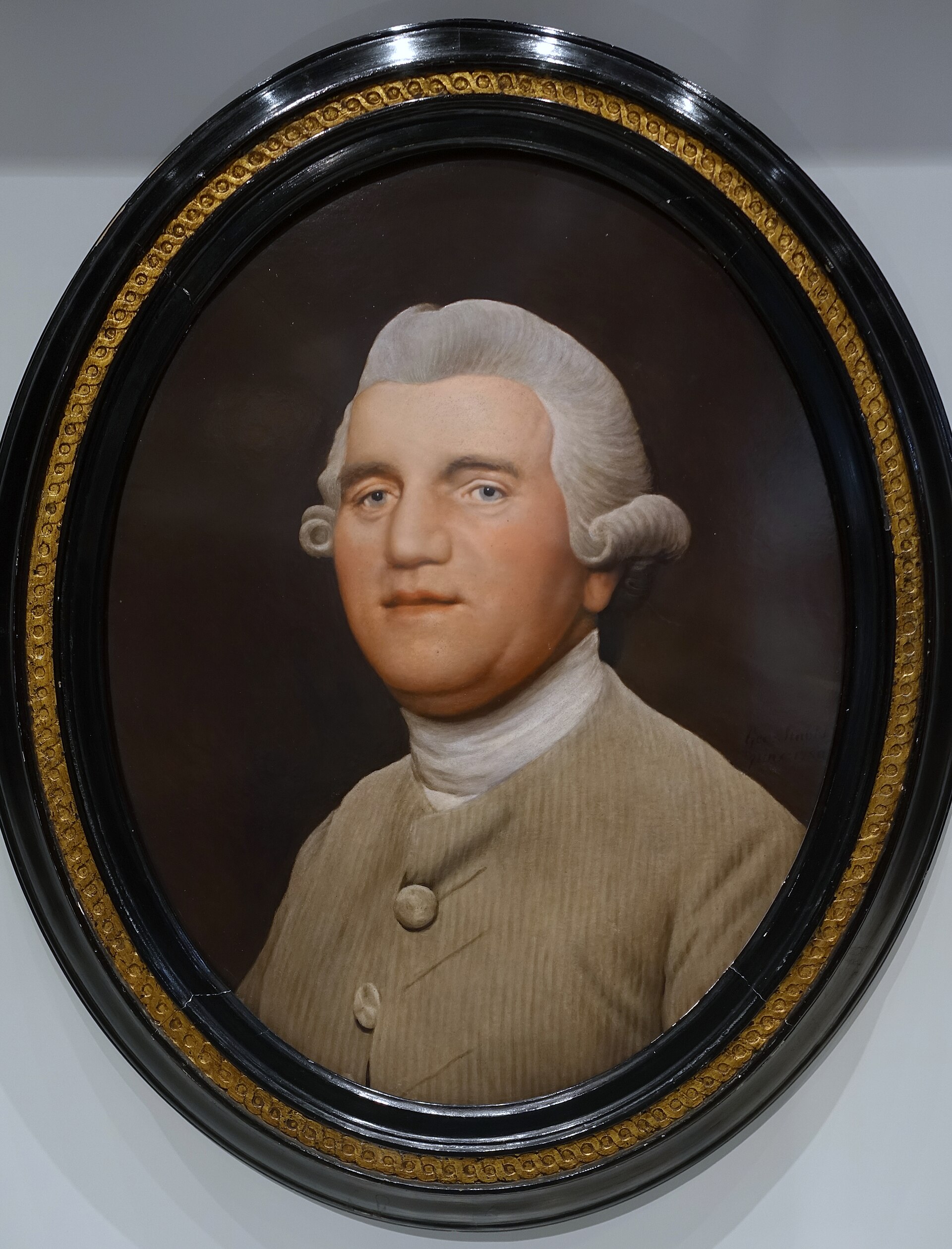
Josiah Wedgwood at fifty, painted by George Stubbs in enamel on a ceramic tablet made at Etruria, signed Geo: Stubbs pinx 1780. The identification is secure: the sitter is named in the V&A's catalogue record for the object, museum number WE.7522-2014, the portrait was painted for Wedgwood himself and descended in the family to the Wedgwood Museum. The support is the point. Stubbs wanted the permanence of enamel on copper at a larger size, and Wedgwood spent years and built special kilns to make him tablets big enough, writing to Bentley in 1779 that he had been labouring hard to furnish Mr Stubbs with the means of adding immortality to his excellent pencil. Stubbs was paid in ceramic; Wedgwood was painted on his own product.
V&A Wedgwood Collection, displayed at the Wedgwood Museum, Barlaston| Full name | Josiah Wedgwood FRS FSA, of Etruria in the county of Stafford |
|---|---|
| Worked as | Potter, Ceramic chemist and inventor of bodies, Manufacturer and factory owner, Retailer and marketer |
| Born | Baptised 12 July 1730, probably also his birth date. · Burslem, Staffordshire, at or near the Churchyard Works... |
| Died | 3 January 1795, of what contemporary and Victorian sources... · Etruria Hall, Etruria, Staffordshire. |
| Nationality | English |
| Movement | English Neoclassicism |
| Sources | 75 cited |
| Last verified | 17 September 2026 |
About this page Last verified 17 September 2026 · 75 sources cited
On this page 13 sections
ContentsClose
Josiah Wedgwood is filed under potter, and the word is misleading in almost every direction. He threw pots for perhaps five years of a fifty-year career, and after 1768 he had one leg and could not comfortably work a wheel at all. What he actually did was develop ceramic bodies by numbered experiment, write the results down, and then build a distribution and retail system to sell them. He was elected to the Royal Society in 1783, on the strength of an instrument he had built to measure the temperature inside a kiln - though the election certificate itself, as the record below shows, names no scientific ground at all.
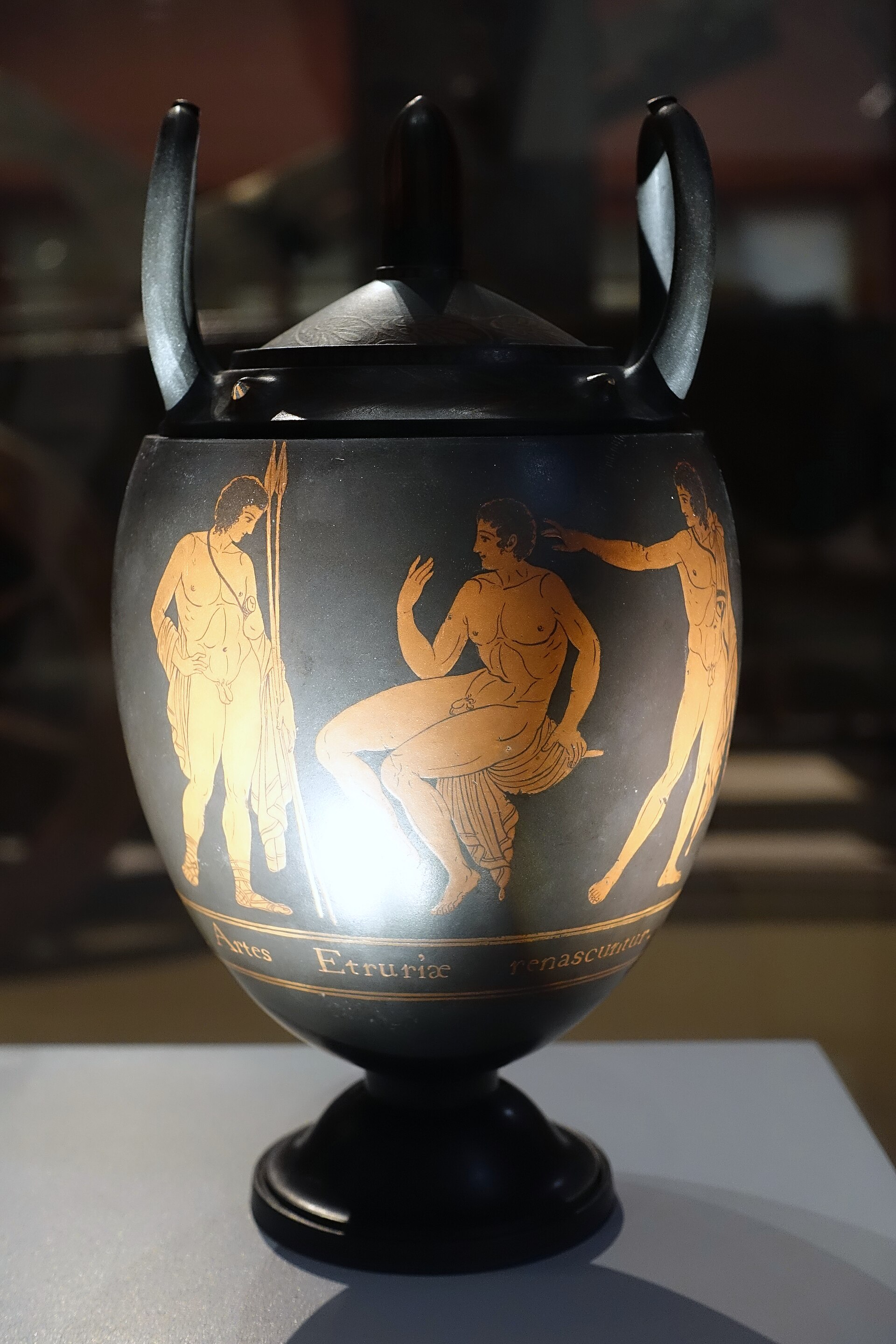
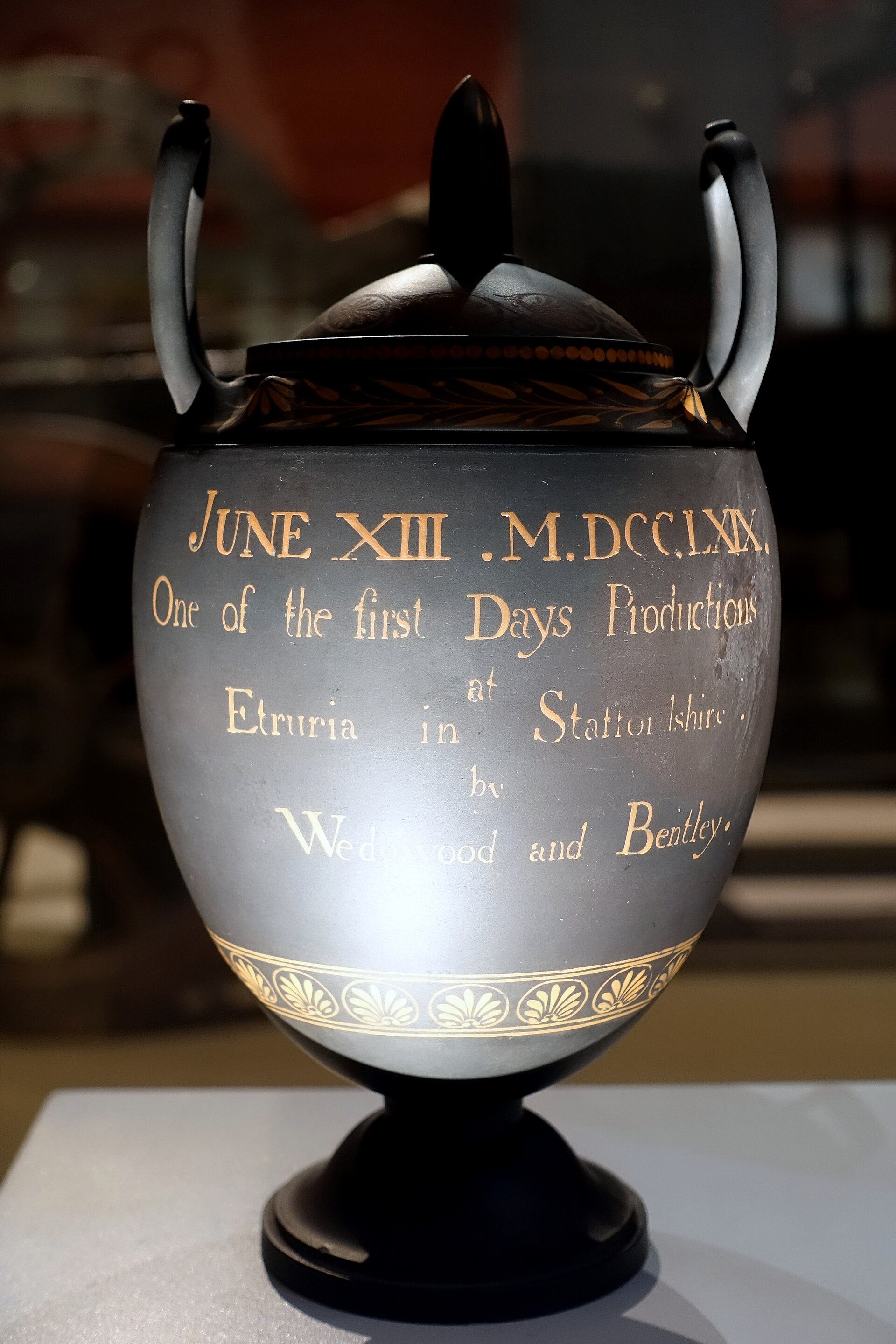
The consequence for anyone handling the objects is that Wedgwood is a body and a process before it is a hand. There is no autograph work in the sense a painting is autograph: the shapes were modelled by employees and outside contractors, the reliefs by named sculptors and unnamed ones, the painting by wage labour in a decorating shop two hundred and fifty kilometres from the factory. The one documented occasion on which he made objects himself, the six vases thrown at the opening of Etruria on 13 June 1769, was commemorated precisely because it was exceptional. Attribution questions on this maker are therefore questions about a firm, a date and a body, not about a brush.
The thing most readers do not know is that the two most famous facts about him are in tension. He was an active member of the committee campaigning to abolish the slave trade, and he gave the abolition medallion away rather than sell it. He also, on the V&A's own account, found new markets in the West Indies for wares that had gone out of fashion in Europe, and profited from the plantation economy he opposed. His own great-granddaughter, writing the family biography in 1915, put the same problem more sharply: while he was writing letters about the slave trade he was also trying to make emigration a penal act for his own workmen.
Images
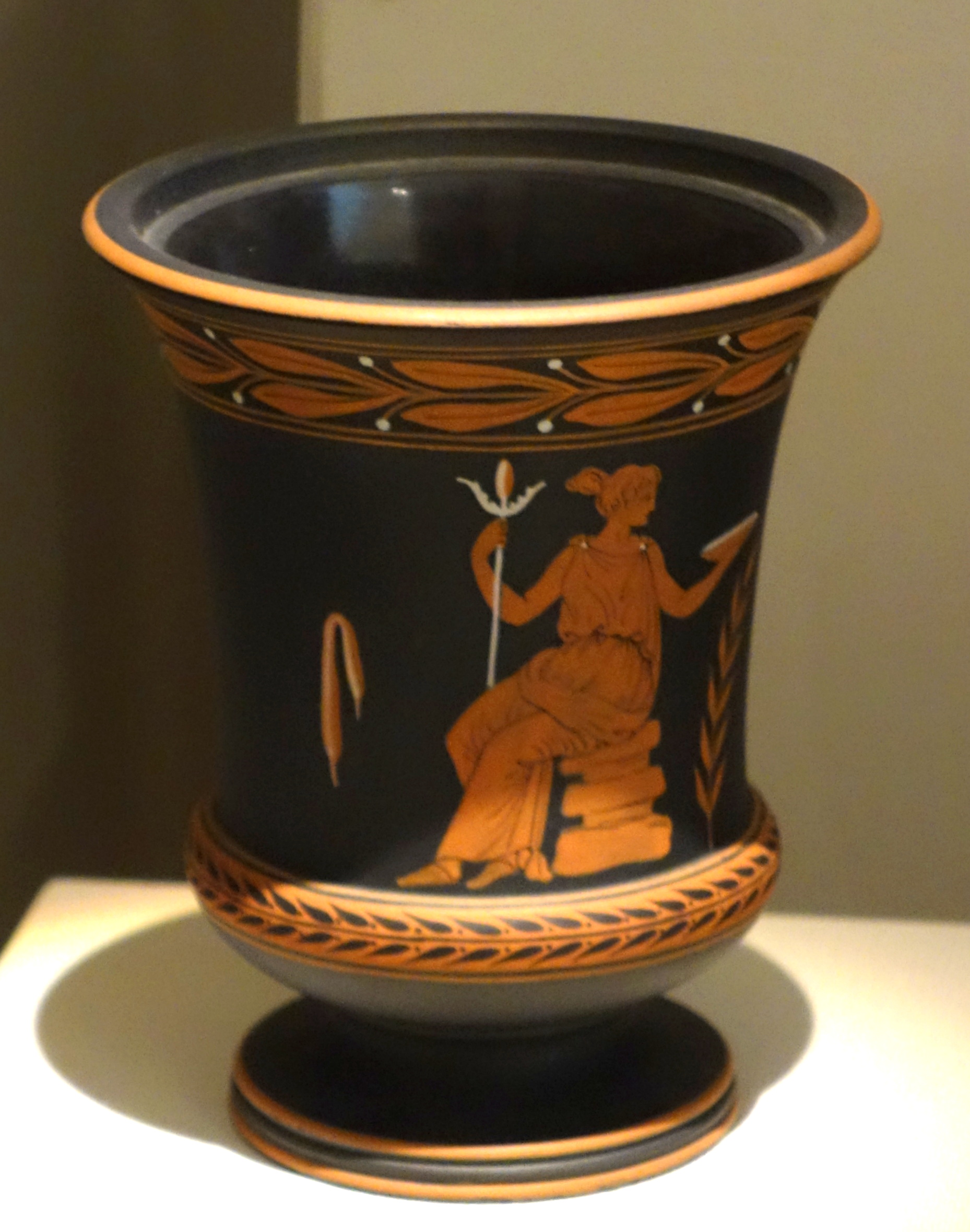
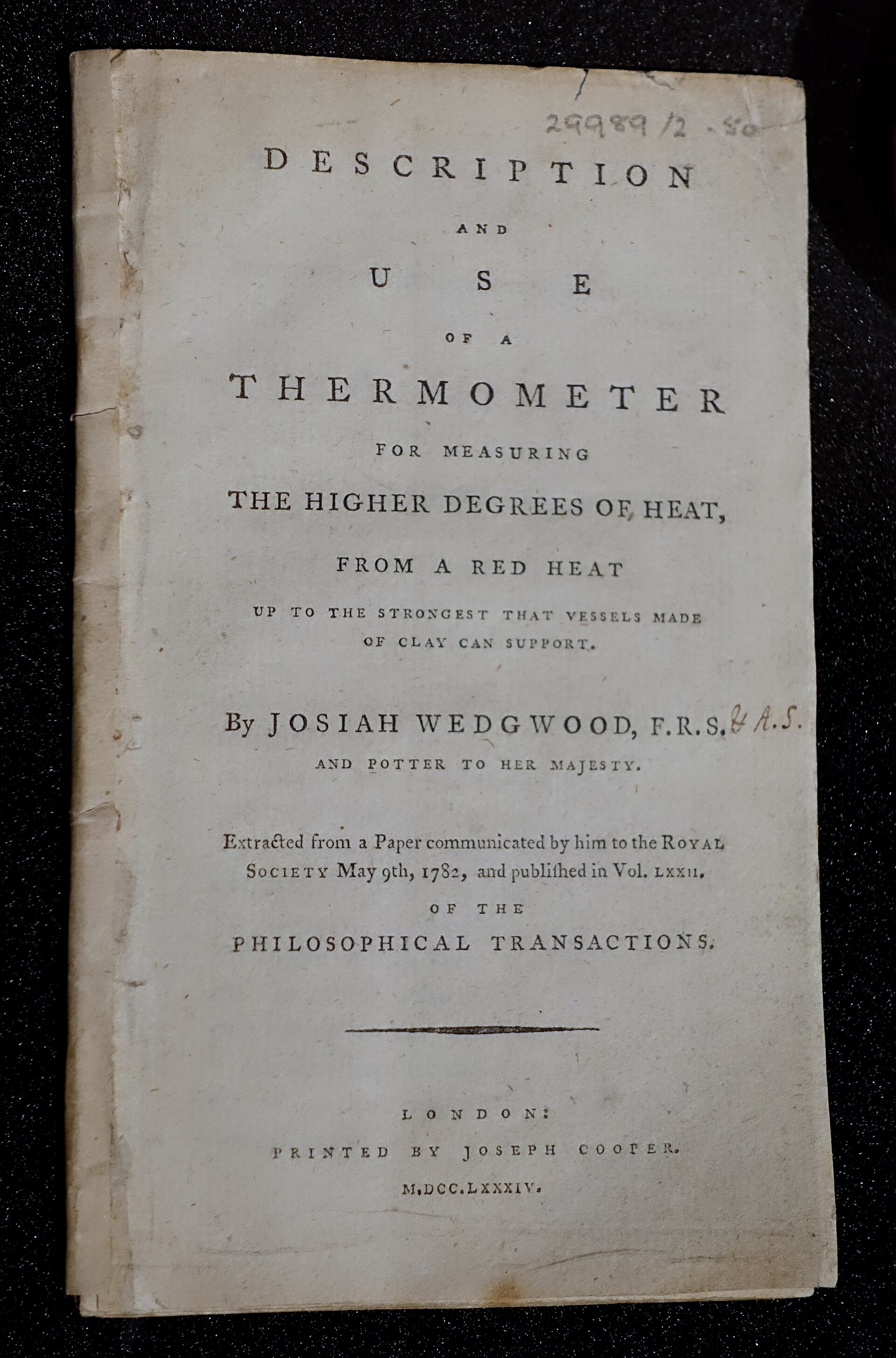
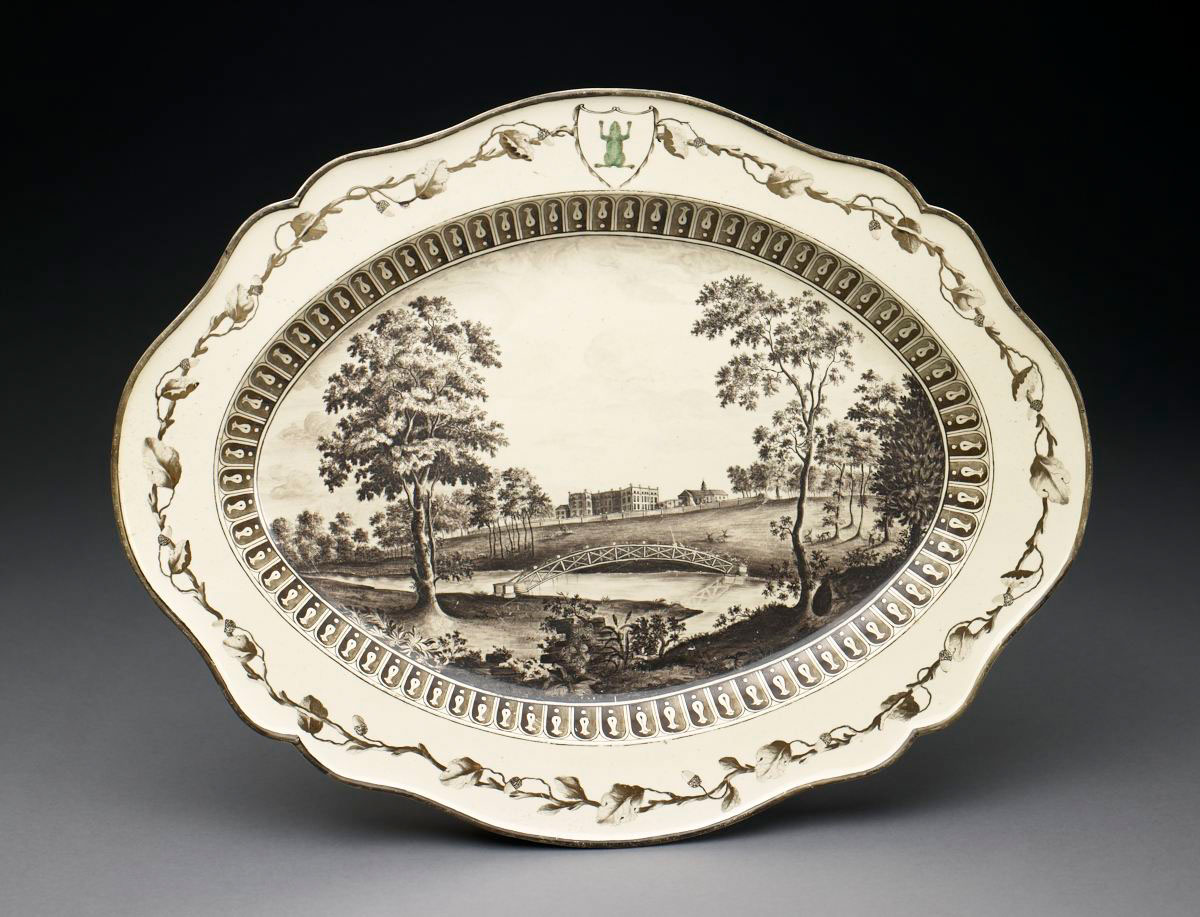
Chronology
- 1730
Baptised at St John's, Burslem, on 12 July, probably also his birth date; thirteenth and last child of Thomas Wedgwood, master potter of the Churchyard Works, and Mary Stringer, daughter of a dissenting minister.19
- 1739
His father dies in June. Josiah leaves the school at Newcastle-under-Lyme and begins an informal apprenticeship at the wheel.1719
- c. 1742
A severe attack of smallpox at about eleven or twelve settles in his right knee. Recurring pain drives him off the potter's wheel and into moulded ware and small ornaments.19
- 1744
Formal indenture, 11 November, as apprentice potter to his eldest brother Thomas at the Churchyard Works. At the end of it his brother refuses him a partnership, thinking his proposed improvements unnecessary.19
- 1754
Enters partnership with Thomas Whieldon at Fenton Vivian, the leading Staffordshire potter of the day.1921
- 1759
Develops an exceptionally brilliant green glaze after six months of research, leaves Whieldon, and rents the Ivy House Works and cottage at Burslem from his cousins John and Thomas Wedgwood.1921
- 1761
Begins shipping wares to Sadler and Green at Liverpool for transfer printing. First expresses interest in a canal through the Potteries.2125
- 1762
A knee accident on a business trip leads to his being taken in by Thomas Bentley at Liverpool. Meets Joseph Priestley while convalescing. Moves to the larger Brick House Works. Bentley's Octagon Chapel opens at Liverpool.1519
- 1764
Marries Sarah Wedgwood, his distant cousin, on 25 January at Astbury near Congleton, after long negotiation of the settlement by attorneys. Persuades John Gilbert to route the proposed Grand Trunk canal through the Potteries. First order from abroad.1925
- 1765
Supplies Queen Charlotte with a tea service for twelve. Opens a warehouse at Charles Street, Mayfair.1921
- 1766
Trent and Mersey Canal Act receives royal assent on 14 May. Wedgwood cuts the first sod at Brownhills, Burslem, on 26 July. Buys the Ridgehouse Estate for about three thousand pounds and renames it Etruria.2225
- 1767
Queen Charlotte's permission to call the creamware Queen's Ware is in use in his paperwork. Draws up the agreement with Bentley dividing ornamental from useful wares.1921
- 1768
Right leg amputated on 28 May, Bentley present. Black basalt on the market. Etruria Hall begun, to designs by Joseph Pickford.151922
- 1769
Etruria Works opens in June; the family moves in July. Six First Day's Vases thrown on 13 June. Patents the encaustic painting process. Partnership with Bentley formalised; the London decorating shop at Little Cheyne Row, Chelsea, opens.1192124
- c. 1771
Begins jasper trials. The body is not advertised for some years.1920
- 1773
Publishes the first ornamental catalogue, sold at the Great Newport Street rooms. Catherine the Great orders the Frog Service through Alexander Baxter, the Russian consul in London.1324
- 1774
The Frog Service displayed at Portland House, 12 Greek Street, Soho, in June, admission for a small fee, before shipping. Jasper first mentioned in the firm's catalogues, still uncoloured. Wedgwood begins deliberately preserving samples of everything the company makes.2124
- 1775
John Flaxman the younger begins supplying designs, and continues until about 1800.1820
- 1777
Trent and Mersey Canal completed. Jasper dipping introduced, because cobalt at thirty-six shillings a pound is too dear to mix through the whole body.2025
- 1780
Bentley dies; Wedgwood turns to Erasmus Darwin for help running the business. George Stubbs spends the summer at Etruria, paints the family conversation piece and the enamel portraits of Josiah and Sarah on ceramic tablets. Pearlware perfected.241921
- 1782
Publishes his pyrometer in the Philosophical Transactions of the Royal Society, volume LXXII part 2. Hackwood models the portrait medallion of Wedgwood.26
- 1783
Elected a Fellow of the Royal Society for the pyrometric device.1926
- 1784
Exporting nearly eighty per cent of total output.19
- 1786
The third Duke of Portland lends him the Barberini, now Portland, vase. Wedgwood writes to Sir William Hamilton in June setting out the technical problem and his four-tier plan for selling the result.111523
- 1787
The Committee for the Abolition of the Slave Trade commissions its seal on 5 July; Wedgwood, a member, has the design adapted into a jasper medallion the same year and gives them away. Henry Webber leaves Etruria for a year in Rome; the firm's Rome studio runs to 1794. The Sydney Cove Medallion is made from clay sent from New South Wales by Joseph Banks.614151921
- 1788
Sends a batch of medallions to Benjamin Franklin. Thomas Clarkson writes asking for as many as can be spared for a tour of the southern counties.619
- 1789
In October a Portland Vase copy good enough to show is sent privately to Erasmus Darwin, who disobeys the injunction of secrecy. Darwin praises it in The Loves of the Plants in the same passage that praises the abolition medallion.1115
- 1790
A finer copy made in April; the first edition shown in London between April and May, admission capped at nineteen hundred printed tickets, then taken abroad at the end of June by his second son and Thomas Byerley to the Hague, Berlin, Hanover and Frankfurt. Reynolds attests the fidelity of the copy. Wedgwood retires.5121523
- 1795
Dies at Etruria Hall on 3 January, probably of cancer of the jaw; buried three days later at Stoke-upon-Trent. Estate approaching five hundred thousand pounds.1719
- 1802
Memorial tablet installed in Stoke parish church by his sons, to a design by John Flaxman.171819
- 1845
The Roman Portland Vase is shattered in the British Museum on 7 February. Wedgwood's copies serve as reference for John Doubleday's restoration.23
- 1940
Production moves from Etruria to the new Barlaston factory; most of the Etruria works is later demolished.22
- 2009
Waterford Wedgwood placed into administration on 5 January; KPS Capital Partners buys the UK and Irish assets; the US business files for Chapter 7 liquidation.21
- 2011
The Wedgwood archive is inscribed on the UK Memory of the World Register, nominated by the Wedgwood Museum. In December the High Court rules the collection an asset of the Wedgwood Museum Trust, available to meet a pension liability estimated at 134 million pounds.921
- 2014
A public appeal completes the Art Fund's 15.75 million pound campaign; the collection is bought on 1 December and given to the Victoria and Albert Museum, which lends it back to Barlaston.821
- 2015
Fiskars completes the acquisition of WWRD on 2 July. Complaints follow that pieces made in Indonesia are being sold labelled Wedgwood England.21
The market
The Wedgwood market is two markets that share a name, and confusing them is the standard error. Ordinary nineteenth and twentieth-century jasperware is one of the commonest things in the antiques trade and is worth very little; the firm has made blue-and-white neoclassical relief ware continuously for two hundred and fifty years and the supply is effectively unlimited. The eighteenth-century ornamental material is a scarce collectors' market with a small number of high prices at the top of it.
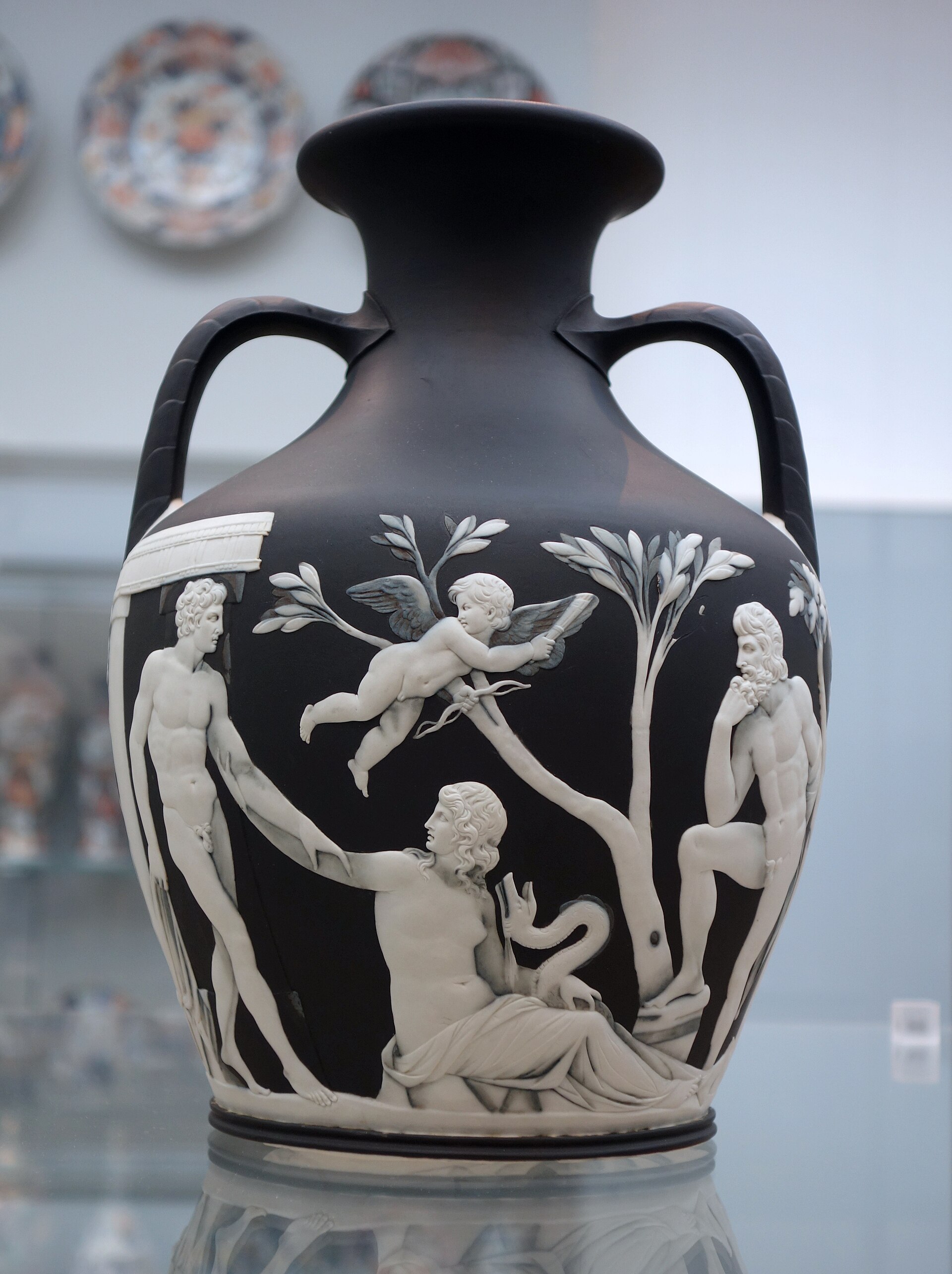
The scale of the gap is best seen on one shape. A full-size black jasper Portland Vase of about 1880 to 1900, correctly marked and in good condition, was appraised on Antiques Roadshow in 2014 at 2,000 to 3,000 US dollars at auction. A numbered first edition of 1790 made 120,000 dollars hammer and 147,000 with premium at Skinner in July 2016. The same shape, the same colours, the same factory, two orders of magnitude apart, and the whole difference is the date and the hand-finishing.
But the sharpest lesson in the recent record is not the height of the top, it is the shallowness of the middle. In June 2024 Dreweatts, with Christie's, sold the Stanley F Goldfein collection at Donnington Priory without reserve: a single-owner, dealer-formed collection of English ceramics catalogued by two houses, which is about as favourable as conditions get. Portland Vases and a Frog Service plate beat their estimates two to four times over. In the same sale, fine late eighteenth-century jasper plaques estimated at 2,500 to 3,500 pounds made 380 to 800; Wedgwood and Bentley basalt busts of Aristotle, Shakespeare and Pitt made 480 to 800; four Wedgwood and Bentley canopic jars estimated at 5,000 to 8,000 made 1,000. A creamware pineapple teapot by nobody in particular made 4,800 and a creamware dovecote of about 1755 made 16,000. Age, factory and body do not carry a price on their own. What carries a price is a documented, dateable object with a story attached.
What commands the premium, in order: a documented first-edition Portland Vase, ideally numbered and unmarked; the First Day's Vases, which are effectively priceless because the edition was closed by an event and only four survive; encaustic-decorated black basalt of the first decade, where a single Wedgwood and Bentley plaque made 31,200 pounds with premium at Bonhams in 2007; pieces of the Frog Service, which come to market rarely because most of it is in the Hermitage; and the abolition medallion, the one thing Wedgwood refused to sell, which made 5,376 pounds with premium at Bonhams in 2025. Large early jasper plaques in the uncommon colours, sage green, lilac and above all yellow, and solid rather than dipped bodies, add value within a category but do not by themselves make one.
Three structural points a bidder should know. First, the houses do not report the same thing: Skinner published hammer and premium separately, Bonhams publishes only the premium-inclusive total, Dreweatts publishes only the closing bid, and Sotheby's gates results behind a login. Almost every Wedgwood figure quoted in print is one of those four things and the writer usually does not say which. Second, the Antiques Trade Gazette's own index shows current Wedgwood auction records being set by twentieth-century design rather than by anything Josiah made: Fairyland lustre and Eric Ravilious. Third, the great collections were formed early and are locked up. The Lady Lever holds what National Museums Liverpool calls the finest collection of Wedgwood jasperware in the world, bought largely from the first Lord Tweedmouth in 1905, who had it from Charles Darwin; the Wedgwood Collection is the V&A's; and the Roman original that started the Portland Vase story has been in the British Museum since 1810. Supply at the top is thin because the top has been in institutions for a century.
| Date | Sale | Work | Result | Note |
|---|---|---|---|---|
| 15 July 2016 | Skinner, Marlborough, Massachusetts | Portland Vase, first edition, numbered 22 in pencil inside the rim, the Beaufort and Codrington copy, in European Furniture and Decorative Arts, sale 2920M, lot 365 | Hammer USD 120,000 With premium USD 147,000 with buyer's premium USD | Estimate 40,000 to 60,000 US dollars. The highest first-edition figure this page has been able to verify from a published result, and probably the auction record for the model, although no house or trade source has been found asserting a record. Skinner published both figures, which is why hammer and premium can be separated here and cannot be on most Wedgwood lots. |
| 7 July 2016 | Christie's | One of the six First Day's Vases, black basalt with encaustic decoration, thrown 13 June 1769, 25.4 cm | Hammer Not published With premium GBP 482,500, stated by the export report to be hammer plus buyer's premium GBP | The largest sum ever paid for a Wedgwood object so far as this page can establish. The government's own export-control report states that the value shown on the licence application, GBP 482,500, represented the hammer price at auction plus buyer's premium, and does not name the house, sale, date or lot. Blocked from export in December 2016 and matched by the Potteries Museum and Art Gallery in 2017 at GBP 482,500 plus GBP 16,500 VAT, so the public outlay was GBP 499,000, more than the market clearing price. Iconotheca's record on that vase derives a hammer of GBP 400,000 from the VAT figure and the Christie's premium scale; that derivation is consistent with the export report but is not a published hammer. |
| 8 March 2006 | Bonhams, London | The Lord Dacre copy: Wedgwood trial first-edition Portland Vase, about 1787 to 1790, 26.5 cm, unmarked; Fine British Pottery and Porcelain, sale 13947, lot 15 | Hammer Not published With premium GBP 19,200 including buyer's premium GBP | A misfired trial of the first edition, from the collection of Hugh Trevor-Roper, Lord Dacre. Bonhams publishes only premium-inclusive figures, and the premium rates shown on its lot pages today are current rates, so the hammer cannot be back-calculated. |
| 7 September 2005 | Bonhams, London | Portland Vase, unnumbered first edition, solid Barberini black, unmarked; Fine British Ceramics, Glass and Enamels, lot 27 | Hammer Not published With premium GBP 14,400 including buyer's premium GBP | An unnumbered first edition. Compare with the unnumbered Starr example estimated at four figures in 2019: the range for unnumbered copies is wide and turns on condition and finish. |
| 27 June 2024 | Dreweatts, with Christie's, Donnington Priory | The Stanley F Goldfein Collection, offered without reserve: lot 1088 blue jasper Portland Vase about 1791; lot 1118 blue jasper Portland Vase late eighteenth century; lot 1083 black jasper trial first edition about 1789; lot 1086 black jasper Portland Vase probably about 1790 | Hammer GBP 15,000; GBP 11,000; GBP 10,000; GBP 10,000 respectively With premium Not published; the house adds 26 per cent of hammer GBP | All four were estimated at GBP 4,000 to 6,000 without reserve. The published figures are read as hammer: the house states a buyer's premium added on top, and several lots in the sale settle exactly on the low estimate. Lot 1086's condition report notes a collection sticker reading Northwood, which would make it an 1870s or 1880s edition rather than about 1790; the catalogue date should not be relied on. |
| 27 June 2024 | Dreweatts, with Christie's, Donnington Priory | Same sale: lot 1047, a Wedgwood and Bentley creamware plate from the Frog Service; lot 1094, an encaustic-decorated black basalt plaque; lot 1089, a Portland Vase by Thomas Lovatt of about 1880 | Hammer GBP 13,000; GBP 7,000; GBP 4,800 respectively With premium Not published GBP | The Frog Service plate was estimated GBP 8,000 to 12,000 and beat it. The two-line proof of what the market is actually paying for is in the same sale: a trial first-edition Portland Vase of about 1789 made GBP 10,000 and a Lovatt edition of about 1880 made GBP 4,800. |
| 27 June 2024 | Dreweatts, with Christie's, Donnington Priory | Same sale, the other half of the picture: late eighteenth-century jasper plaques and Wedgwood and Bentley basalt busts and vases | Hammer GBP 380 to GBP 800 for late eighteenth-century jasper plaques against estimates of GBP 2,500 to 3,500; GBP 480 to GBP 800 for Wedgwood and Bentley basalt busts; GBP 1,000 for four Wedgwood and Bentley canopic jars estimated at GBP 5,000 to 8,000 With premium Not published GBP | This is the finding that matters most to a collector and it is the opposite of the headline. Under the most favourable conditions the material will ever get, a no-reserve single-owner sale catalogued jointly by Dreweatts and Christie's, fine but generic eighteenth-century Wedgwood of the same body and decade as the star lots sold far below estimate. In the same sale non-Wedgwood Staffordshire beat it: a creamware pineapple teapot of about 1765 to 1775 made GBP 4,800 and a creamware dovecote of about 1755 made GBP 16,000. |
| 6 June 2007 | Bonhams, London New Bond Street | Fine British Ceramics, Enamels and European Glass, sale 15270: lot 167, an important Wedgwood and Bentley encaustic black basalt plaque of about 1770; lot 130, a Wedgwood and Bentley medallion of Captain James Cook of about 1779; lot 172, a nineteenth-century Portland Vase | Hammer Not published With premium GBP 31,200; GBP 7,440; GBP 1,560, all including buyer's premium GBP | One sale that shows the whole shape of the market. The eighteenth-century encaustic plaque made twenty times the nineteenth-century Portland Vase. |
| 19 November 2025 | Bonhams, London Knightsbridge | A Wedgwood anti-slavery medallion, about 1790; Fine Glass and British Ceramics, sale 30707, lot 118 | Hammer Not published With premium GBP 5,376 including buyer's premium GBP | The one type of Wedgwood object that was never sold by the firm is now a five-figure lot at auction. |
| 24 March 1892 | Christie's, London | A first-edition Portland Vase from the collection of the late Mr Holt of Liverpool | Hammer Not stated With premium 205 guineas GBP | Reported by Samuel Smiles, who also records one sold at the Rogers sale for 127 guineas. Both figures are Victorian reports and neither states whether any commission is included. The issue price of the first edition is given as thirty guineas by one saleroom and fifty guineas by Jewitt and Smiles; on either figure the edition did not cover its outlay, copies were still unsold in the warehouse in 1828 and ten went to the dealer Apsley Pellatt in 1829. |
| 2009 | Not located | Serving plate from the Frog Service | Hammer Not published With premium Reported as 46,000 US dollars USD | TERTIARY. Reported alongside GBP 14,000 in 2001 and GBP 17,000 in 2004 for dessert plates. Neither house nor sale is named and premium status is not stated. Recorded for order of magnitude only and flagged for replacement with the saleroom records. |
Hammer is the price at which the bidding stopped; with premium adds the fee the house charges the buyer on top. Hammer price and buyer's premium in the glossary.
Recorded without a public price
- 2014 · Full-size black jasper Portland Vase, solid black body with applied white relief, about 1880 to 1900, 10.5 inches, impressed WEDGWOOD at the foot rim, small chip · Not a sale; appraisal · n/a Appraised by Stuart Slavid on Antiques Roadshow at 2,000 to 3,000 US dollars at auction. Bought by the owner's mother for 12 US dollars at a Cleveland charity auction in the 1940s.
- 25 August 2026 · Two first-edition Portland Vases offered on the dealer platform 1stDibs · Not a sale; dealer asking prices · n/a 285,000 US dollars for a copy dated about 1793 and exhibited at the Roche Foundation in 2023, and 168,500 US dollars for another. Asking prices, not results, read on 25 August 2026. Set them against the verified auction figure of 147,000 US dollars with premium in 2016.
- 23 October 2019 · Wedgwood black and white jasperware Portland Vase, late eighteenth century, unnumbered, sold with a period Greek Street admission ticket; Wedgwood and Beyond: the Starr Collection, lot 139 · Sotheby's, New York · Not published; the result is behind a login Estimate 5,000 to 7,000 US dollars. The estimate is the informative figure: an unnumbered late eighteenth-century Portland Vase with museum provenance was estimated in four figures. Provenance: Arthur Sanderson, probably Walter P. Chrysler Jr, the Chrysler Museum (accession 71.989, de-accessioned), Skinner Boston 22 May 1999 lot 270.
Where to see the work
| Institution | City | Holdings | Note |
|---|---|---|---|
| V&A Wedgwood Collection, at World of Wedgwood | Barlaston, Stoke-on-Trent | The firm's own retained collection and archive: over 175,000 works of art, ceramics, manuscripts and photographs on the V&A's figure, including the experiment books, the oven books, the pattern books, the commonplace books, the moulds and the Portland Vase trials. | The single most important place for this maker and the only one where a trial fragment can be matched to a written formula. Owned by the V&A since 1 December 2014 and lent back to Barlaston, on the same site as the working factory. The archive is on the UK Memory of the World Register. Holds the Stubbs enamel portraits of Josiah and Sarah, the Stubbs family conversation piece, a first-edition Portland Vase (WE.8000-2014), two failed Portland Vase trials (WE.7998-2014 and WE.7999-2014), and two of the four surviving First Day's Vases. |
| Lady Lever Art Gallery | Port Sunlight, Merseyside | What National Museums Liverpool calls the finest collection of Wedgwood jasperware in the world, in Rooms 3 and 4, including two of Wedgwood's Portland Vases and the rare plaques painted by George Stubbs. | Much of it was bought from the first Lord Tweedmouth in 1905, who had acquired major pieces from Charles Darwin, Josiah's grandson. William Hesketh Lever added to it. The provenance runs back through the family. |
| The Potteries Museum and Art Gallery | Stoke-on-Trent | One of the four surviving First Day's Vases of 13 June 1769, back on permanent display since 18 September 2017. | Bought by matching the export-deferral price after a public appeal. Two miles from where the vase was thrown. |
| British Museum | London | The Roman Portland Vase itself, museum number 1945,0927.1, deposited 1810 and bought from the seventh Duke of Portland in 1945; Wedgwood copies and a substantial Wedgwood collection in the Department of Britain, Europe and Prehistory; and one of the four First Day's Vases on long-term loan from the Wedgwood family. | The place to see the object Wedgwood spent four years failing and then succeeding to copy, and the copies beside it. |
| Victoria and Albert Museum, South Kensington | London | Wedgwood ceramics in the ceramics galleries and the British Galleries, including a Portland Vase first edition with its original roundel base, jasperware, creamware and the abolition medallion in several bodies and sizes with models and moulds. | Distinct from the V&A Wedgwood Collection at Barlaston, which the museum also owns. Two locations, one owner. |
| Fitzwilliam Museum | Cambridge | A copy of the Portland Vase, C.20-1984, black jasper with white reliefs. | Probably the very copy Wedgwood sent to Erasmus Darwin in September 1789 with instructions not to show it. Darwin's descendants lent it to the museum in 1963 and later sold it to them. Also holds an Emancipation Badge, C.45-1962. |
| State Hermitage Museum | St Petersburg | The great majority of the Frog Service, many pieces on display. | The largest single object Wedgwood ever made and effectively unavailable anywhere else. Over 300 pieces were lent to the V&A for the 1995 exhibition. |
| Metropolitan Museum of Art | New York | Jasperware, basalt, portrait medallions, cameos and the antislavery medallion, accession 08.242, given by the Wedgwood dealer Frederick Rathbone in 1908. | Much of the Met's Wedgwood photography is released openly, which makes it the most usable collection online. |
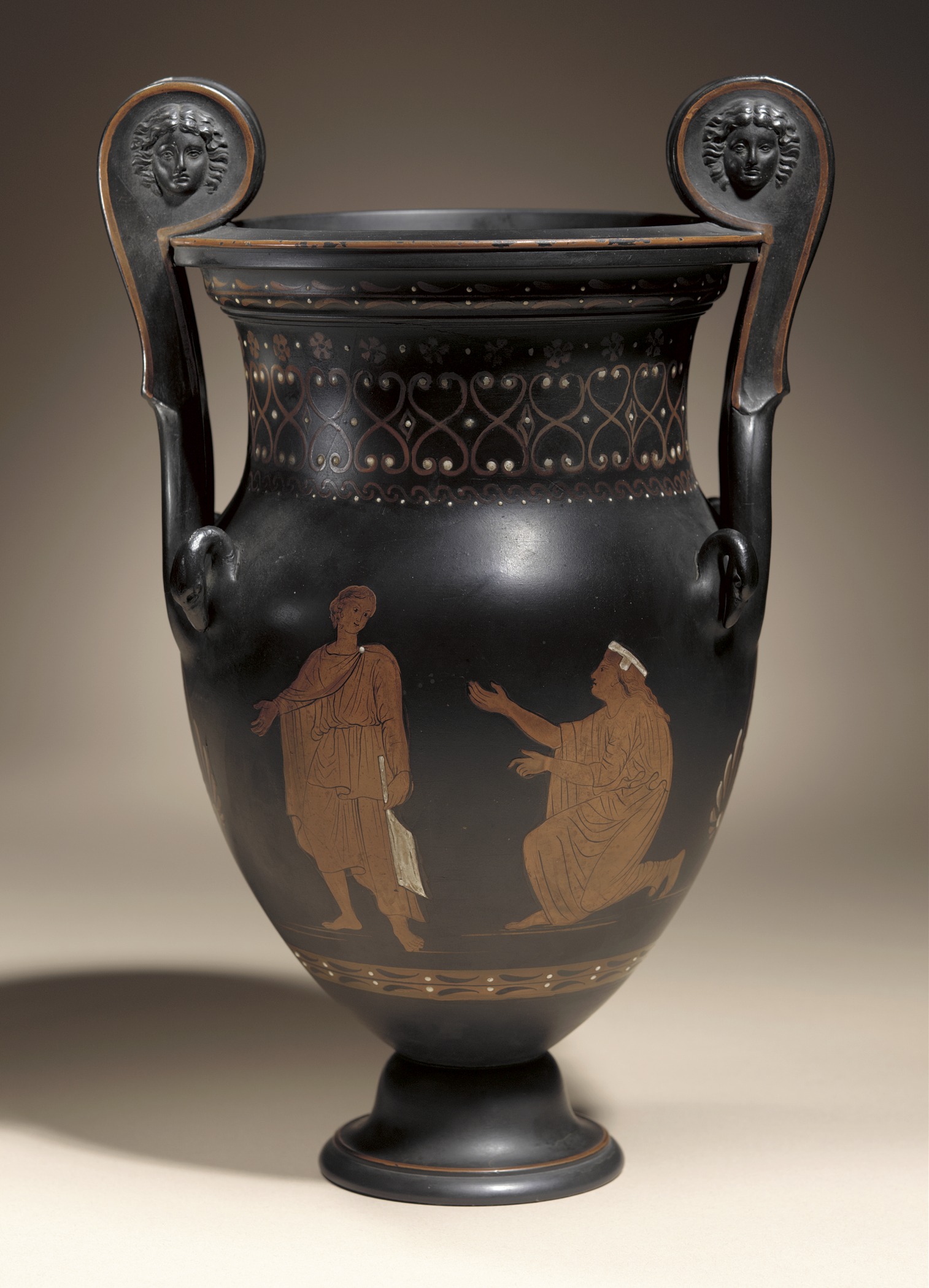
| Los Angeles County Museum of Art | Los Angeles | Wedgwood and Bentley black basalt with encaustic decoration, including a vase of about 1770 to 1780 (M81.257.10a-b) and a volute krater of about 1780 (M.82.46). | The ordinary commercial output of the partnership, in the body and technique the First Day's Vases inaugurated. |
| Art Institute of Chicago | Chicago | A first-edition Portland Vase carrying the highest recorded first-edition number, 30. | The upper bound of the numbering, and therefore part of the evidence for how large the first edition was. |
| Birmingham Museum of Art | Birmingham, Alabama | The Dwight and Lucille Beeson Wedgwood Collection, including Portland Vase copies and a Frog Service platter showing Ditchley Park. | The most substantial Wedgwood holding in the American South. |
| Stoke Minster, the parish church of Stoke-upon-Trent | Stoke-on-Trent | His grave and the marble memorial tablet installed by his sons about 1802, to a design by John Flaxman, carrying a Portland vase and an Etruscan vase and a portrait medallion. | The monument was designed by the sculptor who had supplied the factory with reliefs for twenty-five years. |
Forgeries and misattributions
- The mark itself is the problem
- Wedgwood was among the first English pottery manufacturers to impress his own name into the body as routine practice, which is why the name is worth faking and why it has been faked more than any other in English ceramics. Salerooms warn plainly that many popular reproductions are not authentic and that a mark reading WEDGWOOD is not by itself evidence. The mark has to be read against a known sequence rather than accepted. WEDGWOOD alone, usually with other potter's marks and a single letter, is the eighteenth and earlier nineteenth-century form. WEDGWOOD and ENGLAND as separate impressions indicates 1891 or later. WEDGWOOD and MADE IN ENGLAND separately, or WEDGWOOD ENGLAND on small objects, indicates the early twentieth century, and after 1929 the word WEDGWOOD is set in a sans serif face. A three-letter code, giving month, potter and year with the year letters starting at O for 1860, was used from 1860 but only sporadically on jasper; a single letter in that period is a potter's mark and dates nothing.20343536
- Wedgwood and Bentley on the wrong kind of object
- The Wedgwood and Bentley mark was applied only to ornamental wares, between the opening of the partnership books on 14 November 1768 and Bentley's death on 26 November 1780, and pieces so marked are at an extra level of quality. Useful wares were made under a separate partnership with Wedgwood's cousin Thomas and never carried it. The characteristic circular Etruria form has the letters raised, not sunk. A tea or table piece bearing the partnership mark is wrong on its face, and any object carrying it must be capable of a date inside a twelve-year window. And the circular mark itself has been added to genuinely unmarked objects: such added marks are relatively soft and can be scored with a pin or a knife point. Palmer and Neale both adopted a circular mark with the name in raised letters in the same form, so the shape of the mark is not a Wedgwood indicator on its own.213437
- Later jasper sold as eighteenth century
- This is the commonest and most respectable-looking deception, because the firm has made the same shapes in the same colours continuously and no forgery is required, only silence about the date. The trade term for it is Wedgwood-style, and the equivalent wares of Adams, Turner, Neale and Palmer are genuine antiques of another maker rather than fakes. Three physical tests, in order of usefulness. Undercutting: on the best early pieces the applied white relief was worked over by lapidaries after firing so that it stands free of the ground at its edges; later mass production does not do this. Solid against dip: early jasper is stained through the body, dipping was introduced in 1777, and a chip or unglazed edge on a dipped piece shows white beneath the colour. The production gap: jasper had virtually ceased by 1829, dipped wares resumed in 1844 and solid jasper was not made again until 1860, so a solid piece is either before about 1829 or after 1860 and nothing in between.2035
- Portland Vase copies, first edition against everything after
- Roughly forty-five copies are documented in the incomplete oven books for the first edition of 1790, on Aileen Dawson's reading, of which about ten were broken; other counts give forty-three made between 1791 and 1796 with eleven broken, or fifty. The British Museum's position is that at least thirty to forty first editions survive worldwide. Almost every Portland Vase in circulation is later: the 1838 edition was cast in one piece with the ground painted afterwards, Thomas Lovatt and John Northwood made copies in the 1870s and 1880s, and the shape stayed in production into the twentieth century. The strongest single test is that a first edition should carry no mark at all. Wedgwood marked routinely from about 1772 and Robin Reilly names the first-edition Portland Vases as the most notable exception; later copies carry the impressed WEDGWOOD, with ENGLAND after 1891. After that: undercutting of the white relief with grey shading so the figures fade towards the ground, which is the effect Wedgwood told Hamilton he had to reproduce; a lapidary-polished blue-black ground; the base disc with the head in a Phrygian cap; and pencil numbering inside the neck or rim on some examples. What is not a test: solid against dip, since the V&A's first edition is a dip and a dealer's is solid; colour, since a few were made in blue in 1791; and firing faults, since many first editions and trials are blistered or sagged.1220233274
- The base disc
- A full-size Portland Vase should carry, on the underside, a head in a Phrygian cap. The disc was on the Roman original, where it is thought not to be original to the vase but added to cover a repair; Wedgwood copied it anyway. Its absence on a full-size copy is a problem. The impressed WEDGWOOD mark on the vase is not on the base but along the foot rim, conventionally at the bottom of the tree trunk in the relief, which is where an inexperienced owner fails to look and then reports the piece as unmarked.31
- John Voyez
- Voyez was Wedgwood's own modeller, seemingly French and trained in some form of sculpture. Wedgwood dismissed him and then prosecuted him, and he received a prison sentence at Stafford Gaol in 1769. Accounts of the offence differ between theft of designs and a separate impropriety involving another employee's daughter. He afterwards worked for Ralph Wood II and probably modelled many of the Wood figures. His hand is described in the literature by thick-lidded eyes, somewhat flattened noses, a general roundness of contour and pugnacious facial detail on almost every figure including the women. This is connoisseurship rather than a test, and the Voyez material is a case where the details of the career are, in the words of one account, the subject of considerable controversy in recent decades.27
- The unmarked abolition medallions
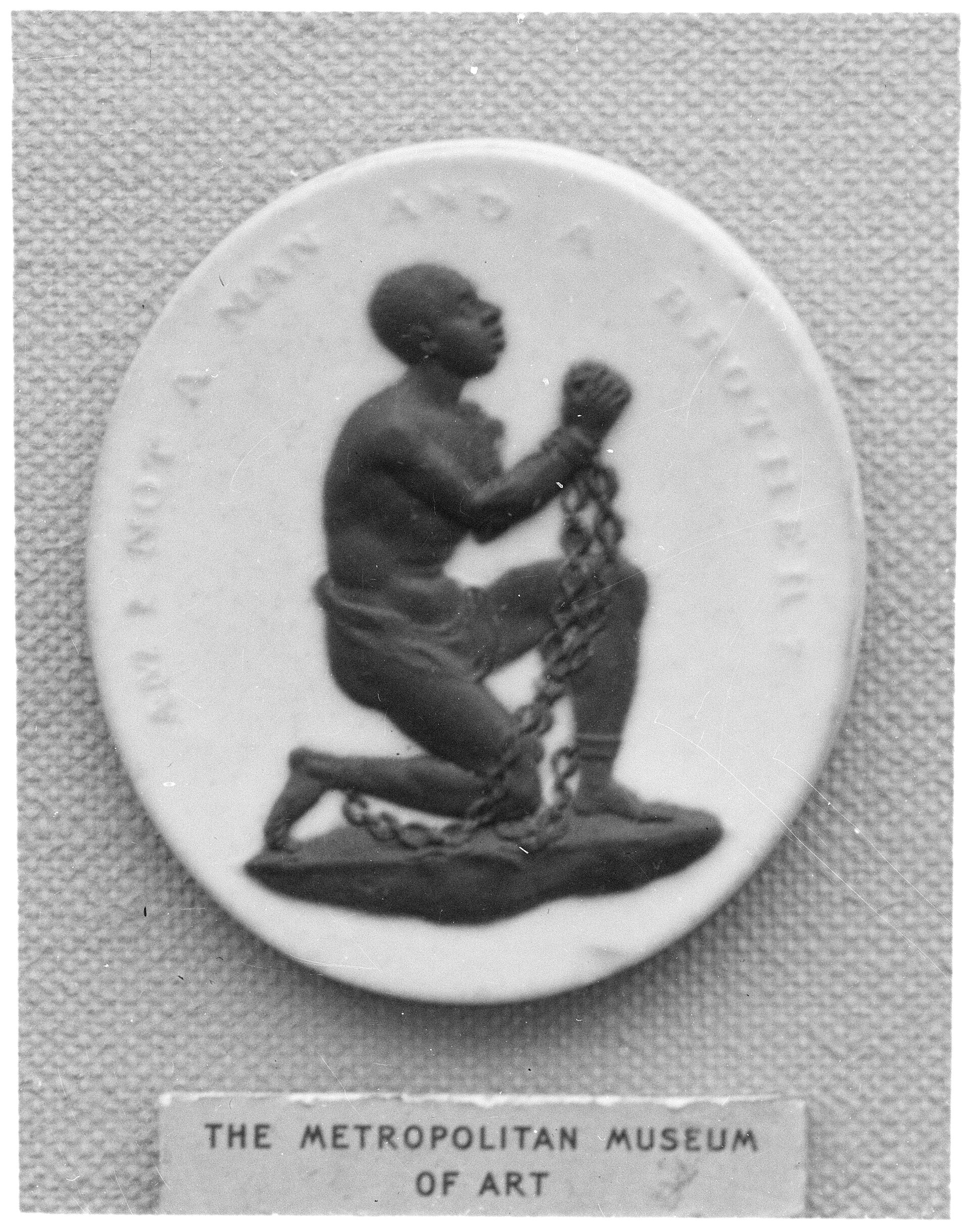
- Larger white terracotta versions of the Am I Not a Man and a Brother design, with an unusual integral ceramic frame and the slogan impressed and painted, made about 1790 by an unidentified Stoke-on-Trent manufacturer. Examples are in the V&A Wedgwood Collection (WE.7825-2014) and the British Museum. They were previously attributed to Wedgwood. They are not marked and there is no conclusive evidence that the firm made them. The V&A now describes them as an imitation and treats the earlier attribution as an artefact of the motif's association with Wedgwood rather than as evidence. It is a clean example of a design becoming a maker's name in the trade's mind.6
- Wedgwood England on wares made elsewhere
- Most production of the modern firm was moved to a factory outside Jakarta between 2006 and 2008, with only a small number of high-end products still made in Britain. In 2015 there were complaints of misleading labelling, in that products made in the Indonesian factory were sold labelled Wedgwood England. Not a forgery in the collector's sense and recorded here because the country-of-origin words in the mark are precisely what a collector uses to date a piece. It is a live reason to treat ENGLAND in a Wedgwood mark as a dating tool for pre-2006 wares and not as a statement about where a modern piece was made.2155
- John Voyez forged the partnership mark in full, and the brief version of his story is wrong
- Voyez was hired on 31 March 1768 as a modeller, the best in London by Wedgwood's account. He was dismissed, prosecuted, and sentenced at the Stafford Lent assizes in spring 1769 to a whipping and three months in prison. Eliza Meteyard, working from Wedgwood's own letters, says plainly that what his crime was it is impossible now to say, that it was probably not theft, and that it must nonetheless have been grave to draw that sentence. Every account that states he stole models and moulds goes beyond the primary source. The legend that he betrayed the jasper secret is also false: jasper was still years from existence in 1769. What he did do is documented in Wedgwood's hand. To Bentley, 12 December 1774: I am now certain that Voyez puts our names full length upon his seals. Voyez is now gone on a journey to Worcester, Gloucester, Bristol and the West of England with a quantity of these to dispose of them as our seals. He was forging the genuine WEDGWOOD AND BENTLEY legend, not a variant spelling. Wedgwood never sued: his attorney Sparrow advised that little could be done in establishing piracy before either a country or a London jury. Meteyard's test, written in 1875, is still the working one: Voyez's fakes are identifiable only from their general imperfections in body and finish, and they consist only of small cameos, seals and intaglios, never of the fine and more costly class of goods. Voyez's own signed work, marked J VOYEZ or on the Fair Hebe jugs, is a different matter and is collected in its own right.273839
- Meteyard's 1875 tests, which are still the best ones
- The Wedgwood Handbook of 1875 was written expressly to treat of the marks, monograms and other tests, and it is the earliest systematic guide to faked Wedgwood. It names the false marks in order of frequency: Wedgwood and Co in capitals, then Wadgwood, then Wedgewood. On genuine fine bas-reliefs and vases the name is in well-formed and small type, clearly impressed; the tell of a fake is the coarseness, irregularity and clumsiness of the impression, from a bad stamp or an unhandy workman. On the three great Flaxman plaques the impression is repeated twice. But the marks can all be copied, and Meteyard's conclusion is that finish, undercutting and fineness of the body are the best proofs of old Wedgwood, together with an unctuous, velvety softness that lets the finger rest a little while passing over. She also warns that many of Wedgwood's finest works were left unmarked, so absence of a mark disqualifies nothing.39
- The marriage fake: old plinths, new bodies
- Meteyard records, twice, that a quantity of old black plinths marked Wedgwood and Bentley were cast out from Etruria, eagerly bought up, and were by 1875 to be found in shops carrying modern bodies and adornments. Bases of undoubted antiquity, correctly marked, joined to rough blue-black modern vases. The mark is genuine and the object is not. The check is the body above the base rather than the impression below it, and the same 1875 tests apply: the quality of the black, the finish of the relief and the feel of the surface. Meteyard also notes that Wedgwood's black comes in two or three shades, that the shining black belongs largely to the Wedgwood and Bentley period, and that dead black pieces usually belong to a later one.39
- The 1994 case: twenty years of undetected fakes
- The Art Newspaper reported in May 1994 that at least thirty authenticated fakes had been identified of Wedgwood jasper and black basalt decorative wares: plaques including a Triumph of Bacchus, miniature classical busts, ruined-column vases and sphinx paperweights. Output was traced back to 1974, which is roughly twenty years undetected. The first identification came in 1992, from a piece bought at Sotheby's New York on 24 April 1992. A Sotheby's specialist called it the worst ceramics fraud of the century. This is the case that shows how far connoisseurship alone can be pushed. The clay composition closely matched the originals and the relief spacing produced correct dimensions, so identification initially required side-by-side comparison with genuine pieces held by the Wedgwood Museum. Scotland Yard's Art and Antiques Squad eventually resorted to thermoluminescence testing, which dates the last firing of a ceramic body and is the only technique that settles the question outright. The investigation involved Gaye Blake Roberts of the Wedgwood Museum and Pat Halfpenny of the Stoke-on-Trent City Museum, and the fakes were shown beside genuine pieces as The Art of Deception at the International Ceramics Fair in London in June 1994. The forger was never publicly named.40
- Wedgewood, Vedgwood, Wedgwood and Co, and J Wedgwood
- Four separate firms and one deliberate misspelling have put the word on wares Etruria never made. William Smith and Company of Stockton-on-Tees was restrained by a perpetual injunction in Chancery on 9 November 1848 and went on marking ware Wedgewood with an E and Vedgwood with a V; he also called his works the Stafford Pottery and used Queen's Ware. Ralph Wedgwood used WEDGWOOD AND CO at Burslem and Ferrybridge about 1796 to 1800. Enoch Wedgwood, a distant cousin with no connection to Etruria, traded as Wedgwood and Co at Tunstall from 1860 because the name suggested one. John Wood, a great-grandson of Ralph Wood, adopted or already had the middle name Wedg and marked his ware J WEDGWOOD and WEDG WOOD. The rule the Staffordshire specialists give: no true Wedgwood ware uses a middle E as WEDGEWOOD, or the words and Co, or an initial J. It caught the Victoria and Albert Museum itself: Geoffrey Godden found two plates carrying Smith's VEDGWOOD mark in that collection, catalogued as Staffordshire.3748
The essay
Chapter 1What the name actually denotes
Five generations of Wedgwoods had potted in Burslem before this one, and another five followed.
Five generations of Wedgwoods had potted in Burslem before this one, and another five followed. There were several related Wedgwood families in the village, each pot-works with a single bottle kiln. The name on an eighteenth-century pot is therefore not by itself a maker: it is a firm, and from 1759 a firm that Josiah controlled.
That firm was unusual in marking its wares at all. Josiah Wedgwood was among the first English pottery manufacturers to impress his own name into the body as a matter of routine, which is why Wedgwood attribution is comparatively tractable and why Staffordshire attribution generally is not. It is also why Wedgwood is the single most faked mark in English ceramics. A mark that means something is worth counterfeiting; a mark that means nothing is not.
The corollary is that the marks are the evidence and the style is not. Wedgwood's competitors copied every body he introduced, usually within a few years: green glaze, creamware, black basalt and jasper were all in other Staffordshire hands quickly, and the Real Fabrica del Buen Retiro in Madrid was producing jasper effects in biscuit porcelain before the century was out. A blue-and-white neoclassical relief is a style available to the whole trade. Only the impression on the base is a statement about who made it, and even that has to be read against a known sequence of marks rather than accepted because it says the right word.
Chapter 2A knee, and what it decided
His father Thomas died in June 1739, when Josiah was eight, and the boy was taken out of Mr Blunt's school at Newcastle-under-Lyme and put to learning to throw.
His father Thomas died in June 1739, when Josiah was eight, and the boy was taken out of Mr Blunt's school at Newcastle-under-Lyme and put to learning to throw. At about eleven, in the Dictionary of National Biography's dating, he caught smallpox in an unusually virulent form. Eliza Meteyard, working from the family papers, describes it as confluent, covering him head to foot, and settling in the right knee; when he got out of bed after many weeks he could not walk for stiffness and deadness in the limb, and used crutches for a time.
The popular version of what followed is compressed, and Meteyard corrects it with a document. He was formally indentured to his eldest brother Thomas at the Churchyard Works on 11 November 1744 to learn the art of thrower and handleing, which is proof that the knee was not yet disabling. The relapse that ended his throwing came at fifteen or sixteen, after which he worked seated with the leg extended on a stool, and he bore the injury for twenty-two years more. Meteyard's own conclusion is the one worth keeping: leaving the thrower's bench turned his attention to the other branches of the trade and gave him a grasp of details he would not otherwise have had.
Whether that is a happy accident or a Victorian moral has been argued since his own century. Gladstone, as Chancellor of the Exchequer, laying the foundation stone of the Wedgwood Institute in 1863, said it was not often that we have such palpable occasion to record our obligations to the smallpox, and that it sent Wedgwood's mind inwards and drove him to meditate on the laws and secrets of his art. Llewellynn Jewitt, printing the speech two years later, disagreed on the same page: the boy had genius and thought, energy and perseverance in him, which wanted not the bodily affliction to become developed. Both positions are in print and neither has been settled.
The indenture also had a clause on conduct, in the ordinary form: at cards, dice or any other unlawful games he shall not play, taverns or alehouses he shall not haunt or frequent. His term was five years rather than the usual seven, which implies prior service. At the end of it his brother, who thought his experiments an idle and unprofitable curiosity, refused him a partnership.
The amputation. In 1768 he over-walked and over-worked the leg. His surgeon, Mr Bent of Newcastle, ordered a vomit to relieve the pain, and Wedgwood's own account of the result is in the letters: the pain had no sooner left his knee than he was very ill in other respects, with great heat and difficulty of breathing, so that he was glad to feel the pain return into the knee. With no way of relieving the pain that did not endanger him, a second surgeon was called, probably with Erasmus Darwin in consultation, and amputation was agreed. Meteyard says Wedgwood suggested it himself, and had resolved on it before opening Etruria; the DNB gives the same motive, that he foresaw the leg would be a serious encumbrance in his enlarged sphere of work.
The right leg came off on 28 May 1768, without anaesthesia, two surgeons and Bentley present. Meteyard says he would not be assisted or have the operation hidden from his view, but sat in his chair and bore it without a shrink or a groan. That famous sentence should be handled carefully: his own great-granddaughter, writing in 1915, transmits it explicitly as hearsay, and explains why no first-hand account exists. Bentley was with him, so the correspondence contains no record of the feelings or experiences of that hour.
What does survive is a clerk's letter, and it is the strongest evidence for the date. Peter Swift, writing from Burslem on 28 May 1768 about an order of cream ware, added: Mr. Wedgwood has this day had his leg taken of, and is as well as can be expected after such an execution. The rev'd Mr. Home's Goods are packed, and one Crate for the warehouse. Meteyard called it, for its prosaicness, about the most extraordinary announcement ever penned. Swift's follow-up a week later reports that the leg had been opened for the first time and both surgeons said it could not possibly be better, and in the same breath that the infant Richard had died on Thursday morning. Sarah Wedgwood dressed the wound, administered the medicines and wrote the letters while burying her son.
The first wooden leg was made by Mr Addison, a lay-figure maker in Hanover Street, Long Acre. Wedgwood went on feeling pain in what he called his no-leg for the rest of his life, and referred to the anniversary as St. Amputation Day. Thirteen months after the operation he sat down at a wheel at the opening of Etruria and threw six vases while Bentley turned it for him. Throwing is done seated.
Chapter 3Whieldon, the green glaze, and a partnership with a secrecy clause
After his brother refused him, Wedgwood took an offer from John Harrison, a Newcastle-under-Lyme tradesman who had put money into Thomas Alders's potworks at Cliff Bank near Stoke; the three were...
After his brother refused him, Wedgwood took an offer from John Harrison, a Newcastle-under-Lyme tradesman who had put money into Thomas Alders's potworks at Cliff Bank near Stoke; the three were partners, and it did not last long. From about 1754 to 1759 he was in partnership with Thomas Whieldon at Fenton, the leading Staffordshire potter of the day, who made high-value small goods, snuff boxes among them.
The Whieldon agreement is the origin of a claim that is repeated loosely and should be stated precisely. Meteyard's account is that Wedgwood undertook to practise for their joint benefit such secret processes as his genius and experimental industry had made his, but without any necessity of revealing to others what they were. The results went to the partnership; the methods stayed with him. It is not the same thing as being allowed to keep his experiments to himself, and Meteyard is paraphrasing: she prints no text and cites no document, and the instrument itself has not been produced.
The result of that programme was a green ware moulded in imitation of leaves and fruit, and the novelty was in the glaze rather than the body. Earlier green ware was coloured in the body with oxide of copper; Wedgwood's glaze was several substances fritted together and then given a due proportion of calcined copper, and nothing as brilliant had been seen. In 1759 he left Whieldon on it.
Relatives of the Big House line, his distant cousins John and Thomas Wedgwood, let him the Ivy House Works and an adjacent cottage at Burslem for ten pounds a year, a figure four independent nineteenth-century sources agree on and which was well below the market value. He moved to the larger Brick House Works in 1762.
He married Sarah Wedgwood by licence at Astbury in Cheshire on 25 January 1764. She was his third cousin, both descending from Gilbert Wedgwood, and the daughter of Richard Wedgwood of Spen Green, a cheese factor who had made a considerable fortune and who held the marriage up for months by argument over the settlement. Wedgwood's own comment survives: he and Miss W were perfectly agreed and could settle the whole affair in three lines and so many minutes, but our Pappa, over careful of his daughter's interest, would by some demands which I cannot comply with go near to separate us. Robin Reilly's ODNB article puts the dowry at four thousand pounds and qualifies it as said to have been; no nineteenth-century source gives a figure.
Sarah Wedgwood was in the business, not beside it. Two letters establish it. On shapes, to Bentley: I speak from experience in Female taste, without which I should have made but a poor figure amongst my Potts; not one of which of any consequence is finished without the Approbation of my Sally. On the experiments, to his brother John on 6 March 1765, in the middle of the search for a white body: Sally is my chief helpmate in this as well as other things, and that she may not be hurried by haveing too many Irons in the fire, as the phrase is, I have ord'd the spinning wheel into the Lumber room. She hath learnt my characters, at least to write them, but can scarcely read them at present. He kept his formulae in a private cipher, and he taught it to his wife.
Chapter 4Queen's Ware: the cheapest possible luxury
In 1765 an order came from St James's Palace, through Deborah Chetwynd, sempstress and laundress to the Queen, for a creamware tea set with a gold ground and raised flowers upon it in green.
In 1765 an order came from St James's Palace, through Deborah Chetwynd, sempstress and laundress to the Queen, for a creamware tea set with a gold ground and raised flowers upon it in green. Wedgwood's own list of what went runs to twelve cups and saucers, a slop basin, sugar dish with cover and stand, teapot and stand, spoon tray, coffee pot, twelve coffee cups, six pairs of hand candlesticks, six melons with leaves and six green fruit baskets with stands edged in gold. Eliza Meteyard, printing the letters, was emphatic that the patronage sought the potter and not the other way round.
The Queen gave her name to the body and appointed him her potter. Royal warrant is the wrong term for it: no eighteenth-century warrant instrument is described in any source, and what is recorded is a permission and an appointment. The date is also less settled than it looks. Meteyard footnotes an invoice of 18 October 1766 as showing that he had not yet received the appointment, then elsewhere says there may be truth in the old tradition that it came in 1763; Jewitt says 1764 but also repeats a story about a caudle service that Meteyard demolishes. 1766 is the defensible date and the disagreement should be stated rather than smoothed.
This is the commercial engine of the whole enterprise and it is routinely underweighted against the blue-and-white ornaments. Queen's Ware is a table body: light, tough, cheap to fire, and close enough to porcelain in the hand to serve the same social purpose at a fraction of the cost. Being light, it also cut freight and import duty in foreign markets, which is a manufacturing advantage rather than an aesthetic one and mattered more. It sold across Europe and to America, disrupted the European faience and delftware trades to the point where some makers went out of business and others adopted English-style bodies, and was perfected as white pearlware from 1780.
He knew exactly what he had. In 1767 he wrote: The demand for the said Cream-colour, alias Queen's Ware, alias Ivory, still increases. It is really amazing how rapidly the use has spread allmost over the whole globe. By 1784 he was exporting nearly eighty per cent of everything he made, and Neil McKendrick's summary is that a maker born into a trade selling almost solely within Staffordshire died having sold to every regal house in Europe.
He was equally clear that the name was the product. He believed his flowerpots would sell better called Duchess of Devonshire flowerpots, and gave his wares the names of their patrons: Queensware, Royal Pattern, Russian pattern, Bedford, Oxford and Chetwynd vases. The strategy was to capture the aristocratic market first and let the cachet filter downwards, and it worked because the object at the bottom of the filter was materially the same object.
Chapter 5Two partnerships, two markets, and why the mark tells you which
This is the most misdescribed thing about the firm and it matters for every attribution.
This is the most misdescribed thing about the firm and it matters for every attribution. There were two partnerships and they did not have the same partner.
The useful wares, meaning the tableware that paid for everything, were made under a partnership with his cousin Thomas Wedgwood, who ran the Useful Works as partner and manager from 1766 until his death in 1788. The ornamental wares, the vases and plaques and cameos, were the subject of a separate partnership with Thomas Bentley, and that partnership covered nothing else. Meteyard states it flatly, and Jewitt proves it from the Chelsea wage books, where a single workman's week is split between a J. W. account and a W. and B. account. The two works at Etruria were physically separate, with their own ovens, yards, workshops and rooms.
The arrangement immediately produced a boundary problem, because as soon as teapots were made in antique forms and painted with Grecian figures it was not obvious which side of the line they fell. Wedgwood's own ruling survives and the criterion is function, not price or decoration: neither richness, nor price, nor colour, nor enamelling, nor bronzing, nor gilding can be a criterion, because a table or dessert service made ever so fine and rich, every piece rich enough to adorn a cabinet, is useful ware still, and the same may be said of a teapot or a chamberpot; while a flowerpot, vase or candlestick made ever so plain is still ornamental ware and clearly within the partnership of W. and B. only.
The dating is precise enough to be useful. Wedgwood first proposed the ornamental partnership to Bentley late in 1766; an agreement dividing the wares was drawn in 1767; the partnership books were opened on 14 November 1768; the ornamental works opened on 13 June 1769; Bentley moved to London as resident partner on 15 August 1769; he died at Turnham Green on 26 November 1780 and was buried at Chiswick on 2 December. Jewitt's rule follows from the books: every piece bearing both names was made in the twelve years between 1768 and 1780.
The consequence is a hard diagnostic. Only ornamental wares carry the Wedgwood and Bentley mark, and pieces so marked are at an extra level of quality. There is no such thing as a Wedgwood and Bentley teacup, and a piece of useful ware bearing that mark is wrong. It also explains an otherwise odd episode: Wedgwood had to ask Bentley to treat the Frog Service as a partnership service precisely because, being tableware, it fell outside the standing partnership.
Bentley's death in 1780 was felt acutely. The correspondence between them is the principal documentary source for everything Wedgwood thought about design, and he relied on Bentley's judgement on artistic questions. He turned afterwards to Erasmus Darwin for help running the business.
Chapter 6Etruria, and the archaeological error it was named for
In 1767 Wedgwood paid about three thousand pounds for the Ridgehouse Estate, on the line of the canal he was then lobbying for.
In 1767 Wedgwood paid about three thousand pounds for the Ridgehouse Estate, on the line of the canal he was then lobbying for. His architect was Joseph Pickford. The factory went up on one side of the canal and Etruria Hall, the family house, on the other, built between 1768 and 1771. The works opened in June 1769 and ran for a hundred and eighty years. A second motto, Sic fortis Etruria crevit, thus Etruria grew strong, out of Virgil, is widely reported as having been set over the main entrance; the earliest citation this page could trace for it is a newspaper of 1935 and it should be treated as tradition rather than record.
The name is a mistake, and it was never corrected. Wedgwood took it from the painted vases then being excavated in southern Italy and published as Etruscan, above all in the catalogue of Sir William Hamilton's collection compiled by Pierre-Francois Hugues, called d'Hancarville, and issued from 1766. Most of those vases are Greek, painted in southern Italy, and the Etruscan attribution was corrected by later scholarship. The most famous statement of purpose in English ceramics, Artes Etruriae Renascuntur, claims the rebirth of an art that its models did not belong to.
There is one part of the programme that was authentically Etruscan, and it is the technical part rather than the decorative one. Genuine Etruscan bucchero is black, burnished and unglazed, and it is black because it was fired in a reducing atmosphere. Wedgwood's black basalt was fired the same way, with the vents closed so that oxygen-starved flames drew the oxygen out of the iron oxides in the body, the colour then deepened with manganese. The ornament copies Greek pots that were called Etruscan; the body genuinely reproduces an Etruscan technique.
Etruria took the ornamental work. Burslem kept the useful wares, including transfer-printed creamware. He also built a village for the workforce at Etruria, and Little Etruria, a house put up for Bentley's use, in which the family lived for several months before the Hall was finished. The opening ceremony itself produced the six First Day's Vases, thrown by Wedgwood with Bentley turning the wheel, inscribed with the date and, on his instruction, never to be sold. Four survive.
Chapter 7What the 1769 encaustic patent actually claimed, and where the idea came from
Encaustic in Wedgwood's usage does not mean the hot-wax technique of Roman Egypt, and he said so himself, in print, in 1773.
Encaustic in Wedgwood's usage does not mean the hot-wax technique of Roman Egypt, and he said so himself, in print, in 1773. The Wedgwood and Bentley catalogue of that year sets out the origin of the discovery in the proprietors' own words, and it is the best account there is.
They had examined original vases lent by the Duke of Northumberland with a view to imitating them, and every connoisseur and antiquary they consulted told them the art was lost. Proof sheets of Sir William Hamilton's book were put into Wedgwood's hands by Lord Cathcart, which set the work going; the published book was afterwards presented to them by Sir Watkin Williams Wynn, and its description of the difficulties was, they wrote, sufficient to damp all hopes of success. They had already made considerable progress before they read it. They also read everything the late Count Caylus had written on Etruscan antiquities, and Meteyard thinks Bentley translated Caylus's work on encaustic painting for Wedgwood's use.
Their diagnosis was material rather than pictorial. Examining the originals, they concluded that the colours of the figures could not be imitated with enamel at all, because enamel is of the nature of glass and the ancient colours were burnt in, smooth and durable, without any glassy lustre. Success would depend on discovering a new kind of enamel colour made on other principles: fluxes that would sink into the body in the enamel kiln and harden there without vitrifying.
They then disposed of Caylus explicitly. His own experiments in encaustic painting had the same object in point of taste, but his use of wax in compliance with the letter of Pliny would have left his pictures liable to injury from any considerable heat, and, they wrote, this kind of painting in coloured wax has little or no resemblance to ours but in name. A reader who assumes Wedgwood's encaustic is a revival of the classical wax technique has the relationship exactly backwards: he invented a substitute for it because the classical technique would not do the job.
The patent, specification number 939, was taken out in November 1769 and covered the purpose of ornamenting earthen and porcelaine ware with an encaustic gold bronze, together with a peculiar species of encaustic painting in various colours, in imitation of the antient Etruscan and Roman earthenware. The document is a set of recipes rather than a principle, and its first ingredient is worth naming: a white earth from Ayoree in North America, calcined at a red heat for half an hour. That is unaker, Cherokee white clay, which Wedgwood's agent Thomas Griffiths went to fetch in 1767 and which moved through Charleston by enslaved labour. The second ingredient is a bronze powder made by dissolving an ounce of pure gold in aqua regia and precipitating it with copper; then crude antimony, tin ashes and white lead.
It was his only patent, it was challenged within two years by a Hanley potter working from the same published plates, and Wedgwood gave it up rather than defend it in court. That episode is set out below, with the two lawsuits.
Chapter 8Jasper: what it is made of, and how to date one
Jasper is the body the name is now attached to and it is the last of the four he is remembered for.
Jasper is the body the name is now attached to and it is the last of the four he is remembered for. Black basalt was perfected by 1769. Rosso antico, a reddish stoneware, and caneware, the colour of bamboo, followed. Jasper trials begin around 1771 and the body is first mentioned in the firm's catalogues, still uncoloured, in 1774. He did not advertise it for some years after he had it. An intermediate body he called waxen white jasper, made by 1773 or 1774, failed too often in the firing and sold badly.
It is a fine stoneware with an unglazed matt biscuit surface, and the exact Wedgwood formula remains confidential to this day. Analyses agree that the key ingredient is barium sulphate. One nineteenth-century analysis gives approximately fifty-seven per cent barium sulphate, twenty-nine per cent ball clay, ten per cent flint and four per cent barium carbonate. The barium sulphate, known in the trade as cawk or heavy-spar, acted as a flux and came as a by-product of lead mining in Derbyshire. This is the sourcing fact that matters: the material that makes jasper possible is a waste product of another extractive industry twenty-five miles away, and the Trent and Mersey Canal is what made moving it economic.
The fired body is naturally white and is stained with metallic oxides. Blue comes from cobalt, sage green, which Wedgwood called sea-green, from chromium oxide, lilac from manganese oxide, black from iron oxide, and yellow probably from a salt of antimony. Yellow is rare. Pale blue is the commonest and the most valuable colours are the ones that are not it.
Solid against dip is the single most useful thing to know. The earliest jasper was stained all the way through and is called solid. Dipping, in which a white body is coated with a coloured slip so that only the surface carries the colour, was first used in 1777, and Wedgwood's reason was cost: the cobalt at thirty-six shillings a pound was, he wrote, too dear to mix with the clay of the whole grounds. On a dipped piece the colour stops at the surface, and a chip, a foot rim or an unglazed edge will show white underneath. Early dark blue was often made by dipping a body that was already solid pale blue.
The second is the lapidary. On the best early pieces the applied relief was worked over after firing by lapidaries, including some undercutting, so that the white stands free of the ground at its edges rather than sitting on it like an applied biscuit. Later production, including everything mass-made in the nineteenth and twentieth centuries, does not do this. Undercut relief is expensive hand labour and it is the clearest physical difference between an early piece and a modern one in the same colours.
The third is a gap in production. By 1829 jasper had virtually ceased. Dipped wares resumed in 1844. Solid jasper was not manufactured again until 1860. Anything solid is therefore either before about 1829 or after 1860, and the intervening thirty years are empty.
Chapter 9The experiment record, and what survives of it
The reason Wedgwood is legible where his rivals are not is that he wrote it down and the paper survived.
The reason Wedgwood is legible where his rivals are not is that he wrote it down and the paper survived. Trial pieces survive in trays, each fragment marked with a number keyed to an entry in his Experiment Book, and many impressed with the firing instruction as well, so that TTBO means tip-top of the biscuit oven. One tray in the V&A Wedgwood Collection holds eighty-one trials, another about ninety-five, another seventy-six. The books were written in code because of the risk of industrial espionage, and when Bentley asked for the jasper formula in February 1776 Wedgwood sent him half of it and the rest in a separate letter three days later.
How many trials there were depends on who is counting what, and the figures should be attributed rather than averaged. The V&A says it took nearly three thousand individual trials to perfect jasper, and separately that around five thousand were made in the process of perfecting the creamware alone. The Wedgwood Museum's own account put jasper at about five thousand meticulously recorded trials over some three years. The figure of ten thousand that circulates has no citable source this page could find. What all of them agree on is the method: a numbered trial, a written formula, and a surviving physical fragment that can be matched to it two and a half centuries later.
Alongside the experiment books are the commonplace books, which are not diaries. They record ideas, quotations and concepts, and are often written in the hand of his assistant Alexander Chisholm, a scholar in his own right. They contain research on the expansion of metals and on achromatic glass, with notes of his discussions with glassmakers; a report on Chinese porcelain listing the types with their original Chinese names; and, between those, instructions on pruning fruit trees and making jam. They also contain a draft advertisement of the 1780s which trades on the royal patronage and then explains the delivery arrangements and promises the customer's money back.
There are also the oven books, the record of what went into each bottle oven for firing. They are the closest thing to a production ledger and they are incomplete, which matters for the two most asked questions on this maker. They are the source for the count of Portland Vase copies. And they are the reason the abolition medallion cannot be counted: although the medallions were in production from 1787, the V&A reports that the oven books do not mention them until April 1792, in the entry J. Steel made 14. Doz black slave cameos, 1 1/4.
The archive is now the V&A Wedgwood Collection at Barlaston, on the same site as the working factory. Published figures for its size differ and should be quoted with care: UNESCO's UK register describes more than eighty thousand documents; the V&A's archive page says over one hundred thousand manuscripts; and the V&A's collection page gives over one hundred and seventy-five thousand works of art, ceramics, manuscripts and photographs for the collection as a whole. The three figures are counting different things. The archive was inscribed in 2011 on the United Kingdom's national Memory of the World Register, not the international one, nominated by the Wedgwood Museum, and UNESCO calls it one of the most complete ceramic manufacturing archives in existence.
He began the collection himself. He wrote as early as 1774 that he wished he had preserved samples of everything the company had made, and started doing so from that year.
Chapter 10Whose hands are on it: the modellers, named and unnamed
Wedgwood went outside the Staffordshire trade for design, which was itself an innovation, and the names he bought are the reason a jasper relief can sometimes be attributed at all.John Flaxman the...
Wedgwood went outside the Staffordshire trade for design, which was itself an innovation, and the names he bought are the reason a jasper relief can sometimes be attributed at all.
John Flaxman the younger supplied designs from 1775 until about 1800, modelling in wax on slate or glass grounds before the designs were cast. The Apotheosis of Homer of 1778, the Dancing Hours of 1776 to 1778 and a Hercules in the Garden of the Hesperides of 1785 are his; some are still in production. In 1787 he went to Rome on a journey partly funded by Wedgwood, where he supervised the firm's modellers rather than modelling himself. His father, John Flaxman senior, supplied sprig casts. George Stubbs and William Wood also designed for the firm.
Henry Webber was recommended by Sir William Chambers and Sir Joshua Reynolds and became head of the ornamental department at Etruria from 2 July 1782 at 252 pounds a year, which is what Wedgwood thought design was worth. He is the modeller Wedgwood meant when he told Hamilton in June 1786 that one of his modellers, recommended by Chambers and Reynolds, was esteemed the first in his profession in England.
The aristocratic amateurs were used for their names as much as their hands. Elizabeth, Lady Templetown supplied figure compositions originally cut in Indian paper; Wedgwood reproduced fourteen reliefs after her designs and acknowledged her exquisite taste and charming groups in the 1787 ornamental catalogue, having first approached her through his nephew Byerley in a letter written, deferentially, in the third person. Lady Diana Beauclerk and Emma Crewe supplied designs on the same footing after 1785.
William Hackwood is the most consequential of them and the one the firm least acknowledged. He was hired on 20 September 1769 as an ingenious boy on a five-year contract, and Wedgwood described him as of the greatest value and consequence in finishing fine small work; a contract of November 1777 gave him a basic wage of one pound eleven shillings and sixpence a week, a rent-free house and per-piece payments on top. He is the modeller of record for the abolition medallion, for the Sydney Cove medallion and for a great many of the portrait subjects.
And there is a letter, which is the whole labour question of this factory in one paragraph. On 22 December 1777 Wedgwood wrote to Bentley about two new medallions, of Shakespeare and Garrick. He could not resist showing them, he said, although they were not so well fired as they should be; then: You will see by looking under the shoulder of each that these heads are modelled by Wm. Hackwood, but I shall prevent his exposing himself again now I have found it out. I am not certain that he will not be offended if he is refus'd the liberty of putting his name to the models which he makes quite new, and I shall be glad to have your opinion upon the subject. Mine is against any name being upon our articles besides W and B, and if you concur with me I will manage the matter with him as well as I can. The manuscript is E.25-18805 in the Wedgwood archive.
Two things about that letter are worth pausing on. The first is the phrase exposing himself for a modeller signing his own work. The second is that Wedgwood knew it would give offence and asked his partner's opinion before acting, which is not the behaviour of a man who thought the position obvious. Meteyard states the policy generally: Wedgwood did not permit any of his modellers to use writing or marks of any kind except technical ones. R. L. Hobson, cataloguing the English pottery in the British Museum in 1903, put it as a rule with exceptions, and the exceptions are two signed Hackwood pieces in that collection.
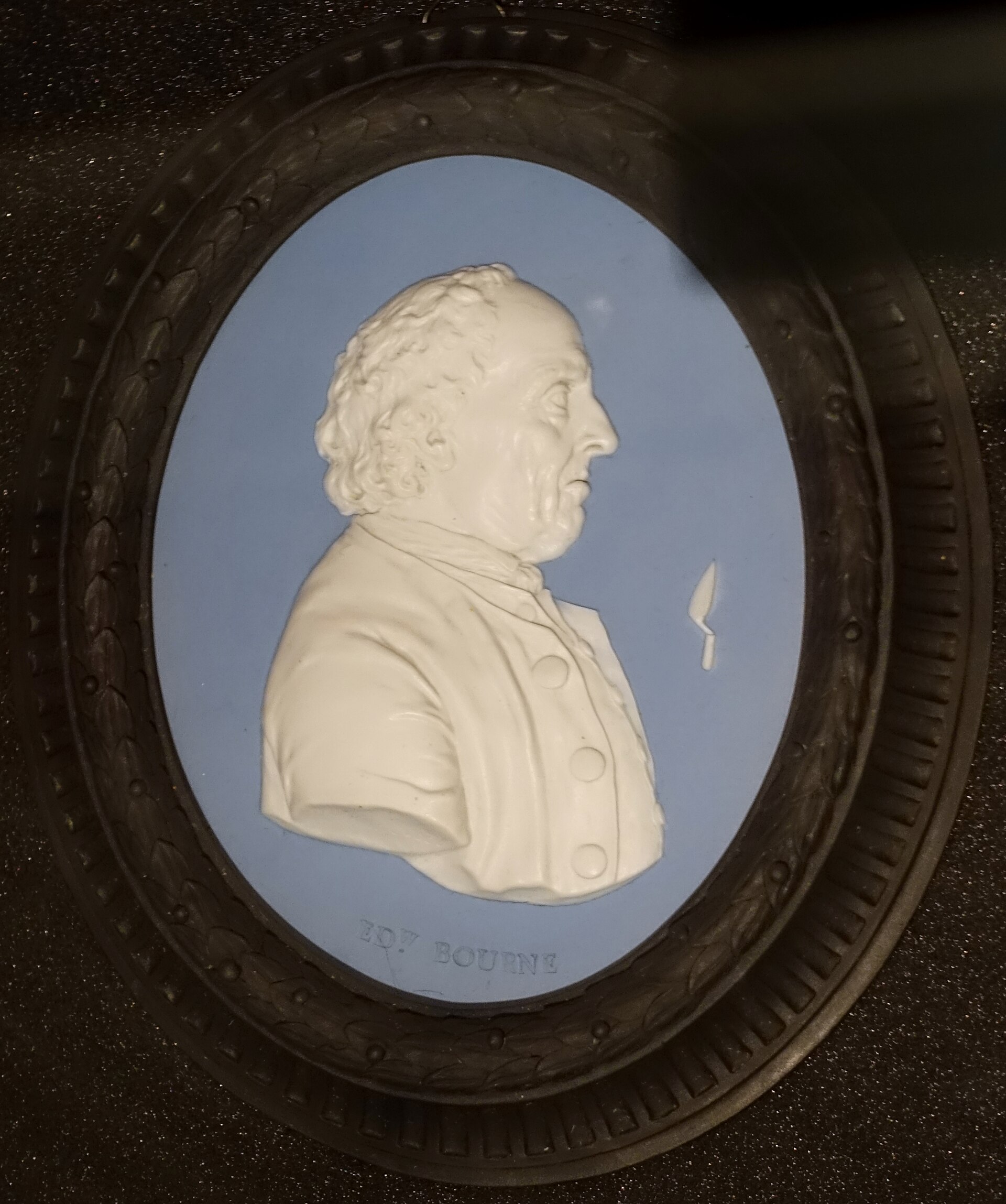
Hackwood did it again. On the medallion of Edward Bourne, a bricklayer at Etruria, modelled about 1778 or 1779, the initials W H appear on the truncation below the shoulder. So the one Wedgwood object that portrays a workman rather than a patron is also one of the few that carries its maker's mark, against the proprietor's stated policy. Wikipedia's formulation, that Hackwood was sometimes allowed to initial pieces, is a softening of what the letter actually says.
The largest case of attribution erasure is not a sculptor at all. William Greatbatch was a slightly younger friend who had trained with Whieldon on the same path, set up on his own around 1762, and probably made most of Wedgwood's early moulds as an outside contractor. His firm failed in 1782; by 1786 he was a Wedgwood employee; he stayed more than twenty years and retired in 1807 on generous terms written into Wedgwood's will. A large part of the shape repertoire of the firm's first two decades is his work under Wedgwood's name, and the will is the clearest acknowledgement anybody made of it.
Chapter 11The Portland Vase, and what Wedgwood knew he could not do
The Roman cameo-glass vase now in the British Museum is first recorded in 1601, in the collection of Cardinal Francesco Maria del Monte.
The Roman cameo-glass vase now in the British Museum is first recorded in 1601, in the collection of Cardinal Francesco Maria del Monte. It passed to the Barberini in 1626 and stayed with them for some two hundred years. Around 1780 Cornelia Barberini-Colonna, Princess of Palestrina, sold it to the Scottish dealer James Byres, who sold it to Sir William Hamilton, who brought it to England and in 1784 arranged a private sale to Margaret Cavendish Bentinck, Dowager Duchess of Portland. It was sold at the posthumous sale of her collection in 1786 and bought in by her son, William Cavendish-Bentinck, third Duke of Portland, for 1,029 pounds.
It was probably Flaxman who told Wedgwood the vase was in England, writing that he wished Wedgwood would come to town to see it, that it was the finest production of art that had been brought to England and seemed the very apex of perfection to which he was endeavouring to bring his biscuit and jasper. The V&A, which holds the manuscript, dates that letter to February 1785; a dealer dates the same letter 5 February 1784. Wedgwood applied to borrow the vase almost as soon as the Portland sale was over, and the British Museum records that on 10 June 1786 he signed a receipt for both the vase and the cameo of Augustus. He had it for more than twelve months.
His letter to Hamilton of June 1786 sets out both his ambition and the exact technical problem, and it is the single most revealing document he wrote. He observes that the ancient carver cut the white layer away to varying depth so that the dark ground shows through where the shadows are wanted, cutting it in places to the thinness of paper and in some places entirely away, so that the ground itself becomes part of the relief. From this he draws the conclusion that condemns his own method in advance: a bas relief with all the figures of one uniform white colour upon a dark ground, will be a faint resemblance of what this artist has had the address to produce by calling in the aid of color to assist his relief. Without it, he writes, a disgusting flatness would appear instead.
The same letter shows him costing the alternative. To match the original he would need an engraver to cut the applied jasper after firing, and he doubts one could be found: how few artists have touches that would not carry ruin with them, and would such an artist quit a lucrative branch and devote half a life to a single work for pay that would not be half his present earnings. And he reports the material advantage he does have: the body is much harder than glass, nearly as hard as agate, will bear cutting and polishing at the seal-engraver's lathe, and takes a blue tint from cobalt to any degree of strength.
In the same letter he lays out, unprompted, a four-tier market for the result. A working artist would take a plain cast in one colour at a price to match. A second class would want a blue ground, even if only painted. A third would want the blue in the body itself and equally permanent. A fourth would pay to have that blue ground polished, and, he writes, these two last would be his customers for jasper copies. This is a manufacturer segmenting a market for an object he has not yet succeeded in making.
He also told Hamilton how the subscription would work, and the terms are unusually honest for a man selling: several gentlemen had urged him to make the copies by subscription and had given him their names, but he told them, with great truth, that he was extremely diffident of his ability to perform the task, and that they should be perfectly at liberty when they saw the copies to take or refuse them; he accepted subscriptions chiefly to regulate the order of delivery. The issue price is reported at thirty guineas by one saleroom and at fifty guineas by Jewitt and Smiles, and on either figure the edition did not cover its outlay. Copies were still unsold in the warehouse in 1828, and ten went to the dealer Apsley Pellatt in 1829.
Chapter 12The first edition: the count, and how you tell one
The dates in circulation conflict and both are right about different things.
The dates in circulation conflict and both are right about different things. A copy good enough to show was produced in September or October 1789 and sent privately to Erasmus Darwin at Derby with strict instructions not to show it outside the family. Darwin's reply is on record: I have disobeyed you, and shown your vase to two or three; but they were philosophers, not cogniscenti. He later put the vase into The Botanic Garden, illustrated by William Blake. Wedgwood was still not satisfied. Experiments in the Barberini black were running in May 1790, and in April 1790 a finer copy was made which he was willing to put in front of the public. So 1789 is the first acceptable copy and 1790 is the edition.
It was shown at Sir Joseph Banks's house in Soho Square and then at the Greek Street rooms between April and May 1790, with numbers capped by printing only nineteen hundred tickets: Admission to see Mr Wedgwood's copy of The Portland Vase, Greek Street, Soho, between 12 o'clock and 5. Wedgwood published a Dissertation on the Portland Vase the same year. At the end of June the vase went abroad with his second son and Thomas Byerley to the Hague, Berlin, Hanover and Frankfurt.
Four men certified it, not one. The Duke of Portland, who owned the original; Sir Joseph Banks as President of the Royal Society; the Earl of Leicester as President of the Society of Antiquaries; and Sir Joshua Reynolds as President of the Royal Academy. Reynolds's certificate is dated Leicester Fields, 15 June 1790, and reads: I have compared the copy of the Portland Vase by Mr. Wedgwood with the original, and I can venture to declare it to be a correct and faithful imitation, both in regard to the general effect and the most minute detail of the parts. In late April 1791 one of the finest copies stood for some days in the rooms of the Society of Antiquaries.
The count. Nobody has a closed number and the honest answer is that there is not one. The oven books, which are incomplete, are read by Aileen Dawson as documenting forty-five copies; Bonhams, working from the same records, gives forty-five of which ten were broken. A dealer's reading gives forty-three made between 1791 and 1796, eleven broken, about thirty completed. Jewitt and Smiles, writing in 1865, both say fifty copies. The British Museum's own position is that its black jasper example is one of at least thirty to forty first editions now in collections around the world, and Dawson says there is some uncertainty about exactly how many were produced. The censuses are Wolf Mankowitz's of 1952, Dawson's appendix of early copies at page 149 of her 1984 catalogue, the Eatwell and Dawson listing at pages 149 to 150 that Sotheby's cites, and Robin Reilly's treatment in Wedgwood Jasper of 1994. Some copies are numbered in pencil inside the neck or rim; the highest recorded number is 30, on the example in the Art Institute of Chicago.
How you tell one, in order of usefulness.
It should have no mark at all. This is the strongest single test and the one most often missed. Wedgwood marked routinely from about 1772, and Robin Reilly names the first-edition Portland Vases as the most notable exception to that rule. Nineteenth and twentieth-century copies carry the impressed WEDGWOOD, with ENGLAND added after 1891 and MADE IN ENGLAND generally from the early 1900s. A Portland Vase with a clean impressed mark is not a first edition.
The relief should be undercut and shaded. On the finished first edition, including the V&A's, the cameo effect is produced by undercutting the white and shading it in grey so the figures fade towards the ground, which is what Wedgwood told Hamilton in 1786 he would have to achieve. Bonhams, cataloguing an early trial, notes some slight undercutting but little attempt at shading, and Reilly reads such pieces as from about 1787, before the refinements were introduced. Uniform flat white relief indicates a reproduction.
The blue-black ground should be lapidary-polished, worked as a gemstone would be, which gives a smoothness later production does not have.
The base disc. A full-size copy should carry the disc with a head in a Phrygian cap, usually identified as Paris, which Wedgwood copied from the Roman original even though the disc is thought not to belong to it. Beyond that the diagnostics diverge and this page does not arbitrate: Bonhams describes the tip of the elbow as cut off by the rim, one dealer describes the raised elbow as protruding slightly above it, and another dealer reports a circular hole in the centre of the disc, visible from inside with strong light, on every first edition he has examined and never on a later one. Those are dealers' stated criteria, recorded here as such.
What is not a test. Solid against dip does not work here. The V&A's first edition is catalogued as a jasper dip; a dealer's first edition is described as solid blue and heavy for its size. Colour is also not decisive: black is the norm, but a small number were made in blue in 1791, reportedly for want of black clay, and the British Museum has one. And firing faults do not disqualify: many first editions and trials show blistering, a sagged neck or lost reliefs. Wedgwood's own son reported one in March 1788 whose shoulder had been turned too thin and had sunk in, and Wedgwood wrote in September 1790 that he had fired five more since his son left and not one was fit to show.
The 1845 smashing. At a quarter to four on the afternoon of 7 February 1845, after a week of drinking, a man giving his name as William Lloyd picked up a sculpted stone in the room where the Roman vase was displayed and smashed both it and its case. Because the statute he was charged under appeared to limit itself to objects worth no more than five pounds, he was convicted instead of destroying the glass case and fined three pounds or two months; an anonymous benefactor paid the fine by post. The British Museum's investigators concluded that William Lloyd was a pseudonym for William Mulcahy, a student missing from Trinity College Dublin. John Doubleday reassembled the vase the same year; thirty-seven fragments he could not place were boxed, lost, and returned to the museum in October 1948; Nigel Williams and Sandra Smith took it apart and rebuilt it again between 1988 and 1989. It is frequently said that Wedgwood's copies served as the model for Doubleday's restoration. That is a reasonable supposition and it is repeated widely, but it is not in the British Museum's own curatorial record and this page has not been able to source it. It is recorded here as a tradition needing a citation.
Chapter 13The Frog Service, and what a loss leader is for
Catherine the Great placed the order in 1773 through Alexander Baxter, the Russian consul in London.
Catherine the Great placed the order in 1773 through Alexander Baxter, the Russian consul in London. It was for the palace at Kekerekeksinen, the frog marsh, later the Chesme Palace, built to celebrate the Russian naval victory at Chesma in 1770. Hence the green frog on every piece. Jewitt records that Wedgwood was very unwilling to disfigure the service with the creature but was told it could not be dispensed with.
The counts. Thomas Bentley compiled the description of the service and it lists 952 pieces with 1,244 real views of Great Britain, all different. That is the figure the State Hermitage, the British Museum and the V&A all give, and it is the one to use. A second set of numbers, 944 pieces ordered for fifty settings, 680 dinner and 264 dessert, with 1,222 views, circulates from later secondary literature. Both are in print; only one is Bentley's.
The two genuinely surprising things about it are the body and the money. It was made in Queen's Ware, an earthenware. A formal royal service on that scale would normally have been porcelain, and an imperial order for a large earthenware service was a landmark in Staffordshire's conquest of the European market rather than an ordinary commission.
And it barely paid. Bentley's own costing survives in the Wedgwood manuscripts. The table services came to 51 pounds 8 shillings and 4 pence; 1,244 enamel views and paintings at an average of 21 shillings came to 1,306 pounds 4 shillings; 1,244 borders and compartments including 1,244 green frogs, at an average of 15 shillings, came to 933 pounds. The three lines total exactly 2,290 pounds 12 shillings and 4 pence, which is the invoice figure. Add the original drawings, the copying of pictures and books of natural history, the insurance at Chelsea, 9 pounds 14 shillings for translating and printing the catalogue, and 22 packing cases and shipping, and the total is 2,410 pounds 10 shillings and 6 pence. Against direct costs of about 2,612 pounds he received a little over 2,700, so the profit was of the order of a hundred pounds on a job that occupied more than thirty painters entirely by hand in the Chelsea decorating shop at Little Cheyne Row. Meteyard reports a price of 3,000 pounds and hedges it herself. Wedgwood's own verdict, to Bentley on 8 July 1774, is the safest thing to quote: with the extras, there will not be near the proffit upon this service that we have upon our commonest painted goods.
The return was the display. Before shipping, the service was laid out at Portland House, 12 Greek Street, in June 1774. Admission was by ticket, advertised in the St James's Chronicle, the Gazetteer and the Public Advertiser; the claim that a small fee was charged is not supported by the contemporary evidence. Mrs Delany, writing on 7 June 1774, describes three rooms below and two above filled with it, laid out on tables, which is where the five rooms of the secondary literature comes from. Fashionable London blocked the street with carriages for over a month. Wedgwood used the same ticketing device for the Portland Vase seventeen years later.
He also chose the views commercially. The selection leaned towards houses belonging to good customers, who could enjoy the thought of the Russian court looking at their gardens; seventeen gardens by Capability Brown appear; and he put his own house, Etruria Hall, on a serving dish. Some pieces show the new industrial buildings appearing in the British landscape.
It was also a technical dead end and he knew it within a few years. He tried to keep the team of painters together and found that customers would not pay porcelain prices for painted earthenware. Transfer printing, which he had used since 1761 through Sadler and Green at Liverpool, was already the economic answer for detailed decoration, and jasper, which needs moulds and stain and no painting at all, was the answer for ornament. The most lavish hand-painted object the firm ever made marks the point at which it stopped making them.
Chapter 14Selling it: the showroom, the catalogue, the refund
That Wedgwood invented modern marketing is repeated so often that it has stopped carrying information, and several items on the standard list do not survive checking.
That Wedgwood invented modern marketing is repeated so often that it has stopped carrying information, and several items on the standard list do not survive checking. What follows separates what is documented from what is not.
The showroom letter. The best single piece of evidence is a letter to Bentley of May 1767, written from the Baptist Head Coffee House, rejecting a room in Pall Mall that had been used for public auctions. Wedgwood explains that the nobility and gentry recommend one another to his rooms and never meet with any other company there, whereas everybody would be apt to stroll into an auction room. Then he explains what he actually wants a large room for, and it is not storage: it was not to show or have a large stock of ware in town, but to enable him to show various table and dessert services completely set out on two ranges of tables, six or eight at least, because such services are absolutely necessary to be shown in order to do the needful with the ladies in the neatest, genteelest and best method; and both those and the vases on the walls may every few days be so altered, reversed and transformed as to render the whole a new scene, even to the same company, every time they bring their friends. His reason is that every new show, exhibition or rarity soon grows stale in London and is no longer regarded after the first sight. And then he reports the result: he had done something of the sort since coming to town, and in the two first days after the alteration sold three complete sets of vases at two and eight guineas a set, besides many pairs, which had been in his rooms six, eight and some of them twelve months, and wanted nothing but arrangement to sell them.
That is the entire discipline in one letter: whole services set complete rather than stock displayed, deliberate frequent re-dressing so that a repeat visit is a new experience, social filtering of the clientele as conscious policy, and a measured sales result from rearrangement alone.
The showrooms. One or two rooms in the house of Ivison, a shoemaker, in Charles Street off Grosvenor Square from about 1765, with William Cox as the clerk in attendance; too small within two years. Great Newport Street from July or August 1768, and this is where the self-service claim actually lives. The building was arranged in three tiers of access: on the ground floor a shop selling seconds, thirds and odd pieces with the prices marked, which the public entered and left at pleasure; on the first floor two rooms with the services ranged on long centre tables and vases, tripods, large reliefs and bough pots on shelves round the walls; and an antechamber holding the choicest pieces, to which only the partners and Cox the manager had access, and which was never shown except to patrons of the rank of the Duke of Northumberland. Then Portland House at 12 Greek Street, Soho, opened in April 1774 and occupied until 1795, with Newport Street kept on for discounted imperfect stock. A showroom opened in Dublin in the autumn of 1771, run on commission through an agent named Brock and pushed by the Duke of Leinster and Lord Charlemont, and in Bath at Westgate Buildings from the spring of 1772, where the opening was deliberately deferred to the beginning of a new season with privileged buyers let in first. Also Etruria itself, Liverpool and Westminster.
Controlled scarcity. He timed openings deliberately, held new goods back to increase their effect, and strictly limited how many jaspers were on display at any one time so that the range felt rarer than it was. Neil McKendrick, who reconstructed this from the manuscripts in 1960, treated it as a sales technique and not an accident of stock.
Catalogues, and what they actually were. The first ornamental catalogue was published in 1773, with an introduction by Bentley, and sold at the Great Newport Street rooms and by Cadell in the Strand, Robson in New Bond Street and Parker the printseller in Cornhill. It is worth being accurate about the object: Meteyard describes an insignificant-looking little pamphlet of sixty pages in twelves, printed on very bad paper and stitched in a thin marbled cover. It is not an illustrated catalogue in 1773. What it is, is a price list, and the prices are the useful part. Intaglios were sold unset at one shilling apiece and set in gilt metal at three shillings. The Dassier papal portrait heads were sixpence each singly, or threepence each to a buyer taking the whole set, which is a volume discount printed in 1773. Ornamental vases in the terra cotta body ran from two shillings and sixpence to two or three guineas depending on size and finish, sets of five from about two guineas to five or six. Black basalt vases ran from five shillings to three or four guineas, sets of five for a chimney-piece from about three guineas to six or eight. The same catalogue sells a shilling seal and a several-guinea garniture, which is the point.
Later editions were translated as a matter of routine business. A second English edition in 1774 carries the Greek Street address; a French translation followed and was called the third; a fourth in English in 1777; a fifth in English and a sixth in French in 1779; a sixth in English in 1787, translated into French again in 1788. Veldhuysen of the Amsterdam branch translated it into Dutch and published it there in the early winter of 1778, and Rost, a Leipzig merchant, translated and distributed the German edition at his own expense. Lists of useful ware went out in almost every continental language. The Frog Service costing carries a line of nine pounds fourteen shillings for translating and printing the catalogue, which is what the practice cost on one job.
Free delivery, and the sum he was prepared to lose on it. He delivered free from the factory to London and replaced free of charge anything broken in transit, and he worked out what it would cost before he did it. Land carriage averaged nine shillings a ton, and paying it without altering his prices would take nearly five hundred pounds a year off his profits; he also expected that once he quoted delivered prices, customers twenty miles away and three hundred miles away would both expect free delivery. He did it anyway.
The refund. A draft advertisement in the commonplace books of the 1780s explains the delivery arrangements at length and reassures the customer that the money will be returned if the goods do not satisfy. The V&A's historians describe a returns policy for goods not agreeable to the customer's wishes; that phrase is not in Meteyard or Jewitt and should be attributed rather than quoted as primary.
What to drop. Direct mail as a discrete practice, pattern boxes carried by travelling salesmen, and buy one get one free all trace to newspaper and think-tank summaries rather than to the archive, and this page does not assert them. What is documented in their place is duller and better: he employed French, German, Italian and Dutch-speaking clerks and answered foreign correspondence in the writer's own language, and he sent his own son and Byerley round the courts of northern Europe with the Portland Vase in 1791.
Chapter 15The canal, and the price of a broken pot
The Staffordshire potters had a transport problem rather than a market problem, and Wedgwood spent fifteen years attacking it in two campaigns.
The Staffordshire potters had a transport problem rather than a market problem, and Wedgwood spent fifteen years attacking it in two campaigns. The roads first, then the canal.
The turnpike, 1762 to 1765. The petition the potters got up in 1762 makes the case in numbers: in and around Burslem were near one hundred and fifty separate potteries, together employing and supporting near seven thousand people, and the existing route forced carriage to and from Liverpool and the Cheshire salt works round by Newcastle, nine and a half miles instead of five. Land carriage in the district ran at about nine shillings a ton for ten miles.
The opposition was not, as is often written, the Cheshire salt interest. It was Newcastle-under-Lyme, and specifically its innkeepers, who raised the utmost clamour and used what parliamentary and aristocratic influence they had to defeat the bill in both Houses, on the ground that the road would divert trade from their town. The bill passed in 1763 as an act for repairing the road from Lawton to Burslem and Newcastle, but with the south end cut back so that it terminated at Burslem instead of joining the Newcastle and Uttoxeter road at Stoke. Even shortened it saved four and a half miles and was passable in winter. In 1765 a further act extended the turnpike from Burslem through Cobridge to Shelton, which completed the north-to-south road through the Potteries that Wedgwood had wanted. The Victoria County History calls the 1763 act a triumph for Wedgwood and the potters over the vested interests of Newcastle.
The canal, 1765 to 1777. Bentley wrote the campaign pamphlet, A View of the Advantages of Inland Navigations, published in 1765; Wedgwood's instruction on 2 January that year was to get a thousand printed, sell what the navigation wanted and risk the rest. Erasmus Darwin contributed and then savaged the draft as flat and tame, and Bentley replied that barely two paragraphs of the offending part were his. The route was fought over: the Liverpool coal merchants opposed a line that would bring in Cheshire coal, and the proprietors of the Weaver, Irwell and Sankey navigations opposed a canal running parallel to their monopoly. One published route missed the Potteries altogether. In 1764 Wedgwood persuaded John Gilbert to include them.
The Trent and Mersey Canal Act received royal assent on 14 May 1766. On 26 July 1766, on the declivity of Brownhills at Burslem, Wedgwood cut the first sod in the presence of James Brindley the engineer and many of the neighbourhood, who each cut a sod after him; Brindley wheeled the first barrow away. Burslem kept the day as a general holiday, a barrel of ale was broached on the spot and a sheep roasted whole in the market place. Brindley died in 1772, five years before the canal opened in 1777 with more than seventy locks and five tunnels, of which Harecastle at Kidsgrove was the hard one: 2,880 yards, fifteen shafts, no towpath, so boats were legged through by men lying on their backs in about three hours. Until it was finished, pots from Etruria had to be carted over the top of the hill to reach the completed section.
What it did to the freight bill. Contemporary figures survive, published in Williamson's Liverpool Advertiser on 8 August 1777 and reprinted by Thomas Baines in 1852: carrying a ton of goods from Liverpool to Etruria cost fifty shillings by land carriage and thirteen shillings and fourpence by the Trent and Mersey. That is a reduction of about seventy-three per cent, on the route that mattered most to him, in the year the canal opened.
What did not change is more interesting. There is no published breakage rate before or after the canal, and this page does not invent one. Meteyard's remark that potters whose goods reached port with two-thirds of their contents intact were fortunate is about theft by bargemen rather than breakage, and she adds that canals mitigated the evil in some degree but not so much as their promoters had expected. Wedgwood's own testimony on river carriage cuts against the usual story altogether: land carriage was three shillings the hundredweight and water carriage about half as much, but the stealage and breakage on the river was often much more than the difference of expense. The canal made Staffordshire pottery cheap to move. Whether it made it safer to move is not established.
Chapter 16The medallion, and the trade it did not stop
The Society for Effecting the Abolition of the Slave Trade was founded on 22 May 1787 at 2 George Yard, Lombard Street, in James Phillips's printing house, by twelve men: Granville Sharp, who took...
The Society for Effecting the Abolition of the Slave Trade was founded on 22 May 1787 at 2 George Yard, Lombard Street, in James Phillips's printing house, by twelve men: Granville Sharp, who took the chair, William Dillwyn, Samuel Hoare as treasurer, George Harrison, John Lloyd, Joseph Woods, Thomas Clarkson, Richard Phillips, John Barton, Joseph Hooper, James Phillips and Philip Sansom. Most were Quakers; Clarkson's own footnote says two-thirds of the committee were, and nine-tenths of the first coadjutors. Wedgwood was added to the committee at one of the meetings between 5 July and 27 August 1787; no source this page could reach prints the minute date. He was a member and not an officer, and Mary Guyatt, working from the minute books in the British Library, records that he attended only seventeen meetings between 1787 and 1791.
The Society resolved to obtain a seal on 5 July 1787, and on 16 October a sub-committee brought in the design. Clarkson describes it: an African in chains in a supplicating posture, kneeling with one knee on the ground and both hands lifted up to heaven, and round the seal the motto as if he were uttering the words himself, Am I not a Man and a Brother?. Who drew it is not settled. The existing literature indicates that Henry Webber, Wedgwood's sculptor, drafted the figure and that it was then modelled at Etruria by the jasper specialist William Hackwood; the V&A says only that it was probably Hackwood and that how the print design became a ceramic sculpture remains something of a mystery; the Metropolitan Museum gives Hackwood outright. The motto's authorship is also uncertain: Wedgwood is popularly credited with it, and the V&A points instead to the Reverend Dr Peter Peckard of Magdalene College, Cambridge.
The object is a small oval, three centimetres by two and seven, and it is not one object but several. The best-known form is white jasper with the figure in black relief, mounted in a gilt-metal hoop, which is what Clarkson described: the ground a most delicate white, and the man imploring compassion in the middle of it in his own native colour. There are also round blue jasper medallions with white relief, and later white terracotta versions with black basalt reliefs by makers unknown.
They were not sold. That is the fact to hold on to about this manufacturer of all manufacturers. They were never listed in the Wedgwood catalogues, the committee minutes record no payment to him, and it is generally accepted that he bore the production and distribution costs himself; medallions of comparable size were retailing at three guineas. How many were made is unknown and Guyatt says so plainly. Nineteenth-century estimates run from many hundred through large quantities to thousands, and the oven books do not mention the medallions at all until April 1792, five years into production, in the entry J. Steel made 14. Doz black slave cameos, 1 1/4. The one hard number is Clarkson's: he received five hundred of them himself.
The correspondence is better evidence than the count. Clarkson wrote to Wedgwood in 1788 asking to be furnished with as many as he could spare because he was setting out the next day on a tour of the southern counties on the subject of the slave trade. On 29 February 1788 Wedgwood wrote to Benjamin Franklin, then president of the Pennsylvania abolition society, enclosing a few cameos on a subject daily more and more taking possession of men's minds on this side of the Atlantic as well as with you, and adding that while relief is given to so many of our fellow creatures immediately the object of it, the subject of freedom itself will be more canvassed and better understood. He was dictating: a rheumatic headache had afflicted him for months and he was using his nephew's hand. James Phillips, sending the box, described Wedgwood as the committee's worthy member.
Franklin replied from Philadelphia on 15 May 1788, misdating his own letter 1787: he was distributing the cameos among his friends, in whose countenances he had seen such marks of being affected by contemplating the figure of the suppliant, which is admirably executed, that he was persuaded it might have an effect equal to that of the best written pamphlet in procuring favour to those oppressed people. Clarkson's own account of what happened next is the most quoted passage in the story: they to whom they were sent did not lay them up in their cabinets but gave them away likewise; some had them inlaid in gold on the lid of their snuff-boxes; of the ladies, several wore them in bracelets and others had them fitted up in an ornamental manner as pins for their hair; and at length the taste for wearing them became general, and thus fashion, which usually confines itself to worthless things, was seen for once in the honourable office of promoting the cause of justice, humanity and freedom.
The archive holds harder material than the medallion. Olaudah Equiano wrote to Wedgwood seeking support for a visit to Bristol because he was afraid of being press-ganged; the letters are in the V&A Wedgwood Collection, one of 1793 under the reference E31-25058, alongside the 1788 subscription proposals for his Interesting Narrative. Wedgwood also met and corresponded with William Wilberforce. Erasmus Darwin worked the medallion into The Loves of the Plants in 1789, in the same passage that praises the Portland Vase copy: the poor fettered slave on bended knee, from Britain's sons imploring to be free.
The criticism is a real scholarly literature and not a recent reflex. Mary Guyatt, writing in the Journal of Design History in 2000, argues that the slave is depicted in a weak posture, supplicating on bended knees and emasculated by his chains, and that since supplication establishes a hierarchy of power he is clearly the submissive party, a non-threatening object whose purpose is to arouse pity in potential converts. Her supporting evidence is Wedgwood's own language: proposing a woodcut of the same figure for a Society pamphlet, he called him a pathetic figure which would increase its effect somewhat. Linda Colley's formulation is that the black man cries out from the safe position of his knees, so that slaves did not threaten and bestowing freedom on them seemed purely an act of humanity and will. Cynthia Hamilton and Marcus Wood have written on the same image, and the V&A's current wall text says much the same in its own voice.
Andrea Feeser's 2024 argument goes further and reaches into the body itself. The white clay of Wedgwood's jasper included unaker, Cherokee white clay obtained at Ayoree in North Carolina in 1767 by Wedgwood's agent Thomas Griffiths and moved through Charleston by enslaved labour. It is the first ingredient named in his own patent specification of 1769, a white earth from Ayoree in North America. On Feeser's reading the medallion is made partly of material extracted through the system it protests.
Two other things sit against it. The V&A states plainly that Wedgwood profited from the trade he opposed, finding new markets in the West Indies for wares no longer fashionable in Europe and indirectly from the wealth of a clientele built on the same economy. And the design went on being read as his long after the fact: unmarked white terracotta versions made about 1790 by an unidentified Stoke-on-Trent maker were attributed to the firm on no evidence beyond the association.
He did not live to see the trade abolished; that came in 1807, and emancipation in the British colonies in 1834. His daughter Sarah was a founding member of the Birmingham Ladies Society for the Relief of Negro Slaves in 1825, the first anti-slavery society for women, and his son Josiah II was elected as one of Stoke-on-Trent's first members of parliament on a platform of immediate abolition. In 1968 the striking sanitation workers of Memphis turned the question on the medallion into a statement, I AM A MAN.
Chapter 17What he believed, read and joined
Calling the family Unitarian at Josiah's birth is anachronistic, and the distinction matters.
Calling the family Unitarian at Josiah's birth is anachronistic, and the distinction matters. They were English Presbyterian Dissenters, and a large proportion of those congregations became Unitarian over the course of the century, which is what happened around him. His mother was the daughter of Josiah Stringer, a dissenting minister whose congregation had been outlawed under the Corporation Act and who held that knowledge based on reason, experience and experiment was preferable to dogma. His brother-in-law William Willet was minister at the Newcastle-under-Lyme Meeting House and visited him repeatedly through the long convalescences.
The building survives and the statutory list entry names him. The Old Unitarian Meeting House in Lower Street, Newcastle-under-Lyme, listed Grade II, is thought to be the earliest nonconformist chapel in North Staffordshire, and Historic England records that Josiah Wedgwood worshipped there and that Joseph Priestley conducted worship there about 1761. The same entry calls him a co-founder of the Unitarian Academy at Warrington, which is Historic England's wording rather than the usual account; the academy was founded in 1757 chiefly by Liverpool and Manchester dissenters and Wedgwood was a supporter and lecturer rather than a founder.
Bentley was a Unitarian too, and the Liverpool Octagon Chapel of 1762 was his project. Wedgwood wrote to him on 16 June 1768 that the account of the opening gave him great pleasure both as a friend to your society and a lover of rational devotion. When Bentley's friend David Williams opened a chapel in Margaret Street near Portland Place in 1776, Wedgwood became a perpetual subscriber for four seats and added considerable donations. His dissent had a consequence at the end: Historic England's entry for the tomb records that he was buried at the entrance to the church rather than inside it because he was not a member of the Church of England.
He was a staunch American through the war, a supporter of the French Revolution before the Terror, and a subscriber for the Poles. His own descendant Julia Wedgwood gives the necessary qualification in the same breath: his conception of liberty was coloured by trade and class interest, and the liberty of the manufacturer as he conceived it was equally infringed by imposts and by the competition of other manufacturers.
The Lunar Society is a live scholarly dispute and this page does not arbitrate it. Eliza Meteyard, in 1866, said flatly that contrary to the generally received notion Wedgwood was not, like Priestley, Watt, Boulton and Withering, a recognised member; he was occasionally present and probably contributed subjects for discussion, but Etruria and Birmingham were too far apart for regular monthly attendance. Her evidence is strong: Priestley's own autobiography lists the members who dined together every month, calling themselves the Lunar Society because the time of meeting was near the full moon, and Wedgwood is not among the names. Modern scholarship goes the other way. Jenny Uglow's The Lunar Men of 2002 places him among the core group, and the society kept no membership roll, so the distinction between member and frequent correspondent may be less real than it looks. Robert Schofield's 1966 bicentenary appraisal in the Royal Society's Notes and Records is the standard authority; this page has not read it.
The working relationships, by contrast, are documented and generous. After Priestley settled in Birmingham in 1780 Wedgwood allowed him twenty-five guineas a year, continued to Wedgwood's death and then by his son to the end of Priestley's life, and supplied his laboratory with retorts, tubes, baths, crucibles and mortars; the Royal Society holds a long run of Priestley's letters to Wedgwood from 1780 onward. After the Priestley Riots of July 1791 Wedgwood wrote condoling on the loss from the brutality, or rather let us hope the temporary insanity, of your neighbours, and privately urged Priestley to soften the preface of his Appeal to the Public.
Matthew Boulton is the more interesting case, because the rivalry and the collaboration are in the same letter. Writing to Bentley from Charles Street on 15 March 1768, Wedgwood reports two days at Soho in which he and Boulton settled many important matters and laid the foundation for improving the manufacture and extending its sale to every corner of Europe: many ornamental articles would be finished to great advantage with works of metal, which Boulton would execute. In the same paragraph Boulton tells him what a trade has lately been made out of vases at Paris, where artists had come over to London, picked up all the old whimsical ugly things they could meet with, mounted them with metal and sold them to the virtuosi of every nation. Wedgwood's conclusion on the combination of clay and metal: this alone is a field, to the further end of which we shall never be able to travel. Boulton's Soho works went on to frame Wedgwood jasper medallions in ormolu and set the smallest plaques in cut steel.
What he read, where it is documented. The Comte de Caylus is the traceable source of the encaustic idea. Meteyard says there is reason to think Bentley translated Caylus's work on encaustic painting for Wedgwood's use; Julia Wedgwood traces the first impulse to Caylus's Recueil d'Antiquites, published in seven volumes between 1752 and 1767, of which Wedgwood had the loan of a copy from a patron. His instruction to Bentley on what to look for is exactly a manufacturer's: the colours of the earthen vases, the paintings, the substances used by the ancient potters, with their methods of working and burning. D'Hancarville's catalogue of Hamilton's vases, four folio volumes from 1766, is the other, and Wedgwood's reservation about it is on record too, that the merits of the original vases were exaggerated in their copies. Beyond those two, his library is undocumented, and the DNB records only that in retirement he collected books, engravings and objects of natural history.
Chapter 18The Royal Society, and an instrument that was wrong
He was elected a Fellow of the Royal Society on 16 January 1783, and the election certificate survives in the Society's archive as EC/1782/08.
He was elected a Fellow of the Royal Society on 16 January 1783, and the election certificate survives in the Society's archive as EC/1782/08. It is worth quoting because of what it does not say. It describes him as Josiah Wedgewood of Etruria in Staffordshire, Potter to Her Majesty, and the fourteen signatories recommend him from their personal knowledge as a gentleman highly deserving of the honour he requests and likely to prove a very useful and valuable member. It names no scientific ground at all. The universal statement that he was elected for inventing the pyrometer is not what the document says. Joseph Banks, who as President communicated his first paper to the Society, is not among the proposers; John Whitehurst of Derby, himself a Lunar Society man, and John Hunter the surgeon are.
He published five papers in the Philosophical Transactions and left an earlier one unpublished. The unpublished paper, a method of ascertaining very great degrees of heat, is dated 1780 and predates the series by two years. The first published paper, of 1782, is an attempt to make a thermometer for measuring the higher degrees of heat, from a red heat up to the strongest that vessels made of clay can support, communicated by Banks. Papers of 1784 and 1786 connect the instrument to the mercurial thermometer and add observations. Two others are not about heat at all: an 1783 paper on a Derbyshire mineral the miners called black wadd, and one of 1790, addressed to Banks, on the analysis of a mineral substance from New South Wales.
The instrument measured kiln temperature by the shrinkage of a half-inch pipe-clay cylinder, read off a tapered pair of scaled bars divided into 240 parts, with zero at the onset of red heat. It is the first standardised pyrometric device and its readings are systematically too high: his melting points for copper, silver and gold are all far above the true figures. Louis-Bernard Guyton de Morveau later showed that the origin should be set much lower and the steps roughly halved, and even after correction the values overestimate. The DNB's verdict, written a century later, is that the method affords irregular results. Both halves belong on the record: a real advance, and an inaccurate one.
He was elected a Fellow of the Society of Antiquaries on 4 May 1786, and on 6 May 1790 he exhibited an early copy of the Barberini vase to that society and read a paper on it. The 1790 Philosophical Transactions paper styles him F.R.S. and A.S., which is contemporary evidence of the double fellowship and the origin of the initials on his monument. In late April 1791 one of the finest Portland Vase copies stood for some days in the rooms of the Society of Antiquaries, and it was there that Sir Joshua Reynolds certified its entire similitude to the original.
One more object connects the science, the empire and the pottery in a single piece. In 1788 Sir Joseph Banks sent Wedgwood a sample of clay from Sydney Cove, which he had from Governor Arthur Phillip, and a sample of black lead from the same colony which became the subject of the 1790 paper. Henry Webber modelled the clay into the Sydney Cove Medallion, an allegory described as Hope encouraging Art and Labour, under the influence of Peace, to pursue the employments necessary to give security and happiness to an infant settlement. Erasmus Darwin put it into verse in the same poem in which he praised the abolition medallion and the Portland Vase.
Chapter 19The other side of the same man
Wedgwood's own descendant Julia Wedgwood, writing the family life in 1915, gave the least comfortable and most useful assessment of his politics that has been published, and it is not the one usually...
Wedgwood's own descendant Julia Wedgwood, writing the family life in 1915, gave the least comfortable and most useful assessment of his politics that has been published, and it is not the one usually quoted. His strongest political passion was a hatred of oppression; but in industrial affairs oppression tended to mean whatever interfered with the arrangements under which his manufacture had thriven. He was warm for liberty where a heretic was persecuted, where thirteen colonies were taxed, where a kingdom was subjugated or where African people were enslaved. He was no less keen when the question was restraining workmen from selling their labour more profitably, or Ireland from competing in manufacture with England. While he was subscribing for the Poles and writing letters about the slave trade he was doing his best to defend liberty; had he been asked to defend his attempts to make emigration a penal act for his workmen, she thought he would simply have been bewildered.
The factory that produced the abolition medallion also produced the industrial discipline Neil McKendrick made his subject in 1961, working through the sixty thousand Wedgwood manuscripts. Division of labour at Etruria was the point of the place, and Wedgwood's own letters name the men and what they were confined to: George Barnet and his boy taken off vases to make jasper bas-reliefs; Ralph Moreton in constant employment on useful things as a handler and to continue in that line; Keeling to make all such things as are made in moulds; Hollinshead to make all the black heads and bas-reliefs. A commonplace book of the early 1790s names the supervisory tier: John Boulton inspector of the turners, John Harrop of the biscuit house, Daniel Steel of the handlers, Jesse Bourne superintendent and looker-out in the warehouse, Joseph Plant looker-over in the slip house, Henry Hulme in the gloss oven.
The training was capital and he accounted for it as capital. Of two runaway apprentices in 1777 he wrote that if the little virago will repent and mind her business it is a pity to part with her after so much time and expense bestowed on them; they have cost him about thirty or forty pounds apiece and should be worth fifty. There was a food riot at Etruria in 1782, which McKendrick is careful to say reflected conditions general to the whole of the Potteries and not peculiar to Wedgwood.
Two things frequently attributed to him need date-checking. The Potters' Instructions in the Wedgwood manuscripts, endorsed 1780, are genuinely his. The numbered works rules that circulate as Wedgwood's factory regulations are in a document endorsed Regulations Manufactory 1810, fifteen years after his death, and should not be read back onto him. The clocking-in ticket system that appears in management literature has no archival citation this page could find. What is attested, and hedged even where it is attested, is the bell: the Victoria County History says it is said that the Brick House Works became known as the Bell Works during Wedgwood's tenancy from his new method of summoning his workmen by bell instead of by horn. At Etruria the bell became architecture, in a cupola over the front range.
He built a village. The first six houses stood beside the southern roundhouse; there were about forty-two cottages by 1770, almost a hundred by his death in 1795 and a hundred and twenty-six by the mid-1820s. They were brick and tile, two rooms to a floor, without ornament, and each had its own rear yard and garden, which the shared yards and privies of the rest of the Potteries did not. It was not a model ornamental village and it did not house the whole workforce. The chapels and schools at Etruria that are sometimes credited to him are all later than he was.
None of this is an argument that the medallion was insincere. It is an argument that the two facts are the same fact seen from two ends, and a page that prints one without the other is not describing an eighteenth-century manufacturer.
Chapter 20Reading a Wedgwood mark
This is the part of the page a buyer needs and it is worth setting out in order, because the mark carries almost all the dating information there is.The impressed name.
This is the part of the page a buyer needs and it is worth setting out in order, because the mark carries almost all the dating information there is.
The impressed name. Josiah began marking about 1759 using printer's movable type, each letter punched separately, so the early mark is uneven and often runs on a slight arc. From about 1769 a single slug was used. A great deal of the early output is unmarked altogether; the trade rule of thumb is that after 1781 few unmarked pieces can be safely given to Wedgwood. The serif impressed mark stays standard until 1929, when the word is recut in a sans serif face.
One caution on the most quoted early test. Dealers who handle the material warn that individually impressed letters and curved marks are frequently the result of clay movement in the firing rather than of movable type, and that it is dangerous to read too much into either. It is a supporting indication and not a proof.
Wedgwood and Bentley. The partnership deed is dated 14 November 1768 and Bentley died on 26 November 1780, so Jewitt's rule is that every piece bearing both names was made in the twelve years between those dates. The characteristic form on ornamental goods is a circular Etruria mark with the letters raised, not sunk, which is the detail most often got wrong. There is also a rare impressed WEDGWOOD & BENTLEY, an extremely rare script mark, and small marks carrying catalogue numbers on seals, cameos and intaglios.
Country of origin. ENGLAND as a separate impression is a consequence of American law, not English practice: section 6 of the McKinley Tariff of 1890 required, from 1 March 1891, that all articles of foreign manufacture be plainly marked in legible English words to indicate the country of origin, on pain of exclusion. MADE IN ENGLAND follows, and here the sources genuinely differ: 1908, about 1909, and from 1910 are all given, and one guide notes the words appearing on some wares as early as 1898. Treat it as a range and not as a date. It is also not a reliable terminus: small items were often exempt, and Wedgwood Christmas thimbles dated 1990 still read WEDGWOOD ENGLAND.
The three-letter code. From 1860 a code of month, potter and year was used, although rarely on jasper or basalt, so its absence dates nothing. The year letters run in cycles: O for 1860 through to N for 1885, then O again for 1886 to I for 1906, then a cycle in which the month letter is replaced by the figure 3, and a fourth in which it is replaced by a 4, ending in 1930, after which the year is given in figures. The way out of the cycle ambiguity is the month letter: June is always T and August always W, and March, May and July change letters in 1864, so a code can usually be pinned to one cycle. A single letter on its own in this period is a tally mark identifying the potter for piece-rate pay and dates nothing at all.
Bone china. Josiah Wedgwood II introduced it in 1812; manufacture was discontinued in 1822, although orders were still accepted as late as 1829, and it was not resumed until 1878. That is the V&A's dating, and the loose 1830 figure in circulation is probably the order-taking tail. First-period bone china carries a printed name-mark in red, blue or gold.
Chapter 21The imitators, and the two lawsuits
Wedgwood took out exactly one patent in his life, specification number 939, in November 1769.
Wedgwood took out exactly one patent in his life, specification number 939, in November 1769. It covered the purpose of ornamenting earthen and porcelaine ware with an encaustic gold bronze, together with a peculiar species of encaustic painting in various colours, in imitation of the antient Etruscan and Roman earthenware. The exact day is not established; 16 November is in circulation and this page has not been able to confirm it against a patent index.
The specification is a recipe rather than a principle. It begins with a white earth from Ayoree in North America, calcined at a red heat for half an hour; a bronze powder made by dissolving an ounce of pure gold in aqua regia, precipitating it with copper and washing the precipitate until it is clean of acid; then crude antimony, tin ashes and white lead. Meteyard's explanation of why it failed as a legal instrument is the useful one: the chemistry and the manipulative dexterity required made it a dead letter to anyone not already expert, and even an expert would be baffled by practical detail the specification does not mention. Which protects the process and gives a court nothing to enforce.
Humphrey Palmer of Hanley was copying the encaustic vases within a year, and Jewitt says flatly that he obtained Wedgwood's new designs as they came out. An injunction went out against Palmer and Neale in 1771. Palmer's defence was that his vases came from Hamilton's published plates, which no single potter could monopolise, and Meteyard's judgement is that had it come to trial the court would probably have found for Palmer. It did not come to trial. Two referees were appointed, Captain Jacob Warburton for Wedgwood and the Reverend Dr Middleton, curate of Hanley, for Palmer, and they advised settlement; Palmer bought a share of the patent and the two divided its cost and the law charges. Meteyard calls the result the overthrow of the patent by the generous relinquishment of the patentee rather than by any verdict, and reports Wedgwood's own reasoning, that he could hold his own without it and should not try to curtail the advance of an art by an impossible monopoly. Palmer then told the trade Wedgwood had known he had no case, and failed in 1778 owing ten thousand pounds.
Wedgwood changed his mind about the value of patents when the seals were pirated. To Bentley, 14 June 1773: I lament we have not a Patent, it would be worth 10,000 pounds to us, and I think the ground was perfectly clear for one, as intaglios for seals had never been made.
Both Palmer and Neale adopted a circular mark with the name in raised letters, in the same form as Wedgwood and Bentley's. That is the most consequential sentence in this section, because it means the shape of the mark is not by itself a Wedgwood indicator.
The second case is about the name, and it was won. On 8 August 1848, in the Vice-Chancellor's Court at Lincoln's Inn, Francis Wedgwood and Robert Brown, trading at Etruria as Josiah Wedgwood and Sons, moved against William Smith, John Whalley, George Skinner and Henry Cowap of Stockton in County Durham, trading as William Smith and Company, to restrain them from stamping, engraving or marking the name Wedgwood or Wedgewood and from in any manner imitating or counterfeiting it. The defendants consented without prejudice. On 9 November 1848 a perpetual injunction was granted and the defendants consented to pay costs.
Smith's answer is the reason a collector still meets his wares. He changed letters and carried on, marking ware Wedgewood with an E and Vedgwood with a V, in forms including W. S. and CO's WEDGEWOOD and W SMITH and CO VEDGEWOOD. He named his works the Stafford Pottery, although it stood at Stockton-on-Tees, and used Queen's Ware, which was Wedgwood's coinage. It worked well enough that Geoffrey Godden later found two plates carrying the VEDGWOOD mark in the Victoria and Albert Museum, catalogued as Staffordshire.
Two other firms compound the confusion lawfully. Ralph Wedgwood, a cousin's son, used an impressed WEDGWOOD and CO at Burslem and then Ferrybridge about 1796 to 1800 on wares made in imitation of Josiah's and, in Jewitt's judgement, much inferior in body and finish. Enoch Wedgwood, a distant cousin with no business connection to Etruria, was the and-Company in Podmore, Walker and Company from about 1835; it was found advantageous to use the Wedgwood name alone because it suggested a connection with the famous firm, and the business became Wedgwood and Co in 1860. Josiah Wedgwood and Sons finally bought it in 1980. A third trap is John Wood, a great-grandson of Ralph Wood, who adopted or already had the middle name Wedg and marked his ware J WEDGWOOD and WEDG WOOD. Hence the working rule the Staffordshire specialists give: no true Wedgwood ware uses a middle E as WEDGEWOOD, or the words and Co, or an initial J.
The imitators worth taking seriously as makers rather than as traps are John Turner and William Adams. Jewitt thought that in jasper, in Egyptian black and in the other fine bodies there was little to choose between Turner and Wedgwood, though the two bodies were not the same composition, and that Adams had been an apprentice at Etruria and a great favourite. Meteyard, writing the first collector's handbook in 1875, disagreed on the decisive point: none of Wedgwood's imitators, not even Turner and Adams, ever approached him in the quality of the jasper body, and especially not in the uncoloured white.
Chapter 22Death, the estate, and what happened to the firm
He retired in 1790. In December 1794 his cheek swelled and he put it down to a decayed tooth and sent for Mr Bent to draw it.
He retired in 1790. In December 1794 his cheek swelled and he put it down to a decayed tooth and sent for Mr Bent to draw it. Meteyard's account, from the family papers, is that the surgeon found early symptoms of mortification; Samuel Smiles says the same in almost identical words, that on inspecting the interior of the mouth the surgeon found the beginnings of gangrene. Mrs Byerley, the widow of his nephew and partner and living near Etruria at the time, wrote that a slough or mortification had begun in the mouth and that everything resorted to kept him in existence three weeks. Erasmus Darwin came from Derby and called in two other physicians. The inflammation spread to the throat, the fever rose, and he became insensible. He died at Etruria Hall on Saturday 3 January 1795, in his sixty-fifth year.
The cancer of the jaw that appears in most modern accounts is a retrodiagnosis and should be labelled as one. It is Robin Reilly's in the ODNB and the BBC's, and both hedge it with probably. No contemporary or Victorian source supports it; the DNB of 1899 names no cause at all; and there was no post-mortem. What is documented is a spreading mortification of the mouth and throat.
He was buried at the entrance of the old parish church of Stoke, which was demolished in 1829; the tomb outside is separately listed. About seven years after his death his sons installed a monument in the chancel of the present church: a plain slab of black marble with a white marble inscription tablet, a Portland vase and an Etruscan vase resting on it and a three-quarter head of Wedgwood in a circular medallion above. It was carved by John Flaxman, who had supplied the factory with reliefs for a quarter of a century. The inscription is the epitaph that stuck: Who converted a rude and inconsiderable Manufactory into an elegant Art and an important part of National Commerce. Transcriptions divide two against two on Manufactory or manufacture, and the monument itself gives his birth as August 1730 against the parish register's baptism of 12 July.
The estate. His will was made on 2 November 1793 and proved on 2 July 1795. The DNB says he left more than half a million of money besides his large and flourishing business; Reilly's ODNB says the estate approached five hundred thousand pounds. The two bracket the same figure from opposite sides and this page prints both. Meteyard gives the legacies: twenty-five thousand pounds to each of the three daughters, twenty-nine thousand to Thomas, thirty thousand to John, a proportionate sum to Josiah along with, apart from Byerley's share, the whole of the business. Alexander Chisholm, the assistant who had written up his experiments since 1781, got an annuity of twenty pounds, an immediate ten guineas as a testimony of regard, and a request that Josiah junior make the remainder of his life easy and comfortable. Erasmus Darwin's verdict, in Meteyard, is that he never knew an instance of a man raising himself to such opulence and distinction who excited so little envy.
The succession. The reorganisation of the firm happened in June 1793, not at the death: John Wedgwood retired to become a banker in London, and the partners became Josiah, Josiah junior and Thomas Byerley, trading as Josiah Wedgwood, Son and Byerley. John rejoined in 1800. Byerley carried the management through the French wars, in which goods worth several thousand pounds sitting in the firm's warehouse in France were destroyed, and died in 1810; his death forced the brothers to face the accounts and buy out his widow, and the firm was owed some sixty-seven thousand pounds between the partners and other debtors. By 1800 there were about three hundred employees in Staffordshire.
The nineteenth century was a long trough. Bone china was tried in 1812 and given up in 1822, although orders were still accepted as late as 1829, and it was not revived until 1878. Neoclassicism went out of fashion; floral enamels were added to black basalt from about 1805 to keep it moving; sanitary ware became a significant part of the output. By 1859 the works had 445 employees and the reputation for technical and design innovation had sunk considerably. Francis Wedgwood at one point offered both the factory and Etruria Hall for sale and in the event sold only the Hall. Godfrey Wedgwood, the founder's great-grandson, became a partner in 1859 and did a great deal to revive it.
The site. Etruria was undermined by subsidence, having sunk several feet below the level of the canal it once stood above, and was contaminated by iron from the Shelton Bar steelworks, which was costing an estimated two thousand pounds a year in iron specking. Land at Barlaston was bought in 1936, the factory was designed by Keith Murray with Charles White, the foundation stone was laid on 10 September 1938 and earthenware production transferred in 1940. Production formally ended at Etruria on 13 June 1950, which is the 181st anniversary of the opening to the day. The last buildings came down in the mid 1960s and one structure survives, the northern Round House of about 1769, listed Grade II star. Etruria Hall, built to Joseph Pickford's design, was restored as the centrepiece of the 1986 Stoke-on-Trent Garden Festival and is now part of a hotel on Festival Way. The Etruria Industrial Museum nearby is not a Wedgwood building at all: it is the Etruscan Bone Mill of 1857, built by Jesse Shirley, and popular accounts blur the two. The Wedgwood Institute at Burslem, whose foundation stone Gladstone laid on 26 October 1863 and which was completed in 1869, stands on the site of Wedgwood's own Brick House Works, carries a bust of him and terracotta panels of the pottery processes, and sits on Historic England's Heritage at Risk Register in poor condition.
The firm. Waterford Glass Group bought Wedgwood plc in 1986 for 360 million dollars. On Monday 5 January 2009, after pre-tax losses of 63.2 million euros for the six months to October 2008 and a failure to raise the 150 million euros it sought, Waterford Wedgwood was placed in receivership, with David Carson of Deloitte appointed receiver. KPS Capital Partners announced on 26 March 2009 that it had acquired certain assets through a newly formed company, WWRD Holdings Limited, free of approximately 800 million euros of legacy liabilities; the financial terms were not disclosed and no price for that transaction has been published. The US business filed for Chapter 7 liquidation in April 2009. Fiskars announced the purchase of WWRD on 11 May 2015 and completed on 1 July 2015; the announcement gives a purchase price payable of 437 million dollars, and the audited financial statement gives the consideration actually transferred as 345 million dollars with a further 114 million of WWRD debt repaid. Those are different numbers and most accounts conflate them. Volume tableware production had already gone to Tangerang in Indonesia from 2006, and ware made there often carries no country of origin in the printed mark, only a removable label.
The administration nearly cost the country the archive. On 20 December 2011 the High Court in Birmingham held that the Wedgwood Museum collection was not held on trust and was therefore available to meet the 134 million pound shortfall in the Wedgwood Group Pension Plan. The Art Fund needed 15.75 million pounds; just over 13 million came from the Heritage Lottery Fund, the Art Fund and private supporters, and a public appeal launched on 1 September 2014 for the last 2.74 million was met in thirty-one days, with thirty per cent of donations from the local area. The collection was bought, given to the Victoria and Albert Museum and lent straight back to Barlaston. The most complete manufacturing archive in the industry came within a court order of being auctioned to pay a pension deficit.
What is documented
Technique
The surviving work
- What is accepted
- There is no accepted number and there cannot be one, because the unit of production was a factory rather than a hand. The V&A Wedgwood Collection, which is the firm's own retained sample archive begun by Wedgwood in 1774 and continued ever since, is described by the V&A as over 175,000 works of art, ceramics, manuscripts and photographs covering more than 260 years; UNESCO's UK register describes the archive alone as more than 80,000 documents; the V&A's archive page gives over 100,000 manuscripts. None of those is a count of objects made in Josiah's lifetime, and no such count exists. The meaningful questions on a Wedgwood object are which body, which mark, which date bracket, and whether the relief was finished by hand, not whether it is autograph.
- What is contested
- What is contested is authorship inside the firm and the boundary of the firm itself. Three specific problems recur. First, the modellers: the artists used for jasper cannot always be identified because they are not named on the pieces they designed, and Hackwood was only sometimes permitted to initial his work. The abolition medallion is given to Hackwood by the Metropolitan Museum, to Hackwood as probable by the V&A, and to Hackwood or Henry Webber by other accounts. Second, the moulds: William Greatbatch probably made most of Wedgwood's early moulds as an outside contractor before becoming an employee in 1786, so a large part of the early shape repertoire is his under Wedgwood's name. Third, the neighbours: Wedgwood was a friend and commercial rival of the potter John Turner the elder and their works have sometimes been misattributed to each other, and unmarked white terracotta abolition medallions made about 1790 by an unidentified Stoke-on-Trent maker were long attributed to Wedgwood on association alone.
- Who rules on attribution
- No active authority and no authentication board. There is no committee that rules on Wedgwood attribution, because the question is almost never who made it but when and whether the mark is genuine. In practice the expertise sits in three places: the V&A Wedgwood Collection at Barlaston, which holds the firm's own archive, moulds, trials and oven books and can match a trial fragment to a numbered formula; the British Museum's Wedgwood holdings and the Dawson catalogue built on them; and the specialist ceramics departments of the salerooms. A piece is authenticated by its mark sequence, its body, and the quality of its relief finishing, and disputes are settled by those rather than by a signature.
Catalogue raisonne
- Robin Reilly and George Savage, The Dictionary of Wedgwood, Antique Collectors' Club, 1980; reissued as Wedgwood: The New Illustrated Dictionary, 1995. The standard reference used by museums, dealers and auction houses. Not a catalogue raisonne of objects and does not claim to be; it is a dictionary of shapes, bodies, marks, modellers and terms. NOT CONSULTED IN THE ORIGINAL for this page; cited from bookseller and library records.19
- Aileen Dawson, Masterpieces of Wedgwood in the British Museum, British Museum Press, London, 1984. The authority Sotheby's cites for the Portland Vase first edition. Page 124 gives the oven-book count of forty-five copies; pages 149 to 150 carry the listing of numbered and unnumbered first-edition vases compiled by Ann Eatwell and Aileen Dawson, which is the nearest thing to a census of that edition. Page 115 prints Flaxman's letter of February 1784. NOT CONSULTED IN THE ORIGINAL; cited from the Sotheby's catalogue note.12
- Hilary Young (ed.), The Genius of Wedgwood, exhibition catalogue, Victoria and Albert Museum, London, 1995. The V&A's own exhibition catalogue and the source for the figure of 1,900 tickets printed for the 1790 Portland Vase viewing. NOT CONSULTED IN THE ORIGINAL.1219
- Eliza Meteyard, The Life of Josiah Wedgwood, 2 vols, London, 1865-66; and Llewellynn Jewitt, The Life of Josiah Wedgwood, London, 1865. The two Victorian lives, both written with access to family papers, both quoted by every later account and both requiring correction. Jewitt is the source for the story that Wedgwood objected to putting a frog on Catherine's service. Digitised copies are on the Internet Archive.171924
- Julia Wedgwood and Charles Harold Herford, The Personal Life of Josiah Wedgwood, the Potter, Macmillan, London, 1915. Written by his great-granddaughter from the family papers. Prints Wedgwood's letter to Sir William Hamilton of June 1786 on the Portland Vase at length, Peter Swift's note of the amputation, the Octagon Chapel letter of 16 June 1768, and Erasmus Darwin's reply on the vase. It is also the most critical published assessment of his politics, and it is a family source. Consulted in full text.15
- Neil McKendrick, 'Josiah Wedgwood: an eighteenth-century entrepreneur in salesmanship and marketing techniques', Economic History Review 12.3 (1960), pp. 408-433; 'Josiah Wedgwood and Factory Discipline', Historical Journal 4.1 (1961), pp. 30-55; 'Josiah Wedgwood and cost accounting in the Industrial Revolution', Economic History Review 23.1 (1970), pp. 45-67. The three articles that established the modern account of Wedgwood as marketer, disciplinarian and accountant, and the basis of almost everything written since about his salesmanship. NOT CONSULTED IN THE ORIGINAL; cited from bibliographies.19
Questions about Josiah Wedgwood
Who was Josiah Wedgwood?
Potter; Ceramic chemist and inventor of bodies; Manufacturer and factory owner; Retailer and marketer; Canal and turnpike promoter; Abolitionist; Fellow of the Royal Society. 1730-1795; in business on his own account from 1759 and at Etruria from 1769, retiring in 1790.
When did Josiah Wedgwood live?
Born Baptised 12 July 1730, probably also his birth date. The memorial tablet erected by his sons in Stoke parish church gives August 1730, which no other record supports., Burslem, Staffordshire, at or near the Churchyard Works beside St John's parish church, the thirteenth and last child of Thomas Wedgwood, master potter, and Mary Stringer; died 3 January 1795, of what contemporary and Victorian sources describe as gangrene of the mouth and throat; no post-mortem was performed. Cancer of the jaw is a modern retrodiagnosis with no contemporary support and should be treated as such, not as the documented cause. Buried three days later. A marble memorial tablet, commissioned by his sons and carved to a design by John Flaxman, was installed in the church seven years afterwards., Etruria Hall, Etruria, Staffordshire. Buried in the parish church of Stoke-upon-Trent, now Stoke Minster.
How are fakes and misattributions of Josiah Wedgwood detected?
The mark itself is the problem. Wedgwood was among the first English pottery manufacturers to impress his own name into the body as routine practice, which is why the name is worth faking and why it has been faked more than any other in English ceramics. Salerooms warn plainly that many popular reproductions are not authentic and that a mark reading WEDGWOOD is not by itself evidence.
Where can you see work by Josiah Wedgwood?
V&A Wedgwood Collection, at World of Wedgwood (Barlaston, Stoke-on-Trent); Lady Lever Art Gallery (Port Sunlight, Merseyside); The Potteries Museum and Art Gallery (Stoke-on-Trent); British Museum (London); Victoria and Albert Museum, South Kensington (London); Fitzwilliam Museum (Cambridge).
What does the market for Josiah Wedgwood look like?
The Wedgwood market is two markets that share a name, and confusing them is the standard error. Ordinary nineteenth and twentieth-century jasperware is one of the commonest things in the antiques trade and is worth very little; the firm has made blue-and-white neoclassical relief ware continuously for two hundred and fifty years and the supply is effectively unlimited.
What is still unresolved about Josiah Wedgwood?
How many first-edition Portland Vases were actually made? The incomplete oven books are read as documenting forty-five, of which about ten were broken; another account gives forty-three made between 1791 and 1796 with eleven broken; Jewitt and Smiles in 1865 both say fifty; the British Museum says at least thirty to forty survive.
Open questions
- How many first-edition Portland Vases were actually made? The incomplete oven books are read as documenting forty-five, of which about ten were broken; another account gives forty-three made between 1791 and 1796 with eleven broken; Jewitt and Smiles in 1865 both say fifty; the British Museum says at least thirty to forty survive. The highest recorded number on a vase is 30. No closed count exists and the four figures are not reconcilable.
- Which vase is number 11? A dealer offering a first edition in 2026 reads a pencil number 11 inside the neck and notes that the traditional lists place number 11 in the Tulk Collection, which would make it the vase now in the V&A, while the museum says its copy is not numbered. Both cannot be right.
- Who modelled the abolition medallion? The Metropolitan Museum gives William Hackwood as modeller; the V&A says probably Hackwood and states that how the print design became a ceramic sculpture remains something of a mystery; other accounts allow Henry Webber. No document has been produced that settles it.
- How many abolition medallions were made? Thousands are thought to have been distributed by the 1790s, but the oven books do not mention them at all until April 1792, five years after production began, and give no reliable quantities. The figure is unrecoverable from the surviving records.
- Was Wedgwood a member of the Lunar Society or a correspondent of it? He is routinely described as an active member, but the society kept no formal roll and modern accounts differ. This page has not located a contemporary document settling his status.
- What was the probate value of the estate? Secondary accounts put the total at approaching five hundred thousand pounds after substantial lifetime gifts to his children. No probate figure has been located in the sources consulted, and the sum is quoted without a stated method.
- Was he born in July or August 1730? The baptism is recorded on 12 July 1730 and is usually taken as being at or near the birth. The memorial tablet erected by his own sons about 1802 says August 1730. Nobody appears to have explained the discrepancy.
- How many pieces were in the Frog Service? Thomas Bentley's own description lists 952 pieces with 1,244 views; the order as usually reported was for 944 pieces, 680 dinner and 264 dessert, with 1,222 views. The two counts are not reconciled and both are in print.
- What did Wedgwood pay Greatbatch, and how much of the early shape repertoire is his? He probably made most of the firm's early moulds as an outside contractor, joined as an employee in 1786 and retired in 1807 on terms written into Wedgwood's will, but no attribution of individual shapes to him has been published that this page could verify.
- Was he really made professor of metallurgy at Warrington Academy? He is recorded as lecturing there on chemistry and as holding that title. A dissenting academy conferring a professorship on a working manufacturer is unusual enough to want a primary source, and this page has not found one.
- What is the wording of the Stoke memorial? Two transcriptions circulate: one gives a rude and inconsiderable manufacture into an elegant art and an important part of national Commerce, another a rude and inconsiderable Manufactory into an elegant Art and an important part of National Commerce, and a third has an important branch of national commerce. The tablet has not been read directly for this page.
- Did all six First Day's Vases survive the firing? The V&A states that only four of the six survived the firing and decorating processes in 1769; most other accounts say four of the six survive today. Those are different claims and neither is evidenced in the sources consulted.
- What was the offence for which John Voyez was whipped and imprisoned in 1769? Meteyard, working from Wedgwood's own letters, says it is impossible to say and was probably not theft. Every circumstantial account in the trade literature goes further than the evidence.
- On what day in November 1769 was patent 939 enrolled? Meteyard gives only the month. 16 November is in circulation and could not be confirmed against any patent index.
- Who was the Wedgwood forger active from 1974 to 1992? At least thirty fakes were authenticated and the case was investigated by Scotland Yard and exhibited in 1994, but no name has ever been published.
- Were Wedgwood's copies actually used as the model for John Doubleday's 1845 restoration of the Roman vase? The claim is repeated everywhere but it does not appear in the British Museum's own curatorial record and no primary or conservation source for it has been found.
- Which is right on the base disc of a first-edition Portland Vase: that the elbow is cut off by the rim, or that it protrudes slightly above it? Two dealers offer opposite descriptions of the same diagnostic. A third reports a circular hole in the centre of the disc on every first edition he has examined. None of the three has been checked against a museum record.
- What did the first edition cost a subscriber, thirty guineas or fifty? A saleroom gives the first figure and two Victorian biographers the second. On either the edition failed to cover its outlay.
- What is the surviving count of the Frog Service? Twenty-two crates reached Russia in 1774 and the great majority is in the Hermitage, but no institution publishes a figure for how many of the 952 pieces survive.
- When did Wedgwood join the abolition committee? Clarkson places it at one of the meetings between the sitting of 5 July 1787 and that of 27 August. No source located prints the minute date.
- Who drew the kneeling figure? The literature indicates Henry Webber drafted it and Hackwood modelled it; the V&A says probably Hackwood and calls the process something of a mystery; the Metropolitan Museum gives Hackwood outright; and the sub-committee that brought in the design is named elsewhere as Woods, Hooper and Sansom.
- Did Wedgwood coin the motto? He is popularly credited with it and the V&A points instead to the Reverend Dr Peter Peckard of Magdalene College, Cambridge, whose pamphlet the museum dates to 1778. This page has not seen the pamphlet and the date looks early against Peckard's known abolition sermon.
Sources
- 1Victoria and Albert Museum, Explore the Collections, 'The First Day's Vase', museum number WE.7569-2014. Source for the formal opening of the ornamental works on 13 June 1769, the six vases thrown by Josiah with Bentley turning the wheel, the inscription, the Hercules subject after plate 129 of volume one of Hamilton's Antiquities, and Wedgwood's instruction that they were not to be sold. collections.vam.ac.uk/item/...
- 2Victoria and Albert Museum, Explore the Collections, 'Josiah Wedgwood I', portrait by George Stubbs, enamel on ceramic, 1780, museum number WE.7522-2014. Source for the signature, the dimensions, the descent through the family, and the 1779 letter to Bentley about adding immortality to Stubbs's pencil. collections.vam.ac.uk/item/...
- 3Victoria and Albert Museum, Explore the Collections, portrait of Sarah Wedgwood by George Stubbs, enamel on a Wedgwood ceramic tablet, 1780, museum number WE.7523-2014. Source for Wedgwood's letter of 30 May 1779 proposing the twin portraits. collections.vam.ac.uk/item/...
- 4Victoria and Albert Museum, Explore the Collections, 'Wedgwood Family Portrait', oil on panel by George Stubbs, 1780. Source for Stubbs's summer at Etruria, the large plaques made for him, and Wedgwood's remarks that they would take the payment in paintings and that the likenesses were strong but not very delicate. collections.vam.ac.uk/item/...
- 5Victoria and Albert Museum, 'Josiah Wedgwood's Portland Vase', last updated 17 April 2024. Source for the loan from the third Duke of Portland in 1786, the first editions launched to subscribers in 1790 after almost five years of trials, the first-edition WE.8000-2014 and the failed trials WE.7998-2014 and WE.7999-2014, and the oven book record of the failures. vam.ac.uk/articles/...
- 6Victoria and Albert Museum, 'The Wedgwood anti-slavery medallion', last updated 1 May 2026. Source for the Committee's commission of its seal on 5 July 1787, the attribution to Hackwood as probable, the oven book entry of April 1792, Clarkson's 1788 request, the batch sent to Franklin, the Equiano correspondence and its archive references, the unmarked terracotta imitations, the West Indies markets, and the museum's own critique of the image. vam.ac.uk/articles/...
- 7Victoria and Albert Museum, 'Wedgwood's ceramic manufacturing archive', last updated 17 April 2024. Source for the 100,000 manuscripts, the pattern books and their placement in showrooms, the commonplace books written in Alexander Chisholm's hand, and the 1780s draft advertisement promising a refund. vam.ac.uk/articles/...
- 8Victoria and Albert Museum, 'Wedgwood', collection landing page. Source for the figure of over 175,000 works of art, ceramics, manuscripts and photographs and the 2014 gift to the V&A. vam.ac.uk/info/...
- 9UK National Commission for UNESCO, 'Wedgwood Museum Archive', UK Memory of the World Register. Source for the inscription in 2011, the nominating institution, the figure of more than 80,000 documents, and the description of the archive as one of the most complete ceramic manufacturing archives in existence. unesco.org.uk/our-network/...
- 10National Museums Liverpool, 'Wedgwood collection', Lady Lever Art Gallery, Rooms 3 and 4. Source for the claim to the finest collection of Wedgwood jasperware in the world, the purchase from the first Lord Tweedmouth in 1905, the Tweedmouth pieces having come from Charles Darwin, and the Stubbs plaques. liverpoolmuseums.org.uk/collections/...
- 11Fitzwilliam Museum, Cambridge, 'Copy of the Portland Vase', C.20-1984. Source for the Wedgwood letter to Hamilton of June 1786, the 1789 copy sent to Erasmus Darwin, Darwin's reply about philosophers not cogniscenti, Reynolds's public declaration, and the descent of the vase to the museum. fitzmuseum.cam.ac.uk/explore-our-collection/...
- 12Sotheby's, 'Wedgwood and Beyond: English Ceramics from the Starr Collection', New York, 23 October 2019, lot 139, catalogue note. Source for the oven-book count of forty-five first-edition copies on Aileen Dawson's reading, the Eatwell and Dawson listing at Dawson pages 149 to 150, the highest recorded number 30 at the Art Institute of Chicago, the Barker and Oster copies at Sotheby's in 1974 and 1977, the Skinner sale of 1999, the wording of the Greek Street admission ticket, and Flaxman's letter of February 1784. sothebys.com/en/...
- 13PRIMARY. Wedgwood and Bentley, 'A catalogue of cameos, intaglios, medals, and bas-reliefs; with a general account of vases and other ornaments, after the antique, made by Wedgwood and Bentley; and sold at their rooms in Great Newport-Street, London', 1773. Digitised scan and full text. Source for the three bodies as the firm described them, the prices of intaglios, Dassier heads, terra cotta vases and basalt vases, and the printed account of the origin of the encaustic discovery including the Duke of Northumberland's vases, Lord Cathcart's proof sheets, Sir Watkin Williams Wynn's gift of the book, and the argument against Caylus's use of wax. archive.org/details/...
- 14Metropolitan Museum of Art, 'Antislavery Medallion', accession 08.242, collection record and Wikimedia Commons file description. Source for the dating to about 1787, the jasperware body, the dimensions, William Hackwood as modeller, and the gift by Frederick Rathbone in 1908. metmuseum.org/art/...
- 15Julia Wedgwood and Charles Harold Herford, 'The Personal Life of Josiah Wedgwood, the Potter', Macmillan, London, 1915. Full text consulted. Source for the amputation narrative and Peter Swift's invoice note, the Octagon Chapel letter of 16 June 1768, the Margaret Street subscription, Wedgwood's letter to Hamilton on the Portland Vase, Erasmus Darwin's reply and his verses, the account of Wedgwood's politics including the attempt to make emigration a penal act, and the Presbyterian to Unitarian drift. archive.org/details/...
- 16Philadelphia Museum of Art, 'A Purer Taste of Forms and Ornaments: Josiah Wedgwood and the Antique', exhibition, 24 October 2009 to 14 March 2010. Source for the 1769 encaustic patent as the firm's statement of the importance of the style, and for Hamilton's catalogue as a source used at the factory for decades. philamuseum.org/exhibitions/...
- 17TERTIARY. thepotteries.org, 'Josiah Wedgwood I: his children and death', reproducing passages from Llewellynn Jewitt, 'The Life of Josiah Wedgwood', 1865. Source for the children, Mrs Byerley's eyewitness account of the last illness, and a transcription of the monument inscription. The page misprints the death year as 1705. Flagged for replacement with Jewitt in the original. thepotteries.org/people/...
- 18TERTIARY. Encyclopedia.com, 'Josiah Wedgwood'. Used only for a second transcription of the monument inscription and for Flaxman's dates of supply to the factory, 1775 to 1800. encyclopedia.com/people/...
- 19TERTIARY. Wikipedia, 'Josiah Wedgwood'. Source for the baptism, the family, the schooling, the indenture, the Whieldon partnership, the Ivy House and Brick House works, the marriage and children, the Queen's Ware quotation of 1767, the showroom addresses, the export share of 1784, the Lunar Society and Royal Society, the Sydney Cove Medallion, and the bibliography of McKendrick, Meteyard, Reilly, Dolan, Hunt and Young. Flagged for replacement with the ODNB, Reilly's biography and the V&A Wedgwood Collection archive. en.wikipedia.org/wiki/...
- 20TERTIARY. Wikipedia, 'Jasperware'. Source for the composition analysis, cawk from Derbyshire lead mining, the colours and their metallic oxides, solid against dip and the 1777 cobalt quotation, the lapidary undercutting on early pieces, the production gap of 1829 to 1860, and the sequence of impressed marks and date codes. Flagged for replacement with Reilly and Savage. en.wikipedia.org/wiki/...
- 21TERTIARY. Wikipedia, 'Wedgwood'. Source for the Queen Charlotte teaset and the Queen's Ware name from 1767, pearlware from 1780, the disruption of European faience and delftware, the Wedgwood and Bentley mark on ornamental wares only, William Greatbatch, transfer printing through Sadler and Green from 1761, the Chelsea decorating shop, the Rome studio of 1787 to 1794, the dry bodies, bone china, the nineteenth-century decline, and the Waterford, KPS and Fiskars ownership history. en.wikipedia.org/wiki/...
- 22TERTIARY. Wikipedia, 'Etruria Works'. Source for the purchase of the Ridgehouse Estate for about three thousand pounds in 1767, Joseph Pickford as architect, the split between ornamental work at Etruria and useful wares at Burslem, the reducing atmosphere in which black basalt was fired, and the move to Barlaston. en.wikipedia.org/wiki/...
- 23TERTIARY. Wikipedia, 'Portland Vase'. Source for the provenance of the Roman original, the four years of trials and the failures, the first edition of 1790 with undercutting and grey shading, the nineteen hundred tickets and the wording of the ticket, the copies at the V&A, Fitzwilliam, British Museum and Indianapolis, the 1838 one-piece edition, and the smashing of 7 February 1845 and Doubleday's restoration. en.wikipedia.org/wiki/...
- 24TERTIARY. Wikipedia, 'Frog Service'. Source for the 944 pieces ordered against Bentley's own count of 952, the 1,222 views, the order through Alexander Baxter in 1773, the Jewitt anecdote about the frog, the price of 2,290 pounds against costs of 2,612 and receipts of just over 2,700, the display at 12 Greek Street in June 1774, the Capability Brown gardens and Etruria Hall on a serving dish, the thirty painters at Chelsea, and the reported later prices for Frog Service pieces. en.wikipedia.org/wiki/...
- 25TERTIARY. Wikipedia, 'Trent and Mersey Canal'. Source for the royal assent of 14 May 1766, the first sod cut by Wedgwood at Brownhills on 26 July 1766, James Brindley as engineer, the opposition from the Liverpool coal merchants and the Weaver Navigation, Bentley's and Darwin's help, the completion in 1777 with more than seventy locks and five tunnels, and the carting over Kidsgrove hill until the tunnel was through. en.wikipedia.org/wiki/...
- 26TERTIARY. Wikipedia, 'Wedgwood scale'. Source for the construction of the pyrometer, the 240-step scale with zero at the onset of red heat, the publication in the Philosophical Transactions of 1782, and Guyton de Morveau's correction showing the origin too high and the steps too large. en.wikipedia.org/wiki/...
- 27TERTIARY. Wikipedia, 'Wood family', for John Voyez's employment by Ralph Wood II after his dismissal by Wedgwood, the 1769 prison sentence at Stafford, the uncertainty over the offence, and the stylistic description of his modelling. en.wikipedia.org/wiki/...
- 28Department for Digital, Culture, Media and Sport, press release, 'Rare Wedgwood Vase at risk of export', 15 December 2016. PRIMARY. Source for the recommended matching price of GBP 482,500 plus VAT of GBP 16,500 on the First Day's Vase, the Waverley grounds, the deferral dates, and the statements by the Minister and by Philippa Glanville. gov.uk/government/...
- 29Art Fund, 'First Day's Vase', grant record. Source for the acquisition by the Potteries Museum and Art Gallery, the Art Fund grant of GBP 90,000 against a total of GBP 482,500, the Christie's catalogue height of 25.4 cm, and the egg-and-dart moulding distinguishing that vase from the other survivors. artfund.org/our-purpose/...
- 30Wikimedia Commons file descriptions for the V&A Wedgwood Collection objects photographed on display at Barlaston in June 2016, including the Edward Bourne medallion, the Thomas Bentley medallion, the Erasmus Darwin medallions, the George III and Queen Charlotte pair in Boulton ormolu frames, the Quiver vase (V&A item number WE.7874-2014), the Apotheosis of Homer vase and the pyrometer booklet. Used for identification and material description only; a Commons caption is not a citation and each is flagged for confirmation against the V&A record. commons.wikimedia.org/wiki/...
- 31PBS, Antiques Roadshow, 'Wedgwood Black Jasper Portland Vase', appraisal by Stuart Slavid, New York, recorded 2014. Source for the appraisal of 2,000 to 3,000 US dollars at auction on a full-size black jasper Portland Vase of about 1880 to 1900, the distinction between solid black jasper and black jasper dip, the Phrygian-capped head on the base disc of a full-size copy, and the placing of the impressed mark along the foot rim rather than on the base. An appraisal, not a sale. pbs.org/wgbh/...
- 32DEALER LISTING, not a sale. 1stDibs, 'First Edition Portland Vase, Wedgwood, circa 1793', offered by a Melbourne dealer at 285,000 US dollars, read 25 August 2026. Source for the dealer's four stated first-edition tests (relief running to the edge of the base, uneven handle heights, a circular hole in the base disc, two-tone black shading), the pencil numbering inside the neck, the number 11 and Tulk Collection question, and the statement that the vase had been offered at auction in New York as a nineteenth-century unmarked example. 1stdibs.com/furniture/...
- 33DEALER LISTING, not a sale. 1stDibs, 'Wedgwood First Edition Portland Vase', offered at 168,500 US dollars, read 25 August 2026. 1stdibs.com/furniture/...
- 34thepotteries.org, Josiah Wedgwood marks. Source for the movable-type impressed mark from about 1759 and the single slug from about 1769, the sans serif recut of 1929, the rule that few unmarked pieces after 1781 can be given to Wedgwood, the forms of the Wedgwood and Bentley marks, the warning that circular marks have been added to unmarked objects and are relatively soft, the printed porcelain marks of about 1812 to 1822, and the Lessore signature marks. thepotteries.org/mark/...
- 35thepotteries.org, Wedgwood date marks. Source for the three-letter code of month, potter and year from 1860, the month letters including June as T and August as W and the changes to March, May and July in 1864, the replacement of the year letter by figures from about 1929, and the caution that the code is rare on jasper and basalt. thepotteries.org/mark/...
- 36DEALER GUIDE. etruria.com.au, Wedgwood marks. Source for the four year-letter cycles from 1860 to 1930, the caution that individually impressed and curved marks are often the result of clay movement in firing, the comma or moustache potter's mark of about 1795 to 1850, the ETRURIA and BARLASTON additions, and the registered mark from 1975. etruria.com.au/pages/...
- 37Llewellynn Jewitt, 'The Ceramic Art of Great Britain', 1878, full text. Source for the twelve-year rule on the Wedgwood and Bentley mark, the raised letters of the circular Etruria mark, the verbatim record of the 1848 Chancery motion and the perpetual injunction of 9 November 1848, Palmer's piracy and the compromise over the patent, the circular marks of Palmer and Neale, the assessments of Turner and Adams, and the sale price and subscription terms of the Portland Vase copies. gutenberg.org/cache/...
- 38Eliza Meteyard, 'The Life of Josiah Wedgwood', volume II, London, 1866, full text. Source for the medical account of the amputation and Wedgwood's own words on the vomit, Peter Swift's letters, the Whieldon secrecy arrangement, the patent specification number 939 and its wording and contents, the account of why it was unenforceable and was relinquished rather than tried, the Boulton letter of 15 March 1768, Priestley's annuity and apparatus, the denial of Lunar Society membership with Priestley's own list, the Portland Vase copies at the Society of Antiquaries in 1791, the last illness, and the legacies. archive.org/download/...
- 39Eliza Meteyard, 'The Wedgwood Handbook', London, 1875, full text. The first collector's manual, expressly treating of the marks, monograms and other tests. Source for the false marks Wedgwood and Co, Wadgwood and Wedgewood; the account of Voyez's fakes as small cameos, seals and intaglios identifiable by imperfections of body and finish; the tests of finish, undercutting and fineness of body and the unctuous velvety touch; the marriage of old Wedgwood and Bentley plinths to modern bodies; the two or three shades of black basalt and the association of the shining black with the partnership period; and the judgement that no imitator approached Wedgwood in the jasper body. archive.org/stream/...
- 40The Art Newspaper, 'Mastermind behind Wedgwood fakes was at work for 20 years', 1 May 1994. Source for at least thirty authenticated fakes traced back to 1974, the identification in 1992 from a piece bought at Sotheby's New York on 24 April 1992, the closely matching clay composition, the use of thermoluminescence testing by Scotland Yard, the investigators named, and the exhibition The Art of Deception at the International Ceramics Fair in June 1994. theartnewspaper.com/1994/...
- 41Department for Digital, Culture, Media and Sport, Reviewing Committee on the Export of Works of Art and Objects of Cultural Interest, annual report, case 12. PRIMARY. States that the value shown on the export licence application, GBP 482,500, represented the hammer price at auction plus buyer's premium, and records the funders of the matching purchase. Does not name the auction house, sale, date or lot. assets.publishing.service.gov.uk/media/...
- 42Dreweatts, in association with Christie's, 'The Stanley F Goldfein Collection: Important English Ceramics, offered without reserve', Donnington Priory, Newbury, 27 June 2024, 127 lots, published results. Prices read as hammer, premium excluded: the house states a buyer's premium of 26 per cent of hammer added on top, and several lots settle exactly on the low estimate. The single most useful body of comparable results for eighteenth-century Wedgwood, because it was a no-reserve single-owner sale of a dealer-formed collection. auctions.dreweatts.com/past-auctions/...
- 43Bonhams, published past-lot records, various sales. Bonhams labels every past result 'inc. premium', so all Bonhams figures on this page include the buyer's premium and no hammer is published. Sales cited: Fine British Ceramics, Enamels and European Glass, London New Bond Street, 6 June 2007 (sale 15270); 8 March 2006 (sale 13947); 10 December 2008 (sale 15958); Fine Glass and British Ceramics, Knightsbridge, 19 November 2025 (sale 30707); and Bonhams Skinner, The Stanley Goldfein Collection of Wedgwood and Related Wares, Marlborough MA, 30 June to 11 July 2024 (sale 30237). bonhams.com/auction/...
- 44Fiskars Corporation, acquisition announcement of 11 May 2015 and Financial Statement Release 2015. Source for the purchase price payable of 437 million US dollars, the consideration actually transferred of 345 million US dollars, the repayment of 114 million US dollars of WWRD debt, and completion on 1 July 2015. fiskarsgroup.com/news/...
- 45KPS Capital Partners, press release, 26 March 2009, archived. Source for the acquisition of certain Waterford Wedgwood assets through the newly formed WWRD Holdings Limited, free of approximately 800 million euros of legacy liabilities, and for the statement that the financial terms of the transaction were not disclosed. No price for this transaction has been published. web.archive.org/web/...
- 46Museums Association, Museums Journal, 'Wedgwood Collection saved by public appeal', 3 October 2014, and Art Fund, 'The Wedgwood Collection'. Source for the 15.75 million pound target, the 13 million already secured, the public appeal for 2.74 million launched 1 September 2014 and met in thirty-one days, the local share of donations, and the transfer to the V&A with a long-term loan back to Barlaston. museumsassociation.org/museums-journal/...
- 47Victoria and Albert Museum, Explore the Collections, Wedgwood bone china teacup and saucer record. States that Josiah Wedgwood II introduced bone china at Etruria in 1812, that manufacture was discontinued in 1822 though orders were accepted as late as 1829, and that it was resumed in 1878. collections.vam.ac.uk/item/...
- 48thepotteries.org, William Smith and Company of Stockton, and the index of confusable Staffordshire marks. Source for Smith's continued use of Wedgewood and Vedgwood after the 1848 injunction, the Stafford Pottery name, the Godden account of two VEDGWOOD plates catalogued at the V&A as Staffordshire, the Enoch Wedgwood and Ralph Wedgwood firms, John Wedg Wood, and the working rule that no true Wedgwood ware uses a middle E, the words and Co, or an initial J. thepotteries.org/allpotters/...
- 49Dictionary of National Biography, volume 60, 1899, 'Wedgwood, Josiah', by A. H. Church, via Wikisource. Source for the baptism of 12 July 1730, thirteenth and youngest child, the smallpox at about eleven, the motive for the amputation, the Ivy House rent of ten pounds, the marriage and the third-cousin relationship, the election to the Society of Antiquaries on 4 May 1786 and the exhibition of a Barberini copy on 6 May 1790, the count of the Philosophical Transactions papers, the will made 2 November 1793 and proved 2 July 1795 with the Chisholm bequest, and the judgement that the pyrometric method affords irregular results. en.wikisource.org/wiki/...
- 50The Royal Society, archive catalogue: election certificate EC/1782/08, dated 16 January 1783, with its verbatim citation text and the names of the fourteen proposers; person record NA8026; and the manuscript papers L&P/7/178 (1780, unpublished), L&P/7/249, L&P/8/23, L&P/8/79, L&P/9/1 and L&P/9/167. PRIMARY. The certificate names no scientific ground for the election. catalogues.royalsociety.org/CalmView/...
- 51Historic England, National Heritage List for England: Old Unitarian Meeting House, Newcastle-under-Lyme, entry 1297486, which names Josiah Wedgwood as a worshipper and Priestley as conducting worship there about 1761; the Tomb of Josiah Wedgwood, entry 1260262; the Church of St Peter ad Vincula, entry 1297936, naming the Flaxman monument; the Round House, Etruria, entry 1291071; Etruria Hall, entry 1195817; the Etruscan Bone Mill of 1857, entry 1195818; and the Wedgwood Institute, Burslem, entry 1195840, with its Heritage at Risk record. historicengland.org.uk/listing/...
- 52Simon Schaffer, 'Learned Insane', London Review of Books, volume 25 number 8, 17 April 2003, reviewing Jenny Uglow, 'The Lunar Men: The Friends who Made the Future', Faber, 2002. Cited for the modern position that Wedgwood was a member of the Lunar Society, against Meteyard's denial, and for the observation that the society only began to receive serious historical attention in the later 1950s. lrb.co.uk/the-paper/...
- 53Antiques Trade Gazette, Wedgwood category index. Cited for the observation that current Wedgwood auction records are being set by twentieth-century designs rather than by eighteenth-century output, including a Fairyland lustre vase and a Ravilious coronation mug. Individual articles are paywalled and premium status is not stated in the listings read. antiquestradegazette.com/categories/...
- 54Samuel Smiles, 'Josiah Wedgwood: His Personal History', 1894, full text. Source for the father's death in June 1739 and the removal from Mr Blunt's school, the list of the eight children with dates, Sarah Wedgwood learning her husband's cipher and conducting his correspondence, the account of the last illness as gangrene, and the description of the Sydney Cove Medallion. archive.org/details/...
- 55PRIMARY. McKinley Tariff Act 1890, section 6, in Statutes at Large volume 26, page 567, digitised. Requires that from 1 March 1891 all articles of foreign manufacture be plainly marked in legible English words to indicate the country of origin, on pain of exclusion. This is why ENGLAND appears in Wedgwood marks from 1891. archive.org/stream/...
- 56RTE News, 'Waterford Wedgwood in receivership', 5 January 2009. Source for the appointment of David Carson of Deloitte as receiver, the pre-tax losses of 63.2 million euros for the six months to 4 October 2008, and the failure to raise 150 million euros. rte.ie/news/...
- 57PRIMARY. Thomas Clarkson, 'The History of the Rise, Progress and Accomplishment of the Abolition of the African Slave-Trade by the British Parliament', London, 1808, volumes I and II, full text. Source for the founding of the Society on 22 May 1787 and the twelve founders, the Quaker proportion, Wedgwood's addition to the committee between 5 July and 27 August 1787, the description of the seal design brought in on 16 October 1787, the statement that he received five hundred medallions himself, and the passage at volume II pages 191 to 192 on snuff-boxes, bracelets and hair pins. gutenberg.org/cache/...
- 58Mary Guyatt, 'The Wedgwood Slave Medallion: Values in Eighteenth-century Design', Journal of Design History, volume 13 number 2 (2000), pages 93 to 105, DOI 10.1093/jdh/13.2.93. Source for Wedgwood's attendance at seventeen committee meetings between 1787 and 1791 from the minute books at British Library Add MS 21254 to 21256, for the statement that he bore the production and distribution costs and that comparable medallions retailed at three guineas, for the statement that the number produced is unknown, and for the critical reading of the kneeling figure together with Wedgwood's own description of him as a pathetic figure. journal18.org/issue17/...
- 59Andrea Feeser, 'When Blue and White Obscure Black and Red: Conditions of Wedgwood's 1787 Antislavery Medallion', Journal18, issue 17: Color, 14 April 2024, open access. Source for the argument that Cherokee white clay, unaker, obtained at Ayoree in North Carolina in 1767 by Wedgwood's agent Thomas Griffiths and moved through Charleston by enslaved labour, was a constitutive and invisible material of the ware. journal18.org/issue17/...
- 60PRIMARY. The Papers of Benjamin Franklin, volume 45, Packard Humanities Institute digital edition of the Yale and American Philosophical Society edition: Josiah Wedgwood to Benjamin Franklin, London, 29 February 1788; Benjamin Franklin to Josiah Wedgwood, Philadelphia, 15 May 1788, the manuscript dateline misdated 1787 by Franklin himself; and James Phillips to Franklin, London, 1 March 1788, describing Wedgwood as the committee's worthy member. These letters are not in Founders Online, whose Franklin papers stop before 1788. franklinpapers.org/yale
- 61The potters' turnpike petition of 1762, reproduced from John Ward. Source for the statement that in and around Burslem were near one hundred and fifty separate potteries supporting near seven thousand people, and that the route to Liverpool and the Cheshire salt works ran nine and a half miles instead of five. thepotteries.org/borough/...
- 62Thomas Baines, 'History of the Commerce and Town of Liverpool', 1852, pages 439 to 440, full text, reprinting a table sourced to Williamson's Liverpool Advertiser of 8 August 1777. Source for the cost of carrying a ton of goods from Liverpool to Etruria: fifty shillings by land carriage and thirteen shillings and fourpence by the Trent and Mersey. archive.org/download/...
- 63Victoria County History, Staffordshire, volume 8. Source for the turnpike acts of 1763 (3 Geo. III c. 45, Lawton to Burslem and Newcastle) and 1765 (5 Geo. III c. 84), for the judgement that the 1763 act was a triumph for Wedgwood and the potters over the vested interests of Newcastle, for the 1765 extension through Cobridge to Shelton, and for the hedged account of the bell at the Brick House Works. british-history.ac.uk/vch/...
- 64Neil McKendrick, 'Josiah Wedgwood and Factory Discipline', The Historical Journal, volume 4 number 1 (March 1961), pages 30 to 55, DOI 10.1017/S0018246X61000017. The article body is paywalled and was not read; its public footnotes are the source used here for the Potters' Instructions of 1780 at Wedgwood manuscripts E.19114 to 19126, for the works regulations endorsed 1810 at E.4045-5, for the division-of-labour letter of 27 October 1777 naming Barnet, Moreton, Keeling and Hollinshead, for the supervisory hierarchy in the commonplace book of 1790 to 1794, for the letter of 4 November 1777 on the cost of an apprentice, and for the Etruria food riot of 1782. cambridge.org/core/...
- 65Neil McKendrick, 'Josiah Wedgwood: an eighteenth-century entrepreneur in salesmanship and marketing techniques', The Economic History Review, second series volume 12 number 3 (April 1960), pages 408 to 433, DOI 10.1111/j.1468-0289.1960.tb00950.x; and McKendrick, Brewer and Plumb, 'The Birth of a Consumer Society', 1982. Not read in the original; the opening paragraph is available through an authorised 1993 reprint and is the source for the statement that a maker born into a trade selling almost solely within Staffordshire died having sold to every regal house in Europe and worth five hundred thousand pounds. onlinelibrary.wiley.com/doi/...
- 66Eliza Meteyard, 'The Life of Josiah Wedgwood', volume I, London, 1865, full text. Source for the parish register entry and Meteyard's statement that the birth date is uncertain, the smallpox and the correction that the 1744 indenture binds him to throwing, the Harrison and Alders partnership, the Whieldon secrecy arrangement and the green glaze, the Ivy House rent of ten pounds, the Queen Charlotte order through Deborah Chetwynd, the Charles Street rooms and William Cox, the pre-canal carriage rates, the canal opposition and the first sod, and Wedgwood's letter on stealage and breakage on the river. archive.org/details/...
- 67State Hermitage Museum, the Green Frog Service. Source for the figure of 952 pieces with 1,244 views and for the museum holding the great majority of the service. web.archive.org/web/...
- 68British Museum, Frog Service plate, registration 1898,0906.1, and the Portland Vase, registration 1945,0927.1, with curatorial comments. Source for the statement that the service consisted originally of 952 pieces, for the receipt Wedgwood signed on 10 June 1786 for the vase and the cameo of Augustus, for the account of the smashing of 7 February 1845 and the restorations by Doubleday, Axtell and Nigel Williams, and for the deposit of 1810 and the purchase of 1945. britishmuseum.org/collection/...
- 69Victoria and Albert Museum, 'Wedgwood: an introduction'. Source for the 1765 order from St James's Palace for a creamware tea set with a gold ground and raised flowers in green, for the contemporary formula recording that the Queen gave her name and patronage and appointed him her potter, and for free delivery to London with free replacement of items broken in transit. vam.ac.uk/articles/...
- 70thepotteries.org, the Etruria village walk. Single unfootnoted source, attributed here as such, for the growth of the workers' village from six houses beside the southern roundhouse to about forty-two cottages by 1770, almost one hundred by 1795 and one hundred and twenty-six by the mid-1820s, each with its own rear yard and garden, and for the statement that it was not a model ornamental village. thepotteries.org/walks/...
- 71Victoria and Albert Museum collection API records for the abolition medallion variants: 414:1304-1885, white jasper with a black relief in a gilt-metal hoop, modeller William Hackwood; WE.7830-2014, round blue jasper with white relief; and WE.7825-2014, white terracotta with black basalt relief, about 1790, maker unknown, catalogued as an imitation. api.vam.ac.uk/v2/...
- 72Marina Vaizey, 'Science into Art, Art into Science', The Tretyakov Gallery Magazine, number 2 (51), 2016. Cited for the returns policy for goods not agreeable to the customer's wishes, and for the origin of the Kekerekeksinen frog-marsh name. A museum historian's summary, not a primary source. tretyakovgallerymagazine.com/articles/...
- 73The Wedgwood Museum's own discovery pack on William Hackwood, archived, and the Fitzwilliam Museum record for the Shakespeare medallion C.117-1933. Source for Hackwood's hiring on 20 September 1769 as an ingenious boy, his contract of November 1777 at one pound eleven shillings and sixpence a week with a rent-free house, the letter of 22 December 1777 at Wedgwood manuscript E.25-18805 forbidding modellers to sign, and the initials W H on the Edward Bourne medallion in defiance of it. R. L. Hobson's 1903 British Museum catalogue of English pottery is the corroborating source for the policy and its exceptions. data.fitzmuseum.cam.ac.uk/id/...
- 74Auction-house and museum records for the Portland Vase copies, consulted individually: Skinner, sale 2920M, 15 July 2016, lot 365 (hammer USD 120,000, USD 147,000 with premium); Bonhams sale 13947 lot 15 and sale 11904 lot 27; Dreweatts with Christie's, the Goldfein sale of 27 June 2024; the British Museum record for the Wedgwood copy H_1802-0312-1 stating at least thirty to forty first editions survive; the V&A records for the first edition 2418-1901 and the trials WE.7998-2014 and WE.7999-2014; and the V&A records for the jasper trial trays WE.7599-2014, WE.4122-2014 and WE.4146-2014 for the trial counts and the coded experiment books. skinnerinc.com/auctions/...
- 75Llewellynn Jewitt, 'The Wedgwoods: Being a Life of Josiah Wedgwood', London, 1865, page 313. Source for the exact wording and date of Sir Joshua Reynolds's certificate of 15 June 1790, for the statement that Banks and other savants gave the same testimony, and for the fifty copies subscribed at fifty guineas each. Samuel Smiles names the four certifiers and reports the Rogers and Holt sale prices. archive.org/details/...

Last verified 17 September 2026