Joseph Wright of Derby
 English · 1734-1797
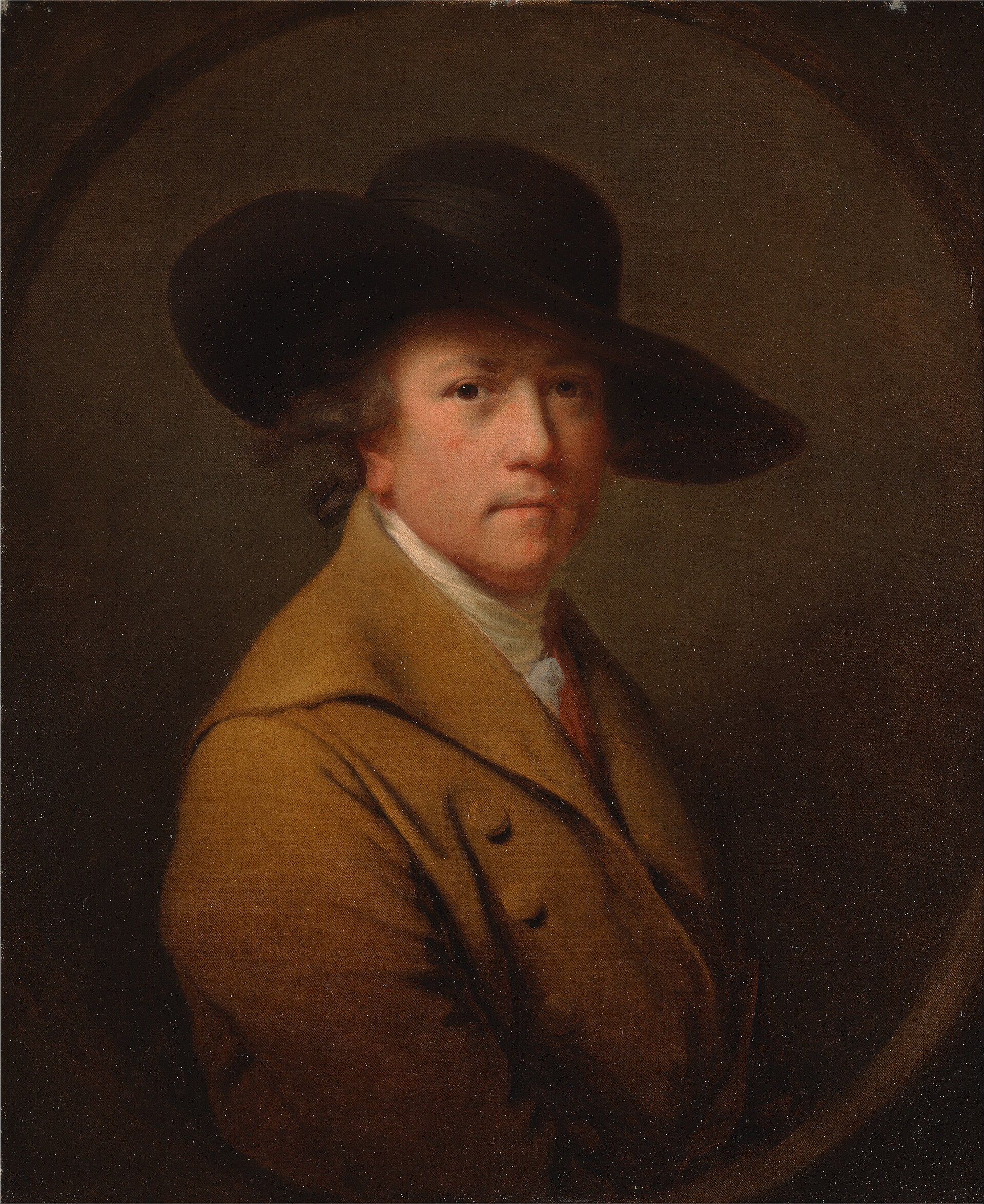
Self-portrait, oil on canvas, about 61 by 73 cm, dated about 1780 in the Yale Center for British Art's record as carried by Google Art Project, in a painted oval with a broad black hat. The sitter is catalogued by the owner as a self-portrait and nothing in the sources opened disputes it; ten self-portraits are counted by the National Heritage Memorial Fund.
Yale Center for British Art, New Haven| Full name | Joseph Wright, styled Wright of Derby |
|---|---|
| Worked as | Painter, Portrait painter, Landscape painter |
| Born | 3 September 1734 · Irongate, Derby, England |
| Died | 29 August 1797 · Queen Street, Derby, England |
| Nationality | English |
| Movement | British Enlightenment painting |
| Sources | 36 cited |
| Last verified |
About this page Last verified · 36 sources cited
On this page 13 sections
ContentsClose
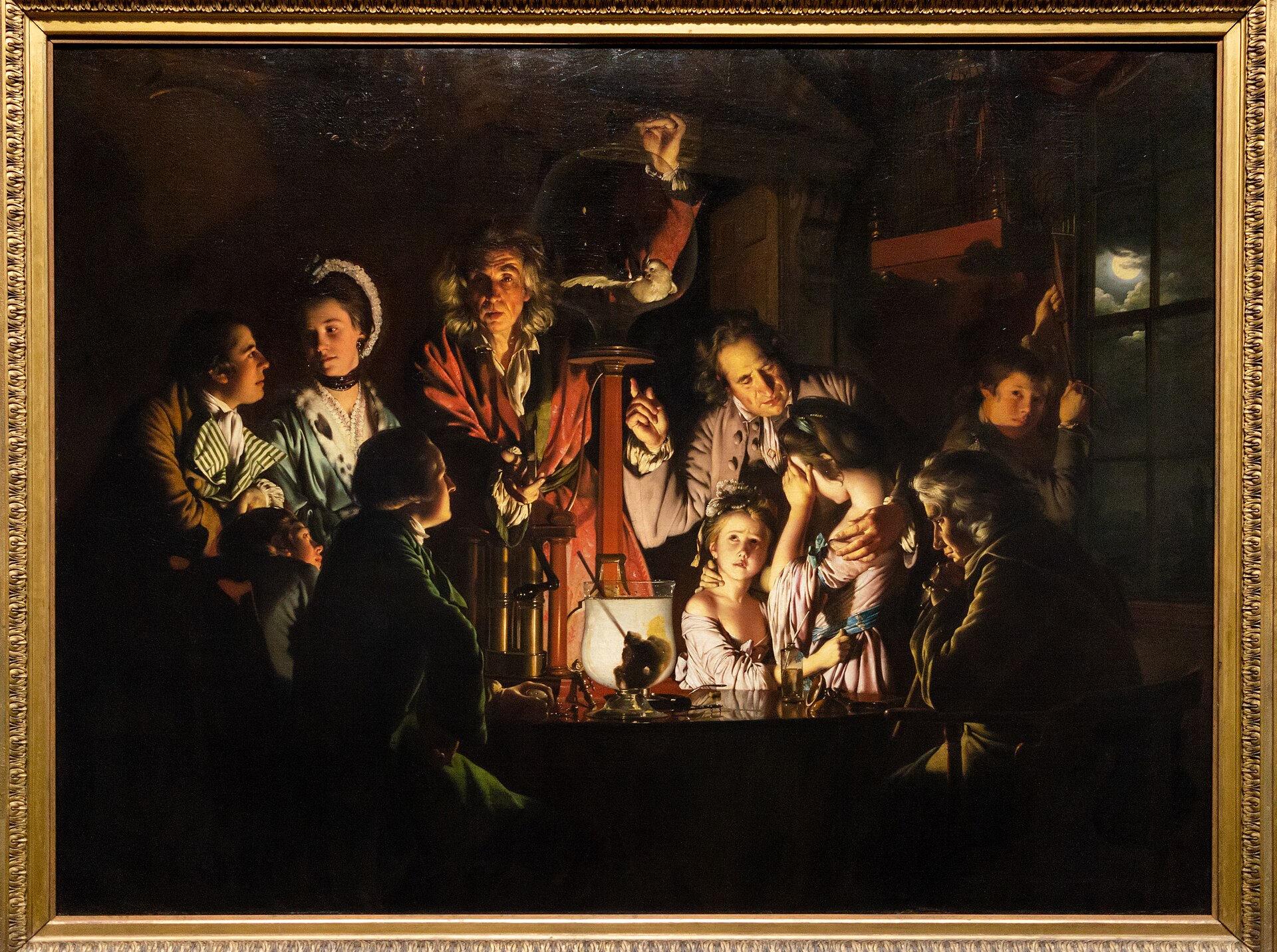
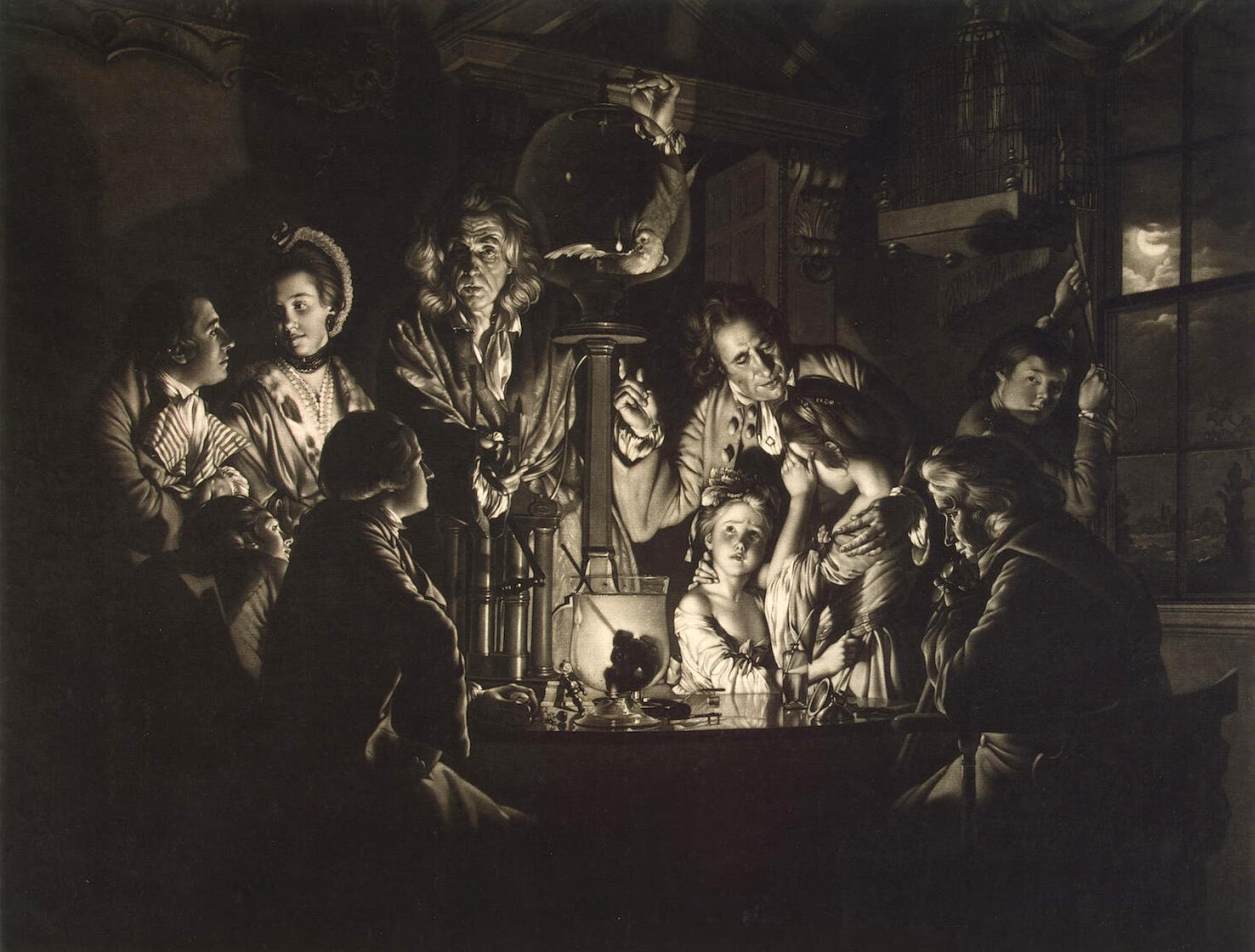
Joseph Wright of Derby is remembered for three pictures of the 1760s in which a scientific lecture is lit by a single hidden candle: a glass in front of the flame, faces lit from below, a room that falls into black a few feet from the table. The best known of them, An Experiment on a Bird in the Air Pump of 1768, hangs in the National Gallery in London. It did not arrive there by purchase. Edward Tyrrell presented it in 1863, nine years after he had offered it at Christie's as the property of a gentleman and the lot was bought in. Wright himself had been paid for it in instalments by a physician, Dr Benjamin Bates, and his own ledger lists it twice, once at 210 pounds and once as paid at 200.
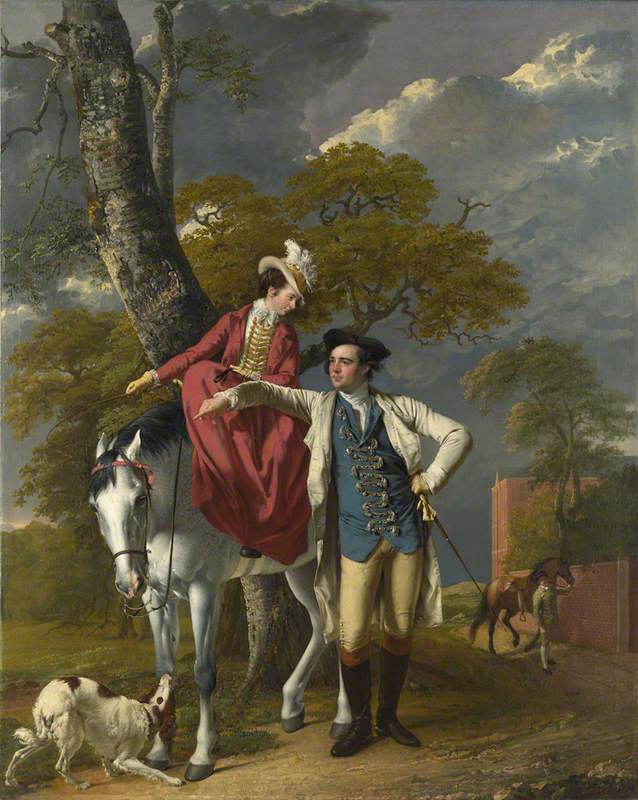
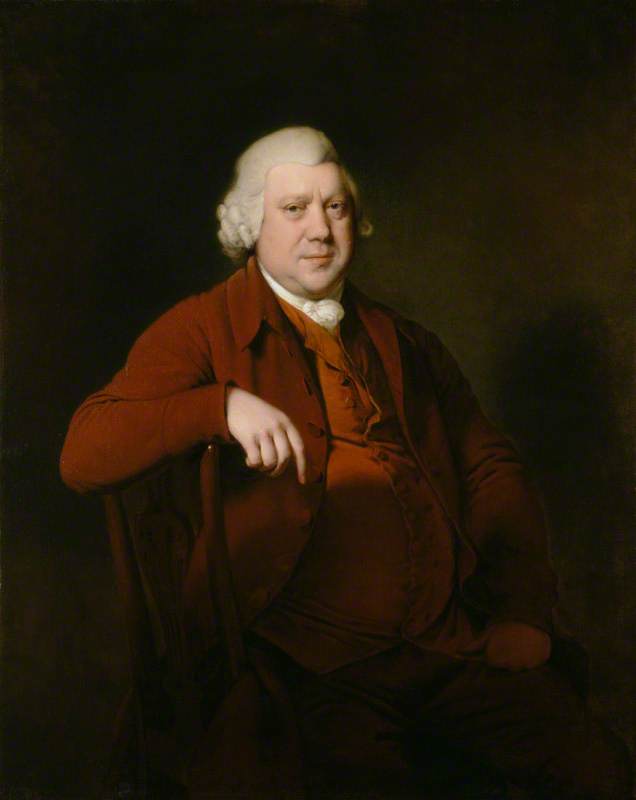
That ledger, the account book Wright kept for much of his working life, is the main source this page uses for what a Wright cost at the time. It records a conversation piece of the Coltmans at 63 pounds, a half length of Sir Richard Arkwright at 26.5 (the unit is not stated), the Gladiator picture at 40 pounds. It also holds his recipes for a priming colour and for the ale-and-rye-flour paste with which he lined canvases. Its entries carry no dates and its pages were rearranged when it was rebound, and Benedict Nicolson, whose 1968 catalogue is still the standard one, misread it: a whole portrait of Arkwright escaped most of the modern literature until the National Portrait Gallery and the Harris Museum bought it in 2008.
The other things the standard account gets wrong are smaller and more repeated. According to the National Gallery's own catalogue Wright was not a member of the Lunar Society, though he was a near neighbour of John Whitehurst and a friend of Erasmus Darwin, both of that circle, and a sale catalogue that says otherwise cites no document. He did not simply reject the Royal Academy: he was elected an associate, declined to become a full academician, and went on sending pictures to its exhibitions. The cockatoo in the Air Pump is, on Egerton's account, a rare bird whose life would never really have been risked in such an experiment, and Wright knew its white plumage would show well in the shadows. There is no total for his output. Nicolson's catalogue numbers run past 300, a revised catalogue by Martin Postle is reported by a dealer as in preparation, and the auction record, 7,263,700 pounds with premium for An Academy by Lamplight in December 2017, belongs to a picture whose present whereabouts the sources opened for this page do not give.
Images
Chronology
- 1734
Born 3 September at 28 Irongate, Derby, third and youngest son of John Wright, an attorney known as Equity Wright.6
- 1751
Sent to London at sixteen or seventeen to study two years under the portraitist Thomas Hudson, then returned to Derby to paint portraits.619
- 1756
Went back to Hudson for about fifteen months; by 1757 he was settled in Derby.628
- c. 1760-2
Painted A Girl reading a Letter by Candlelight, which Egerton calls probably the first of the candlelight series.2
- 1765
First picture shown in London, Three Persons viewing the Gladiator by Candlelight, at the Society of Artists; Dr Benjamin Bates paid 40 pounds for it.2
- 1766
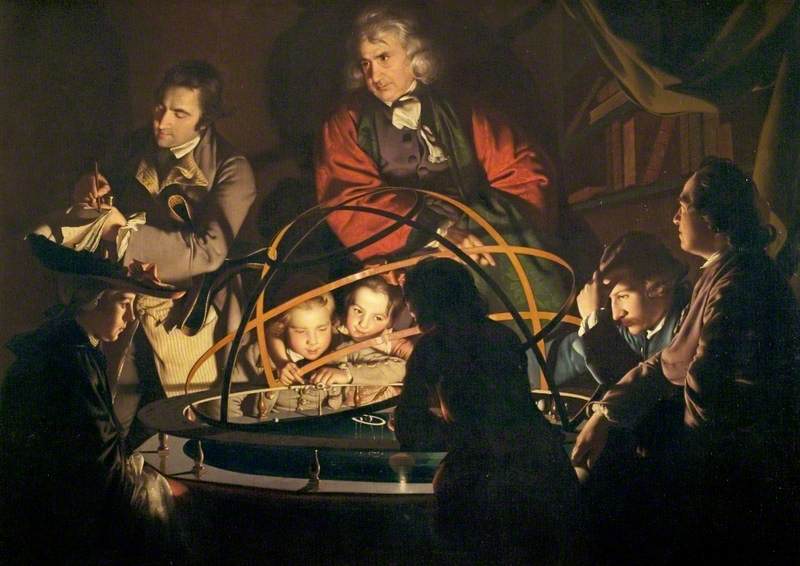
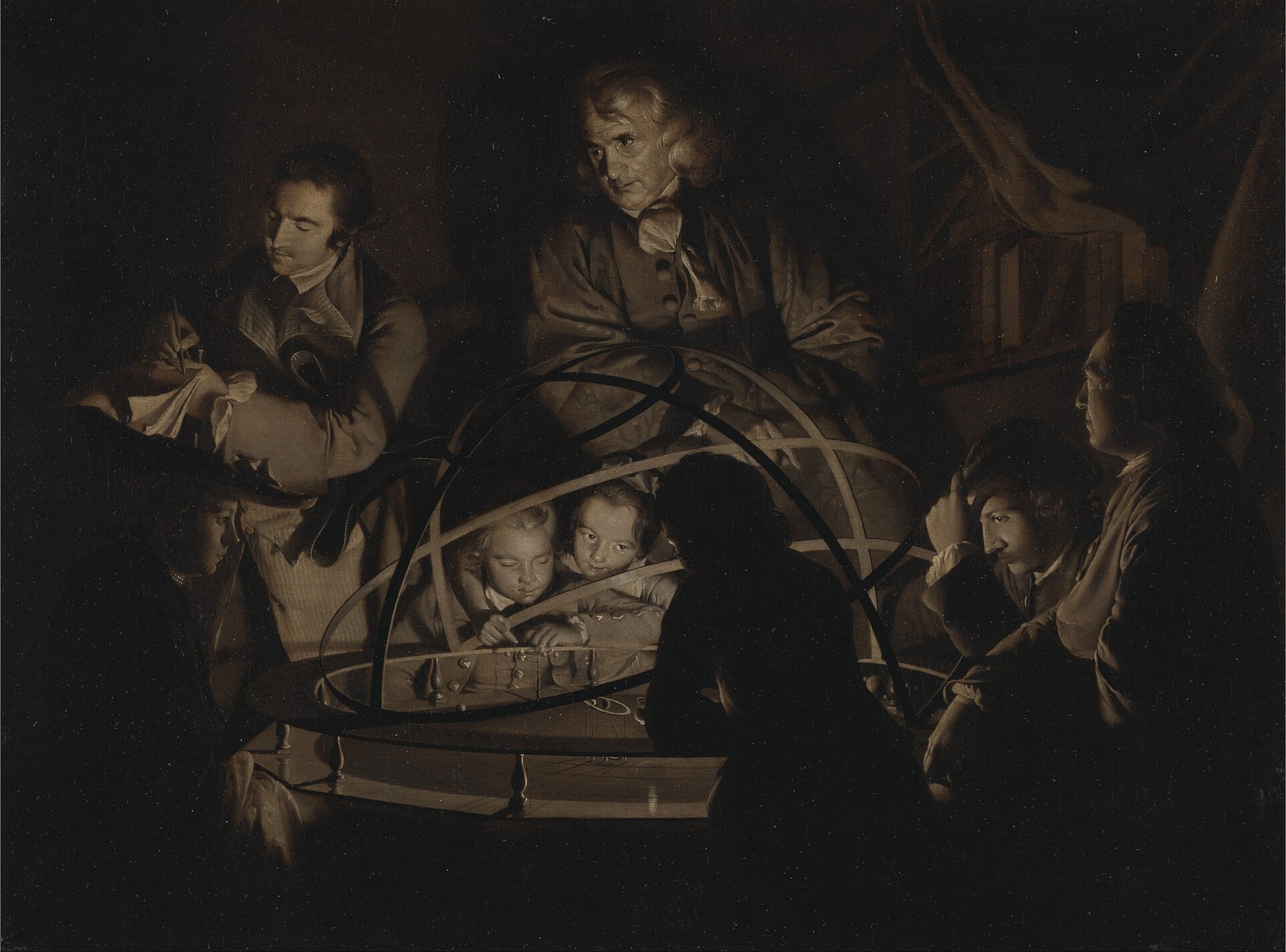
Exhibited A Philosopher giving that Lecture on the Orrery, in which a Lamp is put in place of the Sun; the original was in the collection of Earl Ferrers.230
- 1768
An Experiment on a Bird in the Air Pump shown at the Society of Artists in the spring (no. 193) and again in September at the special exhibition for the King of Denmark; the Gazetteer called him a very great and uncommon genius in a peculiar way.2
- 1768-1771
Worked in Liverpool painting portraits; the name Wright of Derby is said to have fixed itself in this period to distinguish him from a painter of the same name.2831
- 1769
Coltman and Mary Barlow married in October; Valentine Green's mezzotint of the Air Pump was shown at the Society of Artists and the plate bought by Boydell, who sold it at fifteen shillings; Wright showed An Academy by Lamplight.328
- 1771
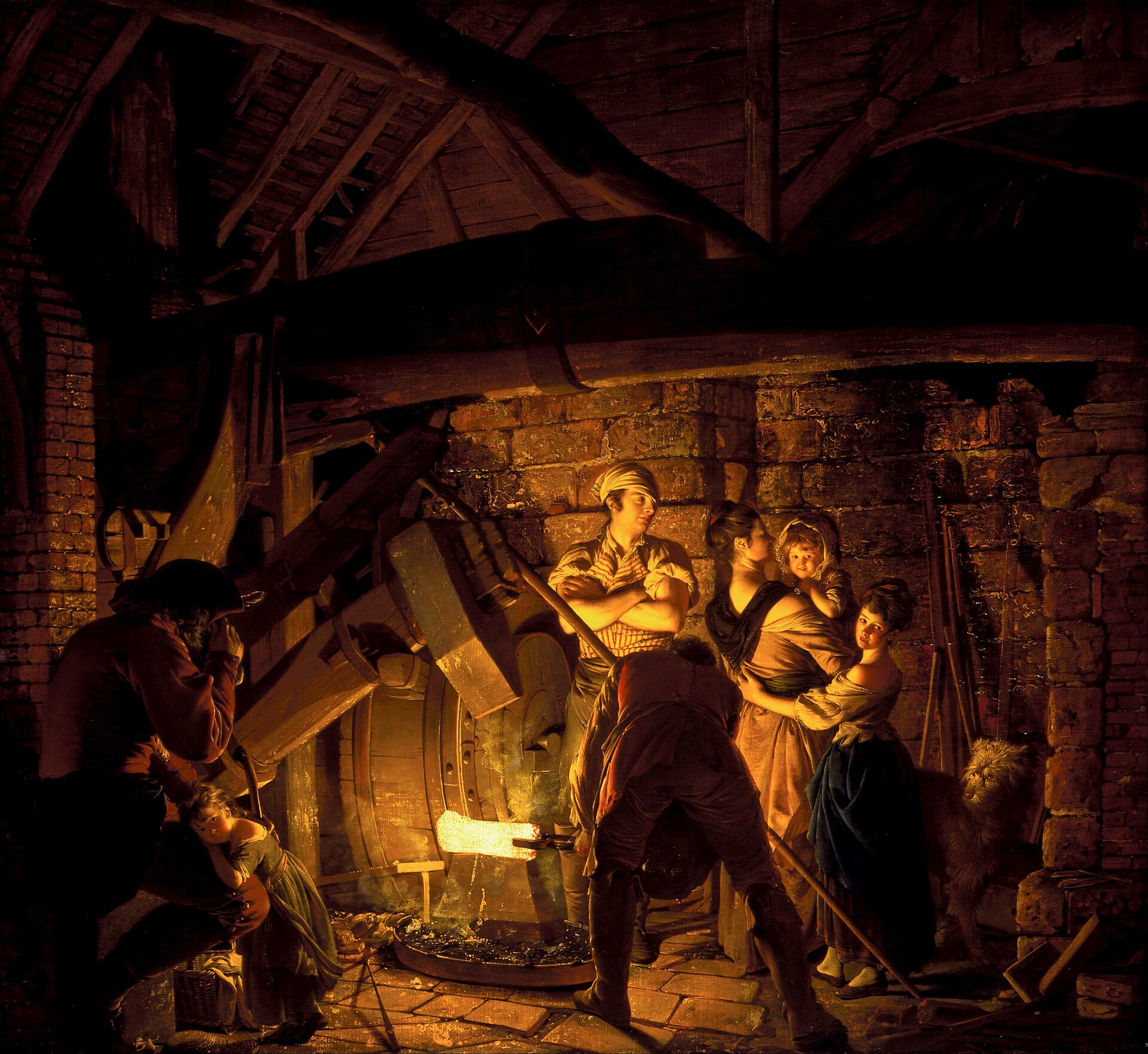
Exhibited The Alchymist in Search of the Philosopher's Stone, whose title refers to the custom of the ancient chymical astrologers. The Yale version of the Blacksmith's Shop was shown the same year.68
- 1772
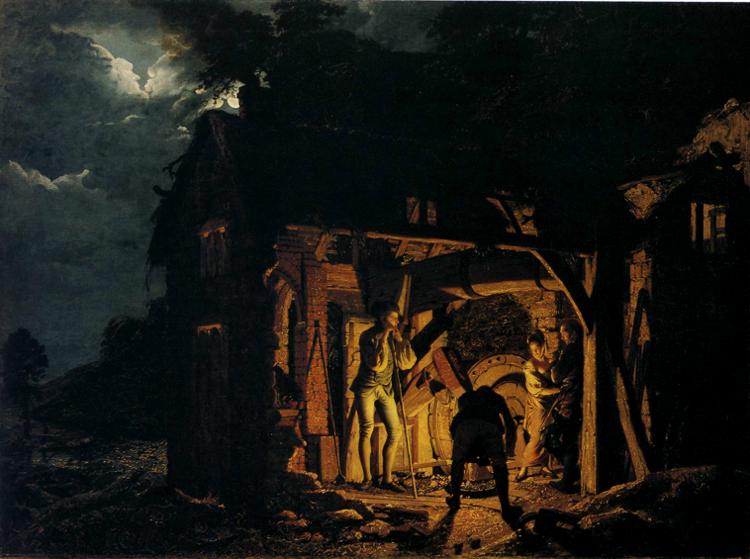
Exhibited An Iron Forge, bought by Lord Palmerston; a second view from without followed in 1773 and went to Catherine the Great.8
- 1773
Married Ann Swift on 28 July and left for Italy in November with his wife and Mr Hurleston.316
- 1774
Reached Rome by February according to Sotheby's, staying seven months before Naples; Art Fund says nine months in Rome.819
- 1775
Back in Derby on 26 September, then tried Bath without success.6
- 1777
Returned to Derby for the rest of his life.6
- 1778
Began exhibiting at the Royal Academy, showing Italian eruptions, grottoes and two literary figures.6
- 1781
Elected an associate of the Royal Academy (Chalmers says 1782).67
- 1783
Erasmus Darwin moved from Lichfield to Derby.2
- 1784
Declined election as full academician for reasons Monkhouse calls not precisely known.6
- 1785
Held his own exhibition at Robins's rooms in Covent Garden; A View of Gibraltar sold there to J. Milnes for 420 pounds, his largest single price.6
- 1787
Gave Josiah Wedgwood a View of Dovedale inscribed to the Patron and Encourager of living Artists.26
- 1789-1790
Painted the full-length Arkwright: a letter from Wright to Richard Arkwright junior dates its completion to 1790, with sittings listed the year before; a copy for Jedediah Strutt was finished in January 1790.18
- 1790
His wife Ann died on 17 August aged 41.6
- 1794
Art Fund reports a mild stroke; he also complained that year of his pictures being placed on the floor at the Academy.196
- 1797
Died 29 August in Derby and was buried on 1 September in St Alkmund's Church.6
- 1854
Edward Tyrrell offered the Air Pump at Christie's on 8 July as the property of a gentleman, lot 163, and bought it in.2
- 1863
Tyrrell presented the Air Pump to the National Gallery.1
- 1883
Derby Corporation Art Gallery showed about sixty of his portraits, the nearest thing to a full study of that side of his work then available.6
- 1885
William Bemrose published The Life and Works of Joseph Wright, A.R.A.6
- 1912-1947
The Air Pump was on long loan to Derby Art Gallery, transferred to the Tate in 1929 and at the Tate 1947-71 and 1972-86; it was cleaned in 1974.2
- 1968
Nicolson's two-volume catalogue Painter of Light published.229
- 1984
The Coltman double portrait sold at Christie's on 23 November, lot 94, bought by Agnew's for the National Gallery for 1,419,600 pounds including premium and VAT.34
- 1990
Egerton's exhibition at the Tate, the Grand Palais and the Metropolitan Museum, with Rica Jones's essay on his techniques.223
- 2008
The National Portrait Gallery and the Harris Museum bought the mid-1780s Arkwright half length, entered in the account book and overlooked after a misreading by Nicolson.16
- 2009
Elizabeth Barker's Documents Relating to Joseph Wright of Derby published in the Walpole Society volume.27
- 2017
An Academy by Lamplight made 7,263,700 pounds with premium at Sotheby's London on 6 December, the artist's auction record.89
- 2018
Export bar placed on the Academy on 1 May; it lapsed in July without a UK buyer.1211
- 2019
Two Boys with a Bladder, bought by the Getty at Maastricht in March, was placed under an export bar on 17 October at a valuation of 3.5 million pounds plus VAT; the licence was granted in January 2020.1314
- 2022
Derby unveiled Self-Portrait at the Age of About Forty, bought through Acceptance in Lieu with a 2,271,621 pound grant; its reverse carries the first oil idea for the Air Pump.15
- 2025-2026
Wright of Derby: From the Shadows at the National Gallery, 7 November 2025 to 10 May 2026, organised with Derby Museums, which the press release says will then travel to Derby Museum and Art Gallery in 2026 (the cited pages give no Derby dates; other listings differ by a day on the opening).201
The market
The record is 7,263,700 pounds including premium for An Academy by Lamplight at Sotheby's London on 6 December 2017, reported by one dealer as a hammer of 6.3 million; the previous record, per Country Life, was 7,208,000 dollars paid for the full-length Portrait of Robert Shore Milnes at Sotheby's New York in January 2007. Sotheby's publishes only the premium-inclusive figures, so no hammer has been confirmed from the house. The export valuation for Two Boys with a Bladder, 3.5 million pounds plus VAT in 2019, and the 1984 Coltman price of 1,419,600 pounds with premium and VAT give two further reference points for candlelight and portrait pictures. Public purchases carry tax and grant relief: the 2022 self-portrait came by Acceptance in Lieu at a special price that is not published.
The ledger prices are the price history that matters most for the first buyers: 40 pounds for the Gladiator, 200 for the Air Pump, 63 for the Coltman conversation piece and about 26 for the Arkwright half length, then in his Derby years 50 guineas for a full-length and 90 to 120 guineas for a conversation piece. An air pump itself cost 21 pounds in 1757. No decade-by-decade series of Wright auction results was obtained from a price database, and the page does not supply one.
| Date | Sale | Work | Result | Note |
|---|---|---|---|---|
| 23 November 1984 | Christie's, London | Mr and Mrs Thomas Coltman | Hammer Not found in sources opened With premium 1,419,600 including premium and VAT GBP | Lot 94, bought by Agnew's for the National Gallery; National Heritage Memorial Fund grant 400,000 pounds, plus the Pilgrim Trust. |
| 2007-01 | Sotheby's, New York | Portrait of Robert Shore Milnes (full length) | Hammer Not found in sources opened With premium 7,208,000 as reported; basis not stated USD | The artist's record until 2017 according to Country Life; whether the figure includes premium was not stated. |
| 6 December 2017 | Sotheby's, London (Old Masters Evening Sale, lot 11) | An Academy by Lamplight (1769) | Hammer About 6,300,000 as reported by a dealer; not confirmed by Sotheby's With premium 7,263,700 including fees GBP | Estimate 2.5 to 3.5 million; three bidders at the end and an overseas buyer; the artist's record. |
| 1 May 2018 | Export deferral (Reviewing Committee), not a sale | An Academy by Lamplight (1769) | Hammer Not applicable With premium 7,456,440 recommended matching price GBP | Deferral to 31 July 2018, extendable to 31 January 2019; the bar lapsed without a UK buyer. |
Hammer is the price at which the bidding stopped; with premium adds the fee the house charges the buyer on top. Hammer price and buyer's premium in the glossary.
Recorded without a public price
- 1765 · Three Persons viewing the Gladiator by Candlelight · Private sale to Dr Benjamin Bates · Not an auction 40 pounds, from the account book as cited by Egerton.
- 1768 · An Experiment on a Bird in the Air Pump · Private sale to Dr Benjamin Bates · Not an auction Listed at 210 and as paid at 200, in instalments, per the account book as cited by Egerton; Art Fund says it sold for much less than its 200 pound asking price, without a source.
- c. 1770-72 · Mr and Mrs Thomas Coltman · Private commission, Thomas Coltman · Not an auction 63 pounds in the account book, within a recorded payment of 100 pounds that may also have covered two candlelight pictures.
- 1785 · A View of Gibraltar during the Destruction of the Spanish Floating Batteries · Wright's own exhibition, Robins's rooms, Covent Garden · Not an auction Sold to J. Milnes for 420 pounds, the largest price Wright received for a single picture, per Monkhouse.
- 8 July 1854 · An Experiment on a Bird in the Air Pump · Christie's, London · Bought in; no price recorded Lot 163, offered as the property of a gentleman by Edward Tyrrell; presented to the National Gallery in 1863.
- 2008 · Sir Richard Arkwright, half length (mid-1780s) · Private treaty, through Philip Mould Ltd · Not an auction 420,000 pounds raised in total by the National Portrait Gallery and the Harris Museum, with Art Fund, the National Heritage Memorial Fund and others.
- 2019-03 · Two Boys with a Bladder · Private sale at TEFAF Maastricht (Lowell Libson and Jonny Yarker to the Getty) · Not an auction The export valuation was 3,500,000 plus VAT in October 2019; the sale price was not published.
- 2022-05 · Self-Portrait at the Age of About Forty · Acceptance in Lieu to Derby Museums · Not an auction Special price not published; National Heritage Memorial Fund grant 2,271,621, plus Art Fund and private donors.
Where to see the work
| Institution | City | Holdings | Note |
|---|---|---|---|
| Derby Museum and Art Gallery (Derby Museums) | Derby | A Philosopher giving that Lecture on the Orrery, the 1795 Alchymist, a Blacksmith's Shop, Arkwright's Cotton Mills by Day, Self-Portrait at the Age of About Forty (2022), the full-length Arkwright on loan and the largest Wright collection anywhere, with a study room for drawings and archive material. | Joseph Wright Gallery. The National Gallery's press release says its exhibition would travel here in 2026; check the displays and dates now. |
| The National Gallery | London | An Experiment on a Bird in the Air Pump (NG725) and Mr and Mrs Thomas Coltman (NG6496). | Both are listed in Room 34 on the Gallery's pages. |
| Tate Britain | London | An Iron Forge (1772, Tate acquisition 1992 per Art Fund), Vesuvius in Eruption, with a View over the Islands in the Bay of Naples (T05846, acquired 1990 per Art Fund) and Sir Brooke Boothby (1781). | Display changes; confirm before travelling. |
| Yale Center for British Art | New Haven | The second version of An Academy by Lamplight, the Blacksmith's Shop of 1771, a monochrome oil Orrery of about 1768 and a self-portrait of about 1780. | The Academy and the Blacksmith's Shop were bought from Wright by Peniston Lamb, according to Sotheby's. |
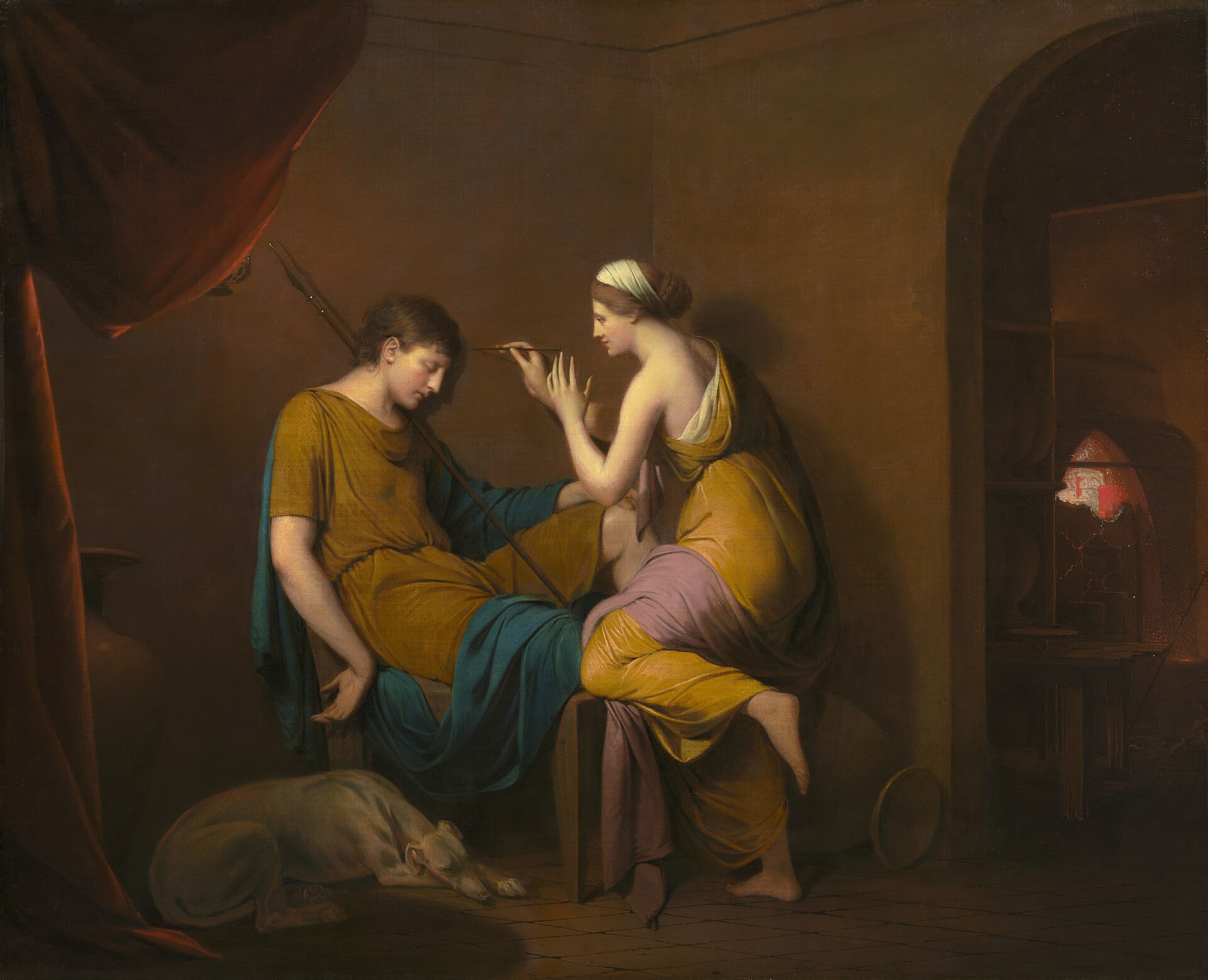
| National Gallery of Art | Washington | The Corinthian Maid (1983.1.46), painted for Josiah Wedgwood. | Gift of Paul Mellon, 1983. |
| National Portrait Gallery and Harris Museum and Art Gallery | London and Preston | Sir Richard Arkwright, half length, NPG 6848, owned jointly and alternating between the two. | Bought in 2008. |
| V&A Wedgwood Collection, World of Wedgwood | Barlaston | View of Dovedale (1787), inscribed as Wright's gift to Wedgwood. | Acquired with Art Fund and a public appeal. |
| J. Paul Getty Museum | Los Angeles | Two Boys with a Bladder (bought 2019) and two other Wrights, one of which the Commons record dates to Penelope Unravelling Her Web by Candlelight (1783-4). | Not confirmed from the Getty's own page. |
| The Hermitage Museum | Saint Petersburg | An Iron Forge viewed from without (1773), bought by Catherine the Great according to Sotheby's. | Display status not checked. |
Forgeries and misattributions
- No forgery case recorded
- None of the sources opened reports a forgery scandal or a dealer prosecution connected with Wright. What the record does show is copies, replicas, repainting and a handful of attribution reversals, listed below. Not applicable.2918
- The Colosseum by Night (Derby)
- A picture in Derby's collection, whose authorship the Derby Telegraph reported as doubted, was the subject of a 15,000 pound grant in 2015 to decide whether it is by Wright. Bendor Grosvenor, looking at high-resolution images, thought the figure in the window and the foliage and sky at top left convincing, and the rest savagely overpainted in the 1960s or 1970s; the curator reported a tip-off that the same restorer sanded originals down to a smooth surface. The outcome of the grant was not found.32
- Self-portrait given to Thomas Gisborne, 1793
- A picture catalogued at auction as follower of Joshua Reynolds was identified in 2017 as a genuine self-portrait; Wright's gift of it to Gisborne was recorded, and it was known from a copy with a Latin inscription in the Crompton-Inglefield collection. The dealer's account is that a gift is recorded in 1793 and that the copy reflects an original now found; this is a magazine report of the dealer's announcement and no scholarly publication was seen.33
- Cut through the Rock at Cromford (Agnes Etherington Art Centre)
- A genuine Wright painted on a fragment of an older picture, with a staffage group by another hand left in place. Radiography and cross-section study showed the support was a cut fragment already degraded before Wright used it; the authors argue Wright lined it himself with his own paste recipe.23
- Anna Romana Wright reading by candlelight (National Gallery of Victoria)
- A genuine portrait of his daughter over an earlier portrait signed H: Vander Myn, which Wright left visible. Radiography revealed the earlier head and the signature was found later.24
- Replicas and pictures catalogued after Wright
- Autograph replicas of the Arkwright portrait exist in the 30 by 25 inch format, for Jedediah Strutt, the Arkwright family and a rival; Derby catalogues other pictures as after Wright (accessions 1931-329 and 1919-768, from their Commons titles). Egerton recognised the replicas by 1990, replacing Nicolson's count of two autograph portraits.18
The essay
Chapter 1The Air Pump came to the National Gallery as a gift, and the price was paid in instalments
The usual line, repeated in the brief for this page, is that the National Gallery bought the Air Pump in 1863.
The usual line, repeated in the brief for this page, is that the National Gallery bought the Air Pump in 1863. The Gallery's own record says otherwise: the acquisition credit is Presented by Edward Tyrrell, 1863, and the provenance runs Wright to Dr Benjamin Bates, then Walter Tyrrell, then Edward Tyrrell, who offered it at Christie's on 8 July 1854 as the property of a gentleman, lot 163, and it was bought in. Nine years later he gave it to the nation. The Gallery then converted a nineteenth-century frame to fit it, a frame carved and gilded by the Wardour Street framers Messrs Wright for a reproduction series after Veronese, Van Dyck and Rubens.
Judy Egerton's 2000 catalogue entry for the Gallery gives the first money. Wright's account book lists the picture twice under the heading Candlelight pictures, on page 35, once as The Air Pump at 210 and again, now marked paid, as The Air Pump Pd 200, with a separate note that Dr Bates paid for it in instalments. Bates was a physician of Little Missenden in Buckinghamshire and a friend of Erasmus Darwin. He had already paid 40 pounds in 1765 for Three Persons viewing the Gladiator by Candlelight, and he is also recorded as owning a Wright picture of Galen about which nothing is now known. So the buyer of the most famous scientific picture of the century was a country physician who took a long time to pay for it.
The story has a competing version. Art Fund's 2026 feature says the picture was painted on spec, drew no interest at the asking price of 200 pounds and was sold for much less on condition that Wright could state the original amount on the receipt. The Gallery's catalogue, which reads the ledger, gives 200 paid. The two cannot both be right as stated, and the feature gives no source for its version.
Chapter 2Not a Lunar Society man, though he painted and sold to its circle
Wright's name is attached to the Lunar Society of Birmingham so often that it is worth separating what is documented from what is repeated.
Wright's name is attached to the Lunar Society of Birmingham so often that it is worth separating what is documented from what is repeated. Egerton's catalogue states that he was not himself a member. His closest contacts were his neighbour in Derby, John Whitehurst FRS, maker of clocks, barometers and other instruments, and Erasmus Darwin, who moved from Lichfield to Derby in 1783. Art Fund's 2026 feature says he was associated with the Society but never joined. Wikipedia says he was not a formal member. The Sotheby's catalogue of 2017 goes the other way and lists him among the more peripheral members, beside Benjamin Franklin and Joseph Banks, and calls the Society the core of his art. That is a sale-room position, offered to explain a price, and it rests on no document the catalogue cites.
The documented links are individual and commercial. Darwin sat to him, first about 1770 (the portrait Birmingham Museums bought in 2013) and again in 1792 (acquired by Derby in 1955), according to Art Fund, and Wikipedia says Darwin treated Wright's asthma and nervous complaints. Whitehurst sat to him; Egerton cites the portraits of Darwin and Whitehurst in her 1990 catalogue. Bates, the buyer of the Gladiator and the Air Pump, was Darwin's friend. For Josiah Wedgwood the National Gallery of Art in Washington records that The Corinthian Maid was painted for him at Etruria, and the Victoria and Albert Museum holds a View of Dovedale inscribed by the artist as the gift of Josh Wright to his friend Jos Wedgwood Esq, The Patron and Encourager of living Artists, 1787. A gift is evidence of friendship and perhaps of a debt, not of a purchase. No price for any Wedgwood picture was found in the sources opened.
Richard Arkwright is the best documented industrial patron, and the evidence is of two kinds. There are portraits, discussed below, and there are the mill pictures: Art Fund records Arkwright's Cotton Mills, by Day (1795-96) as acquired by Derby in 2016. Matthew Boulton is a name the brief asked about and the sources opened give no portrait of him by Wright and no purchase by him. The Air Pump did go to Birmingham in 2009 for an exhibition on Boulton, but that is a loan, not a link.
Chapter 3The cockatoo and the sitters in the Air Pump
Two claims about the Air Pump are repeated more often than they are checked.
Two claims about the Air Pump are repeated more often than they are checked. The first is that the couple on the left are Thomas Coltman and Mary Barlow. The National Gallery's website states it flatly. Egerton, whose catalogue the website draws on, writes that a long tradition identifies them, which is a weaker form: both were living in Derby, both were friends of the artist, they married in 1769 and sat to Wright for the double portrait now NG6496. Nothing sourced identifies anyone else in the room, and Egerton adds that who is who hardly matters beside the fact that the audience mixes ages and men and women. The Gallery says Wright often used relatives or friends as models.
The second is the bird. The creature in the glass is a white cockatoo, and Egerton calls it a rare bird in the Midlands of the 1760s, whose life would never in reality have been risked in such an experiment. Wright had already painted a white cockatoo in his portrait of Mr and Mrs William Chase, about 1762-3, and knew its white plumage was what he needed against the shadows. His first oil idea for the picture, painted on the back of a self-portrait, shows the apparatus at the side and a common songbird in the receiver, a lark or a thrush, which is what lecturers used.
Whether the bird lives is not settled. A boy at the window holds the cords of a cage and waits for his cue. Egerton notes that Valentine Green, in his mezzotint, indicated with a few strokes a just perceptible return of air into the receiver, presumably with Wright's sanction.
Chapter 4Where the candlelight came from, and what the pictures were arguing
Wright did not invent the candlelit picture and the catalogue says so at length.
Wright did not invent the candlelit picture and the catalogue says so at length. Italian, Dutch, Netherlandish and French painters had all used candlelight, and Nicolson argued for affinities with the Utrecht School, though Egerton notes that Wright can have known only what had been engraved or was in English collections by then, and that the candlelight painter he is most likely to have seen at first hand is Godfried Schalcken. The contemporary Nicolson thought certain to have influenced him is Thomas Frye, the portraitist and Bow porcelain co-founder whose large mezzotint Heads of 1760-1 were sold in print shops. Nicolson set Frye's engravings beside Wright's figures to show that the young draughtsman in An Academy by Lamplight and the boy peering up in the Air Pump both derive from one Frye head, and Michael Wynne showed that the old man in the Air Pump is closely derived from a Frye pastel. Wright did not travel abroad until 1773.
The Air Pump is the last of a series. Egerton dates the first, A Girl reading a Letter by Candlelight, to about 1760-2, then the Gladiator exhibited at the Society of Artists in 1765, the Orrery of 1766 and the Air Pump of 1768. Monkhouse's Dictionary of National Biography entry counts thirty-one pictures exhibited between 1765 and 1773, more than half candlelight or firelight scenes, four of them forges. The Orrery's full title as exhibited, A Philosopher giving that Lecture on the Orrery, in which a Lamp is put in place of the Sun, is a documented fact and so is the title of the 1771 Alchymist, which says it shows the alchemist discovering phosphorus and praying for the success of his operation, as was the custom of the ancient Chymical Astrologers.
Beyond what the titles say, the readings are argued by named scholars and should be read as theirs. The Gallery calls the skull and candle emblems of mortality, and Egerton, following William Schupbach (1987), says the skull in the large glass in front of the hidden candle went unrecognised as a skull for two centuries; she adds that if Wright meant a vanitas he strangely underplayed it. Werner Busch, in a 1986 book, compared the central group of lecturer, bird and pointing man to the early Netherlandish type of the Holy Trinity, a comparison Egerton reports and does not adopt. David Solkin's 1992 essay, known here only from its title in the Gallery's bibliography, ReWrighting Shaftesbury: The Air Pump and the Limits of Commercial Humanism, reads the picture against Shaftesbury and commercial humanism. Egerton thinks Richard Savage's poem The Wanderer, which describes a creature in an engine reviving when the air returns, may have partly inspired the choice of a living creature, and that is a suggestion not a document. The National Gallery's 2025 press release, for an exhibition organised with Derby Museums, says the show challenges the traditional view of Wright as a figurehead of the Enlightenment and presents him as exploring death, melancholy, morality, scepticism and the sublime. Flaubert, who saw the picture in London in 1865-6, wrote in his notebook of two lovers in a corner and called it charming in its naivety and depth: a reader's reaction, recorded, and no more.
What the evidence does not show is a hidden programme. Wright took subjects from near-contemporary verse, from Sterne, Beattie, Langhorne, Milton and Shakespeare, encouraged, Egerton says, by his friend and patron the poet William Hayley, and the candlelight pictures sit within an ordinary Georgian taste for lectures, instruments and the pleasures of science. The Orrery's audience is seven people of different ages and levels of knowledge listening to a philosopher, a word then used of anyone learned in a science, at a time when lectures on the orrery were increasingly popular. Egerton's view is that Wright's purpose was to celebrate a new appetite for learning, not to depict a novel experiment.
Chapter 5What Wright was paid, and what that money bought
The ledger prices that survive are modest.
The ledger prices that survive are modest. A neat double barrel air pump with all the usual apparatus cost William Constable of Burton Constable 21 pounds from the Fleet Street instrument maker Benjamin Cole in 1757, according to the receipt exhibited at Hull in 1970 and cited by Egerton, so Wright's Air Pump was priced at roughly ten such machines. Bates paid 40 pounds for the Gladiator and 200 for the Air Pump. Thomas Coltman paid 63 pounds for the double portrait, entered as Mr and Mrs Coltman a Conversation, with a note that suggests his payment of 100 pounds covered the portrait and the balance for other pictures, perhaps his two candlelight pictures, A Girl Reading a Letter with an old Man reading over her Shoulder and Two Boys Fighting over a Bladder. The half-length Arkwright is listed as 26.5; the National Heritage Memorial Fund's quotation of the entry gives no unit, so whether that means 26 pounds 5 shillings or 26 pounds 10 shillings is not settled here. These figures are in pounds sterling of the 1760s and 1780s and the sources do not supply a method for converting them.
Monkhouse, writing in 1900 for the Dictionary of National Biography, gives the later rates: once Wright was settled again in Derby he raised his prices to fifty guineas for a full-length and ninety and a hundred and twenty guineas for a conversation piece. The largest sum he ever received for a single picture, Monkhouse says, was 420 pounds from J. Milnes for A View of Gibraltar during the Destruction of the Spanish Floating Batteries, shown at his own exhibition in 1785. The engraver Heath paid 105 pounds for The Dead Soldier before engraving it, and, Monkhouse says, made a large profit. Boydell offered 300 pounds for Prospero's Cell. Wright thought he deserved as much as any artist on the Shakespeare Gallery, and the picture was sold again in 1805 for 69 pounds 6 shillings. Art Fund adds that Boydell commissioned Romeo and Juliet, the Tomb Scene, then refused to pay after a dispute, and that the picture was still in Wright's studio when he died.
The picture of prosperity is not uniform. Chalmers's 1812 biographical dictionary says Wright's pecuniary circumstances were always affluent and that his pictures were bought from the easel by amateurs. Art Fund's 2026 feature says he struggled to turn high praise into high prices. The ledger figures do not settle it, since a patron's payment of 63 or 200 pounds is a good price for a provincial portraitist and not a fortune.
Chapter 6The account book: undated, rearranged, misread, and held at the National Portrait Gallery
The account book is the foundational document and the places that cite it do not agree on where it is.
The account book is the foundational document and the places that cite it do not agree on where it is. Egerton's 2000 catalogue note describes it as in the collection of Derby Art Gallery. The Allen Memorial Art Museum at Oberlin says Wright kept an account book, London, National Portrait Gallery, recording pictures, patrons and prices. The 1995 conservation paper by Hodkinson and Child, which reproduces two of its pages, credits them to the National Portrait Gallery and cites the volume as Wright's Sitters Book in the Gallery's Library and Archives. Two sources against one put the volume in London; the Derby statement in a catalogue published in 2000 is unreconciled with them. The Archives Hub entry that would give the reference could not be opened for this page.
Hodkinson and Child add what makes the book hard to use. Nicolson called it the Account Book because it lists landscapes as well as portraits, prices, bills paid and monies received. It is more than that: it also carries working instructions, among them The Contents of Ye Pallet and To Line a Picture. The entries have no dates, and the pages seem to have been rearranged when the volume was rebound, probably in the early nineteenth century. That is why the Air Pump appears in it twice, at 210 and at 200 paid, and why a reader needs a transcription that restores an order.
The Walpole Society's page for its 2009 volume describes the one in print: Elizabeth Barker's Documents Relating to Joseph Wright of Derby, in volume 71 of the Society's annual volume, pages 1 to 216, which includes the account book, letters, a fragmentary travel journal and an unpublished memoir of Wright prepared by his niece. The Society called these the foundational materials for the study of Wright, his career and his artistic techniques, and made the article free to its subscribers for a month to coincide with the National Gallery exhibition. The National Gallery cites his niece Hannah for the report that Wright worked with two rooms, one dark with objects and one lit with the door open, so that he could watch the shadows in one and his canvas in the other; the niece's memoir is presumably the source, though that is not confirmed.
The ledger has been misread. The 2008 announcement of the Arkwright portrait says that, due to a misreading of the account book by Nicolson, the picture had been overlooked in most of the modern scholarly literature. The entry is Mr Arkwright half length 26.5, and the picture had been shown in 1867 and last exhibited in 1883. Anyone using Nicolson's catalogue for a price or a sitter should check against Barker's transcription, which the editor of this page could not open.
Chapter 7The ground, the foil, the recipes and the canvases he reused
The most useful technical evidence is a 1995 paper in the Journal of the American Institute for Conservation by Ian Hodkinson and Deborah Child, who examined two small landscapes at Queen's...
The most useful technical evidence is a 1995 paper in the Journal of the American Institute for Conservation by Ian Hodkinson and Deborah Child, who examined two small landscapes at Queen's University in Canada and draw on Rica Jones's work for the 1990 Tate exhibition. Jones examined fifty Wright paintings and cross-sectioned fourteen. The paper reports that of the fifty only two were found to have pink grounds, the 1781 portrait of Brooke Boothby and Cottage on Fire of about 1790 in Derby. Underdrawing was visible on only one of the fifty, View in Matlock Dale. The paper lists as Wright's hallmarks the palette, vigorous textured paint laid with brush and palette knife, lines incised with the butt of the brush in wet paint and subtle glazes. Wright is also recorded covering the clinched ends of stretcher nails with a white lead putty, found in a radiograph.
The account book supplies his own recipes, which the paper prints. To Make the Priming Colour tells the operator to take white lead, black and brown ochre and grind them separately with linseed and drying oil as stiff as possible, laying the paste on with a palette knife. A sample from a filling in one of the Canadian paintings was calcium carbonate and lead white with a little clay and iron oxide in linseed oil, which differs from Wright's recipe by the chalk; the authors note that lead white often came adulterated with chalk, so he need not have listed it. To Make the Paste for lining gives a pint of ale and a pound of rye flour, boiled and beaten until fine and used cold, and the authors found the lining adhesive on the Cromford picture nearly identical in infrared to a paste made to that recipe. The account book also records Wright doing restoration work for others, among them an entry dated 27 April 1789 for three guineas received from Mrs Fox for repairing three pictures for Lord Melbourne.
Two other details bear on how he built a night effect. The 2019 export-bar notice for Two Boys with a Bladder says the painting may have entailed a metallic leaf beneath the bladder to enhance its lustre, which the notice calls an unusual and short-lived technique unique to Wright's works, and The Art Newspaper adds that he experimented with gold and silver foil in the candlelight works, placing it under the paint for a shimmering effect. The National Gallery's note on his working method is the two-room arrangement described above.
What Wright did to a canvas matters for attribution. Cut through the Rock at Cromford is a genuine Wright painted on a fragment cut from an older and already damaged painting by another hand, with a group of figures at the bottom right left in place. The authors raise his 1792 letter to J. L. Philips about cooking up an old sketch as a possible explanation and reject it, because the earlier painting was too degraded before lining to be of Wright's generation. They also state that there is no evidence he employed auxiliaries to paint parts of his pictures. Anna Romana Wright reading by candlelight, about 1795, was painted over a portrait carrying the signature of the Dutch painter Herman Van der Myn, which Wright left in place; the National Gallery of Victoria's conservator Carl Villis notes that Wright appears to have reused old canvases and reworked pictures long after starting them. When a Wright turns up with an odd signature or a second composition underneath, that is a known practice and not evidence against him.
The Air Pump itself, cleaned in 1974, shows many minor alterations through the top layer, particularly in the lecturer and the young assistant on the right, where two tassels or possibly an epaulette are visible; the darker paint has a fine craquelure that exposes the light ground. The Coltman portrait is unlined, so the impasto has not been flattened, and the National Gallery notes that the sky was originally bluer and that the smalt has lost its colour and degraded to grey.
Chapter 8Italy, Vesuvius and a count nobody agrees on
Wright left England in 1773, according to Monkhouse in November, with his wife and a Mr Hurleston, and spent time in Rome copying Michelangelo's frescoes in the Sistine Chapel, in Naples, Florence...
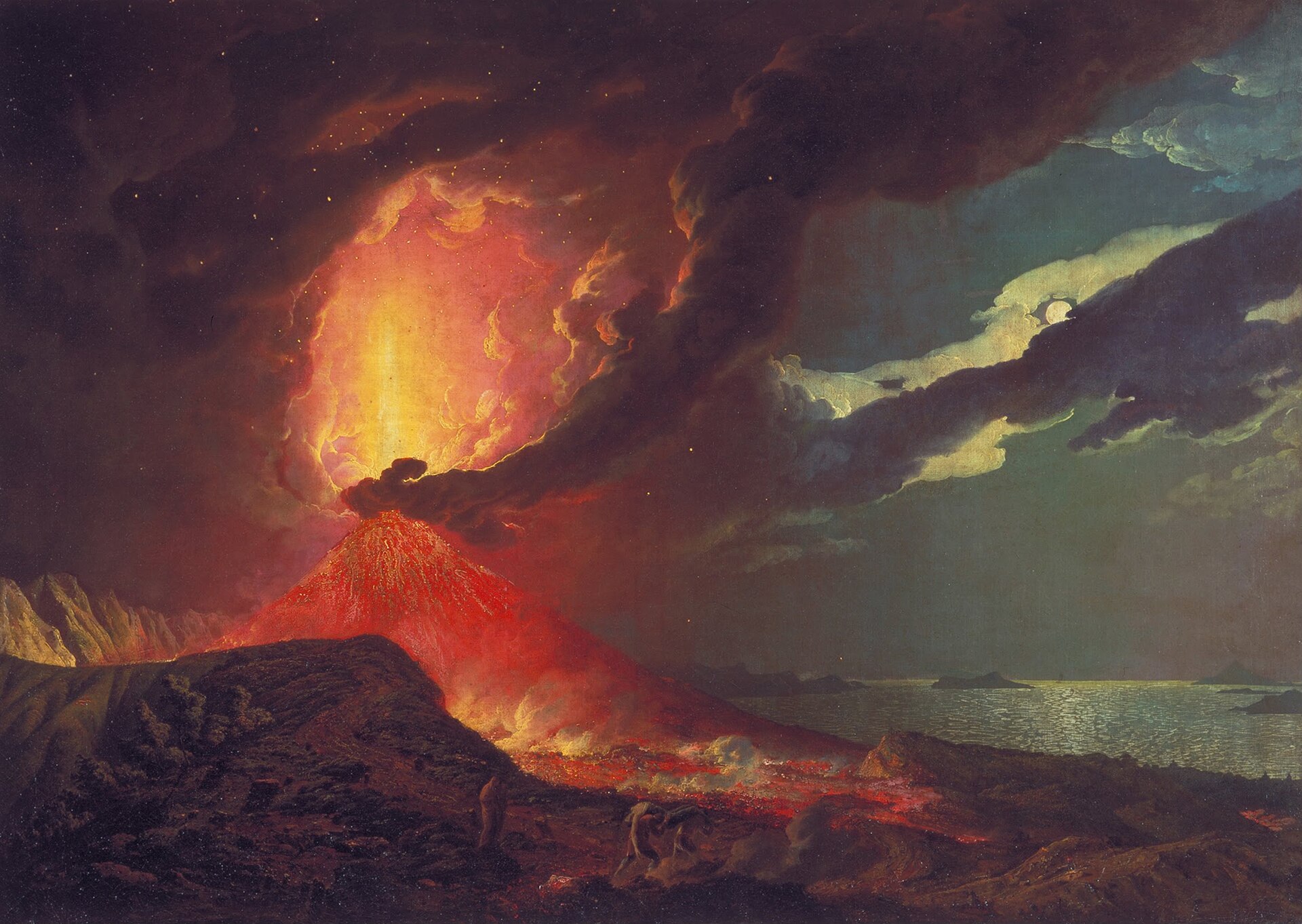
Wright left England in 1773, according to Monkhouse in November, with his wife and a Mr Hurleston, and spent time in Rome copying Michelangelo's frescoes in the Sistine Chapel, in Naples, Florence and Bologna. The Sotheby's 2017 essay names his pupil Richard Hurlstone and the painter John Downman as companions and has them reach Rome in February 1774, staying seven months before Naples; Art Fund says nine months in Rome. He was back in Derby on 26 September 1775, according to Monkhouse. The same 2017 essay lists the paintings that follow the trip: Vesuvius painted at least ten times, grottoes, Virgil's Tomb and the Convent of San Cosimato.
How many Vesuvius pictures there are is not agreed. Monkhouse counts eighteen, the last in 1794. Sotheby's says at least ten. Art Fund says some thirty, and Oberlin more than thirty. Whether Wright ever saw a full eruption is also disputed. Chalmers in 1812 says he saw a very memorable one, and Monkhouse, without saying so in as many words, treats an eruption as the sight that did most to change his art, from candlelight to scenes of conflagration. Art Fund says he never witnessed the volcano in the throes of a full-scale eruption, and Wikipedia, citing Tate, says the same. The Tate's Vesuvius in Eruption, with a View over the Islands in the Bay of Naples, about 1776-80, is the canonical example, acquired by Tate in 1990 per Art Fund.
Who bought the Italian pictures is also contested. Monkhouse says the Eruption of Mount Vesuvius and The Girandola at the Castle of St Angelo shown at the Society of Artists in 1776 were purchased by the empress of Russia for 500 pounds. The Sotheby's essay says Catherine the Great bought An Iron Forge viewed from without, shown in 1773, now in the Hermitage. Both can be true. The essay says the first forge, exhibited in 1772, was bought by Lord Palmerston, and the Tate version is now an Art Fund-supported acquisition of 1992.
He then tried Bath. Monkhouse says the Duchess of Cumberland sat to him, that the full-length she commissioned dwindled to a head, and that he got so few sitters that he felt enemies were at work against him; he left in 1777. Art Fund quotes a letter of 9 February 1776, in which he says a portrait that began as a full length and dwindled to a head cost him much anxiety, and that the great people are so fanciful and whimmy they create a world of trouble.
Chapter 9The Royal Academy: elected, declined, and still exhibiting
The common version is that Wright rejected the Royal Academy.
The common version is that Wright rejected the Royal Academy. The record is more tangled. Monkhouse says he began to exhibit at the Academy in 1778 and showed there every year until 1782, was elected an associate in 1781 and a full academician in 1784, and declined the latter for reasons not precisely known, though he was angry about how his pictures were hung and because the Academy elected Edmund Garvey before him. It is also said, Monkhouse adds, that he resented the rule requiring a member to deposit a picture before receiving a diploma, as Stubbs had done a year or two before. Chalmers, in 1812, gives 1782 for the associate election and says he resigned his diploma offended by Garvey's election, yet continued to exhibit at intervals.
Monkhouse then lists the later visits: Wright sent pictures to the Academy in 1788, 1789, 1790 and 1794, complaining in 1790 about the places given to two large pictures intended for Boydell's Shakespeare and in 1794 that his pictures were placed on the floor and injured by the feet of visitors. In 1783 he sent two pictures to the Free Society of Artists, and in 1785 he held a separate exhibition at Mr Robins's rooms in Covent Garden, which Monkhouse counts as twenty-five pictures and Chalmers as twenty-four. Wikipedia says he severed his official connection but continued to contribute to the exhibitions from 1783 until 1794, which does not fit Monkhouse's gap between 1782 and 1788. On Monkhouse's evidence he turned down a diploma and kept a quarrelsome relationship with the institution, and the sources differ on whether he resigned his associate's diploma (Chalmers) or only declined the full one (Monkhouse), so rejection is too simple a word.
Chapter 10How the pictures travelled: mezzotints and a fame made in print
The National Gallery's 2025 press release says mezzotints played a key role in establishing Wright's international reputation.
The National Gallery's 2025 press release says mezzotints played a key role in establishing Wright's international reputation. Valentine Green's mezzotint of the Air Pump, based on Green's own faithful drawing made presumably soon after the painting was finished, was exhibited at the Society of Artists in 1769; the plate was promptly bought by John Boydell, who published it at fifteen shillings, and good impressions were in demand in Britain and on the Continent, with weakening impressions printed throughout the nineteenth century. Royal Museums Greenwich holds William Pether's mezzotint of the Orrery, published by Boydell, and says the original was in the collection of Earl Ferrers, presumably at Staunton Harold. Monkhouse names the other engravers: Green on the Orrery and the Air Pump; Earlom on the Blacksmith's Shop and the Iron Forge; J. R. Smith on Edwin, Maria and the bladder pictures; Pether on the Alchymist, the Drawing Academy and the Gladiator; and Heath on The Dead Soldier, which Monkhouse says gave Wright wider popularity.
The pictures also drew a response abroad. Egerton records that Charles-Amedee-Philippe van Loo showed an air pump picture at the Paris Salon of 1771 with figures dressed in the style of the previous century, which Diderot dismissed in a line, and that about a decade later he painted his own family around an air pump in a way that suggests he had seen the Wright mezzotint. The National Gallery's 2025 press release says mezzotints played a key role in establishing Wright's international reputation, and an exhibition of them ran with the paintings.
Monkhouse in 1900 reports that Richard Wilson, when he exchanged a landscape with Wright, said, I'll give you air, and you'll give me fire. It is an anecdote in a reference work and is given here as that.
Chapter 11After Wright: the market, the export bars, the public buyers
The auction record is An Academy by Lamplight, sold at Sotheby's London on 6 December 2017, lot 11, estimate 2.5 to 3.5 million pounds, for 7,263,700 pounds with premium, more than double the high...
The auction record is An Academy by Lamplight, sold at Sotheby's London on 6 December 2017, lot 11, estimate 2.5 to 3.5 million pounds, for 7,263,700 pounds with premium, more than double the high estimate. Country Life says it doubled the previous record, the 7,208,000 dollars paid for the full-length Portrait of Robert Shore Milnes at Sotheby's New York in January 2007. The dealer Rehs's blog is cited for a hammer of about 6.3 million pounds and the premium-inclusive figure of 7.26 million; the editor of this page could not re-open that blog on a later check, Sotheby's own pages publish only the premium-inclusive figure, and the hammer is therefore a tertiary, rounded, unconfirmed figure to be replaced with Sotheby's result sheet. The picture is the first of two versions. The second, about 1770-71, was acquired by Paul Mellon in 1964 and is at Yale. Sotheby's essay says both Yale versions, of the Academy and of the Blacksmith's Shop, were bought from Wright by Peniston Lamb, later Viscount Melbourne. Its provenance for the 2017 picture is incomplete: Waterhouse saw it at Somerleyton Hall in 1955 and it probably came from Sir Francis Crossley, the Halifax carpet manufacturer, but what happened between the 1769 exhibition and the Crossleys is stated as unknown.
On 1 May 2018 the arts minister, acting on the advice of the Reviewing Committee on the Export of Works of Art, deferred the export licence until 31 July 2018, extendable to 31 January 2019 if a serious intention to raise funds was shown, at a recommended price of 7,456,440 pounds. The committee's grounds were the picture's outstanding significance for the study of art education and the early history of the Society of Artists of Great Britain. Country Life reports that by the end of July the bar had lapsed with no party, Tate Britain and Derby among them, able to raise the money. The sources opened do not say who bought it or where it is now.
The second bar, on 17 October 2019, concerned Two Boys with a Bladder, valued at 3,500,000 pounds plus VAT, on the grounds of its importance for the study of Wright's working practice. The Art Newspaper reported on 20 January 2020 that the J. Paul Getty Museum had bought it at the Maastricht fair in March 2019 from Lowell Libson and Jonny Yarker Ltd, that Arts Council England said no offer to purchase had been made and that the painting would leave the country. The same article says the Getty owns two other Wrights.
Public purchases show a different price level. The National Gallery's Coltman portrait was sold by the descendants of Coltman's brother at Christie's on 23 November 1984, lot 94, bought by Agnew's for the Gallery. The House of Lords was told the price, including auction premium and VAT, was 1,419,600 pounds; the National Heritage Memorial Fund's grant was 400,000 pounds. The 2008 Arkwright half length was bought through Philip Mould Ltd for the National Portrait Gallery and the Harris Museum, Preston: the two galleries raised 420,000 pounds in total, with about 132,000 pounds from the National Heritage Memorial Fund and 100,000 from Art Fund (the Fund's project page gives its own grant as 131,420). In 2022 Derby Museum and Art Gallery unveiled Self-Portrait at the Age of About Forty with a grant of 2,271,621 pounds from the Fund. The picture came through the Acceptance in Lieu scheme at a special price whose figure the announcement does not give, so the grant is not the market price. Art Fund says it has supported 31 acquisitions of Wright's work since 1925, 19 of them for Derby, with grants of just over 2 million pounds in today's money, a figure for which it does not name a method.
Chapter 12What is by his hand: versions, copies, pupils and attribution cases
Wright repeated his own compositions, and anyone pricing him has to separate an autograph second version from a copy.
Wright repeated his own compositions, and anyone pricing him has to separate an autograph second version from a copy. The Sotheby's essay lists the pairs: the two Academies by Lamplight, the two Blacksmith's Shops (Yale, exhibited 1771, and Derby, 1772), the Alchemist, the Iron Forge and its view from without, two versions of The Old Man and Death in Hartford and Liverpool, at least two of The Captive in Derby and Vancouver, at least two of The Dead Soldier in Bath and San Francisco and numerous variants of Lakes Nemi and Albano. Several of the Arkwright portraits are autograph repetitions: the dealer Philip Mould's text says Egerton acknowledges at least three replicas of the 30 by 25 inch format, one for Jedediah Strutt, one in the Arkwright family and a third at the National Portrait Gallery which Egerton says Arkwright commissioned for a business rival. The same text says Nicolson catalogued only two of the Arkwright portraits as autograph.
The workshop is thinly documented. The Sotheby's essay names the pupil Richard Hurlstone who travelled to Italy with him, Egerton's note names Thomas Moss Tate as his pupil, and Wikipedia says William Tate completed some of Wright's works after his death, a statement for which no catalogue listing was found. The conservation paper on the Cromford landscape says there is no evidence in the considerable body of information about Wright that he employed auxiliaries. Derby Museum catalogues a number of pictures as after Wright, among them accession 1931-329 (a self-portrait) and 1919-768 (a Vesuvius), as the titles of their Wikimedia Commons records show.
No Wright forgery scandal appears in the sources opened, and the page records none. What does appear is a run of attribution events that show how the corpus is argued. In 2015 Derby Museum and Art Gallery obtained a 15,000 pound grant to settle whether The Colosseum by Night is by Wright. The writer Bendor Grosvenor, looking at high-resolution images, judged that it is, but that it had been savagely overpainted in the 1960s or 1970s, and the museum's curator reported a tip-off that the same restorer had sanded down another picture to lay new paint. In 2017 a self-portrait catalogued at auction as follower of Joshua Reynolds was identified as a genuine Wright given to the Reverend Thomas Gisborne in 1793, known until then from a copy with a Latin inscription; that account comes from a magazine report of the dealer's announcement, not from a scholar's publication.
Chapter 13Who decides, and how big the corpus is
There is no authentication board and no single number.
There is no authentication board and no single number. Benedict Nicolson's two-volume Joseph Wright of Derby: Painter of Light (London and New York, 1968) is the standard catalogue and its numbers are cited throughout the literature: the Air Pump is cat. no. 192, the Gladiator 188, the Academy by Lamplight 189, the Orrery 190, the lost Captive King 214 and the Matlock Tor pictures 308 and 309. The catalogue includes works recorded as untraced. Wikipedia's list of further reading gives Nicolson's addenda in Apollo in 1968 and in the Burlington Magazine in 1988. Egerton's 1990 Tate catalogue, with Tim Clayton's catalogue of the prints and Rica Jones's technical essay, updated it, and the Walpole Society's 2009 volume by Elizabeth Barker published the documents.
The dealer Simon Dickinson's April 2026 blog says a number of new pictures have emerged since Nicolson, that Martin Postle is completing a revised and updated catalogue of the artist's work due in the near future, and that Matthew Craske published Joseph Wright: Painter of Darkness in 2020. No publication date for Postle's catalogue was found. No body is named in the sources opened as ruling on attribution. The National Gallery's 2025 press release says Derby Museums hold the world's largest collection of Wright's work, and no ruling body is named in any source opened.
What is documented
Technique
The surviving work
- What is accepted
- No published total was found in any source opened. Nicolson's 1968 catalogue is the numbered base and its numbers are cited at least to no. 309 (the Matlock Tor pictures), including untraced and lost works; a revised catalogue by Martin Postle is reported by a dealer, in April 2026, as in preparation. The count is therefore not a number but a catalogue plus a growing list of rediscoveries.
- What is contested
- Counts that scholars and sellers give for single subjects disagree: Vesuvius pictures are eighteen in Monkhouse (1900), at least ten in Sotheby's (2017), some thirty in Art Fund (2026) and more than thirty in Oberlin; the Arkwright portraits include autograph repetitions, with Nicolson accepting two and Egerton at least three replicas of the 30 by 25 inch format. A whole Arkwright half length was omitted from Nicolson because of a misreading of the account book.
- Who rules on attribution
- No active authentication body and no single ruling scholar is named in the sources opened. Derby Museums hold the largest collection; Postle's revised catalogue is reported by a dealer as in preparation.
Catalogue raisonne
- Benedict Nicolson, Joseph Wright of Derby: Painter of Light, 2 vols (London and New York, 1968) The standard catalogue of the paintings; cat. 192 Air Pump, 188 Gladiator, 189 Academy by Lamplight, 190 Orrery, 214 A Captive King (lost). It records untraced works and misread the Arkwright entry in the account book.23116
- Nicolson, Wright of Derby: addenda and corrigenda, Burlington Magazine 130 (1988), pp. 745-58; and Addenda to Wright of Derby, Apollo 88 (1968) Corrections and additions as listed in Wikipedia's further reading (tertiary; check against the originals).31
- Judy Egerton, Wright of Derby (exhibition catalogue, Tate Gallery, London; Grand Palais, Paris; Metropolitan Museum, New York, 1990), with Tim Clayton on the prints and Rica Jones on technique The modern critical catalogue and the source for the technical picture and the print census.223
- Elizabeth E. Barker, Documents Relating to Joseph Wright of Derby (1734-97), The Walpole Society, vol. 71 (2009), pp. 1-216 Transcribes the account book, letters, a fragmentary travel journal and a niece's unpublished memoir; the foundational document set.27
- Martin Postle, revised and updated catalogue of Wright's work (in preparation) Reported by a dealer in April 2026; no date or publisher found.29
Questions about Joseph Wright of Derby
Who was Joseph Wright of Derby?
Painter; Portrait painter; Landscape painter. 1734-1797.
When did Joseph Wright of Derby live?
Born 3 September 1734, Irongate, Derby, England; died 29 August 1797, Queen Street, Derby, England.
How are fakes and misattributions of Joseph Wright of Derby detected?
No forgery case recorded. None of the sources opened reports a forgery scandal or a dealer prosecution connected with Wright. What the record does show is copies, replicas, repainting and a handful of attribution reversals, listed below.
Where can you see work by Joseph Wright of Derby?
Derby Museum and Art Gallery (Derby Museums) (Derby); The National Gallery (London); Tate Britain (London); Yale Center for British Art (New Haven); National Gallery of Art (Washington); National Portrait Gallery and Harris Museum and Art Gallery (London and Preston).
What does the market for Joseph Wright of Derby look like?
The record is 7,263,700 pounds including premium for An Academy by Lamplight at Sotheby's London on 6 December 2017, reported by one dealer as a hammer of 6.3 million; the previous record, per Country Life, was 7,208,000 dollars paid for the full-length Portrait of Robert Shore Milnes at Sotheby's New York in January 2007. Sotheby's publishes only the premium-inclusive figures, so no hammer has been confirmed from the house.
What is still unresolved about Joseph Wright of Derby?
How many paintings are accepted as autograph? No total is published in any source opened, and Martin Postle's revised catalogue is reported by a dealer as in preparation with no date.
Open questions
- How many paintings are accepted as autograph? No total is published in any source opened, and Martin Postle's revised catalogue is reported by a dealer as in preparation with no date.
- Who bought An Academy by Lamplight after the 2017 sale and where is it now? The export bar lapsed in July 2018 without a UK buyer; the sources opened do not give the outcome.
- Where is the account book, and what does Barker's 2009 transcription say about the Air Pump entries? Egerton places it at Derby in 2000 and a 1995 paper credits it to the National Portrait Gallery; the transcription itself was not opened.
- Was the Air Pump sold for 200 pounds in instalments, as the National Gallery catalogue reads the ledger, or for much less, as Art Fund's 2026 feature states without a source?
- Did Wright see an eruption of Vesuvius? Chalmers says he saw a very memorable one and Monkhouse implies it; Art Fund and Wikipedia say he never saw a full-scale eruption. The count of the Vesuvius pictures runs from ten to more than thirty.
- Why did Wright decline the full Royal Academy diploma in 1784? Monkhouse gives hanging, the election of Garvey before him and the rule on depositing a picture, and says the reasons are not precisely known.
- What happened to his studio and drawings at his death in 1797? The sources opened record only that Romeo and Juliet, the Tomb Scene was still in the studio, that descendants gave two family portraits to the National Gallery of Victoria in 2009, and that the account book was rebound, probably in the early nineteenth century.
- How and when did Derby acquire the Orrery, and was Earl Ferrers the first buyer by commission? The Royal Museums Greenwich record says the original was in Ferrers's collection; the Derby accession history was not opened.
- Which of the people in the Air Pump apart from the Coltman couple, if any, can be named? Egerton says who is who hardly matters.
- What did Wedgwood pay for The Corinthian Maid, and did he buy others? The National Gallery of Art gives the provenance and the later offers by the Wedgwood family in 1814-19 but no price.
- The date of the self-portrait on whose reverse the first Air Pump sketch was painted: Egerton's 2000 note says about 1767-8; the 2022 Derby announcement dates the front about 1772 and Art Fund 1772-73.
Sources
- 1The National Gallery, London, Joseph Wright of Derby, An Experiment on a Bird in the Air Pump, NG725, collection page (overview, in-depth, provenance, frame). nationalgallery.org.uk/paintings/...
- 2Judy Egerton, National Gallery Catalogues: The British Paintings (London, 2000), entry for NG725 An Experiment on a Bird in the Air Pump, online edition, with notes. nationalgallery.org.uk/paintings/...
- 3The National Gallery, London, Mr and Mrs Thomas Coltman, NG6496, collection page (provenance from Egerton 2000). nationalgallery.org.uk/paintings/...
- 4House of Lords debate, 1 April 1985, National Gallery purchasing policy (price of the Coltman portrait), Hansard. api.parliament.uk/historic-hansard/...
- 5National Heritage Memorial Fund, Portrait of Mr and Mrs Coltman by Wright of Derby, project page (grant of 400,000 pounds, 22 November 1984). nhmf.org.uk/projects/...
- 6William Cosmo Monkhouse, 'Wright, Joseph', Dictionary of National Biography, vol. 63 (1900), Wikisource transcription. en.wikisource.org/wiki/...
- 7Alexander Chalmers, The General Biographical Dictionary (1812-17), 'Wright, Joseph', as transcribed at fromoldbooks.org. words.fromoldbooks.org/Chalmers-Biography/...
- 8Sotheby's London, Old Masters Evening Sale, 6 December 2017, lot 11, Joseph Wright of Derby, An Academy by Lamplight, catalogue entry with provenance and catalogue note. sothebys.com/en/...
- 9Sotheby's, Wright of Derby breaks auction record in London Old Masters sale, slideshow, December 2017 (price 7,263,700 pounds). sothebys.com/en/...
- 10Rehs Galleries blog, Sotheby's London Old Master Evening Sale, December 2017 (hammer and with-commission figures). rehs.com/eng/...
- 11Country Life, 'In Focus: the candlelight paintings which are the highlight of the career of Joseph Wright of Derby' (record, previous record and export bar), shortened from Country Life, 12 September 2018. countrylife.co.uk/luxury/...
- 12GOV.UK press release, 'Wright of Derby masterpiece at risk of leaving the UK', 1 May 2018 (export bar on An Academy by Lamplight). gov.uk/government/...
- 13GOV.UK press release, 'Export bar placed on unique 18th century work by Joseph Wright of Derby', 17 October 2019 (Two Boys with a Bladder). gov.uk/government/...
- 14Gareth Harris, The Art Newspaper, 20 January 2020, 'UK fails to save painting of paramount importance as Getty export licence is granted'. theartnewspaper.com/2020/...
- 15National Heritage Memorial Fund, 'Rare Joseph Wright of Derby painting saved for the nation', 16 May 2022 (Self-Portrait at the Age of About Forty). nhmf.org.uk/news/...
- 16National Heritage Memorial Fund, 'Rare Joseph Wright of Derby portrait of Richard Arkwright is acquired by London and Preston', 17 November 2008. nhmf.org.uk/news/...
- 17National Heritage Memorial Fund, Portrait of Sir Richard Arkwright by Joseph Wright of Derby, project page (grant 131,420 pounds, 30 September 2008). nhmf.org.uk/projects/...
- 18Philip Mould and Co via Historical Portraits, Portrait of Sir Richard Arkwright, 1790, dealer text citing Egerton on replicas and Wright's letter of 1790. historicalportraits.com/artworks/...
- 19Paul McQueen, 'The story of Joseph Wright of Derby and Art Fund', Art Fund, 8 April 2026. artfund.org/explore/...
- 20The National Gallery, Wright of Derby: From the Shadows, exhibition page, 7 November 2025 to 10 May 2026. nationalgallery.org.uk/exhibitions/...
- 21The National Gallery, press release, Wright of Derby: From the Shadows (2025). nationalgallery.org.uk/about-us/...
- 22The National Gallery, 'Who was Joseph Wright of Derby?', exhibition feature (account of the niece Hannah's report). nationalgallery.org.uk/exhibitions/...
- 23Ian S. Hodkinson and Deborah M. Child, 'An 18th-century artist-applied lining: Joseph Wright of Derby's Cut through the Rock at Cromford', Journal of the American Institute for Conservation 34:1 (1995), pp. 33-47. cool.culturalheritage.org/jaic/...
- 24Carl Villis, 'Hidden behind the candlelight', National Gallery of Victoria, NGV Magazine issue 16, May-June 2019 (essay of 16 November 2022 online). ngv.vic.gov.au/essay/...
- 25National Gallery of Art, Washington, Joseph Wright, The Corinthian Maid, 1983.1.46, provenance and exhibition history (read through the browser pane). nga.gov/artworks/...
- 26Victoria and Albert Museum, View of Dovedale, WE.7605-2014, V&A Wedgwood Collection, object record with inscription. collections.vam.ac.uk/item/...
- 27The Walpole Society, 'Article from the Archives: Joseph Wright of Derby' (on Barker 2009, Walpole Society 71, pp. 1-216). walpolesociety.ac.uk/post/...
- 28Allen Memorial Art Museum, Oberlin College, Joseph Wright of Derby, artist biography. allenartcollection.oberlin.edu/people/...
- 29Simon C. Dickinson Ltd, 'Joseph Wright of Derby: His art and his market', 23 April 2026. simondickinson.com/blog/...
- 30Royal Museums Greenwich, A Philosopher Giving a Lecture on the Orrery, mezzotint by William Pether, PAJ3149, object record. rmg.co.uk/collections/...
- 31Wikipedia, 'Joseph Wright of Derby'. en.wikipedia.org/wiki/...
- 32Bendor Grosvenor, 'A lost Wright of Derby?', Art History News, 14 January 2015. arthistorynews.com/articles/...
- 33Luxurious Magazine, 'Misattributed painting is actually a self portrait by Joseph Wright', 28 July 2017. luxuriousmagazine.com/self-portrait-by-joseph-wright
- 34Wikimedia Commons, File:Joseph Wright of Derby - self-portrait c.1780 - Google Art Project.jpg, file record with Google Art Project metadata from the Yale Center for British Art. commons.wikimedia.org/wiki/...
- 35Tate, Joseph Wright of Derby, An Iron Forge, 1772, collection page (T06670). tate.org.uk/art/...
- 36Tate, Joseph Wright of Derby, Vesuvius in Eruption, with a View over the Islands in the Bay of Naples, c.1776-80, collection page (T05846). tate.org.uk/art/...

Last verified