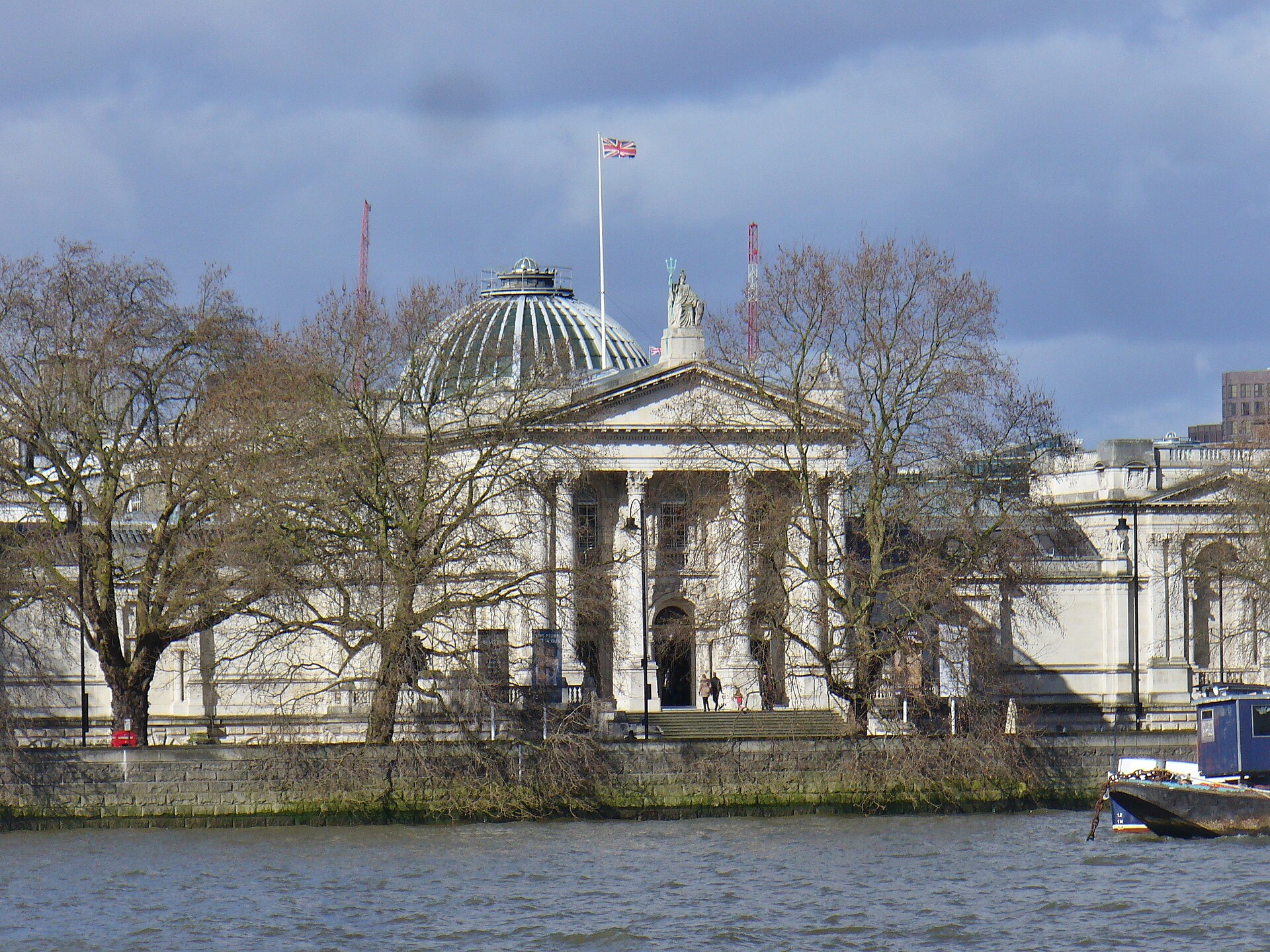
The portico and dome of Tate Britain at Millbank seen from the river. Photograph by Colin Smith.
Colin Smith, CC BY-SA 2.0On this page 16 sections
ContentsClose
British art from 1500 to the present, with the Turner Bequest as the anchor and strong holdings of the Pre-Raphaelites, Blake, Sargent and Hockney.
| Kind | Museum |
|---|---|
| Founded | 1897 |
| City and country |  London, United Kingdom |
| Address | Millbank, London SW1P 4RG, United Kingdom |
| Website | tate.org.uk/visit/tate-britain |
| Status | Open, confirmed |
| Record last verified |
Visiting
- Hours
- Mon-Sun10:00 to 18:00Last entry 17:30; galleries start closing 17:50
- Admission
- Collection displaysFreeFree, no booking needed
- Children 11 and under, exhibitionsFreeUp to four children per parent or guardian
- Tate Collective, ages 16-25, exhibitionsGBP 5Standard adult exhibition price not given on the page fetched
- Family child ticket, ages 12-18, exhibitionsGBP 5
Free entry: Collection displays are free every day- Tickets
- tate.org.uk/whats-on?venue=tate-britain The museum's own ticket page.
- Do I need to book?
- No for the collection; recommended for exhibitions
- Address
- Millbank, London SW1P 4RG, United Kingdom MapTube Pimlico (Victoria line, about 600 m), Vauxhall (Victoria line, about 850 m), Westminster (Jubilee, District and Circle lines, about 1,200 m)
Rail Vauxhall (about 850 m), Victoria (about 1,600 m)
Boat RB2 to Tate Modern about every 30 minutes - Website
- tate.org.uk/visit/tate-britain
- Telephone
- +44 (0)20 7887 8888 (option 1, daily 10.00-17.00)
Before you go how long, access, photography, bags, eating, shop
- How long to allow
- Not stated by Tate
- Access
- Step-free Manton Entrance on Atterbury Street with automatic doors; lifts; Changing Places toilet; quiet room; borrowable wheelchairs and scooters, booking recommended.
- Photography
- Allowed with the flash off.
- Bags
- Bags checked on arrival; larger than 55 x 40 x 20 cm not allowed; free cloakroom on the lower floor.
- Eating
- Djanogly Cafe on the lower floor.
- Shop
- Main Shop upstairs and Manton Shop on the lower floor.
Prices and hours change. We take them from the institution's own pages and print the day we read them, and you can check the current position at the source we used. Confirm before you travel.
What is inside
Historic and Early Modern British Art
Free displays tracing British art from the Tudors to the Second World War, including the Pre-Raphaelites and a room given to Constable in the 2023 rehang.
Modern and Contemporary British Art
Free displays from 1940 to the present, with named artists including David Hockney, Bridget Riley and Lubaina Himid, and about 200 contemporary works acquired since 2000.
The Turner galleries
Seven rooms for the Turner Bequest on the main floor, described by Tate as the world's largest free display of Turner paintings. The Clore Gallery of 1987 was built to hold the collection.
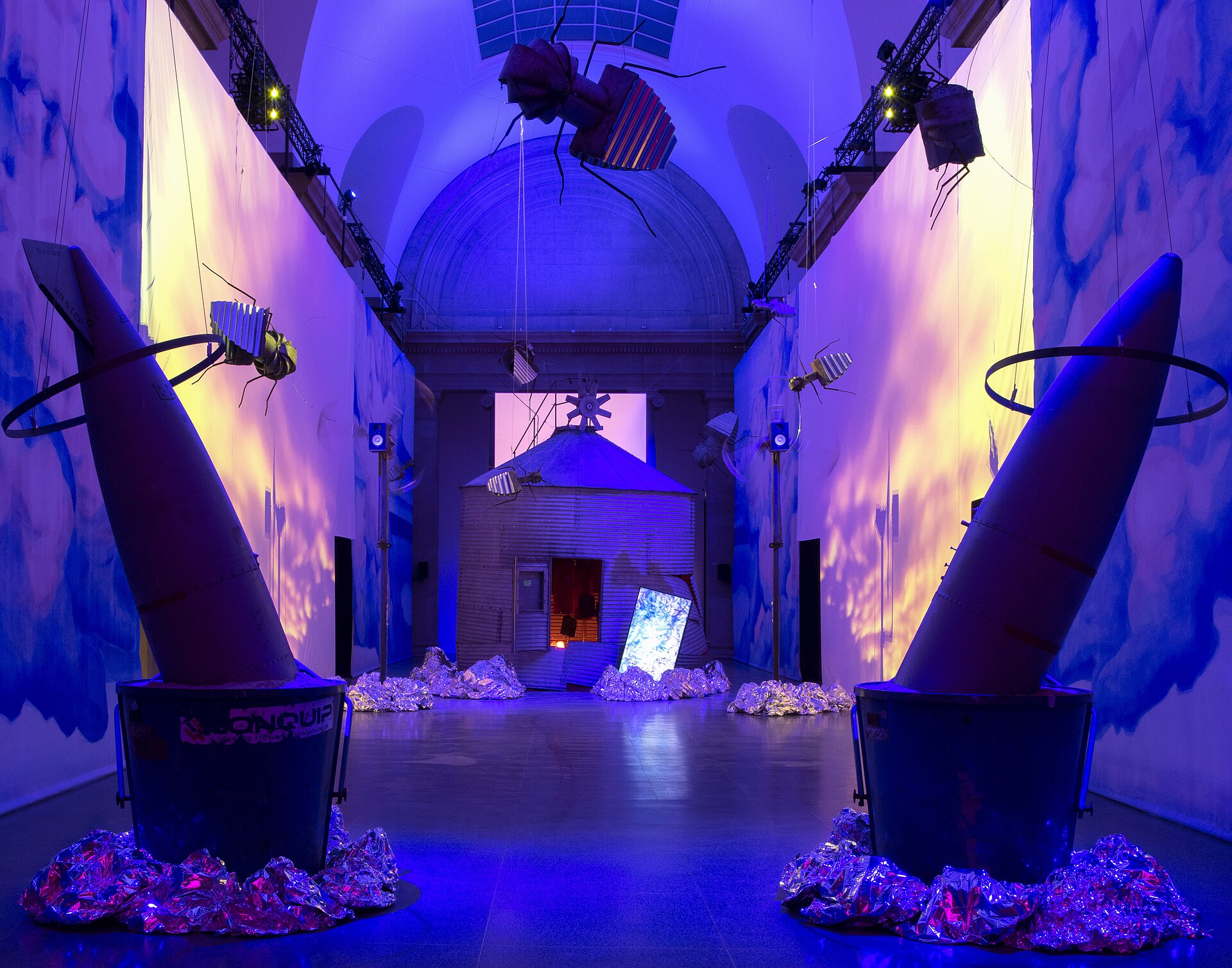
Photograph by Easternhillhiphop · CC BY-SA 4.0 The Duveen Galleries
The long central sculpture halls, funded in 1910 and the first galleries built specifically for sculpture in England. They now host a commissioning programme; the plate shows Heather Phillipson's 2021 commission.
Art Around the Building
Commissions and artworks spread across the building and its garden, outside the main chronological route.
What to see first
Ophelia
John Everett MillaisPainted 1851-2 in oil on canvas. Millais painted the river bank on the Hogsmill in Surrey first, working up to 11 hours a day over about five months, then the figure, for which Elizabeth Siddal lay clothed in a bath in his London studio.11
A Bigger Splash
David HockneyPainted in California in 1967 in acrylic on canvas, 242.5 by 243.9 cm. The splash alone took about two weeks of small brushwork over a flat rolled surface. Tate acquired it in 1981 through the Knoedler Gallery.12
Carnation, Lily, Lily, Rose
John Singer SargentPainted outdoors at Broadway in Worcestershire in 1885-6, in the few minutes each day when the light was right. Leighton encouraged Tate to buy it in 1887 with Chantrey Bequest money, making it the first Sargent bought by a public museum.13
Newton
William BlakeA monotype of 1795, reworked in 1805, one of twelve Large Colour Prints. Blake shows Newton crouched on a seabed drawing with a compass, a rebuke to the Enlightenment's single vision.14
The Lady of Shalott
John William WaterhouseDated 1888 on Tate's own page; the Lady sets out for Camelot in her boat, after Tennyson's poem. Waterhouse returned to the subject in 1894 (Leeds) and 1915 (Toronto).16
The Turner Bequest
J. M. W. TurnerAbout 100 finished and 200 unfinished oils and countless watercolours left to the nation in 1851. It is the reason the gallery has its Turner rooms and the Clore Gallery.15
Exhibitions on now
Past exhibitions here
The building and what it was built to hold
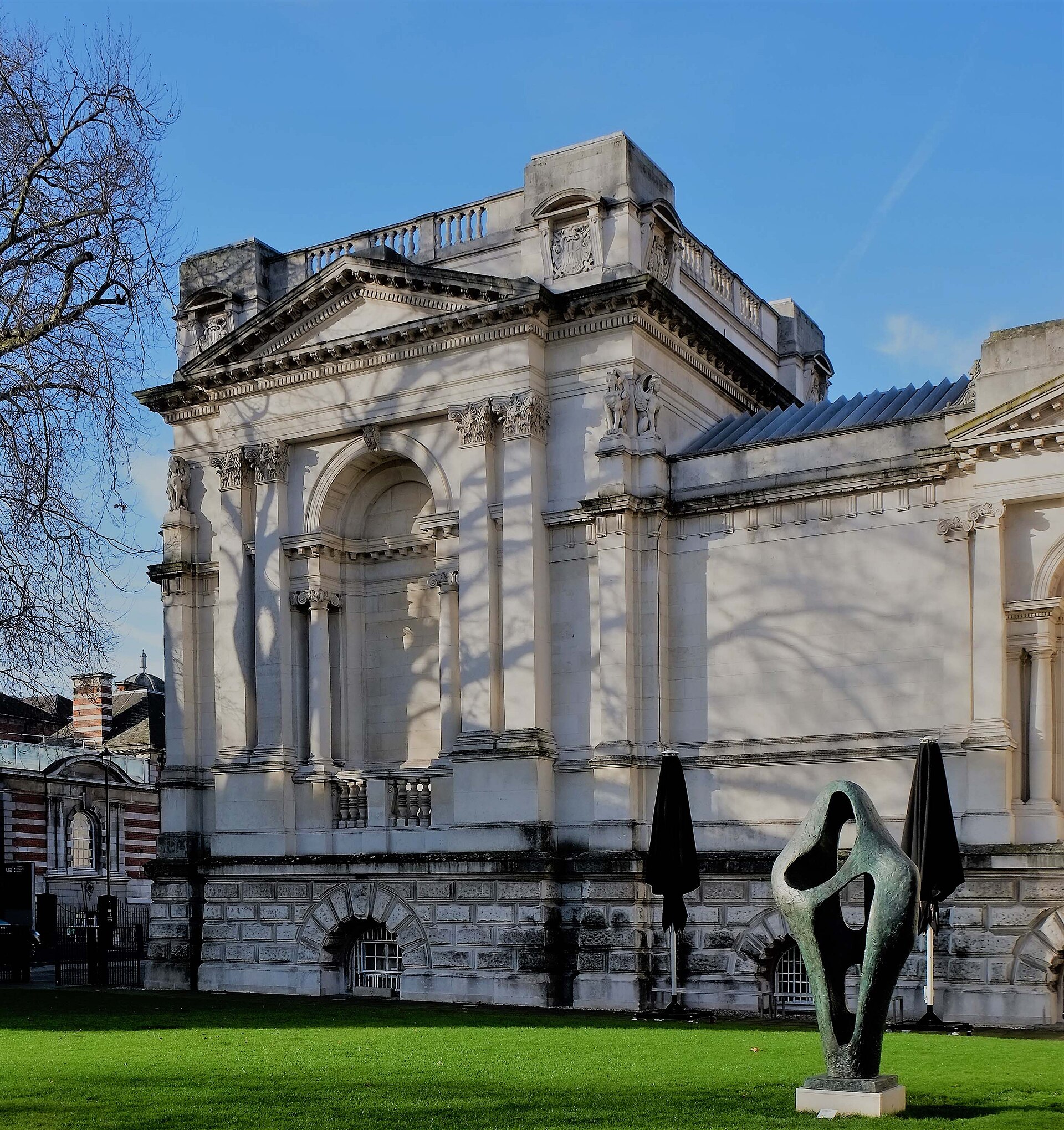
Tate Britain stands on Millbank beside the Thames, on the former site of Millbank Prison. Construction by Higgs and Hill began in 1893 and the gallery opened on 21 July 1897 as the National Gallery of British Art. Sidney R. J. Smith designed the front section with its classical portico and dome, the part a visitor sees first from the river. It was known as the Tate Gallery from 1932 and took the name Tate Britain in March 2000, when Tate Modern took over the modern international collections. The building has been Grade II* listed since 1970.
The money came from Sir Henry Tate. Tate's own history records that in 1889 the sugar refiner offered his collection of nineteenth century British art to the nation and that the trustees of the National Gallery first turned down his offer of 65 paintings because they had no room. A donation of 80,000 pounds then built the Millbank gallery, and Tate's gift together with works from the National Gallery formed the founding collection. A national museum of British art began, in other words, as a collector's offer that the existing national museum could not house.
Growth: the Turner rooms, the Duveens and the Clore Gallery
The gallery has been extended in stages, and each stage says something about what the institution thought it was for. Tate's history page dates the funding of seven new rooms for the Turner Bequest and of the Duveen Sculpture Galleries to 1910, through Sir Joseph Duveen and his son, and describes the sculpture galleries as the first in England built specifically for sculpture. Electric lighting arrived in 1935. The North East Quadrant, completed in 1979, added a great deal of exhibition space, and the Clore Gallery, designed by James Stirling and opened in 1987, was built to house the Turner collection. Charles Clore and his daughter Vivien Duffield gave 6 million pounds towards it and the government gave 1.8 million pounds.
The Turner Bequest is the reason the building holds what it holds. Turner left what remained in his possession at his death in December 1851 to the nation: about 100 finished oil paintings and about 200 unfinished ones, plus a vast number of watercolours and sketches. His cousins contested the will and the Court of Chancery approved a settlement with the executors on 19 March 1856. Most of the bequest is now at Tate Britain, although some works, The Fighting Temeraire among them, hang at the National Gallery. Tate describes its Turner galleries as the world's largest free display of paintings by Turner.
War and water left marks too. The 1928 Thames flood damaged artworks, there was bomb damage in the Second World War, and more than 700 works were moved to Muncaster Castle in Cumbria on 24 August 1939.
What is inside
Tate Britain presents British art from 1500 to the present. Its own collection page splits the free displays into Historic and Early Modern British Art, which runs from the Tudors to the Second World War, and Modern and Contemporary British Art, which runs from 1940 to now. The Turner galleries sit on the main floor, and a fourth strand, Art Around the Building, scatters commissions through the architecture and garden. Rooms named on the page include the Linbury Galleries and the Manton Studio.
The collection was last rehung in May 2023, the first rehang in a decade. The Art Newspaper counted more than 800 works, seven Turner rooms as the bequest requires, one room for Constable and two for Henry Moore. About 200 contemporary works acquired since 2000 are on show. The chronological route through the building was kept, but rooms are organised as small thematic shows with titles such as Fear and Freedom for the postwar years and In Full Colour for British Pop art. Entire rooms honour artists who had been overlooked, including Aubrey Williams and the seventeenth century painter Joan Carlile.
The Duveen Galleries, the long central sculpture halls, now carry a commissioning programme. Commons holds a photograph of Heather Phillipson's 2021 commission, RUPTURE NO 1: blowtorching the bitten peach, installed there. The Turner Prize exhibition has been staged at Tate Britain every other year, with nominees chosen by a jury chaired by the gallery's director.
The Turner Prize, the restaurant mural and the sponsor
Tate Britain has been the usual home of the Turner Prize, which began in 1984 with Malcolm Morley as the first winner. The prize has produced the gallery's loudest public rows. Tracey Emin's My Bed in 1999 drew police attention when two artists jumped on it, in 2002 the culture minister Kim Howells called the exhibits conceptual bullshit, and in 2024 an installation by Delaine Le Bas came under scrutiny over suspected plagiarism. A prize that the press treats as a yearly argument is part of what the building is known for.
The institution has also had to answer for its own walls. The restaurant was named after Rex Whistler, whose 1927 mural included enslaved Black children and caricatures of Chinese people. After complaints an ethics review followed, the restaurant closed, and the space now shows the mural together with Keith Piper's film installation Viva Voce. On sponsorship, BP supported the gallery from 1990, renewed in 2011 and ended support in 2012 citing business conditions, and the activist group Liberate Tate occupied part of the gallery in 2015. These are matters of record for the page of a museum that is a party to its own history and not a neutral host.
Planning a visit
Entry to the collection is free and needs no booking. Tate Britain is open every day from 10.00 to 18.00, with last entry at 17.30 and galleries starting to close at 17.50. As of 15 November 2026 the Millbank entrance is closed until 2027 while the new Clore Garden is built, so every visitor comes in by the step-free Manton Entrance on Atterbury Street. The gallery itself stays open throughout. Tate's release of 30 April 2026 says the garden, designed by Tom Stuart-Smith with a classroom by Feilden Fowles, will have a water feature, seating and a reimagined cafe terrace, and will open in 2027.
The visit page asks you to allow extra time because bags are checked, bags above cabin size (55 by 40 by 20 centimetres) are not allowed, and the gallery is cashless. Photography is allowed without flash. Tate's own visual story warns that the gallery can be crowded and noisy, that the Djanogly Cafe is busiest at lunchtime and that the gallery is quietest at the start and end of the day. A Quiet Room is on the main floor near the Duveen Galleries, a free cloakroom is on the lower floor and a Changing Places toilet is in the Clore Auditorium. Nearest Tube stations are Pimlico, Vauxhall and Westminster, and the RB2 boat links Tate Britain with Tate Modern about every 30 minutes.
Two paid exhibitions were listed on 15 November 2026: The 90s: Art and Fashion, until 14 February 2027, and Vanessa Bell and Duncan Grant: Inside Bloomsbury, until 11 April 2027. Tate's pages fetched for this entry did not give the standard adult exhibition price, so none is printed here.
How the gallery has been received
The recent critical argument is about the 2023 rehang and it is unusually sharp. Tim Smith-Laing in Apollo argued that the mostly negative response had been inflated into a culture war and that the real faults were practical: clumsy additions, dull grey walls, low hanging, cramped rooms and gloomy lighting. He praised the suffragette room and the modernist rooms. J.J. Charlesworth in ArtReview was harder on the idea itself, calling the approach a zombie social art history and finding wall texts preachy and works chosen to make a point more than for their quality, while singling out the portrait of Francis Barber as graceful. Director Alex Farquharson, quoted by The Art Newspaper, said each room works like a mini exhibition and that art is not made in a vacuum.
What nobody disputes is the collection's reach and the fact that most of it is free. The gallery counted 1,149,325 visitors in 2025 according to the Wikipedia article, a tertiary figure to be replaced by the institution's own annual report when one is fetched.
What visitors say
Published criticism of the 2023 rehang is divided: critics agree the collection is rich and the Turner rooms strong, but several found the lighting and wall colour poor and the thematic captions heavy-handed. Entry to the collection is free, which Tate itself puts at the front of its offer.
What is praised, what is criticised
- Praised: A very large free collection of British art, including what Tate calls the world's largest free display of Turner paintings
- Praised: Suffragette and modernist rooms in the 2023 rehang (Apollo)
- Praised: Careful access provision: step-free entrance, quiet room, cloakroom and borrowable mobility aids
- Criticised: Gloomy lighting, dull grey walls and cramped hanging in the 2023 rehang (Apollo)
- Criticised: Wall texts read as preachy and works chosen to make a point (ArtReview)
- Criticised: The Millbank entrance is closed until 2027 and the gallery can be crowded and noisy (Tate)
Questions about Tate Britain
Where is Tate Britain?
Millbank, London SW1P 4RG, United Kingdom.
How much does it cost to visit?
Collection displays: free; Children 11 and under, exhibitions: free; Tate Collective, ages 16-25, exhibitions: GBP 5; Family child ticket, ages 12-18, exhibitions: GBP 5. As confirmed 15 November 2026.
When is it open?
Mon-Sun 10:00-18:00. As confirmed 15 November 2026.
How do you get there?
Tube: Pimlico (Victoria line, about 600 m), Vauxhall (Victoria line, about 850 m), Westminster (Jubilee, District and Circle lines, about 1,200 m); Rail: Vauxhall (about 850 m), Victoria (about 1,600 m); Boat: RB2 to Tate Modern about every 30 minutes.
What should you see first?
Ophelia (John Everett Millais); A Bigger Splash (David Hockney); Carnation, Lily, Lily, Rose (John Singer Sargent); Newton (William Blake); The Lady of Shalott (John William Waterhouse); The Turner Bequest (J. M. W. Turner).
What we could not confirm
- The standard adult exhibition price was not on the pages fetched.
- The Millbank entrance reopening is given only as 2027; the exact date is not published.
- No visitor-platform rating was fetched, so none is printed.
- The Duveen Galleries opening date of 1937 is not confirmed by a fetched source.
Images
Sources
- 1Tate, Visit Tate Britain (hours, address, phone, entry, accessibility, transport), read 2026-11-15 tate.org.uk/visit/tate-britain
- 2Tate, What's on at Tate Britain (current exhibitions), read 2026-11-15 tate.org.uk/whats-on?venue=tate-britain
- 3Tate, History of Tate tate.org.uk/about-us/history-tate
- 4Wikipedia, Tate Britain (: identity, dates, architecture, visitor figures) en.wikipedia.org/wiki/Tate_Britain
- 5Tate press release, Tate Britain celebrates work beginning on new Clore Garden, 30 April 2026 tate.org.uk/press/press-releases/tate-britain-celebrates-work-beginning-on-new-clore-garden
- 6Tate, Tate Britain visual story (photography, cloakroom, noise, toilets) tate.org.uk/visit/tate-britain/visual-story
- 7Tate, Tate Britain collection (displays) tate.org.uk/whats-on/tate-britain/collection-route/tate-britain-collection
- 8Tom Seymour and Gareth Harris, The Art Newspaper, 23 May 2023, on the Tate Britain rehang theartnewspaper.com/2023/05/23/all-change-at-tate-britain-after-first-thing-rehang-in-a-decade
- 9Tim Smith-Laing, Apollo, 30 May 2023, on the Tate Britain rehang apollo-magazine.com/tate-britain-rehang-culture-wars-review/
- 10J.J. Charlesworth, ArtReview, 25 May 2023, on the Tate Britain rehang artreview.com/tate-britain-rehang-a-zombie-social-art-history/
- 11Wikipedia, Ophelia (Millais) () en.wikipedia.org/wiki/Ophelia_(Millais)
- 12Wikipedia, A Bigger Splash () en.wikipedia.org/wiki/A_Bigger_Splash
- 13Wikipedia, Carnation, Lily, Lily, Rose () en.wikipedia.org/wiki/Carnation,_Lily,_Lily,_Rose
- 14Wikipedia, Newton (Blake) () en.wikipedia.org/wiki/Newton_(Blake)
- 15Wikipedia, Turner Bequest () en.wikipedia.org/wiki/Turner_Bequest
- 16Wikipedia, The Lady of Shalott (painting) () en.wikipedia.org/wiki/The_Lady_of_Shalott_(painting)
- 17Wikipedia, Turner Prize () en.wikipedia.org/wiki/Turner_Prize
- 18Wikimedia Commons, Category:Tate Britain (file list, licences and photographers) commons.wikimedia.org/wiki/Category:Tate_Britain
- 19Tate, catalogue page for Waterhouse, The Lady of Shalott (title and date) tate.org.uk/art/artworks/waterhouse-the-lady-of-shalott-n01543