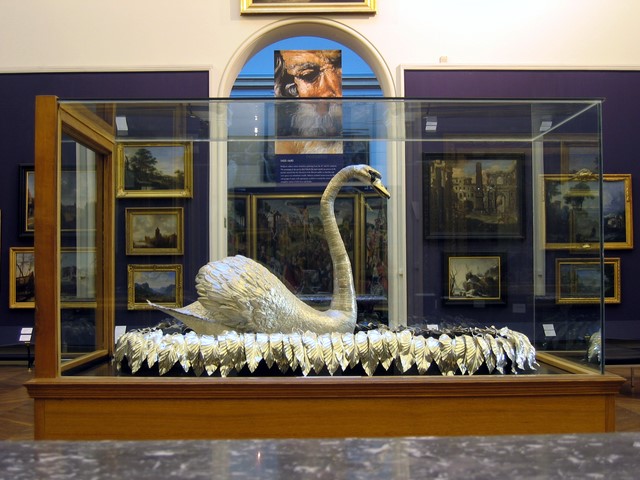
The Silver Swan
c. 1773 · Chased and repousse silver over an iron and...
The Bowes Museum, Barnard Castle
 British · 1723-1800
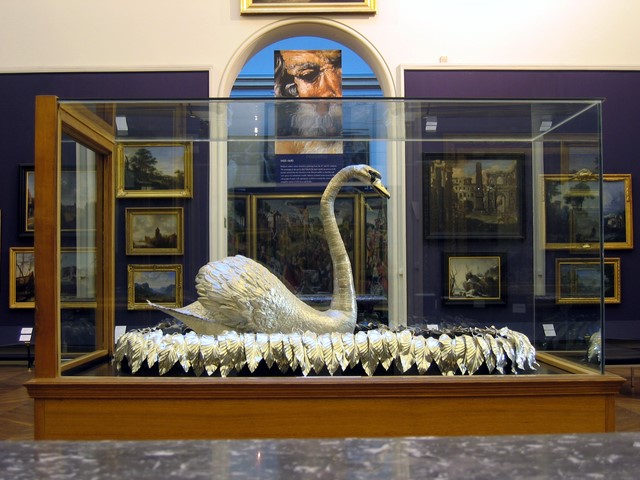
The Silver Swan The Silver Swan, c. 1773, the single most famous surviving object to carry Cox's name, though its mechanism is credited substantially to John Joseph Merlin. At the Bowes Museum, Barnard Castle, the subject of a separate Iconotheca record. Photographed by Andrew Curtis in December 2003. No verified portrait. No securely identified likeness of this maker is known under a free licence. We do not publish a face we cannot verify.
Andrew Curtis, via geograph.org.uk / Wikimedia Commons| Worked as | Goldsmith, Jeweller, Entrepreneur, Museum proprietor |
|---|---|
| Born | c. 1723 · Not established in the sources consulted |
| Died | 1800 · London (exact date and burial place not established in the... |
| Nationality | British |
| In this archive | 1 artwork |
| Sources | 16 cited |
| Last verified |
About this page 1 artwork in the archive · Last verified · 16 sources cited
James Cox's name sits on hundreds of surviving objects and he made almost none of them with his own hands. He described himself on his trade card as a working goldsmith at the Sign of the Golden Urn, offering, in his own words, curious wares in gold, silver, amber, pearl, tortoiseshell and precious stones. By the 1770s he was, in the Metropolitan Museum's own phrase, an entrepreneur who claimed to employ between eight hundred and a thousand workmen, coordinating a London network of independent jewellers, case makers, enamellers and clockmakers who mostly never signed a single piece. English law required a maker's name to appear on the enamelled dial of any clock or watch built in London for export, and that legal accident, not personal vanity, is the documented mechanism by which one man's name ended up on the joint work of a great many others. This record treats every claim of authorship for a Cox-branded object the way the surviving evidence actually supports it: as a brand on a manufactory's output, proven maker by maker only where a name survives, and otherwise an open question rather than a settled fact.
What that manufactory produced, over roughly a quarter of a century, was extraordinary: automata built to catch the eye of the Qianlong Emperor of China, a ten-foot mechanical peacock made for Catherine the Great, and a museum of his own devising at Spring Gardens in London that failed as a shop, succeeded as a spectacle and was eventually liquidated by a special Act of Parliament permitting Cox to sell it off by lottery. Surviving pieces now sit in the Bowes Museum, the Metropolitan Museum of Art, the State Hermitage Museum, the Cleveland Museum of Art, the Walters Art Museum and, on loan from the Palace Museum in Beijing, the Science Museum in London: a corpus scattered by exactly the export trade that built it. Cox went bankrupt twice, was never granted the royal patronage he wanted, and by his own account never personally built the mechanism inside a single one of these objects. No portrait of him is known to survive, a small irony for a man whose entire business was turning craftsmanship into spectacle for other people to look at.
James Cox born; place not established in the sources consulted.11
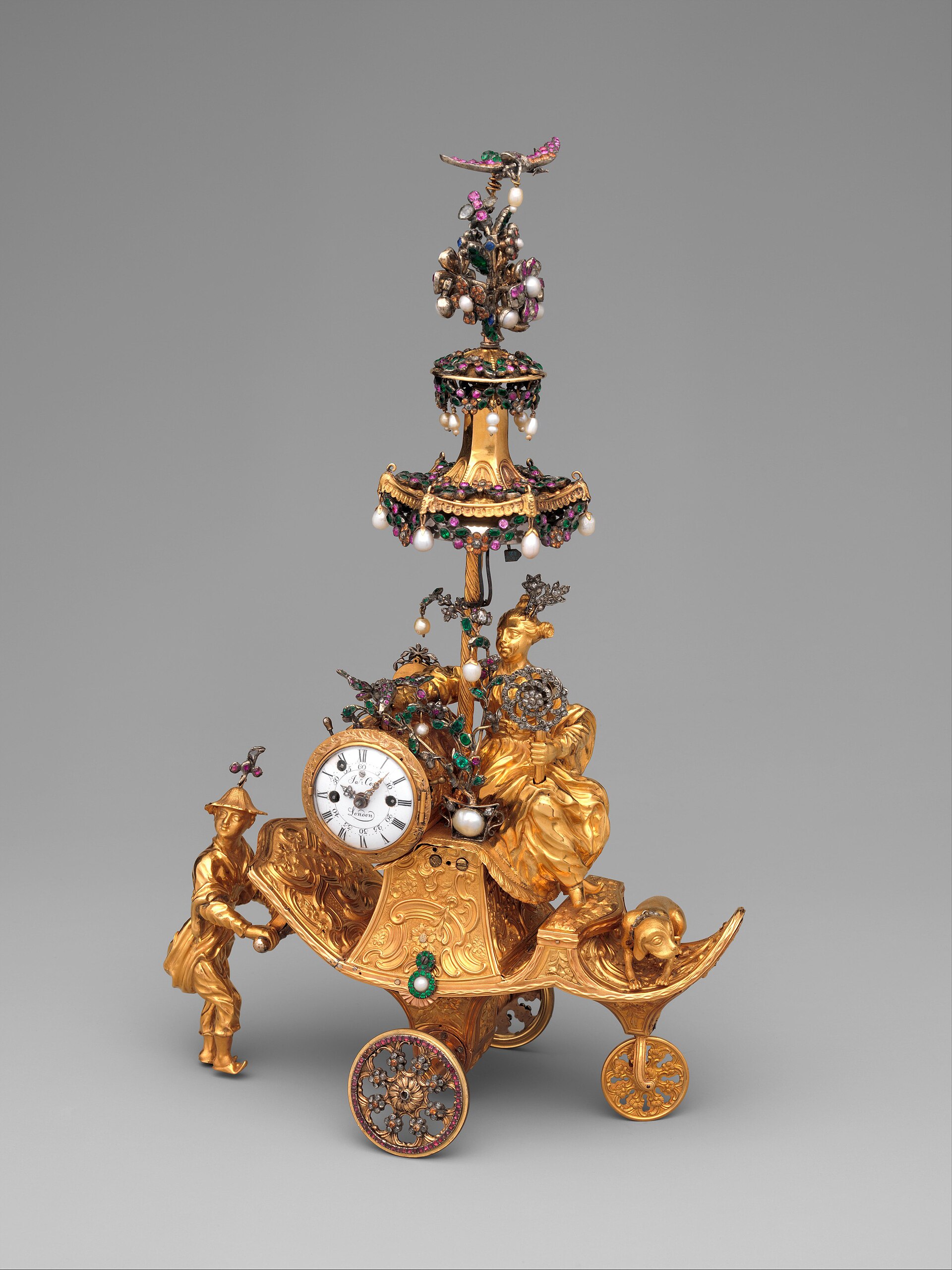
Commissioned by the East India Company to build a pair of automaton chariots as a diplomatic gift for the Qianlong Emperor of China; one survives in the Metropolitan Museum of Art.123
Cox's Museum opens to the public at Spring Gardens, London, to sell down stock left unsold after a ban on shipping his goods to China.111
Parliament passes an Act (13 Geo. 3, c. 42 per the Statutes Project; cited elsewhere as c. 41) authorising Cox to dispose of his museum by lottery to relieve his debts; the Act's schedule lists fifty pieces, including, as item forty-eight, the object now known as the Silver Swan.10
Cox publishes two enlarged editions of A Descriptive Inventory of the museum's contents ahead of the lottery disposal; the Silver Swan is first recorded on public display in this period.114
Cox's Museum closes and its contents are dispersed under the 1773 Act.111
The Duchess of Kingston's visit to Saint Petersburg leads Prince Grigory Potemkin to commission a monumental automaton clock from Cox for Catherine the Great, beginning the Peacock Clock's documented history.8
Cox declared bankrupt for the second time, following the collapse of the China trade, a failed attempt to open direct trade with Russia, wartime disruption from the American Revolution, and the absence of royal patronage.1
The Peacock Clock arrives in Saint Petersburg in pieces, probably delivered by the clockmaker Frederick (Friedrich) Jury (the Metropolitan Museum hedges this with "probably"); Winter Palace chancellery records show two payments to Jury, on 30 September and 14 December, of about 1,800 pounds sterling in total.89
Cox's son John Henry Cox sent to Canton, where he enters partnership with the merchants Daniel and Thomas Beale as the firm Cox and Beale.117
Cox's remaining stock of goods originally intended for the Canton market sold at auction at Christie's in London, 16 February.1
The Peacock Clock's documented continuous display at the Hermitage begins, per the Museum's own account.8
James Cox dies; exact date and place not established in the sources consulted.11
Cox-attributed pieces surface at auction irregularly rather than in a continuous market, and the strength of attribution varies piece to piece, so this record does not attempt a price trend across his output as a whole. The clearest recent benchmark is a single well-documented clock with royal provenance; this record states only what was directly verified for that result rather than extrapolating a wider pattern from it.
| Date | Sale | Work | Result | Note |
|---|---|---|---|---|
| 12 December 2012 | Bonhams | Musical table clock with moonphase indication, agate-panelled and silver-mounted, signed and dated on its key James Cox, London, 1766 | Hammer GBP 320,000 With premium GBP 385,250 (stated as the total price including buyer's premium) GBP | Estimate GBP 150,000-250,000. Provenance: King Farouk of Egypt; sold Sotheby's 1954 following his abdication; exhibited Victoria and Albert Museum, 1962; not on the auction market again until this 2012 sale, and in the same family for at least fifty years beforehand. |
Hammer is the price at which the bidding stopped; with premium adds the fee the house charges the buyer on top. Hammer price and buyer's premium in the glossary.
| Institution | City | Holdings | Note |
|---|---|---|---|
| The Bowes Museum | Barnard Castle, County Durham, England | The Silver Swan, c. 1773 (accession X.4653 per Art UK) | Performs daily; the subject of a separate Iconotheca record. |
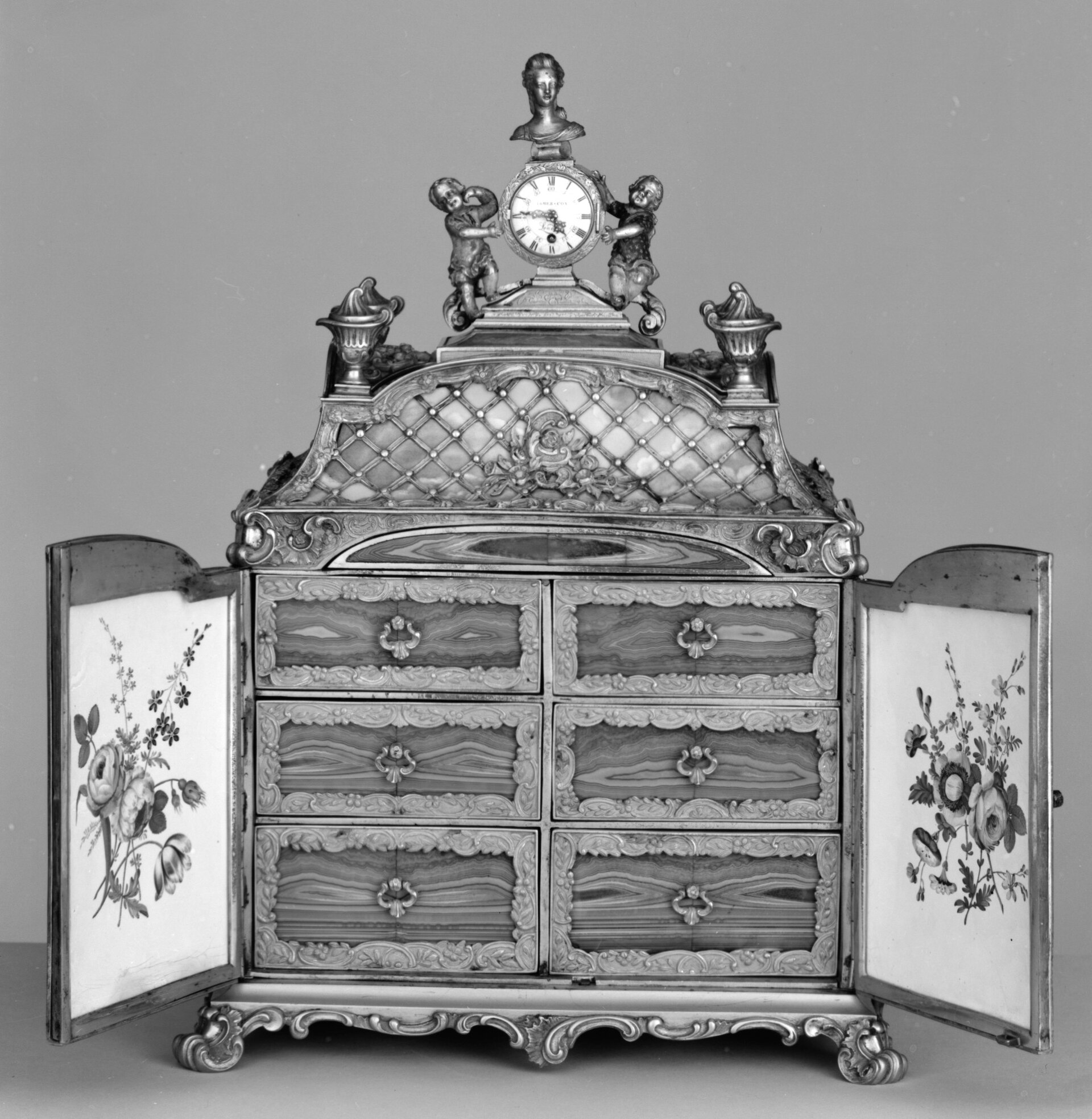
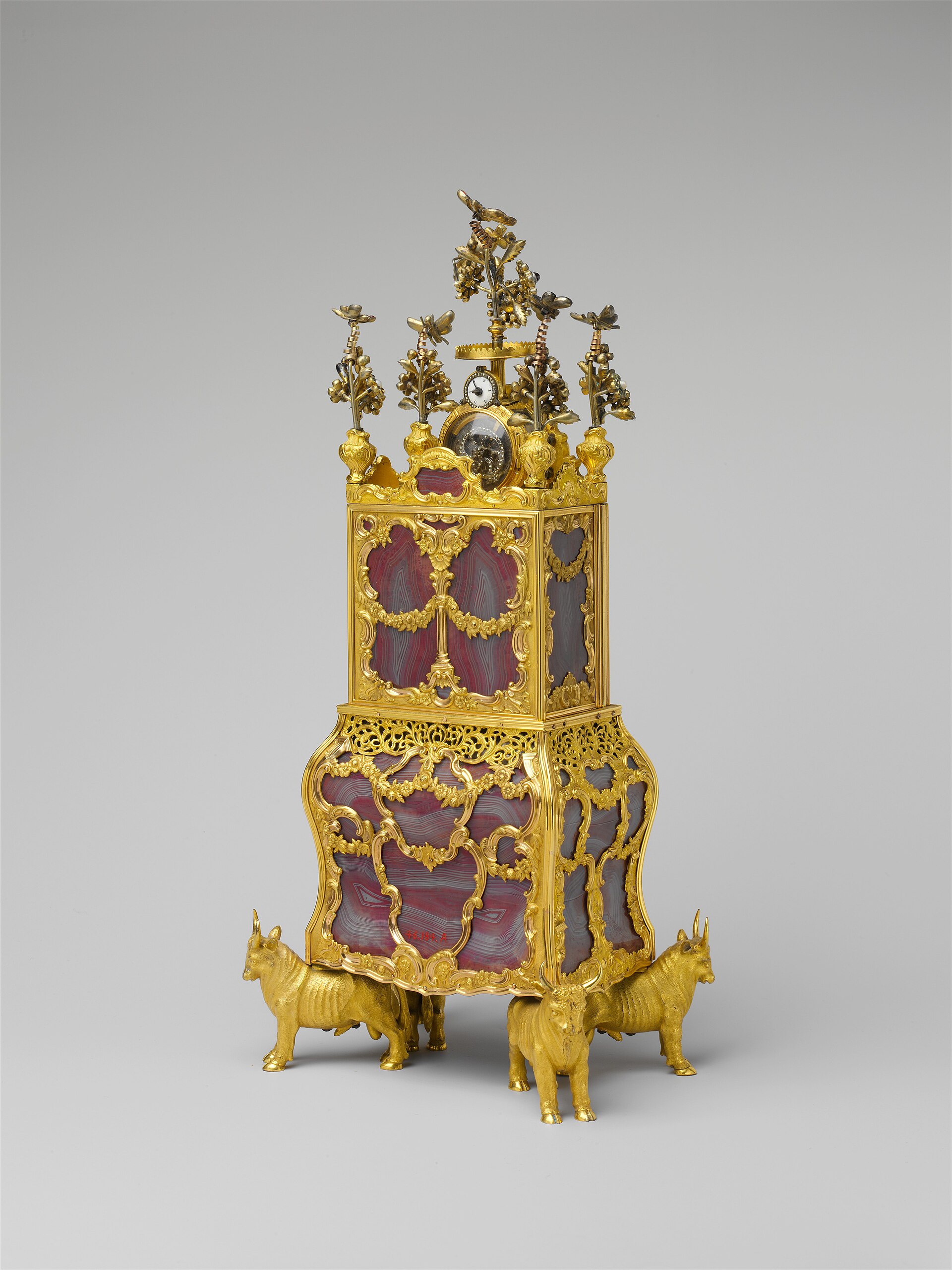
| The Metropolitan Museum of Art | New York | Automaton chariot for the Qianlong Emperor (1766, Jack and Belle Linsky Collection, 1982.60.137); jewel cabinet with watch after designs by Watteau and Boucher; miniature secretary incorporating a watch (46.184a-c); pair-case automaton watch (case by Peter Mounier); further necessaires | Research by Clare Vincent and J. H. Leopold is the principal modern institutional account of Cox's career. |
| The State Hermitage Museum | Saint Petersburg, Russia | The Peacock Clock, delivered 1781 | Described by the Museum as the only large eighteenth-century automaton in the world to survive unaltered and in working condition. |
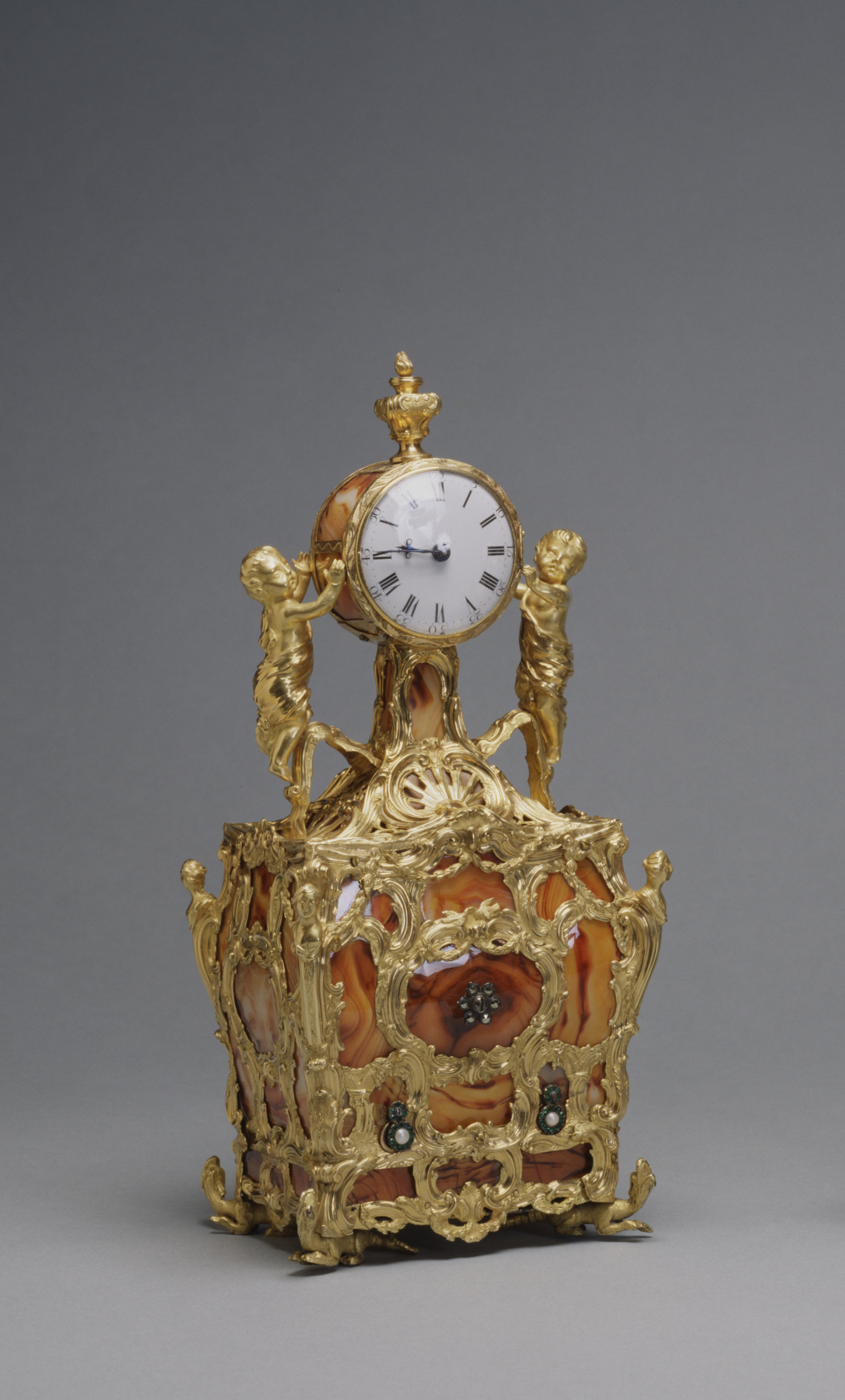
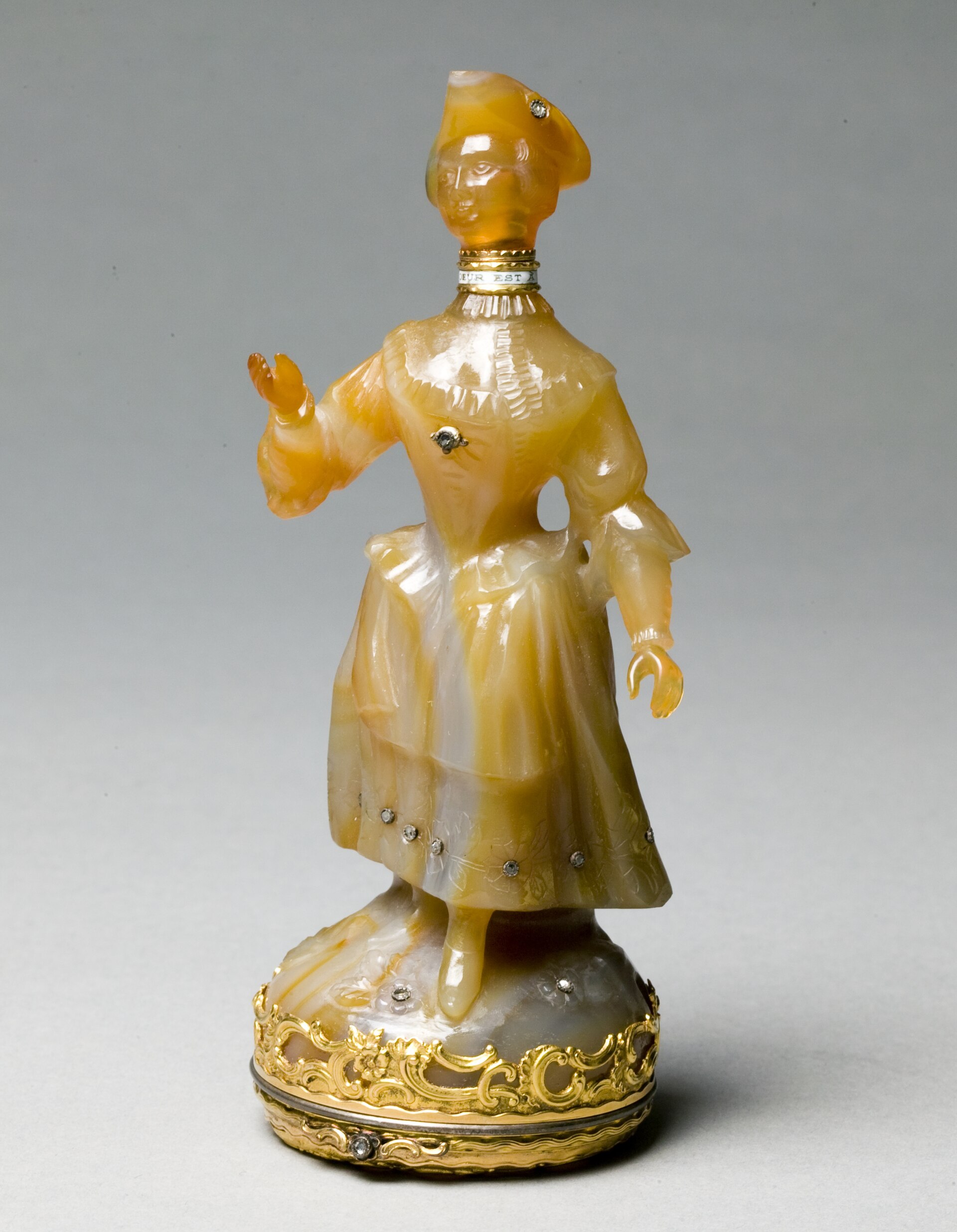
| The Cleveland Museum of Art | Cleveland, Ohio | Necessaire (2009.32); miniature cabinet with watch (2009.77); scent bottle and box in the form of a woman (2009.27); spyglass (2009.24); case with grooming implements (2009.67) | |
| The Walters Art Museum | Baltimore, Maryland | Necessaire with a watch (58238) | Later owned by the dowager empress of Russia, Marie Feodorovna; Faberge later produced a copy of it in silver and nephrite, per the Museum's own description. |
| The Palace Museum | Beijing, China | Zimingzhong (self-ringing clock) automata, including pieces shown on loan at the Science Museum, London | Former Qing imperial collection; direct evidence of Cox workshop pieces reaching the Chinese court. |
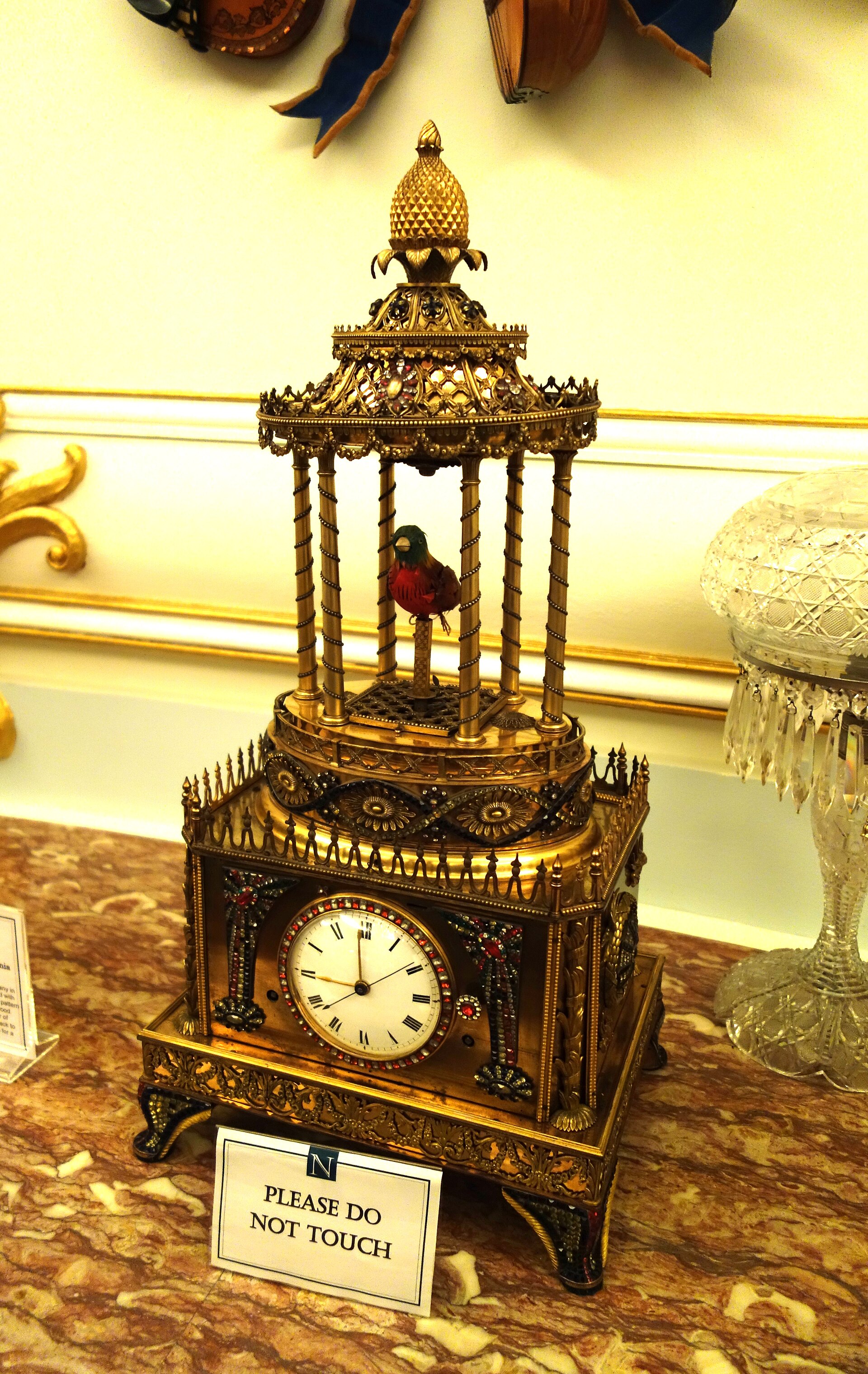
| Nethercutt Collection | Los Angeles, California | Bird Pavilion Clock, signed James Cox and Son, c. 1780 | Privately held; evidence of the family firm's continuation after James Cox's own bankruptcies. |
The clearest primary statement of how Cox's business actually worked comes not from a biographer but from Cox himself, in the preamble to the 1773 Act of Parliament that let him liquidate his museum...
The clearest primary statement of how Cox's business actually worked comes not from a biographer but from Cox himself, in the preamble to the 1773 Act of Parliament that let him liquidate his museum by lottery. Petitioning Parliament, Cox stated that he had, in the prosecution of his trade, invented mechanical pieces of uncommon and expensive workmanship, that construction of them had for many years past found employment for near one thousand workmen and artists, and that pieces of the kind he invented, sold abroad, already amounted to near six hundred thousand pounds. Those are Cox's own figures, offered to persuade Parliament to relieve his debts, and this record repeats them as his claim rather than as an audited fact; no independent tally of his output or workforce was found in the sources consulted. But the shape of the claim matches everything institutional scholarship has separately established: this was a manufactory trading on one name, not a bench worked by one pair of hands.
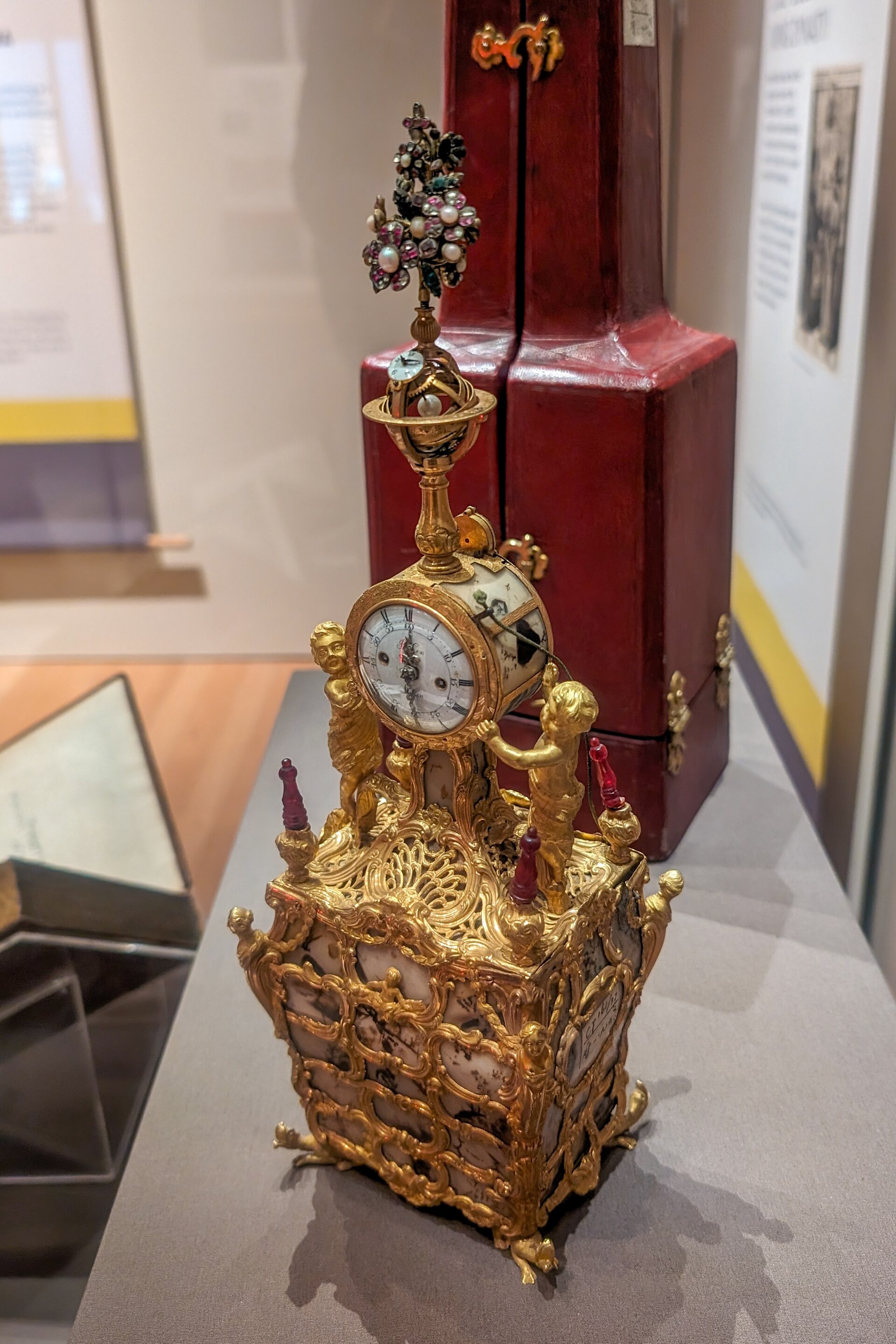
The Metropolitan Museum's own research, by the curators Clare Vincent and J. H. Leopold, states plainly that there is no evidence Cox himself ever made a watch movement, and that how extensively he even contributed to the design of the luxury objects that bear his name remains to be established. Only a handful of the craftsmen in his network have been individually identified: the case maker Peter Mounier, credited by the Museum for a Cox pair-case automaton watch of about 1770; Frederick (also given as Friedrich) Jury, a German-born clockmaker settled in London who supplied Cox's clockwork and who probably delivered the Peacock Clock to Saint Petersburg in 1781, per the Metropolitan Museum's own hedged account; and John Joseph Merlin, the Liege-born mechanician who is credited, by the Bowes Museum's own catalogue, with the head, neck and fish-catching mechanism of the Silver Swan specifically, a separate Iconotheca record on which sets out his career in full. The jewel cabinet with watch now in the Metropolitan Museum carries decorative panels made after designs by Antoine Watteau and Francois Boucher, per the Museum's own attribution, meaning even the painted imagery on a Cox piece could originate with artists who had no other connection to his workshop. A claim occasionally repeated online, that Cox also employed the sculptor Joseph Nollekens and the painter Johann Zoffany to design automata for him, could not be traced to the Metropolitan Museum's research, the British Museum, or any of the specialist literature located for this record; it is noted here as unconfirmed rather than repeated as fact.
Cox's most consequential single commission came in 1766, when the East India Company engaged him to build a pair of automaton chariots, each fitted with a miniature striking clock and a mechanical...
Cox's most consequential single commission came in 1766, when the East India Company engaged him to build a pair of automaton chariots, each fitted with a miniature striking clock and a mechanical bird, as a diplomatic gift for the Qianlong Emperor of China. One of the pair survives, gold, silver and paste jewels standing 25.4 centimetres high, its wheels spring-driven and tiny levers animating a whirligig and a bird's wings; it is now in the Metropolitan Museum's Jack and Belle Linsky Collection. The timing was commercial rather than sentimental: 1766 was the year the East India Company's monopoly on British trade to China lapsed, and a gift built to delight an emperor already known to prize European clockwork was a piece of trade diplomacy dressed as a curiosity.
The reception was real. The Qianlong court collected European and Chinese automaton clocks, known in Chinese as zimingzhong, or self-ringing bells, in large numbers, and pieces made in Cox's workshop for that market survive today in the Palace Museum in Beijing, the former imperial collection. Two of them, a zimingzhong with an armillary sphere and case dated by the lending institution to about 1760 to 1795, and a zimingzhong assembled from parts made in both China and Britain, were shown on loan from the Palace Museum at the Science Museum in London in the exhibition Zimingzhong: Clockwork Treasures from China's Forbidden City, direct physical evidence that objects built in Cox's London workshop entered and remained in the Chinese imperial collection.
The China trade did not stay open. A ban on shipping Cox's luxury goods to China left him with a large stock of unsold automata and jewelled curiosities, exactly the kind of object his workshop had...
The China trade did not stay open. A ban on shipping Cox's luxury goods to China left him with a large stock of unsold automata and jewelled curiosities, exactly the kind of object his workshop had been built to export, and to sell that surplus he opened his own museum at Spring Gardens, near Charing Cross, in February 1772. It became, in short order, one of the more fashionable and expensive destinations in London: the entry fee, around half a guinea, was substantial for the period, and the Museum was promoted with printed catalogues and newspaper verses, some of which, by later account, Cox had placed himself. James Boswell visited on Samuel Johnson's recommendation, and the Museum is referenced in Frances Burney's novel Evelina and in work by Richard Brinsley Sheridan, evidence of how thoroughly it had entered fashionable London conversation within its first year.
Two editions of Cox's own descriptive catalogue were published for the 1772 to 1773 exhibition, and when the stock still had not sold, two further, much-enlarged editions, titled A Descriptive Inventory of the Several Exquisite and Magnificent Pieces of Mechanism and Jewellery, were issued in 1773 and 1774 to accompany the disposal of the collection by lottery. The Metropolitan Museum's own miniature secretary incorporating a watch is identified, by its own curators, as a probable surviving fragment of a larger piece described in the 1773 inventory as Piece the Seventeenth, A superb Cabinet, which in its complete form stood on a gilt rock with artificial waterworks, silver swans swimming in contrary directions, and winged dragons at the corners, under a glass cover on a crimson velvet pedestal. A comparable cabinet survives in the Palace Museum in Beijing and a more elaborately worked example in the State Hermitage Museum, suggesting the design was produced as a small series rather than as a single unique piece, sold either separately or as part of a larger assemblage as the buyer wished.
By 1773 Cox's museum had not sold down his stock fast enough to clear the debts he had incurred building it, and ordinary lottery sales of goods were themselves illegal under acts of Parliament aimed...
By 1773 Cox's museum had not sold down his stock fast enough to clear the debts he had incurred building it, and ordinary lottery sales of goods were themselves illegal under acts of Parliament aimed at unlicensed gambling schemes. Cox petitioned Parliament directly, and the resulting Act, reproduced by the Statutes Project from Pickering's Statutes at Large, is a genuinely unusual document: a piece of primary legislation built entirely around rescuing one tradesman's business. It is cited in different modern indexes as 13 Geo. 3, c. 41 and as 13 Geo. 3, c. 42; this record follows the Statutes Project's citation, c. 42, since that is the version whose actual text was read for this record, and flags the discrepancy rather than silently picking one.
The Act's own preamble states its purpose without euphemism: that unless Parliament's sanction let Cox dispose of the museum to the best advantage, the debts he had contracted completing it could not speedily be discharged, and numbers of artists and workmen employed in it would lose their work. It authorised Cox, or his heirs or assigns, to sell the museum and the pieces composing it by lottery at any time before the first of January 1780, notwithstanding the general law against lottery sales, and it attached a schedule listing fifty individual pieces then composing, or nearly ready to compose, the museum, each briefly described. The schedule is, in effect, Cox's own inventory of his workshop's grandest output at a single moment, and it is the closest thing to an audited checklist his business ever produced: horse-drawn chariots, jewelled vases of flowers nine and ten feet high, singing-bird cages, a bust of the Empress of Russia set with brilliants, a twenty-foot golden throne, and, as item forty-eight, a swan, large as life, formed of silver, filled with mechanism, beating time with its beak to musical chimes, seated on artificial water within reflecting mirrors, with a rising sun above it, the whole eighteen feet high in its full display setting. That is the Silver Swan, now at the Bowes Museum and the subject of a separate Iconotheca record; this Act is the earliest documentary trace of it as a scheduled, saleable object, legally cleared for disposal by lottery within two years of its first recorded public display in Cox's own 1773 to 1774 catalogue. Whether the swan was actually drawn as a lottery prize, held back, or sold privately when the Museum finally closed in 1775 is not established by any source consulted for this or the companion record; this Act only proves it was legally eligible to be.
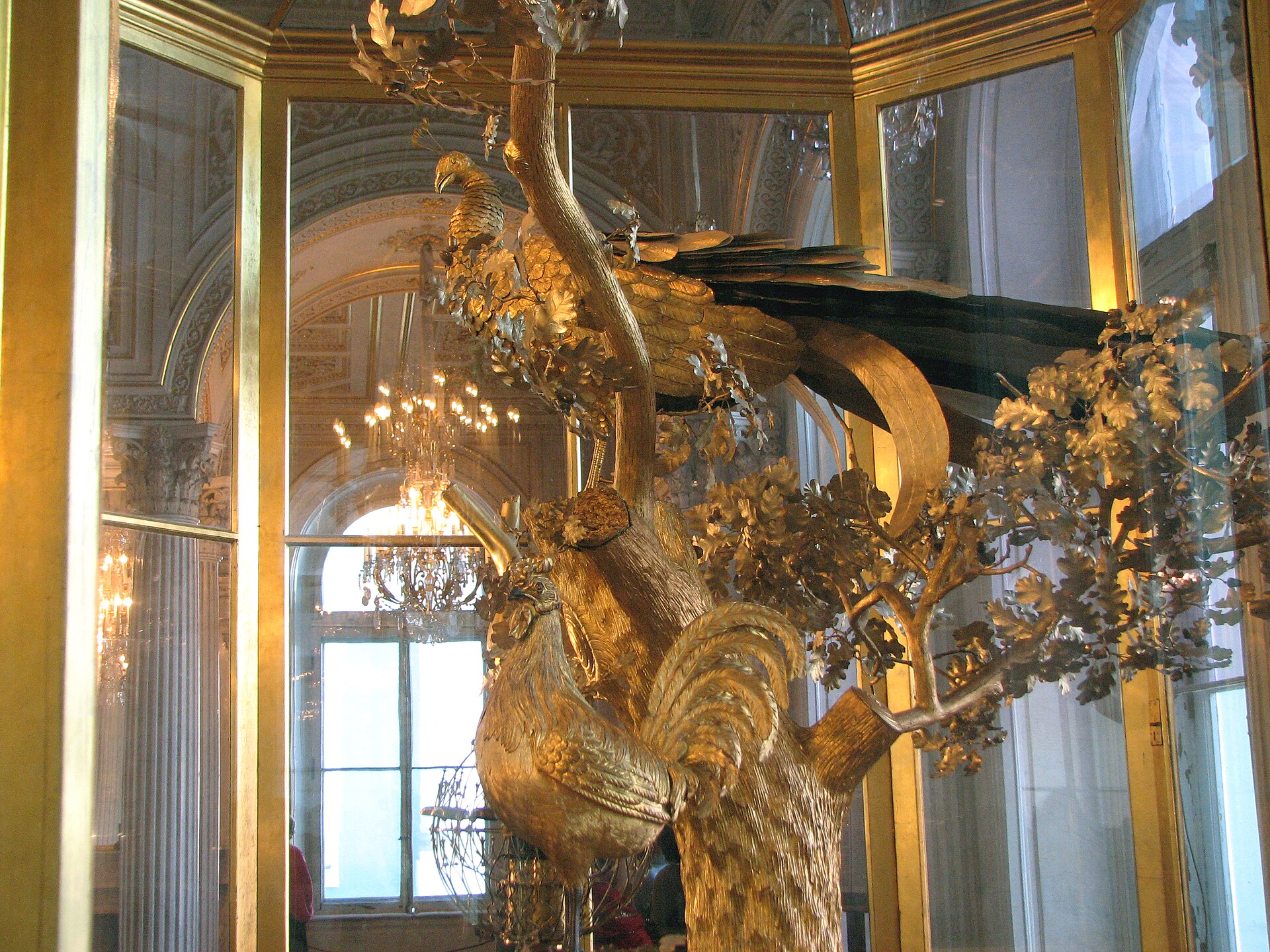
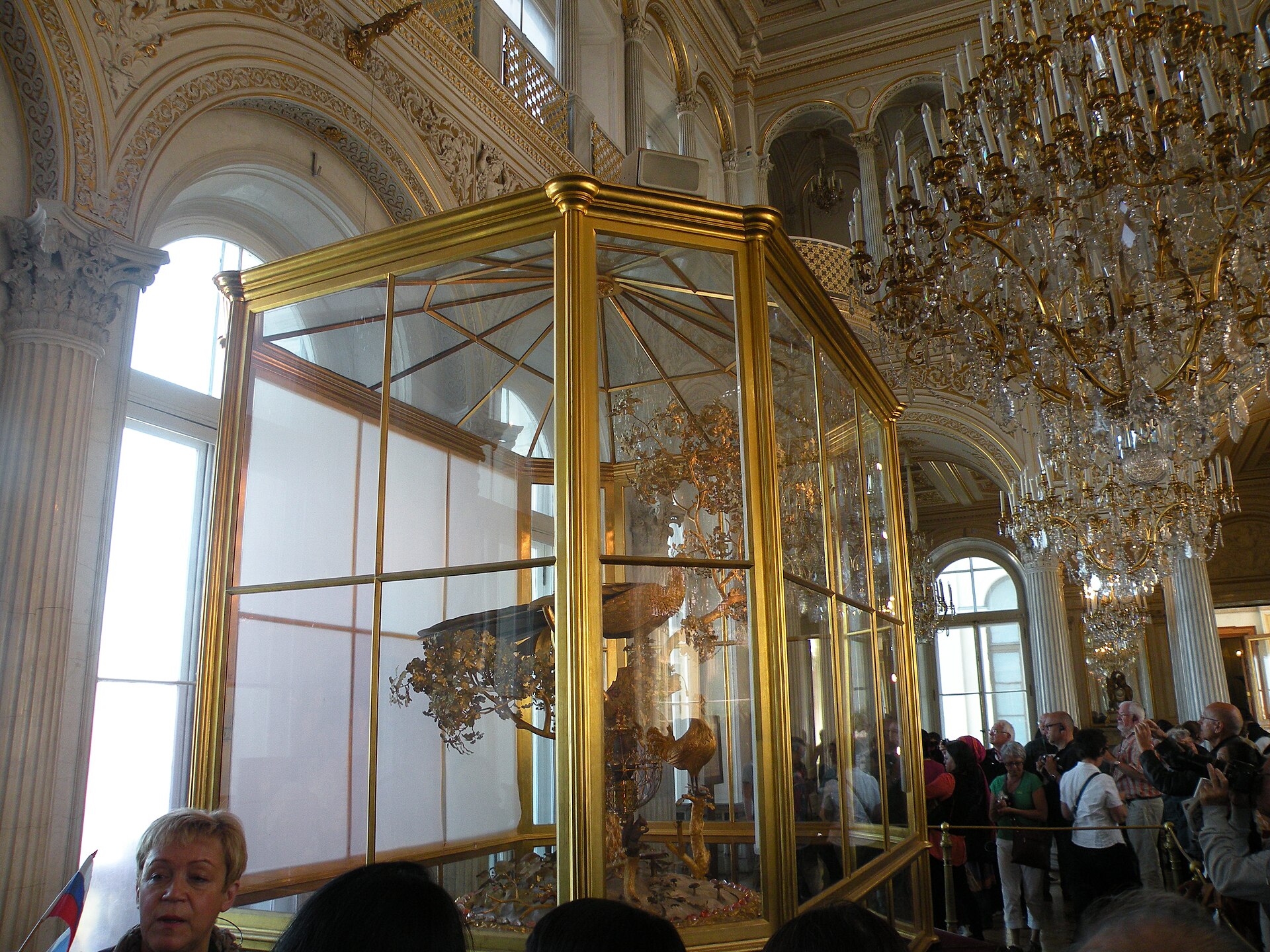
The single most spectacular survival of Cox's enterprise is the ten-foot Peacock Clock, now in the State Hermitage Museum in Saint Petersburg.
The single most spectacular survival of Cox's enterprise is the ten-foot Peacock Clock, now in the State Hermitage Museum in Saint Petersburg. Its own commissioning history, as told on the page the Hermitage itself maintains through Google Arts and Culture, begins in 1777, when the Duchess of Kingston visited Saint Petersburg and Russian society gave balls in her honour. Prince Grigory Potemkin, who met the Duchess socially, learned of James Cox's mechanisms through her, and, catering to Catherine the Great's passion for collecting, commissioned Cox to build a monumental automaton clock for the Empress. Pressed to deliver quickly and, in the Hermitage's own words, with his financial affairs not currently in the best of health, Cox did not start from nothing: he took an existing mechanical peacock that had previously featured in a lottery in Dublin, removed the snakes from its original composition, and added a cockerel, an owl and a clock face set into the head of a mechanical mushroom. To build the expanded piece he recruited Frederick Jury, the German-born London clockmaker who supplied much of his workshop's movements.
The finished automaton reached Saint Petersburg in 1781, shipped in pieces. The Winter Palace chancellery's own records of valuables acquired by Catherine II that year list two payments to the clockmaker Jury, on 30 September and 14 December, for a clock delivered from England, made from the Empress's personal funds on the authority of a letter from Potemkin; the total came to eleven thousand roubles, on the order of eighteen hundred pounds sterling at the time. The Russian mechanician Ivan Kulibin, working at Potemkin's request, set the mechanism in working order after its arrival. The Hermitage's own account calls the Peacock Clock the only large eighteenth-century automaton in the world to have survived unaltered and in working condition, and it has performed at the Hermitage, by the Museum's own dating, continuously since 1797.
The Peacock Clock commission was, for Cox, a foot in a door he badly wanted open.
The Peacock Clock commission was, for Cox, a foot in a door he badly wanted open. Having lost reliable access to the Chinese market, he hoped to establish a direct trade relationship with Russia and attempted to sell jewellery to Catherine the Great herself. The Metropolitan Museum's own account of his career is blunt about the outcome: he met with less success there than in China. No source consulted for this record specifies exactly what Cox offered the Empress beyond the Peacock Clock itself, or precisely why the wider trade relationship failed to develop, and this record does not supply a reason the sources do not give. What is documented is the consequence: the loss of reliable China trade, the failure to establish a Russian one, the disruptive effect of the American Revolutionary War on British overseas trade generally, and the royal patronage in Britain that never arrived, together precipitated Cox's second bankruptcy in 1778.
Cox's first bankruptcy is referenced in the literature located for this record without a firm date being independently established here; his second, in 1778, is the one every source agrees on, and it...
Cox's first bankruptcy is referenced in the literature located for this record without a firm date being independently established here; his second, in 1778, is the one every source agrees on, and it followed directly from the collapse of the China trade, the failed approach to Russia, wartime trade disruption and the absence of royal patronage set out above. It did not end the business. The remaining stock of goods originally intended for Canton was eventually sold at auction in London, at Christie's, on 16 February 1792, fourteen years after the bankruptcy and long after the Spring Gardens museum itself had closed. The literature on eighteenth-century failures in the London jewellery and silver trades, cited in the Metropolitan Museum's own bibliography as John Culme's 1998 study for the Silver Society Journal, situates Cox's bankruptcies within a wider pattern of collapse among London's luxury goldsmiths in this period; its full text was not accessed for this record; and the specific mechanics of Cox's own insolvency proceedings, his creditors and any settlement reached with them are not established by any source this record was able to consult directly.
Cox did not retire from trade after 1778.
Cox did not retire from trade after 1778. He and his sons, one based in Canton and one in London, resumed the China trade, this time sending mostly Swiss-made watches, built by the firm of Jaquet-Droz and Leschot, rather than pieces from Cox's own London network. His son John Henry Cox was sent to Canton in 1782 and there entered partnership with the merchants Daniel and Thomas Beale, forming the firm of Cox and Beale, continuing a British presence in the automaton and watch trade to China under a name descended from, but no longer identical to, James Cox's own workshop. A Bird Pavilion Clock signed James Cox and Son, London, and dated to about 1780, now in the Nethercutt Collection in Los Angeles, is physical evidence that the London side of the business continued to trade under a joint Cox family name into at least the early 1780s, alongside the Canton venture. What became of the London side of the business after James Cox's own death, around 1800, and how long the Cox name continued to be used commercially, is not established by any source consulted for this record.
No catalogue raisonne of James Cox's output exists, and one may never be possible: his workshop operated for roughly a quarter of a century, sold hundreds of pieces into markets on three continents...
No catalogue raisonne of James Cox's output exists, and one may never be possible: his workshop operated for roughly a quarter of a century, sold hundreds of pieces into markets on three continents under a single trading name, and the surviving documentary record is fragmentary business correspondence, auction and museum provenance and Cox's own promotional catalogues rather than a maker's day-book. What can be said with confidence is that surviving Cox-attributed pieces are now held across at least seven public collections on three continents: the Bowes Museum in Barnard Castle, England, which holds the Silver Swan; the Metropolitan Museum of Art in New York, which holds the Qianlong chariot automaton, a jewel cabinet with watch after designs by Watteau and Boucher, a miniature secretary incorporating a watch, a pair-case automaton watch by the case maker Peter Mounier, and further necessaires; the State Hermitage Museum in Saint Petersburg, which holds the Peacock Clock; the Cleveland Museum of Art, which holds a necessaire, a miniature cabinet with watch, a scent bottle and box in the form of a woman, and a spyglass; the Walters Art Museum in Baltimore, which holds a necessaire with a watch with a documented later provenance to the Russian imperial family; the Palace Museum in Beijing, whose zimingzhong clocks have been shown on loan at the Science Museum in London; and the privately held Nethercutt Collection in Los Angeles, which holds a Bird Pavilion Clock signed by the later firm of James Cox and Son. Individual pieces continue to surface at auction, most notably a musical table clock formerly owned by King Farouk of Egypt.
Cox's workshop was not producing devotional or civic imagery, and no source consulted for this record finds any iconographic or religious programme behind his automata beyond straightforward Georgian...
Cox's workshop was not producing devotional or civic imagery, and no source consulted for this record finds any iconographic or religious programme behind his automata beyond straightforward Georgian ornament: swans, peacocks, elephants, camels, singing birds, vases of jewelled flowers, chosen for spectacle and for what a moving mechanism could plausibly be built to do, not for any argued deeper meaning. That absence of a hidden programme is itself the honest finding here, not a gap papered over.
What the objects did carry, well documented in their own reception, was a philosophical provocation about the boundary between mechanism and life, one the eighteenth century was already arguing about through automata generally, most famously Jacques de Vaucanson's digesting duck of 1739 in France. Cox's Silver Swan drew exactly that response from viewers across a century of recorded reactions, from the Bowes Museum's own account of the object's effect to Mark Twain's description of the swan, seen performing at the 1867 Paris exposition, as having a living grace and a living intelligence in a machine he knew perfectly well was not alive; that reception history is set out fully in this publication's separate Silver Swan record. On the Chinese side of Cox's trade, the same objects entered a court culture, documented by specialist scholarship on Qing dynasty clock collecting, in which mechanical clocks and automata functioned within the Qianlong Emperor's own display of imperial magnificence and command over foreign ingenuity, a reading this record notes as the argued position of that scholarship rather than as Cox's own intention, since nothing in the sources consulted suggests Cox designed with any Chinese court meaning specifically in mind rather than simple commercial appeal to a market he knew paid well for spectacle.
Cox-attributed pieces appear at auction with some regularity and can command substantial prices, though the corpus is too fragmented and the attributions too variable in strength for a single price...
Cox-attributed pieces appear at auction with some regularity and can command substantial prices, though the corpus is too fragmented and the attributions too variable in strength for a single price trend to be stated with confidence. The clearest recent example is a mid-eighteenth-century agate-panelled and silver-mounted musical table clock with moonphase indication, signed and dated on its own key James Cox, London, 1766, formerly in the collection of King Farouk of Egypt, sold at Sotheby's in 1954 following his abdication and exhibited at the Victoria and Albert Museum in 1962. It had not appeared on the auction market since 1954 and had remained in the same family for at least fifty years when Bonhams sold it in London on 12 December 2012 for 385,250 pounds including buyer's premium, against a pre-sale estimate of 150,000 to 250,000 pounds; the hammer price before premium was not published in the sources consulted for this record, and this record states the premium-inclusive figure rather than inventing a hammer figure to match it. No wider comparanda of recent Cox sale results, hammer against premium, were located for this record beyond this single well-documented result, and that absence is recorded as a gap rather than filled with unsourced generalisation.
Cox's own early life is thin in every source consulted: no birthplace, no record of formal training or guild membership, and no exact date of death has been established here.
Cox's own early life is thin in every source consulted: no birthplace, no record of formal training or guild membership, and no exact date of death has been established here. The internal division of labour within his workshop is documented only for a handful of named individuals, Merlin, Mounier and Jury among them, leaving the great majority of the eight hundred to a thousand workmen he claimed to employ entirely anonymous. The mechanics of his first bankruptcy, and the full settlement reached with creditors after his second, are not established by any source this record could consult directly. And the fate of the London arm of the family business after James Cox's own death around 1800 is simply not addressed in the material located for this research. Each of these is recorded here as an open question rather than smoothed over.
Goldsmith; Jeweller; Entrepreneur; Museum proprietor. c. 1723-1800.
Born c. 1723, Not established in the sources consulted; Cox is first documented as a working London jeweller by the early 1750s; died 1800, London (exact date and burial place not established in the sources consulted).
The Bowes Museum (Barnard Castle, County Durham, England); The Metropolitan Museum of Art (New York); The State Hermitage Museum (Saint Petersburg, Russia); The Cleveland Museum of Art (Cleveland, Ohio); The Walters Art Museum (Baltimore, Maryland); The Palace Museum (Beijing, China).
Cox-attributed pieces surface at auction irregularly rather than in a continuous market, and the strength of attribution varies piece to piece, so this record does not attempt a price trend across his output as a whole. The clearest recent benchmark is a single well-documented clock with royal provenance; this record states only what was directly verified for that result rather than extrapolating a wider pattern from it.
Where and when exactly was James Cox born, and where and how did he train? No source consulted establishes either.
Last verified
One artwork and its story every Tuesday, with the picture: who owned it, what it made, and what closes soon in the exhibition calendar. No promotion, and nothing we cannot cite.
We send one email to confirm the address and keep nothing else. Every letter carries a one-click unsubscribe. How we handle your data.


